




Abstract
In this paper I critically explore the ways in which food is deployed as an emblematic form of everyday gendered resistance in contestations over extractives-led development. Drawing on photos and interviews from participatory photography research with women anti-mining activists in Northern Peru, the paper argues that women activists harness imagery of everyday practices associated with food cultivation, preparation, and consumption as an evocative means of advocating for more just, hopeful, and sustainable development futures in the context of living with large-scale mining. The way that grassroots women activists place food at the center of their visions of Development alternatives reveals the intersections between food sovereignty, gender, and the impetus to decolonize development, which together underpin their continued resistance to extractivism.
Este artículo explora críticamente las formas en que la comida se utiliza como una forma emblemática de resistencia cotidiana de mujeres, en disputas sobre el modelo de desarrollo liderado por el extractivismo. Basándose en las fotos y entrevistas de una investigación de fotografía participativa con activistas anti-mineras en el norte de Perú, el artículo sostiene que las activistas utilizan imágenes de prácticas cotidianas asociadas al cultivo, preparación y consumo de alimentos como un medio evocador para abogar por futuros de desarrollo más justos, esperanzadores y sostenibles, en el contexto de vivir con la minería a gran escala. La forma en que las activistas sitúan la comida en el centro de sus visiones de alternativas al desarrollo revela las intersecciones entre la soberanía alimentaria, el género y el impulso para descolonizar el desarrollo, que en conjunto sustentan su resistencia continua al extractivismo.
This paper explores the ways in which images of food are used as an emblematic form of everyday gendered resistance in contestations over extractives-led development. Drawing on photos and interviews from Photovoice research with women anti-mining activists in Cajamarca in northern Peru, the paper argues that women activists harness imagery of everyday practices associated with food cultivation, preparation, and consumption as an evocative means of advocating for more just, hopeful, and sustainable development futures in the context of living alongside large-scale resource extraction.
During 2017-2018, I conducted participatory research using a Photovoice methodology (Wang and Burris, 1997; McIntyre, 2003). Photovoice involves participants (often from marginalized groups) undertaking a process of photo-taking and analysis to advocate for change in relation to a particular topic, enabling them to create visual representations of their perspectives. 1 This approach has been used across academia and voluntary sector organizations in a wide range of contexts in the Global North and South (Wang and Burris, 1997; Luttrell and Chalfen, 2010; Fraser, Brown, Wright, and Kiruswa, 2012; Giritli-Nygren and Schmauch, 2012). In this research, the Photovoice process involved a group of twelve women who were actively engaged in anti-extractives activism and community organizing in the province of Cajamarca, in Northern Peru, a location chosen due to its prominent history of community resistance and activism in relation to existing and proposed large-scale mining projects (Bury, 2005; Bebbington, Abramovay, and Chiriboga, 2008; Li, 2013; 2015).
The women who took part were recruited from three women’s organizations actively involved in contesting existing and proposed large-scale mining projects in their region. Two organizations were based in Cajamarca city, and one in the rural town of Celendin, a site of widespread resistance in relation to the proposed Conga mining project (BBC News, 2011; Isla, 2017; Paredes Peñafiel and Li, 2017), which was abandoned in the face of this resistance. The women came from a variety of backgrounds, identities (including women who identified as Indigenous, campesina, and mestiza), and ages, encompassing women between 30-60 years old, with differing skills (such as technical skills, IT skills, writing skills, and creative abilities) and levels of literacy and education. The women were selected by their respective organization, as they were identified as individuals who would be able to commit to the proposed activities, and were motivated to learn new skills and share them with fellow members of their organizations. 2
The research aimed to understand the ways in which women anti-mining activists conceptualize the idea of “Development,” 3 recognizing the contested and loaded nature of this term, especially in the context of efforts to decolonize development (Morris and Gomez de la Torre, 2020; Taylor and Tremblay, 2022; Convivial Thinking, 2023) – but recognizing also the persistent stickiness of the terminology of “Development” (Desarrollo) across academic and practitioner settings (Lang, 2021), as well as amongst women anti-mining activists themselves (Jenkins, 2015). In this project, and in previous research, it is evident that the notion of “Development” continues to be a concept that is in current use amongst women activists, despite recognition of the problematic ways in which it has been imposed upon communities in the Global South.
For this reason, the research aimed to provide a space for grassroots women to reflect on the ways in which Development intersects with their lives and, in particular, their resistance to large-scale resource extraction. The use of Photovoice methodologies provided an opportunity for the scope of the research to be co-designed with women participants and shaped by their priorities. The collaborative approach aimed to ensure that the research provided skills and resources relevant to the women activists and their organizations, alongside countering extractivist approaches to research in communities impacted by resource extraction. In the initial workshops and discussions, participants identified their priorities around developing public-facing narratives around their opposition to resource extraction, as well as demonstrating their continued commitment to resisting extractivism at a time when there was relatively little visibility of their opposition, and explained that these motivations were central to their decision to participate in the project. A public exhibition of their work, held in Cajamarca city in March 2018 (Women, mining and photography, 2018), provided an important public space for the women’s perspectives to be shared and recognized, in the context of a shrinking of civic spaces in which women activists are able to speak up, alongside the continued criminalization of women human rights and environmental defenders across Latin America (Amnesty International, 2018; Vásquez, 2018).
Participants were each loaned a camera for the duration of the project. They took photos independently during three months in 2017, using their photography to reflect on three themes chosen collectively during project workshops: wellbeing, community, and alternatives to resource extraction. Regular check-ins over this period, with members of the research team and with each other, allowed the women to reflect on their images and the priorities that emerged in this process. Follow-up discussions and workshops created spaces for participants to choose a selection of 10-15 preferred photos and develop written reflections on some of them, followed by a one-to-one photo interview.
These activities enabled the women’s own analysis to emerge through in-depth discussions of the photos they had chosen, what they represented, and the rationale that lay behind these. Informed by these discussions, here I critically explore these photos and interviews, as well as draw on the broader dataset of 763 photos taken during the project. 4 The qualitative data analysis software NVivo was used to facilitate the thematic coding of the women’s selected photos and accompanying interviews, enabling these two types of data to be analyzed together. A content analysis of the wider dataset of 763 photos taken during the project was also undertaken and collated into a spreadsheet, providing a broad overview of the patterns of photo-taking. 5
From the earliest stages of the photo-taking activity, it became clear that food was a crucial theme for the participants. Across 763 photos taken by twelve women during the project (and across all three of the chosen themes), 204 (27 percent) depicted food (including animal husbandry) as their main subject matter. 6 This ranged across curated still life scenes of particular types of food, to scenes of food being prepared and consumed, to images related to food production, raising of animals for food, and commercialization. It is thus evident that food provides a potent lens through which to understand the Development futures envisioned by grassroots women activists, as well providing an evocative means for women to represent their resistance to large-scale mining. Below I bring together literatures on feminist political ecology and food, food sovereignty, and gender and everyday resistance, to make sense of the ways that women activists place food at the center of their visions of Development futures and their ongoing resistance to extractivism.
Feminist Political Ecology, Food Sovereignty, And Everyday Resistance
While the women activists involved in this project were not specifically mobilizing around food sovereignty, their centering of food in their narratives of resistance stands out in relation to the long history of demands for food sovereignty (or soberanía alimentaria) in Latin America. The extensive contribution of La Via Campesina (LVC) is of particular relevance here (La Via Campesina, 2023a). LVC originated in Latin America in 1993 and developed into a transnational social movement bringing together marginalized communities from across the world to advocate for food sovereignty, which it defines as “people’s right to healthy and culturally appropriate food produced through ecologically sound and sustainable methods, and their right to define their own food and agricultural systems” (Nyéléni, 2006). Demands for food sovereignty shed light on the connections between food, territory, and identity, particularly foregrounding the demands of Indigenous peoples for land restitution and autonomy (Alonso-Fradejas, 2015; Kamal, Linklater, Thompson, Dipple, et al., 2015; Copeland, 2019; Robin, 2019), and connecting with a wider decolonial impetus across Latin America (Mavisoy Muchavisoy, 2018; Vela-Almeida, Zaragocin, Bayón Jiménez, and Arrazola, 2020; Perez Jiménez, 2022).
Conceptualizing "food sovereignty [as] a day-to-day mode of resistance" (Grey and Patel, 2015: 441)—enacted through, for example, a return to, or recognition of, so-called “traditional” foods and a revival of culturally specific practices, rhythms, and geographies of food production—enables us to understand not only the ways in which the food sovereignty movement challenges the neoliberal, industrialized global food system, but also to articulate this agenda with broader anti-colonial and decolonial struggles that demand “space to imagine social relations differently” (Grey and Patel, 2015: 441). Reflecting on these issues in relation to North American Indigenous peoples, Grey and Patel emphasize the ways in which “being alive well” dovetails with notions of food sovereignty:
“This makes ‘being alive well’ about food sovereignty, and food sovereignty about land, identity, and dissent—and not just for the Cree. In traditional territories all over the world, cultural, environmental, governance, and health-related initiatives are underway that dovetail with the resurrection of traditional foods” (Grey and Patel, 2015: 440).
There are clear parallels here with the Andean Latin American context, in particular with notions of buen vivir and cognate concepts (Leon Vega, 2017), which are central to many alternative conceptualizations of, and resistances to, Development across the region (Gudynas, 2011; Villalba, 2013; Acosta, 2017). Resonating with “being alive well,” buen vivir is usually translated as “living well,” encapsulating Indigenous concepts such as “Sumak kawsay” (Quechua) and “Suma qamaña” (Aymara), with their emphasis on Indigenous cosmovisions and ontologies, collective wellbeing, and living in harmony with nature (Walsh, 2010; Varea and Zaragocin, 2017). Food sovereignty—recognizing ancestral knowledges and practices of food production and consumption that respect the rights of the nature, the autonomy of communities, and work in harmony with the land—is integral to this approach. While buen vivir has been adopted (though by no means unproblematically) within the Ecuadorian and Bolivian constitutions (Gudynas, 2011), it has not been as prominent a discourse in Peru, though Huambachano (2018) identifies the Peruvian Quechua “Allin Kawsay” as a cognate good living philosophy. 7 Drawing from research with Quechua (Peru) and Ma-ori (New Zealand) communities, Huambachano highlights ancestral and spiritual connections to the land as “fundamental to Indigenous peoples’ food and livelihood systems and thereby wellbeing” (2018: 1013), contrasting this with the dominant globalized food security paradigm. Such buen vivir-related approaches challenge the notions of progress and expectations of perpetual economic growth embedded in mainstream neoliberal development, and more specifically in extractivist and (neo)extractivist approaches to development as enacted across Latin America.
There are also significant overlaps between the concerns of the food sovereignty movement and wider anti-extractives resistance across the Global South, especially in relation to how they conceptualize and contest historic and contemporary processes of colonization (Magdoff and Tokar, 2010; Alonso-Fradejas, 2015; Grey and Patel, 2015; Merino, 2020). Furthermore, there is widespread recognition that industrialized, neoliberal processes of food production should also be considered under the umbrella of “extractivism,” operating under many of the same capitalist logics as the large-scale extraction of minerals, oil, and gas. For example, McKay highlights the resource and capital- intensive nature of agro-extractivism, characterized by a lack of benefits for domestic economies or significant revenues for the state, and the production of raw materials for export, alongside the extensive environmental degradation that such large-scale food production produces, including soil depletion and pollution (McKay, 2020).
In this context, feminist political ecology provides an opportunity to critically understand the ways in which gender intersects with food sovereignty and resistance (Leon Vega, 2017; Masson, Paulos, and Beaulieu Bastien, 2017), recognizing the highly gendered nature of all aspects of food production, preparation, purchase, and consumption (Park, White, and Julia, 2015), and how this manifests in particular sociocultural and historical contexts. A food sovereignty approach is fundamentally about tackling inequalities of power and control within the food system (Park, White, and Julia, 2015)—as opposed to an emphasis on food security, which “avoid[s] discussing the social control of the food system” (Grey and Patel, 2015: 565). In this regard, gender is a key consideration, and the impacts of agrarian extractivism are also gendered in particular ways (see, for example, Cunha and Casimiro, 2021).
However, gendered inequalities remain relatively unexplored within the broader food sovereignty literature (Leon Vega, 2017), with few critical analyses of the ways in which women activists are intervening in and shaping specific local struggles around food sovereignty. Several authors in fact identify a tendency within the food sovereignty movement towards reinforcing existing gendered inequalities and assumptions around the division of labor (Jacobs, 2015; Park, White, and Julia, 2015). LVC has a particular emphasis on the recognition of the rights of women farmers, conceptualizing the fight against patriarchy, (neo) colonial extractivism, and the neoliberal food system as inextricably linked (Park, White, and Julia, 2015; Masson, Paulos, and Beaulieu Bastien, 2017; La Via Campesina, 2023b). Yet Masson et al. observe that “LVC’s proposal for food sovereignty is still far from incorporating fully a feminist social change perspective” (Masson, Paulos, and Beaulieu Bastien, 2017: 60).
In this light, Park et al. highlight five key aspects to consider in relation to embedding a gendered perspective into discourses and practices around food sovereignty: “access to or control of land and other resources; access to income-generating opportunities; voice and participation in decision-making processes at the household and community level; the division of labor; and access to food and household food situation.” (Park, White, and Julia, 2015: 588). Furthermore, though often not explicitly framed by food sovereignty, there are many instances across the Global South where women are actively resisting agro-extractivism, for example in relation to soy production in Argentina (Leguizamón, 2019), oil palm plantations (de Vos and Delabre, 2018), and industrial cassava production (Torvikey, 2021).
Gender—and other aspects of identity—intersect in myriad ways with everyday practices and lived experiences of food, as well as ways in which emotions are intrinsic to understandings of food, place, and identity. For example, Srinavas (2006) recognizes the powerful emotional association between food and mothers and grandmothers; she highlights the role of what she calls “gastronostalgia” in relation to forging diasporic identities (in this case in relation to Indian cuisine). This link between food, memory, and nostalgia, is also brought out by D’Sylva and Beagan, who argue that “when a group is marginalized by race, ethnicity, language or religion, food often takes on distinct meaning as a vehicle for transmitting cultural traditions and identities” (2011: 281), again emphasizing how everyday practices of cooking and eating are also suffused with gendered meanings and identities. Elsewhere, similar discussions foreground women’s everyday practices around food cultivation and preparation as a form of resistance, from seed swapping amongst the Mapuche (Hernando Arrese, 2019) and by rural women in Colombia (Hernández Vidal, 2022), to cultivating land threatened by resource extraction (Jenkins, 2017), and the centrality of particular foods and recipes for Afro and Black women’s identities in contexts of marginalization and violence in Esmeraldas, Ecuador (Proyecto RECLAMA, 2023). Such food-related examples speak to a broader literature on the “everyday” as a quiet, hopeful form of resistance rooted in myriad “small” practices (Askins, 2015; Jenkins, 2017; Pottinger, 2017), while also resonating with instances where the defense of food and the everyday has been placed at the center of anti-extractives campaigning (Haarstad and Fløysand, 2007; Gil, 2010; Green, 2018).
The remainder of this paper aims to bring these literatures to bear on the particular example of women’s visual representations of food and food practices as anti-extractives resistance to critically explore the ways in which food—and the emotions and gendered associations it evokes—play a central role in the place-making and identity-making that underpins women’s anti-mining activism and their imagining of alternate Development futures.
Disrupting Taken-For-Granted Narratives Of Extractivism As Development
Looking across the photos taken by the women activists during this research, it is evident they frequently chose to capture images of existing everyday practices of food production and consumption, as well as everyday foodstuffs. In their reflections and discussions of their photos, the women emphasize that this focus on food and agriculture is intended as a means of contesting narratives of Cajamarca as a “mining place,” somewhere that needs extractivism to survive, as Blanca and Felicita explain below.
Blanca Tasilla Moqueira: In Cajamarca we have our products and we don't need [mining]. . . they say in Cajamarca we don't have anything to eat. The people from the mine have always said that Cajamarca used to be very poor, they had nothing to eat, but with [my] photos I want to show that Cajamarca has its own products that serve to feed us naturally, right? That come from the land, right? That strengthen us a lot, and that thanks to these products we can survive, and that we do not need extractivism or mining, as they say we do. (interview, August 2017)
As participant Felicita Vásquez Huamán, explains in relation to the above photograph:
They said that we don’t produce anything and with this we want to show that we do produce. We are ranchers, farmers, we want to show the world, that there is production in our Jadibamba. According to the mine, they say no, that no people live there, that’s a lie. We do live, and we are ranchers, farmers, and with that I want to show that yes there is life. (interview, August 2017)
Source: Felicita Vásquez Huamán / Women Mining and Photography 2017.
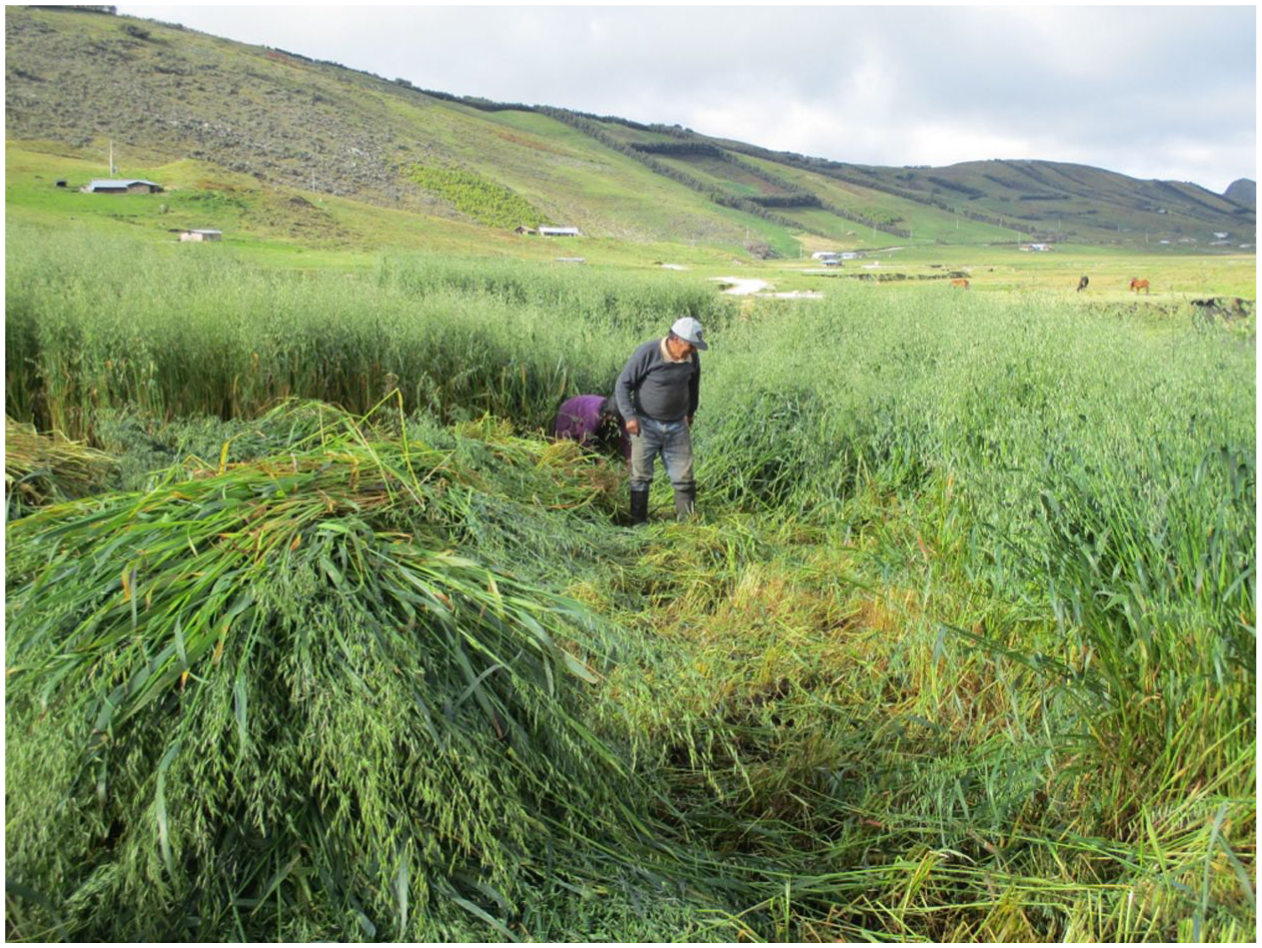
The women’s photos and narratives foreground and celebrate the abundance and richness of food that is grown and produced in Cajamarca—from guineapigs to prickly pears—to emphasize the productive nature of the land, in contrast to dominant pro-mining narratives that seek to portray such lands as empty, unproductive, and impoverished (Svampa and Antonelli, 2009). Instead, the women highlight the actual and future potential of these lands as a possible route to greater prosperity for their communities. In particular, the women’s discourses reflect many of the central tenets of the food sovereignty movement, exploring the ways in which food production – rooted in distinctive and sustainably produced local food products – can provide a viable strategy for economic development.
Source: Blanca Tasilla Moqueira/Women, Mining and Photography 2017.
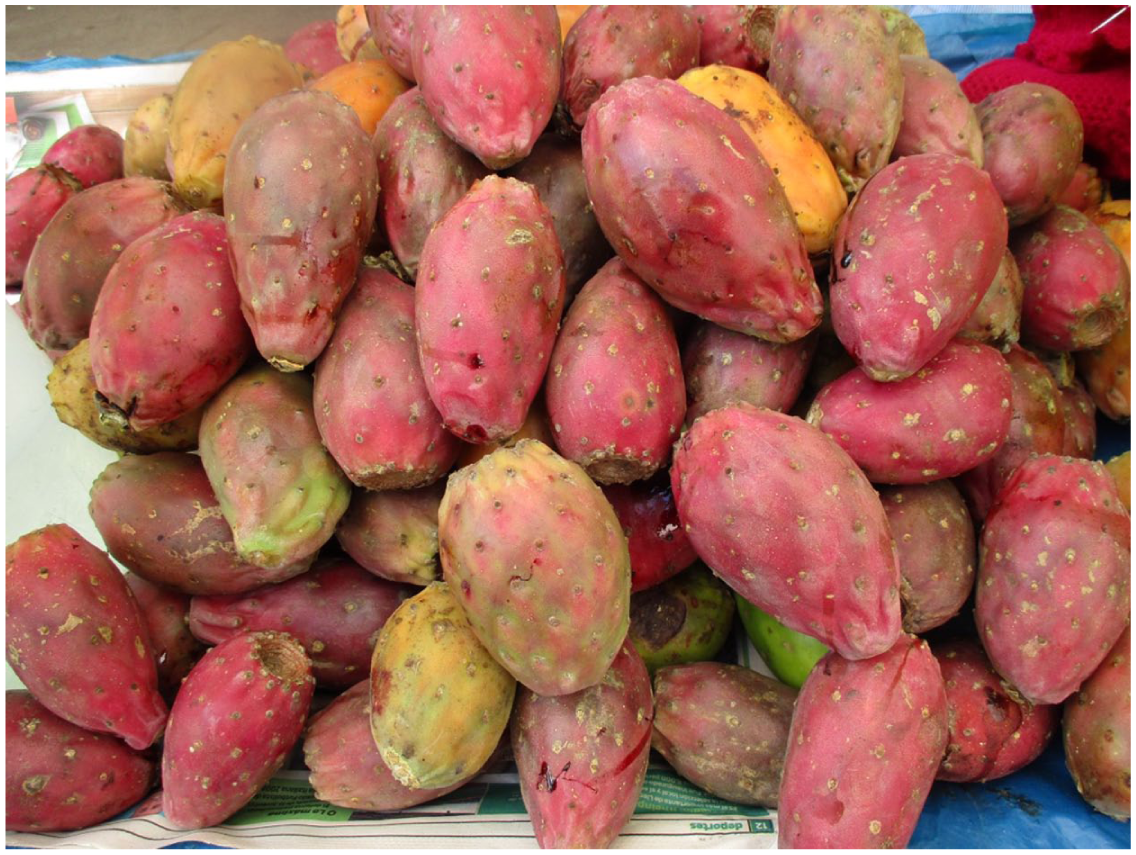
The prickly pear is also a natural fruit of Cajamarca. That's why I took it, to say that we do have something that identifies us as Cajamarquinos. It is a fruit from Cajamarca (interview, August 2017).
Source: Chepita / Women, Mining and Photography 2017.
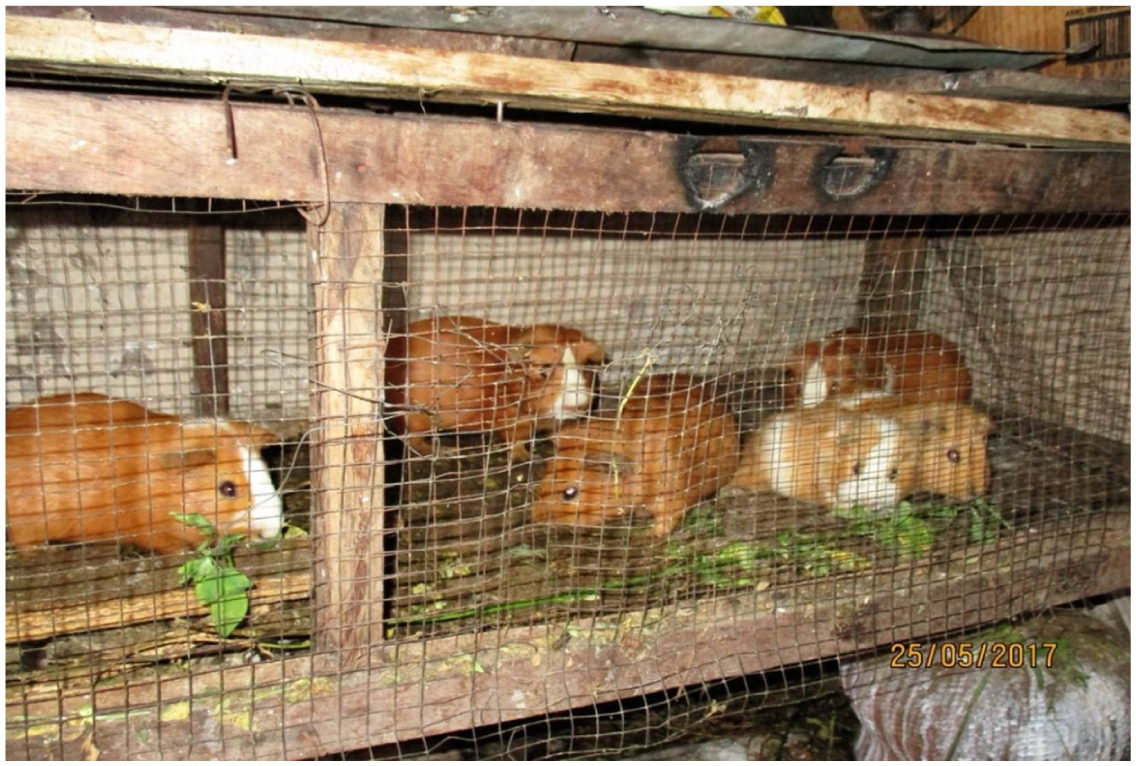
These are my guinea pigs. I have very few, but this represents the fact that there are many different breeds and this is a very exquisite animal. When people come to Cajamarca, they ask where [to go to eat] a delicious guinea pig. . .. I took this [photo] with the purpose of motivating the women of Cajamarca to also organize ourselves and form family farms, both guinea pigs and chickens, ducklings, turkeys, because for example at Christmas those imported turkeys arrive, white, all tasteless, they have no flavor, nothing. So I think that, for example, a group of women can dedicate themselves to raising turkeys for Christmas, for the New Year. So, [this represents] economic improvements. (interview, August 2017)
Source: Liz/Women, Mining and Photography 2017.
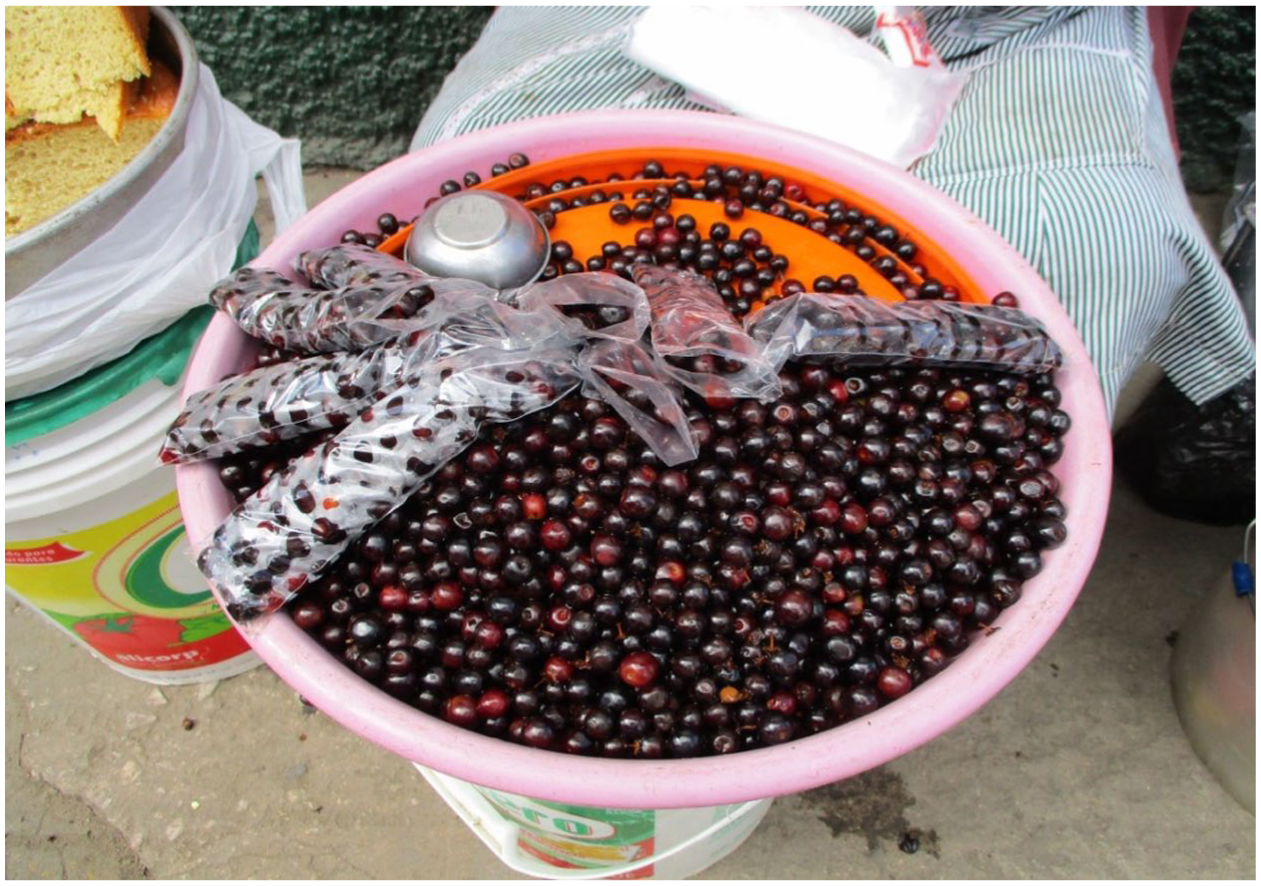
The message I want to give, more than anything, is that we must first consume what we have here, in our community, in our town, or our province. This is original and from here in Cajamarca.
Throughout the women’s discussions of the visions of Development that are represented through the foodstuffs in their photos, they also repeatedly emphasize the nutritional qualities of locally produced food, often contrasting this (implicitly and explicitly) with mass produced, imported, low quality, and nutritionally deficient products. In this way, the women use food to link their resistance to extractivism with a broader critique of the dominant capitalist model of development rooted in neoliberal globalization. As Chepita notes:
They [people living in the countryside] don't have much food, they sell their milk first to buy something else. They sell their free-range chickens to buy your [imported] chicken, that has neither vitamins nor taste. So, what we need here is more organization and to make people aware, so that they can consume what they produce, what is produced in this town. For example, quinoa is all grown in Cajamarca. (interview, August 2017)
Reflecting on her photos, participant Dianira Trigoso Vizconde draws a connection to buen vivir:
Well, this yes it is to do with wellbeing, because we have put our own products to one side. . . our natural products, while pre-packaged foods have entered our society, full of fat, perhaps not very healthy. So, in order to live well I think that we need to re-take what is ours, our natural products . . . And for me the oca is a good example of a natural product that is within reach of anyone. (interview, August 2017)
Such representations that foreground and value locally produced and typically Andean food products (e.g. quinoa, oca, olluco, guinea pigs) and food systems reflect the central tenets of buen vivir and similar “good living” cosmovisions (Leon Vega, 2017; Huambachano, 2018). They provide a powerful critique of large-scale, industrialized, and globalized food production, and link resistance to large-scale mining with the broader narratives and priorities of the food sovereignty movement (Grey and Patel, 2015) as I further explore below.
Emblematic Foodstuffs Representing A Way Of Life Under Threat
The women’s photos and narratives help portray certain foods as symbolic of a particular way of life, emphasizing a campesina identity and the enduring connections of Andean communities to the land. They use these images to communicate their own sense of connection to the land, and their perception that this way of life is under threat from the continuation and expansion of large-scale mining in their territories and communities in particular due to air and water pollution, and the loss of cultivable territory to sustain rural livelihoods.
Source: Blanca Tasilla Moqueira/Women, Mining and Photography 2017.
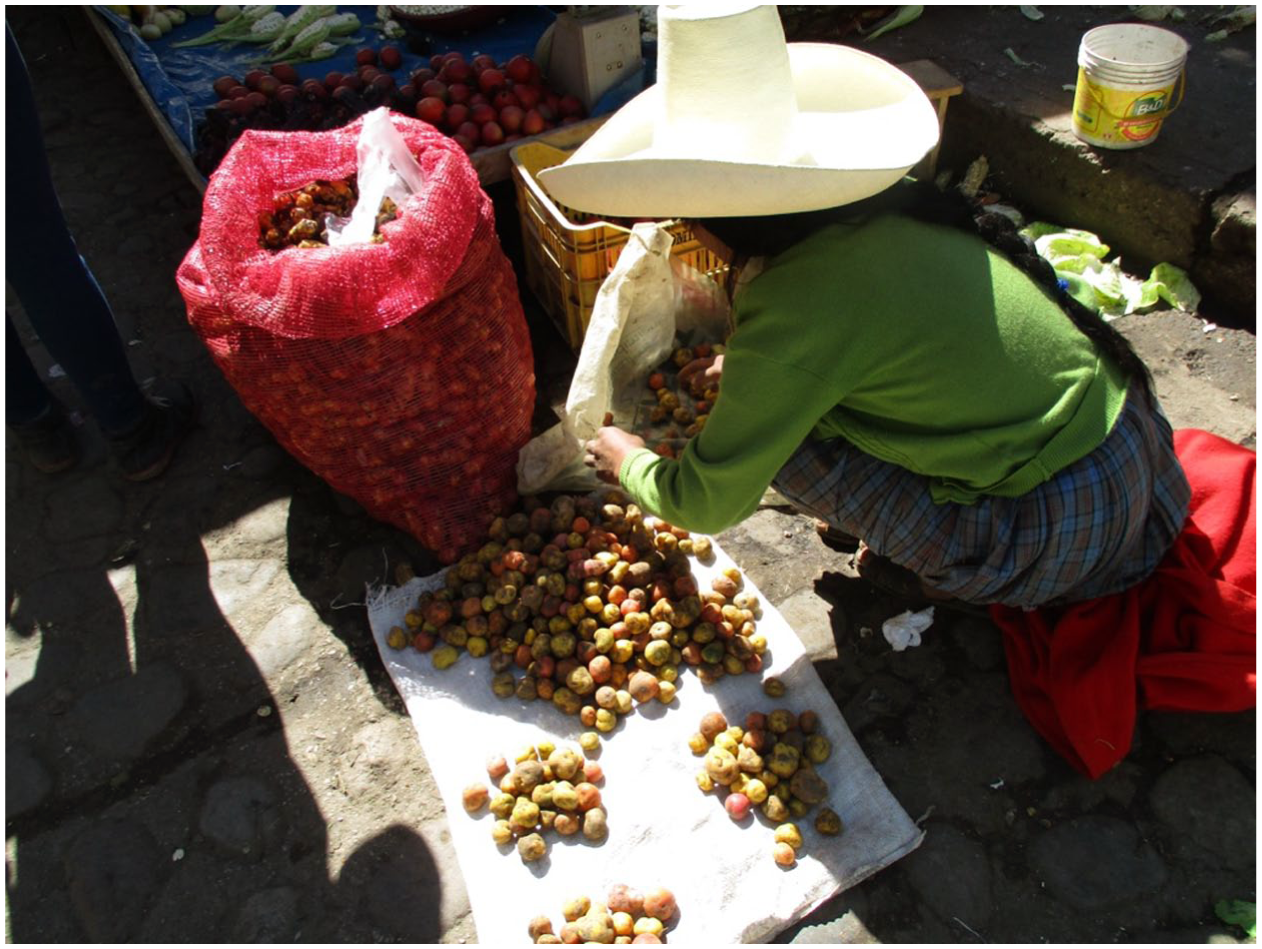
In other words, all agriculture in Cajamarca is threatened by mining, because if we realize mining contaminates the air, the water, even the land, and it seems that it does. . . If mining continues in Cajamarca, the products we produce in Cajamarca will be finished.
So that is why it is important to make these products visible, this way of producing. . .?
These products are evidence of healthy water, land. This means that they can grow, and if mining [expansion] goes ahead, they could no longer be planted. (interview, August 2017)
Images of certain produce, typical to the local area, such as prickly pears, corn, avocados, guinea pigs, and a small tuber called an oca, recur throughout the women’s photos. Through their focus on such foods, the women activists represent these particular foodstuffs (amongst others) as emblematic signifiers of a valued way of life rooted in Andean practices, an approach that echoes the way in which the lime was mobilized as symbolic of Peruvian identity in anti-mining protests in Tambogrande (Haarstad and Fløysand, 2007). The women also use their photos to foreground the variety of produce that Cajamarca produces, emphasizing this as a stark contrast to mass produced and commercialized foodstuffs. For example, the sheer number of different varieties of potato and corn, are highlighted by the women as illustrating the unique food culture that is under threat from the expansion and continuation of large-scale mining. Describing one of her photographs, Chepita explains:
So here we have potatoes, sweet potatoes, and cassava. All these products are from Cajamarca. And there’s the yellow and purple sweet potato too. So, the potato, we have one hundred and twenty varieties of potato. . . . A purple potato, a yellow potato, and other potatoes of different kinds. . . . But delicious, delicious, delicious, of all kinds, the guadamina potato, the guairo potato, the zorli potato. . . The colegiala potato. . . . Oh there’s such a lot of variety, all produced by Cajamarca! (interview, August 2017)
Source: Credit Ana/ Women, Mining and Photography 2017.
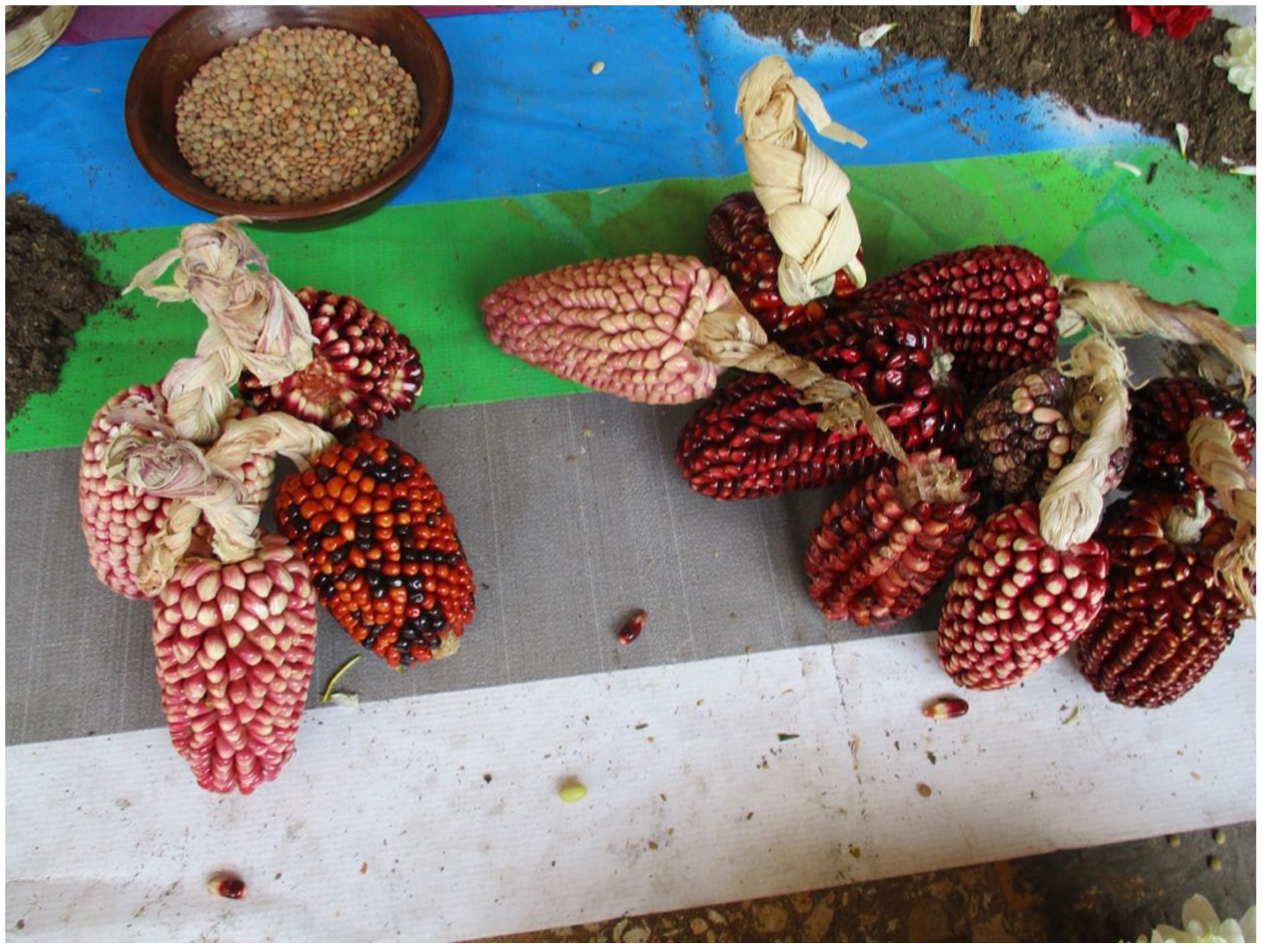
Ana reflects on the importance of the above photo, noting:
This corn is a different color. This more purple, blacker, one We use this to boil, for the chicha morada. For celebrations, any little thing. But on the other hand, these ones here are a little whiter. If they are large, we use it for mote, I don't know if you have eaten it?. . . This corn here, which is black, is not black, just as you see it, it is a color we call sarco. It's a little color between black and [purple], as I told you. . .. But they are beautiful, and this corn, by nature, is soft. (interview, August 2017)
The women’s reflections capture the way in which these emblematic foodstuffs 8 are imbued with emotion and nostalgia, illustrating the affective power of images in anti-extractives campaigning (Li, 2019), and in particular harnessing the ability of images to “travel across time and space and serve as a conduit for raising awareness about injustice and for forging transnational solidarity” (Thomas, 2021: 42). This creates what Li (2019) identifies as a “common vocabulary” that motivates and facilitates collective action. As the women explain the motivations and meanings that lie behind their photos, they often link these foods to what it means to be Cajamarquina (from Cajamarca), and emphasize their visions for a model of development built on a distinctive place-based identity, and food practices that extend back in time. Their images particularly celebrate and visibilize the role of women in sustaining these practices and identities, capturing their involvement in producing and preparing these foods for consumption, as well as in selling and commercializing these foods:
Source: Ana/Women, Mining and Photography 2017.
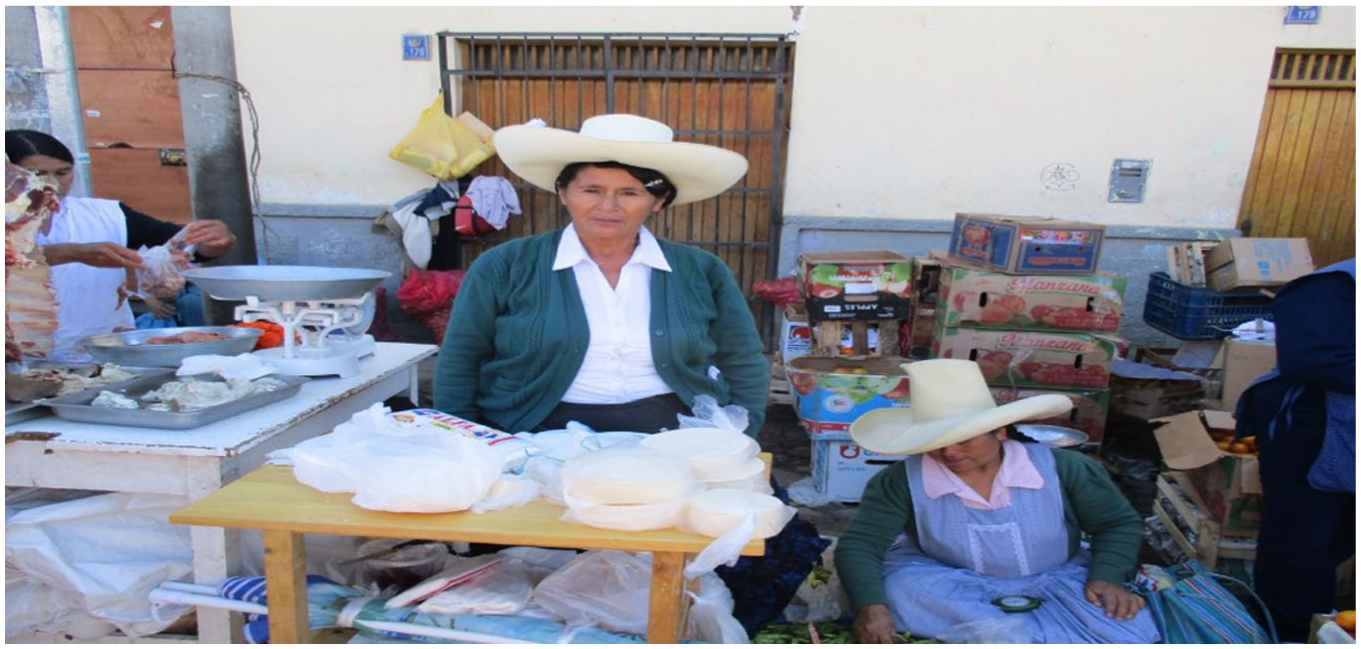
I took her photo and I see that she is an active woman, a trader. She sells her dairy products from what she produces and through her commerce she wants to do something for her life, you see? (interview, August 2017)
Killari, another of the photographers, describes this dynamic:
I think the work of women, the role of women, in daily life is very important. You could say that milking is a form of artisanal production. Today we use industrial machines to extract milk from cows. But no, despite everything, she continues with the tradition, goes out on time, follows the tradition and she milks her cows, she uses the milk or she sells it, or sells half of it and consumes half of it. (interview, August 2017)
Their comments capture the ways in which they perceive gendered everyday practices of food production, distribution, and consumption as an integral part of their communities’ ongoing resistance to extractivism, with their photos performing the important role of making these quieter practices of resistance visible. This reflects the ways in which feminist scholars have theorized the crucial role of the everyday in women’s anti-extractives resistance (Jenkins, 2017; Boudewijn, 2020; Rodriguez Fernandez, 2020). Furthermore, the women also situate these practices as part of a continuum of gendered labor enacted by generations of women in these communities, underlining the interweaving of nostalgia, food, and women’s identities (Srinivas, 2006) in everyday resistance to extractivism.
Source: Blanca Tasilla Moqueira/Women, Mining and Photography 2017.
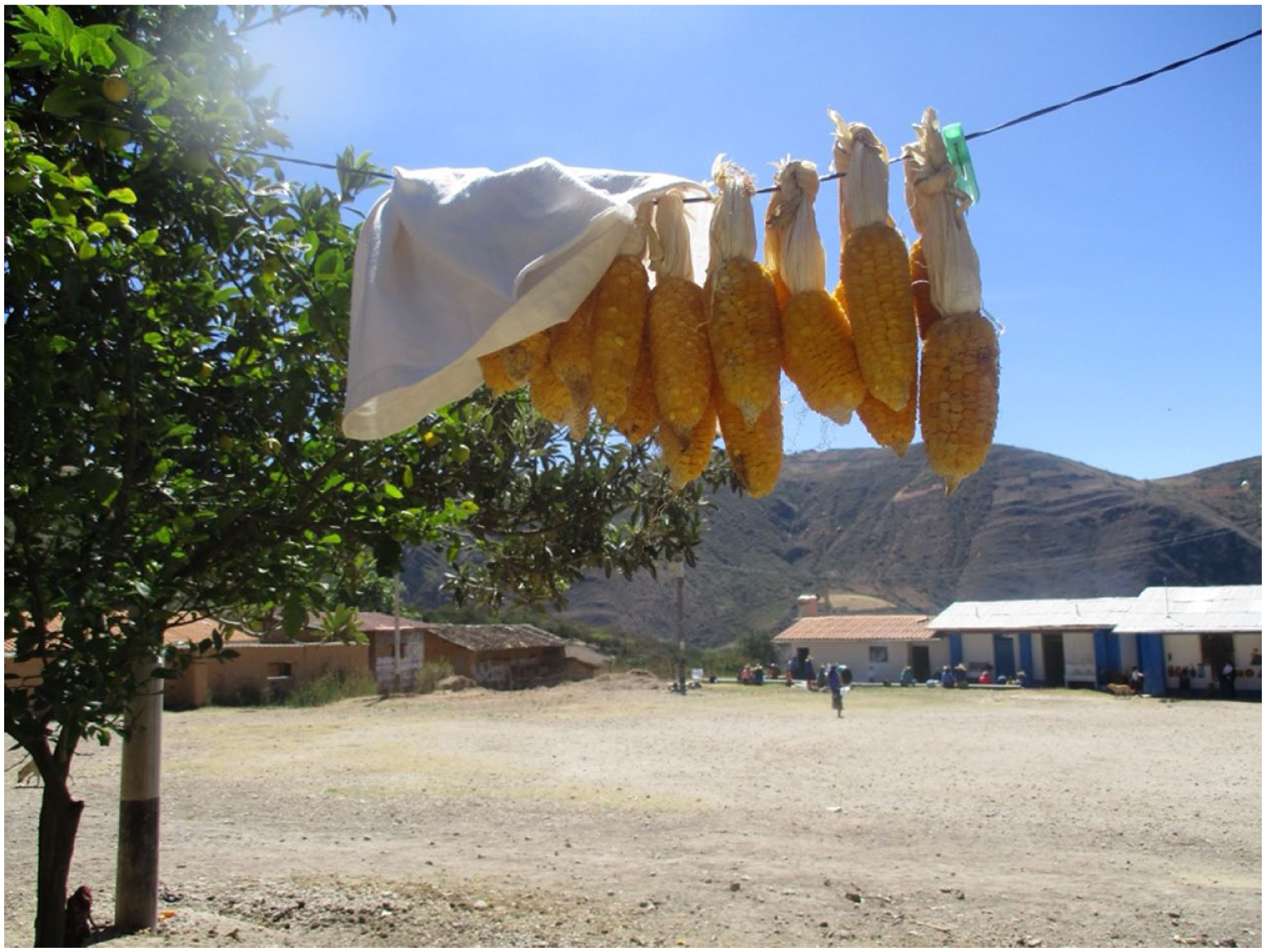
How do you feel when you look at this photo?
I feel very happy, because when I was a child, my mother also made this type of guayungas 9 and dried it to eat the little kernels. And we were very happy because we knew she would use it to make chicharrones with toasted corn. 10 (interview, August 2017)
Source: Ana/ Women, Mining and Photography 2017.
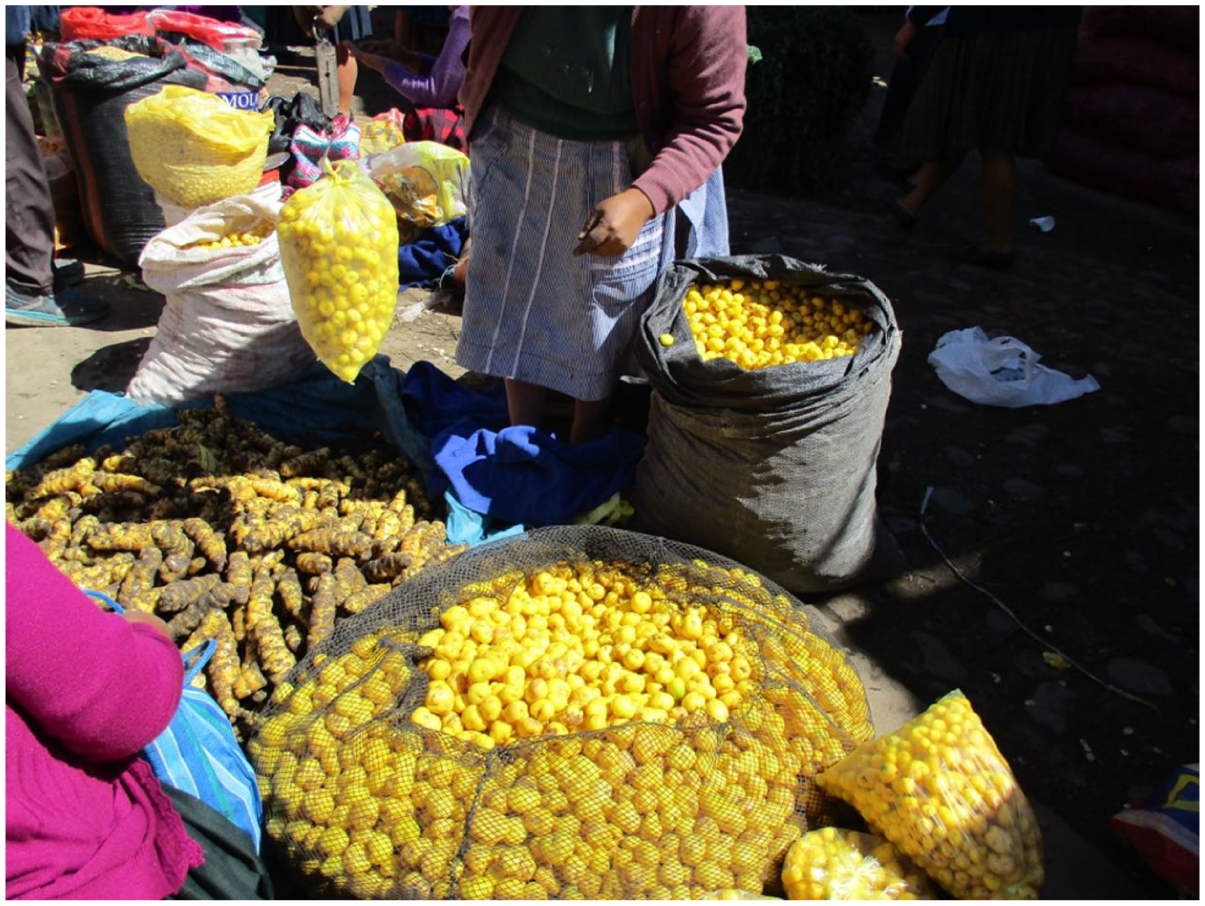
I took this photo because for me, the olluco and the oca, I think you know them? This here is called oca, and this is a kind of sweet potato, with the difference being that the sweet potato has skin and this one does not. . .. You could say they’re almost the same family, with the difference that you can add olluco to soup, you can add salt, you can mix it with the rice. . .. I love this food. They are both ancestral foods, which have been made for a long, long time, but for me at least it is delicious food although the children hardly [eat such things] now, not my grandchildren, they say ‘no, no,’ sometimes they don't even try it because they say ‘I don't like it, I don't like it, I don't like it. . .’ [but] I love it! (interview, August 2017)
These nostalgic narratives also reflect Huambachano’s observations of the importance of the “intergenerational accumulation of knowledge about food security amongst Indigenous communities” (2018: 1021), here foregrounding the role of women in this intergenerational transmission of food knowledges (see also Proyecto RECLAMA, 2023).
Curated Visions Of Abundance
The women’s photos were created with an external public audience in mind, and were exhibited in the main street of Cajamarca 11 with a view to showcasing the women activists’ visions of alternative Development futures, as well as demonstrating their continued resistance to mining. This public-facing agenda, which was planned from the outset of the project and is often integral to Photovoice research, is essential to bear in mind when critically analyzing the ideas and messages embedded in the images. The images are not produced in a vacuum and speak to a broader set of activist ideas and priorities. In this regard, it is evident that photos of agricultural food production and provision are a fundamental element in a carefully curated vision of ways of life and livelihoods that, as Kroijer (2019) discusses (in relation to German environmental activists), enables activists to “remake their own identity and relationship to the land” in ways that speak to broader anti-extractives struggles, in particular mobilizing discourses of Indigeneity and rurality. In this regard, it’s important to note that most of the women involved in this project were not rural or campesina women, but mostly lived in urban areas—though many maintained familial or affective links to more rural communities. 12 Despite this, or perhaps even because of this, an overwhelming majority of the women’s photos capture aesthetically pleasing images that reflect what might broadly be described as campesino ways of life; evocative and emotionally resonant rural scenes that create a sense of continuity with, and nostalgia for, an (idealized) pre-mining past. For example, Blanca reflects on her memories of prickly pears from her childhood: “When I was a child there were lots of prickly pears, they brought some very delicious prickly pears with a very, very good flavor” (interview, August 2017). Ana recalls memories of her grandparents: “I never knew my grandparents, and there’s little that I remember about them, but anyhow my mama always told me their stories, how they would sow, and in what season” (interview, August 2017). The role of gastronostalgia (Srinivas, 2006) is thus evident across many of the women’s photos and narratives. In particular, the women invoke emotive ideas around nourishment, sustenance, and a connection to Mother Earth or Pachamama, as is captured in the photo and poem below by Yenis.
Source: Yeni Cojal Rojas/Women, Mining and Photography 2017.
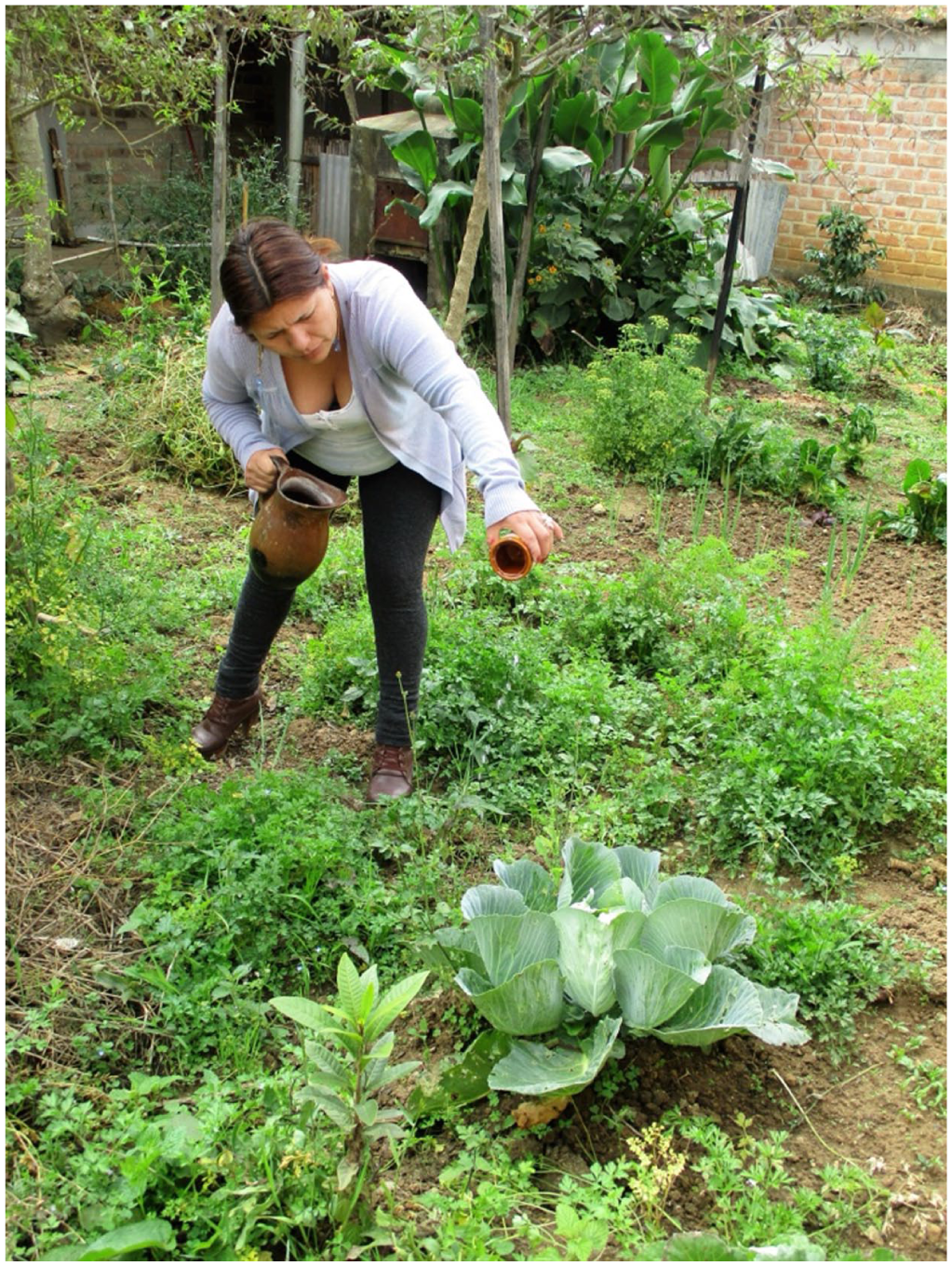
My fingers close around the heavy jug. As I pick up the glass, I calculate the amount of water I should use on the earth and the plants as an offering and thanks to my Mother Nature. My feet on the ground, the security that this is my land, my earth where I was formed and forged against all the odds, and through the sweat and toil with which I labor on my plot of land. The aroma of the plants and, stronger still, the deep scent of coriander. At the same time, I hear the sound of the drops of water that I allow to fall, and the wind whistles in my ears, the force with which it moves the leaves of the plants and the branches of the trees and fruit bushes. This is the result of my efforts at cultivation. I space out the plants for a more productive harvest, with the help of the divine blessing of our God and our warm sun. In my throat the vital liquid of my water, pure and clear, from my sacred and brave land, under a rocky hillside, green with the lush plants that my cows eat to produce their milk. From their milk comes a variety of cheeses, that are never missing from a peasant’s dinner table, accompanied by a delicious bread made from grain harvested by peasants’ hands, and a full mug of our hot chocolate produced in the Marañon valley, and with it the sound of the river. Yes, when a foreigner seeks to destroy it, we defend it with honor, this is my land. Enjoy it, and be served, with much pride and honor. (Yeni Cojal Rojas, 2018)
Such depictions resonate with the ways in which women activists in other contexts have mobilized gendered narratives of nurturing and living in harmony with the land as a powerful means of evoking an historical continuity with a way of life practiced since pre-Hispanic times (Jenkins, 2015). Current food practices are used to evidence a continuity with a symbolically and politically powerful rural and particularly “Indigenous” past. Representations of everyday practices of sowing seeds, harvesting produce, and preparing food, evoke the rhythms of rural life and the quiet day to day resistance (Pottinger, 2017) implied in maintaining this way of life in the face of the threat of displacement and dispossession. 13
Such gendered everyday food practices, and their repeated rhythms, are also evident in the ways that the women recall their mothers and grandmothers, and the details of the particular ways in which they prepared certain ‘typical’ foods and dishes.
For example, my mother, she has her farm, and there’s this dark corn, the dark corn comes out big, but hard. You can't eat it toasted. What does my mum do? My mum takes them and cooks mote con cascara. 14 The smallest ones, that remain a little bit smaller, she separates them, and we make mote pelado as we call it, we cook in with the ashes, we take off the husks, and it is kept dry. And when you want, you cook it to eat it, like mote, but also for tamales. (interview, August 2017)
Food provides an evocative and intimate connection with family, identity, and memory. Through harnessing this gastronostalgia (Srinivas, 2006), the women articulate the threat that large-scale mining poses to the continuation of this way of life, and to the possibility that future generations will also be able to sustain themselves in this way. The women’s frequent depictions of abundant and attractive fruit and vegetables play a similar role, simultaneously celebrating Cajamarca’s fertile lands and a natural abundance while also reflecting on the threat water scarcity and pollution pose to this ongoing production
Source: Flor de Maria Quispe Terrones/Women, Mining and Photography 2017.
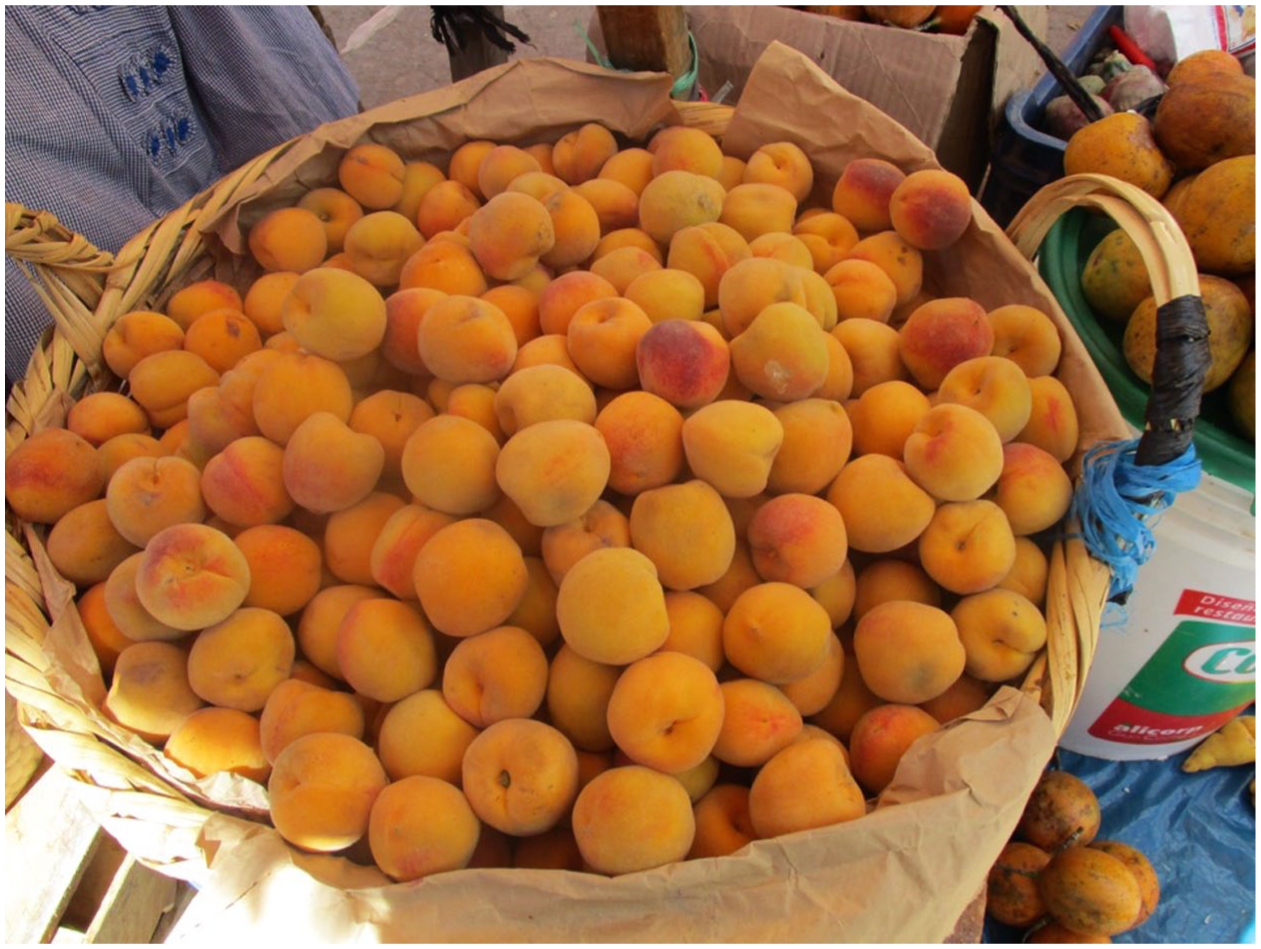
Here we have fruit, peaches. There [were] many peach trees here in Cajamarca. But now there are very few of them, because in reality. . . [they need] a lot of water and in Cajamarca we have a lack of water. Water is scarce, and also there’s this pollution, because of the extractive industries. This affects us a lot, humans and plants (interview, August 2017).
This bountiful food imagery stands in stark visual contrast to scenes of the devastation and destruction wrought on the land by large-scale mining, playing a similar role to that described by Velasquez (2019) in relation to the use of imagery of “pristine paramos” to unite disparate, especially urban, actors around a common anti-extractives struggle. It is evident that the women have sought out particular types of image that speak to broader anti-extractives narratives and modes of campaigning, reflecting their own skills and experience in navigating messaging for an external audience. In particular, reflecting the weight that Indigenous identities carry in relation to anti-extractives struggles (Sarmiento Barletti and Seedhouse, 2019; Radcliffe, 2020)—though in a national context where to identify as Indigenous has been to make oneself vulnerable to marginalization, violence, and racism—many of the photos portray what might be considered to be typically “Indigenous” foodstuffs and practices, using these to invoke particular ideas about rural ways of life and especially notions of buen vivir.
Source: Felicita Vásquez Huamán/Women, Mining and Photography 2017.
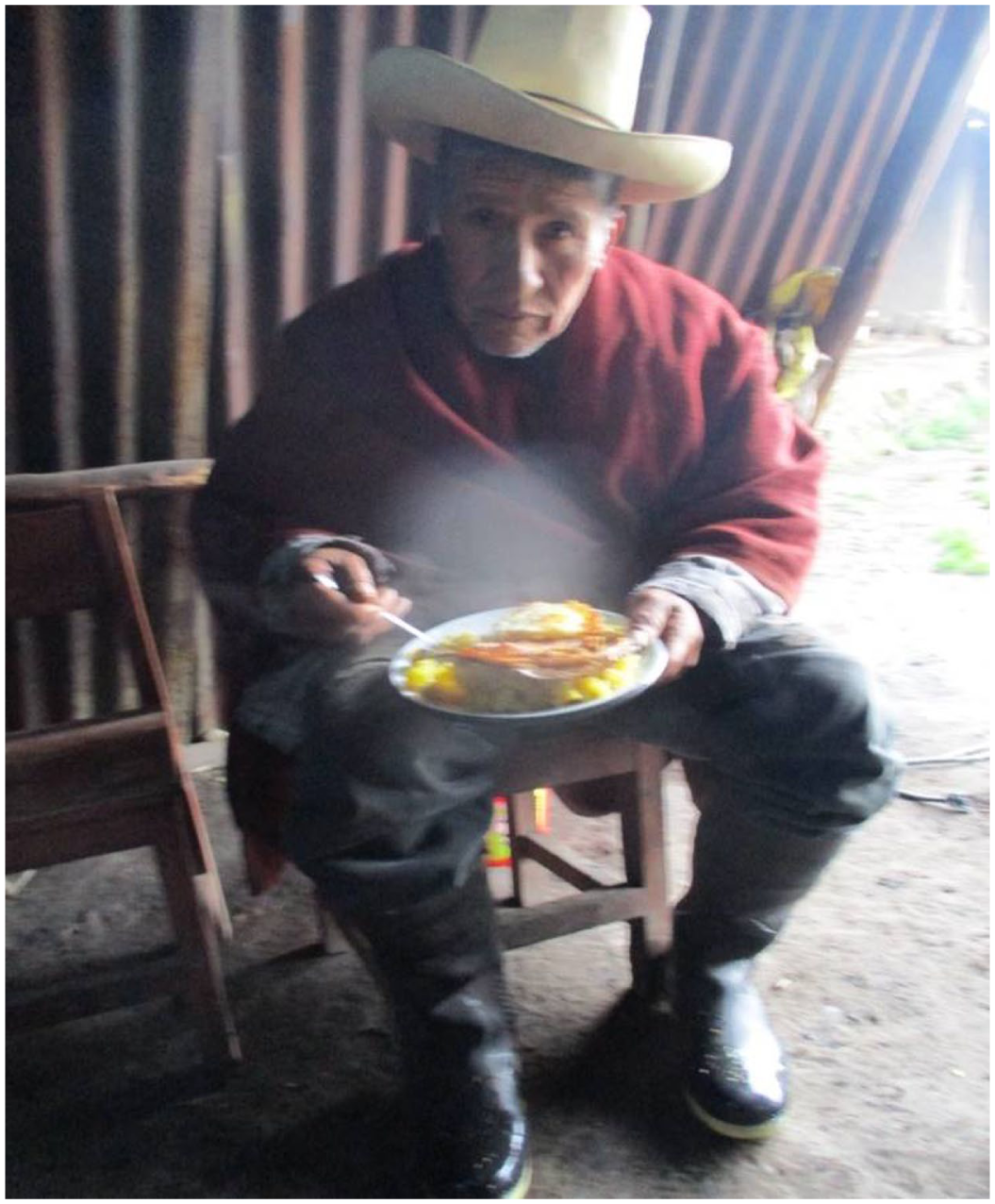
In the morning, we were having our breakfast, having done our chores while my Mom prepared the food. And my Dad is having his breakfast of potatoes and trout.
Delicious! And why did you want to take this photo?
Because it is buen vivir.
In what sense?
Well, in the city, we breakfast with really just a cup of coffee. On the other hand, in the countryside, it’s different. In the countryside we have potato, trout or caldo verde for breakfast.
Hot stew?
Yes, something natural, something that is produced in our own zone.
Of course. And for you is this buen vivir? What does it mean?
Feeding ourselves with products from here. Yes, because the trout is from here, from the river, and we also grow the potatoes ourselves. (interview, August 2017)
The discourse that Grey and Patel (2015) identify around “being alive well” through embracing traditional foods is exemplified in Felicita’s photo and reflections. These ideas are also captured in the ways the women speak about what they identify as “ancestral” or “native” foods—such as quinoa, oca and olluco—foregrounding not only that they are native to Cajamarca, but also that they are nutritious or health-giving foods that should be valued and promoted as part of embracing a way of life rooted in non-Western values and practices. The foods thus encapsulate a particular set of beliefs and strategies related to decolonizing knowledges and practices around food, promoting food sovereignty, and celebrating non-Western value systems and cosmovisions, emphasizing the importance of locally-produced foods for physical and mental wellbeing. These representations therefore go beyond simply resistance to mining, but rather speak to and strengthen thus far under-developed feminist political ecology critiques of the interlinked nature of patriarchy, neocolonial extractivism, and the neoliberal food system (Park, White, and Julia, 2015; Masson, Paulos, and Beaulieu Bastien, 2017; La Via Campesina, 2023b), bringing these into conversation with conceptualizations of buen vivir and living well (see also Jenkins, 2023).
Conclusion
Taken together, the women’s photos and reflections weave a compelling story around the emblematic role of food in everyday gendered resistance in contestations over extractives-led development. Evocative imagery of food preparation, consumption, commercialization, and cultivation provides a powerful way for women to engage with broader discourses around food sovereignty and decolonizing development, enabling them to effectively situate their struggles within wider counter-hegemonic anti-extractives resistance and social movement organizing across both the Global North and South. In this way, the women link their resistance to large-scale mining with resistance to agro-extractivism and the neoliberal industrialized global system of food production. Harnessing visual imagery that invokes ideas around food sovereignty, as well as decolonial thinking on living well, thus provides a powerful and globally legible means of advocating for more just, hopeful, and sustainable Development futures in the context of living with large-scale resource extraction. The paper identifies three inter-linked narratives of resistance that emerge across the collective body of work produced by the women: disrupting dominant extractivist narratives, celebrating a way of life perceived to be under threat, and developing visions of the natural and culinary abundance present in their communities. The outward-facing and activist-oriented nature of these representations reflects the women activists’ ongoing priorities and motivations to continue to contest extractives-led Development, and to imagine and promote the possibility of alternative decolonial Development futures.
The paper furthers Grey and Patel’s (2015) theorization of food sovereignty as decolonization and day-to-day resistance, emphasizing the importance of paying critical attention to the role of women in giving meaning to and sustaining these everyday food practices. The emotive and visually appealing way that women activists place food at the center of their visions of development alternatives, brings to the fore the intersections between food sovereignty, gender, and the impetus to decolonize Development in relation to the lived experiences of communities living with and contesting large-scale resource extraction in the Andes. Through a critical analysis of their photos and accompanying narratives, the paper elucidates the ways in which gendered narratives of food practices, and public visual representations of these, are central to the place-making and identity-making that underpins grassroots women’s continued everyday resistance to extractivism
Footnotes
Notes
Katy Jenkins is Professor of Global Development at Northumbria University (UK). This research was funded by a Leverhulme Trust Research Fellowship (RF-2016-413/8). The author thanks all the women participants in this research project who generously contributed their time, creativity, photos, and reflections. Thanks also to Inge Boudewijn, Alexandra Seedhouse, Floor van der Hout, and Sophia Valle-Cornibert, all of whom have supported aspects of the project at various stages.