




Abstract
In the last thirty years, Cuba and its capital Havana have become homes to one of the most vibrant urban agricultural movements in the world. This article argues that urban agriculture (UA) became the epitome of a broader movement of “agricultural revolution” that followed the collapse of the previous, capital intensive, monocultural agro-export model. It contends that this transformation revolved around three pillars – land redistribution, agricultural diversification, and agroecology – that account for a transition from food security to food sovereignty. It also presents the results of interviews conducted in Havana with urban farmers to assess the impact that UA has on their family’s diet and food security. The research demonstrates that UA guarantees a heightened feeling of independence to urban farmers and has a tremendous impact on their food security and diversity, most notably through autoconsumption. It also shows that community needs, use value, and the decommodification of food and land are the driving principles of UA in Cuba, which is in line with the food sovereignty model.
Over a decade ago, the United Nations published a series of reports highlighting the increasingly urban nature of world poverty (UN-Habitat, 2006; UNFPA, 2007). Experts warned that in this growing “planet of slums” (Davis, 2006), food insecurity would become a predominantly urban problem. In this context, urban agriculture (UA) attracted growing interest from researchers worldwide who stressed its positive impact on food security (Poulsen et al., 2015; Zezza and Tasciotti, 2010). Others also investigated the links between UA and food sovereignty, especially in the Global South (Chihambakwe, Mafongoya, and Jiri, 2019; Siebert, 2020). This article aims to contribute to those debates by analyzing, first, the rise of UA in Cuba as the symbol of the country’s pursuit of food sovereignty and, second, its current impact on household food security in the capital, Havana. While there is substantial literature on UA in Cuba, qualitative research focusing on urban farmers’ perspectives remains scarce. This article seeks to start filling this gap by presenting the results of interviews conducted between October 2013 and February 2014 with urban farmers in Havana. The goal is to assess how those directly involved in UA evaluate the impact that their activity has on their household food security through in-depth, semi-structured interviews gathering urban farmers’ views on the two ways UA is said to improve household food security levels: direct access to food and/or increased income (Korth et al., 2014; Poulsen et al., 2015; Zezza and Tasciotti, 2010).
The development of UA in Cuba has no equivalent anywhere in the world. Virtually nonexistent until the late 1980s, it “gained the status of poster child for the Cuban revolution” (Premat, 2009: 48) in the span of a generation. Given the uniqueness of the Cuban trajectory, it is crucial to place the emergence of UA on the island in the distinct geopolitical and historical context in which it occurred. Hence, after reviewing, in section 1, some of the key debates on the concepts of food sovereignty, food security, and agroecology that frame the discussion, section 2 presents a brief overview of Cuba’s post-revolutionary agriculture. This historical detour demonstrates that it is the collapse of this capital intensive and monocultural agro-export model that pushed the country to pursue an innovative approach in line with the food sovereignty model (section 3). Then, it addresses the development and achievements of UA in Cuba (section 4), which I argue represents the epitome of Cuba’s “agricultural revolution” that revolved around three pillars: land redistribution, agricultural diversification and agroecological principles. Section 5 focuses on the microlevel and presents the results of qualitative research carried out in Havana’s municipality of Arroyo Naranjo to evaluate how urban farmers assess their involvement in UA, discussing those findings in relation to food sovereignty and household food security.
Repoliticizing And Relocalizing Food: Food Security, Food Sovereignty, And Agroecology
As Marx theorized in Capital, Vol.1, “commodity fetishism” – the process of obfuscation that masks the intrinsically exploitative nature of the capitalist relations of production and transforms social relations between people into relations between things, turning “every product of labour into a social hieroglyphic” (Marx, [1867] 1976: 165, 167) – is a defining feature of capitalism. Commodity fetishism defines all capitalist production and exchange, and food offers a striking illustration of this phenomenon. In the current era of “corporate food regime” dominated by transnational companies and agribusiness capital (McMichael, 2013), consumers are unable to trace the various processes that brought a given food item to their table. The unfathomable nature of the conditions of production and distribution obscures the social and environmental damage that they cause. Yet, recently, challenges to the current model that “objectifies and fetishizes food as a vector of capital accumulation,” (McMichael, 2013: 59) have gained in visibility, offering alternatives to the dominant system that recklessly exploits nature and causes incalculable socio-ecological harm. Food sovereignty represents one such alternative.
“Food sovereignty” was first coined in the early 1980s by the Mexican government and was later used by Central American peasants in their struggle against U.S. agricultural dumping. It was popularized at the World Food Summit of 1996 by La Vía Campesina, a transnational, activist network of peasant organizations (Edelman, 2014). To this day, food sovereignty remains a “concept ‘under construction’” (van der Ploeg, 2014: 1000) on which so much has been written that it has become “over defined” (Patel, 2009: 663). To the extent that “food sovereignty means something different in each local context, and evolves as it is being debated,” (Clayes, 2015: 14) some have become critical of a concept that they consider a “free-floating signifier filled with varying kinds of content” (Edelman, 2014: 959–60; Bernstein, 2014). While this is not the place to review the intricacies of the ever-growing literature on the topic, some of the ideas that form the core of food sovereignty will be touched upon briefly.
A point of consensus, in otherwise contested debates, is that food sovereignty aims to repoliticize the question of food and food production to develop an alternative model holding extensive transformative potential (Clayes, 2015; McMichael, 2009; 2013; Patel, 2007; 2009; van der Ploeg, 2014; Rosset, 2009). Food sovereignty is part of a long history of struggle against the capitalist conceptualization of food as yet another commodity whose “natural” destiny is to be traded on global markets as part of capital accumulation processes. When food is treated as a commodity, its production, circulation, and consumption become matters of privilege (Patel, 2009); the privilege of those who control capital to decide what will be produced – under what conditions and for what purposes – and to get access to the diet they desire. In contrast, food sovereignty revolves around the notion of rights (Clayes, 2015; Patel, 2007; 2009). The transformative potential of reconceptualizing food as a basic human right cannot be overemphasized.
Considering food’s use value rather than its exchange value, insisting on social needs rather than profit maximization; in other words, de-commodifying food, entails several shifts that form the six pillars of the “food sovereignty project”: (1) food as a human right and not a commodity, (2) respect, support, and protection for food providers (small farmers, not agribusiness companies), (3) localized food systems that bring producers and consumers together, (4) local control over land use, in socially and environmentally sustainable ways, (5) building and sharing local knowledge, (6) working in harmony with nature (Nyéléni Forum, 2007). These six pillars represent a radical departure from the current, capitalist regime of food production, distribution, and consumption. They also show that there are clear “elective affinities” between food sovereignty and agroecology (Altieri, 2009; Holt-giménez and Altieri, 2013; Menser, 2014).
In their oft-quoted review of the literature, Wezel et al. (2009) note that agroecology can refer to a science, a practice, and/or a movement. At the most basic level, agroecology refers to “the application of ecological concepts and principles to the design and management of sustainable agricultural ecosystems” (Altieri, 2009: 103). However, making a distinction between agroecology as a science/practice and a social movement would be a mistake. As Sevilla-Guzmán and Woodgate (1997) document, agroecology is part of a century-long history of resistance against industrial farming and the commodification of land. Separating the “scientific” from the “social,” “political,” and “economic” dimensions of agroecology erases this history of resistance and presents agroecology as a sort of apolitical “ecotechnocratic” fix. Agroecology does not restrict itself to “cosmetic changes” that can tackle the environmental damage caused by conventional agriculture while leaving intact the unequal power relations on which the corporate food regime rests. Like food sovereignty, agroecology aims not only to solve the “environmental question” but also to address social, political, economic, and cultural concerns. As such, it adds up to a paradigm shift, as illustrated by the more extensive definition developed by Sevilla-Guzmán and Woodgate (1997: 93–94). Overall, food sovereignty and agroecology offer a radical and holistic alternative to the dominant understanding of food security.
According to the Food and Agriculture Organization (FAO), “food security exists when all people, at all times, have physical and economic access to sufficient, safe and nutritious food that meets their dietary needs and food preferences for an active and healthy life” (World Food Summit, 1996). While food security may seem appealing, it is decidedly apolitical. As Patel (2007: 90) writes, “food security is agnostic about the production regime, about the social and economic [and environmental] conditions under which food ends up on the table.” By ignoring the “political economy of food,” food security embodies commodity fetishism and serves the interests of the powerful, both nationally (agribusiness vs. peasant communities) and globally (Global North vs. Global South).
Ultimately, food sovereignty challenges food security’s “agnostic” and de-contextualized approach by offering an alternative that is, at heart, a “relocalization project” (Clayes, 2015: 17). As the six pillars illustrate, reconceptualizing food as a social good destined to fulfill the community’s needs entails decisions on food production, distribution, and consumption being anchored locally, in order to shift from “food from nowhere” to “food from somewhere” (McMichael, 2003). Food sovereignty also entails decommodifying land and guaranteeing the people’s right to it. In this regard, the idea of “land sovereignty” is a particularly useful intervention which “captures the essence of democratising land control in the context of democratising the food system” (Borras Jr. et al., 2015: 610). In sum, the emphasis on “relocalization” is the reason why self-determination/sovereignty and independence are at the core of food sovereignty. While food security stresses nations’ and communities’ right to access to food, food sovereignty emphasizes their right to produce food. Food sovereignty is about reclaiming localized, autonomous food systems to prevent a nation and its citizens from being dependent on the whims of the market or the “goodwill of a superpower” (Rosset, 2009: 116). As the following sections show, the implementation of this model of “territorially rooted social reproduction” (Menser, 2014: 62) became a matter of life and death for Cuba in the 1990s.
Revolutionary Agriculture: The Soviet Connection
As Fidel Castro set out in his famous speech La historia me absolverá (1961), one of the main objectives of the Cuban Revolution was to eradicate extreme inequality between countryside and urban centers by radically transforming the island’s agricultural sector, which was defined by (1) the predominance of sugarcane monocultures, (2) the supremacy of U.S. capital, which controlled 75 percent of the sugar industry that accounted for 92 percent of the island’s export revenues (Leogrande and Thomas, 2002), and (3) extreme levels of land concentration, with 22 sugar companies (13 U.S. and 9 Cuban) owning close to 20 percent of all arable land and less than 10 percent of landowners controlling close to three quarters of it (Nova, 2002). However, the course of the revolutionary government’s agricultural policy was ultimately shaped by the Cold War geopolitical context. The triumph of the Revolution in January 1959 was met by an intense campaign of aggression from the United States. In the wake of these attacks, Cuba turned to the Soviet Union as a source of support, which would have far-reaching consequences for its agricultural model, especially with regards to sugar production.
The revolutionary leadership identified the prevalence of sugarcane monoculture as the source of the country’s so-called “underdevelopment” (Guevara, [1961] 1966) and agricultural diversification was high on the government’s agenda (Chonchol, 1963). However, the diversification program implemented between 1959 and 1963 suffered a series of setbacks and led to a dramatic reduction in sugar production, which had been the cornerstone of the economy since the 19th century. The economic situation deteriorated rapidly as the country’s balance of payments plunged into deficit, causing rising tensions with its Soviet ally (Eckstein, 1981). As the survival of the Revolution seemed in the balance, emblematic figures like Ernesto “Che” Guevara ([1963] 1966: 232) resigned themselves: “we are condemned [. . .] to produce sugar for many years yet in order to maintain our export balance and thus acquire the many products we need from abroad.” Within this context, Cuba established new economic relations with its Soviet allies, officially joining the Council for Mutual Economic Assistance (COMECON) in 1972.
Under this new agreement, Cuba would give up its program of industrialization and agricultural diversification to revert to its historical model of over-specialization in sugar production. Ultimately, Cuba benefited from the principles of “mutual assistance” governing the COMECON. Among other things, it allowed the island to buy oil well below market prices to use for domestic purposes and resell to other Latin American countries. Through the COMECON, Cuba also sold its sugar at preferential rates that could, at times, surpass world market prices by close to a 1:12 ratio (Perez-Lopez, 1988). The island was also able to achieve food security thanks to COMECON food imports. Yet, this shift marked the end of the revolutionary dreams of economic transformation and independence while the “return to King cane” (Benjamin et al., 1989: 123) shaped the island’s agrarian structure and mode of production.
Land redistribution had been a priority of the revolutionary program. The 1959 agrarian reform prohibited foreign actors from owning land and limited to 30 caballerías (402 ha.) the area under private ownership. Such measures ended U.S. economic hegemony and tackled land concentration as land tenure limitations impacted 8.5 percent of farms controlling 73.3 percent of farmland (Chonchol, 1963). The reform granted land titles to 100,000 landless peasants, but most existing large estates (latifundios) were not broken up and redistributed but transformed into state farms (granjas del pueblo), transferring 44 percent of agricultural land under public control (Benjamin et al., 1989). This would be the only reform supporting land redistribution. As the government shifted back to sugarcane monoculture and centralized planning, from the 1963 land reform onwards, the rationale governing agrarian policy can be encapsulated in two slogans: “more state property, more socialism” (Burchardt, cited in Premat, 2003: 86) and “bigger is better” (Enríquez, 2010: 124). This double-approach favored the predominance of gigantic state farms at the expense of all other forms of agriculture, especially autonomous campesinos (farmers). By 1989, 82 percent of all agricultural land in Cuba was made up of state farms – with an average area of 20,235ha – while autonomous campesinos retained ownership over 2.3 percent of the land, with the remaining 15.7 percent in the hands of cooperatives (Merlet, 2011; Valdés Paz, 2009).
The agricultural model was particularly capital intensive, with hyper-mechanization and extensive use of agrochemical inputs considered the best way to cultivate such large areas in a context of labor shortages (Pollitt and Hagelberg, 1994). Between 1959 and 1990, the number of tractors increased tenfold, reaching 90,800 units (three times more than the U.S per capita ratio) and the use of chemical inputs followed a similar, exponential trend. In 1989, Cuba imported 1.3 billion tons of fertilizers (+900 percent since 1958), 10,000 tons of pesticides (+200 percent since 1965) and 17,000 tons of herbicides (+3,300 percent since 1965) (Wright, 2009). In 1986, Cuba was using 2.4 times more fertilizers per hectare than the United States and 7.47 times more than Brazil (Febles-González et al., 2011).
The centralized, post-revolutionary agricultural model based on large, capital intensive, sugarcane monocultures did not only come with a high environmental cost but also proved inefficient (Alvarez, 2004). It also put Cuba in a situation of heightened external dependence on its COMECON allies, especially with regards to its agricultural and food systems. 80 percent of its machinery needs, 94 percent of fertilizers, 97 percent of herbicides, 98 percent of animal feed, and 100 percent of its oil were imported (Wright, 2009). The over-specialization in sugar production – by 1982, sugarcane covered 75 percent of all arable land (Valdés Paz, 2009) – did not prevent Cuba from achieving food security, but by 1980, 70 percent of the food consumed on the island came from abroad, compared to about 20 percent in 1956 (Alvarez, 2004). Thus, while the Revolution resolved the enduring issues of hunger and malnutrition that had formerly plagued the island (Benjamin et al., 1989), this success depended on a system of economic integration defined by high levels of external dependence. Eventually, the limitations of this “food security model,” which is at odds with the food sovereignty approach, would dramatically reveal themselves.
Período Especial: Food Crisis And Agricultural Transformation
The collapse of the Soviet bloc triggered an unprecedented crisis in Cuban history. Cuba did not only lose its most important economic partner – 86.6 percent of trading relations were conducted within the COMECON (Leogrande and Thomas, 2002) – but also the very advantageous terms of trade from which it benefited. The crisis was further aggravated as the United States reinforced its economic blockade in an attempt to precipitate the fall of the revolutionary regime. The Cuban government responded to this crisis by declaring the Período Especial (Special Period), introducing measures initially designed for times of war.
With every aspect of Cuba’s agriculture depending on its special relationship with the Soviet Bloc, the crisis was particularly acute in the agricultural and food sectors. Agricultural output dropped by 50 percent between 1989 and 1994, while the island lost access to the food imports on which its population relied, and distribution networks collapsed due to lack of oil. It is estimated that daily caloric and protein intakes fell by 35–40 percent and that the average Cuban lost 20 pounds (Sinclair and Thompson, 2001). In 1991, Fidel Castro declared that, “the food question has the number one priority” (quoted in Benjamin and Rosset, 1994: 33) while his brother Raúl affirmed: “yesterday, we said that beans were as important as weapons; today we are affirming that beans are more valuable than guns” (quoted in Premat, 2009: 33). The food/agricultural crisis triggered a radical transformation of Cuban agriculture, a “revolution” that revolved around three pillars: agricultural diversification, land redistribution, and agroecological principles.
As the government aimed to convert 60 percent of sugarcane land to food crops, the production of root crops and plantains, vegetables, beans, and corn increased respectively by 66.5 percent, 113.5 percent, 419 percent, and 567 percent between 1988 and 1999 (Sinclair and Thompson, 2001). This new focus on food production led the share of imported food consumed in Cuba to fall from 70 percent to 50 percent in the early 2000s (Botella-Rodríguez, 2019). A new agrarian reform was implemented in 1993, dismantling state farms in favor of small-scale, private farming. While the state retained ownership of the land, this massive and free transfer of land usufruct was a complete reversal of the approach pursued since 1963, leading to the “repeasantization” of Cuban agriculture (Botella-Rodríguez and González-Esteban, 2021). Throughout the 1990s, the usufruct of 3 million hectares of land was redistributed, leading the share of land directly managed by the state to fall from over 80 percent to less than 25 percent today (Altieri and Funes-Monzote, 2012). Ultimately, the crisis triggered by the collapse of the Soviet Union pushed Cuban agriculture along the path originally envisioned by the Sierra Maestra revolutionaries: small scale, private farming focusing on food production for local needs.
While the number of autonomous farmers increased by 81.2 percent between 1979 and 1998 (Valdés Paz, 2009), the government reaffirmed its commitment to this policy in 2008 through the Decree-Law 259, which simplified usufruct transfer processes. In 2012, and then again in 2018, Decree-Law 259 was replaced by Decree-Law 300 and 358, further increasing land transfer. Overall, between 2008 and 2019, the usufruct of more than 2.5 million hectares was distributed through the government’s program“virarse para la tierra” (“turning to the land”) (MINAG, 2019). By 2017, small individual farmers’ control over cultivated land had surpassed all other agricultural structures (Botella-Rodríguez and González-Esteban, 2021). Today, over 68 percent of individual farmers in Cuba are usufructuaries (ONEI, 2021). Last but not least, the agricultural mode of production was revolutionized. The failed, capital-intensive model of the past was replaced by a new approach governed by agroecological principles. From animal traction to locally produced organic inputs; from intercropping to integrated pest control; and from soil and water sustainable management to horizontal networks of knowledge production and dissemination, the development of agroecological innovations on the island has been extensively documented (Funes et al., 2002; Funes and Vázquez, 2016; Machín Sosa et al., 2010; Wright, 2009).
Cuban agriculture underwent a radical evolution. It transitioned from a centralized, export-led, and environmentally harmful system dominated by large, capital intensive sugarcane monocultures entirely dependent on imports to a new model centered on small-scale, independent farmers using agroecological methods and local resources to produce food for local communities. This complete overhaul is clearly in line with the food sovereignty approach described earlier and has been praised as the leading example of transition towards food sovereignty in the world (Altieri and Funes-Monzote, 2012; Blue et al., 2022; Rosset, 2009). This new emphasis on food sovereignty is also reflected in the declarations of Cuba’s highest authorities. In 2009, then president Raúl Castro defined food sovereignty as a “matter of national security” (quoted in Machín Sosa et al., 2010: 75). More recently, Prime Minister Manuel Marrero Cruz reaffirmed that achieving food sovereignty is “not just another priority; it is a vital matter for national security” (Marrero Cruz, 2020), while President Miguel Díaz-Canel declared: “if there is one trench in which the Revolution is defended today, it is in the production of food” (Hernández, 2020). Food sovereignty was formalized in Cuban legislation with the passing, in May 2022, of the Food sovereignty and food and nutritional security law which reaffirms the government’s commitment to food sovereignty. More importantly for the purposes of this article, the Cuban leadership regularly stresses the leading role that UA plays in achieving food sovereignty (Calderón, 2020; Granma, 2021; Hernández, 2020; Marrero Cruz, 2020; MINAG, 2019). In the next section, I argue that the nascent urban agricultural movement best embodies the transition to sustainable, small-scale, food-crops farming.
Urban Agriculture In Cuba: Birth And Development
The food crisis triggered by the collapse of the Soviet Union was particularly severe in urban centers as the lack of oil and truck replacement parts disrupted the distribution networks connecting cities and countryside. In this context, UA emerged in cities like Havana, as a survival strategy. Prior to the Período Especial, UA was virtually nonexistent in Cuba. In the mid-1960s, the government introduced an ambitious plan, the Cordón de la Habana (the Havana greenbelt), whose objective was to create a 10,000-hectare greenbelt around Havana. Due to various planning failures, the initiative was eventually abandoned, putting a temporary end to government-sponsored UA. Private urban farming was equally absent as urban dwellers saw very little benefit in a practice that they considered a sign of poverty (Benjamin et al., 1989).
UA thus emerged in the 1990s as a survival strategy, with city-dwellers taking over unused plots of land to produce food, a process that Koont (2004: 24) refers to as “creating ‘new land’.” As Roberto 1 , a 73-year-old urban farmer interviewed for this study, recounted: “[UA] was an alternative because [. . .] we ran out of everything! So it was an alternative to try and resolve the ‘food problem’ in the cities.” While UA was born as a spontaneous popular movement, the government took decisive actions to support it. Starting in 1991, it launched a nationwide campaign encouraging people to participate in this new activity. Food production became a matter of national security and practicing UA was – and continues to be – presented as a way to defend the Revolution. Governmental institutions also joined the movement as when the Ministry of Agriculture replaced its flowerbeds with lettuces. The Cuban Revolutionary Armed Forces, which made food production their highest priority in 1995, also promoted UA and were pioneers in the use of organopónicos – raised containers used in areas that lack access to cultivable ground. Building on its general policy of land redistribution, the Department of Urban Agriculture of Havana was created in 1994 to facilitate access to idle land. Authors like Koont (2004; 2011) have stressed the importance of state support for the Cuban urban agricultural movement. Most crucially, it implemented a broad policy of facilitating access to land, an initiative whose importance cannot be overemphasized since the right to the land is a major concern for food sovereignty. The majority of “urban farmers” interviewed for this study practice UA on plots whose usufruct they received from local authorities.
Another key source of support comes from the National Group of Urban and Suburban Agriculture (GNAUS), founded in 1994. Among other things, GNAUS organizes four yearly tours during which it awards honorific titles to those who demonstrate excellence in their activity. The symbolic value of these moral incentives has been highlighted in the literature (Koont, 2011; Premat, 2009) and was witnessed first-hand when 66-year-old parcelero (an urban farmer whose activity takes place on a small parcel of land) Jesús enthusiastically showed the author his title of “patio de referencia nacional” (patio of national reference). Beyond awarding these honorific titles, the objective of the tours is to assess the national, regional, and local performance of urban (and suburban) agriculture in the country, to identify the best practices, and to attend to the needs of urban farmers organized around 28 sub-programs. However, grassroots autonomy is a central feature of the Cuban urban agricultural movement, which is based on a mixed horizontal/vertical and bottom-up/top-down approach. The best practices are first developed and disseminated locally through the campesino a campesino (farmer to farmer) method of horizontal knowledge sharing (Machín Sosa et al., 2010) before GNAUS can spread them in other parts of the country. This approach, which is a departure from the centralized, vertical model that prevailed prior to the Período Especial, has been praised as one of the key sources of success of UA in Cuba (Koont, 2011; Wright, 2009). This new model finds public institutions fulfilling a supportive rather than prescriptive role and is in line with the principles of producer autonomy and local knowledge sharing of the food sovereignty approach.
Achievements Of Cuban Urban Agriculture
While hunger was eradicated in post-revolutionary Cuba, food diversity remained an issue (Benjamin et al., 1989). Fresh vegetables, for instance, tended to be absent from the diet of most Cubans. In this regard, UA, with its focus on fruits and vegetables, brought tremendous benefits. The area dedicated to UA has increased substantially since the 1990s. It is estimated that, nowadays, urban and suburban agriculture account for about 15 percent of all agricultural land (Koont, 2011). This figure should continue to grow since the government aims to increase urban and suburban agricultural land by 35 percent between 2020 and 2030 (Granma, 2020). This process of “creating ‘new land’” has been coupled with continued improvement in agroecological techniques. This progress has built on Cuba’s long-established and internationally recognized agricultural expertise, the institutional support provided by the GNAUS, and the horizontal method of knowledge sharing that has shaped Cuban UA since its origins (Machín Sosa et al., 2010). This double process of increased land under cultivation and improved techniques of production has led to an astounding surge in UA’s output.
By 2000, only a few years into the “UA experiment,” 58 percent of all vegetables eaten in Cuba came from UA and daily sales of vegetables and fresh herbs were more than 55 percent higher than the 300g/day/per capita recommended by the FAO (Killoran-McKibbin, 2006; Koont, 2004). By 2006, due to the progress in urban agricultural output, daily sales of vegetables per capita on the island had reached 1kg (Koont, 2007). In Havana, the production of vegetables and fresh condiments increased thirteenfold between 1997 and 2007 to reach 280,000 tons (González Novo et al., 2008). In 2019, UA produced over 1,277,500 tons of vegetables nationally (Granma, 2020). Thanks to UA, it is estimated that vegetable intake increased fivefold between 1997 and 2013 (Rodríguez-Nodals, 2014). While production of animal proteins continues to lag behind, “urban agriculture has ensured that food security and sovereignty has been achieved in the area of vegetable production” (Koont, 2011: 172).
Thanks to the reliance on agroecological principles, these remarkable results were achieved “without,” as Fidel Castro (2006: 400) emphasized, “emitting a gram of carbon dioxide into the atmosphere”. While this might be an overstatement, the environmentally friendly and sustainable aspect of UA in Cuba is undisputable and has been emphasized by numerous publications, including all those referenced in this paper. The prevalence of agroecology is another sign that Cuban UA is in line with food sovereignty principles. My field observations confirm that that there is, as parcelera María noted, a generalized “social consciousness” about the benefits of agroecology. As Mercedes, another parcelera, put it “people have become greener.” While two cooperativistas (cooperative members) recognized that they were sometimes forced to use chemical inputs, both insisted that they did so “almost never,” “only in cases of emergency.” The other respondents were emphatic in stressing that they never used chemical inputs.
When asked why they valued agroecology, many respondents mentioned health concerns. This was the case for Raúl who explained that, since farmers and their families eat what they grow, they should avoid using chemical inputs: “[if they did], they [would be] killing their own family!” Others highlighted environmental concerns: “I’m taking care of the environment, I’m taking care of the earth, I’m taking care of the climate.” (Jesús). Finally, several cooperativistas stressed quality and agricultural output: “in terms of product quality, organic [production] is the best. We wouldn’t achieve anything going back. Things would be of a lower quality [. . .] What we have to do is move forward, not go back in time!” While the interviews demonstrate that the “social consciousness” about agroecology is already well anchored among urban farmers, the government aims to bolster it further through educational projects included in the 2022 Food Sovereignty law. The following section shifts the analysis from the macro to the micro level and presents the results of qualitative research conducted with urban farmers in Havana’s municipality of Arroyo Naranjo between October 2013 and February 2014.
UA And Food Security Today: Arroyo Naranjo, Havana Methods, Sample And Hypotheses
As Benjamin et al. (1989: xvi–xvii) once wrote, “no one should underestimate the difficulties of doing research on and in Cuba [. . .] A siege mentality, probably inevitable in the face of years of efforts by the world’s most powerful government to destabilize the island nation, makes a defensive, closed society.” My own experience, some 25 years later, indicates that little has changed. Interviewing urban farmers without having been previously introduced by a member of the community proved virtually impossible and building relationships of trust with potential respondents became a central part of the research. In this process, the help and support provided by the Fundación Antonio Núñez Jiménez (FANJ) – an organization that plays a central role in the development of UA in Cuba – proved invaluable. Eventually, a total of 21 participants – ten parcelerxs and eleven cooperativistas – were recruited through snowball sampling. There are several differences between parcelerxs and coopertivisitas. The most important one, apart from the fact that cooperativistas belong to a cooperative while parcelerxs do not, is the area cultivated. On average, cooperativistas farmed plots of one hectare, compared to 480m2 for the parcelerxs, whose activity takes place on the roofs, patios, and gardens surrounding their home. The majority of respondents received the usufruct of their land from the local authorities (see table 1).
Respondents’ basic information
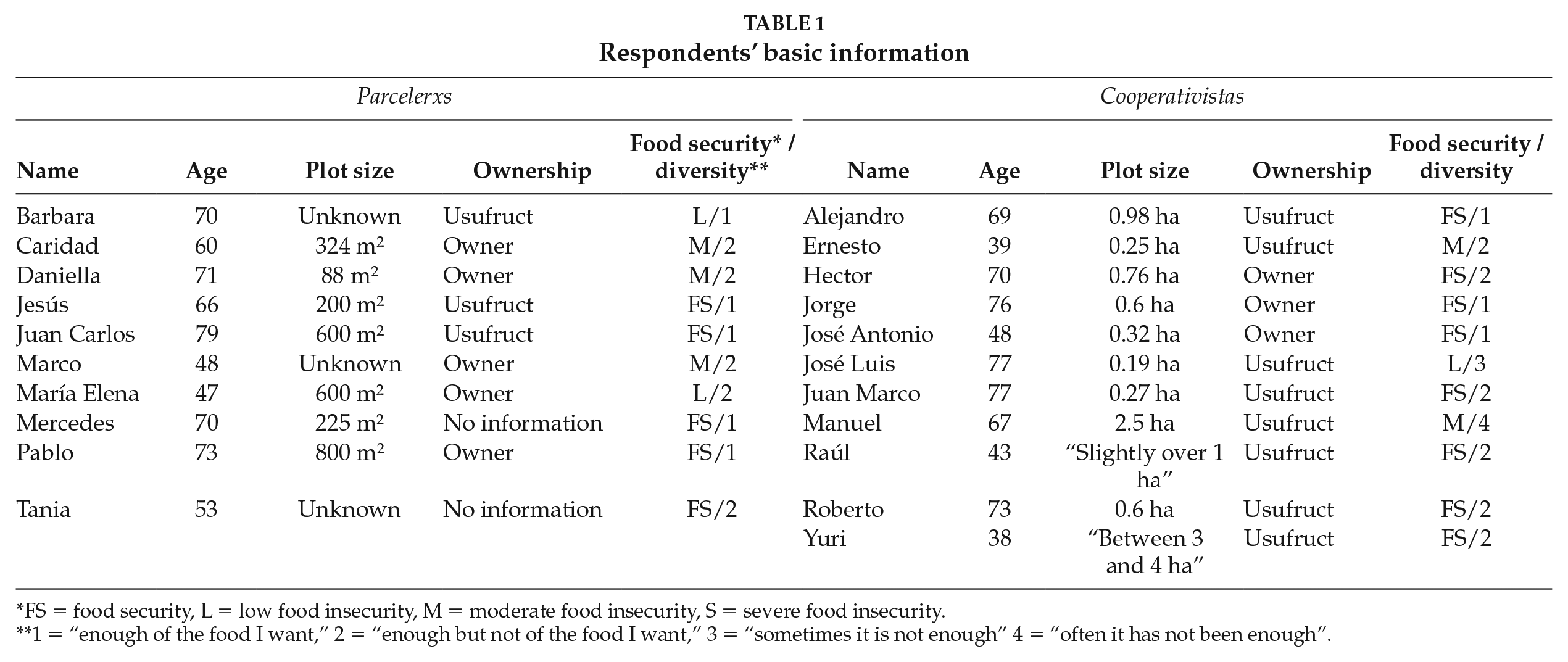
FS = food security, L = low food insecurity, M = moderate food insecurity, S = severe food insecurity.
1 = “enough of the food I want,” 2 = “enough but not of the food I want,” 3 = “sometimes it is not enough” 4 = “often it has not been enough”.
With an average age of 62.5 and a majority of men, the sample corroborates Murphy’s observation (1999: 17) that “many of Havana’s popular gardeners are retired men in their fifties and sixties”. While women were well represented among the parcelerxs, all respondents in the more labor-intensive, cooperatista sector were men. A similar distribution is found at the national level where women represent 31 percent of the 800,000 people involved in UA (Calderón, 2020). Table 1 provides basic information about the respondents.
All interviews but one were recorded and lasted one hour on average. They were then transcribed and coded. The interviews were divided into two main parts. The first section assessed household food security levels by following the Escala Latinoamericana y Caribeña de Seguridad Alimentaria (Latin American and Caribbean Food Security Scale—ELCSA) quesionnaire developed by Latin American researchers from the FAO (2012). Based on the respondents’ answers, ELCSA classifies their household food security level as: “food security” (according to the FAO definition detailed earlier), “low food insecurity,” “moderate food insecurity,” “severe food insecurity.” Since food diversity is a recurring issue in Cuba, an additional question was added to ELCSA. Taken from a food security questionnaire used in the Dominican Republic, it asks respondents to qualify their diet as “enough of the food I want,” “enough but not of the food I want,” “sometimes it is not enough” or “often it has not been enough” (Bezuneh et al., 2008).
The second section consisted of an in-depth, semi-structured interview shedding light on how respondents considered that their involvement in UA impacted their household food security. The goal was to gather their views on the two main ways UA is said to affect household food security according to various systemic reviews of the literature (Korth et al., 2014; Poulsen et al., 2015; Zezza and Tasciotti, 2010). The first hypothesis contends that UA improves urban farmers’ food security by enhancing their direct access to food. The second hypothesis claims that UA can increase the household’s income, creating new economic resources that will be reinvested to buy other – or more – food items. Those two roads to increased food security are summarized in Figure 1:
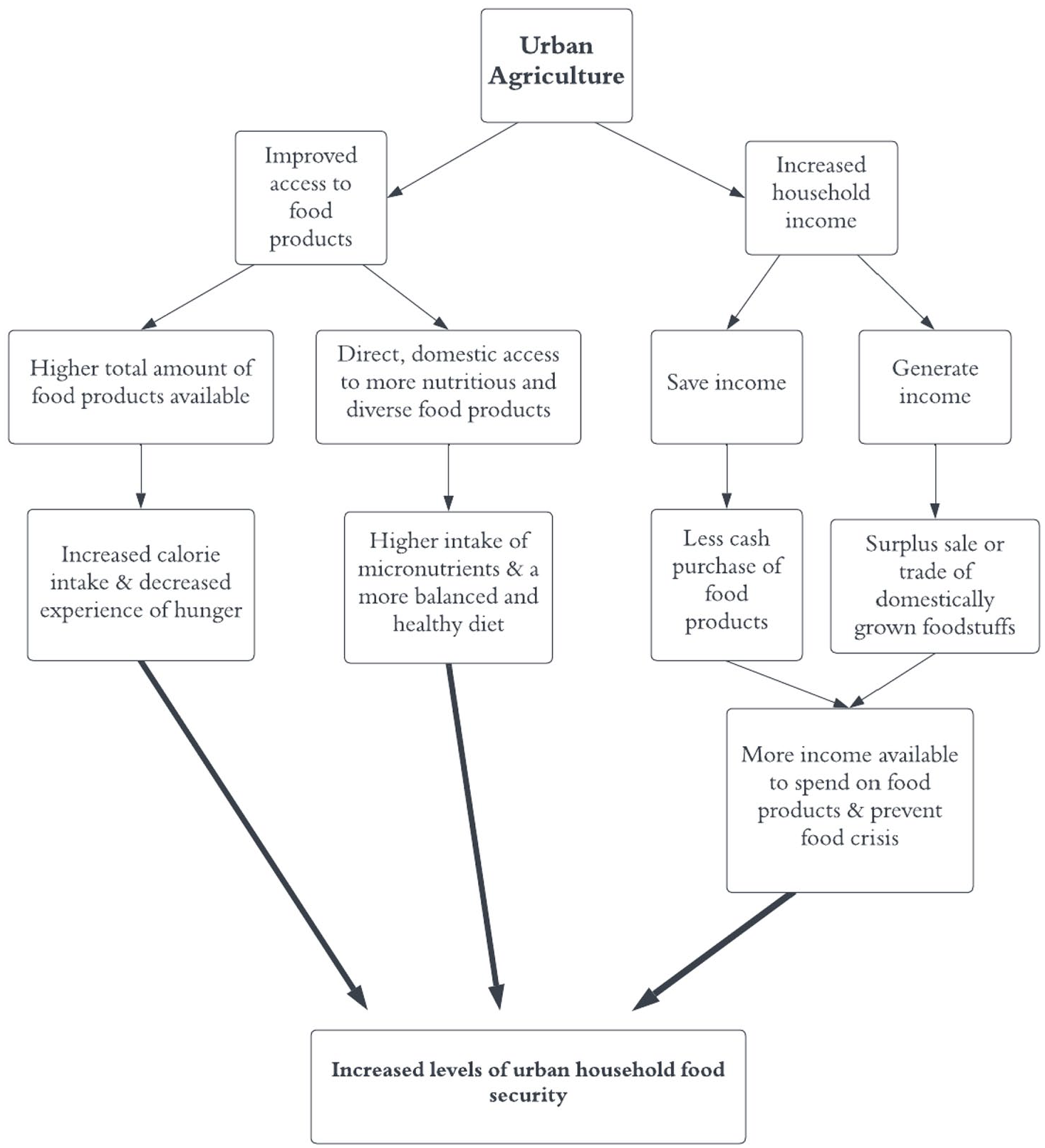
UA’s impact on household food security.
Main results: (1) food security and direct access to food: “¡los sueldos no alcanzan!”
The majority of households were in a situation of food security but most declared that they could not eat the food they desired (see table 1). All respondents complained about prohibitive food prices in the Cuban capital and many used the same expression as Barbara, a 70-year-old parcelera: “the prices are high and the wages aren’t enough [los sueldos no alcanzan].” Except for one interviewee who received generous remittances from his family, all others explained that virtually all their economic resources were spent on food, a situation that parcelera Tania, summarized as: “in Cuba, there’s a saying [. . .]: ‘you eat money’.” “Everything” was one of the most common answers to the question “what part of your income do you spend on food?” 2 Respondents reported that the discrepancy between food prices and purchasing power prevented them from diversifying their diet. As Caridad exclaimed: “food, here, is pushing us against the wall! [. . .] All the money that comes in is food, food, food, and food. . . And not diversified food! Rice, beans, and pork.” In this context, every single interviewee stressed the importance of being able to rely on their own production to improve their family’s diet, both from a quantitative and qualitative perspective.
Thanks to their activity, urban farmers have access to fresh, organic products with high nutritional value whose consumption most participants considered they would have to give up or heavily curtail if it were not for their own production. As cooperativista Ernesto, explained: “I got this ability that, every time I want to eat, I don’t know, a plantain, I go to [my] tree and I take a bunch of plantains, I go and I eat a mango, an avocado. [. . .] It’s not the same as saying ‘I want to eat plantain’ and not having the money to go and buy it.” José Luis made a similar comment, indicating “sometimes I want to buy a lettuce, but not every day do I have the money to be able to buy a lettuce.” For this cooperativista, as for many others, being able to rely on his own vegetable production was seen as the only way to ensure a healthy and diversified diet for his family. Others, like parcelero Jesús were confident that being involved in UA “teaches you to eat vegetables.” As he further elaborated: “look, there are things, like eggplant and different types of vegetables that we didn’t eat before and [. . .] when we harvested them here, we started to eat them and to enjoy it. There was the cauliflower I didn’t know [. . .] the broccoli we didn’t know either.” This resonates with Caridad’s comment that “before, I didn’t use any of those products [chard, spinach, celery and other vegetables she grows in her 320m2 garden] because I didn’t have them!”
In some cases (two cooperativistas and five parcelerxs), respondents were also able to rely on their own production to secure their household’s access to animal proteins (most of them raise rabbits and/or chickens). The importance of having regular access to animal proteins cannot be overemphasized. Meat is by far the most difficult item to buy in Cuba: “this is what is most expensive, meat is the problem!” (Juan Marco). The Cuban government is acutely aware that ensuring the population’s access to animal proteins remains one of the country’s most pressing dietary challenges (Marrero Cruz, 2020). While those raising animals represent a minority of the sample, at least three other respondents planned to start raising rabbits or chickens in the near future.
Ultimately, since “los sueldos no alcanzan,” maintaining direct access to fresh fruits and vegetables and, in some cases, animal proteins (meat or eggs) might be the only way, for the majority of Cubans, to maintain a healthy and diversified diet. However, in addition to prohibitive food prices, unpredictable food distribution and public transportation networks also constitute considerable obstacles to a healthy and diversified diet. As cooperativisita José Luis, explained, summarizing the daily struggles faced by virtually all Cubans, sometimes having money to buy food is not the issue: “sometimes food is scarce, you understand? Let’s say, vegetables that don’t arrive where you [normally] acquire them so it’s logical that when these are in short supply, [your] worries increase since you have to see where you can buy them.” María Elena’s comments are illustrative of the “food neuroses” (Benjamin and Rosset, 1994: 22) caused by the constant challenge of finding food in the Cuban capital: “Where do I need to run [to get food]? Is the chicken cheaper over there? It’s a hassle, it’s a bit stressful. I’d like to have time for something else than worrying about food. . .” For many interviewees, in this context of high food prices and unreliable distribution networks, the benefits they could obtain from maintaining direct access to food products were self-evident and did not require further explanation. As cooperativista José Antonio matter-of-factly commented: “what I grow at home, I don’t have to go look for it in the street.”
All participants were also emphatic that autoconsumption allowed their household to eat products of better quality. As 79-year-old parcelero Juan Carlos mentioned, “it’s not the same to buy a product in a stall, that’s already been driven around twenty times in the truck, than picking it up fresh here.” As virtually all respondents relied exclusively on agroecological techniques, many stressed that autoconsumption guarantees that the fruits and vegetables their family eat are 100 percent organic. As cooperativista Ernesto indicated: “[if you buy] in the street, you don’t know what kind of water they watered it with [. . .] Maybe they fumigated it with chemicals.” Some, like Caridad, even considered that “eating healthy [. . .] without chemical products” is one of the main reasons why they practice UA.
(2) Selling And/Or Gifting: Urban Agriculture And Local Community Needs
While every respondent stressed the importance of autoconsumption, the majority also validated the second hypothesis, according to which UA can improve food security by increasing the household’s income, either as an income generating or income saving activity. Overall, most respondents valued income saving over revenue generation. Being able to consume their own production allows urban farmers to save money which they can then use to buy other food items, all the more so in a country like Cuba with a uniquely high social wage and where food is, by far, the largest item of expenditure. In this context, and in accordance with Engel’s law, every peso saved through autoconsumption will almost always be used to improve the family’s diet, either quantitively (more products) or qualitatively (higher quality or more diversity).
Pablo’s comments provide a clear illustration of this dynamic. As he explained, the money he is saving thanks to his production of avocados has a tremendous impact on his household’s diet: “If I hadn’t produced avocados, I would have eaten less avocados because I would have had to go to the market [to buy them]. Now, I go to the market and I say ‘what do I buy? Sausage or avocado?’ Well, sausage [since I already have avocado]!” Cooperativista Jorge made a similar observation. After showing me his many different crops, he indicated that, if it were not for his own production, his family would not only have to reduce its consumption of fruits and vegetables but would also lose an important source of savings, which would prevent them from buying meat as regularly. It is this ability to reinvest money to buy animal products that was particularly valued. Most Cubans consider meat and milk to be “luxuries” that can only be purchased at the expense of other food items, which explains why several respondents were eager to start raising rabbits and/or chickens. As Mercedes explained, it is only because doing UA allows her household to save money that, every so often, “[they] allow [themselves] the luxury of buying meat, because pork is expensive.” While others did not mention animal products specifically, 16 of the 21 participants agreed that relying on their own production allowed them to save money that they could then reinvest on other food items. As Yuri explained : “If you save this money [thanks to your own production] you can buy other things. If you don’t buy plantains, you can buy tomatoes, onions,. . .” The remaining five respondents said that they would not change their diet if they lost their own production while admitting that they would have to spend more money to eat the same food.
On the other hand, the income generating potential of UA seemed more ambiguous. On this matter, there is a clear distinction between cooperativistas and parcelerxs which, ultimately, reflects differences in agricultural output. As previously mentioned, cooperativistas cultivate larger plots of land and selling part of their production is an integral part of their activity. In general, they have a contractual obligation to deliver about half of their production to their cooperative. Those products are then sold at highly subsidized prices to surrounding social institutions (schools, hospitals,. . .) as part of the cooperative’s plan de consumo social (social consumption plan). The other half of the production tends to be equally divided between the household’s needs and direct sale to the population, which generates higher revenues than the consumo social. Several cooperativistas claimed that the money they receive from UA fluctuates from month to month but, on average, the figure of $600 per month emerged from the interviews, 40 percent higher than the $426 average wage of Arroyo Naranjo. UA, in Cuba, can thus become a relatively profitable activity (Koont, 2011; Premat, 2009). As Juan Marco’s comments illustrate, this increase in readily available cash follows the same dynamic of reinvestment in other food products, in particular animal products: “[my family’s diet] improves with what I sell. With the money, I consume other things that I add to the diet. For instance, when I sell here, I take the money and I buy meat, I buy eggs, I buy other things that are missing.” However, while they were all able to increase their revenue by selling part of their production, it should be noted that most cooperativistas tended to value the autoconsumption and income saving aspects of their activity over its income generating dimension.
The situation among parcelerxs was quite different. Five of them said that they never sold any of their production because it is used exclusively to feed their household. They would rather gift their limited surplus to their extended family, friends and neighbors than selling it to them: “since they’re neighbors, I’m not going to charge them for a little bit of onion, on the contrary, I’ll gift it to them [. . .] this is a way for us to stay united, share what we have” (Jesús). Four parcelerxs recognized that, at times, they ended up selling part of their production. However, they all stressed that they do not pursue UA as an income generating strategy. In fact, their situation was similar to that of the five parcelerxs who never sold any product since they usually distribute their excess production freely. They only resort to selling part of it in the rare instances of unexpectedly large output exceeding both the household and its extended social circle’s needs. María Elena’s case is emblematic in this respect. As she detailed, typically, “I give away a lot [. . .] I use it more like a gift.” However, when pressed further, she recalled one instance when her production of mameys exceeded all expectations, leaving her with a large quantity of fruits on her hands, even after she had given a lot away freely and had made several jars of jam: “I had to sell some, otherwise everything would have rotted away.” The only parcelero who was able to sell part of his production on a regular basis was Pablo, whose 800m2 plot of land made him an outlier among the parcelerxs. Thanks to his relatively large plot, Pablo was able to secure an agricultural output big enough to sell his excess production to the surrounding community, which he considered a welcome source of additional income.
Discussion: UA, Food Security, and Food Sovereignty
The interviews with Cuban urban farmers provide a compelling validation of hypothesis one, according to which UA can improve household food security through improved direct access to food and autoconsumption. This finding is in line with existing research conducted in other settings (Poulsen et al., 2015; Zezza and Tasciotti, 2010). It also confirms a point specifically highlighted in the literature on UA in Cuba regarding the importance of UA as a way to grant producers some level of independence from expensive and unreliable food distribution networks (Koont, 2011; Premat, 2003; 2009; Wright, 2009); a sentiment encapsulated by Marcos’ comments: “if I didn’t have an area for this [i.e. to do UA] my life would change quite a lot [. . .] I’d feel way more dependent, way more insecure, way more vulnerable. Because it really gives me a level of security; that I have ways of producing some basic things and that, every day, I resolve more basic [food] issues because I’m involved in this type of production.” As underscored earlier, this notion of independence is one of the most important aspects of food sovereignty. While, globally, it entails ensuring that a nation does not rely entirely on external actors, be they global markets or superpowers, to feed its population, at the local level, independence relates to the autonomy of local communities in terms of food production and consumption. If food sovereignty is primarily about decommodifying food and land and “regenerating autonomous food system – with, for and by citizens” (Pimbert, 2009: 5), Cuban UA, and its motto “of, by, and for the barrio (neighborhood)” is a perfect illustration of food sovereignty at play. As Jesús stressed, echoing similar comments made by others, UA in Cuba is defined by relations of “mutual help” and “cooperation,” rather than “competition.” This emphasis on “mutual help” is also reflected in the second hypothesis concerning UA’s potential as an income saving and/or generating activity.
While most – 16 out of 21 – respondents considered that saving money through autoconsumption and reinvesting these savings to buy other food items had a considerable impact on their household’s diet and food security, overall, the income generating dimension was seen as a secondary benefit. Urban farmers’ views on the topic were clearly shaped by constraints of plot size and output, with many parcelerxs saying that their limited production “no me da para eso” [doesn’t give me enough for that (i.e. to sell)]. Ultimately, only one parcelero was able to sell part of his production on a regular basis. Yet, even the eleven cooperativistas, for whom selling is an integral part of their activity, tended not to emphasize this aspect.
Overall, the respondents’ insistence on autoconsumption as the main purpose of their activity, coupled with the parcelerxs’ free distribution of surplus, and the relative weight of consumo social for the cooperativistas demonstrate that community needs and food’s use value are the driving principles of UA in Cuba. To be sure, those whose production yields substantial surplus that can be sold, welcomed the opportunity to increase their income. However, the primary motivation for all respondents was to participate in “the well-being of [our] small community” (Daniella), to “bring something to society” (Raúl), and to “improve people’s lives” (Juan Marco). As Premat (2003: 91) states, the emphasis on community needs that is at the core of the food sovereignty approach is also in line with “the image of the Guevarist ideal of the Hombre Nuevo (New Man) who puts collective goals ahead of individual ones.” Decommodification, use value, and community needs are also the guiding principles governing the “land question” in Cuba.
As noted earlier, the majority of respondents work land whose usufruct has been granted freely by the local authorities on the condition they cultivate it. When asked if they were concerned about the possibility of losing their plot in the future, all usufructuaries responded negatively, insisting that they were guaranteed to keep their right to the land as long as they continued to practice UA: “they give it to you so that you put it to work, for your own benefit and for society’s benefit, which is what is needed” (Juan Marco). While secured land tenure has been linked to heightened food security (Nkomoki et al., 2018), the government’s commitment to land redistribution is in line with the “land sovereignty” model, which aims to decommodify the land and to democratize and protect the people’s right to it (Borras Jr. et al., 2015). A similar comment applies to the prevalence of agroecology and the entrenched “social consciousness” about its benefits, which is not only in accordance with food sovereignty principles but has also been proven to improve food security, notably through increased food diversity (Bezner Kerr et al., 2021).
Conclusion: Urban Agriculture, A Cuban, Revolutionary Story
In the first years following the Revolution, the Cuban government implemented a series of agricultural policies in line with the objectives of land redistribution and agricultural diversification that were at the core of the revolutionary program of social justice and national independence. However, the Cold War geopolitical context derailed those plans. The U.S. campaign of aggression and the subsequent rapprochement with the Soviet Union compelled Cuba to revert to its historical, sugar agro-export model. Thus, while post-revolutionary Cuba achieved food security and escaped the unequal and exploitative trade relations of the capitalist economy, it achieved those successes at the price of heightened external dependence on its Soviet allies. The disintegration of the Soviet Union led to the collapse of Cuba’s capital intensive, monocultural agriculture and triggered an acute food crisis. In the midst of the Período Especial, radical transformation of the agricultural model was not so much a matter of choice but one of survival. The “agricultural revolution” implemented in the 1990s revolved around three pillars: land redistribution, agricultural diversification, and agroecological principles. UA became the embodiment of Cuba’s transition to an inward-looking agricultural model revolving around small-scale, agroecological food production that focuses on the needs of local communities.
Over the years, UA evolved from a last resort, grassroots survival strategy to becoming a “poster child for the Cuban Revolution” (Premat, 2009: 48). Considered “one of the best examples of food import substitution implemented on a national scale” (Botella-Rodríguez, 2019: 195), UA has become one of the most important components in Cuba’s ongoing battle for food sovereignty, as is regularly emphasized by the country’s highest authorities. This “model of territorially rooted social reproduction” (Menser, 2014: 62) fosters local autonomy, promotes the decommodification of food and land, and protects the people’s right to both. The interviews conducted with urban farmers in Havana demonstrate that UA has a tremendous impact on household food security. Being able to rely on one’s own production is an essential way to secure direct access to healthy, organic food and to address household needs through autoconsumption. It also allows families to save money that can then be reinvested to buy other food products, especially animal ones. Even for those for whom UA can turn into an income generating activity thanks to more substantial output, it is these two former mechanisms that were valued the most by parcelerxs and cooperativistas who considered that autoconsumption and saving/reinvestment play a crucial role, not only in improving the family’s diet both qualitatively and quantitatively, but in guaranteeing a heightened sense of security and independence.
Overall, UA in Cuba is emblematic of food sovereignty’s reconceptualization of food, not as a commodity embedded in capital accumulation processes that cause great socio-ecological harm, but as a human right and a common good anchored in the needs and desires of local communities. In the words of Cuban urban farmers, it can be said that, ultimately, “the idea is to achieve a consciousness of producer rather than consumer” (Pablo); a producer not concerned about accumulating resources but striving to improve “the wellbeing of [the] [. . .] community” (Daniella).
Footnotes
Notes
Hugo Goeury is a Sociology PhD candidate at The Graduate Center, City University of New York or CUNY.