




Abstract
Global governance has long been pushed to localize, incorporating local voices and knowledge to become both more equitable and effective. This has been particularly the case for global environmental governance, where polycentric modes of governance are found to help local actors acquire responsible stewardship and use resources sustainably. However, the selection of which local actors and knowledges will be incorporated in global governance is still dependent on major international development organizations and funding agencies. This article poses the following questions: Which types of actors are incorporated in the global governance of the Amazon and how do they participate therein? To that end, we analyze the network of stakeholders involved in development, execution, or governance of internationally funded projects in the Amazon. Analyzed projects which were part of a major multilateral initiative—the Global Environmental Facility—focusing on those whose main activities are in the Amazon Rainforest biome. The analysis sheds light on the hierarchies and patterns of exclusion in these networks, identifying which types of actors occupy central and peripheral position, and which others are underrepresented. This will expand our understanding of the politics of global local entanglements in the governance of the Amazon.
A governança global há muito tempo vem buscando se localizar, incorporando vozes e conhecimentos locais para se tornar tanto mais equitativa quanto mais eficaz. Isso é especialmente verdadeiro no caso da governança ambiental global, onde modos policêntricos de governança têm se mostrado úteis para que atores locais adquiram responsabilidade sobre os recursos naturais e os utilizem de forma sustentável. No entanto, a escolha de quais atores e conhecimentos locais serão incorporados na governança global ainda depende das principais organizações internacionais de desenvolvimento e agências financiadoras. Este artigo propõe as seguintes perguntas: Quais tipos de atores são incorporados na governança global da Amazônia e como eles participam desse processo? Para isso, analisamos a rede de stakeholders envolvidos no desenvolvimento, execução ou governança de projetos financiados internacionalmente na Amazônia. Selecionamos projetos dentro do portfólio de uma importante iniciativa multilateral—o Fundo Global para o Meio Ambiente (Global Environmental Facility)—focando naqueles cujas principais atividades estão localizadas no bioma da Floresta Amazônica. A análise de redes buscará compreender as hierarquias e os padrões de exclusão nessas redes, identificando quais tipos de atores ocupam posições centrais e periféricas, e quais outros estão sub-representados. Isso ampliará nossa compreensão sobre a política dos entrelaçamentos globais e locais na governança da Amazônia.
Global governance has long been pushed to localize, incorporating local voices and knowledge to become both more equitable and effective. This has been particularly the case for global environmental governance, where engagement with local actors has long been seen as necessary for embedding practices of sustainable resource management and responsible stewardship in relations of trust and reciprocity (Ostrom, 2010b). At the same time, the interconnected nature of our global ecosystems demands that local initiatives be coordinated to avoid the risk of unsustainable governance practices (Dietz, Ostrom, and Stern, 2003; Galaz et al., 2012; Rockström et al., 2009; 2023). The result of this global-local linkage is the emergence of polycentric modes of environmental governance, where multiple public and private initiatives at multiple levels and scales seek to coordinate efforts of self-governance by local actors (Keohane and Victor, 2011; Abbott, 2012; Jordan et al., 2015; Bulkeley et al., 2012)
In this sense, the ability of polycentric governance to produce effective policy outcomes depends on the global-local linkages it generates. That connection allows for combining the promotion of local solutions to local problems with the scaling up and coordination of successful experiences (Ostrom, 2010b; 2010a; Cole, 2015). However, while much has been written to adjudicate the relative effectiveness of the global architecture comprised of multilevel and polycentric governance (see Biermann, Pattberg, Van Asselt, and Zelli, 2009; Gupta, Pistorius, and Vijge, 2016; Biermann and Kim, 2020), less attention has been paid to variation in forms of global-local connections producing that architecture.
Putative local actors are far from homogeneous, carrying with them multiple interests, power resources, and forms of knowledge that can shape governance practices in variegated ways. This is certainly the case in the Amazon Rainforest, where urban residents, agricultural settlers, and Indigenous peoples are all local users of the biome, but with contrasting uses and often diverging interests. In the broader scale of global governance, even national and subnational authorities have claims of locality in contrast with transnational non-governmental organizations, intergovernmental organizations, and distant foreign states. Therefore, the point of departure of this article is the proposition that the construction of local participation in polycentric governance is ultimately a political process, where a global push for local access meets local actors striving for global connections.
This article investigates the patterns of global-local connections produced in the environmental governance of the Amazon Rainforest. More specifically, I research networks of stakeholder participation in projects funded through the Global Environmental Facility (GEF) and executed in the Amazon biome. The GEF has been operating since 1995 and has become the largest multilateral financial mechanism for environmental cooperation (Alcañiz, 2016). The Amazon region has been a locus of GEF projects since its pilot phase, having granted over sixty projects in the region. Before the recent surge in climate-focused funding initiatives, GEF was the central mechanism for environmental funding in global governance, providing a unique longitudinal window into stakeholder participation. The GEF can be seen as a channel for coordinating polycentric governance since it mandates local stakeholders’ engagement and its system of co-participation allows for multiple funders.
The remainder of the article is comprised of three sections and the conclusion. The first delves into the debates on polycentricity and local participation in global environmental governance, highlighting the contested politics of local representation at their core. The second section narrows the focus to the evolution of local-global entanglements anchored in the governance of the Amazon Rainforest, setting the background for the empirical analysis of stakeholder networks in GEF projects implemented in the Amazon. The third section presents the data, the methods, and the results of the analysis of global-local connections in those stakeholder participation networks. The conclusion discusses results and avenues for future research.
Polycentricity and The Networked Construction Of The Local In Global Environmental Governance
The recognition of the interconnectedness of our planetary nature is at the heart of the very emergence of global environmental governance. From the early treaties on cross-border river navigation to contemporary negotiations on the curbing of carbon emissions, governing the environment entailed coordinating multiple interlinked and often contradictory uses of natural resources (Maglia and Wilson Rowe, 2023; Wilson Rowe, Beaumont, and De Oliveira Paes, 2025). While the state system enshrines in sovereign states the key authority to produce such coordination, the stagnation of state-steered environmental regimes has led to the emergence of a more complex patchwork of initiatives to fill existing gaps in environmental governance (Keohane and Victor, 2011; Abbott, Green, and Keohane, 2016).
These initiatives most often work by seeking to directly and more extensively mobilize the stakeholders being impacted by, or driving, environmental outcomes (Bulkeley et al., 2012; Andonova, 2010; Newell, Pattberg, and Schroeder, 2012; Abbott, 2012). At the same time, states and international organizations themselves have also sought to foster those governance arrangements across scales and catalyze the formation of transnational multi-stakeholder initiatives (Hale and Roger, 2014; Andonova, Hale, and Roger, 2017; Hickmann, 2017). As a result, a web of crisscrossing initiatives and funding mechanisms has emerged to coordinate responses to multiple sources of environmental degradation across the planet.
One key aspect of such architecture is its potential polycentricity (Cole, 2015). The notion of polycentric governance stems from the works of Elinor Ostrom and her colleagues on resource management, which emphasizes the advantages of grounding large-scale governance structures into self-governance initiatives by local users (see Ostrom, Walker, and Gardner, 1992; Ostrom, 1990; 1998; 2010b). This literature has found that locally grounded multi-scalar systems of governance can enhance trust and diffuse reciprocal relationships, while also allowing for coordination and scaling up of successful experiences (Ostrom, 2010b; Galaz et al., 2012; Cole, 2015). In this sense, multi-scalar connections, from the global to the local, are a key component of the current environmental governance architecture.
The local grounding of global governance is not only a matter of sidestepping negotiations deadlocks and implementation gaps, but also largely seen as a matter of social justice. Local users of natural resources can be either the main drivers or the main victims (or both) of environmental degradation, but in any case, they are actors whose livelihoods are most linked to such resources, and they possess a legitimate stake in its governance. Hence, any equitable benefit sharing of an ecosystem’s sustainable management must involve local users (Gebara, 2013; Dehm, 2021). For this reason, a growing number of environmental funding initiatives require local stakeholder participation throughout the development and implementation of projects in any given ecosystem (Bulkeley et al., 2012).
However, the local level is often far from homogenous. As political geography has long studied, the production of scale is a social process (Harvey, 1990; Delaney and Leitner, 1997). Multiple actors are likely to struggle to claim representation of the local scale and enhance their legitimacy for self-governance (Castree, 2004; Bulkeley, 2005; Brown and Purcell, 2005; Evans, Murphy, and de Jong, 2014; Merino, 2022). In polycentric governance structures, these local struggles gain renewed stakes, since granting local access to global actors may result in access to resources, influence, and legitimation (Di Gregorio et al., 2017; Morrison et al., 2019; Kellner, Petrovics, and Huitema, 2024). In this sense, one may expect the construction of local stakeholder participation underpinning multi-scalar polycentric governance to be a process subject to political dispute, which (re-) produces patterns of inclusion and exclusion.
In this article, we draw on the literature on power in multilevel policy networks to make sense of the politics of local stakeholder participation in the Amazon. This literature understands policy networks as the webs of relationships that emerge from patterns of collaboration among multiple actors involved in cross-institutional policy domains (Rhodes, 2007; Berardo, Alcañiz, Hadden, and Jasny, 2016; Di Gregorio et al., 2019). Though most often not formally hierarchical, policy networks are rife with power relations and asymmetries stemming from the positions occupied by different actors (Faul, 2016). Leading scholars in the study of environmental policy networks, Berardo and colleagues conceive of those networks as akin to Bourdieu’s notion of social capital, since differential levels of centrality reflect different levels of recognition and acknowledgment of other actors (Berardo, lcañiz, Hadden, and Jasny, 2016; Alcañiz and Berardo, 2016).
Berardo, lcañiz, Hadden, and Jasny (2016: 619) further distinguish between two types of powerful central positions in policy networks: bonding and bridging. Actors in bonding positions are those who often work with the same group of actors, forming a distinctive cluster of common relationships in the network, which affords them control and influence over their close partners (Berardo, lcañiz, Hadden, and Jasny, 2016: 620). Actors occupying bridging positions are those who link otherwise disconnected groups of actors in the network. These actors fill “structural holes” in the network (Burt, 1992), controlling the flow of information and information across groups (Berardo, lcañiz, Hadden, and Jasny, 2016: 620). In policy networks, these actors have the most capacity to coordinate projects, scaling up and translating local experiences and forms of knowledge.
Evidence on policy networks in the Global South suggests a tripartite dynamic in producing such global-local linkages in environmental governance and their resulting positionalities and power asymmetries. These dynamics emerge from the interplay among wealthy Global North funders, biodiversity-rich countries in the Global South, and local civil society living with and from that biodiversity in those countries. Global North actors (bilaterally or through large NGOs, multilateral funds and intergovernmental organizations) control most financial flows in environmental governance; these geographically distant actors are likely to claim a stake in shaping the composition of policy networks of the projects they fund (Abbott, Genschel, Snidal, and Zangl, 2015; Hale and Roger, 2014; Di Gregorio et al., 2019). States with sovereign jurisdiction over the ecosystems where projects are implemented are also expected to seek a central role in selecting forms of engagement with civil society and subnational authorities in their projects (Gebara, Fatorelli, May, and Zhang, 2014; Di Gregorio et al., 2017; 2019; Alcañiz and Giraudy, 2023). Following these previous findings, one can expect that nation-wide state actors jointly with key players in transnational and international financing of environmental governance—such as donor agencies, IGOs, and global NGOs—are likely to occupy those bridging positions. In turn, local civil society and subnational authorities are expected to provide bonding positions as local catalysts of stakeholder networks.
Regardless of these expectations about the division of labor and hierarchy among scales, the central positions different types of actors will occupy in each scale remain an open and consequential empirical question. Global hubs channeling project funds can be either state-mandated IGOs or privately governed NGOs. Within the national state, actors from different issue areas and with varying levels of bureaucratic autonomy can partake in different networks. The composition of local organizations, including Indigenous organizations, labor organizations, advocacy organizations, and other groups, can be even more varied. More importantly, these actors may interplay in multiple ways, which ultimately determine each other’s positions in those policy networks. The remainder of the article explores this open-ended empirical question by studying policy networks produced through stakeholder participation in a set of internationally funded environmental projects implemented in the Amazon Rainforest through the Global Environmental Facility.
Networked Politics of Localization In The Governance Of The Amazon Rainforest
The rainforest ecosystem springing from the Amazon River basin has long been a central concern of global environmental governance. The degradation of the Amazon Rainforest, and the expansion of the Brazilian agricultural frontier into the biome from the 1970s, coincided with the emergence of a more comprehensive environmental agenda in global governance following the Stockholm UN Conference on the Human Environment in 1972 and the subsequent creation of the United Nations Environmental Program (Becker, 1982; Bratman, 2019). The environmental concerns about the Amazon would tangle local sociopolitical tensions, as deforestation-inducing economic activities threatened the livelihoods of Indigenous peoples and traditional settler communities such as rubber-tappers (Hecht and Cockburn, 1990). The merger of environmental, social, and human rights concerns would produce a linkage between local grassroots movements in the Amazon with transnational advocacy networks in ways that were instrumental to the incorporation of initial environmental sustainability norms in multilateral development assistance programs (Keck, 1995).
The centrality of the Amazon in global environmental governance became even more salient with the Rio de Janeiro United Nations Conference on Environment and Development (UNCED) in 1992. Just as the conference was the birth of key norms, forums, and instruments that currently shape environmental governance, it also shaped the global networks of actors involved in the governance of the Amazon, particularly in Brazil. Within Brazilian civil society, mobilization for the UNCED catalyzed the formation and consolidation of non-governmental organizations that became the main pressure group defending the protection of the Amazon (Hochstetler and Keck, 2007). These groups were also fundamental in providing the expertise to construct Brazil’s domestic environmental government through the Ministry of Environment (MMA) (Maglia, 2022). Internationally, global attention reignited cooperation among the states whose sovereignty cuts across the Amazon through the Amazon Cooperation Treaty Organization (ACTO) to better bargain the terms of their stewardship of the ecosystem (Paes, 2022a; 2023). As a result, Amazonian states individually or through the ACTO established multiple initiatives with external partners and established multiple partnerships with donor states and IGOs (Tigre, 2017; Paes, 2022a).
Through all these different drivers, the global and local increasingly enmesh with the densification of environmental governance architecture that emerged in the first decade of the 21st century. The growing awareness of the existential threat of climate change produced novel mechanisms of global-local cooperation (Bulkeley et al., 2012). In this article, we look at one such mechanism, the Global Environment Facility. The GEF is the largest funding mechanism for environmental aid and one which has been operating for the longest (Alcañiz, 2016; Alcañiz and Giraudy, 2023). It dates from the aftermath of the UNCED in Rio 1992, thus having a temporal coverage that cuts through this process of expansion of global environmental governance described here. The GEF coordinates fund allocation from multiple partners, such as UN agencies, multilateral banks, state donors, and civil society actors, with the goal of aiding states in the Global South implement their international commitments. It further works as a key financial mechanism to the Convention on Biological Diversity (CBD), the United Nations Framework Convention on Climate Change (UNFCCC), the Stockholm Convention on Persistent Organic Pollutants (POPs), the UN Convention to Combat Desertification (UNCCD), and the Minamata Convention on Mercury. 1
The Amazon biome was home to multiple projects through the seven four-year phases of the GEF from 1994 to 2022, which channeled U.S. $437 million in direct funding and mobilized U.S. $2.2 billion in cofinancing (Paes, 2022b). The GEF is only one of the mechanisms for international cooperation on the Amazon Rainforest. Recent years have seen a burgeoning number of resources and initiatives linked to climate financing in the region, as is the case of the Amazon Fund (Paes, Waisbich and Pina, forthcoming). As one of the first funding mechanisms of global environmental governance, and the biggest to date, understanding global-local patterns of entanglement in the GEF are important both as a window into the history of the region, and for identifying a baseline for with more recent initiatives.
Analyzing Stakeholder Networks In Global Environment Facility Projects In The Amazon Rainforest Data
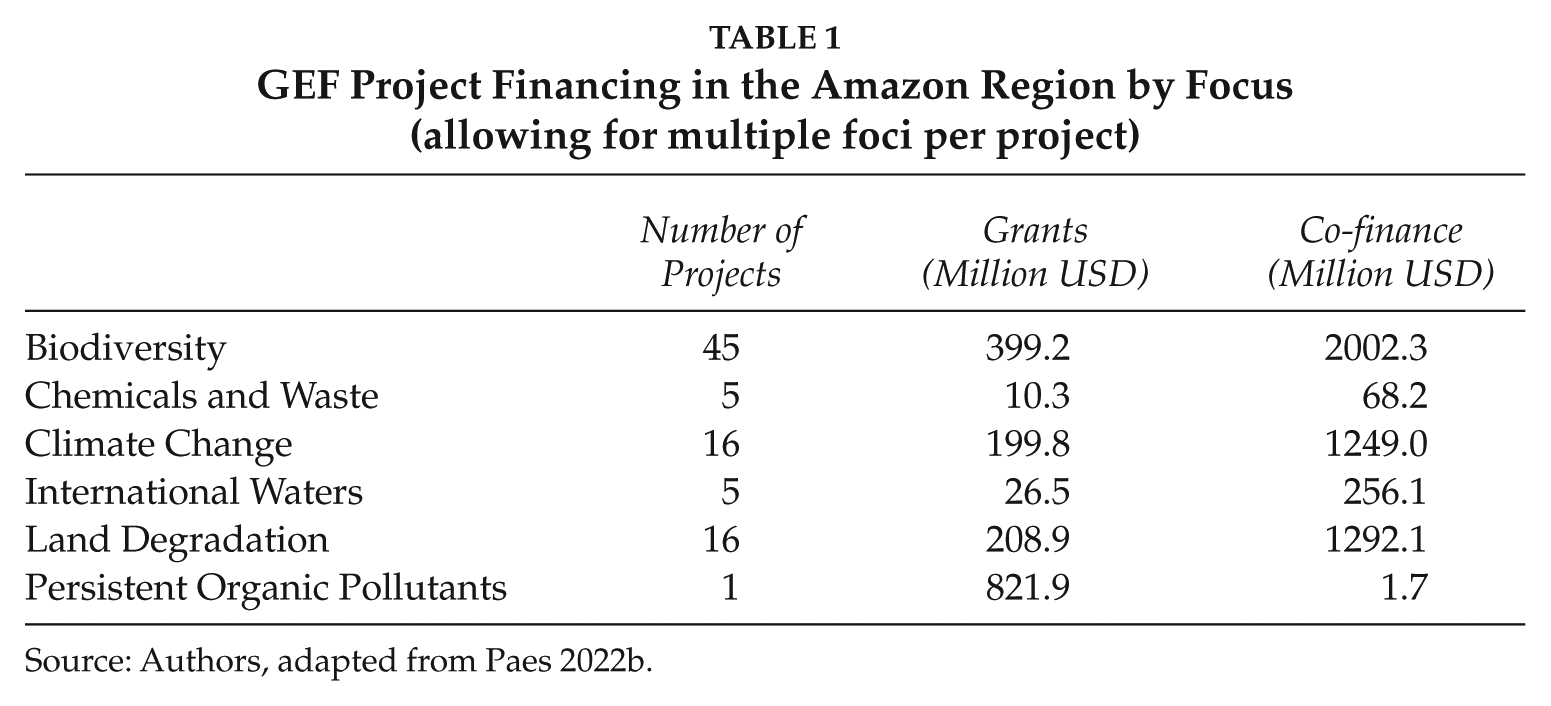
The empirical mapping of the stakeholder network presented in this article is based on an original dataset 2 produced from publicly available information in the GEF project repository database. 3 The dataset was compiled through four steps. The first step was the retrieval of all projects that were either implemented in one of the Amazonian states (Bolivia, Brazil, Colombia, Ecuador, Guyana, Peru, Suriname, and Venezuela) or that explicitly mentioned the “Amazon” ecosystem in the project name. Within this universe, the second stage was reviewing the project description to identify projects whose implementation directly involved the Amazonian biome. This final list resulted in the identification of a universe of 61 projects. Table 1 details project allocation by focus.
GEF Project Financing in the Amazon Region by Focus (allowing for multiple foci per project)
Source: Authors, adapted from Paes 2022b.
Having selected the number of projects to investigate, the third and crucial next step was systematically identifying stakeholder participation. This identification was done by reviewing all project documents listed in the GEF project portfolio repository. 4 Organizations were considered as participants in a project both if they were the executing agencies and if they were listed in the project’s documents as being a part of the project governance (i.e., in a steering or advisory committee) or as a partner in the project documents.
The fourth and final step was then coding each organization along four dimensions. First, organizations were classified by type: Donor Agencies, Environmental Advocacy Non-Governmental Organizations (ENGOs), Intergovernmental Organizations (IGOs), Indigenous Organizations, Industry Organizations, Labor Organizations, National State Entities, Research and Education Organizations, Firms, and Subnational State Entities. Second, organizations were classified by geographical origin, when explicit. Intrinsically, international/transnational organizations, such as IGOs or global NGOs (i.e. World Wildlife Fund or Conservation International), were classified as transnational. Third, organizations were classified as state-owned or privately controlled. This state classification included both national and subnational state entities, as well as research and education organizations and any other owned by the state. Finally, and most importantly, all organizations were classified as to whether they were predominantly located in the Amazon. Local organizations were those whose operations and facilities, as described on their websites, were predominantly placed within the Amazonian biome.
The resulting dataset was then compiled systematically to gather information on two levels. The first level gathered all information on each Amazon-focused project retrieved from the repository, such as GEF financing, recipient co-financing, and country of implementation, alongside the list of organizations participating in the project’s execution. The second level contained all the classifications made to each organization according to the above-cited criteria.
Network Analysis Methods
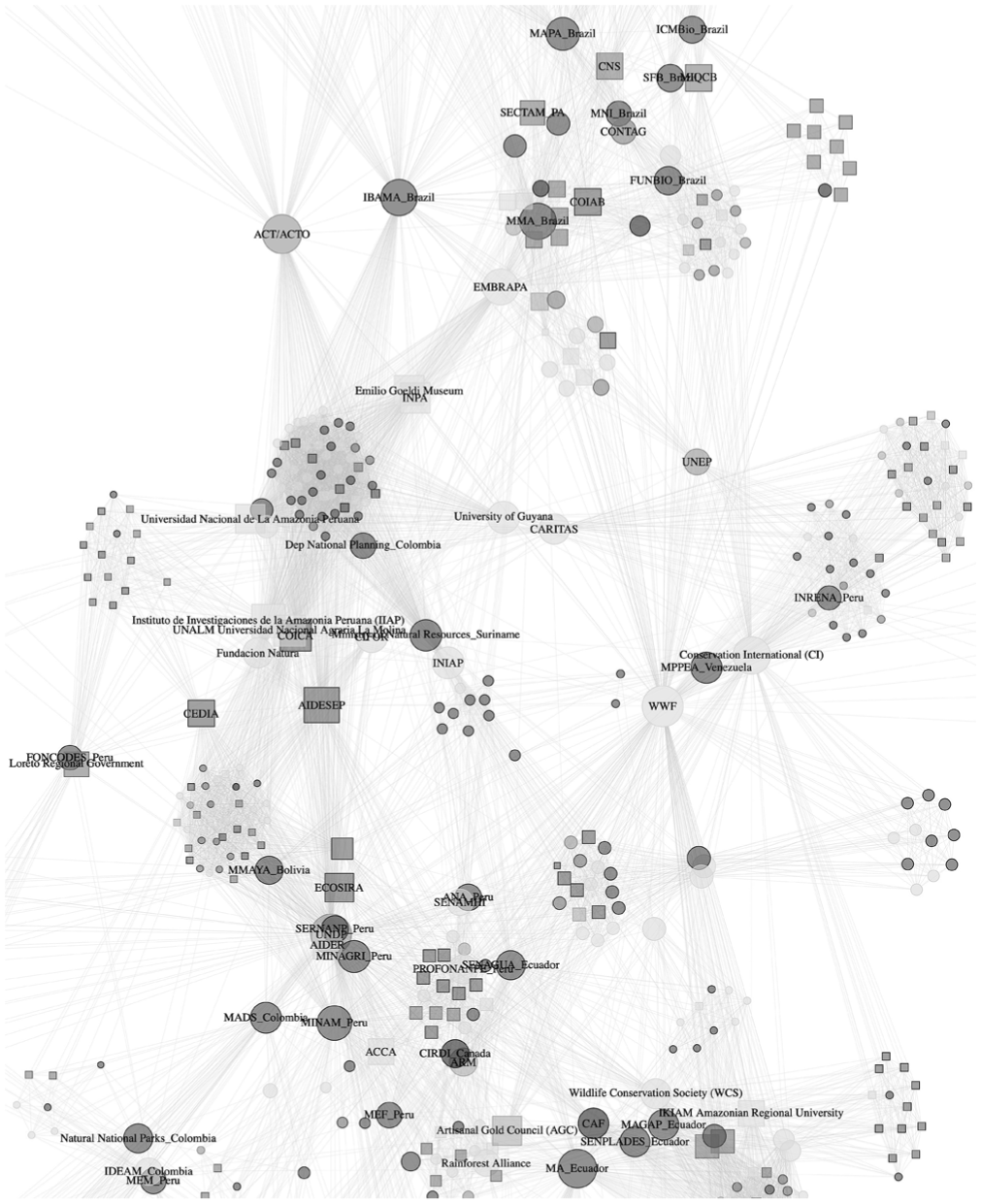
Our analysis of the stakeholder participation network is grounded on links of co-participation among organizations listed in the dataset. Each pair of organizations participating in the same project are thus linked together. Figure 1 depicts the core of the resulting network, in which square nodes depict local organizations, while other organizations that are not predominantly located in the Amazon are depicted as circles. The size of each node in Figure 1 reflects its bridging centrality (see below).
Stakeholder Participation Networks in GEF Projects in the Amazon Rainforest.
The zoom into the core of the network allows us to see the actors occupying most bridging positions linking different clusters in the network. As can be observed, linkages are mostly done by nation-wide state entities, such as ministries and other environmental authorities. This is not at all unexpected since recipient states are entitled to appoint the project’s executing agency (Alcañiz and Giraudy, 2023). 5 However, states are not the only type of organization occupying bridging positions. As shown in Figure 1, some ENGOs, IGOs, and Indigenous Organizations also occupy those central positions; the latter being the main type of local actor to do so.
A second pattern suggested in Figure 1 is the high level of variation in the mixing of ties among organizations. Even though not all clusters appear in the zoom, Figure 1 demonstrates that some clusters are entirely of the same type of organization, while others are with multiple types. We also see some clusters only with local organizations, a few others with none, and most with a combination of local and non-local actors.
To appraise those patterns more systematically, we make use of two sets of network analytical tools. First, we look at the distribution of ties, as well as bridging and bonding positions across organizations. Bridging positions can be measured by betweenness centrality (Alcañiz and Berardo, 2016), in the sense that it shows the proportion to which a given node in the network lies on the shortest path between any two other nodes in the network (Freeman, 2002; Borgatti, 2005). Bonding position can be measured by eigenvector centrality, which captures varying levels of embedding of an actor in a well-connected cluster. Eigenvector centrality takes into consideration the number of relationships an actor has, as well as the number of relationships held by those with whom the actor has a relationship (Bonacich, 1987). This measure is particularly relevant to this study as a means of understanding the hierarchies within those networks.
The second network analytical tool I deploy is the study of categorical homophily. Categorical homophily (or heterophily) is the level to which a given type of actor tends to have ties with those of the same type (or those of another type). We can unpack this homophily by looking at the mixing pattern matrix, which shows the proportion of ties among types (Newman, 2006). Understanding mixing patterns will allow us to better understand the types of inter-organizational relationships producing the patterns of inclusion and exclusion underlying the hierarchies revealed by the analysis of centralities.
Centrality and Power Positions
The distribution of ties among types of organizations confirms the predominance of national states in these networks, followed by subnational state entities, NGOs, and Indigenous organizations. Figure 2 shows the share of each type of organization by GEF Phase. Though there is some oscillation, overall distributions are fairly stable. The main change is the considerable expansion of Indigenous organizations in the latest cycle of projects, which is consistent with GEF’s extension of requirements for stakeholder participation. 6
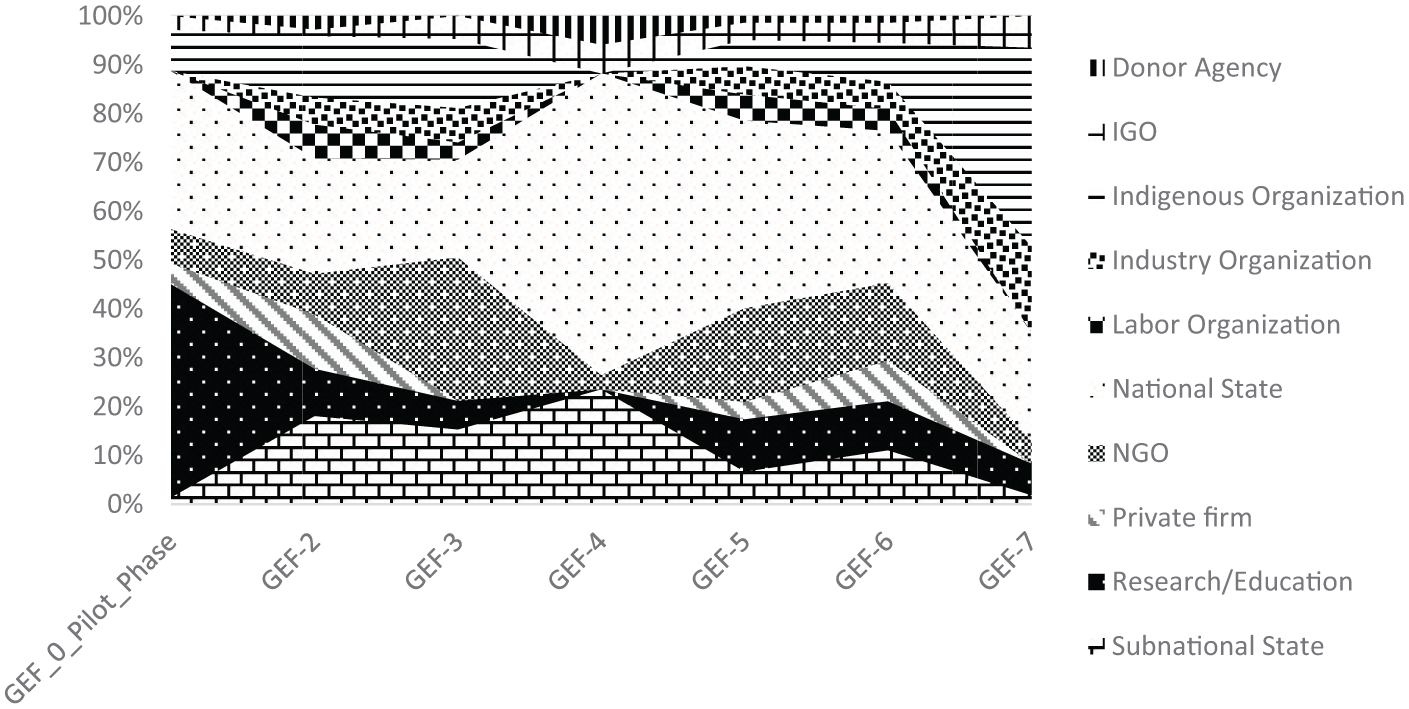
Share of Ties Among Types of Organizations by GEF Phase.
The data also shows increasing demand for local participation, with substantial growth in local participation in GEF-7 (2018-2022) compared to historical averages. Moreover, Indigenous organizations and subnational state entities, followed by industry and labor organizations, have the highest proportion of ties to local organizations. In the case of research organizations, NGOs, and firms, between 15 percent and 30 percent of actors are local, while for all other types, virtually no local organizations were identified.
Figure 3 shows the distribution of centrality scores for measures reflecting bridging (betweenness centrality) and bonding (eigenvector centrality) positions, including the distribution of both types of centralities across all projects, among local and non-local actors. Nation-wide state entities stand out as the main non-local actors occupying both bridging and bonding positions, while IGOs and NGOs also occupy a relevant share of bridging positions and research organizations of bonding positions. Research organizations occupy some of the greater share of both positions among local actors, along with Indigenous organizations. In this broader universe of projects, subnational state entities occupy a rather small share of positions among local actors. These results suggest that nation-wide state entities, NGOs, and IGOs are the main bridges among different projects in the network and control the flows of knowledge and resources. Indigenous and research organizations, in turn, are actors in bonding positions working as lynchpins of project clusters.
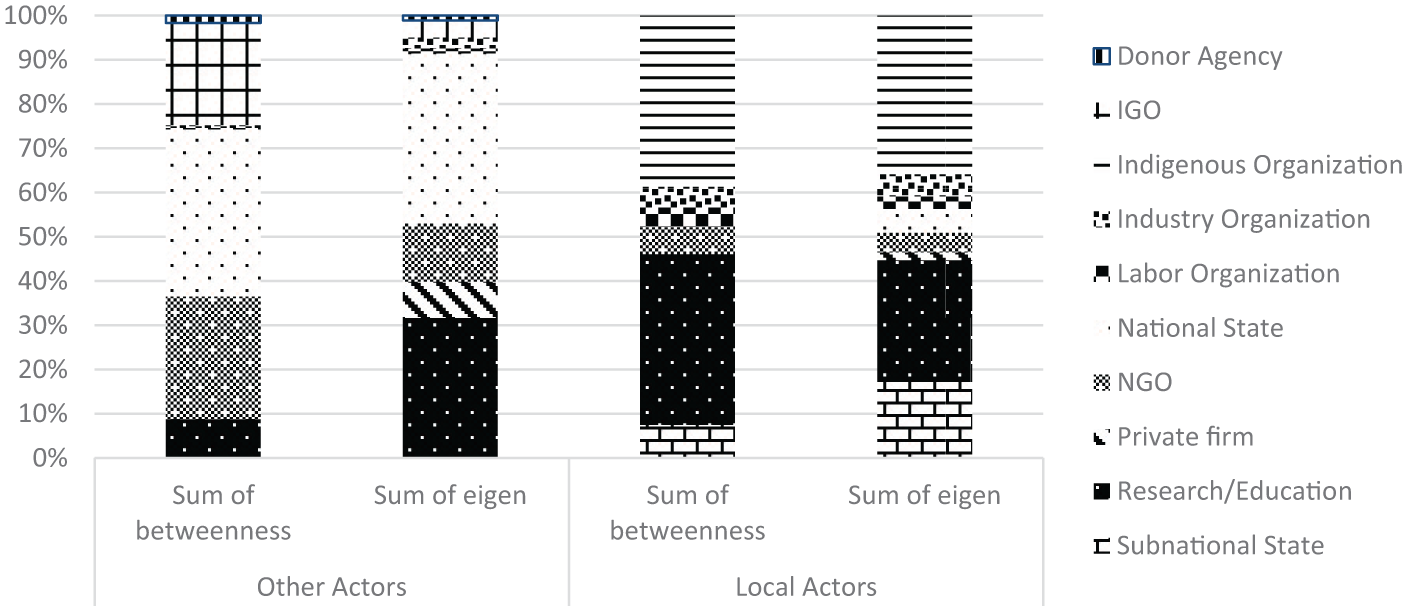
Distribution of Centrality Positions among Types of Organizations.
These patterns differ between countries. The distribution of centrality positions among types of organizations varies substantially depending on the recipient country. Yet broader patterns in local and non-local centrality can be identified. In terms of non-local actor centrality, we can see one pattern best exemplified by Brazil, where nation-wide state entities and NGOs predominate, and another, predominant elsewhere, where IGOs and NGOs stand out, with state actors mostly limited to bonding positions. At face value, it suggests that the national state occupies a different role in those projects in different recipient states, with most countries having a greater executive presence of IGOs, in behavior close to what global governance literature has called orchestration (Abbott, Genschel, Snidal, and Zangl, 2015).
This pattern is interesting in light of the recent findings that point to recipient state control over project design and application as a function of its levels of co-financing (Alcañiz and Giraudy, 2023). Brazil is indeed the country that has the highest share of project co-financing in the region. Still, while levels of control may matter, they do not dictate how and why each country may use it and decide which state and non-state actors to involve in the projects.
Regarding distribution of centrality among local entities, another pattern becomes visible when sorting by country. On the one hand, local centrality in some countries, such as Brazil, Colombia, and Guyana, is strongly concentrated in local state entities. On the other hand, in countries such as Bolivia, Ecuador, Peru, Suriname, and Venezuela, the centrality is distributed among other types of actors, particularly Indigenous organizations. Research organizations are the one type of organization that appears as central across recipient countries. This pattern defies easy explanations. Brazil and Colombia have had strong Indigenous movements across the period of analysis, as did other countries in the region. This diminished participation may be concealed by participation indirectly through other types of state and non-state actors. Still, the specific reasons for this variation in local engagement is puzzling and demands additional explanation.
Global-Local Linkages
The patterns of centralities identified in the network are ultimately a product of inter-organizational relationships: the selection by non-local actors of local actors as partners. Patterns of inter-organizational relations can be described by the mixing pattern matrixes provided in this section. Figure 4 provides the mixing pattern matrix for all ties, without distinguishing between local and other actors. Each cell shows the proportion of ties for each combination of type in terms of the total ties in the network. For instance, across the network, national state actors primarily have ties to research and education organizations, NGOs, Indigenous organizations, and other nation-wide state entities. Indigenous organizations similarly have most ties amongst themselves, but also with national state, NGOs, and research organizations. Relationships among these four types of organizations (national state, NGOs, research/education, and Indigenous organizations) in fact correspond to the majority of ties in the network.
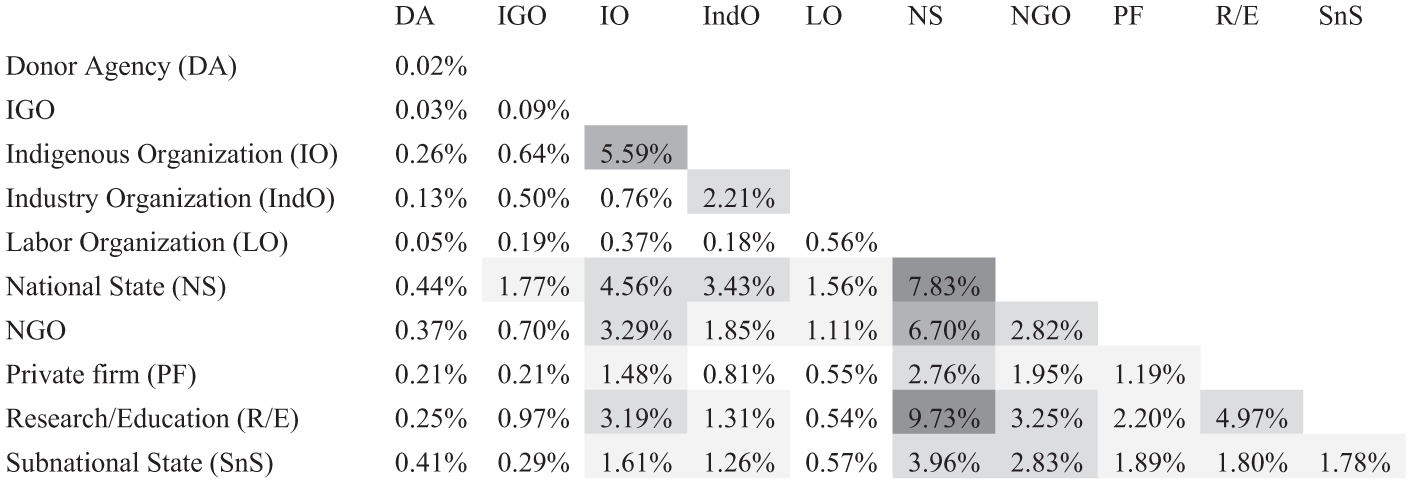
Mixing Matrix by Type of Organization – All Ties.
To better understand inter-organizational drivers of local inclusion, Figure 5 focuses only on the mixing patterns between local and non-local organizations. It shows that most of those linkages are between national states with both Indigenous organizations and substate national actors. For local Indigenous organization, the main other type of connection with non-local actors is with NGOs, followed by research organizations. For local subnational state entities, the main other types of partners are research organizations, followed by NGOs. Local and non-local research organizations are also an important type of connection, as shown in Figure 5. These patterns suggest the central role of national state actors in selecting both Indigenous and local organizations to participate in projects.
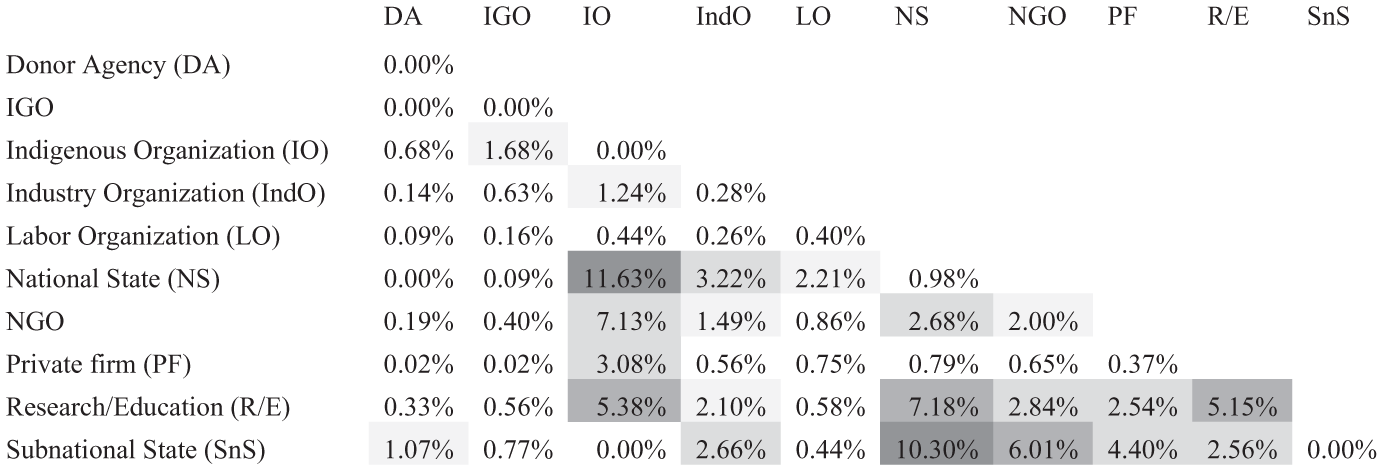
Mixing Matrix by Type of Organization – Local and Non-Local Ties (Overall).
Upon disaggregating the mixing patterns among local and non-local actors by country of project implementation, we find that most ties are indeed concentrated in the national state across all countries. In some countries, such as Bolivia, Peru, and Suriname, Indigenous groups concentrate such ties with non-local entities. In other countries, such as Colombia and Guyana, local subnational entities are those with ties across multiple other types of non-local organizations. Brazil differs from others by having local industry and research organizations alongside subnational entities as the main types of organizations with non-local ties. Ecuador, in turn, has a substantial proportion of local research organizations with such non-local ties along with Indigenous organizations.
Towards Understanding The Politics Of Global-Local Connections In The Amazon
The patterns of global-local connections discussed throughout this article point to potentially relevant political dynamics underlying the networks producing the multilevel governance of the Amazon. In that regard, they must be understood in light of the political struggles underlying such governance, with their long-standing structured asymmetries and contentiousness (Hecht and Cockburn, 1990). Global-local linkages between IGOs, NGOs, and Indigenous and traditional community organizations have been key for defending the Amazonian ecosystem and the livelihoods that benefit from its preservation (Keck, 1995, Bratman, 2019). Hence, the prevalence of such linkages in the networks analyzed show how they can still play a key function in the building of multilateral environmental projects in the region.
At the same time, the centrality of state actors and the role of sub-national entities, particularly in Brazil, demonstrates the consolidation of the state as a key arena for shaping the Amazonian governance. On the one hand, this can mean that the state can be the focus of multiple interest groups with multiple views for the Amazon, but, on the other hand, it shows the importance of efforts by Indigenous organizations and leaders to gain space within the state and influence policy. More importantly, it showcases the importance of the multiple jurisdictions of Brazil as such spaces for producing Amazonian governance.
These patterns gain even more relevance in the context of calls for polycentric arrangements in global environmental governance by showing how the local-global linkages composing such governance can be varied and infused with power relations. The analysis shows that direct transnational civil society linkages can be an avenue for local stakeholder engagement in the fight for environmental justice. At the same time, it shows how that strategy can be limited by, if not combined with, a strategy to occupy democratic spaces within the state across different jurisdictional levels. Mapping these topographies is thus just but one step in understanding these political dynamics of navigating the multilevel governance of the Amazon. The emerging hierarchies and positions must then be understood as part and parcel of political processes allocating resources, authorities, and knowledge. It is in understanding the power relations and processes that produce and animate these topographies that we must advance toward understanding the politics of global-local connections in the Amazon.
Conclusion
The analysis of stakeholder participation networks in GEF projects brings to the fore patterns of hierarchies and dynamics of inclusion in global-local connections in the Amazon Rainforest. Foremost, the analysis showcases how the construction of the local and its representation in global governance arrangements is subjected to variation and likely rife with political dispute. Within this delimited universe of projects, this article demonstrates some considerable variation among the types of actors that produce local linkages, the types of local actors being included, and the types of positions occupied by those actors.
Overall, across projects and countries of implementation, this analysis shows that most bridging positions are concentrated in non-local actors, predominantly in national state actors, NGOs, IGOs, and research organizations. This result is compatible with both the structure of GEF, which is governed by global NGOs and IGOs and operates through state-steered grants (Alcañiz and Giraudy, 2023), as well with broader patterns of transnational governance where these actors indeed tend to occupy coordinating roles (Gebara, Fatorelli, May, and Zhang, 2014; Di Gregorio et al., 2017; 2019). Still, our analysis shows that some local organizations, particularly Indigenous and research organizations, play both bridging and bonding roles, being embedded in local clusters as well as bridging their clusters with the broader network.
However, this pattern is not homogenous across countries. In projects operated in some countries, such as Brazil, the centrality of national state entities and NGOs is even more salient, whereas in most others, NGOs and IGOs are the most central actors. As previously observed, this pattern is consistent with findings about the dual character of GEF projects (Alcañiz and Giraudy, 2023). For some countries, these projects can be a way of supplementing government capacity with little added funds, while for other states, the projects only complement the government initiatives in which they have already invested as much or more. Recipient countries also differ in terms of which local entities are most central in the projects. For Brazil and Colombia, most central local partners are subnational state entities, while for most other states, Indigenous organizations are the most central local partners. This pattern is consistent with the more specific finding by Alcañiz and Giraudy (2023), according to which states with greater control over GEF project allocation will prioritize subnational entities with electoral motivations. Additional research is necessary to adjudicate the reasons behind this variation in hierarchies of local actors’ positions across the countries in the region.
The analysis also delved into the mixing patterns among types of local and non-local organizations producing the hierarchies of those networks. It showed how national states are the main linkage to both local Indigenous organizations and subnational state actors, followed by NGOs and research organizations. The main source variation in those linkages is also then across countries, with some of them having Indigenous organizations as the main hub between local and non-local ties, and others having subnational state entities as that hub. Countries then vary more widely in terms of which non-local actors each type of local actor connects to, apart from nation-wide state entities.
All in all, the analysis in this article shows strong variation in global-local connections in the environmental governance of the Amazon Rainforest across projects. The patterns identified here highlight the need for understanding the interplay between state and non-state actors in shaping those networks born out of an intergovernmental mechanism. Understanding the varying ways in which project proponents, state authorities, and the funding bodies interact is crucial for further specifying the explanatory mechanisms producing the patterns identified. Furthermore, the considerable level of variation in global-local engagements across GEF projects within the same region (a funding instrument with relatively low governing complexity) puts in evidence the need for additional comparative research on patterns of global-local entanglements amidst the growing number of instruments for environmental governance. Understanding which factors, both within states and within different types of initiatives, drive varying participation outcomes is necessary for ensuring equitable architecture for the governing of our planet’s environment.
Footnotes
Acknowledgements
The author disclosed receipt of the following financial support for the research, authorship, and/or publication of this article: This article is part of the project ‘Rebundling sovereignty over local nature in global governance’ (RESOLVING) funded by the Research Council of Norway (RCN) (project number 344903).
Notes

Lucas de Oliveira Paes is a Senior Researcher at the Norwegian Institute of International Affairs (NUPI) in the Global Order and Diplomacy Group.