




Abstract
This article examines the shifting rural social relations in Paraguay’s soybean complex, with a specific focus on the role of farmer cooperatives in the commercialization of Paraguay's agriculture. Drawing on fieldwork conducted in the departments of Itapúa and southern Alto Paraná in 2021 and 2022, this paper adopts an agrarian political economy perspective to argue that cooperatives in Paraguay serve as a stabilizing force by buffering against farming risk and mitigating the rise of reproduction costs. This dynamic allows for the differential incorporation of medium and some small-scale farmers, while contributing to the consolidation of the hegemonic export-oriented agri-food system, with all its associated implications. The article also contextualizes the analysis of contemporary cooperatives by providing a historical overview of the uneven development and concomitant regional variations in Paraguay’s soybean agriculture, and engages with broader historical debates on the potential of cooperative organizations in a capitalist context.
Keywords
Over the past half-century, the eastern region of Paraguay has experienced significant rural transformations as a result of the rapid expansion of the agricultural frontier and the increased predominance of capital-intensive, large-scale farming. The rise of soybean as a paradigmatic flex-crop, with its multiple uses and its downstream linkage with the “feedlot method” of livestock rearing at a time of rising beef consumption worldwide, led to a surge in the market value of soy and its derivatives (Weis, 2013). This, in turn, triggered a rush to expand cultivation in Paraguay and its neighboring countries. The introduction of genetically modified crop varieties, and development of a package of complementary agro- and biotechnologies for successful cultivation, expanded the range of suitable agrological conditions while promoting economies of scale and increasing entry costs.
This boom in soybean extraction (1990–2012), coupled with a broader upturn in commodities markets, coincided with related processes of deindustrialization and economic reprimarization in much of Latin America, making export-oriented agriculture a key growth sector in the region. In the case of Paraguay, where import substitution industrialization (ISI) had not been significant, this period represented the country's most profound incorporation into global markets. The attendant rationalization of rural landscapes and social relations to suit the productive demands of a global “corporate food regime” (McMichael, 2013) has been the subject of numerous critical scholarly interventions, as have the ensuing crises of displacement and ecological devastation (see Ezquerro-Cañete, 2016; Mckay, Alonso-Fradejas, and Ezquerro-Cañete, 2021).
A significant portion of this critical scholarship has focused on two key dimensions. First, it has examined the dominant corporate actors driving this process, particularly the multinational giants of the global agri-food system (see, for example, McMichael, 2013; Wesz Jr., 2016). Second, it has explored the ecological devastation and the displacement faced by the numerous victims of the new international division of labor, as well as their multiple forms of resistance (Borras and Franco, 2013; Vergara-Camus, 2013). 1 A potential drawback of this dual emphasis is that it may inadvertently overlook the diverse range of actors through which the dominant food system articulates its hegemony within the reconfigured social space.
Drawing on fieldwork conducted in 2021 and 2022, this paper contributes toward addressing this gap by examining a relatively understudied aspect of Paraguay’s soybean agriculture—the farmer cooperatives in the southeastern region, specifically in the departments of Itapúa and southern Alto Paraná. In doing so, the paper critically engages with broader discussions on the transformative potential of cooperatives within the context of unfettered capitalist relations. Agricultural cooperatives, as highlighted by Kees Jansen (2015: 219), are dynamic components of contemporary global agribusiness. In Paraguay, these have played a pioneering role in the capitalist modernization of agriculture and remain central actors in defending the new agrarian status quo.
This paper will examine the mediating role of agricultural cooperative organizations in Paraguay’s soybean complex, by employing a political economy perspective. The analysis focuses on two aspects of this role: (1) At a meso level, I discuss the mediation of cooperatives in processes of rural socioeconomic differentiation, while also examining how they are shaped by these processes at both the intra- and inter-cooperative level; 2) At a macro level, the analysis explores the role of cooperatives in Paraguay’s consolidation as a supplier of agricultural commodities in the international division of labor. The argument posited is that cooperatives function as a stabilizing force by absorbing farming risk and mitigating the increase of reproduction costs for specific segments of farmers. Paradoxically, this support contributes to the perpetuation of the hegemonic agri-food system in the Paraguayan context.
The paper commences by introducing the key conceptual elements that underpin the analytical framework. It then provides a brief historical account of the early role of cooperatives in Paraguay’s agricultural modernization, followed by an overview of the agrarian structure in southeastern Paraguay and its development. Subsequently, a description is provided of the cooperatives and their affiliated farmers, followed by an analysis of their mediating role in agricultural production. Finally, the paper concludes by offering reflections on the potentialities and limitations of Paraguay’s cooperative structure given the present context.
Theoretical Framework And Research Methods
This research draws on an agrarian political economy perspective to examine the multiple historical processes and social relations that shape agrarian systems. The study of agrarian change under capitalism, as Terence Byres (1995) aptly argues, necessitates an examination of capitalist accumulation and the mechanisms through which its logic permeates social relations in the countryside and transforms the technical conditions of agricultural production. This entails a shift in the motive force driving cultivation from the creation of use-values for sustaining life to the production of exchange values. The increasingly ubiquitous presence of capitalist relations in rural contexts fuels the commodification of livelihoods and nature, a process that is both driven by and further enables integration into the international division of labor.
This process often involves the dispossession of rural populations through force, fraud, and oppression (Luxemburg, 2003: 432). However, as Bernstein (2010) emphasizes, rural displacement also results from the seemingly normal or transactional process of accumulation through the expanded reproduction of capital. As farming becomes oriented toward commodity production, those who can appropriate a surplus, accumulate, and enhance profitability become implicated in the appreciation of entry costs and associated risks. Consequently, competition for land and resources intensifies, thereby squeezing impoverished farmers out of agricultural production or into indebtedness. While some manage to reproduce their enterprise on a small scale, others struggle and are compelled to reduce consumption or seek alternative sources of income to avoid sliding into the ranks of the unemployed (Bernstein, 2010: 104–108). The introduction of mechanized and high-input, science-driven farming techniques, which Mckay, Alonso-Fradejas, and Ezquerro-Cañete (2021) refer to as corporate-led, external-input plantation agriculture (CEPA), has further intensified this process by accelerating the obsolescence of agricultural processes and locking farmers into a technological treadmill.
The processes of capitalist agrarian change, however, do not advance homogeneously; instead, they confront historical obstructions and exhibit unevenness, leading to variations in development. Moreover, agricultural production, reliant on natural ecosystems, poses challenges in terms of industrial rationalization compared to other sectors. Farming, therefore, carries higher economic risks due to its inherent unpredictability, and not all agricultural activities and staples are equally amenable to the substitution of labor with capital. This results in a greater diversity of production units and subsistence strategies (Bernstein, 2001: 27–28). Furthermore, the significance of land as a factor in agricultural production imbues the sector with a profound territorial dimension. This accentuates a tension within capitalist production between the spatial fixity of the production process itself and the increasingly deterritorialized flows of commodities and monetary capital (Albo, 2004: 91).
Further countervailing or co-determining tendencies in capitalist agriculture may stem from the diverse characteristics of pre-existing agrarian systems. The expansion of the commodification frontier thus unfolds in diverse ways, in some cases advancing through extension into sparsely inhabited territories, in others through wholesale population displacement, yet in many cases through the subsumption of pre-existing agrarian formations. The latter process often unfolds gradually and piecemeal as capital “takes the technical process of production as it finds it, and only subsequently subjects it to technical transformation” (Lenin, 1960: 466). Akram-Lodhi (2007) further observes that in rural economies undergoing incorporation into global capitalism, a “bifurcated agrarian structure” frequently emerges. In this configuration, two structurally distinct yet interconnected productive sub-sectors functionally coexist. One is export-oriented, while the other—of a more peasant character—is marked by a labor-intensive production coefficient, lower levels of capitalization, and a higher degree of production for household consumption or the domestic market. The advantages of this bifurcation, from the perspective of capital, lie in its facilitation of the expansion of commodity production, while ensuring the ready supply of a rural labor force.
Akram-Lodhi notes, however, that the latter smallholding sub-sector is not homogeneous; marginal differences in the ability of farmers to capture economies of scale enables some to become “differentially incorporated” from below into export-oriented markets for agricultural commodities (2007: 1447–1449). Small-scale farmers may additionally resort to productive arrangements, such as contract farming or cooperatives to partially mitigate competitive disadvantages and remain active in the profession (Carter, Barham, and Mesbah, 1996: 41–42). As the findings of this study will suggest, agricultural cooperatives may also serve as a nexus at the interstices of productive sub-sectors, by facilitating the incorporation and subsequent attachment of small-scale producers to global value chains.
This seemingly paradoxical quality of cooperatives is arguably related to the dual roles inherent in their organizational form given a context of predominantly capitalist agrarian relations. From a technical standpoint, cooperatives offer a means to scale up production without the need for "horizontal concentration," or the amalgamation of smaller units into larger ones (Chayanov, 1991: 9). This feature is closely linked with the social role of cooperatives, which can serve as a platform for mitigating individual risk, granting access to otherwise inaccessible resources, and enabling economic empowerment through the democratic control of the enterprise. This, in turn, can lead to greater social cohesion and community development. However, in their role as a specific variant of the process of vertical integration, cooperatives may also fulfill a functional market role, particularly in fragmented agrarian structures, by addressing coordination challenges stemming from the dispersion of supply points relative to the concentration of demand. Indeed, as discussed in the following section, this tension between social and market roles has been at the heart of debates surrounding cooperatives since their inception.
The Cooperative Debate In Historical Perspective: A Brief Overview
The modern cooperative movement originated in 18th and 19th-century Europe as a response to the social upheaval resulting from rural land enclosure and the exploitative relations of capitalist industrialization (Patmore and Balnave, 2018). The founders of early cooperatives were inspired by the utopian social experiments of Scottish industrialist Robert Owen. Cooperatives were initially envisioned as part of self-sustaining communities that could achieve a degree of autonomy from market compulsion through reliance on the production of their members (MacGillivray and Ish, 1992: 7).
Other early influences included Wilhelm Raiffeisen, the founder of credit unions in Germany, the utopian socialism of Charles Fourier, and early backing from the Fabians. The cooperative ideal matured theoretically in the writing of Charles Gide in France and was codified into a set of principles by the Rochdale Society of Equitable Pioneers, an English consumer cooperative, in 1844. These principles, later adopted by the International Cooperative Alliance (ICA), include: open and voluntary membership; democratic member control; equal and fair economic participation; political autonomy; inter-cooperative cooperation; and concern for the community and the environment (Williams, 2016: 10–15).
While the above principles appear broad in scope, they leave ample room for interpretation. Two of these principles demand closer scrutiny, as they speak to the ambivalences that have characterized actually existing cooperativism historically. The first, emphasizing equal and fair economic participation, has commonly been constrained in its application to the cooperative organization itself, its capital, the surpluses generated by it, and any agreed-upon membership contributions. From this perspective, the economic participation principle allows for formal neutrality concerning property relations outside the cooperative, including the privately owned means of production of its members, should these exist. In a related vein, the principle of political autonomy has largely translated into apoliticism in the historical course of the Rochdalean cooperative tradition. As Labarca notes, this emphasis on formal democratic principles, coupled with a myopic view of the structural dynamics of the capitalist market, allowed this framework to travel well in an era marked by the consolidation of a hegemonic liberal ethos (2016: 29). Early critics of this tendency included Fabian socialists Potter and Webb, who claimed in 1920 that cooperatives tended to “fail or degenerate into capitalist firms” (cited in Kasmir, 1996: 206). In a late-19th-century polemic against Eduard Bernstein, Luxemburg (1970: 36) stated that cooperatives function as a “hybrid form in the midst of capitalism,” forced to assume an entrepreneurial role despite the persistence of an internal ethics of mutual aid.
As cooperative ideas spread throughout Europe during the 19th century, questions surrounding their transformative potential became a focal point in rural debates in pre- and post-revolutionary Russia. Danilov (1991: xiv-xvi) notes that Russian economists such as Prokopovich and Tugan-Baranovsky held ambivalent positions on the question. Cooperatives were perceived as being inherently non-capitalist, yet unable to resist market pressures. Others questioned whether their principal function was to better incorporate the peasantry into market relations.
A central figure to emerge from these debates was the agrarian economist Alexander Chayanov (1991: 3–6), who advocated for cooperative organizations as a vertically integrated solution for addressing challenges faced by peasants in the context of emerging large-scale industrial agriculture. However, Chayanov’s Theory of Peasant Co-operatives is inseparable from his larger theory of the peasant economy, whereby resilience to capitalist market pressures emanates from the peasant economic unit, which might be assisted by the cooperative form. Additionally, he advocated for cooperatives as part of an integral program of socialist agrarian reform. There is little to suggest, therefore, that Chayanov perceived cooperatives to be capable in themselves of standing above class relations and economic structures (Chayanov, 1991: 17). With these debates on the role and nature of cooperatives in mind, this paper now proceeds to outline the research methods employed for this study, followed by a discussion of the historical emergence of cooperatives in Paraguay, and a presentation of the findings obtained through on-site research.
Data Collection Methods
Considering the multi-level nature of the subject matter, a mixed-methods triangulation approach was adopted for the purpose of this research. The twofold aim was to examine the role of cooperatives in the broader transformation of Paraguay's agricultural sector and to assess their impact on the livelihoods of medium and small-scale farmers in soybean-producing regions. The cooperative organizations contacted for participation in this study were selected on the basis of their prominence in Paraguay's national cooperative organizational structure and their involvement in the soybean industry. During the exploratory phase, eight of the ten organizations contacted consented to participate and demonstrated a willingness to engage throughout the process.
Qualitative data was collected through on-site observations and semi-structured interviews completed over the course of 14 visitations at eight cooperative organizations and two week-long stays at cooperative-owned and operated facilities between 2021 and 2022. A total of 25 participants, consisting of farmers, agronomists, cooperative staff, and key informants were interviewed in person on condition of anonymity. Due to barriers of organizational insularity, interview participants initially consisted primarily of cooperative representatives or authorized personnel. Subsequently, the range of participants was broadened through on-site snowball sampling. 2
Semi-structured interview guides were designed with an ethnographic focus and addressed topics such as participants' biographical information, household finances, farming operations, sources of livelihood stress, and their perceptions of the cooperative's role in society. Interviews also aimed to gather in-depth insights into participants' perspectives on political issues concerning agriculture, such as land disputes, the government's role in rural development, and environmental regulations. Various institutional documents, including promotional brochures, year-end reviews, and historical narrative accounts, were provided by the cooperatives. Interview transcripts, primary documents, and memos created during the data collection process underwent a preliminary open generative coding process and a subsequent iterative thematic analysis to identify significant patterns and themes. Secondary quantitative analysis was conducted using publicly available census statistics and internal data provided by cooperatives. A variety of media reports and academic sources were also consulted, many of which were written by local authors. The latter proved crucial in developing a historical account of the rural context from which Paraguay’s cooperative organizations emerged, as the following section will discuss.
Settlers, Cooperatives, And The Absent Presence Of The State
Cooperative forms of social organization possess a deeply rooted historical tradition within the region, predating the arrival of European colonization. As research by Fogel and Scappini (2012) detailed, the Guaraní system of social reproduction revolved around the tekoha, an autonomous community distinguished by familial bonds and a prevailing ethos of communal utilization of land and resources. The principles of reciprocity and solidarity, encapsulated in the concept of jopoí, governed exchange among the diverse tekohas. Furthermore, the practice of non-remunerated collective and festive work, known as mba ‘e pepy, along with the customary redistribution of resources during religious rituals, constituted integral facets of the Guaraní social fabric. This mode of social organization subsequently proved instrumental in the Jesuits’ endeavor to establish a republic comprised of thirty Guaraní missions (Fogel and Scappini, 2012: 31–34; Meliá, 1996: 204–205; Vargas-Sánchez and Nacimiento Coronel, 2000: 191).
During the early 20th century, cooperative organizations of a European variety made their initial entry into Paraguay through the Mennonite colonies of the Chaco Boreal. Notably, some of the country’s oldest and largest co-ops can be found in the Mennonite towns of the western department of Estigarribia, with Cooperativa Chortitzer being the country’s largest with over 7,000 affiliated farmers (Cooperativa Chortitzer, n.d.). Traditionally, these cooperatives and their members have focused on livestock and dairy farming but are increasingly finding success in soybean cultivation due to the latest innovations in seed science and technology (Glauser, 2009: 57).
The migration of Menno communities to Paraguay exemplifies a recurring historical pattern in the country, characterized by the establishment of ethnically homogeneous and self-isolating rural communities. Such communities frequently aimed to escape perceived government overreach in their countries of origin and deemed Paraguay to be a relatively “empty space” for the purpose. While Mennonites are renowned for their austere lifestyle, they have played a pioneering role in commercial agriculture in Paraguay, with an orientation toward commodity production, mechanization, and the expansion of land holdings. The Mennonites were proficient in procuring agricultural technology and securing financing and technical assistance from friendly entities abroad—a knowledge transfer replicated by Paraguay’s broader cooperative movement (Fogel, 2001: 30; Flecha, 2016: 43–44).
Upon establishing colonies in Paraguay, the Mennonites formed cooperative-style “civil associations,” as recognized in Paraguay's Commercial Code at the time. The Chortitzer Colonizing Association was founded with a mission that featured various governance functions beyond farming, including the colony's social, economic, health, and educational needs. This multi-purpose conceptualization of the cooperative’s function as a central hub for community economic and social life would subsequently influence the agricultural cooperative movement in Paraguay more broadly (Pastore, 1972: 306; Flecha, 2016: 33–34).
Similarly, in the southeastern department of Itapúa, cooperatives were established primarily in response to a lack of public infrastructure, services, and state support for rural development (Flecha, 2016: 73). In 1953, the Colonias Unidas cooperative was launched by 78 colonists, predominantly of German-Brazilian descent, to address the needs of farmers in the Hohenau, Obligado, and Bella Vista colonies. Over time, Colonias grew to become the second-largest cooperative in the country and a leader in soybean cultivation. Similarly, the later brasiguayo 3 cooperatives in Naranjito and Pindo, established during the 1980s and 1990s, emerged in response to deficiencies in transportation, storage, and marketing infrastructure in eastern Paraguay (Arrúa, Garcia, Ortega, and Zevaco, 2020: 80; Interview with Pindo Cooperative member, San Cristóbal, April 07, 2022).
In 1960 and 1961, a bilateral agreement between the governments of Paraguay and Japan led to the establishment of the Japanese colonies of Pirapó in Itapúa and Yguazú in Southern Alto Paraná, with the vital support of the Japanese International Cooperation Agency (JICA). The acquired lands were subdivided, and prospective settlers organized the cooperatives prior to migration, as crucial elements in the colonization strategy (Arrúa, Garcia, Ortega, and Zevaco, 2020: 80). A continuing partnership with JICA has subsequently facilitated the provision of development assistance, technology transfer, and trade privileges with Japan. Notably, the Yguazú cooperative became the country's pioneer in adopting no-till cultivation techniques in 1983, also collaborating closely with the Center for Agricultural Technology in Paraguay (CETAPAR) to promote its widespread adoption (Kitanaka, Fujishiro, Hosono, and Ito, 2022: 37).
Prior to the onset of the soy boom, the cooperatives made various attempts to cultivate and export cash crops such as cotton, cassava, sugar, tung oil, and yerba mate, but with only moderate success. Efforts toward greater trade integration appear to have been constant even before the mass influx of gaúcho 4 soybean farmers. What appears to have changed most significantly in the subsequent period from the perspective of these cooperatives was the emergence of opportunities in the global agri-food system, which they were well positioned to exploit due to their existing infrastructure, capital assets and land resources (Wesz Jr., 2022: 321; Kitanaka, Fujishiro, Hosono, and Ito, 2022: 23-25).
Uneven Colonization
Throughout much of its post-independence history, Paraguay remained largely on the periphery of global trade and capital flows, but by the end of the 20th century, it emerged as one of the more favorable environments in the region for the extraction of agricultural commodities. The agricultural sector has come to play an outsized role in Paraguay’s economy, contributing approximately 35 percent to GDP. Soybeans dominate the sector, representing 46 percent of the country's export revenue and occupying 56 percent of its cultivated farmland. Paraguay has consistently ranked among the top three to six global soybean exporters over the past decade, and is frequently among the top 10 beef exporters worldwide (World Bank, 2014: 10, 17). As previously noted, the global demand for soy has in large part been fueled by its usage as an input in the production of animal feed. As a leading exporter of both beef and soybeans, Paraguay has thus been doubly incorporated into the extractive frontier of what Weis (2013: 65) termed the “grain-oilseed-livestock” complex, a central node in the global food system. This transformation of the country’s agrarian economy came at a significant cost, not the least of which was the sacrifice of approximately two-thirds of eastern Paraguay’s Atlantic Forest Ecoregion from the early 1970s to 2000 (Huang, Kim, Altstatt, Townshend, et al., 2007: 460). A critical factor enabling this process was the prior state control of extensive territories, which could subsequently be leveraged for political advantage in the establishment of a new epicenter for the country’s economic growth.
Land distribution has become a focal point of social and political conflict in the country’s recent history, primarily due to the combination of political cronyism, incompetence, and violence that characterized the eastern colonization process since the 1950s. Indeed, Paraguay has become notorious for its highly unequal land distribution, with an estimated 60–80 percent of land reportedly controlled by a mere 2–3 percent of the population (Office of the High Commissioner of Human Rights, 2016). However, upon closer examination at the departmental level, substantial variations appear, with the western departments of the Chaco boreal exhibiting considerably higher levels of land concentration. Moreover, within the predominant soy-producing departments in the East, the concentration of arable land is particularly pronounced in the northeastern departments of Canindeyú and Alto Paraná, coinciding with a greater prevalence of land ownership by persons of Brazilian origin (Pereira, 2018: 79; Ministerio de Agricultura y Ganadería, 2023: 50, 88–91).
Research on the development of eastern Paraguay has stressed the implications of Brazil’s rolling frontier policy during the 1960s-80s, particularly in the border departments of Alto Paraná, Canindeyú, and Amambay (see Nickson, 1981; Wilson, Hay, and Margolis, 1989). The subsequent emergence of a highly concentrated agrarian structure, coupled with extensive corporate penetration of farming in that region, has come to be seen as paradigmatic of the development of soybean agriculture in Paraguay more generally. However, the southeastern department of Itapúa presents some key differences, while remaining the country’s second-highest soybean producing department after Alto Paraná. Notably, Itapúa is characterized by a relatively more fragmented land structure, a higher level of smallholder integration into commercial agriculture, and a more diversified output (Hetherington, 2020: 228; INBIO, 2023; Instituto Desarrollo, 2012: 9, 42). Another historical divergence between these two leading soy-producing departments is the prominence of cooperative farming relative to corporate agriculture. In Itapúa, co-ops have long been at the forefront of service provision, including technical assistance and agricultural credit, and have also played a significant role in grain storage, handling, and marketing. According to the 2022 census data, Itapúa remains the department with the highest number of cooperative farmers by a wide margin. By contrast, the share of agricultural services provided by co-ops has historically been less significant in Alto Paraná, although recent census statistics 5 suggest that cooperative farming is on the rise in that department (Ministerio de Agricultura y Ganadería, 2023: 170–174, 181–182; Instituto Desarrollo, 2012: 46; Arrúa, Garcia, Ortega, and Zevaco, 2020: 79).
Two pivotal factors associated with the shifting trajectory of the colonization process appear to have contributed to this structural divergence. First, the agricultural colonization of Itapúa commenced at an earlier stage with the arrival of European migrants in the southern region of the department during the 1930s. By the 1950s, the colonization process had gained significant momentum, with the establishment of publicly managed agricultural colonies driven by the 1940 Agrarian Statute, which included a crucial provision imposing a maximum parcel size of 20 hectares. However, following Stroessner's assumption of power in 1954, colonization in the eastern region rapidly intensified. Subsequently, a new Agrarian Statute was drafted in 1963, eliminating the constraints on parcel size and lifting the previous prohibition on land sales to foreigners in border areas (Fogel, 2001: 43–45; Villagra and Areco, 2017: 113).
The second significant factor relates to the evolving composition of agricultural colonies, as the focus of settlement shifted towards the northeastern border departments. In particular, there was a gradual decrease in the establishment of publicly managed colonies and a corresponding increase in the number of private colonies between 1967 and 1977. These private colonies were predominantly initiated by colonizing companies based in Brazil, which acquired substantial parcels of Paraguayan land, often exceeding 20,000 hectares, and subdivided them for sale to private individuals. This transition roughly coincided with the closure of the frontier in Itapúa and its continued expansion in the departments of Alto Paraná and Canindeyú into the 1980s (Nagel, 1991: 109–110; Heikel and Palau, 2016: 22–29). Over time, the initially fragmented land structure in Itapúa underwent significant consolidation. In fact, Fogel (2001: 49) highlights that this process was already underway in the 1950s as immigrant farmers acquired occupancy rights from Paraguayan colonists. However, land concentration advanced in a far more uninhibited manner in regions where unequal distribution occurred at the moment of allocation (Schvartzman, 2017: 210–211).
Labor Displacement And The Precarious Persistence Of Petty Commodity Production
The emergence and widespread adoption of genetically modified soybean varieties in the 1990s triggered substantial changes in the technical organization of farming by facilitating the development of a suite of complementary labor-saving technologies. The capital-intensive and scale-biased nature of the technological package that rapidly became the norm for soybean cultivation had profound implications for agricultural labor. The rural poor were thus impacted by mutually reinforcing labor-displacing tendencies: (1) that of the socioeconomic differentiation inherent in the expanded reproduction of capital, and (2) a positive relationship between productivity and capital intensification in the newly implemented farming techniques. This shift in relations and forces of agricultural production resulted in the severe contraction of rural labor demand in highly developed soybean-producing regions, and an associated surge in rural to urban migration (Ezquerro-Cañete, 2016: 707–708; Galeano, 1996: 304).
Notwithstanding the broader trend, there is a degree of heterogeneity that precariously persists in the rural landscape, exhibiting patterns highly reminiscent of what has previously been described as a "bifurcated agrarian structure" (Akram-Lodhi, 2007). According to Paraguay’s 2022 agrarian census, approximately 68 percent of Paraguay’s soybean farmers operated on holdings of less than 50 hectares, while contributing only eight percent of total production (Ministerio de Agricultura y Ganadería, 2023: 102). This would seem to indicate that a significant number of medium to small-scale farmers are engaged in soybean farming, while having a very modest impact on the overall fortunes of the sector. A recent study conducted by Arrúa, Garcia, Ortega, and Zevaco (2020: 105–106) provides some confirmation of soybean cultivation being viably conducted on parcels as small as 15 hectares in the department of Itapúa. However, survival at such small scales involves a precarious balancing act of input costs, soil conditions, access to machinery, and yields of approximately 2,500 kilos per hectare. The increasing price of land in the region renders it more convenient for some farmers to rent out their plots to neighboring farmers (Setrini, Borda, González Rios, and Servin, 2020: 28). Others engage in diversification strategies to mitigate risk, such as combining soybean cultivation with other marketable crops and subsistence farming. Yerba mate can be grown on extensions of two to 12 hectares, and smallholders often allocate between one half and five hectares for the cultivation of consumption crops (Arrúa, Garcia, Ortega, and Zevaco, 2020: 90, 108–109).
In a recent article for the Journal of Agrarian Change, Wesz Jr. (2022) describes a modality of contract farming observed more significantly in the northeastern departments of Alto Paraná and Canindeyú. In this arrangement, landowning farmers who are unable to secure affordable financing for their harvests enter into direct contractual agreements with agribusiness companies such as Cargill or ADM. These corporations front the inputs and mechanized services needed for cultivation (Wesz Jr., 2022: 326–335). While this arrangement enables farmers to sustain their operations, it disconnects them from the organization and control of the means of production. Therefore, the price received at the end of harvest, deducting costs, essentially resembles what Banaji (1977: 34) refers to as a “concealed wage.” However, it is important to emphasize that this high level of vertical integration by corporate agriculture is not universally present. Instead, a range of contract, cooperative, and independent farming arrangements exists, exhibiting varying degrees of autonomy in the conduct of farming itself, albeit within a larger context of market-imposed constraint.
The Farmer Co-Ops Of Southeastern Paraguay
Like other soybean producing regions in the Southern Cone, capital concentration in Paraguay’s soy complex is most significant at the extremities of the commodity chain. The highest degree of corporate control is found upstream in input production and downstream in the international grain trade. Notably, two-thirds of soybean exports are handled by five trading groups: Cargill, ADM, Sodrugestvo, COFCO, and Louis Dreyfus, which transport their merchandise through their own private ports on the Paraná-Paraguay River waterway (Arrúa, Garcia, Ortega, and Zevaco, 2020: 212; Trase Insights, 2020; see Map 1). Due to limited value-added processing, virtually non-existent domestic consumption, and the absence of other significant factors influencing price formation, harvested soybeans in Paraguay are traded at the reference price of the Chicago Mercantile Exchange (CME). This underscores the relatively unobstructed flow of capital and its surplus through Paraguayan soils (Rodas et al., 2021: 7423).
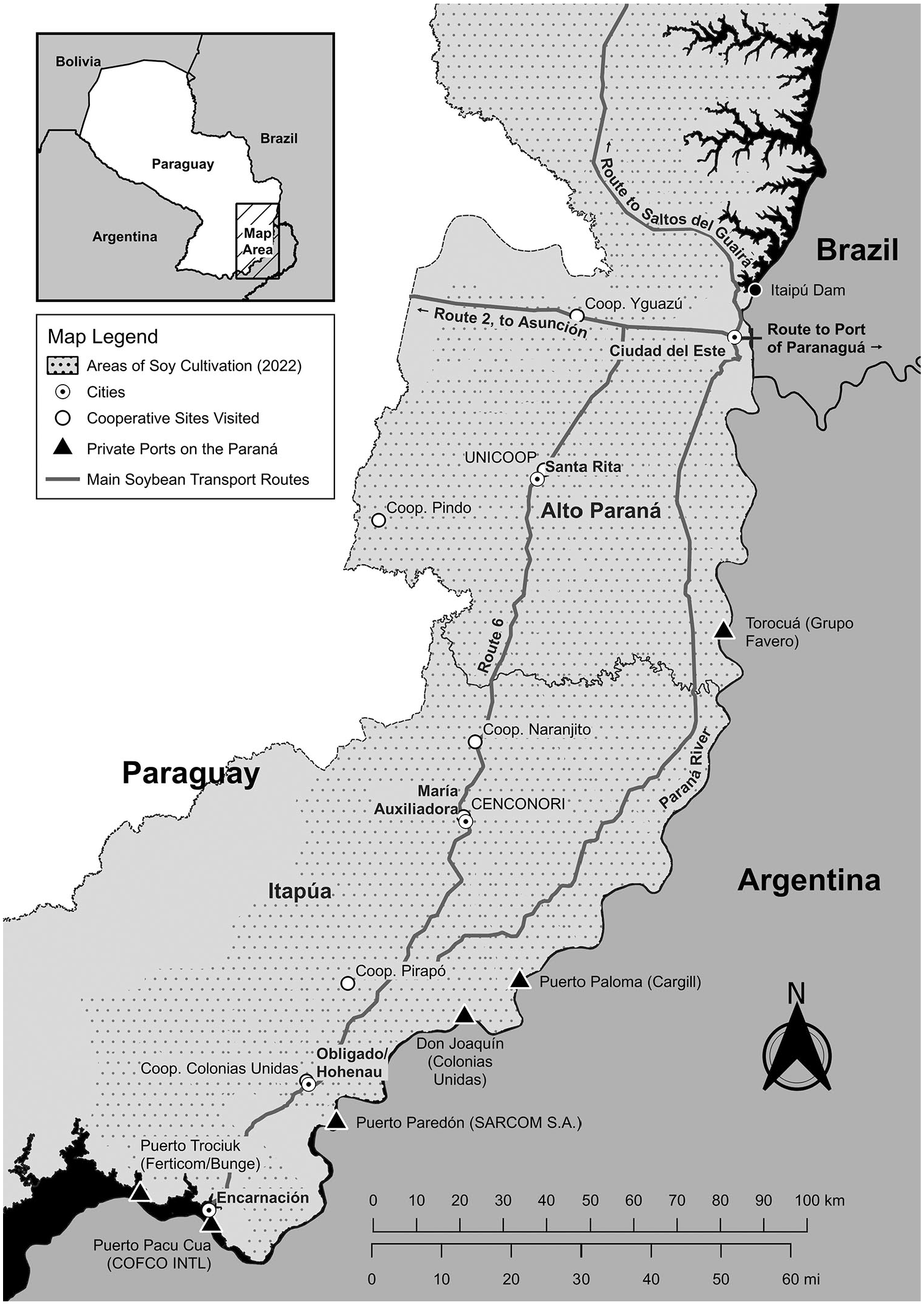
“Map of Southeastern Paraguay. Soy coverage derived from CAPECO.”
As an alternative form of vertical integration, the cooperative structure thus presents several potential advantages for farmers in the Paraguayan context. Many of the larger co-ops are multi-active, as opposed to specialized, which positions them to intervene in various processes and services upstream and downstream of farming. Colonias Unidas has emerged as a leading soybean producer in the country, while also excelling in yerba mate and dairy production. The cooperative’s activities range from seed production, input retailing, provision of credit and technical assistance, sorting and storage facilities, and a mill that ranks among the top ten in the country in terms of processing capacity (Rodas, Enciso Cano, and Frutos, 2021: 7422). Additionally, Colonias Unidas is engaged in livestock feed production, operates a supermarket chain with outlets throughout Itapúa and Alto Paraná, and owns a private port on the Paraná River (Cooperativa Colonias Unidas, n.d.).
The Paraguayan state has assumed a promotional role toward cooperatives, as outlined in Article 113 of the 1992 National Constitution, and the sector additionally benefits from several tax exemptions (Law 438/94, sections 113-114). The formal cooperative structure is regulated by a policy framework that defines the various types of cooperatives. Furthermore, it establishes guidelines for the formation of second-degree cooperative organizations known as “centrals” and federations, derived from the association of a minimum of three and seven first-degree cooperatives respectively (Carosini, 2012: 50; Vargas-Sánchez and Nacimiento Coronel, 2000: 198).
The cooperative organizations discussed in this paper (see Table 1) are all affiliated with the Federación de Cooperativas de Producción (Federation of Production Cooperatives, FECOPROD), the largest and most well-represented farmer co-op federation at the national level. FECOPROD has 34 associate cooperatives and since 2022 is a member of the International Cooperative Association (ICA), the largest non-governmental association in the world (ICA, 2022). FECOPROD was established in 1975 and sustained a longstanding partnership with the Konrad Adenauer Foundation in Germany, which provided support with its institutional design, knowledge transfer, training, foreign internships for its members, and some degree of funding. FECOPROD is additionally a conduit for development aid from entities such as USAID and the European Union (FECOPROD, “Proyectos,” n.d.).
Cooperative Sites Visited
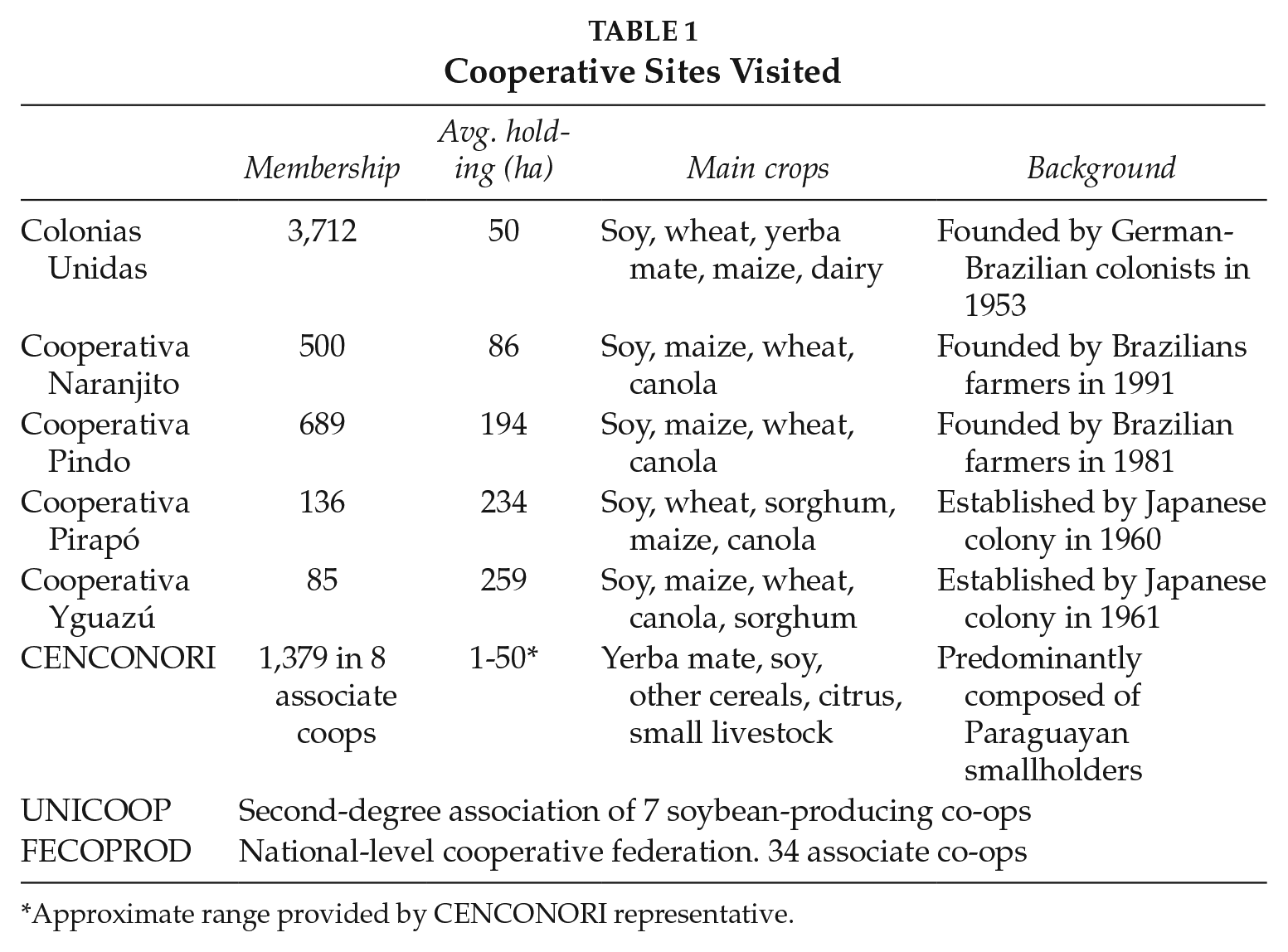
Approximate range provided by CENCONORI representative.
Five of the organizations visited during my field work are classified as first-degree cooperatives, with two falling under the category of centrals, and one a federation. Excluding FECOPROD, these cooperative sites are all located within a 225-kilometer corridor parallel to the Paraná River and in relative proximity to Route 6, one of the country’s main thoroughfares (see Map 1). Apart from the smallholder-oriented Central de Cooperativas del Norte de Itapúa (Cooperative Central for Northern Itapúa, CENCONORI), these organizations primarily serve medium-scale farmers. Most cooperative members own their own land and possess the necessary implements for soybean cultivation, which has been greatly facilitated by the duty-free status of agricultural machinery and surpluses generated during the soybean price surge from 2008 to 2012. Capital owned by the cooperatives is administered by elected boards or, in exceptional cases, by assemblies. Most of the profits from the cooperative’s activities are reinvested in the cooperative, while surpluses generated by the farmers’ own activities are theirs to dispose of once cooperative costs and dues have been discounted (Interview, Colonias Unidas Cooperative member, Obligado, April 05, 2022).
Membership in these cooperative organizations varied significantly, ranging from approximately 85 in the Japanese colony of Yguazú to 3,500 in Colonias Unidas. Apart from CENCONORI, their membership roll is relatively stable. Members of these cooperatives are all farmers (socios productores), although some co-ops provide a secondary level of membership for consumers. Average holding size in the cooperatives (see Table 1) is somewhat higher for the two Japanese co-ops, ranging from 230–250 hectares, which aligns with a smaller and gradually declining membership (Flecha, 2016; UNICOOP, 2021). Data on land distribution within the cooperatives was not provided, but with the exception of CENCONORI, discussed separately below, informants from each cooperative indicated that their members’ landholdings varied considerably. Plots of 200–300 hectares are fairly common, and holdings of more than 1,000 hectares are not unheard of within the cooperatives.
Colonias Unidas is perhaps the most noteworthy example of the extensive integration of medium and small-scale farmers into commercial agriculture in Itapúa. The cooperative has an average landholding size of 50 hectares per member, encompassing the cultivation of various crops. Among its members, approximately 530 farmers are employed in yerba mate production, with 75 percent of farmers operating on plots ranging from one to six hectares. As concerns soybean production specifically, the average holding size per member for the period of 2020 to 2022 was close to 60 hectares, which remains comparatively low (Cooperativa Colonias Unidas, 2023: 16-19).
At the secondary level, the cooperative central UNICOOP is located in the agribusiness hub of Santa Rita and represents a cluster of seven large soybean-producing co-ops in the region, including Colonias Unidas, Naranjito, and Pindo. The primary objectives of UNICOOP are to facilitate joint marketing and input purchases, promote agro-industry within the cooperatives, and secure funding for the sector from national and foreign entities (UNICOOP, 2020). Additionally, UNICOOP plays a significant role in trade union activities and public relations, frequently appearing in the media and issuing public statements in support of the cooperative sector and in defense of private property rights (see, for example, Noticde.com, 2018).
CENCONORI for its part is a cooperative central that contrasts with UNICOOP both in terms of the social composition of its membership and its operative resources. Located in the city of María Auxiliadora, it represents eight affiliated co-ops with a total membership of about 1,400, consisting largely of smallholders cultivating a variety of staples from soybeans to yerba mate, citrus fruits, and small livestock. Services provided by the central include agricultural credit, marketing, bookkeeping, technical assistance, and training. Membership at CENCONORI’s associated cooperatives fluctuates significantly as members frequently fall behind on payments or reporting and must eventually be removed from the membership roll (Interview, CENCONORI Cooperative member, María Auxiliadora, March 30, 2022).
CENCONORI’s affiliate members work plots ranging from six to fifty hectares of often marginally located land, and many of them have not yet obtained full titling. Farming is generally more labor-intensive, and when machinery or tools are required, they are often borrowed or rented from other farmers. Soybean remains the crop of choice for producers who can viably cultivate it, as they perceive it to provide greater market security despite some degree of price fluctuation (Interview, CENCONORI Cooperative representative, María Auxiliadora, March 30, 2022). The second choice, yerba mate, is itself a smallholder’s cash crop, with a significant portion of production being destined for the Argentine market.
Research conducted by Arrúa, Garcia, Ortega, and Zevaco (2020) in the department of Itapúa, provides additional insight on two CENCONORI-affiliated soybean producing cooperatives, Hechapyrá and Oñondivepá, and their mode of integration into the soy complex. The authors note that while Colonias Unidas is the dominant cooperative actor in the region, with significant linkages to corporate agriculture, the smaller cooperatives function as satellites, offering a greater degree of proximity, and a more accessible institutional culture. In doing so, they effectively facilitate the incorporation of smaller-scale farmers into commercial soybean agriculture (Arrúa, Garcia, Ortega, and Zevaco, 2020: 119).
Entrepreneurial Cooperativists: An Ethnographic Snapshot
Having outlined the main characteristics of the cooperatives studied, I now turn to a brief description of the associated farmers, based on interview data and on-site observation. As Nagel (1991: 112) points out, one of the intriguing aspects of the Paraguayan rural landscape is the existence of ethnically homogenous rural settler communities, be they Brazilian, Japanese, German, or otherwise. This phenomenon is indeed highly salient in the culture of the various cooperatives studied. At Naranjito, a community I visited for a week, much of the local social life revolves around a restaurant, mini-market, gas station, and hotel complex all owned and operated by the cooperative. Despite being located over 100 kilometers from the Brazilian border, the mini-market trades in a variety of Brazilian products and souvenirs, and Brazilian popular music dominates the sound system. Employees and clients largely speak a mix of portuñol (Spanish-Portuguese hybrid) and Portuguese.
Notwithstanding the distance between their countries of origin, however, members of the different cooperatives, save CENCONORI, shared many political and ethical perspectives. While the cooperativists interviewed insisted they were Paraguayans, they often criticized certain aspects of the local culture, particularly a perceived tendency towards laziness, which they contrasted with their own thrift and strong work ethic. In Naranjito, one cooperativist extended this view to the Brazilian context by drawing an analogous distinction between those of the South and the Northeast of that country, the latter of which were claimed to rely on government assistance funded by the former (Interview with Naranjito Cooperative member, Naranjito, April 06, 2022). The strident discourse of self-reliance and entrepreneurialism espoused by the cooperativists is nonetheless alternated with a language of mutual aid. Members salute each other as “compañero” (comrade/co-worker) and extoll the virtues of joint endeavor before transitioning seamlessly to a discourse of individualism and meritocracy.
The views expressed by cooperative members interviewed regarding their perspectives on the role of the state and public institutions might be characterized, somewhat stylistically, as a combination of “rugged frontier populism” (see van Olsenen, 1966) and American right-wing libertarianism. The state is generally perceived as ineffective and intrusive, a perspective that seamlessly aligns with a shared myth of origin, which recalls inhospitable conditions, lack of infrastructure and access to markets, and the heroic construction of the country’s primary source of wealth. A degree of dissonance emerged, however, in response to the question of what the state might do to support farmers, which invariably elicited calls for a more active role. Similarly, although participants emphasized a deficit in education as a primary cause for perceived societal ills, opinions diverged on the matter of who should be responsible. Some conceded this to be the domain of the public sector, necessitating public investment, while others doubled down on a “small government” stance, also indicating that the cooperative sector could play a role (Interviews with Cooperative members at FECOPROD, Asunción, April 04, 2022; UNICOOP, Santa Rita, April 07, 2022).
The proclaimed antagonism toward the state is nonetheless accompanied by anxieties over a perceived lack of influence on political affairs in Asunción and an urgency for enhancing the sector’s outreach and lobbying capabilities. One participant highlighted a relatively untapped social role for the cooperatives as a means for integrating the rural poor into productive activities. This person argued that their inclusion in such activities could safeguard them from potential manipulation by subversive political interests emanating from the capital city or, more ominously, from foreign sources (Interview, Pirapó Cooperative member, Pirapó, March 30, 2022). Cooperative representatives interviewed at Colonias Unidas (Obligado, April 05, 2022) and Pindo (Pindo, April 07, 2022) contended that peasants involved in land disputes are manipulated by leftists in the capital, who facilitate information on which plots have faulty paperwork that can be contested. Broadly speaking, however, the cooperative members interviewed agreed with critics that the land reform process was deeply flawed, emphasizing the irregularities created for the land market. The cooperative representatives at Colonias Unidas suggested a sweeping process of regularization was in order but thought it unlikely due to political interests favoring the current gridlocked state of affairs (Obligado, April 05, 2022).
In response to questions posed to participants regarding the main factors affecting their profitability, the theme most highlighted was the rapid turnover in technology necessary to stay competitive and the escalating prices of essential inputs, particularly in the face of global supply chain constraints. Additionally, some participants pointed to the increase in dosages of inputs required to maintain yields and combat plant diseases and pests, leading some to resort to conventional tillage methods as a momentary solution. Overall, participants appeared to have a solid grasp of the industry and of international commodities markets. Some of the sites visited displayed live price charts or tickers in their waiting areas, and three cooperatives noted that members closely monitor price movements and are able to execute sales directly through the co-op. Additionally, participants largely responded to the role of multinational conglomerates in the industry with relative indifference, perceiving the relationship to be non-antagonistic, and indeed often complementary (Interviews, Colonias Unidas Obligado, April 05, 2022; Naranjito, April 06, 2022).
Intra- And Inter-Cooperative Differentiation And Agro-Export Hegemony
In comparing the various characteristics of the cooperatives visited, however, it becomes evident that not all are equally equipped to assist their associates. The resources available to the co-ops are derived from surpluses generated by the productive activities of their own members. As a result, the cooperative structure to a significant extent mirrors differentiation amongst farmers. FECOPROD-affiliated co-ops do indeed adhere to a national social statute that institutes democratic principles such as regular elections and general assemblies (Republic of Paraguay, 1996). However, as Kasmir (2018: 216) notes in discussing the Mondragón worker co-op of the Basque region, decisions in cooperatives often prioritize a managerialist approach focused on productivity.
The large soybean-producing cooperatives demonstrate remarkable internal stability in terms of board composition and institutional framework, which contrasts with the volatility of the Paraguayan rural context. This may be attributable in part to various formal and informal barriers to entry. A representative at Colonias Unidas disclosed that aspiring members undergo formal background checks, and informal research is conducted to filter out individuals suspected of subversive activity (Interview, Colonias Unidas Cooperative member, Obligado, Paraguay, April 5, 2022). The cultural insularity of those cooperatives formed around migrant colonies may also be a disincentive for some outsiders.
The more substantial barriers to participation, however, may be more transparent. As explained by a participant at Colonias Unidas, applicants must be farmers (productores), which implies that they must possess farmland of a sufficient scale and the necessary implements to produce the commodities marketed by the respective cooperative, while meeting industry certification standards. Members who seek credit must present a detailed work plan in advance and demonstrate their ability to remain financially viable to maintain their membership, or to regain it in the future (Interview, Colonias Unidas Cooperative member, Obligado, Paraguay, April 5, 2022). In times of volatility, in particular, more capitalized farmers are better equipped to retain membership, suggesting that while cooperatives may act as a buffer against competitive pressures, they are not immune to the stratifying effect of the capitalist market.
Given that co-ops derive their resources from surpluses generated by their members’ productive activities, disparities are also apparent at the inter-cooperative level. The organizations that are best integrated into exported-oriented commercial agriculture are more affluent, which translates into a leading role within the federation. While FECOPROD consists of a fairly diverse range of member cooperatives of varying sizes and resource bases, the leading staple marketed by its affiliated cooperatives is soybeans, and accordingly the board consistently comprises representatives from the leading soybean producing co-ops (FECOPROD, 2021: 6; Arrúa, Garcia, Ortega, and Zevaco, 2020: 81). A number of these board members also hold positions on industry organizations, such as the Cámara Paraguaya de Exportadores de Cereales y Oleaginosas (Paraguayan Chamber of Exporters and Marketers of Cereals and Oilseeds, CAPECO), alongside major corporate entities such as Agrofertil, COFCO, and Syngenta (CAPECO, n.d.). FECOPROD is also an active member of the Unión de Gremios de la Producción (Agricultural Trade Guilds, UGP), an agribusiness-dominated trade organization. Not surprisingly, then, the political advocacy of FECOPROD and UNICOOP’s representatives tends to reflect the concerns and interests of dominant actors in the sector, such as the pursuit of harsher penalties for peasant land occupations (see, for example, FECOPROD, 2019; UNICOOP, 2021).
Conclusion
This article has presented a brief historical overview of the emergence and development of agricultural cooperatives in Paraguay, followed by an examination of the agrarian frontier expansion. Substantial shifts in the trajectory of the colonization process were identified, with subsequent implications for agrarian structure along the eastern soybean producing corridor. Specifically, the department of Itapúa has been identified as possessing characteristics that differentiate it from the seemingly more paradigmatic case of Alto Paraná, including a more diverse agricultural output, and a greater incorporation of small and medium-scale farmers in soybean cultivation.
Drawing on field research conducted in the department of Itapúa and Southern Alto Paraná during 2021 and 2022, a descriptive overview of the eight cooperative organizations visited and their affiliated farmers offered insights into their current structure and role. At the meso level, particularly in the department of Itapúa, the cooperative structure appears to have served as a mechanism for absorbing risk and partially mitigating processes of socioeconomic differentiation. This has allowed for the greater incorporation and resilience of a segment of medium and small-scale farmers in commercial agriculture, with a higher degree of autonomy than that observed in areas were farming activities are more directly controlled by corporate agriculture. Further research could also provide insights on how the social embeddedness of cooperatives affects the concrete form vertical integration takes relative to other, more explicitly market-oriented forms of organization. Such a structure may prove to be more politically sustainable, without necessarily altering the dominant food system.
The seemingly mixed results of the cooperative structure outlined in the preceding sections raise a critical question as to how the performance of cooperatives can be evaluated. If their goal is to alleviate market pressures for specific socioeconomic groups or facilitate “nested market” alternatives (van der Ploeg, 2014), it appears that relative degrees of success have been achieved in some cases. A Latin American Perspectives article by Vásquez-León (2010: 56) describes one such case in Paraguay, where a smallholder cooperative managed to withstand competitive pressures from large-scale producers in the sugar industry through Fair Trade certification. However, while significant, these outcomes fall short of the transformative potential claimed by some scholars in their writings on cooperatives, which suggest that their inherently democratic nature could make them a viable economic alternative to capitalist market relations (see Ratner, 2009; Jossa, 2014). An assessment of cooperatives based solely on their formal democratic procedures may overlook the ways in which broader social and economic relations alter the meaning and implication of such procedures.
The research presented in this paper indicates that in the case of Paraguay, agricultural cooperatives have historically played a supportive role in the capitalist modernization of agriculture. At the macro-level, the cooperative movement’s representative bodies appear to have also become deeply intertwined with the interests of soy agribusiness, thus aligning themselves with a system of agricultural production that positions Paraguay primarily as a contributor of ecological value in the international division of labor. This system of production has entailed the loss of livelihoods, biodiversity, food sovereignty, and, in many cases, human lives. Nevertheless, the potential for cooperatives to play a more emancipatory role cannot be ignored. It is clear, however, that addressing the exploitative relations implicit in the dominant food system will require contestation at a more fundamental level if we are to avoid reproducing the same socio-economic relations, albeit under a more benign guise.
