




Abstract
The COVID-19 pandemic has made historical and contemporary colonial relationships between and within states more fraught. This complexity is apparent within the research process itself, adding a new dimension to debates on positionality and the politics of knowledge production. Drawing on critical approaches to International Relations, and in dialogue with an emerging literature on the implications of the pandemic for knowledge decolonization, we reflect on our experience as scholars from the UK/Ireland researching colonial legacy and Transitional Justice in Colombia. The aim of this autoethnographic article is to suggest how the COVID-19 pandemic affected inequalities between researchers based in Europe and participants in Latin America. Our findings are mixed. While Covid-related funding cuts undermined equity within relationships, the virtual field offered an opportunity to cultivate cooperation between researcher and participant and re-think issues of ethics, voice, and the research agenda itself. Finally, El Maestro Covid taught us valuable lessons on the colonial trap inherent in our endeavors.
In September 2020, at the height of the COVID-19 pandemic, indigenous protesters in Popayán, Colombia toppled a statue of the Spanish conquistador Sebastián de Belalcázar. In a context where indigenous leaders are frequently targeted while protecting their ancestral lands, this act spurred public debate on the legacies of Spanish colonialism (Buenahora Durán, 2020). Some months prior in June 2020, the statue of British slave-trader Edward Colston was launched into Bristol harbor by Black Lives Matter (BLM) protesters. Again, this event galvanized the debate on historical memory and colonialism in Britain and Ireland (Nasar, 2020). Despite restrictions on protest, 2020 saw a global wave of collective action to denounce the presence of centuries-old, deep-rooted discriminatory structures that continue to shape people’s lives today. This global conversation on the colonial past was played out against the politically and socially fraught backdrop of the COVID-19 pandemic.
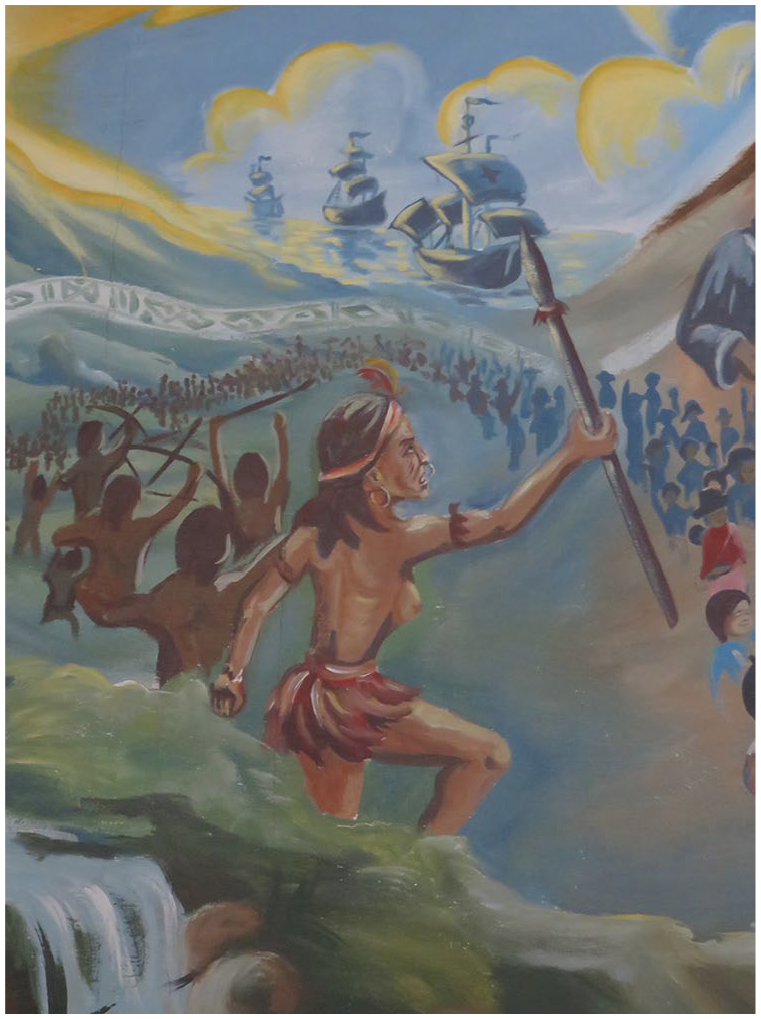
Mural representing the resistance of the Nasa people to colonial invasion.
Photograph taken by Bill Rolston in Toribío, Cauca, Colombia in 2015.
At the same time, the multiplicity of collective action gives rise to an important question: what space is there for collaboration between the Global North (GN) and the Global South (GS) in the pursuit of a decolonial agenda? This is a timely question, as the pandemic uncovered and exacerbated ongoing colonial relationships, particularly the unequal distribution of vaccines (Harman et al., 2021), and the continuity of travel restrictions from GS to GN as the pandemic receded. As Blume (2022) notes, colonial power has historically expanded thanks to epidemics, which have placed subalternized peoples at greater disadvantage. The pandemic has also highlighted the contemporary legacies of colonial rule within postcolonial states, including failing healthcare systems (Cordeiro-Rodrigues, 2021) and the use of emergency powers (Ní Aoláin, 2022). In Colombia, Ilich Bacca, Quigua, and Murillo (2020) note that the harms of COVID-19, bolted to insufficient responses by the government, reproduced deep-set structures and experiences of colonialism suffered by indigenous and Afro-descendant peoples. Undoubtedly, El Maestro Covid 1 offers valuable lessons about the historical roots of contemporary crises.
The issue of colonialism is of particular interest to the authors of this article, who are engaged in a project which compares colonial legacies in Ireland and Colombia, considering the potential of Transitional Justice (TJ)—understood as a toolkit for dealing with mass human rights violations and/or regime change—for redress of historical harms. Phase 1 of the study included 20 semi-structured interviews with Colombian experts on colonialism and/or TJ, from different disciplines, institutions, and geographical locations. One of the main findings from these conversations was the general absence of colonialism from public discourse except within Indigenous and Afrodescendant movements, which highlight the historical roots of their present-day grievances. References to feminist organizations also emerged, some of whom are also beginning to articulate discourses with reference to coloniality. 2 From these findings, in Phase 2 we elaborated new questions on colonial legacies to guide a series of semi-structured interviews with women who had experience of political organizing at the national and local level. 19 interviews were carried out with women of indigenous, Afro-descendant, Roma/gypsy and mestiza descent throughout the country.
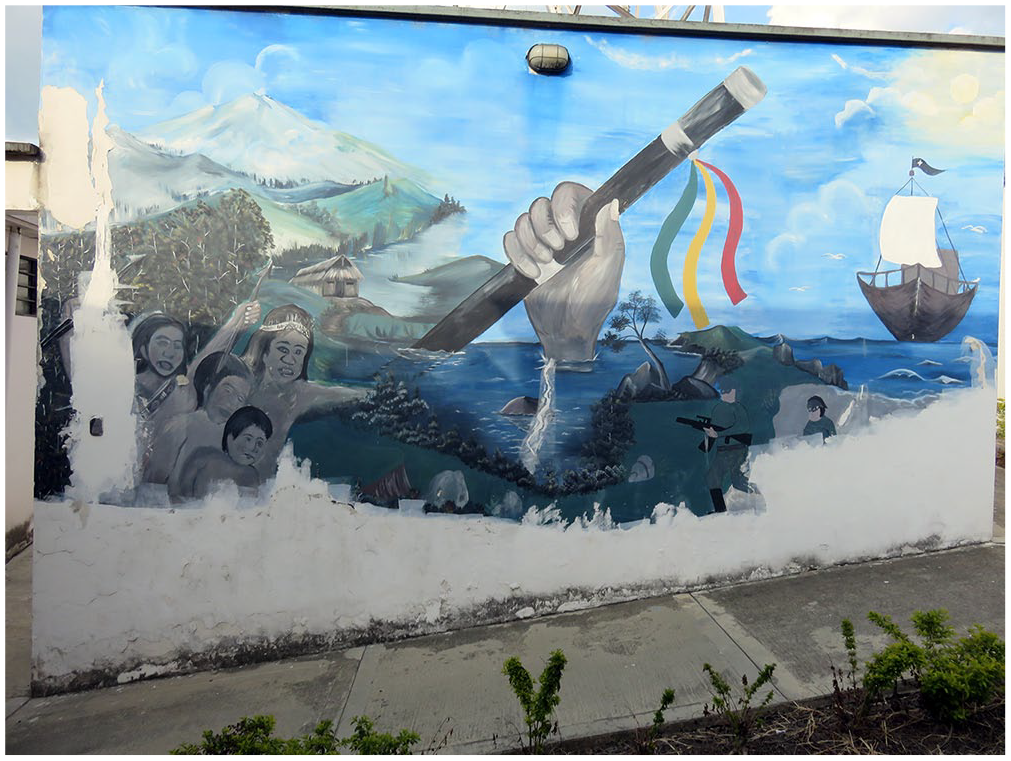
Mural depicting the staff of the Indigenous Guard rising from the water to resist invasion by the Spanish.
Photograph taken by Bill Rolston in Toribío, Cauca, Colombia in 2015.
Our study began in 2020 at the start of the pandemic and gained momentum alongside the debates on colonialism and historical memory in the aftermath of the BLM protests. Consequently, in attempting to put colonialism in the frame to understand contemporary Colombia, we became acutely aware of our own positionality, given that we are all white, all Northern Europeans, two women and one man, and only one of us speaks Spanish fluently. At the same time, two of the authors are Irish and find resonance in relation to colonial legacy articulated in their previous work (Rolston and Ní Aoláin, 2018). Given this multi-layered positionality, we came to consider our own situatedness in the imperial puzzle and how this may shape our research on colonial legacy in Colombia.
The core issue this article grapples with is that of the researcher-interviewee dichotomies and inequalities that constitute a feature of qualitative research (Anyan, 2013), which have been approached through participatory action research (Fals Borda, 2007), and which are exacerbated when researchers from the GN carry out research on the GS (Bilgen, Nasir, and Schöneberg, 2021). This tension came to the fore during the pandemic and is discussed in an emerging literature on the implications of the crisis for the decolonization of knowledge (Barei-Guyot, 2022). We contribute to this conversation by offering an autoethnographic reflection on our endeavors to carry out a meaningful, participatory study on Colombia during the global pandemic. To do so, we draw on critical approaches to International Relations—including decolonial and feminist perspectives—to frame our understandings of the political dimension of our work. Furthermore, we underscore that research on Latin America carried out by scholars based in Europe, particularly when funded by Overseas Development Assistance (ODA), must be considered within the broader context of the international politics of foreign aid (see further Kumar Pankaj, 2005), that is: how academic engagement from outside the region contributes to eliminating or maintaining structural inequalities.
Bringing these reflections together, we employ the notion of “the politics of knowledge,” which Jones and Lühe (2021: 10) develop to refer to “. . .how knowledge is generated, how the boundaries of such knowledge come to be determined, which forms of knowledge are considered to be more legitimate and authoritative, and [how this] shapes the types of policies which are considered, designed and implemented.” The same authors (Jones and Lühe, 2021: 10) highlight the dangers of “knowledge imperialism,” a dominant paradigm in which knowledge is produced from the GN and applied to the GS, often with ruinous effects. We develop this notion further, to refer to the “colonial trap”—that is to say, the inherent danger of researchers who work from a broadly decolonial agenda in the GN reproducing the very structures which they are aiming to undo. In a similar vein, Sullivan-Clarke (2020) notes that many self-declared “allies” of Indigenous communities may deepen colonial relationships by following their own agenda and failing to acknowledge their privilege.
Drawing from our experience as scholars from the UK/Ireland researching colonial legacy and TJ in Colombia, we ask how the COVID-19 pandemic has affected research inequalities between researchers based in Europe and participants based in Latin America. Our findings are mixed. On one hand, the pandemic limited the potential to build equitable relationships for many reasons, including the impact of cuts to ODA and the priorities reset by government during the pandemic, which fell heavily on research which privileged and supported the GN and GS interface. On the other, ongoing online interactions and shared experiences of the pandemic, as well as an acknowledgement of resonances between colonial projects in the GN (such as Ireland) and GS (such as Colombia), gave us the opportunity to cultivate relationships based on what we refer to as “complicidad,” that is a sense of closeness, commonality, and shared purpose. In turn, this meant that we could reconsider aspects relating to participants’ consent and the research agenda itself, as circumstances changed, in keeping with a feminist ethics of care (see further West, 1999). Finally, El Maestro Covid offered some valuable and unexpected lessons on the colonial trap inherent in our research.
The article is organized as follows: in part one, we contextualize the study by discussing TJ and its relationship with colonial legacies, with reference to Colombia, and reflect on our own situatedness as part of the “TJ circuit” (Rowen, 2017); in part two, drawing on critical approaches to International Relations, we frame our study by discussing the politics of knowledge production between the GN and GS; and in part three, we offer a series of reflections from our project on TJ and colonial legacy in Colombia, navigating our positionality as three scholars from Ireland/the UK. The relevance of COVID-19 is a common thread throughout. In the conclusion, we summarize our main findings and offer recommendations on how scholars based outside of Latin America might contribute to a decolonial agenda in future.
Transitional justice: dealing with or dealing out colonial harms?
From the outset, we should clarify what we mean by “colonialism.” Put simply, it is a generic reference to the practices of subjugation, domination, and exploitation of other peoples and territories using violence, with the aim of advancing economic benefits to colonial states. Multiple and layered justifications have facilitated colonial practices including religion, a civilizing mission, economic development (Betts, 1998), “manifest destiny” (Pearce, 1998) and “terra nullius” (Lindqvist, 2007). In sequences from the complex and time-expansive experience of colonization, decolonization is an incomplete process (Jansen and Osterhammel, 2017). As Stoler (2008) argues, there is a link between colonial projects in the past and a lack of opportunities for certain groups in the present, through overt and subtle forms of continuing oppression. The experiences of colonialism in Latin America, while often absent from the postcolonial literature in English (e.g. Bhabha, 1984; Spivak, 1988; and Loomba, 2005), are a case in point.
In this respect, another concept has emerged as central to our research: namely, coloniality (colonialidad), which is rooted in the Latin American experience and (as Phase 1 of our research revealed) has considerable traction among scholars in Colombia. Mignolo (2005: 7) explains that “[W]hile ‘colonialism’ refers to specific historical periods and places of imperial domination,” “coloniality” refers to the underlying structure of colonial domination. As Escobar (2004: 219) puts it, “coloniality did not end with the end of colonialism.” Indeed, coloniality is an overarching and Eurocentric way of seeing and organizing the world; a cosmology and epistemology which begins with Columbus’ journey across the Atlantic in 1492 (Castro-Gómez, 2007: 428). The value of this approach in challenging the Eurocentric ordering of the world is significant.
Applying these discussions to Colombia, colonialism (colonialismo) refers to the invasion of the Americas and the annexation of enormous swathes of land to the Spanish crown during the 16th century. There has been considerable scholarly production on different aspects of this process (e.g. Herrera, 2006; Muñoz Arbaláez, 2015; Nieto Olarte, 2013; Jaramillo Sierra, 2013). Despite declaring independence in 1810, the descendants of the conquistadores clung to power, shaping political and social structures through a colonial prism, with ethnicity as an organizing and marginalizing principle, strict gender roles, and an unequal distribution of land. These expressions of coloniality continue to dictate Colombian politics and society today (LeGrand, 1989). They also became heightened in the government’s response to the COVID-19 pandemic, which left Indigenous and other communities more exposed to both the virus and violent attacks by armed groups (Fernandez, Scauso, and Stravrevska, 2022).
While the concept and field continue to be contested (Gready and Robins, 2020), TJ can be understood “as an umbrella term for approaches to deal with the past in the aftermath of violent conflict or dictatorial regimes” (Buckley-Zistel et al., 2014: 1). These approaches include special courts, legal proceedings, truth commissions, apologies, and reparations, among others. And yet, the deep past—including historical colonial projects—has been notoriously absent from TJ efforts and academic studies. 3 For example, only a handful of truth commissions have identified the colonial past as a structural cause of human rights violations, 4 and TJ has not successfully dealt with the responsibility for colonial crimes in Europe (Fletcher and Weinstein, 2018: 206).
Nevertheless, emerging concerns about the contemporary iterations of colonial relationships since the onset of COVID-19 and the BLM protests have begun to permeate the study and practice of TJ. Indeed, there is now a burgeoning field of studies addressing TJ and colonialism, reflected in a flurry of publications, 5 projects, 6 blogs, 7 and other initiatives. We are also witnessing unprecedented efforts to deal with the legacies of multiple colonial pasts with what might be called a TJ “toolkit” across jurisdictions and regions. The establishment of a Truth Commission by the Belgian government in 2020 to deal with its overseas legacy offers one example of opportunities for reckoning on the harms of the past (Destrooper, 2022).
These developments are relevant to Colombia, as we discovered in Phase 1 of our study. According to the academics we interviewed, there has been a historic lack of attention to colonial legacy within Colombian peacebuilding and TJ efforts, a dynamic that was repeated in the discussions leading up to the Havana Peace Accord and reproduced within the agreement itself (Wright, Rolston and Ní Aoláin, 2023a). And yet, the recent Truth Commission (CEV) (2019-2022) has taken a very different approach. Working amid the COVID-19 pandemic—which tragically cost the life of Afro-descendant Commissioner Angela Salazar—the CEV endeavored with its broad mandate. At the same time, the BLM movement was resonating in Colombia, particularly in locations characterized by violence and structural racism, such as the port city of Buenaventura (Gillooly, 2021), and coincided with a wave of anti-police protests throughout the country.
When the final report of the CEV was published in August 2022, colonial legacy emerged as a key theme. For instance, there are some profound reflections on the colonial roots of contemporary structural inequalities, including the impact of the hacienda system on the (lack of) distribution of land, the dispossession of the “wastelands,” a low-intensity democracy, and a profoundly racist society (CEV, 2022a). Furthermore, an exhortation is made “To the whole nation to overcome structural racism, colonialism and the unjust and immensely clumsy exclusion inflicted on indigenous, Afro-Colombian, Raizal and Romani peoples, disproportionately affected by the war. . .” (CEV, 2022b). As a result, engagement with TJ and colonial legacy in Colombia during the COVID-19/BLM context was in keeping with dynamics elsewhere and organically came to resonate with our research agenda.
There is, however, a prior and arguably more fundamental problem regarding TJ and its capacity to deal with colonial harm. TJ interventions are often seen as a condition for the transferal of aid from the GN, bundled with a global “industry” of professionals, experts, academics, lawyers, and others. Viewing this process has led some critics (Fletcher and Weinstein, 2018: 19; Ahmed An-Na‘im, 2013: 197) to conclude that the Northern “human rights” dominance of TJ is effectively a modern reconfiguration of colonial power, following a similar interventionist and patriarchal logic of the past. At best, such interventions may end up as ineffective, at worst they may open-up “the surest path to sustaining violence” (African Union, 2019: iv).
At the same time, stakeholders and jurisdictions in the GS have been central to the development of TJ as a practice, from the grandmothers of the Plaza de Mayo in Argentina (see Arditti, 2002) to the truth and reconciliation commissions in Guatemala and El Salvador (see Hayner, 2011). Likewise, the truth commissions in Chile and elsewhere fueled debates in the GN about dealing with the legacy of violent conflict. Thus, it would be simplistic to see TJ as “imposed” on the GS and Latin America, given the role of many countries in the region in framing, and developing the field (Jones and Lühe, 2021).
This ambivalence can be seen in Colombia. On the one hand, research carried out by Rowen (2017) reveals some skepticism about and opposition to TJ measures, given a perceived hegemony of Northern influences on the field. Many interviewees—including scholars, policy makers, and advocates—focused on the dominance of the GN in implementing TJ initiatives, seeing Colombia as “just one more stop on the transitional justice circuit” (Rowen, 2017: 633). On the other hand, other Colombian academics and peacebuilders have suggested that recent TJ efforts have had a decolonizing function and generated new, original, and “intercultural” approaches, as Izquierdo and Viaene (2018) find with the Special Jurisdiction for Peace (JEP).
Consequently, for TJ to successfully navigate colonial legacies, it must first deal with coloniality within, as Park (2020) and Bueno-Hansen (2015) note. In parallel, as three European academics working on a project financed by the UK government’s ODA - via the Global Challenges Research Fund (GCRF) (see further UKRI, 2023) - we need to consider our own situatedness in the colonial legacy and contemporary puzzle. Are we part of the broader “TJ circuit” as Rowen (2017) puts it? If so, what are the political implications of our work? In the next section, we discuss the politics of knowledge production and the limits and possibilities for meaningful exchange between Europe and Latin America, in the COVID-19 context.
The Politics Of Knowledge In Times Of Covid-19
Justifying the lens of colonial legacy is one thing, but the legitimacy and ability of three white Northern European scholars to carry out this work on Colombia is quite another. We are called to consider our own multi-layered positionality, the acknowledgement of “gender, race, class and other aspects of our identities” on the grounds that “[K[nowledge is valid when it includes an acknowledgement of the knower’s specific position in any context. . .” (Maher and Tetreault, 1993: 118). For instance, one of us has lived and worked as an academic in Latin America and she is the only one who is entirely fluent in Spanish. Two of the authors are female, but the positionality of gendered experiences for men and women in the GN brings its own baggage and is self-evidently distinct from the experience of being male or female in the GS, thereby limiting the transferability of knowledge (Mohanty, 2003).
Two of us come to this research as descendants of a colonized and subalternized people; indeed, the Norman conquest of Ireland was justified by the supposed intellectual, spiritual, and cultural backwardness of the Irish (Gerald of Wales, 1988: 134). Deeply held discriminatory views persisted through the centuries, laying the blame for colonial harms such as the Famine of the mid-19th century at the door of the Irish themselves. In recent times, this discourse was stoked by the thirty-year conflict in Northern Ireland between the late 1960s and late 1990s. The contemporary effects of British colonialism continue; indeed, the UK government does not consider Northern Ireland to be a conflict site for the purposes of the Women, Peace, and Security agenda (see further O’Rourke, 2014) and rejects the presence and impact of colonialism here. Thus—while explicitly acknowledging the further subalternization of Travelers and other communities in Ireland—we maintain that as people from a colonized nation where the process of decolonization is incomplete (McVeigh and Rolston, 2021), we share a commonality and resonance with those whom we seek to engage in Colombia.
We are mindful that the articulation of one’s position is in itself insufficient. In fact, positionality could be solely gestural, serving simply “to locate oneself in what might be termed the ‘topophilic’ academy” (Robertson, 2002: 788). Rather, knowledge production and the relationships created therein must be understood as inherently political, in keeping with the logic of participatory action research (Fals Borda, 2007). Contributions from critical approaches to International Relations—including decolonial and feminist perspectives - can also be useful here. As Halistoprak (2021: 34) explains “given [that] critical knowledge is normatively motivated for change. . . knowledge production is political as much as it is an academic activity.”
With these epistemic considerations in mind, considerable attention has been given to the dynamics of power and privilege among scholars who—like us—are working on cultures different from their own (see, e.g. Cronin-Furman and Lake, 2018; and Krystalli, 2021). As Jones and Lühe (2021) note, positionality and “the politics of knowledge (i.e. how the way in which knowledge is produced may affect policy outcomes) are particularly important in the field of TJ, given that scholars have shaped peacebuilding in practice, in high-stakes contexts of human rights violations and violence. The same authors (Jones and Lühe, 2021) develop the notion of “knowledge imperialism” to refer to the way in which ideas from the GN are applied to the GS, with disastrous outcomes. As well as highlighting the role of academics in such outworkings, we need to incorporate a fundamentally structural critique, as Flint et al. (2022: 77) do, referring to the “epistemic colonialism,” generated by the North-South flow of research funds. For his part, Mark Israel (2017) criticizes the “ethical imperialism” exercised by Ethics Committees located in the GN, when their standards are applied to contexts in the GS.
Engaging with these reflections, we use the term “colonial trap” to refer to the inherent risk of researchers working from a broadly decolonial agenda in the GN reproducing the very structures they seek to undo. Similarly, Bisoka (2020) refers to the “paradox of western modernity,” i.e. “The simultaneous adherence to humanist discourse and the refusal to renounce privileges that result in the subordination and oppression of subjects at the margins.” Sullivan-Clarke notes that many self-declared allies may inadvertently do harm to the communities they paternalistically claim to represent. As an alternative, she suggests a model of “decolonial ally,” someone who “1) recognizes the self-determination of Indigenous people, 2) acknowledges that they benefit from colonialism, 3) stands in relation to Indigenous people, and 4) allows that relation to provide the framework of their actions of service” (Sullivan-Clarke, 2020: 34).
With this in mind, we mobilize the Spanish idea of “complicidad,” which unlike “complicity” in English, can be positively valanced to reflect a coming together of people who share understandings, experiences, and goals, going beyond the notion of “rapport” which is characteristic of qualitative interviews (Schettini and Cortazzo, 2015). Despite our initial position of privilege, the relationship between the GN and colonialism is far from monolithic. Again, the alternating of our Irishness and ongoing coloniality on the island of Ireland may offer a springboard for resonance with interviewees in Colombia.
In the context of the pandemic, such reflections on the political dimension of knowledge production have become timely. Indeed, there is an emerging literature on the impact of COVID-19 on academic exchange between the GN and the GS, engaging with critical approaches in IR. From a decolonial perspective, Barei-Guyot (2021) argues that the dynamics of the pandemic offered a meaningful opportunity to revise and decolonize research partnerships, an observation echoed by Charvet and Ordóñez (2022). Drawing on feminist perspectives, Boer Cueva, Giri, Hamilton, and Shepherd (2021) find that the lockdowns offered unexpected opportunities for intimacy between scholars and interviewees who found themselves in similar circumstances, despite being geographically distant. Likewise, Barei-Guyot (2022) notes that the pandemic reinforced the urgency for a feminist ethics of care, whereby long-term relationships are prioritized over formal academic structures and exigencies in the GN. Finally, old concerns about the imperial potential of foreign aid (see Kumar Pankaj, 2005), have been supercharged in the pandemic context, given that ODA-financed research had been de-funded (Nwako et al., 2023).
Turning the mirror back on ourselves, while we do not claim to be TJ practitioners nor “missionaries” from the GN, we cannot separate ourselves from our research in a clinical fashion. Similarly, in a widespread context of research fatigue, we inevitably become a concentric circle of the “TJ circuit,” to which Rowen (2017) refers. We do not claim objectivity but are committed to “activist scholarship,” “politically engaged research . . . for the purpose of furthering justice and equality . . .” (Lennox and Yildiz, 2020). The political nature of this agenda takes on a further dimension when we consider that UK Research and Innovation (UKRI), the body which finances our research as an exercise of ODA, places emphasis on impact, that is, “the demonstrable contribution that excellent research makes to society and the economy” (UKRI, 2022). As scholars, we must ensure that the ways in which this impact is thought of, crafted, and implemented do not reproduce knowledge imperialism, but rather go some way to dismantling it. This entails stepping away from the colonial trap, to cultivate complicidad, as “decolonial allies” (Sullivan-Clarke, 2020). The context of the global pandemic has rendered these reflections (developed further in the next section) politically relevant.
Notes From The (Virtual) Field
Our project delves into the relationship between colonial legacies and TJ, but documenting how past harms link to contemporary ones remains a fraught task. The contemporary effects of original dispossession and obliteration are evident: profound inequality and poverty, the bias of law and policy which protects elites and entrenches economic and political dominance, governance systems resting on exclusion and repression, and patriarchal power structures. At the same time, not all those at the end of the chain of marginalization in Colombia and elsewhere in Latin America explain their current positionality as deriving from a colonial past (McClintock, 1992), thanks in part to the ideological trope of mestizaje, which has sought to blur racial lines to forge new national projects (Wright and Martí i Puig, 2012). The crucial task is revealing, as far as possible, the direct lines of colonial ruin—to borrow Stoler’s (2008) idea—between past dispossession and current inequality, without either over- or under-reading the importance of colonial legacies.
To fill the chasm, we first engaged with academics and second with women in situated Colombian communities to gain their perspective. As COVID-19 cast its shadow, travel had to be postponed and so, in keeping with a global shift during this period (see Rahman et al., 2021), we moved our research on-line. While the digital divide was exacerbated by the pandemic, including in Colombia (see Rodríguez-Martínez and Arango Lozano, 2022), the people with whom we engaged had access to mobile phones and/or computers. In the following sections, drawing on critical approaches to IR, particularly decolonial and feminist perspectives, we discuss how the COVID-19 pandemic affected our research and identify the valuable lessons it taught us on the colonial trap implicit in our research endeavors.
Equitable Partnerships In Times Of Budget Cuts
In partial response to critical IR theorists’ claims that foreign aid is essentially an imperialist enterprise (Kumar Pankaj, 2005), in recent decades donor countries have placed emphasis on cultivating equitable relationships, i.e. those that “should aim to be as fair as possible, extant imbalances notwithstanding” (Flint et al., 2022: 79). For its part, our funder UKRI explicitly identifies equitable relationships as a core feature of the GCRF projects (Grieve and Mitchell, 2020). Mindful of this, we sought to form meaningful collaborations with Colombian institutions and organizations instead of asymmetrical, extractive exchanges with individual participants (see further Gaillard, 1994). Phase 2 of the research—engaging with women involved in the public sphere, specifically those of indigenous or Afro descendant origin—was particularly delicate. In a context of generalized violence in post-Accord Colombia, human rights defenders are exposed to reprisals when addressing the conflict, peacebuilding, and structures of social injustice. This situation was exacerbated by the lockdowns imposed during the pandemic, which rendered rural communities and women particularly vulnerable (Chaparro Moreno and Alfonso, 2020).
Consequently, to engage with women meaningfully and strive for equity in this second phase of online research, we established a collaboration with an organization working on women’s rights in Colombia: Corporación Alianza Iniciativa de Mujeres Colombianas por la Paz-IMP (Alianza-IMP). It was agreed that Alianza-IMP would offer technical advice on our interview script and provide contacts with indigenous, Afrodescendant/black, and mestiza women. In return, at their suggestion, we offered a certificate of participation for all interviewees, a report in Spanish with key findings, and our feedback on progress at meetings of their governing body. Additionally, it was agreed that if the results of the study indicated a clear pathway, we would publish a policy paper. In that regard, we would be crossing over from knowledge production into political impact (Jones and Lühe, 2021). In addition to the prior agreements—and despite their insistence that it would be unnecessary—we offered our Colombian partner funds to finance any operational costs that might arise during the collaboration.
We were satisfied that this approach would fulfil the funder’s exigencies to work towards “impact” (UKRI, 2022), and at the same time constitute an equitable partnership (Flint et al., 2022). And yet, El Maestro Covid discarded what, for us, was a key part of this plan. In March 2021, the UK government announced unprecedented cuts to its ODA budget from the following year (from 0.7% to 0.5% of the GDP), including a massive blow to the GCRF scheme. In an excellent analysis of the cuts and their devastating implications for projects supported, Nwako et al. (2023) called into question the commitments of UKRI to partners and development in the GS. Applying a critical analysis to foreign aid, this action can be understood as an expression of the coloniality underpinning research, with financial and decision-making power firmly residing in the GN (the center) rather than the GS (the periphery) (Flint et al., 2022).
While our project survived the cuts, we had no resources for activities for the 2021-2022 period. Our insistence on covering any operational costs was now doubly misguided, as we had to backtrack. Fortunately, our colleagues in Colombia were understanding and keen to carry on with the collaboration whenever we were ready. It also became clear that we had decided what they needed in an inadvertent and overly paternalistic attempt to avoid the colonial trap involved in knowledge production, when they had already clearly stated what they required i.e. the certificates of participation, feedback at meetings, and the final report. In that sense, we had fallen short of the standard of “decolonial allyship” (Sullivan-Clarke, 2020: 34). Indeed, we concur that “the movement to decolonize knowledge should not become one in which researchers from HICs play savior to those in lower-income contexts” (Barei-Guyot, 2022: 2). Our partners, in turn, demonstrated through their practice the importance of adhering to a feminist ethics of care and prioritizing relationships in the long-term. Fortunately, by the time operational costs were incurred (for the production and publication of a policy brief in 2023), the funds had been reinstated and the project was able to cover the costs directly.
Ethics And Voice In The Virtual Field
While professing to safeguard researchers and participants, ethics committees in the GN are increasingly coming under critique. As Israel (2017) notes, they rarely consider the way ethics is understood or practiced in the GS and as a result can exercise “ethical imperialism.” The norms are often rigid and rarely consider the realities of situated research, or its long-term impact, as Grieve and Mitchell (2020) suggest. For her part, Barei-Guyot (2022: 5) argues that such procedures “. . .cannot always account for the reality of the additional care and commitment that goes into establishing and maintaining long-term relationships in the field.” While often well-intentioned, ethics committees run the risk of falling into the colonial trap by defining ethical values and constraints, generally devoid of negotiation and relationship with GS partners, and thus undermining or rarifying decolonial approaches to research.
While our ethics committee did not consider the interviewees to be high risk per se, as a default position it strongly recommended we utilize the generalized option of anonymity for participants, given the ongoing situation of violence and threats made against human rights defenders in Colombia, exacerbated by the pandemic lockdowns (Fernández, Scauso, and Stravrevska, 2022). Towards the end of Phase 2 of our research, one participant was reluctant to give the interview because of the suggestion of anonymity (Yolanda Perea Mosquera, personal interview, on-line, December 1st, 2021). On reflection, the University’s top-down approach had preconditioned us and effectively silenced her voice out of our specifically constructed concerns for her security, unaware of our epistemic privilege (Sullivan-Clarke, 2020). Once again, we had fallen into a colonial trap; in parallel with our insistence on covering operational costs, it became clear that our concern over anonymity was a misplaced expression of paternalism, disregarding the perspective and lived experience of the interviewees.
So, how did the pandemic affect the possibility for us to learn from and correct this mistake? On one hand, by not being present in person, there were many limitations. Conversations with interviewees in Colombia were held over Microsoft Teams or WhatsApp, rather than over coffee. Opportunities to walk in their environment and see what they were seeing and how they lived and worked were lost. And yet, common experiences of the pandemic and the interruption of conversations—by poor internet signals, visitors, conversations with family members, responsibilities for young children and other phone calls (see also Rahmen et al., 2021)—afforded a unique opportunity to create a sense of closeness between researcher and participants. Without making too much of the trope of Covid as a “leveler,” as Fernandez Scauso and Stravrevska (2022) warn, and acknowledging our general privilege as scholars based in the GN, the pandemic created common ground between the researcher and interviewees, which was crucial for the cultivation of strong relationships. It also gave us the opportunity to reflect on points of convergence and resonance in the longer term, including a dialogue over experiences of colonial legacy in Colombia and Ireland.
Thanks to our digital connectivity and the sense of complicidad constructed with the participants over time, in keeping with the feminist notion of an ethics of care (West, 1999), we were able to resolve the issue of anonymity sometime after the initial interviews had taken place. Our Ethics Committee, while strongly recommending anonymity as default, had ultimately left the decision up to the Principal Investigators involved in the project and this, fortunately, gave us room to maneuver. All but one interviewee asked to be named in the final policy report, which—significantly—was produced first in Spanish and then translated into English (Wright, Rolston, and Ní Aoláin, 2023b). Such extended and instantaneous contact with research participants located in the GS and researchers located in the GN was made possible precisely due to the opening-up of the virtual field in the COVID-19 context.
Consequently, while acknowledging the digital divide, the normalization and convenience of on-line communication offered a unique opportunity to address our mistakes and give voice to research participants in Colombia, bolstering our decolonial and feminist agenda. Ongoing communication is thus a significant tool for “decolonial allyship” (Sullivan-Clarke, 2020: 34), considering Knott’s (2019) observation that there is an ethical onus for researchers to be responsive to the situation of research participants beyond the moment of structured engagement, particularly in politically dynamic contexts.
Ending this reflection on the importance of voice, it is important to highlight that the interviewees questioned the basic premise of the research; while acknowledging that some progress had been made, in their experience TJ is not the most appropriate arena to deal with the everyday aftereffects of historical colonialism, namely discrimination and marginalization. Rather, they noted that there are three routes to decolonial transformation: 1) education; 2) participation; and 3) favorable legal structures, with intercultural education policy being priority. We incorporated these findings into our policy brief (Wright, Rolston, and Ní Aoláin, 2023b), acknowledging the situated perspectives of Colombian women who have been active in the public sphere, particularly in the areas of human rights, community organizing, and education. While ultimately weakening our hypothesis on the capacity of TJ to undo colonial legacies, this approach reflects our open commitment to curtail “knowledge imperialism” (Jones and Lühe, 2021), namely the imposition of research agendas from the GN to GS.
Crucially, the purpose of a policy document is to promote change in the public sphere, and consequently it constitutes a bridge between knowledge production and political transformation. As we have discussed, while funders place considerable emphasis on impact, it is important that the ways in which this is developed do not reproduce colonial hierarchies and therefore interests or agendas. Together with nurturing equitable relationships and giving voice to participants, adjusting the focus of our research to look at alternative routes to deal with colonial legacy—while acknowledging the progress already made by women belonging to Ethnic Peoples in Colombia in doing so—is in keeping with a decolonial, feminist ethics of care. Ultimately, our policy recommendations emanate from the interviewees themselves, with all the complexities that this entails. In the same way, long-term interactions and reflections, including acknowledging mistakes and looking to rectify them, must underpin the GN-GS “development” interface.
Conclusions
The global pandemic wreaked devastation and yet El Maestro Covid has provided a moment of reckoning. The crisis gave rise to important conversations on a whole range of issues, paving the way for a global dialogue on the ongoing legacies of colonialism. These discussions have spread to academia and to the field of human rights, including the area of Transitional Justice (TJ). Given the object of our study (colonial legacies and TJ), the political context (global conversations on colonialism during the pandemic), and our own positionality (scholars located in the UK/Ireland carrying out research in Colombia), it became increasingly important to consider our role as agents in the politics of knowledge production (Jones and Lühe, 2021). In keeping with critical perspectives in IR, we maintain that “. . .the so-called “timeliness” of a research agenda is a manifestation of its political relevance” (Halistoprak, 2021: 23).
At the start of this article, we asked the question: how has the COVID-19 pandemic affected research inequalities between researchers based in Europe and participants based in Latin America? Our findings are mixed. In keeping with a critical account of the international politics of foreign aid, the results are devastating. The funding cuts to ODA in response to the global pandemic severely undermined pretensions to equitable partnerships and the potential for decolonial solidarity on the part of the GN, at the structural level. And yet, at an interpersonal level and in keeping with a feminist ethics of care, there is more room for optimism. Indeed, moving to the virtual field (with vast possibilities for follow-up contact) and sharing experiences of the pandemic offered a unique possibility to create a sense of closeness or complicidad between participants based in Colombia and researchers in Northern Ireland, which in part mitigated the problems at the structural level.
We agree with Barei-Guyot (2022) that—while creating difficulties for research relationships between the GN and GS—the global pandemic has offered a unique opportunity to critically interrogate inequalities and look for ways to decolonize these relationships. Indeed, El Maestro Covid taught us valuable lessons regarding our own inadvertent paternalism and “putative” allyship (Sullivan-Clarke, 2020). The first lesson is that equitable relationships go beyond financial resources; rather, they are about really listening to what the partner needs and meeting them there. The second lesson is that conversations over issues such as consent and anonymity need to be dynamic, ongoing and bottom-up (from participants) rather than top-down (from Ethics Committees). It is important to incorporate inputs from participants themselves, regarding both the research relationship and the agenda/results of the study, particularly in contexts which are prone to change (see Knott, 2019).
The next phase in our study is to undertake fieldwork in our own context: the UK and Ireland. The first step in mitigating an extractive approach is to take “seriously the epistemic perspective/cosmologies/insights of critical thinkers from the Global South” (Grosfoguel, 2011: 212) and thus decolonize the canon (Halistoprak, 2021). Indeed, several Colombian colleagues suggested we should turn the mirror back on ourselves and challenge our observations on the GN with insights of scholars from the GS, including the notion of coloniality. The resonance of lessons and experiences between Ireland and Colombia, including reflections on the colonial structures in which we ourselves are entangled, may give greater depth to the complicidad developed between researchers and interviewees in both locations.
Although we come from the part of the globe which originated both historical colonialism and ongoing coloniality, we believe that we can advance legitimate insights, partly gained in attempting to critique these processes and partly because colonialism lies at the heart of many structural inequalities within the GN societies, including Ireland. On the surface, the epistemological ocean between North and South is too great to be traversed, making the position of “Northern” researchers irremediable. Yet if the transformation of the world and the consequent dismantling of colonial hegemony is necessary, it cannot exclude the efforts of those who critique and challenge that system from within and seek to cultivate complicidad with interlocutors in the GS. As we have shown, and thanks to the lessons offered by El Maestro Covid, such efforts must move away from the colonial trap inherent in this type of work, towards a model of “decolonial allyship” (Sullivan-Clarke, 2020).
Footnotes
Notes
Bill Rolston is an emeritus professor with and former director of the Transitional Justice Institute at Ulster University. Fionnuala Ní Aoláin KC (Hons) is concurrently Regents Professor at the University of Minnesota Law School and Professor of Law at Queen's University Belfast. Claire Wright is Lecturer in Politics and International Studies and Course Director for Politics at Ulster University. This work was supported by the Global Challenges Research Fund [AH/S004025/1]. The article forms part of the broader research project “Addressing post-colonial legacies in transitional justice,” which is part of the UKRI GCRF Gender, Justice and Security Hub. The study includes a collaboration with Corporación Alianza Iniciativa de Mujeres Colombianas por la Paz-IMP, and we are particularly grateful to Ángela Cerón Lasprilla for her support and invaluable contributions throughout this process. The authors are also grateful to Angelika Rettberg, Luisa Salazar and María Gabriela Vargas (Universidad de los Andes) for their advice and assistance. Likewise, we are indebted to the individuals we interviewed during this research. Finally, we would like to thank the Latin American Perspectives reviewers for their very insightful comments on our manuscript.