




Abstract
Water is a key challenge when it comes to the Latin American agrarian issue, and its lack threatens rural living. The Chilean case is emblematic of this issue, given the implications of neoliberalism and its consequences on environmental injustice. Social movements are now adding the issue of water to their historical demands for land and territory. This paper addresses what features the water struggle has acquired among social movements in Chile by undertaking a critical, geohistorical reading of ongoing social processes. Our conclusions indicate that the agrarian territories are at a crossroads that demands mobilization or risks initiating a process of rural depopulation.
When portraying the national water scenario and its serious problems, a report in a Chilean newspaper pointed out some time ago: “Let your animals die or release them: breeders and their most difficult decision during Chile’s drought” (Biobío, March 12, 2020). This spoke eloquently of the ravages created by the lack of water in these territories. In one of these areas, Putaendo, the remains of dead animals and their dried corpses exuded the smell of death, announcing not only times of climate change but also evidencing the environmental effects of neoliberal policies that determine life and death for the multiple life forms connected by water across rural territories.
The social peasant struggles seen across the rural territories of Latin America during previous decades were centered around demands for land access as the necessary basis for self-reproduction. However, during the past decade, there has been a shift: demands regarding access to water now identify this issue as crucial to the maintenance of rural living (Terhorst et al., 2013). This situation also links struggles for territorial re-existence among indigenous peoples, peasants, Afro-descendants, women, and inhabitants of the urban periphery who do not have access to water (Ojeda et al., 2020). The widespread problem of water access has motivated political articulations between a diversity of social movements located in different territories, of different scales, and comprising socio-territorial demands for water/territory (Panez, 2022). The purpose of this research is to analyze the implications of current claims against water dispossession (such as privatization, commodification, hoarding, and speculation) in the agrarian struggles for re-existence across rural territories of Latin America using the conflicts for water/territory in Chile as a starting point. To this end, we analyze three specific cases from a geohistorical perspective: that of avocado monocultures in Petorca, the Zapallar reservoir in the Ñuble region, and the forestry and hydroelectric projects in Curacautín. These conflicts have taken place during the past three decades of the country’s recent history and in the context of the consolidation of the neoliberal project, which has aimed to commodify nature. Each of these cases is representative of various forms of conflict around the issue of water, given that each is associated with different water regimes and forms of production.
We undertook a comparative analysis to establish the shared and singular characteristics regarding these cases, all of which speak of the turn toward water access as the fundamental element of territorial demands. In Chile, particularly in the context of the political changes the country has experienced since 2019 in terms of social revolt, water has become a central aspect in the political agenda of the new constitution and the campaign promises of the new Gabriel Boric government.
In the Chilean case, even though the territorial conflict associated with water has become increasingly important in the literature, most of the works have focused on 1) describing the scope of water dispossession due to extractive activities (Panez et al., 2017); 2) the impact of current legislation on the proliferation of these conflicts; 3) case studies on community experiences regarding the relationship between water and territory that is deployed in these conflicts (Melin et al., 2019); or 4) quantify this type of conflict at the national level (Guerrero et al., 2018). However, one aspect that has not been addressed more deeply is the qualitative analysis of the common elements in the demands for water and territory of subaltern groups and classes and their relationship with the agrarian question in the country.
Theoretical Framework: Water Dispossession And The Contemporary Agrarian Question In Latin America
The classical argument around the agrarian question has focused on the implications of the capitalist mode of production in rural territories, with special emphasis on the processes of valorization of capital in agriculture, differential rent, and the transformations in class relations in agriculture (Akram-Lodhi and Kay, 2010; Van der Ploeg, 2018; Kautsky, 1980). These processes have been addressed while considering external elements, such as the rapid and precarious urbanization of Latin America and the consequent loss of agricultural land, as well as internal ones, such as productive specialization, which has meant the consolidation of crops that are profitable to the market via large investments (Woods, 2011). In this context, a regrouping of social responses to these transformations emerged, which in turn encourages us to rethink the implications of the agrarian question today (Akram-Lodhi and Kay, 2010). Below, we briefly address the main transformations that have taken place concerning the contemporary status of the agrarian question in Latin America, and how these transformations affect the hydro-social aspect.
The Corporate Food Regime And The Explosion Of Agro-Exports
Global agriculture has changed dramatically in the past forty years. The volume and number of exchanges have increased; agriculture covers a large part of the planet, supported by the improvement of transport and communication and the rapid innovations of the green revolution. This circulation is mainly driven by the insertion of commodification and financialization along the production chain, which is why it has been characterized as a corporate or agribusiness food regime (Giarracca and Palmisano, 2013; Bernstein, 2011; McMichael, 2016; Gras and Hernandez, 2013).
One of the main consequences of this new export cycle is the strengthening of private land ownership compared to other forms, such as communal and state property, in order to create a more flexible and active land market (Kay, 2016). This process, initiated in the ups and downs of agrarian reform and counter-reform, exacerbates a tendency toward land grabbing pushed by the successive capitalist crises that have led to important processes of land re-concentration in the region (Borras et al., 2011) as well as the incessant search for more areas to convert to production.
The global rescaling of agribusiness has caused a greater focus on the cultivation of certain types of crops, such as corn, rice, and soybeans, among others. These crops are associated with the consolidation and intensified use of resources that not only continue to be used as food but are also the basis of many processed food products for human and animal consumption and even as fuels after a process of distillation (Ávila et al., 2018). This has resulted in a significant increase in water consumption, which generates pressures on the availability and management of water resources. Water is a leading component in the circulation of agro-export, since it is projected that around 15% of the water used in the world is destined for agricultural export in the form of “virtual water” (Pengue, 2006). We should additionally consider that 70% of the water consumption worldwide is irrigation for agriculture.
All this entails greater complexity in agricultural territories since the value chains of each of these markets determine a form of water use and a trans-scale socio-spatial configuration linked with the other uses of this resource in the territory. Agribusiness has become a key agent in the structuring of commodity production, demanding more energy sources for consumption, as well as delegating the role of food production to sectors of the peasantry, establishing the current paradox where the latter are becoming increasingly precaritized and isolated (Giarracca and Palmisano, 2013).
Environmentalization Of The Agrarian Question
The intensified exploitation of nature has been a central pillar of the restructuring of capitalism since the 1970s. In recent decades, the increased demand for raw materials (especially given China’s industrial growth since 2000) and the growing interest among financial agents for natural resources have resulted in a significant increase in commodity prices. This, in turn, has led to a new boom in extractivist activities (Rosset, 2016).
Extractive activities such as open-pit mining, hydrocarbon exploitation, hydroelectric energy, and exploitation of forest resources have accompanied the expansion of agribusiness in rural territories. These processes now occur in territories that were previously less integrated into the capital production cycle while intensifying their presence in areas that had already been exploited (García, 2015; López and Vértiz, 2015). These activities significantly impact territories where large extensions of land and water have been appropriated to enable extractivst operations. The pollution and devastation of natural commons and biodiversity during such operations exist alongside the destruction of community networks linked to indigenous, Afro-descendant, and peasant ways of life.
All this directly affects the quality, availability, access, and management of water for those communities described above. This has influenced various movements to link the environmental issue with the agrarian question, focusing on the defense of all forms of life (biodiversity in Western terms) and the reasonable use of energy and material resources. Authors such as Svampa refer to this process as an “ecoterritorial turn” in continental social struggles (Svampa, 2012).
Particularly when it comes to agribusiness, the new available technologies have made it possible to cover spaces that were not previously considered productive. This includes soils dedicated to livestock, slope cultivation or cultivation in places where rainfall and/or air and humidity did not formerly allow for it (e.g., rainfed areas). In this sense, the dispute also becomes technical since the pressure to convert to technologies that make the use of land and water more efficient in a context of scarcity is pushing sectors of the peasantry to abandon their lands once access to such improvements proves impossible or entails becoming a type of commercial agent who manages credits and future sales. The latter influences processes of territorial fragmentation, both social and ecological.
The Transition From The Land Dispute To The Dispute Over Territory
Starting with the struggles of indigenous peoples in Latin America at the end of the 1980s, the claim for territory emerged as a central aspect. As Porto-Gonçalves (2016) recalls, those large marches in the name of “Life, Dignity and Territory” in Bolivia and Ecuador often chanted, “we do not want land, we want territory.” Here we have an idea espoused by these resisting groups that transcends the demand for agrarian reforms, which spoke of the redistribution of land ownership and the delivery of a portion of it to indigenous people and the peasantry. This slogan claiming territory has been expanded over the past decades and has become one of the critical notions (Mansilla et al., 2019) advocated by those struggling in rural territories. An emblematic case can be found in the internal discussions of La Via Campesina, where the importance of redefining the notion of agrarian reform is acknowledged, as is the need to articulate it with food sovereignty and the defense of territory as a living space threatened by multiple forms of dispossessions (Rosset, 2016).
This centrality of the territory for those in the lower echelons of Latin American society has been addressed from the point of view of critical geography. Authors such as Porto-Gonçalves (2002) have stated that these ongoing conflicts have allowed for the “desacralization” of the debate on this concept, which had traditionally understood the territory in terms of disciplines such as political science or geography—the “natural basis of the nation-state.” This naturalization of “territory = State” is being increasingly questioned via the appropriation that different social actors have made of this notion (Porto-Gonçalves, 2002). From the perspective of Latin American critical geography, the use of the concept of territory allows us to reflect on “the inscription of society in nature, with all the contradictions involved in the process of the appropriation of nature . . . through social relations and power” (Porto-Gonçalves, 2006: 419).
Another fundamental source in the reconfiguration of the dispute over territory is the historical struggle of women in rural sectors. These bodies, beaten and termed inferior by patriarchy, and whose labor has at times been described as performing the invisible work of social reproduction, have positioned themselves as protagonists in the resistance against extractivism precisely because of the threat it poses to the reproduction of life (Zaragocin, 2018). Thus, feminisms from Abya Yala point out the intimate relationship between body/territory and the simultaneous precariousness of women and life in general, both human and non-human: “When the places we inhabit are violated, our bodies are affected; when our bodies are affected, the places we inhabit are violated” (Colectivo Miradas Crítica del Territorio desde el Feminismo, 2017: 7). Regarding the defense of water, women protagonists have played a key role on the continent. Authors such as Zaragocin (2018) seek to conceptualize this interconnection through the idea of “water/body/territory” and call to address “the relationship between water/territory and body/territory from the perspective of the implications of death/body/territory for racialized women” (2018: 9). In this way, “the body as the first territory, ontologically connected with water, would reach another dimension of territoriality” (2018: 14).
The reconfiguration from below of extant struggles in rural territories is linked to the recognition of so-called “territorial re-existences.” There is talk of re-existence because part of these struggles has managed to overcome mere opposition and resistance to specific projects, advancing alternative proposals that comprise territorial ontologies. Porto-Gonçalves terms these “experiences of re-existence” insofar as they consolidate, in their actions, an existence founded on the past, future, and present of collective life trajectories lived as subaltern classes and groups (Porto-Gonçalves, 2016).
The Water Emergency In Territorial Struggles
During the past decade, water disputes in rural territories of Latin America have become more prominent. The annual records contained in the Pastoral Land Commission’s (Comissão Pastoral da Terra, CPT) “Caderno de Conflitos no Campo no Brasil” is an example. The CPT has been calling attention to the increase in water conflicts in that country. If 2018 registered a record 276 conflicts of this type in one year, in 2019, water conflicts had increased by 77% (Comissão Pastoral da Terra, 2020). Water has become the most disputed natural resource, both because of its indispensable role in daily life practices and because of its productive nature in agriculture, whether traditional, industrial, original, peasant, or mestizo. Regardless of the type of work performed and the mechanisms used, water is the basic requirement in any agroecosystem (Bohlen and House, 2009).
Water and its central role in agrarian discussions had been partially omitted in classical readings regarding rent appropriation or rent-seeking, which very literally took the land as a factor of production and as the only component of agrarian space capable of generating wealth in and of itself. On the other hand, it has been situated as part of the infrastructure that grants differential income to silvo-agricultural production, where its value is located more in the capacity of water retention and management than in its intrinsic value for agroecosystemic activity. All of this is accompanied by the concomitant cultural implications for the daily activities and rituals of peasant social groups, whose agrarian practices have been affected by plundering and scarcity (Vila and Bonelli, 2017).
Water cycles slowly turn into hydrosocial cycles, conceptualizing the link and dependence of societies on water (Budds, 2012). However, before any academic theorizing took place, many inhabitants of rural sectors were directly feeling a sociometabolic acceleration prompted by the decrease in water availability across their territories, as well as the inequality in its appropriation for extractive purposes. Narratives of struggle that had thus far considered access to land as the basis for survival were forced to look at water as the central axis of territorial disputes.
All of these processes have led to new rural territorialities as traditional silvo-agricultural activities now coexist with a wide range of extractivist activities (Boelens et al., 2016). Likewise, across the rural world, rural territorialities continue to be transformed by a growing process of urbanization. Territories are the product of geohistorical processes, of the various configurations that capital accumulation and expansion take, and of the strategies that interact for the defense of nature. On the basis of this theoretical construction, we seek to deepen our analysis of the struggles over water in Chile, as well as of the interactions between territory and territorial re-existences in the configuration of the hydrosocial aspect of Chile’s agrarian question. In this way, we can locate each and every case inside a historical trajectory of transformation that has always been relevant for Latin America but undoubtedly shows a turn toward new forms of conflictive relationships with capital.
The Relationship Between The Struggle For Water And The Agrarian Question In Chile
Chile is a paradigmatic regional case and a global model of water dispossession (Bauer, 2015). The water code of 1981, which was established by the military dictatorship, enshrined private ownership of water in the political constitution of 1980 (article 19, numeral 24). Within the context of economic and political reforms that affected the various productive sectors, one of the fundamental issues was the sanctioning of the private condition of water. This unprecedented regulatory apparatus opened the door to the commodification of water by granting powers to those who had water rights to buy, sell, or lease. The water code also separated water ownership from land ownership so that water could be “freed from the bonds” that prevented it from becoming a commodity (Bauer, 2015).
In the Chilean case, this history is marked by agrarian counter-reform and the annulment of communal property regimes in indigenous lands. In this process, the goal was not only to reverse the process of land socialization but also to install a political infrastructure akin to the economic and social model promoted by the state, whose emphasis has been on the liberalization of production (Salém, 2020).
It is important to note that the water privatization model is part of a package of neoliberal adjustment measures that facilitated capitalist development based on the depletion of natural resources (Harvey, 2015). Among the measures that have contributed to the legal privatization of water are the forestry, mining, and fishery laws, which make territorial planning flexible and contribute to the counter-urbanization of rural areas (Mansilla, 2013). This has caused havoc in rural territories and the lives of their inhabitants. Among its most significant consequences have been the retention and worsening of the high concentration of land, as the old latifundio model now coexists with modern forms of land management and purchase (Olea, 2019). In this way, it is now economic groups that are behind the concentration of land, establishing an increasingly unequal relationship between the peasantry and landowners.
This legal fiction of separating water from land in such a property regime has effectively fragmented the socio-ecological and ecosystemic relations linked by water, leading to profound socio-environmental imbalances that affect the expression of life, human and non-human, inhabiting these rural territories. It promotes their deterritorialization to open the door to new forms of capitalist production (Panez et al., 2018). In other works, we have characterized this process as a “socio-metabolic rift”, which points out the rupture generated by extractivism in the reproduction of socio-natural cycles that enable life in rural territories (Panez et al., 2018; Olea, 2019).
Additionally, the situation of rural territories in Chile seems to be further aggravated in the context of the climatic impacts generated during the Capitalocene 1 (Moore, 2016), which cause periods of increasingly prolonged droughts and have led to a considerable decrease in water reservoirs, putting even more pressure on the inhabitants of rural communities. This critical scenario is aggravated by the agro-industrial exploitation model, which has resulted in a greater demand for water.
These climate impacts, added to the radicalization of the commodifying and privatizing components of water regulations in Chile have led to a growth in territorial conflicts where water becomes the central disputed element. The various strategies for water grabbing and water uses have reached a critical point in recent decades. These strategies are turning the water issue into a phenomenon that intervenes the entire rural space and is taking various forms, such as reservoirs, inlets, underground extraction wells, course diversions, canals. Although these infrastructures are not exclusive to our current period, the legal and political context that sustains them is.
These conflicts have led to a progressive process of “politicization of the water crisis” that aims to question the Chilean development model as a whole and the deployment of strategies that would allow conflicts to escalate from the local to the national level (Panez et al., 2017).
Methodology
Our methodological approach takes the perspective of critical rural studies in dialogue with political ecology. The approach is qualitative, considering geographical and historical variables. We analyze the struggles for water in rural territories in Chile under the idea of a “collective case study” (Stake, 1999). The selection criteria of the three emblematic conflicts respond to the fact that these are representative of hydrosocial problems, show diverse forms of capitalist appropriation of the hydrosocial cycle, and are characterized by a diversity of political contestations generated by social organizations in the country. In each of the cases, the authors have inserted themselves in action-research processes contributing to the development of territorial organization against the respective extractivist projects. This insertion involved participant observation, meetings, fieldwork, and workshops. To complement the information of each case, we conducted 11 semi-structured interviews with key actors from the communities that have participated in the territorial resistance. The semi-structured interviews were conducted between 2017-2021 and in accordance with academic standards of interaction with human subjects, including the use of informed consent. An interview outline was designed to identify the main characteristics of the territorial conflict and its link with the struggle for water and territory in rural contexts.
The criteria for comparing conflicts are based on the following issues: How is conflict triggered? Who are the subjects in dispute? What are the business and political interests in each territory? And what is the importance of water in shaping resistance in rural territories? The location of these three emblematic cases can be seen in Figure 1.
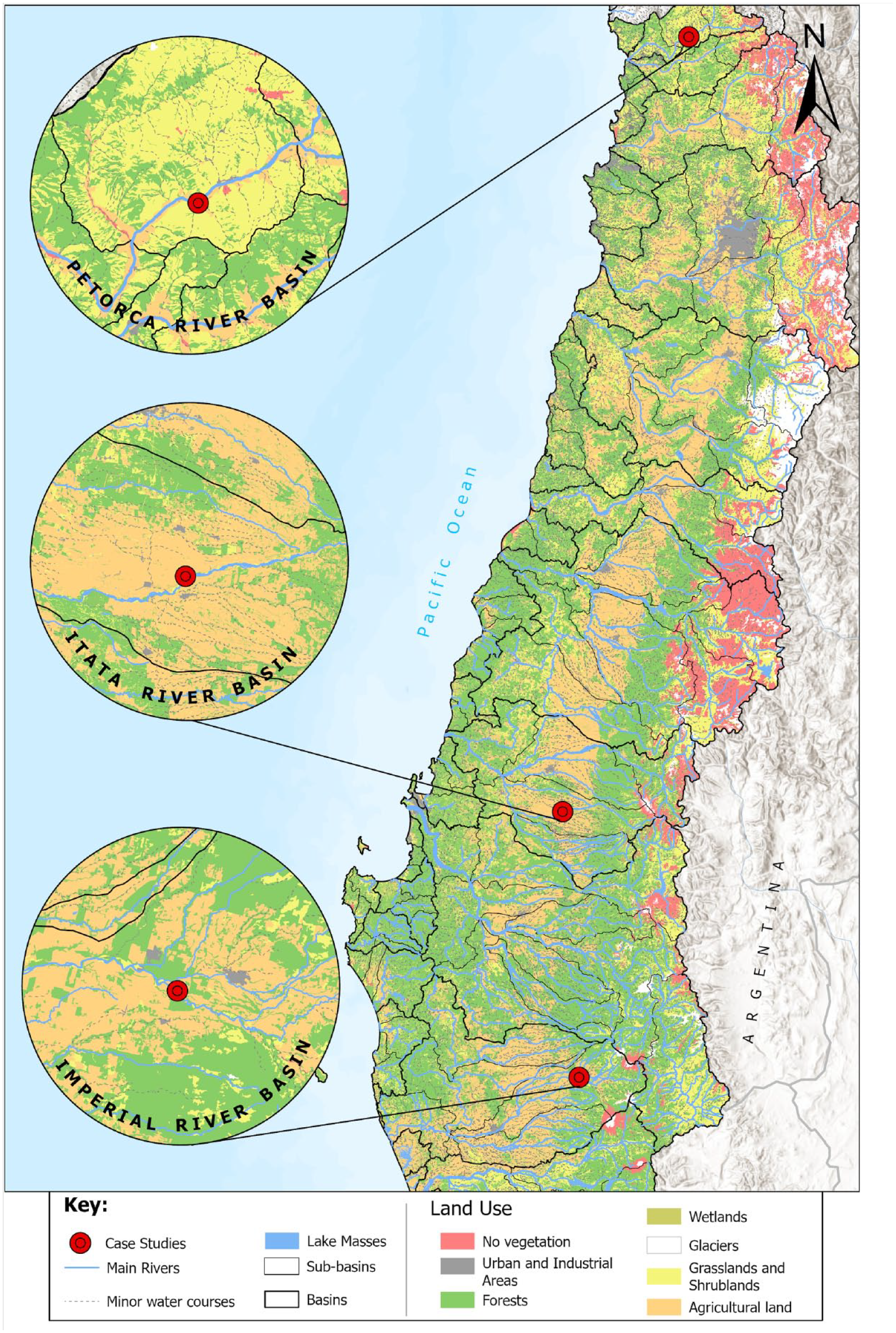
Case Study Map.
The central characteristics of each conflict and the territory in which they are located are:
Avocado monocultures in the province of Petorca: This province is in the northern part of the Valparaíso region of Central Chile. Near the foothills, it has a semi-arid temperate climate of moderate temperatures. It has two basins corresponding to the Ligua and Petorca rivers. Because of its low mountain range, water availability depends on rainfall, the predominant source of the aquifer system and surface water in the basins (Panez et al., 2018). The Petorca basin receives an average annual rainfall of 340 mm and has an average annual temperature of 12 °C. However, between 2010 and 2018, the average annual rainfall was 142 mm, a significant drop associated with the “megadrought” phenomenon (Garreaud et al., 2019).
Historically, small farmers have grown food for self-sustenance and sale in local markets, in addition to raising animals (mainly pigs, chickens, and goats). This province has been affected by an accelerated expansion of fruit fields, the product of business investments since the late 1980s, and the export of citrus and avocados to global markets. The high consumption of water for the expansion of avocado cultivation has generated socio-ecological impacts such as soil depletion and increased erosion, decreased aquifer recharge, and the degradation of peasant ways of life, which in turn has led to intense struggle since 2011—a conflict between affected communities and agricultural businesses (Panez et al., 2017).
Opposition to the Zapallar Reservoir on the Diguillín River: San Ignacio and El Carmen are peasant towns in the Ñuble region that are threatened by the construction of the Zapallar reservoir, which involves the proposed flooding of 315 hectares. These are located on the Diguillín River, which is a sub-basin of the Itata River. This river has its source in the Nevados de Chillán volcanic complex, with an average annual rainfall of 1875 mm and an average monthly temperature of 12.4 ° C, with a range between 6 ° C in winter and 20 ° C during the summer (Zúñiga et al., 2012). The project seeks to expand the availability of water across 10,000 new irrigation hectares. Many of the flooded hectares are currently peasant lands used for agriculture and grazing, in addition to housing great biodiversity of native fauna and flora. It is projected that the expansion of the irrigated area will mainly benefit the fruit export agribusiness that has grown significantly in recent years (mainly chestnut, European hazelnut, and blueberries). This is linked to the fact that the Ñuble region has been branded as the “land of the future” for agriculture export due to its climatic conditions and water availability. There is currently a heated discussion regarding the “productive reconversion” of the region, with a critical stance toward state institutions and large agricultural producers vis-à-vis traditional crops associated with family farming (several of them, such as wheat, are part of the basic diet in Chile), now classified as unprofitable and inefficient. In this sense, we can see the deployment of a strategy that gradually develops projects for the installation of export agribusiness, and these are being established and deployed throughout the territory, placing further stress on the property regimes that sustain the current productive organization while stretching them toward greater concentration and expansion, such as in the case of agro-industrial compounds.
The installation of hydroelectric projects in Mapuche territory of the Cautín River: The Cautín River is one of the most important tributaries in the Araucanía Region. As Rivera et al point out (2004), the source of this river is in the Lonquimay volcano, located in the Andes Mountain range. It extends for approximately 174 kilometers until it reaches the city of Temuco, the regional capital of Araucanía. There, the Cautín joins the Chol-chol River, forming the Imperial River. In the area of the commune of Curacautín, this river acquires its maximum flow, with 291,054 cubic meters per second in the month of July (that is, the winter season).
The conflicts in Mapuche territory are marked by historical demand for land restitution. However, during this past decade, the focus of mobilizations has been characterized by opposition to extractive projects. Monoculture plantations of pine and eucalyptus meant for export have wreaked havoc on water availability as well as the agricultural practices of rural inhabitants, given the high consumption of virtual water. This has even led to processes of displacement among the inhabitants and the consequent rural depopulation (Carte et al., 2021). Added to this conflict is the problem of access to water, which, within the framework of the neoliberal water model, has privatized the rights to water use, leading large forestry, hydroelectric, and fish farming companies to accumulate this type of rights while excluding Mapuche and peasant communities from the use of this resource.
Likewise, the installation of hydroelectric projects is currently framed within the energy development policy implemented by the Piñera government that seeks to promote the production of energy as an engine of development by 2050. Although these projects propose the use of renewable energies such as hydroelectric plants below 3 megawatts, Mapuche communities protest their direct impact on the social, cultural, economic, and environmental relations they have previously built with the various forms of life present in these territories. One of the emblematic cases has been the fight against the installation of three hydroelectric plants in the territory of Curacautín, where communities have resisted via their territorial control over forest properties as well as the exercise of their territorial relations with water (Melin et al., 2019).
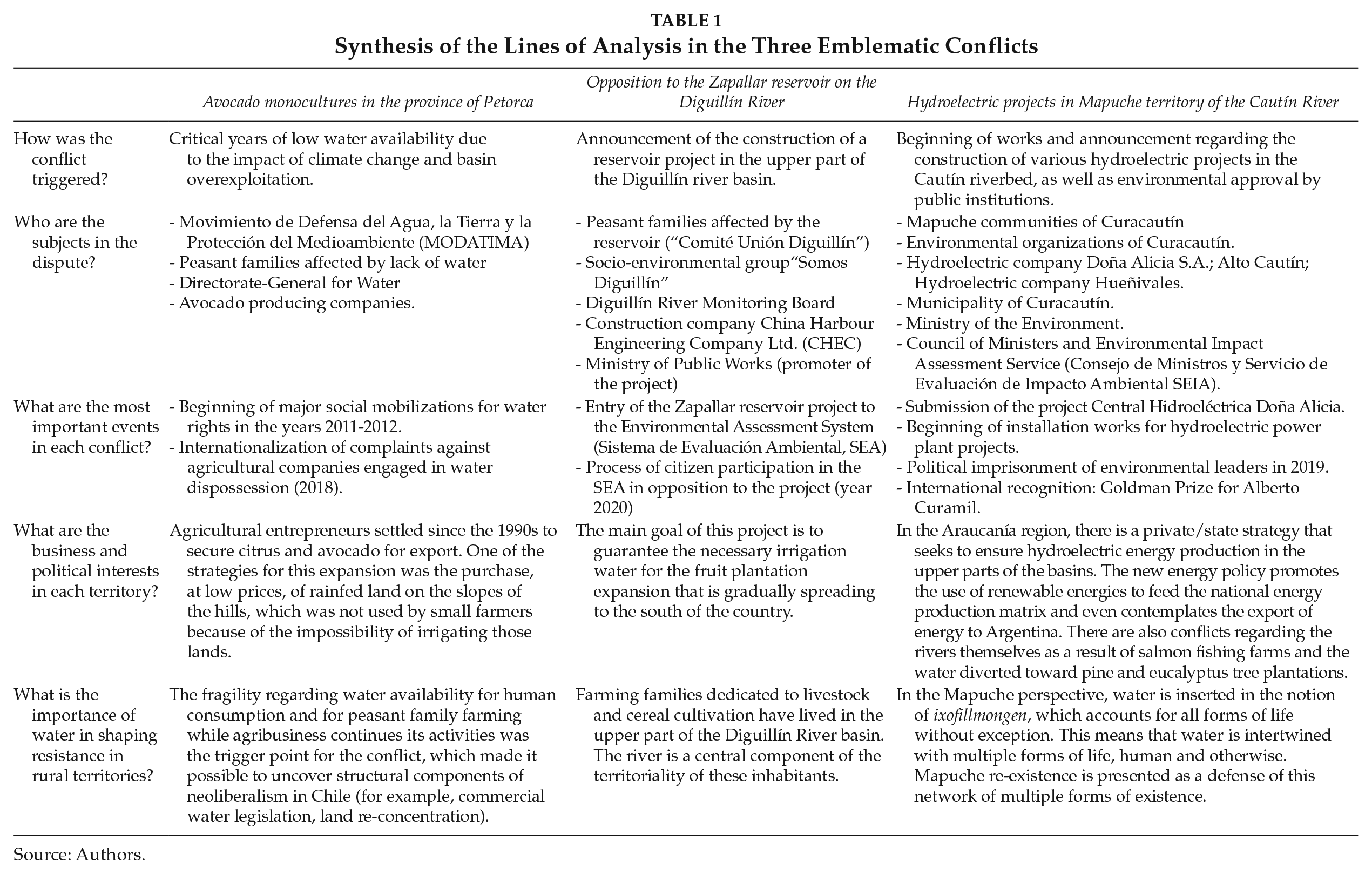
Based on the lines of analysis defined above, we arrive at the following synthesis regarding the three conflicts under research:
Synthesis of the Lines of Analysis in the Three Emblematic Conflicts
Source: Authors.
Lessons From The Water Struggles In The Formation Of Re-Existences Across Rural Territories
In this section, we analyze the transversal lessons that emerge from these emblematic conflicts. After addressing these cases, we identify four political lessons from these struggles that might help us reassess the agrarian question in the 21st century, both in Chile and Latin America at large.
Understanding Water Glows For A More Complex View Of Territorial Dispossession
Contemporary analyses have shown the complexity of deterritorialization in rural territories. In various parts of Latin America, it has become evident that territorial dispossession goes beyond the enclosure of lands that played a central part of the peasant struggles of the 20th century. One of these aspects has to do with contemporary forms of water dispossession. In the Chilean case, the process of water neoliberalization and the socio-metabolic acceleration of extractivism have led to a complex concentration of water use. In the case of the Petorca conflict, the over-exploitation of the basins has led to a drastic decrease in surface water, which has sharpened the, at times, silent dispute over groundwater.
2
Catchment wells are increasingly being made deeper to obtain the water needed to continue production. And, although the depletion of the surface waters of the rivers is evident, the over-exploitation of the aquifers is more difficult to measure by groups and classes who find themselves in a subaltern position because it is not possible to know, at a glance, what is happening underground. This has led to the paradoxical reality of peasants who possess land but have no water with which to irrigate said land. As stated in interviews with peasant families: It is so sad to see that there is this amount of land, and one cannot sow it because there is no amount of water. . . It’s terrible. Because there is one struggle here on earth and, then, to think that water is not coming from above! So, it’s two things. And maybe you can fight for the things that are happening here on earth, but the water that comes from on high, who do you fight with? (Peasant interview in Panez, 2022)
These socio-ecological transformations derived from the new extractivist phase also affect the process of rural depopulation. There is constant pressure to effectively occupy the land and intensify production. This has pushed an increasingly voracious market for land that, faced with the impossibility of cultivation, either because of lack of water, degradation, or lack of resources, leaves the sale of land as the only way out.
A similar situation occurs in the case of the Mapuche territory, in part of the ancestral land that is now Chile, where the monoproduction of wheat in an industrial manner and the proliferation of monocultures of pine and eucalyptus in large tracts of land have been part of the historical strategies implemented on traditional agricultural practices. To this, we should add the incorporation of the production of fruits for export, such as hazelnuts and, more recently, berries, which has profoundly transformed the region’s agricultural landscape .
This also happens in the Diguillín River, where a peasant woman tells us about the impacts of the possible construction of the reservoir on her vital relationship with the waters of the river: I don’t want the reservoir to be built; if it is, you can say that we won’t have a life. Because imagine, they will come here and make that channel, the slopes that we are occupying will all remain in the channel, and we will run out of water. (Informant 2, Zapallar reservoir conflict).
Water As A Multi-Scale Articulator Of Socio-Territorial Demands
Authors such as Harvey (2018) have criticized the localisms implicit in the demands of social groups and movements. According to the author, this “militant particularism” (2018) prevents them from transcending the sectoral demands of social struggles and prompting political leaps via policies of scale that allow for the mobilization of these demands on other platforms, such as political arenas. Thus, this scaled theory of the struggles for spatial justice applied to the struggles for water here analyzed develops in a dialectical movement between the claim for the territories inhabited with a global awareness of social rights which, like water, are violated by the neoliberal system. Currently, in Chile, the issue and concern for water has gone from a local problem in several territories to one of the main topics of debate in the new political constitution as well as in the territorial and environmental management concerns of the Gabriel Boric government. Both scales of action, local and global, are not mutually exclusive but start in the multiplicity of the fields of action. What is interesting from this perspective is that, in the field of social struggles for water, this interaction in the form of territorial networks comes precisely from the capacity for articulation that water acquires in its fluid condition—a connector that links the fabrics of various forms of existence present in the territories (rivers, mountains, animals, plants, humans) who are in a relationship of coexistence in regards to water (Porto-Goncalves, 2006; Panez, 2022).
The connections produced by water flows and hydrosocial cycles suggest that we should go beyond the local and rearticulate scales of resistance and struggle around water at the national and transnational levels. In Chile, initiatives such as the Plurinational March for Water (Marcha plurinacional por el Agua, held annually since 2013), national platforms such as the Movement for the Defense of Water, Land, and Environmental Protection (Movimiento de Defensa del Agua, la Tierra y la Protección del Medioambiente, MODATIMA), or the Movement for the Water and Territories (Movimiento por el Agua y los Territorios, MAT), have managed to bring together various experiences connected to a multiplicity of water problems and, from that, build a multiplicity of strategies and collective demands that are currently being disputed in the context of the new political constitution. Thus, thinking about territories as spaces in dispute in such a context has meant rethinking the strategies and repertoires of struggle. In addition to this articulation of scales, the demand for water at the local level has managed to bring together different organizations and inhabitants of rural territories.
This is the case of the Zapallar reservoir, where the movement in defense of the Diguillín River is made up of peasant communities, groups of young people from urban centers in those localities, small entrepreneurs working in tourism, and environmental NGOs. This plurality of subjects accounts for the mobilizing capacity of the rural struggle for water access. At the same time, Mapuche and other Chilean groups have effectively managed the escalation of struggles to supranational legal instances by denouncing the violation of agreements in international courts, showing strategies that build policies of scale around water.
The commune of Petorca has likewise used scale policy strategies, generating pressure on European avocado-importing countries, denouncing the industry’s poor agricultural practices, water availability problems, and overall socio-environmental impact. This resulted in a loss of buyers and a decrease in avocado production in the territory.
One of the main reasons why social movements around water are among the most significant in Chile’s post-dictatorial period is the result of the country’s radical (neoliberal) privatization and commodification of water. Faced with the complexity of extractive activities in rural areas already theoretically discussed (mining, hydroelectricity, agribusiness, forestry, among others), the transparency of water created a fabric with threads that could weave among the opposition to these particular projects.
Thinking Of Rivers And Watersheds As Central Elements In Rural Territories
In relation to the above, this second political lesson becomes important in the country of Chile, with its long north-south configuration made up of 101 hydrographic basins. The basin scale has opened an interesting starting point since it has placed its center in an ecosystem interaction. From the ecological exchanges that take place in the hydrographic basins, the inhabitants have territorialized the basin as a scale of dispute. Along these lines, rivers become the agent that energizes almost all processes within a basin, mobilizing the exchange of materials and energies. Although social movements distance themselves from technical-based conceptions coming from public policy and academic elaborations on the idea of watersheds, the understanding of hydrosocial dynamics from a perspective of conflict has led organizations to deepen the defense of watersheds as a whole. This is very clear in the explanation made by a territorial leader regarding the possible impacts of the Zapallar reservoir on the Diguillín River: “[with the reservoir] the flow will decrease, and the wells that exist in the surroundings will see a decrease in water because the river has veins that feed the groundwater, and then wells of people over here will reduce, the water will decrease” (Informant 4, Zapallar reservoir conflict).
Similarly, in the Mapuche case, it is a coincidence that the criterion of delimitation used ancestrally to define the minimum territorial unit of political and social articulation, Lof, corresponds precisely to hydrographic sub-basins within which a form of Mapuche territorial ordering or Az Mapu is carried out. These Lof are grouped into larger territorial political structures called Rewe and Ayllarewe. Currently, these natural-cultural delimitations of territory are being employed politically by the Mapuche as a strategy to oppose extractive energy projects. This scale-based understanding has even led organizations to articulate themselves as basins, breaking administrative logistics of territorial division such as the communal scale. They thus form territorial networks between socio-environmental organizations that establish joint strategies to face the problems arising from water dispossession. In this way, the basins and rivers have become the political scale of several conflicts, allowing, on the one hand, to reveal extant ecosystemic interconnections in the territory, the possible impacts of extractive activities, and, consequently, the need to articulate the numerous demands arising from said territory. By determining the basin as a space, it is possible to articulate much more complex movements, which lead to a diversity of problems that affect the rural territory. In this sense, it is interesting to see that today’s struggles bear the name of a geographical element (river, basin, valley) or a slogan against intervening said body, and it is no longer very common for them to use the name of a political group.
This is interesting in a country like Chile, where the installation of extractive projects is housed along basins, initiating a mining or hydroelectric extraction in the upper course, the installation of agroindustry in the middle, and industrial forestry and fishing activities in the lower reaches and coast. The result has been an open struggle to develop regulations limiting the use of watersheds and effectively protecting rivers. To date, the main efforts are focused on territorial planning instruments that seek to work at that scale.
The understanding of the basin and its socionatural cycles fuels critical geography debates around territory, as we previously pointed out. This political lesson refers us to geography as a central component of these conflicts (Porto-Goncalves, 2006). The recognition of the importance of watersheds in territorial dynamics entails an understanding of the culture-nature relationship that reveals not only its symbolic aspects (conceptions of nature) but also geobiophysical interactions contained in territorialization processes (for example, the interaction of deforestation and erosion, the relationship between water grabbing in the basin and groundwater recharge, among others). We think this geobiophysical aspect is partially undervalued in analyses of critical rural studies.
The Struggle For Water As A Channel To Understand Other Ontologies Of Being-Existing In Tandem With The Earth
This lesson addresses the issue of the struggle for water not only as a problem based on the logistics of a spatial justice regarding the redistributive nature of water, but also from the perspective of relational territorial ontologies, and the aspects that arise from an affective turn in environmental issues (Leguía-Cruz et al., 2021). Thus, the case of the struggle of the Mapuche people in Curacautín situates their defense of water within the perspective of their cultural cosmovision, where water emerges within the framework of territorial and relational ontologies of existence between the multiple forms of human and non-human life. This is highlighted via the Mapucheconcept of ixofillmongen, which is used to refer to “all forms of life without exception.” From this perspective, water is understood as maintaining an indivisible ontological relationship between the multiple species that inhabit the territory alongside one another. As the logko Alberto Curamil points out: When we are told about natural resources, perhaps as it can be explained in the Western world. . . for us, that means life. We often talk about itrofillmongen, about biodiversity—that is, of all the life that exists in a given space in which we participate. (Informant Alberto Curamil, Curacautín Hydroelectric Conflict).
Thus, ixofillmongen refers to the dense network of territorial existences. Water, in its various expressions, is part of these connections between beings, human and otherwise. In this way, it is understood that the defense of water and rivers is a struggle for life in all its multiple expressions. An aspect that stands out in this formulation is the use of epistemological and ontological categories from the Mapuche worldview that are politically used as categories of dispute against colonial territorial orders, which opens an interesting door into thinking about territorial and water planning in an intercultural key. These were precisely the arguments employed by the Mapuche communities of Curacautín based on the provisions of ILO Convention 169, which states cultural recognition and rights over land, territory, and territoriality.
This type of affective turn in the political demands of water is also present in various territorial experiences of social movements that promote other ways of being and existing alongside water, as can be seen from this interview with a peasant leader from the province of Petorca: So, water for us peasants is life, life for human beings, especially for peasants, because if we don’t have water, then there is no field. Because if we live here in the countryside, it’s because we want to have animals, we want to produce and if we don’t have water, how can we have animals? The years are bad, little water has come. Animals die. (Interview with rural drinking water leader in Panez, 2022)
Conclusions
Having analyzed the cases, we argue that the social reappropriation of water caused by territorial conflicts is one of the central bridges that connect the agrarian question to the ecological question in Chile and Latin America. As we have pointed out, if access to water is not guaranteed in an equitable manner, and the forms of cultural use of water are not respected, rural living will find itself at a crossroads: depopulation or face the political process entailed by the dispute over territorial control of water and life.
This union between water, land, and territory is visible in some of the struggles discussed in this article. Some groups in the conflicts use the slogan “water for those who work the land,” a phrase heard strongly during mobilizations and a direct allusion to the emblematic claim of the agrarian reform, “the land for those who work it.” Above all, those within peasant territorial struggles claim that “recovering water is today’s agrarian reform.” In this sense, it is important to point out that proposals that are only focused on remedies for the management and access to water and do not question the neoliberal bases on which the territorial model of water dispossession is based fail to understand how territory and life are sustained. In this sense, it is important to reflect broadly on the neoliberal forms of production that comprehensively affect nature and ways of life.
At the same time, we also think it important to point out that the struggles for water should not only be addressed as a redistributive search for control of natural resources, but also seek the construction of new horizons of meaning that can accommodate other natures/cultures. This includes relationships to water that are built from the perspectives of gender, ethnicity, and class intersections, among other cultural forms that emerge in contemporary agrarian spaces. As stated with regard to the case studies described above, the experiences built by original peoples teach us that it is also important to question the coloniality implicit in processes of water dispossession and find ways to decolonize extant forms of exploitation of nature and life (Mansilla et al., 2024).
Likewise, and from an epistemological perspective, the review of these conflicts demonstrates that there are critical questions that must be addressed by the research field dedicated to analyzing the relationship between water, land, and territory in Chile, as well as the rest of Latin America. In the first place, and although in this paper we have stressed the centrality of water in the struggles of rural territories, it is important to insist on how it interweaves with the question of land. Certain approaches taken by the so-called “political ecology of water” are open to question (Prieto, 2015; Fragkou and Budds, 2020; Budds, 2012, among others). This approach, despite making important contributions to the understanding of the socio-natural flows of water, tends to underestimate the land problem and the current characteristics of the agrarian question. On the other hand, it also seems important that we extend the criticism to the field of rural critical studies on the agrarian question, where the socio-ecological dimension of the expansion of extractivism has been, so far, deemed minor.
As we have shown, the repercussions of these processes are key in shaping the hydrosocial cycle and for this reason, water increasingly appears as the central point of rural struggles. It seems to us that the political lessons of the struggles for water and territory here addressed are nourishing this field of studies: understanding how the demand for water affects the political scales-based production of territorial organizations and how waters evidence the geobiophysical interactions that reconfigure the agrarian space seems to us a relevant contribution for the rethinking of this interdisciplinary field. Alongside this, it seems to us that the voices embodied in the article are reworking the agrarian struggles from below, presenting us with horizons of re-existence that allow for the understanding of multiple facets that the agrarian question, as well as demands such as agrarian reform, have nowadays acquired in the continent. These voices show us that the vital importance of water is a founding component for the survival and recreation of other political ontologies of being and existing on this planet. That is why we consider that water and territory must be understood inseparably, avoiding the fragmentation that prevails in studies of water or land issues that disconnect these two elements from each other as well as in analyses of territorial dynamics.
Footnotes
Notes
Alexander Panez is an Assistant Professor at the Centro de Estudios Ñuble (Ñuble Studies Center) and the Department of Social Sciences of the University of Bio-Bio and has a Ph.D. in geography from the Universidad Federal Fluminense, Brazil. Pablo Mansilla-Quiñones is an Adjunct Professor at the Institute of Geography in the: Pontificia Universidad Católica de Valparaíso, Chile, and has a PhD in Geography from the Universidad Federal Fluminense, Brazil. Jorge Olea Peñaloza is an Assistant Professor in the Department of Geography at the Universidad de la Frontera and has a Ph.D. in geography from the Pontificia Universidad Católica de Chile. Mariana Ortega-Breña is a freelance translator based in Mexico City. The authors wish to thank: ANID ANILLOS ATE230072 “Climate Pluriverses: A Decolonial Perspective of Geohumanities for the Design of Alternative Territories in Climate Change Contexts”; ANID Fondecyt de Iniciación Científica nº11220783 “Agricultura y re-producción de desigualdades socioecológicas en contextos de crisis hídrica”; ANID FONDECYT nº1220896 “Wiñolnampulkafe: Mapuche mobilities and their territorialities”; and the Universidad del Bio-Bio “Agricultura, Ciclo Hidrosocial y Desigualdades Socioecológicas.”