




Abstract
Studies on the agrarian question in Latin America have dealt with the role of capital in the area of agriculture and forestry while paying scant attention to its role in other areas, such as mining. Research on mining extractivism, for its part, has privileged recent socio-environmental conflicts without delving into the configurations of social classes and labor relations as it relates to agriculture. This article integrates these topics, analyzing the connections between copper extractivism, the commodification of the yareta plant, and indigenous peasant labor. We studied the medium-upper basin of the Loa River, in northern Chile, where one of the most important copper mines in the world (Chuquicamata) has been operating since 1915. Using ethnography and bibliographic analysis, we provide an account of how the expansion of extractivism requires a mixture of properly capitalist labor relations mixed with customary Andean practices. The latter are subsumed by capital and have played a key structural role during certain periods.
One of the major and long-standing forces to have shaped Latin America’s rural territories is the region’s participation in the world market as an exporter of food and raw materials (Kay, 2015; McKay, Alonso-Fradejas, and Ezquerro-Cañete, 2021; Veltmeyer, 2019; Vergara-Camus and Kay, 2018; Bebbington, 2007). This phenomenon, though quite old in nature (Marini, 2015), has been conceptualized in recent decades as extractivism (Gudynas, 2013; Machado, 2015; Svampa, 2019).
In Latin America, various extractive industries have developed. Among others, those dedicated to minerals and hydrocarbons; monoculture agriculture and forestry; livestock, fishing, and industrial aquaculture predominate. However, studies that address these issues from the point of view of the agrarian question have primarily focused on the dynamics generated by agricultural and forestry capital. Even recent publications fail to delve into other extractive branches in detail (Kay and Vergara-Camus, 2018; McKay, Alonso-Fradejas, and Ezquerro-Cañete, 2021). On the other hand, Latin American studies on extractivism have mainly focused on recent socio-environmental conflicts, mainly where Indigenous, environmentalist or feminist-based social movements are concerned (Delgado, 2013; Göbel and Ulloa, 2014; Vindal and Rivera, 2019), and have paid scant attention to the social class relations of rural populations.
To enrich these approaches, this article will address the labor relations and social classes that occur in a rural territory where mining extractivism predominates. From the colonial period to the present day, mining has expanded in Latin America, especially across the Andean region (Assadourian et al., 1980; Bebbington and Bury, 2013; Perreault, 2014). Therefore, it becomes difficult to understand Andean rurality if we do not connect these processes with the growth of mining (Bebbington, 2007; Bebbington et al., 2008; Long and Roberts, 1984). The Chilean case is an excellent example for addressing this issue.
For most of the 20th century and until today, Chile has been the primary copper producer globally (Comisión Chilena del Cobre, 2020). Since the beginning of the 20th century, large-scale copper mining has intensified in the country, particularly in the Atacama Desert in northern Chile. From the start, the Antofagasta Region has stood out as the most relevant territory. In fact, in 2019, it concentrated 54 percent of national copper production (Comisión Chilena del Cobre, 2020). This region has copper deposits of global importance, located in the middle sector of the Loa River basin whose main mine, Chuquicamata, has been operating since 1915 (Millán, 2006; Servicio Nacional de Geología y Minería, 2020).
The Antofagasta Region is in the hyper-arid Atacama Desert. The ecosystems of the Loa are therefore particularly sensitive to climate changes or water availability (Marquet et al., 1998). In addition, its wetlands and tributaries have long been inhabited by Andean Indigenous people (Aldunate et al., 1986; Castro and Martinez, 1996; Villagrán and Castro, 1997). At present, these populations mostly self-identify as Lickanantay.
Since pre-Hispanic times these peoples have practiced agricultural and pastoral activities involving domestic and communal work (Aldunate et al., 1986; Villagrán and Castro, 1997). These ways of life, associated with the Andean peasantry 1 , persist today. They have, however, transformed and weakened during the 20th and 21st centuries. The expansion of copper extractivism and the reconfiguration of relations between society and nature has given rise to have been a key factor in this transformation (Calderón and Prieto, 2020; Carrasco, 2016; Castro and Martinez, 1996; Gundermann, 1998; Prieto, Salazar, and Valenzuela, 2019).
Our study focuses on the commodification of nature fostered by extractivism, analyzing the role of peasant labor in this process, as well as the main changes that have taken place in the peasantry’s ways of life. In particular, we investigated the commodification of the high Andean yareta plant (Azorella compacta), which was used until the late 1960s as fuel by large-scale mining operations and related urban centers. The peasantry of the upper-middle sectors of the Loa River participated actively in the commodification of the plant, combining properly capitalist labor relations with customary Andean practices. We address this issue via a historical reconstruction of our territory of study 2 (Figure 1), and focus on the connections between copper extractivism, the commodification of yareta, and peasant labor. Our story spans from the early 20th century to the late 1960s, approximately.
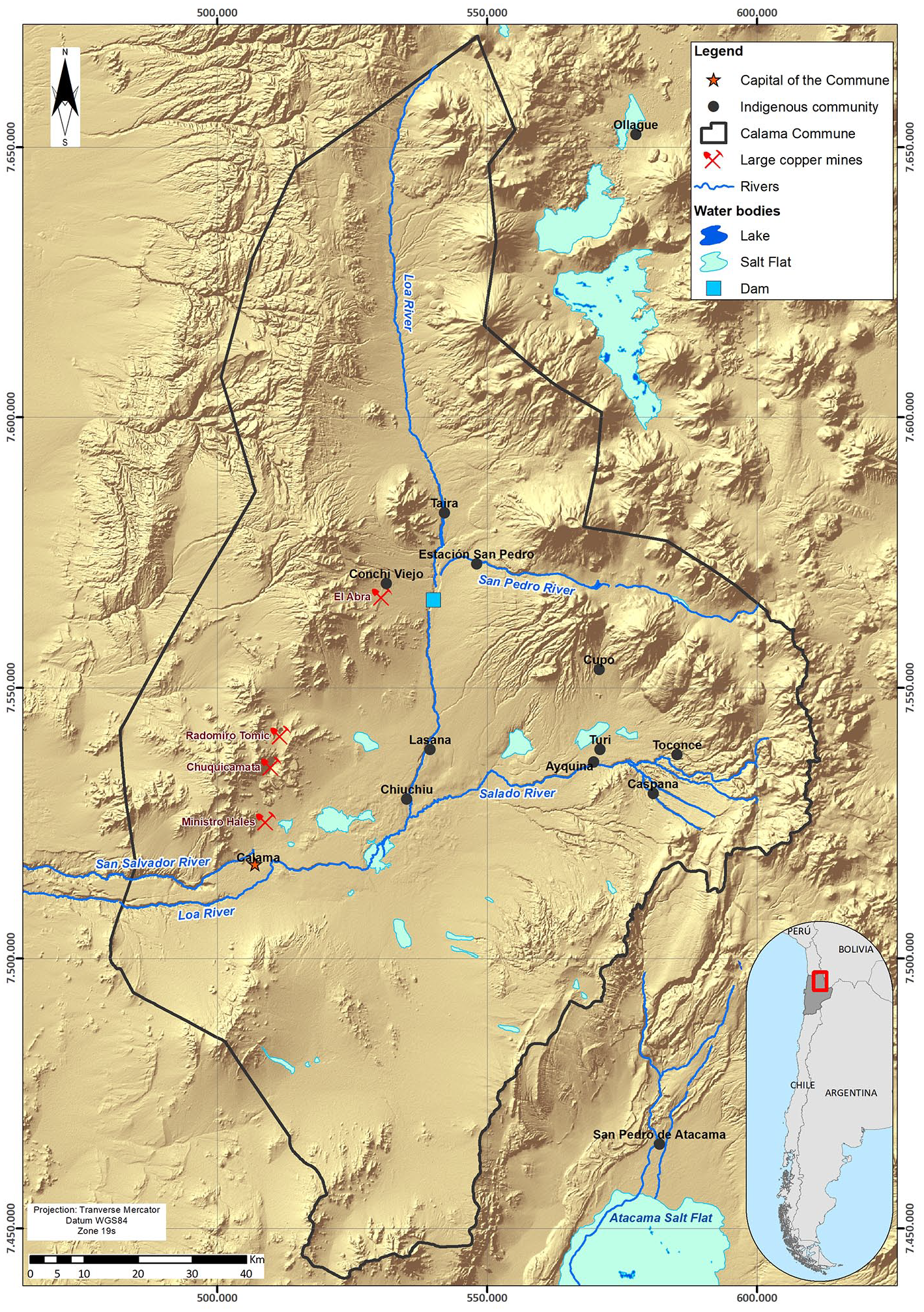
Territory of study: upper-middle basin of the Loa River.
Capitalism, Extractivism And Labor
The capitalist mode of production 3 has certain interrelated tendencies that are expressed heterogeneously in particular territories and during specific moments (Tsing, 2015; Wolf, 1982). Some of these tendencies have been conceived as properly capitalist—such as, for example, the privatization and commodification of the means of production (including nature), the existence of wage labor, and commodity production (Osorio, 2014; Smith, 2008; Wallerstein, 1983; Wolf, 1982).
That said, in capitalism’s process of global expansion and during its regular operation, properly capitalist dynamics combine with relations that are usually described as pre-capitalist or “non-capitalist”—for example, family or community ownership of the means of production, domestic or communal labor relations, and production for self-consumption, among others. Thus, the mixture of typically capitalist relations with so-called “non-capitalist” relations is a constitutive quality of capitalism that becomes necessary for its reproduction (Tsing, 2015; Wallerstein, 1983; Wolf, 1982). In turn, this mode of production has turned into a global system interconnected by commodity chains, and unequal relations between central and dependent (or peripheral) countries (Osorio, 2014; Smith, 2008; Tsing, 2015; Wallerstein, 1983; Wolf, 1982).
Extractivism is a specific dependent modality taken by the capitalist mode of production. It is part of a pattern of reproduction of capital (Osorio, 2014) that can take place in mainly in peripheral countries, or in certain regions within them. 4 It is characterized by the predominance of large-scale extraction, cultivation, or breeding of natural elements (inert or biological) that are then exported with a low degree of processing to the world market (Machado, 2015; Svampa, 2019). One of its central components is that the process of capital accumulation is based on what Marx (1959) termed differential rent. This is the extraordinary profit that allows for the appropriation and exploitation of natural resources that are not reproducible at the will of capital. They are natural forces or elements that can be monopolized since they are not distributed homogeneously across the planet and their productive qualities are not identical.
Here we will distinguish two forms of extractivism depending on the type of relationship capital establishes with nature in the productive process. Based on Boyd, Prudham and Schurman (2001), one type of extractivism arises when the relationship implies a formal subsumption of nature by capital. In this case, nature is presented to capital as physical processes or matter that cannot be generated or accelerated according to capital’s own requirements and, therefore, productive processes adapt to natural conditions and limitations. The operations are characterized by separating natural elements from the spatiality where they are located, and some characteristic activities of this type are mining, the hydrocarbons industry, or extractive fishing.
The second type of extractivism exists when the capital-nature relationship comprises its real subsumption (Boyd, Prudham and Schurman, 2001). Here nature has a biological basis, and capital manipulates cycles or natural qualities to increase its productivity. These activities operate through plant cultivation or animal husbandry involving biophysical manipulation and the use of exogenous elements (hormones, fertilizers, pesticides, etc.). Representative activities include forestry, agriculture, and aquaculture. As these activities are carried out across inert, monopolizable nature (land or sea), differential rent also operates.
The relations of capital with nature, and those of extractive industries in particular, are mediated by labor and social class relations (Smith, 2008; Wolf, 1982). To distinguish between these relations, we will use the notions of formal and real subsumption of labor by capital (Marx, 1971). In the first case, direct producers retain an important degree of autonomy in the process of production, even controlling all or a substantial part of the means of production, although capital appropriates the commodities. Therefore, these are spaces where, while capitalism still operates, there is an important presence of relations that are not typically capitalist. When we transplant these dynamics to spatial processes, we can see that these cases are characterized by capital’s territorial monopolization of areas that continue to be controlled by other social classes such as the peasantry (Oliveira, 2005).
On the other hand, the real subsumption of labor by capital (Marx, 1971) accounts for capitalist ownership of the means of production. Therefore, the use of labor power intensifies, productive management is carried out by capitalists, the social division of labor increases, and payment in wages comes to predominate. In these cases, capital unfolds across the territory, intertwining and co-producing with the socio-natural dynamics of the place. Accumulation is therefore sustained in properly capitalist relations, resulting in the territorialization of capital (Oliveira, 2005).
Methodology
We pay special attention to the experiences of the Indigenous population regarding this problem and therefore rely on data from ethnographic work complemented by bibliographic analysis. Considering that the communities inhabiting the territory did not produce their own written records (at least during the period we are addressing), our historical reconstruction combines oral history and bibliographic sources. To study the more distant periods, we primarily rely on bibliographic sources, while as we narrate more recent stages, we mainly resort to oral histories.
We conducted the ethnographic work in successive visits spanning from 2016 to 2019, during which we interviewed 43 adult respondents (22 men and 21 women) from six rural indigenous villages of the upper-middle Loa region: Chiu Chiu, Lasana, Ayquina-Turi, Cupo, Caspana, and Toconce. Representation per community was not equivalent but was established during the ethnographic research and in accordance with people’s readiness, as well as the available times to carry out the study. We selected the respondents through qualitative sampling. The criteria required the interviewees to have engaged in agricultural activities at some point in their lives and have knowledge of community history. Bibliographic sources, on the other hand, came from specialized libraries and repositories (both physical and online), as well as from scientific databases.
The data were processed via qualitative analysis software using encodings. We drew up six major groups of codes: 1) agricultural activities; 2) mining; (3) other economic activities; (4) demographic changes; 5) natural resources (including yareta) and 6) identities. Each code was composed of subcodes that allowed us to classify the data in detail and relate it.
Our historical reconstruction covers from the beginning of the 20th century to the end of the 1960s, approximately. This was the period in which extractivism led to a dynamic yareta market in the territory of study. However, our reconstruction does not follow detailed chronological precision. The older interviewees managed their own milestones and temporal logistics without sticking to specific years or our historical references. Nevertheless, we established periods when relating the testimonies to our bibliographic sources.
Indigenous Territory, The Arrival Of Extractivism And The Role Of Yareta
At the beginning of the 20th century, the Indigenous of the territory (Lickanantay People) were mostly engaged in agricultural and pastoral activities of the peasant type, making complementary use of different ecological zones (Aldunate et al., 1986; Castro and Martinez, 1996; Gundermann, 1998; Hanson, 1926; Villagrán and Castro, 1997; Walcott, 1925). Agriculture, which persists to this day, has been practiced in oases and streams located approximately between 2,300 and 3,300 meters above sea level. Grazing was carried out in wetlands (locally known as vegas y bofedales) and forage-rich areas generally located above 3,500 meters above sea level, although wetlands also exist in lower ecological zones. In the high pastoral areas, seasonal settlements called “estancias” were established. For example, a respondent from Chiu Chiu recalled that her parents (who were from the towns of Ayquina and Toconce) “had several animals, lambs [sheep] and llamas, mainly. They kept them for an important part of the year in the plains near Chiu Chiu, and for two months during the winter my mother took them to the mountain range to graze” (female respondent G, interview, Chiu Chiu, November 9, 2018).
Regarding agricultural activity, an interviewee said: My grandmother told me that my grandfather was involved in a minga
5
[in Cupo]. My grandfather, my uncles, my mom, my aunt, neighbors, they all engaged in minga. They got together and went out to plant, worked all day. These people [the owners of the land] provided them lunch, breakfast, while the planting lasted. For two days they planted for one person, and then they went and sowed for another person (female respondent C, interview, Calama, October 6, 2018).
Following up on our ethnographic records and bibliographic sources (Castro and Martinez, 1996; Club de Adultos Mayores de Ayquina-Turi, 2017; Gundermann, 1998; Martinez, 1985; Miranda, 2019), we can see that, when it came to agricultural and pastoral activities, family and community working relations marked by strong reciprocal components predominated. Additionally, production was fundamentally oriented toward self-consumption, and resource tenure combined domestic property (agricultural land) with communal property meant for family use (estancias and irrigation water). However, in medium-altitude oases (Calama and Chiu Chiu), non-Indigenous individual property on agricultural land had been established since colonial times (Barros, 2008; Gundermann, 1998). This type of property had also been built over small and medium-sized mines near Calama, as well as over other higher non-metallic deposits (Richard, 2021; Sanhueza and Gundermann, 2007).
As per the above, the peasants were not isolated from the dynamics of global capitalism. And although agriculture and pastoralism functioned through customary relations, they were still transformed by capitalist forces and were part of them. For example, European crops and animals (wheat, fruit trees, alfalfa, goats, sheep, donkeys, mules, etc.) were combined with Andean species (corn, potatoes, quinoa, llamas, alpacas, etc.) Núñez. 1995). Additionally, if within the agro-pastoral system they developed family and communal relations, they were outwardly linked as (more or less sporadic) sellers of labor power to the small and medium-sized mines (Gundermann, 1998; Hanson, 1926; Sanhueza and Gundermann, 2007). Along with this, the Andean communities already extracted yareta on a limited scale to sell to the mines (Bertrand, 1885; Risopatrón, 1905). Regarding salaried work in mining, a respondent relates that, “the other job there was sulfur. The sulfur was extracted in Cabana and several other places (Cerro Apagado, Tatio, etc.). They brought the raw sulfur and arrived at the Tocorpuri plant and refined it there. They brought it refined to San Pedro Station and from there they shipped it” (male respondent C, interview, Calama, October 6, 2018).
The Andean yareta (yarita in Quechua language) is a cushion plant in the family Apiaceae. It grows between 3,800 and 5,200 meters above sea level in the south-central Andes (southern Peru, southwestern Bolivia, northern Chile, and northwestern Argentina). It lives an average of 850 years and can grow to be as old as 3,000 years (Pugnaire et al., 2020) (Figure 2). Since it is one of the woody plant species growing in the area, peasants and herders of the area have been using it on a small scale as domestic fuel, as well as for medicinal, culinary, and ceremonial uses since pre-Hispanic times (Hodge, 1960; Villagrán and Castro, 2004). These uses lasted until recent decades (Caceres De Baldarrago, Poma, and Spadaro, 2013; Villagrán and Castro, 2004; Aldunate et al., 1981; Club de Adultos Mayores de Ayquina-Turi 2017).
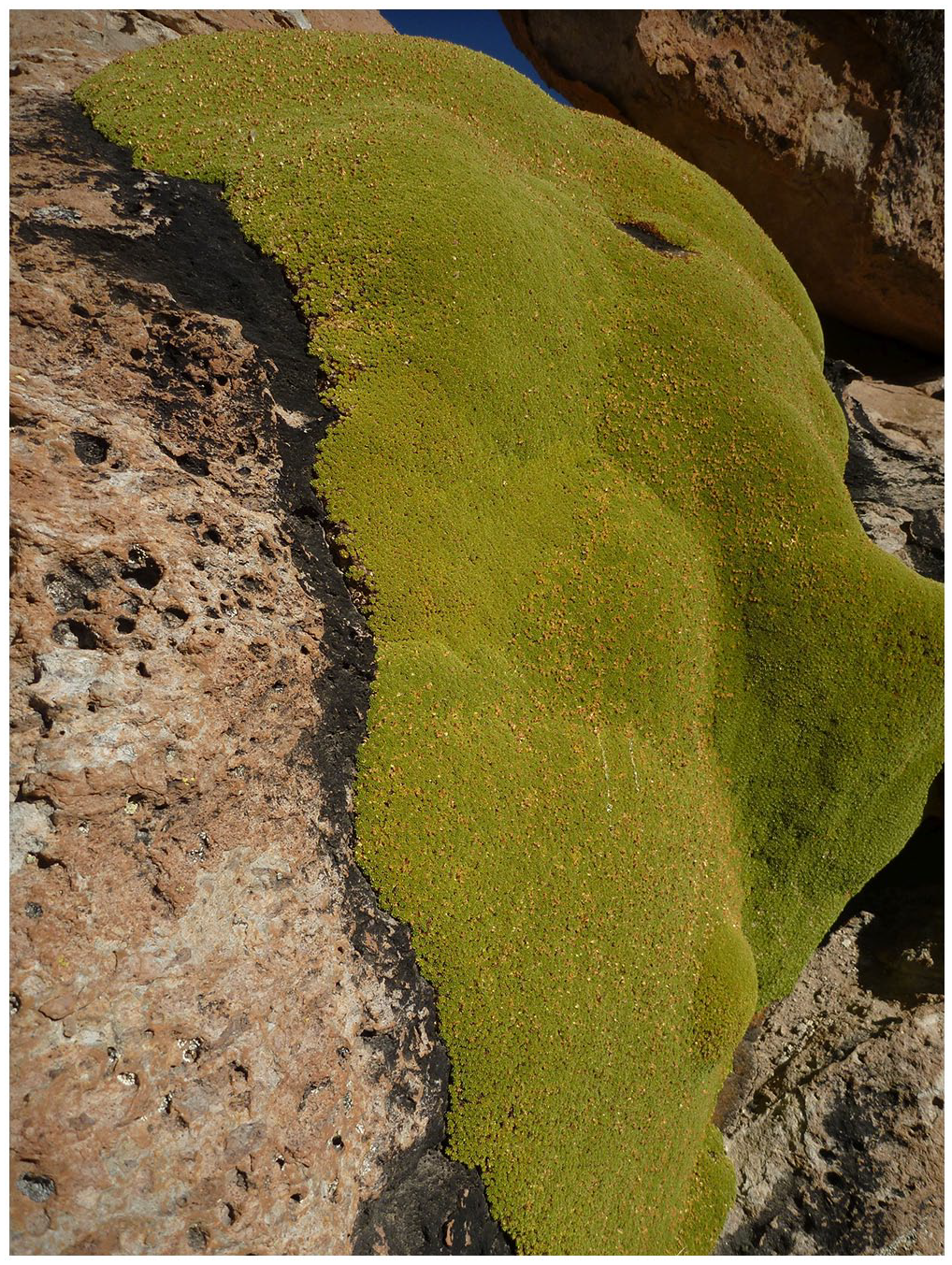
Photograph of a yareta in the upper sectors of the Loa River basin.
Also at the beginning of the 20th century, but on another scale, there was a growing demand for copper from central countries given the metal’s growing industrial use. It was in this context that, in 1915, U.S. capital started operating the Chuquicamata mine, controlled by the Chile Exploration Company (Chilex), in the middle section of the Loa River. It was one of the largest mining projects in the world, and Chuquicamata remained the most important global copper mine for most of the 20th century (Millán, 2006; Orellana, 2004). The management of this operation and its constant expansion led to the growth of the regional urban population until the present day (Calderón-Seguel et al., 2021; Arriaza and Galaz-Mandakovic, 2020).
In addition to making a formal subsumption of copper, large-scale mining relates through the same type of subsumption to other natural elements of the territory. The use of water and the dispossession of this resource experienced by Indigenous communities have received substantial attention (v.gr. Carrasco, 2016; Molina, 2012; Prieto, 2017; Prieto, Salazar, and Valenzuela, 2019; Yáñez and Molina, 2011). However, the reduced presence of forest timber resources in the desert presented additional challenges to copper extractivism, mainly due to the need for fuel. Fossil resources of extra-regional origin provided the supply for production processes by means of thermoelectricity. That said, other processes, and the households of the Chuquicamata camp as well as the city of Calama, were also in need of fuel. This prompted the extraction and large-scale use of yareta, which meant its formal subsumption and the deepening of mercantile dynamics. A respondent recalled that “yareta was used a lot, destined for Calama and Chuquicamata, both in the camp and in the foundry” (male respondent A, interview, Caspana, December 11, 2019).
Although yareta has been commodified since the late 19th century, when it was extracted on a limited scale to supply the small and medium mines in the area (Bertrand, 1885; Risopatrón, 1905), its use became widespread in the south-central Andes during the first half of the 20th century. It was driven by the vertiginous growth of cities, mines, railroads, and industries (Hodge, 1960; Pugnaire et al., 2020). The Chuquicamata mine and its related dynamics (both industrial and urban) were one of the sources of greatest demand (Hodge, 1960; Rudolph, 1951; 1952; Richard, Moraga, and Saavedra, 2016). For example, in the early 1950s, Chuquicamata consumed between 7,000 and 9,000 tons per year (Rudolph, 1951). At the end of this same decade, about 1,000 metric tons housed in the warehouses of the Chuquicamata camp were sold per month for domestic consumption (Hodge, 1960). A woman who lived as a child in the Chuquicamata camp recalled that “the yareta warehouses were loaded in ‘Chuqui’, that’s why there is no more of it; they used it a lot” (female respondent A, interview, Chiu Chiu, November 6, 2018).
During the 1950s and early 1960s, there were technological changes in the production processes of the mine as well as the houses in the camp, and yareta was progressively replaced by electricity and liquefied gas (Rudolph, 1951; Hodge, 1960). However, its use continued in Calama until approximately the end of the 1960s, when new energy sources began getting promoted in the city (Miranda, 2019; Club de Adultos Mayores de Ayquina-Turi, 2017). As the region neared the end of the large-scale demand for yareta, the commodification of the plant was radically reduced until it almost disappeared.
Presumably, the technical changes that resulted in the decommodification of the plant are, at least in part, a reaction to state regulations. In April 1941, the natural deposits of yareta in northern Chile were declared “forest reserves” to avoid their depletion (Cámara de Diputados, 1941a). Since demand for the plant continued, in September of the same year the National Congress discussed the reduction of taxes for yareta imported from Bolivia (Cámara de Diputados, 1941b). Finally, in November 1941, the Chilean State allowed the plant to be exploited through paid concessions (Subsecretaría de Tierras y Colonización, 1941). Apparently, this system operated for the rest of the period we researched. Although regulated, demand and exploitation of the plant remained quite intense between the 1940s and 1960s. In fact, Rudolph (1951) and Hodge (1960) warned that, if extraction continued with the same intensity they had observed, the plant would become extinct. After the large-scale commodification of the plant, it was found that its distribution and abundance in the territory had become quite reduced (Aldunate et al., 1981).
For the Indigenous inhabitants, this process did not occur as if a strange force blasted through the region, destroying the resource before their astonished gaze. The formal subsumption of the yareta was made possible by a formal and real subsumption of Indigenous labor. Indigenous inhabitants, in fact, mediated the relationship between extractivism and the plant. An interviewee from Caspana who participated as a teenager in the activity told us that “it was the foundation [of Indigenous livelihood] in all the communities. Everyone traded yareta, it was like our daily bread. The elders traded yareta and that was how they got their money” (male respondent B, interview, Caspana, June 4, 2019). Another interviewee said: My grandfather was a yaretero [yareta gatherer], he had a troop of forty donkeys, and they would go find yareta in the Tatio and other areas. They would leave for a week or two and then take it down to Chiu Chiu and sell it. Other times they did so in Calama. Many people worked in the yareta (female respondent F, interview, Caspana, January 28, 2019).
Commodification Of Yareta And The Subsumption Of Indigenous Labor
The large-scale commodification of yareta took place through two major mechanisms, each containing different expressions of the subsumption of Indigenous labor. A first form of commodification also recorded elsewhere in the south-central Andes (Hodge, 1960; Richard, Moraga, and Saavedra, 2016; Richard, 2021) involved large operations that extracted and moved the plant to points of intensive consumption.
In our territory of study, a company of this type operated by the San Pedro River (a tributary of the Loa), specifically in the area known as Estación de San Pedro Station (Club de Adultos Mayores de Ayquina-Turi, 2017; Miranda, 2019; Richard, Moraga, and Saavedra, 2016; Richard, 2021; Urdangarin, 2007). It supplied the mine and camp of Chuquicamata and was the exclusive center of yareta supply. It also supplied this resource to other mines in the area (borax mines, sulfur mines, etc.). The operation was owned by a family of Spanish origin with the surname Urdangarin and was locally known as Los Coño. According to a respondent: The people who lived in [Estación] San Pedro worked in Cerro Panire and Cerro Peineta. The company that was devoted to yareta was in San Pedro; they extracted yareta and sold it to ‘Chuqui’. [. . .] I don’t remember the name, but they called it Los Coño. [. . .] Ignacio Urdangarin, I think, was the owner (male respondent C, interview, Calama, October 6, 2018).
Regarding access to the yareta plant after 1941, the Los Coño operation had to continue extraction via the concession system mentioned in the previous section (Subsecretaría de Tierras y Colonización, 1941). We have, however, no historical record of how they functioned previously. Several studies show that extraction was an activity mainly carried out by Indigenous men from the upper sectors of the Antofagasta Region, as well as from southern Bolivia (Club de Adultos Mayores de Ayquina-Turi, 2017; Miranda, 2019; Vilches and Morales, 2017). The work was organized by crews that received a salary based on the amount of extracted plant. Each crew was recruited by a contractor, who was, in turn, the driver of the truck in charge of transporting the yareta to Estación San Pedro, from where it was sent by rail to Chuquicamata. The same interviewee quoted above noted that “workers were hired. They were looking for people and sent them out to find yareta in the hills. Workers came from different places, including Bolivia; from Cupo, Toconce, Caspana, Ayquina” (male respondent C, interview, Calama, October 6, 2018).
The Indigenous people who extracted yareta for Los Coño combined capitalist relations (wages) with technologies and practices from the customary Andean economy. For example, in areas where there were no roads or routes for trucks, they used caravans of llamas or packs of donkeys to move the resource to the trucks or a railway station (Hanson, 1926; Vilches and Morales, 2017; Walcott, 1925). In addition, the camps where they spent the nights during the extraction process were built with materials and architectural style typical of pastoral estancias (Vilches and Morales, 2017). Throughout the year, peasants combined this salaried work with agro-pastoral activities they carried out in their villages of origin, where they continued to participate in the communal economy and communal ritual events (Miranda 2019; Club de Adultos Mayores de Ayquina-Turi, 2017; Hanson, 1926).
According to our ethnographic records, the trucks were owned by Los Coño and the drivers received a salary based on the amount of yareta they moved. Some drivers were Indigenous men who had left rural life behind to insert themselves into urban/extractive dynamics, while others were non-Indigenous people from Calama or other parts of the country (Richard, Moraga, and Saavedra, 2016; Richard, 2021). An interviewee who lived in Estación San Pedro as a child told us that “my dad was a truck driver for Los Coño. He drove one [truck] and had two more under his charge, and fifty-day laborers. Most of them were from southern Bolivia” (female respondent B, interview, Chiu Chiu, November 6, 2018).
Throughout the commercial cycle led by Los Coño, the real subsumption of work (the salaried payment to drivers and extractors) coexisted with elements of formal subsumption in the extraction itself. In this primary link, direct producers had a certain degree of autonomy based on the use of customary practices and technologies. Similarly, Indigenous livelihoods combined wages from yareta extraction with agricultural goods produced within the framework of relations of customary Andean origin. Therefore, we see that at different times of the same mercantile cycle, there were links and spaces where capital had been territorialized into ownership, and others where only the territory was monopolized.
The second system of yareta commodification was in place from the beginning of large-scale copper mining (1915) until the late 1960s. It was carried out by self-employed Indigenous peasants and had a history of small-scale extraction and sale prior to the greater process that arose with large-scale copper mining.
Our ethnographic records show the existence of domestic relations in the extraction and transfer of the resource, with sales to intermediaries who traded it in Calama. In turn, apart from state regulations on yareta, communities were governed by customary criteria of ownership and resource use, in particular when it came to communal property meant for family use (a characteristic of grazing on estancias). This mercantile cycle, although explained by the expansion of large-scale copper mining and the consequent urban growth, took place in parallel to the commodification constituted around Los Coño.
Customary forms and laws regarding the use of pastoral areas were characterized by community ownership and family use, with a clear distinction between the areas that belonged to each community (Castro and Martinez, 1996; Club de Adultos Mayores de Ayquina-Turi, 2017; Miranda, 2019; Villagrán and Castro, 1997). The self-employed exploitation of yareta replicated this mode of territorial control (Miranda, 2019; Club de Adultos Mayores de Ayquina-Turi, 2017; Aldunate et al., 1981). An interviewee explained that “each family got together and each one had right to the use of certain sectors for extraction [of yareta]. Within the community, the sectors were subdivided” (male respondent D, interview, Caspana, June 4, 2019). Other records indicate that “the hill was large, so each community member knew his place, where to arrive. All of that belonged to the community. For the side of Toconce [. . .] Caspana’s side was higher. Everyone knew their sector and respected each other” (Club de Adultos Mayores de Ayquina-Turi, 2017: 28).
However, the self-employed commodification of yareta was not a neutral process given that the customary delimitations of spaces without major pastoral use could be unclear. In this sense, inhabitants of Ayquina and Toconce got in a conflict over the ownership of yareta areas. After negotiations, they managed to establish new communal and family boundaries (Aldunate et al., 1981).
In turn, territorialization pressure by Los Coño over areas under peasant control led to the emergence of new forms of Indigenous property. In 1953, the inhabitants of Caspana managed to obtain state acknowledgement for their areas of yareta extraction by applying for a governmental concession. 6 Customary mechanisms continued to operate within these spaces. An interviewee told us that “there is a document where the community owns these yareteras” [yareta exploitation zones] (male respondent E, interview, Caspana, June 6, 2019). Other ethnographic records indicate that “we needed the concession because Mr. Urdangarin was showing up everywhere and we needed the yareta; that was our sustenance, so we had to defend that place” (Miranda, 2019: 32). This episode expresses a strategic mixture of customary property mores and state-avowed legality with the goal of maintaining territorial control. 7
During our ethnographic work we were told that yareta extraction, in general, was a preferably male task performed by members of the same domestic group. They traveled on foot for several hours from the villages, accompanied by pack animals (llamas or donkeys). Various hand tools were used for the extraction of the plant. As an important number of men participated iteratively in the labor markets, their involvement in the self-employment cycle did not affect the labor division by gender. This had already been organized through seasonal male participation in labor markets and agricultural activities, with regular participation of women and minors in the latter. However, although we were told that yareta extraction was mainly a male job, two female interviewees recalled that, as children, they accompanied their parents. A respondent indicated that “I went to get yareta with my dad, we took the donkeys. I went alone with my dad, I helped him hold the donkey” (female respondent A, interview, Chiu Chiu, November 6, 2018). Another interviewee said that “I worked in Cupo carrying yareta with donkeys. My dad had donkeys. Since my father was sick, I had to carry the yareta” (female respondent C, interview, Calama, October 6, 2018). Thus, this division of labor by gender, although it followed the indicated patterns, was flexible depending on the requirements of the domestic units.
To understand the impact of the self-employed cycle of yareta on the customary economy, it is important to consider that both our ethnographic records and bibliographic sources (Club de Adultos Mayores de Ayquina-Turi, 2017; Miranda, 2019; Sanhueza and Gundermann, 2007) indicate that, throughout the period we researched, there was an economic differentiation between peasant units with disparate tenure of agricultural land and livestock. A few domestic units per community controlled a larger area of agricultural and animal land relative to the general population. However, this did not affect the almost absolute predominance of domestic and community labor relations in the agricultural sector (although there was a limited presence of payments in products, and to a lesser extent, in money).
That said, the unequal possession of animals played an important role in the self-employed trade of yareta. Basically, wealthy units could move more of the plant to marketing points. Until the 1950s or so, the ability of these well-to-do units to transport more yareta strengthened their economic position, and yet this was not expressed in an expansion of land tenure or wage relations. The higher income was used to reproduce the existing differentiation but not to increase it. That said, and as we will see below, there was a process of deepening economic differentiation over time in the forms of participation in the circulation of yareta.
Our interviewees reported that until the 1940s, the resource was moved in caravans of llamas or donkeys to Chiu Chiu or Calama, where it was sold to intermediaries who in turn sold it at retail price in the city. However, the llamas were progressively replaced by donkeys. By the 1950s they were no longer being used for the transport of yareta. This was done entirely with donkeys and the exclusive point of reception was Calama (Club de Adultos Mayores de Ayquina-Turi, 2017; Miranda, 2019). A woman we interviewed told us that after going with her father to extract yareta: We used the donkeys to leave it in Chiu Chiu, and from there it would be carted to Calama, to Bañados street, and that’s where they delivered. [. . .] Others brought it using llamas, but these were smaller yaretas [. . .] In Chiu Chiu, someone bought the big balls of yareta and sold them in Calama (female respondent A, interview, Chiu Chiu, November 6, 2018).
On the other hand, a peasant from Caspana explained to us that “the oldest ones went down to Chiu Chiu. When I was a child, adults made that trip on a donkey” (male respondent E, interview, Caspana, June 6, 2019). Another interviewee from Cupo recalls: Since there was yareta, my aunt took care of the animals and my uncle worked gathering it. He took the yareta to Chiu Chiu with donkeys to sell it. So that is what they did, they had animals and they had yareta, they carried [sold] it and bought what they needed the most: sugar, flour, things like that. The potatoes and onions were brought from Lasana, but they already had the meat. (female respondent C, interview C, Calama, October 6, 2018).
During the 1950s, several villages of the upper Loa became spaces for the yareta trade. By that decade and in the beginning of the 1960s, well-to-do peasant units that had accumulated capital chose to invest it in the purchase of trucks. At the same time, the network of roads in the territory expanded (Richard, Moraga and Saavedra, 2016; Richard, 2021).
The previous investment allowed them to control the circulation of the resource to Calama, displacing those who did not have trucks for this activity. The rest of the peasantry continued to participate as yareta extractors and only moved the plant, using donkeys, from the places of extraction to the buyers’ trucks. The truck owners then took the resource to Calama and sold it to intermediaries who marketed it for urban consumption. Thus, a layer of intermediate peasantry was configured, and moving yareta turned into a specific occupation for well-to-do units. Despite this intensification of economic differentiation, the well-off units, along with those of a lower economic position, were primarily involved in domestic relations in all the activities in which they participated. Two sisters from Cupo recall that “my dad brought yareta to Chiu Chiu on a donkey. Sometimes he gathered a lot and there was a gentleman from Rio Grande who had a truck and came to buy yareta” (female respondents D and E, interview, Calama, November 10, 2018). Another informant told us: Every family extracted yareta [. . .]. I worked picking yareta with my brother [. . .]. We hauled it down from the hill using donkeys, down to where the vehicle could reach, and they bought it right there. We sold it to the owner of the truck and he took it to Calama. The people who operated the trucks were people from here who had vehicles. Before the road was made, we only did this with donkeys. (male respondent E, interview, Caspana, June 6, 2019)
The Indigenous population engaged in the activities described above without any major changes until the late 1960s. As stated in the previous section, in those years the self-employment cycle ceased when demand ended in Calama due to the change in energy sources. The commodification led by the Los Coño operation had ceased about ten years earlier.
Some interviewees remember, with a hint of nostalgia, the end of the mercantile cycles of the yareta. The two sisters already mentioned said: “The yareta could not be sold, they already had problems as it could no longer be extracted up there, they banned that. The yareta stayed where it was and it can no longer be removed; it is danger of extinction or something like that” (female respondents D and E, interview, Calama, November 10, 2018). Another female respondent said that “we came [to Chiu Chiu] because the pega [work] ended in Estación San Pedro, it ended in the yareteras and sulfur plants because the gringos [operation Los Coño] left” (female respondent B, interview, Chiu Chiu, November 6, 2018).
In this context, with the end of the large-scale commodification of the yareta, important changes took place in the economic activities of the Indigenous population from the 1970s onwards.
An important aspect that became clear during this research is that both cycles of yareta commodification (Figure 3) encouraged the Indigenous population to remain close to their villages. When the possibilities of obtaining cash income in the high Loa decreased, the population increased its mobility toward Calama, and this progressively became the primary residence for most of the Indigenous people of the territory. As part of this same process, there were relevant changes in agricultural and pastoral activities and, in general, there was a tendency toward weakened agricultural activities and the end of herding. 8 This process of reduced peasant activity and weakened agro-pastoral work was not expressed homogeneously throughout the territory. The causes, forms, and rhythms varied (these included loss of income near the villages, water dispossession, and the lure of urban life, among others). More research is required to delve into these aspects.
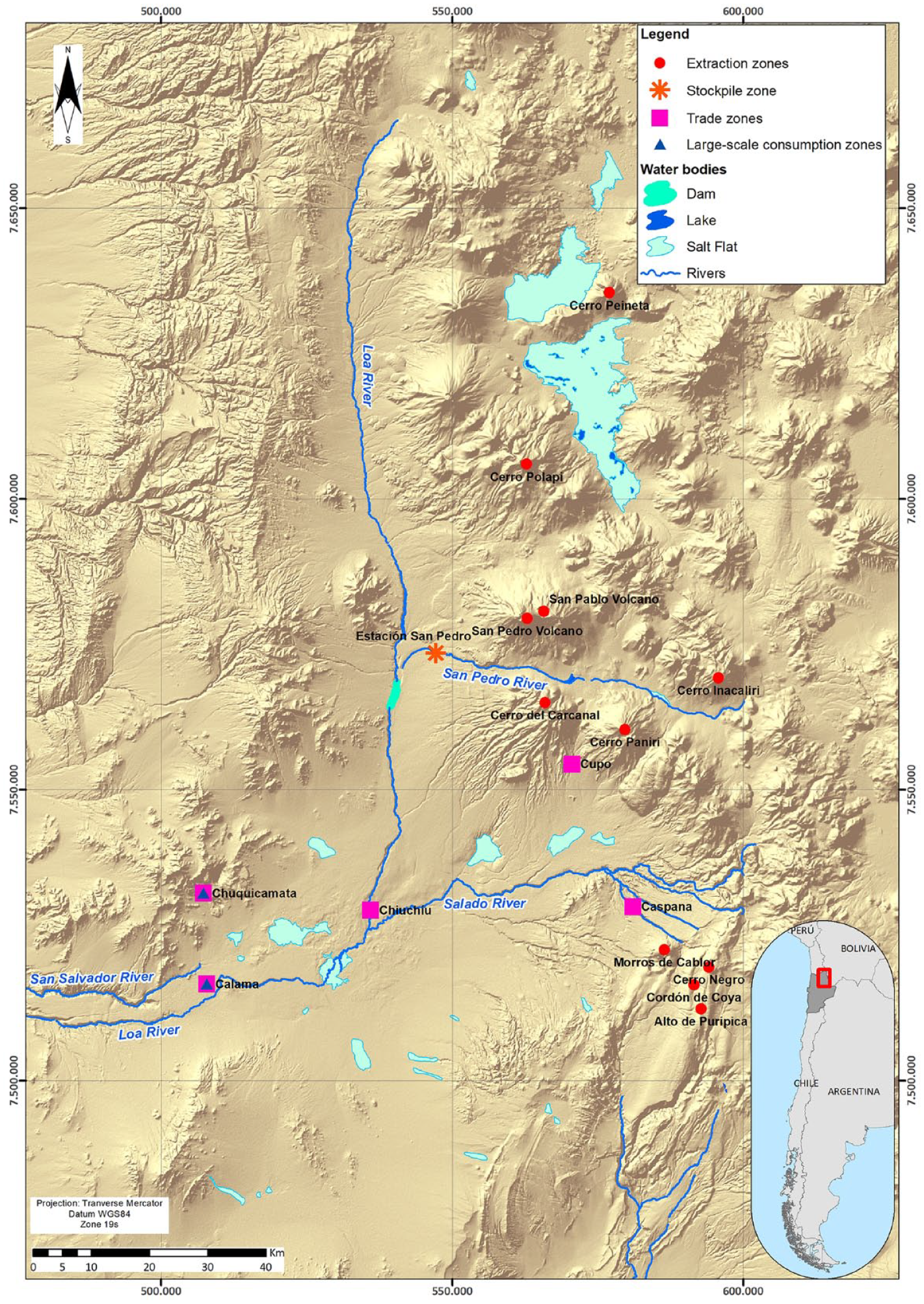
Main areas for the extraction, collection, trade, and consumption of yareta.
Conclusions
The relations between copper extractivism and yareta took place through two major procedures that, rather than being exclusive, were complementary. That is, they were expressions of the same growth process driven by large-scale mining in the territory. Out of the two cycles of commodification we identified, one was directly controlled by capital, configuring a space where it had been territorialized, and the other was controlled by the peasantry, in which case extractivism monopolized the space without becoming territorialized.
The first cycle corresponds to the Los Coño operation and its direct relationship with Chuquicamata. In this case and throughout the cycle, capital deployed a combination of real and formal subsumption of labor. In the area of circulation, wage labor predominated in the recruitment of truck drivers who transported the resource. In the field of extraction there was also wage labor by the Indigenous peasantry who, however, predominantly executed their work using customary Andean techniques and practices. Thus, the spatial deployment of extractivism, in this mercantile cycle, combined a territorialization of capital with a territorial monopoly restricted to extractive practices.
The second case involves the mercantile cycle of the yareta carried out in a self-employed manner by the Indigenous peasantry to supply Calama. During this cycle, extractivism was nourished by yareta through the formal subsumption of peasant labor. The Indigenous inhabitants still deployed customary forms of property and labor relations in this process of extraction and circulation. Peasant participation in this cycle was conditioned by processes of economic differentiation prior to copper extractivism, and the resources of the well-to-do units allowed them to reproduce and then deepen the economic differentiation prior to large-scale mining. However, customary relations remained dominant throughout the peasant economy. In this sense, the configurations of social classes prior to extractivism and customary practices conditioned the self-employment cycle. At the same time, the commodification of the yareta plant transformed class dynamics while maintaining relevant aspects of customary relations.
With regard to this dynamic, the expansion of mining extractivism has required the implementation of capitalist relations in certain mercantile links and spaces, while in others it has sustained the process of accumulation through customary relations. These are absorbed and integrated, becoming both necessary and functional to the expansion of capital, and, consequently, part of the process of extractivism and the capitalist mode of production. The form they acquire and how they are combined with purely capitalist relations will, however, depend on the historical-territorial context.
Finally, we would like to emphasize that, in both mercantile cycles of the yareta plant, there was not an exclusive, unidirectional domination of capital over labor and nature. This is because Indigenous participation, as wage earners or through self-employment, formed part of a strategy of social reproduction that facilitated, for quite some time, their presence in their territories of historical occupation, and encouraged the permanence of agro-pastoral activities of customary origin.
Footnotes
Notes
Matías Calderón-Seguel is an Assistant Professor of the Department of Social Sciences at the University of Tarapacá, Chile. Manuel Prieto is a Professor of the Department Historical and Geographical Sciences at the University of Tarapacá, Chile, and Director of Millenium Nucleus in Andean Peatlands (AndesPeat). Mariana Ortega-Bre�a is a freelance translator based in Mexico City. This research was funded by the Agencia Nacional de Investigación y Desarrollo (ANID) through grants FONDECYT – 11230028, MILENIO NCS2022_009, and FONDAP–1523A0003, as well as by Universidad de Tarapacá (UTA) (grant number UTA Mayor 5803-22). We extend our gratitude to Gino Sandoval for his valuable contributions to cartography, and to the respondents who generously participated in ethnographic interviews. We acknowledge that this research was conducted on the traditional lands of the Lickanantay People.