




Abstract
The expansion and intensification seen in the production of açaí, a fruit that typically grows in the Amazon, can have undesirable and serious socio-environmental consequences. Based on the premise that financialization in the agrifood sector accelerates processes that destroy the environment, an investigation is carried out into the claim that the supply chain regarding açaí is in the process of being financialized. Due to the absence of literature concerning this subject, this article serves as an exploratory case study with a theoretical base. As a result, primary information was collected as much from field visits as from official sources. These field visits produced semi-structured interviews (both in-person and virtual) and informal conversations with some of the actors involved in the açaí production chain. This article argues that the financialization of açaí is still in its early stages. This is primarily due to the involvement of large, financialized corporations, state support for expanding production, and the development of new products and agro-industrial technology.
A ampliação e a intensificação da produção de açaí, um fruto típico da Amazônia, tem gerado consequências socioambientais indesejáveis. Partindo do pressuposto de que a financeirização agroalimentar acelera processos de destruição ecológica, buscamos investigar se a cadeia do açaí está financeirizada. Devido à ausência de literatura a respeito deste tema, realizamos um estudo de caso exploratório e teoricamente orientado. Coletamos informações primárias tanto em fontes oficiais quanto em visitas de campo, por meio de entrevistas semiestruturadas (presenciais e virtuais) e de diálogos informais com alguns dos atores da cadeia produtiva do açaí. Concluímos que a financeirização do açaí está em estágio inicial, principalmente devido à entrada de grandes corporações financeirizadas e ao apoio estatal para a ampliação da produção, para o desenvolvimento de tecnologias agroindustriais e de novos produtos.
Since the 1980s, some foods have been classified as superfoods. One of these foods was açaí, a fruit that typically grows in the Amazon. In an economy where agrifood corporations constantly search for new markets through processes such as nutritional engineering and marketing concerning healthy eating (Scrinis, 2015), superfoods are foods that have nutritional characteristics that are considered to be exceptional with regards to promoting health and beauty. They are also often associated with discourses regarding practices that are seen to be exotic, natural, sustainable, ancient, or primitive in nature. These characteristics are usually counterpoised with a “Westernized” diet that is often cited as a major cause of illness. Moreover, due to its industrialized mode of production that is based on monocultures, the western diet not only harms the environment but also the way of life of many rural, traditional communities (Loyer and Knight, 2018).
Critical studies concerning the socio-environmental relationships surrounding superfoods are still in their infancy (Magrach and Sanz, 2020). Nonetheless, these studies show with some certainty that, to meet a rising demand for superfoods, there is often an intensification and expansion relating to the production of these same plants or animals. This is a process that occurs through capitalist means. Such processes also alter the relations of production that can, in turn, lead to unforeseen consequences on socio-environmental relationships (Longo, Clausen and Clark, 2015). Magrach and Sanz (2020) in their literature review of six superfoods (avocado, almonds, cocoa, coconuts, quinoa, and açaí), discovered (with some peculiarities) that negative environmental consequences are associated with the intensification and expansion of production regarding superfoods. These consequences include soil degradation, reduction in biodiversity, changes in the cycles of birds and pollinators, an increase in use of agrotoxins and chemical fertilizers, and water depletion.
Case studies that have researched in depth the effects of superfoods in South America argue that negative consequences often follow the introduction and intensification of capitalist processes that seek to integrate traditional crops into value chains. In the Bolivian Andes, the integration of quinoa into a new framework created a hybrid, local space where indigenous, economic traditions based on mutual benefit overlapped with a capitalist system that had a somewhat synergistic orientation. Nonetheless, intensifying production through mechanization and expansion into marginal areas was one of the main causes of soil degradation (Walsh-Dilley, 2013). In the Ecuadorian Andes, the organic integration of the uvilla (also known as the cape gooseberry or Inca berry) in international systems resulted in a large imbalance of power between farmers and export firms. While the organic cultivation of the uvilla is seen by many as a healthy alternative to the cultivation of flowers that are normally filled with agrotoxins, the financial demands and practices brought to bear by businesses that control the production chain led to the exacerbation of various types of social inequality, such as the large rise in debt among rural families (Beune, 2016). In Colombia, foreign demand for a specific type of avocado led to the integration of local producers into larger international value chains. The producers that could not keep up with the production costs or adapt to the management techniques of the new business model, primarily small, traditional producers, became marginalized (Serrano and Brooks, 2019). In the Brazilian Amazon, indigenous, extractive communities and quilombos, communities composed of Brazilians whose ancestors escaped slavery during Brazil’s colonial period, located in the state of Amapá, received more income as a result of the increased demand for açaí. However, integrating these communities into value chains encourages monoculture and creates tension with relation to the traditional use of communal lands that are incompatible with ideas of social development (Superti, Pegler and Araujo, 2019).
Based on studies that have examined the relationship between the intensification of processes surrounding the capitalist exploitation of superfoods and the unintended social and environmental consequences that stem from them, previously mentioned in the case of açaí (Weinstein and Moegenburg, 2004; Freitas et al., 2015; Campbell et al., 2018), we investigated whether the logic of agrifood financialization plays a role in stimulating the açaí production chain in Brazil. In recent decades, there has been more financialization of agrifoods (Clapp and Isakson, 2018; Schmidt, 2016) that has run parallel with another process that has witnessed a strong direct link between this framework and the decline in living conditions of rural and coastal communities. This also accounts for the destruction of environments located in various parts of the world (Sassen, 2016; Dowbor, 2017; Marques, 2018). The situation is no different in Latin America where financialization adds to the already heavy burden that farmers are forced to bear. This exacerbation of the “agrarian question” has direct implications on processes relating to the destruction of the environment (Pitta, Mendonça, and Boechat, 2017; Varrotti, 2019; Fairbain, 2020). If we accept the premise that capitalism is a continual process of territorial expansion that transforms commons into commodities and leads to social and environmental devastation (Longo, Clausen, and Clark, 2015), it can be argued that agrifood financialization accelerates this process considerably.
The situation regarding açaí presents us with an interesting case. After years of being labelled a superfood, this fruit, at the same time, became the raw material for a junk food that is increasingly turning into one of the main staples in the diet of many in Brazil’s working class. This food is called Mix de Açaí (Fonseca, 2020), an ultra-processed formula that is high in energy, frozen, cheap, sweet and easily digested. The rise of açaí’s image as a “food of the masses” places it in the same category as other commodities that are heavily financialized, such as sugar, corn, coffee, and palm oil (Clapp and Isakson, 2018). Corporations can profit from this process in two ways: through premium markets or from within mass markets. Policies concerning the intensification and expansion of production are implemented to meet this demand. They also constitute an integral part of a larger process of capitalist accumulation that “progressively deepens and creates ecological rift” (Longo, Clausen and Clark, 2015: 35).
Within this general framework, this article seeks to examine if and how a process of financialization plays a role in the agrifood chain concerning açaí. It is the first study that examines the financialization of açaí in Brazil. The other case studies that were reviewed concerning superfruits do not explore the issue of financialization (Reisman, 2020; Lima, 2018; Loyer and Knight, 2018; Serrano and Brooks, 2019; Walsh-Dilley, 2013; Beune, 2016). This article is divided into five sections including the introduction. Section two will examine the transformation of açaí from a fruit that was used primarily only among certain communities to a popular commodity. Section three will briefly define what agrifood financialization is. Section four will describe the methodology used in this case study, while section five will present the results of the empirical study. Finally, the last section will serve as the conclusion.
Açaí: Traditional Food, Superfruit, and Junk Food
There exists evidence that açaí (Euterpe Oleracea Mart.) was used before the onset of Iberian colonization in the XVI century (Brondízio, 2004; 2008). In this section, a brief history is presented of how the use of açaí palm trees changed from a logic of the commons to one that now treats this plant as a commodity (Longo, Clausen, and Clark, 2015).
Açaí is a fruit that originates from a type of palm tree that grows naturally near riverbanks in Brazil’s Amazon biome (Brondízio, 2004; 2008). The fruit was historically harvested in these regions through extractivism (also known as agroforestry) on common and public lands. Those who harvested açaí were known as peconheiros (or “catchers”). Families who lived in the rural Amazon, among the poorest in the entire country, were the main producers of this fruit. Commercial agreements were made in conjunction with other local agents in this specific chain to distribute resources to social sectors who were historically marginalized. These agents included batedores (“beaters”), atravessadores (“middlemen”), and other intermediaries. It is only from within a perspective that prioritizes the processing of açaí for local consumption, which primarily consists of mixing the fruit in with water, that the figure of the batedor begins to make sense; “at least 10,000 artisans [known as] ‘batedores’ work in this industry within the territory of Pará” (Oliveira and Tavares, 2016: 7), a state in the Brazilian Amazon.
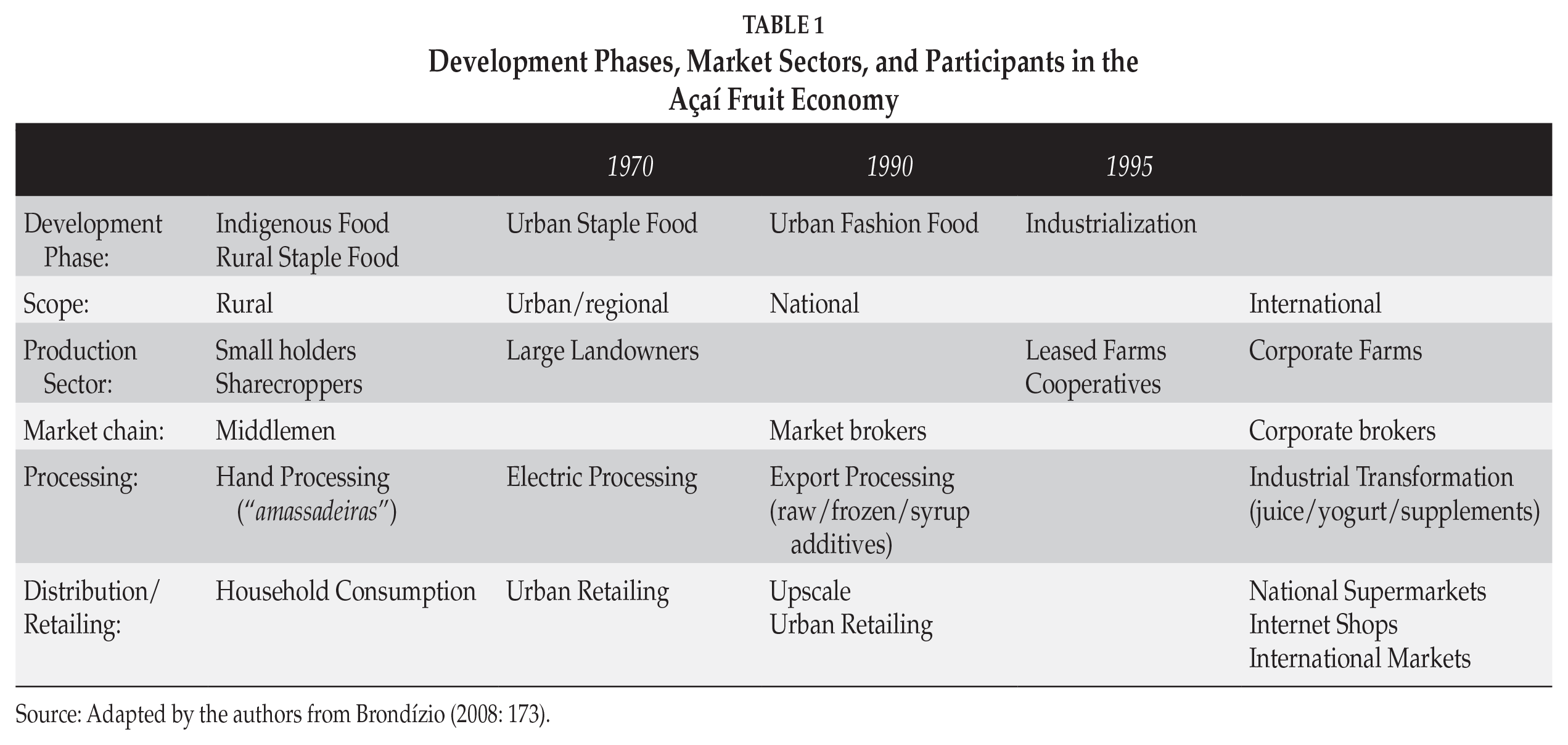
Historically, açaí was consumed by inhabitants who lived in the Amazon. It was normally eaten as a slightly bitter broth that was served with fish and flour, a typical food of the popular sectors (Brondízio, 2004; 2008). It is a minimally processed food high in micronutrients and without any chemicals added (Monteiro et al., 2017). The palm tree that produces the açaí fruit is still used by traditional communities (i.e., indigenous peoples, quilombos, and farmers) as a food (hearts of palm), medicinal herb to treat malaria and snake bites, and as a material with which to build houses (Fonte, 2015). There were reports of the fruit being used during the 1960s as a fuel source, given the fact that a type of charcoal can be made from its pit. The açaí’s pit was also used to make bricks in local potteries, a process still seen in some regions of Brazil. However, despite its multiple uses, none of which reached an industrial scale, the consumption of this fruit as a food consisted only of the fruit itself and its hearts of palm, both of which are minimally processed. In the 1970s, açaí was still a staple food that was consumed mainly by farmers and indigenous peoples. With the urbanization of Belém, the capital of Pará, and the settlement policies promoted by Brazil’s military regime (1964–1985), there was an expansion in consumption of açaí within urban centers located in the Amazon due to the low income of workers and the growth in demand for basic foods (Brondízio, 2008).
However, it was only in the 1990s that açaí reached the status of a superfood in large, industrialized cities in Brazil’s Southeast, such as São Paulo, Belo Horizonte, and Rio de Janeiro. It was during this time that açaí began to be prepared and served differently than before. Instead of being served as a slightly bitter broth, it was prepared as a sweet ice cream, like a sorbet, and served with fresh fruit and other foods high in energy, such as honey, peanuts, granola, chestnuts, guarana syrup, among others. From a typical food of manual laborers and families who lived in the Amazon, açaí became a food popular with fitness audiences and people looking for more “natural” food products, gaining high-income consumers in the richest regions of the country and abroad, especially in the United States. In the wake of the United Nations Conference on the Environment and Development held in 1992 in Rio de Janeiro (ECO-92), açaí was marketed as a “product of the Amazon” since it was harvested by extractivists from this region, serving to promote açaí’s image as a fruit that could lead to “sustainable development” (Brondízio, 2008).
Paradoxically, in addition to its characterization as a superfood, açaí has gained another connotation in Brazil: a food of the “working masses” (Brondízio, 2004; Fonseca, 2020). In such cases it is not consumed because it is healthy, but because it is extremely sweet, energizing, refreshing and leaves the consumer with a feeling of being sated. Such preparations are accompanied by fresh fruit, peanuts and granola, but also condensed milk, dairy flour, and powdered milk, all of which are ultra-processed products. According to Brondízio (2008: 187), “the content (and flavor) of açaí pulp in different dishes has progressively changed from 100 percent pure and fresh to less than 5 percent in some cases.” The main ultra-processed food derived from the fruit is Mix de Açaí (Costa, Fernandes and Crispim, 2018). When one analyzes Mix’s standard packaging, one finds the following ingredients: açaí pulp, water, sugar, high fructose corn syrup, orange fiber, sodium carboxymethyl stabilizer, food flavoring agent, citric acid acidulant, monoemulsifier, and glycerides derived from fatty acids. The preparation of this mix became cheaper due to a rise in the product’s commercialization and production, which combined with the speed with which it was consumed, in turn, increased the demand amongst the poorest Brazilians. It became a fast food consumed in popular shopping malls, subways, train stations, bus stops, factory exits, school gates, universities, among other places.
As reports began to circulate about Mix not being healthy because it is ultra-processed, “purer and healthier” options appeared on the market at a markedly higher price, consequently keeping them even more restricted to Brazil’s richer classes. Nonetheless, it is interesting to note that this type of ultra-processed açaí does not seem to have the image of being a “working-class” food in most of the Amazon, where it has maintained its traditional image of being a healthy food that is minimally processed.
Additionally, açaí has gained non-food uses. Among them, the cosmetics sector stands out with the production of shampoos, facial creams, body oils, among others made with açaí, claiming its antioxidant properties promote “beauty,” as well as a “connection with the natural environment of the Amazon” and with the “sustainable development” of the region. The imaginary connection between health, nature, and sustainable development, carefully constructed by the advertising and marketing sectors has been decisive in solidifying açaí’s image as a superfood or superfruit in “premium markets.”
However, there is evidence to suggest that the expansion and intensification of açaí production results in ecological problems. Weinstein and Moegenburg (2004: 315) note that in some communities there was a “conversion of native floodplain forests into açaí-dominated forests that closely resemble plantations.” Later studies, such as those by Freitas et al. (2015) and Campbell et al. (2018), argue that this simplification in biodiversity caused by the expansion in the cultivation of açaí palm trees generated unintentional ecological imbalances that carried with it possible negative consequences for other parts of the forest.
With this context in mind, an attempt is made to identify whether a process of financialization has stimulated the açaí chain. Before moving on to the case study, it is necessary to briefly examine the phenomenon known as agrifood financialization.
Agrifood Financialization
Agrifood financialization must be understood as a specific expression of contemporary capitalism (Chesnais, 2016; Dowbor, 2017). Financialization occurs when the main elements governing an economic sector possess a fundamental framework that is run exclusively by financial actors (Epstein, 2005) and has a finance logic at its core. Thus, a financialization of relations regarding agrifood happens when the underlying order governing how agrifood products are produced, marketed, distributed, and consumed (among others) is fundamentally organized by financial interests (Burch and Lawrence, 2009; 2013; Bonnanno, 2016). A financialized system is different from other types of agrifood orders that are dominated by various interests relating to production, business, private consumption, agroecology, religion, among others (Niederle and Wesz Jr., 2018).
In an influential book, Clapp and Isakson (2018: 107 – emphasis added) state that,
The melding of finance and agrifood supply chains has resulted in the restructuring of the global food system in ways that prioritize financial profits over other goals, such as food security, environmental sustainability, and cultural diversity” (Clapp and Isakson, 2018: 107 – emphasis added).
In fact, the relationship between the agricultural and financial sectors can be traced back to the sixteenth century (Clapp and Isakson, 2018). However, in the last fifty years, economic actors have created new and complex financial tools to exercise their economic power in sectors such as agrifoods, where they have been able to win out over other interests whose actions were governed by other logics of organization (Niederle and Wesz Jr., 2018). As a result of this process, financial actors continue to expand their influence in the production, distribution, and consumption of foods. They also seek the best form of mobility possible, both for entering and exiting markets, with the accumulation of capital as their overall goal (Schmidt, 2016). Long-term return prospects, which are normally associated with investors acting upon principles of production and trade, or communities interested in living in harmony with the rural environment are losing ground to the logic of shareholders: a logic that is uncommitted to territories and peoples, and that seeks extraordinary short-term profits based purely on speculative methods. (Clapp and Isakson, 2018; Fairbairn, 2020).
Various financial actors make up the corporate, agrifood regime, such as sovereign wealth funds, pension funds, hedge funds (multiple markets), large grain companies, stock markets, and of particular interest for this article, Private Equity firms (Burch and Lawrence, 2009; Schmidt, 2016). Private Equity (PE) is a practice, tool, and form of financial investment that was created by companies who specialize in investing in other companies. The goal is usually to invest in companies that show potential for rapid growth, such as start-ups, that allow the PE to reap profits in the short, medium, and long term, but always allowing for rapid divestment if the company fails to perform to its expectations (Varrotti, 2019).
While there are actors who insist that the financial market can mitigate the harmful social and environmental effects of the capitalist system through the stock market (IEDI, 2019), critical studies argue that financialization can, in a variety of ways, lead to the degradation of natural environments. When a process of financialization is applied to a commodity, it feeds a logic centered on quick profits, which ends up intensifying environmental degradation and various types of social violence (Dowbor, 2017; Sassen, 2016; Marques, 2018).
Two conditions are necessary for the financialization of a natural resource to occur. The first is the transformation of the resource into a commodity (for instance, a superfood or an agrofuel). The second is the ability to procure investments from companies who subject themselves to a finance logic applied to that commodity. This logic has the potential to significantly impose its will on the relations of production. Nonetheless, it is important to understand that, historically, the ways in which these financialized relations manifest themselves vary from case to case, since the interaction between businesses, states, and civil society tend to take on forms that are essentially unique. Therefore, the model presented in this article proposes to estimate the depth of financialization of açaí by comparing this case with a fully financialized agricultural commodity. It must be stressed, however, that it is not the intention of this article to elaborate on any specific theory regarding the financialization of superfoods.
Research Design
No studies that addressed the financialization of açaí were found. In addition, experienced researchers who have studied the social relationships surrounding açaí, such as Dr. Eliane Superti and Dr. Eduardo Brondízio, have stated that they were unaware of any research in this area. For this reason the following article was designed as an exploratory, single case study (Yin, 2003; Vennesson, 2008) and centered around an ideal type. Ideal types are useful for case studies because they “are abstract models, with an internal logic, against which real, complex cases can be measured” (Della Porta, 2008: 206). Due to the lack of literature regarding the financialization of superfoods, books and articles that focus on financialized agricultural commodities (such as sugar, corn, palm oil, among others) serve as a foundation for the construction of an ideal type. This ideal type was called a Commodity Agrícola Tradicional Financeirizada (Financialized Traditional Agricultural Commodity or CATF), which is based on five dimensions, covered in the next section.
According to the analytical framework, the more these dimensions grew in scope and intensity in the açaí chain, the more this chain fell under the sway of financialization. In addition, the more the açaí chain resembled that of a CATF, the more açaí itself became the center of harmful social and environmental effects that are typically associated with CATFs.
With regards to the situation surrounding the financialization of the açaí chain, on further investigation, multiple sources of evidence were discovered using various methods. These methods included a literature review to collect economic data, an analysis of regulations concerning the açaí chain, research into media and state sites with the goal of identifying laws, public policies, and state reports that would provide valuable evidence and allow an evaluation of whether or not state power resists, encourages, or plays an idle role in the financialization of the açaí chain, and finally, an examination of company reports for the purposes of gathering economic data and understanding business strategies. In addition to these methods, semi-structured interviews were conducted in loco and remotely with leaders from this sector and academics, among others. The goal was to gather general and undocumented information as well as opinions concerning the chain’s framework. Field visits were also carried out to observe the chain’s performance. Interviews were conducted in person and remotely with industrial actors, financial agents, public officials, and research institutions located in Belém, the capital of Pará, between 2018 and 2019. Field visits to local areas allowed for firsthand insight into the various ways açaí is extracted and processed (Breves), its use in the cosmetics industry (Benevides), and its production on dry land (Santa Izabel do Pará), as well as providing an understanding of the intricate marketing dynamics that exist between extractivists, or those responsible for harvesting açaí for export, intermediaries, and industries in these regions (Abaetetuba and Mocajuba). For the interviews, people were initially selected based on their role in the açaí economy. Afterwards, virtual contacts and those in loco invited others to be interviewed. In total, twelve actors were directly interviewed after they signed the Termos de Consentimento Livre e Esclarecido (Terms of Free and Informed Consent or TCLE). They were assured that their identities would remain anonymous. Actors that were interviewed directly include representatives from businesses, the public sector, rural areas, and educational institutions. The indirect interviews often took place in a more informal manner during field research. All formal interviews were audio-recorded, and all notes were taken by hand. No systematic method was used to analyze the interviews. Instead, statements that corroborated or dismissed aspects of the model were identified, and then this information was combined with the available literature and documentary analysis.
As is commonly the case with case study methods, the research procedures were not bound by an extremely rigid protocol, so that concepts, insights, and discoveries fed back into the research as evidence. In other words, instead of following past methods that prescribed the need to develop a roadmap filled with fixed stages and procedures, a model proposed by Vennesson (2008) was adhered to. In this model, researchers not only apply case study methods but also engage in “casing” or a process whereby the researchers themselves make subject matter into a case.
Analytical Model: Characteristics of Financialized Traditional Agricultural Commodities (CATFs)
Initially, it is important to explain that there is a contradiction in the use of the term “traditional” because from the point of view of native, quilombola, and peasant communities, among others, corn is a traditional crop, in a historical, ancestral, native, and popular sense, with a variety of uses (Puppo, 2017). However, in the context of international agrifood systems, a traditional commodity is defined as any commodity that is produced on a large scale for capitalist purposes, usually in the form of monocultures, and with standardization and flexibility prescribed by the international agroindustry. In contrast, non-traditional commodities are defined as, “agricultural products that have not previously been consumed or planted as cash crops in a country” (Waskey, 2007: 1,259). According to this definition, (Non-Traditional Agricultural Exports or NTAEs), “(. . .) include fruits, vegetables, flowers, nuts, and spices” (Waskey, 2007: 1.259). Indeed, historically, the systematic export of tropical products is nothing new since this phenomenon shared and continues to share a direct relationship with larger processes of colonialism and contemporary imperialism (Patnaik and Patnaik, 2017). The goal of this article is to identify whether açaí (a NTAE) is currently following the logic of financialization.
The dimensions that characterize a financialized commodity are: its attractiveness for industrial interests with a focus on large-scale production; production incentives through sectoral public policies; the creation of a land market attractive to foreign investors; projection of future markets for further speculation of the commodity; and, finally, but perhaps most importantly, to be a flex crop, which will be discussed below.
The adoption of an agricultural commodity as an industrial input is a necessary precondition for its transformation into a financialized commodity. If a commodity serves more than one industry, it becomes even more attractive to financial actors, because this favors mobility. For this to occur, these commodities must first be categorized as flex crops (Reyes and Sandwell, 2018; Borras Jr. et al., 2016). Two interconnected concepts are used to help explain a flex crop: multiplicity and flexibility.
Coconut serves as an example to explain these two concepts. It has multiple uses, such as water, oil, cosmetics, fabrics, and biodiesel fuel. Nonetheless, it has low flexibility since the industry that extracts a product from it (water, for example) is not able to produce biodiesel fuel. [A commodity is] flexible when it allows the same production facility to alter its production in accordance with market demand with minimal advances in [terms of] machinery and technology (Barbanti Jr., 2017: 143).
Flex crops play an important role in the strategies of financial actors because they allow production and commercialization to migrate as new short-term opportunities arise, for example, due to the volatility of crop prices, government subsidies, mergers and buyouts concerning agribusinesses, biological alterations in seeds, among other factors. They can also be of interest to agricultural producers: if the fuel industry offers a higher price than the food industry, the producer will sell to the fuel industry, and vice versa.
The growth in demand and speculation with relation to flex crop commodities is therefore tied to a rise in demand for land and to various opportunities for land grabbing that this process creates. For example, greater global demand for food, energy policies based on agrofuels, or the invention of new uses for cellulose create opportunities (or expectations) for profitability, in turn, driving the quest for control of land that can produce these commodities. After all, in the commodities market and the agroindustry, gaining scale is fundamental (Longo, Clausen, and Clark, 2015). These movements, in turn, heat up the rural real estate market and the processes of expansion (both violent and non-violent) of the agricultural frontier (Pitta, Boechat, and Mendonça, 2017; Varrotti, 2019; Pereira, 2018; Fairbain, 2020).
These processes, which are tied to sections of the agroindustry, research and product development, and the creation of a real estate market, can either be encouraged or constrained by public policies. That is, the role of the state is fundamental to understanding the dynamics of financialization (Dowbor, 2017; Chesnais, 2016).
Finally, it is important to examine whether financial agents play an important and effective role in the value chain in which a commodity is situated. In short, the more a commodity is a) integrated into an agribusiness; b) a flexcrop; c) influencing land concentration; d) mobilizing research and marketing sectors; e) the subject of public policies that encourage the aforementioned activites – the closer it is to the CATF ideal-type.
The State, the Market, and the Transformation of Açaí (Euterpe Oleracea Mart.) into a Commodity
The Amazon is a region that covers 5.5 million km, the Brazilian part of which is 5.2 million km. This case study focuses on the açaí produced in the Amazonian state of Pará, 1.2 million km, and is responsible for 95 percent of the açaí produced in Brazil. There is also significant agro-industrial production in other Brazilian states in the Amazon. However, the goal of this article is not to analyze the production in these states (Sauma and Maia, 2019). The main regions that produce açaí in terms of tons are: Igarapé-Miri, Portel, Abaetetuba, Cametá, and Limoeiro do Ajuru (see Boletim da Sociobiodiversidade CONAB – 4° trimestre, 2019).
Since the 2000s, there has been an intensification of the process of industrialization of the fruit, the establishment of corporate farms, increased contract farming with peasants, and the turn towards national and international markets, each of which was founded on the same narrative of sustainable development and superfoods. In this context, movements on the part of Fusões e Aquisições (Mergers and Acquisitions or F&A) of industries were detected, as well as specific state public policies geared towards this sector. Table 1 below summarizes this historical evolution:
Development Phases, Market Sectors, and Participants in the Açaí Fruit Economy
Source: Adapted by the authors from Brondízio (2008: 173).
It is hard to measure the transactions and volume of açaí production because, “the lack of statistical data regarding extractive harvesting, managed areas, and plantations on dry land, both with and without irrigation, makes it difficult to calculate the actual production of açaí fruit” (Tavares and Homma, 2015: 12). An estimate made by the Instituto Brasileiro de Geografia e Estatística (Brazilian Institute of Geography and Statistics or IBGE) notes that close to 1.4 million tons of açaí were produced, with a movement in the state economy of R$3 billion or USD $707.5 million in 2018 (see Boletim da Sociobiodiversidade CONAB – 4th quarter, 2019). 1 The Sindicato das Indústrias de Frutas e Derivados do Pará (Union of Fruits and Byproducts Industries of Pará or SINDFRUTAS) reports that production is 1.2 million tons, moving USD $1.5 billion in the state (Sauma and Maia, 2019). Furthermore, 5 percent of this production is exported, primarily to the United States; 35 percent goes to other regions of Brazil, with half of this amount going to the states of São Paulo, Rio de Janeiro, and Minas Gerais; and, finally, 60 percent of production remains in Pará (Tavares and Homma, 2015).
There is considerable evidence to suggest that açaí is increasingly a flex crop. This is because açaí has a variety of uses and demonstrates a flexibility in terms of its industrial use,
The production of freeze-dried açaí is of particular interest because the freeze-drying of açaí is very efficient, both in terms of preserving nutrients from the fruit and in optimizing the costs for product storage. Furthermore, powdered açaí has a great versatility that allows it to be used in energy drinks, yogurt, cereal bars, ice cream, milk shakes, cosmetic products, etc., as well as in food supplement capsules (Costa, Fernandes, and Crispim, 2018: 119).
With relation to the food industry, the presence of financialization is noted through the company Frooty, the largest corporation for the processing and commercialization of açaí in Brazil. Based in the city of São Paulo, in southeastern Brazil, Frooty is the leader in the national market for açaí food derivatives. Frooty was bought out by one of the largest Private Equity firms in Latin America: Pátria Investimentos. According to a report published by the consulting firm, KPMG, in conjunction with the Associação Brasileira de Private Equity e Venture Capital (Brazilian Association for Private Equity and Venture Capital or ABVCAP), Pátria Investimentos is listed among the fifteen largest investment managers in Brazil (KPMG and ABVCAP, 2020). Furthermore, given the scope of this study, it is important to recognize that the agribusiness, food, and drink sectors are the main investment sectors for Venture Capital and Private Equity firms between the years 2011-2019 (KPMG and ABVCAP, 2020). Pátria Investimentos has a strategic partnership with the Black Stone Group, one of the largest, global PE firms, headquartered in New York. At the end of 2018, Patria put Frooty up for sale as part of its divestment strategy, with the expectation of raising R$250 million (USD $58.9 million) (Valor Econômico, 2018). No information was found regarding the outcome of this divestment.
In the cosmetics sector, açaí is used to make products such as shampoos, facial and body creams, soap, body oils, among others. The principal manufacturer is the transnational corporation Natura & Co, which has a line of products called Ekos, and a large industrial plant in the region of Benevides, PA that focuses on processing Produtos Florestais Não-Madeireiros (Non-Timber Forest Products or PFNM). Natura has shares traded (Natura & Co Holding S.A. – NTCO3) in the B3 stock market. In January 2020, Natura announced the purchase of the U.S company Avon Products, estimated at a value of R$2 billion or USD $471.6 million and subsequently became the fourth largest cosmetics company in the world after L’Oréal, Procter & Gamble, and Unilever. Natura’s market value is estimated at USD $11 billion (R$46.6 billion) (AFP, Reuters, 2020).
In an interview with a representative (interview, Belém, PA, November 20, 2019) of the Laboratório de Óleos da Amazônia (Oils Laboratory of Amazonia) at the Federal University of Pará (UFPA), data was collected concerning tests that were conducted by the laboratory to transform açaí oil into a biofuel. However, according to the representative, this operation is not economically feasible due to the relatively high cost of extracting the oil. This is because the oil represents only a small part of the fruit itself not to mention the fact that any biofuel that is derived from açaí would have to compete with those derived from sugar cane and soy, both of which are produced on a large scale in Brazil.
In terms of public policy, the Secretaria de Estado de Desenvolvimento Agropecuário e da Pesca do Pará (Pará’s State Department for Agricultural Development and Fishing or SEDAP) relies on its Programa de Desenvolvimento da Cadeia Produtiva do Açaí no Estado do Pará (Development Program for the Açaí Production Chain in the State of Pará or PROAÇAÍ – PA) that was put in place between the years 2016-2020 (Oliveira e Tavares, 2016). The program was designed to stimulate new investments in the açaí chain, based on the view that national production in Brazil was unable to keep up with growing demand for açaí, the result of which was a rise in the fruit’s price in national and international markets.
This government program positions açaí in a very different place from other crops that, due to overproduction, need to have developed new uses and images to gain new markets (Scrinis, 2015). Almonds (Reisman, 2020) and peanuts (Lima, 2018) in the United States mirror this dynamic. In both cases, an oversupply encouraged investment in different areas, from advertising to nutritional research, with the goal of attracting new consumers based on the status given to almonds and peanuts as superfoods, a process that can be described as a type of semiotic spatial fix (Reisman, 2020). Nonetheless, the situation vis-à-vis açaí is different because there are no issues stemming from an excess in supply. Therefore, it is argued that the spatial fix thesis is less relevant than the primitive accumulation hypothesis proposed by Luxemburg (1968). This is because the capitalist system expanded to include fruit from native palm trees that were located on lands and waters widely considered to be commons, and took advantage of labor relations that are much more fragile than those shared by formal workers. As a result, these lands and waters became predatory extraction areas where many former autonomous workers are forced into precarious wage relations. Besides, açaí palms that are cultivated on dry land require abundant irrigation, which unquestionably causes changes in river courses that can negatively affect water availability for other uses in neighboring communities. Indeed, Regulations and monitoring concerning water use in the Amazon apparently are not enforced on a regular basis (see Zuker, 2019).
The state was a driving force in the transformation of açaí into a flex crop as well as in laying the technological and institutional groundwork that allowed for the expansion of capitalist processes regarding açaí. This phenomenon also stands at the center of a larger process of primitive accumulation that transforms commons into commodities. One of its main tools is the PROAÇAÍ program that seeks to mobilize various public actors in areas such as Agricultural Extension, Research, Economic Subsidies, among others. The goal is to bolster the development of the açaí production chain in different regions across the state of Pará. Some of the main goals of the program are the distribution of technologically advanced seedlings, training with relation to the management of palm trees and fruits, and the expansion of irrigated açaí production on dry land, an issue that will be covered later.
Another important example with regards to public policy is the Decreto Estadual no 1.522/2016 – Política Industrial de Açaí (State Decree #1.522/2016 – Açaí Industrial Policy) that was issued on April 1, 2016. This decree demonstrates how various public and private sectors are connected based on their relationship to açaí. The main goal of this public policy was to offer tax credits to industries that, in turn, add value to and establish links with production and industrial centers in Pará. It was for this reason that it offered subsidized credit and tax exemptions that included the Imposto sobre Operações Relativas à Circulação de Mercadorias e sobre a Prestações de Serviços de Transporte Interestadual e Intermunicipal e de Comunicação (Tax on Operations Relating to the Circulation of Goods and the Delivery of Interstate and Intermunicipal Transportation and Communication Services or ICMS). This is the most important state tax in Brazil due to its role in making the transportation of fruit and pulp, the purchase of packaging materials, and the acquisition of machinery much cheaper. The following paragraph should be noted:
Paragraph 4. The tax treatment available in item II of the main paragraph, [it] shall be granted in the case where the company [in question] is located in the municipality of the Região de Integração do Marajó (Integration Region of Marajó), as well as engaged in the region herein, concerning the project presented to the Comissão de Incentivos (Incentives Committee), producing 3 (three) new lines of products based on açaí pulp (mix, ice cream, bars, energy, etc.) . . . (PARÁ, 2016).
In interviews that were conducted with business leaders in the region (interview, Belém, PA, November 15, 2019), it became clear that this public policy was not only designed to foster açaí’s industrial development but also had ties to business interests. In addition, the field study identified recently established plants in the region of Breves (PA), located in the southeast on the island of Marajó, and in the district of Santa Izabel do Pará (PA). Visits to these factories occurred during the first encounter with the object of research in 2018. These visits facilitated the carrying out of interviews in 2019. In the ones with business owners, an intensification in the degree of contract farming with small and medium-sized producers was noted. The goal of this intensification was to develop corporate governance strategies aimed at monitoring changes in prices and guaranteeing a constant supply of raw materials. According to Costa, Fernandes, and Crispim (2018), there was also an increase in cooperation between large businesses and the Brazilian government with regards to participation in trade shows, technical training, and meeting the interests of various groups.
The genetic mutation of the açaí seed, however, is greater evidence of the transformations induced by agro-industrial and financial interests in conjunction with the public sector, in the field of Research and Development (R&D). As explained earlier, açaí palm groves usually grow on the banks of rivers because they depend on a large volume of water to thrive. For this reason, the Empresa Brasileira de Pesquisa Agropecuária (Brazilian Agricultural Research Corporation or Embrapa) the largest state-owned agricultural research company in Brazil launched a new cultivar called BRS Pai d’Égua in 2019 (Farias Neto, 2019). This new type of palm tree does not need to grow near riverbanks to survive. It can be cultivated on dry land on farms specifically designed for this purpose. The BRS Pai d’Égua is different from other natural palm trees in that it, “produces 46 percent during the inter-harvest period (from January to June) and 54 percent during the harvest period (from July to December)” with its fruit, “yielding 3 percent more pulp than the fruit grown on traditional açaí palms” (Embrapa Amazônia Oriental, 2019). Furthermore, the “first harvest [was] completed after three and a half years as opposed to that of traditional [raw] materials that [normally] begin in their fifth year” (Embrapa Amazônia Oriental, 2019). In other words, this process serves to accelerate the capital turnover in this industry. In fact, cultivating on dry land with the support of Embrapa has been taking place since the 1990s, but the emergence of BRS Pai d’Égua is recent evidence of this, with the potential to significantly alter land and water use.
This new cultivar can lead to the intensification and expansion of açaí’s production as a cash crop and intensify the concentration of land, including through land grabbing. This process can also result in changes in land use that can have repercussions on local food production and the environment. Financialization not only amplifies these same processes but can also trigger them, especially in the case of an açaí palm that grows more rapidly than its natural counterparts. The rise in international demand can also play a major role in this process. The state, for its part, is promoting a capitalist process geared towards encouraging the development of “technological solutions” that speed up the times of nature and surpass their limits (Longo, Clausen, and Clark, 2015).
With regards to the expansion of açaí production on dry and irrigated land, PROAÇAÍ reveals an attempt at collaboration on the part of public and private interests to modify the use of land. One of PROAÇAÍ’s goals is “expansion [regarding] the establishment and management of irrigated açaizeiros (açaí palm farms) in dry land areas in the state of Pará during the period between 2016-2020. [It] places particular emphasis on local and regional socioeconomic development while [at the same time] ensuring [a degree of] environmental conservation” (Oliveira and Tavares, 2016: 8). Although public policy is concerned with environmental conservation, the expansion of monocultures does little to ensure this result due to the intensification of the use of natural resources, such as water, that occurs to manage new cultivars.
Regarding water, it was noted that there was a common interest on the part of business owners in obtaining “grants concerning water use” from the Secretaria de Estado de Meio Ambiente e Sustentabilidade (State Department for the Environment and Sustainability or SEMAS) during interviews that were conducted with different actors as part of the field study (interviews, Belém-PA, November 14 and 19, 2019). Their goal was to produce açaí palms through irrigation in the metropolitan region and in other municipalities close to the capital. One territorial target is the green belt, a place where vegetables are produced in the metropolitan area of Belém. It is a region that has large volumes of rainwater and a favorable environment to produce irrigated açaí, including lower logistical costs to transport production. If this is confirmed, it is likely that there will be a fall in the production of vegetables to increase açaí production for the industry. A change in land use can, in turn, not only lead to a decline in the food supply but also to the variety of foods available to the local population, with possible repercussions in the worsening of the diet and an expansion of the agricultural frontier.
Finally, the company Açaí Amazonas plays an important role in this phenomenon. It oversees the large-scale production of açaí, its transformation into several products, such as frozen and freeze-dried pulp, and its use in the production of Mix de Açaí. According to its website, starting in 2002, Açaí Amazonas conducted a variety of R&D activities that were centered on açaí. It also owns 1,400 hectares (ha) of irrigated açaí plantations on dry land (Açaí Amazonas, nd). However, the investments in large-scale açaí production seem to have occurred after Monsanto, a transnational company involved in the agricultural technology sector that was bought out by Bayer in 2018 for USD $63 billion, acquired Agroeste Sementes, the largest company within Grupo Vaccaro, in 2007 in a deal worth over USD $100 million. Processes relating to Mergers and Acquisitions play an important role in strategies adopted by financial groups. Grupo Vaccaro is a family-owned business that has a national presence in Brazil’s agribusiness sector, with investments in various parts of production chains of different crops, and Agroeste operated exclusively in the corn seed sector (Agrolink, 2007). Since then, Agroeste (which remained under management of Grupo Vaccaro) has gone in search of new investments and saw the irrigation of açaí palms on dry land as a good place to invest. It is significant that this case was not reported to the authors by someone from the Grupo Vaccaro, but by other entrepreneurs and technical assistants from outside the company itself, who vouched for the fact that Agroeste is the best example in this sector. The activities of Grupo Vaccaro illustrate the emergence of a giant financial player in Brazil’s agrobusiness sector that seeks to expand açaí production on dry land, using industrial techniques.
Conclusion
Since the 1990s, açaí has ceased to be a basic, healthy, and minimally processed food for populations living in the Amazon. In this article, it is shown how açaí has also been transformed into both a superfood and a junk food, and to a lesser extent, how it has also become an important ingredient for the cosmetics industry. Emphasis was given to how much these changes are driven by capitalist investors that often have close ties to the state. The article also seeks to examine the extent to which a financialization framework is present in açaí production, given that financialization tends to accelerate the processes of environmental destruction and other social ills already present in capitalist societies.
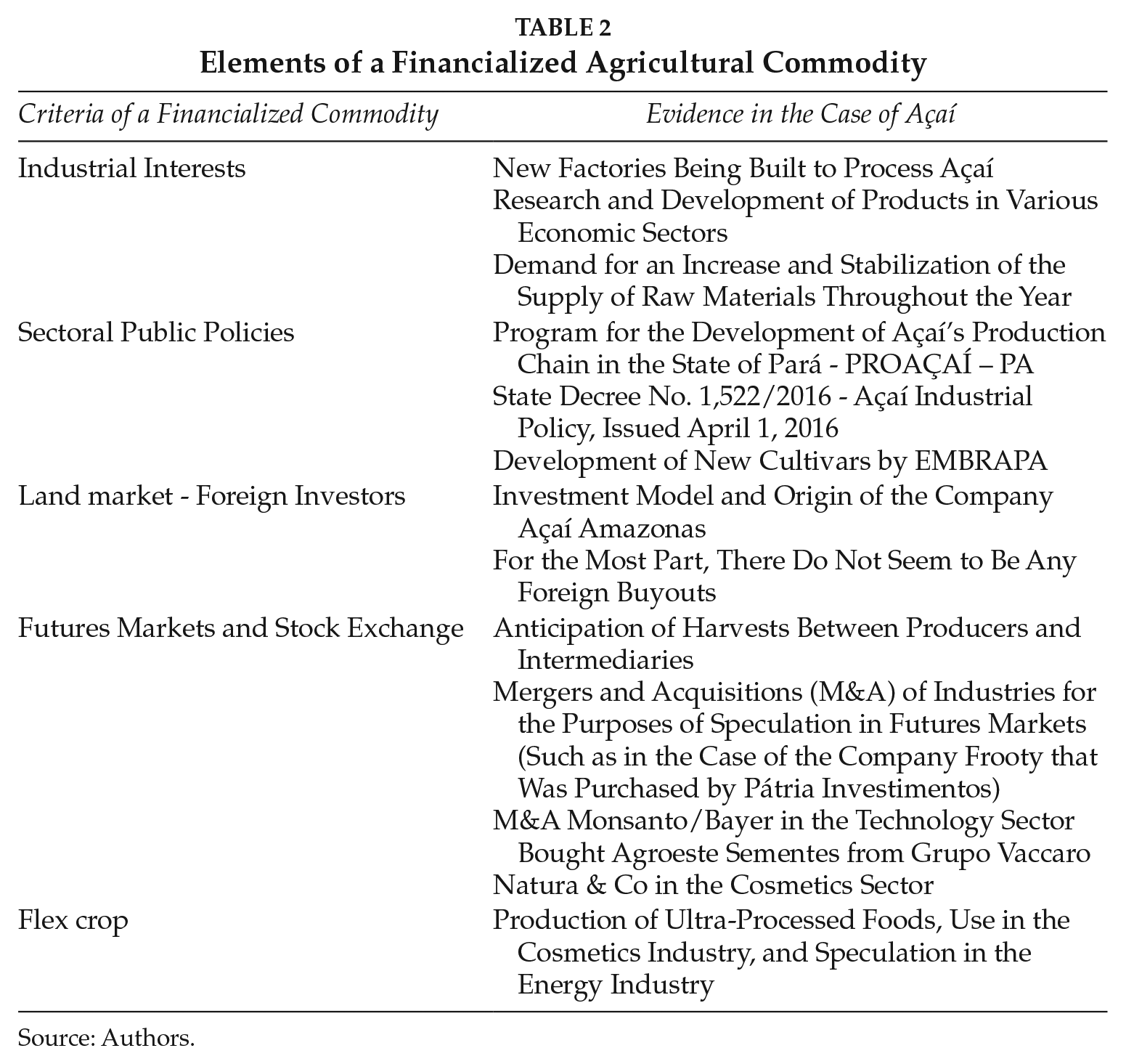
It is concluded that there is indeed financialization in the açaí chain. Nonetheless, this financialization is in a much less advanced stage than that seen in CATF chains. Table 2 summarizes the findings:
Elements of a Financialized Agricultural Commodity
Source: Authors.
One obstacle to the expansion of financialization in the açaí sector seems to be its limited production capacity vis-à-vis current demand. This means that açaí is far from being a global commodity or at least more internationalized. However, this limitation also serves as an incentive to attract investments, which are geared towards improving the açaí chain’s productivity, including seeds, and expanding its production. The state supports these investments through public policies and Research & Development, seen in its support for açaí production on dry and irrigated land. This process has the potential to concentrate land and create large alterations in terms of land use. The alterations can, in turn, have repercussions for social and environmental relations, including the reduction in the variety of local foods, factors that accompany the dynamics of financialization.
It was also observed that certain companies continue to develop food products with the aid of public policies, and one of the main examples of this process is the spread of Mix de Açaí. By way of this ultra-processed food, another factor associated with agri-food financialization was identified, which is the spread of ultra-processed foods that are harmful to the health and transported over long distances. (Clapp and Isakson, 2018).
Natural commodities do not exist and all internationalized commodities are the product of a historical phenomenon. If açaí follows the same path as palm oil agro-industrial complexes in Southeast Asia, and becomes a global commodity, one should expect an intensification of land grabbing, monoculture, and their associated effects in the future (Alonso-Fradejas et al., 2016).
In terms of its limitations, this article has not been able to advance an understanding of the impact financialization has had and continues to have on labor relations and on the income of harvesters and communities around açaí. These are relationships that can present serious problems for these groups as is seen in other studies concerning superfoods (Serrano and Brooks, 2019; Beune, 2016) as well as with CATFs. What is known is that the expansion of açaí cultivation has produced and continues to produce ecological imbalances (Weinstein and Moegenburg, 2004; Freitas et al., 2015; Campbell et al., 2018) as well as tensions in the use of common lands and waters (Superti, Pegler and Araujo, 2019). Further studies are needed to understand the impact financialization has on the concentration and changes in land and water use, as well as its possible impact on the livelihoods of local communities, the environment, and the availability of local foods. Taking into consideration that agrifood financialization generally accelerates capitalist processes while neglecting environmental conservation and the health of consumers, the prognosis that emerges from this study is not encouraging, given the fact that giant financial corporations are already present in the açaí chain.
PROAÇAÍ and the Açaí Industrial Policy lack ex-post evaluations concerning public policies and financialization, but nevertheless they are still being implemented. However, actors interviewed from the Assistência Técnica e Extensão Rural (Agency for Technical Assistance and Agricultural Extension or ATER) were dissatisfied with the political and budgetary roadblocks that continue to negatively influence the program’s performance. In another interview conducted with a member of the Instituto de Desenvolvimento Florestal e da Biodiversidade do Estado do Pará (Institute for Forest Development and Biodiversity of the state of Pará or Ideflor-Bio), it was suggested that this poor performance is a possible sign that this public policy is failing in its objective (interview, Belém-PA, November 14, 2019).
Finally, it is necessary to evaluate the ways in which these changes are resisted by social movements and sectors linked to agroecological production, as well as the degree the logic of financialization represents an obstacle to the agendas of these same movements and sectors.
Footnotes
Notes
Rafael Neves Fonseca holds an MA in Public Management and International Cooperation and is a member of the Grupo de Pesquisa sobre Fome e Relações Internacionais (Research Group on Hunger and International Relations) at the Federal University of Paraíba or UFPB. Thiago Lima (corresponding author) is a professor in the Department of International Relations and coordinator of the Research Group on Hunger and International Relations at the UFPB. The authors would like to thank the twelve individuals who agreed to do semi-structured interviews and those people who opened new possibilities and engaged in an informal manner with researcher Rafael Fonseca during his field visits and during the virtual meetings that came from them. Their names will be kept confidential. This article serves as a synthesis of a master’s thesis that was defended at the Postgraduate Program in Public Administration and International Cooperation at the Federal University of Paraíba (UFPB). Our thanks go out to professors Andrea Santos Baca and Eliane Superti who gave us valuable comments and suggestions, and to Alexandre C. C. Leite on the examination board where this research was first presented. We would also like to thank Professor Elia Elisa Cia Alves for her comments and the members of FomeRI for revising the various versions of this article. Our special thanks go to the journal editors for their patience and fruitful dialogue that gave us more important insights on this topic.