




Abstract
U.S. intervention in Guatemala’s agricultural autonomy over the past 80 years has been a toxic blend of commission and omission. From the Green Revolution on, the United States has exported both harmful pesticides and ideological frameworks to persuade indigenous and other locally rooted small farmers to abandon traditional, chemical-free agriculture. Although U.S.-funded programs suggested that with proper labor protocols agrochemicals can be applied without harm on export plantations, there are no conditions for "safe use" under real-life conditions for small subsistence farmers, many of whom live in close proximity to protected areas. Transnational biodiversity conservation organizations have remained oddly silent on this issue, and indigenous and peasant movements have not yet mobilized against pesticides because of a paucity of information about their dangers and the “slow” violence of their impacts on health. To decolonize agriculture and conservation will require a more inclusive environmentalism aligned with peasant movements that take seriously the real conditions of risk and vulnerability in the majority-Maya Guatemalan countryside.
La intervención estadounidense en la autonomía agrícola de Guatemala en los últimos 80 años ha sido una mezcla tóxica de comisiones y omisiones. A partir de la Revolución Verde en adelante, Estados Unidos ha exportado tanto pesticidas dañinos como marcos ideológicos para persuadir a los pequeños agricultores indígenas y otros agricultores con arraigo local de abandonar la agricultura tradicional y libre de químicos. Aunque los programas financiados por Estados Unidos sugirieron que, siguiendo los protocolos laborales adecuados, no había peligro en utilizar agroquímicos en las plantaciones de exportación, no existen condiciones para su “uso seguro” en contextos de la vida real tal y como atañe a los pequeños agricultores de subsistencia, muchos de quienes viven muy cerca de áreas protegidas. Las organizaciones transnacionales de conservación de la biodiversidad han permanecido extrañamente silenciosas respecto al tema, y los movimientos indígenas y campesinos aún no se han movilizado contra los pesticidas debido a la poca información sobre sus peligros, así como la “lenta” violencia de sus impactos en la salud. Una descolonización de la agricultura y la conservación requerirá de un ambientalismo más inclusivo y alineado con los movimientos campesinos; uno que tome en cuenta las condiciones reales de riesgo y vulnerabilidad en el campo guatemalteco, con su población mayoritariamente maya.
At a 2001 USAID-funded conference about biodiversity conservation, sustainable development, and rural economy in the northern Guatemalan lowlands, the agenda brimmed with papers on protected areas, forest management, and land use planning. I admittedly was also planning dissertation research on those tired themes but had decided to do something more original for my conference paper. Through World Health Organization and U.S. Environmental Protection Agency databases, I traced the regulatory status of pesticides being used in Petén and found that at least two-thirds were banned or restricted in Europe and North America. Observing the shocked faces in the panel room, the organizers extended my 15-minute paper into a full lunch-hour Q&A. I vividly remember the lifelong and widely respected agricultural extension agent Alberto Contreras’s asking, “Why are the gringos poisoning us?” and then a clarion question that stayed with me, “Why don't we know this?”
This article is, in some sense, an extended answer to Alberto's two pointed questions. For profit and power, the United States intoxicated Guatemala as a pawn in Cold War geopolitics. To secure Guatemala’s dependency on trade, it began peddling pesticides at midcentury through various channels, including the United Fruit Company, malaria control projects, the cotton and coffee industry, Protestant missionaries, U.S. drug enforcement, Mediterranean fruit fly control (see Copeland, 2014, for a riveting ethnographic account of rumors about overflights), and a growing number of Green Revolution projects financed by U.S. foreign aid. Then in the 1970s, USAID dramatically accelerated the spread of pesticides—many of them banned in the United States—through programs to incentivize small-scale production of nontraditional exports like broccoli, berries, and snow peas. Not until muckraking journalists in the 1980s reported a series of scandals about pesticide residues on produce imports from Guatemala (Dowie, 1979; Roosevelt, 1983; Weir and Schapiro, 1981) did the U.S. government finally launch training programs for pesticides exported by U.S. agribusiness corporations. Although USAID programs said that highland Maya agricultural workers could somehow apply agrochemicals to export crops without harm, I will show (and illustrate with gruesome ethnographic examples) that, once the Pandora's box of pesticides was opened, small farmers throughout the country began experimenting with them with little to no training or information about safety precautions and potential health harms.
Pesticides were not the only poisonous export financed by USAID. Perhaps more pernicious was its underwriting a dogmatic transnational conservation ideology prioritizing the abstract value of biodiversity over other varieties of environmentalism with/by/for indigenous and grassroots communities (Guha, 1997). As a volunteer (1992–1995) and then renegade employee (1997–1999) turned disenchanted critic (2002–on) of Conservation International's program in Guatemala's northernmost department, Petén, I was a frontline witness over three decades to the way USAID and other allied donors dumped more than US$100 million in the northern lowlands for nonprofit projects that emphasized parks over people. I also accompanied one local organization, ProPetén, through a bitter paradigm dispute and divorce from Conservation International in 2003–2004. To this day, ProPetén is the only conservation organization in the region that has creatively engaged in pesticides education and alternatives through a radio soap opera, a talk show with an agronomist, farmer extension programs, and experiments with natural sprays made from forest plants that repel insects.
I was also witness to an academic parade of repetitive, theory-driven, deductive critiques of community-based conservation by foreign students concerned more about advancing their citation indices than about supporting the local environmental and peasant organizations that managed to break free of their international overlords. To capture the “boom” of sustainable development treatises, the late Norman Schwartz and I constructed a database of 300 or more graduate theses completed over the past quarter century in northern Guatemala. Not one examined the influence of pesticides on wildlife, much less on human health, even though pesticides and other toxicants (Grandia, 2019) pervade rural life in villages in and around protected areas, contaminating waterways and wells. 1 In Guatemala writ large, aside from one recent monograph on fair-trade coffee (Dowdall and Klotz, 2014), the number of peer-reviewed social science articles on pesticides in Guatemala could be counted on one hand (Arbona, 1998, being the most commonly cited).
Ignorance is not bliss. What you don't know can hurt you. I and an alarming number of foreign graduate students and conservation volunteers who sojourned in Petén in our twenties went on to develop aggressive, pesticide-linked cancers in our thirties. Far too many more of my Guatemalan conservation colleagues and their kin have died of cancer. Although I have never sprayed pesticides myself and eat an organic diet, my blood marker tests for organophosphate exposure are in the 99.9th+ percentile. How many pesticide-applying small farmers developed cancer or other diseases related to pesticide exposure is anyone's guess, since public health systems have no mechanism for tracking and connecting pesticide morbidities or even fatalities. Instead, I will share qualitative observations from a large, multiethnic frontier community in the Maya Biosphere Reserve (where I resided for 14 months across 1993, 1994, 1995, and 2003 and paid regular visits thereafter during my seven years of fieldwork) (Figure 1).
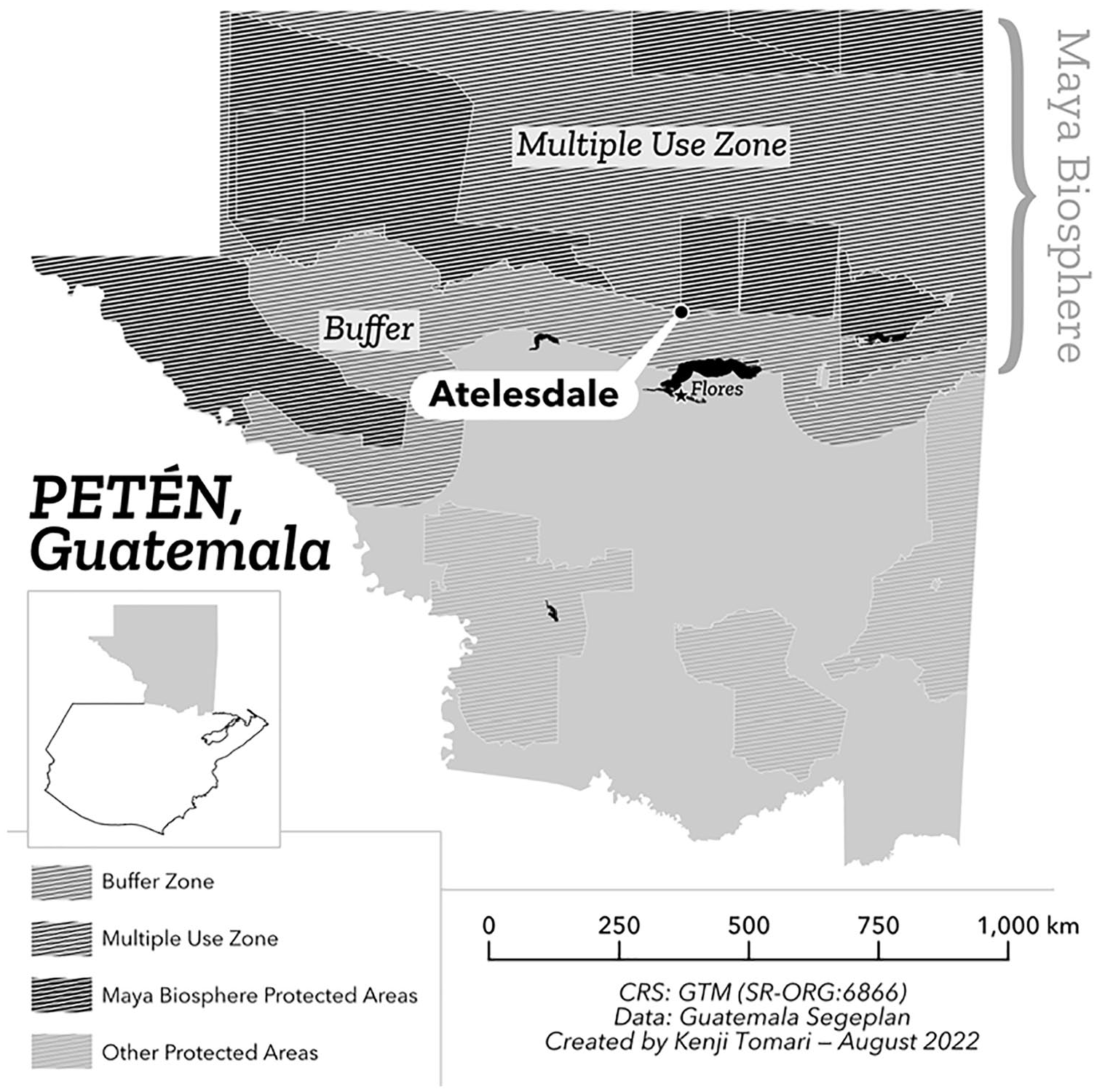
The location of “Atelesdale,” the gateway to the Maya Biosphere Reserve.
Through the lens of this village, I will show the impossibility of “safe use” under real-life conditions of the countryside, offering examples of how small farmers unintentionally or inadvertently expose themselves, their families, and surrounding wildlife to hazardous pesticides. Almost any farmer can tell a story of personal experience or the experience of a friend or family member of being sickened by pesticides, especially paraquat. And, like me, village friends in their forties are now suffering alarming rates of kidney failure, diabetes, and cancer.
Barely a generation ago, however, Petenero swidden farmers used little more than machetes, axes, planting sticks, and fire to cultivate their crops of maize and beans. In fact, many indigenous (Q'eqchi'-Mayan-speaking) and ladino (Spanish-speaking) settlers moved into these northern frontier forests explicitly to seek economic independence from cycles of debt tied to the chemical inputs that had become necessary to eke out a livelihood from the degraded soils in their places of origin—the south coast, the Verapaz highlands, or Guatemala's dry eastern corridor. “The land no longer provided” (La tierra ya no daba) was the refrain of hundreds of migration stories. The migrants founded frontier villages like the one I have called “Atelesdale” (for the spider monkey habitat nearby) deep in the rain forest to exchange the treadmill of agricultural inputs and injustices suffered as sharecroppers on plantations for the chance to become yeoman farmers.
Then in the mid-1990s protected areas suddenly claimed half the arable land of Petén. The largest was the 2.1-million-hectare Maya Biosphere Reserve, established in 1992 on the basis of a design sketched by U.S. conservationists. By hubris or by accident, the reserve engulfed approximately 15,000 family farms into its buffer and multiple-use zones, including more than 200 farms in Atelesdale. Between population growth, heritable subdivision, cattle/plantation land grabs, and park enclosures, parcel size and yields began to plummet. Thin tropical soils require long fallows to sustain organic fertility. Without adequate space to rotate crops, swidden farmers across Petén began using the same agrochemicals to combat pests and weeds that their parents and grandparents had intentionally abandoned.
According to a stratified study I codesigned with Norman Schwartz for Guatemala's National Institute of Statistics, by 1999, 65 percent of Petén farmers reported using pesticides, most (48 percent) using both herbicides and insecticides, 40 percent just herbicides, and 12 percent just insecticides (Grandia et al., 2001). A decade later, a graduate student approached us for our data, our officially vetted survey protocols, and introductions to our Guatemalan coinvestigators to replicate our survey design. Albeit exhausted from chemotherapy, I generously supported her project, layering in a few additional questions I crafted on pesticide safety precautions. The comparative data were startling. In just 10 years the percentage of farmers using herbicides had more than doubled, to 85 percent, and insecticide use had risen to 33 percent (Ybarra et al., 2012). Frequency counts of the most commonly cited products show that insecticide use remained fairly constant but the use of herbicides had more than doubled (Table 1).
Percentage of Petén Farmers Reporting Use of Pesticides, 1999 and 2009
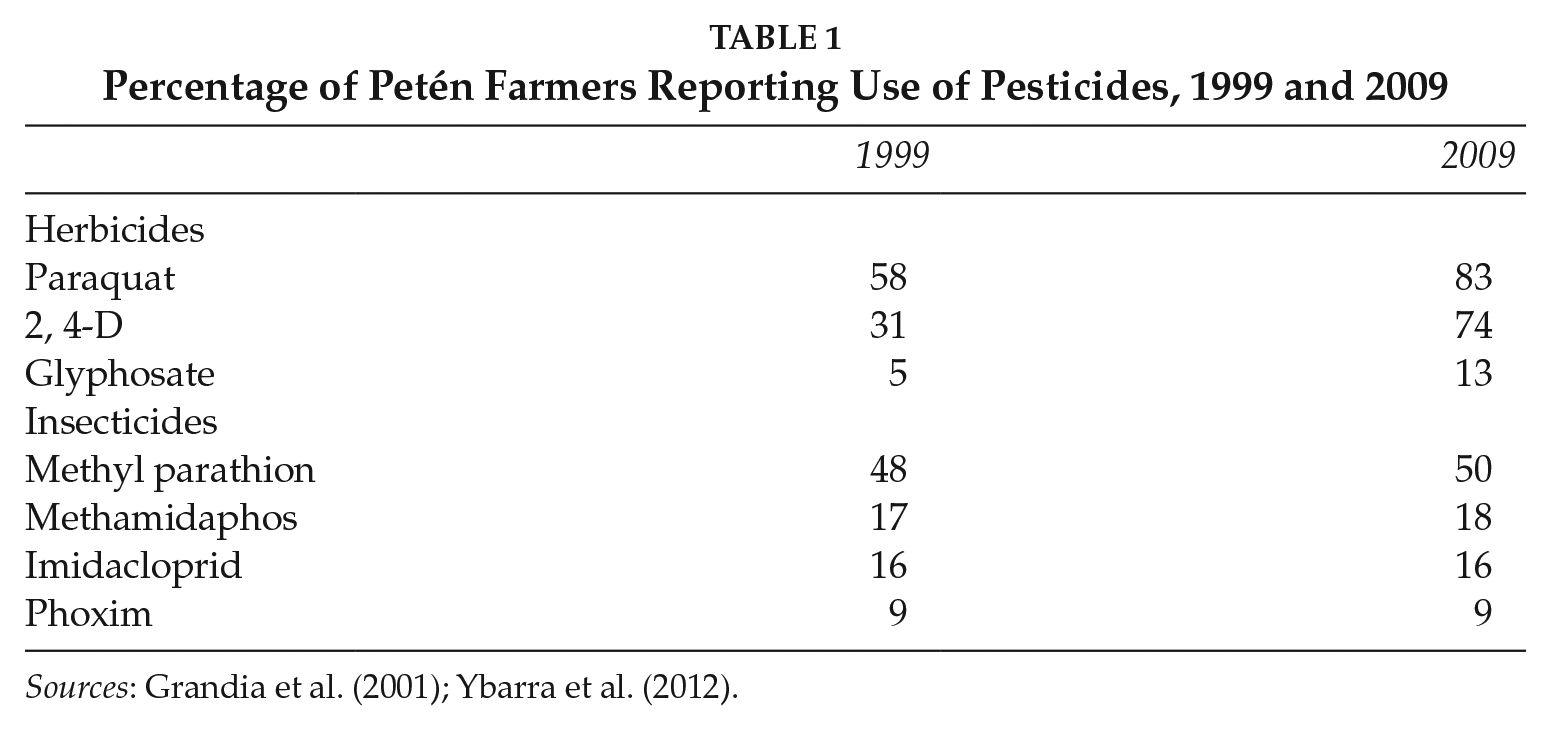
Sources: Grandia et al. (2001); Ybarra et al. (2012).
The three main herbicides in circulation (2,4-D, glyphosate, and paraquat) are now known to be carcinogenic. However, because of fine-print clauses in free-trade agreements, Guatemala would be hamstrung in regulating pesticides for human health even if nascent understanding among peasant movements about the health harms of pesticides could secure the political will to do so.
Guatemala's Green Revolution
Although Guatemala is now awash in agrochemicals, its “green” revolution required decades of concerted U.S. intervention in Guatemalan politics, economy, military, and conservation affairs. Pesticides were originally developed as nerve gases and other agents of chemical warfare during the two world wars. In the 1940s, U.S. corporate interests introduced pesticides to Mexico and Central America as part of a broader agricultural modernization program known as the “Green Revolution” (Murray, 1994). In today’s development lingo, this was a “public/private partnership” financed by the U.S. government and private foundations like Ford and Rockefeller (Dowie, 2001), which had vested family interests in promoting oil-dependent agricultural production with fossil-fuel-derived fertilizers, mechanized tractors, and other machinery, petrochemically produced pesticides, and electrically powered irrigation to optimize yields of “improved” hybrid seeds. Drawing on anticommunist rhetoric (Carey Jr., 2009), Western development proponents argued that these new agricultural technologies should replace subsistence agriculture practices (especially the cultivation of basic grains) so as to free labor in developing countries for industrialization, provide food for growing urban areas, and boost national income from the export of new cash crops.
Prescient critics noted that these technologies were a Trojan horse for state intervention in previously autonomous rural areas (Shiva, 1991). Writ large, they deepened the dependency of the Global South on foreign-supplied inputs and technical knowledge manufactured in the Global North (George, 1977). Above all, the Green Revolution ignored inequities in land distribution and essentially depoliticized the Malthusian problem of “feeding the world.” Although small farms were/are conclusively more productive per acre than large industrial farms (Altieri, 2004; Chayanov, 1986 [1925]), agricultural modernizers portrayed indigenous agroecology systems as obstacles to national progress. From East to West, small farms became the casualty of state policies and scales of economy that favored larger industrial farms. Both the United States and the USSR lavished agricultural aid on Third World countries to boost short-term increases in agricultural productivity and win allies in the Cold War.
This transition ironically began under Guatemala's two most progressive presidents, who led the country’s brief transition to democracy after the 1944 October Revolution. Although they rightfully ended indigenous debt servitude on plantations and initiated agrarian reform, both the Arévalo and Arbenz administrations embraced agricultural modernization (Carey Jr., 2009; Chassé, 2017). Professor-turned-President Juan José Arévalo (1945–1951) poured substantial government resources into an experimental, modernized agricultural colony in Petén and welcomed the opening of Iowa State University's Guatemala Tropical Research Center in Antigua to investigate maize varieties for breeding hybrids (Carey Jr., 2009). One dissident voice was that of Héctor Sierra, Arévalo's director general for agriculture, who was concerned about worker deaths from pesticides on cotton plantations (Chassé, 2017). However, Arévalo’s endorsed successor, Colonel-turned-President Jacobo Arbenz (1952–1954), himself owned a cotton plantation, El Cajón, on Guatemala's south coast. His personal pesticide experiments began to inform ministerial policy before the CIA deposed him for nationalizing some of United Fruit’s idle land (a fraction of a large concession the Guatemalan government had granted without charge to the company in the late nineteenth century). On other lands seized from German landowners during World War II, the state ran nearly 130 large farms (primarily coffee) around the country that were hardly organic (Chassé, 2017).
The shift to chemical-intensive agriculture accelerated under the right-wing military junta installed by the CIA in 1954. Following CIA dictates, they returned land to the latifundistas (large holders), executed a generation of peasant leaders, and blazed roads into the northern forest to defuse any new demands for agrarian reform. This redefined Guatemala's spatial division of agriculture. The northern frontier was to become Guatemala’s maize basket (Schwartz, 1990) 2 while USAID officers heavily promoted Green Revolution technologies for the wholesale conversion of Pacific coastal land for exports. USAID also touted fertilizers in the western highlands in the late 1950s and 1960s (Carey Jr., 2009) to free a Maya reserve-army-of-labor for seasonal migration to coastal plantations. To the northeast, the United Fruit Company introduced pesticides for its monopoly on banana production on the Atlantic coast, and Euro-American coffee barons and Protestant missionaries introduced pesticides to Guatemala's north-central Verapaz highlands. In the east and on the northern frontier, Guatemala's military regime rewarded large landowners, especially cattle ranchers, with technical aid and subsidies from Kennedy's Alliance for Progress (Carey Jr., 2009; Colby and Dennett, 1995; Grandia, 2013).
With 2 percent of the population controlling roughly 80 percent of Guatemala's land and almost 100 percent of its most arable and fertile regions on the south coast and in the Polochic Valley, foreign agricultural inputs disproportionately favored economies of scale for large landowners with access to capital (Carey Jr., 2009). However, anticommunist religious institutions (both Catholic Action and evangelical churches) also successfully promoted Green Revolution technologies to their small-farming flocks (Colby and Dennett, 1995). For instance, Nazarene missionaries collaborated with the Organization of American States in 1970 to produce a storybook in Q'eqchi' Mayan about why farmers should fight corn worms not only with DDT but also with Parisian Green, an outmoded arsenic-based insecticide known since the 1890s in Europe to be hazardous to human health (Eachus and Carlson, 1970). 3
For small and indigenous farmers, agricultural modernization was a Faustian bargain. Synthetic fertilizers entered Guatemalan commerce as early as the 1920s but were not widely embraced by Maya highland smallholders until the 1960s and 1970s. Amid the turmoil of civil war, Carey Jr. (2009) argues that the deep Maya value of autonomy led small farmers to try fertilizers in the hope of making a living from their own small farms and avoiding the harrowing abuses of seasonal plantation labor on coastal plantations—where airplanes routinely sprayed pesticides while Maya families labored in the fields (Menchú, 1984). Although fertilizers initially produced dramatic yield increases, these synthetic chemicals “dried” or “burned” the soil (in colloquial Maya terms) and disturbed beneficial soil organisms (see Richard, 2008). Soon trapped on a “treadmill,” small farmers found themselves needing to apply more and more fertilizers to sustain their yields. Guatemala's military dictatorships created political patronage systems similar to those established by Mexico's monopoly Partido Revolucionario Institucional to maintain control of the rural areas through the free and subsidized distribution of fertilizers (see Simon, 1997). Even more recently, during the 2013 trial of the former Guatemalan president Efraín Ríos Montt, who presided over the worst massacres of indigenous villages in the early 1980s, the state baldly offered fertilizers to Ixil survivors bussed to Guatemala if they would join a rally to deny the genocide (they refused) (Figure 2).
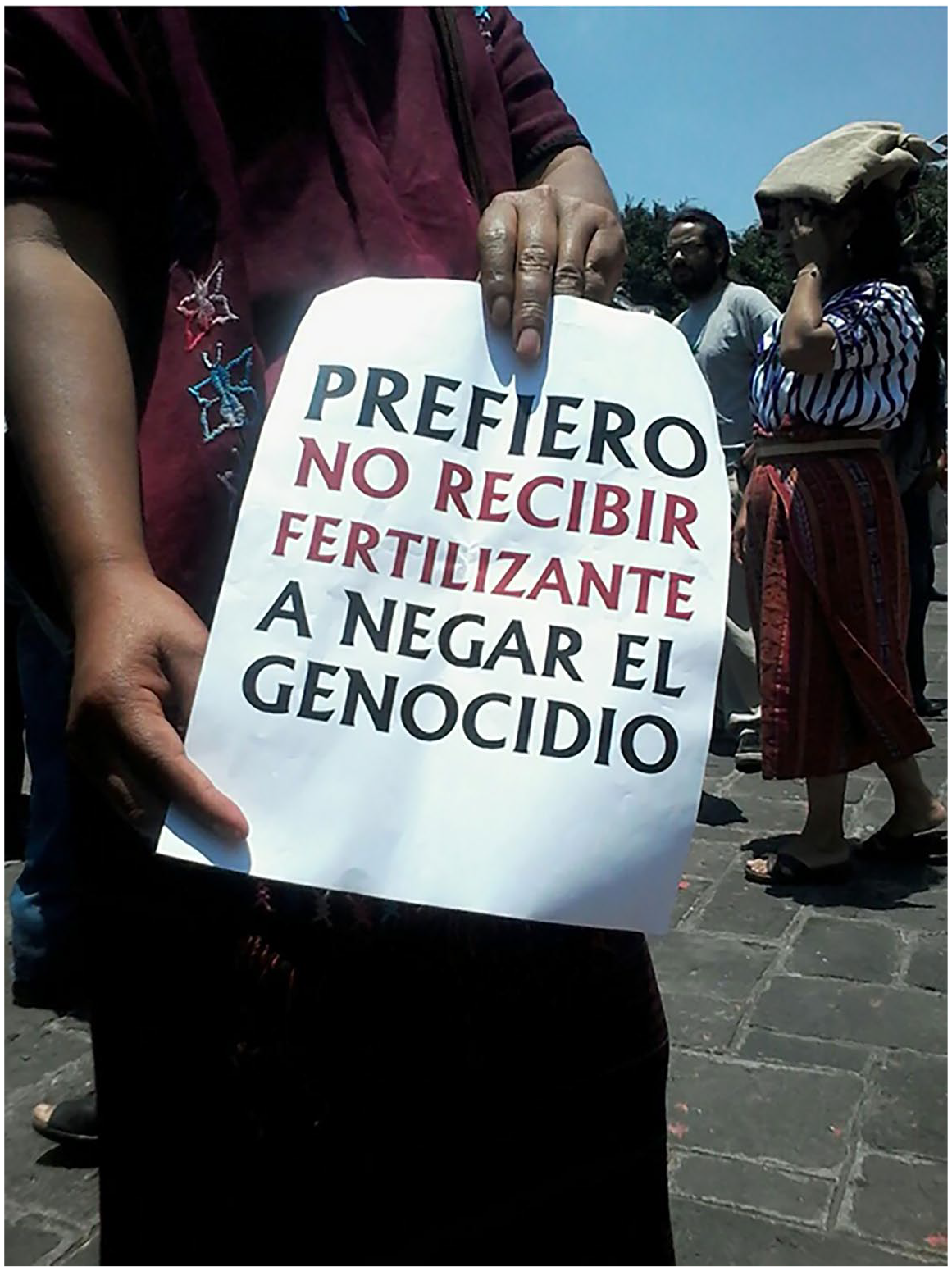
Ixil survivors rejecting fertilizer bribe.
By the 1970s, maize diversity and yields had plummeted, and Maya farmers found themselves enmeshed in new webs of cash dependency. Seasonal migration to industrial farms on the Pacific coast intensified, and some displaced farmers began to make longer journeys as emigrants to the United States. USAID “rewarded” those who stayed and survived the military’s massacres with programs to develop nontraditional exports (berries, broccoli, melons, snow peas, etc.) that could ensure cheap, fresh produce year-round to U.S. consumers (Carey Jr., 2009). A sample USAID budget from this period included modern agricultural development (US$23 million), trade (US$17 million), private sector enterprises (US$10 million), and farm-to-market roads (US$30 million). In fact, one of these USAID projects shared offices with Agrequima, Guatemala's front association for agrochemical producers (Barrett, 1995).
The tripartite World Bank Group (the International Bank for Reconstruction and Development, the International Finance Corporation, and the International Monetary Fund), along with the Inter-American Development Bank, also accelerated Guatemala’s chemical transition through numerous loans for agricultural modernization. 4 In fact, some 80 percent of development bank loans to Guatemala between 1956 and 1980 went to large-scale export crops (then cotton, sugar, and coffee) (Whirled Bank Group, n.d.). As did almost all other impoverished countries targeted by “economic hit men” (Perkins, 2004), Guatemala then defaulted on these impossible loans in the 1980s. When the International Monetary Fund imposed fiscal austerity, structural adjustment programs further elevated export agriculture to generate foreign currency to make the minimum repayment on the country’s debts (Carey Jr., 2009). The World Bank group also set in motion a neoliberal framework to open the Guatemalan economy to foreign investors after the state signed peace accords in 1996, ending the 36-year civil war (the second-longest in Latin America).
Although these accords promised public financing for land, new institutions for resolving agrarian conflicts, credit programs, productive projects, infrastructure for rural development, training programs, price information systems, legal reforms, and progressive land taxes to discourage concentration, a cabal of consultants from the World Bank to GTZ to USAID decided that instead what Guatemala needed was to secure private property through GIS cadastral mapping and land titling programs. Parallel to this, through its Puebla-to-Panamá Plan, the Inter-American Development Bank financed a network of roads, ports, hydroelectric dams, pipelines, and other infrastructure to attract foreign corporations (Grandia, 2013). Put together, these megaprojects sparked a land rush not witnessed in the Americas since the early Spanish colonial period. Within just two years of the close of the World Bank's 1997–2008 Land Administration Project, half of the small farmers in Petén had lost their land (approximately one-sixth of Guatemala’s territory) (Grünberg, Grandia, and Milian, 2012).
All these pressures have pushed subsistence farmers struggling to survive on smaller and smaller plots of land to experiment with dangerous pesticides that are intended for supervised use on export plantations but nonetheless circulate unregulated on the national market. For impoverished farmers, a crop failure can be catastrophic, so they often apply a sequential barrage of chemicals or chemical mixtures—figuring that "if one is good, then two are better" (Arbona, 1998; Barry, 1987; Wright, 1990). Between 1985 and 1991, Guatemala almost doubled its pesticide imports from the United States, to 9 million kilos, of which 2.5 million kilos were either restricted or known to have adverse health impacts (Barrett, 1995). Today, Guatemala is one of the three countries worldwide with the highest per capita uses of pesticides (alongside Ecuador and China) (FAO, 2017). Barely the size of Tennessee, Guatemala was also the fifth-largest importer worldwide of the most toxic Class I pesticides from the United States (Dowdall and Klotz, 2014).
Bhopalization of the Business Model
The dirty open secret of the pesticide industry is that the United States allows corporations to export pesticides that are banned, restricted, or never registered at home. Although the Jimmy Carter administration briefly prohibited this practice by executive order, Reagan immediately reinstated it. The United States now exports roughly half the pesticides it produces to the Global South (Barrett, 1995). Following the tobacco industry playbook, whenever a chemical gets banned or regulated in the United States, pesticide companies just shift those sales abroad. For example, after the Environmental Protection Agency (EPA) restricted methomyl in 1996, DuPont compensated for its reduced domestic sales by increasing exports of the chemical from 3 to 6 tons a day (PANNA, 1998). As quoted in Langman (2008), Jay Vroom, president of the U.S. trade group CropLife America, argues, Simply because a product is not registered for use in one country does not mean it is banned. That is a very crude term. There are a lot of good, rational drivers on why a product may not be registered in a country where it is produced but perfectly legitimate and safe to use in another country with different kinds of crop pest infestations and climate conditions.
The day after the Ninth Circuit Court of Appeals ordered Trump’s EPA to implement its ban on chlorpyrifos (a neurotoxic insecticide known to cause brain damage in children), a Dow spokesperson chillingly told the press that chlorpyrifos was an essential pest management tool in the Global South and that Dow would “continue to support the growers who need this important product” (Biesecker, 2018). Used primarily by the Guatemalan coffee industry, chlorpyrifos circulates throughout the country and appeared like clockwork the next year (2019) in the longitudinal inventories of pesticides sold in Petén that I began in 1999. Sales of Roundup (embattled in cancer lawsuits in the United States) are also on the rise after a Monsanto/Bayer advertising blitz in Petén (Figure 3).
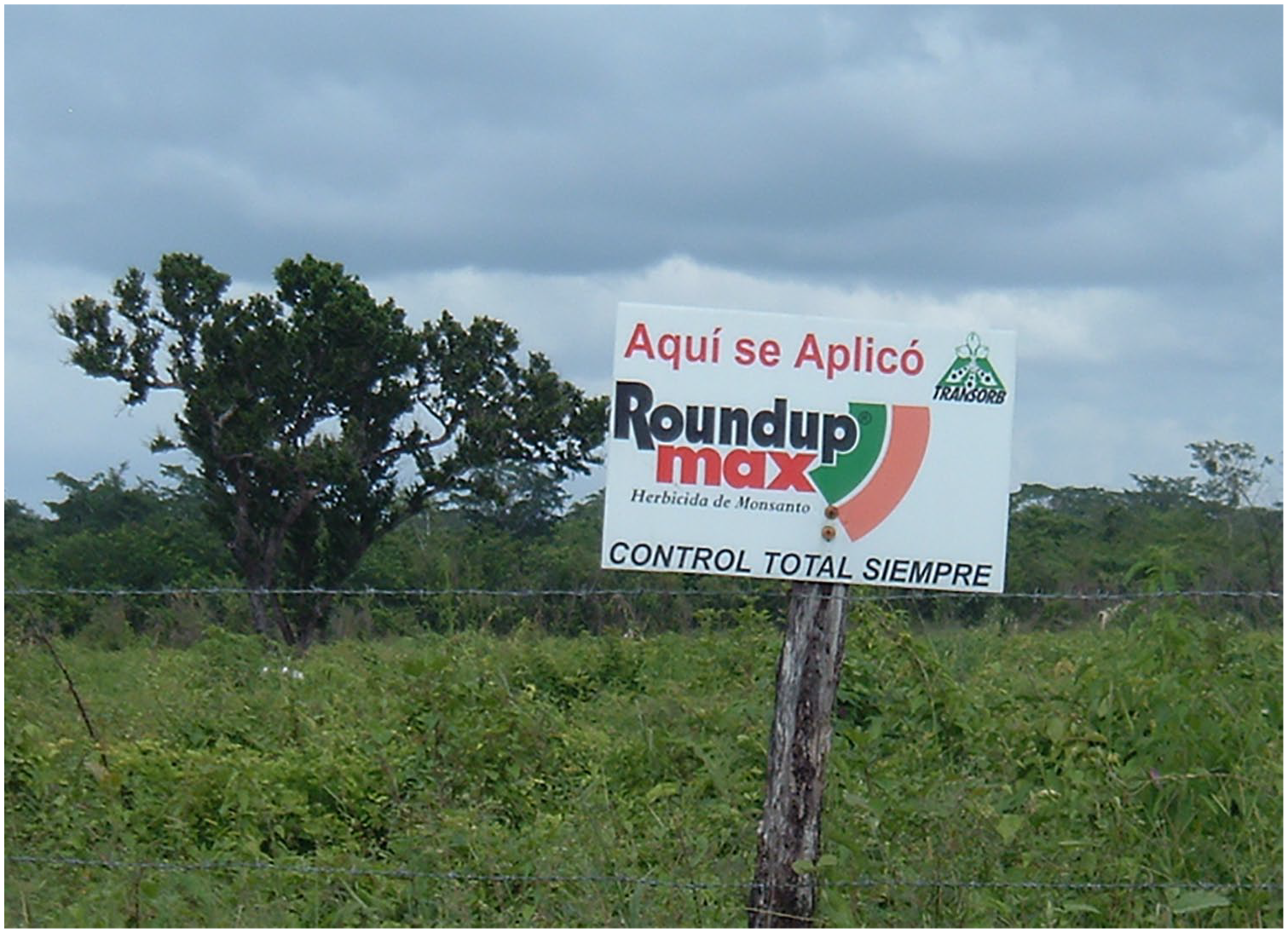
Roundup advertisement in Petén. Photo © Ericka Moerkerken
While most of these pesticides were once fabricated in a sacrifice zone known as “Cancer Alley” on the Gulf coast, chemical corporations began outsourcing their chemical plants in the 1980s to countries with less restrictive occupational health regulations (Tansey et al., 1995). The most infamous case of unsafe offshoring was Union Carbide’s pesticide-manufacturing plant in Bhopal, India, where improper safety precautions led to a 1984 gas leak that sickened at least 500,000, killed 3,500–8,000 (though estimates range as high as 16,000), and caused permanent health problems for another 10,000. By 2008, Central America had 42 similarly underregulated pesticide plants concentrated in Guatemala and Costa Rica, mostly producing generic versions of expired patent formulations (Galt, 2008). The latter are often of low quality, contaminated by (additional) toxic substances, impurities, or incomplete reactions, and/or poorly packaged (FAO and WHO, 2001). Although Guatemala is a net pesticide exporter to the rest of Central America, a growing number of products come from China. Black-market pesticides are a chronic problem, estimated to constitute 10 percent of sales (Martínez Ramos, 2006). One 1989 study found that of 246 pesticide shops, 62 percent were not registered with the government, 39 percent sold illegal products, and a whopping 80 percent violated Guatemala's bare minimum regulations (Barrett, 1995). Compared with Eastern Europe, where governments have reduced pesticide inventories to a more manageable 300–500 products, Guatemala has a confusing array of 3,667 registered pesticide products (Schroeder, López, and López, 2010), including at least 17 different formulations of chlorpyrifos.
Although the 1985 International Code of Conduct on the Distribution and Use of Pesticides (updated in 2013) recommends that agrochemical companies (1) refrain from selling products when safe use cannot be guaranteed, (2) make less toxic formulas available, (3) design packaging that is safe, childproof, and not attractive for reuse, (4) test all pesticides for human health impact, (5) train distributors, (6) provide clear directions and labels in the appropriate local language, (7) advertise ethically, and (8) follow international standards for manufacturing, storing, and shipping, all these recommendations are purely voluntary (Dinham, 1991). The UN’s Food and Agriculture Organization (FAO) has no authority for enforcement (Murray and Taylor, 2000).
Pesticide Poisonings
It is little wonder that farmers in the Global South are dying in droves from pesticides. Despite grotesque global data deficiencies on this topic, experts estimate that pesticide-related poisonings range from 400,000 to 25 million per year and pesticide deaths between 10,000 and 40,000 (Tansey et al., 1995). Just 20 percent of all pesticides are used in the Third World, but 99 percent of pesticide deaths occur there (Smith and Beckmann, 1991). Latin American farm workers are 13 times more likely to be poisoned than agricultural workers in the United States (Tansey et al., 1995). In Guatemala, though the official number of poisonings hovers around 1,000 per year, Dr. Heriberto Arriaga, a professor at Guatemala’s San Carlos University, believes that the real number might be five times higher (Lambrecht, 1993a). 5 Another toxicologist suggests that poisonings may be undercounted by 97.5 percent (Guzmán-Quilo, 2016).
According to Guatemala’s National Forensics Sciences Institute, 4 of the country’s 381 documented pesticide deaths in 2013 were due to malathion but many more (60) to paraquat. Also known as “gramoxone,” paraquat is nearly ubiquitously applied by subsistence farmers in Petén to reduce the workload of weeding by machete. It is the poison of choice for farmer suicides—and apparently now teenage suicides. On my most recent trip to Atelesdale, multiple villagers recounted the story of a young girl who drank it. Few of these cases are properly investigated because drug trafficking and gang violence have politically and budgetarily overwhelmed the institute. Hoping to gather some regional data in 2019, I interviewed a blasé director who had kept no archival records on the subject and could only vaguely recall 10 fatal pesticide poisonings during his term of office (2016–2019)—a hardly credible figure, since I had heard about nearly that many cases from my own acquaintances on a short field visit. 6
While acute poisonings and deaths remain underreported, far less is known about other delayed morbidities or epigenetic inheritances of pesticide exposure from parents or grandparents. DDT exposure, for example, in previous generations can manifest itself in higher rates of several cancers, diabetes, obesity, and other inflammatory diseases (Marya and Patel, 2021). Whether from previous exposure to persistent organic pollutants or from the current exposure to more volatile organophosphates, cancer rates are clearly on the rise. In just one week in 2019 I learned that a regional peasant leader's daughter had died of liver cancer at 24; two of my closest friends and hosts in Atelesdale had recently died in their forties from pesticide-related cancers and diabetes; a friend of friends had uterine cancer that had metastasized to the neck, and, not wanting to impoverish her family with medical expenses, she was at home “waiting to die.” A shocking number of middle-aged adults in Atelesdale were on metformin for diabetes. Numerous middle-aged village leaders had died of kidney failure (also highly correlated with pesticide poisoning). Village midwives commented on rising rates of infertility (a problem virtually unknown when I was running a reproductive health program from 1997 to 2000). The bus attendant had accidentally been blinded in one eye while spraying herbicides on a palm plantation. However, day laborers like him may soon lose even this hazardous job, since a gringo just opened a drone business for aerial spraying at a lower cost; surrounding communities are already reporting poisonings from pesticide drift to a distinguished organization of village health promoters that serves them. 7
Petén's Vice Ministry of Agriculture and Ranching technically should monitor pesticide sales and use (Martínez Ramos, 2006) but willfully abdicates this responsibility. Even a USAID consultant was shocked that the agricultural ministry uses an entirely different system of color coding from that recommended by the World Health Organization. Many chemicals banned or restricted in other countries in the Global South receive only a yellow (moderately toxic) or green (lightly toxic) label in Guatemala (Schroeder, López, and López, 2010).
“Safe Use”
Of course, as the Q’eqchi’ verb q’oq’onk succinctly expresses, what goes around comes around. Produce exported from the Global South reenters the markets in the Global North with unacceptable pesticide residues. To give but one example, although the EPA canceled DDT's registration in 1972, a study showed that 7 percent of U.S. imports from Guatemala in 1979 were adulterated with DDT (Roosevelt, 1983). 8 Two other influential investigative pieces (Dowie, 1979; Weir and Schapiro, 1981) inspired a U.S. House of Representatives subcommittee to conduct hearings in 1983 on this “pesticide boomerang.“ Patrick Leahy twice attempted to pass a bill, the Circle of Poison Prevention Act, that would have prohibited the export of hazardous substances banned or restricted in the United States (approximately a quarter of international sales), but it languished in conference committee (Karmin, 1989). No one really knows what percentage of exported pesticides would be illegal in the United States, because no federal agency tracks these data; nor can independent researchers glean this information, because the General Accounting Office stopped reporting data for fear of terrorist attacks on shipping containers after 9/11 (Galt, 2008).
An ironic proxy indicator for poisonous exports is the regularity with which screening of produce imports reveals unacceptable levels of residues. An estimated 18,000–20,000 smallholders (mostly Maya) produce nontraditional export crops in the western highlands (Galt, 2010). Although Guatemala’s exports represent only 0.57 percent of fruit/vegetable imports to the United States, they have the highest percentage of adverse pesticide residues on tested shipments, a shocking 18 percent (Galt, 2010). The magnitude of the problem is likely far greater. The Food and Drug Administration (FDA) apparently tests only about 1 percent of imports and can only screen for half of the pesticides in commerce (Galt, 2010), but imports are allowed to continue toward the market while it awaits these limited results. Even when residues exceed federal limits, 60 percent of contaminated produce has already reached consumers, and the FDA rarely attempts to recall it (Karmin, 1989).
Instead, imports are more likely to be rejected for aesthetic defects; some 15 percent of Guatemalan broccoli exports are refused for cosmetic imperfections, driving farmers to risk extra prophylactic pesticide applications (Hamilton and Fischer, 2003). In 1993, the FDA rejected 1,755 shipments of broccoli and snow peas because of high pesticide levels (Murray and Taylor, 2000). Between 1995 and 1997, the snow pea industry lost US$70 million to FDA detentions (Mahmoud, 2017). Between 1996 and 2006, 26 percent of peas, 14 percent of squash, 30 percent of bok choy, 28 percent of string beans, and 100 percent of chayote from Guatemala had adverse residue rates (Galt, 2010)
With mounting scandals associated with Guatemala's nontraditional export sector, it was not a coincidence that the International Group of National Associations of Manufacturers of Agrochemical Products chose Guatemala in 1991 as one of three pilot countries for a million-dollar Safe Use Campaign (along with Kenya in Africa and Thailand for Asia) (Murray and Taylor, 2001). This was hardly a philanthropic project, as the trade lobby’s local counterpart Agrequima can levy a 0.05 percent tax on imported pesticides to fund do-gooding activities that include litter campaigns, school gardens, or anything but the grim reality of small-farmer intoxication. 9 In neoliberal fashion, this program places responsibility on the laborer rather than ensuring that owners provide safety equipment and unbiased health care services (company doctors are notorious for dismissing symptoms of intoxication).
That same year, USAID pledged another US$4 million to Guatemala for training farmers in export zones in integrated pest management (Murray and Taylor, 2000). The implicit message of the campaign was “use pesticides safely, but by all means, use pesticides” (Murray and Taylor, 2000: 1742). Pointing to the obvious irony of USAID’s fixing a problem that prior U.S. intervention had created, critics also noted that the program emphasized individual farmworker responsibility and education about personal protective measures rather than a significant reduction in (let alone a ban on) the use of pesticides by farm owners and agricultural exporters. The agro-development focus on behavioral education implicitly directed blame for pesticide morbidities and mortalities onto farmers and away from the agrochemical industry. As Julio Ruano, the Guatemalan director of Agrequima, assured the press, any harm to the environment or human health from agrochemicals in Guatemala was the result of “someone’s misusing [pesticides]” (Gándara, 2018). A more subtle problem of this and other USAID projects (whether family planning, tree planting, or export crops) is that the neoliberal development model presumes that “common sense” rationalities will enable farmers and farmworkers to apply agrochemicals without personal harm (Popper et al., 1996). Even were that true, places like Petén lack the conditions for “safe use.”
Real Pesticide Users of Petén
Pesticides used in export agriculture are showing up in Petén agricultural-input shops, but knowledge about “safe use” does not follow them. From hundreds of conversations in Petén, I have found that farmers are keenly aware that chemicals may be dangerous to their health but lack the time, land for fallow, and other economic means to shift to safer or organic practices. To confirm these qualitative observations, in our 1999 survey (Grandia et al., 2001) we asked the 65 percent of farmers who used pesticides what they did to protect themselves. Just half (49 percent) of farmers reported taking some safety precautions when spraying pesticides. Most (47 percent) then volunteered using only one measure, 38 percent reported two, and only 15 percent three or more. Use of the measures that they did mention was significantly less than the safety rates found in two other national and regional studies (Conroy, Murray, and Rosset, 1994; Hoppin, 1989) (Table 2).
Percentage of Small Farmers Reporting Use of Various Protective Measures against Pesticides in Petén and Elsewhere
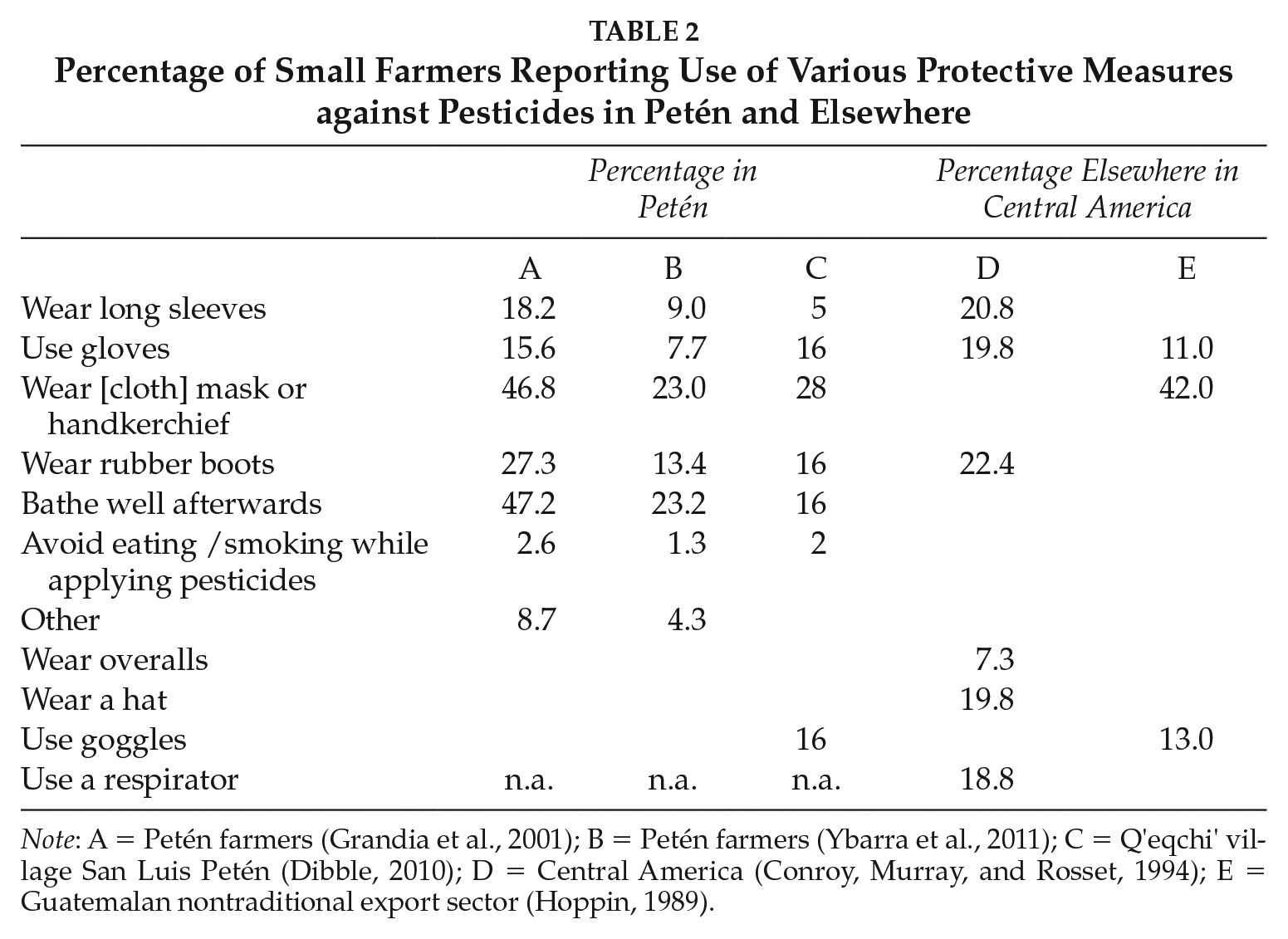
Note: A = Petén farmers (Grandia et al., 2001); B = Petén farmers (Ybarra et al., 2011); C = Q'eqchi' village San Luis Petén (Dibble, 2010); D = Central America (Conroy, Murray, and Rosset, 1994); E = Guatemalan nontraditional export sector (Hoppin, 1989).
One explanation may be that because 42 percent of male heads of household in Petén never attended school and another 46 percent attended only primary school (INE, 2009), the vast majority of small farmers (especially Q'eqchi'-speakers, for whom Spanish is a second language) cannot read complicated pesticide warning labels. These labels no longer carry the universally known skull and crossbones sign for danger but instead bear a plain X, which an illiterate person might interpret as a favorable voting mark. Even farmers who can and do read the fine print of labels may find unrealistic instructions like “Store product in a cool, dry place” when they live in a one-room pole-plank house. Instructions also advise “In case of accident, call a physician,” but doctors are hours if not days away from frontier villages. Labels instruct users to wash well after using, but northern Petén has little surface water, and most villages lack running water.
Even if farmers had the means and desire to acquire it, most of the recommended safety equipment is simply not available for sale in Petén. Not a single store in Petén in 1999 sold respirators or goggles, much less full protective gear. By 2011, overalls and masks could be found in the back of a few stores in the central urban area but at prohibitive cost. With the average daily wage Q20–30 in rural areas, a new set of equipment each season could cost more than Q1,000 (more than two months’ wages, plus another Q100 for travel to town): coveralls, Q175; protective mask, Q75–180; hat, Q35; gloves, Q20; tall boots, Q50; new sprayer, Q650. Although it may seem odd to include a new sprayer as safety equipment, I heard a half dozen horrific stories about dermal intoxications caused by leaky backpack sprayers that soaked farmers' shirts in paraquat and other pesticides. A USAID consultant admitted, “Hand-pump backpack sprayers, used by the poorest farmers among others, can and do eventually develop leaks at almost every junction (filler cap, pump handle entry, exit hose attachment, lance attachment to the hose, and at the lance handle), which soak into exposed skin” (Schroeder, López, and López, 2010).
Even where farmers are aware, willing, and wealthy enough to purchase all the above, when tropical temperatures regularly pass 40°C., rubber coveralls, a helmet, and water-/chemical-proof gloves are simply not practical. The hot climate also exposes farmers to higher amounts of agrochemicals through dermal absorption (via open sweating pores) and respiration (via higher volatility at higher temperatures) (Barry, 1987). Because organophosphates trigger the nervous system, pesticide ingestion may cause dizziness and cloud farmers' judgment, resulting in high rates of poisoning (Barrett, 1995). (Many farmers described to me collapsing in the field for unknown time periods during which more pesticides soaked through their pores.)
Although farmers tend to wear long sleeves and cover their mouths with a cotton bandana, these are hardly protective. With oil-based pesticides soaking into their clothing, farmers will dermally absorb pesticides through the skin for hours until bathing is possible. Poor farmers often wear the same pesticide-laden work clothes day after day (see Dinham, 1993) because they own so few changes of clothing and laundry water is scarce. In northern Petén families may have to ration a few gallons a day when wells run dry. Conversely, if farmers don clean clothes daily it means that their mothers, sisters, or daughters will have washed their pesticide-laden outfits with absolutely no protection at village wells or in ponds or rivers. This may lead to the leaching of mixtures of various pesticide residues or other metabolites into the community’s water supply.
Beyond inadvertent mixing in community water sources, farmers also proactively mix dangerous “cocktails” of two or more pesticides. Household and field pesticides are used interchangeably. Other dangerous substances like rat poison may be added to crop pesticides. Families may apply powdered pesticides (a particular favorite is Phoxim, a powdered ant poison) to corn storage bins to prevent worm infestations. They also use pesticides for nonagricultural purposes such as killing head lice, treating leishmaniasis, removing warts, or making insect repellents (Lambrecht, 1993b and my observations).
Perhaps the most egregious pathways of exposure are via the reuse of pesticide vessels for food and water storage. To prevent leakage in transit or storage, the International Code of Conduct on the Distribution and Use of Pesticides stipulates that pesticides be packaged in liquid-tight vessels that are easy to handle and pour without dripping or glugging. These same qualities, however, make them ideal for reuse (WHO and FAO, 2008). On many occasions I witnessed schoolchildren reusing pesticide bottles to carry water to school. Even more frequently I saw pesticide barrels repurposed as waste bins, rainwater collection vessels, or bathing water storage containers for ranch workers. In one village deep in the Maya Biosphere Reserve, one family had frugally cut up a paraquat bottle for storing the incense resin from Protium copal trees for ceremonial use. I saw even highly trained government workers decanting malaria pesticides with leaky, homemade “funnels” cut from the tops of plastic soda bottles before they sprayed the village school while it was in session.
One day on my village rounds in Atelesdale, I happened to visit a lady processing annatto fruit (Bixa orellana) for a spice prized in Q’eqchi’ cooking and utilized internationally as a natural dye for margarine, cheddar cheese, and other oily foods. This involves hours of peeling a sackful of fruit, washing the seeds repeatedly, and then slowly boiling the rinse water into a paste over 24 or more hours. During our conversation, she complained about how exhausted she felt. I noticed that she was washing her annatto in an old herbicide container that her husband had brought back from a ranch where he worked as a day laborer spraying pasture (Figure 4). This particular weed-killer was Kuron 16-SL, manufactured by Dow Chemical with two active ingredients (Picloram and 2,4-D) that are considered “bad actors” by the Pesticide Action Network as suspected groundwater contaminants, endocrine disrupters, and/or carcinogens. As I studied the drum label, she self-consciously rationalized that she had washed it out well. No wonder she felt poorly.
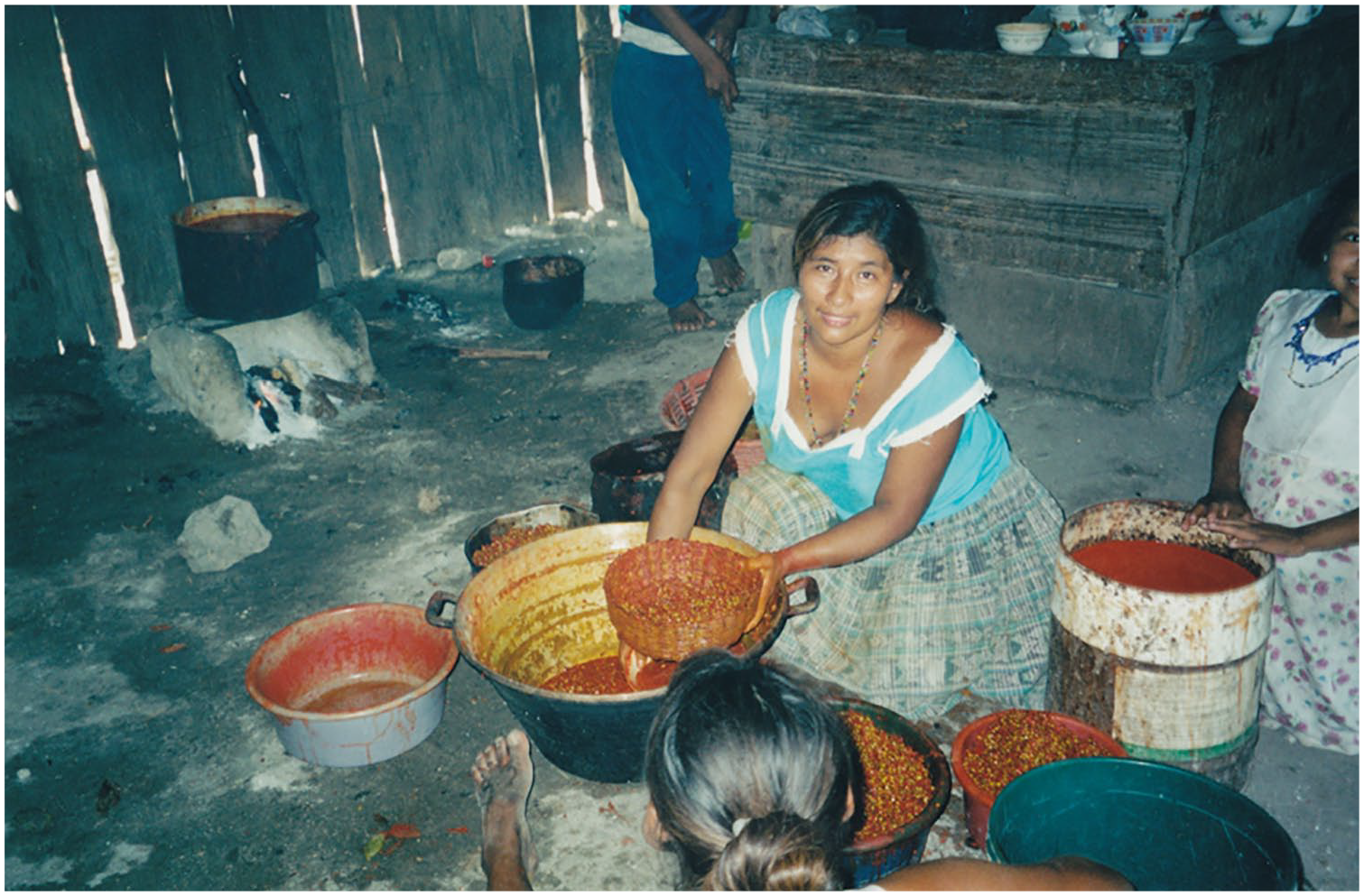
Annatto being washed in an old herbicide barrel.
The disposal of these and other pesticide containers presents a particularly pernicious problem for the rural poor, who lack geographic or economic access to basic landfills, much less hazardous-waste storage facilities, and must therefore take pesticide trash disposal into their own hands. Practically speaking, what should a farmer or malaria worker do with empty pesticide containers? Leave them in the fields? Burn them? 10 One afternoon as I walked through “Macawville” (a village a day’s walk west of Atelesdale), I noticed a discarded pesticide bag alongside a path near the school where any child might have touched it. As I stopped to take a photograph of it, a farmer returning home from his fields inquired about my interest in the object. With just two months of language study at that point, I explained as best I could in Q’eqchi’ Mayan that it was dangerous and should be—and as I searched for the right word, he anticipated “burned.” “No!” I exclaimed, explaining that burning pesticides would be quite dangerous and perhaps it would be best to bury it. Yet in rural places that depend on well water, is the government recommendation to bury pesticide waste any safer? For communities living in protected areas, what might this mean for wildlife, pollinator, or ecosystem health? USAID's highland, agricultural programs explicitly recommend that project beneficiaries avoid using pesticides within 2 kilometers of a park and ideally establish a 10-kilometer organic zone around protected areas—recommendations never discussed, much less implemented, in the lowlands where most of Guatemala's protected areas are located (Schroeder, López, and López, 2010). According to one USAID consultant, Agrequima’s imprudent “solution” in the highlands was to collect empty pesticide containers in areas of high use for “recycling . . . into plastic furniture” (Schroeder, López, and López, 2010).
Would you, my reader, buy such furniture? Likely not, if you received a different kind of environmental education inspired by the great Rachel Carson.
Missing the Chemicals for the Trees
As almost any schoolchild in the United States now knows, DDT endangered the U.S. symbol of freedom by making bald eagle eggs so fragile that they shattered under their mother's weight in their nests. Thanks to the connections Rachel Carson (1962) made between the “silencing” of birds and human illness, what had previously been an environmental movement of the rich (nature lovers, birdwatchers, and hunters) focused on park conservation broadened into a movement that included housewives, students, farmworkers, and people of color concerned about the air we breathe, the water we drink, and the food we eat. However, the ideological version of “environmentalism” exported in the 1990s by the big international nongovernmental organizations (BINGOs in the development literature) remained focused on parks and biodiversity to the exclusion of other environmental health issues. The executive staffs of international conservation organizations are predominantly privileged white male biologists uninterested in and even hostile to the idea of partnering with indigenous, peasant, or other local social movements (Chapin, 2004; Grandia, 2012a). Although their rhetoric speaks of sustainable development, a macho “people versus parks” mentality remains the dominant modus of project organization.
Likewise, institutional Guatemalan environmentalism began as an elite affair to separate humans from nature. During the Guatemalan civil war, an upper-class urban ecology movement from Guatemala's elite passed two major pieces of legislation that created an environmental commission in 1986 and established a system of protected areas in 1989 (Berger, 1997). 11 The U.S. government, the World Bank, and other international donors invested millions in the parks (Chapin, 2004) but offered negligible resources to the broader framework for democratic environmental governance. This created a strange imbalance in the hierarchy of Guatemalan state agencies. For many years, Guatemala's national park service employed hundreds of people with advanced GIS computing systems and well-appointed offices, while its parent organization, the Ministry of the Environment, had but two people on salary (a director and a secretary) in a rented house with virtually no furniture but a handful of plastic chairs.
Seeing only the forest, the technocratic conservation class trained by the international organizations measured its success only in hectares conserved. For example, in the original 1992 design of USAID’s 10-year Maya Biosphere Reserve program, the Rodale Institute's local affiliate Centro Maya was to research and revitalize ancient (organic) Maya agronomy systems. However, most of its (entirely male) employees were foresters, uninterested in agriculture, and within a year, USAID approved a reorientation of its work plan to sustainable timber management. In general, USAID oriented all the nongovernmental organizations’ work plans toward reducing deforestation, ignoring other known environmental issues at the time (e.g., dioxin residues from defoliant spraying and a 1992 report of “thousands of tons” of radioactive and toxic waste dumped in unknown locations across Petén).
Never once did I hear these environmental justice subjects broached in any of the hundreds of international conservation meetings I observed or participated in over the past 25 years. When ProPetén was still under the control of Conservation International, I tried to raise issues like monitoring for oil spills or the impact of woodstove smoke on maternal and child health, but my DC boss responded ruefully, “Liza, we do green issues, not brown issues." Others in organizational leadership were less apologetic. That same summer of 1993, the vice president for what became Conservation International's current Center for Environmental Leadership in Business cornered me in the hall after I had posted a sign for an informal brown-bag lunch among the interns to discuss concerns about Conservation International's partnership with Chiquita (whose banana industry had sterilized plantation workers with the pesticide dibromochloropropane) and organizational collaborations with corporations like Monsanto. Snapping his suspenders and pointing to my flyer, he asked pointedly, "How long do you hope to work for Conservation International?" and then "suggested" that I cancel the lunch discussion (I did not).
Troubled by pesticide use in Atelesdale, in 1998 I recruited an energetic agronomist working for ProPetén who agreed to volunteer his time experimenting with homemade organic sprays (made with soaps, garlic, cayenne, forest plants that repel insects, etc.). We approached a community leader who was one of the few farmers to have made a good living producing vegetables and melons for sale to urban markets, but with heavy pesticide use for 30 years. Don Tito Martínez was initially skeptical of going organic, but because of the rising costs of pesticides (then Q1,600 a season = US$213, when the daily wage was US$3.33), he agreed to try one of the natural sprays on his corn crop (Q16 of locally procured ingredients). That evening he had second thoughts and remarked to his son that they should go to the field the next day and apply some petrochemical pesticides. When they arrived, however, he discovered that his maize field was utterly free of pests. “That day,” he told me, “I buried my poisons” (both literally and figuratively). Don Tito had a bumper watermelon harvest, and three dozen farmers joined the experimental group and produced a remarkable booklet of natural recipes that the Hesperian Foundation profiled internationally in its Community Guide to Environmental Health (Conant and Faden, 2008), translated into at least a dozen languages (from Swahili to Russian to Mandarin), and distributed worldwide through village health worker programs and organizations with free online downloads (Paula Worby, e-mail message, 2022). However, when my bosses in Conservation International got wind of our organic group, they asked, “What does this have to do with biodiversity conservation?” Despite local enthusiasm, they forbade me to continue—a bizarre decision, since these Atelesdale farmers otherwise would be spraying pesticides inside the Maya Biosphere Reserve near spider monkey habitat. (The demoralized agronomist soon quit, but continued his popular organic education via a local radio program.) Twenty years later, when I returned to Atelesdale to give a talk about pesticides to the middle school, all of the boys raised their hands (including Don Tito’s grandson) reporting they had sprayed pesticides without protection. 12 Another perfect 100 percent of the teenage girls had washed the pesticide-laden clothes of their fathers and brothers bare-handed (Figure 5).
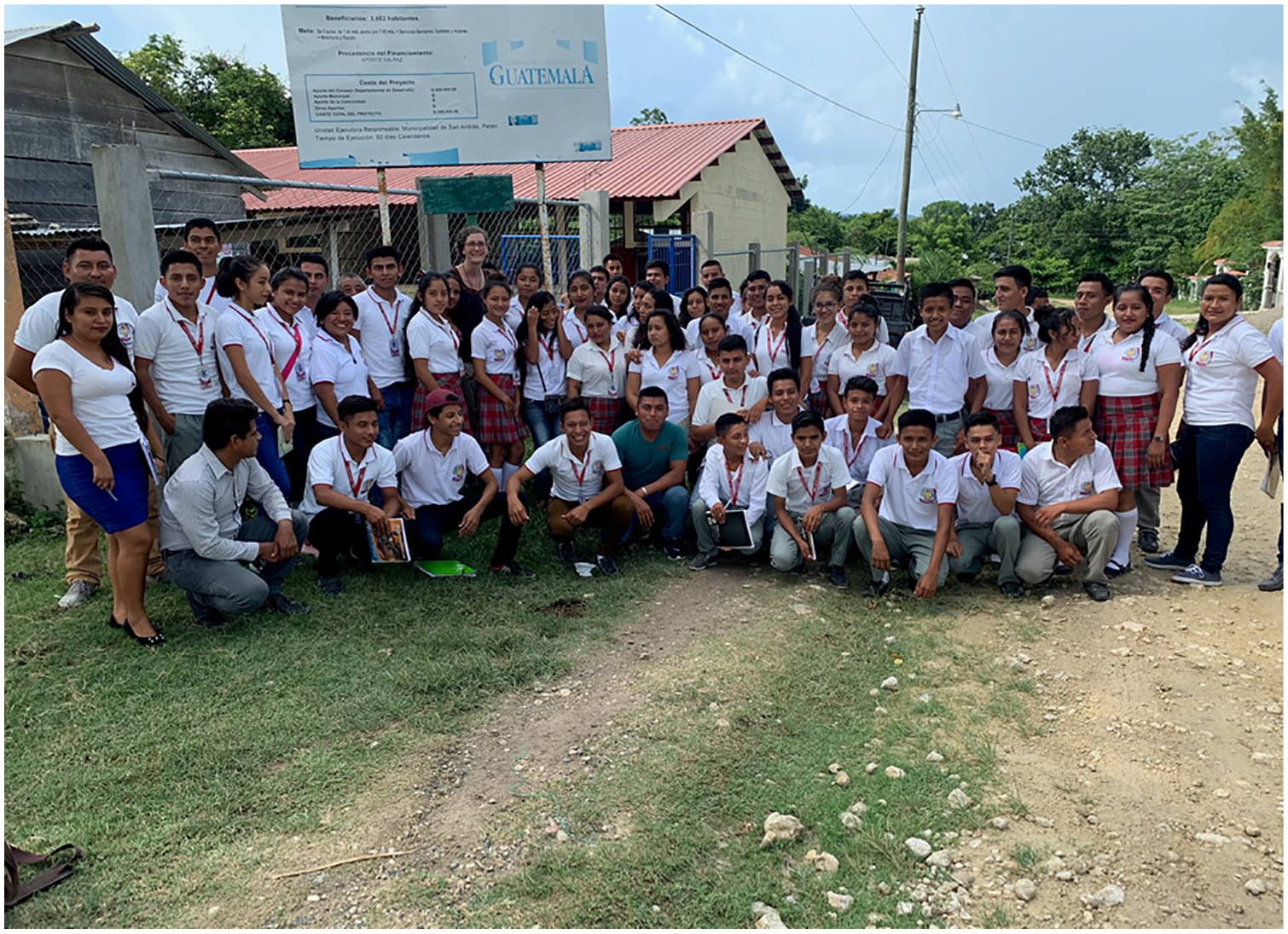
Atelesdale youth universally exposed to pesticides.
Conservation International's myopic conservation reign ended in 2002 when USAID temporarily suspended funding to the region. A couple of years later, however, another transnational nonprofit, Wildlife Conservation Society (WCS), became USAID’s new favored organization for fortress conservation and subgrants to Guatemala’s park service. Although "wildlife health" is one of the WCS’s priority areas, the word “pesticides" never appears on its website, much less in project design. Although WCS-Guatemala touts its conservation work with the famous Morelet's crocodile (Crocodylus moreletii) that nests in the Laguna del Tigre RAMSAR-designated wetlands, it turns a blind eye to the pasture and farm runoff into the Rio San Pedro basin. Yet some of the first studies on the impacts of endocrine disrupters on wildlife showed that Florida alligators in proximity to pesticide zones exhibit significant reproductive abnormalities, including shrunken penises, from endocrine-disrupting pesticides (Guillette Jr. et al., 1996). In the case of the WCS, it is not just that it withheld such vital research from its Petenero staff and its biological partners in the park service (despite lavish training budgets) but that it also paints indigenous and small farmers as conservation enemies. When I invited a WCS executive to dialogue with Petén's largest peasant federation, the Asociación de Comunidades Campesinas Indígenas para el Desarrollo Integral de Petén (Association of Indigenous Peasant Communities for the Integral Development of Petén—ACDIP), about concerns over cattle ranching, he retorted that "over his dead body" would one of his employees visit ACDIP’s offices.
Such conservation racism was on display in June 2015 when a palm oil subsidiary for the Olmeca conglomerate spilled a pesticide, malathion, into the Río Pasión and killed aquatic life for 180 kilometers. Three months later, Rigoberto Choc, a Q’eqchi’ schoolteacher who had denounced this "ecocide" to the press, was gunned down on the steps of his municipal courthouse by unknown assailants. His death added to the grim tally of Central American peasant leaders killed for their work defending their land and environment and one of Guatemala's nearly 5,000 unsolved homicides that year. After the pesticide spill, the park service’s biologists painstakingly inventoried (23 species), weighed (6,000 kilos), and quantified the value (US$10 million) of the fish loss, but collected no health data on the 12,017 people in 17 mostly indigenous villages who depend on this river for drinking water, laundry, and bathing. Although malathion was once thought to be safe in humans and even used in shampoos for lice, the European Union banned it in 2006; a 2010 study linked this acetylcholinesterase inhibitor to ADHD in children (Bouchard et al., 2010), and the International Agency for Research on Cancer reclassified it as a Class 2A "probable carcinogen" in 2015 (WHO, 2015). Q'eqchi'-Maya-speaking communities along the river reported widespread rashes and acute illnesses in their children, but authorities collected no epidemiological data on morbidities, much less conducted a prospective cohort study on delayed illness.
The disconnect between human welfare and biodiversity conservation was also manifested in the strange silence of powerful and well-endowed conservation organizations during negotiations of the Central American Free Trade Agreement with the United States (to which a similar agreement with the Dominican Republic was tacked after negotiations ended, making the treaty the DR-CAFTA). All the major transnational conservation organizations had been vociferously divided in the debates leading up to the approval of the North American Free Trade Agreement (NAFTA) in 1993, but by the time CAFTA was negotiated in 2005, not one of the four major groups bothered to take a stance on the treaty despite its obvious consequences for biodiversity. When Kent Redford, a vice president for the WCS, was asked about it at a provocative public lecture at the University of California, Berkeley, entitled “Has Poverty Alleviation Abducted Conservation?” he replied that his organization “does not engage in policy work.” It was an odd response, given that the WCS has an entire international policy division for tracking the Convention in International Trade in Endangered Species of Wild Fauna and Flora and transboundary conservation of migratory species. Conservation International’s vice president for conservation and government told me, “We don’t have a position [on CAFTA].” A World Wildlife Fund representative wrote, “WWF has not been tracking CAFTA either in Central America or in our U.S. office. As a result, we don’t have a position on CAFTA.” Nor did The Nature Conservancy have anything to say about the fine print of this treaty.
Their silence seemed foolhardy given that several pesticide-related lawsuits under NAFTA provided a preview of how agrochemical companies could use the DR-CAFTA to challenge environmental regulations as barriers to "free trade" (Public Citizen, 2018). Through its infamous Chapter 11, NAFTA became the world's first trade agreement to allow "investor-state lawsuits"—meaning that it allowed corporations to sue member nations for loss of profits caused by social or environmental regulations. In 2001, Crompton/Chemtura, for example, the producer of a persistent organic pesticide called lindane, sued Canada for US$100 million for having prohibited its use on canola crops, arguing that this was a form of expropriation (Langman, 2008). As of 2016, Public Citizen estimated that the United States had paid US$3 billion to foreign investors with US$14 billion in pending claims. The DR-CAFTA then became the first treaty to allow corporations to sue not only for supposed expropriation but also for future lost profits. Even while the DR-CAFTA was being negotiated, Harken Energy threatened to sue Costa Rica for US$57 billion (three times the country’s gross domestic product) if it was not permitted to drill for oil in the Talamanca coastal reserve, where the WCS has projects.
Although neoliberal economists argue that these trade treaties "harmonize" environmental laws, the fine print of the DR-CAFTA explicitly prevents Central American countries from ever updating their pesticide regulations. Buried in this 2,400-page agreement is Article 15.10.1b, which protects agricultural chemical companies from having to divulge to the public “undisclosed data concerning the safety or efficacy of a product that was previously approved in another territory.” In other words, if the EPA or the U.S. Department of Agriculture has already registered a chemical, then Central American governments can consider only data that were available to U.S. regulators prior to its introduction to the market and must disregard any subsequent scientific studies (Suppan, 2004). This would mean, for example, that although many states and local jurisdictions in the United States are banning Roundup on the basis of new information linking this herbicide with non-Hodgkin’s lymphoma and other cancers, Guatemala could never take into account this new information for additional precautionary regulation of glyphosate.
Right before the pandemic, I shared these contradictions in a public lecture at Petén's state university with a standing-room-only audience. As with my first conference paper on pesticides in 2001, indignant grassroots leaders and Guatemalan professionals responded with ire at the realization that they had been kept in the dark about the hazards of pesticides. In the discussion that followed, the leader of Petén's cooperative of forest communities, the Asociación de Comunidades Forestales de Petén, decried at length the racism of the United States’s permitting the export of pesticides banned at home. Having just learned that Bayer had bought out Monsanto, he reflected before the microphone that he used to spritz Bayer's aerosol Baygon every day for household pest control but intended to stop. Petén's largest local pesticide vendor, “Javier,” kin to an old friend from my ProPetén years, had come to my lecture, and over coffee the next day, he revealed private concerns about the impacts on his own health and wondered what organic inputs he might start selling and using on his own finca.
Peasant Perspectives
The time is ripe for alternatives. Tired of being a conservation contrarian (Grandia, 2012b) and wanting to proactively support indigenous resurgence, for the past 10 years I have worked in alliance with ACDIP, which like most of Guatemala's organized peasant movements is now almost entirely indigenous. Given the immediacy of other neoliberal threats it faces, pesticides had not previously been on its radar or that of Guatemala’s larger national peasant organizations. 13 Working under almost constant death threats from shadowy military/state interests and narcos alike, it is understandably overwhelmed with negotiating agrarian conflicts, navigating land bureaucracies, water theft, infrastructure projects, conservation enclosures, extractivist concessions (oil, mining), plantation land grabs, pandemic health care for abandoned rural areas, and relentless government corruption, to name but a few of the issues it bravely tackles without external support. Therefore I was delighted to be invited to repeat my university lecture at its Q'eqchi' agroecology high school. As I dialogued with the students and staff, it dawned on one of the Q’eqchi’ teachers that the headache and myalgia that had caused her to call in sick earlier that same week were likely not dengue but poisoning from the Roundup she had sprayed on her yard in flipflops. Her confession illustrated that even when pesticide intoxication is rapid and acute, people often mistakenly attribute the symptoms to common infectious diseases.
Indigenous and peasant movements have yet to mobilize en masse about this issue because of the paucity of information about the “slow violence” (Nixon, 2011) of pesticide health harms. This upcoming year, I am collaborating with the peasant federation to open a digital library (tasal hu-uluul-ch’iich in Q’eqchi’) with more robust information about pesticides, including materials from a promising new organization, the Red Nacional para la Defensa de Soberanía Alimentaria de Guatemala (National Network for the Defense of Food Sovereignty of Guatemala—REDSAG), that has begun seed exchanges, agroecological markets, and small-farmer education about the threat of genetically modified crops. As a longtime ACDIP leader, Rigoberto Tec, lamented, "99 percent of us Q'eqchi' use poisons," but the 1 percent is starting to organize. Along many other lines of action, ACDIP is supporting the communal registration of one upland community in Poptún that will become the first village in the region to prohibit deforestation and pesticide use for its own autonomous subsistence production. This is doubly significant because, although organic production has steadily grown in Guatemala, almost all pesticide-free foods are directed toward the export market, not local consumers. Guatemalans from all walks of life are keenly aware that from beef to maize to vegetables to coffee, they eat gringo rejects. As the Q'eqchi' farmer Sebastián Che put it to me, "Guatemala eats poisoned food. . . Businesses aren't stupid. They process and send the poisoned food back to us . . . like beans in cans or corn flour." 14
Guided by ancestral authorities, this Q'eqchi' peasant federation is traveling an uphill "road" to revive heirloom seeds that inherently withstand pests better than Green Revolution hybrids and paths to organic agriculture and reforestation/agroforestry. While transnational biodiversity organizations like WCS maintain luxury offices with little outreach to the countryside, peasant organizations that could mobilize thousands into new agroecological production remain broke. Even for well-endowed fair-trade projects, escape from the agrochemical treadmill, especially fertilizer use, requires a multiyear transition that impoverished farmers often cannot risk (Dowdall and Klotz, 2014) despite growing international markets for organics.
No matter what USAID officials may say from their armed bunker in Guatemala City, the free hand of the market cannot solve a problem concocted by heavy-handed U.S. policy. When undergoing chemotherapy for lymphoma in 2008, I received a sympathetic message from a high-level USAID conservation director and took advantage of that aperture to ask him pointedly if there was ever any talk in the environment office of USAID of doing any pesticides mitigation or prevention. His response was prototypically neoliberal:
If we have strong enough demand for organic[ally] grown foods and sustainably supplied products, the markets would respond. But as long as economics and agro-policies allow non-organics to be grown ‘cheaper’ (for the producers; although not for society and not sustainably, as they pollute our groundwater, rivers, and oceans), most people feel compelled by their purses to buy the cheapest option.
To decolonize agriculture and conservation will require more active and inclusive environmentalism aligned with peasant movements that take seriously the real conditions of risk and vulnerability in the Guatemalan countryside. As I have shown, the U.S. government has intervened repeatedly in Guatemala to push pesticides onto unsuspecting Maya farmers. Even chemicals that might be classified as safe for large farms in rich countries or for export plantations in the Global South may still cause harm to small subsistence farmers who lack access even to basic safety equipment like rubber gloves, much less respirators or running water. Until more is known about these manifold and everyday exposures of farmers, their families, and surrounding wildlife, the paradigm of "safe use" seems to be about bolstering the industry's reputation rather than making pesticides safe (Murray and Taylor, 2000). Although U.S. foreign aid no longer directly arms the Guatemalan military to wage war against Maya communities, it continues to weaponize the pesticide industry through trade treaties. To sell pesticides banned in the United States in such contexts is nothing short of chemical genocide—for which the United States owes Guatemala reparations.
If a landowner kills his neighbor over a border dispute, it is considered murder. If a smuggler kills a jaguar, it is considered trafficking in wildlife. But when a transnational agrochemical corporation slowly murders indigenous and other small farmers through unethical sales of agro-chemicals, it is celebrated as free trade. If those same agrochemicals should leak into the nearby watershed, transnational conservationists seem not to care whether the trees remain standing. Beyond its more obvious historical export of Green Revolution ideologies and its complicity in helping the pesticide industry greenwash its image through "safe use" propaganda, the U.S. government has also exported to Guatemala a myopic version of environmentalism reduced to biodiversity conservation as measured by forest cover and protection of pristine places for ecotourism. This is the real "green war" 15 being waged against everyday Guatemalans.
Footnotes
Notes
Liza Grandia is an associate professor of Native American Studies at the University of California, Davis, where she directs the Indigenous Research Center of the Americas.