




Abstract
Following the guiding thread of recent Ecuadorian economic history, a review of the attempts of several Latin American natural-resource-rich countries to climb the ladder of the international division of labor indicates that the construction of a particular perspective on development with the goal of reducing dependence on international commodity prices is nurtured by dependency theory and by the irruption of environmental thinking in development studies. The Ecuadorian state embarked upon the pursuit of a better position in the world economy mainly during its oil booms (1972–1981 and 2003–2014). Since the twilight of the last century, the state’s embrace of an official environmental discourse and growing social environmental awareness have increasingly held sway in development policy making, but the end of the most recent commodities cycle and the COVID-19 crisis have seen a highly indebted economy in which dependence on exports of natural resources and imports of manufactured products persists as the hallmark of a peripheral state.
Siguiendo el hilo conductor de la historia económica reciente de Ecuador, una revisión de los intentos de varios países latinoamericanos ricos en recursos naturales por ascender en la jerarquía de la división internacional del trabajo indica que la construcción de una perspectiva particular del desarrollo con el objetivo de reducir la dependencia de los precios internacionales de los productos básicos se nutre de la teoría de la dependencia y de la irrupción del pensamiento ambiental en los estudios del desarrollo. El estado ecuatoriano se lanzó a la búsqueda de una mejor posición en la economía mundial, principalmente durante sus auges petroleros (1972-1981 y 2003-2014). Desde el ocaso del siglo pasado, la adopción por parte del Estado de un discurso ambiental oficial y la creciente conciencia ambiental social han prevalecido cada vez más en la formulación de políticas de desarrollo, pero el final del ciclo de las materias primas más reciente y la crisis del COVID-19 han llevado a una economía muy endeudada en la que persiste la dependencia de las exportaciones de recursos naturales y la importación de productos manufacturados como sello de un estado periférico.
The commodity price downturn of 2014 cast a shadow of pessimism over Latin America’s “idyllic decade” (Ocampo, 2015: 8). Waking up to the harsh reality after a bonanza is not, however, new for Latin American countries that have traditionally relied on “crisis-prone” natural-resource-driven development models (Peters, 2017: 47). In such countries, the COVID-19 pandemic merely exacerbates existing economic, social, and political crises. The purpose of this article is to contribute to the study of the structural causes of recurring crises in natural-resource-rich countries of the Global South, advocating the revival of key tenets of dependency theory and drawing attention to the irruption of environmental thinking. International commodity price cycles serve as a point of entry for an outline of the conditions imposed on peripheral states by the capitalist world economy.
The article offers an in-depth analysis of the political economy/ecology of development in natural-resource-dependent countries by focusing on the paradigmatic case of Ecuador. The COVID-19 pandemic hit the country in the midst of a multidimensional crisis that started with the end of the “commodities super-cycle” of 2003–2014 (Erten and Ocampo, 2013). I argue that economic and social crises are the recurrent outcome of failed attempts to escape dependence on highly volatile international commodity prices. The ensuing analysis takes advantage of Ecuador’s condition of “model student” accurately replicating Latin America’s telling economic and sociopolitical processes during the past half-century. Three instances of consensus have steered development policy making and deeply marked Ecuador’s domestic situation: (1) a consensus around the idea of import-substitution industrialization as a way of departing from the traditional natural-resource-driven development model; (2) the Washington Consensus, in which comparative advantage (i.e., the possession of natural resources) is regarded as the key to neoliberal globalization; and (3) the “commodities consensus” (Svampa, 2015), which highlights the centrality of natural resources in the development process and neoextractivism as the prevailing development strategy.
The article is structured as follows: First, it locates the debate on natural resource abundance and development in a Latin American framework and presents an initial crucial issue for revisiting dependency theory: the role of the state in the national development process. It goes on to contextualize the concept of neoextractivsm, thereby highlighting the irruption of environmental thinking into development studies as the next key issue in reassessing dependency theory. Then it delves into the case study and presents a diachronic comparative approach to the Ecuadorian oil booms (1972–1981 and 2003–2014) in terms of the aforementioned categories of analysis. In the conclusions, insights are drawn from the case study with regard to natural-resource-driven development models across the Global South and serve as a pretext for a discussion on the direction of development studies and contemporary periphery debates.
“Sowing the Oil”: A Latin American Perspective on Development
The development of the capitalist peripheral state had been widely approached in the academic literature from the end of World War II until the late 1970s in terms of its structural heterogeneity and its extraversion. The idea of structural heterogeneity has been analyzed from either an economic or a sociopolitical perspective. Whereas the economic perspective on heterogeneity is related to the prevalence of low productivity in most economic activities except those connected with the external market (e.g., extraction of natural resources) (Rodríguez, 1977: 206), socio-structural heterogeneity addresses the prevalence of precapitalist modes of production (which are shaped by personal dependency relationships) and the failure of the increasing urban-marginal population to become integrated into the urban labor market (Pinto, 1970; Becker, 2008: 18). Central to understanding the notion of extraversion is an outward-oriented development model amounting to exporting raw material (natural resources) and importing manufactured goods. The Prebisch-Singer hypothesis early drew attention to the disadvantages of relying on such a model, pointing out that natural-resource-dependent economies experience long-term deterioration of the terms of trade because commodity prices tend to decline relative to the prices of imported manufactured goods 1 (Prebisch, 1950: 10; Singer, 1950: 477). By calling reliance on natural resources into question, the Prebisch-Singer hypothesis also censured the classical Ricardian doctrine of comparative advantage.
The pioneering perspective of Latin American (under)development thinking not only opened the way for a broader understanding of the connections between the domestic situation of the peripheral state (its structural heterogeneity) and its position in the international division of labor (its extraversion) but also deeply influenced development policy making. The structuralist school, which arose from the contributions to neoclassical economics made by the Economic Commission for Latin America and the Caribbean (ECLAC), prescribed the extensive penetration of capitalist production techniques to cope with the region’s backwardness (Rodríguez, 1977: 211). Domestic industrialization was the epitome of structuralism’s attempt to catch up in economic development and was materialized in the pursuit of import-substitution industrialization, which held sway in policy making across the region until the end of the 1970s.
Whereas structuralism pinned its hopes on capitalism, the Latin American school of dependency theory censured it as the fundamental cause of underdevelopment in the periphery (Frank, 2006 [1966]). Kay (1989: 125) identified two main currents in dependency theory, the reformist and the Marxist. The watershed and concurrently a major source of criticism of dependency theory was the debate on the ties between peripheral states and capitalist centers (Elsenhans, 1987: 65). On the one hand, a hallmark of the Marxist stance was the contention that development would ensue from splitting away from the capitalist world-system (Frank, 1966); a corollary was the imperative of seizing the state in order to control the national economy. On the other hand, the reformist position stressed the possibility of attaining development without becoming “completely autonomous” from capitalist centers (Cardoso and Faletto, 2002 [1969]: 25) through arrangements such as “dependent development” (Cardoso, 1973; Evans, 1979, cited in Elsenhans, 1987: 65), and “negotiated dependency” (Quijano, 2014 [1971]: 490). The academic literature provides further examples of the debate: Whereas a late Prebisch (1984: 84) asserted that “peripheral industrialization had been greatly delayed and took place during successive crises at the centers” (i.e., when ties with the capitalist centers were loose), Cueva (2013 [1977]: 96) argued that peripheral industrialization depended on the necessities of the capitalist centers and therefore took place when ties with capitalist centers were tighter.
In contrast to other theoretical perspectives, which assign local bourgeoisies central tasks in the development process, Latin American (under)development thinking underscores the role of the national state. Local bourgeoisies have been characterized mainly in terms of their proximity to the traditional oligarchy, the economic and sociopolitical order dominated by agro-exporters and landowners (latifundistas) linked to transnational capital, and their rentier behavior, which releases them from the pressure of reinvesting natural resources rent in productive activities in order to remain competitive (Wilcock, Scholz, and Elsenhans, 2016: 12). Thus, in Latin American (under)development thinking, local bourgeoisies have been charged with a lack of what Schumpeter (1911: 284) called “entrepreneurial will and action” and pictured as Oedipal not for killing the agro-exporter father but for marrying the landowner mother. In order to underline their dependence on (rather than their connection with) transnational capital and their null contribution to the region’s development, Latin American bourgeoisies have sometimes been called “lumpenbourgeoisies” (Frank, 1972). Along this line, in classic structuralism the expected role of the state in the development process goes far beyond the mere creation of conditions for sponsoring domestic industrialization in order to move away from the natural-resource-driven development model. ECLAC’s writings provide a rationale for the state’s enhanced participation through economic planning and investment in infrastructure and manufacturing and emphasize the creation of public enterprises because of their influence on decisive sectors of the economy and “their ability to serve as agents of development policy” (Sunkel, 1976: 8; CEPAL, 1971: 1).
Both reformist structuralism and revolutionary dependency theory settle on the pursuit of an economy that relies on the domestic market rather than on what Baran (1968: 101) called “the gambles of the world market and its international price policy.” In most Latin American natural-resource-dependent countries, the pursuit of an “autocentric national economy” or an “economy in which relations with the exterior are subject to the logic of internal accumulation and not the reverse” (Amin, 1990: 11) translated into what Larrain (1989: 87) called the “industrial society paradigm.” The belief in industrialization is backed by modernization theory (Lewis, 1955; Rostow, 1960), which provides evidence of the significance of natural resources to economic growth in certain countries. However, a crucial problem regarding industrialization in Latin America is the planned mobilization of surplus from the primary sector of the economy (the natural resources sector) to the industrial sector. Cueva (2013 [1977]: 96) early recognized that the takeoff of more advanced economic sectors hinged on the appropriation of surplus generated by the natural resources sector, since in several countries in the region it provided the one and only mechanism for capital accumulation. Therefore, the pursuit of an autocentric national economy implies a nationalistic discourse in which natural resources are supposed to be protected against the influence of foreign interests in order to be used to spark the national development process. 2
Already by 1936, during the early days of the Venezuelan oil era, Arturo Uslar Pietri famously called for “sowing the oil” in order to harvest development, thus becoming a forerunner of today’s broad consensus in development studies on the benefits of economic diversification (Sachs and Warner, 1995; UNCTAD, 2016). Until the 1970s, several Latin American states did in fact manage to increase industrial production by taking advantage of the financial leeway provided by natural resources exports (especially during boom periods), apparently succeeding in sowing the oil. The overall outcomes remain largely disappointing, however, since large segments of the manufacturing sector heavily depend on state transfers and have been unable to attain the expected productivity gains necessary to become internationally competitive (Purroy, 1997). Failures in sowing the oil have had consequences. Throughout the 1980s, several countries faced payback time for the industrialization attempts of the previous decades. The “time bomb” of external debt grew out of unparalleled international lending by private banks in the latter part of the 1970s and was nurtured by the rise of the real interest rate. The debt crisis, together with the appreciation of the U.S. dollar, which reduced the value of the region’s exports (Hettne, 1987: 14; Herrero, 2019: 85), triggered a severe economic and social crisis known as the Latin American “lost decade.” Subsequently, several countries (among them Mexico, Brazil, and Argentina) reached a point where they lost the capacity to repay their external debt obligations.
Mirroring current development policy wisdom and past political initiatives for reducing dependence on international commodity prices, most Latin American states attempted to “sow the oil” during the commodities boom triggered by the increasing demand from nonindustrialized countries, especially China (World Bank, 2018: 52). According to a 2019 report of the United Nations Conference on Trade and Development, however, all South American and several Central American countries are “commodity-dependent”—having more than 60 percent commodities in their exports (UNCTAD, 2019: 17). Dependence on natural resources exports since the 1970s is shown for selected countries in Table 1. Since commodities exports continue to determine the position of an increasing number of countries in the world-system hierarchy—in other words, since natural resources continue to be “the material foundation of the international division of labor”—Coronil (1997: 29) proposes to discuss an “international division of nature.”
Proportion of Primary Products in Total Exports (percentages), Selected Countries, 1971–2018
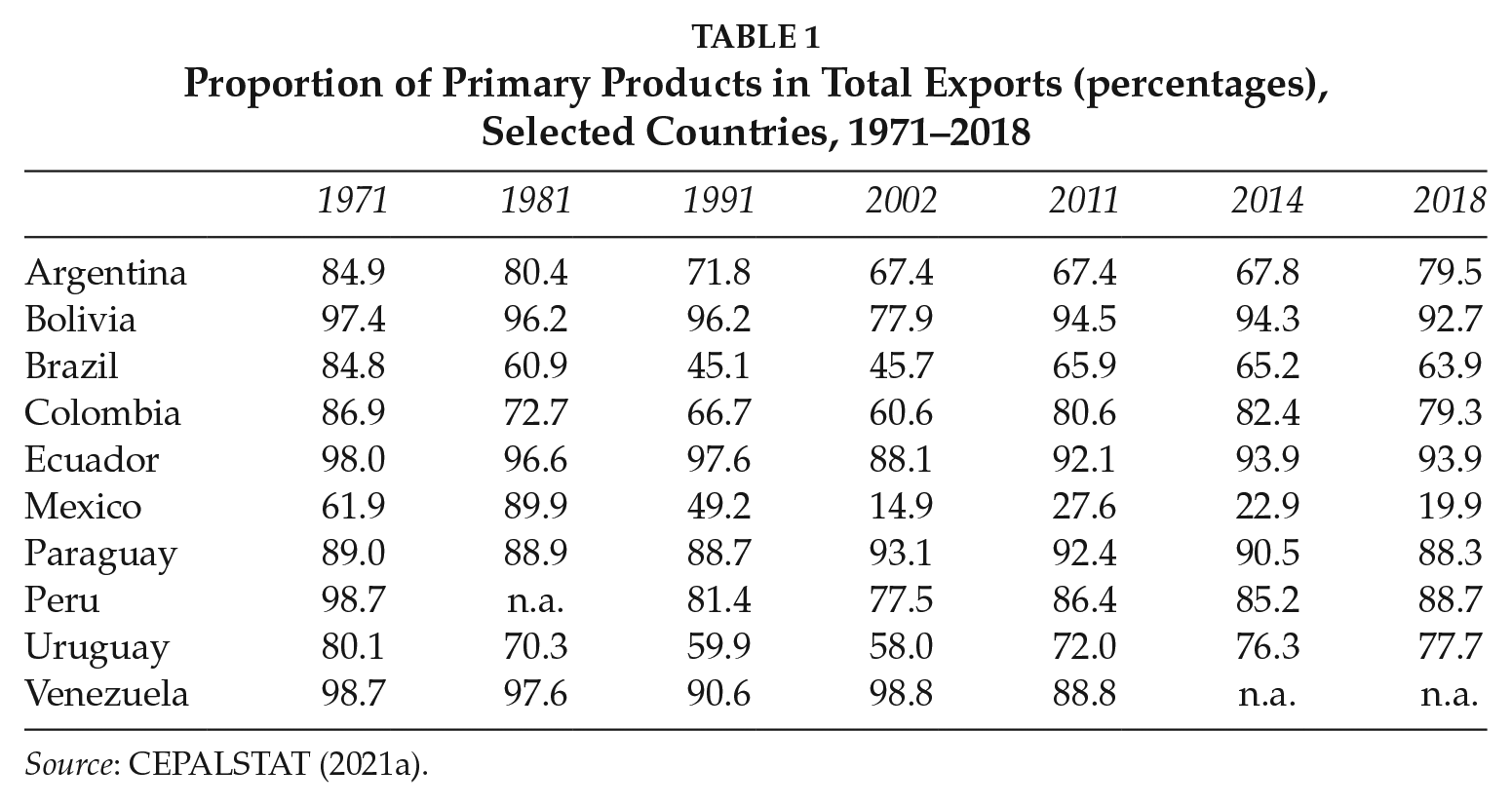
Source: CEPALSTAT (2021a).
The End of the Import-Substitution-Industrialization Consensus and the Irruption of Environmental Thinking
The crisis of the lost decade was the prelude to the arrival of the Washington Consensus in Latin America. Far beyond a range of economic measures, this consensus “deserved to be endorsed across the political spectrum” (Williamson, 1993: 1329), since it implied a set of governance devices in which the state’s role in the development process was meant to change drastically. The establishment of the World Trade Organization in 1995 unveiled a new global governance scheme that sought the elimination of barriers to trade on the basis of a renewed option for comparative advantage. Under this regime, the state’s enforcement of policies to protect noncompetitive domestic industry seemed provocative if not downright blasphemous with regard to the neoliberal globalization and free-market gospels. Moreover, the state’s intervention was considered the main source of free-market distortion and even the principal cause of corruption (Nederveen Pieterse, 2010: 7; Todaro and Smith, 2012: 482). By the dawn of the twenty-first century, several Latin American states had revisited the industrial society paradigm within the scenario framed by the Washington Consensus, updating their economic diversification strategies in order to pursue a “selective” integration into economic globalization through competitive rather than comparative advantage (Kay and Gwynne, 2000: 58). The recognition of the prevalence of free-trade rules was central to reassessing the classic structuralist paradigm, which rested on the state’s capacity to intervene in the national development process. Yet, in neo-structuralism, the creation of market niches (within the established international division of labor/nature) takes priority over the protection of uncompetitive domestic industry. The inclination toward integration into the world economy even at the cost of the national industrialization project reveals the pursuit of strong ties with capitalist centers during neoliberal globalization.
The height of neoliberalism interfaced with the rise of the “international environmental discourse of sustainable development” (Lewis, 2016: 77). This discourse was originally outlined in 1987 by the Brundtland Commission (the World Commission on Environment and Development of the United Nations); the commission’s Our Common Future (United Nations, 1987) placed the environment as the interface between the polar opposites of natural resources extraction and environmental protection. In 1992, during the Earth Summit (the United Nations Conference on Environment and Development), representatives from 172 nations signed their acceptance of the imperative of environmental policy making at national and subnational levels, thus embracing the environmental discourse of sustainable development. 3 Concurrently, social environmental awareness mushroomed in Latin America. As an overall outcome, environmental thinking increasingly influenced development policy making across the region.
The irruption of environmental thinking had a number of political implications. On the one hand, alongside states’ adoption of the environmental discourse of sustainable development, the Latin American region experienced a wave of creation of environmental ministries and promulgation of new environmental legislation during the 1990s. Nevertheless, neoliberal reforms, including a subsidiary role for the state in natural resource governance, built the base for a process of intensified natural resource extraction in the ensuing decades (Álvarez Huwiler, Godfrid, and Duárez, 2015: 173). On the other hand, widespread social environmental awareness piled up arguments against the natural-resource-driven development model through its denunciation of the negative socioecological consequences of extractivism— the “intensification of natural resources extraction for commodification in the global market” (Burchardt, Domínguez, and Peters, 2016: 7). As natural-resource-rich Latin American states upheld the official discourse of sustainable development while relying on extractivism, socioecological movements 4 laid the foundation for the construction of alternative meanings of “nature” (as opposed to the official view of natural resources and the environment), which mostly refer to natural heritage and ancient peoples’ habitat and means of subsistence (Alarcón, 2020: 217). Moreover, the socioecological critique of the natural-resource-driven development model built on the “resource curse thesis,” which originally stated the secular underperformance of natural-resource-dependent economies (Auty, 1993). At the end of the twentieth century, the “enhanced” resource curse thesis became a deus ex machina in development studies for rationalizing the region’s backwardness and environmental degradation.
Environmental thinking and increased social environmental awareness unfolded in different ways across the region during the commodities boom. Whereas some initiatives in Latin American states bet on a market for environmental or ecological goods and services (Domínguez et al., 2019: 156), Ecuador and Bolivia drew the world’s attention by granting nature rights in their new political constitutions of 2008 and 2009. The idea is in line with the states’ embrace of buen vivir/vivir bien (good living), an alternative-to-development discourse that allegedly stems from sumak kawsay in Ecuador and suma qamaña in Bolivia. Either indigenous worldview entails an influential socioecological dimension rooted in a harmonious relationship between society and nature, though, in accordance with its conceptual and bureaucratic co-optation, buen vivir has been despoiled of its critical and transformative potential (Alarcón, 2020: 227; Peters, 2014: 140).
Despite the adoption of official environmental discourses with country-specific particularities, most natural-resource-rich Latin American states relied mainly on rent income from extractivism during the commodities boom. Self-styled progressive governments in Argentina, Brazil, Bolivia, Ecuador, and Venezuela in particular revived the nationalist discourse regarding natural endowments and followed a neoextractivist development strategy that involved maximizing the government’s appropriation of natural resources rent, reviving economic planning in an effort to reassess the industrial society paradigm, and taking advantage of the increased financial leeway to bankroll social development measures.
The enforcement of the neoextractivist developmental strategy in several Latin American countries, together with the entrenchment of environmental thinking in politics and society and the debatable outcomes of intended economic diversification, nurtures the current academic discussion on the relationship between natural resource abundance and development. Along this line, the region provides development studies with new theoretical insights; the analysis of neoextractivism focuses on changes in the scale and intensity of natural resource extraction and the modification of the state’s role in natural resource governance (Gudynas, 2009; Burchardt and Dietz, 2014), thereby unveiling a particular sociopolitical juncture that Svampa (2015) has called the “commodities consensus.” Despite the apparent consensus, the enforced natural-resource-driven development model faces increasing criticism and finds focal points of resistance in territories affected by extractivism. Debates on Latin American neoextractivism highlight the connections between the domestic situation of the peripheral state (the governance scheme regarding natural resources) and its position in the international division of labor/nature (the intensification of natural resources extraction and its resistances), thereby following the tradition of Latin American (under)development thinking.
The end of the latest international commodity price cycle brought no foreseeable shift in the natural-resource-driven development model. In this connection, Arsel, Hogenboom, and Pelligrini (2016: 880) argued that natural resources extraction is expected to “expand regardless of prevailing circumstances, with the state playing a leading role and capturing a large share of the ensuing revenues.” The end of the commodities boom revitalized development studies and periphery debates. On the one hand, environmental thinking and social environmental awareness are reconfiguring the domestic situation in peripheral states as the defense of antagonistic meanings of nature is increasingly shaping the relationship between state and society. On the other hand, discussions of dependency are fueled by old and new conditions that arise from the capitalist world economy such as the “gambles of the world market and its international price policy” and the impact of the COVID-19 crisis on the international demand for commodities.
Deep Diving into the Oil Era: (Re)Insertions through Nature
The metaphor of a sailing ship has properly described Ecuador’s natural-resource-driven development model over time; natural resources exports are the sails, which unfurl with the world’s winds. Since the beginning of the twentieth century, international prices of cacao, bananas, and oil have successively played the role of the wind that propels the ship called “Ecuador.” To steer the ship, according to Salgado (1978: 27), would require the creation of a significant internal market and the diversification of exports. During past natural resources booms (cacao, bananas), a significant source of income for the state was taxation of private agro-exporting activities, and therefore economic growth was governed by a “rigid relationship between the external sector of the economy and the evolution of agriculture” (Bocco, 1987: 41). The beginning of oil extraction in Ecuadorian Amazonia in the 1970s obviously meant no change in the hierarchical order of the international division of labor/nature but transformed the country profoundly. The first Ecuadorian oil boom signified an enduring shift in the structure of the state’s income to dependence on rent generated by the sale of oil overseas.
In February 1972, General Guillermo Rodríguez Lara led a military coup and installed the self-styled “revolutionary nationalist” government. Following the nationalist trend that prevailed in Latin America at that time, a central concern of the dictatorship was the claim to state ownership of subsoil natural resources. As a latecomer to the international oil business, however, Ecuador did not engage in oil nationalizations, which had their “golden years” in the 1960s and 1970s (Ross, 2012: 39); instead, it confronted the multinational corporations over the appropriation of a larger portion of oil rent. The principal strategies deployed by the dictatorship were the creation of the state oil company and the renegotiation of previous agreements, which included the shift from concessions to contractual schemes. This was accompanied by the country’s entry into the Organization of Petroleum Exporting Countries (OPEC), which exerts international pressure to realize higher values of oil rent for the benefit of petro-states. The appropriation of a considerable portion of rent income (about 62.5 percent in 1977) turned the Ecuadorian state into a powerful development agent.
With oil rent at its disposal, the state occupied an “unprecedented dominant position” in the economy (Conaghan, 1988: 47), and the dictatorship embarked on the pursuit of the industrial society paradigm. Since the import-substitution-industrialization paradigm was beginning to fade in the 1970s, the Ecuadorian endeavor is sometimes known as “late import-substitution industrialization.” Crucial ingredients were the dictatorship’s faith in economic planning and the transfer of oil rent from the primary sector to other sectors of the economy. Thanks to the enforcement of one of the “most generous” sets of measures to back industrialists in Latin America (World Bank, 1980: 253, cited in Fernández, 1989: 197), which included subsidized credits, tax benefits, exemptions from tariff and import duties, and subsidies (e.g., on industrial electricity and oil products for industrial use), the Ecuadorian manufacturing sector expanded slightly 5 during the first oil boom (Table 2).
Gross Value-Added in 2007 US$ by Sector (% of GDP), Selected Years, Ecuador, 1972–2016
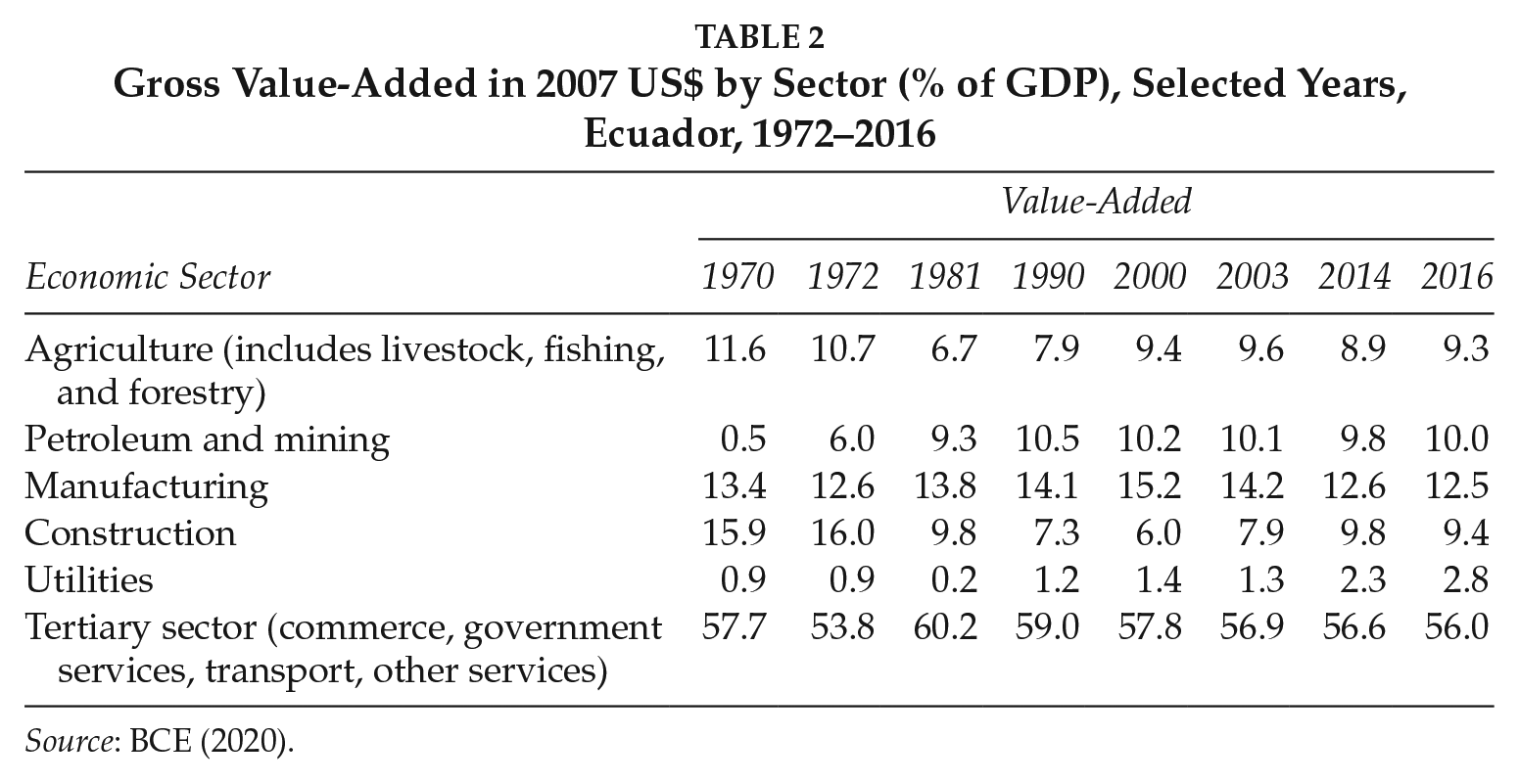
Source: BCE (2020).
This growth resulted, however, from a transient upsurge in already dominant industrial segments in a context of domestic demand expansion—small- and medium-sized industries of finished consumer goods such as food processing and textiles and clothing. Thus the temporary expansion of the manufacturing sector did not mean the takeoff of domestic industry or represent a significant qualitative change in the country’s industrial profile. The other side of the coin was the country’s snowballing dependence on imports of manufactured goods not only for industrial supply but also for household consumption, accompanied by galloping external debt (Fernández, 1989: 201; Alarcón, 2021: 114).
During the downturn in international commodity prices, oil was dethroned as the champion of Ecuadorian export products. One of the most significant consequences of the financial debacle of the end of the twentieth century was the state’s adoption of the U.S. dollar as the national currency in 2000. Thanks to an “accommodative” U.S. monetary policy that bet on currency depreciation until 2008, Ecuadorian exports gained international competitiveness (Ozyurt and Cueva, 2020) and nontraditional export products (particularly flowers) experienced a takeoff (Figure 1). Official dollarization was then sustained by the massive influx of petrodollars of the ensuing commodities boom, which allowed the absorption of fiscal imbalances, while traditional export products (mainly bananas, cacao, and shrimp) afforded a reliable source of fresh foreign exchange during crucial years. Despite (or because of) the growing volume of natural resources exports, the Ecuadorian state abandoned initiatives for promoting other sectors of the economy. Thus the illusion of economic diversification translated into diversification of the portfolio of natural resources exports.
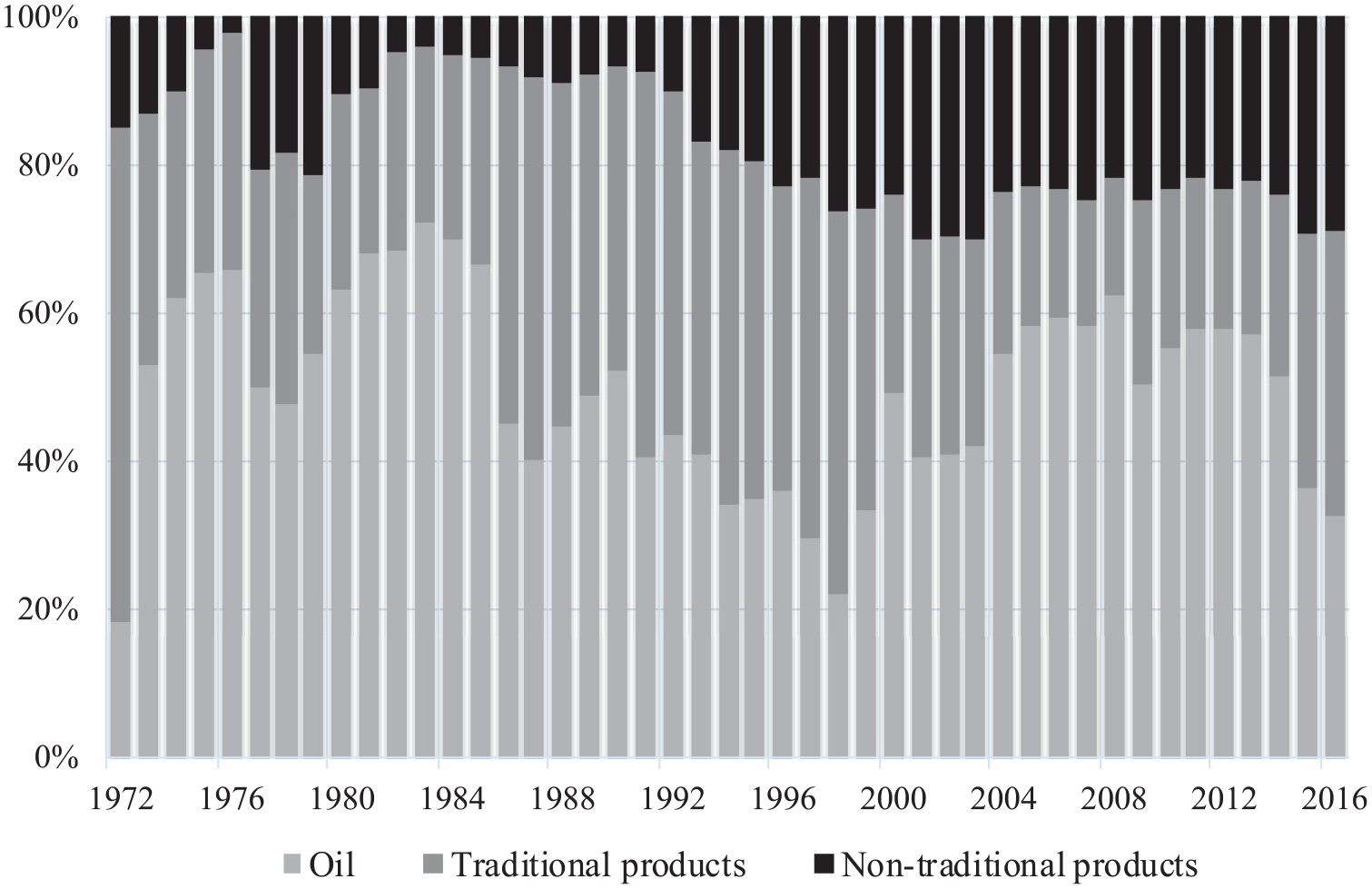
Proportions of export products by type (%), Ecuador, 1972–2016 (data from BCE, 2017: 111).
The state’s pursuit of an improved position in the international division of labor/nature resumed during the commodities super-cycle of the twenty-first century. Significant landmarks in the state’s recovery of a larger portion of oil rent were reminiscent of the first Ecuadorian oil boom. President Alfredo Palacio canceled the contract with Occidental Petroleum Corporation in 2006 after accusing the multinational of violating the Hydrocarbons Law. By taking over Occidental’s operations, the state company recovered about one-fifth of the country’s total oil output. Another pointer to the return of the nationalist discourse was Ecuador’s readmission 6 to OPEC in 2007. Both of these landmarks converged with the nationalistic “pink tide” that began in 1998 with the election of Hugo Chávez in Venezuela (Levitsky and Roberts, 2011: 1). Some of the measures aimed at appropriating a larger portion of oil rent enforced by Rafael Correa’s government proved to be constraints in disguise. The 2010 reform of the Hydrocarbons Law, for instance, resulted in five multinational oil corporations’ leaving the country and taking legal action in international courts (such as the International Center for Settlement of Investment Disputes) to demand compensation. The dispute with Occidental alone cost the state about US$1 billion (Valencia, 2016).
Alongside the debatable results of conventional oil policy, in which the rate of oil extraction remained practically constant for a decade and the exploration of new reserves dropped off (Villavicencio, 2014: 270), Correa’s government launched the Yasuní initiative under the banner of buen vivir. The unconventional measure aimed at saving one of the most biodiverse and culturally sensitive areas of Ecuadorian Amazonia from oil drilling by leaving about one-fourth of the country’s reserves underground in exchange for international monetary compensation. “Leaving the oil in the ground” was originally part of the discourse of the socioecological movements, and therefore its adoption ensured Correa the support of vast progressive sectors. Nonetheless, he never subscribed entirely to the alternative (Alarcón, Rocha, and Di Pietro, 2018: 61). When the government unilaterally dropped the initiative in 2013, progressive sectors defected permanently from Correa’s electoral base 7 and nurtured the leftist current of critique of the left in power and its inclination toward extractivism.
The termination of the Yasuní initiative coincided with an oil-for-loans rush and the launching of several mining projects. First, just a month before the dropping of the initiative, Ecuador obtained a US$2 billion loan from the China Development Bank in exchange for nearly 40,000 barrels a day or 8 percent of the total national oil extraction over two years (Kraus, 2013). Also, after 2009 Correa’s government bargained with Chinese and Thai oil corporations over credits to be repaid with oil, and as a result Asian companies take a large part of Ecuadorian crude exports (Orozco, 2018; Valencia, 2015). The deals poured important amounts of foreign exchange into the state’s coffers but jeopardized long-term development opportunities. Second, the importance of rent generated by mining to the Ecuadorian economy remained minor compared with that of oil rent (Table 3). During the past decade, however, the state granted multinational mining corporations an increasing number of concessions to exploit several mining projects in what seems to be the government’s next extractivist venture.
Oil and Mineral Rent as Percentage of GDP (Average), Ecuador, 1971–2017
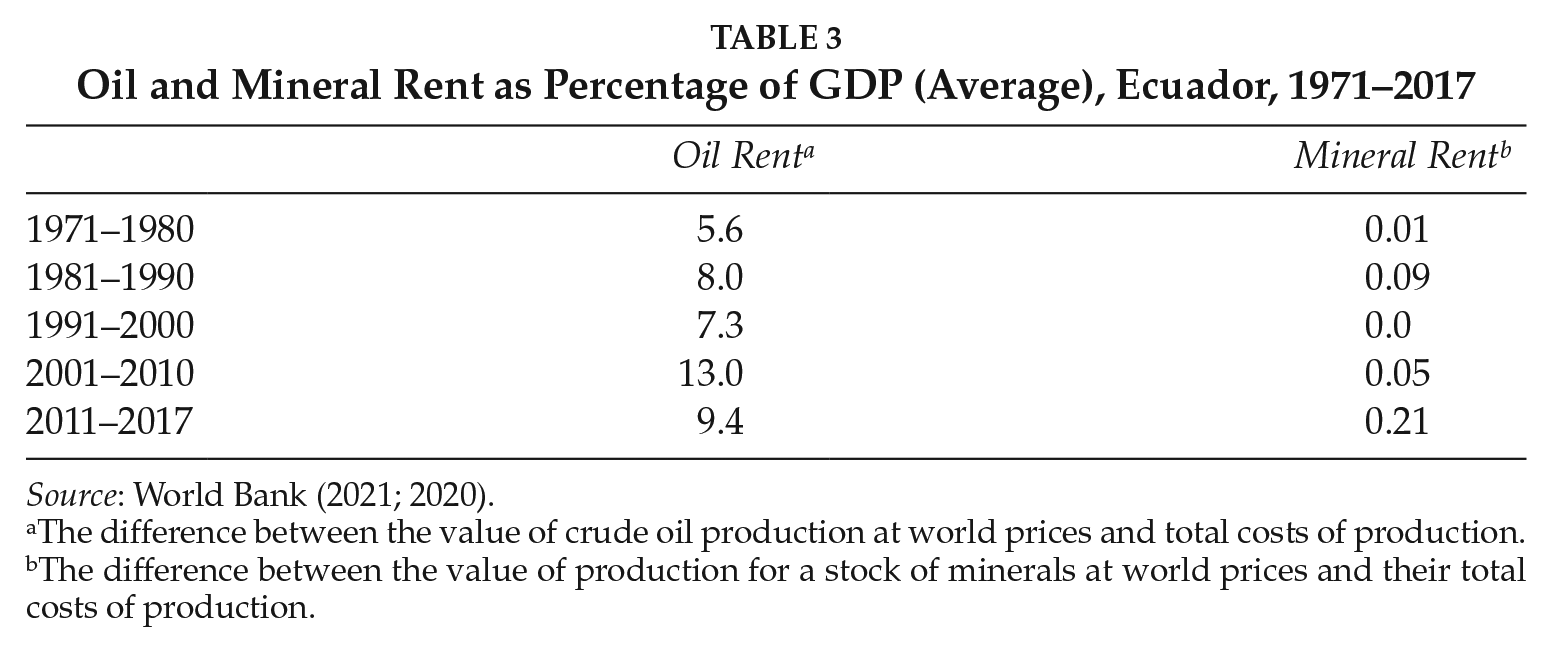
Source: World Bank (2021; 2020).
The difference between the value of crude oil production at world prices and total costs of production.
The difference between the value of production for a stock of minerals at world prices and their total costs of production.
With hefty external debt resources and swollen natural resources rent at the state’s disposal, Ecuador revisited the industrial society paradigm, but external conditions soon proved a straitjacket. Economic globalization turned into a growing hindrance to the enforcement of the state’s protectionist measures, and technologically driven productivity became the barometer for competitiveness in the world economy and set the pace of industrial development. Together with environmental thinking, these external constraints forced the reassessment of the 1970s industrial society paradigm. Correa’s government chose boosting investment in tertiary education as a main strategy for pursuing a transformation of the structure of production. The Universidad Yachay Tech, established in 2013, was envisioned as the center of the industrial society paradigm. Another landmark in the promotion of tertiary education was an ambitious program of international scholarships that benefited about 13,000 students until 2018. Scholarship holders were meant to lead the transformation of the productive structure, but the government’s rhetoric toward the private sector did not include the question whether it could absorb the influx of highly skilled recruits. Neither the new state university, with its overpriced campus, nor the freshly returned highly skilled professionals have yet revitalized the sluggish manufacturing sector, which has been in decline since the turn of the century (see Table 2). At the same time, primary and secondary public education remain deficient.
Moreover, the government tried to promote local production with protectionist measures, mainly import tariffs, with questionable results. A telling example is its attempt to encourage the use of homemade induction cookers. The objective was twofold—supporting the domestic manufacturing sector and effecting a significant reduction in the consumption of subsidized domestic gas. Subsidized liquefied petroleum gas (LPG), which is massively used for cooking by Ecuadorian households, was meant to be replaced by electricity fueling induction cookers, with the country’s substantial hydroelectric resources being touted as fully environmentally friendly. Despite generous subsidies for national businesses, the project did not prosper, and the government opted to import induction cookers from China. Alongside the appreciation of the U.S. dollar, Ecuador’s current account (with its main component, the balance of trade) has been deteriorating since 2009 (Ozyurt and Cueva, 2020: 29; Calderón and Stumpo, 2016: 15). In order to cope with the problem of addiction to imported products, Correa’s government imposed tariffs on about one-third of all imports (particularly consumer goods) in March 2015. Since Ecuador is a signatory to free-trade treaties at the regional and global level, the protectionist measure was limited to two years. However, the enforcement of new import tariffs was insufficient to cope with the growing current-account deficit.
Concurrently with the importance of crude oil in the export portfolio, dependence on imported oil products has greatly increased since 1972. The state purchases oil products at international prices; this constitutes the paradox of the Ecuadorian oil era and confirms Ecuador as a textbook case of a peripheral state, dependent on raw material exports (crude oil) and on manufactured imports (oil products). Because of the stagnation of domestic refining capacity, imports mainly of domestic gas and transportation fuels (diesel and gasoline) jumped from 2.1 million barrels in 1978 to the historical peak of 57.1 million barrels in 2014 (BCE, 2017: 197). Ecuador’s refining capacity has never been enough to meet domestic demand; since the start of commercial operations of the state-owned Refinería de Esmeraldas in 1978, no significant refining capacity has been added. During the second Ecuadorian oil boom, Correa announced a big step in the direction of the industrial society paradigm: the construction of the Refinería del Pacífico, to be inaugurated by 2017. The government declared the project a national priority, but despite an outlay of more than US$1.5 billion it was never constructed (Pacheco, 2019). The fact that the Ecuadorian state offers imported oil products at fixed subsidized prices creates snowballing fiscal pressure. Nevertheless, subsidies on oil products have persisted for nearly 50 years, since they are regarded as a quasi-naturalized right by the people living in natural-resource-rich countries (Alarcón and Peters, 2020; Peters, 2017; Bautista Urbaneja, 2013).
Dependence on imported oil products has escalated dramatically in the twenty-first century. Whereas the state imported 10 percent of the country’s demand for gasoline, 17 percent of diesel, and 60 percent of LPG in 2000, by 2015 the proportions of oil products imported were 70 percent, 69 percent, and 87 percent, respectively (Espinoza and Guayanlema, 2017: 7). At US$0.50 and US$0.67 per liter of diesel and gasoline, prices are among the lowest in South America (GlobalPetrolPrices, 2021a; 2021b). A 15-kg cylinder of domestic gas is marketed at a fixed price of US$1.60, whereas the state pays at least 10 times that for the same amount of LPG in international markets. On average, subsidies on oil products cost the Ecuadorian state US$2.3 billion per year or 3 percent of GDP (Schaffitzel et al., 2019: 5). For comparison, the Ecuadorian government invested in public health an equal amount (on average US$2.34 billion per year) over the past decade (CEPALSTAT, 2021b). The consequences of spending the same amount of state resources on fuel imports as on public health became palpable during the COVID-19 crisis.
Discussion: The Dead End of Natural Resources Dependency
The approach to the half-century-long Ecuadorian oil era highlights the prevalence of the natural-resource-driven development model despite successive attempts at climbing the ladder of the international division of labor/nature. In an apparent paradox, natural resources rent traditionally bankrolled the battle against natural resources dependency. With more than 90 percent of its export portfolio composed of natural resources (mainly crude oil, bananas, and cacao), Ecuador is Latin America’s second-most-commodity-dependent country and among the 30 most commodity-dependent countries worldwide (UNCTAD, 2019: 43). As attempts at economic diversification failed throughout the commodities booms, nature (in a broader sense) proved to be the ultimate connection to the capitalist world economy. As a result, the natural-resource-driven development model faces increasing criticism founded largely on the deep entrenchment of environmental thinking in society and politics. As in other natural-resource-rich countries of the Global South, dependence on raw material exports and on manufactured products imports remains the hallmark of the periphery.
The end of the latest international commodity price cycle in 2014 revived academic discussions of the direction of development studies and periphery debates. On the one hand, economic crises and growing public-account deficits caused by plummeting commodity prices erode states’ financial leeway and call into question the survival of the development gains achieved during the commodities booms. During 2019 Latin America was a powder keg; people in Chile, Ecuador, Venezuela, Colombia, and Bolivia were taking to the streets. Ecuador epitomized the regional juncture when the government tossed a stick of dynamite into a tinderbox by eliminating subsidies on transportation fuels (diesel and gasoline) in October 2019. Amid social and political turmoil, the president was forced to bury the measure after only two weeks (Alarcón and Peters, 2020; Ponce et al., 2020). Social crises and political turmoil were replicated in other natural-resource-rich countries in the Global South (such as Algeria, Iran, and Sudan) as the current international commodity price cycle seemed to wipe out recent development gains. Along this line, the arrival of COVID-19 added arguments to the thesis that natural-resource-driven development models are crisis-prone. The exacerbation of the current crisis by the pandemic is heading an increasing number of commodity-dependent states in the Global South toward a historic crossroads, the choice between pursuing an autocentric national economy by prioritizing investment in economic diversification and providing constitutionally prescribed but traditionally unmet essential state services such as public health, public education, and social security.
On the other hand, the downturn in commodity prices invites scenarios for the role of the peripheral state in the national development process during the next international commodity price cycle. Since “back to normal” means “back to the crisis,” the capitalist world economy will continue imposing conditions aimed at ensuring market liberalization and the frictionless flow of raw material from the Global South. The question of economic diversification in natural-resource-rich peripheral states will continue to be constrained by global economic cycles and the interests of the capitalist centers. Thus the possibilities for “delinking” (Amin, 1990) from the world economy seem ever more remote. Despite the deep entrenchment of environmental thinking in the state and society, more sustainable or alternative development models might be dropped in favor of the well-known option for comparative advantage as it was across Latin America during the recent commodities boom. In this connection, even regional integration initiatives might be set aside in favor of bilateral deals between peripheral states and capitalist centers; for instance, as Benzi (2017: 12) puts it, the “recent marriage” with China is neither sustainable nor progressive, since it reinforces the rentier logic of Latin American societies and contributes to environmental devastation. With the benefit of hindsight, the pursuit of an improved position in the international division of labor/nature in commodity-dependent states of the Global South may translate into a more diversified portfolio of raw material exports. In other words, nature will remain the material foundation of any possible (re)insertion into the world-system.
Footnotes
Notes
Pedro Alarcón is a postdoctoral researcher on social climate change impacts and sustainability innovation in southern Africa and sorthern South America at the Justus-Liebig-Universität Giessen. He thanks Ronald Chilcote for comments that enriched this paper.