



Abstract
The Asociación de Mujeres Afro por la Paz (Association of Afro Women for Peace—AFROMUPAZ) is an organization of displaced Afro-Colombian women now based in Bogotá. The organization represents a differential brand of feminism in the face of historical and ongoing violence and provides community, support, and employment opportunities for dozens of women and their families. Its “feminism with a woman’s body and face” is part of the landscape of popular feminism in the region, but its specific social location and its actions cannot be understood without a deliberate and critical understanding of race.
La Asociación de Mujeres Afro por la Paz (AFROMUPAZ) es una organización de mujeres afrocolombianas desplazadas ahora radicadas en Bogotá. La organización representa un tipo distinto de feminismo frente a la violencia histórica y continua, y ofrece oportunidades comunitarias, de apoyo y de empleo para decenas de mujeres y sus familias. Su “feminismo en cuerpo y cara de mujer” es parte del panorama del feminismo popular en la región, pero la comprensión de su ubicación social específica y acciones requiere de un acercamiento deliberado y crítico de la cuestión racial.
Bogotá is the capital of Colombia and, with more than 11 million inhabitants in the metropolitan area, has been a hub of internal migration due to displacement during the country’s 52-year conflict. Victims of guerrilla groups, paramilitary organizations, state forces, and criminal gangs fled to the city from all parts of the country. Despite the signing of a peace accord between the government of Colombia and the Fuerzas Armadas Revolucionarias de Colombia guerrillas in 2016, security dynamics are worsening, and society’s most vulnerable continue to face ongoing violence. This article shows how a group of victims of displacement uses a popular feminist mobilization strategy to overcome the triple problematic of healing from past violence and trauma, resettling in an unknown space, and confronting present vulnerabilities. It goes on to point out, however, that their intersectional feminism is inextricably linked to their racial identities as Afro-Colombian women.
The following pages examine the case of the Asociación de Mujeres Afro por la Paz (Association of Afro Women for Peace—AFROMUPAZ), which was founded in 2000. In the midst of a hostile environment, María Eugenia Urrutia established an organization for women who, like her, had fled from their homes on Colombia’s Pacific Coast and arrived in Bogotá with no personal ties or social links. The organization now represents the central community, support network, and employment opportunity for dozens of displaced Afro-Colombian women and their families. Because the women of AFROMUPAZ are clear that their project for gender justice is based in their Afro-Colombian identity, the article will examine the ways race and culture (and to a degree, class) guide their actions and practices and influence their mobilization around a differential gender identity. 1 It posits that AFROMUPAZ’s strategies and goals can be partially understood as belonging to the broad spectrum of popular feminism but that any examination of the organization is incomplete without understanding that its particular feminism is inextricably tied to participants’ racial identities. It argues that the study of “popular feminism” must critically engage with understandings of race and ethnicity to accurately describe the specific types of mobilization taking place.
At the time of the research, the organization had been examined in detail in the context of structural racism and sexual violence only once (see Marciales Montenegro, 2015). This article will describe and explain AFROMUPAZ’s mobilizational strategies to see how it achieves its goals of protecting displaced Afro-Colombian women from further victimization and providing them with a healing space to cope with the violence suffered in the past. The article proceeds as follows: First, the context overview paints a picture of Colombia’s “geographies of terror” and explains that violence is suffered differently depending on gender and race. Second, it outlines the research methodology and introduces the fieldwork site and interlocutors. Third, it looks at the theories of popular feminism and Afro-Latina feminisms and posits that AFROMUPAZ exists somewhere between the two, neither purely engaging in class critique nor adopting the more radical rhetoric of other Afro-Colombian feminist groups. Next, it describes the history, activities, and experiences of AFROMUPAZ in detail, drawing links between their quotidian strategies and popular feminism. Finally, it returns to the argument that while AFROMUPAZ can be considered a popular feminist organization, this categorization is useful only insofar as it critically engages with the gendered and racialized identities of its participants.
Gendered and Racialized Geographies of Terror
Colombia’s decades-long armed conflict has left over 8.1 million people displaced (Unidad para las Víctimas, 2021). To understand the experiences of displacement and resettling in a new city, I use Oslender’s (2008: 77) “geographies of terror” framework for studying the “impact of terror and its spatial manifestations on local populations.” Oslender examines the case study of Colombia’s Pacific Coast region to “set an agenda for approaching terror as a complicated set of spaces, emotions, practices, movements, and materialities” (84). Once we understand the intersecting ways in which people experience the conflict in this region, we can begin to examine the dynamics of resistance of its various social movements.
Oslender describes the 1990s as a “time of hope,” particularly because of the recognition of Afro-Colombians as an ethnic minority in the country’s 1991 Constitution (2007b: 754; 2008: 86). In late 1996, however, the Colombian army, in conjunction with paramilitary groups, began an offensive against guerrilla forces in the region, leaving civilian casualties in its wake. Local communities were caught in the crossfire, “sandwiched between fighting groups” (Oslender, 2008: 89). Thus began the phenomenon of massive forced displacements of hundreds of thousands of civilians. At the same time, powerful economic groups began to expand their mining and palm-oil operations, often on land collectively held by local populations. 2 Community leaders who spoke out against this were disappeared and killed by paramilitary forces (Asher, 2017; Oslender, 2004). Scholars suggest that there were strategic economic interests in forced displacement (Escobar, 2003; Marciales Montenegro, 2015; Oslender, 2007b; 2008). In this way, the Pacific Coast of Colombia went from a “peace haven” to a “geography of terror.”
Geographies of terror are gendered, although these experiences are not always documented or analyzed. For example (Meertens, 2001: 134), Women continue to be a military objective insofar as they form part of the “indiscriminate acts” of terror against the civilian population. . . . Sexual violation also continues to be a practice of war, although largely undocumented. Just like the “indiscriminate acts,” it constitutes a subterranean form of gender violence. . . . Women are victims and survivors of displacement and uprooting in the first place as widows of rural violence, heads of household suddenly expelled toward the cities; in the second place as spouses, when the effects of violence and uprooting and the necessities of survival touch them differently from men; and in the third place as leaders whose experiences of participation and organization help them to forge new life projects, individual and collective, in the city.
An analysis of the gendered impact of the geographies of terror, then, can be broken down into two key moments: “that of destruction of lives, possessions, and social ties and that of survival and reconstruction of the life project and of the social fabric at the place of arrival” (Meertens, 2001: 137). This article looks to the latter and asks how women use popular feminist strategies of resistance to transform geographies of terror into safe places.
Being Afro-Colombian is a fundamental facet of these women’s identity and, moreover, has shaped the dynamics of the violence they have suffered during the conflict and continue to suffer today. Crenshaw (1991) was one of the first academics to discuss the importance of intersectionality, especially with regard to identity politics. She notes that racism and sexism do not exist on “mutually exclusive terrains” and that there is a need for separate consideration of the “intersectional identities . . . [of] women of color” (1991: 1243). The “elision of difference in identity politics is problematic, fundamentally because the violence that many women experience is often shaped by other dimensions of their identities, such as race and class” (1242). The literature on race, ethnicity, and multicultural citizenship in Latin America highlights severe “racial inequality and discrimination against Afro-Latinos and indigenous populations” despite legal measures that prohibit it (Hooker, 2005: 285). Hooker (2008: 282) emphasizes that “racial discrimination is a major cause of these inequalities in the living conditions between white and Afro-descendant Latin Americans.”
With regard to the Colombian conflict, we know that women have been differentially impacted (CNMH, 2017; Meertens, 2001; 2010; 2012; Oslender, 2008; Zulver, 2018a), and Marciales Montenegro (2015) has argued that black women have been further targeted for both their sex and their race. For her, the violence suffered by the women of AFROMUPAZ should be analyzed as part of a colonial discourse about “race,” “women,” and “Black women” and their position as participants in a social, sexual, and racial hierarchy. Her argument is that sexual violence against the women of this organization (both in Chocó and then in Bogotá) is an expression not only of gender-based violence but also of structural racism.
This intersectionality is in fact recognized by the Colombian state. For example, a report by the Centro Nacional de Memoria Histórica (CNMH, 2017: 294) highlights the fact that sexual violence against Afro-Colombian women perpetuates practices of domination that have existed since the colonial period. Hegemonic discourses about Afro-Colombian women represent them as “inferior human beings, uncivilized . . . savages” (CNMH, 2017: 297), automatically placing them in contexts in which they are socially discriminated against, economically excluded, and likely to be victimized by armed conflict. The 2011 Victims’ and Land Restitution Law created a Victims’ Unit to provide comprehensive social, economic, cultural, and environmental compensation (collective reparations) to collective victims (Unidad para las Víctimas, 2017), and Afro-Colombians are specifically mentioned as requiring differential treatment. AFROMUPAZ has spent years negotiating and working with various institutions of the state in order to develop a specific package of reparations for its members.
Finally, this intersectional experience of violence is identified by Afro-Colombian women’s organizations themselves. For example, Laó-Montes (2016: 11) describes the employment by Afro-Colombian feminists in a high-level forum of a critical radical decolonial feminist analysis of the problem of femicide [in the conflict] as the product of regimes of domination founded on the entanglement of modes of accumulation of capital by dispossessing people from their territories, with a racist culture that denies importance to Black lives, combined with forms of patriarchal violence aggressively executed over bodies of Afrodescendent and Indigenous women.
The women of AFROMUPAZ come from the coast, and after their initial experiences of violence, arriving in Bogotá as displaced persons was further overwhelming, stressful, and insecure. Meertens (2001: 140) suggests that the “rupture of social fabric at the family and neighborhood level has produced the sensation of being adrift: like a boat with no harbor.” Victims of displacement recount having called distant relatives or people from their home towns who had already set up a new life in Bogotá in the hope of staying with them until they could find their own housing. They recall how difficult it was to arrive in a new city with few relatives, far from home, with no job prospects. They talk about the racism they encountered in the city; as black women they were often unable to find work or even rent a house. It was in this context that Urrutia saw the need to establish an organization that offered a welcoming community, the ability to heal the emotional scars of past abuses, protection against ongoing revictimization, and a source of fair employment.
Methodology
This article is based on 10 months of fieldwork with AFROMUPAZ, from January to October 2017. 3 The organization is located in Usme, a locality in the south of Bogotá. It is made up of about 70 families, primarily headed by women who have between two and five children each, and is engaged in three main activities: psychosocial healing programs based on traditional practices, providing economic security through a series of small business ventures, and legally denouncing past and present acts of violence committed against members of the organization. At the time of research, it had its headquarters in a rented house that served as a meeting place, a source of employment, a day care center, and a space for psychosocial healing. Usme is far from a safe neighborhood and is home to many criminal gangs engaged in the trafficking of drugs, weapons, and people, but the office’s central location is easy for many displaced women to reach on a daily basis.
Twenty-seven in-depth, semistructured interviews were conducted with both leaders and rank-and-file members of the organization, and they are complemented by many hours of participant observation of the daily workings of the organization, the behind-closed-doors deliberations of its leadership, and open organization-wide meetings. Because of the context of violence and the sensitive nature of the issues discussed, the article omits names to protect participants’ anonymity. María Eugenia Urrutia permitted her name to be used; most of our discussions about AFROMUPAZ’s brand of feminism come from a series of interviews with her. 4
Feminism “With a Woman’s Body and Face”
The salience of the category “popular feminism”—what Lebon (2016) calls “class-inflected gender struggles”—is called into question in examining organizations whose collective identities are inextricably linked to race. The category itself is somewhat broad; outlining the history of the term, Maier (2010: 35–36) says, During the decade of the eighties, small groups of feminists, originally from the left of the political spectrum, formed the first associations dedicated to addressing the specific needs of women from the most vulnerable strata of urban society. Committed to social justice and convinced that the secret to a mass women’s movement in Latin America lay in the intersection of gender and class, popular feminists saw the women of the neighborhood organizations through the lens of gender-consciousness solidarity and with prospects of growing the movement. . . . The methodologies used by popular feminists rested on the shared identification, systematization, analysis, and comprehension of women’s personal experiences as the source of collective knowledge about the meaning of gender, which then served as the reference for the development of political agendas based on a gender-class perspective.
Lebon (2010: 12–13) says that the new millennium and its critiques of entrenched neoliberal agendas allowed a new set of popular feminisms (including black women’s feminisms) that did not easily fit within the professionalized feminist projects or feminist nongovernmental organizations to become more dynamic within the larger women’s movement. Despite this, understandings of popular feminism often remain blind or neutral when it comes to critical engagement with intersecting identities such as race, even though many participants in popular feminist organizations are women of color.
Alvarez (2009: 177) observes that feminism in Latin America today has been “‘sidestreamed’ . . . spreading horizontally into a wide array of class and racial-ethnic communities and social and cultural spaces.” Groups of working-class, Afro-descendant, indigenous, and/or lesbian women have “translated and radically transformed some of [feminism’s] core tenets and fashioned ‘other feminisms’ that are deeply entwined . . . with national and global struggles against all forms of inequality and for social, sexual, and racial justice” (182). While “sidestreaming” offers the possibility of intersectional analysis, there is utility in preserving the specifically class-based perspective offered by popular feminism. AFROMUPAZ engages in activities that readily fall under the umbrella of popular feminism, particularly in that way they seek to meet women’s practical interests and needs, 5 but its members discuss their own brand of feminism as one with cuerpo y cara de mujer (“a woman’s body and face”). Examining this organization, then, produces critiques not only of gender and class inequalities but also of inequalities between women and between racial and social groups, thereby “expanding the scope and reach of feminist messages” (Alvarez, 2009: 182). It further allows us to critically engage with what a popular feminism lens continues to render salient when it comes to the intersections between racialized gender and class.
Writing about differential feminist movements in the United States, Sandoval (2000: 60) says, “U.S. Third World feminism rose out of the matrix of the very discourses denying, permitting, and producing difference. Out of the imperatives born of necessity arose a mobility of identity that generated the activities of a new citizen-subject and that revealed yet another model for the self-conscious production of resistance.” For her, Third World feminism is a “model for oppositional political activity and consciousness in the postmodern world.” This seems to fit AFROMUPAZ’s feminism. When I asked Urrutia if she considered the organization “feminist,” she said, “Yes, but a differential feminism. We defend ourselves in the body and face of a woman—from our breasts to our vaginas! We will defend ourselves as women—from our makeup to our high heels. . . . I don’t want to hide my body. I don’t hide my bottom or my breasts” (interview, Bogotá, March 2, 2017). In my field notes, I wrote that there was a slightly uncomfortable feeling when I asked this question, and Urrutia became somewhat defensive in answering it. She continued: “AFROMUPAZ doesn’t subscribe to the kinds of feminism where you wear suits. Sometimes we have disagreements with suit-wearing feminists. These women judge me for wearing colorful dresses or braids or makeup and looking sexy. But I am free—if I want to be a queen with a beautiful body, I will be.”
There is a tension here between what Urrutia considers feminism and what she seems to think of as a more traditional or Western liberal definition implicit in the question. In referring to “suit-wearing feminists” she seems to be talking about a formalized or institutionalized feminist project 6 with which she does not identify herself or the organization. Indeed, because I am of European descent, there is a chance that she is expressing skepticism of traditionally white middle-class feminist projects (i.e., that I am the kind of feminist who might wear a suit and this is not AFROMUPAZ’s understanding of feminism). Finally, given our different positionalities, she may also have been referencing a class distinction.
Beyond being distinct from more “traditional” feminism, Urrutia’s brand of feminism is tied up with racial identity. While at first glance her talk of colorful dresses, braids, and makeup may seem to make reference to an ethnicized feminity or sexuality (perhaps consistent with body politics), 7 my research with the organization reveals that she is referring to a specifically race-based identity that she is not willing to compromise. Waylen et al. (2013) discuss body politics and “the way that gender intersects with race and ethnicity, sexuality . . . class [and] . . . other categories or axes of difference to illustrate that bodies are at intersections of different identity markers and powers.” For the women of AFROMUPAZ, these practices (clothing, makeup, and hairstyles) are ways of remembering the way they dressed and behaved in their communities before they were displaced; it is also a powerful reminder of the conflict actors that tried to take away their agency over their own bodies. While these features are performances of (heteronormative) gender and sexuality, they can also be considered acts of resistance to structural racism. An interview with a member of an Afro-descendant feminist organization expanded on this point: “It might seem like a minor or subtle thing to talk about hair or about skin, but this is something that we are continually judged for in our daily lives, and this generates ongoing racism” (interview, Bogotá, August 13, 2018). Members of AFROMUPAZ describe the links between their appearance and their ability to freely express their racial identities; one interviewee discussed being offered employment on the condition that she remove her braids and change her hairstyle: “I had to start denying my heritage to get a job. I straightened my hair. My integrity suffered” (interview, Bogotá, February 28, 2017).
There are ongoing debates about the roles of femininity and performances of heteronormative gender and sexuality vis-à-vis the pursuit of feminist goals (see Coole, 2013; Lind, 2013). Given the racial and racialized history of violence suffered by Afro-Colombian women over the years, however, this is a key element of their feminism. Elman (2013) notes that particular experiences of sexual violence “reflect and shape women’s subordination and mobilization against that subordination.” Indeed, as noted above, hegemonic discourses about Afro-Colombian women’s bodies from the colonial era onward hypersexualized them in a way that permitted and perpetuated sexual violence during the conflict. Reclaiming femininity and sexuality, then, can be seen as a way of reclaiming physical integrity and personal agency. Feminism is performed and represented “with a woman’s body and face.”
Latin American women’s movements have a long tradition of questioning and contesting hegemonic (particularly Western) ideas of feminism (and what constitutes feminist behavior and action) (see Alvarez, 1999; Cabnal, 2010; Gargallo Celentani, 2012). Gargallo Celentani (2012: 132) notes that women from different walks of life—particularly indigenous or Afro-Latina women—may have multiple and intersecting concepts of “empowerment,” “women’s rights,” or “feminism(s)”: “There exist important lines of women’s thinking that act in favor of women to better their life conditions but reject . . . calling themselves feminists.” She explains that they may not want to project an ethos of “man-hating,” see “feminist NGOs” as imposing projects that do not include their community/ancestral practices, or reject the idea of “hegemonic feminism as a political movement” (125, 129). 8 Perhaps the most appropriate of these reasons for rejecting “feminist” labels is that an intersectional identity based in race is by its very nature mixed. Given the oppression that the women of AFROMUPAZ have faced as a function of being black women during Colombia’s civil conflict, they are reluctant to isolate themselves from the larger movement of Afro-Colombians (men and women) who have also suffered racially based violence.
Urrutia does not flatly reject the label but rather qualifies it within her own understanding of the term. In calling herself a “differential feminist,” she espouses gender equality and seeks gender justice without abandoning the traditional cultural symbols of femininity of her community and her upbringing. With Sandoval (2000: 196), then, we can see that her feminism “represents the opportunity to engage in social praxis through the constant surveying of social powers and interjection in them by a new kind of politicized citizen-warrior.” For example, when she talks about braids and colorful clothes, she is referring to styles that are tied to her identity and positionality as a black woman from the Pacific Coast. As noted above, given her experiences of sexualized violence, these acts are also tied up with a recovery of feminity and sexuality. She understands that flaunting her sexuality and engaging in traditionally gendered roles (for example, child care and cooking, which notably are included under the umbrella of “popular feminism”) may not fit within some definitions of “feminism.” From a popular feminist perspective, however, many women from the “popular” classes attribute value to these activities and link these in a positive way to their identities as mothers and women. For Urrutia, this is not counterproductive to the pursuit of gender equality.
These tensions are consistent with those of Afro-Colombian feminist movements more broadly. As Laó-Montes (2016: 10, 12) observes, “the new generation of Afro-Colombian feminism is bringing sexual politics to the forefront of the politics of Black liberation” and “cultivating dynamic racial and sexual politics, their most critical and radical sectors actively advocating for a decolonial politics of liberation.” Instead of contesting gendered divisions of labor, these women celebrate the ability to participate in domestic tasks and expressions of femininity and sexuality. What may seem like body politics is really “a rising political culture, which includes hair and dressing styles as sort of political performances” (9). With regard to AFROMUPAZ, we have seen that women’s experiences of violence and oppression rest in their identities both as women and as black women.
The areas in which they operate—psychosocial healing, social safety nets, collective reparations, and cultural activities—are, broadly speaking, consistent with those of popular feminism: in the absence of state support and the presence of systematic violence, women take it upon themselves to meet the practical needs of their community. What also becomes apparent, however, is that all of these activities fundamentally include a connection with Afro-Colombian heritage, traditions, wisdoms, and understandings. Alvarez and Caldwell (2016: vi, quoting Pons Cardoso, 2014) write of “Amefricanidade,” an epistemology that enhances the visibility of Afro-descendant feminisms, “thinks from within” those decolonial histories of struggle, and pursues “an interconnected approach to racism, colonialism, imperialism, and its effects.” They note that Afro-descendant feminisms have advanced “radical re-imaginings of not only ‘mainstream’ or hegemonic Latin American feminisms, but also of race, gender, sexuality, democracy, health, development, cultural production, generation, citizenship, and other issues and ideas that are central to feminist theory.” Indeed, an interview with a young Afro-descendant member of the Colectiva Matamba (quoted in Zulver, 2018b: 380) highlights her disagreements with “white feminists” who uncritically criticize gendered divisions of labor: Feminism is a political movement that fights for social equality. But when Black women have never [properly] been understood as women, I can’t buy into this understanding. When white women were asking to be in the streets, my ancestors were already in the streets, working for free as slaves. What type of freedom does white feminism include? We understand femininity differently. We live our femininity differently. We resist differently.
Another member framed her group’s activism in the context of structural racism emanating from Colombia’s era of slavery (Zulver, 2018b: 380): We have had lots of struggles with white feminists in the past. They only defend what they consider women’s rights. For example, women’s right to work. But Black women have always had to work. Maybe Black women would prefer to be in their own houses, taking care of their own children, but they can’t because they have to take care of other people’s children.
Simply employing a popular feminist lens would show that the women of AFROMUPAZ engage in gendered activities such as cooking, sewing, and child care in the absence of a state that takes care of their needs. The addition of an intersectional perspective, however, highlights that these women are engaging not only in a class critique but, given their long history of subordination (beginning in the colonial/slavery era and continuing throughout Colombia’s armed conflict), in a race critique.
In this sense, AFROMUPAZ operates in what Laó-Montes (2016: 6) calls the “boom” of Afro–Latin American feminisms that emerged in the context of the region’s political pink tide: “One of the most important developments in feminist theory and politics in the region is the rise of Afrodescendent and Indigenous feminisms with explicitly intersectional perspectives—that ethnic-racial, gender, class, and sexual oppression articulate and inform one another.” He further links Crenshaw’s (1991) language of intersectionality to a “radical political culture growing across the region that relates social justice to gender democracy, respect for sexual diversity, ethnic-racial equity, and ecological harmony” (7).
AFROMUPAZ falls somewhere between a popular feminist movement and a radical Afro-descendant feminist movement. Its activities neither are entirely consistent with the gender-class perspective offered by popular feminism nor share the radical and transformational aspirations of some other Afro-descendant feminist organizations. Rather, it straddles the two categories. The rest of this article will show the utility of employing both class- and race-based lenses to understand and analyze AFROMUPAZ in the wider context of gendered violent pluralism in Colombia.
Navigating Experiences of Terror and Resistance
The women of AFROMUPAZ are the victims of multiple and continuing acts of violence. After being displaced from the Pacific Coast, many of them traveled to different parts of the country and experienced secondary and tertiary acts of displacement before arriving in Usme. Members of the organization talk about revictimization. The experience of living in Usme exposes them to further dangers, both related directly to the conflict and as a function of living in a socioeconomically marginalized neighborhood. Moreover, being part of an organization of women puts an additional target on their backs: “We have been threatened for being part of AFROMUPAZ. We leave the building and they threaten us. 9 . . . We are afraid, but this also gives us strength. It makes us stronger” (Sandra and Paula, interview, Bogotá, June 23, 2017).
Urrutia is herself a survivor of displacement and multiple incidents of sexual violence. Originally from San Juan in the Department of Chocó, in 1998 she was raped by paramilitaries while her former partner and her child were forced to watch. With only a suitcase, she brought her family to Bogotá and established AFROMUPAZ as a way to help women in similar situations. She was one of the organizers and participants of the invasion of the Red Cross buildings in Bogotá by displaced families (see El Tiempo, 2002; Pinilla, 2000). The Afro-Colombian women present decided that they wanted differential representation that understood their situations as both Afro and women: “They said, no, we don’t want to be lumped in with all the women or with all the Afro-Colombian people” (interview, Bogotá, September 25, 2017). Urrutia was the obvious choice and was elected leader. When she left the Red Cross building she began to organize with other women, working together for the specific needs of Afro-Colombian women who had been displaced by the conflict.
In 2010 (10 years after founding the organization), she and another member of AFROMUPAZ were kidnapped from the office in Usme by paramilitary successors and repeatedly sexually abused over the course of a week. She was told that she was being abused this way as punishment for encouraging other women to denounce the crimes they had suffered (Gómez Carvajal, 2015; Moloney, 2014). After being released, she found comfort in singing the ancestral songs of her childhood in Chocó. Through experiences of violence and pain she generated a strategy for confronting and resisting both past and present violence.
These experiences of historical and ongoing violence are AFROMUPAZ’s raison d’être. It sees a need to overcome the pain of the past while also protecting women from contemporary dangers and risks. Urrutia’s primary focus is the creation of an identity of survivorship. She speaks out against calling women “victims” and encourages a celebration of the experience of having survived violent acts. 10 A quilt that hangs in the downstairs meeting room at the AFROMUPAZ house, the product of one of the house’s programs, features phrases such as “We Build Peace,” “Cultural Diversity,” “Afro Women,” “Healing,” and “The Town of the Survivors” (Figure 1).
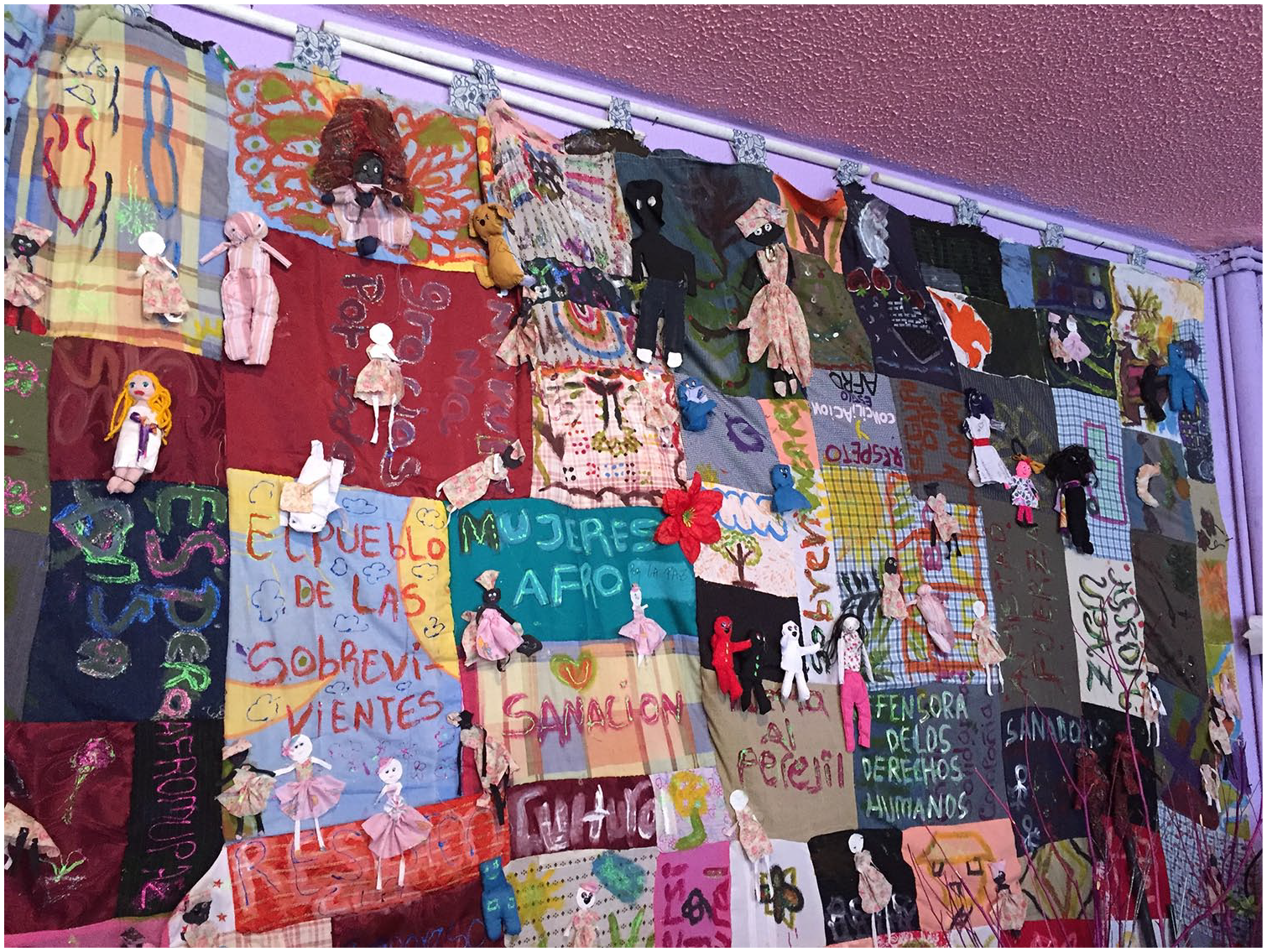
Quilt on the wall in AFROMUPAZ house.
Psychosocial Healing
The Huerta al Perejil (Parsley Garden) program developed by Urrutia and the women of AFROMUPAZ is named after a song from the Chocó region and seeks to recover the “ancestral roots” of the community that have been damaged through displacement. In her introduction to the organization’s book on the subject, Urrutia says, “[This process] begins with the recognition of the historical, economic, social, and cultural inputs that our black communities have given to this country and the understanding that from this foundation we can create a healthy and peaceful society” (AFROMUPAZ, 2014: 10). AFROMUPAZ tries to foster a sense of collective identity by drawing on shared cultural and ancestral traditions. In doing so, it “reconstructs the social and communal fabric” of the Afro-Colombian community in a new city. Using a narrative of cultural wisdom and ancestral traditions, it invites women displaced by the conflict to reassociate themselves with their backgrounds and thus become united by a shared heritage—one that was specifically targeted during the conflict—in addition to their shared experiences of pain.
AFROMUPAZ aims to carry out activities that allow “a path of healing for the women in which the feeling of estrangement and isolation generated by displacement is transformed thanks to the recovery of ancestral roots that contain a shared memory that was previously silenced by the violence” (AFROMUPAZ, 2014: 10). The process of collective identity creation can be understood as a form of resistance against violence. The Huerta al Perejil program employs dance, song, theater, and relaxation exercises to allow participants as part of a 14-step “individual and collective comprehensive healing process” that includes reflection, remembrance, and forgiveness. It is important to note the collective element of this process. In completing the steps of the program, the survivor is engaging in an exercise that dispels the idea that she is alone in her pain and stresses that she is part of a community of women who have also suffered. In creating a shared identity of survivorship, AFROMUPAZ builds a solid base for resistance, reconstruction, and political training. According to Paula, “What gives a person the strength to erase all of this is the knowledge that it’s not just one person but many together” (interview, Bogotá, June 23, 2017). In creating this alternative psychosocial healing program, AFROMUPAZ calls attention to the fact that the government programs are not tailored to the specific needs of Afro-Colombian women and that a differential understanding of the violence they have suffered for their identities as black women is essential for their emotional healing.
Social Safety Net
Another part of Urrutia’s vision for AFROMUPAZ was creating a social safety net for displaced Afro-Colombian women. The experience of arriving in Bogotá, often widowed and with children, was socially isolating for these women (see Meertens, 2001). Moreover, as discussed above, the social dynamics of racism made it hard for them to obtain employment or even rent a place to live. Seeing these dynamics and having experienced them herself, Urrutia decided to create a space—both physical and emotional—for women to come together and gain the benefits of community solidarity. She realized that AFROMUPAZ needed to create not only a safe space for women to share their emotional burdens but also a safe place free from racism where women could earn a living. As a result, AFROMUPAZ became not only an organization but also a business: “Women have to generate their own resources—this actually serves to prevent violence! Women are then going to be less willing to accept violence. We do not allow for a narrative of inequality in AFROMUPAZ. This makes your mind poor. . . . We do not talk about victims, we talk about survivors” (interview, Bogotá, March 2, 2017).
The AFROMUPAZ house is home to an industrial kitchen that women use to bake coconut biscuits, chontaduro cake, and other sweets. They import the ingredients from Chocó and use traditional recipes. In addition, they receive training in catering and hire themselves out to cook for and serve food at events. When the kitchen is not being used for cooking, they make beauty products such as soaps and creams that they sell at markets. Upstairs they have sewing machines, and they design and produce clothing and jewelry typical of the Chocó region. All of the women of AFROMUPAZ are expected to participate in these activities (according to their skills); this becomes a member’s “day job.” Interviewees express their satisfaction at being able to work in a safe environment with their friends, away from racism and discrimination. The profits from the sale of these products do not yet allow the women to earn a wage, but this is the goal. At the time of research, the profits pay the bills and the rent on the house. Every day, however, the women prepare a hot lunch for themselves and their children. Moreover, the attic of the building has been converted into a day care center so that the women do not have to worry about child care while they are at work.
In this effort AFROMUPAZ is comparable to other popular feminist organizations in Latin America such as the comedores populares in Peru and Bolivia (see Blondet and Montero, 1995). When the state does not meet the material needs of vulnerable women, they are prone to take things into their own hands. Whether the long-term results of this self-sufficiency are desirable, however, is questionable (Schroeder, 2006). Although these activities seem to fit within traditional understandings of “women’s work,” interviewees express their satisfaction at being to able to maintain their cultural and ancestral practices, which they do not see as incompatible with their gender objectives.
The “housework” performed by Afro-descendant women must be considered in terms of the long trajectory of slavery and ongoing structural racism. Certain feminists’ fight for the right to leave the confines of the home to participate in the labor market does not adequately address or problematize the fact that black women have been forced to work outside their homes for centuries. As discussed by interlocutors above, if an Afro-descendant woman chooses to engage in child care and cooking, this decision must be framed in terms of an understanding of what these actions mean culturally and historically as well as from a class-based perspective.
Collective Reparations
Beyond internal benefits, AFROMUPAZ has also called on the institutions of the state to help displaced Afro-Colombian women. Since 2015 the organization has been receiving collective reparations. Urrutia is pragmatic about the organization’s demands. She stresses that any campaign that the Victims’ Unit or the Mayor’s Office devises with AFROMUPAZ needs to bring about change, and she recognizes the need to maintain a balance between the scope of the reparations program and the needs of the organization. She points out that the women of the organization were acutely aware of the window of time in which it was possible to convert their demands into practice: “We were able to take advantage of the willingness of the government to negotiate and advance” (interview, Bogotá, May 11, 2017). In outlining their demands in the form of a plan developed in conjunction with the Victims’ Unit, however, the women accepted that there would be specific issues that would not be negotiable at that moment but others on which they could move forward: “In what we could not [negotiate], we said, ‘Let’s put it aside and wait and see. In what we can [negotiate], let’s advance!” (interview, Bogotá, May 11, 2017). For example, they knew that they were unlikely to receive wages for work in the kitchen or money to pay the rent on their house, but if they requested supplies and equipment that could help them increase the outputs of their business this would generate funds to pay the rent and eventually to provide them with wages.
Cultural Activities
Finally, AFROMUPAZ engages in a series of public strategies—cultural fairs and open days—that educate and showcase Afro-Colombian culture for the Colombian public in order to reduce racist stigma. At the time of my research, it was planning its sixth cultural fair. Previous events had involved music, dance, and song and the exhibition of culinary and artisanal products. Usually held in public spaces like the Plaza de Bolívar, these fairs look to use cultural diversity to promote healing. According to Urrutia, they allow the organization to create “stages of peace.” AFROMUPAZ is founded on the belief that the recovery of cultural traditions can bring about healing, and the cultural fairs are an opportunity for sharing this with the public (Secretaría Distrital de la Mujer, 2015).
Open days are a new strategy in the AFROMUPAZ repertoire. In June 2017, the organization advertised an open day for various state institutions with which it works to come and learn more about its cultural heritage. The garage doors were opened, and the main meeting room was used to display all the different products and food items created by the organization. Other open days were designed for the neighbors. Yasmina explains that in order to build social cohesion in the neighborhood, it is imperative that the neighbors understand what the women of AFROMUPAZ are doing (interview, Bogotá, June 31, 2017). By sharing music and food with the community, the organization demonstrates the benefits it provides to local Afro-Colombian women. It hopes to create bonds of trust with the neighbors that will prevent further violence and victimization of members. Opening its doors to the public not only allows the community to get to know the strategies of AFROMUPAZ but also establishes it as a legitimate social actor in the neighborhood. Celebrating being women and being Afro-Colombian in a public space is an act of resistance to those who have systematically tried to silence them throughout the conflict.
Conclusion: Racialized Identities and Popular Feminism
Alvarez (1999: 184) locates feminisms as inhabiting an “expansive, polycentric, heterogeneous, discursive field of action which spans a vast array of cultural, social, and political arenas.” In Colombia’s geographies of terror, feminist action is circumscribed by high risk. AFROMUPAZ advocates gender justice by actively resisting the racialized sexism that is intensified by conflict. It also, however, engages in activities that meet the practical needs of its constituents.
The activities that AFROMUPAZ undertakes, including cooking, sewing, and child care, are broadly consistent with popular feminism. With that said, the organization’s feminism “with a woman’s body and face” is a feminism intrisincally tied to its members’ racial identities. Thus it represents an interesting critique of race-blind or race-neutral popular feminist theorizing. As can be seen in Urrutia’s reticence to uncritically identify as a feminist, the willingness of the women of AFROMUPAZ to subscribe to a feminist identity is contingent on the inclusion of race in its definition. Members draw on identities both as women and as Afro-Colombian women to shape an understanding of their environment and create strategies of resistance against violence.
While the case of AFROMUPAZ has highlighted popular feminism’s blindness to certain intersectional dynamics of Afro-descendant mobilization, it has also reinforced its capacity to call attention to the gendered struggles of displaced women and the intersections of racialized gender and class. Their struggles to feed themselves and their children, find employment, and generate income may not immediately appear to be feminist concerns, but they are in fact tied up with gendered processes and are therefore key to understanding women’s resulting mobilization. Afro-Colombian women are economically marginalized and continue to be discriminated against, and their livelihood struggles (practical interests) are intrinsic to their pursuit of gender justice (strategic interests).
In contrast to the Afro-Colombian feminist collectives discussed by Laó-Montes (2016) and Vergara and Arboleda (2016), AFROMUPAZ does not position itself as having paradigm-shifting goals. Indeed, the women of AFROMUPAZ openly take part in activities that are consistent with popular feminism. They provide food for themselves and their children, create small businesses to generate financial resources, and even engage in psychosocial healing practices to recover from past and ongoing traumas. Their activities have a gendered dimension: at first glance, cooking, child care, sewing, and beauty-product-making seem to fall within binaries about what women’s work looks like. However, these activities are less about their gendered roles in the community than about celebrating their Afro-Colombian identities, including a recovery of identities and activities that they were denied throughout a history of slavery and then of armed conflict. Understanding AFROMUPAZ’s actions as an expression of popular feminism results in an incomplete understanding of the spaces that it occupies, the strategies it employs, and the societal criticisms it puts forward. Locating the organization within the larger landscape of Afro-Colombian and, indeed, Afro–Latina feminisms makes its raison d’être clearer. AFROMUPAZ, then, highlights the need for a reconstructed or intersectional understanding of popular feminism. Laó-Montes’s (2016: 16) observation that “decolonial feminism and intersectional analyses and methodologies are rising and shining, involving a radical critique of the coloniality of power along with a multifaceted politics of liberation” can be taken as a call to develop the ways in which we study women’s organizations in the region more broadly.
Footnotes
Notes
Julia Zulver is a Marie Skłodowska-Curie Research Fellow at the University of Oxford’s School of Global and Area Studies and the Instituto de Investigaciones Jurídicas at the Universidad Nacional Autónoma de México. Her doctoral thesis examined women’s mobilization in Latin America with a focus on Colombia and aimed to test and refine the parameters of high-risk feminism. This research was supported by the Commonwealth Scholarship and a Social Sciences and Research Council of Canada Doctoral Fellowship. The author thanks the women of AFROMUPAZ for their time and willingness to participate in this project. She also thanks Leigh Payne, Jonas von Hoffmann, Janet Conway, Nathalie Lebon, and the other reviewers for their thoughtful comments and suggestions.