




Abstract
We examined the intersection of juvenile psychopathy with protective factors, dynamic violence risk, and recidivism in a court adjudicated Canadian sample of 257 male and female, ethnoracially diverse youth. The Psychopathy Checklist: Youth Version (PCL:YV) and measures of dynamic violence risk (Violence Risk Scale–Youth Version; VRS-YV) and protective factors (Structured Assessment of Protective Factors–Youth Version; SAPROF-YV) were rated from court and treatment files. Recidivism information was obtained from official criminal records. PCL:YV scores were associated with fewer protective factors and predicted recidivism across gender and ethnoracial (Indigenous vs non-Indigenous) groups; however, PCL:YV scores did not incrementally predict future crime and violence when controlling for violence risk and/or protective factors scores, while both of the latter measures did. Juvenile psychopathy is a clinically relevant construct for justice-involved youth but it does not equate to a lack of protective factors or inability to make treatment-related changes in risk.
Keywords
Juvenile psychopathy is a serious developmental psychopathological condition in youth (Forth et al., 2003). Interpersonally, youth with substantial traits are adept at impression managing, deceitful and manipulative, and may be egocentric and grandiose, far exceeding developmental norms. Affectively, these youth can present with callous and unemotional features characterized by cruelty toward others, a lack of remorse or conscience for wrongdoing, and difficulty experiencing the normal range and intensity of emotion. Behaviorally, youth with juvenile psychopathy tend to be reckless and sensation seeking, easily bored and impulsive, engaging in activities with limited reflection or forethought or consideration of the consequences. This often is associated with a pattern of antisocial and criminal behavior that can be frequent, varied, and even violent in nature, resulting in formal contacts with the justice system. Scores on a clinical rating scale frequently used to assess juvenile psychopathy, the PCL:YV (Forth et al., 2003) are a robust predictor of future crime and violence (Olver et al., 2009).
Given the criminal justice system relevance of the juvenile psychopathy construct, not uncommonly measures such as the PCL:YV will be employed in tandem with other measures of risk and need to assess risk for future crime and violence in youth (Olver & Stockdale, 2010). This is not without controversy, however, given concerns that have been raised about the pernicious effects of labeling and dubbing children and youth with substantial traits as being “untreatable,” which can create barriers accessing services and adversely impact decisions affecting the youth person (Edens & Vincent, 2008; Olver & Stockdale, 2010; Viljoen et al., 2010). Furthermore, others have argued that traits such as egocentricity, impulsivity, proneness to boredom, and irresponsibility are normative in adolescence—a case for which may be the high frequently of “adolescent limited” offenders in Moffitt’s (1993) typology, as well as other lines of trajectory research (e.g., Day et al., 2012). Forth et al. (2003) remind us, however, that these are extreme and aberrant variations on some of what may otherwise be normative personality and behavioral traits of adolescence and an understanding of developmental norms is required to assess psychopathic traits (e.g., callous/unemotional traits). Finally, given the dynamism of youth and adolescence and the gargantuan leaps socially, emotionally, and behaviorally that occur throughout the teenage years, concerns have been raised about clinical use of the juvenile psychopathy construct, given the stability and even permanence that the syndrome connotes (Edens & Vincent, 2008). Adolescence is a developmentally critical period to intervene and prevent future justice contacts (Olver & Stockdale, 2017); not all children and youth with criminal justice involvement, even those with substantial psychopathic traits, become involved in the adult justice system. Here we discuss two agents that can divert youth from the adult system: (a) changes in risk from forensic treatment programming, and (b) the cultivation and utilization of protective factors. These are not mutually exclusive, and may even complement one another.
Changing Risk Through Risk Reduction Treatment
First, there is a large literature supporting the efficacy of psychological treatments for justice-involved youth to prevent future crime and violence (Lipsey, 2009). For instance, Lipsey (2009) in a meta-analysis of 548 independent samples, found a range of therapeutic services (e.g., multiservice, counseling, restorative, skill building) netted a 10% to 13% reduction in recidivism, compared to punitive and deterrence-based approaches which yielded little reduction (2%–8%), with specific classes of programs, including behavioral or cognitive behavioral skill building approaches, mentoring and group therapy, and coordinated case management of multiple services yielding the largest reductions in recidivism (20%–26%). Specific variants of evidence informed, effective programs further include multisystemic therapy (Henggeler et al., 1998), functional family therapy (Alexander & Parsons, 1973), and multidimensional treatment foster care (Chamberlain, 1994), each of which have independent literatures supporting their efficacy for prosocial reintegration and decreasing adverse outcomes in justice-involved youth (e.g., Chamberlain & Reid, 1998; Sawyer & Borduin, 2011).
Common to these interventions is the risk, need, and responsivity principles (Bonta & Andrews, 2024) of effective correctional treatment. Briefly, the risk principle states that treatment intensity should be matched to the risk level of clientele, such that higher risk clients receive more services, and lower risk clients receive few or no services. The need principle states that dynamic risk factors linked to crime and violence, also known as criminogenic needs, such as the Central Eight (i.e., antisocial attitudes, peers, and personality pattern, drug/alcohol employment/education, family/marital, and leisure/recreation), should be prioritized for service delivery. Finally, the responsivity principles states that effective services employ cognitive behavioral methods of change (general responsivity), that are adapted to the unique circumstances and characteristics of clientele (specific responsivity) which may include high-psychopathy traits (e.g., Olver et al., 2011). Meta-analytic research has demonstrated that adherence to a greater number of principles is associated with greater reductions in recidivism (Bonta & Andrews, 2024), including for youth samples (e.g., Pappas & Dent, 2023). RNR also guides the integration of psychological risk assessment and intervention by way of appraising risk to inform service intensity (risk principle), identifying high-priority areas to intervene and evaluating changes in those domains (need principle) and identifying client features that can impact programming and inform service delivery (e.g., mental health concerns, cognitive strengths and weaknesses, literacy). In all, the RNR principles apply to justice-involved youth in general, and high-psychopathy youth in particular.
Protective Factors: Their Role, Relevance, and Risk-Mitigating Properties
Protective factors are social, psychological, and environmental agents that mitigate risk for recidivism and should, in principle, promote positive outcomes, examples of which include prosocial leisure, engagement in school and/or work, and adaptive coping skills (Bouman et al., 2010; Hoge et al., 1996; Rennie & Dolan, 2010). There are formal measurements of protective factors for youth such as the Protect domain (six binary protective items) from the Structured Assessment of Violence Risk for Youth (SAVRY; Borum et al., 2002), as well as the SAPROF-YV (de Vries Robbé et al., 2015b), a 16-item measure of protective factors developed to assist in assessing risk for youth crime and violence and to identify areas that mitigate risk to inform risk management service delivery. While the Protect domain of the SAVRY is a component of a broader youth violence risk assessment scale, the SAPROF-YV (derived from the SAPROF; de Vogel et al., 2009) is a standalone measure of protective factors for youth, intended to be used in conjunction with one or more forensic risk assessment measures (e.g., SAVRY).
Most recently, a meta-analysis of the SAPROF measures by Burghart et al. (2023) found SAPROF-YV ratings (k = 5) to significantly predict decreased violent (d = .51) and general (d = .77) recidivism, while a number of individual studies elsewhere have demonstrated the Protect domain to also predict decreased recidivism across youth samples from Canada (e.g., Lovatt et al., 2022; Muir et al., 2020) and Australia (Shepherd et al., 2014). Lovatt et al. (2022) did a direct comparison of the Protect domain with the SAPROF-YV through Cox regression analysis on a sample of 257 court-adjudicated youth and found that SAPROF-YV ratings incrementally predicted decreased violent, nonviolent, and general recidivism, while the Protect domain did not. Thus, a critical question remains if reducing risk and increasing protection are distinct processes. The one youth study that has examined this (Lovatt et al., 2022) found that posttreatment measurements of dynamic risk and change each incrementally predicted decreased recidivism controlling for SAPROF-YV scores, which in turn, did not significantly predict decreased recidivism after controlling for risk and change.
Psychopathy, Treatment Change, and Protective Factors
With a potentially troubling moniker such as juvenile psychopathy, treatment efficacy, and protective factors may not readily leap to mind. There is a growing literature on both, mostly with adults, but also extending to youth. Briefly, psychopathy is associated with more serious criminal histories, a greater number and density of dynamic risk factors, and higher recidivism rates in both youth (McCuish et al., 2018; Stockdale et al., 2010) and adult (Sewall & Olver, 2019; Simourd & Hoge, 2000) forensic and correctional populations. Furthermore, within the adult literature, engagement in RNR-based programming has been found to be associated with decreased recidivism in high-psychopathy correctional and forensic mental health samples, including those with histories of sexual offending (Langton et al., 2006), violent offending (Wong et al., 2012), and forensic outpatients (Skeem et al., 2002).
In the youth psychopathy treatment literature, the Mendota Juvenile Treatment Center (MJTC) Program has featured prominently. A high-intensity residential program that integrates social learning and systems theory, positive role modeling, and a contingency management system to reward prosocial behavior, evaluations of the MJTC with high-psychopathy youth have been favorable including reduced institutional aggression (Caldwell et al., 2008; Caldwell & Van Rybroek, 2001) and decreased community recidivism relative to conventional programming (Caldwell, 2011; Caldwell et al., 2006). Furthermore, Rojas and Olver (2022), in a sample of 53 justice-involved youth with criminal histories of sexual offending, found changes in sexual violence risk associated with group sexual offense treatment services to be associated with decreased recidivism, controlling for baseline risk and PCL:YV measured psychopathy.
Fewer studies however have examined the intersection of psychopathy and protective factors. Olver and Riemer (2021) examined the interrelation of PCL-R measured psychopathy and SAPROF measured protective factors in a treated sample of 461 incarcerated men with sexual offense histories. PCL-R scores were inversely related to protective factors and pre–post treatment changes; importantly, however, there was no difference in treatment-related changes in protective factors (i.e., SAPROF change score) between high-psychopathy and low-psychopathy men, even though psychopathic men continued to have fewer of these at posttreatment. Furthermore, high-psychopathy men who scored above the mean on the SAPROF had significantly lower rates of violent and general recidivism. Changes in protective factors from pre to posttreatment also predicted decreased violent recidivism controlling for PCL-R score.
Diversity Considerations in the Intersection of Psychopathy and Protective Factors
Psychopathy and protective factors research with ethnoracial minorities and women and girls is also limited, and their intersection has yet to be examined in youth justice populations. Furthermore, controversies abound around the application of PCL measures with vulnerable groups such as justice-involved Indigenous persons. Indigenous persons, both adults and youth, are overrepresented in correctional systems across Canada, the United States, New Zealand, and Australia. They tend to score higher risk on structured forensic measures than non-Indigenous (White majority) persons, are more likely to be classified as high risk, and have higher rates of return to custody and recidivism (Stewart & Wilton, 2019). In Canada, certain measures, including the PCL, have faced legal challenges on their psychometric appropriateness (particularly predictive validity for crime and violence) with Indigenous persons (Canada v. Ewert, 2016; Ewert v. Canada, 2015, 2018). A recent meta-analysis of the Indigenous risk assessment literature (Olver et al., 2024) demonstrated small in magnitude differences in PCL-R (d = .20, k = 5) and YV (d = .15, k = 5) scores between Indigenous and non-Indigenous (White majority) groups. Furthermore, both measures had medium predictive accuracy for violent and general recidivism for Indigenous (d = .55–.61) and non-Indigenous (d = .41–.63) samples.
Research with Indigenous persons and protective factors is more limited; Olver et al. (2024) found that Indigenous youth scored lower on both the SAVRY Protect domain and the SAPROF-YV total and subscale domains. Most notably, however, SAPROF-YV scores were predictive of decreased recidivism, particularly in the Motivational domain, followed by the Resilience domain. However, there is a need for additional work examining the risk-mitigating properties of protective factors with justice-involved Indigenous youth populations.
Present Study and Rationale
Very little research to date has examined the presence of protective factors in high-psychopathy criminal justice and correctional populations; even less has examined the risk-mitigating properties of protective factors as a function of psychopathy, and how this may be independent from changes or reductions in risk (e.g., due to engagement in forensic treatment). And to our knowledge, no research has examined these interrelations, and their clinical and criminal justice implications, as a function of gender and ethnoracial heritage. Accordingly, this study examined the intersection of psychopathy, violence risk, protective factors, and change to recidivism in a gender and ethnoracially diverse sample of court-adjudicated youth. Informed by the RNR principles, the aims were as follows: (a) extend limited previous research examining the association of PCL measured psychopathy to protective factors in a youth justice sample, and specifically, as a function of gender and Indigenous heritage (responsivity principle); (b) extend previous work examining the predictive properties of the juvenile psychopathy construct, measured by the PCL:YV, to Indigenous and female youth (risk principle); (c) examine the risk-mitigating properties of protective factors among youth with prominent features of juvenile psychopathy (need principle); (d) examine the extent to which changes in violence risk predict decreased recidivism after accounting for baseline measurements of protective factors and juvenile psychopathy (need principle); and (e) examine the role and clinical relevance of measures of violence risk and protection in predicting recidivism outcomes, controlling for individual differences in juvenile psychopathy (need principle).
Method
Participants
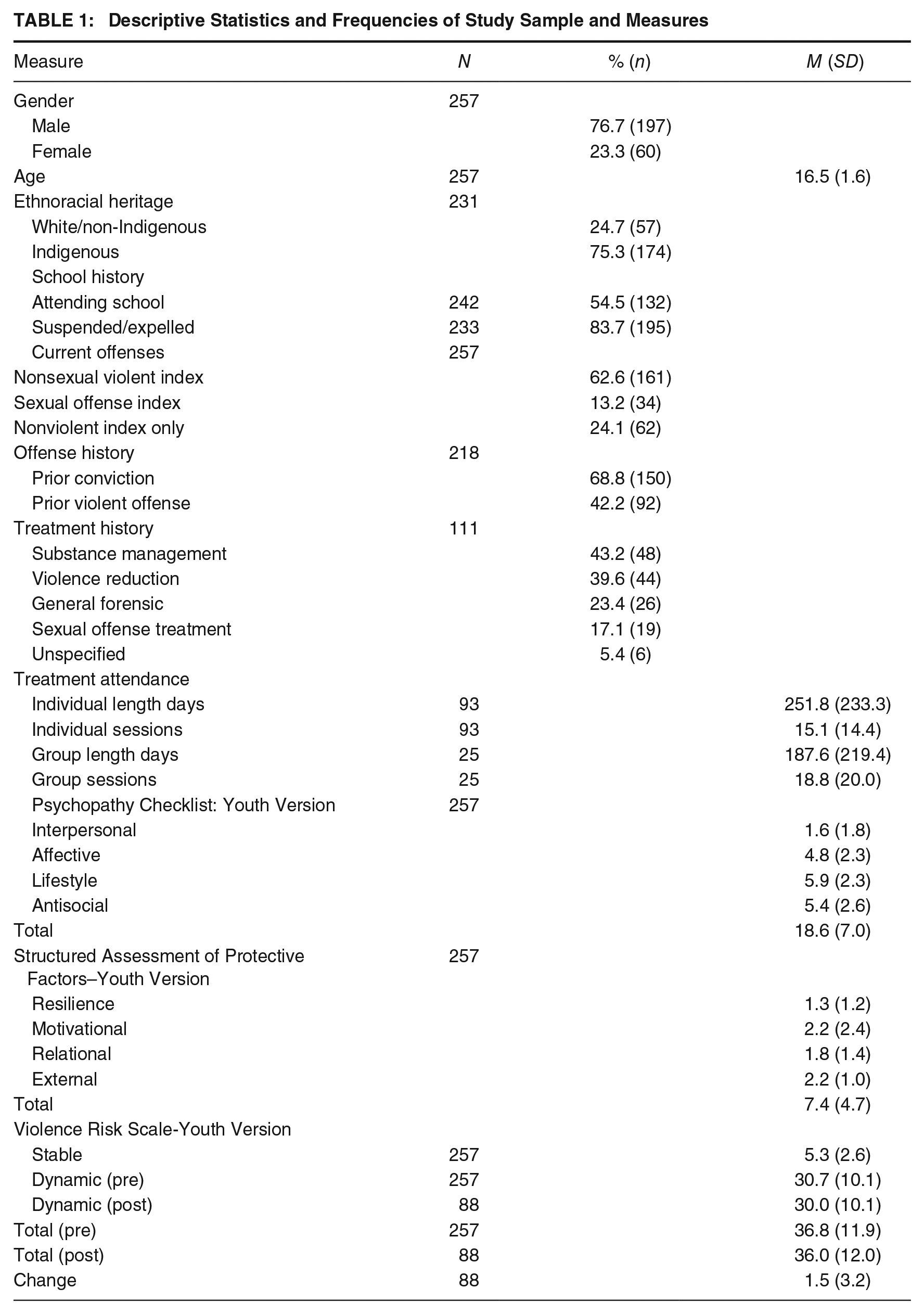
The study sample was developed initially by identifying 451 consecutive admissions to a community mental health facility in Saskatoon, Saskatchewan, Canada within a 5-year catchment period (2007–2012). Youth were referred either by the courts or a community youth worker for assessment and/or treatment services. Of these 451 cases, 257 files were of sufficient quality to code the study measures and comprised this study sample described as follows. Owing to incomplete or missing details within files, the n fluctuated for some variables within the sample and exact variable counts are provided in parentheses. Overall, about three quarters of the sample was male (76.7%, 197/257) and about one quarter was female (23.3%, 60/257). On average, the youth were 16.5 (SD = 1.6, range age: 12–20) years of age at the time of services. Most youth had a history of school suspension or expulsion (83.7%, 195/233), approximately half were attending school at the time of arrest (54.5%, 132/242), and the last grade completed was grade 8 (M = 8.3, SD = 1.4). Information concerning ethnoracial heritage was available for most of the sample (89.9%, 231/257), most of whom were identified as having Indigenous ancestry (75.3%, 174/231) from self-report and/or legal processes (e.g., inclusion of Gladue considerations in presentence reports), and the remainder were predominantly White or other non-Indigenous heritage (24.7%, 57/231). More than half (62.6%, 161/257) of youth had an index conviction for a nonsexual violent offense (e.g., assault, robbery), while a smaller proportion had convictions for sexual offenses (13.2%, 34/257), or exclusively nonviolent offenses (24.1%, 62/257). About two thirds (68.8%, 150/218) had any previous conviction and 42.2% (92/218) had a previous conviction for a violent offense.
Almost half the sample (43.2%, 111/257) had participated in some form of forensic treatment service such as substance management (43.2%, 48/111), violence reduction treatment or anger management (39.6%, 44/111), general forensic therapeutic services (23.4%, 26/111), sexual offense treatment (17.1%, 19/111), or other unspecified services (5.4%, 6/111); fairly frequently, youth attended multiple programs (27.9%, 31/111). For individual services (n = 93), youth attended an average number of 15.1 individual sessions (SD = 14.4) and cumulative individual sessions spanned an average of 251.8 days (SD = 233.3). For group services (n = 25), youth attended an average of 18.8 total sessions (SD = 20.0) over a cumulative duration of 187.6 days (SD = 219.4). Table 1 presents descriptive statistics and frequencies of the sample for all demographic, criminal history, clinical, and treatment variables and study measures.
Descriptive Statistics and Frequencies of Study Sample and Measures
Measures
Psychopathy Checklist: Youth Version
The PCL:YV (Forth et al., 2003) is a 20-item symptom construct rating scale designed to assess the features of psychopathy in youth age 12 to 17. Items are rated on a 3-point ordinal scale of 0 (no, characteristic/trait absent), 1 (partially/possibly present), 2 (yes, present) with possible total scores ranging from 0 to 40. Given the developmental fluidity of adolescence and the ethical perils of labeling, there is no diagnostic cut score for juvenile psychopathy (Forth et al., 2003). The items can be organized into two factors and four facets: Factor 1 captures the personality style and emotional features of juvenile psychopathy and can be arranged into interpersonal (four items, e.g., impression management, grandiose, and deceitful) and affective (four items, e.g., callous/lack of empathy, and lack of remorse) facets. Factor 2 captures the impulsive, irresponsible, and antisocial lifestyle pattern of juvenile psychopathy and can be arranged into lifestyle (five items, e.g., lacks goals, impulsive, and need for stimulation) and antisocial (five items, e.g., early behavior problems, poor anger controls, and criminal versatility) facets. Interrater reliability was examined on 27 randomly selected cases, independently double coded by the same two raters, via intraclass correlation coefficient, one-way, random effects, single measure, absolute agreement (ICCA1): Per Cicchetti and Sparrow (1981), the ICCs values were broadly “excellent” (i.e., ICC > .75) as follows: PCL:YV total ICCA1 = .96, interpersonal ICCA1 = .86, affective ICCA1 = .84, lifestyle ICCA1 = .78, antisocial ICCA1 = .90. PCL:YV scores demonstrated acceptable internal consistency reliability, with the values (Cronbach’s alpha) reported as follows: PCL:YV total α = .83, interpersonal α = .64, affective α = .77, lifestyle α = .71, and antisocial α = .72.
Structured Assessment of Protective Factors–Youth Version
The SAPROF-YV (de Vries Robbé et al., 2015a) is a 16-item structured professional judgment (SPJ) measure of protective factors for justice-involved youth. Divided into four subscales, Resilience (four items, e.g., social competence, coping, and self-control), Motivational (six items, e.g., motivation for treatment, school/work, and leisure), Relational (three items, e.g., parents/guardians, and peers), and External (three items, e.g., professional care and court order), each item is rated on a 3-point ordinal scale of 0 (absent), 1 (partially and possibly present), and 2 (present). As an SPJ measure, the items are not summed in clinical practice, but rather, the pattern or configuration of items are scrutinized to generate global protection ratings, although psychometric evaluations of the tool frequently employ summed ratings (Burghart et al., 2023). Meta-analytic research of the SAPROF-YV and its parent tool support the predictive properties of the tool for decreased recidivism. In this study, from 27 randomly selected double-coded cases, ICC values were broadly “excellent”: SAPROF-YV resilience ICCA1 = .83, motivational ICCA1 = .92, relational ICCA1 = .76, external ICCA1 = .73, total ICCA1 = .94. SAPROF-YV internal consistency reliability values (Cronbach’s alpha) were as follows: SAPROF-YV total α = .86, resilience α = .63, motivational α = .79, relational α = .48, external α = −.01. The lower α for the resilience dimension is due to the small number of items (M inter-item r = .27 vs. M inter-item r = .29 for total scale), while the low α for external is due to the influence of one low correlating item (pedagogical climate) compounded by short subscale length.
Violence Risk Scale–Youth Version
The Violence Risk Scale–Youth Version (VRS-YV; Wong et al., 2004–2011) is a youth violence risk assessment and treatment planning tool designed to assess risk for future violence, identify targets for treatment, and to assess changes in risk from treatment or other change agents. The tool consists of four static/stable items (i.e., historical and generally unchanging) and 19 dynamic items (i.e., potentially changeable social, psychological, and environmental characteristics). Items are rated on a 4-point (0, 1, 2, 3) ordinal scale and are summed to yield static, dynamic, and total (stable + dynamic) scores; higher stable scores represent a greater severity of violence history and instability of background, while higher dynamic scores represent a greater density of criminogenic need areas linked to violence. Dynamic items with a 2- or 3-point rating are considered criminogenic and prioritized for violence risk management interventions; items with 0 or 1 ratings are generally areas that are low risk or well managed. Changes in risk are assessed via a modified application of Prochaska et al.’s (1992) transtheoretical model of change, which outlines a series of cognitive, experiential, and behavioral changes in stagewise fashion as individual’s attempt to remediate problem areas. Five stages of change are operationalized for each dynamic item: precontemplation (denial of problem area and no insight), contemplation (awareness of problem area), preparation (recent or inconsistent use of skills and strategies to manage problem area), action (sustained use of skills and strategies), and maintenance (generalization and transfer of new learning across key high risk situations). Criminogenic items (i.e., 2 or 3 rating) are given a baseline stage of change rating at the initial assessment (e.g., pretreatment) and then stage of change is reassessed at subsequent assessment intervals (e.g., posttreatment and community discharge). Progression from one stage to the next, in the direction of risk reduction is credited with a 0.5-point deduction, 2 stages, a 1.0 deduction and so on; no credit is given for progression from precontemplation to contemplation given that there is no behavioral change. Deterioration can be scored as an increase in score. Research has demonstrated VRS static, dynamic, and total scores predict future crime and violence (Lovatt et al., 2022; Stockdale et al., 2014) and institutional violence and aggression (Gray & Viljoen, 2023). In 27 randomly selected double-coded cases from the present sample, ICC values were “excellent”: VRS-YV stable ICCA1 = .93, dynamic (pre) ICCA1 = .96, total (pre) ICCA1 = .97. VRS-YV scores demonstrated acceptable internal consistency reliability (Cronbach’s alpha): VRS-YV total (pretreatment) α = .90, stable α = .68, dynamic (pretreatment) α = .88.
Recidivism Criteria
Recidivism was obtained through the Canadian Police Information Center (CPIC), a nationwide registry of criminal charges and convictions maintained by the Royal Canadian Mounted Police (RCMP). Recidivism was defined as new criminal convictions for offenses occurring after the community assessment date or (for youths in custody) community release. Violent recidivism was defined as any new criminal conviction for an offense that involved actual, potential, or threated physical or psychological harm toward an individual (e.g., robbery, assault, homicide, and uttering threats) including sexual offenses. Nonviolent recidivism was defined as any new conviction for an offense not perpetrated against a person and that likely would not entail direct physical or psychological harm (e.g., property and drug offenses, mischief), including technical violations. General recidivism was defined as a new criminal conviction for any offense. Time to the first recidivism event (conviction date) within a given category was calculated to permit survival analysis and use of fixed follow-ups; for nonrecidvists, the total follow-up time was employed, with the date of CPIC download serving as the end date.
Procedure
Ethical and/or operational approval to conduct the present research was obtained from the University of Saskatchewan Behavioral Research Ethics Board (Beh ID # 18–30), the Provincial Ministry of Justice (Corrections and Policing Division), and the Provincial Law Courts. This study is a retrospective archival investigation that involved rating the study measures from Court and clinical files. A well-established literature supports the validity and reliability of file-based ratings for measures of psychopathy, violence risk, and protective factors across youth and adult populations (e.g., de Vries Robbé et al., 2015a; Stockdale et al., 2014; Wong et al., 2012), so long as the files are sufficiently detailed. All files captured between 2007 and 2012 were stored at the agency and data collection occurred on site. The files were accessed, reviewed for completeness, and if sufficient information was available (which usually required at a minimum a psychological assessment report and a presentence report), the structured forensic rating scales, criminal history, sentencing, treatment, and demographic variables were coded.
All files and study measures were coded by the first author, who was a graduate clinical psychology student at the time of the research, and a senior undergraduate honors student. The raters were trained on rating the study measures and supervised by two registered psychologists (the second and third authors), each of whom had more than 15 years of experience in research and clinical practice with youth justice populations and had been trained on, or were involved in the development of, the study measures. The coder training for this study consisted of a full day of youth violence risk assessment training on the VRS-YV, PCL:YV, and SAPROF-YV and completing two redacted cases, one female and one male. The research supervisors then co-coded four study cases on all measures from file with the two raters to calibrate their ratings, with rating discrepancies resolved through consensus. When a satisfactory level of consensus had been obtained (i.e., through reviewing and discussing ratings), the raters began independent coding. Approximately 10% of files were periodically selected at random and independently double-coded throughout the study to establish interrater reliability and to prevent rater drift.
Given that files often had multiple opening dates and youth could have multiple admissions to the agency, the raters pulled each other’s files, reviewed each one, and then removed any information that could be potential source of criterion contamination before the file was subsequently reviewed and coded by the other rater. When files had multiple opening dates, the last admission was used and all information contained from that point forward was utilized in coding the study measures. In this manner, the potential for criterion contamination was considerably decreased. For clinical files that contained both assessment and treatment progress information, the researcher conducting the screening separated the two sets of information for the other coder so that ratings on the measures completed at pretreatment (i.e., using baseline assessment and pretreatment information) and posttreatment (i.e., using treatment progress information) could be done as independently as possible. All files were coded prior to obtaining recidivism data, and thus blind to outcome. The recidivism data, in turn, were coded from CPIC by the three study authors.
Planned Analyses
All analyses were conducted using SPSS for Widows v. 28 and were conducted to examine the intersection of PCL:YV measured juvenile psychopathy, protective factors, violence risk, and change to recidivism as a function of gender and ethnoracial heritage. Whenever power permitted, we conducted intersectional analyses; however, the small number of non-Indigenous female youth in the sample precluded most analyses with this subgroup.
First, we reported PCL:YV facet and total scores and conducted gender (male–female) and ethnoracial (Indigenous–non-Indigenous) group comparisons on the measures employing standardized mean difference (Cohen’s d), in which d values of 0.20 correspond to small, 0.50 medium, and 0.80 large (Cohen, 1992). Second, to examine the relation of protective factors to juvenile psychopathy, we subsequently compared high and low PCL:YV scoring youth (based on a cut score of 20) within gender and ethnoracial groups on the SAPROF-YV total score and its four subscales, again employing Cohen’s d to capture the magnitude of difference. Third, we subsequently examined the convergent properties of PCL:YV facet and total scores by correlating these with the VRS-YV and SAPROF-YV total and subscale scores, with correlation magnitudes (between two continuous variables) corresponding to small r = .10, medium r = .30, and large r = .50 (Cohen, 1992); analyses were conducted on the aggregate sample for parsimony.
Fourth, we examined the predictive properties of PCL:YV scores for the three recidivism outcomes employing fixed 3- and 5-year follow-ups via ROC (receiver operating characteristic) analyses. These fixed follow-ups are commonly employed in the correctional risk assessment literature (Olver et al., 2024) to control for differences in follow-up time and to capture prediction at different timepoints (e.g., shorter vs. intermediate or longer term), respectively. The follow-ups also reflect the developmental context and time limited duration of adolescence. These analyses were conducted on the aggregate sample, among broad gender and ethnoracial subgroups, and among specific gender × ethnoracial subgroups. ROC analyses generate an area under the curve (AUC) statistic representing the probability that a randomly selected recidivist scores higher on a given measure than a randomly selected nonrecidivist. With possible values ranging from 0 to 1.0, and .50 representing chance-level prediction, AUC magnitudes can be interpreted using effect size language of small .56, medium .64, and large .71 (Rice & Harris, 2005). Of note, for SAPROF-YV analyses, the direction of the criterion variable was reversed (i.e., increasing protection associated with decreased recidivism) so that all AUC values would be in the positive direction (i.e., above .50).
The remaining sets of analyses examined the incremental predictive validity of measures of protective factors and violence risk and change, controlling for PCL:YV total score, through a series of hierarchical Cox regression survival analyses. These analyses featured a pretreatment model, a posttreatment model, and a change model and were conducted on the aggregate sample using continuous predictor scores given the power requirements of multipredictor regression models, particularly given that analyses using change information were limited to one-third of the sample. The pretreatment Cox regression model examined the relative contributions of baseline risk and protection for predicting recidivism over and above psychopathy, with the order of entry switched in alternating blocks to directly examine the relative contributions of static and dynamic risk (VRS-YV) and protection (SAPROF-YV), prior to entry into the final predictor model (block 2). The analyses were intended to examine: (a) the risk-mitigating effects of protective factors over and above juvenile psychopathy, (b) how a purposively developed violence risk scale with dynamic factors compares to the juvenile psychopathy construct in the prediction of outcome, and (3) whether protective factors and violence risk measures uniquely predict outcome over and above juvenile psychopathy. The baseline pretreatment model was supplemented by a set of Kaplan–Meier survival analyses examining recidivism trajectories employing mean splits of high and low psychopathy (i.e., PCL:YV ≥20 vs. ≤19, respectively) and high and low protection (SAPROF-YV total ≥8 vs. ≤7, respectively). Mean splits were employed to evenly distribute cell n to maximize power; given that the sample had a high proportion of youth with substantial psychopathy features, the high scoring PCL:YV group reflected an abundance of such traits. A risk-mitigating effect would be illustrated by steeper recidivism trajectories for youth who are high on psychopathy and low on protective factors, compared to high-psychopathy youth who are high(er) on protective factors.
The posttreatment Cox regression model substituted in posttreatment dynamic item ratings to examine to what extent dynamic variables incorporating change information and protective factors, were uniquely associated with outcome controlling for psychopathy and static risk. The change Cox regression model incorporated VRS-YV change scores as a final covariate in the analyses, to directly examine to what extent treatment-related changes in risk versus a baseline measure of protective factors, are associated with decreased recidivism after accounting for individual differences in levels of psychopathy and on static and dynamic risk factors.
The final set of analyses were exploratory and featured a set of targeted Cox regressions for the Indigenous, non-Indigenous, male, and female groups. Given that any gender or ethnoracial subgroups employing posttreatment or change information would be prohibitively small to support the Cox regression models, variations on the baseline models were examined; to partly account for changes that occurred in risk, scores from the most recent available dynamic assessment were employed.
Results
Profiles of Juvenile Psychopathy Among Gender and Ethnoracial Groups
Table 2 reports PCL:YV descriptives and gender × ethnoracial group comparisons on PCL:YV total and facet scores. Indigenous youth scored significantly higher than non-Indigenous youth, overall and in the male subgroup, on PCL:YV total score (small effect) and its Lifestyle (large effect) and antisocial (medium effect) facets; by contrast, non-Indigenous youth scored higher overall (small effect) than Indigenous youth on the Interpersonal facet. Indigenous youth scored nonsignificantly higher on the Affective facet. The same pattern of ethnoracial differences was observed for female youth but none were significant owing to the extremely small cell size of White female youth.
Psychopathy Checklist: Youth Version (PCL:YV) Score Comparisons for Gender and Ethnoracial Subgroups
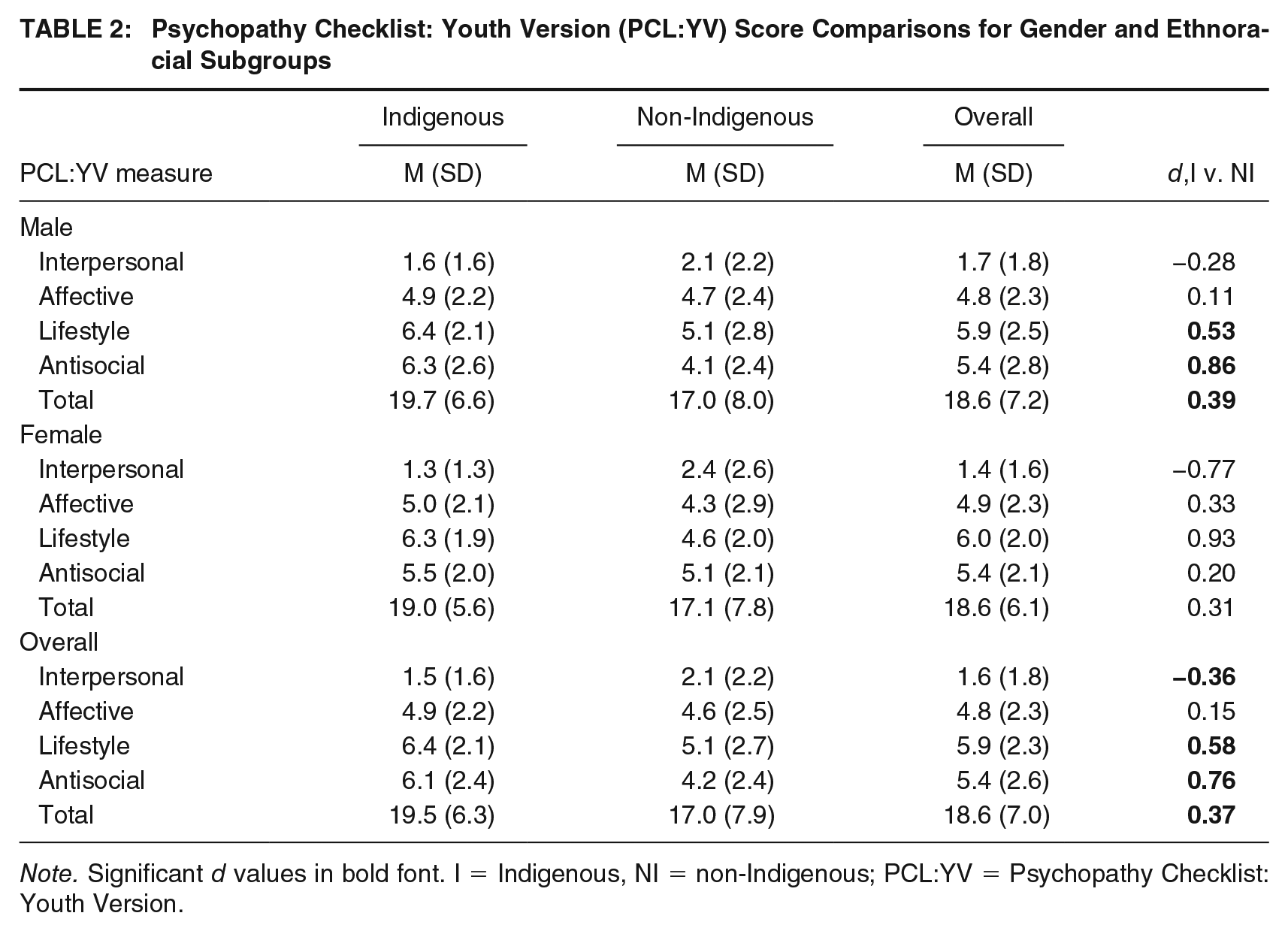
Note. Significant d values in bold font. I = Indigenous, NI = non-Indigenous; PCL:YV = Psychopathy Checklist: Youth Version.
The Interrelations of Psychopathy, Protective Factors, Violence Risk, and Change
As seen in Table 3, youth scoring with a higher preponderance of psychopathic traits (PCL:YV total score 20+) scored significantly lower on SAPROF-YV measures of protective factors across gender and ethnoracial groups. In particular, high-psychopathy youth scored lower with uniformly large effects on the Motivational domain (d = −0.84 to −1.11), medium to large effects on the Resilience domain and total score (d = −0.65 to −1.11), and medium effects for scores on the Relational domain (d = −0.43 to −0.72). The only exception were frequently weak and variable nonsignificant psychopathy group differences on the External domain for female and Indigenous youth and small to medium effects for male and non-Indigenous youth.
High and Low Juvenile Psychopathy Group Comparisons on Measures of Protective Factors Among Gender and Ethnoracial Subgroups
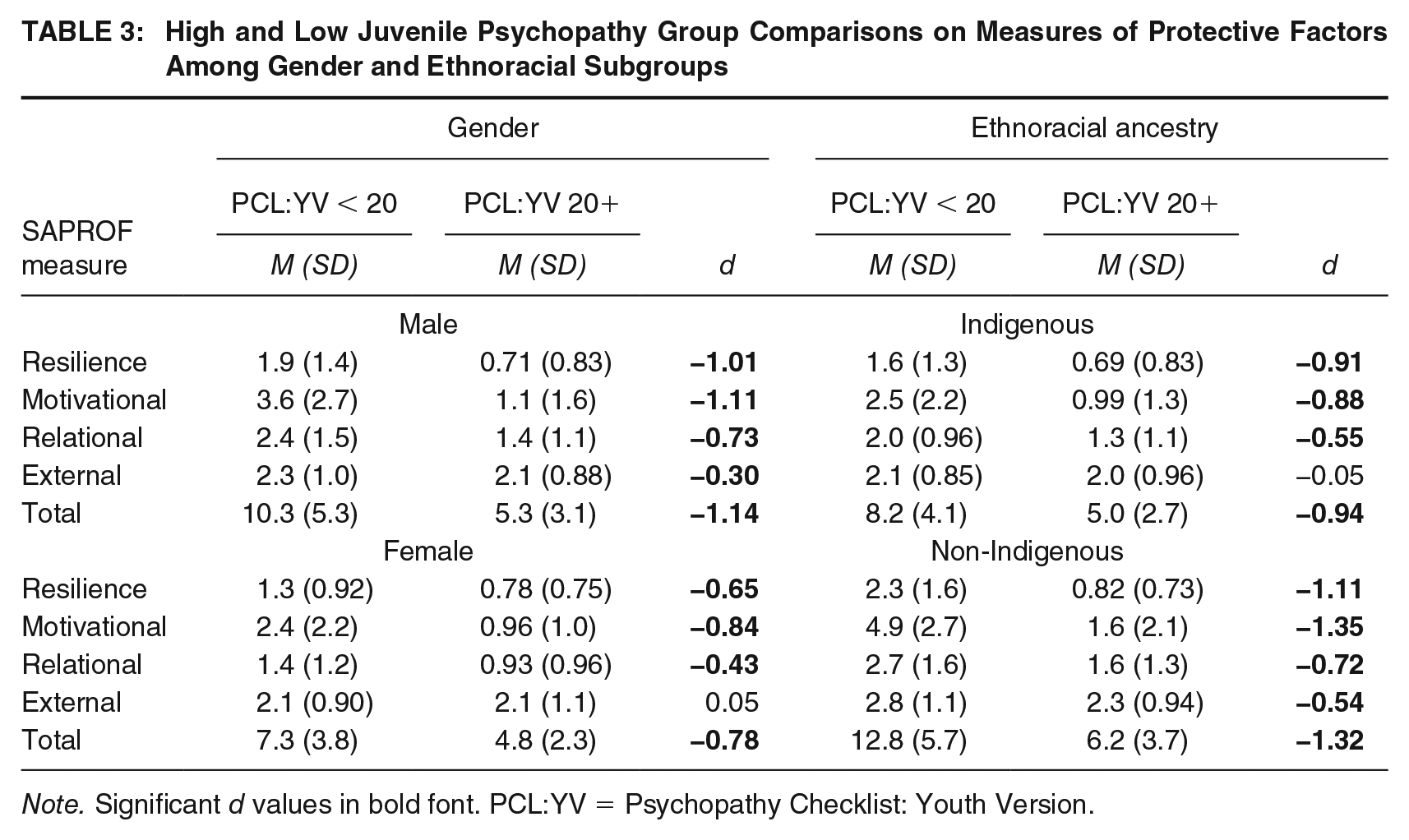
Note. Significant d values in bold font. PCL:YV = Psychopathy Checklist: Youth Version.
Table 4 is a convergent validity correlation matrix of PCL:YV factor and total scores with violence risk and protection measure scores. As anticipated, higher levels of PCL:YV measured juvenile psychopathy were associated with greater levels of violence risk as measured by the VRS-YV and fewer protective factors as measured by the SAPROF-YV. Specifically, large in magnitude associations were found for PCL:YV total score and Affective, Lifestyle, and Antisocial factor scores with VRS-YV dynamic and total scores (pre and post), and SAPROF-YV total scores and Resilience, Motivational, and Relational scores. VRS-YV static/stable scores had particularly strong associations with PCL:YV Lifestyle and Antisocial factor and total scores. PCL:YV Interpersonal factor scores, by contrast, had small in magnitude (or lower) associations with the VRS-YV and SAPROF-YV measures.
Correlation Matrix of PCL:YV Associations With Violence Risk and Protection Measures
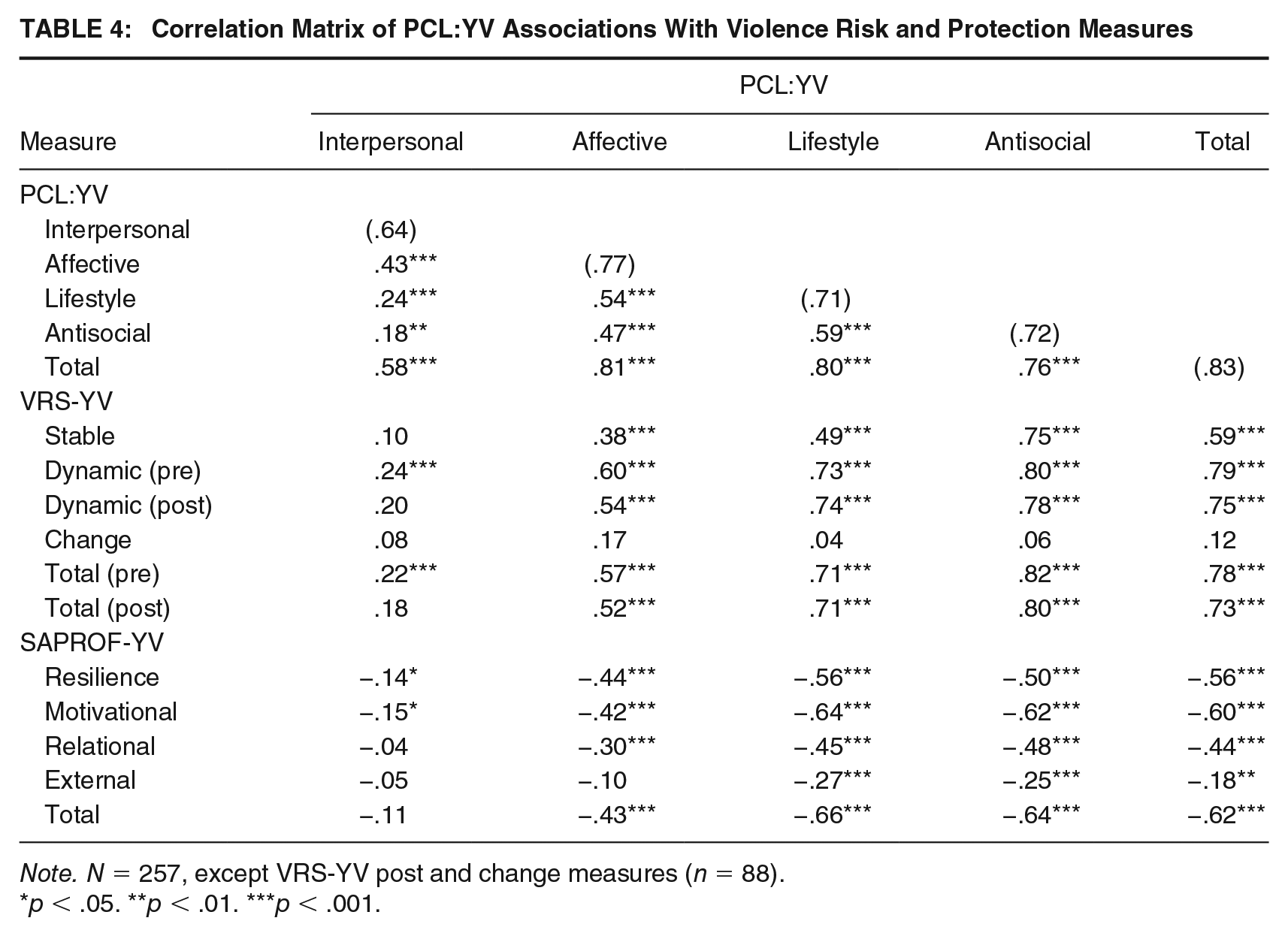
Note. N = 257, except VRS-YV post and change measures (n = 88).
p < .05. **p < .01. ***p < .001.
Predictive Accuracy of PCL:YV Scores as a Function of Gender and Ethnoracial Heritage
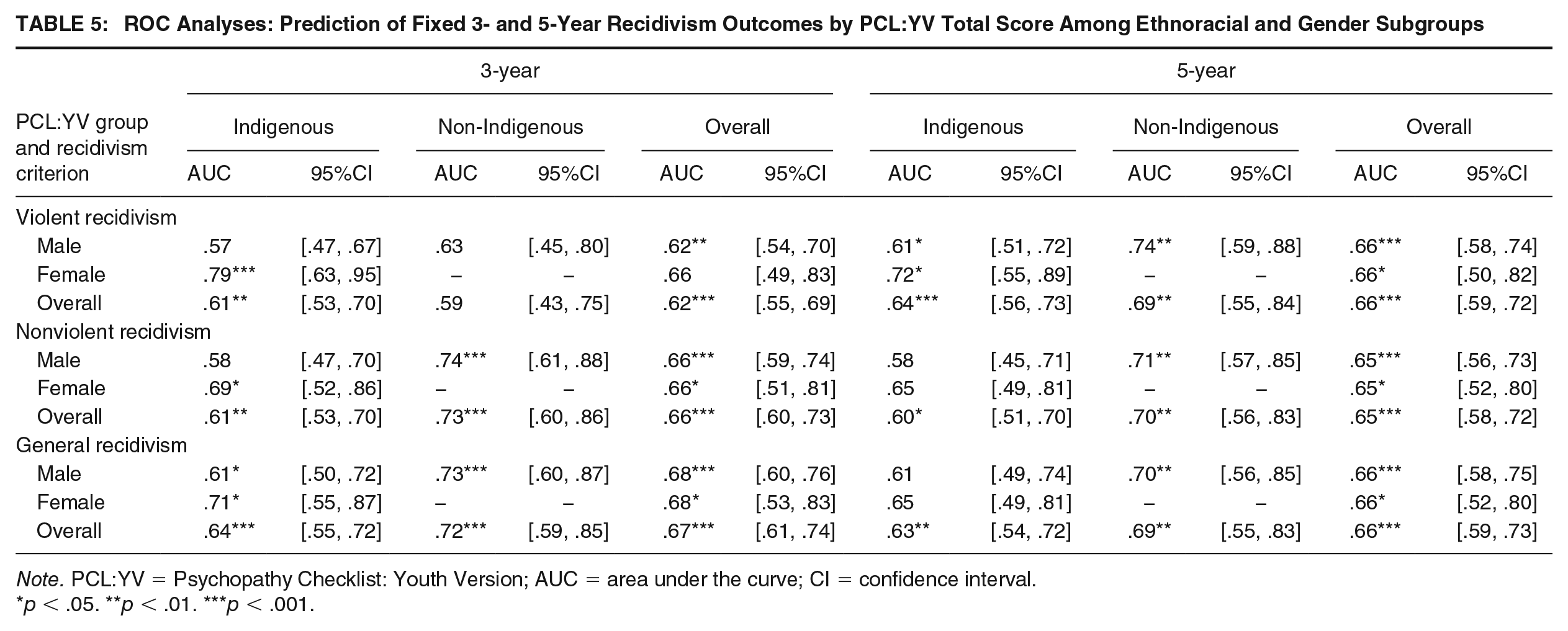
Table 5 reports predictive accuracy results (ROC analyses, AUC) for PCL:YV total scores with 3- and 5-year violent, nonviolent, and general recidivism overall and among gender × ethnoracial subgroups. In the aggregate sample overall, PCL:YV scores had broadly medium effects in the prediction of each of the recidivism outcomes over both follow-ups. AUC magnitudes were also largely equivalent between male and female groups (medium effects), with the exception of a small effect in the prediction of 3-year violence for male youth. Across broad ethnoracial groups, PCL:YV scores showed the greatest parity in the prediction of violence and some disparity in the prediction of nonviolent and general recidivism. Specifically, PCL:YV scores had small effects in the prediction of 3-year violence and medium effects in the prediction of 5-year violence across Indigenous and non-Indigenous groups. It had small effects in the prediction of nonviolent recidivism for Indigenous youth (compared to medium to large effects for non-Indigenous youth), and small to medium effects in the prediction of general recidivism for Indigenous youth (compared to medium to large effects for non-Indigenous youth); none of these AUC differences reached statistical significance.
ROC Analyses: Prediction of Fixed 3- and 5-Year Recidivism Outcomes by PCL:YV Total Score Among Ethnoracial and Gender Subgroups
Note. PCL:YV = Psychopathy Checklist: Youth Version; AUC = area under the curve; CI = confidence interval.
p < .05. **p < .01. ***p < .001.
When predictive properties were examined within gender-ethnoracial subgroups, for female Indigenous youth, large prediction effects were observed for violent recidivism and 3-year general recidivism, and medium effects were found for the remaining outcomes (AUCs are not reported for female non-Indigenous youth owing to the extremely small cell n). A similar pattern emerged for male non-Indigenous youth, for whom PCL:YV scores had large effects in the prediction of nonviolent recidivism, 3-year general, and 5-year violent recidivism, and a small effect for 3-year violence and medium effect for 5-year general recidivism. By contrast, for male Indigenous youth, PCL:YV total scores had small prediction effect sizes for all three outcomes across both follow-ups. For the PCL:YV facets (not reported for space considerations), the Lifestyle and Antisocial factor scores tended to have the most consistent associations with violent, nonviolent, and general recidivism (see Supplementary Table S1 for full facet level AUC prediction findings).
Incremental Associations of Psychopathy, Protective Factors, Violence Risk, and Change
A series of hierarchical Cox regression survival analyses were conducted examining the incremental associations of PCL:YV, SAPROF-YV, and VRS-YV scores to violent, nonviolent, and general recidivism across three sets of models: a pretreatment (i.e., baseline risk and protection) model, posttreatment model, and change model. A set of Kaplan–Meier survival analyses followed to unpack the psychopathy, protective factors, and recidivism associations.
Psychopathy, Protective Factors, and Recidivism
The first block (1a) of the Cox regression survival analyses found both PCL:YV scores and SAPROF-YV total scores incremented the prediction of the three recidivism outcomes in their expected direction. That is, higher levels of psychopathy predictably were associated with higher and faster rates of reoffending across all outcomes, while this was offset by higher levels of protective factors, which were associated with lower and slower rates of reoffending. A set of Kaplan–Meier survival analyses further illustrated how the risk aggravating properties of psychopathy are offset by the risk-mitigating properties of protective factors, by way of comparing recidivism trajectories in high- versus low-psychopathy (PCL:YV total 20+ vs <20) and high- versus low-protection groups (SAPROF-YV total 8+ vs <8). As seen in Figure 1, youth with high psychopathy and low protection had significantly higher rates of each recidivism outcome over time compared to similarly high-psychopathy youth who also scored above the mean on protective factors (see Supplementary Table S2 for full survival analysis results). Moreover, youth who were either high on psychopathy or low on protection, had virtually indistinguishable trajectories of recidivism, while youth who were both low psychopathy and high on protection had the shallowest trajectories of each recidivism outcome.
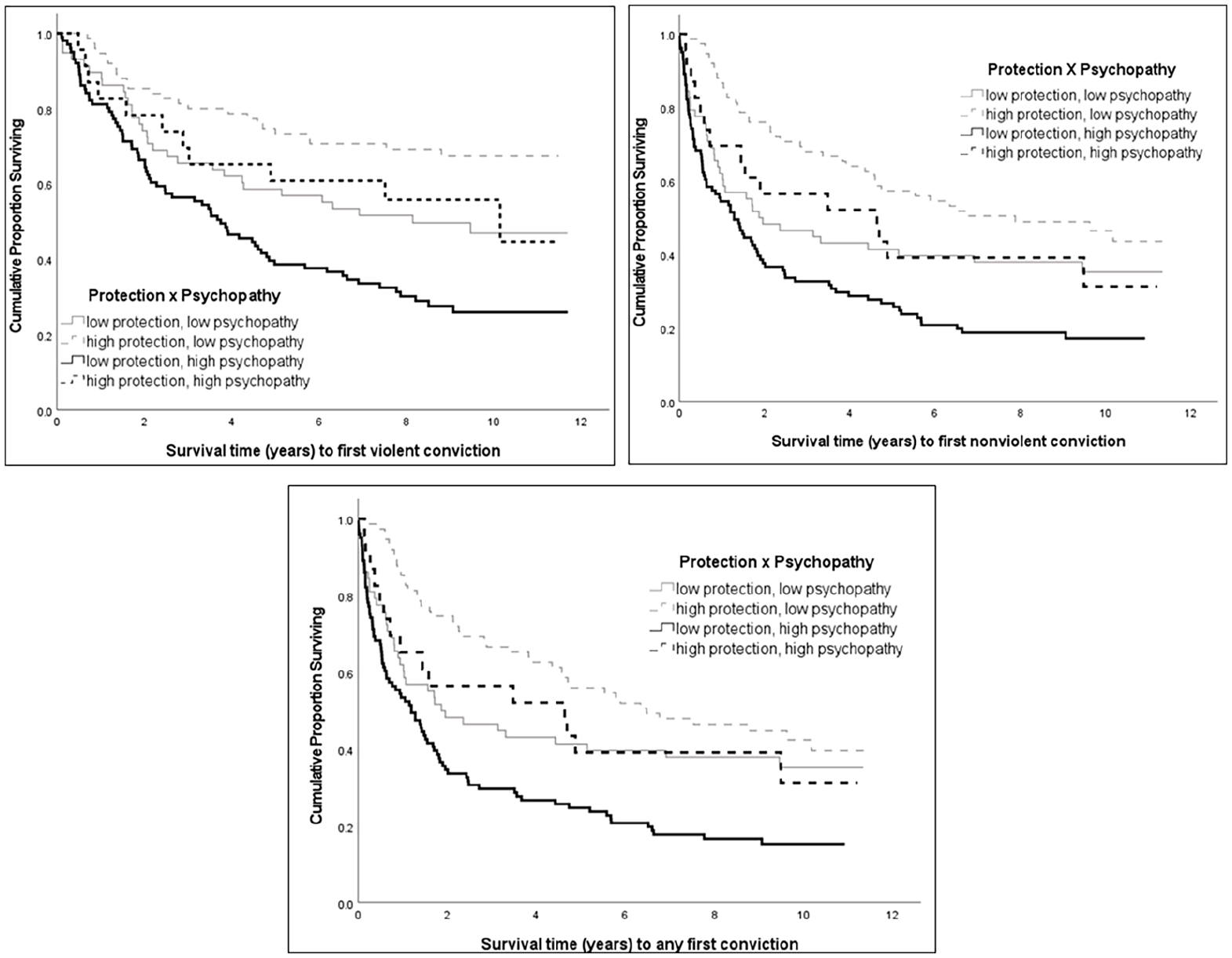
Survival Analysis: Trajectories of Recidivism as a Function of Psychopathy (PCL:YV) and Protection
Psychopathy, Protective Factors, Violence Risk, and Change
The remaining Cox regression survival analyses in Table 6 examined the intersection of psychopathy, protective factors, violence risk, and change to recidivism over time. The first block (1b) of the baseline pretreatment model found that only dynamic factor scores uniquely predicted any of the recidivism outcomes, notably violent and nonviolent recidivism, controlling for PCL:YV and stable factor scores. When SAPROF-YV scores were added to the baseline pretreatment model (block 2), although most predictor-criterion associations were in the expected direction, none attained significance. In the posttreatment model, despite featuring only one third of the sample (n = 88), posttreatment VRS-YV dynamic scores incrementally predicted all three recidivism outcomes, including violence over time, while none of the other model predictors had significant unique associations with any outcomes. In the final change model, which disaggregates the VRS-YV posttreatment dynamic score into separate pretreatment dynamic and change components, dynamic factor scores continued to uniquely predict increases in each recidivism outcome. VRS-YV change scores were also significantly associated with decreased nonviolent and general recidivism after comprehensive controls for baseline risk; however, none of PCL:YV scores, stable factors, or protective factor scores incremented predictions of any recidivism outcomes.
Hierarchical Cox Regression Survival Analyses: Incremental Associations of Psychopathy, Protective Factors, Violence Risk, and Change Measures With Recidivism
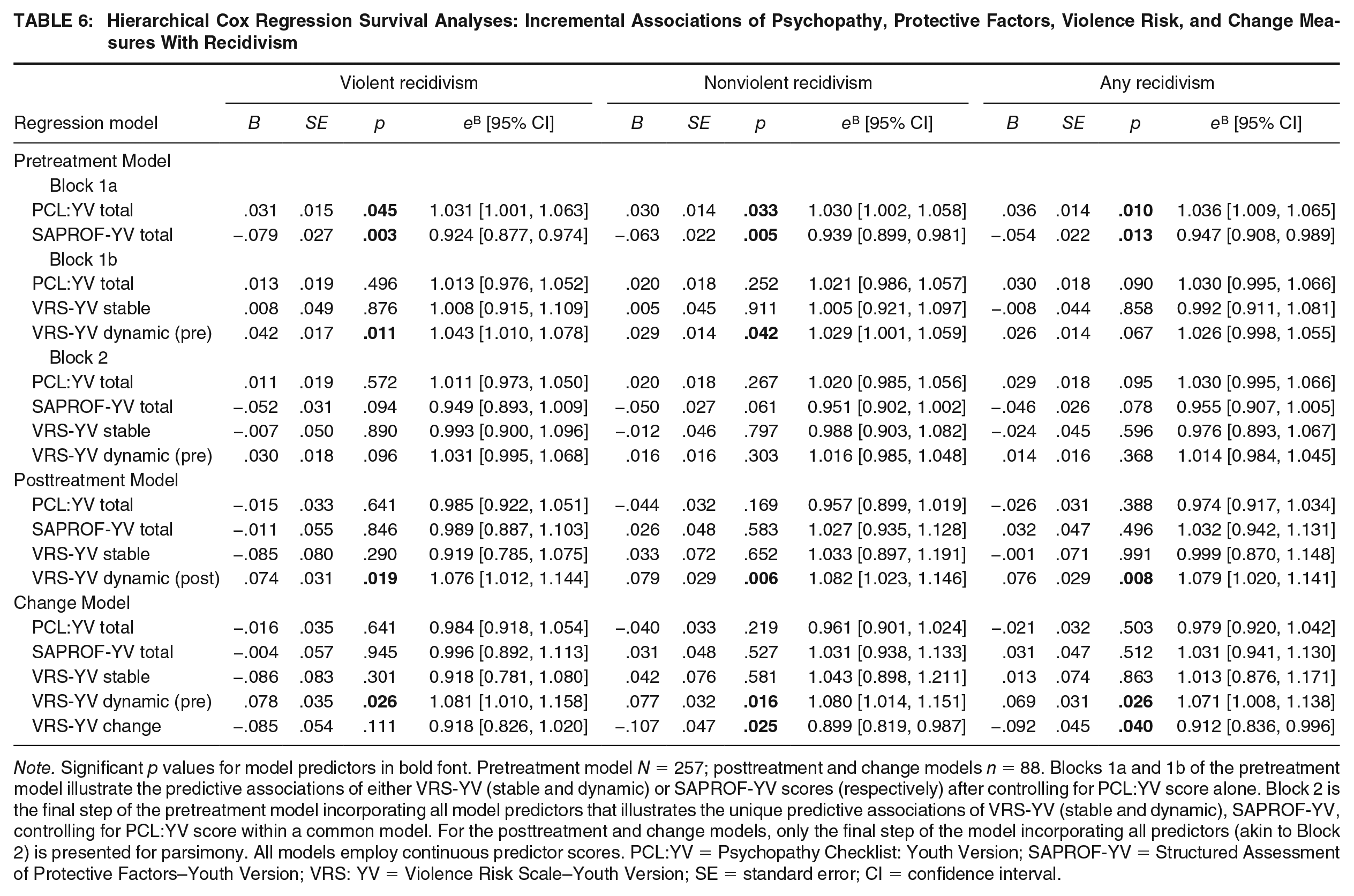
Note. Significant p values for model predictors in bold font. Pretreatment model N = 257; posttreatment and change models n = 88. Blocks 1a and 1b of the pretreatment model illustrate the predictive associations of either VRS-YV (stable and dynamic) or SAPROF-YV scores (respectively) after controlling for PCL:YV score alone. Block 2 is the final step of the pretreatment model incorporating all model predictors that illustrates the unique predictive associations of VRS-YV (stable and dynamic), SAPROF-YV, controlling for PCL:YV score within a common model. For the posttreatment and change models, only the final step of the model incorporating all predictors (akin to Block 2) is presented for parsimony. All models employ continuous predictor scores. PCL:YV = Psychopathy Checklist: Youth Version; SAPROF-YV = Structured Assessment of Protective Factors–Youth Version; VRS: YV = Violence Risk Scale–Youth Version; SE = standard error; CI = confidence interval.
Gender and Ethnoracial Moderators: Psychopathy, Protection, and Violence Risk
The final set of hierarchical Cox regressions examined variations on the baseline pretreatment models employing the most recent dynamic factors assessment across gender and ethnoracial subgroups (Table 7). The results are interpreted with caution given that none of these regression models could directly examine changes in risk and owing to fluctuating and some small cell sizes, some of regression models would be underpowered. Furthermore, combining gender groups within an ethnoracial category and vice versa due to sample size limits, invariably muddies interpretation and the results may not generalize to the individual gender or ethnoracial groups subsumed within the larger aggregate category. We believed, however, that the nature and strength of some of the observed predictor-criterion associations and the importance of the conclusions emanating from these analyses both justified and necessitated their execution, and offset the limitations inherent within these analyses.
Hierarchical Cox Regression Survival Analyses: Incremental Associations of Psychopathy, Protective Factors, and Violence Risk Measures With Recidivism among Gender and Ethnoracial Groups
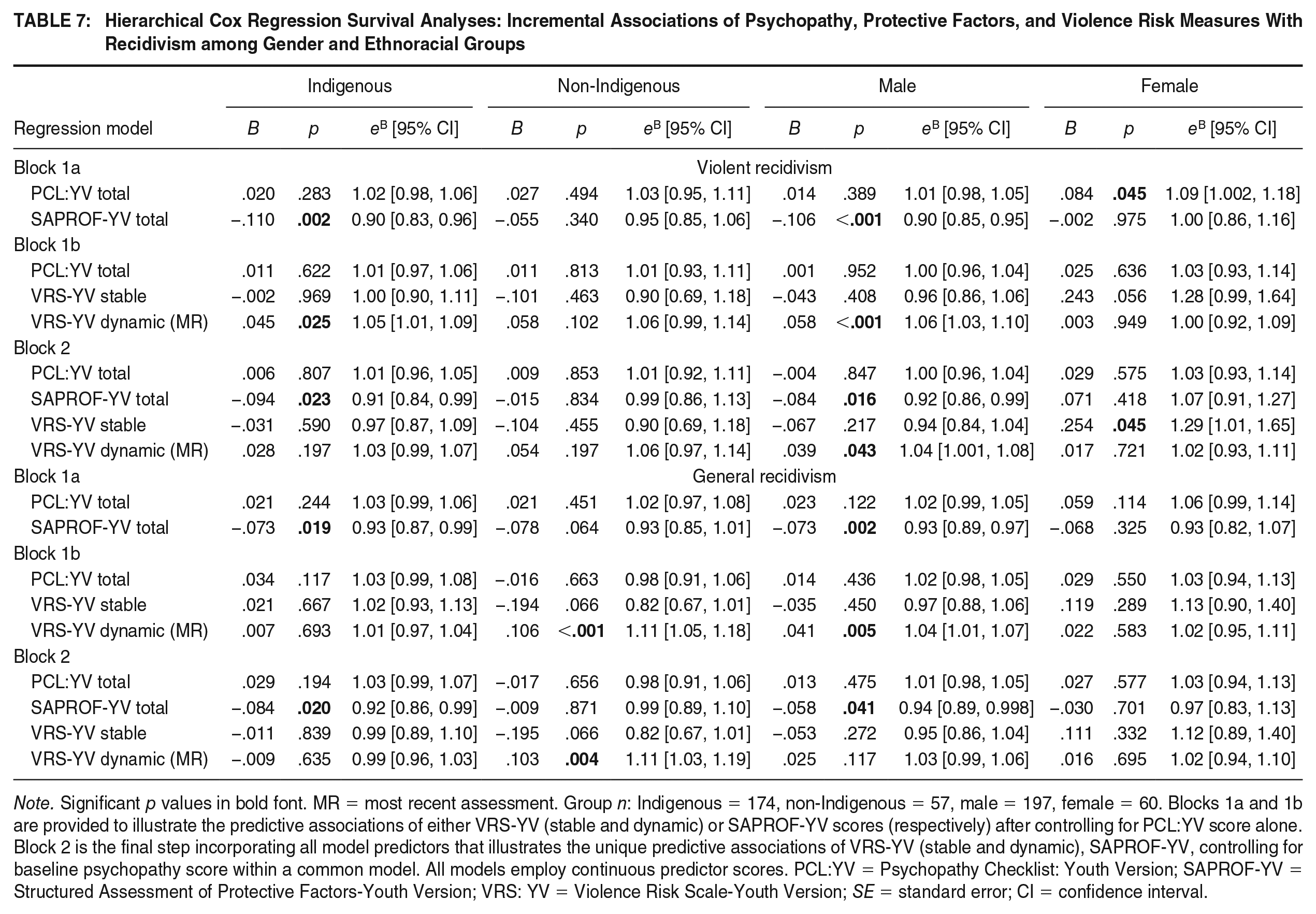
Note. Significant p values in bold font. MR = most recent assessment. Group n: Indigenous = 174, non-Indigenous = 57, male = 197, female = 60. Blocks 1a and 1b are provided to illustrate the predictive associations of either VRS-YV (stable and dynamic) or SAPROF-YV scores (respectively) after controlling for PCL:YV score alone. Block 2 is the final step incorporating all model predictors that illustrates the unique predictive associations of VRS-YV (stable and dynamic), SAPROF-YV, controlling for baseline psychopathy score within a common model. All models employ continuous predictor scores. PCL:YV = Psychopathy Checklist: Youth Version; SAPROF-YV = Structured Assessment of Protective Factors-Youth Version; VRS: YV = Violence Risk Scale-Youth Version; SE = standard error; CI = confidence interval.
The male subgroup, and the largest of the subgroups, found that VRS-YV dynamic scores and SAPROF-VY scores each incremented predictions of violence controlling for the VRS-YV and that in the final model (block 2), both dynamic risk factors and protective factors each uniquely predicted future violence in their expected direction. A similar theme was observed for general recidivism, only in the second block of analyses, dynamic scores did not reach significance. Paradoxically, in the female only regression models, psychopathy ratings trumped protective factor ratings in the prediction of violence (block 1a) and only VRS-YV stable scores uniquely predicted future violence in the final regression model (block 2); none of the predictors demonstrated incremental prediction of general recidivism. Among Indigenous youth in a combined male–female subgroup, dynamic factor and protective factor ratings each incremented the prediction of violent recidivism, while PCL:YV score did not, and in the final model (block 2), only SAPROF-YV scores reached significance; dynamic factor ratings, although in the expected direction, did not retain significance. Furthermore, only SAPROF-YV scores incremented predictions of general recidivism for Indigenous youth. By contrast, for non-Indigenous youth, VRS-YV dynamic item ratings consistently incrementally predicted general recidivism, while none of the other model predictors had significant associations with outcome.
Discussion
Juvenile Psychopathy and Protective Factors: Unpacking the Association
This study examined the intersection of psychopathy, violence risk, protective factors, and treatment change with recidivism in an ethnoracially diverse sample of male and female court-adjudicated youth. Protective factors were fewer in number for high-psychopathy youth; the greater the number of juvenile psychopathy features, the fewer protective factors a given youth tended to have. This inverse association between juvenile psychopathy and protection was observed across ethnoracial and gender subgroups; all of which have implications for the adaptation of services suited to the unique characteristics of clientele to cultivate and harness strengths to increase treatment buy-in, minimize attrition, and maximize gain, per the responsivity principle. The disparity was most notable for the resilience, motivational, and relational domains (and by default, the total score) but less so for the external domain. The external domain refers to the availability of external supports and resources to the youth, whether they are fully utilized or not, and although these should be prioritized for higher risk, higher psychopathy youth (per the risk principle), they may not be. The other protective domains reflect the use of internal, psychological, and behavioral resources such as self-control and healthy coping (resilience), positive, and effortful engagement in prosocial systems such as engaging in school/work, meaningful leisure, or having a positive attitude toward authority (motivational), or close connectedness with prosocial others (relational). To the extent that youth struggle with motivation, task completion, prosocial orientation, emotional bonding, or have largely dysfunctional familial and social networks, will they score lower on these domains; and high-psychopathy youth are unfortunately likely to have many such concerns that undermine the development and expression of protective factors. This may explain for instance, why inverse associations were most notable with the affective, lifestyle, and antisocial features, but not so with the interpersonal domain. Arguably, some of the features of the interpersonal domain, if prosocially channeled, may have adaptive qualities (e.g., charm and volubility, persuasive qualities, and intact self esteem).
Protective Factors and Risk Mitigation in High-Psychopathy Youth
The above being said, youth with higher levels of psychopathy did have protective factors, and per Olver and Riemer’s (2021) findings with a large treated adult sexual offending sample, higher levels of protection appeared to have risk-mitigating properties, although the baseline was low. On average, youth in this sample, who tended to be broadly medium to high risk and had committed serious crimes, scored only 7 out of what would be a maximum possible 32 points, when summing the items on the SAPROF-YV; and for youth lower in psychopathy versus those who were high, the ratio of protective factors was about 2 to 1. For high-psychopathy youth scoring above average on protective factors, however, the results of survival analysis demonstrated that they had significantly lower rates of future violence and other outcomes over time than similarly high-psychopathy youth without the same number and quality of protective factors. Overall, both PCL:YV scores and SAPROF-YV ratings uniquely predicted recidivism, that is, SAPROF-YV scores mitigated risk, but youth with higher PCL:YV scores still posed a greater recidivism risk than youth with lower scores; put another way, with enough protective factors, it is possible that these can offset the risk aggravating qualities of juvenile psychopathy.
Direct comparisons between high-psychopathy youth who were high versus low on protective factors demonstrated significant differences on each of the SAPROF-YV domains (around or exceeding a full standard deviation), and these differences were cumulative; however, high-psychopathy high-protection youth also had fewer static and dynamic risk factors, and hence were also lower risk. The key seems to be risk relevance—in order for protective factors to have risk-mitigating qualities, these factors must be antithetical to risk—prosocial, realistic, attainable, and time limited, such as engaging meaningfully with school or work, having an influential prosocial caregiver or support person, or ready access to prosocial cultural, spiritual, or leisure pursuits. A further candidate is access to risk-reduction treatment that can promote the development of prosocial competencies, skills, and strategies that can offset risk for crime and violence, and increase the potential for positive outcomes, per the risk and need principles.
Dynamic Violence Risk and Treatment Change in Juvenile Psychopathy
A growing literature, primarily with high-psychopathy adult populations, has demonstrated meaningful engagement in treatment to be associated with decreased recidivism outcomes (e.g., Langton et al., 2006; Olver & Riemer, 2021; Skeem et al., 2002; Wong et al., 2012). This too was found in this study, whereby changes in violence risk, as measured by the VRS-YV, in a subsample of youth who participated in treatment services and had sufficient documentation available to evaluate change, were significantly associated with decreased nonviolent and general recidivism, after controlling for individual differences in static and dynamic risk factors, as well as PCL:YV score. Moreover, in these regression models, PCL:YV score and static/stable factors did not increment predictions of recidivism, while dynamic factors and change did. In other words, youth who engaged meaningfully and were rated as having reduced their violence risk had lower rates of adverse outcomes, irrespective of psychopathy or static/historical factors. The results extend findings elsewhere that show serious youth justice populations change on dynamic risk factors with appropriate intervention (e.g., Viljoen et al., 2017). Furthermore, those youth who were higher risk and thus stood to benefit the most from services (i.e., had greater criminogenic need and hence, the most room for change), would have derived greater benefit than lower risk youth, per the risk principle (Bonta & Andrews, 2024).
Ethnoracial and Gender Implications for Protective Factors and the Juvenile Psychopathy Construct in Violence Risk Assessment and Management
Consistent with the Olver et al. (2024) meta-analysis (which included unpublished data from this study among the studies included in the final aggregation), PCL:YV scores were significantly higher overall, by about one-third of a standard deviation (small effect), for Indigenous male and female youth, with the difference explained primarily by higher scores on the lifestyle and affective facets. Furthermore, PCL:YV scores predicted their targeted outcomes with small to medium effects for violence in Indigenous and non-Indigenous subgroups, small effects for nonviolent recidivism (vs medium to large for non-Indigenous youth), and small to medium effects for general recidivism (vs medium to large for non-Indigenous youth). When these bivariate associations were examined intersectionally, there was a notable disparity in the predictive accuracy of PCL:YV scores for male versus female Indigenous youth; specifically, the PCL:YV registered consistently small effect sizes for male Indigenous youth, but medium- to large-effect sizes for female Indigenous youth.
A set of targeted Cox regressions examining variations on a baseline pretreatment model generally supported the value of dynamic risk and protective factors even from a pure prediction standpoint. Among male youth, close to the prototypical or ideal scenario statistically was observed, with dynamic risk factors uniquely predicting increased violent recidivism, and protective factors, decreased violent recidivism. A similar trend for the aggregate Indigenous sample was observed with respect to violence, although for any future recidivism, only protective factors uniquely predicted this outcome. The opposite seemed to be the case for non-Indigenous youth and female youth; protective factor ratings did not incrementally predict any outcomes. For non-Indigenous youth, dynamic factor ratings had unique prominence (but the associations achieved significance only in the general recidivism model), and for female youth, stable factor and psychopathy ratings had the most predictive strength, and only for future violence. Given that dynamic risk and change could not be examined within the subgroups owing to sample size limits, which also precluded specific gender-ethnoracial subgroup analyses, and the fact that some of these regressions were underpowered, caution is warranted in interpreting these associations, but we believe some conclusions are clear.
One conclusion is that protective factors can have value added to measures of static and dynamic risk and vice versa, and this was most evident in sufficiently powered regression models; however, when the dynamic measures are assessed in a dynamic manner (i.e., at two or more timepoints) and incorporated measures of risk change, baseline assessments of protective factors added little to predictive validity. Elsewhere, in another Canadian sample, Finseth et al. (2023) found SAPROF-YV scores incrementally predicted decreased general recidivism controlling for scores on a general risk-need measure among Black youth, but not for White youth. Of note, both sets of measures were administered at only one time point, so conclusions could not be drawn about situating protective factors within dynamic assessments of risk and need. As such, further research is warranted to compare changes in protection to changes in risk to see if each add unique information toward predicting recidivism outcome (e.g., de Vries Robbé et al., 2015a; Olver & Riemer, 2021), including in diverse samples.
A second conclusion is to underscore the value of dynamic risk factors, both from a recidivism prediction as well as risk reduction and recidivism prevention standpoint. This was also readily apparent from the capacity for dynamic factor ratings to incrementally predict most outcomes, particularly violence, above and beyond static/stable factors, but not vice versa. Especially for Indigenous correctional populations, the incorporation of dynamic and protective factors can offset biases inherent in unduly weighting historic factors, and provide a positive and rehabilitative angle toward prosocial community reintegration and the prevention of recidivism.
A third conclusion is casting the juvenile psychopathy construct within a realistic light; when valid measures of risk and protection are available, the unique predictive properties of the construct seemed to take a backseat. Longitudinal investigations of juvenile psychopathy in youth populations also show that measures of the construct can change over time and follow different developmental trajectories, one of which includes decreases in psychopathy features and concordant crime and aggression (Hawes et al., 2018). This does not diminish the relevance of juvenile psychopathy in forensic risk assessment, but rather, that high juvenile psychopathy ratings are not all defining; they do not place limits on the capacity for prosocial change or determine outcome for youth. This is important to bear in mind, given that juvenile psychopathy evidence has increased in youth court cases in North America in recent years and has been found to be influential for some decisions (Viljoen et al., 2010).
With all this said, a note is warranted about the hierarchical Cox regression findings for female youth; the initial report from this data set demonstrated that VRS-YV and SAPROF-YV ratings each predicted recidivism in bivariate analyses with female youth (Lovatt et al., 2022), but in this study, when entered into a Cox regression model along with PCL:YV ratings, they did not uniquely predict outcome. We do not believe this finding diminishes the value of dynamic or protective factor ratings for female youth, and given the small female subsample and its diversity, the results of a multipredictor regression need to be interpreted with caution, and the analyses should be replicated on a larger sample. From our clinical experience working with justice-involved youth, we believe the findings reflect the nature and lived experiences of this court-adjudicated female sample, in which elevated levels of juvenile psychopathy and severity of history, notably violence background and an unstable chaotic upbringing, are prominent, and have important clinical and forensic relevance.
Strengths, Limitations, and Future Directions
This study has notable strengths and limitations with implications for further research and practice. This work featured a diverse sample of male and female youth, comprehensive information sources to obtain quality data, and sufficient intervention information to evaluate changes in risk for about one third of the sample. These conditions facilitated gathering data regarding the predictive properties of risk, treatment change, and protective measures situated within the clinical construct of juvenile psychopathy. The findings we hope, offer cautious optimism and a rejoinder about the immutability of high-psychopathy youth and the presence of strengths and resiliencies to mitigate risk. Furthermore, the diverse nature of sample enabled examination of key clinical research questions among diverse subgroups. Most analyses were sufficiently powered to make inferences pertaining to broad gender and ethnoracial groups, and in some cases (e.g., PCL-R bivariate recidivism associations), specific intersectional gender-ethnoracial subgroups (e.g., Indigenous male and female persons). That said, although the sample was sufficiently large to power most analyses, perhaps the most significant limitation was insufficient n to conduct a greater number of specific gender-ethnoracial analyses, particularly for multipredictor regression models. Moreover, only one-third of the sample had participated in some form of structured forensic treatment intervention with sufficient information available to evaluate changes in violence risk, which reduced statistical power to some degree and also made subgroup analyses of treatment-related risk change untenable.
Thus, these findings need to be replicated and extended to additional samples and settings to permit more nuanced examination of risk, treatment change, and protection, in an intersectional manner. To start, the dynamic and responsive properties of measures of protection in youth samples require further investigation. Research on criminogenic risk factors for adults and youth has begun exploring the relevance of other culturally salient factors (e.g., gender, Indigeneity), but these lines of inquiry have yet to be pursued with measures of protective factors to better understand if there are culturally specific areas of protection that may not be tapped by extant tools. Further research is also required on high risk-need subsamples of justice-involved youth; these are the very youth that stand to benefit the most from risk-reduction services, and these youth often present with specific responsivity considerations to be effectively addressed in treatment. As such, a better understanding of the relationship between risk-need and protection, in treated samples is critical to inform clinical practice and juvenile justice decision making.
Supplemental Material
sj-docx-1-cjb-10.1177_00938548241307235 – Supplemental material for The Intersection of Juvenile Psychopathy, Protective Factors, Treatment Change, and Diversity in Justice-Involved Youth
Supplemental material, sj-docx-1-cjb-10.1177_00938548241307235 for The Intersection of Juvenile Psychopathy, Protective Factors, Treatment Change, and Diversity in Justice-Involved Youth by Kristine M. Lovatt, Keira C. Stockdale and Mark E. Olver in Criminal Justice and Behavior
Footnotes
Authors’ Note:
Funding for this research was provided from a University of Saskatchewan Centre for Forensic Behavioral Science and Justice Studies graduate student research grant, awarded to Kristine Lovatt. The views, opinions, and assumptions expressed in this paper are those of the authors and do not necessarily reflect the views or official positions of the Saskatchewan Health Authority, Correctional Service of Canada, or the University of Saskatchewan. The authors thank Jessica Prince for her contributions to data collection and to the Young Offender Program, Mental Health and Addiction Services Saskatchewan Health Authority; Saskatchewan Ministry of Justice: Corrections and Policing; and the Saskatchewan Law Courts for their support of this research. Keira Stockdale and Mark Olver are co-authors of Violence Risk Scale-Youth Version (VRS-YV) materials and have occasionally received remuneration for training and consultation services with the tool. As this study features the use of protected or copyrighted materials to collect highly sensitive data on a vulnerable population, the data, as well as most study measures, are not publicly available; the VRS-YV is available on request from the study authors (see correspondence details) or through  . This study was not preregistered.
Supplemental Material
References
Supplementary Material
Please find the following supplemental material available below.
For Open Access articles published under a Creative Commons License, all supplemental material carries the same license as the article it is associated with.
For non-Open Access articles published, all supplemental material carries a non-exclusive license, and permission requests for re-use of supplemental material or any part of supplemental material shall be sent directly to the copyright owner as specified in the copyright notice associated with the article.
