




Abstract
Core normative value theory asserts that perceptions of the legitimacy of law enforcement authorities are not just a product of these agencies’ conduct and performance, but are also based on deeply embedded ideological worldviews. This study further tests the theory, exploring the diverse relationships between values and legitimacy in multicultural societies. We use Israel’s highly divided society as a case study. Our data were derived from a survey among a representative sample of more than 1,600 Israelis from seven social groups—mainstream Jews, ultra-Orthodox Jews, Jewish residents of the occupied territories, immigrants from the former Soviet Union, Druze, Muslims, and Arab Christians. The results point to significant differences in levels of the core normative values and legitimacy across the seven groups, and differences between the groups in associations between the values and legitimacy, controlling for socio-demographic variables. The findings support the main premises of the theory.
Keywords
There is growing recognition that beyond procedural justice and the performance of law enforcement institutions, there exist other factors that may affect people’s perceptions of, and attitudes toward, such institutions (see Albrecht & Green, 1977; Beetham, 1991; Bottoms & Tankebe, 2012; Bradford & Jackson, 2018; Fine et al., 2019; Jonathan-Zamir et al., 2024; Roché & Roux, 2017; Zelditch, 2001). 1 These factors may include political and social inclinations and preferences, as well as individual normative values (see Factor & Mehozay, 2023; Mehozay & Factor, 2017; Skitka, 2002). In general, this scholarship complements the body of criminological research on legitimacy and compliance with law enforcement authorities (see Hinds & Murphy, 2007; Mazerolle et al., 2013; Sunshine & Tyler, 2003; Tyler, 1990; Weisburd et al., 2022).
Following this direction, core normative value theory (Mehozay & Factor, 2017) questions the notion that legitimacy should be studied only as a rational construct. It examines instead whether the antecedents of legitimacy perceptions toward law enforcement authorities also include deeply embedded core normative values, particularly in culturally divided societies characterized by internal value conflicts and gaps. In such societies—which arguably include most contemporary states—it is reasonable to assume that legitimacy and obedience to law enforcement authorities will not depend solely on the conduct and performance of the police. In other words, legitimacy will vary even absent objective differences in how representatives of the law implement their authority.
In this article, we further explore the impact of core normative value theory by focusing specifically on the relationship between core normative values and legitimacy at the group level. We suggest that different social groups will perceive law enforcement agencies as legitimate to greater or lesser degrees, and that these differences will reflect each group’s socio-political and cultural history and status—for example, majority versus minority group; level of social marginalization; and racial, ethnic, or national conflict with the dominant group. 2 In addition, we argue here that different social groups will be characterized by particular sets of core normative values, which may be more or less embedded in individuals within the group. Accordingly, people within any given social group will have different perceptions of legitimacy based on the degree to which they adhere to certain core values, and these differences will vary in their effects depending on the nature of the values: Some will increase legitimacy, while others will lessen it.
We use seven social groups in Israel as a case study, exploiting some of that country’s known social divisions (see, inter alia, Barzilai, 2003; Kimmerling, 2004; Shafir & Peled, 2002) to examine core normative value theory and the predicted associations with legitimacy. It is important to note that we do not claim here to study Israeli society per se, but rather employ Israel as a case study to examine the theory. Moreover, while Israel is clearly qualified to serve as a case study, it is obviously not the only possible one.
Core Normative Values
As noted, this study builds on the general hypothesis that beliefs about the legitimacy of law enforcement authorities derive in part from core normative values. It rests on the understanding that these embedded value-laden worldviews serve as a lens through which people interpret and form opinions about the world (Factor & Mehozay, 2023; Mehozay & Factor, 2017). These worldviews act as external sources of judgment and thus antecede perceptions of legitimacy separately from direct judgments of law enforcement authorities’ conduct and performance. It should be stressed that this theory does not exclude other social or personal factors as additional, coexisting antecedents of legitimacy (e.g., class).
Core normative value theory, as defined in previous studies (Mehozay & Factor, 2017), centers on four sets of foundational value perceptions: the religious–traditional, liberal, republican–communitarian, and ethno-national. According to the theory, the religious–traditional core normative value system is based not just on strong spiritual beliefs, but even more on actively being a member of a devout community, and engaging in particular everyday practices as part of this community. People who adhere to a religious–traditional value system maintain that religious laws and traditions should be publicly practiced with the support of the state, or at least with no official opposition. This position is obviously a source of tension in societies organized on the common Western state model. As such, the theory hypothesizes that in such societies, a religious–traditional core normative value system will be negatively associated with a belief in the legitimacy of law enforcement authorities.
The liberal core normative value system is based on the sanctity of human dignity and personal liberty. In this view of the world, all rights are given by birth, and the state’s role is to protect and preserve these rights but otherwise remain neutral. Accordingly, people’s identities should not determine their rights. Because in general this understanding is part of the foundation of the Western state model, it is expected that this value system will be positively associated with the legitimacy of state institutions and agencies, including law enforcement authorities.
The republican–communitarian core normative value system emphasizes active citizenship. Here, unlike in the liberal value system, freedom derives from participating in the political life of one’s community and state (i.e., fulfilling one’s civic virtue). Moreover, unlike the religious–traditional and ethno-national value systems, republicanism does not define what the common good should be; it only demands participating in the pursuit of the common good. Legal institutions, including enforcement agencies, are taken to operate as part of this pursuit. Thus, according to core normative value theory, it is expected that a republican–communitarian value system will be positively associated with the legitimacy of law enforcement authorities.
Finally, according to the ethno-national core normative value system, only those who share the ethnic identity of the community deserve full rights. While a shared religion may be associated with an ethno-national identity, it is the exclusive nature of the community, rather than religion itself, that defines this value system. The community’s ethno-national identity is often also based on shared history, culture, and language. In consequence, according to this core belief structure, the state should support and promote the ethnic community above all other social groups. A state that fails to give preferential treatment to the preferred ethnos, but that acts to promote civil equality, is considered derelict in its duty. Because the Western state model opens the door to a wide range of possible tensions and fractures between the ethnic community and the state, the theory hypothesizes that an ethno-national value system will tend to be negatively associated with the legitimacy of law enforcement authorities (Mehozay & Factor, 2017).
This Study: Social Groups in Israel
The impact of core normative value systems is particularly significant in multinational, multicultural, and diverse societies such as Israel (Factor & Mehozay, 2023). Israel is deeply divided, and its social groups differ in their identity, socioeconomic status, social norms and values, political status, history, and sometimes even language. It is well-established that given these divisions, different social groups in Israel hold different general attitudes, perceptions of legitimacy, and levels of obedience to the law (see Al-Haj, 2002; Factor et al., 2013, 2014; Hasisi, 2008; Hasisi & Weitzer, 2007; Kimmerling, 2004; Rattner & Yagil, 2004; Shafir & Peled, 2002; Weisburd, 1988). As such, Israel serves as an ideal setting for this study.
In this study, we test the core normative value theoretical model with respect to seven recognizable social groups: mainstream Jews, ultra-Orthodox Jews, Jewish residents of the occupied territories (OT), immigrants from the former Soviet Union (FSU), Druze, Muslims, and Arab Christians. The first four groups (with some caveats for the fourth, described below) belong to the roughly 74% of Israel’s population identified by Israel’s Central Bureau of Statistics (2020) as Jewish at the time of the study. The latter three belong to Israel’s minority Arab population. For the purposes of this study, we identify a significant social group within Israel’s Jewish majority that we title mainstream Jews. We acknowledge that this is not a homogeneous group (e.g., it includes both Ashkenazi and Mizrachi 3 Jews). Still, all members of this group share a common Israeli majority identity—nationally Jewish, living within Israel’s pre-1967 borders, and predominantly secular in their beliefs and practices. 4 As the group that represents the Israeli majority identity, members of this mainstream group identify with the state of Israel and its institutions and thus generally accept their legitimacy (Factor et al., 2013, 2014).
Ultra-Orthodox Jews are members of a highly religiously devoted group that is socially and culturally set apart from mainstream Jews. The ultra-Orthodox community is estimated to make up about 11% of the Israeli population (Malach & Cahaner, 2020). Ultra-Orthodox Jews tend to adhere to traditional Jewish law (Barzilai, 2003) and traditional authority, with a strong gerontocratic orientation, at the expense of secular state law and state administration. Historically, this group was even anti-Zionist and antagonistic toward the state of Israel (Yagil & Rattner, 2002). Over the years, however, ultra-Orthodox Jews have become more accommodationist and have found ways to participate in government and some elements of broader Israeli society. In recent years, growing right-wing ideology and sentiment have brought this community closer to the Jewish nationalist groups that form the core of our third social group, described below (Yogev, 2022). Still, to date, ultra-Orthodox Jews remain highly isolated from mainstream Jews; they live in segregated neighborhoods and follow a rigid religious lifestyle (with an emphasis on Torah study as a life’s vocation) that keeps them apart from the Israeli labor market and workforce. As a result, they also have higher poverty rates. All told, these positions vis-à-vis Israeli society manifest in negative perceptions of legitimacy toward the Israeli state and its institutions (Malach & Cahaner, 2020; Pedahzur et al., 2000; Rattner & Yagil, 2004), and specifically toward the police, with whom this community has had violent clashes over the years (Brewer et al., 1996; Gilman, 2021).
Jewish residents of the OT form a distinct social group in Israel inasmuch as they are Jewish citizens of Israel who reside in contested territories, which were never officially annexed by the state. This means that Israeli law as such does not apply in these territories, and only indirectly applies to Jewish residents. According to the Central Bureau of Statistics (2020), there are about half a million Jewish residents in the OT, making up about 5% of the Israeli population. While some of these residents moved to the OT for economic reasons, following government offers of generous welfare support (Gutwein, 2006), most are motivated by an ideological drive.
The original Jewish residents of the OT, who are often called settlers, were members of Gush Emunim, a group governed by an ideology rooted in strong, even supremacist, nationalistic, and religious worldviews (Shafir & Peled, 2002). This group is similar to the ultra-Orthodox in the fervency of their religious belief, but unlike the ultra-Orthodox, they combine religious devotion with secular educational principles and a strong nationalist–Zionist creed (Shafir & Peled, 2002). The Jewish national identity and supremacist orientation of this group manifests particularly with respect to land ownership within the biblical borders of the land of Israel, which they argue should be solely in Jewish hands.
Given the strong ethno-nationalist sentiment of this social group, and its active efforts to secure Jewish supremacy in the disputed territories, its members have had numerous clashes with law enforcement authorities over the years (e.g., when these authorities have upheld state policy to restrict expansion of some Jewish settlements in the OT). The most significant rupture, in this respect, occurred when the Israeli government, operating under internal as well as international pressure, withdrew in 2005 from the Gaza Strip and from a small area in the northern West Bank. All told, members of this social group have high potential to be alienated from state policy and to have negative perceptions of legitimacy toward enforcement agencies, chiefly the police (Rattner & Yagil, 2004; Weisburd, 1988; Yagil & Rattner, 2002).
Immigrants from the FSU comprise individuals who immigrated to Israel in the 1990s in a massive wave following the collapse of the USSR. By 2020, more than a million former Soviet citizens had immigrated from across Russia and the other former Soviet states. Despite substantial diversity among FSU immigrants, they were regarded, and also saw themselves, as part of a distinct social group, “Russians” (Kimmerling, 2004). At the time of the study, this community made up about 11% of the Israeli population (Central Bureau of Statistics, 2020).
FSU immigrants are generally secular, with high levels of education (Amit, 2012; Philippov & Knafelman, 2011). This background helped them to bridge cultural gaps with mainstream Jews. All considering, though not without struggles—and despite a tendency to preserve their status as a separate community, with its own linguistic and cultural traditions (Amit, 2012; Leshem & Ne’eman-Haviv, 2013; Shechory & Ben-David, 2010)—immigrants from the FSU were able to integrate into Israeli society relatively successfully (Kimmerling, 2004; Remennick, 2002; Walsh et al., 2015). Politically, the majority of these immigrants hold distinct right-wing tendencies, which can be explained by their common history under Communist rule and the Soviet Union’s subjugation of Jewish culture, both of which manifest in a strong rejection of leftist policies (Kimmerling, 2004). In Israel, despite the fact that about 30% of the FSU immigrants are not formally Jewish according to Jewish religious law (Halacha), this political sentiment has translated into strong Jewish ethno-patriotism toward the state and its institutions (Kimmerling, 2004).
As noted above, the next three groups belong to Israel’s Arab population—a largely nonassimilating minority that comprised about 21% of Israel’s population at the time of the study (Central Bureau of Statistics, 2020). Despite often being lumped together as “Israeli Arabs,” this is a diversified community that includes four main social subgroups: Druze, Muslims, Christians, and Bedouins. (A fifth group, Circassians, are Muslims from the Caucasus, and so are not Arabs.) All of these groups are to some degree subject to discrimination within Israeli society, and generally speaking, they have higher levels of poverty than the Jewish majority (Ben-Porat & Yuval, 2011; Factor, 2018; Hasisi & Weitzer, 2007). Historically, all Israeli Arabs were subject to military law from the inception of the state of Israel in 1948 until 1966. This experience of military rule laid the foundation for these groups’ physical and cognitive separation from the Jewish community and established a long relationship based on dependency (Kimmerling, 2004). Today, perhaps the most prominent expression of discrimination against Israel’s Arab minority relates to land ownership. About 93% of all land within Israel proper is under Jewish ownership or control (Kedar, 2001), and since the establishment of the state, except for urbanization among the Bedouin in southern Israel (the Negev), no new Arab city has been founded. Yet the various subgroups vary in the degree to which they experience discrimination and marginalization.
Based on their size and impact, this study focuses on the first three of these Arab subgroups: the Druze, Muslims, and Christians. The Druze are ethnic Arabs whose religion developed over a 1,000 years ago under the influence of Christianity, Islam, and other belief systems; they comprised about 144,000 people in Israel at the time of the study (Central Bureau of Statistics, 2020). The Druze tend to be culturally conservative; in this respect, as we shall see, they are more similar to the Muslim community in Israel than to Arab Christians. Yet, historically, the Druze have been an exception to the rule among Israel’s Arab minority. Their ties with the Jewish majority date back even before the establishment of Israel (Kimmerling, 2004); and in 1957 (i.e., even before the end of military rule), the Druze formally changed their status within Israel: their official national–political identity became “Druze” rather than “Arab,” and Druze men became subject to Israel’s compulsory military service law, which prior to that had applied only to Jews (Kimmerling, 2004). This historical background, and particularly the Druze’s service in the Israeli Army, has been a major source of unity and a sense of shared destiny with the Jewish majority. Thus, in general, members of the Druze community identify with Israeli state institutions and law enforcement authorities (Hasisi, 2008).
Muslims are the largest social group among the Israeli Arab minority, forming about 85% of that sector and about 18% of the total Israeli population (Central Bureau of Statistics, 2020). Despite decades of co-existence, Israel’s Muslim Arab minority has experienced minimal assimilation into Israeli culture and remains to a great extent in conflict with the Jewish majority; concomitantly, it continues to experience high rates of discrimination and poverty (Factor, 2019). Unsurprisingly, there is deep mistrust between Muslims and the Israeli security forces, including, of course, the Israeli police (Hasisi & Weitzer, 2007), a situation exacerbated over the years by a number of violent and deadly clashes between the two. As a result, the Muslim community tends to depend on traditional and informal forms of social control (Sorek, 2011). All told, compared with other social groups in Israel—most evidently subgroups within the Jewish majority, but even the other Arab minority communities—Muslims display more negative perceptions of the police (Hasisi & Weitzer, 2007; Weitzer & Hasisi, 2008). That said, to a substantial extent, as a minority which is in conflict with the majority group, their main refuge is institutions that protect and uphold (albeit imperfectly) civil liberties.
Arab Christians, even more so than the Druze, are a minority within a minority compared with the Muslim Arab population. According to figures, at the time of the study, there were about 136,000 Arab Christians living in Israel, making up about 1.5% of the total population (Central Bureau of Statistics, 2020). Most members of this community live in the northern part of Israel. Generally speaking, they tend to be more urban, culturally Western, and more educated and affluent compared with the Druze and Muslims, and even with respect to the Jewish population (Kimmerling, 2004, p. 379). This is well reflected in the fact that the average age at first marriage in this group is 30.6 years for men and 26.8 for women—both distinctly higher than the average age at first marriage among other social groups in Israel (Central Bureau of Statistics, 2020). Similarly, Christian families have, on average, 1.86 children, compared to 2.42 and 2.62 for Jewish and Muslim families, respectively (Central Bureau of Statistics, 2020)—another sign that this social group is culturally more liberal. At the same time, like the Muslim minority, they have to rely on state institutions, including law enforcement agencies, to preserve civil liberties.
This study examines core normative values among these seven Israeli groups. Following related literature and the core normative value theoretical model, we expect to find differences between the groups in their core normative values and their perceptions of legitimacy toward law enforcement authorities. Moreover, due to these differences, we expect to also find differences between the groups in the strength of the associations between the four core normative values and legitimacy.
Methodology
Sample
Data were gathered through a national representative random-digit telephone survey conducted between June and mid-August 2021. Interviews were conducted by trained interviewers from a professional survey institute in Hebrew, Arabic, or Russian, according to the preference of the participant. The final sample included 1,617 Israelis from the seven social groups—mainstream Jews (402), ultra-Orthodox Jews (210), Jewish residents of the OT (202), FSU immigrants (204), Druze (200), Muslims (200), and Arab Christians (199). The subsamples were weighted by gender and age to align them with the distribution of the subpopulations according to national data (Central Bureau of Statistics, 2020).
The response rate was 14.0% overall, ranging from 19.4% for the mainstream Jewish subsample to 9.9% among the respondents from the FSU. The total cooperation rate was 17.4%, ranging from 23.2% for mainstream Jews to 12.0% among respondents from the FSU (for a description of the rate calculations, see American Association for Public Opinion Research, 2016). These rates are comparable to those found in other large telephone surveys in recent years (see Kohut et al., 2012; Lavrakas et al., 2017; Marken, 2018). It should be noted, however, that response rates are poor measure of data quality and nonresponse bias, and de facto do not have a substantial impact on survey estimates, including crime-related attitudes such as fear of neighborhood crime (Curtin et al., 2000; Groves, 2006; Keeter et al., 2000, 2006; Lee et al., 2009).
Research Tool
The telephone interviews employed a survey questionnaire including items for the four core normative values, legitimacy, and demographic and socioeconomic questions (see below for details on the variables and items). The values and legitimacy items were based on in-depth interviews (not reported here) and items previously used in the literature if available.
Before administration of the survey, two pilot studies were conducted. First, a small pilot was held among 10 participants, who were asked to indicate whether and how they understand the questions. Following this pilot, some items were modified to improve clarity. Second, based on the revised questionnaire, a survey was conducted among another group of 30 participants reflecting the seven groups questioned in the final survey. We then analyzed the internal reliability of the scales and used the results to create the final questionnaire, taking into consideration comments received by the interviewers during the second pilot.
Variables
There is no consensus in the literature regarding how to operationalize legitimacy. However, most measures include several dimensions or subscales, with obligation to obey, moral/normative alignment, legality, and trust among the most common (see Chan et al., 2023). Following recent work (see Akinlabi, 2017; Madon et al., 2017; McLean & Nix, 2022; Rodrigues & Medina, 2021), we operationalized our dependent variable, legitimacy, as consisting of trust, moral alignment, and obligation to obey. The variable was created from five items based on previous surveys assessing public attitudes toward the police in different countries and in the Israeli context (Alward, 2024; Jonathan-Zamir & Weisburd, 2013; Perry et al., 2022; Sunshine & Tyler, 2003). Each item was measured on a 5-point Likert-type scale ranging from 1 (strongly disagree) to 5 (strongly agree; see Supplemental Material for the wording of the items available in the online version of this article). Our four main independent variables are the four core normative value systems. Each item was measured on a 5-point Likert-type scale ranging from 1 (strongly disagree/never) to 5 (strongly agree/every day). Religious–traditional values were measured with four items, republican–communitarian and ethno-national values were measured with three items each, and liberal values had two items.
To test for construct validity and the internal reliability of the scales, we conducted confirmatory factor analysis (CFA) for the 17 items capturing legitimacy and values (see Supplemental Material is available in the online version of this article). In the CFA, each item was allowed to be related to only one latent variable, with no cross-loadings. All the items in the CFA are significant (p < .001), and the fit indices (Comparative Fit Index (CFI) = .92; Root Mean Square Error of Approximation (SRMR) = .05) indicate a good fit of the model (Cheung & Rensvold, 2002; Hair et al., 2006; Schumacker & Lomax, 1996). CICFA values for all scales were lower than .85, meaning there is no evidence of a discriminant validity problem (Rönkkö & Cho, 2022). Cronbach’s alphas generally point to acceptable levels of reliability (Ab Hamid et al., 2017; Taber, 2018; Ursachi et al., 2015). The single exception is the liberal values scale, which has just two items. Cronbach’s alpha values can be small for scales containing very few items. In these cases, it is recommended to calculate the mean interitem correlation for all items in the scale. The mean interitem correlation for the liberal scale was .42, which is within the recommended range (Briggs & Cheek, 1986; Pallant, 2007).
Four control variables were collected: female (0 = male), age, years of schooling, and average monthly net income from all sources (no income to more than 14,000 New Israeli Shekel (NIS)). Descriptive statistics of the main research variables and the control variables can be found in the Supplemental Material (available in the online version of this article).
Research Method
The analysis included several steps. First, to test for differences between the social groups in perceptions of legitimacy and the core normative values, we used analysis of variance (ANOVA) to examine the mean differences between all variables across the social groups. Second, we further probed the data using a radar diagram, which allows identifying similarities and differences across multiple groups and multiple variables within a single graph (Saary, 2008; Seide et al., 2021). Finally, to explore the associations between the core normative values and legitimacy within each of the groups examined, we executed a series of multivariate linear regressions of legitimacy on the four core normative values and control variables for each of the seven social groups. We conducted separate analyses for each group, for three main reasons: (a) Our primary focus is to explore the relationships between core normative values and legitimacy within each specific group, with the intent of uncovering potential variations; (b) given our belief that group membership interacts with other variables in the model, using a single model would necessitate incorporating numerous interaction terms, leading to a reduction in the model’s efficiency; and (c) creating a unified model based on a representative sample of the Israeli population would require weighting the groups according to their prevalence in the population, resulting in notably small sample sizes for certain groups. However, it is worth noting that a regression analysis encompassing all groups and their interactions with the four values yielded similar results. In all the regressions, all independent variables in the model had variance inflation factor (VIF) scores lower than 2.18, with a mean value of 1.30, indicating an absence of multicollinearity (Fox, 2008). To illustrate the main findings obtained in the regression analyses, the regression coefficients were used to calculate the marginal effect displays of the predicted level of legitimacy, controlling for the other variables in the model by setting them to their means (Factor & Gur-Arye, 2020; Fox, 2008).
Results
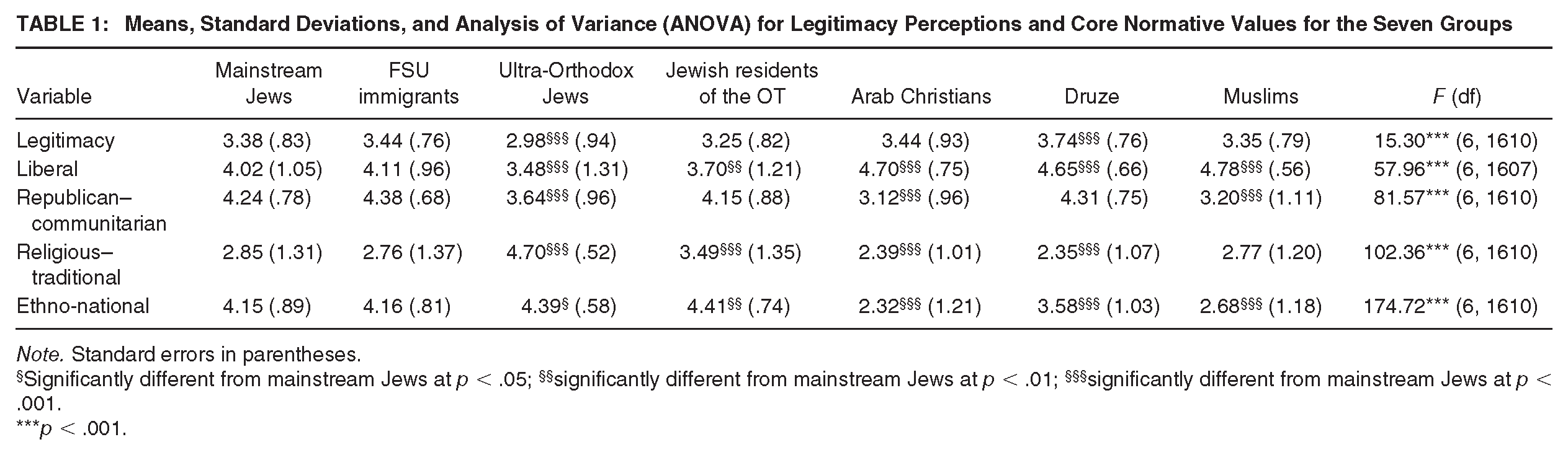
Table 1 presents the results of the ANOVA for legitimacy and the four core normative values across the seven social groups. As can be seen, significant differences (p < .001) were found between the seven groups in legitimacy perceptions and the four core normative values. (These significant differences hold also when using the Bonferroni correction for multiple comparisons, at p = .001.)
Means, Standard Deviations, and Analysis of Variance (ANOVA) for Legitimacy Perceptions and Core Normative Values for the Seven Groups
Note. Standard errors in parentheses.
Significantly different from mainstream Jews at p < .05; §§significantly different from mainstream Jews at p < .01; §§§significantly different from mainstream Jews at p < .001.
p < .001.
Figure 1 presents the radar plot displaying the means for legitimacy and the composition of values in each of the seven groups. From the figure, we can see that all seven groups have intermediate perceptions of legitimacy, ranging from 2.98 among the ultra-Orthodox Jews to 3.74 among the Druze (see also Table 1).
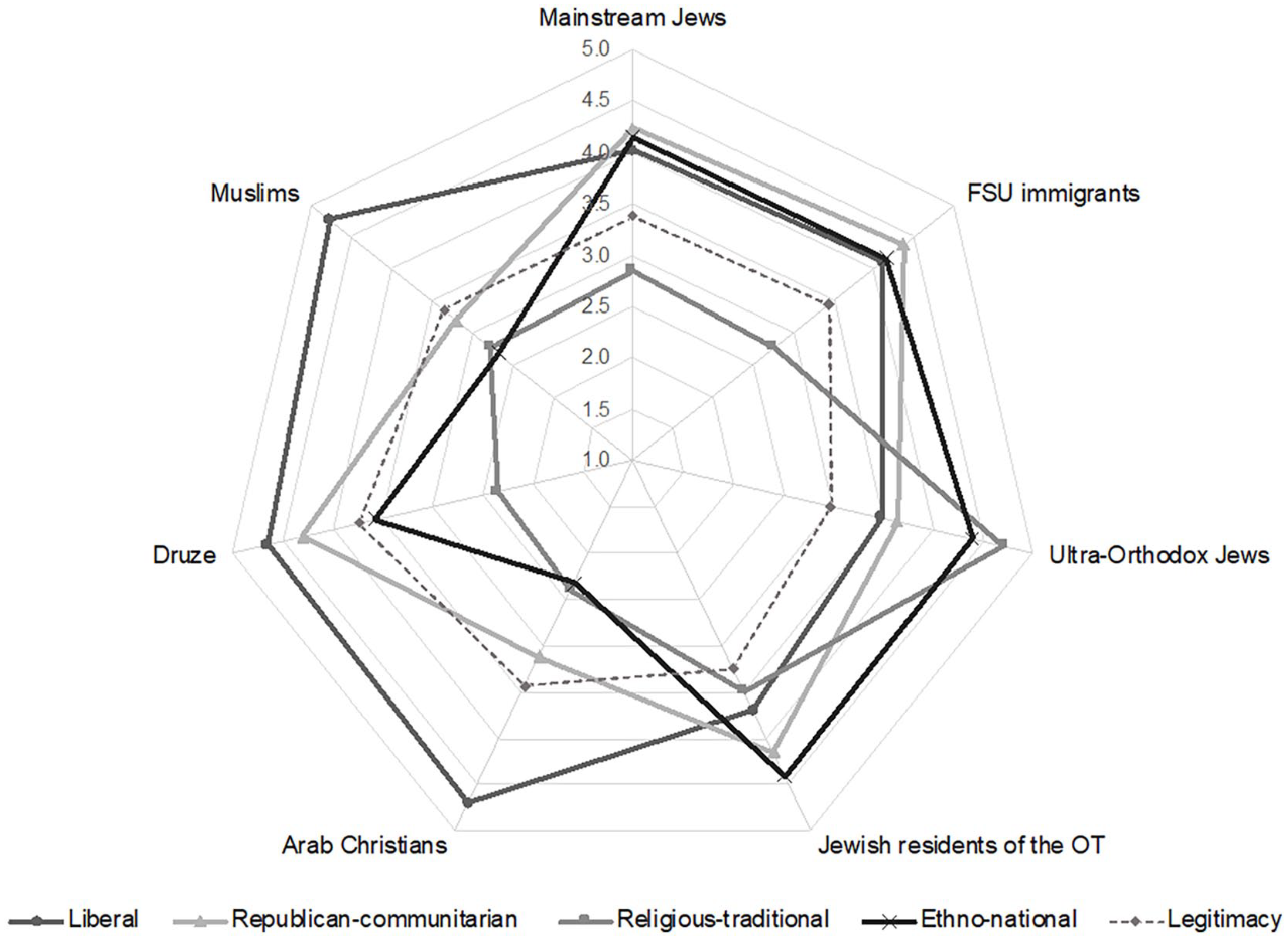
Mean Core Normative Values and Legitimacy Across the Seven Groups
Regarding the core normative values, the figure shows that mainstream Jews—the majority group in Israel—adhere almost equally to republican–communitarian, ethno-national and liberal values, while having lower levels of religious–traditional values. This is unsurprising, given that (as mentioned above) the mainstream Jewish population in fact comprises heterogeneous subgroups, linked primarily by their lower levels of religious observance relative to the ultra-Orthodox and the settler population. Moving clockwise around the figure, we can see that the most salient value system among immigrants from the FSU is the republican–communitarian, followed by the ethno-national. Ultra-Orthodox Jews have higher religious–traditional and ethno-national values, while Jewish residents of the OT are characterized mainly by ethno-national and republican–communitarian values. Interestingly, the most salient value system among all three of the Arab minority subgroups—Arab Christians, Druze, and Muslims—is the liberal system, followed by republican–communitarian values.
Next, we explore the associations between the core normative values and legitimacy in our seven groups. To do this, we regressed the legitimacy measure on the four value systems, controlling for demographic and socioeconomic characteristics, for each of the seven groups. Table 2 presents the standardized coefficients from this set of regressions. As can be seen from the table, republican–communitarian core normative values have a significant positive association with legitimacy among mainstream Jews (β = .24, p < .001), immigrants from the FSU (β = .22, p = .007), and Jewish residents of the OT (β = .23, p = .005), controlling for demographic and socioeconomic variables. Among ultra-Orthodox Jews, republican–communitarian (β = .44, p < .001) and liberal core normative values (β = .32, p < .001) have significant positive associations with legitimacy, and religious–traditional values have a negative association (β = −.11, p = .026) with legitimacy. Among Arab Christians, liberal (β = .32, p < .001) and republican–communitarian values (β = .22, p = .007) have significant positive associations with legitimacy. Among Muslims, we found a positive association between liberal core normative values and legitimacy (β = .19, p = .015) and a negative association between religious–traditional values and legitimacy (β = .17, p = .036). By contrast to all of these subgroups, among the Druze no significant associations were found between any of the four core normative value systems and perceptions of legitimacy. 5
Linear Regression of Legitimacy on Four Core Normative Values and Socio-Demographic Variables by Social Group

Note. Standardized beta coefficients; standard errors in parentheses.
p < .05. **p < .01. ***p < .001.
The associations between the core normative values and legitimacy can be easily seen in Figure 2. The figure displays predicted legitimacy by the significant core normative values in the six groups where such associations were found, while controlling for the other variables in the regression, which are set to their means. Careful perusal of the slopes allows us to delve more closely into the associations described above. For instance, the predicted level of legitimacy for ultra-Orthodox Jews with the weakest republican–communitarian values is 1.86, while for those with the strongest republican–communitarian values, it is 3.56—an increase of about 92%. Conversely, predicted legitimacy is 3.71 for ultra-Orthodox Jews with the weakest religious–traditional values and 2.92 for those whose religious–traditional values are most salient, resulting in a decrease of about 21%. Among Arab Christians, Figure 2 highlights the positive association between both republican–communitarian and liberal values and legitimacy, while showing that the effect for liberal values is stronger, as its slope is steeper: the difference between those with the lowest and highest levels of the values is about 76% for liberal values, but only 29% for republican–communitarian values. Among Muslims, the positive association between liberal values and legitimacy manifests in about a 44% difference in predicted legitimacy between the lowest and highest levels of liberal values, and the negative association between religious–traditional values and legitimacy appears as a decrease of 12% between the lowest and highest levels. Finally, we can see that for all three of the remaining groups there is a similar positive association between republican–communitarian values and legitimacy, manifested in an increase between those with the weakest and strongest values of about 37% among FSU immigrants, and 34% among both Jewish residents of the OT and mainstream Jews. 6

Predicted Legitimacy by Core Normative Values, by Group
Discussion
Core normative value theory (Mehozay & Factor, 2017) asserts that perceptions of the legitimacy of law enforcement authorities derive not just from these agencies’ conduct and performance, but also from deeply embedded cultural and ideological attitudes, which are identified in the theoretical model as the religious–traditional, liberal, republican–communitarian, and ethno-national core normative value systems. In this research, we used Israel’s highly divided society as a case study to further test the effects of core normative values on different social groups who, for historical and cultural reasons, differ in their attitudes toward and relations with law enforcement authorities. The study builds on a representative sample of 1,617 Israelis from seven social groups—mainstream Jews, ultra-Orthodox Jews, Jewish residents of the OT, immigrants from the FSU, Druze, Muslims, and Arab Christians.
Our findings show, first, that the seven social groups differ in the core normative values to which their members most strongly adhere. For example, our results suggest that the most salient value system among both Arab Christians and Muslims is the liberal core normative value system; that Jewish residents of the OT adhere mainly to ethno-national and republican–communitarian values; and that ultra-Orthodox Jews tend to hold religious–traditional and ethno-national values. Similarly, we found significant differences between the groups in levels of perceived legitimacy (though all were intermediate in range). Among the seven groups we examined, legitimacy perceptions toward Israeli law enforcement authorities were weakest among ultra-Orthodox Jews and strongest among the Druze. These interesting findings point to the diversity of Israeli society and also serve as a validation of our research tool.
Looking more deeply at the dominant values and attitudes of each group, our findings are largely in agreement with what we might have expected based on previous studies, and on each group’s historical and cultural background, as introduced earlier (see Al-Haj, 2002; Factor et al., 2013; Hasisi, 2008; Kimmerling, 2004; Rattner & Yagil, 2004; Shafir & Peled, 2002). However, some of our results are surprising. In particular, we might have expected the Muslim community in Israel, which is typically viewed as highly conservative, to adhere mainly to the religious–traditional core normative value system. Yet, along with the Arab Christians, the Muslims we surveyed reported high levels of liberal values, and secondarily, republican–communitarian values. One possible explanation for these interesting findings relates to the items we used to measure these two sets of values. The items used to measure liberal values related to civil rights in general; as such, support for these values may simply reflect Muslim respondents’ determination to assert their own rights, both as individual citizens and as members of a minority group. Likewise, the items that were used to measure republican–communitarian values focused on community service and social involvement and disconnected from national politics. Future studies should validate the current results using additional items for measuring liberal and republican–communitarian values that might take into account the positions of nondominant minority groups, which would allow for more nuanced distinctions.
Turning to the association between each of the core normative values and legitimacy within our seven groups, we found that the associations generally follow the premises of core normative value theory and the findings of previous studies (Factor & Mehozay, 2023; Mehozay & Factor, 2017). Of particular interest, we found notable similarities and differences in the effects of the values on legitimacy across the groups. For example, we found significant positive associations between republican–communitarian values and legitimacy among both ultra-Orthodox Jews and Arab Christians, and between liberal values and legitimacy among ultra-Orthodox Jews, Arab Christians, and Muslims. Likewise, we found negative associations between religious–traditional values and legitimacy among both ultra-Orthodox Jews and Muslims. By contrast, for immigrants from the FSU, Jewish residents of the OT, and mainstream Jews, the only values system found to be significantly associated with legitimacy, controlling for the other values and socio-demographic characteristics, is the republican–communitarian value system.
Another interesting finding is the absence of associations between ethno-national values and legitimacy in any of the groups studied. This is despite significant differences between the groups in the level of ethno-national values, which ranged from 2.68 (among Muslims) to 4.41 (among Jewish residents of the OT). This finding might indicate that in the Israeli context, the formulation of the ethno-national value system, or the differences between these values and other values (particularly the republican–communitarian), is less clear and should be studied further.
The current findings should be interpreted in light of the study’s limitations. First, the study is based on cross-sectional self-reports, with the well-known limitations this entails (including its exclusion of causality inferences). Second, the study is based on a sample of seven Israeli groups. Although this division encompasses large segments of Israeli society, it is important to validate and expand our findings among additional social groups and, in particular, other societies. Third, relatedly, some of the items used for the value scales in this study were based on features of Israeli culture and political life. When the theory is explored in other societies, some items will have to be replaced and potentially tailored to specific characteristics of the society under study. Fourth, the scales in this study were specifically developed to explore core normative value theory, using in-depth interviews and pilot studies. However, the liberal values scale included only two items. We encourage researchers to continue to develop the scales, and adding items designed to capture liberal values among minority groups that a priori may have a disposition to prioritize civil rights. Fifth, following previous studies, our legitimacy scale included three dimensions: obligation to obey, moral alignment, and trust. However, it is important to note that some scholars argue that trust is not in fact a dimension of legitimacy (e.g., Reisig et al., 2007). In this vein, although we measured legitimacy through items which were previously used for that purpose, some of these items may not measure legitimacy itself so much as behaviors that people engage in which are affected by legitimacy, and the obligation item may not clearly distinguish between internalized obligation and other instrumental factors (Pósch et al., 2021; Reisig et al., 2023). Future studies should validate the current results by exploring different legitimacy measures with differing subscales and items. Finally (and, again, relatedly), the scales were calculated by averaging scores for the items. However, this procedure assumes that all items are equally measuring the underlying construct and may create truncated distribution of the variables. Validating the present results using larger samples for each subpopulation would allow the use of structural equation models (SEM), which may address these problems. 7
Notwithstanding these limitations, this study indicates that how people perceive the legitimacy of law enforcement authorities is shaped by deeply embedded cultural and ideological orientations, as reflected in a set of core normative values through which individuals operate in and interpret the world. Moreover, these core normative values vary across different social groups and differ across groups in their associations with the perceived legitimacy of law enforcement authorities. In this respect, core normative value theory complements existing theoretical approaches to police legitimacy in pushing the field to consider additional factors, particularly historical and cultural background, as they shape values and sets of beliefs in different social groups. As such, the results suggest that state officials and policy makers should take these differences into account. Public cooperation, in this respect, involves more than the mere interaction with law enforcement authorities, but rests on a socio-political foundation of respect and acceptance. A tolerance of others’ values (as long as they are not harmful toward other groups), and a sense of a shared political framework, could be key to enhancing the legitimacy of law enforcement authorities in diverse societies.
Supplemental Material
sj-docx-1-cjb-10.1177_00938548241286802 – Supplemental material for Legitimacy and Deeply Embedded Core Normative Values in Different Social Groups
Supplemental material, sj-docx-1-cjb-10.1177_00938548241286802 for Legitimacy and Deeply Embedded Core Normative Values in Different Social Groups by Roni Factor and Yoav Mehozay in Criminal Justice and Behavior
Footnotes
Authors’ Note:
This study was funded by the Israel Science Foundation (grant no. 1204/18)

Notes
References
Supplementary Material
Please find the following supplemental material available below.
For Open Access articles published under a Creative Commons License, all supplemental material carries the same license as the article it is associated with.
For non-Open Access articles published, all supplemental material carries a non-exclusive license, and permission requests for re-use of supplemental material or any part of supplemental material shall be sent directly to the copyright owner as specified in the copyright notice associated with the article.
