




Abstract
The criminal justice system (CJS), comprising police, prosecutors, and courts, is pivotal in preventing intimate partner violence (IPV). However, challenges persist in effectively protecting victims, with high post-reporting recidivism rates. This systematic review aims to identify CJS interventions targeting IPV recurrence and to assess their effectiveness. Eleven articles meeting inclusion criteria were categorized into three themes: police (five articles), prosecutor (zero articles), and court (six articles). While overall findings lack conclusive evidence on intervention effectiveness, they suggest potential in reducing IPV recidivism among specific perpetrator sub-groups. The review underscores the need to consider contextual factors when evaluating interventions like arrest for IPV prevention. Challenges in identifying evidence-based practices within the CJS persist, necessitating ongoing evaluation research and investment in evidence-based strategies to inform policy and practice effectively.
Introduction
Interventions intended to prevent recidivism of intimate partner violence (IPV) have rarely been proven to be evidence-based (see, e.g., Travers et al., 2021). There is therefore a lack of knowledge regarding the effectiveness of such interventions. Historically, research conducted within the criminal justice system (CJS) has focused on established interventions, such as protection orders (POs; see, e.g., Cordier et al., 2021), without adequately evaluating their evidence or exploring complementary interventions that could increase the effectiveness of the initial intervention. The consequence of relying on untested or inadequately evaluated interventions is an increased risk of undesired outcomes, potentially threatening the safety and wellbeing of victims. Medical interventions and treatments, on the other hand, have been subjected to rigorous empirical validation. Just as any deviation from evidence-based medical practice may put patients’ lives at risk, poorly targeted or ineffective CJS interventions may lead to a recurrence of IPV, possibly resulting in serious injury to or even the death of, victims.
For the purposes of this study, we define the CJS as the police, prosecutors, and courts. Between them, these institutions are responsible for implementing tertiary interventions to prevent recurring IPV. This is the main responsibility of the CJS, rather than primary and secondary prevention which address the underlying causes of IPV, typically beyond its remit. Primary and secondary prevention are outside the scope of this study but have been the subject of recent reviews (see, e.g., Karakurt et al., 2019). Thus, this review focuses on pre-verdict interventions by the police, prosecutors, or courts in response to reports of IPV. More specifically, the aim was to identify and evaluate the effectiveness of such interventions.
Although Bell and Coates (2022) provide a comprehensive overview of 41 reviews of interventions for perpetrators of domestic violence and IPV, only five specifically address policing and legal interventions, and three of these focus on POs. In the context of the study by Bell and Coates (2022), it is important to recognize the contributions of other independent reviews in this field. In addressing IPV, various interventions have been investigated, such as mandatory arrest (Hoppe et al., 2020), second responder programs (SRPs; Petersen et al., 2022), POs (Cordier et al., 2021), legal firearm restrictions (Zeoli et al., 2016), stalking interventions (Backes et al., 2020), and criminal sanctions (Maxwell & Garner, 2012).
Policing Interventions
The main responsibility for pre-verdict tertiary prevention interventions to reduce the risk of IPV recurrence rests with the police. This involves both investigating cases and preparing and implementing strategies to keep victims safe and includes interventions such as mandatory arrest and SRPs.
Mandatory Arrest
In the United States, many states have adopted a policy of mandatory arrest, mandating the police to make an arrest whenever there is probable cause. Hoppe et al. (2020) conclude that mandatory arrest policies in the United States are not a significant deterrent against recidivism; on the contrary, their findings suggest that they might increase the risk of IPV. That said, the review has limitations, as nine of the eleven articles were published before 1995, possibly reducing their applicability to the present context, which validates the need for more recent research. In summary, there is insufficient evidence to definitively establish the effectiveness of mandatory arrest policies.
Second Responder Programs
Another police intervention is SRPs, in which specialist teams of police officers and social workers visit victims of IPV in the immediate aftermath of a violent incident (Petersen et al., 2022) to capitalize on the “window of opportunity” when victims may be more receptive to seeking help or leaving a violent partner. However, the systematic review by Petersen et al. (2022) found no significant effects on recurring family abuse from either police or victim reports, nor did they find any substantial reductions in self-reported victimization. Notably, some experimental studies have shown an increase in police-reported violence, suggesting either increased rates of IPV or an increased tendency to contact the police.
Prosecutorial Interventions
The role of the prosecutor in preventing IPV recurrence is both complex and crucial. Prosecutors decide whether to proceed with a prosecution and seek to ensure that an appropriate sentence is passed. Their involvement typically revolves around legal proceedings and post-verdict interventions, whereas pre-verdict tertiary prevention often requires immediate, on-the-ground intervention that may well fall outside the traditional scope of the prosecutor’s role. Nevertheless, POs can be issued either by prosecutors or police, depending on policy and legislation. While POs issued by the police often come into effect immediately in response to an incident, those issued by a prosecutor typically follow a formal legal process, providing a more long-term solution (see, e.g., Logan et al., 2005).
Protection Orders
POs, also known as restraining orders, are legal directives used to prevent one person from contacting or harming another. They are sought by individuals who have experienced IPV, harassment, or stalking. These orders typically prohibit perpetrators from contacting victims or entering specific locations, with violations carrying legal consequences.
The preventive effects of such have been thoroughly studied (see, e.g., Bell & Coates, 2022; Cattaneo et al., 2016; Cordier et al., 2021), and they remain one of the most frequently used strategies to prevent IPV recurrence (Cattaneo et al., 2016). However, Cordier et al. (2021) conclude that obtaining a PO does not always prevent violence from recurring. Various types of POs have exhibited positive outcomes in terms of victim safety and violence reduction. Moreover, victims report feeling safer when the CJS imposes sanctions on perpetrators who breach such orders. In addition, POs have been demonstrated to be more effective, when (a) combined with the arrest of perpetrators, (b) perpetrators have no history of stalking victims, or (c) perpetrators have no prior arrests for violent behavior. Cordier et al. (2021) also found that victims who had sustained more severe injuries prior to being granted a PO were more likely to be re-victimized due to a breach of a PO.
Stalking by former partners who repeatedly attempt to contact victims against their will, creating fear and insecurity, also presents a number of challenges. In their systematic review, Backes et al. (2020) conclude that the effectiveness of risk-management interventions may be compromised due to the limited ability to share information across different agencies, jurisdictions, or courts. Still, POs remain the most common intervention to put a stop to stalking, and breaches of an order have been shown to increase the chances of convicting a stalker (Backes et al., 2020). Nonetheless, no specific intervention has been proven to be highly effective in preventing further violence by ex-partners who stalk their victims.
In conclusion, the available evidence suggests that POs can be effective when used in combination with other sanctions. This effectiveness can be observed when POs are issued across different types of perpetrators and complemented with follow-ups and sanctions in response to breaches. However, given the need for a more far-reaching method to deal with the challenges posed by IPV, it is essential to explore additional interventions.
Court Interventions
Courts play a different role in preventing IPV recurrence than prosecutors. While prosecutors focus on ensuring a successful prosecution and that, once convicted, perpetrators receive an appropriate sentence, the courts are responsible for adjudicating cases and imposing sentences in accordance with the law. The courts can, however, implement interventions before delivering a verdict, such as ordering that firearm be confiscated or imposing criminal sanctions (e.g., Maxwell & Garner, 2012; Zeoli et al., 2016). These interventions are intended to immediately mitigate the risk posed by perpetrators by restricting their access to the means to commit further acts of violence and implementing legal consequences even before a final verdict is reached.
Firearm Restrictions
Aligned with specific risk-management interventions targeting perpetrators of IPV, the courts have the authority to impose restrictions on the possession of firearms to prevent further violence. In many countries, it is illegal for anyone with prior convictions to commit violent offenses, including IPV, or who is subject to a PO to buy or possess firearms.
In their systematic review, Zeoli et al. (2016) conclude that revoking firearms licenses and limiting access to firearms have some effect on reducing IPV depending on the characteristics of perpetrators. In summary, while interventions by the courts to restrict access to legal firearms might serve as a preventive intervention for some perpetrators, there is insufficient evidence to establish their preventive effects.
Criminal Sanctions
In their systematic review, Maxwell and Garner (2012) found that using criminal sanctions to address IPV had no significant crime-control effects. That said, this lack of effect might be linked to the lower quality of the reviewed articles, leaving the researchers with insufficient data to draw solid conclusions about the effects. Maxwell and Garner (2012) suggest that more studies with stronger research designs and access to various types of data are needed to enhance our understanding of the effects.
It is also essential to recognize that studies of interventions have been published in gray literature, such as reports and internal publications from responsible authorities and organizations. While these sources contain valuable insights, they pose a significant challenge when it comes to critical examination and evaluation. Furthermore, reliance on such literature can be seen as problematic, as it may result in interventions being accepted and implemented before any rigorous evaluation has been performed. Consequently, the potential for biased reporting, methodological limitations, and inconsistent data collection may cause complications. Therefore, while the current state of knowledge provides some insights into the effectiveness of various risk-management interventions employed by the CJS, a knowledge gap remains as previous reviews have not fully investigated the effects of such interventions.
The Present Study
While previous systematic reviews addressing IPV have contributed to our understanding of risk-management interventions within the CJS, they have primarily focused on already well-documented and widely implemented interventions, such as POs (Cordier et al., 2021). Knowledge about other types of CJS interventions in terms of their effectiveness and limitations is limited, which highlights the need for this review to identify and evaluate pre-verdict interventions by the CJS that have not been widely studied. Here, we mean interventions that, although potentially effective, are not recognized or used in the common approach to preventing IPV. This includes innovative or emerging strategies that, unlike more established interventions, have not yet received attention from researchers.
Globally, POs are the most widely available tool when the CJS seeks to intervene in cases of IPV (Cattaneo et al., 2016), which may be why existing literature on the effectiveness of POs in combatting IPV has been so well documented (see, e.g., Cattaneo et al., 2016; Cordier et al., 2021). Given this well-established knowledge, our systematic review focuses on alternative interventions by the CJS, hence the exclusion of POs. While POs have demonstrated potential, there is a compelling body of evidence highlighting the necessity to combine them with complementary interventions if they are to have a sustained effect (e.g., Cordier et al., 2021). So, by identifying lesser-studied interventions, there is a potential for them to complement existing interventions to enhance their effectiveness. For example, incorporating alarm packages for victims who have obtained a PO could be an impactful addition, increasing the overall protective capability of these orders.
Previous reviews have focused on recognized interventions by reviewing them separately rather than in combination with one another. In cases where risk-management interventions have been subjected to systematic review, they are often limited to (a) specific interventions (e.g., Cordier et al., 2021), (b) specific countries (e.g., Hoppe et al., 2020), or (c) a focus on either perpetrators or victims (e.g., Klein et al., 2021; Travers et al., 2021). In addition, we recognize that previous systematic reviews have covered interventions such as mandatory arrest policies (Hoppe et al., 2020) and SRPs (Petersen et al., 2022). However, the shortage of studies on evidence-based interventions in the CJS reveals a critical gap in the literature, potentially leading to an underestimation or oversight of intervention effectiveness. This gap hinders our ability to identify and implement interventions proven to reduce IPV recurrence, leaving policymakers and practitioners without clear guidance on resource allocation.
Therefore, it is crucial to identify and evaluate additional research beyond what is included in previous reviews, focusing on evidence-based studies that may offer new insights into the effectiveness of CJS interventions. By expanding our scope in this way, we aim to enhance our understanding of effective interventions for preventing and responding to IPV within the CJS context. Our systematic review aims to offer a unique perspective by going beyond the limitations observed in previous reviews. Specifically, the aim of this study is to identify and evaluate pre-verdict risk-management interventions conducted by the CJS, exploring the following research questions:
Besides protection orders, what types of risk-management interventions have been used by the CJS and how effective did they prove in reducing IPV recurrence?
Which of the identified interventions target perpetrators, and which target victims?
Method
The structure, methodology, and reporting of this systematic review are based on the guidelines Preferred Reporting Items for Systematic Reviews and Meta-Analyses (PRISMA; Page et al., 2021).
Literature Search
The present systematic review consists of peer-reviewed empirical articles identified in a literature search performed in February 2023 in the following databases: Criminal Justice Abstract, PubMed, PsycINFO, Scopus, Social Science Premium, and Web of Science. To ensure that our research questions matched the areas of interest and were relevant to the discourse on IPV, search terms were first identified using key words from articles on the subject of IPV. We then used a thesaurus in our search strategy to identify synonyms that were consistently found in all six databases. Synonyms were thus included if they were a relevant term in each of the specific databases. This strategy was used to ensure a more systematic retrieval of relevant articles across multiple databases.
Various combinations of the search terms were used in the databases for full text (i.e., for appearance anywhere in the article) with no restrictions other than the articles being published in English in a peer-reviewed journal between January 1, 2010, and February 15, 2023. Search terms used included Intimate partner violence OR domestic violence OR spousal assault OR spouse abuse OR family violence OR violence against women OR intimate partner abuse OR dating violence AND risk management strategies OR safety plan OR preventive action OR protective action OR intervention. In total, 12 articles were included for the quality assessment (see Figure 1).
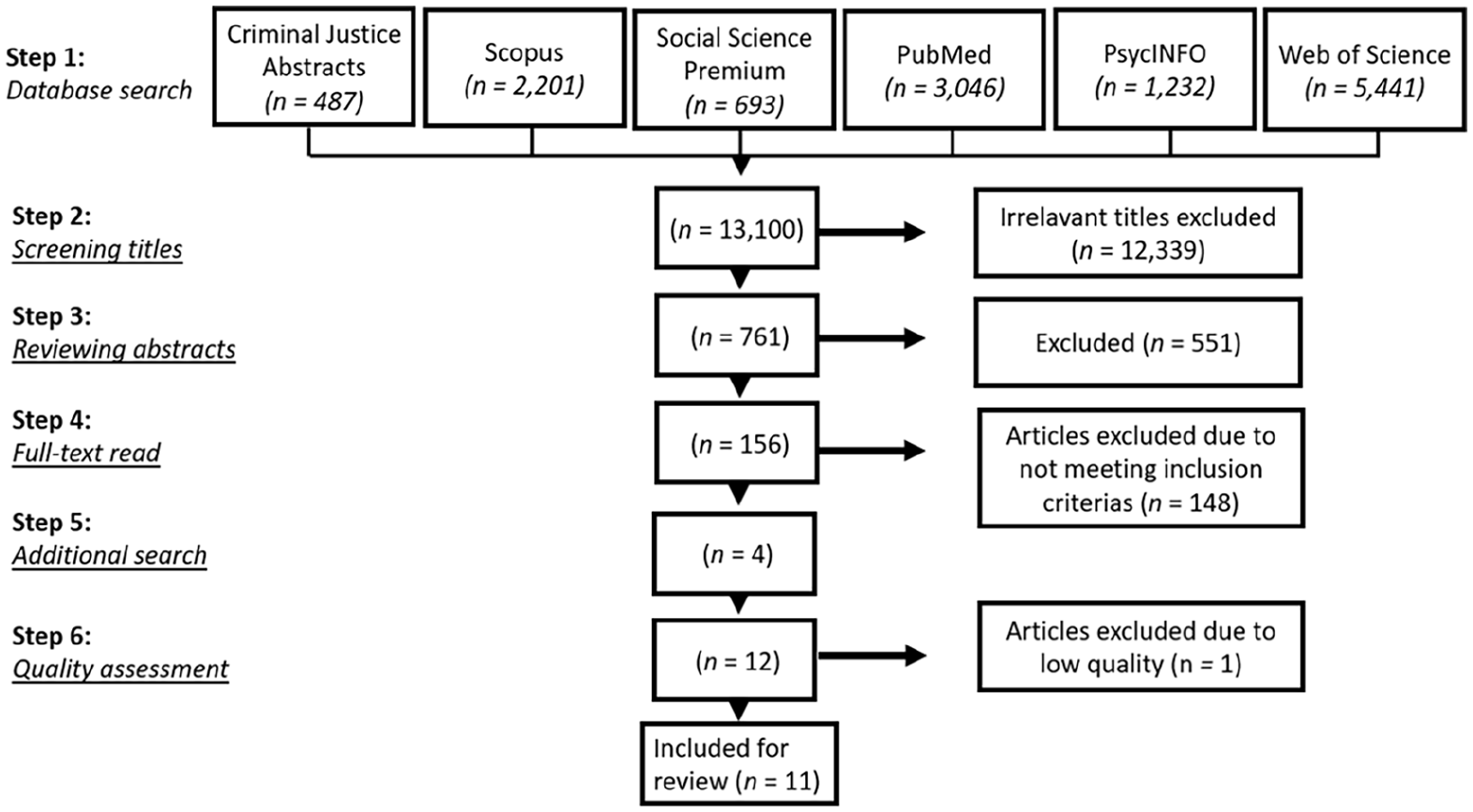
Flowchart of Search Strategy
The review’s time restriction focuses on recent and relevant interventions to ensure up-to-date strategies and exclude outdated interventions. The chosen approach refines the search while addressing the current landscape of IPV prevention in the CJS. The methodological strategy also excluded gray literature in order to prioritize peer-reviewed research. The exclusion of gray literature is addressed in the section on the limitations of the review.
Description and Definition of Variables
Risk Management
Risk management was used as an umbrella term for strategies to prevent further violence. A strategy may include one or more interventions.
Tertiary Preventive Interventions
Tertiary preventive interventions within the context of this study include actions or interventions conducted by the CJS after the occurrence of IPV has been identified. It encompasses a range of interventions taken post-incident and pre-verdict, with the primary objective of reducing recidivism.
Effectiveness
Effectiveness was either measured as a reduction in repeat violence by perpetrators or reduced re-victimization of victims. All quantitative measurements of effect were included.
IPV recurrence
IPV recurrence or recidivism was defined as any form of re-arrest or re-entering the CJS for IPV-related offenses, whether against the same or a new partner. As there is a likelihood of underestimating IPV offending when basing figures solely on official police reports (Tjaden & Thoennes, 2000), data on self-reported re-victimization were also included.
Eligibility Criteria
Inclusion Criteria
Articles must include IPV and (a) interventions implemented or initiated by the CJS with the intended outcome of reducing IPV recurrence or re-victimization, (b) involve a quantitative measurement of the intervention’s effect on IPV recurrence, (c) have a study population of 18 years of age or older, and (d) involve tertiary risk-management interventions.
Exclusion Criteria
Articles were excluded if they (a) were included in any of the recent literature reviews presented in the Introduction (Backes et al., 2020; Cordier et al., 2021; Hoppe et al., 2020; Maxwell & Garner, 2012; Petersen et al., 2022; Zeoli et al., 2016), (b) dealt primarily with POs, (c) dealt primarily with primary or secondary interventions to prevent IPV recurrence, such as police training or legislative amendments, (d) were published or initiated by any other public authority or agency (e.g., social service or health care providers), or (e) were assessed as being of poor methodological quality. Moreover, all interventions implemented after the court reached a verdict were deemed beyond the scope of this review (i.e., post-verdict) due to the review’s focus on pre-verdict interventions. This distinction is critical as it allows for a focused examination of interventions that occur before a verdict is reached, thereby addressing a gap in the current literature, which often emphasizes post-verdict strategies (see, e.g., McGinn et al., 2016). While our primary focus was on interventions implemented prior to the involvement of correctional facilities, we acknowledge the role correctional interventions play in addressing IPV (e.g., rehabilitating perpetrators). However, the detailed exploration of correctional interventions fell beyond the scope of this study. Dissertations and articles unavailable electronically were also excluded as were needs assessments and nonempirical articles.
The decision to exclude studies covered in prior systematic reviews was based on a strategic approach to ensure the uniqueness and distinctiveness of the present review. While existing systematic reviews have already comprehensively evaluated certain interventions within the CJS, the aim of this study was to contribute to the field by focusing on interventions that might have been understudied or not extensively addressed.
Screening and Selection
The initial database search yielded a comprehensive dataset comprising 13,100 articles, as illustrated in Figure 1 (Step 1). To ensure a rigorous screening process, an interrater reliability (IRR) assessment was conducted by two authors, who independently reviewed 25 randomly selected article titles. By using the predefined inclusion and exclusion criteria, the IRR test generated an 84% agreement between the two authors. The four titles on which they disagreed were resolved through discussion. All the remaining titles were screened by one author, which resulted in the exclusion of 12,339 articles due to not meeting the inclusion criteria, meeting one or more of the exclusion criteria, or being duplicates (Step 2).
Step 3, the remaining 709 abstracts underwent further evaluation to identify articles for full-text reading. During this phase, each abstract was assessed and marked by the authors using the following classification: 0 = excluded, 1 = earmarked for full-text review, or 2 = potential inclusion. Author 1 reviewed all 761 abstracts, and Author 2 independently reviewed a representative sample of 100 abstracts. The two authors subsequently cross-checked their ratings to ensure alignment. Any disparities were subjected to thorough discussion until a consensus was reached. Furthermore, all abstracts reviewed classified as potential inclusions by Author 1 were discussed. This process resulted in the identification of 156 abstracts meriting full-text assessment. In Step 4, all 156 articles underwent comprehensive independent full-text review by both authors resulting in the exclusion of 148 articles. Several articles were excluded for various reasons. For example, abstracts using “law enforcement” required full-text review for clarification, and many did not involve police-initiated interventions as one might have expected, while others focused on victim-perceived safety instead of recidivism outcomes. Step 5 contributed an additional search using the interventions identified from the eight included articles (i.e., arrest, surveillance, and IPV court) from which four articles were included, ultimately resulting in the selection of 12 articles for the quality assessment (Step 6).
Methodological Quality Assessment of Included Articles
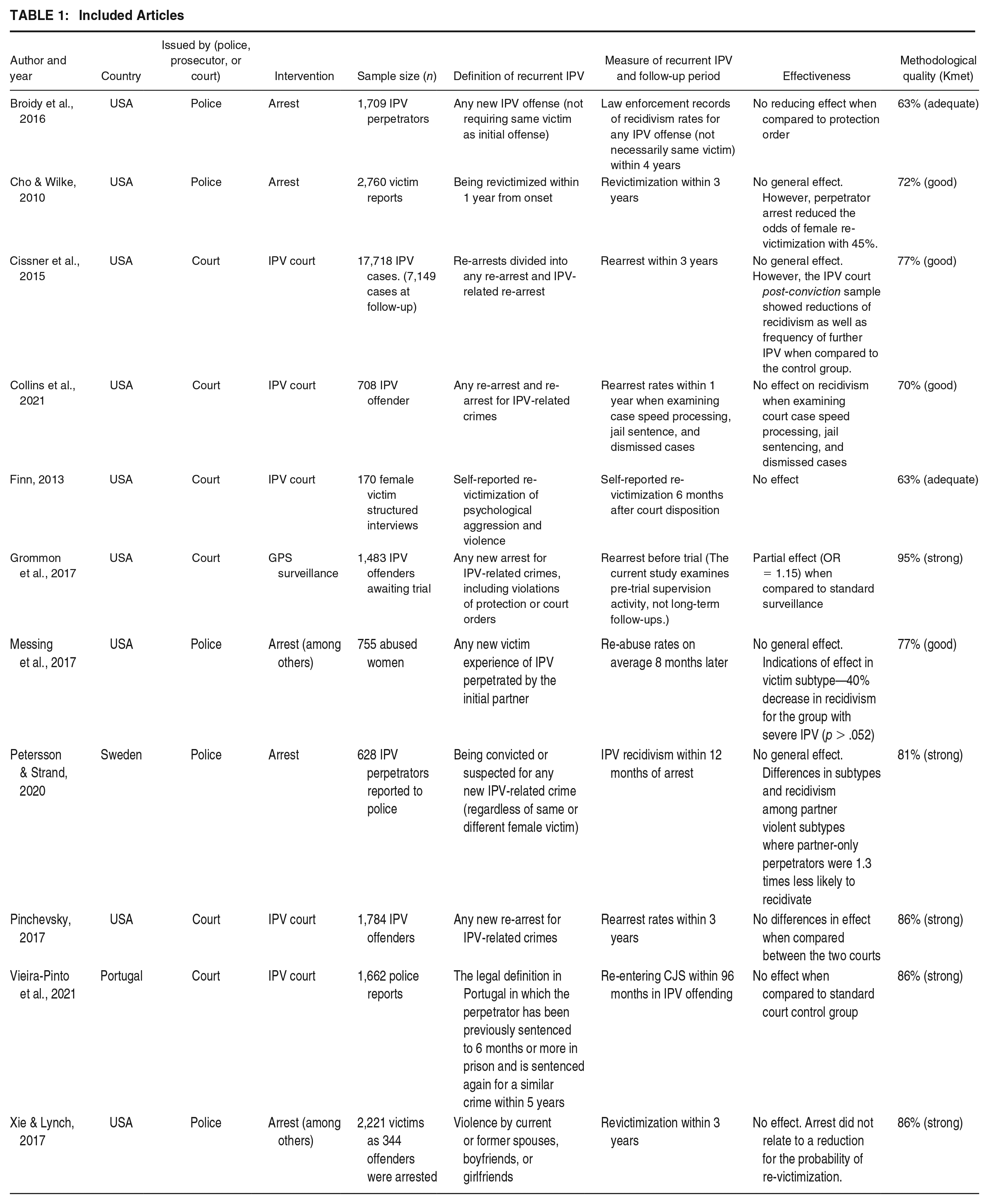
The quality of articles was assessed by using the checklist Standard Quality Assessment Criteria for Evaluating Primary Research Papers from a Variety of Fields (Kmet et al., 2004). The checklist contains 14 items, each of which was rated using a three-point scoring system ranging from 0 (No), 1 (Partial), 2 (Yes), or not applicable (N/A). The points were added to give a total score, which ranged from zero to a maximum of 28. If an item was not applicable, it was removed from the calculation. The total score was therefore variable, since not all items were possible to assess. Each item was worth a maximum of two points; thus, its removal lowered the maximum possible score by two. The percentage for the quality assessment was calculated by dividing the score for each article with its total score of applicable items. Furthermore, in accordance with Cordier et al. (2021), the quality assessment of each article was categorized as low (<50%), adequate (50% to 69%), good (70% to 80%), or strong (>80%). The first author rated the methodological quality of the 12 articles, five of which were rated as strong, four as good, two as adequate, and one as low, thereby excluding one article on the grounds of low methodological quality.
Data Extraction
Data extraction variables were formed from our research questions, and the following data were extracted: (a) authors, country, year of publication; (b) type of intervention and which part of the CJS implemented the intervention; (c) sample size and type of data source; (d) measurement, definition of the outcome variable, and the study’s follow-up period; (5) the effectiveness of the intervention; and (e) methodological quality.
Study Sample Characteristics
The eleven studies chosen for inclusion were conducted in three different countries: the United States (9), Portugal (1), and Sweden (1). The sample size across studies ranged from 162 to 7,149 perpetrators, victims, or cases, adding up to a total of 21,191 cases. Seven of the studies included perpetrator data, three of the studies included victim data, and three of the studies included case report data.
Out of these, four of the studies consisted solely of male-to-female IPV, and seven studies had both male-to-female and female-to-male IPV. No studies consisted solely of female-to-male IPV or same-sex IPV. The mean age of perpetrators was presented in eight of the studies, resulting in a total mean age of 36 years, ranging from 16 to 92 years. The mean age of victims was presented in seven of the studies, resulting in a total mean age of 35 years, ranging from 18 to 89 years.
Study Data Sources
Data sources used for follow-up included administrative records (n = 10), interviews with victims (n = 2), and questionnaires completed by victims (n = 1). For articles that used administrative data, the most common sources were law enforcement (n = 12), courts (n = 6), police reports (n = 4) and the US National Crime Victimization Survey (n = 2). In most cases, data were collected and followed up roughly within a 3-year period (Cho & Wilke, 2010; Cissner et al., 2015; Pinchevsky, 2017; Xie & Lynch, 2017). The shortest follow-up period was 6 months (Finn, 2013), and the longest was 8 years (Vieira-Pinto et al., 2021). The mean follow-up period was 27 months. One study lacked information on follow-up time (Grommon et al., 2017).
Analysis
The extracted data variables described earlier were analyzed using a deductive thematic approach complemented with inductive sub-themes (Guest et al., 2012). The first step of the process began with the identification of initial themes, specifically targeting key components within the review’s definition of the CJS: the police, prosecutors, and courts.
The second step was to develop sub-themes. Each sub-theme was directly derived from the focus of the study it was part of. For example, if a study examined arrest procedures, “arrest” became the sub-theme. Similarly, in cases where a study concentrated on IPV courts, the sub-theme was labeled as “IPV courts.” In the third and final step, a description was prepared for each sub-theme. The focus was on identifying and categorizing the outcome variable of IPV recurrence, as either re-entering the CJS, re-victimization or repeat offending, and coded as IPV recurrence.
Results
The systematic review consists of 11 articles (see Table 1) examining the effectiveness of three different interventions by the CJS with the intention of reducing IPV recurrence. The interventions were divided into three main themes with sub-themes.
Included Articles
Policing Interventions
Five of the articles were identified as interventions implemented by the police. The sub-theme that emerged was arrest.
Arrest
The aim of arrest was both to protect victims from perpetrators and to prevent perpetrators from causing further harm. Two articles solely examined the effect of arrest (Cho & Wilke, 2010; Petersson & Strand, 2020), three articles compared the effect of arrest in combination with other protective actions, such as civil POs (Broidy et al., 2016), women’s shelter or victims obtaining their own protection such as mace (Messing et al., 2017), and reporting the crime to the police and the use of victim support services (Xie & Lynch, 2017).
Cho and Wilke (2010) found that male perpetrators who were arrested were almost half as likely to reoffend by subjecting a female partner to IPV within 12 months compared to those who were not arrested, Exp(b) = .551, p < .001. No reduction was found for male victims. While Petersson and Strand (2020) in general found that arrest did not reduce IPV recurrence within 12 months of the original offense, they identified significant differences in IPV recurrence after being arrested among sub-types of IPV perpetrators, with partner-only perpetrators 1.3 (95% confidence interval [CI], 1.2 – 1.4) times less likely to commit a repeat IPV offense within six months of being arrested, x2 (1, N = 15) = 4.15, p = .042. No such difference was found for general violent perpetrators.
Moreover, Broidy et al. (2016) compared arrest with POs but found no difference in effect, with 25% of perpetrators were arrested, 21% of those issued with a PO, and 22% of those who were both arrested and issued with a PO committing a repeat IPV offense within a 4-year follow-up period.
Similar results were found by Messing et al. (2017) when comparing perpetrators arrested for various offenses, including threats, stalking, and moderate and severe IPV. Female victims who were exposed to severe IPV had a 40% lower risk of re-victimization within the 8 months following an arrest, almost reaching the level of significance (p = .052).
Xie and Lynch (2017) examined the correlation between arrest and the risk of re-victimization within a 3-year follow-up period. Contrary to expectations, their findings indicated no significant reduction in the risk of re-victimization (Hazard ratio, 0.87; 95% CI, 0.55–1.40; p = .57).
In summary, no significant results were found for a general sample of perpetrators regarding effectiveness in reducing IPV recurrence or re-victimization. However, differences were identified when comparing two different sub-types of perpetrators, with general perpetrators of violence apparently less deterred by an arrest than partner-only perpetrators (Petersson & Strand, 2020). Furthermore, female re-victimization showed significant reductions when perpetrators were arrested (Cho & Wilke, 2010). The use of arrest therefore seems to be effective with a specific type of perpetrator and ineffective for general offenders. This is in line with previous research showing that arrest has mixed results (see, for example, Sherman & Berk, 1984).
Prosecutorial Interventions
Although a handful of articles involving various forms of prosecutorial intervention were identified during the abstract phase, these did not examine the effects of interventions in relation to reduced IPV recurrence. In addition, some of the articles were not based on empirical data while others, such as descriptive articles, were excluded as they did not examine the effectiveness of the intervention. In summary, no articles looking at prosecutorial interventions were included in this theme.
Court Interventions
Six articles were identified focusing on interventions by the court divided into two sub-themes: Specialist IPV courts and GPS surveillance.
Specialist IPV Courts
The initial aim of courts specializing in IPV (often known as Specialized Domestic Violence Courts [SDVCs]) was to process cases more efficiently and to obtain more consistent verdicts with regard to relevant legislation (Labriola et al., 2010). The priorities of these courts were to ensure cases were brought successfully, to assist victims, and to hold perpetrators to account. SDVCs were the most common judicial intervention strategy and were included in five of the six articles within the judicial theme.
Vieira-Pinto et al. (2021) conclude that SDVCs do not reduce the risk of IPV recurrence compared to regular courts. In cases brought before an SDVC, 24 perpetrators (16.2%) re-entered the CJS for an IPV-related offense compared to 104 perpetrators (14.7%) in the control group of cases brought before the regular courts.
Cissner et al. (2015), on the other hand, make a distinction between arrested perpetrators and convicted perpetrators, finding that while SDVCs had no more effect on perpetrators committing further IPV offenses than a regular court, the follow-up post-conviction sample showed significant reductions in the frequency of IPV recurrence. Perpetrators tried by an SDVC were re-arrested in 29% of the cases, with an average of 0.5 re-arrests within a 3-year post-conviction period compared to 32% for the control group with an average of 0.58 re-arrests (p < .01).
Pinchevsky (2017) compared two similar SDVCs (County A and County B) to explore the correlation between court dispositions and reoffending, finding no significant differences in prevalence, incidence, or time-to-rearrest across perpetrators processed in the two courts. In both courts, less than 20% of perpetrators were re-arrested for another domestic violence offense within 3 years of case disposition, at an average of 0.15 re-arrests (SD = 0.36) versus 0.17 (SD = 0.38).
Finn (2013) examined the impact of prosecution policy on self-reported re-victimization 6 months after case disposition in two SDVCs with different jurisdictions. In Court A, where policy was evidence-based, victims were significantly more likely to report recurrence of psychological aggression (OR = 3.76, 95% CI [1.28, 11.07], p < .05) and physical violence (OR = 7.17, 95% CI [1.82, 28.28], p < .01) than in Court B, which followed a victim-centered policy.
Instead of comparing two different courts, Collins et al. (2021) studied one expedited domestic violence court to examine whether expedited proceedings, imposing prison sentences, and how often cases were dismissed had any effect on IPV recurrence within 1 year. Perpetrators in cases where proceedings took longer than 60 days were more likely to be re-arrested (10.9%) than those in cases taking less than 60 days (6.2%; χ2 = 4.919, p < .05).
Furthermore, perpetrators were more than twice as likely to be re-arrested if given a prison sentence than if given a noncustodial sentence (6.4% for noncustodial compared to 16.5% for custodial, χ2 = 15.814, p < .01). There was no significant difference in the rate of re-arrest for IPV between perpetrators who had their cases dismissed and those who were tried.
In summary, four out of five articles showed that SDVCs did not have a significant impact in terms of reducing IPV recurrence or re-victimization. Looking at prior arrests overall, Collins et al. (2021) found that perpetrators with a prior arrest for domestic violence were more than twice as likely to be re-arrested for a domestic violence offense (OR = 2.33), suggesting that SDVCs might be less effective in reducing the frequency of IPV. However, contrary to the findings in Collins et al (2021), Cissner et al. (2015) found a lower level of re-arrest among convicted perpetrators with at least one prior arrest compared to perpetrators with no prior arrests. Meanwhile, Finn (2013) identified differences in reoffending between two SDVCs with differing prosecution policies and suggests that a victim-centered policy may reduce recidivism in the long term.
Electronic Tagging
Global Positioning System (GPS) surveillance, known as electronic tagging, is used to monitor the movements of IPV perpetrators between being arrested and going on trial. Knowing the whereabouts of a perpetrator can give victims and the police more time to respond to incidents, such as a breach of a PO (Erez et al., 2012). Electronic tagging has therefore often been used as a supplementary tool to strengthen POs. The GPS data collected can also be used as evidence. One article concerning electronic tagging was identified in which Grommon et al. (2017) examine the effects of using GPS surveillance on misconduct by defendants awaiting trial on IPV charges. Their findings suggest that electronic tagging is equally effective in reducing re-arrests as traditional, non–technology-based pre-trial supervision, with no significant differences identified between the groups.
Discussion
The aim of this systematic review is to identify and evaluate the effectiveness of pre-verdict risk-management interventions conducted by the CJS in reducing IPV recurrence. The comprehensive search conducted in this review revealed a limited number of CJS interventions being validated. In addition, only a few articles demonstrated effects in reducing IPV recurrence.
Policing Interventions
The identified policing interventions (including arrest, SRPs, and specialist domestic violence units) yielded mixed results in terms of reducing IPV recurrence. While, in line with findings from previous reviews (e.g., Hoppe et al., 2020), arrests did not demonstrably reduce recidivism, it is worth noting that these studies were all conducted in the United States. This is particularly significant given that the first experimental arrest study was conducted in the United States by Sherman and Berk (1984), who found arrest to be effective compared to ordering perpetrators to attend counseling or temporarily removing them from the family home. Subsequent efforts to replicate these findings (e.g., Binder & Meeker, 1993) have however failed to consistently identify the same positive effects.
This can be seen as problematic, as many U.S. states have mandatory arrest policies that may not be evidence-based. Moreover, the studies in this review suggest that, without additional interventions, arrest alone has limited effect on recidivism for general perpetrators of violence. On the contrary, Petersson and Strand (2020) suggest that arrest could increase recidivism rates among the subtype general perpetrator of violence. Clearly, arrest serves its immediate purpose of temporarily removing perpetrators from the streets and preventing them from further harming their victims, but its effectiveness may vary. For instance, Xie and Lynch (2017) find that simply reporting IPV to the police, with no arrest, could reduce the risk of IPV recurrence by 34% compared to arrest, suggesting that a police presence alone might act as a deterrent. However, due to the lack of detailed information regarding specific police activities at the scene, Xie and Lynch (2017) were not able to evaluate the correlation between the police attending the scene of an offense and reductions in IPV.
In high-risk cases, arrest shall generally not be viewed as a standalone solution but rather as a part of a broader risk-management strategy. Given the varied time limits for holding perpetrators in custody (48 hours in the United States), it is crucial to implement further interventions after the arrest. This is underlined in the finding of Cantos et al. (2015) that previous arrests, a common trait among general perpetrators of violence, may not be enough to prevent IPV recurrence.
This calls for a more comprehensive approach, including risk assessments and additional interventions prior to release. Furthermore, as Broidy et al. (2016) found, combining arrest with a PO was no more effective than issuing a PO alone. In fact, Holt et al. (2002) found that POs can sometimes be perceived as a provocation by perpetrators. It is therefore important to differentiate between different levels of PO. Unfortunately, this was overlooked by Broidy et al. (2016), who used the term protection order to describe a broad category of different levels of protection (e.g., temporary versus extended) without differentiating between them in their results. Furthermore, perpetrators who repeatedly commit IPV may be high-risk individuals requiring thorough risk assessments and a variety of risk-management interventions, as arrest alone has a limited deterrent effect.
Simply arresting perpetrators without assessing the subsequent consequences for victims can be counterproductive, potentially increasing the risk. In a well-functioning interagency collaboration, information about perpetrators’ criminal record should be made available to enable rapid risk assessment. Assessing the risk that a perpetrator will commit further acts of violence can enable other interventions that do not necessarily involve the police, such as offering a place in a women’s shelter or addiction program.
However, to effectively prevent IPV recurrence, it is equally important to provide protection for victims. Focusing solely on perpetrators without ensuring sufficient protection for victims may not fully prevent recidivism. In this sense, arrest can be seen as a short-term solution to protect victims in the immediate aftermath and prevent perpetrators from using further violence. SRPs, on the other hand, are tailored for long-term solutions (Petersen et al., 2022).
That said, the effectiveness of SRPs remains uncertain due to the lack of documented information concerning police strategies in previous research (see, e.g., Exum et al., 2014). Nonetheless, even though SRPs were not deemed effective in reducing IPV recurrence in previous reviews (Petersen et al., 2022), Xie and Lynch (2017) did identify components of these programs that decrease the risk of victimization (i.e., reporting to the police). It is therefore important to further investigate which components of SRPs are relevant to increasing the effectiveness of the intervention.
Prosecutorial Interventions
Aside from POs, no articles dealing with prosecutorial interventions were identified. More research is needed to understand the prosecutor’s role besides issuing POs. One explanation for the lack of articles can be found in the exclusion criteria for this review, as a large part of a prosecutor’s role in the preventive work is the decision to bring charges. The main role of a prosecutor is not preventive but rather prosecuting perpetrators after the fact. Many of the interventions available to prosecutors to prevent IPV recurrence have become the responsibility of correctional facilities, and all post-conviction interventions are beyond the scope of this review.
Court Interventions
Among the identified judicial interventions, the establishment of SDVCs stands out. These were described as swift and certain in their adjudication and, by being so, handing over the responsibility of risk management to other authorities (Labriola et al., 2010). However, the studies by Cissner et al. (2015) and Vieira-Pinto et al. (2021) found no disparities in conviction rates between SDVCs and regular courts. Moreover, Collins et al. (2021) found that, despite the expedited proceedings in these courts, re-arrest rates remained similar to those in regular courts. This raises questions about the efficacy of SDVCs, especially when considered alongside Pinchevsky’s (2017) and Maxwell and Garner’s (2012) previous findings, which show no difference in IPV recurrence between courts using different dispositions of criminal sanctions.
One factor contributing to this lack of effect may be the legal framework that applies regardless of the type of court; even if SDVCs have specialized knowledge of and competence in IPV cases, they are still regulated by the same laws as the regular courts. This in turn suggests that specialized knowledge and competence alone does not benefit victims. However, in their review, Zeoli et al. (2016) conclude that revoking firearms licenses and restricting access to firearms does have some effect but that judges loathe to order the confiscation of firearms even when requested to do so by victims requesting a restraining order.
Furthermore, the lack of effectiveness of SDVCs may be linked to the outcome measures used in these studies, which were primarily official re-arrests. The study by Messing et al. (2017) was the only one that included a broader range of abusive behaviors when grading violence. By using broader outcome measures, the findings indicate that, while interventions like SDVCs and the confiscation of firearms may not entirely prevent further violence, they have the potential to reduce the severity of the violence and thus intimate partner homicide.
The role of no-drop policies is discussed in two of the articles (Cissner et al., 2015; Finn, 2013). These policies are based on evidence-based prosecution, urging or requiring prosecutors to take all cases of IPV to trial, even when victims no longer wish to press charges. Furthermore, although intended to protect victims, these no-drop policies may sometimes have the opposite effect (Johnson & Dawson, 2011). Victims of IPV could be subjected to a trial in an SDVC with a no-drop policy at the risk of being accused of obstruction of justice and participate for that reason only rather than any benefit to themselves. Victim satisfaction with the CJS often depends on their ability to have their voices heard (see, e.g., Buzawa & Buzawa, 2003).
Although there is not necessarily a correlation between victim satisfaction and effectively reducing IPV, previous evaluations have shown that the SDVCs that exhibit best practice are those that address both justice and safety (Moracco et al., 2019). Finn’s (2013) study found that courts with a victim-centered prosecution policy witnessed less recurring violence than those with an evidence-based policy. The success of courts in dealing with IPV cases seems to involve effectively focusing on both victims and perpetrators (Moracco et al., 2019). However, few of the articles included in this review focus on victims rather than, for example, expedited proceedings.
The challenge in identifying the effectiveness of SDVCs might come from the lack of victim collaboration in combination with no-drop policies adopted by the state. While these are intended to increase the chances of IPV cases being brought to trial, no-drop policies might not always be in the best interest of victims, making assessments of the court’s effectiveness difficult. This aspect, along with victim satisfaction with SDVCs, is not within the scope of this review. However, it may be important to consider when evaluating the overall effectiveness of SDVCs, underlining the complexity of dealing with IPV cases in the legal system.
Building on this complexity, Grommon et al. (2017) emphasize the need for clearer definitions of recidivism, especially in context of GPS surveillance, which is focused on the physical movements of perpetrators rather than digital approaches to victims, such as threats on social media. This highlights the limitations of reliance of electronic tagging to prevent IPV recurrence. It implies that the effectiveness of GPS surveillance might rely on a range of factors beyond its technical capabilities, including its implementation, the specific characteristics of the cases involved, and how the technology is used in the overall management of the case. However, the fact that GPS surveillance is not significantly more or less effective than traditional non–tech-based surveillance raises questions about the extent to which these technologies are being optimally utilized in the context.
In addition, Winter et al. (2021) report that once perpetrators had electronic tags removed, recidivism rates were nearly 50%, suggesting that while GPS surveillance is effective for monitoring a perpetrator’s movements, it may not be a long-term solution for victims. Further research is needed to explore the full potential of GPS surveillance and its integration with other interventions.
Challenges in Researching CJS Interventions
The challenges encountered in this systematic review align closely with those previously identified by Maxwell and Garner (2012). The challenges range from definitions and measurements of IPV, statistical power, and sampling issues, which will be further discussed below.
Definitions and Measurements
First, the lack of consensus on definitions within the research field, as well as the variations in measurements used, posed significant challenges. Definitions of IPV varied from one article to the next, potentially impacting the effectiveness of interventions when comparisons were made using different definitions of IPV and recidivism.
Second, differences in how the effectiveness of the interventions was measured makes comparisons complicated. For instance, Cordier et al. (2021) stated that there is no consistency in the literature in terms of a universally accepted definition of what constitutes a breach of a PO, something that Grommon et al. (2017) also highlighted as problematic. The same conclusion could be drawn regarding definitions of recidivism, which varied from any reoffending, regardless of offense, to a repeat partner-related offense against the same victim. It is reasonable to assume that IPV recurrence rates would be higher were a broader definition be adopted, with a concomitant effect on the estimated effectiveness of interventions.
This review observed considerable diversity in follow-up durations among the studies, potentially influencing the estimated effect. Prior studies have shown that recidivism among perpetrators often occurs within 12 months (e.g., Loinaz, 2014), suggesting that longer follow-up periods enhance the detection of recidivism. Moreover, follow-up periods varied in their starting points, such as the date of police report, conviction, or victim self-reports.
Statistical Power
Most samples compared interventions against standard procedures, lacking within-group analyses. This made it challenging to determine whether interventions might be more effective for specific populations rather than for the general sample. Consequently, interventions that could benefit certain individuals ran the risk of being seen as ineffective due to statistics from the general sample. This one-size-fits-all approach is problematic, as it may not accurately reflect the effectiveness of interventions for entire populations.
Cho and Wilke (2010) found differences in re-victimization rates between male and female victims after the arrest of a perpetrator, but no significant differences for female-to-male violence. However, due to the small sample size, detecting any arrest effects proved challenging; by analyzing larger samples, one could potentially identify effects for certain populations and guide more effective risk-management strategies.
Sampling Issues
Finally, biased sampling in the studies was evident. For instance, Vieira-Pinto et al. (2021) found significant differences between perpetrators tried by SDVCs and those tried in regular courts when risk factors for IPV and intimate partner homicide such as alcohol abuse and weapon possession were considered. This disparity may have contributed to the perception of perpetrators assigned to SDVCs being high risk, potentially impacting the effectiveness of the SDVC (Zeoli et al., 2016). This aligns with prior research; for instance, Strand (2012) reached a similar conclusion regarding restraining orders. Perpetrators assessed as low or medium risk for IPV were less likely to recidivate if they had a restraining order issued upon them than those assessed as high risk. These findings suggest that restraining orders may effectively prevent IPV in certain circumstances but may not be universally effective, especially for individuals assessed as high risk for future violence.
In addition, assessing the effectiveness of interventions targeting perpetrators was challenging because low-risk cases were less likely to receive interventions to the same extent as high-risk cases. While understandable, this approach is problematic because control groups in studies often include low-risk perpetrators, leading to lower rates of IPV recurrence compared to the intervention group.
Limitations of the Review
Using recidivism as the outcome measure for the effectiveness of interventions may have limited our literature review, potentially excluding studies that examined other important outcomes, such as victim-perceived safety, which can significantly influence intervention effectiveness. However, the decision to prioritize recidivism was driven by the study’s objective to assess the direct impact of CJS interventions on perpetrator behavior.
Cordier et al. (2021) emphasize the importance of triangulating data sources, incorporating both perpetrator- and victim-focused measures to gain a more accurate understanding of the effectiveness of an intervention. In addition, defining what constitutes an effective measure may be open to debate; however, a reasonable threshold is one that demonstrates greater effectiveness than standard CJS procedures in reducing the risk of IPV recurrence among comparable control groups.
The limitation of not including gray literature is that it may result in a less comprehensive exploration of potential interventions and strategies within the field of IPV. Gray literature could have provided valuable insights into emerging trends, innovative practices, and local interventions that may not yet have been extensively studied or published in academic journals.
While acknowledging the potential limitations of not including gray literature in our review, we focused on peer-reviewed interventions to ensure a rigorous evaluation of effectiveness and to establish a solid foundation for informing evidence-based practices within the CJS, rather than compiling an exhaustive list of all potential interventions.
Practical Implications and Future Research
Our review underscores the necessity of contextualizing interventions like arrest within their implementation settings. Indeed, our review of more recent studies reveal nuanced effects of arrest on IPV recurrence, suggesting varying impacts across sub-groups. This highlights the importance of considering individual circumstances, risk factors, and other contextual factors when evaluating the effectiveness of IPV interventions. To advance, future research should integrate diverse literature types to address publication bias and enhance understanding of potential CJS strategies for preventing IPV. This approach might offer a broader perspective on potential strategies the CJS could employ to prevent IPV recurrence, considering the full range of available options rather than solely focusing on proven effectiveness. Continued investigation is vital for refining interventions and bolstering efforts to combat IPV effectively.
Conclusion
In conclusion, this systematic review aimed to evaluate the effectiveness of CJS interventions using peer-reviewed empirical studies. Despite examining commonly used interventions such as SRPs, arrest, and POs, our review found limited evidence supporting their effectiveness in reducing IPV recurrence. This highlights a critical gap in the literature and underscores the need for greater attention to the evaluation and dissemination of evidence-based practices within the CJS.
The shortage of interventions with evidence supporting their effectiveness poses challenges for policymakers, practitioners, and stakeholders in making informed decisions.
Still, implementation of interventions takes time, and once implemented, it takes time to evaluate. Conducting evaluation research within the field is essential to develop an evidence-based understanding of CJS interventions’ effectiveness. However, addressing the demands outlined by Maxwell and Garner (2012) may prove challenging given the limited number of available studies. While it is vital to address the challenges identified in this review, some may need to be addressed gradually as the research field generates more evidence. Continued research in the field will contribute to its advancement and lay the groundwork for addressing remaining challenges as evidence accumulates over time.
Footnotes
Authors’ note:
The authors have no conflicts of interest to disclose. This research did not receive any specific grant from funding agencies in the public, commercial, or not-for-profit sectors. The authors have no acknowledgements to declare.
