




Abstract
Studies on self-legitimacy in the prison environment have confirmed the differences in prison workers’ perceptions of their own legitimacy in different cultural settings. This study focuses on factors influencing prison workers’ self-legitimacy and their support of the specific treatment of correctional clients in Slovenian prisons. The results highlighted good relations with correctional clients, satisfaction with payment, internalization of subcultural norms, higher education, and positive perception of workplace (professional) competencies as correlates of prison workers’ self-legitimacy. Prison workers’ support of the resocialization of correctional clients was influenced by their feelings of obligation toward correctional clients, rejection of prison subculture norms, and gender, female prison workers being more inclined toward resocialization. In contrast, lack of cooperation between prison services, bad relations with correctional clients, and lower levels of achieved education were associated with prison workers’ support of the harsh treatment of correctional clients. The implications of these findings are discussed.
Costa (2016) highlighted the dialogical nature of legitimacy, where the external (in relation to the wider society) and internal (in relation to correctional clients) 1 justification of existing penal policies and practices must be ensured. In comparison with interactions between police officers and citizens, on which the majority of studies on legitimacy focus (e.g., Nix & Wolfe, 2017; Tankebe, 2019), the internal dialogical nature of legitimacy is even more profound in prisons where relations and interactions between prison workers and correctional clients are more frequent and intense. Within a prison, prison workers represent a mediating element for correctional clients that influences their “good/right or bad” behavior, which is manifested in the observance of the prison rules (Bottoms, 1999). Simultaneously, in interactions with correctional clients, prison workers confirm their status as legitimate power-holder (Hacin & Meško, 2020). Akoensi (2016) pointed out that the legitimacy of power-holders in the prison environment has been the subject of few studies, despite the fact that the lack of legitimacy of authority can lead to inappropriate behavior of prison workers and the inability to perform the assigned role according to their position or function in the institution. The self-legitimacy of prison staff is the foundation of a successful dialogue between prison staff and correctional clients.
Bottoms and Tankebe (2021) argued that the importance of factors influencing legitimacy varies in different social contexts. Empirical research confirmed that legitimacy in the prison context varies between (a) different cultural environments (Akoensi & Tankebe, 2020; Reisig & Meško, 2009), (b) different prison regimes (Brunton-Smith & McCarthy, 2016; Hacin, 2018), and (c) different time periods (Hacin et al., 2019). While differences in perception of legitimacy and self-legitimacy in the prison context have been identified, studies on the impact of self-legitimacy of prison workers on their work and treatment of correctional clients remain rare (e.g., Akoensi & Tankebe, 2020; Hacin & Meško, 2020).
This study advances the literature on legitimacy in the following ways. First, a quantitative analysis of the correlates of prison workers’ legitimacy in a Slovenian (former socialist) prison context is conducted, which provides a test for generalization of the concepts of self-legitimacy, and its correlates in a different cultural setting (Nelken, 2009). Second, as previous research on self-legitimacy in Slovenian prisons exposed certain deviations (Hacin & Meško, 2020) from the existing theoretical framework of correlates of self-legitimacy (Bottoms & Tankebe, 2012, 2013), new variables (possible correlates) were introduced. Finally, building upon Akoensi and Tankebe’s (2020) study in Ghana, the impact of self-legitimacy of prison workers on their support for the resocialization of correctional clients and harsh treatment was tested in a treatment-oriented Slovenian prison system. The article proceeds as follows. First, a theoretical framework of self-legitimacy and its correlates in the prison context is provided. A short description of the Slovenian prison system follows. In the second part of the article, methods for testing theoretical assumptions are delineated, and the results of statistical analyses are presented. Finally, the findings and their implications are discussed.
The Concept of Self-Legitimacy in the Prison Context
Woolf (1991) argued that prisons must seek their legitimacy with correctional clients. Accepting prison workers as legitimate power-holders by correctional clients requires appropriate relations based on fairness and trust (the level of trust can vary significantly, influencing instrumental and normative compliance of correctional clients; Hacin & Meško, 2020). Ryan and Bergin (2021) pointed out that consistent, fair, and respectful treatment of correctional clients has a positive effect on their perception of prison workers and the prison regime as legitimate. All relations are based on dialogues, and the self-legitimacy of prison workers presents the foundation of dialogues between them and correctional clients. Self-legitimacy can be defined as the confidence of power-holders in the legitimacy of their own authority and/or position (Bottoms & Tankebe, 2013). As legitimacy in its nature is unstable, self-legitimacy is a constant process of building, confirming, and resisting a certain image of power-holder (Tankebe, 2019). Bottoms and Tankebe (2013) argued that power-holders enter into interactions with audiences to project and seek validation of a particular self-identity that believes it is the rightful power-holder. Within this form of legitimacy, power-holders seek confirmation through “internal conversation” that the authority they hold is morally justified (Akoensi & Tankebe, 2020). A positive perception of one’s own legitimacy affects the efficiency and professionalism of prison workers and has a positive impact on the implementation of prison tasks, relations between prison staff and correctional clients, treatment of correctional clients, and maintenance of order (Meško et al., 2014). Despite the strength of their own position, most prison workers strive for recognition of legitimacy with correctional clients, as they are aware that their recognition of legitimacy is important for voluntary compliance with the rules dictated by the authorities because the use of coercive power can be “expensive” (Steiner & Wooldredge, 2018; Tyler, 2010). In contrast to the positive aspects of self-legitimacy on the efficiency of prison workers, Bottoms and Tankebe (2013) warned about the double danger of underconfidence and overconfidence, which are reflected in the lack of prison workers’ claims of authority and overweening sense of power. In this context, Debbaut and De Kimpe (2023) discuss (un)balanced (excess or lack of) self-legitimacy driven by a desirable normative framework. While their discussion is focused on police officers, prison workers with a balanced belief in the moral justice of their authority should be less rigid and more inclined to develop relations with correctional clients, so-called soft power (Crewe, 2011). Moreover, Gilbert (1997, p. 52) drew attention to the problem of reluctance of prison workers to use coercive authority and argued that prison workers who are able to resolve this dilemma have an “integrated morality,” allowing them to use coercion through their professional role without damaging their self-image. Prison workers’ perception of their special position/status among the powerless audience (i.e., correctional clients) can result in what Bottoms and Tankebe (2013) called “noble cause corruption.” The latter can, in practice, lead to excessive use of force (i.e., physical abuse), as prison workers perceive themselves as representatives of a higher level of normative validity than the state and “punish” correctional clients in the process of retribution. As Hacin and Meško (2020) pointed out, prison workers with a positive perception of self-legitimacy expressed greater willingness to use force upon correctional clients.
The interactions of power-holders with their colleagues, supervisors, and audiences present teachable moments about legitimacy. Tankebe (2019) called the search for confirmation of one’s own legitimacy the triad of recognition. Prison workers primarily seek confirmation of the legitimacy of their position from their supervisors, fellow prison workers, and correctional clients. Organizational justice, comprising procedural, distributive, and interactional fairness, provides a framework for understanding prison workers’ perception of workplace justice and is an important component that influences the experience of working in a prison environment (Lambert, 2003). Success at work depends on the relations with supervisors and their ability not only to manage but also to lead in an honest, reliable, and effective way. In general, prison management influences the welfare and attitudes of prison workers (Nelson & Appel, 2022). Supervisors who are fair to their employees provide a positive symbolic message to prison workers about their self-identity and moral status (Butler et al., 2019; Crewe et al., 2011). Social groups with strong bonds influence the individual’s sense of belonging to the group, which leads to the development of specific attitudes, emotions, and behaviors. Meško et al. (2004) described prison workers (prison officers) as a homogeneous group of conservative individuals with a cynical outlook on life. As a specific closed social group, prison workers seek support and understanding from their colleagues (Stern, 1993). Solidarity and cohesion among prison workers are key to successfully performing daily tasks and coping with the stresses and dangers resulting from the nature of work (Akoensi & Tankebe, 2019; Kauffmann, 1988). As most prison workers feel misunderstood, their colleagues present a group of individuals who understand their work, frustrations, and stress, and provide them with the necessary confirmation of their work (Liebling & Price, 2001). Good relations between prison workers not only influence their work enthusiasm and performance (Hacin & Meško, 2020) but also present an informal network in prison important for the normative orientation of prison workers (views of what is right and what is wrong). The perception of audience legitimacy refers to the perceptions of prison workers as seen by correctional clients. In other words, it is the prison workers’ perception of what correctional clients think of them. Akoensi (2016) emphasized that audience legitimacy is influenced by the quality of prison staff–correctional client relations, prison workers’ respect for correctional clients, and the professional competence of prison workers.
In addition to the abovementioned correlates of prison workers’ legitimacy, which can be described as “core variables,” Hacin and Meško (2020) identified relations with correctional clients, the subculture of the prison staff, and stress (primarily in the form of dissatisfaction with pay) as variables influencing self-legitimacy of the prison staff. Trulson and Marquart (2009) noted that everyone benefits when prison staff develop productive relations with correctional clients. To establish such relations, prison workers must present a legitimate authority to correctional clients who have their best interest in mind and not authoritarian personalities who treat them with a lack of respect and communicate through orders (Trammel et al., 2018). Liebling (2011) highlighted important differences in the discussion on good versus right relations between prison workers and correctional clients. The term “good relation” does not necessarily mean [ethically] “right relation,” as correctional clients (and prison workers) can perceive relations as good, but they are not right, if they have limited contact (i.e., creating distance by avoiding each other as much as possible), or the relations are “too close” resulting in conditioning, romance, corruption, and laxity in security procedures. The “right” prison staff–correctional clients relations should be between formal and informal behavior, closeness and distance, and policing by consent and imposing order (Liebling, 2011, pp. 490–491). Such relations are important in pursuing justice at the micro level. Prison workers represent the prison in every interaction with correctional clients. Relations between correctional clients and prison staff based on honesty, respect, and dialogue can be seen as instruments of legitimacy. These relations are important for achieving internal legitimacy, as correctional clients do not have the same “voice” in decisions that affect them as free citizens (Hacin & Meško, 2020).
Prison work is stressful, as prison staff work with “clients” who are imprisoned against their will (Armstrong & Griffin, 2004), and often leads to negative psychological and physical consequences for prison workers (Neveu, 2007). At the same time, prison staff face a conflict of roles, where helping correctional clients and simultaneously supervising them intertwine or oppose each other (Hepburn & Albonetti, 1980). Stress can lead to employees’ dissatisfaction with the workplace and negatively affect their commitment to the organization and self-legitimacy. Dissatisfaction with payment causes severe stress to prison workers and affects an individual’s perception of his role in the prison system. Lack of adequate payment sends a (wrong) message to prison workers that their position in society is not special or important, negatively affecting their self-image.
Liebling and Price (2001) found that through “collegiality” and cohesiveness, prison officers develop similar beliefs to police officers, leading to the formation of a subculture. The internalization of subcultural norms means identification with the special cynical social group of individuals who face the same problems and look to each other for support for work in a prison environment, confirmation of one’s work, and opportunities for social life. Identifying with such a group evokes an individual’s sense of belonging and entitlement to the status of power-holder in a prison environment (Hacin & Meško, 2020).
Most individuals decide to work in prison for two reasons: (a) economic pragmatism (e.g., salary, working conditions, location, and possibility of promotion) and (b) self-actualization (desire to improve oneself and help others) (Arnold, 2016; Morrison & Maycock, 2021). The desire for personal improvement and helping others leads to the development of feelings of obligation to fair treatment of correctional clients that influence prison workers’ perception of themselves. Self-actualization is present among all types of prison workers, while the desire to help correctional clients presents a vital trait of the professional image of several types (i.e., styles of work) of prison workers across different typologies (e.g., professional and reciprocator in Muir’s and Gilbert’s typology of work styles; true and limited carer in Tait’s typology of prison officer caring styles) (Gilbert, 1997; Tait, 2011).
The “front line” prison workers are members of two distinct services responsible for safety and security in prison, comprising prison officers, and resocialization of correctional clients dominated by the treatment and workshop staff (Antonio & Price, 2021; Hacin & Meško, 2017). Half a century ago, Cameron (1973) pointed out that the position of prison officers in modern prisons requires them to provide assistance to correctional clients and cooperate with the treatment staff in the process of resocialization. Due to the nature of their work and overall mission (security vs. treatment), “clashes” are frequent between representatives of individual service. Cooperation between services goes beyond good relations with colleagues and signals to an individual that his position in prison and work performance are recognized and respected by the “opposite” group.
The relationship between prison workers and the prison organization is reciprocal, as prison workers influence the operation of the prison, and the prison environment/organization affects the well-being of prison workers (Lambert et al., 2021). Due to the challenges of working in prison, organizational commitment is one of the crucial factors preventing prison workers from leaving the service. It can be described as a bond between prison workers and the prison system, which is manifested in pro-organizational behavior, greater work efficiency, support for the resocialization of correctional clients (or other primary aims of the prison administration), greater respect for rules, less absenteeism from work and reduced burnout, etc. (Culliver et al., 1991; Lambert et al., 2008, 2020; Leip & Stinchcomb, 2013). For example, Tankebe and Meško (2015) confirmed the influence of self-legitimacy on the pro-organizational behavior of police officers; however, it was mediated by relations with colleagues. While organizational commitment (i.e., elements of organizational commitment in the form of pro-organizational behavior) can be seen as an output of prison workers’ perception of their own legitimacy, it also has a significant influence on normative compliance with the values and mission of the prison system (Archambeault & Archambeault, 1982), which constitutes the perception of an individual’s role and position within the organization.
The high level of prison workers’ discretionary power highlights the importance of their competence (Kifer et al., 2003). Prison workers work in a hostile environment where the possibility of being physically attacked or threatened is always present (Lavender & Todak, 2021). The constant presence of threats can lead to prison workers’ “exaggerated” responses if they do not show the restraint they acquire during training and professional socialization. Such excessive (spontaneous) responses negatively influence individuals’ self-legitimacy. As Gilbert (1997, p. 52) highlighted, only the appropriate use of coercive authority by prison workers in their professional role has no damaging effect on their self-image. Moreover, the inability to help correctional clients due to the lack of professional competencies can seriously reduce an individual’s self-confidence and professional self-image.
The primary goal of imprisonment is (or rather should be) resocialization of correctional clients. Prison workers present the key actors in this process. Individual characteristics of prison workers, cooperation between various professional groups (prison services) within a prison (i.e., prison officers and treatment workers), and the quality of professional training are just some of the factors influencing the commitment of prison staff to resocialization of correctional clients (Jackson & Ammen, 1996; Kauffmann, 1988). The impact of self-legitimacy on an individual’s behavior in prison cannot be overlooked; for example, Hacin and Meško (2020) identified positive correlations between the self-legitimacy of prison workers and willingness to use force, and Akoensi and Tankebe (2020) pointed out that prison officers with a positive perception of their own legitimacy are more inclined toward resocialization of correctional clients. As all prison systems strive for resocialization of correctional clients, it can be assumed that prison workers’ positive perception of self-legitimacy influences their support for resocialization, whereas lack or negative perception of one’s own legitimacy leads to support for harsh treatment of correctional clients.
A Brief Note on the Slovenian Prison System
Slovenian Prison Administration is a body within the Ministry of Justice responsible for implementing prison sentences, remand prison, and educational measures for juveniles in a correctional home. The prison system comprises six prisons and a correctional home located in 14 different locations across Slovenia, in which 1,382 individuals (average number) were imprisoned in 2022 (987 convicted individuals, 372 pretrial detainees, 14 juveniles, and nine individuals sanctioned under the provisions of Minor Offences Act). A progressive prison system is a characteristic of Slovenia, consisting of closed, semi-open, and open departments. Differences between the regimes are based on the level of security and restriction of an individual’s freedom of movement. Slovenian division of prison regimes is (more or less) similar to that in Western countries (e.g., minimum, medium, and maximum security). Approximately a third of all correctional clients serve their sentences in open and semi-open departments; however, all are not first imprisoned in closed departments but are immediately put in more open regimes due to the positive initial evaluation of their behavior and psychological state upon incarceration, the nature of their crime, and length of sentence (up to 5 years for open and up to 8 years for semi-open regimes) (instructions on the placement and sending of sentenced persons to serve prison sentences, Official Gazette 60/18, 2018; Ministry of Justice, Prison Administration, 2023). Resocialization of correctional clients has been the traditional orientation of the Slovenian prison system, supported by the amendment of the Criminal Code in 2017 that has prioritized resocialization (besides special prevention and positive general prevention) as the aim of punishment (Meško et al., 2020). The composition of prison staff reflects the strive for the treatment of correctional clients as the treatment staff (e.g., pedagogues, social workers, psychologists, and individuals responsible for workshops and vocational training) present 18% of all prison workers, resulting in one of the highest percentages of treatment staff in European prisons (Aebi et al., 2022). The work scope of prison officers, representing 60% of all staff, is not limited to providing safety and security within individual institutions but also implementing certain aspects of treatment programs. The organization of the prison system, where small prisons are the norm, and most comprise all types of correctional clients and regimes (separated within the same institution), affects the work of prison staff. Most prison workers are daily involved with all types of correctional clients, with prison staff working in dislocated open departments presenting an exception. However, the latter represents less than 10% of all prison workers. Consequently, the treatment of correctional clients presents the primary mission for all prison workers, but the intensity of treatment varies between departments, as individuals in open and semi-open departments are more independent and have “proven themselves” during incarceration (i.e., progression from closed departments). Since 2018, the Slovenian prison system has been challenged by the increasing rate of foreigners, rising to approximately 30% of all correctional clients in 2022. The composition of foreign correctional clients from non-European countries, whose culture, language, and everyday behavior are not known by the prison staff, presents a significant strain on the traditional treatment orientation in Slovenian prisons (Meško et al., 2022).
Method
Survey Development and Procedure
The study took place in the entire Slovenian prison system. The survey instrument was first developed for measuring the self-legitimacy of police officers (Tankebe & Meško, 2015) and later modified to suit the prison environment (Meško et al., 2014). It has to be emphasized that in 2016, the translated questionnaire was significantly expanded by Hacin and Meško (2020). It included questions on prison workers’ perceptions of their own legitimacy, supervisors’ procedural justice, relations with colleagues, audience legitimacy, relations with correctional clients, stress, the subculture of the prison staff, satisfaction with salary, the use of force, and demographic characteristics. The questionnaire used in this study comprises questions on previously mentioned fields and also questions on prison workers’ feelings of obligation toward correctional clients (professional and supporting treatment), cooperation between different prison services, organizational commitment, support for different approaches to prison work, and competencies of prison workers. All parts of the questionnaire were pretested in different studies on self-legitimacy (e.g., Hacin & Meško, 2020, 2022) and competencies of prison workers (e.g., Meško et al., 2004; Prevolšek et al., 2018). Before surveying, consent from the Slovenian Prison Administration was obtained. A team of experts including practitioners from judicial police (i.e., prison officers’ service) and treatment service as well as senior management at the General Directorate of the Slovenian Prison Administration examined and approved the research plan and survey instrument. The surveying itself took place in June 2022 in all Slovenian prisons (closed, semi-open, and open departments) and a correctional home. All prison workers were invited to participate in the study. The surveying began with the introduction of the study, after which questionnaires were distributed to individuals who decided to participate (paper-and-pencil method). Participation was voluntary and anonymous. Surveying took place in three forms: (a) simultaneous survey of a large number of prison workers who gathered in common areas, (b) survey of individual prison workers in their offices or workstations, and (c) distributing questionnaires to prison workers, together with the envelope, in which they inserted completed questionnaire, sealed it, and left it at the prior-agreed place, where it was picked up by the first author of the article. The latter method was rarely used (less than 10% of all respondents).
Participants
In total, 322 out of 914 prison workers employed in Slovenian prisons and a correctional home at the time of the study participated in the surveying (response rate of 35.23%); however, only fully completed questionnaires were included in the sample (253 prison workers). They represent 78.6% of all participants and approximately 27.7% of all prison workers employed in the Slovenian prison system. Males presented the majority of respondents (69.2%). The average age of prison workers was 43.86 years, with the average work experience in the prison system of 14.60 years. More than half of the prison workers (predominately specialized workers responsible for the treatment of correctional clients) achieved higher levels of education (57.7%). Prison officers presented the largest group in the sample (63.8%), followed by specialized workers (18.6%). More than a quarter of prison workers (25.7%) reported that they were physically attacked by a correctional client in the past. These data were largely representative of the composition of prison workers in Slovenia, in particular, in terms of the work position (prison officers represented 60.9% of prison workers), gender (women represented approximately 29% of prison workers), and place of employment (specific prison, department, or correctional home) (Ministry of Justice, Prison Administration, 2023).
Survey Measure Factors
The following section describes the variables (84) included in the factor analysis. The scale of the variables included reflects prison workers’ perceptions of the measured variables rather than the actual measure of observed variables. Modified factors were formed based on the findings of previous studies on self-legitimacy (e.g., Akoensi & Tankebe, 2020; Hacin & Meško, 2020) and competencies of prison workers (e.g., Meško et al., 2022). A principal axis factoring extraction with varimax rotation was used. Each of the 14 factors represents a small number of variables, simplifying the interpretation (Abdi, 2003). Factor scores were calculated as a sum of variables (weighted averages of factors are reported; see Online Supplemental Materials), which highly correlated with the factor (the cutoff value was set at .50). All items included in the factor analysis featured a 5-point Likert-type response ranging from strongly disagree (coded 1) to strongly agree (coded 5).
Self-Legitimacy
Prison officers’ perception of their own legitimacy was measured using six survey items (e.g., The powers I have as a prison worker are morally right; I am sure that I have enough authority to do my job). Self-legitimacy was a summated scale that exhibited an adequate level of internal consistency (Cronbach’s α = .79, Kaiser–Meyer–Olkin [KMO] measure of sampling adequacy was .74) and was coded so that higher values correspond to greater levels of perceived self-legitimacy.
Supervisors’ Fairness
Prison workers’ perceptions of fairness of their supervisors were measured using 14 survey items (e.g., I feel that my supervisor treats me with respect and dignity; Decisions of my supervisor are equally fair to every prison worker). The scale possessed a high level of internal consistency (Cronbach’s α = .97, KMO measure of sampling adequacy was .95). Supervisors’ fairness was operationalized as a summated scale. Higher scale values reflected more favorable assessments of supervisors’ fairness.
Relations With Colleagues
Prison workers’ perception of the quality of relations with their colleagues was measured using five survey items (e.g., Relations with colleagues are good; I feel that my colleagues trust me). The scale possessed a high level of internal consistency (Cronbach’s α = .87, KMO measure of sampling adequacy was .85). Relations with colleagues was operationalized as a summated scale. Higher scale values reflected more favorable assessments of relations between prison workers.
Audience Legitimacy
Prison workers’ perception of audience legitimacy with correctional clients was measured using six survey items (e.g., Most of the correctional clients with whom I work feel that prison workers treat them fairly; Most of the correctional clients with whom I work feel that prison workers always comply with the laws). The scale possessed a high level of internal consistency (Cronbach’s α = .87, KMO measure of sampling adequacy was .87). Audience legitimacy was operationalized as a summated scale and coded so that higher values corresponded to greater levels of perceived audience legitimacy.
Relations With Correctional Clients
Prison workers’ perception of the quality of relations with correctional clients was measured using three survey items (e.g., I feel respected by correctional clients; I have a good relationship with correctional clients). Relations with correctional clients was a summated scale that exhibited an adequate level of internal consistency (Cronbach’s α = .77, KMO measure of sampling adequacy was .69) and was coded so that higher values correspond to a more positive perception of relations with correctional clients.
Stress
Prison workers’ stress caused by prison work was measured using four survey items (e.g., At work, I am subjected to stress; The stress that I am experiencing at my job affects my personal life). Stress was a summated scale that exhibited a high level of internal consistency (Cronbach’s α = .82, KMO measure of sampling adequacy was .78) and was coded so that higher values correspond to greater levels of stress.
Satisfaction With Payment
Prison workers’ satisfaction with pay was measured using three survey items (e.g., I am satisfied with my present pay; Considering how much I work, I am satisfied with my pay). Satisfaction with pay was a summated scale that exhibited a high level of internal consistency (Cronbach’s α = .95, KMO measure of sampling adequacy was .77) and was coded so that higher values correspond to higher levels of satisfaction.
Subculture of the Prison Staff
Prison workers’ respect for the norms of the subculture was measured using three survey items (e.g., I always support my colleagues in front of correctional clients; I always support a prison worker in a dispute with a correctional client). Subculture of the prison staff was a summated scale that exhibited an adequate level of internal consistency (Cronbach’s α = .78, KMO measure of sampling adequacy was .64) and was coded so that higher values correspond to a greater internalization of subcultural norms.
Feelings of Obligation Toward Correctional Clients
Prison workers’ feelings of obligation toward correctional clients were measured using seven survey items (e.g., It is important to show interest in correctional clients and their problems; I feel a sense of duty to act lawfully toward correctional clients). The scale possessed a high level of internal consistency (Cronbach’s α = .82, KMO measure of sampling adequacy was .82). Feelings of obligation toward correctional clients were operationalized as a summated scale and coded so that higher values corresponded to greater feelings of obligation toward correctional clients.
Cooperation Between Prison Services
Participants’ perception of different services in prison was measured using five survey items (e.g., Different services in prison cooperate well; Relations with colleagues from other services in prison are good). Cooperation between prison services was a summated scale that exhibited a high level of internal consistency (Cronbach’s α = .86, KMO measure of sampling adequacy was .78) and was coded so that higher values correspond to a more positive perception of (members of) different services in prison.
Organizational Commitment
Prison workers’ commitment to the prison service was measured using four survey items (e.g., I feel a strong sense of belonging to prison service; I have found that my values and my organization’s values are very similar). Organizational commitment was a summated scale that exhibited an adequate level of internal consistency (Cronbach’s α = .69, KMO measure of sampling adequacy was .67) and was coded so that higher values correspond to a greater sense of organizational commitment.
Workplace Competencies
Prison workers’ perception of their own competencies for working in prison was measured using 12 survey items (e.g., I have enough knowledge of peaceful conflict resolution; I have enough knowledge of procedural rules and other legislation related to prison work). The scale possessed a high level of internal consistency (Cronbach’s α = .89, KMO measure of sampling adequacy was .86). Workplace competencies were operationalized as a summated scale and coded so that higher values corresponded to a more positive perception of prison workers’ own competencies.
Resocialization
Prison workers’ support for the resocialization of correctional clients was measured using six survey items (e.g., Part of my job is to provide support to correctional clients; Treatment programs for correctional clients are a good idea). The scale possessed a high level of internal consistency (Cronbach’s α = .87, KMO measure of sampling adequacy was .87). Resocialization was operationalized as a summated scale and coded so that higher values corresponded to prison workers’ greater support for the resocialization of correctional clients.
Harsh Treatment
Prison workers’ support for harsh treatment was measured using six survey items (e.g., Correctional clients should be subject to severe discipline; The best way to work with correctional clients is strict treatment and keeping a distance). Harsh treatment was a summated scale that exhibited an adequate level of internal consistency (Cronbach’s α = .79, KMO measure of sampling adequacy was .79) and was coded so that higher values correspond to greater support of harsh treatment.
Five socioeconomic variables were included in the regression analyses to control for spuriousness. Age was measured in years. Four binary-coded variables (1 = yes, 0 = no)—gender (male), education (high school), work position (prison officer), and victimization in prison (previously victimized)—were included. The normality assumption of dependent variables (i.e., self-legitimacy, resocialization, and harsh treatment) was tested graphically using histograms, Q–Q plots, and P–P plots (residuals). The observed variables, as well as residuals, were normally distributed.
Planned Analyses
The survey data were entered into a data set and analyzed with the SPSS program. In the first step, Pearson’s correlation test was conducted to examine correlations between factors and test the possible effect of multicollinearity. Second, regression analyses with self-legitimacy of prison workers as a dependent variable were conducted to test different correlates (previously identified in other studies on legitimacy and new variables introduced in this study) of self-legitimacy in a former socialist cultural environment of the Slovenian prison system. Finally, self-legitimacy as a dependent variable in regression analyses was replaced with resocialization and harsh treatment to identify possible correlations between prison workers’ perception of self-legitimacy and their support of different approaches to the treatment of correctional clients.
Results
First, a correlation analysis (Pearson’s correlation test) was conducted to establish initial associations between the substantive research variables (Table 1). The strongest correlations were identified between prison workers’ perception self-legitimacy and feelings of obligation toward correctional clients (r = .40; p < .01), as well as relations with correctional clients (r = .30; p < .01). In turn, prison workers’ feelings of obligation toward correctional clients (r = .48; p < .01), and support of harsh treatment (r = −.44; p < .01), correlated strongly with their support for resocialization of correctional clients. Finally, (lack of) cooperation between prison services (r = −.27; p < .01), and support for resocialization of correctional clients (r = −.44; p < .01), correlated strongly with prison workers’ support for the harsh treatment of correctional clients. Results of the Pearson’s test rule out threats of multicollinearity, as correlations were lower than .80 (Field, 2009), and further diagnostic tests confirmed the initial assessment; the variance inflation factor (VIF) for variables was less than 2.07 (Tables 2 and 3).
Correlation Matrix for Key Variables
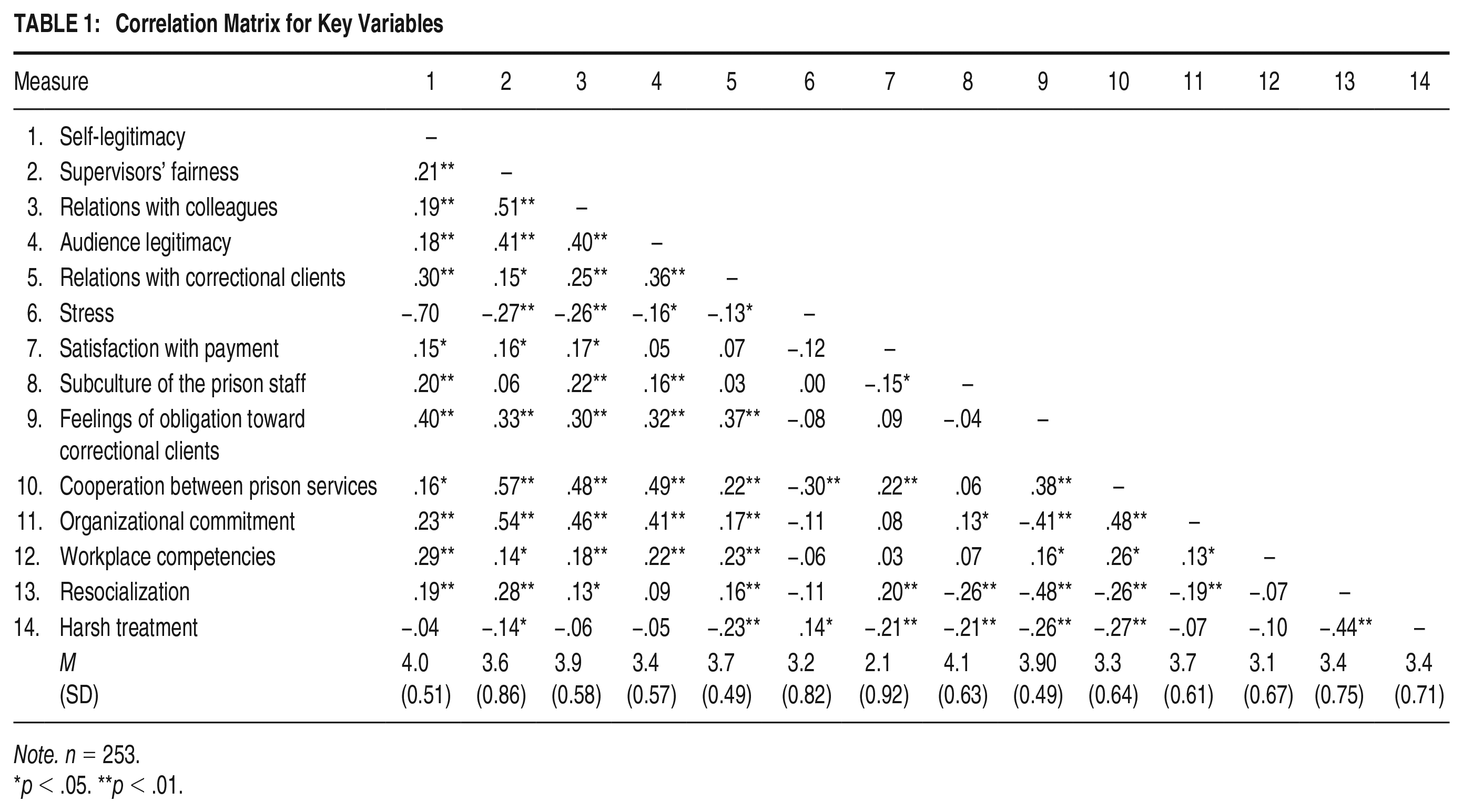
Note. n = 253.
p < .05. **p < .01.
OLS Regression Analysis Predicting Self-Legitimacy of Prison Workers
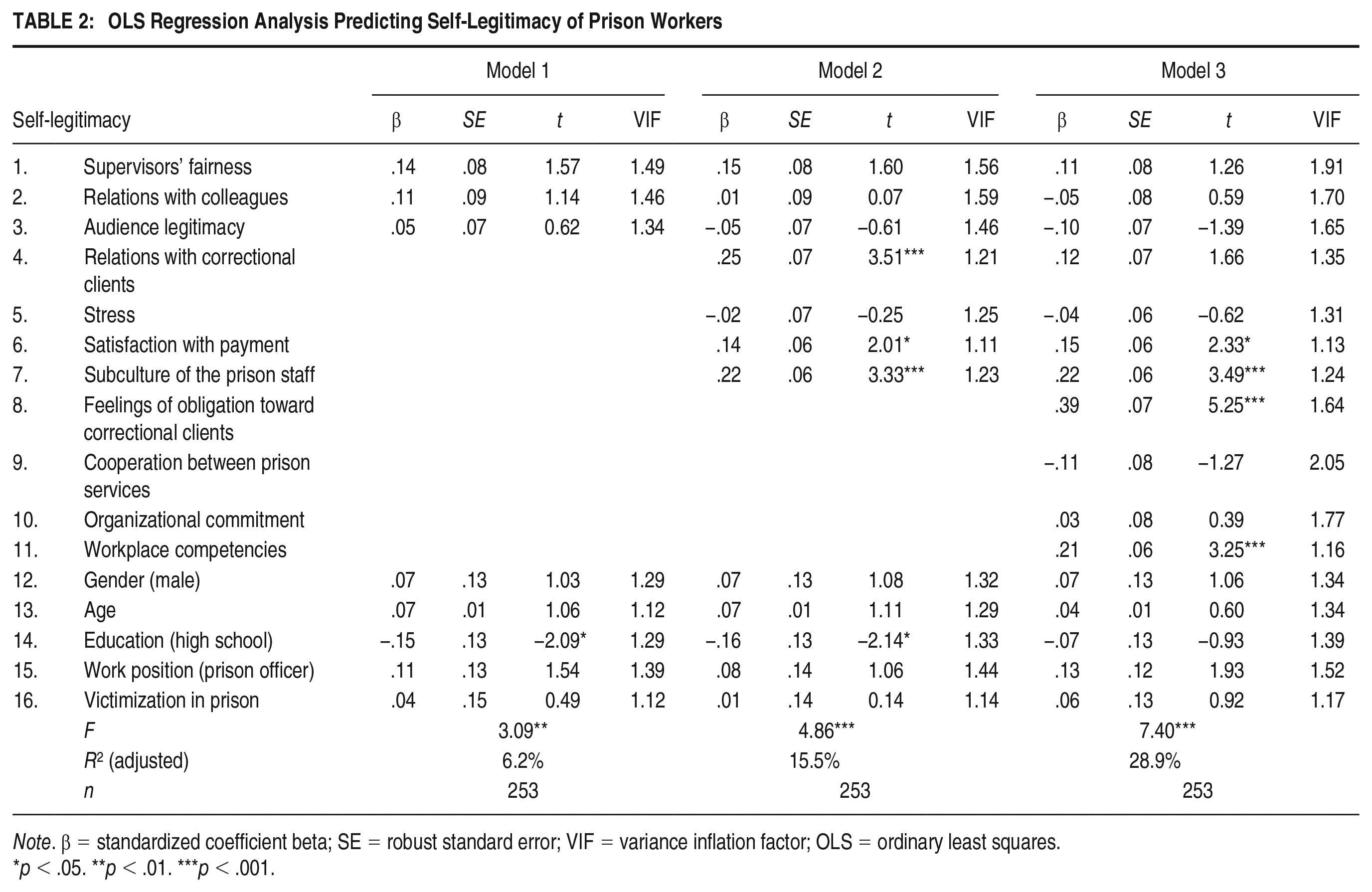
Note. β = standardized coefficient beta; SE = robust standard error; VIF = variance inflation factor; OLS = ordinary least squares.
p < .05. **p < .01. ***p < .001.
OLS Regression Analysis Predicting Prison Workers’ Support for Resocialization and Harsh Treatment
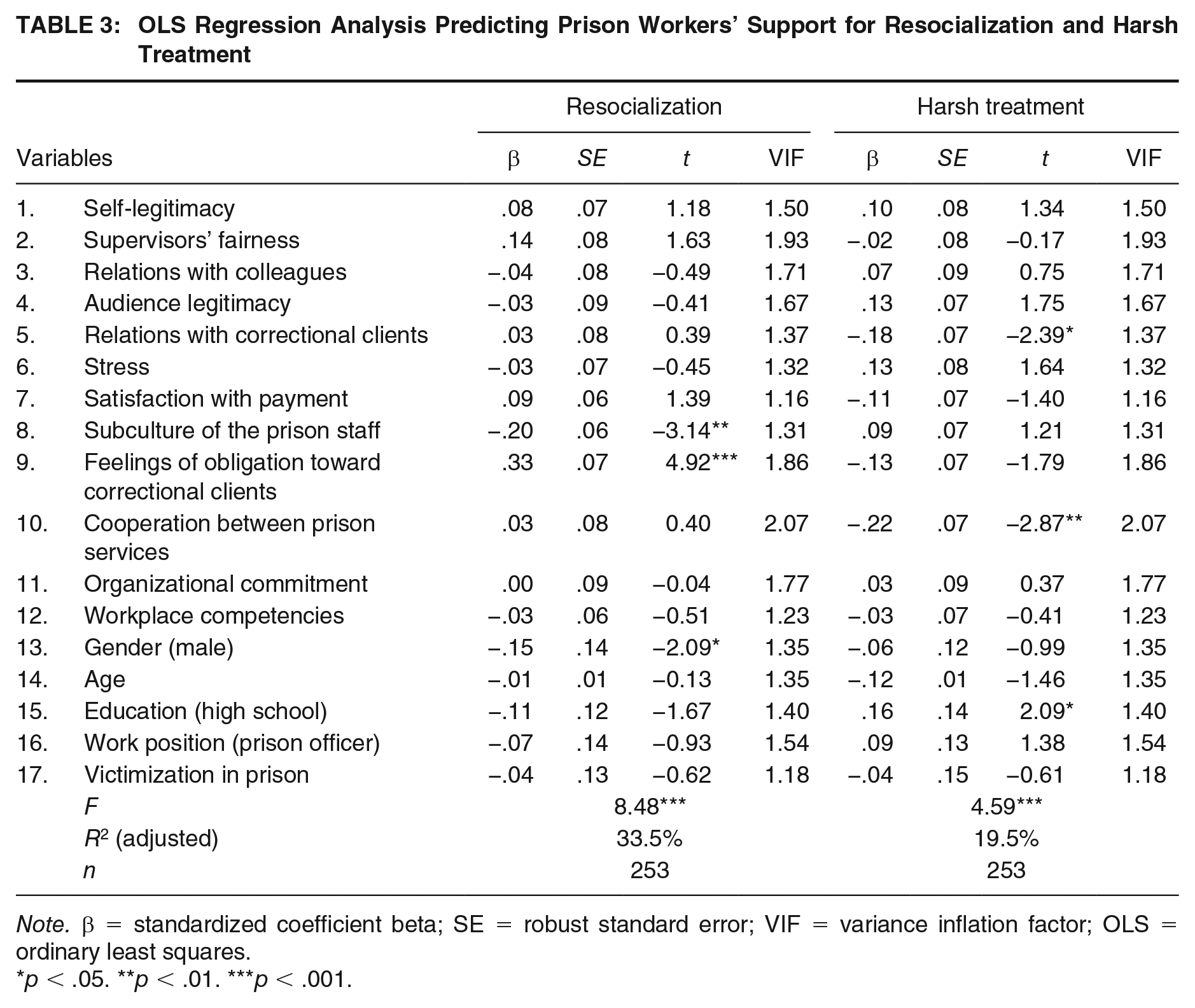
Note. β = standardized coefficient beta; SE = robust standard error; VIF = variance inflation factor; OLS = ordinary least squares.
p < .05. **p < .01. ***p < .001.
The examination of predictors of self-legitimacy by applying multiple regression analysis with robust standard errors tackling the problem of clustering of respondents within prisons took place, which results are displayed in Table 2. Model 1 considers the influence of demographic variables in combination with “core variables” used for explaining self-legitimacy: relations with colleagues, supervisors’ fairness, and audience legitimacy. In contrast to results of studies focusing on police officers’ self-legitimacy (see Hacin & Meško, 2022; Tankebe, 2019; Tankebe & Meško, 2015) and previous studies on self-legitimacy of prison workers (see Akoensi & Tankebe, 2020; Hacin et al., 2019), none of the “core variables” influence self-legitimacy of prison workers. Moreover, higher educated prison workers perceived their own legitimacy more positively (β = −.15; p = .04). Overall, the model explained 6.2% of the variance in the perception of self-legitimacy of prison workers sampled.
Model 2 introduced relations with correctional clients, stress, satisfaction with payment, and subculture of the prison staff, variables identified by Hacin and Meško (2020) as predictors of prison workers’ self-legitimacy. Results indicate that self-legitimacy of the prison staff is influenced by relations with correctional clients (β = .25; p < .001), subculture of the prison staff (β = .22; p < .001), education (β = −.16; p = .03), and satisfaction with payment (β = .14; p = .04). Contrary to previous findings on prison staff’s perception of their own legitimacy, relations with correctional clients overshadowed the “core variables” in influencing self-legitimacy, indicating the importance of everyday interactions as teachable moments for prison workers about their own legitimacy. Similarly, the subculture of the prison staff in the sense of unconditional support among colleagues significantly affects individuals’ perception of their own legitimacy. The model explained 15.5% of the variance in the perception of self-legitimacy of prison workers sampled.
The introduction of new variables in Model 3 presents a deviation from the previously used models for exploring the self-legitimacy of prison workers in Slovenia (Hacin & Meško, 2020). In combination with variables from Model 2, these variables accounted for 28.9% of the variation in the self-legitimacy of prison workers. Similar to Model 2, satisfaction with payment (β = .15; p = .02) and subculture of prison staff (β = .22; p < .001) were positively associated with the self-legitimacy of prison workers. Introducing new variables, feelings of obligation toward correctional clients (β = .39; p < .001) and workplace competencies (β = .21; p < .001) reduced the strength of relations with correctional clients. It seems that the quality of basic and additional training influences prison workers’ perception and trust in their own competencies and, consequently, their self-legitimacy. The influence of feelings of obligation toward correctional clients on the self-legitimacy of prison workers indicates the importance of the treatment orientation/ethos in Slovenian prisons on individuals’ perception of themselves as capable and legitimate power-holders.
In Table 3, correlates of prison workers’ support for the resocialization and harsh treatment of correctional clients were examined. In contrast to previous studies (Akoensi & Tankebe, 2020), findings show that female prison workers are more supportive of the resocialization of correctional clients than their male colleagues (β = −.15; p = .04). Prison workers who internalized their “call in prison” and felt obligated to help correctional clients were most disposed to support their resocialization (β = .33; p < .001). In accordance with expectations, the subculture of the prison staff had a negative impact on their support for the resocialization of correctional clients (β = −.20; p = .002). The norms of prison staff’s subculture are most often internalized by cynical individuals with a pessimistic outlook on life, who are less inclined to help correctional clients (Stern, 1993). Overall, the model explained 33.5% of the variance supporting resocialization of correctional clients of prison workers sampled.
Due to the changes in the Slovenian prison system in recent years that had a negative impact on the traditional treatment of correctional clients, correlates of prison workers’ support of harsh treatment were examined. Positive relations with correctional clients mediated prison staff’s support of harsh treatment (β = −.18; p = .02), as those prison workers who make an effort and “get to know” correctional clients realize that they are not (all) evil and incorrigible. As Gilbert (1997) argued, the main product of prison workers should not be security and control but their personal interactions with correctional clients. Cooperation between prison services, that is, the treatment service and prison officers, is crucial for a comprehensive treatment of correctional clients and deterring prison workers from supporting harsh treatment as the result of their ineffectiveness to resocialize correctional clients, evolving cynicism, or professional rivalry between services. Finally, it seems that prison workers with a lower level of education (mostly prison officers) are more inclined toward harsh treatment of correctional clients. This result supports the findings of Akoensi and Tankebe (2020) that more educated prison officers express greater support for resocialization of correctional clients. In total, these variables accounted for 19.5% of the variation in prison workers’ support of harsh treatment.
Discussion
Penal studies have demonstrated that the presence of legitimacy influences the internal order in prisons and presents an alternative to traditional coercive measures (Liebling & Price, 2001; Sparks et al., 1996). As Akoensi and Tankebe (2020) pointed out, self-legitimacy studies predominately focus on police officers, neglecting prison staff. Based on the national sample of Slovenian prison workers, this study aims to address this gap and advance our understanding of the correlates of prison workers’ self-legitimacy and its impact on their support of specific treatment of correctional clients.
First, different models of correlates of prison workers’ self-legitimacy were tested. It seems that the traditional model comprising “core variables” (i.e., supervisors’ fairness, relations with colleagues, and audience legitimacy) is not best suited for the Slovenian prison system. None of the abovementioned factors influenced self-legitimacy of the prison staff. The significance of this finding can be seen in (a) the confirmation of the unstable nature of self-legitimacy and its correlates through time; in Hacin and Meško’s (2020) study in Slovenian prisons, all three “core variables” correlate with self-legitimacy; (b) exposing the possible unsuitability of traditional models for exploring self-legitimacy, developed primarily to measure police officers’ self-legitimacy, in the prison environment; Bottoms and Tankebe (2021) drew attention to this problem; however, future research is needed; and (c) the effect of the cultural setting on correlates of self-legitimacy, as relations with colleagues and supervisors’ treatment correlated with self-legitimacy of prison officers in Ghana (Akoensi & Tankebe, 2020).
In contrast to the unstable nature of the “core variables,” relations with correctional clients, satisfaction with payment, and subcultural norms have a constant influence on self-legitimacy of prison workers in Slovenia (Hacin & Meško, 2020). Subcultural norms are present in every prison across the world, and in this context, they can be explained as an unconditional reliance and support of one’s colleagues that goes beyond good or bad relations with colleagues. The camaraderie between prison workers influences an individual’s sense of belonging and status of a power-holder (Liebling & Price, 2001). An honest payment can be seen as the acknowledgment of the prison system to prison workers that their position and work are important and valued. Finally, relations with correctional clients were identified as one of the strongest correlates of prison workers’ self-legitimacy. Liebling (2011) wrote that relations between prison workers and correctional clients represent the beating heart of a prison. Relations between these two groups influenced the lives of all involved and significantly affect the overall social climate (Brinc, 2011). It has to be emphasized that due to the architectural features of Slovenian prisons (predominately small prisons), and the openness of the regimes, conditions allow prison workers to develop intense (right) relations with correctional clients, as they are in daily (formal and to a certain extent informal) interactions with them.
In addition to already identified and previously tested correlates of self-legitimacy, new variables were introduced. Feelings of obligation toward correctional clients in the sense of duty to help them “get on the right path” indicate that most prison workers do not perceive their work as a mere job but as a profession, for which, similar to police officers, have a calling (Hacin & Meško, 2022). Finally, the role of professional competencies on prison workers’ perception of self-legitimacy cannot be overlooked. The quality of training directly affects prison workers’ sense of competence and suitability for the role and position of a power-holder in prison. These findings are significant as they indicate that the self-legitimacy of prison workers depends or rather can be influenced by the appropriate training program and partial “indoctrination” into the prison workers’ profession.
Second, following Akoensi and Tankebe’s (2020) example, the impact of the self-legitimacy of prison workers on their support for the resocialization of correctional clients and harsh treatment was tested. Prison workers’ support for resocialization is essential if they want to prepare correctional clients for life without crime after release (Brinc, 2011; Farkas, 1999). Feelings of obligation toward correctional clients present the strongest correlate of prison workers’ support of resocialization. Prison workers who defied the traditional subcultural norms, and internalized the prevailing orientation toward treatment and care of correctional clients in Slovenian prisons, are more inclined toward resocialization. We assume that the Slovenian prison system comprises a “healthy” mix of all types of prison workers (Gilbert, 1997; Tait, 2011); however, the support of the treatment ideology (i.e., resocialization of correctional clients) is predominant with the majority. In contrast to Akoensi and Tankebe’s (2020) findings, female prison workers in Slovenian prisons were more inclined toward resocialization. However, it has to be emphasized that women present the overwhelming majority of treatment workers whose main task is the resocialization of correctional clients.
Prison workers’ support of the harsh treatment is a direct consequence of their bad relations with correctional clients and the lack of cooperation between prison services. Bad or strictly formalistic relations between prison workers and correctional clients present a step backward in the strive toward the resocialization and regression into a culture of contempt and interpersonal hostility (McDermott & King, 1988). Correctional clients who do not perceive prison workers as trustworthy individuals who have their best interest in mind will not cooperate and will play the “treatment game” (Petrovec & Meško, 2006). Lack of cooperation between prison services prevents a comprehensive treatment of correctional clients and leads to the division within an organization into “us and them,” which correctional clients will exploit to their benefit. While studies (e.g., Akoensi & Tankebe, 2020; Hacin & Meško, 2020) have identified greater support for resocialization with more educated prison workers, it appears that the opposite is also true. Prison workers with lower levels of education (mostly finished high school) expressed greater support for the harsh treatment of correctional clients. It has to be emphasized that this group is predominately represented by prison officers whose primary task is not the resocialization of correctional clients but maintaining order and security in prisons. As Hacin and Meško (2017, 2020) demonstrated, the effect of prison workers’ position in prisons (and their educational level) on self-legitimacy and relations with correctional clients in Slovenia is complex and demands its own study.
The study is not without limitations. First, there is a possibility of response bias, as data are cross-sectional and capture views of prison workers at a single point in time. As studies (e.g., Hacin et al., 2019) have shown, changes in correlates of prison workers’ self-legitimacy can vary over time. A longitudinal study should be implemented in the future, which would not only compare the (un)stable nature of self-legitimacy in different time periods but also combine quantitative research (surveying) with qualitative methods (interviews) that would enable an in-depth exploration of correlates of self-legitimacy. Second, the problem of sincerity should be mentioned, as the possibility exists that prison workers gave socially desirable answers in the process of surveying due to fear of disclosures and possible sanctions from their supervisors. To avoid such behavior, researchers ensured confidentiality and anonymity before surveying. Third, proposed models for identifying correlates of prison workers’ self-legitimacy comprising new variables used in the current study were tested solely in the Slovenian prison system and demand additional testing in other cultural settings. As Bottoms and Tankebe (2021) highlighted, the importance of factors influencing legitimacy varies in different social contexts. Fourth, variables relating to resocialization and harsh treatment referred to prison workers’ attitudes toward specific treatment of correctional clients, not their actual behavior toward them. Finally, as previous studies showed (e.g., Brunton-Smith & McCarthy, 2016; Hacin, 2018), prison regimes influence correctional clients’ perception of prison staff’s legitimacy and relations with prison workers. It can be assumed that the same is true for prison workers; however, due to the specific organization of Slovenian prisons affecting prison workers’ daily interactions with all types of correctional clients, it was not possible to include a variable that would differentiate between prison regimes. Future research should address this issue by introducing new questions in the survey instrument that would tackle the problem of differentiation.
Supplemental Material
sj-docx-1-cjb-10.1177_00938548231206844 – Supplemental material for Self-Legitimacy of Prison Workers and Treatment of Correctional Clients: A Study in Slovenian Prisons
Supplemental material, sj-docx-1-cjb-10.1177_00938548231206844 for Self-Legitimacy of Prison Workers and Treatment of Correctional Clients: A Study in Slovenian Prisons by Rok Hacin and Gorazd Meško in Criminal Justice and Behavior
Footnotes
AUTHORS’ NOTE:
The authors state that the article is in compliance with ethical standards. The authors have no competing interests to declare that are relevant to the content of this article. This article is based on a research project—Research of prison workers’ professional competencies and relations in prisons (c2031-22-090000)—that was financially supported by the Ministry of Justice, Slovenian Prison Administration.

Notes
References
Supplementary Material
Please find the following supplemental material available below.
For Open Access articles published under a Creative Commons License, all supplemental material carries the same license as the article it is associated with.
For non-Open Access articles published, all supplemental material carries a non-exclusive license, and permission requests for re-use of supplemental material or any part of supplemental material shall be sent directly to the copyright owner as specified in the copyright notice associated with the article.
