




Abstract
Most research finds that individuals are drawn to the correctional officer occupation for the pay and benefits or because it provides a new and exciting opportunity. However, these are not the only interests for choosing a correctional officer position. The current study draws on a sample of pre-service correctional officers surveyed prior to beginning their jobs (N = 673). In the spirit of the deviant case method, we focus on a subset of our sample who provided problematic motivations for becoming officers (n = 38). Using a thematic analytic approach, we identified five broad themes within this nefariously/disconcertingly motivated sample: use of force, punitive focus, power and control, cavalier ulterior motives, and problematic social boundaries. We theorize, based on prior research, that these individuals could constitute a meaningful minority that may contribute to the detriment of both their organizations and those they are overseeing. Future research should explore this possibility.
Individuals who choose to work as a correctional officer often face many challenges on the job. Notwithstanding the fact that they perform a job that carries with it an increased risk of physical assault, contracting transmissible diseases, and developing psychological maladies, they are often portrayed as “hacks” who do “dirty work” (Freeman, 1998; Konda et al., 2013; Maruschak et al., 2016; Vickovic et al., 2013). Due to the difficulties of the work, and often negative depiction of their occupation, a key question is: “Why do individuals choose to become correctional officers?”
Studying career motivations for this occupation is not new or unique. Several studies have specifically explored the factors that motivate individuals to choose correctional officer careers. These studies generally report that “pay and benefits,” “job status,” and a “new opportunity” are the main draws for choosing a correctional officer position (Burton, Jonson, Miller, Petrich, & Burton, 2022; Ricciardelli et al., 2022; Ricciardelli & Martin, 2017; Schlosser et al., 2010). However, not all individuals are motivated by these prospects. Given the relative power that correctional officers are afforded over those serving time in prisons, a small but meaningful number of individuals are motivated to take these positions for what we label as “nefarious or disconcerting reasons.” We define these interests as ones that are, on their face, disturbing or potentially problematic for the safety or well-being of all those living and working in the prison.
In the spirit of the deviant case method (Molnar, 1967; Sullivan, 2011), the current study examines the ~6% of our sample that provided nefarious or disconcerting interests for choosing a correctional officer career. Note that a defining characteristic of the deviant case method is “to acknowledge the existence of outliers and reflect on their theoretical implications” (Gibbert et al., 2021, p. 179). Although our study reflects on the potential implications of these individuals on their organizations, it is important to interpret our findings and theorizations with caution. In other words, what we present here is not the norm in the occupation. In the case of our overall sample, approximately 94% of the officers reported what we consider to be either neutral or favorable reasons for taking a correctional officer position, such as “the pay and benefits,” “to protect society,” and “to help offenders turn their lives around.”
Drawing on data from newly hired corrections officers collected in three states, we focus specifically on the nefarious/disconcerting reasons officers gave for pursuing a position as a correctional officer. We then theorize how this group might constitute a meaningful minority that could potentially contribute to the detriment of departments of correction as well as those serving time in prisons. Below, we review the correctional officer career motivations literature examining the linkage between motivations/interests and related outcomes, and then the literature on correctional officer deviance. The working theory posits that those whose motivations and interests for entering the occupation are nefarious or disconcerting might be more likely to commit deviant acts while on the job. Prior to discussing the methods used to carry out our work, we also explain a “bad apple” argument outlining the potential ramifications of these officers both on those they oversee and work with.
Choosing the Correctional Officer Profession
Regardless of the challenges faced by correctional officers at work and the bravery that is required to do the job, correctional officers are generally depicted negatively and labeled as “hacks” (Vickovic et al., 2013). In this context, the “hack” correctional officer is regarded as incompetent, performing a low-skill job that is mostly custodial in nature, with little care for the suffering of people incarcerated; in other words, the “hack” correctional officer is someone who simply performs “dirty work” (Toch, 1978; Tracy & Scott, 2006). Newspaper media perpetuates this image. For example, analyzing approximately 1,500 newspaper articles, Freeman (1998) uncovered that about 60% of articles perpetuate the stereotype that correctional officers are “hacks.” Using a similar methodological approach, Vickovic and colleagues (2013) corroborated Freeman’s (1998) fifteen years later and reported that 79.6% of articles negatively depicted correctional officers. Considering this bleak reality, what motivates tens of thousands of individuals each year to pursue correctional officer positions?
Primary Motivations
Several studies have examined what motivates individuals to choose corrections careers both in the United States and Canada. For example, Schlosser et al. (2010) asked a sample of newly hired correctional officers why they chose to apply to their correctional officer position. The most cited reasons were the job security, opportunities for advancement, early retirement with good pay, and the ability to keep the community safe (Schlosser et al., 2010). The salience of pay and benefits as a primary draw for this line of work has been corroborated by virtually every study examining the motivations for choosing correctional officer positions (Burton, Jonson, Miller, Petrich, & Burton, 2022; Collica-Cox & Schulz, 2018; Lombardo, 1981; Ricciardelli et al., 2022; Ricciardelli & Martin, 2017). Furthermore, Burton, Jonson, Miller, Petrich, and Burton (2022) recently reported several other motivations officers gave for choosing the occupation, which included opportunities to help rehabilitate individuals serving time in prisons and to protect society from harm.
Although it appears evident why most individuals are motivated to choose a correctional officer career, these motivations are not held by all who do. Just as some individuals are motivated for positive and prosocial reasons (e.g., to assist in the rehabilitation process), a group of individuals appear to be motivated by negative and antisocial reasons. Because many individuals who choose correctional officer positions come from industries with little autonomy or power within their organization (e.g., factory work, manual labor), a correctional officer position may attract those seeking power and control over others (Burton, Jonson, Miller, & Cook, 2022; Burton, Jonson, Miller, Petrich, & Burton, 2022; Lombardo, 1981). We theorize that some of these individuals, if hired, could potentially go on to have problematic careers and adversely affect the organization and those serving time. Below we review the broader literature on correctional officer deviance and theorize how detrimental these nefariously or disconcertingly motivated officers could be in their positions.
The Link Between Career Interests, Motivations, and Behaviors
The study of career interests and motivations has received considerable attention in the last decade. Perhaps most popularly, Sinek (2017) has referred to these motivations as someone’s “why.” As Sinek (2017) argues, the answer to the “why” question is important because it might serve as an anchor point from which the employee’s attitudes, orientations, and behaviors are predicated. Within the broader academic literature, numerous studies have examined the role of career interests and motivations and their tangible effects on work outcomes.
There are at least three explanations in the extant literature relating career motivations and interests to workplace outcomes. One argument is that interests in a career affect the extent of involvement a person brings with them on the job. Put simply, they will involve themselves more with tasks related to their overarching career interests and less with tasks that do not (Dawis, 1991; Van Iddekinge, Putka, & Campbell, 2011; Van Iddekinge, Roth, et al., 2011). A second explanation for the relationship between career interests and motivations is that they are just expressions or proxies of personality (Holland, 1997). In this vein, the aspects of the employee’s personality are ascertained by exploring their interest in and motivation for a specific occupation. Then, upon the job, their personality affects feelings, thoughts, and behaviors toward their work (Barrick et al., 2003).
Finally, a third explanation is that career interests and motivations affect job outcomes through work values (Van Iddekinge, Putka, & Campbell, 2011; Van Iddekinge, Roth, et al., 2011). Work values are generally defined as standards that guide workplace choices and behaviors and also reflect a broader importance that employees place on work-related goals and outcomes (Dawis & Lofquist, 1984; Dose, 1997). The logic here is that career interests and motivations carry with them a specific set of work values an individual brings with them to a job. Those values then shape their behaviors as well as their efforts toward achieving the specific goals of their organization.
In addition, the linkage between thinking about and acting on a subsequent behavior has long been recognized within the criminal justice system. Cognitive behavioral therapy (CBT), which posits that an individual’s thoughts, attitudes, and beliefs are direct antecedents to their behavior, has been the foundation of correctional rehabilitation among justice-involved populations for decades (Andrews et al., 1990; Lipsey et al., 2007). Rather than focusing on external events and situations, CBT interventions look internally within a person and work to replace their “antisocial thoughts with prosocial thoughts” as a means to alter criminal behavior (Andrews & Bonta, 2010, p. 540). The effectiveness of CBT programs is supported by a vast empirical literature. Specifically, CBT treatment is associated with diminished criminal behavior among adults, juveniles, and those who committed violent or sex offenses (Lipsey et al., 2007; Wilson et al., 2005). As a result, within the correctional rehabilitation literature, the relationship between thoughts and behaviors is well documented and leveraged to curb future criminal behaviors among justice-involved populations. Tying this to our study, officers’ nefarious and disconcerting thoughts and interests toward pursuing correctional officer work may become actions and behaviors while on the job.
Potential Consequences of Nefarious or Disconcerting Motivations
Harmful Officer Conduct
As with any other profession, correctional officers are not immune from engaging in acts of deviance. These acts include engaging in inappropriate relationships with or sexually abusing those incarcerated, the use of violence as a means of coercion, involvement in contraband markets within correctional institutions, theft or destruction of property owned by people incarcerated, discrimination, abuse of authority, and a general failure to fulfill the duties of the job (see, for example, Beck et al., 2013; Lankenau, 2001; Marquart, 1986; J. I. Ross, 2013).
Stories of these types of behavior from correctional officers are often found in the news media. Tully (2022), for example, recently reported that 14 officers from New Jersey’s Edna Mahan Correctional Facility for Women were indicted for their involvement in a large, preplanned raid of cells in January of 2021. That raid resulted in substantial injuries to several of the incarcerated women, including one whose skull was fractured after she had complied with orders to let herself be handcuffed. A report from the year prior by the Justice Department indicated that sexual abuse of incarcerated people by correctional officers had been a long-standing problem within that institution (United States Attorney’s Office, 2020; see also Benner, 2020). Another recent article by ProPublica identified 18 correctional officers in Illinois who, despite being found responsible for engaging in misconduct by the Illinois Department of Corrections between 2014 and 2019, remained on the job. For example, charges were substantiated against four officers involved in the death of Terrance Jenkins, an incarcerated man (Heffernan, 2022). Investigations revealed that officers had continued to apply force to Jenkins after he had been restrained, and paramedics found mysterious balls of paper in Jenkins’s throat (Mills, 2017).
Despite these sorts of stories in the media, scholars acknowledge that there is a dearth of empirical data on the prevalence of deviant behavior among correctional officers (Carter, 2020; J. I. Ross, 2013; Worley & Barua Worley, 2011). The most robust estimates of officer-initiated sexual victimization come from Beck and colleagues’ (2013) analysis of the National Inmate Survey. Between 2011 and 2012, 92,449 adults incarcerated in prison and jail and 1,738 juveniles held in adult institutions were surveyed about sexual victimization while incarcerated over the previous year. Within the adult sample, 2.4% and 1.8% of people housed in prisons and jails, respectively, reported at least one incident of sexual contact with staff. For those incarcerated in prisons and jail, 62.5% and 77.8%, respectively, reported these contacts being “unwilling” as a result of “physical force, pressure, or offers of special favors or privileges” (Beck et al., 2013, p. 9). A slightly higher proportion of juveniles held in adult prisons and jails—2.8% and 3.3%—also reported sexual contact with staff. Among this group, 32.1% of juveniles reported the contact as unwilling, as well as 66.7% of juvenile jail detainees. Regardless of whether the incarcerated persons themselves report sexual contact with staff as being willing or not, it is important to note that any form of sexual contact between the staff and those in prison/jail is illegal given the inherent power differential between them (Pimlott Kubiak et al., 2018).
Little is known about the extent of other, non-sexual forms of correctional officer deviance. Researchers have long lamented this fact (e.g., Griffin, 1999; Marquart, 1986), yet there are still no official sources of data on officers’ excessive use of force against people in prisons/jails, involvement in illicit markets, or other sorts of boundary violations (Rembert et al., 2023). Early ethnographic work by Marquart (1986) illustrated that officers often use verbal intimidation and physical violence to maintain control and order within institution when people incarcerated engage in misconduct, refuse to obey orders, or are disrespectful toward staff. A more recent analysis of court filings by Rembert et al. (2023) reveals similar reasons for officer-on-incarcerated person excessive use of force. And a small handful of officer surveys in Arizona by Griffin (1999, 2002) and in Texas by Worley and Barua Worley (2013, 2016) indicate that some officers are more willing to use force or otherwise cross boundaries than others (e.g., tampering with incarcerated people’s food, reporting other officers’ misconduct, turning a blind eye to misconduct).
Along with this pittance of information on the prevalence of correctional officer deviance, explanations of such deviant acts are in short supply. Most research that has addressed the reasons for officer misbehavior points to the nature of the job and workplace conditions. In addition to using violence as a means of controlling unruly incarcerated people, Marquart’s (1986; see also Riley, 2000) work suggested that newer recruits are encouraged—and sometimes rewarded via promotion through the ranks—to use coercion against justice-involved individuals. Physically reprimanding incarcerated people for their perceived misbehavior thus serves to build a sense of brotherhood among officers. Perceptions of other officers committing acts of deviance also consistently emerged as a significant predictor of self-reported deviance in the surveys by Worley and Barua Worley (2013, 2016).
Furthermore, in Griffin’s (1999, 2002) officer surveys, a lack of clarity about rules and regulations predicted readiness to use force (see also Worley & Barua Worley, 2016). Perceiving supervisors as unsupportive, fear of victimization, a weak sense of personal authority, and having a more punitive or custodial orientation toward the job were also associated with a greater readiness to use force. Investigations of the conditions surrounding officer-incarcerated people relationships by Marquart et al. (2001) and Worley et al. (2003) suggest as well that these relationships are most often initiated by those incarcerated. Although sometimes done for genuine feelings of affection, these studies find that, more often, relationships were transactional for people incarcerated, serving as a means of securing contraband or favors, or for the purpose of creating havoc within the institution.
Existing research thus tends to suggest that it is primarily the difficult conditions of the job and the nature of supervising incarcerated people that lead officers to commit acts of deviant behavior (see, more generally, Haney et al., 1973; Sykes, 1958). However, as with the literature on incarcerated people’s misconduct (e.g., Walters & Crawford, 2013), it is just as plausible that officers import preexisting attitudes, beliefs, experiences, and personality traits into the institution that increase their risk of deviant behavior. However, little is known about such preexisting characteristics of correctional officers.
“A Bad Apple Spoils the Barrel”
Beyond deviant behavior, individuals drawn to correctional work for nefarious or disconcerting reasons may pose other risks within the prison setting. Correctional officer work is highly interpersonal and dependent on teamwork, with the group dynamics between both officers and those behind bars critical to the successful execution of the job (Sykes, 1958). Although not extensively studied in correctional settings, the organizational psychology, sports, and policing literatures have long shown cohesion to be the hallmark of an effective team (de Jong et al., 2014; Ilgen et al., 2005; Johnson & Johnson, 2005). However, the presence of a small group of individuals—or even a sole person—who “violate[s] team norms and/or exhibit unethical behaviors” can have devastating impacts in the workplace (Boutler et al., 2022, p. 1; see also Felps et al., 2006; Gino et al., 2009). A “team cancer” has the ability to significantly disrupt the unity of the group while simultaneously creating conflict and difficulty in achieving desired outcomes (Cope et al., 2010, p. 24; see also Leggat et al., 2020). In other words, “a bad apple” has the potential to “spoil the barrel.”
With “negative relationships” having “more powerful consequences than positive ones” (de Jong et al., 2014, p. 514), understanding the impact that individuals with nefarious or disconcerting motivations—or “team destroyers”—has on the work environment becomes imperative (Felps et al., 2006, p. 176). Although there are numerous ways in which “bad apples” adversely affect the workplace, we highlight three that are most relevant to the prison setting: the lowering of team morale/performance, defensiveness, and the contagion or role modeling of negative attitudes and behaviors (Felps et al., 2006; Gino et al., 2009; Leggat et al., 2020; Ouellet et al., 2019; Roithmayr, 2016; Wetlaufer, 1994).
First, a “bad apple” can decimate morale and team performance among co-workers (Chiaburu & Harrison, 2008; de Jong et al., 2014; Eder & Eisenberger, 2008; Felps et al., 2006). Negative team members can leave fellow members feeling exhausted and distracted. To cope, individuals begin putting less effort into and withdrawing from their jobs, and, in extreme cases, quit to avoid the toxic interactions with co-workers (Felps et al., 2006; Pearson et al., 2000). These consequences are salient for the correctional workforce. A voluminous literature documents the profession continuously has grappled with high rates of absenteeism, burnout, job dissatisfaction, stress, and turnover for decades (Cheeseman et al., 2011; Cullen et al., 1985; Lambert, 2001; Lambert et al., 2006; Minor et al., 2011). In addition, in response to these negative work reactions as well as the recent COVID-19 pandemic, there is an alarming shortage of correctional officers in the United States (Russo et al., 2018). With correctional officers long experiencing negative outcomes from their job, the presence of “bad apples” will likely further cripple morale within the prison and may serve as another impetus for officers to leave the occupation.
Second, toxic co-workers can result in their fellow team members becoming defensive. Frustrated by the hostile environment created by the “bad apple,” other members of the team can become angry, anxious, and fearful (Boutler et al., 2022; Felps et al., 2006). As these feelings grow, some individuals “explode,” resulting in people lashing out, seeking revenge, or actively sabotaging their fellow team members (Bies et al., 1997; de Jong et al., 2014; Felps et al., 2006). In a prison setting, these defensive reactions become particularly concerning both for correctional officers and for those serving time behind bars. On the one hand, a toxic co-worker seeking revenge could put a fellow officer in danger if they fail to provide back-up or generate a volatile situation that increases the chance of violence (see Konda et al., 2013). On the other hand, an incarcerated individual may lash out in response to the adverse treatment by a “bad apple.” This reaction could potentially result in the person serving time being victimized or obtaining an infraction for responding negatively to the officer’s behavior or the officer being harmed by the incarcerated person (Logan et al., 2022). Consequently, the defensiveness elicited by nefariously or disconcertingly motivated officers is likely to contribute to the dangerousness of the prison setting.
A third consequence of employing correctional officers with nefarious or disconcerting intentions is the potential for contagion or role modeling of unethical behaviors and attitudes (Felps et al., 2006; Gino et al., 2009; Leggat et al., 2020). As explained by mainstream psychological and criminological theories (e.g., Akers, 1998; Sutherland, 1947), “bad apple” behavior has the potential to spread to other team members through the process of learning. Due to the vast amount of time spent together at work, members of a team may begin to mimic and adopt the attitudes and behaviors of one another, particularly if the individual is rewarded for their actions. This negative behavior spillover has been found among athletes (Leggat et al., 2020), students (Gino et al., 2009), financial advisors (Dimmock et al., 2018), and frontline service workers (Housman & Minor, 2015).
More closely related to correctional work, a growing body of research also has uncovered a contagion effect concerning police officer misconduct (Ouellet et al., 2019; Quispe-Torreblanca & Stewart, 2019). For example, Ouellet et al. (2019) found that greater exposure to colleagues with use of force complaints increased the likelihood of an officer being named in a subsequent use of force complaint. Similarly, evidence for the transmission of deviant police behaviors between peers was found among 35,000 officers and staff members in the London Metropolitan Police Service. Specifically, while examining numerous forms of misconduct (e.g., discriminatory behavior, failure of duty, oppressive behavior), Quispe-Torreblanca and Stewart (2019) uncovered a positive relationship between peer misconduct and an individual’s later misconduct. With the “bad apples” appearing to contaminate teams and result in further corrosive behavior across a variety of professions, correctional work is likely not immune from the toxic effects of these types of employees.
Method
Research Design
The current study uses a deviant case analytic method to examine the not-so-common motivations for choosing a correctional officer position. Scholars first began using this method nearly 60 years ago (Molnar, 1967; A. O. Ross, 1963). Generally, the “deviant case analysis concerns itself with the ways in which an individual differs from the population norm” (A. O. Ross, 1963, p. 339). In other words, the focus centers on “cases which are anomalous with respect to a given hypothesis” (Molnar, 1967, p. 1). Regarding the current study’s focus—motivations for choosing a correctional officer position—the population norm would be defined as pay, benefits, and a new opportunity (Burton, Jonson, Miller, Petrich, & Burton, 2022; Ricciardelli et al., 2022; Schlosser et al., 2010). Conversely, a less frequent (i.e., “anomalous”) set of motivations for choosing this line of work are what we define as “nefarious” or otherwise disconcerting in nature, or specifically, any motivation for taking a correctional officer position that, on its face, is disturbing or potentially problematic for the safety or well-being of all those living and working in the prison.
Given that deviant case analyses focus on a small portion of a sample—in our study, 38 of 673 officers (5.6%)—what is the benefit of such a design? The chief contribution of the method is its utility for theory building (Gibbert et al., 2021; Sullivan, 2011). In nearly every instance, social science theories are never considered “general.” In colloquial terms, this simply means that they cannot explain everything all the time. One must look no further than Gottfredson and Hirschi’s (1990) attempt, A General Theory of Crime, which has been the focus of much empirical contention (e.g., Unnever et al., 2006). Thus, because no theory achieves “general” status, it is argued that no subset of cases that fails to conform with the mainstream theory is too small to offer additional theoretical insight into some phenomenon. Accordingly, focusing on deviant or anomalous cases allows for refinement and extension of existing theory (Sullivan, 2011). Given the relative benefits of the deviant case method, criminologists have used it to examine a variety of topics such as youth delinquency, social control, and criminal careers (e.g., Giordano, 1989; Hirschi, 1969; Sullivan, 2011).
Theoretical implications notwithstanding, applying the deviant case method to study correctional officer career motivations has direct policy implications. This topic takes on added salience when it is realized that even a very small percentage of correctional officers becomes tens of thousands of individuals at scale. This is because there are nearly 420,000 individuals working in the correctional officer occupation in the United States (U.S. Bureau of Labor Statistics, 2022). Below we discuss our sampling strategy, the approach used for discovering nefarious career motivations, and a demographic summary of these individuals.
Sample
Approximately 5 years ago, our research team began a large project to explore a variety of issues related to recruiting, selecting, and training correctional officers (Burton et al., 2023; Burton, Jonson, Barnes, et al., 2022). We initially approached 764 pre-service correctional officers (i.e., hired but have not completed basic training) across three states with a survey request. In total, 673 officers responded. The questionnaire was presented in a pencil/paper format to the officers while they were in their respective state’s training academy. Because the current study focuses on the 38 individuals whose motivations for choosing a correctional officer position were nefarious or disconcerting in nature, we focus solely on them in Table 1. As shown, the sample is 52.6% male, 71.1% White, and on average 28.8 years old. Regarding education, 23.7% of the sample holds a college degree. Note that, for reference, Table 1 also presents the descriptive statistics of the larger sample of officers who did not report nefarious or disconcerting interests for pursuing a correctional officer career.
Sample Demographics and Descriptive Statistics
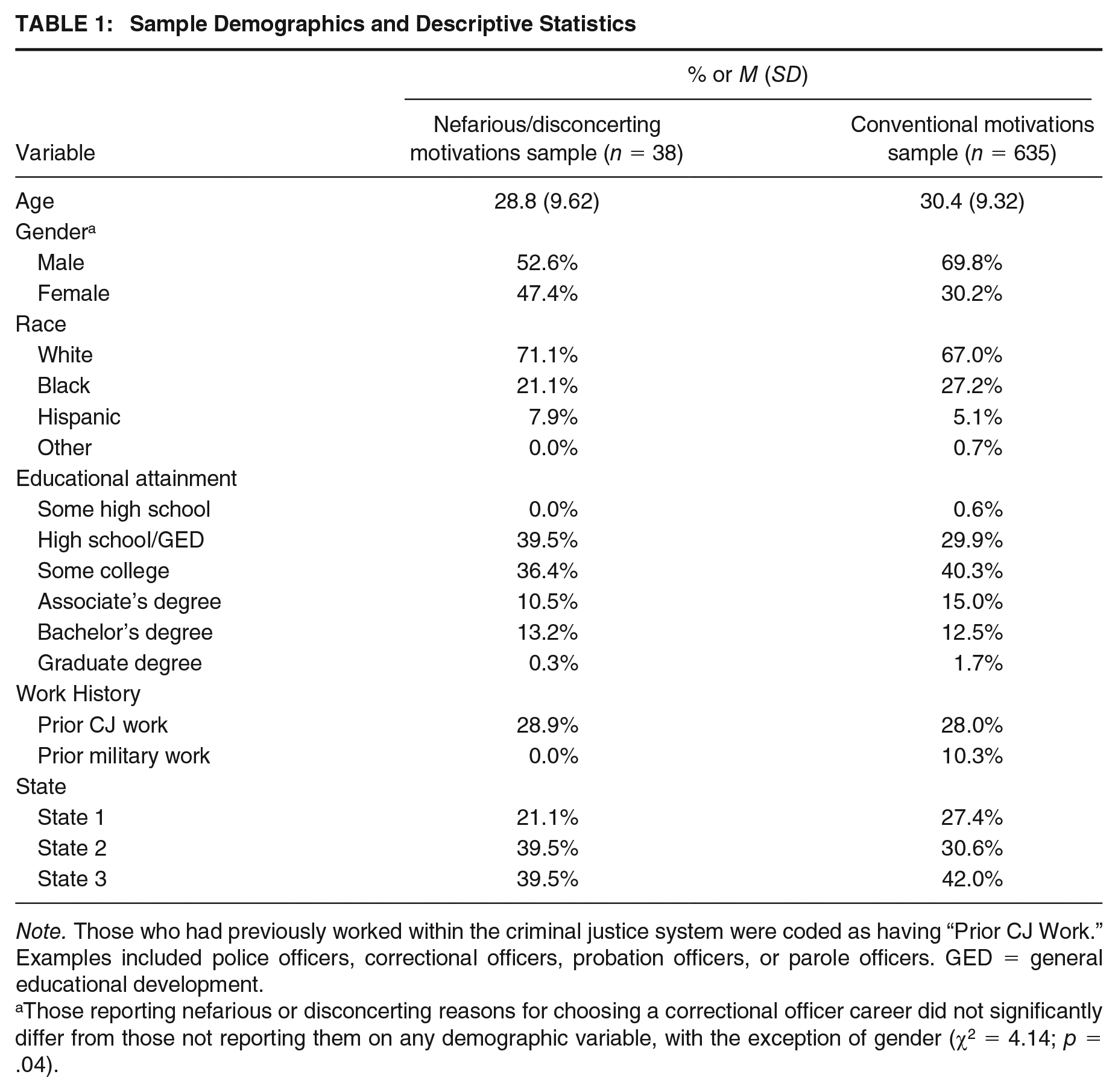
Note. Those who had previously worked within the criminal justice system were coded as having “Prior CJ Work.” Examples included police officers, correctional officers, probation officers, or parole officers. GED = general educational development.
Those reporting nefarious or disconcerting reasons for choosing a correctional officer career did not significantly differ from those not reporting them on any demographic variable, with the exception of gender (χ2 = 4.14; p = .04).
Measurement and Analytic Plan
To assess career motivations for newly hired correctional officers, they were asked, “What interests you most about the position you are currently in training for?” The respondents were then provided with space on the hardcopy surveys to guide their written response to the question. Note that there were no subprompts used and the nature of the question and response format was open-ended. Responses to this question were analyzed using a thematic analysis strategy (Braun & Clarke, 2006). As our goal in the current study was primarily descriptive and participants’ responses were generally quite short (i.e., one sentence or less), an inductive, open coding approach was sufficient to derive themes from the data (Corbin & Strauss, 1990; see also Bailey, 2017). The goal throughout this process was to break participants’ varied responses down into a smaller set of more manageable, cohesive themes that captured their primary reasons for an interest in correctional officer work. To do so, two coders independently reviewed all 673 responses and generated lists of initial themes. Following this step, the coders met to discuss their findings, agree upon a master set of themes, and provide operational definitions for each theme. Coders then independently categorized responses according to the master list and subsequently reconvened to discuss their findings. Interrater reliability for this particular question on primary interest in the job was 88%, and any coding discrepancies were settled based on discussion between the two coders. Most participants’ reasons for choosing the job were “conventional” (94.4%), such as opportunities for higher pay and benefits, interest in fields of criminal justice or corrections, helping those in prison, or protecting the community (Burton, Jonson, Miller, Petrich, & Burton, 2022). However, a small group of officers (5.6%) gave answers that the coders marked as “nefarious” or “disconcerting.” The coders conducted another stage of coding in which the disconcerting responses were further broken down into the themes presented below.
Results
Five distinct themes emerged when analyzing those who expressed interest in correctional officer work for nefarious or disconcerting reasons: use of force, punitive focus, power and control, cavalier ulterior motives, and problematic social boundaries. These themes comprised 97.4% of the subsample of nefariously/disconcertingly motivated officers. The responses reported below are exactly as they were written on the questionnaires. In other words, the quoted text is not abbreviated, and we present the full statements provided by the officers.
Use of Force
Many individuals choose careers that allow them to physically exert themselves. Some have a passion for martial arts or firearms and seek careers that allow them to explore these passions. However, there are both prosocial and disconcerting means through which people could channel these interests in the workplace. With this in mind, around 10.5% of the 38 deviant cases reported that they were most interested in correctional officer work for reasons centering around use of force or weapons. Respondents who identified something on the use of force continuum or mentioned weapons or physical control tactics were placed into this category. Examples of responses included “Pepper spray,” “defensive tactics,” “defensive tactics and carrying a shotgun,” and “tactics teams.” Although use of force is a part of the job, it is nonetheless disconcerting that these respondents named specific weapons as the most interesting thing about becoming a correctional officer. These responses can be juxtaposed with those in the larger sample who focused on keeping the prison or the community safe, including “keeping inmates safe,” “community safety,” “keeping inmates safe from each other,” “protecting inmates and protecting my community,” and “stopping gang violence.” These individuals value the control tactics and tools at their disposal but focus instead on a prosocial purpose in their responses.
Punitive Focus
Approximately a quarter (23.7%) of the respondents assessed in this study reported punishments, punitive sanctions, or mechanisms through which sanctions may be brought against those serving time as their primary interest in the position. These responses included “teaching inmates a lesson,” “moral objection to offender treatment,” “training dogs (offenders),” “treating them (offenders) like the animals they act like,” “discipline offenders,” “teaching inmates a lesson,” “finding contraband,” “doing urine samples,” and “moral objections to offenders receiving treatment.” It is important to note that not all individuals who mentioned punitive perspectives in the entire sample of 673 respondents were categorized as disconcerting; respondents also provided motivations such as “want to be firm, but fair,” “teaching offenders morals and values,” and “teaching offenders the right things.” Thus, only those who focused on sanctions and harsh punishment were coded as having a nefarious or disconcerting motivation.
Power and Control
Just over one-third (34.2%) of the respondents emphasized power and control over those serving time as their primary interest in the position. Examples of these responses included “Power over offenders,” “Power over prisoners,” “being in charge,” “control over offenders,” and “advancement and authority over offenders.” Many respondents in the large sample provided reasons that pertained to power or control but did so in a less disconcerting manner: juxtaposing more prosocial responses to disconcerting responses were those who said “leadership roles,” “being a leader,” “leadership and management,” and “supervising inmates.”
Cavalier Ulterior Motives
Although not nefarious in nature, just over one-fifth (21.1%) of the officers assessed in this study stated that they were most interested in the position for reasons that indicated a lack of seriousness about the job as well as motives for the work that are contrary from what might be expected. These included “Weird job,” “Can’t get fired,” “less responsibilities,” “the adrenaline rush and keeping prison safe,” “Good for my mental health,” and “Helping me keep sobriety.” Although people seeking employment for their mental health and sobriety would normally be appropriate, in the context of this stressful and sometimes dangerous position, these responses were disconcerting as they indicate a lack of understanding of or seriousness about the role.
Problematic Social Boundaries
Officers espousing interests indicating problematic social boundaries comprised 7.9% of the sample. These responses comprised officers with interests in the work due to relationships they already had or intended to establish with those serving time in the prison. Examples of these interests for taking the officer position included “My brother is in this institution,” “being around inmates,” and “making friends with crims.” Given the need for correctional officers to refrain from having nonprofessional relationships with those serving time (Beck et al., 2013; Lankenau, 2001; Marquart, 1986; J. I. Ross, 2013), it is disconcerting that these officers highlighted having relationships with those in prison as the factor that interests them the most.
Other Reasons
Finally, the remainder of the nefarious/disconcerting motivations sample (2.6%) provided reasons that did not fit into any of these five categories but were nonetheless nefarious or disconcerting in nature. They included, “I have a CO mentality” and “not a people person.” Although these reasons are not necessarily nefarious, they are disconcerting due to the assumption that there is a “CO mentality” and the need for social skills in correctional officer positions.
Discussion
This deviant case analysis sought to examine the not-so-commonly observed motivations for choosing to work as a correctional officer. We identified in our data a subset of officers whose career interests were nefarious or disconcerting in nature. Given the features of correctional officer work (e.g., control over others’ lives, discretion), this group could constitute a meaningful minority that may contribute to the detriment of both the organization and those they are responsible for overseeing and ultimately helping. Below we review the primary themes that were drawn from the data to explicate how these individuals might prove problematic for their organizations (the “bad apple” argument).
Nefarious and Disconcerting Motivations
The use of force in prisons has largely been ignored when compared with the policing literature (Walker, 1996). Only recently have state departments of correction begun substantial initiatives to address the problem. One mechanism to curtail the issues has been to implement body-worn cameras in prisons (Bischoff, 2022). Given that correctional officers, like the police, find themselves in situations where force may be warranted, it is disconcerting to find that some officers reported the opportunity to use force against others as their primary motivation for seeking this position. Force is generally on a continuum and used as a last resort. Although it goes beyond our data to make such an assumption, may these officers reporting these types of motivations be the ones to commit the most heinous use-of-force acts?
A general sentiment of punitiveness was also observed in the officers’ motivations for taking the position. This finding is expected given general levels of punitiveness found in society (Enns, 2016), as well as among correctional staff (Farkas, 1999). The punitive reasons tended to focus on negative attitudes and dehumanizing views toward those serving time in prison, calling them things such as “dogs” and “animals.” These officers are unlikely to see the redemption potential of those behind bars (Burton et al., 2020), and thus may also contribute to the toxicity of the environment. Furthermore, these staff most likely view prisons as places responsible for pain and retribution, and not of human service and rehabilitation. Given that rehabilitation is a cited goal of correctional institutions (Lynch & Richards, 2011), it is paramount that states work to identify those with punitive motivations for becoming correctional officers.
Some individuals were motivated by the power and control that is afforded to the officer position inside prisons. Although this may be some sort of personality trait, it may also be due to the type of industries individuals who come to corrections work are drawn from. Most individuals choosing correctional officer work come from the service and manual labor industries (e.g., customer service, factory work; Burton, Jonson, Miller, & Cook, 2022; Burton, Jonson, Miller, Petrich, & Burton, 2022; Lombardo, 1981). Thus, a correctional officer position offers the opportunity for power and control over those behind bars. Virtually no other occupation allows for so much power and control over other lives with such minimal hiring standards (e.g., high school diploma/GED, no criminal record).
One potential way to combat this would be to change the messaging and advertising about these jobs to prospective applicants. When examining a job posting for correctional work, it is not uncommon for the ad to explain solely the security and custody aspects of the job (e.g., Correctional Officer Essential Functions, 2020). This may appeal to applicants whose interests in the job lie with the potential for power and control. Instead, states could more fully explain the human service and rehabilitative components of the job, which may make the positions seem more balanced and not focused so much on control (Russo et al., 2018).
Finally, several individuals in our sample chose a correctional officer position for reasons that indicated they may not take the job as seriously as they should. The correctional officer position is afforded the critically important responsibility of keeping all those living and working in prisons safe (Lombardo, 1981). Thus, officers reporting they chose this job simply because they “can’t get fired” and to help “keep sobriety” might not understand the salience of the occupation. Moreover, a number of officers reported taking the job for reasons that seem to convey they are interested in crossing social boundaries that are problematic in a prison setting. Included here are those whose interests in the position were due to having family members serving time in prison and for the opportunity to form friendships with those behind bars. Although it is important for officers to serve as prosocial models for those in prisons (Dowden & Andrews, 2004), anything beyond that runs the risk of causing harm and the potential for legal action. States should make it clear to all those hired not only the seriousness of the occupational duty but also the rules and regulations that come with the position.
Theoretical Implications
Conventional wisdom and extant research suggest that pay, benefits, and opportunities for advancement are the primary motivations of individuals seeking employment as correctional officers (Burton, Jonson, Miller, Petrich, & Burton, 2022; Ricciardelli & Martin, 2017; Schlosser et al., 2010). Scholars have argued—and to a small extent, illustrated with data—that deviance within this population results from the harsh conditions of the job, opaque management structures, the need for solidarity among colleagues, or enticements by people incarcerated (e.g., Griffin, 1999; Marquart, 1986; Worley et al., 2003). In short, then, the purported reason for the corruption of initially well-intentioned correctional employees lies “in the psychological [and social] nature of the situation and not in those who [pass] through it” (Haney et al., 1973, p. 90).
The conditions of corrections work may indeed eventually turn some officers toward deviance, yet it is also important to consider the relevance of pre-employment characteristics. Theoretical models of incarcerated person misconduct and culture point out that the attitudes, social networks, and personality traits that justice-involved individuals import into prisons affect their behavior while incarcerated, even accounting for the deprivations inherent to the prison experience (Irwin & Cressey, 1962). Research shows, for example, that constructs such as general criminal thinking, adherence to the code of the street, self-control, and temper are all predictive of incarcerated people’s violence during confinement (e.g., Choi & Dulisse, 2020; Walters & Crawford, 2013). In the current study, we illustrated that some correctional officers begin their employment with—or import—unconventional motivations, such as to have power and control over those behind bars, teach incarcerated people a lesson, or help themselves keep their sobriety, among other things.
Although this nefariously/disconcertingly motivated group makes up a small proportion of our sample—roughly 6%—they nonetheless are worthy of in-depth, substantive study in future research. A corollary in the research on justice-involved individuals is the oft-repeated finding that approximately 5% to 7% of people actively engaging in crime are responsible for committing at least 50% of all crime (e.g., Farrington et al., 1986; Moffitt, 1993; Wolfgang et al., 1972). When compared with their low-rate or nonoffending counterparts, this group of persistent, high-rate justice-involved individuals tends to have higher rates of mental illness and substance use disorder; higher scores on measures of negative emotionality, neuroticism, and impulsivity; and evince more instability with personal relationships and employment (Moffitt & Caspi, 2001; Moffitt et al., 2002).
Analyses of our own data indicated that conventionally and nefariously motivated individuals did not differ significantly in terms of basic demographic characteristics such as age, race, gender, or educational attainment (see Table 1). Future research would do well, then, to evaluate longitudinally the extent to which pre-employment personality, mental health, and social characteristics are tied to motivations for the job and, ultimately, on-the-job deviant behavior. Our hypothesis is that a small group of correctional officers might be responsible for the majority of deviant behavior in institutions; that these individuals import pro-deviance characteristics into prisons and jails rather than being socialized into misbehavior; and that these individuals could be screened out beforehand with the right psychometric tools.
“An Ounce of Prevention Is Worth a Pound of Cure”
Although the deviant case method’s chief contribution is the advancement of theory (Sullivan, 2011), there are several policy implications that can be informed by our findings. Drawing from theory and prior research, states would be best off not hiring nefariously motivated individuals as corrections officers. Thus, a critical question becomes, “How do states ensure that they do not?” Cognizant that our data reveal no demographic differences between these individuals and those entering the profession for prosocial reasons, we propose two actions that can be taken by states to address this issue.
First, beyond ensuring applicants check all the boxes for hire (e.g., appropriate age, educational level, criminal record history), states should develop practices to effectively screen individuals for concerning characteristics (Russo et al., 2018). These assessments could happen during the interview process and consist of personality screening inventories and attitudinal assessments. One such assessment that might be used is the Attitudes Toward Prisoners Scale (Melvin et al., 1985). Included in this scale are two items particularly useful for potentially excluding those with less-than-ideal attitudes: “most prisoners are stupid” and “prisoners never change.” Equipped with this information, states carefully could consider if these are the types of individuals they wish to hire to supervise their incarcerated populations. Taking the time to use such assessments could not only get a sense of these officers’ attitudes and personality traits, but also their “why” for taking these positions. In a sense, states could have the opportunity to not hire those applicants with nefarious career motivations or tendencies and prevent future problems that could arise from having a “bad apple” employee.
Second, in addition to more empirically supported screening practices, states should also increase the ethics training provided to correctional officers. Perhaps in no other occupation has corruption and misconduct been highlighted more than for correctional officers (Vickovic et al., 2013). Thus, what is the current landscape of ethics training for correctional officers? A recent national survey revealed that nearly all states do train correctional officers in ethics (Burton et al., 2018). However, the content, quality, and duration of that training is unknown. Given that misconduct remains relatively high even though most states train officers in ethics, there is room for improvement. If corrections mirror their policing counterparts, ethics training needs substantial changes and improvements. A recent national review by Cohen (2021) revealed that only 3.21% of the training police officers receive prior to beginning their jobs is devoted to ethics-related topics. Thus, we recommend state departments of correction address this issue by systematically evaluating the quality of their ethics training and making subsequent changes. Although this type of training is critical for all correctional staff, it takes on added salience for those officers whose purported reasoning for taking the job is nefarious in nature. This training could temper those disconcerting reasons for pursuing this career as well as provide departments of correction one additional way to weed out potentially problematic employees.
Limitations and Future Research
This study was the first to examine the nefarious and disconcerting reasons that draw people to correctional officer work; however, it is not without its limitations. Here, we highlight three such limitations and provide recommendations for future research. First, the current research relied upon a cross-sectional design. Although prior work has shown the link between attitudes, thoughts, and beliefs and subsequent behavior, we are unable to uncover if the “bad apples” identified in our sample went on to engage in deviant behavior throughout their careers. As such, future research should follow correctional officers longitudinally to determine both the short- and long-term effects that nefarious and disconcerting motivations have on on-the-job behaviors. Second, our sample only included officers from three state prison systems. As there are vast differences in the American correctional system, scholars should attempt to replicate our research in other states, the federal prison system, and within local jails. Relatedly, the justice system employs a vast array of individuals in a variety of occupations (e.g., law enforcement, probation/parole, judiciary). Due to the innate power associated with these occupations, scholars should explore the motivations of those drawn to work in the criminal justice field more generally. Third, and finally, our sample was restricted to 38 people. As a result, our ability to uncover meaningful differences across the categories of nefarious and disconcerting motivations was limited; thus, future research should seek to obtain larger samples to allow for this type of analysis.
Conclusion
As staffing shortages of correctional officers continue to sweep across the nation (Russo et al., 2018), state departments of correction have become hard pressed to find quality candidates to fill these vital positions. Though challenging, states still should invest the time and resources to discern important background characteristics about those they will be hiring and entrusting to operate their prisons (Burton, Jonson, Miller, Petrich, & Burton, 2022). Specifically, they should seek answers to these critical questions: Why did the individual apply for the job? What types of personality traits do they exhibit? What are their attitudes toward working with those behind bars? As our data ominously reveal, not all individuals come to this occupation for prosocial reasons and with good intentions. Instead, some are excited about the power and control over those behind bars, while others want to teach a lesson to and punish them. Given the established empirical relationship between career interests and motivations and work-related outcomes and behaviors (Dawis, 1991; Van Iddekinge, Putka, & Campbell, 2011; Van Iddekinge, Roth, et al., 2011), state departments of correction should increase efforts to screen and effectively train prospective officers.
