




Abstract
A systematic effort to answer in what ways and contexts the claims of restorative justice (RJ) prove persuasive is lacking. We address this gap through a metasynthesis of qualitative studies. Drawing on 26 studies identified through the systematic literature search, we identified three overarching themes to understand “how RJ works”: (1) opportunities for humanization, learning, and putting emotions of victims and individuals who committed a crime at the center of conflict-solving, (2) support networks and mechanisms for communication, and (3) life-changing journey enshrined in healing. We develop a line of argument showing how the micro-, meso-, and macro-elements of RJ interact with each other. While offering reflections on the limitations of existing literature around this key issue, we conclude with implications for advancing research of RJ.
Introduction
Restorative justice (RJ) is a novel type of justice response. Although it has been practiced in various contexts (e.g., schools, workplace), this study focuses on those in the criminal justice setting where they are taken as “a contemporary justice mechanism . . . [that] involves a meeting . . . of affected individuals.” (Daly, 2016, p. 21, emphasis in the original). By encouraging the individuals who committed a crime to take responsibility for their offending and empowering the victim to voice their thoughts about the impact of offending, RJ aims to restore the harm caused by crime and rebuild the relationship between all the parties concerned. When it emerged, RJ met suspicion as to whether it could truly live up to what it promised because of its high aspiration (e.g., Levrant et al., 1999). Although early advocates counter-argued these critiques by providing the potential benefits of RJ (e.g., Braithwaite, 1999), this tension remained unsolved because there was not sufficient empirical evidence to determine the effectiveness of RJ (Kurki, 2000).
However, an upsurge of empirical studies on RJ in criminal justice settings over the last two decades has shown that RJ can benefit individuals who committed a crime and victims in multiple ways. This is particularly evident in recent meta-analyses. According to Sherman et al.’s (2015) meta-analysis, RJ can decrease the fear of revictimization and post-traumatic stress among victims and reduce the frequency of reoffending after 2 years compared to conventional justice approaches. Focusing on RJ as a diversion program, Wong et al.’s (2016) meta-analysis indicated that RJ can reduce the rate of recidivism among youth who engaged delinquent behavior. In their meta-analysis of RJ practices for youth who engaged delinquent behavior, Wilson et al. (2017) found that RJ can reduce future delinquency, increase the youth perception about the fairness of the outcome, and enhance victim satisfaction with the outcome.
While existing literature backed by these meta-analyses provided systematic knowledge of what RJ can do, “how RJ works” remains unknown (e.g., Bolitho, 2017). This is not a new problem; rather, it was indicated by some scholars more than a decade ago. From early on, Bazemore and Green (2007) argued that it was unclear what elements of RJ produced positive outcomes. More recently, Walgrave (2011) called for the next phase of research to unravel the elements for a successful RJ. In other words, knowledge is scarce as to what elements of RJ lead to the positive results, and how.
To address this key issue, we employ a qualitative metasynthesis. Many qualitative studies have been conducted to explore the experiences of individuals who committed a crime and victims with the RJ process. Yet, there has been no systematic attempt to synthesize the findings of these qualitative studies. Qualitative metasynthesis seeks to systematically integrate the findings of qualitative studies (Erwin et al., 2011), hence helping to map out a comprehensive picture of experiences of individuals who committed a crime and victims in RJ.
While scholars suggest a variety of theories to explain the RJ process, we can classify them into a one side-focused or an interaction perspective. Braithwaite’s (1989) reintegrative shaming theory, for example, in distinguishing two types of shaming—reintegrative shaming and stigmatizing shaming—seeks to explain how RJ conferencing can promote the reintegration of individuals who committed a crime through inducing shame as well as receiving support from the presence of their supporters. Yet, it is critiqued because it focuses largely on individuals who committed a crime, even though RJ is an interactive process involving individuals who committed a crime and victims (Hayes & Daly, 2003). A more advanced understanding of the dynamics of RJ was developed by Rossner. Drawing on the interaction ritual theory and one video-recorded RJ conferencing, Rossner (2011) demonstrated how the ritual elements of RJ that are developed through the emotional rhythm in its process helped to change the mindsets of participants. This case study remains a singular study on the interactional dynamics thus far, although later on she tested it in a large-scale dataset (Rossner, 2013). Like Rossner, we focus on the interaction perspective in RJ. Our aim, however, is to develop an integrated explanation of the dynamics of RJ. By unpacking the complexity of RJ through the synthesis of existing qualitative research, we provide a framework of understanding how RJ works as well as point out the future direction for RJ research.
Method
Qualitative Metasynthesis
Qualitative metasynthesis is a synthesis method to analyze and interpret the findings of the qualitative studies. Unlike a meta-analysis of quantitative research, qualitative metasynthesis is not an integrated review of the findings in the qualitative studies; it is an interpretive integration of the findings in the qualitative studies (Zimmer, 2006). In contrast to qualitative secondary studies, qualitative metasynthesis does not analyze the raw qualitative data; it analyzes the findings of the qualitative studies (Sandelowski & Barroso, 2006). The purpose of qualitative metasynthesis is not to summarize but to interpret the findings of the qualitative studies. In other words, the synthesis is not a sum of the original findings (Siddaway et al., 2018) but aims to generate “a new interpretation or theory that goes beyond the findings of any individual [qualitative] study” (Campbell et al., 2011, p. 8).
Metasynthesis may be considered less evidence-based than meta-analysis driven by a rigorous quantitative approach. This is not the case, however. One of the strengths of a qualitative approach is the provision of in-depth information about the phenomena under investigation. By consolidating the findings of the qualitative studies, metasynthesis can offer “deeper insights that might not be available in a single [qualitative] study” (Erwin et al., 2011, p. 187). Instead of developing evidence-based knowledge of whether an intervention works or not as in meta-analysis, metasynthesis can provide evidence-based knowledge of how, in what conditions, and for whom an intervention works (Erwin et al., 2011). Therefore, we consider qualitative metasynthesis the most appropriate methodology for our research. It allows us to grasp the nuances and dynamics of RJ in criminal justice contexts.
Search Strategies
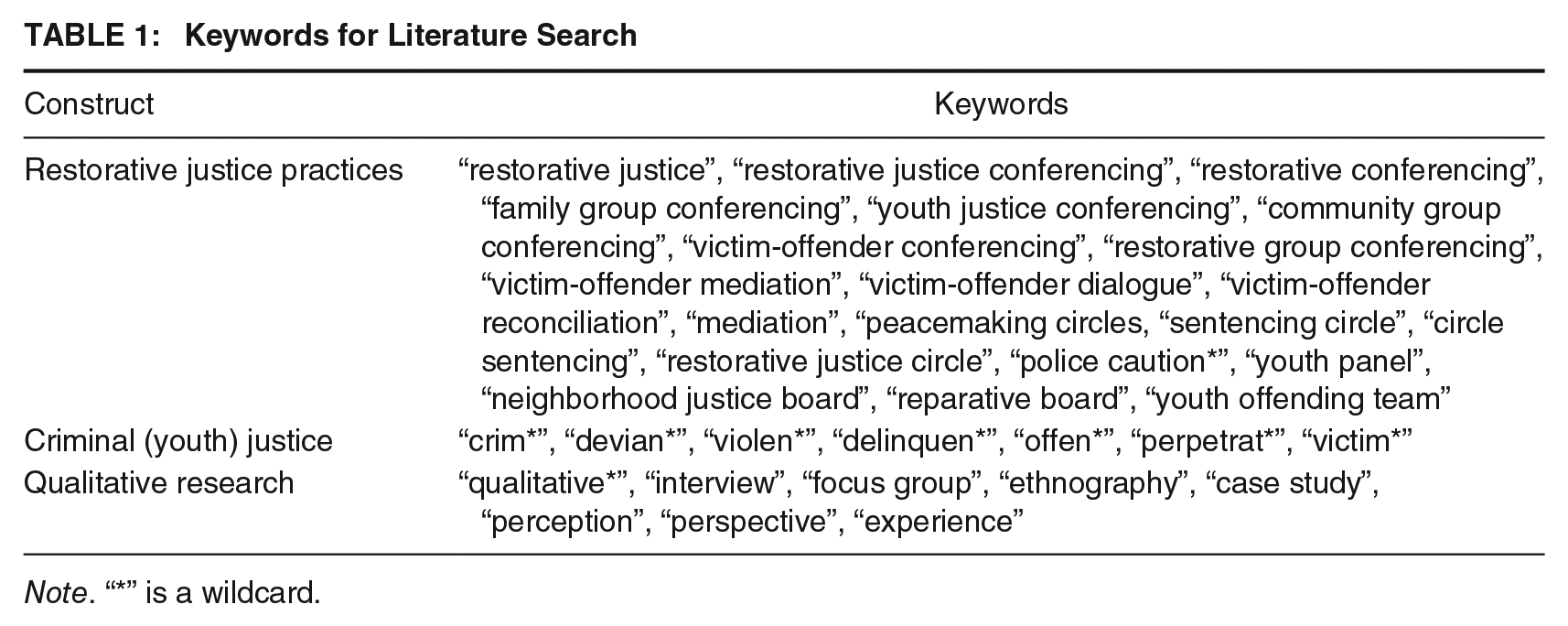
To select studies, we focused on qualitative research that conducted in-depth interviews with individuals who committed a crime and victims about the experiences in RJ. When the studies were based on the same data, we included them if their research focuses or questions were different. We limited our search to literature in English. We selected journal articles, books, book chapters, and Ph.D. dissertations. However, due to a lack of a comprehensive database to search for unpublished works (Siddaway et al., 2018), we excluded gray literature. Based on the above approach, we created three constructs for keywords to conduct a literature search: RJ practices, the criminal (youth) justice, and qualitative research. Table 1 shows the keywords for each construct.
Keywords for Literature Search
Note. “*” is a wildcard.
We then administered an abstract search in six databases: Criminal Justice Abstracts, Sociological Abstracts, Social Services Abstracts, PsychINFO, Scopus, and ProQuest Dissertations and Theses. We used the following combination of the keywords: Construct 1 AND Construct 2 AND Construct 3. The Boolean “OR” was also used to connect the keywords within each construct (e.g., [restorative justice] OR (restorative justice conferencing)). Two RJ-titled journals including Restorative Justice: An International Journal (The International Journal of Restorative Justice since 2018) and internet Journal of Restorative Justice are not included in some databases we used. We manually checked all the articles published in these journals during the literature search period. All the literature searches were conducted in October, 2019.
Screening Process
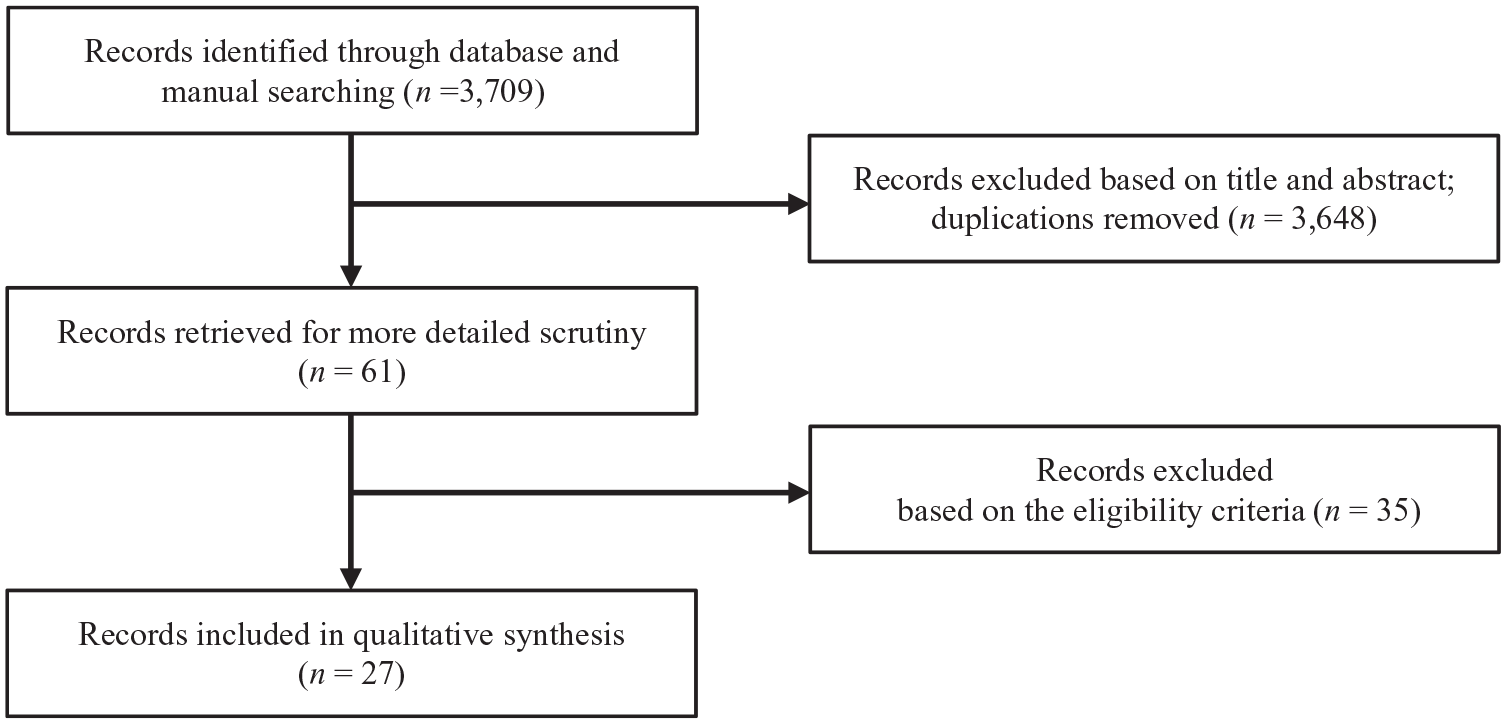
Figure 1 describes the screening process. We first checked the title and abstract to verify whether the identified records matched our inclusion criteria. Duplicates were removed; records were all retained when there was uncertainty about the eligibility. We then conducted eligibility check by reading through full texts. For those records still pending, we discussed the eligibility. Eventually, 27 studies were enlisted. While 10 to 12 studies are recommended to conduct metasynthesis (Bondas & Hall, 2007), Campbell et al. (2011) suggested that fewer than 40 is acceptable to maintain familiarity with the studies included.
Screening Process
Quality Appraisal
After the screening process, we conducted quality appraisal to check the quality of the identified qualitative studies by using the Critical Appraisal Skills Program (CASP, 2018) checklist. Our values of Cohen’s kappa range from .65 to 1.00. According to Landis and Koch’s (1977) criteria, we reached “substantial” agreement on the quality of the identified qualitative studies. Except for one study (Venter & Ankin, 2006), all the identified studies met the quality standard in the CASP checklist. We decided to exclude this study because it did not offer sufficient details of the data collection process for comparison.
Study Characteristics
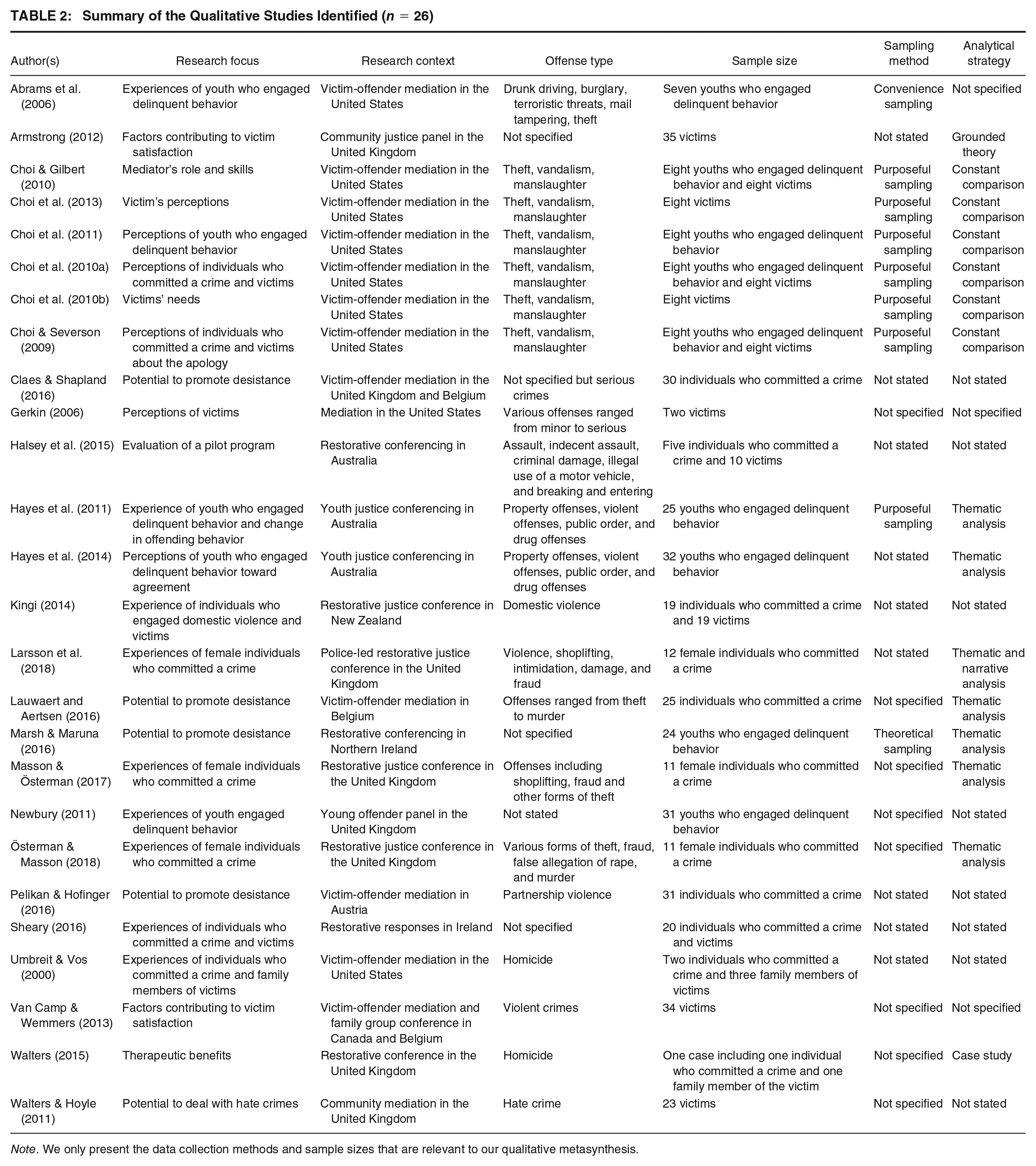
Table 2 summarizes the identified studies in terms of the dataset, research aim, context, offense type, sample size, sampling method and analytical strategy. Several studies (n = 10) were based on the same dataset. There are such six studies by Choi et al., two by Hayes et al., and two by Österman and Masson. While about half of the studies (46.2%) focused on “general” experiences of individuals who committed a crime and victims in RJ, other studies focused on their perceptions about specific outcomes of RJ, such as desistance (n = 4) and victim satisfaction (n = 2). A majority of the studies (65.4%) was conducted in the US or the UK. The type of offenses dealt with in the identified studies ranged from minor (e.g., theft) to serious crimes (e.g., homicide). Several studies focused on particular types of individuals who committed a crime, such as juveniles (n = 11) and females (n = 3). While purposeful sampling (n = 7) and thematic analysis (n = 7) were common, sampling method and analytical strategy were not specified in most of the identified studies.
Summary of the Qualitative Studies Identified (n = 26)
Note. We only present the data collection methods and sample sizes that are relevant to our qualitative metasynthesis.
Analytic Strategy
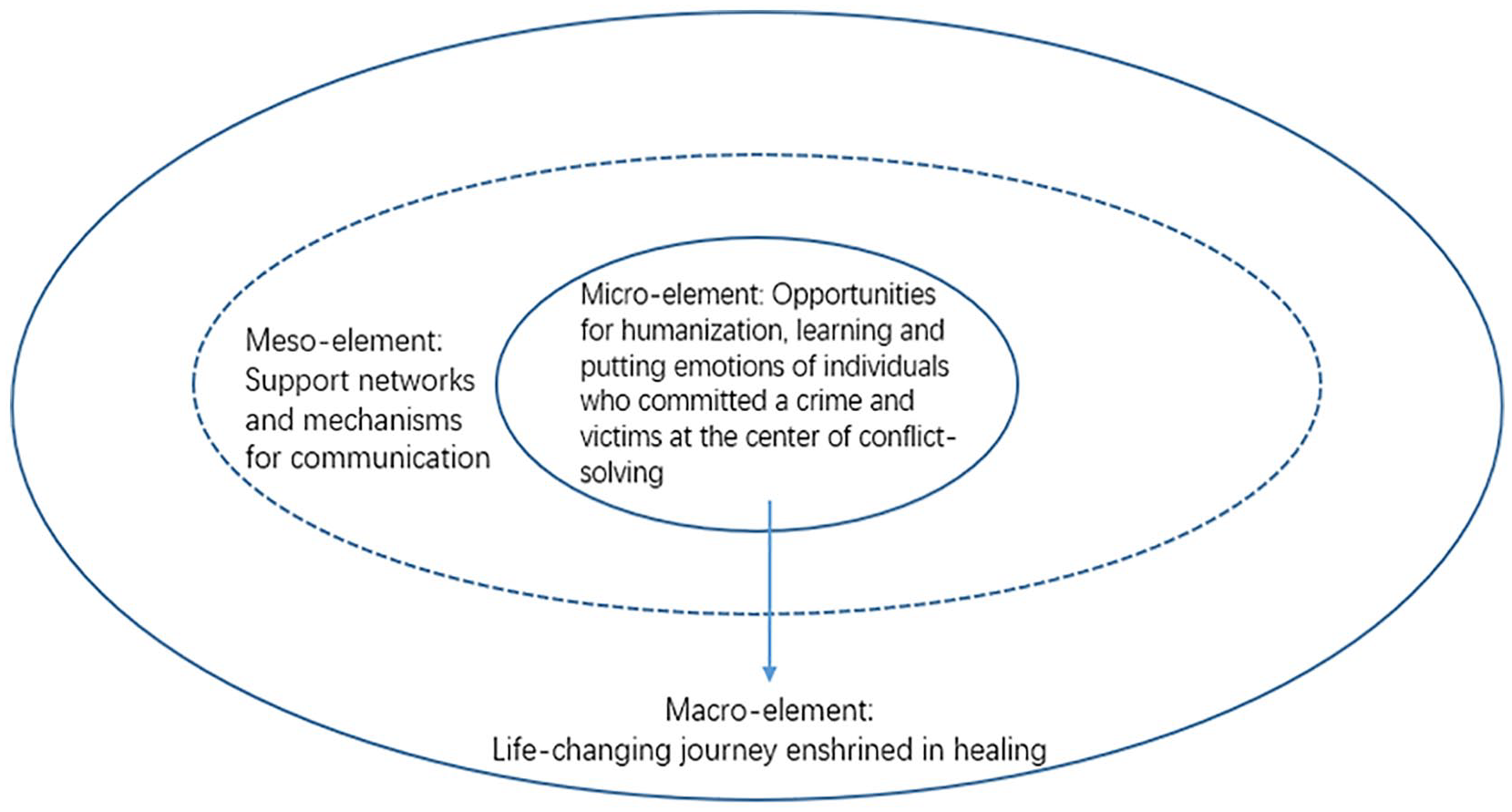
To develop themes, we borrowed concepts proposed by Noblit and Hare (1988): reciprocal translation, refutational translation, and a line of argument. According to reciprocal translation, the themes in the qualitative studies are synthesized when they are similar. Refutational translation suggests that a further explanation is required for synthesis when the themes in the qualitative studies offer contradictory findings of a similar phenomenon. A line of argument is employed to depict the relationship between the themes developed based on the metasynthesis analysis. Among these concepts, we focused on reciprocal translation because we were interested in similarities in terms of what elements of RJ individuals who committed a crime and victims find beneficial. We also used a line of argument to present our synthesis finding to go beyond the original findings (see Figure 2).
Line of Argument Based on the Overarching Themes
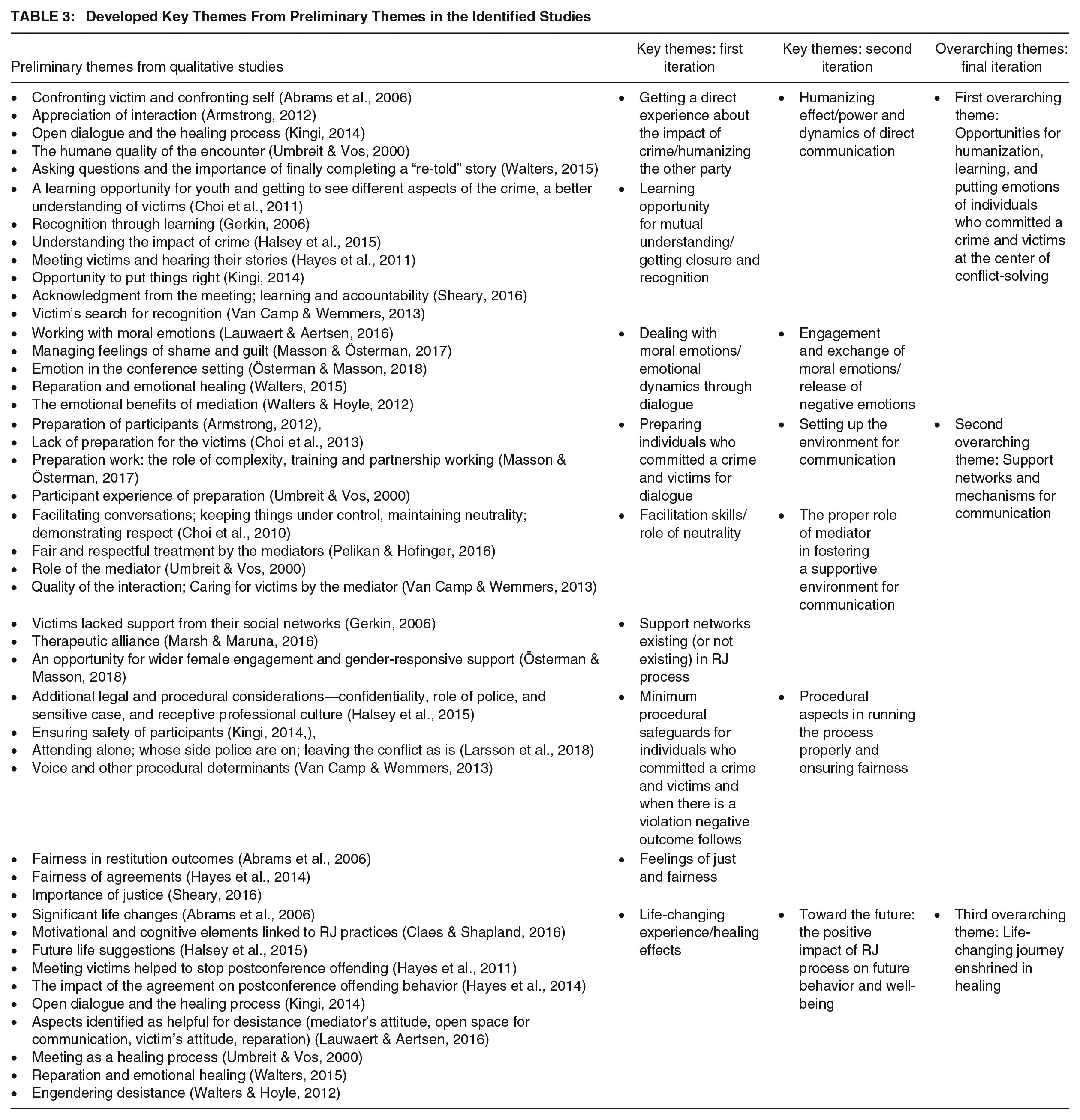
Using the idea of reciprocal translation, we first developed the first iteration of key themes based on the themes in the qualitative studies. We then examined the relationship between the first iteration of the key themes to develop the second iteration of the key themes. Finally, we formulated overarching themes that integrate the original themes and their relationships (Walji et al., 2014). To ensure the transparency of our synthesis process (Paterson, 2001), we tabulated how we reached the final themes (see Table 3). While there is a debate over the use of quotes from the qualitative studies (c.f., Herber & Barroso, 2020), we present the overarching themes alongside quotes from the qualitative studies to ensure the validity of our interpretation (Horton, 2020).
Developed Key Themes From Preliminary Themes in the Identified Studies
Results
Drawing on 26 studies identified through the systematic literature search, we conducted a qualitative metasynthesis to explore the experiences of individuals who committed a crime and victims with the RJ process. We identified three overarching themes through metasynthesis: (a) opportunities for humanization, learning, and putting emotions of individuals who committed a crime and victims at the center of conflict-solving, (b) support networks and mechanism for communication between individuals who committed a crime and victims, and (c) life-changing journey enshrined in healing. Below we elaborate on these themes.
Opportunities for Humanization, Learning, and Putting Emotions of Individuals Who Committed a Crime and Victims at the Center of Conflict-Solving
What both individuals who committed a crime and victims most appreciated in RJ was the quality of interaction because it helped them to humanize the other party (Armstrong, 2012; Umbreit & Vos, 2000). For individuals who committed a crime, RJ was an opportunity to listen to how victims were affected by their offending (Choi et al., 2011; Halsey et al., 2015; Hayes et al., 2011). Before attending RJ, individuals who committed a crime did not realize how victims’ lives were changed due to their offending. Listening to victims’ stories enabled individuals who committed a crime to understand the impact of their offending on victims: Actually, because when he [the victim] said it, like he explained everything and how it affected him and everything he had to do. Because before I went in there I thought it’s just like a little incident and nothing and then he said all the stuff—what it did and how much it cost him and I actually realised what I’d done and how much it affected him (Individual who committed a crime in. Hayes et al., 2011, p. 137)
For victims, RJ was an opportunity to understand what individuals who committed a crime looked like (Armstrong, 2012). Until meeting them in person, victims were afraid of individuals who committed a crime because victims think individuals who committed a crime were “abnormal” and unlike them. By meeting individuals who committed a crime in person and listening to what led them to offending, victims started to seeing individuals who committed a crime as another human being who is “normal” and like them: I thought, you know, “he’s a thug,” “he’s a monster” . . . and it was quite shocking to see him [the individual who committed a crime], he was just . . . normal you know? . . . I could understand where he was coming from, what he was saying, and why it happened. (Victim in Walters, 2015, p. 1217)
RJ was also an opportunity to put moral emotions at the center of conflict-solving. As a result of offending, individuals who committed a crime experienced shame and guilt. Managing these moral emotions of individuals who committed a crime was a crucial step to the success of RJ because these emotions could stigmatize them (Masson & Österman, 2017). As the process continues, a humane encounter with victims in RJ helped to release the negative emotions of shame and guilt from individuals who committed a crime: I tell you, I didn’t hide anything, I was frank with her, I said it made me uncomfortable, and I tell you, in the beginning when I saw her, . . . I was really embarrassed, embarrassed, embarrassed, but the lady, she managed to make me feel really really comfortable, it’s a good service. (Individual who committed a crime in Lauwaert & Aertsen, 2016, p. 361)
As a result of victimization, victims had needs. One of these needs is receiving an answer to the question “why me.” Victims appreciated receiving an answer to this question and felt restored (Walters, 2015) because they understood that the victimization was not their fault: I’m more out there . . . I feel like I have gotten my confidence back. I am out there looking for a job . . . you know there is peace in my block, well for me and my family. So I’m back to being myself. (Victim in Walters & Hoyle, 2011, p. 18)
RJ thus offered a setting where human beings with normal needs, being individuals who committed a crime or victims, are free to exchange their emotions and views, thereby reaching a mutual understanding, or at least leaving the conflicts and moving on with a positive outlook. This theme does ring true across these qualitative studies. However, such a miniature does not reflect the full story of how RJ works.
Support Networks and Mechanisms for Communication
In RJ processes, both support networks and mechanisms are found to facilitate communication between individuals who committed a crime and victims in RJ. Support networks consist of various relationships that individuals who committed a crime and victims have with the family, mediator/facilitator, and justice agencies, while support mechanisms guarantee that the RJ process is just and fair in procedural terms. Both contain several elements outlined in the body of literature. The first was preparatory work by facilitators. Both individuals who committed a crime and victims appreciated this preparatory work by facilitators because it contributed to promoting their understanding of RJ and setting “reasonable” expectations of their roles and outcomes in RJ (Armstrong, 2012; Choi et al., 2013; Masson & Österman, 2017). For the victims, preparation offers the first layer of support: I felt really prepared for the meeting . . . and that helped a lot because I knew what would happen and what I needed to do when I was in there. (Victim in Armstrong, 2012, p. 45) The preparation was totally necessary. I don’t think that it would have gone nearly as well if I hadn’t had the preparation. (Victim in Umbreit & Vos, 2000, p. 74)
Aside from facilitation, facilitators/mediators offered procedural support, to ensure safety for individuals who committed a crime and victims in RJ (Kingi, 2014). This assurance allowed individuals who committed a crime and victims to freely express their opinions in RJ: From the very beginning, [the mediator] told me that I was in the driver’s seat and it was all about what I needed and what I wanted, it wasn’t about, you know, anyone else. And that I could stop at any time. So, it was really awesome because all of a sudden I felt safe. (Victim in Van Camp & Wemmers, 2013, p. 124)
Neutrality was also maintained by facilitators, which received high recognition among individuals who committed a crime and victims. For instance, they felt that they were not judged because of their offending or victimization.
There was no judgement. I was reproaching myself the most. And it did me really good. I mean nobody approved what has happened, of course. But when I explained the whole story to the mediator she kind of understood how it could actually have happened. And this was so helpful. It was important that in the end I was able to forgive myself and to accept that I’ve made a mistake but that I’m not a monster (Individual who committed a crime in Pelikan & Hofinger, 2016, p. 333). I don’t think they [the mediators] directed any responses pro or con—they made no judgments that I recall. It was for us to make the judgments as to the type of activity that had occurred and the type of restitution these children [youths who engaged delinquent behavior] were making. (Victim in Choi & Gilbert, 2010, p. 218)
As such, these minimal procedural safeguards in RJ were documented as an essential feature of communication between individuals who committed a crime and victims (Halsey et al., 2015; Kingi, 2014; Van Camp & Wemmers, 2013).
Support networks extend beyond the mere meeting sessions. They exist not only to support the attendance by individuals who committed a crime and victims but also to promote the reintegration of individuals who committed a crime after RJ as what Marsh and Maruna (2016) called “therapeutic alliance.” The agreement plan, for instance, includes reintegrative aspects such as supervision, where it resulted in building up a relationship with justice agency personnel. Youth who engaged delinquent behavior appreciated this relationship because it offered informal support to maintain their desistance from crime: Part of the youth conference plans was meeting the [justice] worker, that was the first part of change for me. I had seeds planted in my head and watered through the years that the person knew me. That person also pointed out the problems that I had that I didn’t know. There was a lot of things to do with not feeling worthy, that was a really big thing. That person helped me to deal with that. (Youth who engaged delinquent behavior in Marsh & Maruna, 2016, p. 384)
Support networks, embedded in human connections, offered tremendous support to individuals who committed a crime and victims, who were trapped in conflicts, came together for resolution, and genuinely needed to move on. In particular, support from facilitators/mediators, which was often overlooked, came to prominence across these studies. Social support is the key to ensuring procedural fairness and satisfactory outcome for individuals who committed a crime and victims, making RJ greatly accepted instead of being rejected.
Life-Changing Journey Enshrined in Healing
RJ was the beginning of a journey toward a new life for individuals who committed a crime and victims because they experienced it as life-changing (Abrams et al., 2006; Kingi, 2014). For individuals who committed a crime, RJ was likely a trigger and/or support for change toward desistance (Halsey et al., 2015; Hayes et al., 2011; Lauwaert & Aertsen, 2016). RJ promoted their motivation not to commit any further offending because the victims’ story made them realize the impact of their offending: “To hear that from my victim was a shock to me, I had no idea at all that she would feel like this [ . . . ] it made me more certain that I will not do that again” (Individual who committed a crime in Claes & Shapland, 2016, p. 312). In addition, RJ offers a life-turning opportunity—staying away from problems in their life that could lead to offending, such as addition and gambling (Abrams et al., 2006), hereby addressing the root cause of their offending. RJ typically involved a discussion about what individuals who committed a crime should do to stay out of crime, such as attending anger management counseling. Through this discussion, RJ could open a path toward desistance. While RJ was not sufficient to stop offending for some individuals who committed a crime, the future life suggestions indicated in RJ offered a key for change. One individual who committed a crime summarized: “I left [the conference] feeling that I’d accomplished something . . . not that I’d just gone there and got it out of the way [but] that I’d actually accomplished something” (Halsey et al., 2015, p. 493).
The healing process for victims meant meeting individuals who committed a crime in a safe environment supported by the presence of “community of care” (e.g., family members and close friends), enabling them to regain their confidence lost by crime (Umbreit & Vos, 2000; Walters, 2015): It was relaxed. I was tense. When we went in we were embarrassed by our actions and why we were there. We were frightened we might get judged. But it was okay. It was nice to have people there from the community that I knew. (Victim in Kingi, 2014, p. 150)
Moreover, gaining closure directly from the individuals who committed a crime contributed to the victim’s healing journey: “I [the victim family] had heard that he [the individual who committed a crime] had confessed . . . it was gratifying to hear it out of his mouth and not out of a reporter’s mouth” (Family of Homicide Victim in Umbreit & Vos, 2000, p. 78). These altogether contributed to diminishing negative feelings of victims caused by the crime and move forward to a new life through healing. Seen in this light, RJ achieved some higher-level goal of exerting long-term impact on persons via a variety of healing opportunities and resources.
Discussion
How Does RJ Work?
Situating Overarching Themes in the Current Literature
The first overarching theme lends support to the suggestion in the literature that the key feature of RJ is communication between individuals who committed a crime and victims. RJ may benefit individuals who committed a crime and victims because it takes what Umbreit (1997) called a “humanistic mediation” approach. This approach is not settlement-driven but dialogue-driven, which aims to help individuals who committed a crime and victims “to recognize each other’s common humanity despite the conflict” (Umbreit, 1997, p. 204).
The second overarching theme, support network and mechanism, fills a gap of an area often neglected in the literature. In our metasynthesis, support mainly came from mediators/facilitators through preparation and facilitation as well as from justice agencies. The significance of the support network and mechanism should be highlighted particularly in terms of the perspectives of individuals who committed a crime. Despite the scholarly consensus on the important role of support in the reintegration of individuals who committed a crime, it largely disappears from RJ literature (Hansen & Umbreit, 2018). More attention needs to be paid to the role of the support networks and mechanisms in RJ.
The final overarching theme suggests a transformative impact. When it comes to the life-journey for individuals who committed a crime, for instance, RJ can be what Sampson and Laub (1993) called a “turning point” to trigger change toward desistance. Or RJ can also be what Robinson and Shapland (2008) called a “stepping stone” on their desistance journey because participation RJ requires acknowledgements of offending and some individuals who committed a crime may already start their desistance journey before the RJ process. As a result of crime, individuals who committed a crime may also have various needs, such as expressing their remorse or telling their own stories (Toews & Katounas, 2004). In RJ, individuals who committed a crime are also given opportunities to explain their situations and give an apology, which may help individuals who committed a crime restore their sense of dignity and reintegrate them into the community (Young & Hoyle, 2003).
A Line of Argument
The overarching themes developed in this study echo the large body of RJ literature—supporting the traditional findings or beliefs. We particularly reveal the inner workings between different sets of themes. Our findings are thus consistent with the extant literature; however, our aim is not to offer a sum of the findings reported in the qualitative studies but to offer a new interpretation by synthesizing them to answer how RJ “works.” Therefore, we consolidate our findings as a line of argument, which depicts the relationship between the key themes about how individuals who committed a crime and victims experience RJ.
Figure 2 sketches our line of argument. Moving beyond the findings reported in a single qualitative study, our consolidation demonstrates that the micro-, meso-, and macro-elements of RJ interact with each other. Our model suggests that transformations in RJ primarily take place inside individuals who committed a crime and victims, but they are facilitated by the web of support networks and mechanisms. This vision of transformation does not derive from a normative meaning of RJ, but an accumulated power residing in and out of individuals who committed a crime and victims. In other words, it is not imposed but is an action from inside out, and it carries potentials to influence society at large. This framework is not necessarily a manifestation of the “ripple effect” as it might appear. However, it conveys how a micro-level process in RJ is not an isolated, individualistic initiative, but interacts with the meso-structure and exerts a bigger societal impact.
This framework provides an interlinked explanation of “how RJ works” based on the overarching themes developed in our metasynthesis analysis. At the inner core, it is closest to the traditional conception of RJ, that is, individuals who committed a crime and victims are directly involved in the discussion of crimes and conflicts. Meaningful engagement is supported by respectful dialogue and a platform to exchange emotions and opinions. When such an engagement is conducted only superficially, individuals who committed a crime and victims may not benefit from RJ.
Meaningful engagement is facilitated by support networks, which provide emotional and substantive assistance, and support mechanisms that ensure procedural fairness during the encounter. This terrain extends the traditional conception of RJ to embrace a dimension that is not yet fully recognized. As emotionally charged as RJ encounter can be, social support delivered to the individuals who committed a crime and victims works to alleviate the uneasiness and affirms their needs as humane and ordinary citizens. Social support from sources such as the mediators/facilitators and justice agencies cannot be viewed in isolation. Instead, it constitutes a pillar for individuals who committed a crime and victims to move through the changing phases. Built into the network of social relationships, support mechanisms provide proper treatment of all those involved, especially ensuring that individuals who committed a crime and victims feel fairly treated about what they have gone through and will set out to achieve.
At the outer circle, the life-changing journey enshrined in healing emanates from the inner core. This relationship with two other overarching themes indicates that life-changing journey through RJ may not be linear as commonly described in the literature. Rather, it may be structured, layered process because the life-changing journey may not abruptly commence after the RJ process. For some, the RJ process itself may be the beginning of their life-changing journey because they are encouraged to change by their support networks that foster emotions that humanize the other party. For others, the life-changing journey may already embark before the RJ process because they may show their willingness to change through their motivation to participate in RJ. Their life-changing journey is facilitated through the meaningful engagement within RJ that is backed by their social support.
A strength of our model proposed as a line of argument is its incorporation of the interactional perspective of RJ. It is almost unanimous opinion among RJ scholars that its key feature is the interaction between individuals who committed a crime and victims. Yet, except for Rossner’s (2011) work, little is known about the interactional dynamics of RJ (Vanfraechem & Aertsen, 2010). The scope of the existing RJ literature tends to be limited to either individuals who committed a crime or victims (c.f., Suzuki & Jenkins, 2020). These approaches might have led to a lack of focus on the dynamic effects of each RJ case. Our findings indicate the significance of the interactive mechanism between individuals who committed a crime and victims as well as support networks and mechanisms for effective communication between them. Such an interactional model does not simply reside in persons—individuals who committed a crime or victims, a traditional focus in most RJ research. Instead, it binds the persons with their support networks and even the broader social structure.
Limitations and Future Research Directions
Our metasynthesis is not without limitations, which are related to the characteristics and methodology in the studies included. First, the dominance of youth who engaged delinquent behavior in the sample. Eleven studies in our sample focused on juveniles, where six of them were conducted by Choi et al. and two by Hayes et al. However, we found no systematic and consistent difference between young and adult individuals who committed a crime in terms of their experiences in RJ. While this makes the studies included more homogeneous, we feel the need for comparative studies between youths and adults who committed a crime in RJ, given the former’s limited cognitive and development capacities (e.g., Suzuki & Wood, 2018). RJ practice may benefit if research examines differing needs for the reintegration of youths and adults who committed a crime. This will assist in developing the follow-up phase of RJ by indicating what support is necessary to sustain the positive influence of RJ.
Second, as the sample is split in a focus between individuals who committed a crime (n = 12) and victims (n = 6), our findings may be biased toward the perspectives of individuals who committed a crime. We are not advocating a specific focus here, but given the current advocacy of RJ as a victim-centered approach (van Dijk, 2013), due attention should be paid to the marginalization of victims in the studies (Bolívar et al., 2015). Future research should fill this gap in the literature to better understand how RJ may benefit victims. In particular, it may be necessary to examine how RJ can contribute to victim recovery as it remains as “black box” (Bolitho, 2017). Since not all victims may get recovered through RJ depending on the impact of offending (Daly, 2005), research on how, in what condition, and for whom RJ helps recovery is needed.
Third, the studies included are very ambiguous about their sampling methods and analytical strategies. This reality caused some trouble for our metasynthesis. We therefore call for a clear guideline or consolidated criteria for reporting qualitative research not least in RJ research, but in qualitative criminology studies in general (Copes et al., 2020). As our research shows, qualitative metasynthesis is a useful method to integrate qualitative findings. However, this requires detailed reporting in primary qualitative studies because metasynthesis needs to maintain the original research contexts. Researchers who wish to conduct a qualitative metasynthesis might benefit if qualitative criminologists follow a guideline for reporting, such as the consolidated criteria for reporting qualitative research (COREQ) (Tong et al., 2007).
Finally, and most importantly, while our findings indicated the important role of support networks given by “community of care” and facilitators, this topic is under-researched (Bolitho & Bruce, 2017; Bolívar, 2012). Some recent studies demonstrated that the presence of supporters of individuals who committed a crime could help to promote perceptions of procedural justice in individuals who committed a crime (e.g., Scheuerman & Keith, 2015), while other research suggested that supporters’ defensive comments contributed to undermining interactions between individuals who committed a crime and victims (e.g., Hoyle & Noguera, 2008). Different facilitators may have different RJ goals in mind, which are influenced by their values, beliefs, and experiences (Paul & Borton, 2013). These differences in the goals may affect how each case is handled by facilitators, consequently influencing outcomes. Nonetheless, our findings provide a clear illustration that their “bridge” role in practicing RJ and researching the macro–micro interaction of RJ cannot be underestimated. This carries significance for testing, expanding or challenging the integrated interactional model being proposed in this study, and brings RJ research toward meso-level or macro-level scrutiny. Future research may be needed to examine what support networks exist for what type of individuals who committed a crime and victims as well as how support networks facilitate the life-changing journey through RJ in a distinctive way.
Footnotes
Authors’ Note:
We would like to thank Dr. Brunilda Pali, Ellie Piggott, and Navin Kumar for their feedback on the early draft of this paper. This research is supported by the Shanghai Young Eastern Scholar Program.
