




Abstract
Little is known about the relative influence of shared and individual perceptions of prison climate on adjustment to incarceration. This study investigated the relationship between prison climate and well-being among a sample of 4,538 adults incarcerated in the Netherlands. Prison climate dimensions were considered both as prison unit-level variables and as individual-level perceptions. Multilevel analysis results showed that most variance for well-being is found at the individual rather than the unit level. This implies that it does not make much of a difference for well-being in which prison unit someone resides. Positive effects of prison climate on well-being were primarily found for individual perceptions of prison climate, rather than for the aggregate unit measures. More research is needed to determine whether this finding holds true in other countries. The findings confirm the importance of disentangling the contribution of prison climate at the individual and group level.
Keywords
Introduction
The year 2018 marked the 50th anniversary of Sykes’s The Society of Captives. Although imprisonment today has raised new and highly pressing concerns, including mass incarceration, the core issue of how the “pains of imprisonment” affect individuals’ adaptation to incarceration remains highly relevant. It is important to minimize the harms of imprisonment not only for humane reasons and a broader concern for safety and decency, but also because it may have long-lasting effects that extend beyond the prison sentence (Haney, 2002; Ward & Stewart, 2003). It is therefore a concern that there are various indications that levels of well-being of individuals who are incarcerated are disproportionately low compared with the general population. For example, the risk of suicide in prison is higher than in the general population (Fazel, Ramesh, & Hawton, 2017), and the levels of self-harm and mental health problems are disproportionately high among people in custody (Fazel & Seewald, 2012; Hawton, Linsell, Adeniji, Sariaslan, & Fazel, 2014). In a broader sense, individuals who are incarcerated may experience anxiety and distress around existential and deeply affective issues, including their sense of self, feelings of shame and remorse, prospects for the future, the passage of time, and purpose in life (Cohen & Taylor, 1972; Crewe, Hulley, & Wright, 2017; Goffman, 1961).
Various factors may contribute to well-being of incarcerated individuals, including characteristics of the prison environment and prison climate, and individual vulnerabilities and circumstances. Prison environments vary not only in their survivability in a literal sense, but also in terms of the subjective severity of the sentence and well-being more broadly (Liebling, 2011; Liebling, Durie, Stiles, & Tait, 2005). The survivability of a prison may be captured—to a large extent—by the notion of “prison climate.” The central aim of this article is to examine to what extent individual and shared perceptions of the prison climate are related to psychological distress and subjective well-being.
Prison Climate and Prisoner Well-Being
Prison climate has previously been defined as “the social, emotional, organizational and physical characteristics of a correctional institution as perceived by inmates and staff” (Ross, Diamond, Liebling, & Saylor, 2008, p. 447). An extensive review of international literature and existing measurement instruments identified that the following dimensions constitute prison climate: autonomy, safety and order, meaningful activities, staff–prisoner relationships, contact with the outside world, and facilities (Boone, Althoff, & Koenraadt, 2016). Prior research has found that a positive prison climate is associated with better outcomes in terms of behavior, treatment motivation and therapeutic change, and well-being (Gonçalves, Endrass, Rossegger, & Dirkzwager, 2016; Goomany & Dickinson, 2015; Ruiz, 2007; Van der Helm, Beunk, Stams, & Van der Laan, 2014; Van der Helm, Stams, & Van der Laan, 2011; Woessner & Schwedler, 2014; Wright, 1991).
Prison climate can affect the well-being of incarcerated individuals through various mechanisms. First, the organizational and physical characteristics of the prison provide the perimeters within which social life is shaped. While imprisonment is associated with inevitable deprivations (Sykes, 1958), there is variation across institutions and regimes within institutions in the extent to which these deprivations are expressed. For example, the deprivation of liberty and autonomy may be felt less severely by people who spend most of their time out-of-cell, are free to move around the prison, or are able to work outside the prison during the day (Van der Kaap-Deeder et al., 2017). Even the ability to self-cater, for individuals to cook their own meals, may mitigate the deprivation of autonomy and enhance well-being (Parsons, 2017). There is also variation in terms of facilities for contact with the outside world, such as the possibility for conjugal visits in some countries, including the Netherlands. This may mitigate the deprivation of intimacy (or in Sykes’s terms, “heterosexual relationships”) to some extent (Wooldredge, 1999). Higher security prisons tend to impose greater restrictions and deprivations, which is indeed associated with diminished well-being (Dye, 2010; Huey & McNulty, 2005; Pizarro & Stenius, 2004). According to the deprivation perspective, then, adjustment is influenced by the hardships experienced in prison.
Second, the social fabric of the prison (i.e., social and emotional characteristics), made up of peer relationships and staff–prisoner relationships, is essential to understand experienced safety and fairness. Safety and fair treatment by staff are considered important elements of prison climate and have been found to be related to well-being (e.g., Beijersbergen, Dirkzwager, Eichelsheim, Van der Laan, & Nieuwbeerta, 2014; Liebling & Arnold, 2004). Prison staff have a large amount of power over incarcerated individuals, not only because they literally hold the keys to their freedom, but also because they have a great deal of “soft power,” including the ability to decide on privileges, access to activities, services and material goods, and even—for people with indeterminate sentences—the duration of the prison sentence (Crewe, 2011). The appropriate use of power is best characterized as “light” and “present,” meaning that staff are not afraid to enforce the rules, but do so in a consistent, fair, and humane manner (Crewe, Liebling, & Hulley, 2014). In other words, staff–prisoner relationships affect the “weight” of imprisonment, which refers to the psychological onerousness of imprisonment (Crewe, 2011; King & McDermott, 1995). Fair and humane treatment by staff can result in a lighter experience, but where staff are too absent or lax in their exercise of power, this can lead to victimization. Previous research has shown that positive perceptions of procedural justice in prison (in relation to treatment by prison staff) are related to better mental health, lower misconduct, and even lower recidivism (Beijersbergen et al., 2014; Beijersbergen, Dirkzwager, Eichelsheim, Van der Laan, & Nieuwbeerta, 2015; Beijersbergen, Dirkzwager, & Nieuwbeerta, 2016). Peer relations, including trust among peers, can also have an impact on how imprisonment is experienced, although the relationship with well-being is still contested; Liebling and Arnold (2012) reported that a lack of trust among peers was experienced as painful, whereas Kreager, Palmen, Dirkzwager, and Nieuwbeerta (2016) found that low peer trust had a protective effect on mental health. Victimization in prison and fear of victimization are associated with lower well-being (Baidawi, Trotter, & Flynn, 2016; McCorkle, 1993; Wooldredge, 1999).
Evidently, previous research points to the importance of various aspects of prison climate for the well-being of incarcerated individuals. To date, however, only a few studies have quantitatively examined the relationship between a multidimensional measure of prison climate and well-being. Based on the environmental concerns identified by Toch (1977; i.e., privacy, safety, structure, support, emotional feedback, social stimulation, activity, and freedom), Wright (1985) developed the Prison Environment Inventory (PEI) to measure prison climate. In later research with adult men in New York prisons, Wright (1991) found that certain aspects of prison climate (e.g., safety, activities, and support) were positively related to adjustment. In a longitudinal study with 75 young people in a Portuguese prison, Gonçalves et al. (2016) found that a more positive perception of prison climate was related to less severe mental health symptoms. In this study, prison climate was measured with a total score on the PEI. Using survey data from 12 prisons in England and Wales, Liebling and Ludlow (2016) identified a relationship between moral performance and psychological distress. Perceptions of dignity, safety, personal development, and family contributed most to the prediction of levels of distress. The concept “moral performance” is closely related to the notion of prison climate and offers a multidimensional operationalization of the subjective quality of prison life (Liebling & Arnold, 2004). Moral performance primarily relates to the interpersonal and material treatment of individuals in prison and encompasses the dimensions harmony, security, professionalism, conditions and family contact, and well-being and development (Liebling, Hulley, & Crewe, 2011).
These prior studies have two shortcomings. First, prison climate is either measured as a characteristic of the prison or as an individual perception (with the exception of Wright, 1991, who included scores aggregated to the prison level). It is not yet known to what extent a person’s well-being is influenced by the unit (wing) where they serve their sentence relative to individual experiences and characteristics. Importantly, climate can be regarded as a psychological construct at the individual level, as well as a set of shared perceptions at the group or organizational level (Field & Abelson, 1982; Glick, 1985; Wright, 1991). The second shortcoming is that the dependent variable is limited to symptoms of distress, as opposed to well-being in a broader sense. It is likely that subjective well-being and psychological distress are distinct dimensions of the more global construct of mental health or well-being (Veit & Ware, 1983). Subjective well-being has not received as much attention in Criminology as it has in other fields of study (Diener, Suh, Lucas, & Smith, 1999). This article aims to fill these gaps in knowledge by answering the question, “What is the relationship between prison climate and well-being of incarcerated individuals?”
Individual and Contextual Predictors of Well-Being
Aside from the prison environment, there are various individual vulnerabilities and contextual factors unrelated to the prison that can have an impact on well-being. The idea that adjustment to incarceration is influenced by preexistent characteristics, values, and vulnerabilities is known as the importation perspective (Irwin & Cressey, 1962). Individuals who are incarcerated tend to have a complex history of mental health needs, including psychiatric disorders and substance use problems (Butler et al., 2006; Fazel, Bains, & Doll, 2006; Fazel & Seewald, 2012). Many have experienced traumatic events prior to imprisonment, and women in prison even more so than men (Messina, Grella, Burdon, & Prendergast, 2007), although gender differences may depend on the type of traumatic event (Carlson & Shafer, 2010). This, in turn, can have an impact on adaptation to imprisonment (Crewe et al., 2017; Friestad, Åse-Bente, & Kjelsberg, 2014). The experiences of young, elderly, and foreign national individuals in prison may also be idiosyncratic and impose additional burdens (Crawley & Sparks, 2005; Ireland, Boustead, & Ireland, 2005; Lambie & Randell, 2013; Mann, 2012; Warr, 2016).
In addition, it is important to consider how sentence characteristics may be related to well-being. The initial stages of the sentence, including pretrial detention, are considered most stressful (Fazel, Cartwright, Norman-Nott, & Hawton, 2008; Liebling & Ludlow, 2016). This may be due to the shock of imprisonment, the need to adjust to a new environment, and the uncertainty about the trial outcome. Sentence length and index offense may also be associated with well-being; a higher suicide risk was found among those accused and convicted of violent crimes (Duthé, Hazard, Kensey, & Shon, 2013; Fazel et al., 2008) and those with longer sentences (Rabe, 2012). Overall, then, well-being of incarcerated individuals is affected by a combination of deprivation and importation factors, but the extent to which a positive prison climate can mitigate the weight of imprisonment remains underresearched.
The Current Study
This article presents a comprehensive study of the relationship between prison climate and well-being. Uniquely, prison climate will be measured as a shared unit experience, in addition to individuals’ perceptions. We also consider multiple dimensions of prison climate as opposed to one score, using a questionnaire with high psychometric validity. It is a strength of the study that it is based on a large and representative sample of male and female adults incarcerated across different prison regimes in all prisons in the Netherlands. This offers the opportunity to examine the extent to which variation in deprivation across prison units is related to well-being. It also allows us to take into account a large number of independent and control variables. Finally, this study contributes to the prison literature by considering well-being more broadly than only in terms of psychological health. Although previous studies have primarily operationalized well-being as (the absence of) symptoms of mental health problems and psychological distress, we also consider a more subjective or affective dimension, linked to life satisfaction and happiness.
Imprisonment in the Netherlands
Notable characteristics of imprisonment in the Netherlands are its low imprisonment rate, its relatively high pretrial population, and a few recent policy measures, including a differentiation in privilege levels. The current imprisonment rate in the Netherlands is the lowest in Europe, at 50 per 100,000 inhabitants (De Looff, Van de Haar, Van Gemmert, & Bruggeman, 2018). Half of all adults leaving prison in 2017 had a stay of no more than 27 days (M = 106 days). Of the total prison population, 31% stay in pretrial detention. In addition to pretrial and regular prison regimes, there are special units for vulnerable individuals (extra-care units), units for individuals who are regarded as persistent offenders (who have received a 2-year custodial security measure [in Dutch “ISD maatregel”]), minimum security units, and units for short-stay custody (arrested by the police for various reasons; e.g., not paying fines, not successfully completing a community sentence, or an outstanding prison sentence). Some prisons also have wings for people suspected or convicted of terrorist offenses and people experiencing severe behavioral problems. In addition, the Netherlands has psychiatric penitentiary institutions for people experiencing serious mental health problems (not included in this study). In an international perspective, it is relevant to note that Dutch prisons can have a mix of regimes and populations, including pretrial regimes, regimes for convicted and sentenced individuals, maximum security regimes, and open regimes. There are a few relatively large facilities that hold between 500 and 800 individuals, but most hold between 150 and 500 individuals.
While conditions may be relatively favorable given the low incarceration rate, there have been various austerity measures in recent years, as well as a differentiation in privilege levels. Budget cuts involved the closure of many prisons and an increase in double cell capacity from 2,500 (number of beds, 20% of total capacity) in 2013 to 6,146 (52% of total capacity) in 2017, of which 1,460 beds were actually occupied in their double cell capacity (De Looff et al., 2018). For individuals who are convicted, two separate regimes have been introduced: a basic regime and plus regime. The basic regime also applies to everyone in pretrial detention and offers 43 hr out-of-cell time and activities, including 1 hr for visits. Individuals who are convicted can be promoted to the plus regime if they demonstrate a motivation to work on their re-integration and have shown good behavior for a period of 6 weeks. The plus regime offers 5 extra hours of activities, including an extra hour for visits. Moreover, individuals in the plus regime are also allowed to stay out-of-cell in-between activities.
Method
Data
Data were used from the Life in Custody Study, a nation-wide survey of adults incarcerated in the Netherlands (for detailed information about the study, see Van Ginneken, Palmen, Bosma, Nieuwbeerta, & Berghuis, 2018). For the purpose of this study, data were collected using a questionnaire and administrative information. The Prison Climate Questionnaire (PCQ) consisted of 136 items, covering six domains of prison climate (Autonomy, Safety, Relationships in prison, Contact with the outside world, Meaningful activities, and Facilities), as well as different measures of well-being, behavior, expectations, and questions on background variables (see Bosma et al., in press, for further information and reports on the psychometric quality of the PCQ). The survey served the dual purpose of performance monitoring and improvement by the Dutch Prison Service and independent research on the experience of imprisonment.
Sample and Procedure
Questionnaires were distributed and collected by research assistants from the University, so that confidential treatment of the data could be ensured. All individuals incarcerated who could be approached were invited, in person, to participate in the study between January and April 2017. We were unable to approach people experiencing severe mental health problems, people held in segregation units, or people who were unable to read or speak one of the languages in which the questionnaire was available (Dutch, English, and Spanish). To everyone else, the purpose of the study was fully explained, including the voluntary nature of participation, and a small incentive was handed out regardless of one’s decision to participate. Anyone who wanted to participate had to give informed consent for use of the data for research purposes, including permission to obtain administrative data (it was also possible to participate anonymously). We offered assistance with completing the questionnaires to anyone who had difficulties with reading.
Out of 6,088 approached individuals, 4,938 completed a questionnaire (81%). There were 400 questionnaires that could not be used for research purposes, either because they could not be matched with administrative data or participants did not give consent for the use of their data for research. The final sample consisted of 4,538 participants housed in 244 prison units in 28 prisons. Participants and nonparticipants did not differ with respect to age, sex, and time served. People with a non-Dutch background were underrepresented in the final sample, which may be due to the fact that questionnaires were only available in Dutch, English, and Spanish. In relation to index offense, people convicted of property offenses were slightly underrepresented in the sample, whereas people convicted of drugs offenses were slightly overrepresented. Finally, there was a slight overrepresentation of people in pretrial regimes relative to people in regular prison regimes (see Van Ginneken et al., 2018, for test statistics). Overall, the large sample size and reasonable representation of different groups in the sample allow for generalization to the Dutch adult prison population (excluding individuals in foreign national prisons and psychiatric penitentiary institutions). Table 1 displays descriptive statistics of the sample.
Descriptive Statistics
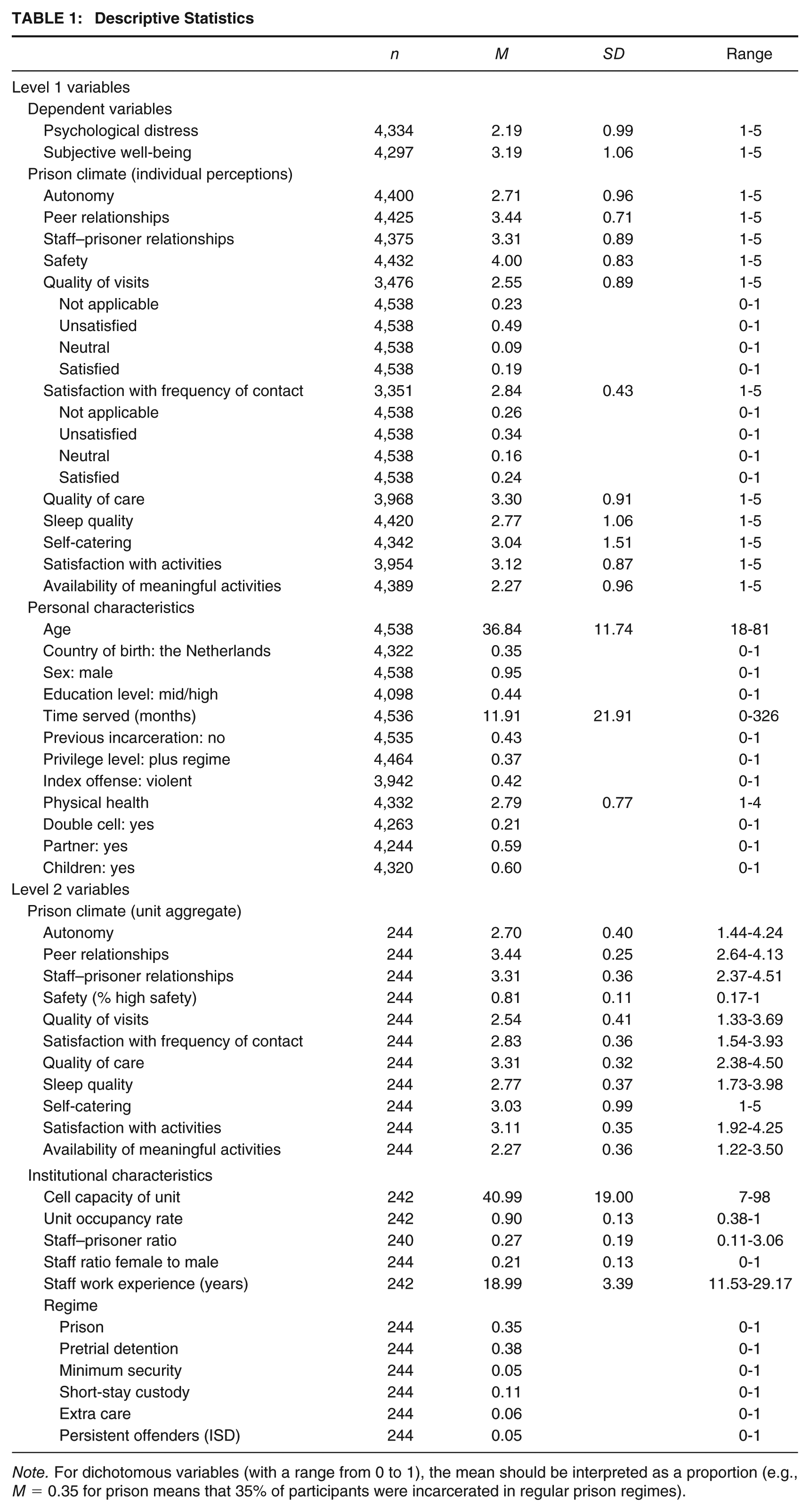
Note. For dichotomous variables (with a range from 0 to 1), the mean should be interpreted as a proportion (e.g., M = 0.35 for prison means that 35% of participants were incarcerated in regular prison regimes).
Measures
Well-being was measured using various scales in the PCQ, to capture different dimensions of this broad construct. Psychological distress was measured using the Kessler Screening Scale for Psychological Distress (K6; Kessler et al., 2002), which consists of six items measured on a 5-point scale, asking about symptoms of anxiety and depression (e.g., “During the past week, about how often did you feel hopeless?”). This validated scale also has good internal consistency in the present study (α = .91). For the K6, a cut-off point of 12/13 is suggested as a screen for serious mental illness, when summing each of the items, scored from 0 to 4 (Kessler et al., 2003). For the purpose of this study, a mean score of psychological distress (ranging from 1 to 5) was calculated if participants had filled out at least three out of six items, with higher scores referring to higher levels of psychological distress.
Subjective well-being was measured using the subscale “emotional well-being” from the Mental Health Continuum–Short Form (Lamers, Westerhof, Bohlmeijer, Ten Klooster, & Keyes, 2011). This subscale consists of three items measured on a 5-point scale, enquiring about happiness and life satisfaction (e.g., “During the past month, about how often did you feel happy?”). This validated scale also has good internal consistency in the present study (α = .82). The mean norm score for Dutch adults on the subscale “emotional well-being” is 3.67 (Lamers et al., 2011). Higher scores on this scale refer to higher levels of subjective well-being. Our exploratory factor analysis suggested a two-factor solution and a confirmatory factor analysis indicated that the most optimal fit was achieved with a correlated factor structure in line with the existent scales (χ2(26) = 622.90, root mean square error of approximation [RMSEA] = 0.072, comparative fit index [CFI] = 0.973, Tucker–Lewis index [TLI] = 0.963). Therefore, separate analyses were conducted with subjective well-being and psychological distress as dependent variables. The correlation between subjective well-being and psychological distress is −.496 (p < .001), which indicates that they tap into an overarching construct (i.e., well-being more generally).
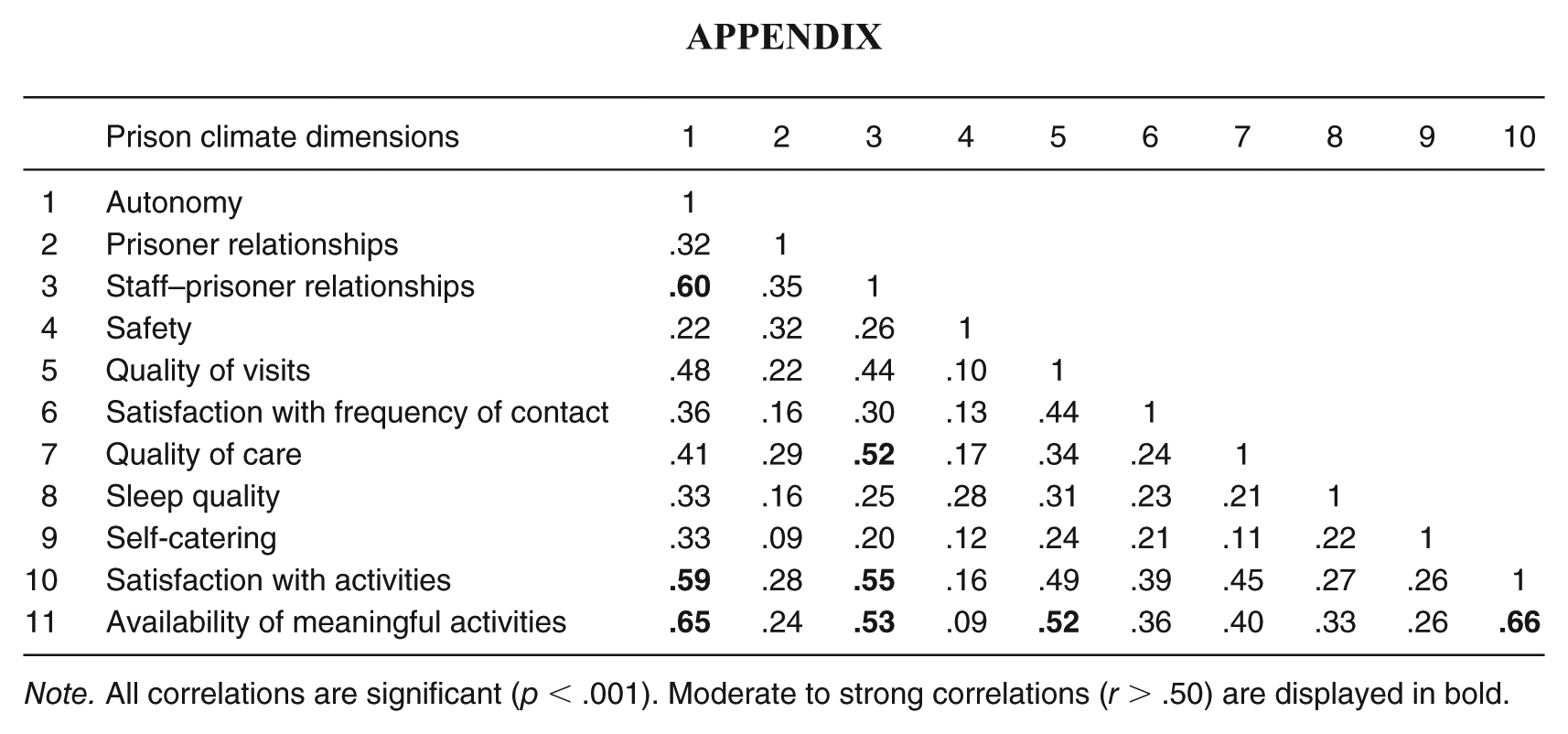
Prison climate was measured with 11 scales from the PCQ, encompassing six domains: Autonomy, Safety, Relations in prison (staff–prisoner relationships and peer relationships), Contact with the outside world (satisfaction with frequency of contact and satisfaction with visits), Meaningful activities (satisfaction with activities and availability of meaningful activities), and Facilities (quality of care, sleep quality, and opportunity for self-catering). The prison climate items consisted of statements that were rated on a 5-point scale ranging from 1 (strongly disagree) to 5 (strongly agree), with higher scores reflecting more positive attitudes about the prison climate. The prison climate measures have excellent psychometric properties (see Bosma et al., in press), including good internal consistency of all scales with Cronbach’s alphas ranging from .78 to .92. Each of the scales load on different factors, but are also related to each other in a meaningful and expected way (see also the correlation matrix in Appendix), given that they measure the central concept of prison climate (Bosma et al., in press). Criterion validity was supported by the finding that the prison climate domains were able to account for a large amount of variance in individuals’ overall rating of the quality of the institution. Furthermore, regime differences in prison climate were congruent with expectations and previous findings, which offers support for construct validity of the PCQ (Van Ginneken et al., 2018).
Prison climate was included in the analysis on two levels. On the individual level (Level 1), prison climate scores were a reflection of each individual’s experience. Because there were participants who did not receive visits and therefore did not answer these questions, we recoded the satisfaction with frequency of contact and quality of visit scales into dummy variables to represent “no answer/not applicable,” “dissatisfied” (M < 3), “neutral” (M = 3), and “satisfied” (M > 3). On the unit level (Level 2), aggregate variables were created to reflect the average prison climate on each unit. This was done by calculating mean scores per unit (based on individual scores of the people residing in the unit at the time of the survey) for all scales except safety, which was skewed toward very high scores. Instead, for safety, a variable was created to reflect the proportion of people in the unit who felt very safe (M > 4).
Individual characteristics included as control variables were sex (0 = female, 1 = male), age, country of birth (0 = the Netherlands 1 = other), educational level (0 = low, 1 = medium/high), partner (0 = no, 1 = yes), child(ren) (0 = no, 1 = yes), index offense (0 = nonviolent, 1 = violent), detention length (months), cell sharing (0 = no, 1 = yes), privilege level (0 = default, 1 = plus regime), and physical well-being.
Institutional characteristics included at the unit level were regime (pretrial detention, prison, minimum security, extra care, short-stay custody, and persistent offenders [ISD]), cell capacity of the prison unit, occupancy rate, staff–prisoner ratio, ratio male to female staff, and staff work experience (in years).
Analytical Strategy
Individuals reside in prisons that are divided in units, and respondents within the same unit may respond and behave more similarly compared with respondents from a different unit, as they in part share a common experience. To account for the clustered nature of our data and to correct the estimated standard errors for a certain clustering of observations, multilevel methods were applied (Goldstein, 2003). Two levels of data were distinguished: the individual level (Level 1) and the unit level (Level 2). Prison was not selected as a third level, because no prison-level variables were included in the multilevel models and because particular shared influence of prison over and above the unit level was also not expected. Ad hoc analyses confirmed this assumption and showed that no significant portion of variance in psychological distress nor subjective well-being was present at the prison level.
All independent continuous variables at the individual and unit level were centered on their grand mean before they were included in the multilevel models to allow for easier interpretation of effects. Scores of 0 now refer to the overall sample mean of these variables, Level 1 effects are to be interpreted as deviations from the overall mean, and Level 2 effects are to be interpreted as unique contextual effects excluding the Level 1 effect of the same variable.
We ran two multilevel models, for psychological distress and subjective well-being, respectively. The first step was to run a null model with random intercepts to see whether the dependent variables significantly varied across prison units. We then calculated the intraclass correlation coefficients (ICCs) for each outcome to see what proportion of the variance in psychological distress and subjective well-being could be attributed to between-unit differences. Second, Level 1 models with random intercepts and fixed slopes were estimated to see to what extent individual-level experiences of prison climate, controlling for important covariates, explained variance in psychological distress and subjective well-being. Finally, full models including both individual- and unit-level experiences of prison climate were estimated to calculate to what extent these variables explained individual- and unit-level variances in psychological distress and subjective well-being. Analyses were carried out using full information maximum likelihood with robust standard error (MLR) estimation, which allows for all available pieces of information to be used, meaning that all 4,538 adults across 244 units were included in the analyses, regardless of missing values. Descriptive analyses were conducted in Stata Version 15 (StataCorp, 2017) and multilevel analyses in Mplus Version 8.1 (Muthén & Muthén, 1998-2017).
Results
Psychological Distress and Subjective Well-Being
Scores on the two dependent variables give some reason for concern about the well-being of people in prison: The mean score on subjective well-being (M = 3.19, SD = 1.06) is substantially lower than the norm score of the Dutch adult population (M = 3.67; Lamers et al., 2011), a significant mean difference of 0.48, 95% confidence interval (CI) = [–0.51, −0.45], t(4,296) = −29.72, p < .001. Regarding psychological distress (M = 2.18, SD = 0.99), 18% of participants have a score above the suggested cut-off score for screening serious mental disorder on the K6. The distribution of psychological distress is positively skewed because a substantive proportion of participants reported no symptoms of distress (19%), whereas subjective well-being is relatively normally distributed (see Figure 1). For participants who reported experiencing no distress (n = 809), scores on subjective well-being are negatively skewed (M = 3.77, SD = 1.14), but still show substantial variation. This means that people who reported no symptoms of psychological distress experienced different levels of subjective well-being.
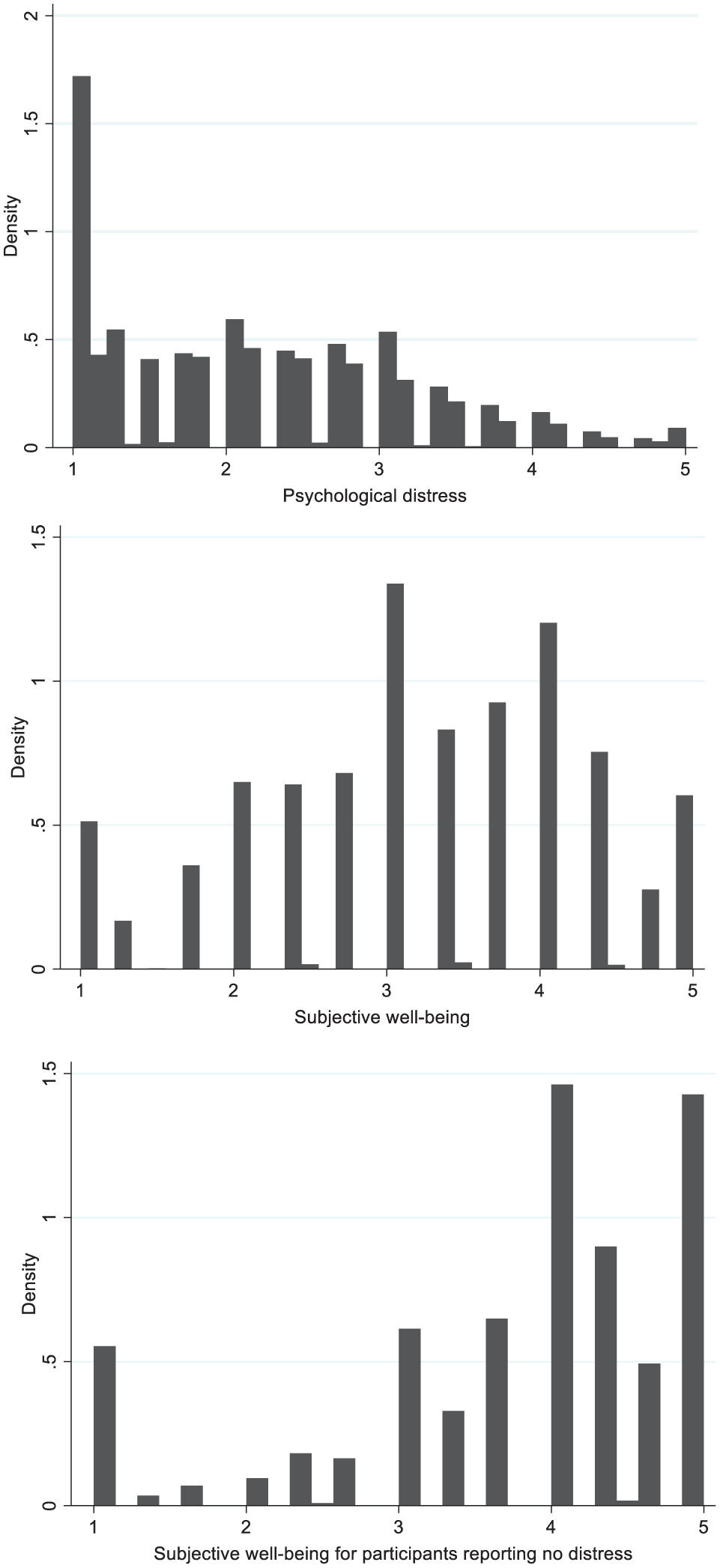
Distribution of Scores on Well-Being Measures
Prison Climate and Well-Being
The first step in the multilevel analysis was to determine whether any variance in well-being (considering both psychological distress and subjective well-being) could be attributed to unit differences. The so-called null models with random intercepts and no explanatory variables revealed that a small, but significant amount of variance in well-being pertained to the unit level. The ICC was 4.5% for psychological distress and 3.7% for subjective well-being. This indicates that the majority of the variance in well-being is at the individual level rather than the unit level. Nevertheless, the significant amount of unit-level variance warrants the use of multilevel modeling.
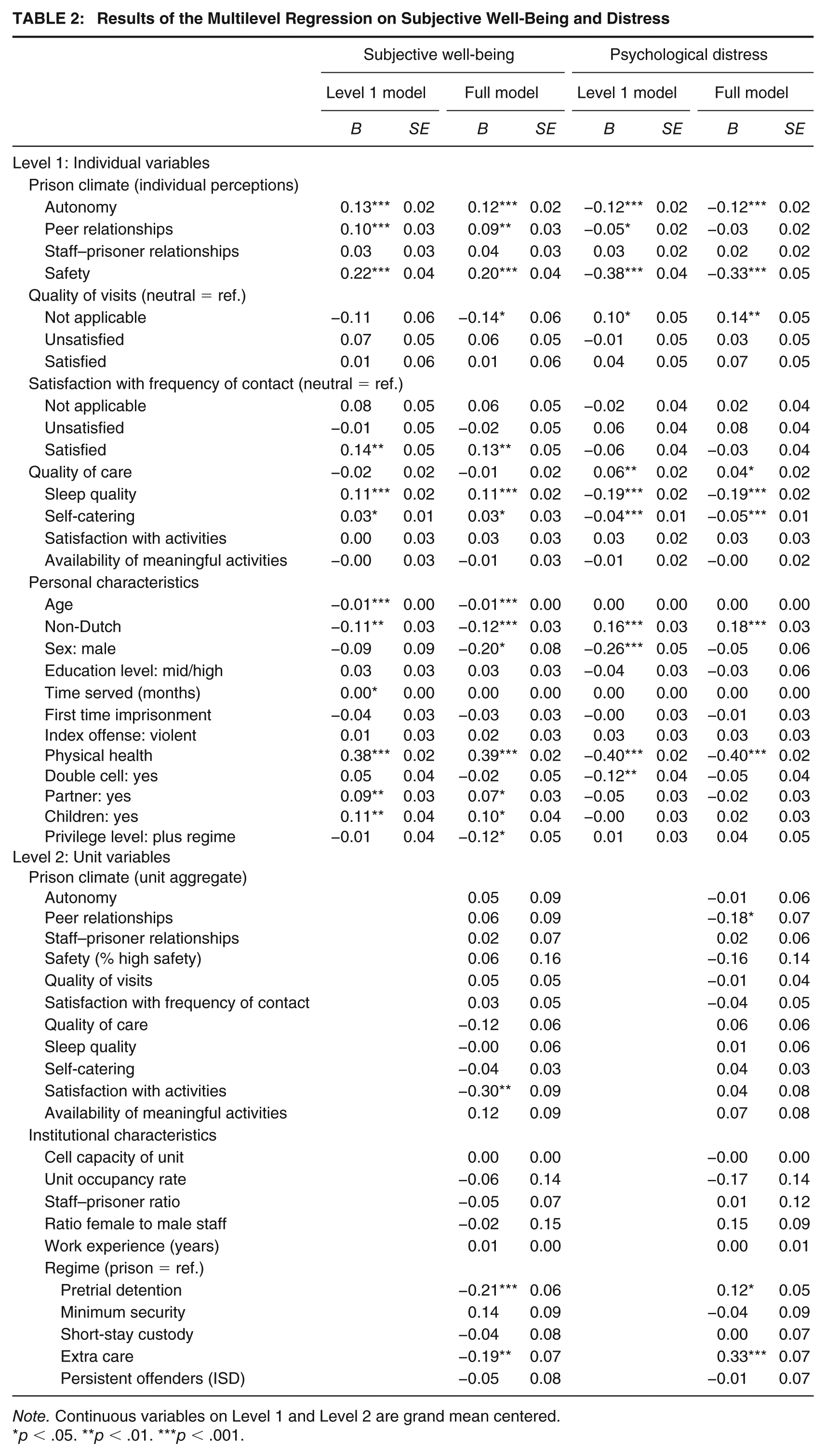
The multilevel models (see Table 2) show multiple significant coefficients of individual perceptions of prison climate: greater autonomy, safety, sleep quality, and the ability to self-cater were associated with higher well-being in general. Individual perceptions of good peer relationships and satisfaction with the frequency of contact with family and friends were associated with higher subjective well-being. Better quality of care was related to higher levels of psychological distress, possibly because this only applies to individuals who rely on health care facilities. It was also found that people who did not receive visits reported lower levels of well-being, in general. There were no significant individual-level effects of staff–prisoner relationships, satisfaction with activities, and availability of meaningful activities.
Results of the Multilevel Regression on Subjective Well-Being and Distress
Note. Continuous variables on Level 1 and Level 2 are grand mean centered.
p < .05. **p < .01. ***p < .001.
The results from the full multilevel regression further show that very few predictors at the unit level were significant; this suggests that shared perceptions of prison climate have little impact on well-being. For both measures of well-being, individuals in pretrial and extra-care regimes had lower well-being than those in prison regimes. High unit satisfaction with activities was associated with lower subjective well-being, whereas positive unit perceptions of peer relationships were associated with lower psychological distress. In other words, in units where people rate the relationships with their peers, on average, more positively, people experienced less psychological distress.
From inspection of the control variables, it appeared that physical health was strongly related to well-being (i.e., poorer health was associated with lower well-being). Moreover, individuals who were not born in the Netherlands reported lower levels of well-being. Small, positive relationships were found between having a partner and subjective well-being and having children and subjective well-being (but no effects for psychological distress). Finally, individuals in plus regimes experienced lower levels of subjective well-being, all other things equal.
A few differences in predictor effects can be observed for psychological distress versus subjective well-being. Individuals who were satisfied with the frequency of contact with the outside world reported higher subjective well-being; this was not related to psychological distress. Satisfaction with the quality of care, on the contrary, was related to psychological distress but not subjective well-being. Women reported higher levels of subjective well-being, but there was no significant relationship between sex and psychological distress in the full model. Having a partner and children was associated with higher subjective well-being, but not with psychological distress. A positive effect of peer relationships was found for subjective well-being at the individual level, while a similar effect was found for psychological distress at the unit level. Finally, satisfaction with activities only had a negative relationship (at the unit level) with subjective well-being.
Adding individual-level predictors to the model explained 21% of variance in subjective well-being at the individual level and 27% of variance in psychological distress. Furthermore, 61% of variance was explained at the unit level for subjective well-being and 78% of variance for psychological distress. Adding unit-level predictors to the model further explained variance at the unit level: With the full model, 95% of variance in subjective well-being and 100% of variance in psychological distress at the unit level was explained. This means that (nearly) all variation in well-being that is clustered at the unit level (i.e., shared among individuals in the same unit) can be explained by the variables included in our models. Table 3 displays the variance at each level for each model.
Variance on Level 1 and 2 for the Different Models
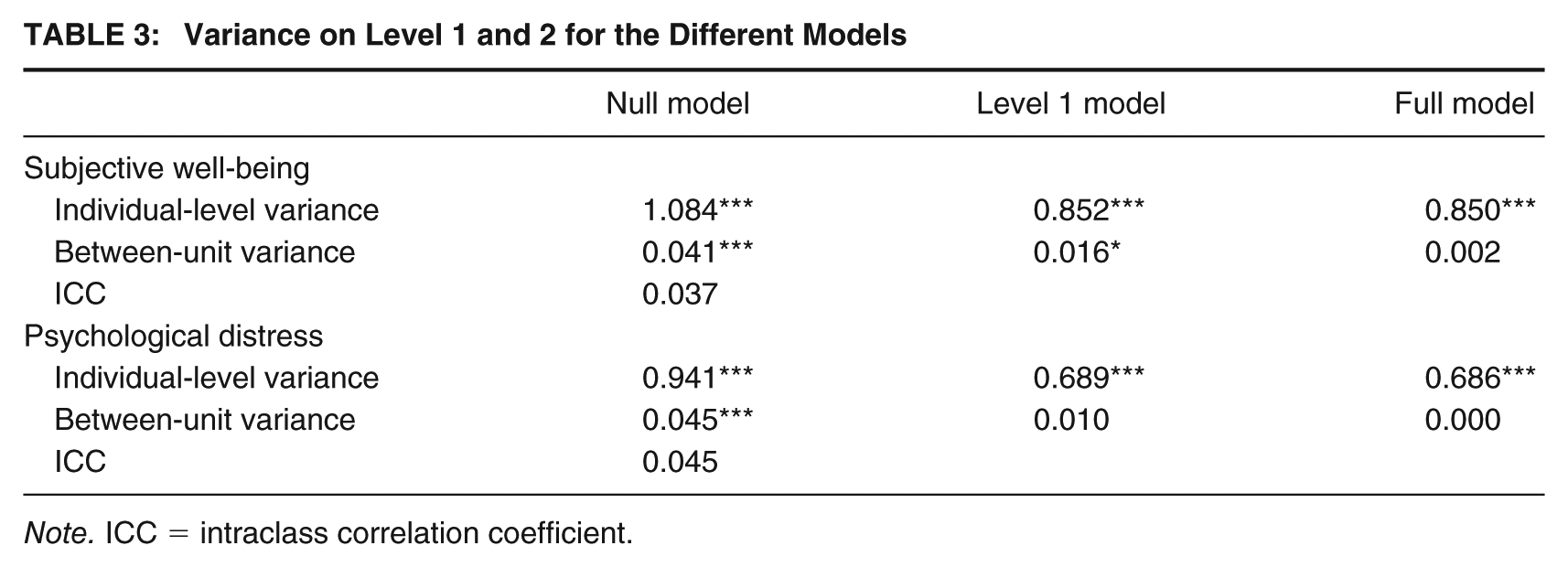
Note. ICC = intraclass correlation coefficient.
Discussion
This article sought to investigate the relationship between prison climate and well-being, distinguishing between subjective well-being and psychological distress. We found evidence that various dimensions of prison climate, particularly at the individual level, were associated with the two measures of well-being. Only a small amount of shared variance in well-being was found among individuals in the same prison unit. We discuss these findings in more detail below.
First, positive individual experiences of prison climate were found to be related to higher well-being. In particular, positive effects were found for perceptions of safety, autonomy (including the ability to self-cater), and good peer relationships (for subjective well-being only). This is in line with previous findings that found that (elements of) individually experienced prison climate were related to well-being (Gonçalves et al., 2016; Liebling & Ludlow, 2016; Van der Kaap-Deeder et al., 2017; Wooldredge, 1999; Wright, 1991). In addition, participants who did not receive visits experienced lower overall well-being, whereas satisfaction with the frequency of contact was associated with higher subjective well-being. It is likely that visitation experiences are also an indication of the quality of people’s relationships, regardless of how the prison facilitates contact. The finding that sleep quality showed a significant relationship with both measures of well-being may reflect, on one hand, that poor sleep quality (i.e., insomnia) can be a symptom of various mental health problems, and, on the other hand, that it can negatively affect adjustment (Carli et al., 2011; Vogler, Perkinson-Gloor, Brand, Grob, & Lemola, 2014).
Contrary to earlier research with Dutch adults in pretrial detention (Beijersbergen et al., 2014), positive perceptions of staff–prisoner relationships were not associated with higher well-being. Ancillary analyses (not presented) showed that there was still no effect if the analyses were repeated for adults in pretrial detention only. It is likely, however, that this discrepancy in results can be explained by the correlation among prison climate variables. That is, staff–prisoner relationships were moderately correlated with autonomy (see Appendix), which was found to be a significant predictor. Possibly, a fair exercise of power by prison officers increases the sense of autonomy of incarcerated individuals (see also Crewe, 2011; Crewe et al., 2014).
There were only a few unit-level effects of prison climate on well-being: Higher average ratings of peer relationships were associated with lower psychological distress. However, the positive direction of the effect (i.e., positive relationships were associated with lower distress) is not in line with a previous study in which low peer trust was associated with better mental health among incarcerated individuals (Kreager et al., 2016). In addition, higher average ratings of satisfaction with activities were associated with lower subjective well-being, which is contrary to what one may expect. Possibly, those who experience lower well-being may have more need for and a greater rate of participation in activities; however, it is curious that a similar effect is not found for psychological distress.
Second, the vast majority of variance in well-being is on the individual level, rather than the unit level. This means that the placement in a specific unit is unlikely to have a great impact on a person’s well-being, because there is nearly as much variance in well-being among individuals within a unit as among individuals between units. Nevertheless, it is difficult to translate the unit variance percentages of between 3.7% and 4.5% to real-world impact; it is very well possible that even such a small amount of variance may make a noticeable difference to someone’s quality of life. We found some evidence, however, that this variance between units could be largely explained by regime characteristics; particularly, pretrial detention and extra-care regimes were associated with lower well-being. Placement in these regimes is determined by sentence status (for pretrial detention) or particular vulnerability of the individual (due to mental health problems or index offense). Thus, it may be these characteristics rather than the specific “climate” that could partly explain the lower levels of well-being of people in these units. A possible explanation for this particular finding is that imprisonment in the Netherlands may be a fairly uniform experience, with little variation across units and prisons. This corresponds to previous studies that have described prison conditions in the Netherlands, overall, as relatively humane (Dervan, 2011; Kruttschnitt & Dirkzwager, 2011). For this reason, the results should not be generalized to other countries. A cross-national comparative study would be informative to understand whether the relationship between prison climate and well-being differs across countries and whether there are elements of the national penal climate that are related to incarcerated individuals’ well-being.
Finally, descriptive analyses yielded different score patterns for subjective well-being and psychological distress, which suggests that it is worthwhile to distinguish between different dimensions of well-being. In particular, subjective well-being showed a fairly normal distribution, whereas psychological distress was skewed: There were a substantial proportion of participants reporting no distress. This suggests, as indeed the items and purpose of the scale would suggest, that psychological distress taps into the clinical constructs of depression, anxiety, and serious mental illness more generally. Subjective well-being, on the contrary, may capture a nonclinical dimension of well-being, more closely related to life satisfaction and happiness. This could also help make sense of our findings that having a partner and children was associated with subjective well-being but not distress, whereas quality of care was only related to distress. In line with previous research, it was found that psychological well-being, in general, is lower among individuals incarcerated than among the general population (Butler et al., 2006; Fazel et al., 2017; Fazel & Seewald, 2012; Hawton et al., 2014). The mean scores were lower for subjective well-being and higher for psychological distress than norm scores for the adult population.
The current study benefits from a large and (mostly) representative sample of male and female incarcerated adults, from all prisons in the Netherlands. This allowed us to include many independent and control variables and also control for shared variance across units. Our constructs of interest (including well-being and prison climate) were measured with previously validated scales, which supports the reliability and validity of the included variables.
Our findings highlight the importance of considering climate at the individual and group level. Individual perceptions of prison climate and scores on a well-being measure are likely to be influenced by a person’s mood at the time of filling out the questionnaire, as well as a general disposition toward positive or negative affectivity (Podsakoff, MacKenzie, Lee, & Podsakoff, 2003). In other words, a significant relationship between individual perceptions of prison climate and well-being may be partly explained by a general tendency to fill out the questionnaire in a positive or negative way (i.e., common method variance). A similar observation has been made earlier in relation to research on (organizational) climate more generally (Johannesson, 1973). In the current study, we have attempted to address this issue, partly, by including a measure of psychological prison climate at the individual level, as well as an aggregate measure of group prison climate. From our findings, it appears that well-being is more strongly related to psychological climate (i.e., climate as perceived by the individual) than group climate (i.e., average perceptions of people in a unit). Further research could consider including information about prison climate and well-being collected at different points in time and from other sources (e.g., staff and observations).
A limitation of our study is that the dimensions of prison climate (and the scales included in the analysis) were correlated with each other, which makes it more difficult to draw conclusions about the effects of individual dimensions (as, indeed, it appears that the dimensions overlap and may thus also have shared effects). However, this supports the notion that the dimensions each relate to an overarching construct of prison climate. Elsewhere, we reported on the results of a factor analysis, which confirmed the factor structure of the prison climate questions (Bosma et al., in press).
Our findings suggest that it is worthwhile to use a multidimensional measurement of well-being in future research. Our study is limited by the use of two brief scales, which nevertheless captured different manifestations of well-being. In particular, it would be interesting to further investigate the relationship between mental health and subjective well-being. Although our study considered these as two dependent variables, they are likely related to each other in a complex way; that is, mental health may, for example, contribute to subjective well-being. Longitudinal research and more extensive scales could contribute to a greater understanding of the development and interrelationships of different dimensions of well-being among individuals in prison.
The finding that differences in well-being are largely concentrated at the individual level has important implications for policy and practice. Primarily, it highlights the need for mental health professionals to engage with individuals to identify their vulnerabilities and offer them appropriate, tailored support. This is a pressing need, given the low scores on both measures of well-being, compared with the general population. The findings also confirm the relationship between feeling safe and well-being; even in relatively humane detention conditions, there are risks of victimization. A prison climate survey can help institutional administrators identify units where (a proportion of) individuals feel relatively unsafe and work together with staff to improve the situation. Finally, the negative relationship between pretrial regimes and well-being compared with regular prison regimes once again confirms that pretrial detention is stressful and possibly harmful. This is especially concerning given the high proportion of individuals held in pretrial detention in the Netherlands (31% of the total prison population). On one hand, pretrial detention should be minimized (echoing concerns voiced elsewhere, see Crijns, Leeuw, & Wermink, 2016); on the other hand, the negative impact may be mitigated if activities and freedom (including access to “plus regime” privileges) are more in line with those in regular prison regimes.
Footnotes
Appendix
| Prison climate dimensions | 1 | 2 | 3 | 4 | 5 | 6 | 7 | 8 | 9 | 10 | |
|---|---|---|---|---|---|---|---|---|---|---|---|
| 1 | Autonomy | 1 | |||||||||
| 2 | Prisoner relationships | .32 | 1 | ||||||||
| 3 | Staff–prisoner relationships |
|
.35 | 1 | |||||||
| 4 | Safety | .22 | .32 | .26 | 1 | ||||||
| 5 | Quality of visits | .48 | .22 | .44 | .10 | 1 | |||||
| 6 | Satisfaction with frequency of contact | .36 | .16 | .30 | .13 | .44 | 1 | ||||
| 7 | Quality of care | .41 | .29 |
|
.17 | .34 | .24 | 1 | |||
| 8 | Sleep quality | .33 | .16 | .25 | .28 | .31 | .23 | .21 | 1 | ||
| 9 | Self-catering | .33 | .09 | .20 | .12 | .24 | .21 | .11 | .22 | 1 | |
| 10 | Satisfaction with activities |
|
.28 |
|
.16 | .49 | .39 | .45 | .27 | .26 | 1 |
| 11 | Availability of meaningful activities |
|
.24 |
|
.09 |
|
.36 | .40 | .33 | .26 |
|
Note. All correlations are significant (p < .001). Moderate to strong correlations (r > .50) are displayed in bold.
Author’s Note:
The authors wish to thank the Dutch Custodial Institutions Agency (DJI) for their support with the administration of the survey. The Life in Custody study was funded by the DJI and Leiden University. The opinions, findings, and conclusions expressed in this article are those of the authors and do not necessarily reflect those of the DJI.
