




Abstract
The reciprocal associations between social media use, political expression, and political participation are central to communication scholars. The cross-lagged panel model (CLPM) represents a common and widely advocated analytic approach to test these relationships. However, it fails to separate within- from between-person effects. In this paper, we propose a random intercept cross-lagged panel model (RI-CLPM) disaggregating within-person and between-person effects. Using three-wave panel data, we demonstrate positive associations between social media use, political expression and online as well as offline participation consistently across waves using the CLPM. However, these relations could not be observed at the within-person effects level with the RI-CLPM. This suggests that the associations between social media use, political expression and political participation are mainly driven by trait-like differences and not by individual changes over time, fundamentally challenging some of the key conclusions of previous research. Implications for communication scholarship are discussed.
Introduction
It is one ‘truism’ of communication research that social media can provide new ways for citizens to become politically engaged (Boulianne, 2020; Boulianne & Theocharis, 2020; Dimitrova et al., 2014; Ekström et al., 2014; Skoric et al., 2016a). One prominent explanation for this relationship is that social media use fosters political participation because citizens are provided with the opportunity to express themselves politically. According to this ‘political expression hypothesis’, the act of expression can influence the senders of a message (Pingree, 2007). There is an abundance of evidence that political opinion expression can influence political participation (e.g., Boulianne, 2015; Boulianne & Theocharis, 2020; Chan, 2016; Kim & Ellison, 2021; Valenzuela, 2013). Taken together, the available body of literature clearly suggests that social media use fosters online and offline political participation, either directly, or indirectly by fueling political expression in a first step, which then leads to engagement in a second step.
In this paper, we aim to revisit these key assumptions. Our main argument is that prior studies have not separated between-person relationships from within-person relationships. Scholars have made great progress in this line of inquiry, rightfully criticizing the use of cross-sectional data and recommending panel models (Boulianne, 2015; Boulianne & Theocharis, 2020). However, when it comes to the rising use of such panel data, communication scholarship, including our own work (Matthes et al., 2021, 2022), has largely relied on two-wave panel data, estimating cross-lagged models (CLPM; Boulianne & Theocharis, 2020; see Boukes, 2019, for a notable exception). Of course, the CLPM has several advantages over cross-sectional studies such as including auto-regressive effects or clarifying the directionality of the relations (Kearney, 2017; Taris, 2011). However, the CLPM is unable to separate within-person effects from between-person relationships (Berry & Willoughby, 2017). Translated to the present research, this means that a CLPM may show that individuals with a high social media use (relative to others) will show a rank-order increase in political participation compared to individuals with low social media use (Orth et al., 2021, p. 5).
However, such models cannot demonstrate that an increase in social media use, as for instance during a campaign, will lead to a subsequent increase in political participation at the individual level. Yet such within-level variation is a key assumption in communication research. That is, when we assume an effect of one variable onto another, we assume that something happens at the level of the individual. Even more so, political expression is conceptualized as an intrapersonal process with immediate effects unfolding within the individual (Lane et al., 2022). As clear and straightforward these assumptions are, they have—to our knowledge—not been put to an empirical test.
Against this background, the aim of this paper is to test the relationship between social media use, political expression, and online as well as offline participation. We compare the classic CLPM with a random intercept cross-lagged panel model (RI-CLPM) that can separate within-person change from stable between-person relations, providing a more accurate and theoretically meaningful test of the underlying hypothesized processes (Hamaker et al., 2015). In the present study, we demonstrate that the previously detected relations between social media use, political expression and political participation can be explained by stable between-person differences, rather than processes operating within individuals.
Social Media Use and Online and Offline Political Participation
While political participation can be generally defined as “a voluntary activity by citizens in the area of government, politics or the state” (Van Deth, 2014, p. 351), scholars typically distinguished between online and offline participation (e.g., Skoric & Poor, 2013). Offline participation refers to traditional activities outside the online realm, such as voting, helping in a campaign, attending speeches, or displaying campaign buttons. Online participation refers to activities such as creating or signing an online petition, sending an email to a politician, or sharing political messages on social media. Some forms of online participation have been described as “slacktivism” or “feel-good” forms of participation, requiring low amounts of resources. Nevertheless, there is strong agreement in the literature that online participation can drive offline political participation (Kim et al., 2017, p. 902, see also Boulianne & Theocharis, 2020).
Recent meta-analyses reported a significant positive association between social media use and online as well as offline political participation (e.g., Boulianne, 2015, 2020; Boulianne & Theocharis, 2020; Skoric et al., 2016a). There are several explanations for this, some predicting a direct effect of social media, others suggesting a mediating process. As for direct effects, the Social Media Political Participation model (Knoll et al., 2020) holds that social media can strengthen participation when a chain of subsequent conditions are met. First, individuals have to be (intentionally or incidentally) exposed to political content on social media; second, this content needs to be appraised as relevant; third, individuals need to sense a discrepancy between a current state and a desired future state; fourth they need to believe that the goal behind the participator effort is actually attainable; and fifth, this goal must be dominant in the participatory situation (Knoll et al., 2020).
Other work suggests that the relation between social media use and political participation is mediated. For instance, social media provides citizens with opportunities for learning, either explicitly because citizens can freely choose the contents they are interested in (Boukes, 2019), or implicitly by fostering incidental exposure to political information (Nanz & Matthes, 2022a, 2022b). Another theory holds that social media use helps citizens to develop skills and psychological dispositions that, in turn, promote participatory efforts (Kim et al. 2017). What is more, Kim and Ellison (2021) found that the observation of others’ political activities on social media can inspire citizens to model these and engage in similar political activities. Also, it has been theorized that social media use can strengthen social relationships between individuals, fostering collective action and group engagement (e.g., Goh et al., 2019). A key argument in the literature is that social media offers possibilities for political expression, which is a key driver of participation (Gil de Zúñiga et al., 2014). Regardless the explanation, there is great consensus that social media use has direct effects on online as well as offline participation (e.g., Boulianne, 2015, 2020; Boulianne & Theocharis, 2020; Skoric et al., 2016a). We therefore hypothesize:
Social Media Use and Political Expression
Given that online environments provide a space for political expression (Shah et al., 2005), a rising stream of research highlights that social media have elevated individuals’ political expression (Gil de Zúñiga et al., 2014). Political expression can be understood as an intrapersonal communication process (Lane et al., 2022), which may shape and strengthen citizens’ political self-concepts (Lane et al., 2019; Pingree, 2007). However, the definition of political expression on social media is elusive in nature, and as Lane and colleagues (2022) recently pointed out, scholars under-conceptualize or rely on various conceptualizations. Basing on a systematic review, the authors concluded that political expression has been conceptualized in the literature as a range of behaviors: (1) more narrowly, as a way for individuals to voice their political views on social media, (2) as a behavior with more specific instrumental goals, such as posting, sharing and commenting on political issues, and (3) as a behavior oriented on social movements or collective action (Lane et al., 2022).
One line of research has looked into the relationship between political or news-related internet or social media use and political expression (e.g., Gil de Zúñiga et al., 2014; Kushin & Yamamoto, 2010). For instance, Shah and colleagues (2005) showed that online political information seeking increases public online opinion expression. A two-wave panel study found that incidental exposure to news on social media increased online political expression over time (Yamamoto & Morey, 2019). A more recent two-wave panel study identified that effortful processing of incidentally encountered political content on social media is positively related to political expression over time (Nanz & Matthes, 2022a). Another research avenue has explored the relationship between more general, non-political social media use and political expression (e.g., Yu, 2016). Other research illustrates the relationship between social media use and political expression (Gil de Zúñiga et al., 2014), suggesting that relational social media use may initiate political expression. First, on social media, individuals are likely to encounter political news within their network, which may spark online political expression (Kushin & Yamamoto, 2010), especially since it is possible to share one’s own political expression with numerous people at once (Gil de Zúñiga et al., 2014). And second, citizens use social media to perform and showcase their identities (Skoric et al., 2016b). For instance, non-political content on social media can serve as a prompt to express one’s identity within one’s network, potentially leading to discussions about shared experiences, political issues and solutions. Referring to individual-level processes, scholars thus have argued that the general social media use increases political expression. Thus:
Political Expression and Political Participation
Scholars commonly argued that a citizen’s political expression leads them to engage in more acts of online and offline political participation. Importantly, political expression is frequently conceptualized as an intrapersonal process (Lane et al., 2022). Thereby, scholars focus on the circumstance that political expression may have an effect on the sender that happens even before there is any feedback from a potential interaction with a receiver. The expectation of expression, composition of the message as well as expectations about message release may affect the sender, their attitudes, their self-conception, or their future behavior (Pingree, 2007).
For example, in anticipation of feedback by friends or peers as it is common on social media, individuals may incorporate considerations about how an act of expression affects their appearances and how this relates to their desired self-image (e.g., Schlenker et al., 1994). Similarly, while carving out the specific formulation of a political thought, individuals may reconsider or refine their opinion. Previous research suggests that political expression can strengthen pre-existing political preferences (Cho et al., 2018) and foster one’s political identity (Lane et al., 2019). It has been argued and shown that posting political messages is associated with political activities that require more effort (Knoll et al., 2020). Thus, political expression on social media through which individuals build their political self-image may be the stepping stone for more effortful political action.
Another related line of research examines political discussion as an antecedent of political participation. Political discussion is most commonly understood as an interaction of political substance between at least two individuals (e.g., Cho, 2015), while political expression—and also scholars’ reasoning to study it (i.e., see expression effects)—may not necessarily imply interaction. While conceptually distinct from political expression, we believe that it is crucial to discuss the role of political discussion here for two reasons. First, various scholars have lamented that the field does not always clearly conceptualize and operationalize expression and discussion in a manner that allows to distinguish them (e.g., Lane et al., 2022). Second, at first sight, one may think that the literature on political discussion is less focused on the individual-level relationship between discussion and participation, given that—instead of an intrapersonal process—an interpersonal process is examined. However, as we will showcase in the next paragraph, scholars predominantly argue that the act of engaging in a political discussion on social media will encourage an individual to participate political.
This line of research frequently builds on (adaptions of) the Citizen Communication Mediation Model (e.g., Park, 2019). Thereby, it is often argued that while engaging in political discussions individuals may be confronted with new or opposing standpoints (e.g., Yamamoto & Nah, 2018), which may invite them to elaborate further on the own opinions (e.g., Eveland & Hively, 2009). In sum, the literature on political discussion and its relationship with participation, similarly to the literature on political expression, establishes the association on the level of the individual: People are hypothesized, for example, to learn or reaffirm their own opinions through discussion which then leads them to participate more. Thus:
Separating Within-from Between-person Effects
Longitudinal studies on the relationship between social media use, political expression, and political participation have primarily relied on cross-lagged panel models (CLPM; see for this assessment, Boulianne, 2015; Boulianne & Theocharis, 2020), mostly using two-wave panel data (Gil de Zúñiga et al., 2014; Nanz & Matthes, 2022a; Shah et al., 2005; Yamamoto & Morey, 2019). The CLPM has several advantages over cross-sectional studies such as modeling the correct time order between cause and effect and accounting for stability in attitudes and behaviors by including auto-regressive effects (Kearney, 2017; Taris, 2011). Thus, a shift from cross-sectional study designs toward the CLPM marked the first step toward a more stringent test of over-time relationships between social media use, political expression, and political participation (Boulianne, 2015; Kearney, 2017). However, recent methodological debates revealed that important questions cannot be answered conclusively using the CLPM based on two-wave panel data (Mund & Nestler, 2019; Thomas et al., 2021). In technical terms, the CLPM “assumes that individuals fluctuate around a common group mean in each of the involved variables over time” (Mund & Nestler, 2019, p. 2)—consequently, the model does not take into account that both stable, trait-like differences (between-person effects) and dynamic, momentary changes (within-person effects) combined explain why individuals deviate from the population mean at a given time (Hamaker et al., 2015; Mulder & Hamaker, 2021). Thus, within-person effects and between-person relationships are not clearly disaggregated (Berry & Willoughby, 2017). Scholars have criticized that this limits the interpretability of the findings and can lead to erroneous conclusions (Berry & Willoughby, 2017; Hamaker et al., 2015). To illustrate this, when there is a high correlation between the same variable measured over time, or a very similar mean score over time, this indicates a stability of the variable. However, such stability refers to the group level. There can still be substantial individual-level variation. Some individuals may increase or decrease significantly on the measure, while others remain stable. On average, this may appear as stability, although there is considerable within-variation.
This issue concerns central questions of communication science, since many questions of interest are primarily concerned with within-person effects, such as whether changes in media use can cause a shift or change from individuals’ usual patterns of attitudes and behaviors (Thomas et al., 2021). Between-person relationships, in contrast, describe whether individuals’ baselines, for instance, their usual pattern of media use and behaviors, are correlated.
This distinction is also reflected in the relationships between social media use, political expression, and participation: Scholarship in this area seeks to understand “how use of the Internet—particularly the features associated with the second digital wave of social media—might enhance engagement with electoral politics” (Koc-Michalska & Lilleker, 2017, p. 2), for instance by mobilizing individuals to act (Boulianne, 2020). This relationship can be described as a within-person effect: When individuals use social media more than they usually would (i.e., they change or shift) and/or engage more frequently in political expressions, this could lead them to engage in political participation more than they usually would (i.e., they change or shift). On a between-person level, it is likely that general tendencies to use social media, express political views, and participate in politics are correlated. For instance, individuals that are overall involved and interested in politics might be more likely to participate in politics, express political views, and frequently check social media to stay informed about political issues. Separating both levels in statistical analyses, including in longitudinal models, can reduce biases in the estimation of parameters (Lucas, 2023).
Given the importance of distinguishing within- and between-person effects, a re-examination of earlier findings derived from CLPMs is highly warranted. To get insights into within-person effects, we turn to the random intercept cross-lagged panel model (RI-CLPM). A central aim of the RI-CLPM is to “truly reflect the underlying reciprocal process that takes place at the within-person level” (Hamaker et al., 2015, p. 108). This is achieved by controlling for stable, trait-like differences using a random intercept while modeling autoregressive and cross-lagged relationships of within-effects over time. While other models more precisely reflect individuals’ stable trajectories (Thomas et al., 2021; Usami et al., 2019), we rely on the RI-CLPM because we are mostly concerned with within-person effects.
While the RI-CLPM is useful for the separation of within- and between-effects, it should be mentioned that a causal inference perspective still reveals weaknesses of the approach. The expectation that the latent random intercept controls for unobserved confounding factors and therefore allows to assess causal effects rests on strong assumptions that are not always fulfilled (Lüdtke & Robitzsch, 2022). For instance, the model cannot exclude the possibility of spurious relationships when unobserved, time-varying confounders affect the results (Rohrer & Murayama, 2023). Furthermore, the model is no panacea for other flaws in the study design such as the use of incorrect time lags or measurement errors (Lucas, 2023; Rohrer & Murayama, 2023). The same, however, applies to the CLPM. Moreover, in contrast to the RI-CLPM, the CLPM “cannot distinguish between associations that occur at the stable-trait level from those that involve causal effects of one variable on another” (Lucas, 2023, p. 8), making it more vulnerable to erroneous causal claims.
To summarize, there are two main reasons to choose the RI-CLPM over the CLPM in the case of our research subject. First, our effects of interest are located at the within-level, which is better reflected in the RI-CLPM. Second, the RI-CLPM is useful since, compared to the CLPM, it can control for the alternative explanation that cross-lagged effects occur due to associations at the stable-trait level instead of reflecting actual causal effects (see e.g., Lucas 2023). Thus, we can translate hypotheses 1 to 3 to a RI-CLPM logic, as depicted in Figure 1. For within-person effects, we would expect:
For between-person effects, it follows:
Theorized Temporal Effects
The theorized temporal effects are marked by two main characteristics: Accumulation and stability. First, in our study, we expect so-called drip effects—media effects that occur as small, incremental changes that accumulate over time (Thomas, 2022). As people use social media more, this might boost political expression for instance due to increases in political knowledge (Boukes, 2019), the development of participatory skills (Kim et al. 2017), or cultivation effects (Kim & Ellison, 2021). We theorize that these processes tend to be gradual and cumulative (see also Thomas, 2022). Similarly, as described earlier, political expression affects participation by strengthening people’s political self-concept and changing their attitudes (Pingree, 2007). Since attitudes and individuals’ self-concepts are marked by a certain degree of stability, this is likely a continuous and slow-building process: A singular instance of political expression is unlikely to move the needle on political participation. However, as individuals build a habit of expression, the proposed effects will accumulate over time.
Second, we argue that these effects are unlikely to fade after a short period. The processes of building habits, knowledge, skills, and self-concepts are theorized to persist once there is an impact and therefore can be categorized as far-reaching or at least fading processes (Thomas, 2022). In contrast to more fleeting processes such as priming effects, they occur under a high level of elaboration and therefore are likely to be durable (Baden & Lecheler, 2012). This is in line with prior research that suggests that political expression and political participation are habit-forming processes; thus, changes in participation are detectable even after extended periods of time (see e.g. Gerber et al., 2003). Therefore, in line with our theoretical conceptualization of the effect duration and stability, we study the accumulative effects of social media use and political expression over the course of a campaign.
Method
Sample and Data Collection
A three-wave panel survey was conducted during the German national election campaign 2021 (W1: between 2021-04-28 and 2021-05-11; W2: between 2021-07-07 and 2021-07-19; W3: between 2021-09-13 and 2021-09-21). Election day was September 26. The timing of the panel waves was in line with the campaign logic and in line with previous research (e.g., Heiss, 2021). Prior to data collection, each wave was approved by the departmental IRB (date of decision for W1: 2021-03-29, W2: 2021-06-12, W3: 2021-08-16). A professional survey provider (Dynata) recruited the respondents based on quotas for age, gender, and education. We sampled users of Facebook, YouTube, Twitter, Instagram, or instant messaging apps. Quota goals were representative for the German voting population (at least 18 years old, German citizenship, living in Germany). We flagged inattentive respondents (i.e., failing three of three attention checks, taking less than one third of the median response time) and excluded them from the analyses. The survey link from W1 was accessed by 2,418 people (1,827 agreed to the informed consent, were not screened-out, and were not sent into quota-full), resulting in a sample of 1,513. The questionnaire of W2 was started by 1,148 participants (1,100 agreed to the informed consent and were not screened-out), resulting in 974 completes. In W3, 903 participants started the survey (859 agreed to the informed consent and were not screened-out), which led to N = 686 valid cases after data cleaning. Data are available on OSF (https://osf.io/3kyud/overview). The final sample was on average 48.89 years old (SD = 11.53) and 55.98% were male (51.90% less than high school, 20.12% high school, 27.99% more than high school). Online Appendix B shows the demographic composition of the sample per wave. The sample is older than the German voting population and males are overrepresented.
Measures
Social Media Use
We asked respondents how much time they spend on the following social media on a seven-point-scale from “1 = no time at all” to “7 = a lot of time” (derived from Lee & Xenos, 2019; Valenzuela, 2013): (1) “Facebook,” (2) “YouTube,” (3) “Twitter,” (4) “Instagram,” and (5) “Instant messaging apps (e.g., WhatsApp, Telegram, Signal. . .).” The measure demonstrated sufficient reliability (ωW1 = .79, αW1 = .78, MW1 = 3.14, SDW1 = 1.35; ωW2 = .79, αW2 = .79, MW2 = 3.09, SDW2 = 1.34; ωW3 = .80, αW3 = .79, MW3 = 3.08, SDW3 = 1.36). The question did not feature a time span as anchor. We followed the work of prior studies using generic social media use measures as predictors of expression and participation (e.g., Chan et al., 2012; Mou et al., 2013, Yu, 2016). Also the meta-analysis by Boulianne (2015) indicated that the majority of studies looking into the relationship between social media use and political participation have employed measures of general social media use (see also Skoric et al., 2016a).
Political Expression on Social Media
We asked respondents to rate how often they did the following three activities on social media during the last two months (adapted from Heiss, 2021; Valenzuela, 2013): (1) “posted [their] political opinion,” (2) “shared [their] opinion on a political topic,” and (3) “put forward [their] position in a political discussion” (seven-point scale, 1 = “never,” 7 = “very often”). The measure was reliable (ωW1 = .94, αW1 = .94, MW1 = 2.59, SDW1 = 1.72; ωW2 = .95, αW2 = .95, MW2 = 2.50, SDW2 = 1.69; ωW3 = .95, αW3 = .95, MW3 = 2.45, SDW3 = 1.70).
Online and Offline Political Participation
We measured online and offline political participation with six items each (seven-point scale, 1 = “never,” 7 = “very often,” derived from Gil de Zúñiga et al., 2014; Nanz & Matthes, 2022b). We asked respondents how often they performed online (e.g., “supported online petition or online signature campaign”; ωW1 = .92, αW1 = .93, MW1 = 2.00, SDW1 = 1.38; ωW2 = .93, αW2 = .94, MW2 = 1.98, SDW2 = 1.40; ωW3 = .93, αW3 = .94, MW3 = 1.88, SDW3 = 1.36) and offline acts of political participation (e.g., “participated in demonstrations or protests on political issues”; ωW1 = .92, αW1 = .92, MW1 = 1.98, SDW1 = 1.35; ωW2 = .93, αW2 = .93, MW2 = 1.98, SDW2 = 1.36; ωW3 = .93, αW3 = .93, MW3 = 1.91, SDW3 = 1.33) in the last two months. Items are available in the Online Appendix A.
Additional Measures and Controls
We ran two alternative models. First, we ran an alternative CLPM model, additionally controlling for age, gender, education, and left-right political ideology. Second, we exchanged expression with political discussion, measured by asking how often respondents discussed politics with different groups of people in the last two months, regardless if online or offline (seven-point scale, 1 = “never,” 7 = “very often”; ωW1 = .80, αW1 = .80, MW1 = 3.31, SDW1 = 1.41; ωW2 = .83, αW2 = .83, MW2 = 3.16, SDW2 = 1.42; ωW3 = .79, αW3 = .80, MW3 = 3.16, SDW3 = 1.40).
Analytical Strategy
We used Comparative Fit Index (CFI) ≥ .95, Tucker Lewis Index (TLI) ≥ .95, and the Root Mean Square Error of Approximation (RMSEA) ≤ .05. We freely estimated covariances between error terms of identical items over time. We ran models for online and offline participation separately.
Results
Cross-Lagged Panel Model
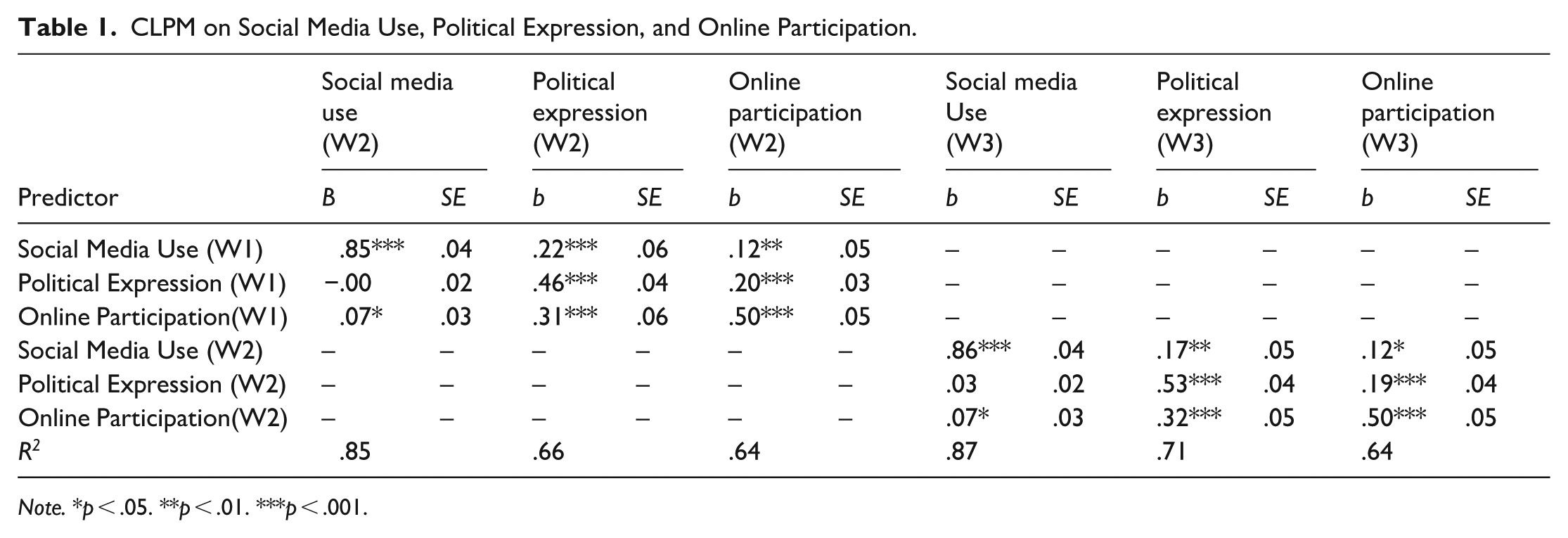
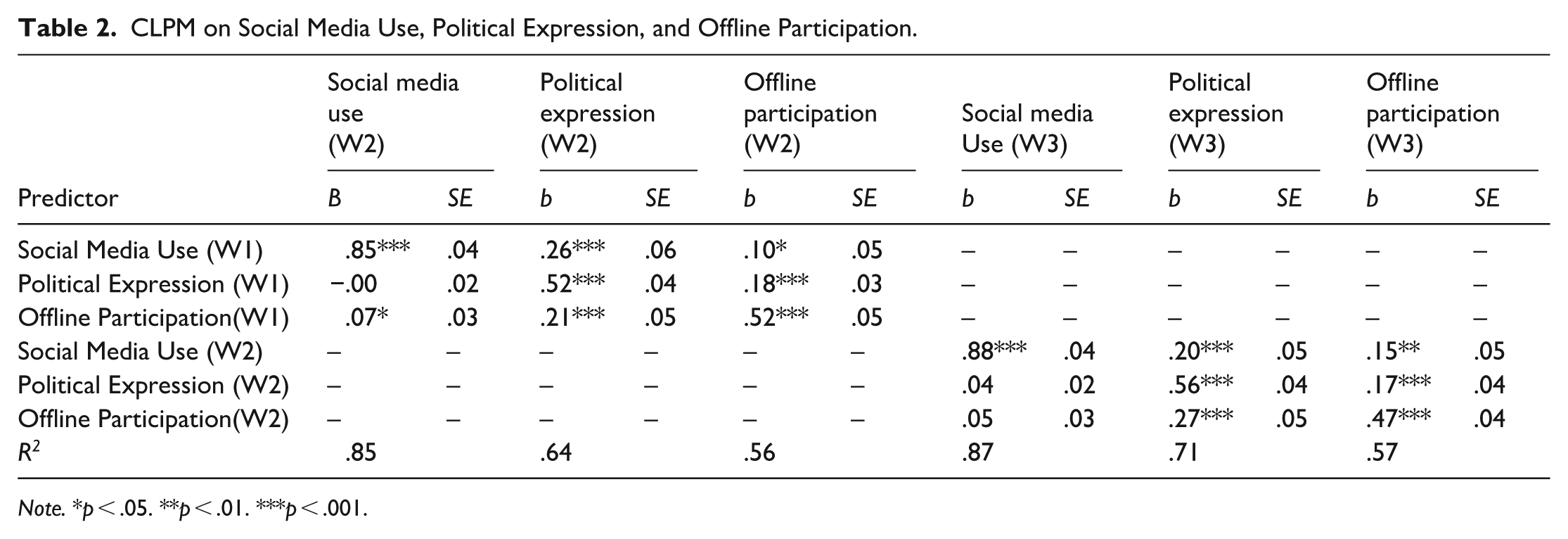
The results for a CLPM on online participation are shown in Table 1. Model fit was good: CFI 0.97; TLI = 0.97; χ2/df = 2.26, p < .001; RMSEA = 0.04, 90%-CI [0.04; 0.05]. We examined a longitudinal metric measurement invariance of all latent variables by constraining all factor loadings as equal over time. When comparing the constrained model to the unconstrained model, we found no significant difference in model fit (p = .28). Thus, metric invariance over time was established. Using offline instead of online participation, model fit was also good: CFI = 0.96; TLI = 0.95; χ2/df = 2.55, p < .001; RMSEA = 0.05, 90%-CI [0.05; 0.05]. We also confirmed longitudinal metric measurement invariance, as the constrained model did show no difference in model fit (p = .32).
CLPM on Social Media Use, Political Expression, and Online Participation.
Note. *p < .05. **p < .01. ***p < .001.
As can be seen in Table 1, social media use wave 1 positively predicts online participation wave two, b = .12, p = .009, as does social media use wave 2 with online participation wave three, b = .12, p = .009, supporting H1a. In line with hypothesis 2, social media use wave 1 was positively related to political expression wave two, b = .22, p < .001, as between wave 2 and wave 3, b = .17, p = .002. We also found clear support for H3: political expression wave 1 positively predicts online participation wave two, b = .20, p < .001, as political expression wave 2 with respect to online participation wave three, b = .19, p < .001.
Findings on the CLPM for offline participation are shown in Table 2: Social media use wave 1 positively predicts offline participation wave two, b = .10, p = .03, as does social media use wave 2 with offline participation wave three, b = .15, p = .002, supporting H1b. Again, social media use wave 1 was positively related to political expression wave two, b = .26, p < .001, as was social media use wave 2 with respect to political expression at wave three, b = .20, p < .001. We also found clear support for H3b: political expression wave 1 positively predicts offline participation wave two (b = .18, p < .001). Finally, political expression wave 2 predicted offline participation wave three (b = .17, p < .001).
CLPM on Social Media Use, Political Expression, and Offline Participation.
Note. *p < .05. **p < .01. ***p < .001.
In an additional analysis, we added gender, age, education, and political ideology as predictors. The findings remain virtually unchanged. In another exploratory analysis, we exchanged political expression with political discussion (CFI = 0.95; TLI = 0.95; χ2/df = 2.71, p < .001; RMSEA = 0.05, 90%-CI [0.05; 0.05]). Social media use wave 1 positively predicts discussion wave 2, b = .12, p = .01, also from wave 2 to wave 3, b = .18, p < .001. Discussion wave 1, however, was not positively related to online participation wave 2, b = −.04, p = .57, but discussion wave 2 positively predicted online participation wave 3, b = .18, p < .001. Online participation predicted discussion for the first period (wave 1 → wave 2: b = .28, p < .001), but not from wave 2 to wave 3 (b = .09, p = .09).
For offline participation and discussion (CFI = 0.94; TLI = 0.93; χ2/df = 2.91, p < .001; RMSEA = 0.05, 90%-CI [0.05; 0.06]), again, social media use wave 1 positively related to discussion wave 2, b = .14, p = .01, also for wave 2 on wave 3, b = .19, p < .001. Discussion wave 1, however, was not positively related to offline participation wave 2, b = .00, p = .98, but wave 2 positively predicted wave 3, b = .17, p = .001. Offline participation predicted discussion (wave 1 → wave 2: b = .23, p < .001), but not from wave 2 to wave 3, b = .07, p = .11).
Random Intercept Cross-Lagged Panel Model
The RI-CLPM for online participation fits the data well, χ2/df = 2.01, p < .001; CFI = 0.98, TLI = 0.97, RMSEA = .04, 90%-CI [0.04; 0.04]. We examined a longitudinal metric measurement invariance, showing no significant difference between the constrained and unconstrained model (p = .17). Using offline participation, model fit was also good: χ2/df = 2.31, p < .001; CFI = 0.97, TLI = 0.96, RMSEA = .04, 90%-CI [0.04; 0.05]. Again, we confirmed longitudinal metric measurement invariance (p = .07).
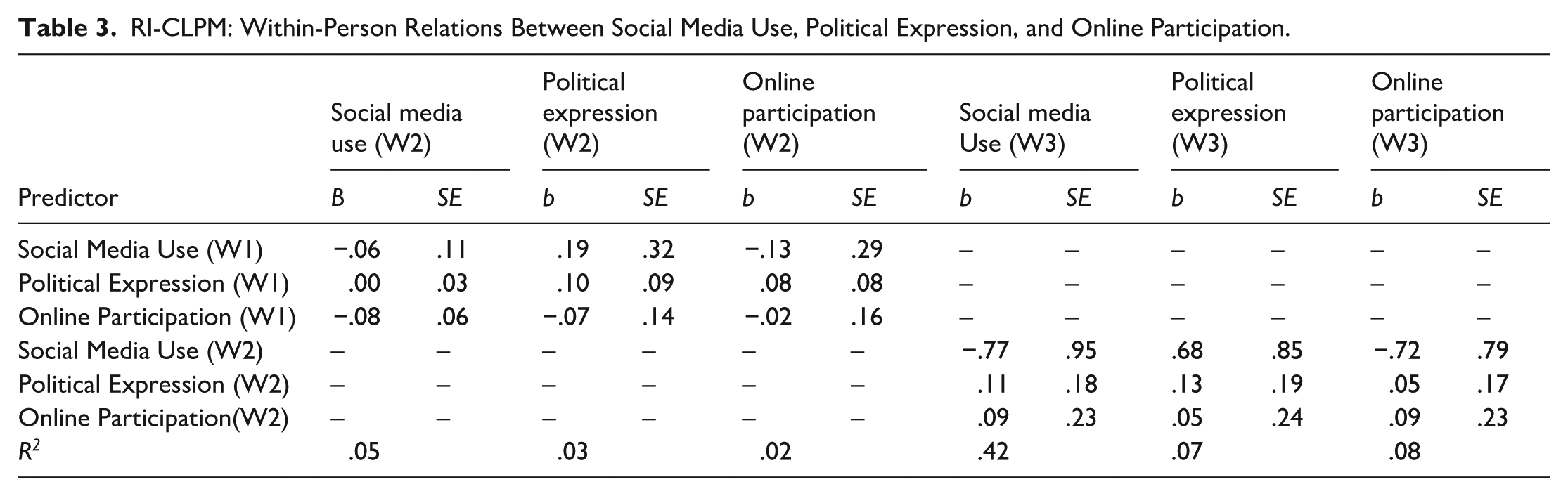
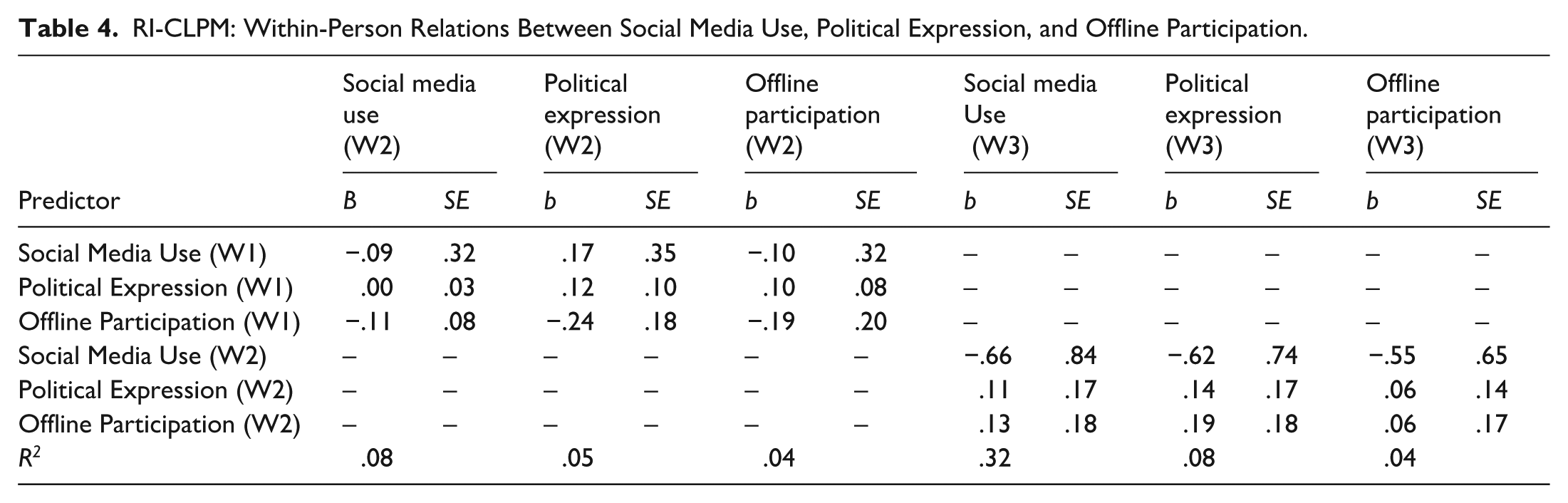
Zooming in on the within-person effects for the online participation model, we found no evidence of cross-lagged effects of social media use at wave 1 on online political participation wave 2, b = −.13, p = .64, and no relation of social media use wave 2 with online political participation wave 3, b = −.72, p = .36, falsifying H4a. In contrast to hypothesis 5, social media use wave 1 was unrelated to political expression wave 2, b = .19, p = .56, as was social media use wave 2 with respect to political expression wave 3, b = −.68, p = .43. We also found no support for H6a: political expression wave 1 was unrelated to online participation wave 2, b = .08, p = .29, as was political expression wave 2 with respect to online participation wave 3, b = .05, p = .76. Basically the same picture emerged for the offline participation model: Social media use at wave 1 was unrelated to offline political participation wave 2, b = −.13, p = .64, as was social media use wave 2 with offline political participation wave 3, b = −.652, p = .40, falsifying H4b. Again, social media use wave 1 was unrelated to political expression wave 2, b = .17, p = .63, as was social media use wave 2 with respect to political expression wave 3, b = −.62, p = .40. We also found no support for H6b: political expression wave 1 positively was unrelated to online participation wave 2, b = .10, p = .20, as political expression wave 2 with respect to online participation wave 3, b = .06, p = .70. Thus, the findings of the CLPM are not visible at the within-person level of the RI-CLPM (see Tables 3 and 4).
RI-CLPM: Within-Person Relations Between Social Media Use, Political Expression, and Online Participation.
RI-CLPM: Within-Person Relations Between Social Media Use, Political Expression, and Offline Participation.
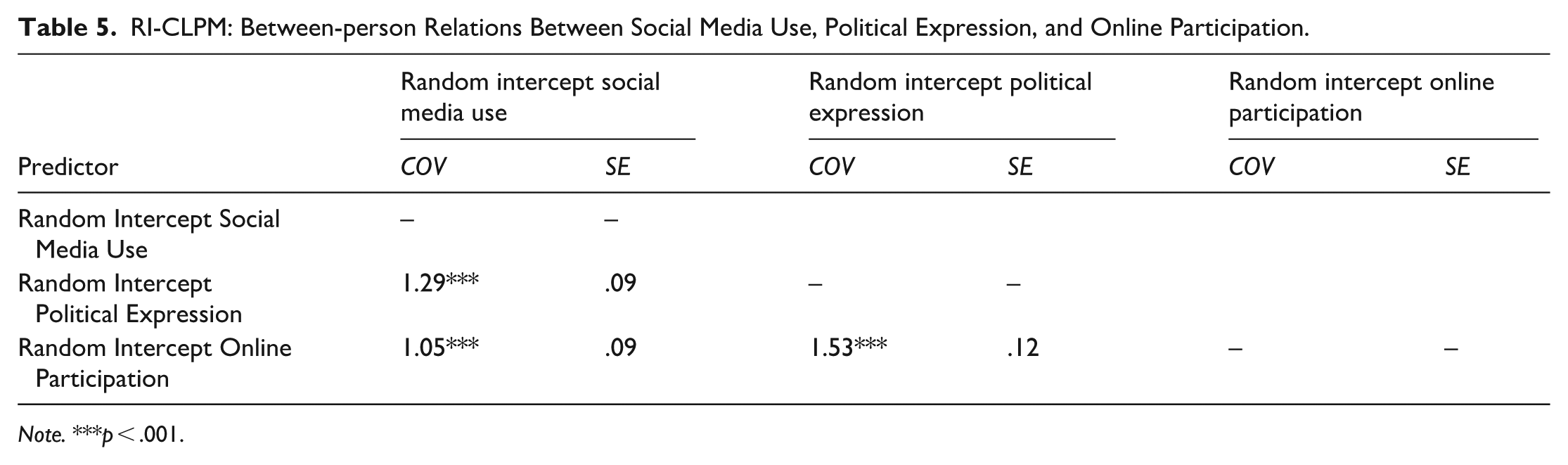
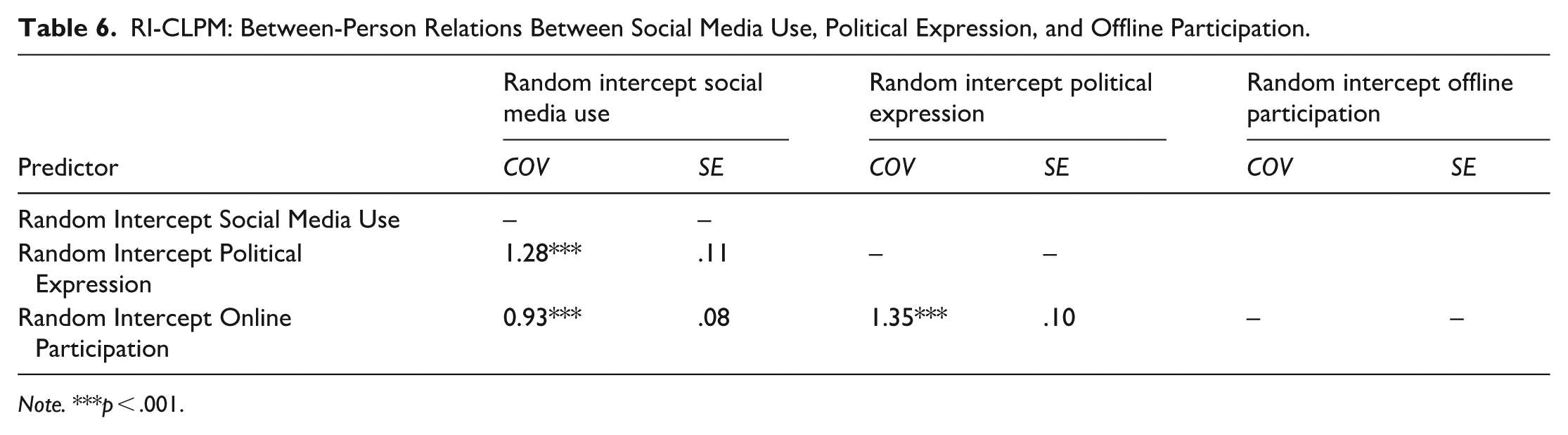
Tables 5 and 6 show the between-person effects. Supporting H7a, there was a significant positive covariance between the random intercepts of social media use and online political participation (b = 1.01, p < .001). We also can confirm H8, as there was a significant positive covariance between the random intercepts of social media use and political expression (b = 1.29, p < .001) as well as H9a, as we observed a significant positive covariance between the random intercepts of political expression and online political participation (b = 1.53, p < .001). These findings are replicated with the offline participation model: As predicted (H7b), there was a significant positive covariance between the random intercepts of social media use and offline political participation (b = .94, p < .001). Again, there was a significant positive covariance between the random intercepts of social media use and political expression (b = 1.23, p < .001), and a significant positive covariance between the random intercepts of political expression and online political participation (b = 1.35, p < .001), confirming H9b.
RI-CLPM: Between-person Relations Between Social Media Use, Political Expression, and Online Participation.
Note. ***p < .001.
RI-CLPM: Between-Person Relations Between Social Media Use, Political Expression, and Offline Participation.
Note. ***p < .001.
In an additional analysis, we exchanged expression with political discussion. The findings remain largely the same: For the online participation within-person effects model, there was no evidence of cross-lagged effects of social media on online political participation (wave 1 → wave 2: b = .19, p = .48; wave 2 → wave 3, b = -1.04, p = .32). Social media use wave 1 was unrelated to discussion wave 2, b = .34, p = .15, as between wave 2 and wave 3, b = -.67, p = .40. Discussion wave 1 was unrelated to online participation wave 2, b = -.22, p = .07, as between wave 2 and wave 3, b = .58, p = .08. As for between-person relations, the random intercepts of social media use and online political participation were related (b = 0.98, p < .001), as were the random intercepts of social media use and discussion (b = 0.75, p < .001) as well as discussion and online political participation (b = 0.86, p < .001).
Also for offline participation, findings remain largely unchanged. Looking at the within-person effects model, social media use at wave 1 was unrelated offline political participation wave 2, b = .22, p = .43, also from wave 2 to wave 3, b = −.75, p = .34. Social media use wave 1 was unrelated to discussion wave 2, b = .39, p = .13, as between wave 2 and wave 3, b = −.58, p = .40. Discussion wave 1 was unrelated to offline participation wave 2, b = −.15, p = .22, but there was significant relation between wave 2 and wave 3, b = .53, p = .03. As for between-person relations, the random intercepts of social media use and offline political participation were related (b = 0.89, p < .001), as were the random intercepts of social media use and discussion between wave 1 and wave 2 (b = 0.75, p < .001) and of discussion and offline political participation (b = 0.78, p < .001). The findings of all hypotheses are summarized in Table 7.
Summary of Hypotheses Tests.
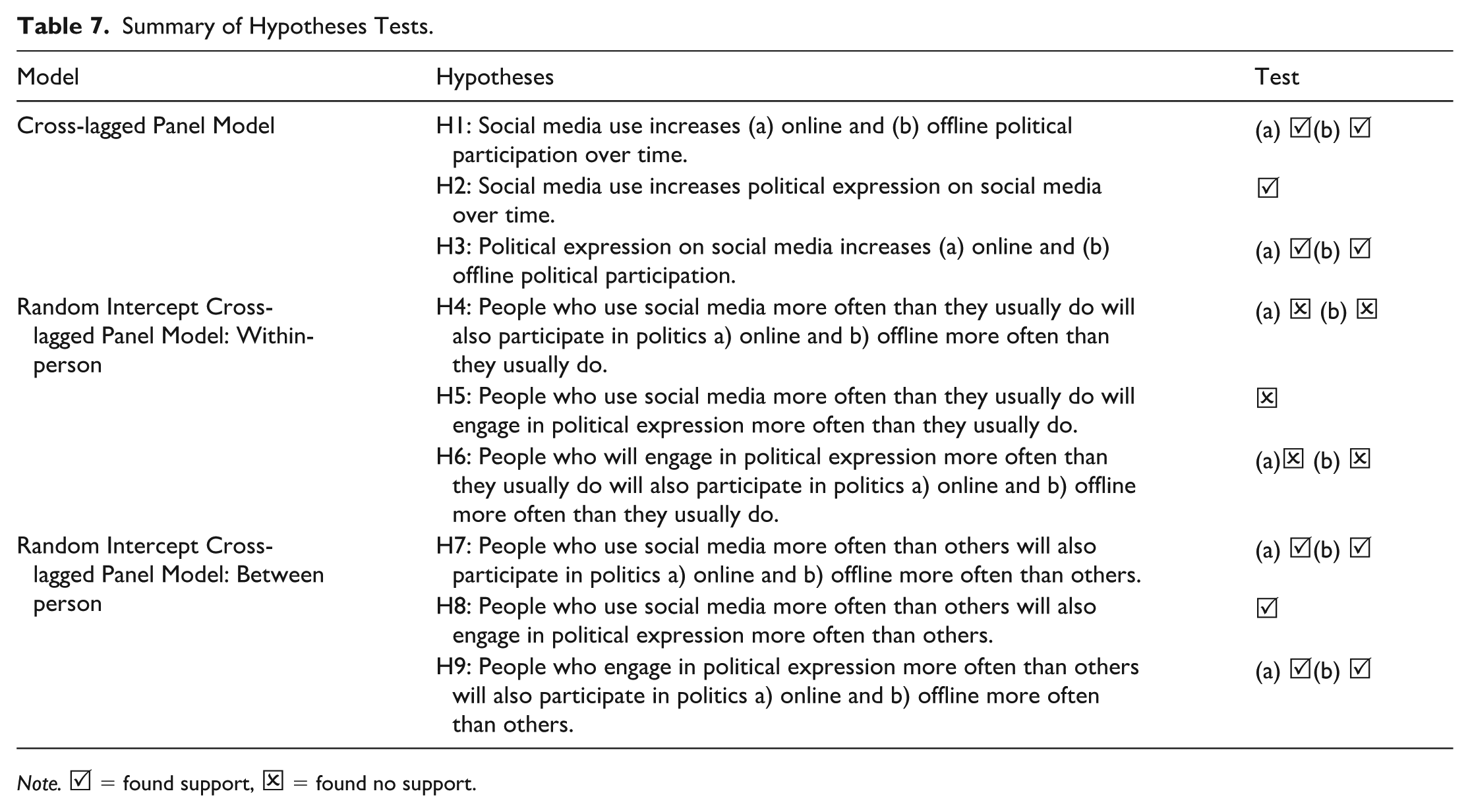
Note. ☒ = found support, ☑ = found no support.
In an exploratory analysis, we aimed to describe the individuals who may be responsible for the between-person effects observed in the present study. We performed a cluster analysis with the Ward algorithm, using the wave 1 measures of social media use, expression and overall participation. Inspection of the heterogeneity measure clearly indicated a three-cluster solution. Cluster one (59.3%) includes individuals with low to moderate levels of social media use (M = 2.53, SD = .96) and very low levels of expression (M = 1.36, SD = .63) and participation (M = 1.34, SD = .57). This largest cluster can be summarized as the ‘politically inactive’. The second cluster (23.4%) can be called the ‘politically expressive’. These individuals scored very low on participation (M = 1.80, SD = .78), but high on expression (M = 4.05, SD = 1.10) and moderate on social media use (M = 3.58, SD = 1.08). It seems that this group is communicating about politics, but not really participating. Finally, cluster three, the ‘politically active’, includes those who score high on all three constructs (social media use: M = 4.65, SD = 1.41; expression: M = 4.82, SD = .99; participation: M = 4.46, SD = .90). This is the smallest cluster (17.4%). In theoretical terms, this means that a small group of individuals may be responsible for the between-person relations of the constructs.
Discussion
Numerous studies have confirmed that social media promotes the expression of political opinions, which in turn, increases online as well as offline participation. However, the available panel studies were analyzed using the cross-lagged panel model (CLPM). This model fails to separate within- from between-person effects. This failure has fundamental implications on how we interpret the available findings. If we cannot separate between- from within-person effects, we cannot say that an individual’s increase in social media use leads to a subsequent increase in expression and participation. Yet based on the theory, any relation between social media use, expression, and participation arguably takes place within an individual. Yet if prior work was unable to separate within-person from between-person effects, what do we really know about the participatory outcomes of social media use?
In this study, we attempted to answer this question by proposing a random intercept, cross-lagged panel model (RI-CLPM) disaggregating within-person and between-person effects. Using three-wave panel data, we compared the findings of the CLPM with the RI-CLPM. In the CLPM, we perfectly replicated findings from prior research: Across panel waves, social media use was positively related to online as well as offline participation. In addition to this general relationship, findings suggest social media promotes the expression of political opinions over time, which is also related to online and offline participation. Interestingly, the CLPM showcases a number of reciprocal relationships, suggesting that online participation is associated with subsequent social media use and expression. Offline participation was also related to expression over time, and in one out of two relationships, also to social media use. Finally, in additional analyses, we replicated the findings by adding controls and we exchanged political expression for political discussion, largely yielding the same findings, albeit not for the relation of discussion wave 1 and online and offline participation wave 2.
However, when disentangling between-person from within-person effects, the picture looks very different. At the between-person level, all three variables were significantly related. Yet at the within-person level, no cross-lagged associations were found between changes in social media use and subsequent changes in expression as well as online and offline political participation, and vice versa. The results were largely unchanged with the inclusion of political discussion instead of expression. This suggests that the associations between social media use, political expression and political participation are mainly driven by trait-like differences and not by state-like individual changes over time, fundamentally challenging some of the key conclusions of previous research. In fact, based on the present findings, we cannot say that a change in social media use within an individual leads to a change in expression or participation.
Rather, our findings suggest that those who are already high in social media use (as compared to others) are also more likely to participate in politics online and offline (as compared to others). That is, there may be characteristics that predispose individuals to score both high social media use and on political participation. While investigating the more stable characteristics behind the association is beyond the scope of the paper, one could assume that trait-like constructs play a key role. These could be personality traits such as extraversion or need for cognition, norms such as perceived civic duties, an involvement in strong political communities, or, more basically, high levels of political interest and efficacy. It follows that interventions aiming to increase political participation should not only focus on exposing individuals to information on social media, but rather in fostering the more stable characteristics of individuals from early on.
Limitations
Some important limitations need to be acknowledged. Our study is based on self-reports. Related to that, our study was not designed to capture short-time effects that are followed by a quick decay (Thomas, 2022). Non-perceptual methods such as experiments, but also in-situ approaches such as mobile experience sampling, are therefore warranted. Related, our study cannot clarify the question of how political participation is enhanced within individuals. However, the study lays the ground for future research clarifying that question with appropriate methodologies. We used a rather simple measure of social media use (Lee & Xenos, 2019; Valenzuela, 2013). However, although commonly used, this measure can be criticized. While we asked participants how much time they spend on specific social media platforms and collapsed this into an index, other studies have measured, for instance, specific ways of social media use such as consumption of political information on social media (see e.g., Boulianne, 2015). In addition, an alternative and possibly a more accurate way to measure social media use would be relying on data donations or log data (e.g., Araujo et al., 2017; Scharkow, 2016). These considerations apply also to the measure of political expression on social media. Given the goal of this study, which was to study well-established between-level associations of social media use, political expression, and participation in prior research at the within-level, reliance on widely used self-report measures can be viewed as less problematic.
Also, the question introduction to our social media use measure did not specify the time interval for the behavior (see for this, Schreurs et al., 2024). While we unfortunately do not have empirical data to back this claim, we believe that this has only limited consequences for the inferences made in this paper. General social media use is, for many people, a very frequent behavior. For such frequent behaviors, people tend to rely on global representations rather than retrieving every single behavioral episode (Schwarz & Oyserman, 2001). Thus, since these global representations are updated on a continuous base, the most recent social media use should affect responses to our question the most (in contrast to the media use seven weeks ago). The measures for expression and participation each featured a two-months interval as anchor.
Further, for the general between-person relation between social media use and online as well as offline participation, we were unable to shed light on the underlying mechanism (see e.g., Boukes, 2019; Kim et al. 2017; Nanz & Matthes, 2022a,b). Future research should thus replicate our findings using additional constructs such as learning or efficacy. When it comes to expression, we focused on intra-individual expression effects (Pingree, 2007), ignoring the complex interactions and feedback loops with others arising from expression. Also, while we ran the same models with political discussion instead of expression, we do not dissolve the fuzziness of both terms as employed in the literature (Lane et al., 2022). As the panel data was collected in one country only, future studies should replicate the findings in other countries and employ cross-country comparisons. Further, the composition of the sample in the final wave differed regarding gender and age from the target population, potentially limiting the generalizability of our findings. While this is not uncommon for research in this area, research using random sampling and multiple recontact efforts is needed. Finally, future research should employ four or more panel waves to better reflect the underlying dynamics over time. A replication of our study in a more dynamic context would be particularly interesting, for instance, when there is a major political scandal. In such cases, it is possible that social media use, expression, and participation are associated at the within-level.
Theoretical, Methodological, and Practical Implications
These limitations notwithstanding, our findings hold a number of important implications. When it comes to the relation between social media use, political expression, as well as political participation, we need to question the underlying theoretical mechanisms. The original argument was that social media use leads to learning or a sense of efficacy (Boukes, 2019; Boulianne & Theocharis, 2020; Skoric et al., 2016a), which in turn drives participation. More recent work, however, suggests that learning political news from social media is very limited (Amsalem & Zoizner, 2023; Dreston & Neubaum, 2023; Schäfer & Schemer, 2024). Scholars have pointed to algorithmic and self-selected biases, so citizens get either more of the same or non-political information, as well as information overload (Amsalem & Zoizner, 2023). Furthermore, the affordances of different platforms deserve more attention. For instance, different platforms have different norms according to which political discussions are perceived as appropriate. For example, Instagram may be seen as a place for lifestyle, X for political discussion. Failing to account for platform affordances, which can also be said about the present study, will ultimately blur the picture. Finally, we also need to understand the reasons for why an increase in social media use, even if political, does not automatically lead to more expression and participation. Social media platforms may be increasingly perceived as toxic spaces, where citizens perceive a risk of negative responses, discouraging political expression and participation (Kim et al., 2021).
Second, rather than using the CLPM, we urge scholars to employ more advanced research designs, which can tease out within-person differences. This call is not new (Thomas et al., 2021). Media effects theories assume that any media content that people are exposed to may cause changes at the individual level (Valkenburg & Peter, 2013). As stated in work from adjacent disciplines and recent work in the field of communication (Mund & Nestler, 2019; Thomas et al., 2021), these within-person mechanisms need to be captured. First and foremost, longitudinal panel designs with three (or ideally more) waves may allow to use the RI-CLPM or related models such as Latent Growth Models to directly model intra-individual change over time. Ideally, scholars should work with shorter time intervals (i.e., monthly) and more than three waves to capture the unfolding mechanisms in a more fine-grained manner. Besides, compared to the present study, the complexity of the models should be increased, considering mediators and moderators. Beyond traditional surveys, mobile experience sampling can be used to model short-term dynamics. Also, qualitative over time media diaries can be used to gain a more fine-grained understanding of the underlying processes.
More importantly, however, within-person effects may vary from individual to individual, some may display an increase in a behavior, attitude, or cognition, and some others may decrease. These differences in change patterns can be explained. In fact, it is unlikely that change processes within individuals always follow the same pattern during a political campaign. Some may express more, some may tune out and express and/or participate less. As proposed by the Differential Susceptibility to Media Effects model (Valkenburg & Peter, 2013), dispositional, developmental, and socio-contextual variables may explain a person’s or a group of persons’ change trajectory. Thus, rather than asking whether or not there is an effect of social media on any politically relevant outcome, we may seek to explore the factors that help to explain why some citizens tend to change over time when using social media, while others do not.
When it comes to practical implications, our findings suggest that campaigners cannot assume that an increase in social media activity will automatically lead to more political engagement. Also, given that engagement is driven by trait-like differences, campaigners need to tailor specific target groups. A one-size-fits-all strategy may be ineffective. Finally, when it comes to the measurement and estimation of campaign success, practitioners should consider change processes at the individual level, rather than relying in aggregate-level data.
Conclusion
Overall, our study somewhat challenges the widespread enthusiasm about the participatory benefits of social media use. Using the RI-CLPM, we demonstrated that separating between-person and within-person effects can fundamentally change the substantial conclusions made in this line of inquiry. In fact, previously observed associations between social media use, political expression, and participation were only present at the between-level, but not at the within level. It can be concluded that participatory outcomes of social media use can be traced back to stable between-person differences rather than processes operating within citizens.
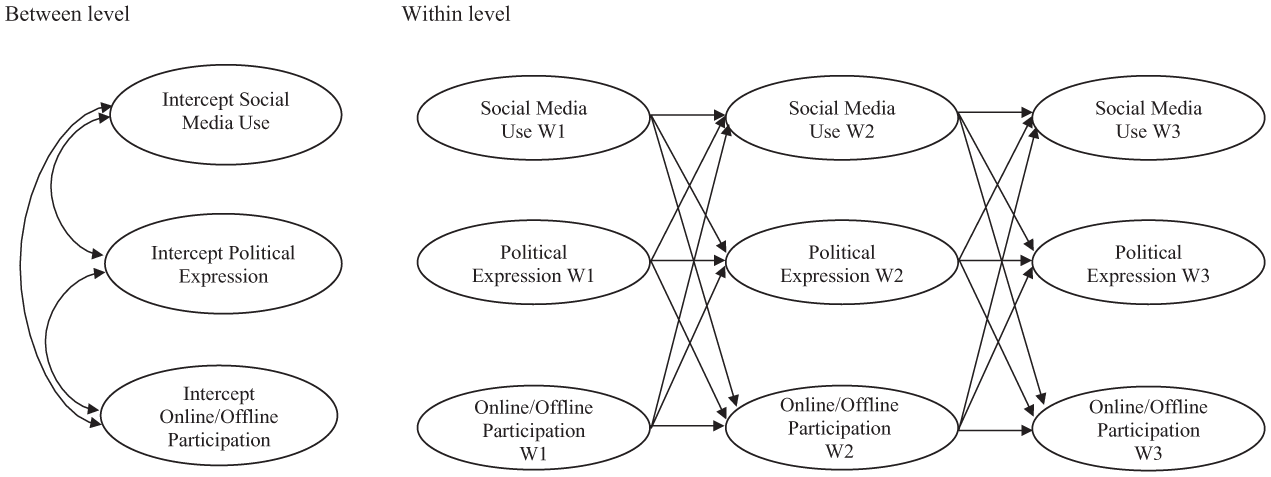
Simplified graphical representation of the random-intercept cross-lagged panel model depicting the relationships between social media use, political expression, online/offline participation.
Supplemental Material
sj-docx-1-crx-10.1177_00936502261430387 – Supplemental material for Disentangling the Longitudinal Relationship Between Social Media Use, Political Expression and Political Participation: What Do We Really Know?
Supplemental material, sj-docx-1-crx-10.1177_00936502261430387 for Disentangling the Longitudinal Relationship Between Social Media Use, Political Expression and Political Participation: What Do We Really Know? by Jörg Matthes, Andreas Nanz, Marlis Stubenvoll and Ruta Kaskeleviciute in Communication Research
Footnotes

Funding
The authors disclosed receipt of the following financial support for the research, authorship, and/or publication of this article: This research received funding from the Austrian Research Funds (FWF). Funding number: P 31081-G29
Declaration of Conflicting Interests
The authors declared no potential conflicts of interest with respect to the research, authorship, and/or publication of this article.
Disclaimer
All authors have agreed to the submission and that the article is not currently being considered for publication by any other print or electronic journal.
Supplemental Material
Supplemental material for this article is available online.
Author Biographies
References
Supplementary Material
Please find the following supplemental material available below.
For Open Access articles published under a Creative Commons License, all supplemental material carries the same license as the article it is associated with.
For non-Open Access articles published, all supplemental material carries a non-exclusive license, and permission requests for re-use of supplemental material or any part of supplemental material shall be sent directly to the copyright owner as specified in the copyright notice associated with the article.
