



Abstract
A total of 4,556 US college students were surveyed immediately after Election 2012 to investigate what social media–related psychological and behavioral factors predicted their online political participation. Structural equation modeling and hierarchical multiple regression results showed that online social capital, political self-efficacy, and Facebook group participation were positive predictors of online political participation, while social trust did not directly influence online political participation. General political use of Facebook and Twitter was a positive predictor of online political participation; however, extensive Facebook and Twitter use was a negative predictor. Implications for research and political practice are discussed.
Keywords
US citizens’ online political participation is on the rise, fueled by the phenomenal growth of social media. In the 2008 election, the Pew Internet & American Life Project found that, for the first time, the majority of US adults (55%) used the Internet to stay informed or get involved in the political process (Smith, 2009). Two years later, the Pew Internet & American Life Project reported that, in the 2010 midterm elections, 73% of adult Internet users (54% of US adults) received political news or information, or got involved online, and 35% of social networking site (SNS) users (about 22% of online adults) visited these sites for political information or getting involved in the campaign (Smith, 2011a, 2011b). A more recent Pew survey found that, on SNS, 66% of social media users (39% of US adults) engaged in one of eight civic or political activities (Rainie, Smith, Schlozman, Brady, & Verba, 2012). Political scientists and communication scholars urged politicians to tap the huge potential of engaging voters and campaigning via social media (Utz, 2009) because those who use social media for political purposes are more likely to vote or to donate to a campaign (e.g., Kim & Geidner, 2008). Political candidates have turned the Internet into a major fund-raising tool since 2000 when John McCain made history by raising US$2.7 million within 3 days of winning the New Hampshire primary (van Natta, 2000). In the 2008 presidential campaign, Barack Obama’s campaign raised US$500 million dollars of contributions with the help of 35,000 groups organized by My Barack Obama website, the most popular Facebook page, and 1,800 YouTube videos (Learmonth, 2009). Of US$1.1 billion raised by the Obama team in the 2012 presidential campaign, US$690 million came from online donations (Green, 2012; Mason & Tanfani, 2012).
Little is known about how US millennials’ general social media use, political use of social media, political self-efficacy, general social trust, and online social capital influence their online political participation, although there is a growing body of research literature on social media use and political participation since 2004—the birth year of Facebook. Most of them attempted to discover whether the general use of social media could enhance young people’s online and offline political participation and civic engagement (e.g., Baumgartner & Morris, 2010; Bode, Vraga, Borah, & Shah, 2014; Gil de Zúñiga, Jung, & Valenzuela, 2012; Hargittai & Shaw, 2013; Valenzuela, Kim, & Gil de Zúñiga, 2012; Valenzuela, Park, & Kee, 2009). Most of these studies were conducted in Western democracies such as the United States (e.g., Bode et al., 2014; Gil de Zúñiga et al., 2012), the United Kingdom (Xenos, Vromen, & Loader, 2014), Australia (Xenos et al., 2014), Sweden (Sveningsson, 2014; Svensson, 2014), Italy (Vaccari et al., 2015), Spain and the Netherlands (Calenda & Meijer, 2009). A meta-analysis of 36 studies demonstrated a positive relationship of social media use and political participation but only half of the coefficients were statistically significant (Boulianne, 2015). Thus, the question remains: whether can social media use influence online political participation of young citizens in developed democratic societies? Extent research also explored the role of social media use in building social capital which may predict their civic engagement and political participation (e.g., Ellison, Steinfield, & Lampe, 2007; Gibson & McAllister, 2013; Gil de Zúñiga et al., 2012; Skoric, Ying, & Ng, 2009). Again, the findings are inconclusive to link online social capital to online political participation directly. In addition, no study has ever tried to measure online social capital differently than the use of bonding and bridging social capitals (e.g., Gil de Zúñiga et al., 2012). Finally, few studies ventured to examine what motivates young people’s use of social media for political purposes (Gil de Zúñiga, Molyneux, & Zheng, 2014) and whether their political use of social media led to active political engagement online and offline except Bode et al. (2014) who use a national sample of teenagers. To date, no published study can be retrieved from EBSCO and ProQuest databases that investigated social media use and online political participation of US millennials in the 2012 presidential election, in which 60% of millennials voted for Obama (Kotkin, 2012). Using a big random sample of US college students and primary data analyses, the present survey study intends to validate and extend these studies to deepen our understanding of social media use and online political participation of well-educated millennials in the presidential election year in a “swing” state in the United States.
Theoretical Framework
Online Political Participation
Conventionally, political participation refers to the participation of citizens in activities that can influence the structure of government, selection of officials, and policies (Himelboim, Lariscy, Tinkham, & Sweetser, 2012; Putnam, 1995). Online political participation has been defined in the same way as conventional political participation, except that the activities are occurring in an online context (Brady, 1999; Verba, Schlozman, & Brady, 1995). These relatively serious online political activities include (1) writing to a politician online, (2) making a campaign contribution online, (3) subscribing to a political listserv, (4) signing up to volunteer for a campaign/issue online, (5) sending a political message via email, and (6) writing a letter to the editor of a newspaper online (Gil de Zúñiga et al., 2012; Shah, Cho, Eveland, & Kwak, 2005; Zukin, Keeter, Andolina, Jenkins, & Delli-Carpini, 2006).
Recently, Valenzuela et al. (2012) contended that, based on the different results of studies about Internet effects on mobilizing and reinforcing participation, there is justification for viewing online and traditional participation as separate constructs. A clear delineation of the components of online participation is lacking in current research, although a recent study showed that online political participation should be identified as a distinctive type of participation (Oser, Hooghe, & Marien, 2013). Researchers have investigated individual aspects of online political participation (e.g., Kushin & Yamamoto, 2010), but have not developed an overall model.
The phenomenal popularity of social media has provided various opportunities for US citizens’ online political participation. Internet users with political interest can share their political views on SNS with friends, join interest groups on SNS, forward political videos or ads via YouTube or SNS, follow political characters on Twitter, tweet or retweet any political comment, publish blogs about important social and economic issues, and pin their favorite political images/videos/websites on Pinterest. Many political and communication scholars applauded the tremendous democratic potentials of social media for online civic and political participation (e.g., Holt, Shehata, Strömbäck, & Ljungberg, 2013; Kushin & Yamamoto, 2010). The US government and other democratic countries worldwide have also launched the initiatives to engage young citizens and voters with social media (Bridges, Appel, & Grossklags, 2012; Macnamara, Sakinofsky, & Beattie, 2012).
Dozens of studies attempted to explain the dynamics of social media use and online political participation but the results are mixed and even conflicting (for a meta-analysis, see Boulianne, 2015). For example, Carlisle and Patton (2013) identified political interest as the only important predictor of political participation on Facebook, whereas Mihailidis’ (2014) survey of 800 college students showed that social media were rarely used for politics. However, Gil de Zúñiga et al. (2014) discovered that social media political expression was a strong predictor of online political participation. Researchers and practitioners are still wondering how young people’s social media use, political use of social media, online social capital, political self-efficacy, and general social trust influence their online political participation.
Political Benefits of Social Media Use
Theoretically, social media, especially social networking websites, can be used by American citizens to accumulate online and offline social capital because the primary purpose of social media use is to maintain and increase one’s online and offline social networks (Ellison et al., 2007; Joinson, 2008). Conventionally, social capital has been defined as social connections among individuals—social networks and the norms of reciprocity and trustworthiness that arise from them (Putnam, 2000). However, Lin (1982, 1999, 2001) argues that social capital should be defined as resources embedded in social networks or social resources—not as goods possessed by the individual. Rather, they are resources accessible through one’s “direct or indirect ties” (Lin, 1982, p. 132). Lin (2008) points out that the premise that social capital is network-based has been widely recognized by established social scientists such as Bourdieu, Coleman, and Putnam. Moreover, Lin (2008) contends that an individual may borrow or capture others’ resources (e.g., their wealth, power, or reputation) by utilizing one’s social relations and social networks. In this way, these social resources can produce benefits to an individual such as finding a job or getting a promotion. So, social capital should be conceptualized in terms of its capacity to produce returns—the pool of resources embedded in one’s social networks—with the expectation that the richer or greater the capacity, the better the return (Lin, 2008). In short, Lin’s neo-capitalist approach to social capital regards maintaining and building social relations/networks as an investment.
Lin (2008) also believes that the best measure of an individual’s potential pool of resources accessible and embedded in his/her social networks is to ask respondents to indicate whether she/he knows anyone in a list of systematically sampled positions in a social hierarchy (from physician, lawyers to office worker/guard, housemaid, or cleaning worker). Lin, Fu, and Hsung (2001) assigned prestige scores to different positions to arrive at a cumulative score to quantify one’s social capital: for example, if you know a physician, you score 78, and if you know a cleaning worker, you score 22. As we are not aware that any new media study has tested Lin’s hierarchical theory of social capital, we decided to follow Lin’s definition of social capital as “resources embedded in social relations and social networks” (Lin & Erickson, 2008, p. 4) and adopted their position generator measurement of social capital (Lin et al., 2001). This simple measure of social capital was developed in the United States and has been adopted by many sociological scholars and validated in the Netherlands (Flap & Völker, 2008; Van de Gaag, Snijders, & Flap, 2008), in Taiwan (Fu, 2008), and China (Bian, 2008).
Previous social media studies have already provided some preliminary evidence that social media use can increase Internet users’ online and offline social capital often operationalized as bonding and bridging social capital (Ellison et al., 2007; Kim & Geidner, 2008; Steinfield, Ellison, & Lampe, 2008; Utz, 2009; Valenzuela et al., 2009). The study focused on US college students’ use of Facebook and Twitter. A total of 71% of online adults were Facebook users as of September, 2013, increased from 67% in late 2012 (Duggan & Smith, 2013), and Twitter is considered by seasoned journalists and scholars to have fundamentally changed the ways that political leaders interact with citizens and how political news is covered (e.g., Hamby, 2013; Parmelee & Bichard, 2012). As time spent on SNS sites is the most widely used measure of social media use intensity (e.g., Ellison et al., 2007; Valenzuela et al., 2009), we propose that:
H1. The time spent on (a) Facebook and (b) Twitter by US college students daily positively predicts their online social capital.
Past research suggests that social media users are more likely to participate in offline and online political activities than non-users. A Pew Center study revealed that Facebook users who used the site multiple times per day were more likely to be politically engaged than those who did not (Hampton, Goulet, Rainie, & Purcell, 2011). Another national survey of 3,000 youths aged 15-25 found that 41% of respondents had started a new political group online, or written or disseminated a blog about a political issue, or forwarded a political video to their social network, or participated in a poetry slam online (Kahne & Middaugh, 2012). A more recent Pew survey showed that 66% of social media users participated in one of eight civic or political activities—to “like” or promote material related to politics or social issues, to encourage people to vote, to post their own thoughts or comments on political and social issues, to repost content related to political or social issues, to encourage others to take action on political or social issues, and to post links to political stories or articles (Rainie et al., 2012). More recently, Hargittai and Shaw (2013) found that social network site usage was a significant predictor of the political action of signing a petition. Thus, we expect that:
H2. The time spent on (a) Facebook and (b) Twitter by US college students daily positively predicts their frequency of using social media for political purposes.
Social media use has been connected with civic engagement and political participation in the current research literature on social media and politics. For example, Kim and Geidner (2008) showed that online social network usage explained 5.8% of the probability of voting of young people. Valenzuela et al. (2009) found that the intensity of Facebook use positively predicted civic participation whereas the intensity of Facebook group use enhanced both civic and political participation. Baumgartner and Morris (2010) revealed that the SNS use positively predicted three online political activities including posting political message on blog, signing an email or web petition, and forwarding a political email or link. Recently, Kim and Chen’s (2012) analysis of the 2008 Pew survey data identified the uses of SNS and blogs as two strong predictors of online political participation. Gainous, Marlowe, and Wagner (2013) arrived at the similar conclusion that online social networking might stimulate online political participation after analyzing the 2008 Pew survey data. Moreover, several national surveys reported that most of social media users were civically and politically engaged citizens, especially compared with non-users (Allstate/National Journal Heartland Monitor Poll XIII, 2012; Rainie et al., 2012; Smith, 2011b). Non-US studies also found that social networking use predicted traditional active political participation (e.g., Bakker & de Vreese, 2011).
Hence, the study posits that:
H3. The time spent on (a) Facebook and (b) Twitter by US college students daily positively predicts their online political participation.
Political Use of Social Media
Political use of Facebook is operationalized as the discussion of any political topic on Facebook, and political use of Twitter involves the frequency of tweeting or retweeting about any political topic and the number of political characters followed in this study.
Previous studies demonstrate that online civic talk or political expression is a positive predictor of online and offline political participation (e.g., Bode et al., 2014; Hsieh & Li, 2014). Research also shows that US Internet users’ social media use for political purposes has a significant influence on their offline political participation, such as situational political involvement and voting intent or behavior (Bode et al., 2014; Gil de Zúñiga et al., 2014; Hyun & Kim, 2015; Kim & Khang, 2014; Kushin & Yamamoto, 2010; Valenzuela et al., 2009). Non-US studies corroborated that the political social media use increased offline or online political engagement (e.g., Holt et al., 2013; Tang & Lee, 2013; Vaccari et al., 2015; Valenzuela, 2013; Zhang & Lin, 2014). Similarly, the political uses of social network sites (especially political discussion/expression/conversation in social media) and blogs have been found to be positively related to online political participation in the United States (Bode, 2012; Gil de Zúñiga et al., 2014; Towner, 2013; Valenzuela et al., 2009, 2012; Vitak et al., 2011). It follows that:
H4. US college students’ political use of (a) Facebook and (b) Twitter positively predicts their online political participation.
Online Social Capital and Political Participation
Social capital has been seen as instrumental to political participation since Putnam first brought our attention to the disappearance of social capital in 1985. Lake and Huckfeldt (1998) suggested that some social capital created in personal networks was politically relevant, and the accumulation of social capital might give rise to political engagement. Similarly, Zhang and Chia (2006) found that citizens’ social connectedness encouraged both civic and political participation. Moreover, Klesner (2007) discovered that greater involvement in non-political organizations led to more political participation in four Latin American countries.
Online social capital was found to enhance online and offline political participation (e.g., Gibson & McAllister, 2013; Skoric et al., 2009; Valenzuela et al., 2012). Specifically, a 2007 Australian Election Study found that bonding online social contacts predicted offline political participation (Gibson & McAllister, 2013). Valenzuela et al. (2012) showed that larger online networks were associated with online participation. In addition, Skoric and colleagues (2009) found that online bridging social capital was a strong predictor of online political participation whereas online bonding capital positively predicted traditional political participation in Singapore. So, it is very likely that
H5. US college students’ online social capital positively predicts their online political participation.
Political Self-Efficacy, Social Media, and Online Political Participation
The success of a democratic government relies on the citizens’ confidence and competence of governing and being governed by others, that is, their political self-efficacy (Clarke, Kornberg, & Scotto, 2006). It is widely recognized that political efficacy consists of two related but distinct components: (1) internal efficacy —the beliefs about one’s capabilities to understand politics, and to participate in political activities effectively, and (2) external efficacy —the beliefs that government authorities and institutions are responsive to citizen demands (Niemi, Craig, & Mattei, 1991). The sense of political efficacy has been measured since 1952 in every US presidential election survey conducted by the University of Michigan’s Center for Political Studies (Acock & Clarke, 1990). It has been consistently shown to be a strong positive predictor of traditional political participation (Pollock, 1983; Scheufele & Nisbet, 2002) and voting intent or behavior (Leshner & Thorson, 2000; Pinkleton, Austin, & Fortman, 1998). Thus, this study considers political self-efficacy as a two-dimensional construct and examines the combined impact of internal and external political self-efficacy.
If social media users believe that they are politically knowledgeable and capable of influencing the political process, they will be more motivated to discuss politics on SNS, follow political characters on Twitter, or tweet or retweet about a political issue than others. Previous studies showed that political self-efficacy predicted the use of traditional media for political purposes such as the use of call-in political television shows (Newhagen, 1994) and talk radio (Hollander, 1996). Although empirical evidence is not abundant for social media now, a few studies did report a positive relationship between political self-efficacy and the political use of SNS (Kim & Geidner, 2008) and blogging (Kaye, 2005). Hence, we assume that:
H6. US college students’ political self-efficacy positively predicts their frequency of using social media for political purposes.
If well-informed and confident citizens tend to be politically active offline as suggested by the literature, they should be more likely to get involved in political campaigns and other political activities online than others. Indeed, a few recent studies showed that political self-efficacy positively predicted online political participation (Gil de Zúñiga et al., 2012; Jung, Kim, & Gil de Zúñiga, 2011). Therefore, we hypothesize that:
H7. US college students’ political self-efficacy positively predicts their online political participation.
Social Trust, Online Social Capital, and Political Participation
As an integral component of social capital, the general social trust has been connected with civic engagement and considered essential to effective functioning of democratic societies (Burns & Kinder, 2000; Putnam, 2000). The general social trust can be defined as an individual’s general attitudes toward human nature, especially, one’s faith in people (Rosenberg, 1956). It can be operationalized by measuring the extent to which most people in a given community, region, or nation trust each other (Halpern, 2005). It was examined by the World Values Survey, the General Social Survey, the National Election Study, and many studies of social capital. It turns out that the percentage of people agreeing that most people can be trusted was very highly correlated with Putnam’s (2000) elaborate index of social capital (r = .92).
General social trust is positively related to political self-efficacy. Trust in others will lead to trust in government institutions and officials (Bäck & Kestil, 2009), resulting in efficacious feelings toward politics (Rahn, Brehm, & Carlson, 2000). On the other hand, politically active citizens with high political self-efficacy are more likely to hold high political trust (Hooghe & Marien, 2013). Trustworthiness of one’s democratic government can gender the general trust of one’s democratic society. Hence, the study posits that:
H8. US college students’ general social trust is positively related to their political self-efficacy.
Recent studies of social media and politics show that social media use contributes to people’s social capital including their general social trust (Valenzuela et al., 2009). Interpersonal trust in social media can help SNS users maintain and increase their online social networks (strong or weak ties) and enhance cooperation of participants (Grabner-Kräuter, 2009). In this sense, we propose that:
H9. US college students’ general social trust is positively related to their online social capital.
General trust was found to be positively related to civic engagement (Brehm & Rahn, 1997; Burns & Kinder, 2000; Putnam, 2000; Sullivan & Transue, 1999; Uslaner, 2007). Several studies have identified the weak influence of general social trust on political participation (e.g., Burns & Kinder, 2000). Trust plays a central role in facilitating Internet users’ participation in online marketing and e-commerce activities (e.g., Comegys, Hannula, & Väisänen, 2009; Pavlou, 2003). If Internet users trust the information provided by their friends and acquaintances online, they are more likely to participate in online political activities such as sending political emails, signing an e-petition, reading political blogs, and joining a political Facebook group (Himelboim et al., 2012). Thus, we expect that:
H10. US college students’ general social trust positively predicts their online political participation.
Figure 1 presents the conceptual model of social media use and online political participation based on the current research literature and summarizes 10 hypotheses.
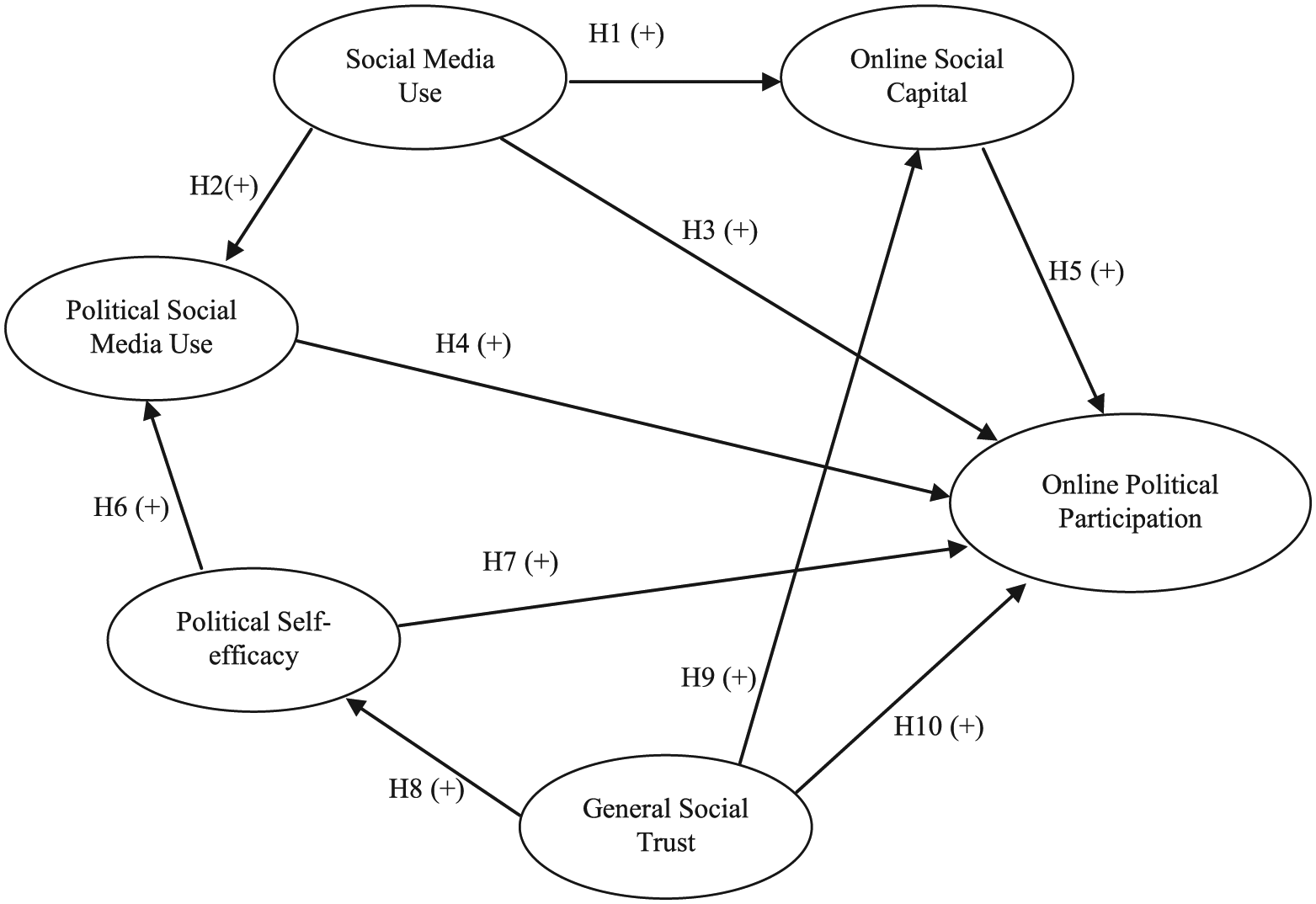
The proposed model of social media use and online political participation.
Method
A web survey on http://www.surveymonkey.com was administered immediately after Election Day 2012 to collect data from undergraduate and graduate students at 12 four-year public universities in a Southeastern “Swing” state of the United States. Online survey is an appropriate research method frequently adopted by political scientists and communication scholars (e.g., Gil de Zúñiga et al., 2012; Valenzuela et al., 2009). A college student sample is appropriate as well-educated young adults are more likely to use the Internet and social media (Duggan & Brenner, 2013; Zickuhr & Madden, 2012). Young voters and college students are decisive voters in 2008 and 2012 Presidential elections. The Pew Research Center (2012) reported that 60% of young voters under age 30 supported Barack Obama in 2012, comparable to 2008 when 66% of them voted for Obama. In addition, students were the primary sample (44.7%) in 219 social media studies in advertising, communication, marketing, and public relations from 1997 to 2010 published in top journals in these fields (Khang, Ki, & Ye, 2012).
A total of 11 universities each provided 2,000 randomly selected email addresses of their currently enrolled students, and one college provided a complete email list of its 860 students. An email notice was first sent to 22,860 randomly selected college students to ask for their participation, followed by two email reminders at a 3-day interval.
An incentive that one respondent would receive a US$100 Amazon online gift certificate in a random drawing was offered to boost the response rate. As previous research indicates, cash and non-cash incentives can significantly increase the response rates of both mail surveys and Web-based surveys (Cobanoglu & Cobanoglu, 2003; Dillman, 2007). After three email requests, 4,607 responses were collected in 9 days, resulting in a response rate of 20.2%. The response rate is comparable to many web surveys with email contacts among college students (e.g., Kaplowitz, Hadlock, & Levine, 2004; Sax, Gilmartin, & Bryant, 2003) and 12% higher than that of Valenzuela et al. (2009). Eventually, 4,556 completed questionnaires with no missing data were retained for further statistical analyses including t-test, partial correlation analysis, multiple regression analyses, and structural equation modeling (SEM) with SPSS-19 and Amos-19.
The survey questionnaire consists of 54 questions. Most measures are adapted or adopted from previous studies in various areas of social sciences. Time spent on Facebook on a typical day and the number of Facebook friends were collected to measure Facebook use (Ellison et al., 2007). Similarly, daily time spent on Twitter was adopted to assess their Twitter use (Yang, 2012). A single item of political discussion on Facebook was used to stand for their political use of Facebook. Two items were developed to tap their political use of Twitter—following political characters and tweeting/retweeting about politics. These measures of political use of social media were created based on previous studies (e.g., Bode, 2012; Rainie et al., 2012). The position generator of online social capital was borrowed from Lin et al. (2001) so that participants could indicate how many of their Facebook friends belong to different occupations. A cumulate prestige score was calculated to represent the online social capital of each respondent. Facebook friends were a very good indicator of one’s online social capital as the primary function of Facebook is to maintain and increase users’ online and offline social networks (Ellison et al., 2007; Joinson, 2008). The questionnaire also included a six-item scale of general social trust with statements such as “Generally speaking, I would say that people can be trusted” and “You can’t be too careful in dealing with people” (reversely coded) (Valenzuela et al., 2009). We also adopted Niemi et al.’s (1991) scale of political self-efficacy composed of seven items such as “I consider myself well-qualified to participate in politics” and “People like me don’t have any say about what the government does” (reversely coded). Online political participation was measured by a six-item scale adapted from Gil de Zúñiga et al. (2012), Shah et al. (2005), and Zukin et al. (2006). It examined the online political activities of writing to a politician online, making a campaign contribution online, subscribing to a political listserv, signing up to volunteer for a campaign/issue online, sending a political message via email, and writing a letter to the editor of a newspaper online. We also asked their Facebook group membership and participation (Valenzuela et al., 2009), and five demographic questions about their gender, age, race, family income (socioeconomic status), and personal income. They were considered control variables for multiple regression analyses and not included in the SEM. All important scales are presented in Appendix.
Confirmatory factor analysis was conducted to fit the measurement models of five multi-item scales to the survey data. Table 1 displays their fit indices. Two chi-square values are statistically significant, but the chi-square or likelihood ratio test is very sensitive to sample size (i.e., large samples) by assuming that the model fits perfectly in the population (Byrne, 2010). Therefore, other fit indices were developed and recommended to assess the fit of measurement and structural models: the normed chi-square (the model chi-square divided by the degree of freedom) should be in the range of 1-5, the Root Mean Square Error of Approximation (RMSEA) ⩽ .06, Tucker–Lewis Index (TLI) ⩾ .95, and Comparative Fit Index (CFI) ⩾ 0.95 (Byrne, 2010; Hu & Bentler, 1999; Schumacker & Lomax, 2010). As five measurement models have outperformed these conventional standards, they are considered satisfactory. To cross-validate these findings, Table 2 presents the Cronbach coefficients (α) of five multi-item scales (measuring political use of Twitter, general social trust, political self-efficacy, and online political participation), and the results of exploratory factor analyses (maximum likelihood estimation with varimax rotation). A liberal minimum requirement for scale reliability is .60 (Churchill, 1979; Peter, 1979), but some scholars recommended a stricter minimum requirement of .70 (e.g., Nunnally & Bernstein, 1994). So, the performance of four scales is deemed satisfactory, and the reliability of one scale is acceptable. In addition, the extracted variance of three concepts exceeded the .50 recommended level (Fornell & Larcker, 1981). Overall, the internal consistency of five scales is good.
Fit Indices for Confirmatory Analysis of Five Key Concepts.

RMSEA: root mean square error of approximation; TLI: Tucker–Lewis index; NNFI: non-normed fit index; CFI: comparative fit index.
p < .10; *p < .05; ** p < .01.
Construct Reliability and EFA Results.

N = 4,556. Exploratory factor analysis (EFA) with maximum likelihood estimation and varimax rotation.
Results
The descriptive statistics of 4,556 respondents are reported in Table 3. The majority of the sample is male (69.1%), White (66.3%), and young (89.7% under 36) (Mean = 24.8 and median = 21). Their family annual income distribution skews toward lower income brackets with 61.9% of their families making less than US$60,000, but 21.7% of them earn over US$90,000 annually. Similarly, the majority of their monthly personal income falls below US$800 (61.9%). There are more light and medium users of Facebook than heavy users and non-users among our participants: 27.1% of respondents (1,235) reported to use Facebook for 1 to 30 min on a typical day, 43.4% of them (1,977) spent 31 min to 2 hr on Facebook daily, 17.7% (805) used Facebook for more than 2 hr daily, but only 11.8% (539) did not use Facebook daily. Female, younger respondents with higher personal income are more likely to use Facebook than others. However, the majority of our participants (61.3%) did not use Twitter daily. A total of 15.6% of them (711) reported to use Twitter for 1 to 30 min on a typical day, 15.1% (687) spent 31 min to 2 hr on Twitter daily, and only 8% (365) claimed to use Twitter for more than 2 hr daily. Female, non-White, younger college students with higher family income and lower personal income are more likely to spend more time using Twitter than others.
Descriptive Statistics (N = 4,556).

SD: standard deviation; SES: socioeconomic status.
Table 4 shows the means, standard deviations, and independent samples t-test results by gender of key concepts. There was no significant difference in the Facebook group participation, political use of Twitter, general social trust, online social capital, and online political participation of our participants across gender. However, male respondents were more likely to discuss a political topic on Facebook than females, with higher political self-efficacy. Therefore, it is not necessary to conduct multi-group SEM tests.
Means, Standard Deviations, and t-Test Results of Key Concepts.

SD: standard deviation.
Total N = 4,556. Female N = 1,409. Male N = 3,147. Independent samples t-test by gender (equal variances not assumed).
p < .05; **p < .01; two-tailed.
Partial correlation analysis was also conducted to demonstrate the correlations of key variables with five demographic variables controlled, and the results are shown in Table 5.
Partial Correlation Matrix of Key Variables With Five Demographic Variables Controlled.

N = 4,556.
p < .05; **p < .01; ***p < .001.
A hierarchical multiple regression modeling was also used to determine what demographic, psychological, and behavioral factors predict US college students’ online political participation in the 2012 election year. The results are shown in Table 6. Demographic variables should not be considered latent constructs and their measurement contains minimum errors. We deemed hierarchical multiple regression modeling a sufficient statistical method to detect the influence of demographic variables and the predictive power of key variables over and above demographic variables. Therefore, they were not included in the SEM tests. Facebook group membership and group participation were also treated as control variables as it is not reasonable to include them in the Twitter model.
Results of Hierarchical Regression Analyses for Variables Predicting Online Political Participation (N = 4,556).

SE: standard error.
N = 4,556. Gender was dummy coded as 1 = male and 2 = female. Race was dummy coded as 1 = Whites and 2 = non-Whites.
p < .05; **p < .01; ***p < .001.
The maximum likelihood method of SEM was employed to fit the research model of Figure 1 to the survey data and test the hypotheses. The fit indices of two proposed models and two revised models are shown in Table 7. Figures 2 and 3 display the standardized path estimates of all variables in two models. Four significant chi-square statistics and normed chi-square values can probably be attributed to the big sample size (Byrne, 2010). Thus, other fit indices were evaluated based on the following criteria: RMSEA ⩽ .06, TLI ⩾ .95, and CFI ⩾ 0.95 (Byrne, 2010; Hu & Bentler, 1999; Schumacker & Lomax, 2010). All four models had achieved satisfactory fit as their RMSEAs were smaller than the recommended cutoff value of .06, their CFIs exceeded the conventional standard of .95, and their TLIs surpassed .95. Therefore, the two proposed models were retained for hypothesis testing but two revised models were recommended for future research, with the path from trust to online political participation removed.
Fit Indices for Two Proposed and Two Re-Specified Models.
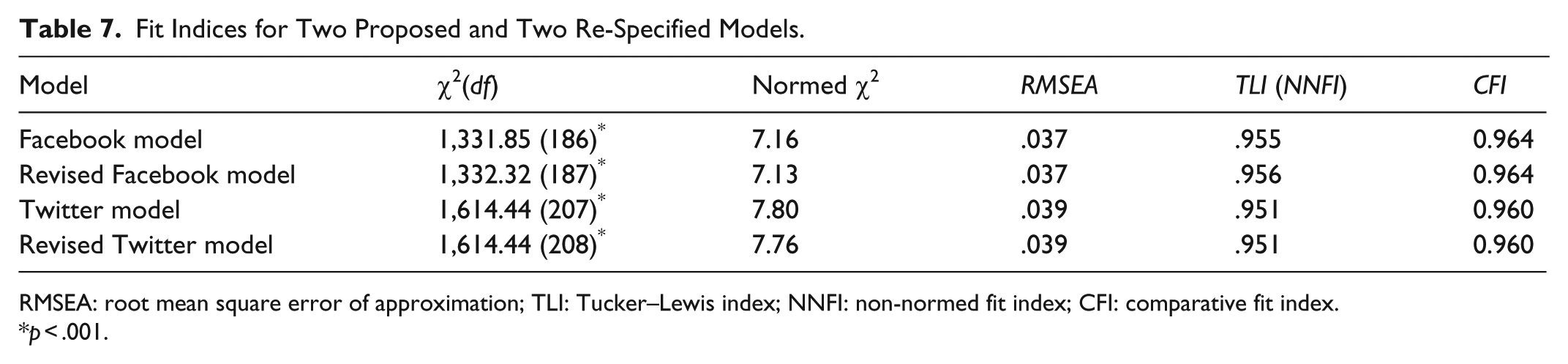
RMSEA: root mean square error of approximation; TLI: Tucker–Lewis index; NNFI: non-normed fit index; CFI: comparative fit index.
p < .001.
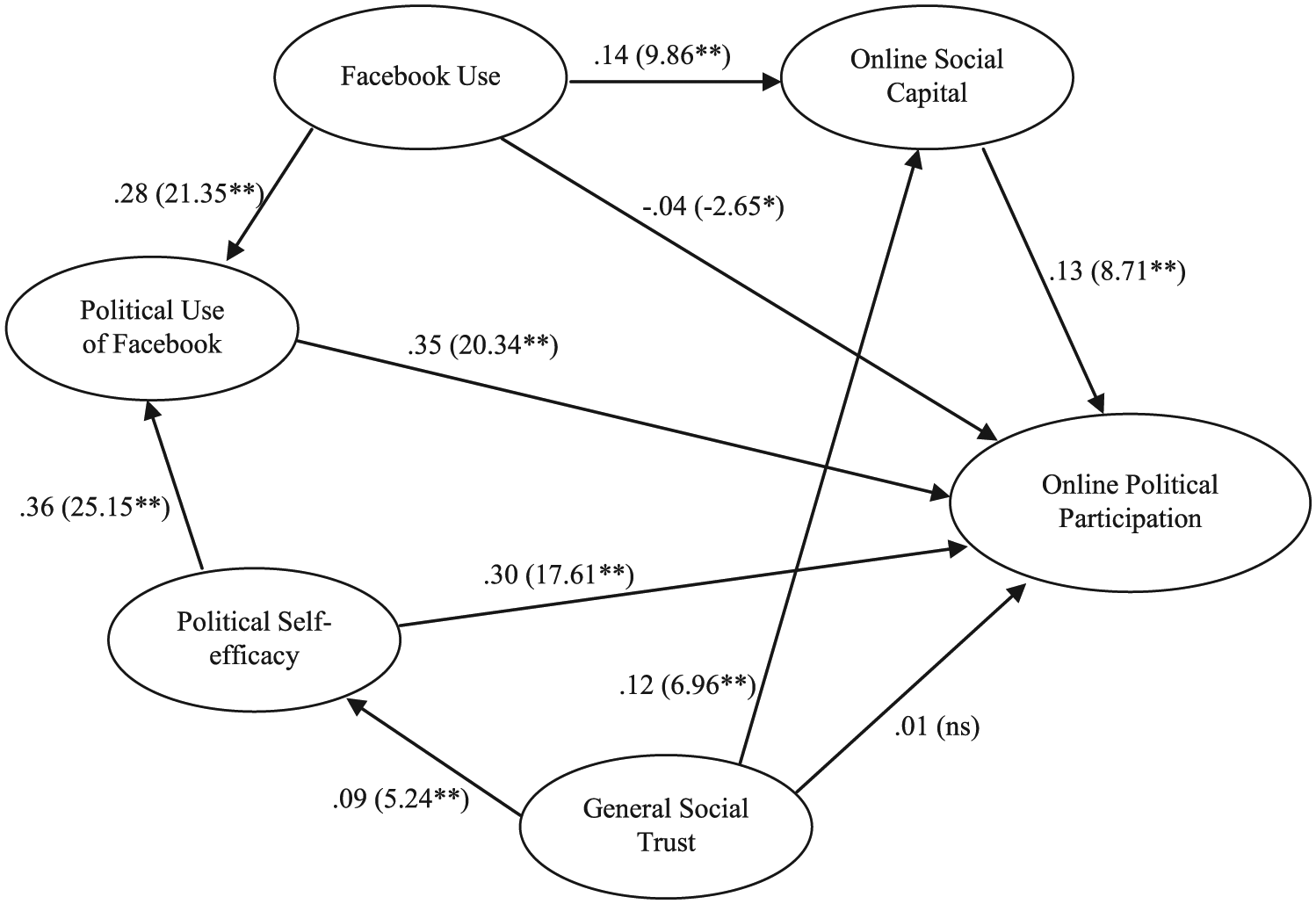
The Facebook model with standardized path coefficients.

The Twitter model with standardized path coefficients.
The mixed SEM results supported H1a but rejected H1b. The Facebook use of US college students positively contributes to their online social capital in Figure 2, but their use of Twitter failed to predict their online social capital in Figure 3.
Students’ time spent on Facebook and Twitter led to the frequent use of Facebook and Twitter for political purposes as demonstrated by two strong positive path estimates in Figures 2 and 3. Hence, H2 was supported. Unexpectedly, H3 was rejected by the multiple regression and SEM results. The amount of time spent on both Facebook and Twitter by US college students negatively predicted their online political participation.
The political uses of Facebook and Twitter by US college students emerged as two very significant predictors of their online political participation in the third regression model and four path models. H4 was substantiated. Similarly, H5 received strong empirical support in the multiple regression and SEM results. The online social capital of US college students definitely predicted their online political participation.
As expected, the political self-efficacy of US college students strongly motivated them to use social media for political purposes, illustrated by Figures 2 and 3. Thus, H6 was firmly supported. H7 was evidently supported because the political self-efficacy of US college students positively predicted their online political participation in Table 6, Figures 2 and 3.
As shown by two significant, positive path estimates from general social trust to political self-efficacy in Figures 2 and 3, the general social trust of US college students contributed to their political self-efficacy. Therefore, H8 was supported. Similarly, H9 was supported because the path estimates were positive and statistically significant, connecting their trust to online social capital. However, H10 was rejected as students’ general social trust failed to predict their online political participation in the multiple regression and SEM results.
Finally, the multiple regression results also showed that the online political participation of US college students varied by gender, age, and race, but their annual family income and monthly personal income did not predict their online political participation. Specifically, older, non-White, and female college students were more likely to get politically involved online than younger, White, and male counterparts. In addition, Facebook group membership and participation were found to be two positive predictors of the online political participation of our respondents.
Discussions and Implications
Built upon previous studies on social media, social capital, and political participation, this study constructed and successfully tested a model of social media use and online political participation immediately after the 2012 presidential election with a large random sample of US college students in a “swing” state. As a big majority of the participants are 18-36 (89.7%), our findings might be generalized to well-educated millennials in the United States. We found that the political use of social media is a very strong predictor of the online political participation of US college students but not the time spent on social media. Students’ political self-efficacy and online social capital were also identified as two very important factors influencing their online political participation. Their social media use led to frequent use of social media for political purposes, while contributing to their online social capital. Students’ general social trust was positively correlated to political self-efficacy and online social capital. Interestingly, their use of social media (Facebook and Twitter) negatively predicted their online political participation. These findings carry important implications for social/political scientists, communication scholars, political strategists, campaign organizers, and politicians.
As the current research shows that the political use of social media is a very important predictor of the online political participation of US college students, the frequency of using social media for political purposes deserves more attention from academia and political practitioners than the total amount of time spent on social media. This study validated the positive relationship between the political use of social media and online political participation shown in previous studies (e.g., Bode, 2012; Gil de Zúñiga et al., 2014; Valenzuela et al., 2012). It is very likely that those social media discussants are more interested in politics and have more political know-how than non-discussants. They might also be more involved and motivated participants of politics in real life. In light of this finding, we recommend that political figures, campaign organizers, and online fund raisers reach out to social media users who have discussed politics on Facebook, followed a political figure on Twitter, or tweeted/retweeted about any political issue. Appealing to online political talkers through social media is more likely to convert these political talkers into online political mobilizers, volunteers, activists, and donors. Encouraging their political discussions in social media can help create a cascade effect so that more and more young Internet users will feel free to discuss political or social issues in social media. In addition, political marketing campaigns might be more effective and efficient if they are designed to target social media users who have used social media as a platform to discuss any political or social issue.
Our results also indicate that many of our respondents did not often discuss any political topic on Facebook (Mean = 1.88 on a scale of 1-5) and the majority of them did not follow any political figure on Twitter, nor tweet and retweet about any political topic (Mean = 2.99 on a scale of 2-13). The finding is consistent with those of recent Pew surveys (Rainie et al., 2012; Smith, 2011a, 2011b) and previous studies (e.g., Kahne & Middaugh, 2012). It suggests that social media have not yet become a widely accepted platform for political discussion, and it is not yet a social norm to discuss politics on Facebook or Twitter. US college students’ lack of interest in political policies as shown through social media is still a legitimate concern. Political communicators, politicians, and social activists need to improve their communication strategies to tap the huge potential of social media for social–political purposes. They should figure out how to better engage more young well-educated citizens in social–political discussions or activities on Facebook and Twitter. For example, they may want to encourage young social media users to discuss political and social issues they care about, such as creating jobs and lowering unemployment rate, reducing the federal deficit, and building a world-class education system (Harvard University Institute of Politics, 2013). The use of humor appeals or even sexy appeals can be considered to promote a political issue, taking lessons from successful online viral ads (Golan & Zaidner, 2008). The fun contests or challenges can also be employed to engage online political participation, such as the famous Ice Bucket Challenge.
On the other hand, we found that the overuse of Facebook and Twitter might be a barrier to the online political participation of US college students. It is possible that some heavy users of Facebook and Twitter are so deeply absorbed by building social relationships within their small inner circles that they cannot find time and energy for communities and politics. Perhaps this is a link to the theory of media displacement in political science and communication studies. For example, Putnam (1995) suspected that TV was to blame partly for the strange disappearance of social capital, citing Williams’ (1986) study. Actually, many scholars could not find any positive influence of social media use on political participation (e.g., Ancu & Cozma, 2009; Baumgartner & Morris, 2010; Dimitrova & Bystrom, 2013; Gil de Zúñiga et al., 2012; Gustafsson, 2012; Kushin & Yamamoto, 2010; Zhang, Johnson, Seltzer, & Bichard, 2010) although some studies have identified the general social media use as the positive predictor of online political participation (e.g., Kim & Chen, 2012; Valenzuela et al., 2009). The present study showed that the total amount of time spent on Facebook and Twitter negatively predicted US college students’ online political participation. The finding replicated at least two previous studies (e.g., Bode, 2012; Vitak et al., 2011). It serves as another wake-up call to those scholars and politicians who are enthusiastically advocating the positive role of social media in political processes and participatory democracy. We should be aware of the possibility that heavy users of social media are spending a lot of time and energy on socializing, when that time and energy could be channeled to civic and political participations. The negative relation between the use of Facebook/Twitter and online political participation suggests that the efforts of political communicators, campaign organizers, and fund raisers will be more rewarding by focusing on light and medium users of Facebook and Twitter. Heavy users of social media might be too consumed by online social activities to participate in offline social–political activities.
Our study has also revealed that Facebook use contributes to US college students’ online social capital which, in turn, leads to more active online political participation, while establishing the position generator as a valid measure of online social capital. This study has provided additional empirical evidence that the use of social networking websites can increase one’s online social capital, which is consistent with previous studies (Ellison et al., 2007; Kim & Geidner, 2008; Steinfield et al., 2008; Utz, 2009; Valenzuela et al., 2009). Moreover, our research provides new insights into the relationship of online social capital and online political participation, as the online social capital was measured in this study differently from previous studies that broke social capital into bridging and bonding social capital. Although the position generator has not been widely adopted by communication scholars, this study has validated this simple measure of online social capital. It turns out that our findings on the relationships of online social capital, online political participation, and general social trust are consistent with previous studies that measured bridging and bonding social capital (e.g., Gibson & McAllister, 2013; Skoric et al., 2009). Our study suggests that the different occupations of one’s Facebook friends are as important and beneficial as the frequency and intensity of online communications with Facebook friends in terms of accumulating online social capital. Social networks of US college students on Facebook will become a useful resource for their career choice and job search (Lin & Erickson, 2008).
The online social capital of US college students emerged as an important predictor of their online political participation, and their general social trust was positively related to online social capital in our study. The first finding suggests that social media users with relatively wide online social networks are more likely to get involved seriously in politics, whereas US college students will benefit politically from their online association with people from different occupations. If US college students befriend working professionals such as doctors, lawyers, teachers, business owners, and politicians on Facebook, they tend to participate in online political activities, and vice versa. There are some important implications for political practitioners and community organizers. It is commendable for online civic and political groups to invite young people to join them as Facebook group participation was also identified as a significant driver of online political participation in this study. Parents, educators, and activists could also advise US college students to consider joining various civic and political groups on Facebook, because these online activities might transform them into engaged citizens in a participatory democracy. Political figures and social activists should encourage their online Facebook friends to refer more Facebook friends. In addition, both civic and political campaign organizers could recruit more online participants by communicating the message that a wide online social network—online social capital—can help US college students find a good internship or even a permanent job. Finally, it is advisable for political communicators and community organizers to target their online campaign efforts to those active social media users who befriend people from all walks of life. They are more likely to become effective viral agents of online social–political campaign messages, thanks to their extended social networks.
It is not surprising that we found that US college students’ political self-efficacy strongly encouraged them to talk about politics on Facebook and Twitter, as well as motivating them to get involved in politics online. Recent studies have tried to connect political self-efficacy with politically motivated social media uses (e.g., Kim & Geidner, 2008). Other researchers also identified political self-efficacy as an important predictor of online political participation (e.g., Gil de Zúñiga et al., 2012). The present study adds more empirical evidence to the current literature in these aspects. Nevertheless, this study calls attention to the moderate level of political self-efficacy among US college students (Mean = 30.09 on a scale of 7-49), and the fact that female college students exhibited a significantly lower level of political self-efficacy than males. As educators, we are concerned to find that the majority of US college students do not consider themselves well-qualified to participate in political activities, as they feel ill-informed about important political issues facing this country. Educators and parents have to try harder informing and educating college students about serious social and political issues. They should also strongly encourage students’ participation in the governance of their universities to cultivate their political self-efficacy. Campaign organizers and social activists would likely have mobilized more male and female college students to take political actions online if they had found a way to equip these young citizens with a good understanding of important political issues. Political and social causes should be promoted in a more engaging but enlightening manner by using both rational and emotional appeals. Moreover, it is imperative for political campaign organizers and social activists to instill US college students with a sense of empowerment and greater faith in social change if they are to recruit more online social–political activists among college students.
Although the general social trust of US college students was found to predict their political self-efficacy and online social capital positively, trust did not directly influence their online political participation. We expected that general social trust would contribute to online social capital as social trust is considered an integral component of social capital (Putnam, 2000). Halpern (2005) argues that social capital can be successfully tapped by a very simple measure of social trust. The direct effect of general social trust on the online political participation of US college students was zero, but it might be fully mediated by their political self-efficacy and online social capital that enhanced online political participation. Therefore, we should not dismiss the importance of general social trust in our civic and political life. We have some concerns that US college students in this large sample expressed a moderate level of general social trust (Mean = 24.25 on a scale of 6-42). Building up the general social trust of US college students can strengthen their political self-efficacy and enrich their online social capital, which enhances their online political involvement indirectly.
Based on additional findings of this study, political campaign organizers and social activists may want to tailor their social–political messages online for older, non-White, and female college students, as these demographics are more likely to become politically involved online than are their younger, White, and male counterparts. Contrary to conventional wisdom, social media can be utilized to reach older Internet users and voters in the United States. Moreover, funding online multicultural initiatives might be a good way to engage minority voters, such as getting the help from celebrities with African American, Hispanic, and Asian American heritage. In addition, it is advisable for campaign organizers and social activists to advocate those social and political issues that women really care about in social media. Finally, they should consider establishing cohesive Facebook groups for their specific campaigns to build big online communities, as we found that the joiners and active online group members tend to participate in more online political activities.
Limitations and Future Research
Although the survey data were collected from a large random sample of college students at 12 public universities in the southeastern United States, the external validity of the current study can be strengthened by future research to generalize findings to all US college students. Future studies should also include more females, as the majority of participants (69.1%) were male in this study. The findings might be biased by the nature of our sample as lesser educated and/or techno-savvy US adults might participate in fewer online political activities and exhibit different behaviors of social media uses than college students.
Future studies should also examine the influence of other social, psychological, and behavioral factors on the online political participation of US college students, such as political interest, political affiliation, normative pressures, online news consumption, blogging, political video consumption and sharing. Additionally, survey research cannot help us determine causality and the relationships of key variables are likely bidirectional in this project. Future studies should employ longitudinal panel designs or field experiments to establish causality. A cross-cultural investigation may also provide valuable insights. Finally, political use of social media should be fully operationalized in future research to include other kinds of political engagements on Facebook and Twitter such as liking, commenting, and sharing political videos.
As social media change and evolve, political and civic organizers will face challenges as to how to target a population that uses social media for varying purposes. More studies in the area of online political participation through social media will enhance our understanding of how to keep citizens engaged in civic and political processes.
Footnotes
Appendix
Key measures on social media use and online political participation.

| Facebook usage a | On a typical day, about how much time do you spend on Facebook? |
| (1) 0. (2) 1-30 min. (3) 30 min-1 hr. (4) 1-1.5 hr. (5) 1.5-2 hr. (6) 2-2.5 hr. (7) 2.5-3 hr. (8) 3-3.5 hr. (9) 3.5-4 hr. (10) 4-4.5 hr. (11) 4.5-5 hr. (12) More than 5 hr. | |
| Facebook friends b | About how many total Facebook friends do you have? |
| (1) 0. (2) 1-50 friends. (3) 51-100 friends. (4) 101-150 friends. (5) 151-200 friends. (6) 251-300 friends. (7) 351-400 friends. (8) 451-500 friends. (9) More than 500 friends. | |
| Facebook group membership c | How many online groups have you joined on Facebook? |
| (1) 0. (2) 1-3 groups. (3) 4-6 groups. (4) 7-9 groups. (5) 10-12 groups. (6) 13-15 groups. (7) 16-18 groups. (8) More than 19 groups. | |
| Facebook group participation d | 1. On a typical day, about how much time do you spend reading and posting messages on the profiles of online groups you have joined on Facebook? |
| (1) 0. (2) 1-30 min. (3) 31 min to 1 hr. (4) 1 hr to 1 and 1/2 hr. (5) 1 and 1/2 hr to 2 hr. (6) 2 hr to 2 and 1/2 hr. (7) 2 and 1/2 hr to 3 hr. (8) More than 3 hr. | |
| 2. In the past week, how often have you read the profiles of online groups you have joined on Facebook? | |
| (1) Never. (2) Rarely. (3) Sometimes. (4) Usually. (5) Always. | |
| 3. In the past week, how often have you posted messages in online groups you have joined on Facebook? | |
| (1) Never. (2) Rarely. (3) Sometimes. (4) Usually. (5) Always. | |
| Twitter usage e | How much time do you spend on Twitter on a typical day? |
| (1) 0. (2) 1-30 min. (3) 31 min to 1 hr. (4) 1 hr to 1 and 1/2 hr. (5) 1 and 1/2 hr to 2 hr. (6) 2 hr to 2 and 1/2 hr. (7) 2 and 1/2 hr to 3 hr. (8) More than 3 hr. | |
| Political use of Facebook f | How often do you discuss any political topic on Facebook? |
| (1) Never. (2) Rarely. (3) Sometimes. (4) Usually. (5) Always. | |
| Political use of Twitter g | 1. How many political characters do you follow on Twitter? Such as senators, congressmen, news commentators, journalists, and activists etc. |
| (1) 0. (2) 1-5. (3) 6-10. (4) 11-15. (5) 15-20. (6) 21-25. (7) 26-30. (8) More than 30. | |
| 2. How often do you tweet and retweet about any political topic? | |
| (1) Never. (2) Rarely. (3) Sometimes. (4) Usually. (5) Always. | |
| Online social capital h | Among your Facebook friends, are there any in the following kinds of work? |
| (1) Physician. (2) Lawyer. (3) Owner of large firm. (4) Congressman/woman. (5) Manager of large firm. (6) High school teacher. (7) Division head. (8) Reporter. (9) Nurse. (10) Owner of small firm. (11) Policeman/woman. (12) Electrician/plumber. (13) Truck driver. (14) Office worker/guard. (15) Housemaid or cleaning worker. | |
| General social trust i | 1. Generally speaking, I would say that people can be trusted. |
| 2. People try to take advantage of you if they got the chance. (Reversely coded) | |
| 3. People try to be fair. | |
| 4. You can’t be too careful in dealing with people. (Reversely coded) | |
| 5. People try to be helpful. | |
| 6. People are just looking out for themselves. (Reversely coded) | |
| Political self-efficacy j | 1. I consider myself well-qualified to participate in politics. (Internal) |
| 2. I feel that I have a pretty good understanding of the important political issues facing our country. (Internal) | |
| 3. I feel that I could do as good a job in public office as most other people. (Internal) | |
| 4. I think that I am better informed about politics and government than most people. (Internal) | |
| 5. Sometimes, politics and government seem so complicated that a person like me can’t really understand what’s going on. (Internal) | |
| 6. People like me don’t have any say about what the government does. (External) (Reversely coded) | |
| 7. I don’t think public officials care about what people like me think. (External) (Reversely coded) | |
| Online political participation k | In 2012, how often have you participated in the following activities on the Internet? |
| 1. Writing to a politician online. | |
| 2. Making a campaign contribution online. | |
| 3. Subscribing to a political listserv. | |
| 4. Signing up to volunteer for a campaign/issue online. | |
| 5. Sending a political message via email. | |
| 6. Writing a letter to the editor of a newspaper online. | |
| (1) Never. (2) Rarely. (3) Sometimes. (4) Often. (5) Very often. (6) Always. |
Note. All response options ranged from 1, “strongly disagree” to 7, “strongly agree” if not provided.
Adapted from Ellison, Steinfield, and Lampe (2007).
Adapted from Valenzuela, Park, and Kee (2009).
Adapted from Yang (2012).
Developed by the authors based the relevant literature.
Adapted from Lin, Fu, and Hsung (2001).
Adapted from Valenzuela et al. (2009).
Adopted from Niemi, Craig, and Mattei (1991).
Declaration of Conflicting Interest
The author(s) declared no potential conflicts of interest with respect to the research, authorship, and/or publication of this article.
Funding
The author(s) received no financial support for the research, authorship, and/or publication of this article.