




Abstract
Amid growing concerns about employee misconduct within private WhatsApp groups, this study captures the dual nature of work-related group chats on external instant messaging platforms. We distinguish between employees’ prosocial (e.g., information sharing) and antisocial (e.g., bullying) work-related instant messaging use. In addition, we examine the positive (i.e., resources) and negative (i.e., demands) consequences of this use for employee well-being, operationalized as work engagement and exhaustion. Data were collected from 383 Belgian and 375 U.S. employees via an online survey and analyzed using structural equation modeling. Results show that antisocial work-related instant messaging is relatively rare. Yet, it is associated with reduced communication efficiency, increased co-worker conflicts and work-life tensions, which in turn relate to lower work engagement and higher exhaustion. Prosocial work-related instant messaging use is generally linked to better co-worker communication and relationships, which enhance work engagement and reduce exhaustion. However, these findings proved to be partially culture-bound.
Keywords
Introduction
Media coverage of misbehavior within private employee group chats highlights a relatively new challenge for today’s employers. In the United States, for instance, a group of sheriff’s deputies used a WhatsApp group to exchange pictures of corpses and discriminating “jokes” about criminal suspects (Rosenfield et al., 2024). In Europe, a group of Belgian teachers exchanged discriminatory statements about students and fellow teachers in a group chat on that same instant messaging platform (Belga, 2023). Instant messaging (IM) platforms are internet applications that allow for the exchange of messages, images, videos or sound content between two or more users, either computer or mobile phone-based (Bahri et al., 2020). Especially since the COVID-19 pandemic and the subsequent rise of remote work, organizations increasingly depend on IM apps for internal communication purposes like disseminating information or facilitating collaboration (Bahri et al., 2020; Paerata, 2023). Research has primarily focused on employees’ use of internal or enterprise IM platforms, like Microsoft Teams or Slack (Bodhi, 2025). Far less scholarly attention has been paid, however, to employees’ work-related use of external IM apps like WhatsApp and Facebook Messenger.
There are a number of notable differences between internal and external IM platforms. Unlike their internal counterparts, external IM platforms were originally designed as social communication tools for connecting with family and friends, rather than as organizational tools meant to support business processes (Ahmad et al., 2023; Bahri et al., 2020). However, particularly in the last decade, platforms like WhatsApp have shown to be widely adopted for work-related communication. They are popular among employees for creating virtual groups in which they can efficiently exchange work information, ideas and updates (Huang & Zhang, 2019; Jabbar et al., 2021; Koçak & Yüksek Vergiveren, 2019). Interestingly, rather than being introduced top-down like internal IM tools, it is most often the employees themselves who spontaneously decide to create a group chat on an external IM platform like WhatsApp (Hirvonen et al., 2022). As such, this self-initiated and voluntary communication behavior typically occurs “backstage,” remaining invisible to management and thus escaping explicit organizational guidance (Hirvonen et al., 2022; Mak, 2019; van Zoonen & Rice, 2017).
Employees’ work-related use of external IM applications represents a double-edged sword. On the one hand, these platforms provide employees with a simple and efficient means of communication (Huang & Zhang, 2019). On the other hand, they bring about certain risks for both employees and organizations. A risk that has already received considerable attention in prior research is the impact on employees’ work-life balance (e.g., Boswell et al., 2016; Cheng et al., 2021; Hirvonen et al., 2022). Group chats make employees accessible for colleagues anytime and anywhere, blurring the boundaries between their professional and personal lives (Cheng et al., 2021; Hirvonen et al., 2022). A risk that has received much less scholarly attention is the impact on workplace culture. Private group chats create a virtual environment in which employees are less likely to display the formality and professionality traditionally associated with workplace talk (Mak, 2019). As reflected in news media reports (e.g., Belga, 2023; Rosenfield et al., 2024), they can therefore become a breeding ground for employees to discriminate, bully and gossip about one another.
The question thus arises as to whether organizations should be happy that external IM apps facilitate efficient communication among their workforces, or worried that they create a dysfunctional work environment characterized by a poor work-life balance and co-worker conflicts. Through a cross-cultural survey among 758 employees, this study addresses this important question and provides a comprehensive picture of how work-related group chats can have both positive and negative effects on employee well-being. Our theoretical contribution is threefold. First, this study integrates and expands upon the Job Demands-Resources (JD-R) Model (Demerouti et al., 2001). Specifically, we apply the framework to the context of work-related instant messaging and examine how both positive (i.e., resources) and negative consequences (i.e., demands) associated with work-related IM are related to employee well-being (i.e., work engagement and exhaustion). Secondly, this is—to the best of our knowledge—the first study to distinguish between prosocial (e.g., coordinating work tasks) and antisocial organizational behavior (e.g., gossiping about colleagues) in employees’ work-related group chats. Thirdly, while most studies focus on samples from one country, we tested our conceptual model among both Belgian and U.S. employees. As such, we aim to improve the generalizability of our findings and uncover possible country-related differences.
Practically, this study raises awareness about the responsibility of organizations to safeguard their employees’ well-being. Today’s workplaces face a continuous influx of younger generations who grew up with mobile technologies and use them very frequently (Cho et al., 2019). Employers are, therefore, more than ever in need of best practices on how to inform and educate their workforces about the opportunities and risks of work-related IM use. Our findings can help organizations develop a governance framework that protects both organizational and employee interests. We also provide valuable insights for policymakers, as governments around the globe are increasingly adopting so-called “right to disconnect laws” to protect employees from after-hours work communication (Von Bergen & Bressler, 2019).
Literature Review
Work-Related Instant Messaging
IM applications allow employees to exchange messages, images, videos or sound content, either through their computers or mobile phones (Bahri et al., 2020). A distinction can be made between internal and external IM apps. Internal or enterprise IM platforms like Microsoft Teams, Slack and Viva Engage (formerly Yammer) are managed at the corporate level and are accessible for organizational members only (Oksa et al., 2021; van Zoonen & Rice, 2017). The current study, however, exclusively focuses on employees’ use of external IM apps like WhatsApp, Facebook Messenger and Telegram 1 (Bahri et al., 2020). These apps are not operated by the employer and are publicly accessible (Cho et al., 2019; Mak, 2019).
The scope of this study is further narrowed down to only include employees’ group-based communication on these external IM platforms. While employees often use IM apps for one-on-one communication with colleagues (Mak, 2019), they are also well-suited for creating virtual groups (Bahri et al., 2020). The current study uses the term “group chat” to refer to a persistent conversation on an external IM platform involving more than two people, typically organized around a shared purpose or topic (Koçak & Yüksek Vergiveren, 2019). These group chats can be created top-down, according to organizational structures like departments or teams (Huang & Zhang, 2019). In most cases, however, they are created “bottom-up” by employees themselves to enhance collegial communication (Hirvonen et al., 2022).
Finally, this study is specifically concerned with work-related communication in employee group chats. We will, in other words, examine how employees use them to talk about work-related matters (e.g., projects, colleagues) but not private matters (e.g., birth announcements, leisure activities; Hirvonen et al., 2022; Oksa et al., 2021). In what follows, we further categorize this work-related IM communication into prosocial and antisocial organizational communication behavior.
Prosocial and Antisocial Work-Related Instant Messaging
Several survey-based studies have examined the consequences of employees’ use of external IM apps, typically revealing a positive influence on their engagement and satisfaction (e.g., Oksa et al., 2021; Sheer & Rice, 2017). These studies, however, often focus solely on the frequency or intensity with which employees use these apps to communicate about work. Yet, based on several interview studies (e.g., Hirvonen et al., 2022; Mak, 2019), we can conclude that not only the frequency, but also the nature of employees’ IM conversations can vary significantly. A limited number of studies have, therefore, already distinguished between employees’ social-related (e.g., arranging social events with co-workers after work hours) and work-related (e.g., sharing information about organizational objectives with colleagues) IM use (e.g., X. Zhang et al., 2019; H. Zhang et al., 2021). Building on this prior work, the current study proposes another distinction within work-related IM use, namely between prosocial and antisocial work-related IM use.
Prosocial organizational behavior is defined as “behavior which is (a) performed by a member of an organization, (b) directed toward an individual, group, or organization with whom he or she interacts while carrying out his or her organizational role, and (c) performed with the intention of promoting the welfare of the individual, group, or organization” (Brief & Motowidlo, 1986, p. 711). Examples are cooperating with co-workers, helping them with job-related matters, facilitating problem-solving, speaking favorably about the organization and protecting it from criticism or unforeseen issues (Bolino & Grant, 2016; Brief & Motowidlo, 1986). Insights from prior interview research suggest that work-related group chats on external IM apps give employees a vehicle to engage in prosocial organizational behavior. First, they use them for intra-organizational information sharing (Ahmad et al., 2023). This includes disseminating company news as well as providing status updates about ongoing work tasks and projects (Huang & Zhang, 2019; Oksa et al., 2023). These can be routine updates but also time-sensitive updates like an urgent client problem or unanticipated shift changes due to illness (Boswell et al., 2016; Hirvonen et al., 2022). Second, employees use work-related group chats to coordinate and collaborate (Huang & Zhang, 2019; Oksa et al., 2023). This includes allocating work, issuing instructions and reminding colleagues to address certain tasks (Ahmad et al., 2023; Bahri et al., 2020). The chats also allow employees to set up meeting times, swap shifts and draw up work schedules (Boswell et al., 2016; Huang & Zhang, 2019). Finally, employees rely on IM apps to provide as well as request help or advice on work matters (Ahmad et al., 2023). While providing help may seem more inherently prosocial, requesting help is also considered a form of prosocial organizational behavior because it facilitates problem-solving at work (Bolino & Grant, 2016). An example is a day-shift nurse asking in the WhatsApp group whether the night-shift nurse can take care of something she forgot to do (Hirvonen et al., 2022).
Opposite to prosocial organizational behavior, antisocial organizational behavior is used to refer to a wide range of negative employee behaviors. It is defined as any behavior that “brings harm, or is intended to bring harm, to an organization, its employees, or stakeholders” (Giacalone & Greenberg, 1997, p. vii). This includes severe behaviors such as harassment, bullying, discrimination, and confidentiality breaches, but also less serious—yet still harmful—behaviors like spreading rumors, gossiping, starting arguments or saying rude things about colleagues (Bennett et al., 2018; Giacalone & Greenberg, 1997). IM platforms can become a breeding ground for such behaviors because they are perceived as private and intimate communication environments (Waterloo et al., 2017). In such settings, employees tend to display less professionality and formality than they would in the physical office, and feel less constrained by the social risks usually associated with antisocial behavior (Mak, 2019; Waterloo et al., 2017). Antisocial organizational behavior in work-related group chats can take different forms. First, these chats create new avenues for discrimination, harassment and cyberbullying, such as the exchange of offensive pictures or messages about colleagues (Oksa et al., 2023; Oksanen et al., 2020; Paerata, 2023). A second antisocial subject matter in an organizational context is gossip, not only about colleagues and superiors but also clients or customers (Koçak & Yüksek Vergiveren, 2019; Mak, 2019). Thirdly, it is not uncommon for misunderstandings or arguments to arise between colleagues in group chats (Boswell et al., 2016; Hirvonen et al., 2022). A final form of antisocial organizational behavior facilitated by group-based IM is sharing sensitive or confidential information. Healthcare workers can, for instance, violate patient privacy when using chat groups to discuss patient-related issues without using pseudonyms (Hirvonen et al., 2022).
Demands and Resources in the Context of Work-Related Instant Messaging
To examine how prosocial and antisocial organizational behaviors in work-related chats affect employees, we turn to the Job Demands-Resources (JD-R) model (Demerouti et al., 2001). This model has already been applied to examine the consequences of employees’ use of various communication technologies, such as e-mail and social media like Facebook (e.g., Ter Hoeven et al., 2016; van Zoonen et al., 2017). The JD-R model is rooted in the idea that in every job, employees are confronted with demands (“bad things”) and resources (“good things”; Bakker & Demerouti, 2007). Job demands are “aspects of the job that require sustained physical or mental effort and are therefore associated with certain physiological and psychological costs” (Demerouti et al., 2001, p. 501). Examples are work overload, work-life conflict and interpersonal conflicts (Schaufeli, 2017). Job resources, by contrast, are “aspects of the job that may do any of the following: (a) be functional in achieving work goals; (b) reduce job demands at the associated physiological and psychological costs; (c) stimulate personal growth and development” (Demerouti et al., 2001, p. 501). Examples are career perspective, communication and team effectiveness (Schaufeli, 2017).
According to the JD-R model, job demands and resources trigger two psychological processes that underlie employee well-being (Schaufeli, 2017). Employee well-being is broadly defined as “the overall quality of an employee’s experience and functioning at work” and comprises psychological, physical, and social dimensions (Grant et al., 2007, p. 52). In the JD-R model, employee well-being is typically operationalized as work engagement and work exhaustion, which represent the positive and negative poles or indicators of well-being at work, respectively (Schaufeli et al., 2002). Work engagement is defined a positive psychological state characterized by high energy and resilience (i.e., vigor), an emotional sense of significance, pride and challenge (i.e., dedication), and a cognitive state of concentration and engrossment in one’s work (i.e., absorption; Schaufeli, 2017; Schaufeli & Bakker, 2010). Work exhaustion, by contrast, refers to employees feeling emotionally drained and depleted of energy (Bakker & Demerouti, 2007; Schaufeli, 2017).
The first psychological process proposed by the JD-R model is called the health impairment process, which predicts that employees facing chronic job demands and a lack of resources will display high work exhaustion and low engagement (Bakker & Demerouti, 2007; Demerouti et al., 2001; Schaufeli, 2017). The second psychological process is referred to as the motivational process, and is sparked when employees dispose of abundant job resources, which fosters work engagement and decreases work exhaustion (Bakker & Demerouti, 2007; Demerouti et al., 2001; Schaufeli, 2017). In what follows, we apply the psychological processes of the JD-R model to the context of group-based work-related IM, resulting in the conceptual model depicted in Figure 1. The model predicts how prosocial and antisocial IM (i.e., antecedents) are related to work engagement and exhaustion (i.e., outcomes) through IM-related resources and demands (i.e., mediators). As an IM-related resource in the hypothesized model, we propose efficient communication. As demands, we propose work-life conflict on the one hand and co-worker conflict on the other.
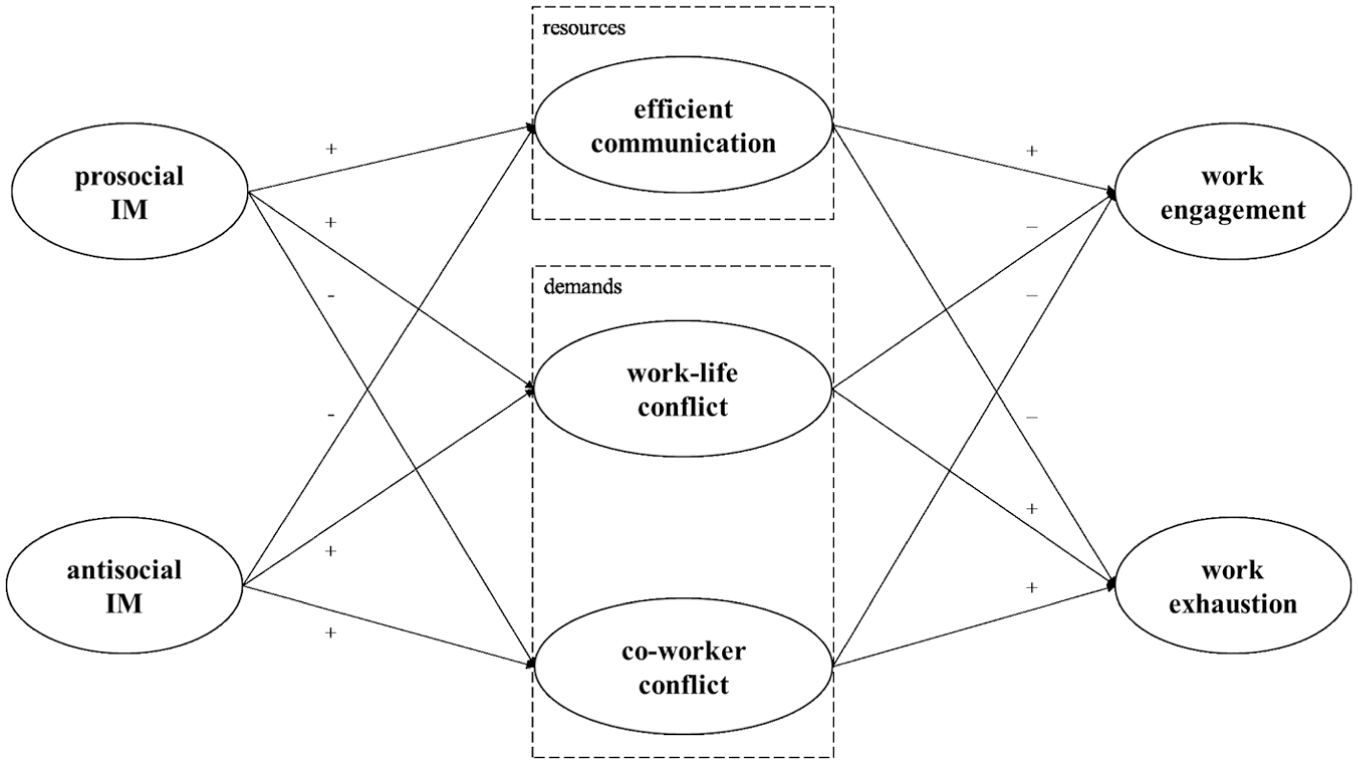
Conceptual model.
Efficient Communication
Prior research has identified efficient communication as a key benefit of employees’ group-based IM use (e.g., Huang & Zhang, 2019; Jabbar et al., 2021). Having an employee group chat benefits the internal flow of communication because it not only eliminates the need to contact every colleague separately (Hirvonen et al., 2022), but also overcomes time and space constraints (Huang & Zhang, 2019). Compared to internal IM applications, external IM platforms are usually installed on employees’ personal devices. As such, colleagues can easily exchange work-related information and updates during regular and non-regular work hours, and regardless of their location (Boswell et al., 2016; Oksa et al., 2023). In round-the-clock facilities like hospitals, for instance, a WhatsApp group is believed to enhance the communication efficiency between day and night-shift employees (Hirvonen et al., 2022).
Efficient communication is considered a resource because it helps employees achieve work goals (Demerouti et al., 2001; Schaufeli, 2017). In line with the JD-R model’s motivational process (Demerouti et al., 2001), efficient communication fostered by employees’ work-related use of technologies like e-mail (Ter Hoeven et al., 2016) and public social media (van Zoonen et al., 2017) has proven to enhance work engagement and reduce exhaustion. We predict the same for employees’ work-related IM use, but only when it is prosocial as compared to antisocial in nature. When employees engage in prosocial IM, they mainly use their group chats for information sharing, coordination or collaboration (e.g., Ahmad et al., 2023; Huang & Zhang, 2019). Such prosocial organizational behavior is associated with functional consequences, such as enhanced communication, improved problem-solving and strengthened overall functioning of work teams (Bolino & Grant, 2016; Brief & Motowidlo, 1986; Feather et al., 2018). By contrast, when employee group chats are antisocial in nature, they are characterized by discrimination, gossip, arguments, and the like (e.g., Hirvonen et al., 2022; Oksa et al., 2023). Such antisocial organizational behaviors can be harmful to an organization’s communication climate. For instance, in organizations where gossip is common, employees may avoid sharing opinions, suggestions, and concerns with colleagues because they feel unsafe to do so (Guo et al., 2021). Likewise, in organizations facing high levels of incivility, employees may withhold knowledge or information from one another because they feel drained from having to deal with rude or disrespectful colleagues (Agarwal et al., 2024). As such, based on the JD-R model (Demerouti et al., 2001), we expect prosocial IM to spark a motivational process by fostering efficient communication, while antisocial IM triggers a health impairment process by hindering communication efficiency:
Work-Life Conflict
When it comes to the demands related to employees’ group-based IM use, several studies have focused on the issue of work-life conflict (e.g., Cheng et al., 2021; Hirvonen et al., 2022). Work-life conflict is “a form of interrole conflict in which the general demands of, time devoted to, and strain created by the job” interfere with the responsibilities related to one’s private life (Netemeyer et al., 1996, p. 401). Employees use external IM apps to communicate with personal (e.g., family, friends) and professional contacts (e.g., colleagues, superiors) at the same time (H. Zhang et al., 2021). This can make it difficult for them to maintain a clear boundary between their private and work lives (Cheng et al., 2021; Huang & Zhang, 2019). This boundary management becomes even more difficult due to the constant accessibility of IM apps via smartphones, allowing employees to stay connected anytime and anywhere (Von Bergen & Bressler, 2019). As such, they can send and receive work-related messages—both prosocial and antisocial in nature—outside work hours, during weekends, vacations and other non-working days (Bahri et al., 2020; Boswell et al., 2016). Overall, being involved in work-related group chats may keep employees mentally occupied with work, preventing them from being fully immersed in family or leisure activities (Yue, 2022).
Because work-life conflict drains employees’ energy and mental resources, it is considered a demand (Schaufeli, 2017). As predicted by the JD-R model (Demerouti et al., 2001), work-life conflict induced by employees’ work-related use of public social media (van Zoonen et al., 2017) and IM platforms (Cheng et al., 2021) has shown to trigger a health impairment process. More specifically, employees who use public social media to share and read work-related information (van Zoonen et al., 2017) or use IM platforms to communicate with supervisors (Cheng et al., 2021) experience more work-life conflict, which in turn increases their work exhaustion and lowers their work engagement. We expect this process to apply to both employees’ prosocial and antisocial work-related IM use:
Co-Worker Conflict
Another demand associated with work-related group chats relates to the tensions or conflicts they can create among co-workers (e.g., Oksa et al., 2023; Oksanen et al., 2020). Co-worker conflicts are “interpersonal incompatibilities among members [of an organization], which typically includes tension, animosity, and annoyance” (Jehn, 1995, p. 258). Employee group chats can become a breeding ground for conflict due to the absence of nonverbal cues. This can lead people to interpret messages more negatively than they were intended (Boswell et al., 2016). In addition, group chats can result in conflict when co-workers have different understandings of what the group should be used for and what level of formality should be maintained (Huang & Zhang, 2019). Particularly given the informal nature of external IM platforms, some employees may start using the group chat for unprofessional rather than coordination purposes, which may not be appreciated by all colleagues (Huang & Zhang, 2019). It is, therefore, not exceptional for employees to leave or opt out of these group chats (Hirvonen et al., 2022). Finally, employees work-related use of IM platforms like WhatsApp has been associated with the creation of in-groups and out-groups, potentially causing colleagues to feel excluded, discriminated or bullied (Oksa et al., 2023; Oksanen et al., 2020).
Co-worker conflict is considered a demand because it requires sustained mental effort from employees (Demerouti et al., 2001; Schaufeli, 2017). It lowers their satisfaction with the group they work in, and triggers negative reactions like anxiety (Jehn, 1995). In line with the health impairment process of the JD-R model, we expect that co-worker conflict caused by work-related IM use will increase work exhaustion and decrease engagement (Bakker & Demerouti, 2007; Demerouti et al., 2001; Schaufeli, 2017). It is evident from the literature, however, that this risk is particularly associated with antisocial organizational behavior in employee group chats, such as bullying and arguing (e.g., Hirvonen et al., 2022; Oksanen et al., 2020). Therefore, we only expect a health impairment process to be triggered in case work-related group chats are antisocial in nature. Antisocial organizational behavior is generally believed to affect the organizational culture in a negative way (Bennett et al., 2018). For instance, both gossiping (Wax et al., 2022) and cyberbullying (Muhonen et al., 2017) at work have been linked to detrimental effects on how employees perceive their relationships with colleagues—even when they are not the direct targets of the offending behavior. By contrast, prosocial organizational behavior in employee group chats, such as coordination or collaboration (e.g., Huang & Zhang, 2019; Oksa et al., 2023), has shown to improve rather than damage co-worker relationships (Hirvonen et al., 2022). We thus predict that antisocial IM leads to health impairment because it triggers co-worker conflict, while prosocial IM sparks a motivational process because it mitigates such conflict:
Cross-Cultural Differences
Scholars have suggested that there are cross-cultural differences in how employees perceive and engage in work-related IM (Cho et al., 2019). As there is a lack of empirical research supporting these claims, we will test our model among both Belgian and U.S. employees. We expect differences in the outcomes of prosocial and antisocial work-related IM between these two countries based on Hofstede’s model of national culture (Hofstede et al., 2010). This model consists of six dimensions representing differences between national cultures: power distance, uncertainty avoidance, individualism, masculinity, long term orientation and indulgence (Hofstede, 2011). We acknowledge that Hofstede’s model has been criticized for assuming national cultural homogeneity and for relying on data from a single organization. Yet, it remains widely recognized, and is considered particularly useful in studies where culture is not the primary focus (Hadwick, 2011; Sent & Kroese, 2022).
According to Hofstede’s work (2024), Belgium and the United States differ most significantly in terms of power distance and uncertainty avoidance. Power distance refers to “the extent to which the less powerful members of organizations [. . .] accept and expect that power is distributed unequally” (Hofstede, 2011, p. 9). Belgium is a large-power-distance country, which means that hierarchy plays an important role in Belgian organizations. Belgians are, therefore, accustomed to a certain formality when communicating with colleagues, especially with those in higher positions. In contrast, the United States is a small-power-distance country, where communication in organizations is more informal and participative (Hofstede, 2024; Hofstede et al., 2010). Given the informal nature of IM platforms like WhatsApp (Mak, 2019), U.S. employees may feel more comfortable than Belgians when using these platforms to communicate with co-workers and superiors.
Uncertainty avoidance refers to the “the extent to which the members of a culture feel threatened by ambiguous or unknown situations” (Hofstede et al., 2010, p. 191). Belgium is one of the highest scoring countries on this dimension, which means that Belgians have a high need for predictability, clarity and structure (Hofstede, 2011; Hofstede et al., 2010; Hofstede, 2024). By contrast, the United States scores below average on uncertainty avoidance, indicating that people from the United States are more comfortable with unexpected events (Hofstede, 2011, 2024). An employee group chat is a highly unpredictable communication environment, as colleagues can unexpectedly send each other messages at any time and from anywhere (Ter Hoeven et al., 2016; Von Bergen & Bressler, 2019). In contrast to people from the United States, Belgians may experience this as more overwhelming and stressful.
Besides these differences in cultural dimensions (Hofstede et al., 2010), Belgium and the United States also show meaningful differences in their legal frameworks regarding electronic work communication outside work hours. Just like in other European countries such as France and Italy, the Belgian government has introduced a so-called right to disconnect law (Von Bergen & Bressler, 2019). This law was passed in 2022 and obliges Belgian middle and large-sized organizations to make arrangements (e.g., guidelines, training) allowing employees to digitally disconnect from work beyond work hours (Federal Public Service Employment, Labor and Social Dialog, 2022). In the United States, the disconnect law has been proposed but not yet enacted (Deletter, 2024). Based on both the cultural and legal differences between Belgium and the United States, we expect the well-being of Belgian and U.S. employees to be affected differently by work-related IM use. Given the lack of prior empirical work on this topic, we do not formulate specific hypotheses.
Methodology
Data Collection and Participants
Two online surveys were conducted to collect a representative sample in terms of age, gender and education from the (Dutch-speaking) Belgian and U.S. working population. In December 2023, an online survey was launched in Belgium through the market research agency Bilendi. Between March and April 2024, a translated version of the survey was launched in the United States through the market research platform Prolific. Participants were prescreened based on their age (18–67 years old), nationality (Belgium/United States), fluent languages (Dutch/English), employment status (full-time, part-time or freelance) and company size (middle or large-sized 2 ). They also had to own a personal account on one or more external IM platforms (e.g., WhatsApp, Facebook Messenger) and be part of one or more group chats with colleagues and/or superiors on these platforms. Eligible panel members were invited to anonymously fill out the main survey hosted on Qualtrics. All participants provided written informed consent prior to participating. The study was approved by the Ethical Committee of the first and second authors’ university.
While 888 Belgian and 500 U.S. employees started filling out the survey, respectively 505 and 102 were removed because they did not complete it (nBelgium = 16, nUS = 10), failed at least one of the two attention checks (e.g., “Select response option 1 here”; nBelgium = 39, nUS = 12) or provided answers that did not meet prescreening requirements 3 (nBelgium = 421, nUS = 80). Another 29 Belgian and 23 U.S. participants were excluded because they ignored instructions by providing responses related to their use of internal (e.g., Microsoft Teams) rather than external IM platforms. 4 The final sample thus consisted of 383 Belgian and 375 U.S. participants, amounting to 758 in total. This met the minimum required sample size of 247 set by the a-priori sample size calculator for Structural Equation Modeling (SEM) with 44 observed and 7 latent variables, medium effect size, power level of 0.8 and probability level of .05 (Soper, 2023). Demographic characteristics of the samples are summarized in Table 1.
Demographic Characteristics of the Samples.
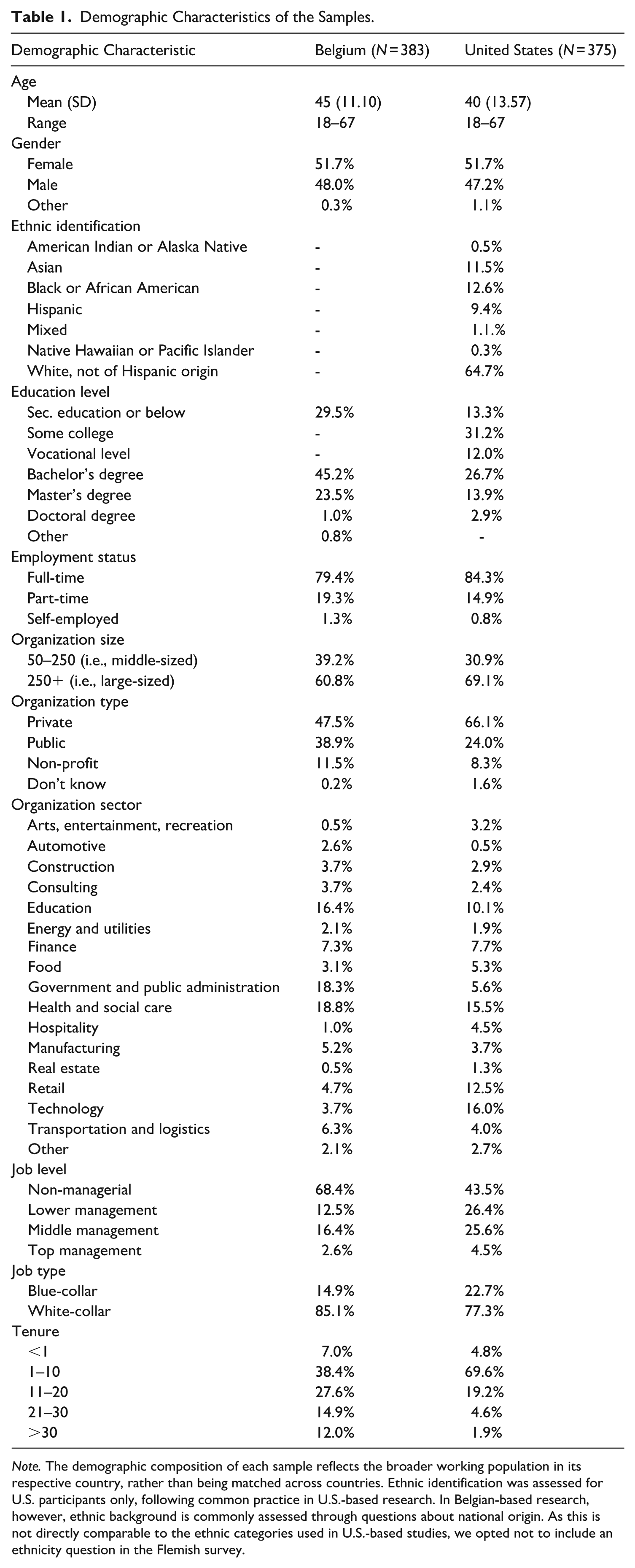
Note. The demographic composition of each sample reflects the broader working population in its respective country, rather than being matched across countries. Ethnic identification was assessed for U.S. participants only, following common practice in U.S.-based research. In Belgian-based research, however, ethnic background is commonly assessed through questions about national origin. As this is not directly comparable to the ethnic categories used in U.S.-based studies, we opted not to include an ethnicity question in the Flemish survey.
Measures
Descriptives
For descriptive purposes, we asked participants on which external IM platforms they had group chats with colleagues and/or superiors, as well as what types of people were members of these groups (e.g., department colleagues). We assessed how frequently they checked (M = 4.68, SD = 0.72), posted and responded (M = 3.88, SD = 1.10) to messages in these chats with a scale going from 1 (Never) to 5 (Daily). Based on Boswell et al. (2016), we asked whether their organization had established any kind of (in)formal policy that prevented them from creating groups on external IM apps, prescribed when they should or should not communicate (e.g., no after-hours communication), or identified appropriate (e.g., routine matters) or inappropriate topics (e.g., sensitive matters) for them to discuss in the group chats.
Antecedents
The antecedents of the hypothesized model, namely the prosocial (M = 3.99, SD = 1.21, α = .86) and antisocial (M = 1.65, SD = 0.96, α = .92) organizational behaviors in participants’ work-related group chats, were measured with self-developed scales comprising eight and ten items, respectively. For each item, participants indicated on a scale from 1 (Never) to 7 (Always) how often their work-related group chats were used for that specific purpose (e.g., gossiping about a colleague/superior). Items were derived from prior interview studies regarding work-related IM use (e.g., Ahmad et al., 2023; Hirvonen et al., 2022; Huang & Zhang, 2019) as well as the unpublished results from an interview study conducted by the first and second authors among 45 Belgian employees. The classification of items as either prosocial or antisocial was informed by prior conceptualizations of prosocial and antisocial behaviors in an organizational context (e.g., Bolino & Grant, 2016; Giacalone & Greenberg, 1997). A pilot study was conducted in which ten Belgian employees were asked to complete the questionnaire and provide feedback on its clarity and comprehensibility. This allowed us to refine the items and assess their preliminary validity and reliability.
Mediators
The resources and demands (i.e., mediators) included in the hypothesized model were measured with seven-point Likert scales (1 = Strongly disagree; 7 = Strongly agree). Participants’ efficient communication with colleagues 5 was measured with a four-item scale by van Zoonen et al. (2017), adapted from Ten Brummelhuis et al. (2012) (M = 5.35, SD = 0.88, α = .74). Work-life conflict was assessed with a four-item scale by van Zoonen et al. (2017), adapted from Netemeyer et al. (1996) (M = 3.40, SD = 1.61, α = .94). Co-worker conflict was measured with a four-item scale by Jehn (1995) (M = 2.84, SD = 1.39, α = .95).
Outcomes
The outcome variables of the hypothesized model were measured with seven-point Likert scales (1 = Strongly disagree; 7 = Strongly agree). Work engagement was assessed using the Utrecht Work Engagement Scale (Schaufeli & Bakker, 2010; M = 4.75, SD = 1.25, α = .94). This scale measures the sub-dimensions vigor, dedication and absorption with three items each. Based on van Zoonen and Rice (2017), we measured work exhaustion with five items from the Maslach Burnout Inventory (Maslach & Jackson, 1981; M = 3.77, SD = 1.63, α = .95). All construct measures are listed in Supplemental Table S1.
Data Analysis
Descriptive analyses were conducted using SPSS version 28. For the main analyses, the conceptual model was tested using SEM in Mplus version 8.8. First, single-group analyses were performed. Prior to assessing the structural model, the measurement model was tested through Confirmatory Factor Analysis (CFA). Second, multi-group analyses were conducted. Before examining cross-cultural differences between the Belgian and U.S. samples, measurement invariance was tested across groups. To assess model fit, we used Comparative Fit Index (CFI), Tucker-Lewis Index (TLI), standardized root mean square residual (SRMR) and root mean square error of approximation (RMSEA; Kline, 2011). We applied the thresholds specified by Hair et al. (2010) for models with 30 or more observed variables and a sample size of 250 or higher (CFI > 0.90, TLI > 0.90, SRMR ≤ 0.08, RMSEA < 0.07).
Results
Descriptive Analyses
When asked which platform(s) they had a group chat on with colleagues and/or superiors, the majority of our participants (65%) mentioned WhatsApp. Other popular platforms were Facebook Messenger (30%), iMessage (23%), Discord (13%) and Telegram (6%). Almost all participants (95%) indicated that the chat(s) consisted of colleagues from their own department or team. Colleagues from other departments or teams (38%) and former colleagues (23%) were also frequently mentioned. While it was common for direct supervisors to be members of the group chat(s; 52%), it was rather exceptional for top executives to join (6%). Most participants checked the messages posted in the group chat(s) on a daily basis (78%). Actively posting or responding was reported less frequently, with 35% doing so daily and 37% weekly. Participants generally reported more prosocial (M = 3.99, SD = 1.21) than antisocial organizational behaviors (M = 1.65, SD = 0.96) in their work-related group chats. As for cross-cultural differences, U.S. employees scored consistently higher than Belgian employees, both in terms of prosocial (US: M = 4.45, SD = 1.09; Belgium: M = 3.53, SD = 1.14; t(756) = −11.34, p < .001) and antisocial organizational behaviors (US: M = 1.93, SD = 1.08; Belgium: M = 1.38, SD = 0.73; t(756) = −8.21, p < .001).
Participants were also asked about the social media policies in their organizations. The most frequently reported type of policy concerned inappropriate topics. About a quarter (27%) indicated that their employer had specified which topics are inappropriate for them to discuss via external IM channels (e.g., sensitive matters). This percentage was slightly lower (22%) for policies about appropriate topics (e.g., routine matters). As for policies prescribing when employees should (not) contact each other via these channels (e.g., no after-hours communication), 17% participants reported that their organization had such a policy in place. Finally, only 6% indicated that their employer had a policy prohibiting the creation of group chats on these platforms altogether. As for cross-cultural differences, the number of U.S. participants reporting the presence of a policy in their organization was consistently higher than the number of Belgian participants. U.S. organizations were thus more likely to identify what topics are appropriate (US: 32%, Belgium: 13%, χ2 = 64.9, p < .001) or inappropriate (US: 37%, Belgium: 16%, χ2 = 62.3, p < .001), prescribe when employees should (not) communicate through IM channels (US: 19%, Belgium: 15%, χ2 = 29.8, p < .001), as well as prevent the creation of IM group chats (US: 8%, Belgium: 4%, χ2 = 32.1, p < .001).
Structural Equation Modeling
Single-Group Confirmatory Factor Analysis
Before testing the full measurement model, we conducted separate CFAs to validate the factor structure of the newly developed measures used to assess prosocial and antisocial organizational behaviors in participants’ group chats. First, we tested a one-factor model including all eight prosocial items, which revealed acceptable model fit (χ2 = 128.290, dƒ = 20, CFI = 0.961, TLI = 0.946, SRMR = 0.035, RMSEA = 0.085). Two items, PRO2 (0.28) and PRO8 (0.37), were deleted due to small standardized loadings below the threshold of 0.5. The modified model showed good fit (χ2 = 60.384, dƒ = 9, CFI = 0.980, TLI = 0.967, SRMR = 0.027, RMSEA = 0.087). All standardized loadings were significant and ranged from 0.62 to 0.91.
Second, we tested a one-factor model including all ten antisocial items. Although all standardized loadings were significant and ranged from 0.61 to 0.85, the analysis revealed bad model fit (χ2 = 1,574.031, dƒ = 35, CFI = 0.738, TLI = 0.663, SRMR = 0.078, RMSEA = 0.241). Modification indices indicated that the misfit was due to the high error covariances between items ANTI1 and ANTI2 (M.I. = 413.29), ANTI4 and ANTI5 (M.I. = 253.21), ANTI7 and ANTI8 (M.I. = 367.96), and ANTI9 and ANTI10 (M.I. = 109.02). This was not surprising given the similar wording and meaning of each pair of items (e.g., ANTI1: “Sharing pictures or videos of a client/customer that could be considered offensive,” ANTI2: “Sharing pictures or videos of a colleague/superior that could be considered offensive”). Adding these four error covariances significantly improved model fit (χ2 = 388.818, dƒ = 31, CFI = 0.939, TLI = 0.912, SRMR = 0.044, RMSEA = 0.123; ∆χ2(4) = 1,185.213, p < .001).
Finally, we performed a CFA that tested the full measurement model including all latent constructs. The analysis revealed good fit (χ2 = 2,346.586, dƒ = 791, CFI = 0.942, TLI = 0.937, SRMR = 0.049, RMSEA = 0.051). One item, EFFCO2, had a standardized loading below the threshold of 0.5. After deleting it, the measurement model still showed good fit (χ2 = 2,279.971, dƒ = 751, CFI = 0.943, TLI = 0.937, SRMR = 0.050, RMSEA = 0.052) and demonstrated convergent and discriminant validity. All standardized loadings were significant and ranged from 0.63 to 0.95. They are listed in Supplemental Table S1. All composite reliability (CR) and average variance extracted (AVE) surpassed the thresholds of 0.7 and 0.5 respectively. As presented in Table 2, all constructs met the Fornell-Larcker criterion (Fornell & Larcker, 1981), meaning that the squared root of each factor’s AVE was larger than that factor’s correlation with other factors.
Composite Reliability (CR), Average Variance Extracted (AVE), Factor Correlations Matrix.
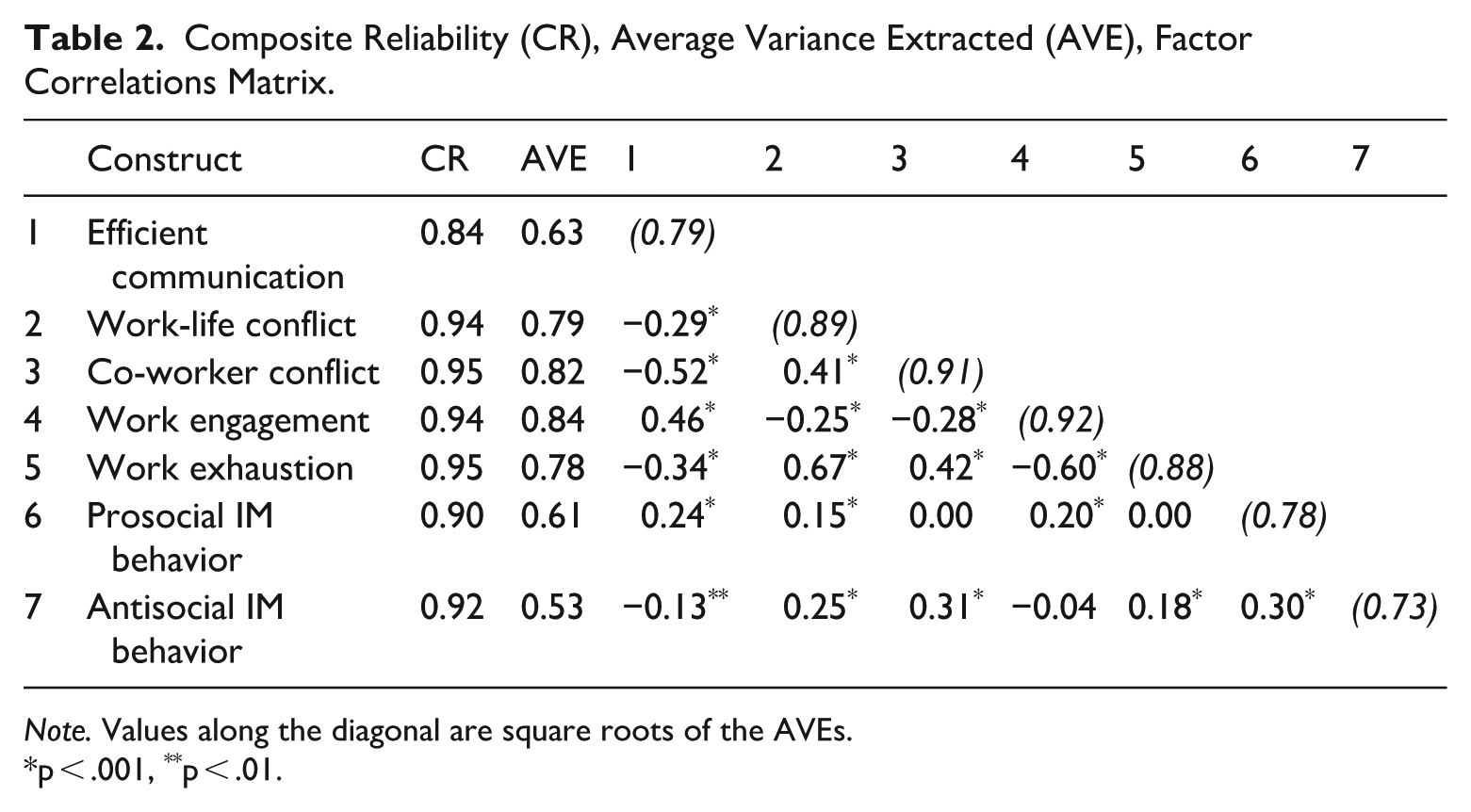
Note. Values along the diagonal are square roots of the AVEs.
p < .001, **p < .01.
Single-Group Structural Equation Analysis
Next, the structural model was estimated. Based on prior research (e.g., Cho et al., 2019; Ter Hoeven et al., 2016), we controlled for age, gender, employment status, organization size, job type and job level. Nominal control variables were dummy-coded. In order to be able to analyze the nature of our hypothesized mediation effects, we modeled both indirect pathways from the independent variables (i.e., antisocial IM and prosocial IM) to the dependent variables (i.e., work engagement and work exhaustion) as well as direct pathways between these variables. The model showed acceptable fit to the data (χ2 = 3,168.888, dƒ = 1,042, CFI = 0.922, TLI = 0.914, SRMR = 0.080, RMSEA = 0.052). To further test the robustness of our model, we examined alternative specifications in which work-life conflict and co-worker conflict were treated as exogenous variables, rather than being predicted by prosocial and antisocial IM. As shown in Supplemental Table S2, the original hypothesized model demonstrated superior fit.
Single-Group Hypothesis Testing
We used bootstrapping (N = 5,000 samples) to test the hypothesized indirect effects between work-related IM use and work engagement and exhaustion. Estimates of all direct and indirect effects are shown in Supplemental Table S3. The first set of hypotheses (
The second set of hypotheses (
The third set of hypotheses (
Measurement Invariance
Measurement Invariance Testing.
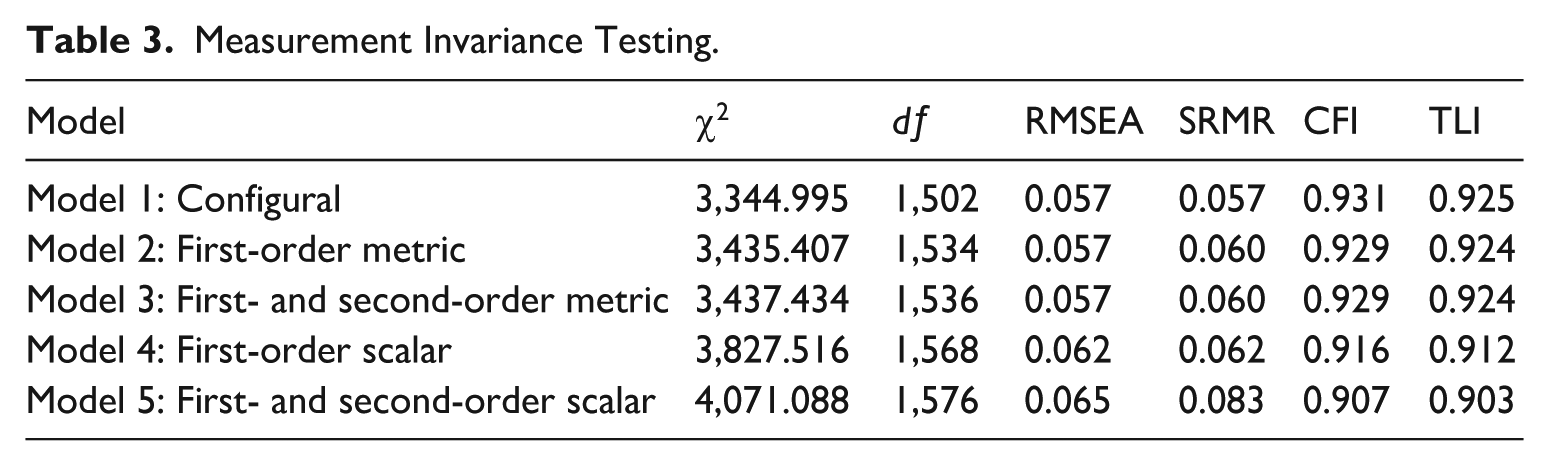
First, we tested for configural invariance by running a model without equality constraints (Model 1). The good model fit indicated that the general factor structure was the same across the Belgian and U.S. sample. Second, we assessed first-order metric invariance by fixing first-order factor loadings to be equal across groups (Model 2). The model showed good fit and indicated a decrease in CFI of only 0.002 compared to Model 1 (Byrne, 2011; Rudnev et al., 2018). According to Cheung and Rensvold (2002), a decrease in CFI equal to or below 0.01 indicates invariance. Thirdly, we assessed metric invariance on the second-order level (Model 3). Constraining both first- and second-order loadings to be equal across groups led to very similar fit indices and no decrease in CFI. Finally, we assessed scalar invariance by fixing intercepts to be equal across groups (Model 4). Although model fit was acceptable after constraining first-order intercepts, there was no evidence for invariance due to a 0.013 decrease in CFI. When both first- and second-order intercepts were set to be equal across groups, model fit further deteriorated (Model 5). Hence, while there was evidence for both configural and metric invariance, scalar invariance was not supported. The primary aim of
Multi-Group Analysis
In order to identify cross-cultural differences in the structural model, we compared the fit of an unconstrained model (i.e., coefficients freely estimated across groups) to that of a constrained model. We included the same control variables as in the single-group analysis, namely: age, gender, employment status, organization size, job type, and job level. The unconstrained model (χ2 = 4,622.446, dƒ = 2,118, CFI = 0.908, TLI = 0.902, SRMR = 0.084, RMSEA = 0.056) showed a significantly better fit to the data than the constrained model (χ2 = 4,718.575, dƒ = 2,174, CFI = 0.907, TLI = 0.901, SRMR = 0.092, RMSEA = 0.056; ∆χ2 (56) = 96.129, p < .001). As such, we could conclude that there were cultural differences in the hypothesized relationships between the latent variables. Results of the multi-group hypothesis testing are summarized in Table 4. Detailed estimates of all direct and indirect effects for each sample are reported in Supplemental Table S3.
Multi-Group Hypothesis Testing Results.
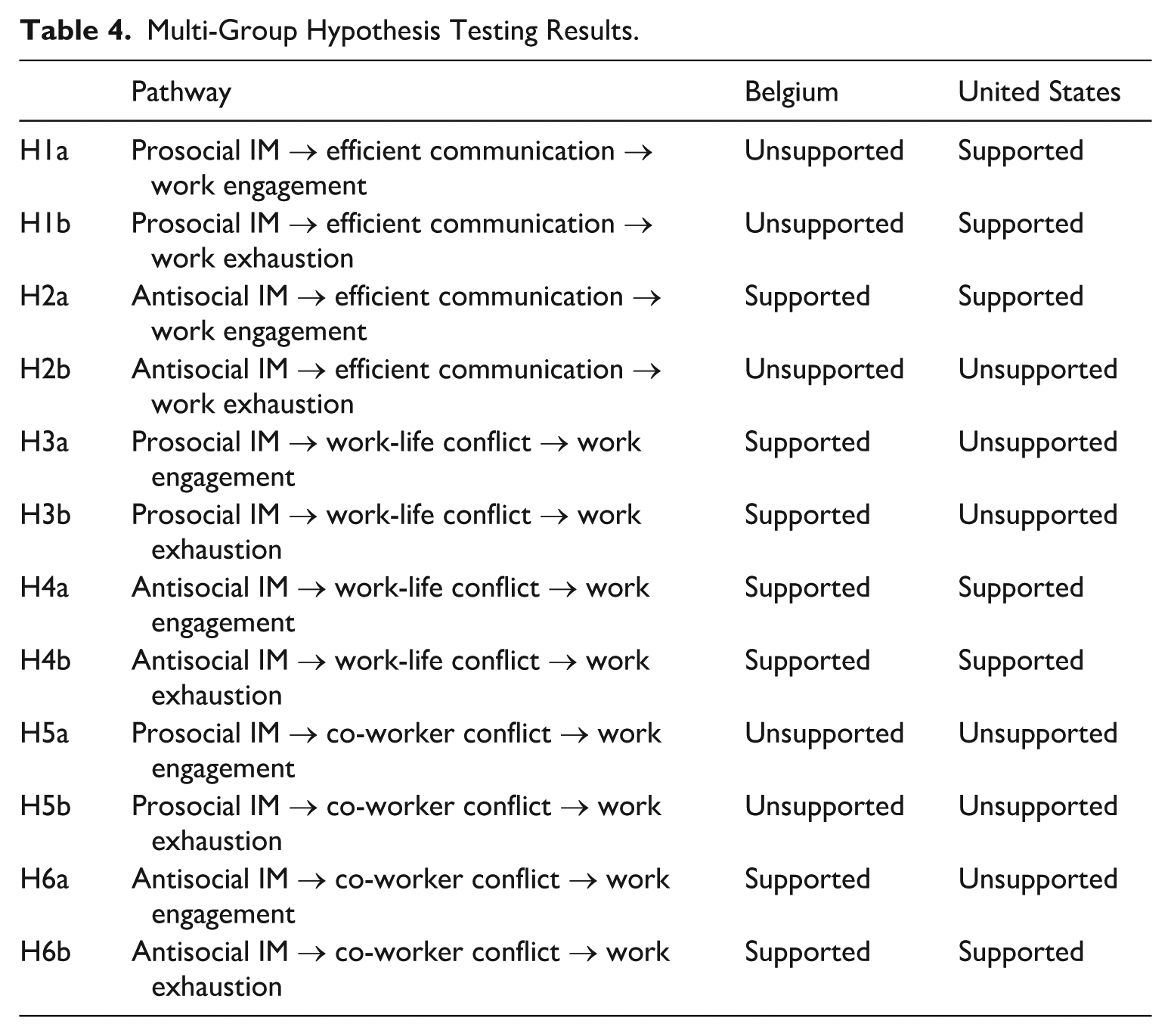
We can distinguish two major differences. First, both
Discussion and Conclusion
External IM apps have become widely adopted by employees to create work-related group chats (Jabbar et al., 2021). Through a cross-cultural survey, we examined the impact of both prosocial and antisocial organizational behaviors in such group chats on employees’ work engagement and exhaustion. This resulted in a theoretical framework that sheds light on how the group-based work-related use of external IM apps affects employee well-being.
Theoretical Contributions
This study is—to the best of our knowledge—the first study about employees’ work-related use of IM applications that distinguishes between prosocial organizational behaviors (Brief & Motowidlo, 1986) in employee group chats on the one hand and antisocial organizational behaviors (Giacalone & Greenberg, 1997) on the other. As such, our study builds upon prior research that has underscored the need to move beyond single, all-encompassing measures of IM frequency or intensity by also accounting for differences in the nature of employees’ interactions on IM platforms (e.g., X. Zhang et al., 2019; H. Zhang et al., 2021). To assess these behaviors, we developed and tested new scales. Interestingly, participants scored much lower on the antisocial IM scale (M = 1.65, SD = 0.96) compared to the prosocial IM scale (M = 3.99, SD = 1.21). This suggests that employees only rarely display antisocial organizational behaviors such as gossiping and arguing in their work-related group chats, but more frequently engage in prosocial organizational behaviors such as information sharing and task coordination. As such, highly mediatized cases of employee misconduct within private WhatsApp groups (e.g., Belga, 2023) may be less common than they appear. This conclusion should, however, be treated with caution and needs to be confirmed by future research. Ultimately, prior studies have pointed to a large and growing group of employees who are confronted with cyberbullying and cyber harassment in the workplace (Oksanen et al., 2020; Paerata, 2023). We cannot entirely rule out the possibility that participants in this study consciously concealed antisocial organizational behaviors in their group chats due to social desirability concerns. It is also possible that they unconsciously underreported such behaviors, given that the distinction between prosocial and antisocial organizational behaviors may be subject to individual interpretation. For instance, what one employee views as gossiping, another may perceive as sharing important information.
In addition, it must be mentioned that about half of our participants reported their supervisors to be part of the group chats. Despite the behavioral privacy typically associated with platforms like WhatsApp (Waterloo et al., 2017), the presence of supervisors can explain why employees do adhere to social norms and avoid sharing negative comments in work-related group chats (cf. Huang & Zhang, 2019). To examine this assumption, we conducted two independent samples t-tests. Indeed, participants whose supervisors were members of their group chats reported significantly lower levels of antisocial IM use (M = 1.57, SD = 0.93) than those whose supervisors were not present (M = 1.74, SD = 0.98, t(756) = 2.56, p = .01). As such, these findings pave the way for future research to further explore the conditions under which employees may resort to antisocial organizational behaviors online.
This study also advances our understanding of the (dis)advantages of employee group chats on external IM apps. By applying the JD-R model (Demerouti et al., 2001) to the context of work-related instant messaging, we addressed how the most prominent resource and demands associated with prosocial and antisocial work-related IM affect employee well-being (i.e., work engagement and exhaustion). Based on prior interview research (e.g., Hirvonen et al., 2022; Jabbar et al., 2021), efficient communication was examined as an IM-related resource, while work-life conflict and co-worker conflict were studied as demands. In addition, we tested our conceptual model with a Belgian as well as U.S. sample, allowing us to uncover cross-cultural variations in how employees are affected by work-related IM.
First, as an IM-related resource, efficient communication played a mediating role in the relationships of both prosocial and antisocial IM with work engagement. As expected, the single-group results indicated that prosocial work chats were positively related to efficient communication. In line with the JD-R model’s motivational process (Demerouti et al., 2001), the communication efficiency resulting from prosocial IM led to more engagement. This confirms the long-standing premise that prosocial organizational behavior has functional consequences for organizations and employees (Brief & Motowidlo, 1986; Feather et al., 2018). It also echoes recent literature linking IM apps to enhanced co-worker communication because they eliminate time and space constraints (Hirvonen et al., 2022; Huang & Zhang, 2019). It is important to note, however, that the multi-group results add nuance to these positive findings. While the positive relationship between prosocial IM and work engagement via enhanced communication efficiency was evident in the U.S. sample, it was not observed in the Belgian sample. One possible explanation for this can be found in Hofstede’s model of national culture. In large-power-distance and high-uncertainty-avoiding countries like Belgium, employees are accustomed to a more formal and predictable communication environment than in small-power-distance and low-uncertainty-avoiding countries like the United States (Hofstede, 2011, 2024). Yet, the informal tone (Mak, 2019) and unpredictability of incoming messages (Ter Hoeven et al., 2016) are exactly what characterizes IM. For Belgians, these characteristics may overshadow the advantages usually associated with IM, such as the efficient information exchange (Huang & Zhang, 2019). They may, therefore, prefer more traditional channels like e-mail because “it makes communication formal, documented and backup of all information is available any time” (Jabbar et al., 2021, p. 648).
In contrast to prosocial IM, antisocial IM was negatively related to efficient communication. As predicted by the JD-R model’s health impairment process (Demerouti et al., 2001), the decrease in communication efficiency due to antisocial IM resulted in less work engagement. This aligns with previous studies showing that antisocial organizational behaviors such as cyberbullying (Muhonen et al., 2017), gossip (Guo et al., 2021), and incivility (Agarwal et al., 2024) can damage an organization’s social or communication climate and, in turn, undermine employee well-being. Notably, these findings were confirmed in both the single-group and multi-group analyses.
Second, because employee group chats facilitate conversations about work outside office hours (Bahri et al., 2020), work-life conflict was examined as an IM-related demand. While our single-group results confirm the mediating role of work-life conflict in the relation of antisocial IM with work engagement and exhaustion, this was not the case for prosocial IM. Work-related group chats only triggered work-life conflict when they were antisocial in nature. This work-life conflict, in turn, increased exhaustion and decreased engagement, as predicted by the JD-R model’s health impairment process (Demerouti et al., 2001). Thus, while prior research has pointed to the negative impact of employees’ overall work-related IM use on their work-life balance (e.g., Cheng et al., 2021; Hirvonen et al., 2022), our findings suggest that such effects are particularly pronounced when IM is used for arguing, gossiping and the like. This resonates with Boswell et al. (2016), who showed that negative after-work texts lead to greater work-life interference because of the positive-negative asymmetry effect, which causes people to ruminate more about negative work interactions than positive ones.
Again, however, the multi-group results prompt us to interpret these findings with caution. For U.S. employees, only antisocial IM use was associated with work-life conflict. For Belgian employees, however, both antisocial and prosocial IM use were related to work-life tensions and a subsequent decline in well-being. Regardless of the nature of their work-related group chats, Belgian employees thus experienced what prior research has termed “‘technostress’—a form of stress that arises when people struggle to manage communication and information technologies in a work context (Bahri et al., 2020). Work-related IM use can cause such stress because messages cannot only interrupt employees” efforts to concentrate on work tasks during office hours, but also their attempts to engage in family or leisure activities after office hours (Cheng et al., 2021; H. Zhang et al., 2021).
The observed discrepancy in the relationship between IM use and work-life conflict between Belgian and U.S. participants may be explained by differences in segmentation preferences. Ultimately, the tendency to separate work and personal life is influenced not only by individual factors like family demands, but also by cultural norms (Ollo-López & Goñi-Legaz, 2017). In low-uncertainty-avoidance countries like the United States, people are more likely to blend their work and personal lives (i.e., integrators). In high-uncertainty-avoidance cultures like Belgium, people tend to keep their work and personal lives more separate (i.e., segmentors; Ashforth et al., 2000; Ollo-López & Goñi-Legaz, 2017). Segmentors generally have stronger reactions to electronic work communication than integrators because they experience it as more bothersome to their personal lives (Boswell et al., 2016).
Finally, as the second IM-related demand, co-worker conflict played a mediating role in the relationships of both prosocial and antisocial IM with work exhaustion. As predicted, the single- and multi-group analyses revealed that employees who reported more antisocial organizational behaviors in their group chats perceived greater friction among their colleagues in general. This validates concerns that employees’ problematic behavior on digital platforms can be related to more extensive tensions within the organizational culture at large (Oksanen et al., 2020). In line with the health impairment process of the JD-R model (Demerouti et al., 2001), the increase in co-worker conflict resulting from antisocial IM use led to more work exhaustion. Overall, this supports prior evidence that problematic online behaviors at work, including cyberbullying and cyber harassment, can harm co-worker relationships and ultimately lower employees’ well-being (Muhonen et al., 2017; Oksanen et al., 2020). In contrast to antisocial IM, prosocial IM was negatively related to co-worker conflict. If used for collaboration and coordination, employee group chats thus enhance rather than damage co-worker relationships. This ties in with qualitative research on group-based IM for work purposes (Hirvonen et al., 2022), but also broader literature regarding the functional consequences of prosocial organizational behaviors (Bolino & Grant, 2016; Feather et al., 2018). In line with the JD-R model’s motivational process (Demerouti et al., 2001), the decrease in co-worker conflict caused by prosocial IM resulted in less work exhaustion.
Practical Contributions
This study has several practical implications. First, our findings support previous scholars’ claims that employers should actively prevent antisocial organizational behaviors like gossiping and bullying in online environments (e.g., Muhonen et al., 2017; Oksanen et al., 2020). Although our findings suggest that such behaviors are relatively rare, they were associated with a less efficient communication climate, co-worker conflicts, work-life tensions, and ultimately reduced employee well-being. However, employers should also consider the opportunities related to work-related IM use. If employees use their co-worker group chats for prosocial organizational behaviors such as coordination and collaboration, our findings suggest that this may contribute to improved relationships and communication with one another and ultimately enhance their overall well-being at work.
At the same time, our findings suggest that the effects of work-related IM use are partially culture-bound. For Belgian as compared to U.S. participants, prosocial organizational behavior in work-related group chats was not associated with more communication efficiency, but with work-life conflicts. Thus, for employees from small-power-distance and high-uncertainty-avoiding countries like Belgium, there may be an increased risk that work-related group chats will harm employee well-being. Organizations operating in such countries may, therefore, want to raise awareness about the potential downsides of sending each other messages through IM outside work hours (cf. Yue, 2022).
Finally, our findings offer preliminary insights into the effectiveness of disconnection laws that are increasingly adopted around the globe. Despite the fact that the Belgian government has passed the right to disconnect law in 2022, only 15% of our Belgian participants was aware of an organizational policy that specified (in)appropriate times for them to communicate with colleagues via external IM apps (e.g., no after-hours communication). Although it is not uncommon for employees to be unaware of their organizations’ social media policies (Oksa et al., 2023), this may indicate a gap between policy and practice. It is also possible that Belgian organizations did, in fact, implement disconnection policies, but that these are exclusively focused on internal (e.g., Microsoft Teams) rather than external IM platforms (e.g., WhatsApp). In any case, these findings partially answer the call from researchers such as Stephens (2023) to explore organizational policies that support employees in navigating mobile communication and mobile work environments. This has become a crucial topic in the post-COVID-19 era, where remote and mobile work practices have become increasingly common (Stephens, 2023). In that light, our findings highlight the need for proper implementation of disconnection law in organizations —particularly in Belgium and other uncertainty-avoiding countries—as this may prevent work-related group chats from jeopardizing employees’ work-life balance.
Limitations and Future Research
While this study offers several theoretical and practical insights, it also entails limitations. First, given the cross-sectional design, we cannot make claims about causality. Longitudinal designs can be used to clarify the long-term effects of work-related IM on employee well-being. Second, this study is—to the best of our knowledge—the first to quantitatively assess prosocial and antisocial organizational behaviors in work-related group chats, which prompted us to utilize self-developed scales. While these were subjected to a thorough factor analysis, we call for future research to further utilize and validate them.
Third, our findings indicate that work-related group chats are almost never antisocial in nature. Despite the anonymity of the survey nature of the survey, however, responses may have been influenced by social desirability. This is possible given that antisocial IM use can be considered quite private, sensitive or embarrassing (Crano et al., 2015). It is also possible that there were, in fact, more instances of antisocial organizational behavior in participants’ group chats, but they did not interpret it as such. As covered in news reports (e.g., Belga, 2023), it is not uncommon for employees to justify racist or sexist messages in their chats as innocent jokes. Future research could study the actual content of these group chats through qualitative or quantitative content analysis rather than using self-report measures.
Fourth, throughout this study, antisocial IM has been presented as inherently harmful to organizations. Yet, several scholars (e.g., Spoelma & Hetrick, 2021; Wax et al., 2022) have suggested that behaviors like gossiping, while often labeled as antisocial, can also have a prosocial side to them. Future research should account for the complexity of these behaviors rather than treating them as uniformly antisocial.
Fifth, this study collected valuable descriptive data on the presence of organizational policies regarding work-related use of external IM apps. Yet, the low prevalence and skewed distribution of these policies prevented their inclusion as control variables in our main analyses. Future research could more directly examine the extent to which the implementation and enforcement of such policies moderate the effects of employees’ online behaviors. In addition, while we asked participants whether their organization had any policies regarding the use of external IM apps, we did not specifically assess the extent to which their use was officially established or prescribed. Future research could explore how the outcomes of employees’ group chats on external IM apps differ depending on whether their use is initiated top-down (e.g., by management) or bottom-up (e.g., by employees), and whether participation is mandatory or voluntary (Hirvonen et al., 2022; Huang & Zhang, 2019).
Finally, while this study controlled for organization size and job type (i.e., white vs. blue-collar), other organizational differences were not considered. For example, employees working in multinational organizations may face unique challenges related to work-related group chats, as conversations outside their own work schedule may be more common due to colleagues working in different time zones (Stephens, 2023). Future research could explore how such organizational contexts shape the nature and consequences of work-related IM.
Supplemental Material
sj-docx-1-crx-10.1177_00936502251401642 – Supplemental material for A Double-Edged Sword? The Consequences of Work-Related Instant Messaging Use for Employees
Supplemental material, sj-docx-1-crx-10.1177_00936502251401642 for A Double-Edged Sword? The Consequences of Work-Related Instant Messaging Use for Employees by Ellen Soens, An-Sofie Claeys and Cen April Yue in Communication Research
Footnotes

Ethical Considerations
This study was approved by the Ethical Committee of the Faculty of Arts and Philosophy at Ghent University (Reference number: 2023-48) on December 12, 2023.
Consent to Participate
Participants provided written informed consent prior to participating.
Consent for Publication
Not applicable.
Funding
The authors disclosed receipt of the following financial support for the research, authorship, and/or publication of this article: This study was funded by the Research Foundation Flanders under Grant 1S41624N.
Declaration of Conflicting Interests
The authors declared no potential conflicts of interest with respect to the research, authorship, and/or publication of this article.
Data Availability Statements
The datasets generated and analyzed during the current study are available from the corresponding author on reasonable request.
Supplemental Material
Supplemental material for this article is available online.
Notes
Author Biographies
References
Supplementary Material
Please find the following supplemental material available below.
For Open Access articles published under a Creative Commons License, all supplemental material carries the same license as the article it is associated with.
For non-Open Access articles published, all supplemental material carries a non-exclusive license, and permission requests for re-use of supplemental material or any part of supplemental material shall be sent directly to the copyright owner as specified in the copyright notice associated with the article.
