




Abstract
We experimentally manipulated social media affordances theoretically linked to cyberbullies’ anonymity using hypothetical scenarios taking advantage of the diverse ways people get bullied by someone they can identify versus an anonymous cyberbully. Nine different social media platforms–from TikTok, Twitter, and Tumblr to Instagram, iMessage, and Email–manipulated a cyberbully’s anonymity to uncover pathways known to precipitate poor mental health in a 2 × 9 design. Inferring upward-mobility and highlight-difference goals did not predict affective outcomes; whereas inferring insecurity goals predicted increased hurt and negative emotion regardless of anonymity but inferring personal-attack goals was more hurtful, emotionally negative, and severe when victims knew the bully. Second, inferring the goals predicted decreased coping via increased use of motivation (but not identity) uncertainty reduction strategies, especially if the bully was anonymous. Third, inferences of the insecurity and personal attack goals predicted decreased attraction to the cyberbully via increased coping if the bully was anonymous.
Keywords
Cyberbullying is difficult for all those involved. Well established are bullying’s deleterious effects on mental health, including increased suicidal ideation (Kowalski et al., 2014), increased depression (Mark et al., 2019), and reduced academic performance (Vanderbilt & Augustyn, 2010). Bullying occurs across the lifespan (Giumetti & Kowalski, 2019) with negative consequences for bullies, victims, bully-victims (Mark et al., 2019), and even bystanders (Ng et al., 2022) of such hostile messaging. Discovering the cross-contextual mechanisms through which bullying eventually yields poor mental health via difficulty coping with the pain of bullying will facilitate the development of intervention programs to mitigate such harmful bullying outcomes. One key set of factors that moderates the negative outcomes of cyberbullying are the social media affordances involved in bullying episodes, which are unique compared to more traditional forms of bullying (Bonanno & Hymel, 2013). Anonymity is one dimension along which media affordances vary in ways that have consequences for cyberbullying (O’Sullivan & Carr, 2017). For instance, when victims are unable to identify the cyberbully, the severity of any embarrassment and pain victims experience is greater than if you can identify the bully (Ševčíková et al., 2012). Thus, we aim to understand how cyberbullying episodes that vary in the extent to which the bully is anonymous to the victim alter fundamental processes regarding how victims deal with bullying in terms of their psychological and communicative responses. We aim to understand cyberbullying as a communication phenomenon that occurs in a variety of relational settings and social media platforms, which manifested in our intentionally diverse set of operationalizations.
Specifically, following in the steps of Palomares and Wingate (2020) and Yu and Riddle (2022), we experimentally manipulated social media affordances that are theoretically linked to a cyberbully’s anonymity using hypothetical scenarios that take advantage of the myriad ways in which folks get cyberbullied by people they know versus people they cannot identify (i.e., anonymous bullies). That is, under the conceptual guidance of goal understanding theory (GUT), we employ nine different social media platforms–from TikTok, Twitter, and Tumblr to Instagram, iMessage, and Email–to manipulate a cyberbully’s identifiability to their victim in a controlled experimental design to establish causal connections, as recommended by a recent review of methods used to study victimization (see Franzen et al., 2023). We use GUT’s focus on goal inferences as cognitive appraisals to cope with bullying to uncover pathways of cyberbullying known to precipitate poor mental health. In what follows, we first deduce hypotheses and pose research questions, subsequently reporting data from a 2 × 9 experimental design and then discussing theoretical and practical implications.
Goal Understanding and Cyberbullying
GUT starts with the assumption that communication is goal-oriented from senders’ and receivers’ perspectives. In other words, processing messages requires an implicit awareness of senders’ potential mental states, of which goals are central factors (Palomares, 2011). Understanding others then involves inferring their goals at least implicitly if not consciously at times (Fitzsimons & Bargh, 2003). Goals are desired end-states that are mentally represented in hierarchies (Palomares, 2014). Goal inferences are generated via cognitive activation of factors in social interaction that are connected to goals. Certain features of interaction trigger certain goals over other goals, and people tend to infer goals with higher cognitive accessibility. GUT argues, in other words, that people generate goal inferences based on contextual factors in a situation with goals strongly cognitively linked to the interaction more likely inferred than goals weakly linked.
GUT advances this line of reasoning by arguing that goal inferences have spillover effects or consequences beyond interpreting messages, such as perceptions of others and self (Palomares & Derman, 2019). Goal inferences can filter perceptions and produce unique effects such as emotional reactions and judgments. In the context of cyberbullying, victims’ inferences of a bully’s goals can prescribe meaning to bullying episodes in ways that can have implications for how they react to and cope with bullying. That is, victims tend to infer the goals to interpret and understand bullying episodes and different goals can have unique consequences for victims’ wellbeing (Wingate & Palomares, 2021). The following applies this reasoning to explain how victims respond to and cope with cyberbullying.
Cyberbullying occurs when communicators exchange messages to achieve a subordinate goal of harming at least one person in a mental, emotional, and/or physical way to achieve a set of hierarchically structured superordinate goals (Giumetti & Kowalski, 2019; Kowalski et al., 2023; Modecki et al., 2014). Cyberbullying can occur at all ages and in a network of communicators who interact via assorted social media platforms or apps, such as Instagram, Twitter, or email (Giumetti & Kowalski, 2019). Each platform has a set of affordances (Sundar, 2008) that provide cyberbullies with different means to harm intended victims that can result in unique effects at times compared to face-to-face bullying (Jadambaa et al., 2019; Li et al., 2022). One affordance is anonymity or the extent to which a message receiver perceives a source as known and recognizable (Scott, 1998). For instance, regardless of any established relationships, bullies can induce anonymity relatively easily online via fake accounts for a series of unidentified attacks (Gámez-Guadix et al., 2016). Such anonymous episodes are often consistent with the repetitiveness and power imbalance of bullying (Smith et al., 2012). Indeed, a cyberbully can choose to send hurtful messages via assorted platforms that makes learning who the bully is difficult for victims (Mishna et al., 2009). Such uncertainty can exacerbate the severity and struggle of coping with cyberbullying (Machackova et al., 2013; Pure, 2009). Thus, we conceptualize cyberbullying in a contextually transcendent way across ages that includes hurtful messages from classmates or peers online, as much as it does from anonymous others via Discord, coworkers via WhatsApp, romantic partners texting, or Instagram acquaintances (Giumetti & Kowalski, 2019). We aim to test cyberbullying across nine social-media-platform and relational-type combinations to understand the fundamental processes that conceptually underly unique online platforms and their affordances to inform best practices of supporting victims of cyberbullying.
Despite the variety of ways in which it manifests online, cyberbullying can fundamentally vary in how anonymous the victim perceives the bully in consequential ways (Palomares & Wingate, 2020). Bullies can intentionally remain unidentified just as much as they can let the victim know who they are for various reasons and with different outcomes potentially (Ševčíková et al., 2012). Cyberbullies can also attack at random without knowing the victim (Sticca & Perren, 2013). Whatever the preexisting relationship, bullies can moderate how identifiable they are to victims via social media affordances when cyberbullying episodes unfold (Alipan et al., 2021; Yu & Riddle, 2022). For example, victims who were able to cope more with hypothetical cyberbullying were less interpersonally attracted to the anonymous bully but not if the bully was their friend (Palomares & Wingate, 2020). At the same time, goal understanding mechanisms help explain how victims respond to and cope with a cyberbully.
Because bullying is goal-directed, any given bullying episode can facilitate the inferences of a variety of bullying goals that are superordinate to the goal of harming (Palomares et al., 2024). Bullying goals can include seeking revenge or a personal vendetta (Brandau & Rebello, 2021; Mishna et al., 2009). Likewise, goal inferences can focus on upward mobility reasons of gaining status in a network of peers (Faris, 2012; Faris et al., 2020). Highlighting a victim’s differences relative to some standard or norm is a third common goal for cyberbullying, such as making fun of a gender non-conforming classmate (Magin, 2013; Thornberg, 2011). Likewise, bullies often harm because they are insecure and lack confidence, which can be associated with past trauma (Guinta & John, 2018; Roland, 2002). Our focus is on victims’ inferences of these four goals that are strongly linked to cyberbullying episodes, as victims will tend to infer these goals given the cognitive activation process and such inferences should have spillover effects as discussed next.
According to GUT, inferences of upward-mobility, personal-attack, highlight-differences, and insecurity bullying goals are consequential for how victims psychologically process and react to bullying (Palomares & Wingate, 2020). That is, the goals that bullying episodes trigger in the minds of victims can lead to goal inferences that have spillover effects beyond pure interpretation and understanding (Palomares, 2013). In the context of cyberbullying, GUT reasons that goal inferences should predict affective responses because they provide a background of meaning to the bullying episode. Indeed, inferences of bullying goals moderated the extent to which victims’ negative emotion, hurt, and the severity of recalled bullying episodes was associated with depression and general anxiety (Wingate & Palomares, 2021). Also, in experimental work using Facebook and iMessage, inferences of upward-mobility and personal-attack goals predicted increased hurt, negative emotional reaction, and perceived severity (Palomares & Wingate, 2020). Victims perceive hostile bullying messages with vulgar content focused on victims’ immutable characteristics in ways that have lasting and severe consequences for victims, which tends to be associated with negatively valenced emotion (Troop-Gordon, 2017). GUT maintains that when victims infer goals to explain why they are being cyberbullied, they give credibility to the bullying episode, which fosters negative affective reactions when compared to dismissing or actively ignoring the episode (Alipan et al., 2021; Brandau & Rebello, 2021; Machackova et al., 2013). In fact, victims often experience increased levels of hurt when they are bullied for upward-mobility, personal-attack, and other goals (Palomares & Wingate, 2020; Slonje & Smith, 2008). The more victims interpret a bullying message as originating for concrete reasons, then the more credence they give the messages and the more severe, hurtful, and emotionally negative they find the episode. Thus, we posit our first hypothesis (H):
H1: As victims infer more (a) personal-attack, (b) upward-mobility, (c) highlight-differences, and (d) insecurity goals, they report increased hurt, perceived severity, and negative emotional reaction.
GUT maintains that any given goal inference requires minimal data to be triggered (Palomares, 2008). Goal inferences are generated quite automatically, for example, sometimes just upon mere mention of a close relational partner (Fitzsimons & Bargh, 2003). Goal inferences can change as victims obtain more diagnostic data with their uncertainty driving their desire to confirm initial inferences. Thus, having confidence in the accuracy of an inference takes a meaningful amount of data accumulation compared to generating inferences (Palomares, 2008, 2009). Based on this reasoning from GUT, inferring bullying goals often increases the use of uncertainty reduction strategies (URS), which are means of gaining information about others to understand more about their identity and motives (Ramirez et al., 2002). For example, when receiving hurtful messages, victims can search online or ask others for information about the bully’s identity and motives or they can directly talk to suspected cyberbullies to reduce their uncertainty about the source (Machackova et al., 2013). In fact, inferring upward-mobility and personal-attack bullying goals was associated with increased use of both identity and motivation URS (Palomares & Wingate, 2020). According to GUT, as victims infer more bullying goals, they will inherently have increased uncertainty about who the bully is and why they are attacking. Given the pain of inferring such goals, in other words, victims have an increased desire to confirm their suspicions. Thus, victims will employ more URS to reduce their uncertainty generated by such goal inferences:
H2: As victims infer more (a) personal-attack, (b) upward-mobility, (c) highlight-differences, and (d) insecurity goals, they report increased use of identity and motivation URS.
The use of URS to mitigate uncertainty generated from goal inferences in cyberbullying can yield both positive and negative outcomes (Knobloch & McAninch, 2014; Palomares & Wingate, 2020). When goal inferences induce negative emotions, perceptions of severity, and hurt, URS can help reveal useful information that facilitates coping and their ability to deal with negative consequences of bullying. Inferences of bullying goals, in other words, should facilitate victim’s ability to overcome the negative consequences of a cyberbully attack via URS and what they learn via information seeking (Navarro et al., 2018). Victims who ask others for information, for instance, tend to cope more effectively than those who do not seek such assistance (Machackova et al., 2013). According to GUT then, goal inferences are useful for victims’ ability to cope with the pain of cyberbullying via their increased use of URS, which reduces their uncertainty in who the bully is and why the bully attacked given what they discover. Thus, we predict:
H3: Identity and motivation URS mediate the positive relationships between inferring (a) personal-attack, (b) upward-mobility, (c) highlight-differences, and (d) insecurity goals and coping.
We are agnostic regarding the extent to which victims will respond differently to cyberbullying when targets perceive the bully as relatively anonymous versus when they recognize and can identify the bully. Inferences of bullying goals predicted increased identity and motivation URS, negative emotion, perceived severity, and hurt regardless of the victim’s perceived anonymity of the cyberbully (Palomares & Wingate, 2020). In other words, victims responded relatively the same when acquaintances, friends or anonymous others were attacking them; but these experiments did not assess other platforms and relational types. Thus, we propose a research question (RQ) asking if the bully’s anonymity moderates predictions so far:
RQ1: To what extent does the cyberbully’s anonymity moderate results for H1 to H3?
Another spillover effect that we consider in terms of GUT is that victimization often facilitates social attraction to the bully depending on goal inferences (Palomares & Wingate, 2020). Bullying is often used to gain appeal and clout in the eyes of others (Faris, 2012), such as when teasing or joking at another’s expense (Kim & Palomares, 2022). Popular and attractive individuals are often more aggressive than their less popular/attractive counterparts (Borch et al., 2011). Bullies and bully-victims will strategically attack lower and higher status others to maintain or increase their reputations among peers (Andrews et al., 2017). Goal inferences help explain this social attraction process. Indeed, even victims are attracted to their cyberbullies because of the goals they infer for bullies (Palomares & Wingate, 2020). At the same time, we wonder if the anonymity of a cyberbully will moderate the extent to which inferring certain bullying goals is associated with victims’ interpersonal attraction to the bully because of bullying’s connection to social hierarchies and status. From a victim’s perspective, the extent to which the bully is anonymous might moderate this social attraction process because being unable to identify a bully allows for more malleable perceptions to form compared to already having established views regarding a known cyberbully.
We are also interested in the extent to which coping might mediate the relationship between goal inferences and social attraction, based on GUT’s logic that goal inferences provide a means to interpret and deal with being bullied. Whereas we expect unique effects across goals, GUT does not provide a detailed explanation for how and why the goals should specifically affect social attraction via coping. The goals differ in their implications for how victims respond to and cope with bullying. For instance, victims might be attracted to an anonymous bully when they infer personal attack goals because seeking revenge or retaliating is a means to regain clout that along with the anonymity adds to the allure of the bully (e.g., “who is this person and what did I do to them?”). This pattern is likely different for other goal inferences because status climbing, highlighting differences, and being insecure are qualitatively different than a personal attack, such as seeking revenge. For example, victims’ coping mediated a negative indirect association between inferring upward mobility goals and attraction to the bully when the bully was anonymous but not when the bully and victim were friends (Palomares & Wingate, 2020). This process likely occurred because inferences of upward-mobility goals provide meaning and clarity to victims of an anonymous bully because they can cope more from the painful bullying episode (e.g., “they are just trying to use me to be popular”). Still, we are unsure of the relationship between victims’ inferences of each unique goal and social attraction to the bully via coping, especially when considering potential moderation from the bully’s anonymity. Thus, we ask the following:
RQ2: To what extent does victims’ inferences of personal-attack, upward-mobility, highlight-differences, and insecurity goals have conditional direct and indirect effects on victims’ social attraction to the cyberbully via coping as a function of the cyberbully’s anonymity.
Method
Participants and Research Design
To test Hs and RQs, we used a 2 (source of cyberbullying messages: identifiable vs. anonymous) × 9 (social media platform: BeReal, Discord, Email, iMessage, Instagram, TikTok, Tumblr, Twitter, or WhatsApp) between-subjects design. Participants (N = 959) volunteered via Prolific earning $2.69 at a rate of $12 an hour and were randomly assigned to 1 of the 18 conditions. Qualtrics automatically screened and removed 29 participants who failed to recall the proper social media platform (among a list of all nine possibilities plus an “other” category), 104 for failing to recall accurately if they knew or did not know the bully, and 96 participants for failing at least one of two attention checks; we also removed six suspected bot responses (via Recaptcha Score), resulting in 724 total for the final sample (age: M = 27.67, SD = 4.98; gender: 48.74% men, 45.44% women, 3.87% nonbinary/third gender, 1.24% prefer not to say). All deletions were random across conditions. We obtained IRB approval prior to data collection.
Perceived Anonymity of the Bully
The source of the cyberbullying message was manipulated by first having participants imagine (by reading a scenario) that they received a message from someone on a social media platform that was either someone they know or do not know/recognize, after which they viewed a legitimate screengrab with the message and appropriate social media affordances unique to the platform pictured based on the randomly assigned condition. To increase stimulus generalizability of our findings across relational and social media contexts, we intentionally diversified the way in which anonymity was operationalized. For example, if the sender was identifiable, the message was from “a friend you know through mutuals and social events’’ (Twitter condition), “a friend you have known for a couple months” (BeReal and Instagram conditions), “a coworker that you know well–quite well–you have worked together for several years” (Email and WhatsApp conditions), or variations thereof. On the other hand, if the message was from an anonymous other, we told participants that the message was from “someone you mutually follow but do not know or even recognize” (TikTok condition), “someone you do not know and or recognize at all” (Twitter condition), “an account you are unfamiliar with and do not recognize” (Tumblr condition), “a text message from an unknown number” (iMessage condition), or variations thereof. Bullying messages were crafted based on actual reports of bullying messages from past research. All bullying messages within each platform condition were repetitive, hostile, and strategically worded to apply for both identifiable and anonymous bullying conditions. For instance, messages often employed taboo language (“Fucking loser,” “ugly piece of shit”), attacked their character (“you’re pathetic and weak,” “nobody likes you,” “the lack of self-awareness you have is comedic”), and were threatening (“You should be dead,” “Do the world a favor and kill yourself”). Messages varied across platforms to increase stimulus generalizability and to be consistent with the relational type, but messages were identical within each platform for the two anonymity conditions. Written scenarios and screengrabs, including the bullying messages, for all conditions are available online, which also contains output for all Hs and RQs: https://osf.io/dt9m8/
Measures
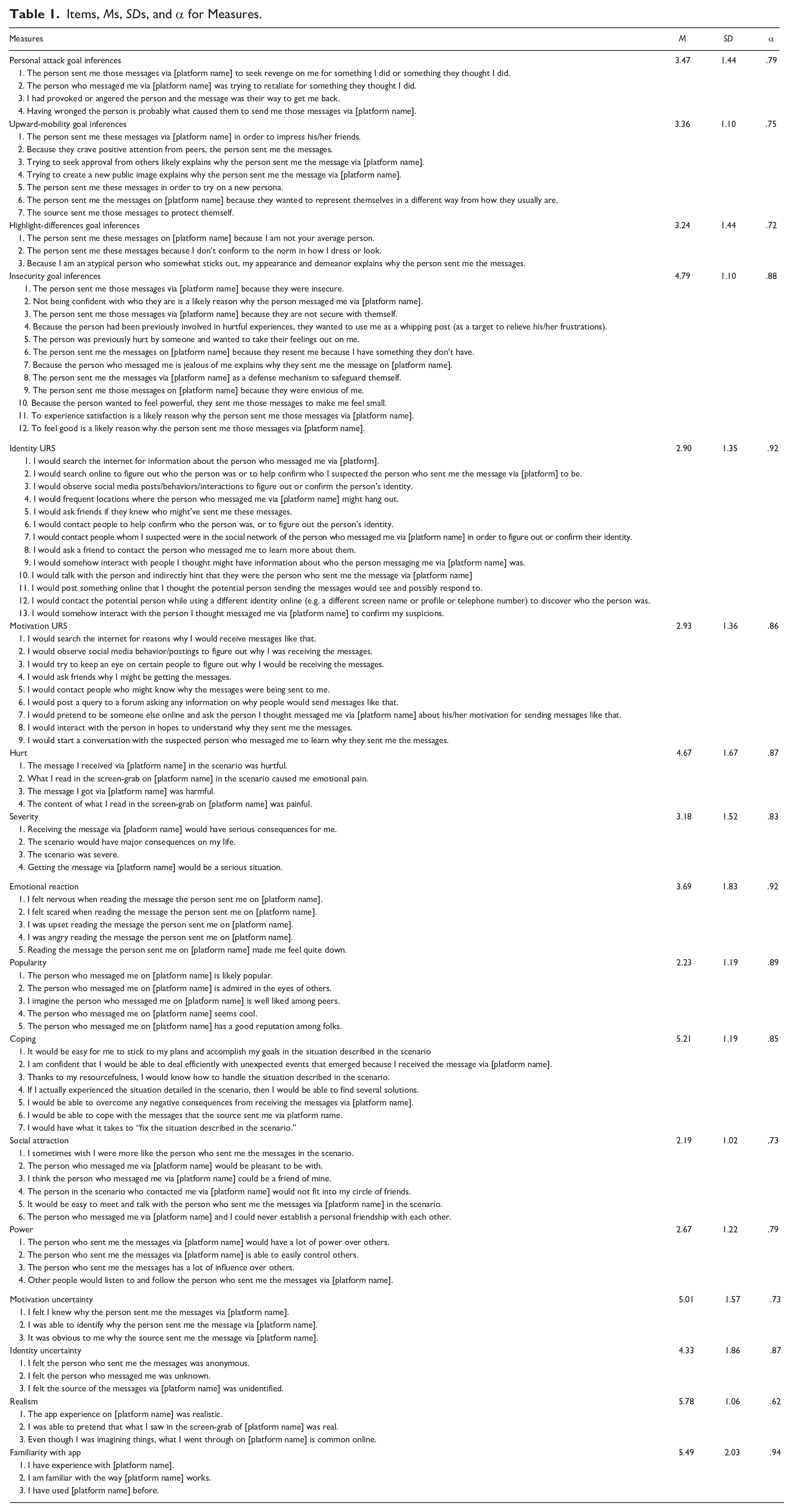
All variables were assessed on 7-point scales using established measures (1 = Strongly Disagree, 4 = Neither Agree nor Disagree, 7 = Strongly Agree). All items, some of which were reverse coded, formed reliable scales and are listed in Table 1 along with Ms, SDs, and αs.
Items, Ms, SDs, and α for Measures.
Goal Inferences
To measure participants’ inferences of personal-attack goals, four items asked if the bully had sent the message because they wanted to seek revenge, wanted to retaliate, were provoked, or were wronged. Seven items for upward mobility goals asked if the bully had sent this message either because they wanted to impress their friends, get attention from peers, get approval from others, create a new public image, or other status-gaining goals. For highlight-difference goals, we used three items that asked if the bully sent the cyberbullying message either because the participant was not the average person, the participant didn’t conform, or the participant was someone who sticks out. Twelve items for insecurity goals asked if the bully sent the messages because they were insecure, wanted to feel good, were involved in prior hurtful experiences, were jealous, or other goals emerging from lack of confidence. Principal component analysis determined which items we included in each of the four goal inference scales and resulted in ways we anticipated given our four a priori goals (Palomares & Wingate, 2020).
Identity and Motivation URS
Two scales assessed identity and motivation URS (Antheunis et al., 2010). Thirteen items measured identity URS. Higher scores indicate a higher likelihood of engaging in information-seeking behaviors to learn about the identity of the message source. Nine items measured motivation URS indicating the extent to which participants would engage in behaviors to learn why the bully sent the message.
Perceived Severity
Four items assessed the extent to which victims perceived the message and scenario as serious and consequential (Wingate & Palomares, 2021).
Hurt
Four items measured how hurtful, harmful, and painful the messages in the screengrabs were (Vangelisti et al., 2005).
Emotional Reaction
Five items captured victims’ emotional reactions toward the message and scenario with higher scores indicating more negative emotions (Palomares & Wingate, 2020).
Coping
Seven items measured the extent to which victims could handle the cyberbully incident and be able to continue as planned, find solutions, and overall deal with the episode (Navarro et al., 2018).
Interpersonal Attraction
We used six items to measure the extent to which participants saw the cyberbully as interpersonally attractive (McCroskey & McCain, 1974 ).
Manipulation Check Measures
To measure identity uncertainty, we asked participants how anonymous, unknown, and unidentified the source of the message was (Rains, 2007). To measure platform familiarity, three items asked participants how much experience they have with the platform and how much they have used it before. To assess realism, three items assessed the extent to which participants thought the experience was realistic, common online, and one that they were able to pretend to be real.
Control Variables
Three reverse-coded items measured participants’ motivation uncertainty about the source’s goals for sending the messages (Palomares, 2008). Five items measured participants’ perceived popularity of the bully, and four items assessed perceived power of bully. We also controlled for self-esteem via a validated single item (“I have high self esteem”; not very true of me = 1, very true of me = 5; Robins et al., 2001).
Procedure
After reading and agreeing to the consent form, participants were randomly assigned to one of the 18 conditions. Next, they learned that the study is about the assigned platform and how people interact on it. More specifically, we told participants that they need no experience with the assigned platform, briefly instructed them on how people message each other on the platform, and informed them they would have a simulated experience of receiving a message on the platform after which they would answer questions about the experience and themselves. Participants then read the scenario and saw a screengrab of their randomly assigned condition.
After exposure to stimulus materials, participants completed screening items except one attention check, along with dichotomous items and contingent open-ended questions asking about their likely immediate reactions to the bullying message, the data for which we do not report herein. Then participants completed randomly ordered items for all measures including the remaining attention check. Participants then answered questions on platform familiarity, realism, demographic variables, self-esteem, and other items not analyzed herein. This link contains the entire survey: https://osf.io/dt9m8/. The words bullying, cyberbullying, victim, or variants thereof did not appear in the consent form, instructions, stimuli, or measures for participants.
Results
Table 2 contains the correlation matrix for all measures across the anonymity conditions. With our final sample size and 2 × 9 design, a priori analyses indicated power was 0.76 to detect a small effect (d = 0.25) and 0.99 for a medium effect (d = 0.50).
Correlations.

p < .05. **p < .01. ***p < .001.
Manipulation Checks
First, participants in the anonymous bully condition (M = 5.32, SD = 1.39) reported more uncertainty about the identity of the source of the message than those in the source-identifiable condition (M = 3.14, SD = 1.63), F(1,706) = 407.46, p < .001, η2p = 0.366, as expected in a large effect. A main effect of much smaller magnitude for platform emerged, F(8,706) = 3.21, p = .001, η2p = 0.035, as well as a relatively minor interaction, F(8,706) = 5.42, p < .001, η2p = 0.058, both of which demonstrate that the iMessage condition, which used a romantic partner as the source of the text for the identifiable condition, was rated as less uncertain about their identity than the other conditions on average, but especially for the BeReal and Discord platforms, both of which use friends of a few months for the identifiable condition. Thus, the manipulation of bully anonymity trended in anticipated ways even if some of the conditions had slightly different effects than others via a small interaction compared to the anticipated large main effect for anonymity. Second, participants indicated that their experience was realistic on average (M = 5.78, SD = 1.06) more than 4, t(722) = 45.58, p < .001, d = 1.69; plus, realism ratings did not differ across the 2 × 9 design via main or interaction effects, Fs < 1.82, ps > 0.07. Third, participants rated platforms in terms of their familiarity with it on average (M = 5.49, SD = 2.03) more than 4, t(722) = 19.75, p < .001, d = 0.74. Platform familiarity varied in minimal ways as expected with a platform main effect only, F(8,705) = 37.89, p < .001, η2p = 0.30, with the BeReal (M = 2.85, SD = 1.93), the newest of all platforms, being the only platform rated below 4, whereas the rest were all above 4 on the scale (with only Tumblr being second lowest [M = 4.92, SD = 2.05]) and all others over 5 (Discord, TikTok, WhatsApp, iMessage) and sometimes above 6 (Email, Instagram, Twitter) on the 7-point platform familiarity scale. Fourth, random assignment was successful as age, gender, self-esteem, and other individual differences did not systematically vary across conditions. Thus, we had a successful manipulation of anonymity, or participants’ perceived identity uncertainty of the cyberbully, in consistent ways across the nine platform conditions. As such, for all subsequent analyses we ignore the platform IV and report results focused on the anonymity IV, as we aimed to generalize findings across platforms.
H1 & RQ1
H1 expected increased inferences of goals would predict increased hurt, severity, and emotional reaction, whereas RQ1 asked if anonymity moderated correlations. We conducted three hierarchical multiple regression analyses–one for each relevant DV. Power, popularity, uncertainty motivation, and self-esteem were entered as controls in Step 1; Step 2 included the four goal inferences to test H1; and Step 3 added goal by anonymity interactions to answer RQ1. See Table 3 for regression results. Step 1 was significant for all models (ps < 0.001).
Results for H1.

Note. Standardized regression coefficients reported for final models. Anonymity is coded as 0 = bully is identifiable and 1 = bully is anonymous.
p < .05. **p < .01. ***p < .001.
Step 2 of the model predicting hurt was significant (r2adjj = .15, Δr2 = .04, FΔ(4,705) = 7.28, p < .001). Specifically, as victims increasingly inferred personal attack (β = .09, p = .021) and insecurity (β = .18, p < .001) goals, they were more likely to report higher feelings of hurt. Upward-mobility (β = −.04, p = .411) and highlight-differences (β = .003, p = .931) goal inferences were not significant predictors of hurt. For the model predicting perceived severity, step 2 was significant (r2adjj = .25, Δr2 = .02, FΔ(4,705) = 4.07, p = .003). Attack goal inferences were a significant predictor of perceived severity (β = .12, p < .001), but none of the other goal inferences were significant predictors of severity (see Table 2). Finally, step 2 of the model predicting emotional reaction was significant (r2adjj = .20, Δr2 = .04, FΔ(4,701) = 7.92, p < .001). Personal attack goal inferences (β = .13, p < .001) and insecurity goal inferences (β = .13, p = .002) were significant predictors, but again upward-mobility (β = −.06, p = .138) and highlight-differences (β = .03, p = .42) goal inferences were not.
RQ1 asked if anonymity of the bully moderates the relationships between goal inferences and perceived hurt, severity, and emotional reaction. The first model looking at hurt was significant (r2adjj = .18, Δr2 = .02, FΔ(4,701) = 4.72, p < .001). Anonymity of the bully moderates the relationship between attack goal inferences and hurt and between upward-mobility inferences and hurt, but not highlight differences or insecurity goal inferences (see Table 3). Specifically, as victims increasingly infer personal attack goals, they feel more hurt when they know the bully (r(328) = 0.25, p < .001, but not when the bully’s identity is anonymous (r(390) = 0.01, p = .87); and the slopes were significantly different from one another (z = 3.26, p < .001). As victims increasingly infer upward mobility goals, they are more likely to feel hurt when the bully is anonymous (r(390) = 0.12, p = .02) but not when they know the bully (r(328) = −.002, p = .97); however, the correlations were not significantly different across the conditions (z = −1.63, p = .10). The second model looking at severity was just above the significance threshold (r2adjj = .26, Δr2 = .01, FΔ(4,701) = 2.31, p = .056). Attack goal inferences were significant (β = −.12, p = .02) but not upward-mobility, insecurity, or highlight-differences goals (see Table 2). As victims increasingly inferred personal attack goals, they were more likely to view the bullying as more severe when they when they knew the bully (r(328) = 0.21, p < .001) but not when the bully was anonymous (r(390) = 0.04, p = .40); and the slopes were significantly different across the two conditions (z = 2.30, p = .02). The third model looking at emotional reaction was not significant (r2adjj = .20, Δr2 = .01, FΔ(4,701) = 2.03, p = 089). Anonymity of the bully did not moderate the relationships for upward-mobility, insecurity, and highlight-differences goal inferences (see Table 3) but did for personal attack inferences (β = −.07, p = .043). As victims tended to infer attack goals, they were increasingly likely to have a negative emotional reaction when they when they knew the bully (r(328) = 0.24, p < .001) but not when the bully was anonymous (r(390) = 0.07, p = .19); slope magnitudes were significantly different as well (z = 2.33, p = .01).
Overall, the findings for H1 and RQ1 revealed that as individuals increasingly infer personal-attack and insecurity goals, they are more likely to report increased feelings of hurt and stronger negatively valenced emotions. At the same time, when victims infer attack goals, they are more likely to experience more hurt and negative emotional reaction and perceive the bullying to be more severe, if they know the bully, but not if the bully is anonymous. Inferring upward-mobility and highlight-differences goals did not tend to predict any affective outcome.
H2, H3, and RQ1
For H2 and H3, we used a series of four PROCESS model 4s to test the hypothesized mediation model using 5,000 bootstrap resamples and confidence intervals (Hayes, 2018). For each model, one of the four goal inferences served as the predictor variable (X), coping was always the outcome (Y), and identity and motivation URS were always the mediators (M). Additionally, power, popularity, uncertainty motivation, and self-esteem were always controls. See Figures 1 and 2 for results for H2 and H3, as we explain below. H2 predicted that increased inferences of personal-attack, upward-mobility, highlight-differences, and insecurity goals would lead to increased identity and motivation URS. Inferring all four goals predicted increased use of identity and motivation URS (see Figures 1 and 2). Results are consistent with H2.
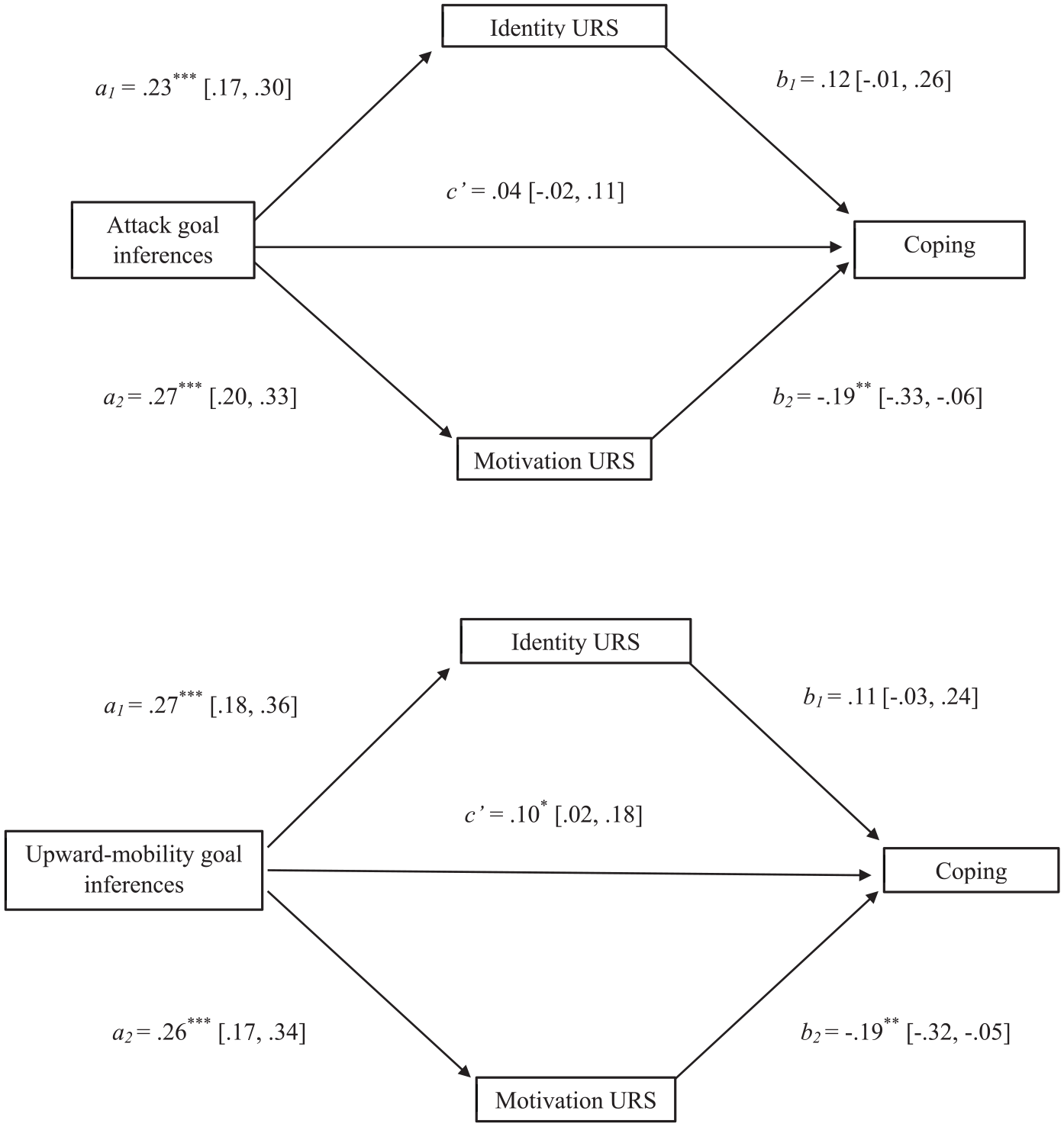
Parallel mediation models for attack and upward-mobility goal inferences.
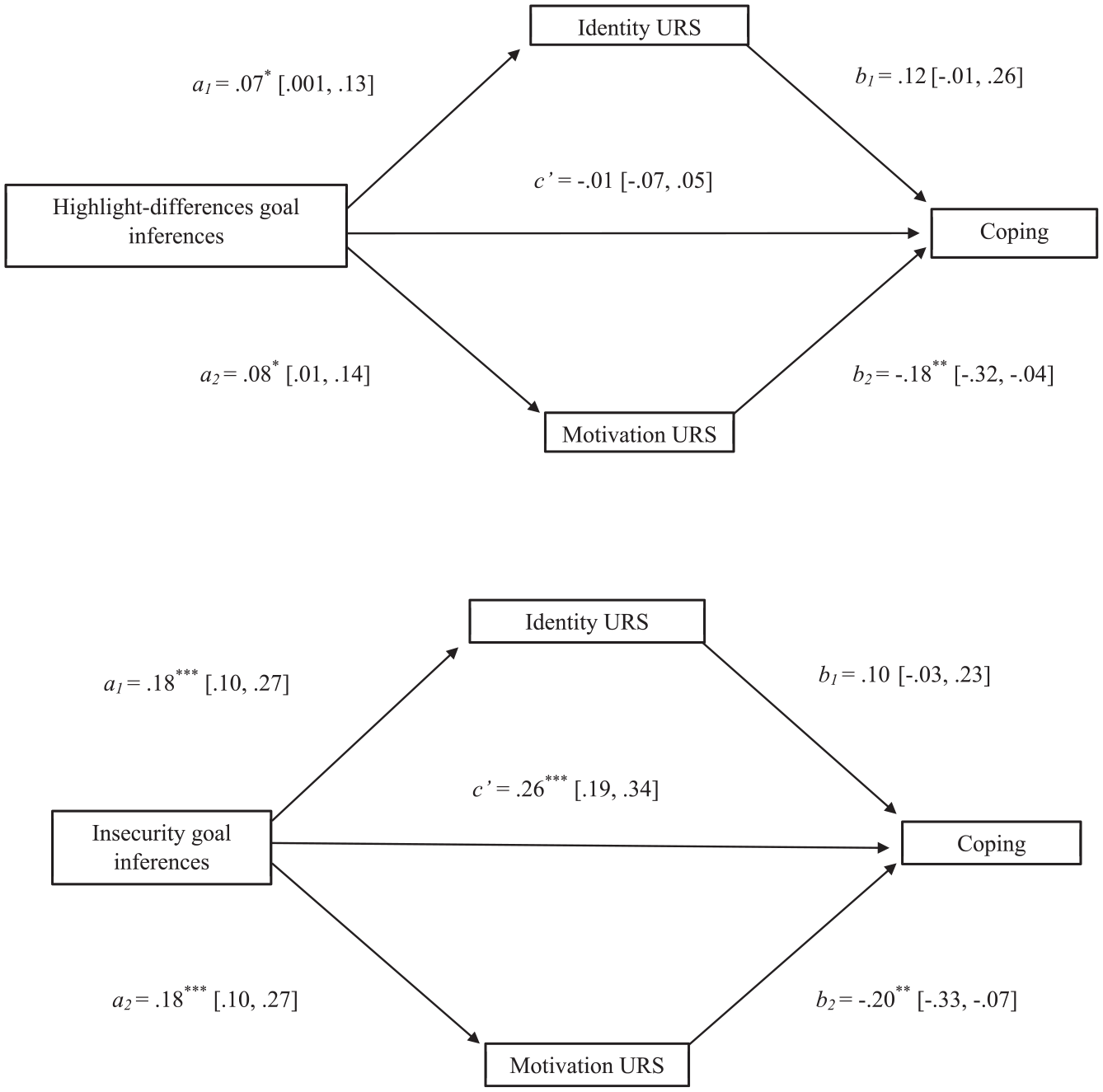
Parallel mediation models for highlight-differences and insecurity goal inferences.
H3 predicted that identity and motivation URS would mediate a positive association between goal inferences and coping. The first model employed attack inferences as the predictor. The indirect effect results were inconsistent with H3a as motivation URS mediated a negative relationship between attack inferences and coping (b = −0.05, 95% CI [−0.09, −0.02]) but not identity URS (b = 0.03, 95% CI [−0.00, 0.06]); the two effects were different (b = 0.08, 95% CI [0.02, 0.15]). Tests of H3b focusing on upward-mobility goals showed a similar pattern. Motivation URS mediated the relationship between mobility goal inferences and coping (b = −0.05, 95% CI [−0.09, −0.01]) but again not identity URS (b = 0.03, 95% CI [−0.00, 0.08]); the two effects were significantly different (b = 0.08, 95% CI [0.01, 0.16]). Testing H3c showed a similar pattern. Motivation URS mediated the relationship between highlight-differences goal inferences and coping (b = −0.01, 95% CI [−0.04, −0.001]), but again identity URS was not an effective mediator (b = 0.01, 95% CI [−0.002, 0.02]); the two indirect effects were significantly different (b = 0.02, 95% CI [−0.001, 0.06]). The final model employing insecurity inferences as the predictor was consistent with findings for the previous three goals and inconsistent with H3. Motivation URS mediated the relationship between insecurity inferences and coping (b = −0.04, 95% CI [−0.07, −0.01]), but not identity URS (b = 0.02, 95% CI [−0.005, 0.05]); the effects were significantly different (b = 0.06, 95% CI [.01, .12]). Overall, the findings for H3 indicate that only motivation URS mediated a negative relationship between goal inferences and coping in the unanticipated direction.
To answer RQ1, we ran a series of four PROCESS models 59 using 5,000 bootstrap resamples (Hayes, 2018), which tests for moderated mediation on all paths. For each model, one of the four goal inferences was the predictor variable (X), coping was the outcome (Y), identity and motivation URS were the mediators (M), and anonymity was the moderator (W). Power, popularity, uncertainty motivation, and self-esteem were control variables. The conditional direct effect of the first model looking at personal attack goal inferences was significant when the victims did not know the bully (b = 0.11, 95% CI [0.02, 0.20]) but not when they knew the bully (b = −0.03, 95% CI [−0.12, 0.06]). Both conditional indirect effects were not significant for identity URS (identifiable: b = 0.03, 95% CI [−0.01, 0.08]; anonymous: b = 0.02, 95% CI [−0.02, 0]). The conditional indirect effect for motivation URS was significant when the bully was anonymous (b = −0.06, 95% CI [−0.12, −0.02]), but not when the bully was identifiable (b = −0.03, 95% CI [−0.08, 0.03]); but these two effects were not significantly different in magnitude (b = −0.04, 95% CI [−0.11, 0.04]).
The conditional direct effects of the second model looking at upward-mobility inferences was significant when the victims did not know the bully (b = 0.13, 95% CI [0.02, 0.24] but not when they knew the bully (b = 0.04, 95% CI [−0.08, 0.16]). Further, both conditional indirect effects were not significant for identity URS (identifiable: b = 0.04, 95% CI [−0.02, 0.12]; anonymous: b = 0.02, 95% CI [−0.02, 0.07]). However, when individuals did not know the bully, motivation URS was a significant mediator of the relationship between upward-mobility goal inferences and coping (b = −0.05, 95% CI [−0.11, −0.01]), but not when the bully’s identity was known (b = −0.04, 95% CI [−0.10, 0.02]); the two effects were not significantly different (b = −0.02, 95% CI [−0.10, 0.06]).
For the model looking at highlight-differences inferences, both conditional direct effects were not significant (identifiable: b = −0.05, 95% CI [−0.14, 0.03]; anonymous: b = 0.02, 95% CI [−0.08, 0.10]) as well as conditional indirect effects for identity URS (identifiable: b = 0.01, 95% CI [−0.01, 0.04]; anonymous: b = 0.01, 95% CI [−0.01, 0.03]). However, motivation URS was a significant mediator when the bully was anonymous (b = −0.02, 95% CI [−0.06, −0.001]) but not when identifiable (b = −0.01, 95% CI [−0.04, 0.01]); the effects were of similar magnitudes (b = −0.01, 95% CI [−0.05, 0.02]).
For the final model looking at insecurity goal inferences, the conditional direct effects were significant when the bully was identifiable (b = 0.16, 95% CI [0.05, 0.26]) and when the bully was anonymous (b = 0.37, 95% CI [0.26, 0.47]). However, both conditional indirect effects were not significant for identity URS (identifiable: b = 0.03, 95% CI [−0.02, 0.09], anonymous: b = 0.02, 95% CI [−0.01, 0.05]). However, motivation URS was a significant mediator when the bully was anonymous (b = −0.04, 95% CI [−0.09, −0.01]) but not when the bully’s identity was known (b = −0.03, 95% CI [−0.09, 0.01]); the two effects did not significantly differ (b = −0.01, 95% CI [−0.07, 0.06]).
Overall, the results of RQ1 revealed that whereas the bully’s anonymity was not a significant moderator when identity URS was a mediator, anonymity tended to moderate the relationship between all four goal inferences on coping via motivation URS as a mediator. Specifically, when the bully was anonymous, as individuals increasingly inferred any of the goals, they engaged in increased motivation URS, which in turn led to decreased levels of coping; this tended to be the case when the cyberbully was anonymous.
RQ2
For RQ2, we asked whether coping mediates an indirect association between the four goal inferences and social attractiveness of the bully, when the bully is anonymous compared to when they know the bully. Four PROCESS model 59s using 5,000 bootstrap resamples and confidence intervals answered RQ2 with each goal inference serving as the predictor variable (X) for each respective model, interpersonal attraction as the outcome variable (Y), coping as the mediator (M), and anonymity as the moderator (W) with power, popularity, uncertainty motivation, self-esteem, hurt, emotional reaction, and perceived severity as controls.
All relationships were not significant for the highlight-differences goals model. The conditional direct effects of highlight-differences goals on interpersonal attraction were not significant both when victims knew the bully (b = −0.02, 95% CI [−0.08, 0.04]) and when the bully was anonymous (b = 0.04, 95% CI [−0.02, 0.10]). Both conditional indirect effects were not significant as well (identifiable: b = 0.001, 95% CI [−0.004, 0.01], anonymous: b = −0.01, 95% CI [−0.02, 0.02]). Conditional direct and indirect effects were likewise not significant for the model with upward mobility goal inferences (direct identifiable: b = −0.04, 95% CI [−0.12, 0.04]; direct anonymous: b = 0.06, 95% CI [−0.02, 0.14]; indirect identifiable: b = −0.00, 95% CI [−0.02, 0.004]; indirect anonymous: b = −0.01, 95% CI [−0.03, 0.003]). For personal attack goal inferences, the direct effects were significant for an identifiable bully (b = 0.09, 95% CI [0.02, 0.15]) but not an anonymous bully (b = 0.04, 95% CI [−0.03, 0.10]). The indirect effects of attack inferences on attraction via coping was not significant for identifiable bullies (b = −0.00, 95% CI [−0.01, 0.004]), whereas it was significant for anonymous bullies (b = −0.01, 95% CI [−0.03, −0.001]); the two effects were of equal magnitude. For insecurity goals, the direct effects were significant when the cyberbully was identifiable (b = −0.20, 95%CI [−0.28, −0.12]) and anonymous (b = −0.12, 95%CI [−0.21, −0.04]). Furthermore, the indirect effect of insecurity goal inferences on interpersonal attraction through coping was significant when the victim did not know the bully (b = −0.04, 95% CI [−0.07, −0.01]), but not when they knew the bully (b = −0.001, 95% CI [−0.02, 0.02]); the two effects were significantly different (b = −0.04, 95% CI [−0.07, −0.002]) demonstrating moderated mediation.
When the bully’s identity is anonymous, victims increasingly infer insecurity and attack goals leading to lower interpersonal attraction in part because victims have an increased ability to cope from inferring the goals, but not when victims know the cyberbully. Thus, inferring insecurity and personal-attack goals for an anonymous cyberbully predicts decreased social attraction to the bully overall via their increased ability to cope.
Discussion
Results revealed three general patterns. First, victims’ affective responses to cyberbullying differed across the four goals they inferred to interpret why bullies attacked them. Inferring upward-mobility and highlight-difference goals did not predict hurt, emotional reaction, or perceived severity; whereas inferring insecurity goals predicted increased hurt and negative emotional reaction regardless of the bully’s anonymity, and inferring personal attack goals was more hurtful, severe, and emotionally negative when victims knew the bully compared to anonymous bullies. This finding is consistent with GUT’s logic that goal inferences have unique implications. Goals are qualitatively different, and victims respond accordingly in other words. For instance, attack goal inferences are more personal relative to other goals, which might explain the moderation effect from an identifiable bully. Future research would gain strides by continuing to examine how victims understand and process messages in terms of goals and anonymity. Experimental work could manipulate goal inferences more directly, whereas survey research could track actual bullying episodes longitudinally. Either way, more data are needed to understand why some goal inferences produce unique outcomes for victims.
Second, inferring all four of the goals predicted decreased levels of coping via motivation (not identity) URS, which tended to be the case when the bully was anonymous. We had anticipated the opposite pattern with increases in coping via URS. One reason for this unexpected finding is that URS might generate more uncertainty when they fail to produce answers. In other words, maybe our method highlighted participants’ desire to reduce uncertainty but they never obtained additional data to actually reduce their anxiety from not knowing. If URS uncovered evidence to confirm inferences, then perhaps results for coping would have been consistent with our expectations. This rationale might also account for differences in our findings between identity and motivation URS, considering goal inferences are more closely connected to uncertainty about goals than identities. Getting bullied by identifiable others compared to anonymous sources seems less consequential for victims’ ability to cope. Likewise, being confident in a bully’s motives seems more consequential than seeking out a bully’s identity.
Third, inferences of the insecurity and personal-attack goals predicted decreased attraction to the cyberbully via increased ability to cope when the victim did not know the anonymous bully. Again, the other goals—highlight differences and upward mobility—produced no effects. Inferring goals about the dispositions of message sources (e.g., “they’re just insecure and trying to get back at me”) facilitates coping and reduced interpersonal attraction to an anonymous bully, in other words. Compared to inferring goals with status implications or goals focused on making fun of others, insecurity and personal attack goal inferences allow for victims to move on and deal with bullying, even when particularly uncertain about the bully’s identity. Perhaps shifting the reasons for why a victim is attacked to the psychology of bullies (and away from the target) is helpful for coping and not being interpersonally attracted to the bully. Indeed, being insecure might even precipitate gaining status and making fun of others’ differences, which suggests a need to examine goal hierarchies beyond 2-goal structures. Victims, for instance, might infer they are being sent hurtful messages because gaining status and highlighting differences goals facilitate insecurity goals (a 4-goal structure). Coping seems to be connected to goal inferences uniquely, in other words, providing meaning and context given qualitative differences among bullying goals. Again, research needs to continue examining the complexities of how victims interpret a bully’s goals in their attempt to find closure and move on. At the same time, we think our musing herein provide a strong theoretical springboard for continued effort along these lines. We next consider implications.
Theoretical and Practical Implications
Goal inferences matter for how bullies understand, feel about, and respond to bullying episodes and the source of the message. Personal-attack and insecurity goals are particularly painful to infer for cyberbullying, which is consistent with thematic analyses of actual bullying experiences (Mishna et al., 2009). A potential reason is that being the target of such bullying is likely to be formulated in particularly personalized ways that are less performative than the other two more easily dismissed goals (Machackova et al., 2013). That is, when victims understand bullying episodes to be about performing for others, they are no more affected in terms of hurt, severity, and emotionality. Cyberbullies who direct their hostility at victims to gain status or to make fun of someone’s differences do not seem to increase hurt, negative emotional reaction, or severity for victims. Thus, clinicians aiming to support cybervictims and mitigate suffering from being bullied might consider the way in which victims construe bully’s goals (Alipan et al., 2021). Shifting victims’ inferences away from personal-attack and insecurity goals and onto upward-mobility and highlight-difference goals might be useful strategies, akin to cognitive behavioral therapy trying to reduce intrusive thoughts. Though, more realistic settings and longitudinal methods will shed additional light on such recommendations for therapists.
At the same time, because all goal inferences predicted decreased levels of coping via increased use of motivation (not identity) URS, another implication is that goal inferences do not seem to be especially useful for coping with cyberbullying episodes. Indeed, results suggest that goal inferences increase uncertainty for victims given confidence requires more diagnostic data than generating inferences does. However, although victims employ URS to reduce that uncertainty, they still report being less able to cope. The desire to uncover information about the bully’s true goals was not helpful for coping, in other words, and in fact predicts reduced coping. One reason for this finding might be rumination or not being able to just let it go, which interferes with coping and prevents the use of more positive cognitive distractions, as found in cross-sectional survey research (Parris et al., 2022). Also consistent with our findings, helplessness and confronting potential bullies were associated with increased depression, whereas seeking social support was associated with reduced depression, in a longitudinal study (Machmutow et al., 2012). Indeed, those wanting to help victims cope might reduce the extent to which victims focus on and seek to learn the accuracy of the reasons motivating the cyberbully, especially when inspecting overall correlations in Table 2. To reduce the negative consequences of inferring goals on coping, social support providers might focus on affirming victims’ goal inferences to reduce their desire to uncover the bully’s motivation, as internalizing behaviors like seeking information to confirm inferences seems to be ineffective for coping; yet, because not all goal inferences are the same, one might still avoid encouraging some goal inferences given their other unique outcomes. This recommendation seems to be consistent with advice based on reports of actual bullying episodes (Brandau & Rebello, 2021). That is, clinicians can help victims disconnect from social media and try to not to ruminate about the bullying episode.
Indeed, a final implication focuses on inferences of insecurity goals and their potential unique utility in victims’ ability to cope with cyberbullying in terms of social attraction to the bully. When victims inferred insecurity goals, they were increasingly able to cope, which in turn reduced the extent to which they found an anonymous bully socially attractive. This mediation path did not emerge when victims knew the cyberbully, however. This moderated mediation was not the case for upward-mobility goal inferences, which does not replicate past work that is consistent with the same prediction in iMessage among anonymous others versus friends (Palomares & Wingate, 2020). This inconsistency is likely due to the addition of the new goals herein, as past work included measures of personal-attack and upward-mobility goals only. Regardless, therapeutic advice for victims aiming to cope with bullying might be to focus on insecurity goals to explain the bully’s motives, as such inferences seem to increase coping, which reduces affinity to the bully, if they are anonymous. These findings jibe with a network analysis of middle and high school students demonstrating that bullying manifests in ways to increase one’s reputation in a social network by targeting friends and friends of friends more than strangers (Faris et al., 2020); at the same time, our data suggest that such attacks are ineffective from victims’ perspective if bullies are identifiable and motivation URS can be counterproductive in coping. Again, we suggest continued effort on how victims interpret cyberbullying and cope with it as a means to disrupt pathways from being victimized and resulting in poor mental health.
Limitations
Two noteworthy limitations center around our experimental method and minimal focus on individual differences. In terms of method, we employed a contrived bullying scenario asking participants to imagine receiving a hypothetical message. This design allowed us to ethically study bullying without actually attacking participants, but it likewise limited the magnitude of our effects. Indeed, effect sizes are small. Longitudinal research employing actual recalls of bullying in terms of the goal understanding and coping processes involved in legitimate hostile episodes will help address such restrictions with our data. Such research will also demonstrate causal connections of our mediation paths, which are correlational other than moderation from anonymity. A second limit is we controlled for minimal individual differences and did not test how participants’ depression or friend/support networks for instance might moderate goal understanding processes. At the same time, we controlled for self-esteem, demonstrating effects beyond what that self-perception might account for. Yet as seen in Table 2, self-esteem inversely predicts many of the perception measures such as coping and severity. Thus, future research would benefit from considering how self-esteem and other predispositions moderate the effects of anonymous cyberbullying. Victims with high self-esteem might find bulling messages less self-applicable/credible and therefore can cope more easily than those with lower self-esteem.
Conclusion
To sum across implications, we should affirm insecurity goal inferences to help victims overcome bullying so they reduce their motivation uncertainty and how much they employ motivation URS (e.g., “Yup, they incredibly insecure. Maybe we should stop searching online, cuz you definitely right”). Fostering confidence in such goal inferences will help victims cope and be less attracted to anonymous cyberbullies. Affirming personal attack goal inferences might provide similar outcomes, whereas highlight difference and upward mobility goal inferences might not. Our recommendations emerge from data that transcend unique operationalizations of anonymity across nine social media platforms. Of course, continued research needs to confirm such clinical advice, especially with alternative methods that are less contrived than experimental work, though our results echo findings from non-experimental work, as discussed above. Methodological triangulation with longitudinal diary research, for instance, will prove fruitful to explain how victims interpret, respond to, and cope with cyberbullying in order to build effective interventions to mitigate the negative consequences for mental health.
Footnotes
Declaration of Conflicting Interests
The authors declared no potential conflicts of interest with respect to the research, authorship, and/or publication of this article.
Funding
The authors received no financial support for the research, authorship, and/or publication of this article.
