




Abstract
This study compares two explanations why some journalists are targeted more than others, both by general digital hostility and specifically by identity-based hostility, job-related hostility, and severe hostility such as threats and repeat offences. The first explains targeting by identity, especially of historically disadvantaged groups such as women and migrants; the second explains targeting by celebrity: journalists with larger audiences, greater social media presence, more television work, and focus on political coverage are targeted more. A Swiss survey of 568 journalists shows that celebrity mainly explains targeting with general hostility, whereas the effects of identity vary for different types of hostility. Additional interactions suggest that historically disadvantaged groups tend to experience more digital hostility, but only with increasing celebrity capital. This study emphasizes how hostility types differentiate explanatory values. Further, it contributes an innovative celebrity explanation and demonstrates how interactions can illuminate the tangled relation between identity, visibility, and hostility.
Journalists are particularly often targeted by hostile messages via public and nonpublic digital channels (Binns, 2017; Gardiner, 2018; Nilsson & Örnebring, 2016). However, some journalists seem to be regularly flooded with hostile messages, while others are largely spared. Which journalists are more often targeted, and why? The answer matters because digital hostility can cause emotional and professional damage and harm journalists’ social and economic capital (Tandoc et al., 2021). If the experience of hostility is not randomly distributed but focused on particular social characteristics, the long-term loss of these groups and their perspectives from journalism can threaten press freedom. Research literature on the topic advances two broad explanations for these hostility patterns. One explanation is that the bulk of hostility is directed at historically disadvantaged groups, such as women and ethnic and racialized minorities (e.g., Waisbord, 2020). This is implied, for example, by an abundance of qualitative studies on digital hostility against female journalists (Chen et al., 2018; Koirala, 2020; Miller & Lewis, 2022; Tandoc et al., 2021), whereas equivalent studies explicitly focusing on men are lacking. Although some of the few more systematic, quantitative studies can confirm such identity differences (Binns, 2017; Miller, 2023), others cannot (Nilsson & Örnebring, 2016). The second explanation, supported by other findings, suggests that more visible journalists might experience more hostility (e.g., Duffy & Hund, 2019; Nilsson & Örnebring, 2016). Furthermore, it is conceivable that identity and visibility reinforce each other: Journalists from disadvantaged groups may be more likely to be targeted the more visible they are.
Previous studies, despite their great added value, have provided hardly any theory-based predictions about the parallel effects of identity and visibility on the frequency of digital hostility, including systematic quantitative tests. Moreover, interaction effects have not yet been investigated. These research gaps are consistent with the general lack of theories of press hostility lamented by researchers (e.g., Miller, 2021).
Accordingly, this study provides theory-based predictions of target frequency that incorporate identity and so-called celebrity capital, describing the “accumulated media visibility that results from recurrent media representations” (Driessens, 2013, p. 543). The first proposition, inspired by social role theory and stereotypes (Eagly & Karau, 2002; Rudman et al., 2012; Stephan & Stephan, 2013), predicts that those with socially and economically disadvantaged identities, such as women and those with migrant backgrounds, are targeted more often than the majority identities because they threaten traditional social hierarchies. The second proposition predicts that the more celebrity capital journalists have, the more often they are targeted (Driessens, 2013; Goldhaber, 1997). It assumes that in a media environment where information is abundant, it is the position of the target within the larger attention-generating structures that is critical rather than the characteristics of the target. In addition, interactions are examined. This study predicts that the relationship between celebrity capital and digital hostility is stronger among representatives of disadvantaged groups than among their counterparts. Digital hostility pushes formerly disadvantaged groups that become too visible, and thus powerful and threatening, back to less visible and less powerful positions (Eagly & Karau, 2002; Rudman et al., 2012). These predictions are empirically tested in multivariate regressions, including various identity and celebrity indicators, using data from a trilingual nationwide survey of 568 journalists in Switzerland. Because it is conceivable that some effects may vary depending on the nature of the hostility, all analyses are conducted for general digital hostility and for two types of hostility related to content, identity-related and work-related, and one format-related type: severe hostility including threats and repeat offenders.
Theory
Digital Hostility Against Journalists and Its Subtypes
Digital hostility here refers to verbal messages that receivers consider to be “vulgar, pathologizing, inappropriately generalizing, disparaging, offensive, and threatening” (Stahel & Schoen, 2020, p. 2). These messages are received through technologically mediated channels, including any type of electronic application, whether online or through the mobile network. They can occur publicly in social media and commentary sections or privately by email, text message, or phone. Digital hostility can be distinguished from merely negative comments by its pejorative and threatening tone.
This study distinguishes three types of hostility. The first type devalues the target’s identity by attacking their group membership, such as sexism or racism. The second type devalues professional aspects of the target’s work, such as their job performance. The third type is particularly severe, for example, because it contains threats or comes from repeat offenders. To date, explicit theoretical categories of hostility are rare in the literature on journalists (for exceptions, see Miller, 2023; Miller & Lewis, 2022). The types presented here are therefore inspired by observing recurrent forms of hostility that are somehow related to identity (Nilsson & Örnebring, 2016), involve devaluation of individual’s professional abilities (Miller, 2023), or seem particularly severe (Binns, 2017; Gardiner, 2018; Nilsson & Örnebring, 2016). This study thus understands digital hostility as an umbrella term for online incivility, cyberbullying, online hate speech, online stalking, and similar acts.
An Identity Explanation of Digital Hostility
It is usually claimed that the journalists most likely to face hostility are the historically disadvantaged groups. Two social groups are highlighted: historically disadvantaged gender groups, usually women, and minorities associated more broadly with concepts of race, racism, or xenophobia, including foreigners, people of migrant background, and ethnic and racialized minorities such as people of color. Their higher probability of being targeted is indirectly illustrated by a large number of qualitative studies, particularly on women, that examine their corresponding experiences (Adams, 2018; Chen et al., 2018; Koirala, 2020; Miller & Lewis, 2022; Tandoc et al., 2021). In contrast, there is a lack of studies that exclusively examine the experiences of the advantaged equivalents. Preliminary sparse quantitative evidence confirms such disadvantageous differences for women (Binns, 2017; Miller, 2023).
Theoretically, such unevenly distributed gendered and racialized experiences of digital hostility could be explained by existing social inequalities that produce and are fueled by the unequal treatment of different social groups. Historically formed systems advantage some groups over others in social, legal, and economic terms, manifesting in inequalities in family, work, and education. The resulting differences are legitimized by cultural beliefs. For example, the female gender is usually less valued in binary gender hierarchies, as are ethnic minorities in ethnic hierarchies. Through socialization, individuals adopt these cultural stereotypes and prejudices (Quillian, 1995; Swim et al., 1995). In particular, groups that are seen as a threat by a dominant group can experience hostile discrimination (Stephan & Stephan, 2013). Because journalists play a central power-shaping role in society by framing discourses, influencing political agendas, and legitimizing representations of the social world (Couldry, 2003), journalism could be a public profession in which disadvantaged groups are perceived as a particular threat. Journalists occupy semipublic positions in which, similar to politics and business, men, Whites, and nonmigrants are traditionally over-represented (Eagly & Karau, 2002; Lowe, 2013; Scharrer, 2013). The autonomous public engagements of disadvantaged groups challenge power relations by claiming resources and influencing the dominant meaning system. Consequently, hostility not only represents “citizen vigilantism to discipline journalism” (Waisbord, 2020, p. 1) but also penalizes disadvantaged groups to enforce social hierarchies (Rudman et al., 2012). This reasoning leads to these two hypotheses:
H1. Female journalists are more frequently targeted with digital hostility than male journalists.
H2. Journalists with migrant backgrounds are more frequently targeted with digital hostility than journalists without migrant backgrounds.
However, some studies find that advantaged and disadvantaged groups are equally likely to be targeted or even that men are more likely to be targeted than women (Nilsson & Örnebring, 2016; Preuss et al., 2017). Others suggest that organizational and professional factors are more important than journalists’ gender in predicting external interference (Hiltunen & Suuronen, 2022). These mixed results open a space for consideration of factors and mechanisms other than identity.
A Celebrity Capital Explanation of Digital Hostility
The main proposition introduced in this section is that journalists with more celebrity capital are targeted more often than those with less capital. This argument develops from the notion that modern societies are socially differentiated into specialized fields of social relations that structure social action, such as politics, economics—and journalism (Bourdieu, 1993). Within these fields, individuals called agents, such as journalists, compete for hierarchical, dynamically changing positions. To advance in any field, capital is required (Schultz, 2007). This study focuses on celebrity capital. People who attract more attention and are recognized more have more of it (Driessens, 2013). As a result, they are considered more successful and influential than those who do not. And although celebrity capital today can be acquired more easily and by more people outside professional media and entertainment (Webster, 2014), celebrity capital is still highly unequally distributed. Today’s media are overloaded with information, but the attention of media users is limited; consequently, institutions, media, and individuals compete for this scarce resource (Goldhaber, 1997; Webster, 2014). For example, recommendation systems on newspaper and social media platforms push popular content and thus serve as “lenses” through which audiences perceive and respond to the media environment, often unconsciously (Webster, 2014, p. 3). This attention logic has resulted in a common public sphere in which most people typically circulate between the most popular and salient media offerings (Webster, 2014; Webster & Ksiazek, 2012). In this environment, individuals that stand out attract the most attention and are seen as more significant, while the rest are quickly forgotten. They are rewarded with money and power (Goldhaber, 1997), but they also become the object of control and surveillance (Driessens, 2013).
This study argues that this hierarchy of fame translates directly into a hierarchy of hostility among journalists. Journalists, as agents, compete for the few prominent positions available in the field of journalism. When they succeed, they are rewarded with social networks, money, and social influence, but they also increase their surface for hostile attacks from the audience. Assuming an information-overloaded environment (Goldhaber, 1997; Webster, 2014) and boundedly rational individuals using heuristics to prioritize the information to which they pay attention (Gigerenzer & Gaissmaier, 2011), audience members motivated to be hostile focus on the most prominent personalities who are brought to their attention. Attacking them also promises social recognition, because hostile comments against more famous personalities promise more replies, sharing, and likes from other users.
Given the general vagueness of the celebrity concept in the literature and its diverse definitions (Driessens, 2013), this study proposes not one but four indicators of journalists’ celebrity to test and strengthen the robustness of the argument. Because no indicators of celebrity capital have yet been defined for journalists, the following selection is to be understood as a first proposal. All of the indicators selected determine how much attention journalists receive from their audience and/or how much they are recognized by them. Because the audience is the starting point of hostility, this excludes celebrity, which exists only within the journalistic profession but is not perceived from outside, that is, the position of the audience.
Size of Audience
The size of the audience is a reliable sign of how much attention journalists receive. It can represent both individual capital, such as social media followers for noninstitutionally embedded influencers (Hess et al., 2022), and organizational capital, which spills over onto embedded individuals. The size of an individual journalist’s audience is very dynamic and difficult to determine, especially for printed newspapers. Therefore, an organization’s reach, as indicated by metrics such as newspaper copies sold, is a more reliable indicator of how much attention the average journalist receives. Journalists working in media organizations with a greater reach are rewarded accordingly by having their published content seen, read, and heard by more people (Hovden & Knapskog, 2015). They attract both more attention and more hostility.
H3. The more celebrity capital that journalists gain through attracting a larger audience, the more frequently they are targeted with digital hostility.
Social Media Presence
Journalists with a stronger social media presence attract more attention. On social media, people can turn into “micro-celebrities” (Marwick & Boyd, 2011) by liking content, sharing links, bonding with others emotionally, and participating in debates (Marwick & Boyd, 2011, p. 127). The number of such social interactions is crucial for building celebrity capital online (Labrecque, 2014). Platform algorithms typically prioritize the clicks and likes of interactions, thereby amplifying attention. Many public professions today demand social media presence, and their representatives embrace social media to differing degrees (Molyneux et al., 2019). Those constantly engaging on social media can benefit from it, but their exposure also attracts hostility.
H4. The more celebrity capital that journalists gain through strong social media presence, the more frequently they are targeted with digital hostility.
Working for Television
Celebrity status is further enhanced if journalists work for television. Although the types of media have diversified, television is still a highly popular media channel, accounting for about half the time people spend with media (Webster, 2014). Whoever produces content for television and particularly whoever appears on it is able to attract the great bulk of attention. Its audiovisual format discloses many personal characteristics of journalists. It makes audiences to feel more familiar with television journalists and cultivates them as celebrities (Bainbridge & Bestwick, 2010, p. 207). However, journalists are also likely to become a screen for hostile projections (Miller & Lewis, 2022). Even more strongly than photo bylines do to columnists (Nilsson & Örnebring, 2016), the television format thus invites hostility (Chen et al., 2018; Lewis et al., 2020).
H5. The more celebrity capital that journalists gain through working for television, the more frequently they are targeted with digital hostility.
Publishing on Political Topics
Finally, journalists who cover politics have greater celebrity capital because they are traditionally at the top of the journalistic hierarchy of attention. Generally, news stories are placed differently in this hierarchy (Schultz, 2007, p. 195). Journalists covering political issues, so-called hard news including political leaders, breaking political events, and society-disrupting scandals, tend to be ranked at the top of the newsroom ladder (Hovden & Knapskog, 2015). By embodying the democracy-related journalistic ideal of monitoring those in power, political journalists have more potential for sociodemocratic impact and transformative power (Hovden, 2012; Schultz, 2007). They are therefore more often listened to and recognized. Some of the most well-known “celebrified journalists” are thus political journalists (Olausson, 2018, p. 2379). Initial evidence suggests that a variety of political news topics including government inefficiency, immigration, defense, foreign policy, and politicians may indeed attract hostile press comments (Salminen et al., 2020). This argument is supported by the phenomenon that celebrities also engage in politics to benefit from the visibility of political elites and thus increase their power status; consequently, they expose themselves to public criticism. Conversely, journalists who report on soft topics such as human interest, culture, family, health, and science and technology are lowest in the hierarchy (Hovden & Knapskog, 2015) and have the least capital. They are therefore at lower risk of being targeted.
H6.1. The more celebrity capital that journalists gain through publishing on political topics, the more frequently they are targeted with digital hostility.
H6.2. The less celebrity capital that journalists gain through publishing on soft topics, the less frequently they are targeted with digital hostility.
Interactions Between Identity and Celebrity
Social role theory and stereotyping (Eagly & Karau, 2002; Lowe, 2013; Rudman et al., 2012) suggest an interaction between identity and celebrity. Gender role theory posits that the perceived appropriate behavioral norms associated with gender roles for women and men determine public perceptions and responses to whether women or men seek leadership positions. Women in high status positions are at odds with stereotypical feminine characteristics, which are normally associated with lower status. Their behavior thus violates gender role expectations, for which they experience a backlash: they are devalued. Empirical literature confirms this (Eagly & Karau, 2002; Rudman et al., 2012). For example, female politicians are more likely to be attacked on Twitter than male politicians, but only if their large number of followers render them very visible (Rheault et al., 2019). The same role incongruity logic has been observed with other disadvantaged-identity groups (Lowe, 2013; Quillian, 1995).
Consistent with this argument, the relationship between celebrity capital and digital hostility is expected to be stronger among representatives of disadvantaged groups than among their counterparts. Disadvantaged group members in influential journalistic positions endowed with celebrity capital and thus with the characteristics of majority groups are perceived as violating traditional social roles. Their perceived threat should be even stronger than it is in the semipublic position of the average journalist because their role incongruity is even more obvious. Here, hostility enforces traditional social roles and hierarchies and should intensify against disadvantaged journalists with strong celebrity capital. In contrast, disadvantaged journalists with little celebrity capital are viewed as role-congruent and thus as less threatening. This reduces, and possibly even reverses, the difference between the hostility they experience and that experienced by their advantaged equivalents (for the interaction model, see Figure 1).
H7. Journalists’ identities and celebrity capital interact, such that journalists with historically disadvantaged identities such as females and migrants with strong celebrity capital are targeted more frequently than equivalent journalists with historically advantaged identities such as males and nonmigrants with comparable capital. Conversely, journalists with historically disadvantaged identities and low celebrity capital are targeted similarly frequently or less frequently than equivalent journalists with historically advantaged identities with comparable capital.
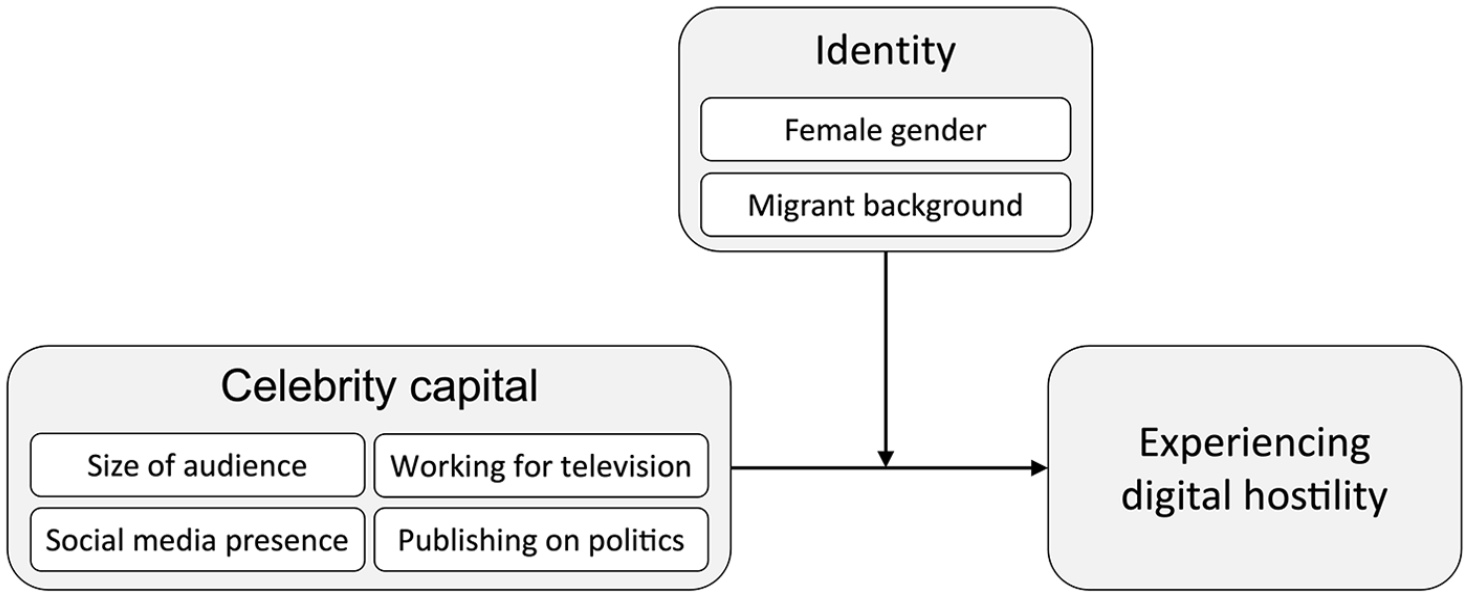
Explanatory model of the interaction between journalists’ identity and celebrity capital on the frequency of digital hostility experiences.
Data and Method
Data
The hypotheses were tested with an online survey of journalists in Switzerland (the following description of the data collection is inspired by a study by Stahel & Schoen, 2020). The survey data was collected from July to October 2017. Self-reported survey data have the advantage over observing real-world instances of hostility that they capture hostility through private channels that would otherwise remain invisible to researchers. Accordingly, of all journalists surveyed, 41% were publicly attacked, including comment columns and online forums, and 48% were attacked through private channels such as email, phone, and text messages (12% exclusively through private channels). In addition, self-disclosure allows journalists to decide which messages they find hostile, against the backdrop of managing their boundaries of their journalistic profession. As the context governs whether any particular utterance is interpreted as hostile or not, for instance as ironic, it is assumed that the journalists involved in the communication can assess this context better than researchers.
The population includes employed and freelance journalists from print and online newspapers and magazines, television and radio, and news agencies, in all three major language regions of Switzerland: German, French, and Italian. Journalists who worked mainly in advertising and public relations or who had retired were not considered. Dingerkus et al. (2018) estimated the number of journalists in Switzerland in 2017 at a maximum of 10,500 journalists. To reach as many journalists as possible, the invitation to the survey was distributed via two channels. First, the survey was sent out in all three national languages by email to all members of the four largest Swiss professional associations for journalism (overall 7,877 journalists). As journalists have to be officially registered with one of the associations, this is a common way to identify them and invite them for surveys. To increase the response rate, the Swiss journalist database Renteria was also used. There, 6,062 journalists were registered, all of whom were contacted. However, the two samples overlap to a considerable extent. This second step therefore consisted of a reminder to those journalists registered with an association who had not yet participated and a first invitation to those who were not registered with any association.
Finally, 637 journalists took part in the survey. The response rate is 8%, calculated as a proportion of all association-registered journalists. A total of 568 journalists were included in the analysis because they provided no missing values on the variables included. The characteristics of the sample broadly correspond to those of a study by Dingerkus et al. (2018) characterizing the journalist population in Switzerland (see Appendix A).
Measurements
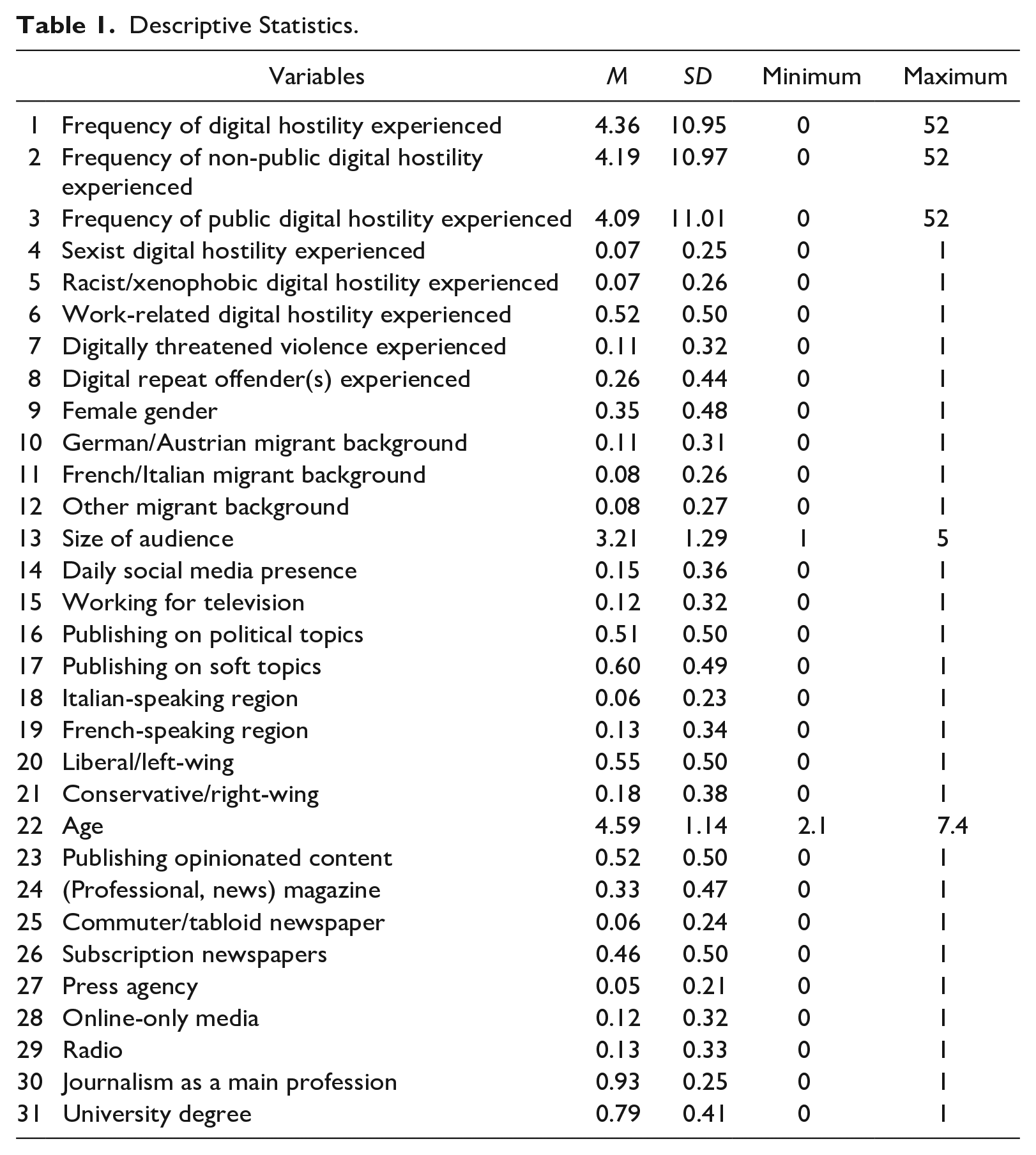
The questionnaires provided to the author by Preuss et al. (2017) and Nilsson and Örnebring (2016) on similar topics inspired some of the operationalizations chosen in this study. All the variables rely on journalists’ self-reports. The journalists were instructed to think of the 12 months prior to the survey when answering questions about the following variables. The descriptive statistics for all variables can be found in Table 1, and the survey questions for the outcome variables and variables of interest are in Appendix B.
Descriptive Statistics.
Outcome Variables
Frequency of digital hostility experienced measures how often journalists and/or their journalistic content were attacked via digital channels by “offenses, threats, and aggressive, vulgar, pathologizing, or generalizing statements that are inappropriately disparaging” (Stahel & Schoen, 2020, p. 11). This definition is intended to provide a common interpretation of hostility. However, some interindividual variance must be tolerated. This is because phenomena such as hate speech and aggression are interpreted depending on the context and prevailing individual and social norms. However, journalists’ categorization of messages as hostile is expected to reflect social norms for journalistic autonomy. The categorical regularity of hostility reported by journalists was recoded into a count variable, that is, the number of hostilities in the last 12 months. Some 47% of journalists were never targeted, 11% once per year (=1), 14% once in 6 months (=2), 15% once in 3 months (=4), 8% monthly (=12), and 5% at least weekly (=52 times per year).
The type of digital hostility was measured by asking the journalists about the content of the hostility they had received. Journalists indicated this on a predefined list of dimensions of hostility. Theoretical considerations and a factor analysis of these responses were used to define three main types: (1) identity-based hostility, which includes the separate subtypes of sexist messages and racist/xenophobic messages; (2) work-related hostility, which comprises messages devaluing journalists’ journalistic competence, mental judgement, and political orientation and accusing them of being “the lying press”; and (3) severe non-identity-related hostility. This includes the separate subtypes of receiving threats of nonsexual violence and vandalism and being targeted by the same offender over a relatively long period of time (>1 month) or more than three times.
Variables of Interest
Identity is measured by two variables: female gender and having a migrant background. The latter describes whether journalists or their parents or grandparents immigrated to Switzerland from another country or not. Migrant background is a widely used category in European surveys and, unlike people of color, for example, promises sufficiently large categories to allow for meaningful multivariate inferential statistics. To depict the migrant background in a nuanced manner, three variables are distinguished, based on spatial and cultural proximity to neighboring countries and the size of the migrant group. German/Austrian refers to those migrants from the German-speaking neighboring countries of Germany and Austria. They represent the largest migrant group (11% of journalists). Studies show that prejudiced and xenophobic feelings against Germans are widespread in Switzerland because German migrants, despite their cultural closeness, are seen as a threat to Swiss culture and jobs (Helbling, 2011). Italian/French reflects the smaller group of those having immigrated from the other neighboring countries of France and Italy (8% of journalists). Other includes the journalists from all the remaining and culturally more distant countries (8% of journalists). For the interaction analyses, this categorical variable is dichotomized into with migrant background or without.
Four variables measure celebrity capital:
Size of audience measures media reach: how large the audience is of the organization for which the journalist mainly works. For radio and television, these are the listeners or viewers per day, for print media the readers per issue, and for online media the unique users per day. Overall, 13% of journalists were part of an organization with a reach of 1 to 10,000 people (=1), 20% of 10,001 to 50,000 people (=2), 16% of 50,001 to 100,000 people (=3), 35% of 100,001 to 500,000 people (=4), and 16% of 500,001 to 5 million people (=5). For the interaction analyses, this categorical variable is dichotomized. A large audience refers to a reach of more than 100,001 and a small audience refers to a reach of up to 100,000 people.
Daily social media presence measures whether journalists published content or participated in discussions on their public or semipublic social media profiles at least once daily, compared to those who do so less frequently.
Working for television is measured by the proxy variable whether journalists worked for television. Although not all journalists working for television necessarily appear on the screen, one can expect that, on average, their overall celebrity capital is higher than those working for other media types.
Publishing on political topics measures whether journalists reported publishing regularly on political issues, choosing from a list of 13 topics. Publishing on soft issues serves as an additional validation of the effect of political topics, although opposite effects can be expected.
The analysis additionally controls for some sociodemographic and professional factors (see overview in Appendix C).
Analytical Strategy
The frequency of experiencing digital hostility is regressed on the identity, celebrity, and control variables and the respective interactions. Multivariate negative binomial regressions are used, which is consistent with the structure of the dependent variable, the frequency of journalistic experience of digital hostility. It is treated as a count variable with an overdispersed negative binomial distribution because its variance is larger than its mean. The negative binomial regression is also a better fit than a Poisson model, as a likelihood ratio test shows. As an additional analytical step, celebrity capital is logistically and negative binomially regressed on the identity variables to exclude any indirect effects of identity on hostility through differences in celebrity capital. The experience of being targeted by types of hostility is logistically regressed on the identity, celebrity, and control variables and the respective interactions. The estimated effect sizes of all interactions are presented as predicted average marginal effects. They represent the estimated frequency in negative binomial regressions or probabilities in logistic regressions of experiencing hostility, controlling for other variables. Multicollinearity problems are also controlled for. The highest correlation was between Liberal/left-wing and Conservative/right-wing (−0.51), so multicollinearity can be excluded.
Results
Effects of Identity and Celebrity Capital on Digital Hostility
These results are depicted in full in Appendix D (see also Figure 2).
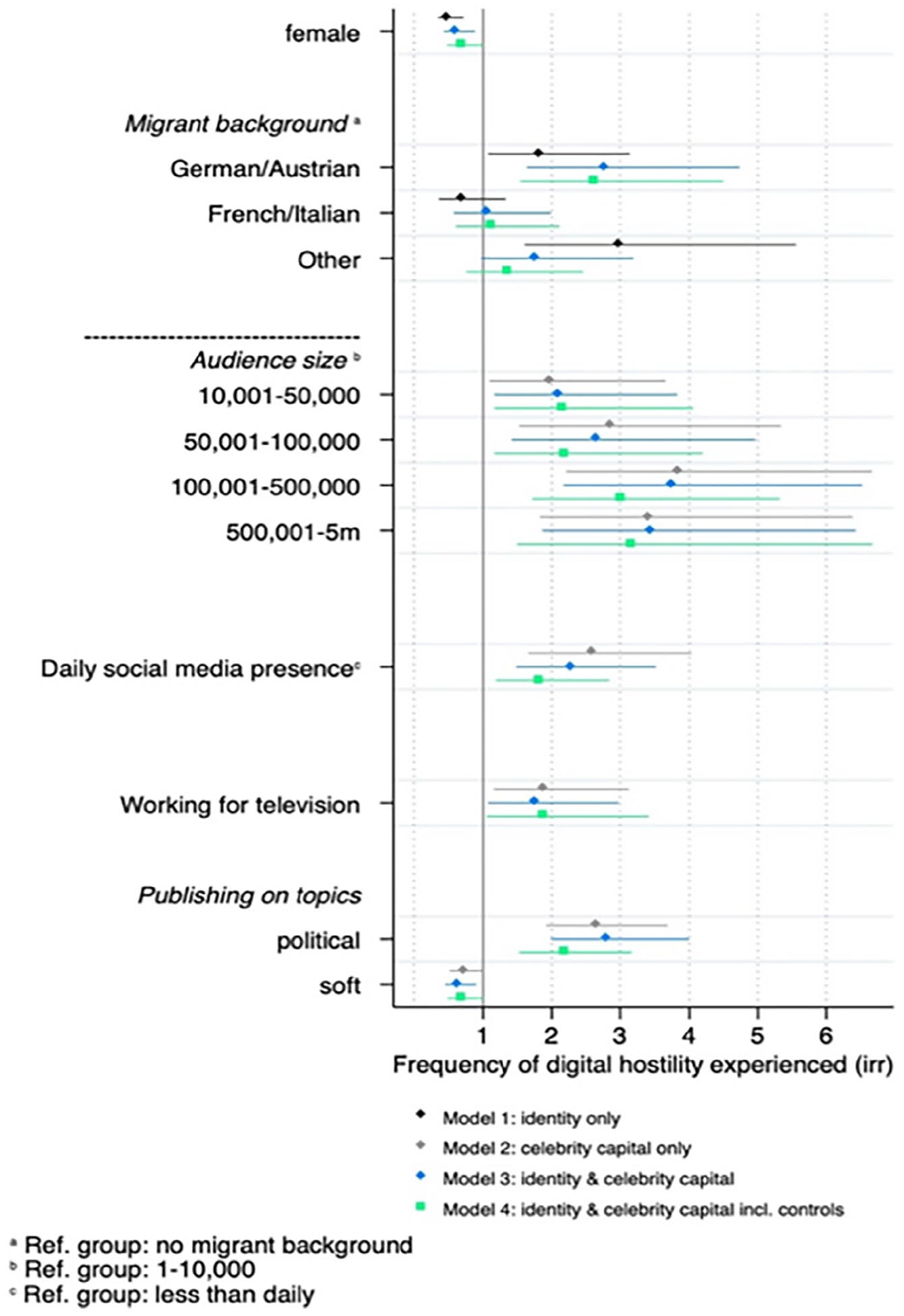
Negative binomial regression effects on digital hostility experiences by identity and celebrity capital.
Identity Hypotheses
The identity hypotheses are only partially supported by the binomial regression results, which even find opposite effects. Contrary to H1, female journalists are targeted less often than male journalists. This difference is strongest (IRR = 0.50, z = −3.78, p = .000) when only considering identity variables (Model 1: Deviance R2 = 5.4%, LR χ2 (4, N = 568) = 28.97, p < .001). The inclusion of the celebrity capital variables (Model 3: Deviance R2 = 20.7%, LR χ2 (12, N = 568) = 119.23, p < .001) and the control variables (Model 4: Deviance R2 = 27.0%, LR χ2 (26, N = 568) = 160.73, p < .001), successively weakens the effect (IRR = 0.69, z = −1.96, p = .05). Accordingly, a typical female journalist is attacked about 3.5 times per year, whereas a typical male journalist is attacked nearly five times, meaning female journalists experience around 30% less digital hostility.
H2, dealing with migrant background, is only partially supported. Migrant journalists experience more hostility than nonmigrant journalists. In the full model (Model 4), this effect is highly significant for those with a German or Austrian background (IRR = 2.64, z = 3.57, p = .000) but not significant for a French or Italian background (IRR = 1.13, z = 0.38, p = .701) or other backgrounds (IRR = 1.36, z = 1.03, p = .301). A typical nonmigrant journalist is attacked about four times a year; a typical migrant journalist from Germany or Austria experiences about two and a half times as many hostilities, a journalist with a French or Italian background about one tenth more, and a journalist with another background about one third more. Compared to the model considering only the identity variables (Model 1), this full model appears to strengthen the effect of German or Austrian background (Model 1, IRR = 1.83, z = 2.22, p = .027), reverse the initially negative effect of French or Italian background (Model 1, IRR = 0.69, z = −1.10, p = .273) and weaken the effect of other backgrounds (Model 1, IRR = 2.99, z = 3.46, p = .001). However, these effects should be viewed with caution, because characteristics that only a few individuals exhibit (e.g., 43 individuals with French/Italian backgrounds and 45 with other backgrounds) may widen confidence intervals and reduce precision.
Discussions on intersectionality and the interactive nature of disadvantage (Sidanius & Veniegas, 2013) raise the possibility that hostility multiplies as a result of identity stigmas, so that female journalists with migrant backgrounds experience more hostility than any other combination of gender and migrant background. This is not supported (IRR = 0.53, z = 3 − 1.63, p = .104; see Figure in Appendix E). Adverse effects are observed for migrant background, but in combination with male gender. The hostility experienced by women journalists hardly varies with migrant status. Conversely, men experience only as little hostility as women if they do not have migrant backgrounds. If they do, they typically experience about twice as much hostility.
Celebrity Capital Hypotheses
The celebrity capital hypotheses are consistently and strongly supported. All effects are relatively stable, from the model with only the celebrity capital variables (Model 2: Deviance R2 = 16.3%, LR χ2 (8, N = 568) = 92.28, p < .001) to the full model (Model 4). Therefore, only the effects of the full model are discussed below. As expected in H3, those with larger audiences are targeted more often. A typical journalist working for an organization reaching 500,000 to five million people is targeted five to six times per year (Model 4, IRR = 3.16, z = 3.03, p = .002), whereas one working for an organization reaching only 1 to 10,000 people is not even targeted twice. Overall, the variance increases with increasing audience size, suggesting that frequency is harder to predict for journalists with larger audience sizes.
Further, those journalists with a strong social media presence are targeted online more often than those with a weak one, supporting H4. The individuals posting content or participating in discussions on their public or semipublic social media profiles at least daily are targeted almost twice as often (Model 4, IRR = 1.83, z = 2.72, p = .006) than those contributing less frequently. Here again, those with a strong presence show greater variance in the frequency of being targeted.
Moreover, and as expected in H5, a typical journalist working for television receives seven to eight hostile messages online per year (Model 4, IRR = 1.89, z = 2.12, p = .034), whereas a typical journalist not working for television receives less than half as many. The 95% confidence intervals greatly enlarge for the first group. This may be explained by the method of data collection. This group might involve not only journalists explicitly appearing on television, which reflects high celebrity capital, but also those working in the background, whose relatively lower celebrity capital predicts less digital hostility. However, this would imply that the effect for those appearing on television is underestimated here.
Finally, whereas a typical journalist regularly publishing on political topics is targeted five to six times per year (Model 4, IRR = 2.20, z = 4.26, p = .000), a journalist who does not is targeted less than half as often, supporting H6.1. This effect is validated by the reverse effect found for publishing soft topics (Model 4, IRR = 0.70, z = −1.97, p = .049), supporting H6.2.
Generalization to Nonpublic and Public Digital Hostility
To generalize the results across the channels through which hostile feedback was received, both the frequency of nonpublic and public digital hostility experienced was regressed separately negatively binomially on the identity, celebrity capital, and control variables. The results show no systematic channel-specific effects (see Appendix F).
Excluding Indirect Effects
In addition, one needs to exclude the indirect effects of identity on hostility through differences in celebrity capital: for example, that a certain gender has more celebrity capital and therefore is targeted more often. Additional binomial and logistic regression effects of the four identity predictors on the four forms of celebrity capital can largely exclude this possibility (Table in Appendix G): Of the total 20 effects, 17 are not significant, thus ruling out systematic meaningful differences. Three exceptions exist: Journalists with migrant backgrounds of non-neighboring countries are more likely to work for television (b = 0.88, z = 2.22, p = .027), and females are less likely to publish on political topics (b = −0.84, z = −4.57, p = .000) and more likely on soft topics (b = 0.54, z = 2.90, p = .004).
Interaction Effects of Identity and Celebrity Capital on Digital Hostility
Next, interaction effects are introduced between the indicators of identity and celebrity capital. These results are depicted in full in the Table in Appendix H and considers all control variables. To achieve a satisfactory number of cases in the interaction cells and thus decrease Type II errors (see more on Type II errors below), the three migrant categories of German/Austrian, Italian/French, and Other are combined into a single dichotomous variable indicating a migrant background from at least one of these countries. For the same reason, the size of the audience is dichotomized.
Interactions Between Gender and Celebrity Capital
H7 is partially supported. Of the interactions between gender and celebrity capital (Appendix H, Model 2: Deviance R2 = 25.4%, LR χ2 (24, N = 568) = 149.83, p < .000), only one is statistically significant (IRR = 2.37, z = 1.70, p = .089; Figure 3a). Figure 3a shows that among typical journalists who do not work for television, women report receiving less hostility than men. This effect is reversed in the case of typical journalists who work for television: Here, women receive more hostility than men. Overall, men are barely targeted more often when they work for television, but the frequency triples for women. The large confidence intervals can be explained by the small numbers of 25 women working for television. This increases the possibility of false negatives or Type II errors: the statistical power is limited, so that the true effects are underestimated or not detected. For the remaining indicators, women in this sample do not experience more digital hostility than men with more celebrity capital.
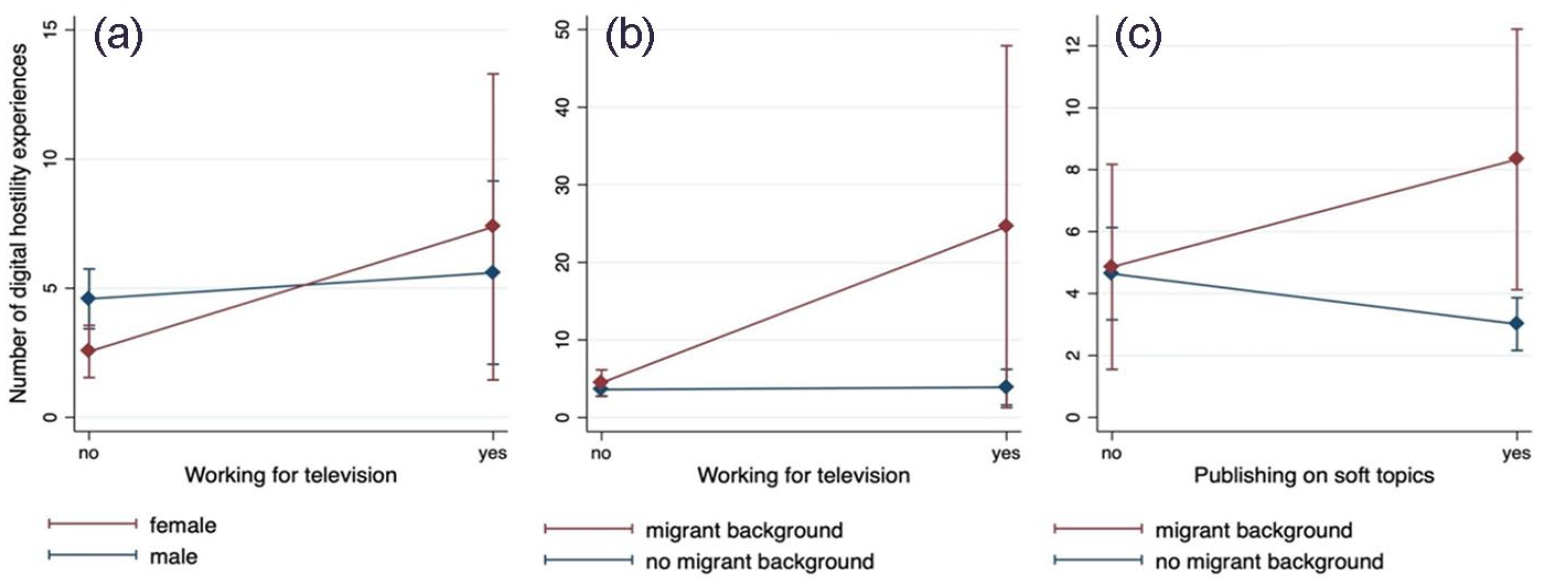
(a–c) Interactions between identity and celebrity capital indicators on digital hostility experiences.
Interactions Between Migrant Identity and Celebrity Capital
Of the interactions between migrant background and celebrity capital (Appendix H, Model 3: Deviance R2 = 26.9%, LR χ2 (24, N = 568) = 159.9, p < .000), two are statistically significant. Figure 3b shows that among typical journalists who do not work for television, both the nonmigrant and migrant ones are estimated to receive a similar number of hostile messages per year: about four. For television journalists, by contrast, hostility remains similar among nonmigrant journalists, but it increases approximately fivefold among migrant journalists (IRR = 5.07, z = 2.85, p = .004). However, the great enlargement of the 95% confidence intervals for the migrant group lowers precision because of the relatively few television journalists with migrant backgrounds: just 17 cases overall. Figure 3c shows a rather surprising effect. Among typical journalists who do not publish on soft topics, both those with and without migrant backgrounds receive similar numbers of hostilities. Among journalists reporting on soft topics, the number of hostilities nearly halves for the nonmigrant journalists, but it nearly doubles for the migrant journalists. Again, the large confidence intervals are explained by the relatively few non-soft topic migrant journalists (44 cases). Because the interaction hypothesis would indirectly imply an opposite effect for soft issues and predicts the present effect for political issues instead, the question of alternative explanations arises. For example, the effects could be attributed to journalists with disadvantaged identities in soft subject areas who handle contentious political issues such as gender equality, identity, and celebrity politicians, albeit from an entertainment perspective, thus making themselves vulnerable to attack.
Effect of Identity and Celebrity Capital on Type of Digital Hostility
Figure 4 (see Table in Appendix I) illustrates the results of the logistic regression of the identity and celebrity capital indicators and the control variables on the likelihood of experiencing different types of digital hostility. To gain an impression of what kind of hostile messages individuals receive, the journalists in the survey were asked to provide example comments. The following discussion is illustrated with these example comments (comments were translated from German to English by the author).
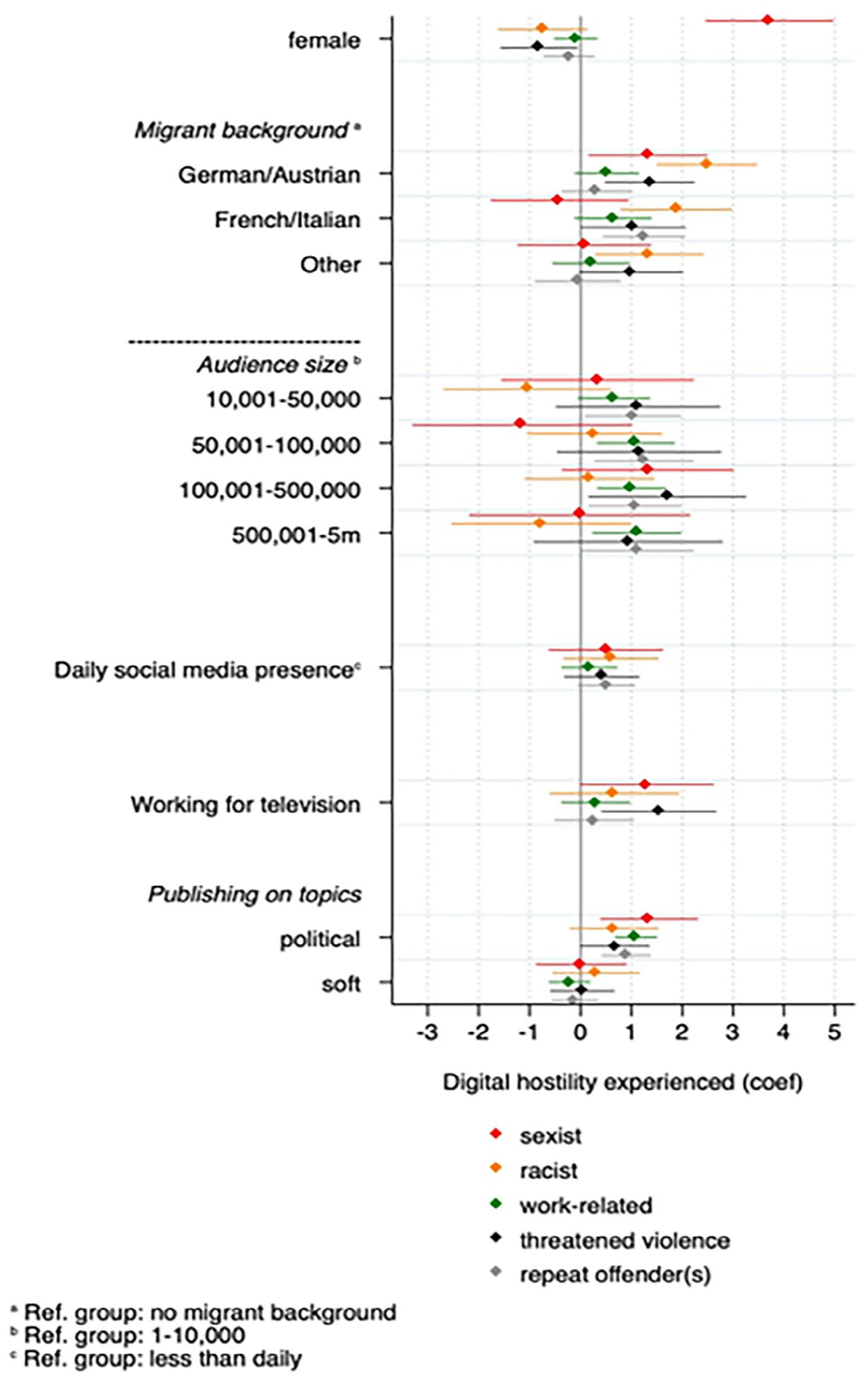
Logistic regression of journalists’ identity and celebrity capital on experiencing different types of digital hostility.
The overall expectation is confirmed: Disadvantaged-identity journalists are more likely to experience identity-related hostilities, and journalists with higher celebrity capital are more likely to experience work-related hostilities.
Effects on Identity-Related Hostility
The results for identity-related hostility (Appendix I, Model 1: Cragg-Uhler (Nagelkerke) R2 = 43.7%, LR χ2 (24, N = 568) = 107.3, p < .000) show that sexist hostility is more likely to be reported by female than male journalists (b = 3.71, z = 5.79, p = .000). It is the greatest effect across all identities and types of hostility. In addition, sexist hostility is also significantly more likely to be reported by journalists with German or Austrian backgrounds than those without migrant backgrounds (b = 1.33, z = 2.21, p = .027) and by journalists publishing on political topics (b = 1.35, z = 2.75, p = .006). Example sexist comments include “Leave the reporting to a mature man” and “Ugly women can’t discuss anyway.”
Analysis of the experience of racist and xenophobic hostility (Appendix I, Model 2: Cragg-Uhler (Nagelkerke) R2 = 32.7%, LR χ2 (26, N = 568) = 80.55, p < .000) shows that such hostility is significantly more likely to be reported by German and Austrian journalists (b = 2.48, z = 4.92, p = .000), French and Italian journalists (b = 1.88, z = 3.37, p = .001), and journalists of other migrant backgrounds (b = 1.36, z = 2.49, p = .013) than by nonmigrant journalists. Example racist and xenophobic comments include “Goatherd, go back to where you came from” and “Ah, a German on top of that.”
Effects on Work-Related Hostility
In contrast, work-related hostilities (Appendix I, Model 3: Cragg-Uhler (Nagelkerke) R2 = 27.1%, LR χ2 (26, N = 568) = 129.13, p < .000) are significantly more likely to be experienced by those with greater celebrity capital in two areas. These are journalists with a reach of more than 50,001 people (b = 1.09, z = 2.78, p = .005). However, when this threshold is reached, greater reach does not attract more hostility. Also, journalists publishing on political topics are more likely to receive work-related hostility (b = 1.09, z = 5.11, p = .000). Example comments include “imperialist dirty journalism,” “complete idiot,” “perhaps you should move to North Korea with your thought police,” and “traitor to his country.”
Effects on Severe Hostility
The likelihood of experiencing severe nonidentity-related hostility increases significantly for identity groups, although not always in the expected manner, and for high celebrity capital. Journalists who are more likely to be threatened with nonsexual violence and vandalism (Appendix I, Model 4: Cragg-Uhler (Nagelkerke) R2 = 27.6%, LR χ2 (26, N = 568) = 85.85, p < .000), are more likely to be male (b = −0.82, z = −2.11, p = .035) and have German or Austrian (b = 1.36, z = 3.02, p = .003), French or Italian (b = 1.04, z = −1.97, p = .049), or other migrant backgrounds, with the last of these effects only weakly significant (b = 0.99, z = 1.91, p = .057). The likelihood of threat also significantly increases for journalists with a median reach of 100,001 to 500,000 people compared to those with a reach of 1 to 10,000 people (b = 1.71, z = 2.15, p = .031) and for journalists on television (b = 1.54, z = 2.67, p = .008). Example comments include “You should be hanged” and “I know where you live.”
Compared to experiencing threats, the hostility of repeat offenders similarly affects those with celebrity capital in two areas in particular but affects the disadvantaged-identity groups somewhat less (Appendix I, Model 5: Cragg-Uhler (Nagelkerke) R2 = 25.4%, LR χ2 (26, N = 568) = 106.27, p < .000). Hostility from repeat offenders is more likely to target journalists with French or Italian backgrounds (b = 1.25, z = 3.03, p = .002) than nonmigrant journalists. It again is more likely to target journalists with a median reach of 10,001 to 500,000 people than those with a reach of 1 to 10,000 people (average effect: b = 1.11, z = 2.30, p = .022) and journalists publishing on political topics (b = 0.90, z = 3.64, p = .000).
Interaction Effects of Identity and Celebrity Capital on Types of Digital Hostility
Next, interaction effects are introduced between the indicators of identity and celebrity capital and the three types of hostility or their five dimensions, considering all control variables.
Interaction Effects of Gender and Celebrity Capital on Types of Digital Hostility
For gender, three significant interactions are found. Figure 5a shows that among typical journalists with a weak social media presence, men are more likely to experience racist and xenophobic hostility than women. This effect is reversed in the case of a daily presence in social media: Women are the more likely target (Appendix J, Model 2, b = 2.31, z = 2.33, p = .020). Overall, it makes little difference to men how strong their social media presence is, but for women the difference is large. The wide confidence intervals can be explained by the small number of 23 women with daily social media presence.
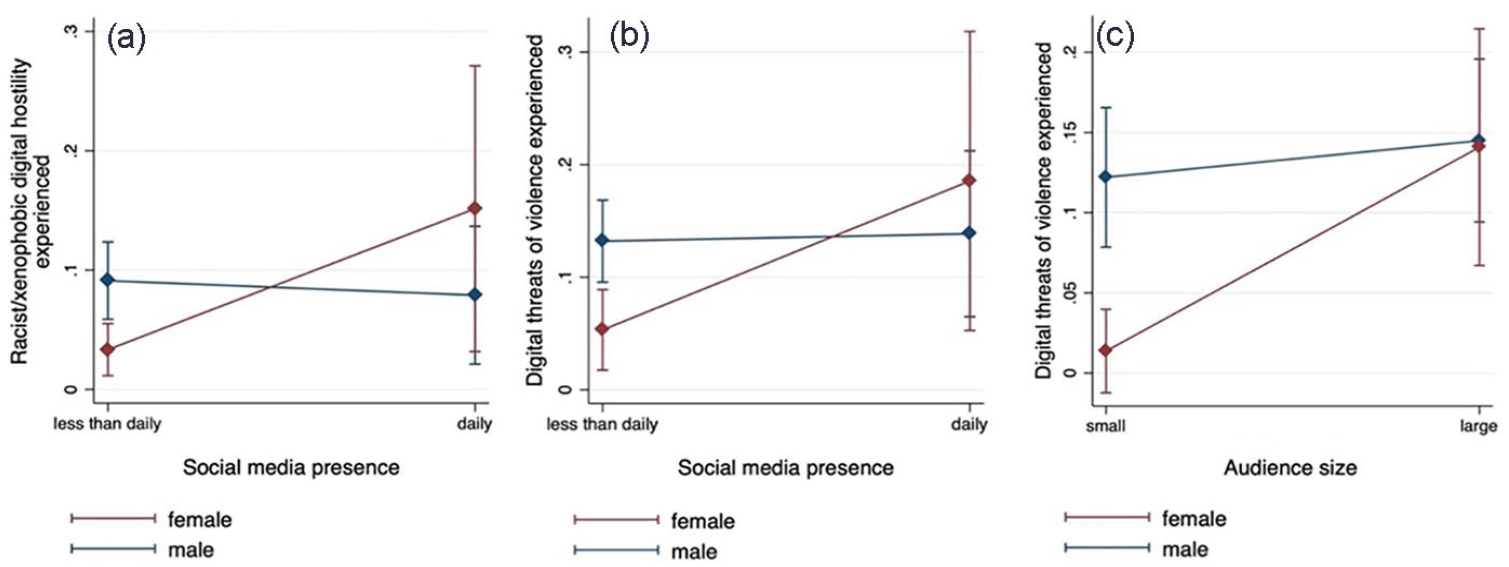
(a–c) Interactions between gender and celebrity capital indicators on experiencing types of digital hostility.
A similar effect is found for threats of violence. Figure 5b illustrates the advantageous effect for women of a weak presence in social media and the disadvantageous effect of a strong presence (Appendix J, Model 4, b = 1.76, z = 1.99, p = .046).
Finally, Figure 5c shows that, again, female journalists are less likely than male journalists to be threatened if their audience is small. Although the probability increases only slightly among men for large audiences, it increases sharply for women and reaches the level of men (Appendix J, Model 4, b = 2.58, z = 2.23, p = .026).
Interaction Effects of Migrant Background and Celebrity Capital on Types of Digital Hostility
The interactions for migrant background also exhibit three significant interactions. Figure 6a shows that among typical journalists who do not work for television, nonmigrant and migrant journalists are equally likely to be subjected to sexist hostility. For those who do work for television, this probability increases sharply, but only for migrant journalists (Appendix K, Model 1, b = 3.43, z = 2.80, p = .005). A similar effect is seen in the experience of repeat offenders. Among nontelevision journalists, the difference is not migrant specific; among television journalists, the likelihood increases for migrant journalists (Appendix K, Model 5, b = 1.55, z = 2.12, p = .034; Figure 6b).
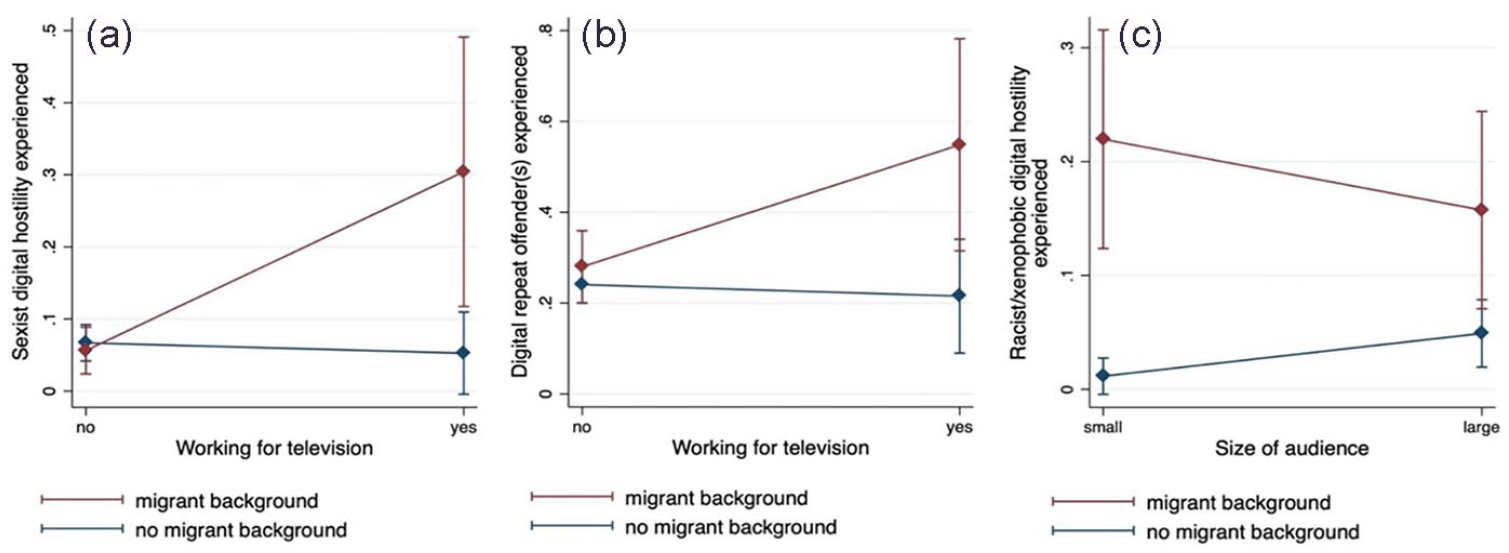
(a–c) Interactions between migrant background and celebrity capital indicators on experiencing types of digital hostility.
Finally, Figure 6c shows an unusual effect: the difference between the advantaged identity groups and the disadvantaged reduces with larger celebrity capital. Among journalists with small audiences, the migrant ones are much more likely to experience racist or xenophobic hostility than the nonmigrant ones; for journalists with large audiences, the difference remains, but is smaller (Appendix K, Model 2, b = −2.03, z = −2.15, p = .031).
Discussion
Summary
This study finds that journalists with larger audiences, strong social media presence, and working for television that publish on political topics more frequently experience general digital hostility. The individual effects are driven to varying degrees by different types of hostility. Women experience general hostility less frequently than men, and this effect is reversed only with sexist hostility. Journalists with German or Austrian migrant backgrounds experience general hostility less frequently than nonmigrant journalists, and this effect generalizes to all kinds of migrant backgrounds with racist and xenophobic hostility and severe hostility. Work-related hostility exhibited no significant identity effects. In addition, migrant men experience general digital hostility more frequently than nonmigrant men, but no difference is observed among the corresponding women. Finally, the relationship between working for television and general digital hostility is stronger among women and migrant journalists than among their counterparts. This effect is observed for sexist hostility and repeat offenders regarding migrant journalists. The relationship between social media presence and racist and xenophobic hostility and threats is stronger for women than for men, as is the relationship between audience size and threats.
Contributions
This study contributes to the literature on hostility against journalists by theoretically underpinning the interplay between identity and celebrity capital incorporating large, persistent structures of inequality and empirically validating it. Three points are salient.
First, the distinction between types of hostility is useful in explaining previously contradictory effects between identity and hostility. Lacking, partial, or even unexpectedly reverse identity differences in the experience of general digital hostility refute theories of gender and social discrimination (e.g., Eagly & Karau, 2002; Lowe, 2013; Quillian, 1995). However, the present results are consistent with empirically observed gender-equal and male-disadvantageous frequencies among journalists (Nilsson & Örnebring, 2016) and other public professionals, such as politicians (Ward & McLoughlin, 2017). This is particularly evident in the result on work-related hostility, which shows no significant differences with identity, only with celebrity capital. In contrast, only identity differences between content-based (i.e., sexist, racist, and xenophobic) hostility reveal social patterns of discrimination. Thus, the systematic findings on types provide empirical support for existing hypotheses that digital hostility is mapped onto axes of social identity (Duffy & Hund, 2019; Waisbord, 2020). Surprisingly, severe hostility seems to occur across identity and celebrity groups. Apart from sheer frequency, devaluation of one’s stable identity can lead to more stress and have a stronger chilling effect than attacks on less stable and personal work-related characteristics (Fox & Tang, 2014). This may explain the frequent appearance of disadvantaged-identity groups in case studies on hostility. In sum, whether identity differences can be identified depends strongly on how hostility is defined and measured.
Second, celebrity capital (Driessens, 2013) and the attention economy (Goldhaber, 1997) seem particularly suited to illuminating how the unequal distribution of public attention leads to unequal experiences of digital hostility among journalists. The consistent pattern between hostility and celebrity provides quantitative confirmation of previous case-based evidence of the relevance of general visibility to hostility (Duffy & Hund, 2019) and quantitative findings on personal visibility (Lewis et al., 2020; Nilsson & Örnebring, 2016) but underpins it with a more general theoretical framework. The explanation of celebrity may become more pronounced in the future if the “widening gap between borderless media and limited attention” (Webster, 2014, p. 4) and the “visibility mandate” (Duffy & Hund, 2019, p. 4983) for public professions actually increases. In such a winner-takes-all logic, ever fewer public figures accumulating global attention may well receive ever-growing volumes of hostility. And if celebrity is indeed a dynamic position with a rapid turnover (Driessens, 2013), emotional-hostile online firestorms against journalists may well intensify.
Third, the interplay of identity and celebrity can shed further light on the unsettled puzzle of identity’s role in hostility toward journalists. Our contribution is to show that there is indeed more hostility toward disadvantaged groups, but it depends on the level of celebrity capital. For general and specific hostility, working for television seems particularly relevant. This might be explained by the strongly visual character of this channel, which potentially makes identities more salient (Lewis et al., 2020; Miller & Lewis, 2022). Disadvantaged groups are also punished with some specific types of hostility for having large audiences and strong social media presence. The interaction effects are consistent with backlash as a result of perceived role incongruity (Eagly & Karau, 2002; Rudman et al., 2012). Conversely, the absence of interaction effects in other celebrity indicators could reflect a weakening of social and especially gender stereotypes (Eagly et al., 2019). Future work could test the robustness of these exploratory findings and their disentanglement in even larger samples with better populated variables. Such an approach could additionally test and ideally rule out alternative explanations. An alternative would be that digital hostility toward journalists on television or with a stronger social media presence is due to the specific characteristics of the television or social media audience, such as education level, which might motivate hostility more strongly.
Limitations and Future Research
First, the use of surveys may introduce potential biases related to measurement invariance and the recruitment process. Although the definition of hostility provided to the survey participants is intended to promote a common and comparable understanding of hostility, members of groups with historically disadvantaged identities may be more sensitive than members of groups with advantaged identities to judging certain communications as hostile (Costello et al., 2019). Future studies could counter this with “anchoring vignettes” (King, 2021). Moreover, even if the present response rate is considered satisfactory for an elite sample and is equivalent to those for online surveys of journalists on hostility, which range from 2% (Preuss et al., 2017) to 8% (Obermaier et al., 2018), a nonresponse bias cannot be excluded. The invitation cover letter motivating even those journalists with no experience of hostility to participate was intended to counteract this. Furthermore, social desirability issues such as minority members being embarrassed to talk about the potentially shameful experience of hostility were addressed by assuring the anonymity and confidentiality of the data. Finally, self-reporting only captures the hostility that actually reaches the journalists and is perceived and remembered by them. Thus, the measurement should not be confused with the number of hostilities that originally emanate from the audience. However, assuming that perception and recall errors and prior external blocking, for instance by moderators in comment columns (Gardiner, 2018), do not vary systematically between journalists of varying identity and celebrity capital, they should not affect the present results. Overall, these biases can never be completely ruled out for surveys in general and for those about hostile phenomena in particular.
Second, the indicators of journalists’ identity and celebrity capital presented here certainly do not exhaust the range of possible indicators, which may also vary over time and context. Besides age and class, future studies could examine alternative indicators such as people of color. However, their collection can be ethically problematic. Also, their single-digit percentage proportions in some elite populations, including journalists, would require particularly large, difficult-to-implement samples to detect true effects. Despite the limited statistical power of this study, it contributes initial valuable insights, especially given the fact that journalists are a special and hard-to-reach population, it has a satisfactory response rate, and it illuminates the complex interplay of identity and celebrity in this sphere. Furthermore, data triangulations such as with social media data and industry data are also conceivable. Finally, future research could more deeply explore hierarchies of celebrity and of identity indicators in relation to digital hostility.
Footnotes
Appendices
(I) In recent years, there have been increasing reports of journalists in democracies being attacked by the public (readers, listeners, viewers). Attacks include insults, threats, and aggressive, vulgar, pathologizing, or generalizing statements that are inappropriately derogatory. These are directed against the person or their publications. Attackers either directly target journalists (e.g., via traditional channels such as e-mail, text messages, telephone, postal letters, or face-to-face) or indirectly express themselves about them (e.g., via public online channels such as social networks, comment columns, and debate forums).
How often have you been attacked in the last 12 months? Please provide a rough estimate.
(II) Through which channels were you attacked (last 12 months)? Please provide a rough estimate. We understand the answer category “Always” to mean “Applies to all attacks experienced by me.” Multiple answers are permitted.
(Answer categories: “never,” “rarely,” “occasionally,” “often,” and “always”)
Translation into variable “Frequency of digital hostility experienced”
First step—hostility experienced:
(I) a => 0, b => 1, c => 2, d => 4, e => 12, f OR g OR h => 52
Second step—only digital forms are considered:
All values were recoded to 0 if (II) a = never AND b = never AND c = never.
Translation into variable “Frequency of non-public digital hostility experienced”
Recoding of all values on variable “Frequency of digital hostility experienced” => 0 if (II) a = never AND c = never
Translation into variable “Frequency of public digital hostility experienced”
Recoding of all values on variable “Frequency of digital hostility experienced” => 0 if (II) b = never
In what way or on what levels were you attacked? We understand the answer category “Always” to mean “Applies to all attacks experienced by me.” Multiple answers are permitted, as attackers can mix several levels.
I have been attacked. . .
(Answer categories: “Never,” “Rarely,” “Occasionally,” “Often,” “Always”)
Translation into variable “Sexist digital hostility”:
h = rarely OR occasionally OR often OR always => 1
Translation into variable “Racist/xenophobic digital hostility”:
f = rarely OR occasionally OR often OR always => 1
Translation into variable ‘Work-related digital hostility”:
a OR b OR c OR d = rarely OR occasionally OR often OR always => 1
Translation into variable “Threatened violence”:
i = rarely OR occasionally OR often OR always => 1
How often did it happen that you were attacked by the same perpetrator for a longer period of time (more than 1 month) or more than three times?
Translation into variable “Repeat offender(s)”:
b, c, d, e => 1
My gender is:
Translation into variable:
b => 1
Do you have a migrant background, that is, did you or your (grand)parents immigrate to Switzerland from another country?
Translation into variable “German/Austrian migrant background”:
c AND country indication of Germany AND/OR Austria
Translation into variable “French/Italian migrant background”:
c AND country indication of France AND/OR Italy
Translation into variable “Other migrant background”:
c AND any other country indication
Section Introduction: The next questions refer to the medium or media you have worked for in the last 12 months.
What is the audience size of the medium for which you primarily worked? Please give a rough number of readers per issue (for print), listeners or viewers per day (for radio and TV), or unique users per day (for online media).
To all freelancers: please provide the value for your primary client.
Translation into variable:
Section Introduction: In the following, we have a few more questions for you about your journalistic work. Your answers should reflect the predominant state of the last 12 months for all questions.
If you maintain one or more (semi-)public social media profile(s) such as on Facebook or Twitter, blogs, or similar: How often have you posted content or participated in discussions there (last 12 months)?
Translation into variable:
g OR h => 1
Section Introduction: The next questions refer to the medium or media you have worked for in the last 12 months.
What type(s) of media did you work for (last 12 months)? Multiple answers are allowed.
Translation into variable:
a => 1
Section Introduction: In the following, we have a few more questions for you about your journalistic work. Your answers should reflect the predominant state of the last 12 months for all questions.
On which topics did you report regularly? Multiple answers are allowed.
Translation into variable “Political topics”:
d => 1
Translation into variable “Soft topics”:
J AND/OR k AND/OR l AND/OR m => 1
Acknowledgements
The author would like to thank the journalists who helped to inform and optimize the online questionnaire.
Declaration of Conflicting Interests
The author(s) declared no potential conflicts of interest with respect to the research, authorship, and/or publication of this article.
Funding
The author(s) received no financial support for the research, authorship, and/or publication of this article.
