




Abstract
Concerns are frequently raised about politicians’ increasing use of incivility. Yet, there is little longitudinal empirical work testing whether politicians’ use of incivility is actually rising, and little is known about the determinants that affect the prevalence of incivility. This study analyzes incivility over time and proposes a multi-layered framework of theoretically-driven incivility-inducing determinants. A quantitative content analysis of 4,102 speech acts in 24 Belgian televised election debates over the course of 35 years (1985–2019) shows that politicians’ incivility did not increase but occurs in a volatile pattern with ups and downs over the years. Confirmed by our analysis of the studied determinants, incivility shows to be highly context-specific. Particularly, incivility levels are affected both by characteristics of politicians, such as populism, incumbency, and gender, and by debate determinants, such as the topic under discussion, the number of politicians simultaneously debating each other, and previous incivility occurrences in the debate.
Keywords
Incivility in politicians’ discourse, and particularly its alleged increase over time, raises a lot of concern in the public and academic debate (e.g., Dryzek et al., 2019). These ubiquitous worries exist despite incivility’s potential to grab citizens’ attention, stimulate vibrant and heterogeneous debate, and to get one’s point across (Chen et al., 2019; Mutz & Reeves, 2005; Rossini, 2022). Among the main reasons for concern are the adverse effects of incivility on citizens’ political attitudes, such as political trust, political cynicism, legitimacy perceptions, and affective polarization (Druckman et al., 2019; Mutz, 2007; Mutz & Reeves, 2005). Notwithstanding the growing body of research on the effects of politicians’ use of incivility, our knowledge is still limited about (1) the prevalence of politicians’ use of incivility over time (i.e., is incivility actually increasing, as is generally assumed?) and (2) contextual features that influence politicians’ use of incivility (i.e., how do characteristics of the politician and the debate affect this?). These insights are particularly lacking outside the U.S.-context. This study furthers our understanding on these points by analyzing the evolution and determinants of incivility in 35 years of televised election debates in Belgium (1985–2019).
In this study, political incivility refers to politicians’ use of a disrespectful or rude communication style. It includes elements such as insults, derision, and name-calling, and can be directed both toward the character and the policies of other politicians (Brooks & Geer, 2007; Stryker et al., 2016). The evolving media and political context in which politicians operate has likely heightened their use of incivility over the past decades. Trends such as the increasing mediatization of politics, rising success of populist parties, and increasing importance of social media are expected to have led to a rise in incivility among politicians across the entire political spectrum (e.g., Eberwein & Porlezza, 2016; Marien et al., 2020; Ott, 2017; Uslaner, 1993). Analyzing incivility over time allows us to put this expectation to an empirical test. Only in the U.S. some first insights have been gathered, generally pointing toward rising levels of political incivility (e.g., Shea & Sproveri, 2012; Uslaner, 1993). Interestingly, these U.S. findings also show that the increasing trend happens in a volatile pattern with ups and downs over the years. Scholars therefore argue that it is also important to study (time trends of) incivility in relation to its context (e.g., Shea & Sproveri, 2012).
In line with that conclusion, we introduce a multi-layered framework of eight theoretically-driven determinants that are expected to influence politicians’ use of incivility in mediated political debates. First, factors that are stable throughout a debate, but can differ between debates, are studied. These include the type of broadcaster (public or commercial) on which a debate is aired and the presence of populist actors. Second, we study factors that change during debates. These include the type of topics discussed throughout a debate, the number of politicians simultaneously debating with each other, and what we call the “action-reaction” of incivility: whether one uncivil statement spurs following uncivil statements. Last, we include determinants that differ between politicians, with a focus on incumbency status, gender, and populist ideology. We apply our framework to televised election debates but note that it is also applicable to other mediated political debate formats, such as political talk shows. Several of the determinants can moreover be analyzed in other types of political discourse, such as parliamentary debates, political speeches, or social media posts.
The contribution of this study is threefold. First, to date, the assumption that politicians’ use of incivility is on the rise remains largely unsubstantiated. By conducting a systematic empirical analysis of political incivility over time, we contribute to filling this gap. Second, by means of a multilevel approach, politicians’ use of incivility is not only mapped over time, but also studied in relation to its context. Contextual determinants that influence levels of incivility are studied increasingly, yet the large majority of studies focus on citizens’ use of incivility, for instance in online news or social media contexts (e.g., Rossini, 2022; Su et al., 2018; Ziegele et al., 2020). We build on but also extend and innovate the existing literature by proposing a multi-layered framework of determinants that applies to politicians’ communication in mass mediated contexts. Third, as the incivility literature is largely U.S.-focused, empirical evidence in other contexts remains fairly limited. By studying Belgium, we aim to contribute to filling this gap. Like many other western democracies, Belgium is a multi-party, consensus democracy with a strong public broadcaster and limited degrees of negative campaigning. Belgium has moreover been characterized by trends of increasing mediatization, social media importance and populist success, that is, the trends expected to lead to rising incivility. Although one in-depth case study does not allow to draw strong cross-national conclusions, these results can provide first indications of what political incivility patterns look like in other contexts—particularly contexts that are characterized by similar characteristics and similar societal trends (Esser & Strömbäck, 2014; Rooduijn et al., 2019).
Incivility in Politics
Defining political incivility is challenging due to the complex and multidimensional nature of the concept (Herbst, 2010; Stryker et al., 2016). Overall, incivility is the opposite of civil or respectful communication. The latter is generally defined as a social norm to adhere to (Bormann et al., 2022; Jamieson et al., 2017) and can be situated within the broader normative (deliberative) ideal of respectful interactions between politicians (Steiner et al., 2004; Strömbäck, 2005). When politicians communicate civilly with each other, they express a relationship of mutual respect and show a willingness to listen to and take seriously their opponents’ standpoints and arguments (Jamieson et al., 2017). The main reason to argue for civility are its alleged beneficial consequences for the well-functioning of politics and democracy. When politicians show respect for their opponents in public political debate, they facilitate the inclusion of a variety of perspectives and signal that other perspectives are legitimate and valuable (Bächtiger & Parkinson, 2019). This, in turn, would increase tolerance toward out-groups, increase citizens’ legitimacy perceptions and understanding of different perspectives, and, overall, strengthen the quality of political opinion formation (Brooks & Geer, 2007; Cohen, 1989; Habermas, 1981; Mutz, 2006, 2007; Popan et al., 2019).
Political incivility, in contrast, violates the social norm of civility. The breaking of the norm is what causes and signals the lack of mutual respect. Incivility has been defined and categorized in several ways (e.g., Bormann et al., 2022; Chen, 2017; Muddiman, 2017; Papacharissi, 2004; Rossini, 2022; Stryker et al., 2016). Following Muddiman (2017), political incivility can be divided into two main norm-violating categories. The first one is what Muddiman refers to as “personal-level incivility” and contains communication that violates interpersonal politeness norms (p. 3183). It is “characterized by discursive behaviors that represent the rejection of communication norms pertaining to considerate, courteous, and respectful discussion” (Hopp, 2019, p. 206) and consists of elements such as name-calling, derision, insulting, mockery, and aspersion (e.g., Coe et al., 2014; Mutz & Reeves, 2005). It can include explicit forms of rude language (e.g., “You moron!”) but can also be somewhat more implicit, such as sarcastic comments or delegitimizing language (e.g., stating that someone is constantly telling lies). Some, however, argue that this definition describes impoliteness rather than incivility. For these scholars, uncivil messages are those that violate norms of the political and democratic process. These include messages that “threaten democracy, deny people their personal freedoms, and stereotype social groups” (Papacharissi, 2004, p. 267). Muddiman (2017) refers to this as “public-level incivility.” In a similar vein, Rossini (2022) distinguishes between uncivil (impolite) and intolerant discourse, where the latter refers to communication that threatens democratic pluralism (p. 2).
Both categories of incivility are highly important to understand and warrant scholarly attention. Yet in this first attempt to examine the evolution and determinants of politicians’ use of incivility outside the U.S.-context, we chose to study one category in depth. We analyze politicians’ use of personal-level incivility, which can be directed at one’s opponents’ character and at their standpoints, ideas, and policies (Brooks & Geer, 2007; Stryker et al., 2016). Studying personal-level incivility is important for several reasons. Politicians’ use of it can, for instance, severely harm vital democratic outcomes: it has been shown to increase affective polarization, and to decrease political trust, perceived legitimacy of opposing perspectives, and the perceived informativeness and relevance of political discourse (Brooks & Geer, 2007; Goovaerts & Marien, 2020; Mutz, 2007; Mutz & Reeves, 2005; Skytte, 2021). 1 Citizens furthermore perceive this form as highly uncivil, even more so than public-level forms of incivility (Muddiman, 2017). Moreover, although empirical research substantiating this is still limited, it is plausible that in wide-reaching mass media channels of democratic countries like Belgium, politicians are less likely to use public-level forms of incivility that attack democratic norms and processes, as compared to personal-level forms of incivility that attack political opponents in the debate.
Patterns and Determinants of Incivility in Televised Election Debates
To study the evolution and determinants of incivility among politicians, we investigate the case of televised election debates. These debates have been organized for decades in many countries around the world and, as indicated by generally high viewership numbers, they are one of the big moments for voters to look forward to during the electoral campaign (Juárez-Gámiz et al., 2020). Moreover, election debates serve an important role in democracy (Coleman, 2020; Turkenburg, 2022). It is one of the few places where political leaders of different parties directly interact and discuss politics side-by-side in front of the wider public. Hence, these debates can substantially influence and shape citizens’ attitudes and image of politics. While citizens generally learn from watching election debates (Benoit et al., 2003), politicians’ use of incivility in these debates can also decrease citizens’ trust in politics and lower politicians’ own favorability ratings (Goovaerts & Marien, 2020; Hopmann et al., 2018). Election debates moreover provide an ideal case to study politicians’ use of incivility because the same topics are discussed at the same time in one comparable setting.
Although studies have increasingly started to investigate patterns and determinants of politicians’ use of incivility (e.g., Coe & Park-Ozee, 2020; Kenski et al., 2018; Marien et al., 2020), so far most content analyses focus on citizens, investigating for instance citizens’ use of incivility in online discussions, in comment sections on social media or news outlets, or in messages directed at politicians (e.g., Coe et al., 2014; Oz et al., 2018; Popan et al., 2019; Southern & Harmer, 2021; Theocharis et al., 2020; Ziegele et al., 2020). Moreover, notwithstanding some noteworthy exceptions (e.g., Rossini & Maia, 2021; Southern & Harmer, 2021), most studies focus on the U.S., especially when it comes to politicians’ use of incivility. Regarding the evolution of incivility, some of these first U.S. findings indicate that incivility has been increasing, for instance in U.S. Congress (Ahuja, 2008; Uslaner, 1993; but see Jamieson & Falk, 1998), in U.S. political news (Sobieraj & Berry, 2011), and in U.S. politics more generally (Shea & Sproveri, 2012). For the western European context, such longitudinal studies are, to the best of our knowledge, virtually absent.
Importantly, the U.S. studies that report rising levels of incivility also generally show that this increase does not happen steadily but in a volatile pattern with ups and downs. Studying incivility in its context and examining which factors influence it at certain points in time is therefore equally important (Coe et al., 2014; Shea & Sproveri, 2012). Although noteworthy, those studies that already analyzed determinants of incivility among politicians mainly focused on a limited number of determinants (e.g., Kenski et al., 2018 on party affiliation; Marien et al., 2020 on electoral system and populism). This is different for the negativity literature, where evidence on patterns and determinants of politicians’ use of negative messages is much more extensive (e.g., Nai, 2020; Walter, 2014). Because incivility can be seen as one specific form of negativity, 2 we can also build on this literature to formulate our expectations.
In what follows, we first explain the reasoning behind the expected increase in incivility over time. After that, we develop a multi-layered framework of incivility-inducing determinants and formulate expectations for each determinant. We treat these two parts separately because time as such cannot be seen as a “determinant”: it is not the passing of time by and of itself that would heighten incivility levels. In Figure 1, an overview is presented.
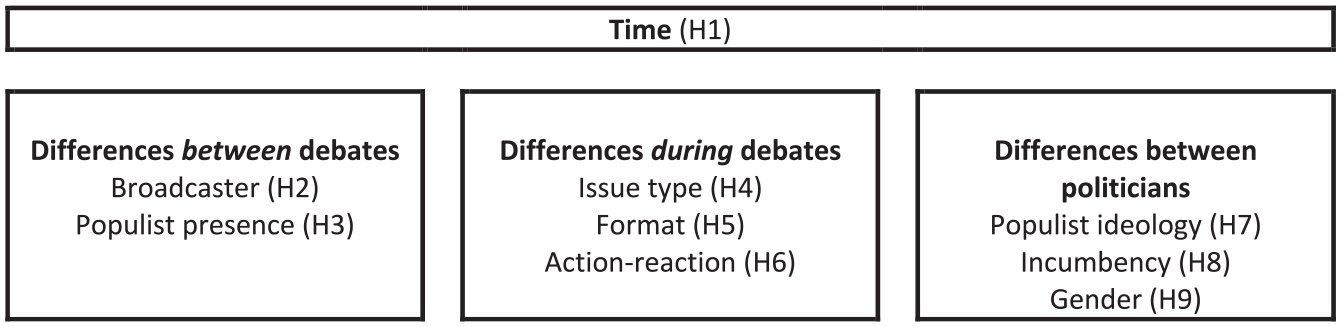
Overview of hypotheses and determinants.
Incivility Over Time
Since the 1980s, a number of societal trends have taken place in western (European) democracies which we expect to have led to rising levels of incivility in election debates: increasing mediatization of politics, growing importance of social media, and rising success of populism. 3
First, since the nineties, and in response to the growing fragmentation, competitiveness, and commercialization of the media landscape, the (traditional) media increasingly operate via a certain logic, called media logic (Brants & Van Praag, 2006). Because audiences are being overwhelmed by an overload of broadcasters, channels, programs, and new communication outlets, the traditional media have to fight intensely and increasingly to get the audience’s attention. Adherence to media logic helps them to grab that attention. Importantly, this logic strongly affects political communication in the media by emphasizing or stimulating certain behaviors and messages, and by presenting political information in attractive ways (Altheide, 2004). Emphasizing and encouraging incivility fits this logic well (Muddiman, 2018). Moreover, over the years, politicians have learned that they benefit from adapting their communication style to this logic because it increases their chances to be picked up by the news media and grab attention (Esser & Strömbäck, 2014). Therefore, they may have been stimulated increasingly to act uncivilly.
Second, in more recent years, we have moved beyond traditional media logic because of the emergence and rising importance of new venues to spread political content, particularly social media channels such as Facebook, Instagram, and Twitter (Brants & van Praag, 2017). These channels operate via specific features that “privilege discourse that is simple, impulsive, and uncivil” because it is easily picked up and shared online (Ott, 2017, p. 59). Politicians are thus primed even more today to use incivility to heighten their visibility on these platforms as well. This also relates to election debates. The conversation about the debates does not stop once the debate is finished but extends to social media during and after the debate (Juárez-Gámiz et al., 2020; Trilling, 2015). This encourages politicians to align their communication with those features, such as incivility, that prove successful in getting attention online.
Third, the success of populist politicians has been increasing from the nineties onward throughout Western Europe (Rooduijn et al., 2019). Populist politicians are generally known for their “bad manners” and uncivil communication style (Moffitt, 2016). Appearing increasingly on the political stage, they are likely heightening the prevalence of incivility. Moreover, there is a strong connection between the goals and communication strategies of populists and those of the media (Krämer, 2014), where populists’ (uncivil) communication style fits media logic extremely well, guaranteeing them wide visibility (Mazzoleni, 2008). The success of populists does not go unnoticed by other politicians, who tend to copy populists’ debate style in order to compete with them more effectively (Bossetta, 2017; Marien et al., 2020). Therefore, the argument goes that we are currently living in a “populist zeitgeist,” where “populist discourse has gone mainstream in the politics of contemporary western democracies,” (Mudde, 2004, p. 562) making political discourse more uncivil across the entire political spectrum.
Based on all of this, Hypothesis 1 is formulated: Politicians’ use of incivility in election debates increased over time (1985–2019).
A Multi-Layered Framework of Incivility-Inducing Determinants
The multi-layered framework we present consists of three categories. The first category constitutes determinants that differ between debates. They remain stable during a debate but can vary between individual debates. The second category includes determinants that change during the debate; they can change over the course of an individual debate. The third category includes determinants that differ between politicians and looks at politicians’ individual-level characteristics.
Differences Between Debates
At the between-debate level, we expect broadcaster type (i.e., commercial or public) and populist presence to influence incivility levels. The first expectation about broadcaster type relates to media logic. Public broadcasters have to compete with commercial broadcasters for the audience’s attention and for market share, but commercial broadcasters are driven more strongly by this “consumerist idea of giving the public what it wants,” and are consequently even more likely to follow media logic and thus push politicians to act uncivilly (Brants & Van Praag, 2006, p. 30; Wessler & Rinke, 2014). Because commercial channels generally depend heavily on advertising revenues, which is not or more limitedly the case for public broadcasters (i.e., largely government-funded), they are stimulated even more to adhere to media logic to attract wide audiences. Moreover, public broadcasters are generally driven stronger by the deontological code to inform the public well, which is also the case in Belgium (Bardoel & D’Haenens, 2004). For all these reasons, debate moderators on commercial channels may stimulate incivility more (Walter & van Praag, 2014). In sum, we expect incivility to be higher in election debates aired on commercial broadcasters, compared to public broadcasters (Hypothesis 2).
Second, building on our populism argument explicated earlier, the mere presence of a populist politician(s) in the debate could heighten incivility levels. This may not only be the case because they themselves are more likely to be uncivil, but also because they tend to incite more uncivil replies by non-populist politicians, making the debate more uncivil overall (Bossetta, 2017; Marien et al., 2020). The mere presence of populists might furthermore cause other politicians and debate moderators to (unconsciously) anticipate more incivility and act accordingly. Therefore, we expect that incivility is higher in election debates where populist politicians participate, compared to election debates where they do not participate (Hypothesis 3).
Differences During Debates
In the next layer of our framework, determinants are not fixed throughout, but vary during a debate. First, election debates are generally divided into several parts, each part consisting of a certain policy issue that is discussed. We expect levels of incivility to depend on the issue, and particularly the morality of an issue. Moral issues generate conflict about basic moral values and are “related to fundamental questions, such as death, reproduction, and marriage” (Engeli et al., 2012). Typical examples are euthanasia, abortion, immigration, and minority rights (Colombo, 2021). When moral thoughts are elicited, more affective polarization and stronger emotional, hostile reactions are provoked, and there is less willingness to compromise (Garrett & Bankert, 2020; Ryan, 2017). In the context of Facebook reactions to news articles, Ziegele et al. (2020) already found that incivility is more prevalent when the articles deal with value-laden moral topics. In sum, we expect that discussing moral issues leads to more incivility than discussing non-moral issues (Hypothesis 4).
Second, debate formats can affect politicians’ use of (non-)clashing strategies (Carlin et al., 2001). One format element that we particularly expect to influence incivility, and varies during debates, is the number of politicians that directly and simultaneously interact with each other. Previous research shows that the total fixed number of politicians present in a debate does not influence the prevalence of negative messages (Maier & Jansen, 2017). Yet, next to the total number of politicians present in the entire debate-broadcast, the number of politicians directly debating each other often varies throughout the different topic sections that are generally organized (especially in multi-party contexts). The total number of politicians present may, for instance, be six, but different pre-defined sections could involve three politicians debating the tax issue, four politicians debating migration, and all six discussing the campaign. The reasoning behind the expected effect is as follows: election debates generally attract large audiences, but even more people will hear about the debates—intentionally or accidentally—via the news or on social media afterward. Politicians aim for that extra attention and know that uncivil statements are likely to be picked up by the media (Esser & Strömbäck, 2014). Yet the higher the number of politicians that are simultaneously debating, the harder they have to fight for the extra attention, and the more they may be inclined to use incivility. This leads to Hypothesis 5: the higher the number of politicians debating each other, the more they use incivility.
Last, previous studies already documented that incivility may spur more incivility (Shmargad et al., 2022). This effect has been shown in workplace contexts (e.g., Andersson & Pearson, 1999) and in online political discussion contexts among citizens (e.g., Gervais, 2017; but see Rösner et al., 2016). In the context of election debates where a politician uncivilly attacks another politician, the attacked politician may, in response, get into “attack-mode” and reply with an uncivil statement themselves. One reason for this is that the use of norm-violating behavior is more likely if that behavior is already present, because it signals that norms can be violated (Cheng et al., 2017). Another reason is that the attacked politician loses face (i.e., the positive way in which people want others to perceive them; Goffman, 1956). Face-threatening acts such as uncivil attacks can result in retaliatory action by the attacked person as a way to harm the face of the offender and restore their own (Chen, 2015). This is what we call the “action-reaction” of incivility. We expect that one uncivil statement in the debate spurs following uncivil statements (Hypothesis 6).
Differences Between Politicians
Some politicians may use more incivility than others. First, we study populism at the individual level here rather than at the aggregate debate level (see above). As stated earlier, it is widely believed and argued that populist politicians more frequently use a “bad-mannered” uncivil communication style than non-populist politicians (e.g., Moffitt, 2016), yet, empirical studies analyzing these claims remain limited (but see e.g., Marien et al., 2020). One reason why populists may use this norm-violating style more often is that populist politics is precisely about violating norms and changing the system (Goovaerts & Marien, 2020). Moreover, in a large-scale cross-national study, Nai (2021) showed that populists turn substantially more to negative campaigning than non-populists. The reasoning is that this is a well-suited way to express their strong anti-elitist perspectives: critiques and attacks on the political elite are core to their ideology (Mudde, 2004). While negativity is broader than incivility, the same logic is likely to apply (Marien et al., 2020). All of this leads to Hypothesis 7: Populist politicians use more incivility than non-populist politicians.
Second, incumbents are likely to defend the policy decisions they made in the previous legislature and are more likely to promote themselves and their accomplishments than challengers do (Walter & Nai, 2015). Challengers on the other hand are likely to be more critical and attack incumbents and their policies to convince voters to choose a different path (Ganghof & Bräuninger, 2006). Also because they cannot lose an office, they are more likely to take risks and use an attacking strategy (Walter & Nai, 2015). It has already been shown repeatedly that this logic holds in the negative campaigning literature: challengers use more negative messages than incumbents (e.g., Lau & Pomper, 2004), also in the specific case of election debates (Maier & Jansen, 2017). A similar logic is again likely to apply for incivility (Bächtiger & Hangartner, 2010; Jenny et al., 2017). Accordingly, Hypothesis 8 is formulated: Challengers use more incivility than incumbents.
Last, men are more closely associated with agentic traits (e.g., assertiveness) and women with communion traits (e.g., friendliness; Williams & Best, 1982). These associations lead to gender role beliefs and expectations that produce certain behaviors, and deviations from these expectations are likely to be sanctioned (Eagly & Wood, 2012). For instance, female leaders adopting assertive styles are evaluated more negatively than male leaders (Eagly et al., 1992). Since men and women are generally aware of costs that come with deviating from gender role expectations, they are not likely to do so (Eagly & Wood, 2012). Accordingly, as incivility rather signals the possession of agentic traits (Mölders et al., 2017), female politicians may be less likely to use it (Poljak, forthcoming). Moreover, as men hold higher levels of enjoyment regarding arguments and disagreement (Wolak, 2022), they may be less hesitant to employ incivility. Additionally, women are more likely to perceive political speech as uncivil than men by applying different social norms to communication (Kenski et al., 2020). In sum, female politicians may be more hesitant to use an uncivil debate style, leading to Hypothesis 9: Male politicians use more incivility than female politicians.
Data and Method
Case: Televised Election Debates in Belgium
An original dataset of televised election debates in Belgium (Flanders 4 ) was collected, based on the following criteria: The debates (1) featured at least two political leaders; (2) were held in the context of and in the week before the election(s); (3) were broadcast on the public broadcaster (VRT) or main commercial broadcaster (VTM) 5 ; (4) were moderated by at least one moderator; (5) were organized for the national and/or regional election(s) 6 . We collected all debates that met these criteria and were accessible in the broadcaster archives or online, resulting in a dataset of 24 election debates aired from 1985 to 2019. This sample is close to a perfect representation of the population of election debates that were broadcast in Flanders over the past 35 years (see Supplemental Appendix A for a detailed overview including year, broadcaster, participants).
Belgium is a western European country that provides a good and interesting case to test the hypotheses. Belgium has several characteristics that are shared by many other western democracies, but also differs from the U.S., where most incivility research has been conducted. Belgium is a democratic corporatist system, characterized as a multi-party, consensus democracy with a strong public broadcaster and limited presence of negative campaigning (similar to e.g., Germany, the Netherlands; European Elections Monitoring Center, 2019; Hallin & Mancini, 2004). High prevalence of incivility is less likely in systems with these characteristics in comparison to more competitive, polarizing systems such as the U.S. (majoritarian system, plethora of commercial broadcasters, high levels of negative campaigning).
Regarding generalizability of over-time findings (H1), the Belgian case and 1985 to 2019 period are well-suited to test longitudinal shifts that we link to rising trends of mediatization, social media importance, and populist success. Mediatization of politics started in the nineties with the emergence of commercial broadcaster VTM in 1989 and increased during the subsequent decades (Van Aelst, 2014); Belgians’ usage of social media has been rising over the past decade, also for getting politically informed (Tankovska, 2021); and the success of the main radical right-wing populist party Vlaams Belang started and kept increasing during the 1990s and 2000s. It declined between 2009 and 2014 but is largely increasing again since then (Goovaerts et al., 2020; Pauwels, 2011). Many other western democracies also experienced increases in mediatization (Esser & Strömbäck, 2014); importance of social media and dual-screening during election debates (Juárez-Gámiz et al., 2020; Trilling, 2015); and populist success (Rooduijn et al., 2019). Hence, the results can provide insights into the evolution of incivility in countries that experienced similar societal trends. While analyzing one country in-depth by collecting nearly all its election debates allows us to draw strong longitudinal claims for one case, we also recognize that we should remain careful with drawing strong cross-national conclusions.
Next, we expect our multi-layered framework of determinants (H2–H9) to hold across different contexts. There is little theoretical reason to believe that the influence of the different determinants under study (commercial vs. public broadcaster, moral vs. non-moral issue, populist vs. non-populist politician, etc.) would not hold or go in opposite directions in other contexts. We expect that differences that do occur in other contexts will mainly be differences of relative strength rather than opposing our findings. Again, while we should be careful in drawing strong cross-national conclusions based on one case, this study provides the opportunity to make some first predications and generalizations about the determinants of politicians’ use of incivility to other country contexts, and mostly to countries with similar characteristics.
Content Analysis and Measurements
Before starting the coding phase, turns were denoted in all debate transcripts as the units of analysis (see Marien et al., 2020; Sobieraj & Berry, 2011 for a similar approach). Every time a politician speaks, their speech act is considered a turn (total N turns = 4,102). The conversation goes back and forth in a debate, and politicians take turns by responding to each other or to the moderator. When a politician is interrupted, the interruption is a new turn on its own.
After identification of the turns, a manual quantitative content analysis was conducted. In line with our definition, personal-level forms of incivility directed at the character and/or standpoints of political opponents were coded, for example, when the politician used a form of name-calling, insulting, aspersion, derision, belittling, obscenities, or slurs (see e.g., Coe et al., 2014; Sobieraj & Berry, 2011). Uncivil turns can be explicitly uncivil (e.g., “the politicians here are mainly hypocrite”; VRT 1987 turn 15, or “that’s really flat-out bullshit”; VRT 1995 turn 65) but also more implicit (e.g., “Are you really the one who is going to start talking about values, Mr. Verhofstadt?”; VRT 1995 turn 168). For practical reasons, coding was limited to verbal expressions which means that non-verbal expressions of incivility, like eye-rolling, were not included. The normative (deliberative) ideal of civility was used as a yardstick or baseline, against which deviations from it were measured (Steiner et al., 2004). Once a politician’s turn deviated from the baseline, code 1 was assigned (if not, code 0). The baseline includes explicit civility (e.g., “I think, in all honesty, Kris Peeters certainly didn’t do a bad job, he did a good job for that matter”; VTM 2009 turn 17), more implicit civility, and neutral ways of communicating that can include criticism and disagreement (e.g., “I don’t think it’s a very wise idea to limit the housing bonus to 15 years because it makes it hard for young people to buy their own house”; VRT 2014 turn 4). We argue that politicians should be able to disagree and criticize, especially in election debates which have the aim to present different vote options, and because criticizing an opponent does not necessarily equate incivility. Using the baseline allows for a systematic analysis and lowers the influence of personal, subjective ideas of what is normal or “not done” in a debate, thereby increasing the coding scheme’s validity (Potter & Levine-Donnerstein, 1999). In total, 9.9% of turns were uncivil. More information on coding instructions can be found in Supplemental Appendix B.
One coder coded all 24 debates. To assess inter-coder reliability for incivility, the second coder coded 7 debates independently from the first coder (i.e., 1,051 turns accounting for 25% of all turns). The first coder (first author) is a Belgian national and consequently has a thorough understanding of the country’s political history, which ensures that context-dependent subtleties in the debate are understood well. The second coder (second author) is a native Dutch-speaker from the Netherlands. This way, any potential subconscious biases the first coder might have through knowing political history are accounted for, which means there is a lower chance of subjective interpretation of the (un)civil utterances. Inter-coder reliability scores were satisfactory: percentage agreement = 93.33; Cohen’s kappa = 0.737.
Predictors
First, the time variable was defined by the year in which the election debate took place. Second, for predictors that differ between debates, we assigned score 0 to all turns in debates aired on the public broadcaster VRT (75.1% of all turns), and score 1 to turns that were expressed in debates on the commercial broadcaster VTM (24.9% of turns). We assigned score 0 to debates where populist politicians were absent (31.7% of turns), and score 1 when at least one populist politician was present (68.3%). Third, for predictors that vary during debates, we assigned score 1 when moral topics were discussed (15.3% of turns); score 0 when they were not (84.7%; see Supplemental Appendix C). 7 To indicate the number of politicians that were simultaneously debating with each other in different debate sections, corresponding scores were assigned: when two politicians were debating, score 2 was assigned (31.3% of turns), when three politicians were debating, score 3 (11.8%), and so forth. When politicians expressed opening or closing statements, or when the moderator started a conversation with one politician, score 1 was assigned (12.6%). To measure “action-reaction,” a variable was created where the action-reaction variable automatically received score 1 (9.8%) if an uncivil statement was preceded by another uncivil statement, and score 0 if not (90.2%). Finally, for predictors that vary between politicians, we coded whether the speaking politician was a populist (score 1; 11.7%) or not (score 0; 88.3%). Politicians from Vlaams Belang, Lijst Dedecker, and PVDA were considered populist (Rooduijn et al., 2019; Wauters & Pittoors, 2019). Next, we classified whether the politician belonged to an incumbent party, that is, a party that was in government during the legislature right before the elections (score 0; 46.6%), or to a party in opposition (score 1; 53.4%). Finally, a male politician received score 0 (85.4%), a female politician score 1 (16.6%; see Supplemental Appendix C and E for more descriptives and correlation matrix).
Analyses
We start our analyses by conducting a Bayesian multilevel logistic regression analysis including all variables. Next, we descriptively present the time trend of incivility to discuss longitudinal shifts in more detail, and discuss the influence of different determinants at different points in time.
Our data constitute a three-level data structure: 4,102 turns (level 1), expressed by 48 speakers (level 2), nested in 24 debates (level 3). There are several reasons to opt for a Bayesian approach to conduct the multilevel analysis and we build on previous studies that worked with similar data (structures) to analyze trends and determinants of debate quality (e.g., respect) and that recommend the Bayesian approach for the following reasons (Bächtiger & Hangartner, 2010, pp. 620–621; Hangartner et al., 2007; Wyss et al., 2015, p. 645).
First, at the highest level we have 24 debates. This is not extremely low but neither very high. This may pose convergence issues in a frequentist approach that makes inferences to a hypothetical super-population. Bayesian analysis, in contrast, makes inferences conditional on the data at hand, which is more appropriate for a dataset like ours that is not randomly selected from a large population but contains almost all Flanders’ election debates aired between 1985 and 2019 (Hangartner et al., 2007; Hox, 2010). Second, there is a high degree of cross-classification: several politicians participate in different debates, and several politicians speak up more than others. While a frequentist approach can also address cross-classification, this becomes increasingly difficult the more cross-classification there is because it strongly increases the computational burden for parameter estimation (Rasbash & Browne, 2007). These issues are minimized with the Markov Chain Monte Carlo (MCMC) algorithm in Bayesian analysis (we use the Metropolis-Hastings algorithm) that recognizes the correlation patterns across speakers, and performs better than the quasi-maximum likelihood algorithm that performs badly with regard to bias and coverage of point estimates for models with three or more variance terms (Browne & Draper, 2006; Wyss et al., 2015, p. 645). As a result, the MCMC algorithm for cross-classified models is not more difficult than for nested models (Hangartner et al., 2007, p. 623).
Bayesian analysis allows the incorporation of substantive prior knowledge, but we refrain from doing so because there is little knowledge from prior studies available on the topic under study, which means there is no strong guidance on the construction of the prior distributions. Therefore, we only use weakly informative priors on the unknown parameters of the model (see also Wyss et al., 2015). More specifically, we use inverse gamma (0.01; 0.01) prior distributions for the varying intercepts of our random intercept multilevel model because such priors draw parameter values that are always positive (Arreola & Wilson, 2020). All other parameters have a normal distribution with a mean of 0 and variance of 10,000. We used an MCMC sample size of 90,000, burn-in of 50,000, and thinning interval 10, resulting in 949,991 iterations. Inspecting the convergence diagnostic graphs shows no convergence issues to estimate the parameters (Supplemental Appendix F1). As a robustness check, we also conducted the frequentist multilevel logistic regression (Supplemental Appendix G). Results are similar to those of the Bayesian analysis.
Finally, our dataset includes election debates from regional elections, federal elections, and elections where they coincided. As regional and federal elections are both considered first-order elections in Belgium (Deschouwer, 2012), where similar parties and party leaders participate, we have no strong theoretical reasons to expect differences depending on the government level of the election. Yet, since these different government levels are included in our dataset, we control for it just in case differences would occur (see Supplemental Appendix C for descriptives).
Results
Bayesian Multilevel Analysis
The results in Table 1 present the posterior distributions for the estimated coefficients for each covariate. The second column displays the logit coefficients. The third column presents the 95% credible intervals of the logit coefficients. Credible intervals are the Bayesian equivalent of confidence intervals in frequentist statistics and have a straightforward interpretation: they indicate that we can be 95% certain that the posterior mean lies within the interval. If the interval contains 0, we can conclude that the result is not significant. The fourth column adds the odds ratios (OR) to ease interpretation of the effects’ magnitude.
Bayesian Multilevel Results.
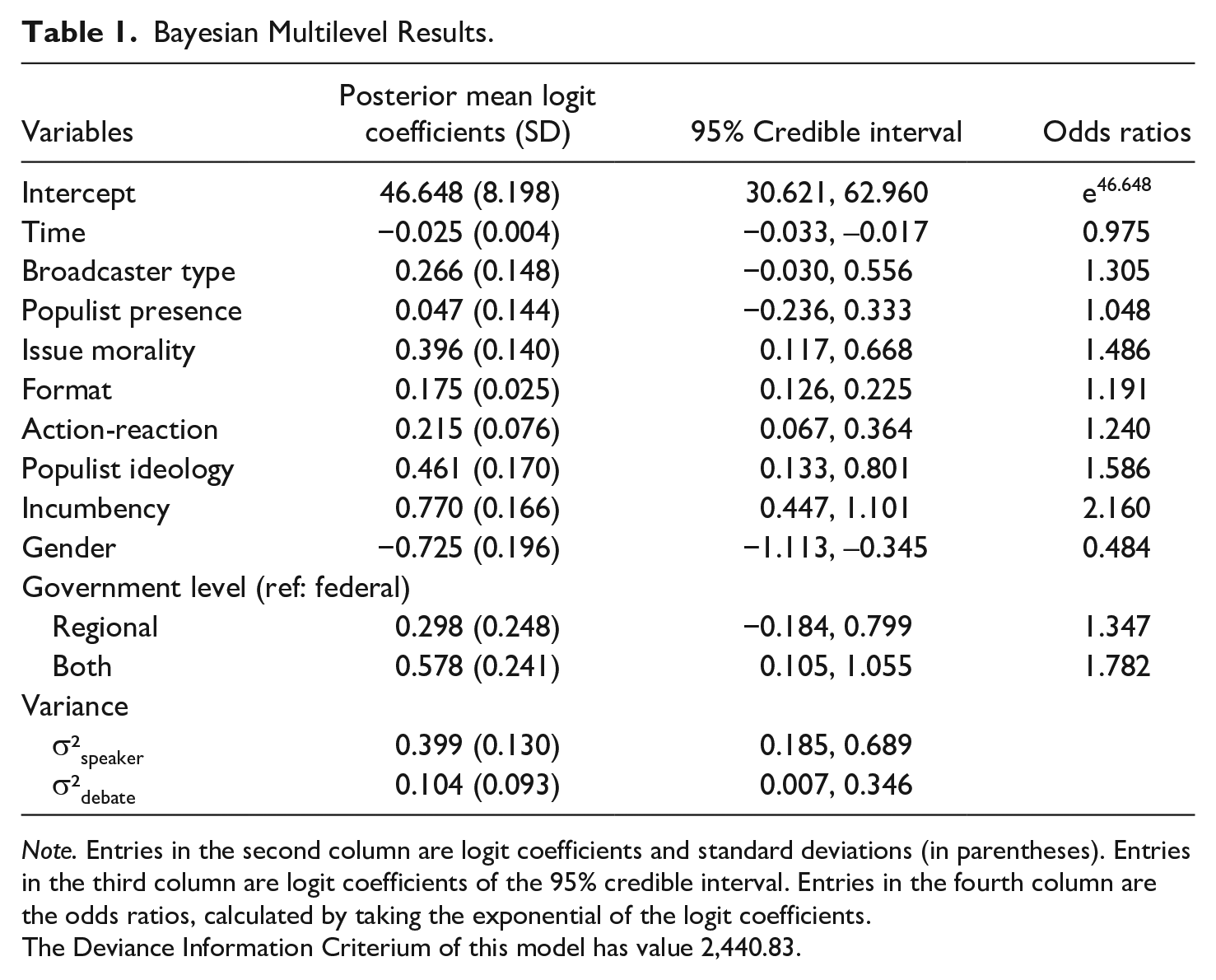
Note. Entries in the second column are logit coefficients and standard deviations (in parentheses). Entries in the third column are logit coefficients of the 95% credible interval. Entries in the fourth column are the odds ratios, calculated by taking the exponential of the logit coefficients.
The Deviance Information Criterium of this model has value 2,440.83.
First, the results indicate that incivility is slightly less likely to occur as time increases. The odds ratio equals 0.975, indicating that with every unit increase in time, the odds of incivility decrease by a factor of 0.025 (1–0.975) or by 2.5%. This is a small effect. When we run a model where we only include time and do not control for the different determinants (Supplemental Appendix F), there is no significant relationship between time and incivility. All of this refutes support for H1: there is no increase of incivility over time.
Turning to the determinants that vary between debates, results in Table 1 show that they do not significantly influence incivility. While the coefficients are positive, the credible intervals contain zero. Hence, it seems that incivility is not significantly higher on the commercial broadcaster VTM compared to the public broadcaster VRT, and neither in debates where populist politicians are present compared to debates where they are absent. This would lead us to decline support for H2 and H3. However, we should note that when we conduct Chi²-analyses, we do observe significantly more incivility in debates aired on the commercial broadcaster (χ2 = 16.15; p < .001) and in which populists are present (χ2 = 9.53, p = .002; Supplemental Appendix D). Similar significant results are found for bivariate logistic regressions. Therefore, it is likely that the higher degree of incivility on the commercial broadcaster is explained by other predictors included in the model (see below).
As Table 1 shows, all the determinants that vary during debates and between politicians influence the prevalence of incivility significantly and in line with expectations. For the during-debate determinants, incivility is more likely to occur when moral issues are discussed (H4), when the number of politicians simultaneously debating with each other is higher (H5), and when a statement is preceded by an uncivil statement (H6: incivility spurs more incivility). For the politician-determinants, it is confirmed that populist politicians (H7), challengers (H8), and male politicians (H9) are more likely to use incivility than non-populist politicians, incumbents, and female politicians. Interpreting the odds ratios shows, for instance for populist ideology, that the odds of incivility increase by a factor of 1.586, or by 58.6%, when a populist speaks as compared to a non-populist politician. All other odds ratios higher than 1 can be interpreted similarly. The odds ratio of gender is lower than 1, showing a decrease of 51.6% when a female politician speaks. These are all substantial effects and confirm support for H4–H9.
Some of these during-debate and between-politician determinants may explain away the significant bivariate effects for broadcaster type (H2) and populist presence (H3) in the full Bayesian model. Debates on the commercial broadcaster and with populist politicians could be characterized more strongly by some of these predictors, thereby explaining where higher incivility levels in these debates come from. For instance, the commercial broadcaster tends to invite a higher number of politicians to the debate stage than the public broadcaster. Indeed, once we control for the number of politicians debating each other, the significant bivariate effect of broadcaster type disappears. The time variable could also provide an explanation. As soon as time is included, the significant result of broadcaster type disappears (Supplemental Appendix F). The most likely reason for this is that incivility did increase on VTM between 2009 and 2019, but not on the public broadcaster VRT (see below, and Supplemental Appendix D). For these reasons, we conclude that H2 (more incivility on commercial broadcasters) and H3 (more incivility when populists are present) can also be supported.
Finally, we did not expect effects for our control variable (i.e., government level of the election) but do observe that election debates for the combined regional and general elections include more incivility. One reason may be that the stakes are perceived to be even higher in these debates where politicians need to perform well on both levels. Therefore, politicians may strive to be in the spotlight even more, leading to a stronger coarsening of the debate.
Incivility Over Time
To gather some deeper insights into the over-time trend, Figure 2 visualizes the degree of incivility in the debates over the past 35 years (in percentages). Overall, the trend line does not increase or decrease much, and the upward trend that one can observe is extremely small, namely less than 1%, again refuting support for H1. What strikes most attention are the pronounced peaks and valleys over time, particularly during the 2000s. Before that, there is a clear increase in incivility from 1985 to 1999. The first, and largest, drop appears during the next election year in 2003. It rises again in 2004, but then strongly diminishes again in 2007. A new trend of rising incivility appears from 2007 onward, yet without exceeding the incivility levels of the (late) nineties.
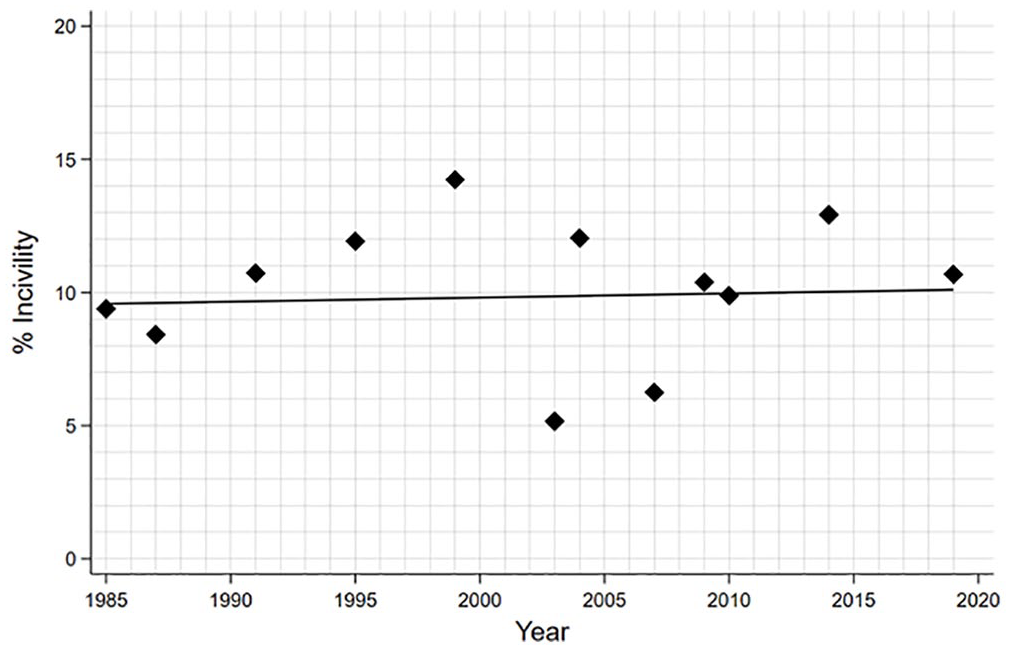
Percentage of uncivil turns per election year.
Interesting to note is that incivility follows an almost identical pattern for the debates on the public broadcaster VRT and commercial broadcaster VTM until 2007. This changes in 2009: between 2009 and 2019 increasing incivility levels are observed on the commercial broadcaster but not on the public broadcaster, where incivility does not rise nor decline substantially (Supplemental Appendix D). Notwithstanding this interesting finding of a rising trend between 2009 and 2019 on VTM, looking at the overall 35-year time pattern, it can be concluded that incivility did not increase.
Connecting the Time Trend to the Determinants
How can the results from the multilevel analysis be connected to the pattern observed in Figure 2? First, incivility increased from 1985 to 1999. During these years, and specifically in 1995, populist politicians started to participate in the debates, and public broadcaster VRT had to compete increasingly with commercial broadcaster VTM that also started to air election debates from then onward. Populist success and media logic were both new elements that started to permeate the political and media landscape, which may have stimulated increasing incivility. Incivility rises, but also reaches its highest peak in 1999, after which there is a sudden, and the largest, drop in the following election year 2003. In 2003, all three election debates that were broadcast were characterized by low incivility levels (Supplemental Appendix A). Particularly the limited presence of populist politicians and the debate format could be important here. Only one debate included a populist politician, accounting for only 2.8% of the speech acts in 2003 (i.e., 16 turns out of 581 were expressed by a populist). Moreover, the debate format included a maximum of only three politicians simultaneously debating with each other. Additionally, in two of the 2003 debates, only leaders of the three biggest mainstream parties were invited, and two of these parties were incumbent. Also half of the third debate consisted of a debate between these three politicians. Together, these factors could explain the low incivility levels in 2003. In the debates for the next elections of 2004, a higher number of politicians from different parties were present again, and populist politicians were included in all three debates, which could explain the rise in incivility as compared to 2003. In 2007, the next election year, the second substantial drop is observed. This drop is largely driven by one of the three debates aired in 2007 (Supplemental Appendix A), namely the only other debate over the whole time period that only invited the leaders of the three biggest mainstream parties, offering the same rationale behind the low incivility levels as observed in 2003. From 2009 onward, incivility was at higher levels again, with some smaller peaks and valleys over the past decade. As outlined earlier, this rise from 2009 onward is due to increasing incivility levels in the debates aired on VTM.
Discussion and Conclusion
Civility is generally seen as an important virtue in public discussions among politicians. However, there are ubiquitous concerns about rising levels of incivility. The first aim of this paper was to validate the legitimacy of these concerns about rising incivility; the second to shed light on the role of potential factors influencing the prevalence of incivility; and the third to gather this evidence outside the U.S.-context where most incivility research is performed. To these ends, we conducted a content analysis of televised election debates, aired from 1985 to 2019 in Flanders, Belgium. We first discuss the over-time findings and their implications, followed by those of the different determinants.
Contrary to expectations, we did not find evidence for politicians’ increasing use of incivility over time. Findings of rising incivility in the U.S. can therefore not be automatically generalized to other contexts (e.g., Shea & Sproveri, 2012). One explanation may be that other characteristics or trends play a larger role in influencing incivility trends than the ones we theorized about (i.e., increasing mediatization, social media importance, populist success). For instance, the U.S. has seen substantial increases in (affective) polarization and partisan media over the past decades (Boxell et al., 2020; Levendusky, 2013). For Belgium, and several other western European democracies, longitudinal evidence for this is still more limited and mixed (Boxell et al., 2020; Hernández et al., 2021; Reiljan, 2020). Therefore, rising incivility may also be absent elsewhere. We encourage future studies to conduct more cross-national, longitudinal research across a wide range of countries (e.g., with or without increasing polarization) to get a deeper cross-national understanding of incivility over time and to pinpoint similarities and differences between countries and systems.
Since we did not find an increase in incivility, one may wonder what then causes this general assumption and feeling of politics becoming harsher and nastier. One possible explanation could be that, whilst politicians do not increasingly use incivility themselves, the incivility they do display gets emphasized and highlighted more frequently in today’s media landscape. Previous research shows that political news coverage has become increasingly negative (Geer, 2012; Reinemann & Wilke, 2007). A similar trend may be ongoing for incivility. By repeatedly highlighting and over-emphasizing politicians’ use of incivility, journalists may nourish the perception that politicians have become more uncivil over time (Skytte, 2019; Walter, 2014). Moreover, social media in general has made political discussions more anonymous and simplistic, leading to more incivility online (Ott, 2017). Again, rather than politicians behaving more uncivilly, political incivility may be shared more often on social media, thereby heightening citizens’ exposure to rude and nasty politics. In light of this, it is important to study different communicators (e.g., politicians, journalists, citizens) and venues (e.g., mediated debates, online discussions) and distinguish between them when making claims about trends in incivility.
Next, what stood out most in the observed time pattern were the ups and downs, showing a volatile pattern of incivility over the years. This can be traced back to contextual factors inspiring the surge or descend of incivility at certain moments in time, and shows the importance to investigate communicative patterns in relation to their context (Coe et al., 2014). Even though the list of determinants in our study is not exhaustive, we can clearly see their influence through the years on different levels. Overall, expectations for the different determinants in our framework were confirmed. The largest influences were observed for determinants that vary during debates and between politicians. We found that discussing moral topics and debating politics with a higher number of politicians stimulates more incivility. We also found that one uncivil statement spurs additional uncivil statements. Moreover, being a populist politician, challenger, and male politician leads politicians to use more incivility. These findings signal the important role debate moderators and organizers can play. Debate organizers could create formats that alternate between more and less incivility-stimulating topics and ensure that groups of politicians debating each other are varied and not too large. Debate moderators can play a key role by pointing out politicians’ incivility and intervening before situations escalate. Although it is likely that moderators themselves encourage incivility in order to adhere to media logic, too much incivility can also frustrate the viewer, decrease their trust in politics and in the media, and cause them to change channels (Goovaerts, 2022; Weber Shandwick et al., 2019). At the between-debate level, bivariate analyses showed that incivility levels are higher on the commercial broadcaster and when populist politicians are present, but the effects disappear when the other determinants are included and controlled for. Hence, some of the other factors we studied could explain away these effects. For instance, commercial broadcasters invite a higher number of politicians to the debate stage who may be more uncivil in the first place. Future research could dive deeper into this.
This study was not without limitations, providing more opportunities for future research. First, the findings are based on a one country-case and we encourage cross-national research to further test the robustness of our findings. Second, we only focused on the genre of election debates and encourage future studies to extend the scope to different communication formats (e.g., political speeches, politicians’ social media posts). Yet, incivility in election debates also still has much uncovered ground. Our framework can still be extended by including other determinants, such as the role moderator(s) play in stimulating or preventing incivility (e.g., Vraga et al., 2012). Third, different conceptions and types of incivility exist in literature. We have taken a rather generic approach and did not study or compare different incivility types. This way, a first global image was provided of the evolution and determinants of (verbal forms of) personal-level incivility in Belgian election debates. This approach does not allow to pick up differences between various forms of incivility, such as interruptions, insults, non-verbal incivility, or public-level incivility. It may well be the case that some forms of incivility increased over time—driving the narrative of rising incivility—whilst other forms decreased or remained stable (see e.g., Coe & Park-Ozee, 2020). Relatedly, we did not study explicit civility or other deliberative attributes. Chen (2017) for example finds that, in online discussions, incivility and deliberativeness can co-exist. Future studies could further examine the interaction and co-existence of incivility, civility and other deliberative features. Fourth, future research could examine potential variation in the effects we found for the different determinants. For instance, incumbency effects may differ depending on the ideological color or extremity of one’s opponent (Nai, 2020; Poljak, 2022). In a multi-party context, some challengers and incumbents are closer “friends” than others who are further “enemies.” How does that influence effects of incumbency status on use of incivility? Moreover, there are first indications that male politicians use less incivility in televised debates toward female opponents (e.g., Maier & Renner, 2018). How do variations in the gender of the sender and receiver of incivility further influence the findings? Additionally, including the populist presence determinant at the aggregate between-debate level was strongly driven by current concerns about populists’ use of incivility and its “contagion-effect” to non-populist politicians’ use of incivility. Several other determinants can also be studied at the between-debate level (e.g., how does the mere presence or absence of female politicians influence incivility levels?). Finally, using a baseline to code the debates over time allows for reliability and objectivity of our measurement but also means that we studied (in)civility through a specific modern lens. Therefore, we may miss out on longitudinal changes of (in)civility norms: expressions that are civil now may have been uncivil some years or decades ago, and vice versa. It would be fruitful for theory-building and empirical research if future research could study incivility norms across time, cultures, and contexts.
To conclude, since we did not detect a linear increase in politicians’ use of incivility in Belgian election debates, worries about a general increase in incivility should be considered with caution. Yet, they should not be ignored altogether: while these worries may not originate in politicians’ uncivil behavior, they may originate in the strong attention that politicians’ use of incivility gets in today’s news and social media environment. This is an important factor to consider in academic and societal debate about rising incivility. Despite the absence of a linear increase, we do find that incivility patterns are highly volatile, confirming the importance to study incivility in relation to its context. Gathering systematic insights on the determinants that heighten (or lower) incivility levels is not only important from a scientific, but also from a practical and societal point of view. When journalists, debate organizers, moderators and politicians consider the conditions under which incivility thrives, the amount of incivility that the public is exposed to through the media could decrease. In turn, harmful societal consequences of high exposure to incivility, on outcomes like media trust, political trust and affective polarization, could diminish.
Supplemental Material
sj-docx-1-crx-10.1177_00936502221135694 – Supplemental material for How Contextual Features Shape Incivility Over Time: An Analysis of the Evolution and Determinants of Political Incivility in Televised Election Debates (1985–2019)
Supplemental material, sj-docx-1-crx-10.1177_00936502221135694 for How Contextual Features Shape Incivility Over Time: An Analysis of the Evolution and Determinants of Political Incivility in Televised Election Debates (1985–2019) by Ine Goovaerts and Emma Turkenburg in Communication Research
Footnotes
Declaration of Conflicting Interests
The authors declared no potential conflicts of interest with respect to the research, authorship, and/or publication of this article.
Funding
This work was supported by the FWO Research Foundation Flanders under Grant no. G068417N, and Internal Funds KU Leuven under Grant no. C14/17/022.

Data Availability Statement
Supplemental Material
Supplemental material for this article is available online.
Notes
Author Biographies
References
Supplementary Material
Please find the following supplemental material available below.
For Open Access articles published under a Creative Commons License, all supplemental material carries the same license as the article it is associated with.
For non-Open Access articles published, all supplemental material carries a non-exclusive license, and permission requests for re-use of supplemental material or any part of supplemental material shall be sent directly to the copyright owner as specified in the copyright notice associated with the article.
