




Abstract
Although the appraisal of online incivility highly depends on the social context in which it occurs, little research has focused on this aspect. Drawing on the general aggression model, we assumed that the appraisal of and the reaction to an uncivil discussion comment is affected by the represented stance and the appearance of accompanying comments. To examine these assumptions, we conducted an online experiment (N = 611) with a three (uncivil vs. civil vs. no preceding comments as a control) × two (opposing vs. conforming recipient’s views) between-subjects design. Data revealed that the influence of preceding comments is limited. However, people were more likely to attribute aggressive motives to senders of incivility when they opposed their opinion. In turn, these attributions increased individuals’ anger, anxiety, hostile cognitions, but also enthusiasm. Furthermore, aggressive motive attributions, participants’ emotions, and hostile cognitions guided participants’ intentions to answer in a discussion-centered and/or aggressive way.
On social media, citizens can easily engage in political conversations that influence their involvement in online and offline political activities (e.g., Hyun & Kim, 2015). However, discussions on these platforms are not always constructive. Research demonstrated that social media users often discuss in an uncivil manner (e.g., Su et al., 2018). Incivility has been defined as “features of discussion that convey an unnecessarily disrespectful tone toward the discussion forum, its participants, or its members” (Coe et al., 2014, p. 600). Although uncivil comments often express justified opinions and are rather directed against political elites than other discussion contributors (Rossini, 2021), various serious negative effects are associated with incivility. For instance, it was found that exposure to incivility increases negative emotions (Gervais, 2015, 2017; Masullo et al., 2021), hostile cognitions (Rösner et al., 2016), and perceptions of polarization (Kim & Park, 2019). Also, it can polarize opinions (A. A. Anderson et al., 2014) and inhibit open-mindedness toward opposing positions (e.g., Hwang et al., 2018). Moreover, it was shown that incivility fosters the likelihood of further uncivil reactions (Chen & Lu, 2017; Rösner & Krämer, 2016) and discourages individuals from participating in online discussions (Han & Brazeal, 2015; Ordoñez & Nekmat, 2019).
To explain in which ways incivility affects people, the general aggression model (GAM; C. A. Anderson & Bushman, 2002) is helpful. The model was developed to comprehensively explain human aggression and postulates that humans develop certain (aggression-related) knowledge structures through their experiences. These structures are connected to individuals’ affective states and guide how people perceive, interpret, and react to their social environment under consideration of situation-related factors. C. A. Anderson and Bushman (2002) highlight three knowledge structures that particularly influence the interpretation of aggression in social situations: (1) perceptual schemata (e.g., identifying a comment as an uncivil social act); (2) person schemata (e.g., beliefs about the sender of a comment); and (3) behavioral scripts (e.g., information about how individuals should react to a discussion comment).
Therefore, if people regard a comment written by specific persons as uncivil, their reaction is guided by behavioral scripts they have learned through past experiences (e.g., reacting uncivilly or refraining from commenting). However, research on incivility faces challenges because the dynamics in online discussions can be very complex. For instance, when approved by all communication partners, incivility might even serve as a social function that helps to manage relationships (Chen et al., 2019). Thus, the consequences of uncivil user comments depend strongly on the social context. As in most studies incivility is treated as an attribute of a discussion that is either present or not, at this time, little is known about how people appraise uncivil messages and how the social context alters this appraisal. This is important because, in online discussions, individuals are typically confronted with several comments of very different types. Whereas some comments might be uncivil, others are written civilly. Especially in public online discussions, people are usually exposed to heterogeneous opinions. Thus, to make an impression of a discussion, people must process various comments that can be very distinct. In this respect, it has not been confirmed that the negative effects of incivility linearly increase with the amount of incivility. Quite the contrary, when a discussion is solely uncivil, negative consequences of incivility might even drop (Rösner et al., 2016)— probably because in such cases people consider incivility as normative behavior (Shmargad et al., 2021). Hence, it is important to examine how people assess single uncivil comments in the social context to disentangle how incivility has undesired outcomes.
To explain how individuals assess and react to uncivil messages based on the social context, the GAM (C. A. Anderson & Bushman, 2002) provides a valuable theoretical framework that can be extended by the affective intelligence theory (Marcus et al., 2000) to determine which emotions are relevant for the processing of incivility in the context of online political communication. We conducted an online experiment assuming that the processing of an uncivil comment is shaped by the amount of incivility in preceding comments as well as by the opinion expressed in the comment. In this context, it was investigated in which ways recipients’ discussion behavior is affected by their emotions and hostile cognitions, as well as the appraisal of senders’ commenting motives. Preregistration is available online. 1
Processing Incivility in a Social World
The GAM (C. A. Anderson & Bushman, 2002) provides a stable theoretical fundament to determine factors that are important to explain how incivility is processed and how this guides individuals’ reactions. The model has been applied to different contexts, such as physical violence or the consumption of violent media (Allen et al., 2018). However, the model has been generalized to non-aggressive outcomes (Buckley & Anderson, 2006). A key component of the GAM is the assumption that people develop certain knowledge structures through their experiences which guide how people assess and react to aggressive events. These knowledge structures can be activated more or less automatically and are triggered by certain stimuli (e.g., violent media) or personal characteristics (e.g., beliefs and attitudes). C. A. Anderson and Bushman (2002) refer to three knowledge structures as being particularly important: (1) Perceptual schemata guide how individuals categorize certain events. In the context of online discussions, this can be the identification of a discussion comment as a comment but also to identify a comment as uncivil. (2) Person schemata represent the beliefs about others, including social groups. For instance, in online discussions, that can be beliefs about persons with a specific opinion or affiliation to a certain party. (3) Behavioral scripts guide people’s behavior under the given circumstances and, thus, determine in which way individuals react to other (uncivil) comments. Each of these three structures is elementary as they determine in which ways situational aspects influence individuals’ affective state along with their arousal as well as subliminal cognition, and also how people cognitively appraise the situation. Hence, in the following, we discuss how the interplay of internal state variables and the cognitive appraisal of the situation can explain how incivility is processed, and how social contextual factors can influence this process.
Affect and Cognitions
At first, the GAM (C. A. Anderson & Bushman, 2002) assumes that individuals’ affective states, along with arousal and subliminal cognitions, are influenced by situational and personal factors. Although the model focuses on negative affective states like anger or hostility (C. A. Anderson & Bushman, 2002), it can also account for the occurrence of emotions beyond aggression, as it builds on very general assumptions (Buckley & Anderson, 2006). Nevertheless, since the approach is very broad, it has to be discussed which specific emotions are relevant when it comes to online political discussions. Here, affective intelligence theory (Marcus et al., 2000) is a useful complementary framework to explain how incivility affects a person’s emotions. The theory distinguishes two systems that guide individuals’ information processing and decision-making in the context of politics: The dispositional system highlights two different emotional states that guide engagement with political stimuli. Within the theory, feelings of enthusiasm reflect individuals’ willingness to like or engage with political stimuli whereas aversion relates to individuals’ avoidance and defensive responses to political stimuli (Marcus et al., 2006, 2011). The surveillance system, on the other hand, is assumed to rely on emotions like anxiety to draw individuals’ attention to unusual circumstances (Marcus et al., 2000, 2006, 2011). Thus, the theory implies that the influence of incivility in online political discussions can go beyond the impact on feelings of anger. Yet, although aversion and anxiety are distinct emotions that can drive different reactions (Nabi, 1999), they often occur together and usually oppose enthusiasm (Marcus et al., 2011).
Indeed, incivility seems to affect all three emotional states. It was found that people feel higher levels of enthusiasm when exposed to civil discussion comments compared to uncivil discussion comments and, in turn, are more likely to engage in online political discussions (Hutchens et al., 2019). Likewise, it was shown that feelings of aversion in the form of anger increase when individuals are exposed to incivility (Gervais, 2015, 2017; Masullo et al., 2021). Concerning anxiety, mixed findings are provided by literature. Whereas Gervais (2017) found that exposure to incivility reduces feelings of anxiety, Lu and Myrick (2016) found that disagreeable uncivil comments increase recipients’ feelings of anxiety. Since the primary function of anxiety is to increase attention and consciousness in new and threatening situations (Marcus et al., 2000), it probably depends on the context if incivility positively or negatively affects anxiety.
In sum, the affective intelligence theory serves as a useful extension to the GAM. Yet, apart from individuals’ affective states, their cognitions are a central part of the internal state. Within the GAM, hostile cognitions are considered the “acceptability of aggressive concepts in memory” (C. A. Anderson & Bushman, 2002, p. 38). Indeed, C. A. Bushman and Anderson (2002) demonstrated that people who played a violent video game indicated more aggressive thoughts within a story completion task. Likewise, Rösner et al. (2016) found that exposure to uncivil discussion comments increases recipients’ hostile cognitions. Thus, in addition to emotions, hostile cognitions seem to play an integral role in the processing of incivility.
Appraisal of Uncivil Comments
In the next stage, the GAM suggests that individuals’ affect and cognitions determine how people appraise a social (aggressive) situation which in turn guides their behavior. The way people appraise a social situation can be explained by attributional processes that usually occur when people try to understand the behavior of others. C. A. Anderson and Bushman (2002) propose that people often make certain trait or situation inferences when explaining others’ behavior. However, attribution theorists highlight that this person–situation dichotomy is only useful to explain accidental behavior or outcomes of actions (e.g., success or failure) because in these cases, actors lack direct control. Intentional behavior, in contrast, is explained by the motives and traits that are attributed to an actor (Jones & Davis, 1965; Reeder, 2009). Especially, the motives people attribute to other persons seem to be important. To interpret another person’s intentional behavior, people usually search for the actor’s motives to understand the reasons behind their behavior. By doing so, individuals also consider the influence of certain situation-related aspects, such as the behavior of bystanders and other actors (Reeder, 2009). It was demonstrated that people attribute more negative motives to individuals who behave proactively in an aggressive manner compared to persons who aggressively react to others’ preceding aggressive behavior (Reeder et al., 2002). In the context of online discussions, Kluck and Krämer (2021) found that individuals attribute more aggressive motives to the sender of an uncivil comment than to the sender of a civil comment.
The Interplay of Internal State Variables and Appraisal
Basically, the GAM (C. A. Anderson & Bushman, 2002) proposes that the internal state variables (i.e., affect, arousal, and cognitions) precede the appraisal process. Yet, appraisal theories of emotions suggest that emotions reflect individuals’ appraisal of the “significance of the environment for well-being” (Moors et al., 2013, p. 120). Accordingly, it was theorized that incivility increases moral indignation (which includes anger, disgust, and contempt) because it is appraised as a violation of social norms (Hwang et al., 2018). Hence, the authors argue that moral indignation roots in moral judgments that can be viewed as a cognitive antecedent of the emotional state. This perspective does not contradict the assumptions of the GAM (C. A. Anderson & Bushman, 2002) per se. Quite the contrary, the model acknowledges that cognitive appraisal can re-influence an individual’s initial rudimentary internal state when individuals are sufficiently motivated. Hence, internal states and the cognitive appraisal of a situation influence each other rather than following a clear hierarchy. In accordance, appraisal theories like Nabi’s (1999) cognitive-functional model suggest that emotions can set a baseline for subsequent information processing. Consequently, the appraisal of a situation is probably guided by individuals’ initial emotions and cognitions that are elicited through the first impressions of a situation. However, in turn, the appraisal can alter individuals’ initial emotions and cognitions when people are motivated to think about a situation (see also Berkowitz, 1990).
Nevertheless, despite the general compatibility of the assumptions of the approaches, it is still inconclusive what drives individuals’ reactions. Following the GAM (C. A. Anderson & Bushman, 2002), in the end, the cognitive appraisal of a situation determines how people respond—even if people come to a reappraisal. This contradicts the assumptions of the functional approaches to emotions which suggest that emotions guide goal-directed action (Keltner & Gross, 1999). Likewise, the affective intelligence theory (Marcus et al., 2000) proposes that emotions guide attention and engagement toward or away from political stimuli. In the context of incivility, this theoretical conflict is not trivial since developing effective interventions requires an understanding of what affects individuals’ reactive behavior the most.
Therefore, the current study scrutinizes the interplay of emotions, subliminal cognition, and deliberate cognitive appraisals when it comes to the processing of and reaction to incivility. As the GAM (C. A. Anderson & Bushman, 2002) emphasizes that knowledge structures and schemata are crucial for how an event affects the different internal state variables, the following is discussed how situational factors influence the process described above.
Impact of Preceding Comments
The GAM (C. A. Anderson & Bushman, 2002) proposes that perceptual schemata determine how a social event is categorized. In this vein, incivility must first be recognized and disapproved of as a norm violation to have any negative consequences (Bormann et al., 2021; Chen et al., 2019). However, the decision of whether a discussion comment is uncivil or not can be very complex. One challenge is that incivility does not occur in a vacuum; rather, the appraisal of a comment depends on the qualities of accompanied comments that shape the prevailing social norm. Here, following the focus theory of normative conduct (Cialdini et al., 1990), descriptive norms and injunctive norms can be distinguished. Descriptive norms refer to the perception of what is typically done and drive individuals’ behavior “by providing evidence as to what will likely be effective and adaptive action” (p. 1015). Injunctive norms refer to assumptions about which behavior is commonly approved or disapproved by others. These norm perceptions can co-exist, but which norm has more impact on individuals’ behavior crucially depends on which norm is more salient. In the context of uncivil comments, people probably consider such behavior as antinormative because they follow an injunctive norm (i.e., incivility is societally disapproved). Yet, if all comments in a discussion are uncivil, the descriptive norm might mitigate the influence of the injunctive norm.
Indeed, it was found that swearing is contagious online (Kwon & Gruzd, 2017) and that frequent participation in online discussions leads to higher acceptance of incivility (Hmielowski et al., 2014). Moreover, Rösner et al. (2016) found that individuals’ hostile cognitions increase when being exposed to uncivil comments compared to civil comments. Unexpectedly, participants’ hostile cognitions did not increase linearly to the proportion of uncivil comments. On the contrary, comparing hostile cognitions when exposed to one, three, or six uncivil comments (out of six discussion comments), mean values suggest that the impact of incivility on an individual’s cognitions even dropped when all comments were uncivil. Accordingly, Shmargad et al. (2021) demonstrated that when an uncivil comment was accompanied by other uncivil comments (as the manifestation of descriptive norms), positive ratings for this comment (as the manifestation of injunctive norms) increased relative to uncivil comments that were not accompanied by other uncivil comments.
These results indicate that the impact of incivility is mitigated rather than facilitated by preceding incivility because, then, incivility has become a descriptive norm. Consequently, people should appraise uncivil discussion behavior preceded by other uncivil comments as less aggressively motivated than uncivil discussion behavior that is preceded by comments, not including incivility. Supporting this idea, as discussed earlier, it was found that inducing aggressive behavior is appraised as more negative than reactive aggressive behavior (Reeder et al., 2002) and people attribute more aggressive discussion motives to individuals who comment in an uncivil manner compared to those who comment civilly (Kluck & Krämer, 2021). Yet, in the context of online discussions, it has not been investigated how the attribution of discussion motives for uncivil commenting differs depending on the amount of incivility in other comments. Based on earlier results (Kluck & Krämer, 2021; Shmargad et al., 2021) it can be assumed that:
H1: When exposed to an uncivil comment which is preceded by uncivil comments, people will attribute less aggressive motives to the comment’s sender compared to the sender of an uncivil comment which is accompanied by preceding comments, not including incivility.
The GAM (C. A. Anderson & Bushman, 2002) suggests that the internal state variables (i.e., emotions and subliminal cognitions) are directly influenced by contextual factors such as the prevailing descriptive norm. From this perspective, these variables would function as an antecedent of the cognitive appraisal: High levels of aversion, anxiety, and hostile cognitions would probably lead to the attribution of more aggressive discussion motives whereas high levels of enthusiasm would decrease such an assessment. In this case, there should be an indirect effect of uncivil preceding comments on aggressive motive attributions through the pathway of the internal state variables, as emotions and subliminal cognitions shape the deliberate cognitive appraisal.
However, from the perspective of cognitive appraisal theories (e.g., Nabi, 1999), internal state variables would rather be influenced by the extent of the attribution of aggressive discussion motives than the other way around. Then, the attribution of aggressive motives would probably increase levels of individuals’ aversion, anxiety, and hostile cognitions as people appraise the behavior to be more threatful and consequently decrease feelings of enthusiasm. Thus, in this case, the cognitive appraisal is decisive for how the internal state variables evolve. As no research on incivility has investigated these variables together we ask:
RQ1: Do individuals’ feelings of aversion, anxiety, enthusiasm, and the extent of hostile cognitions influence recipients’ attribution of aggressive discussion motives when exposed to a different amount of incivility, or do these attributions predict individuals’ emotions and cognitions? 2
Influence of Opposing Opinions
As proposed by the GAM (C. A. Anderson & Bushman, 2002), person schemata seem to be another important knowledge structure for how people process incivility. In the context of online (political) discussions, disagreement is probably a central factor that guides such schemata. Especially on social media, people are likely to be confronted with divergent opinions (Barnidge, 2017). Political disagreement was defined as “the perception of difference resulting from an encounter with an individual or entity in a setting in which it is possible to interact via communication” (Barnidge, 2017, p. 303). Since opposing views are challenging for individuals (Klofstad et al., 2013), disagreement is likely to increase feelings of dissonance (Festinger, 1957). Yet, disagreement can be very different and can range from general over partisan (e.g., Klofstad et al., 2013) to topic-related disagreement (e.g., Wojcieszak & Price, 2012). Following the self-categorization theory (Turner et al., 1987), already minor differences between individuals can trigger perceptions of dissimilarity and situational group-belongingness. The theory suggests that people assess like-minded individuals more positively than individuals from a group to which they do not feel to belong. Indeed, it was shown that people attribute more negative motives to individuals with dissimilar attitudes than to like-minded individuals (Reeder et al., 2005). Likewise, Kluck and Krämer (2021) demonstrated that people attribute more aggressive discussion motives to individuals expressing an opposing opinion toward a specific political issue than to individuals expressing a like-minded opinion—regardless of whether the comment was uncivil or not. That does not necessarily mean that people develop stable perceptions of group belongingness in a discussion. More important is that people seemingly do not only assess the message without making a bigger picture of the sender. Thus, we assume that:
H2: When exposed to an uncivil comment opposing one’s stance, people will attribute more aggressive motives to the sender of the comment compared to an uncivil comment with a like-minded stance.
Again the question arises whether emotions and subliminal cognitions guide this appraisal or are influenced by it. In line with the assumptions of the GAM (C. A. Anderson & Bushman, 2002), it was shown that both civil and uncivil comments arouse negative emotions and aggressive intentions when they contradict the opinion expressed by recipients (Chen & Lu, 2017). Moreover, it was found that individuals have increased feelings of anger when they are confronted with incivility from an opposing social group (Gervais, 2015, 2017). Also, Hutchens et al. (2019) found that the negative effect of incivility on enthusiasm can only be found when a comment is written by people from a social group with different attitudes. For anxiety, Lee et al. (2021) found that anxiety can increase attention to disparate opinions. Since people prefer to avoid disagreement (e.g., Klofstad et al., 2013), being confronted with such a stance can be considered to be a mismatch with one’s goals leading to more negative and less positive emotions (Marcus et al., 2000).
Again the question arises of whether the resulting cognitive appraisal of the situation guides an individual’s emotions and subliminal cognitions or whether the internal state variables influence the cognitive appraisal in the form of motive attributions. Following the GAM (C. A. Anderson & Bushman, 2002), the internal state variables would be directly influenced by the perception of opposing opinions. Through this pathway, the cognitive appraisal would be rather indirectly affected. From this perspective, when confronted with an opposing stance, people might misattribute negative feelings due to cognitive dissonance to the “other side” to restore cognitive consistency (Cooper & Mackie, 1983). However, as appraisal theories (Moors et al., 2013; Nabi, 1999) suggest that the internal state variables are determined by individuals’ cognitive appraisal of the situation (e.g., motive attributions), cognitive (re)appraisal of the situation could also be an antecedent of emotions and subliminal hostile cognitions, and override primal internal states caused by cognitive dissonance. In this way, internal state variables would directly be the product of the cognitive appraisal. Since the evidence about the interplay of internal state variables and cognitive appraisal is weak, we ask:
RQ2: Do individuals’ feelings of aversion, anxiety, enthusiasm, and the extent of hostile cognitions influence recipients’ attribution of aggressive discussion motives when exposed to an opposing stance, or do these attributions predict these emotions and cognitions? 3
Interaction of Preceding Comments and Stance of the Comment
The perception of social norms is affected by processes of self-categorization because in-group members have a stronger prescriptive value than out-group members (Hogg & Reid, 2006). This suggests that people are more willing to accept incivility as a norm when they are exposed to a comment from an in-group member, which is preceded by like-minded incivility and not by opposing incivility. Otherwise, individuals do not conform to a perceived social norm from an in-group because they think it is the right thing to do but to comply with empirical and normative expectations (Bicchieri, 2017). Thus, they might conform to certain behavior, but their appraisal is not affected by an interaction of the experimental conditions. Since empirical evidence is scarce, we ask:
RQ3: Will there be an interaction between incivility in preceding comments and comment’s stance?
Behavioral Intentions of Recipients
Following the GAM (C. A. Anderson & Bushman, 2002), when people have appraised a certain (aggressive) situation, they decide how to react. Hence, we expect that individuals activate certain behavioral scripts when perceiving incivility. In line with this assumption, it was found that individuals’ willingness to comment in a discussion with or without an uncivil comment is directed through the path of perceived polarization and open-mindedness (Kim & Park, 2019). Likewise, Kluck and Krämer (2021) found that the appraisal of the sender of an uncivil message also affects commenting willingness. When people assess a comment to be aggressively motivated, we expect that this appraisal activates aggressive behavior scripts. Therefore, people should have a stronger intent to answer aggressively to the uncivil comment (see also Chen & Lu, 2017) and less the intention to discuss constructively with the person. Thus, we expect that:
H3: The attribution of aggressive intent (a) negatively affects an individual’s intentions to write a discussion-centered answer and (b) positively affects an individual’s intentions to write an aggressive answer to the respective comment.
However, functional approaches to emotions suggest that actions are directly guided by emotions (Keltner & Gross, 1999). Therefore, it is unclear whether the cognitive appraisal in form of aggressive motive attributions only indirectly influences individuals’ reactions by predicting internal state variables. As proposed by the affective intelligence theory (Marcus et al., 2000), enthusiasm should induce approaching behavior whereas aversion should lead to avoidance or defensive behavior. Thus, it is not given that the cognitive appraisal alone guides individuals’ reactions in a certain situation but one could also expect that enthusiasm increases constructive response behavior, whereas aversion fosters aggressive response behavior. As anxiety can also lead to avoidance behavior based on perceived threats (Gray, 1990; Valentino et al., 2011), it is also conceivable that increased anxiety leads in general to a decreased willingness to respond to a comment. Then, the cognitive appraisal would rather indirectly influence individuals’ reactions to opposing stances through the pathway of these internal state variables. Therefore, we ask:
RQ4: Do individuals’ feelings of aversion, anxiety, enthusiasm, and the extent of hostile cognitions directly guide discussion behavior? 4
The actual behavior was also found to be influenced by incivility. It was repeatedly demonstrated that people are more likely to answer in an uncivil way when confronted with incivility in discussions. For instance, Chen and Lu (2017) found that uncivil disagreement, but not civil disagreement, increased uncivil responses. Moreover, Gervais (2017) found that compared to like-minded incivility, only incivility from an opposing group fostered uncivil answers. This indicates that people are more likely to react uncivilly to incivility when they feel threatened. However, Gervais (2015) postulates that criticizing others is also a good indicator for an anger-induced reaction. Indeed, some people probably have learned that civilly criticizing others is a more appropriate reaction to aggression. Thus, although critique can be uncivil, it does not have to be. Therefore, we argue that:
H4: Attribution of aggressive discussion motives positively affects an individual’s likelihood of (a) writing an uncivil answer and of (b) criticizing the sender of the comment.
Noteworthily, although not hypothesized in the preregistration, from a theoretical perspective, the strength of individuals’ behavioral intentions guides whether people act accordingly. Ajzen (1991) argues that “the stronger the intention to engage in a behavior, the more likely should be its performance” (p. 181). As aggressive intentions can be considered as a precursor of the discussion behavior addressed in H4, the relationship is probably mediated by individuals’ aggressive answering intentions.
Method
To test the hypotheses, an online survey addressing a German-speaking population was conducted. A single uncivil statement has been constructed to serve as a basic uncivil comment (i.e., the comment to be evaluated). According to the experimental conditions, the basic uncivil comment was preceded by either five civil comments, five uncivil comments, or, as a control, by no comments. The control condition was included to determine whether the expected effects actually stem from perceptions of an uncivil descriptive norm or whether incivility in an otherwise civil discussion is per se perceived as more uncivil as it might appear more offending. Moreover, comments were consistently either pro or con on the issue. Data analyses were conducted with IBM SPSS 25 and IBM SPSS Amos 25.
Sample
Within the survey, individuals who were neither pro nor con to the relevant issues (n = 103) have been screened out in advance since they could not be properly allocated to the experimental conditions. Of those who were not screened out, 651 participants completed the survey. The sample was primarily recruited via social media platforms. However, some individuals have additionally been recruited via surveycircle.com (n = 101) and prolific.com (n = 49), which are platforms for scientific survey recruitment. As an incentive to take part in the study, gift cards for retail stores were raffled. Overall, 40 participants have been excluded from the analyses based on unrealistic completion times and incomprehensible answering behavior (e.g., when answering inversed items). Thus, the final sample included 611 individuals (397 females and 6 not specified) who were on average 32 years old (ranging from 18 to 76). Most participants indicated that they had a university degree (47.5%) or graduated from high school (29.8%) and were either university students (43.5%) or employees (36.8%). Individuals stated that they use social media on average 2.22 hours (SD = 1.76) per day and 32.9% of participants indicated writing discussion comments on social media at least once a week.
Stimulus Construction and Pre-Test
The comments to which the participants were exposed were embedded in a Facebook post that neutrally asked for others’ opinions toward a socially relevant topic. Each participant was randomly assigned to one of two discussion topics. This approach was taken as it was found that the issue of discussion might alter the effects of incivility (Wang & Silva, 2017). As presented in the result section, the variables did not significantly differ between the different topics. Thus, the differentiation was not included as an additional experimental factor in the analysis but data were merged to enhance the generalizability of the findings. One issue has addressed the question of whether school canteens should be obliged to offer only vegetarian food (n = 307), and the other issue has addressed the question of whether fees for public broadcasting services should be abolished (n = 304). Overall, participants rated the discussion about the respective topic as moderately important for themselves (one-item 7-point Likert scale; M = 3.41, SD = 2.19 for the topic of school canteens and M = 4.07, SD = 2.15 for the topic of broadcasting fees). To avoid undesired effects of names or profile pictures, these features were blurred. In all experimental conditions, participants were exposed to one uncivil comment that was either preceded by five uncivil comments, five civil comments, or blurred comments as a control. These comments were consistently either pro or con the issue addressed by the Facebook post. Examples of the comments are presented in Table 1.
Examples of Comments Employed in the Study.
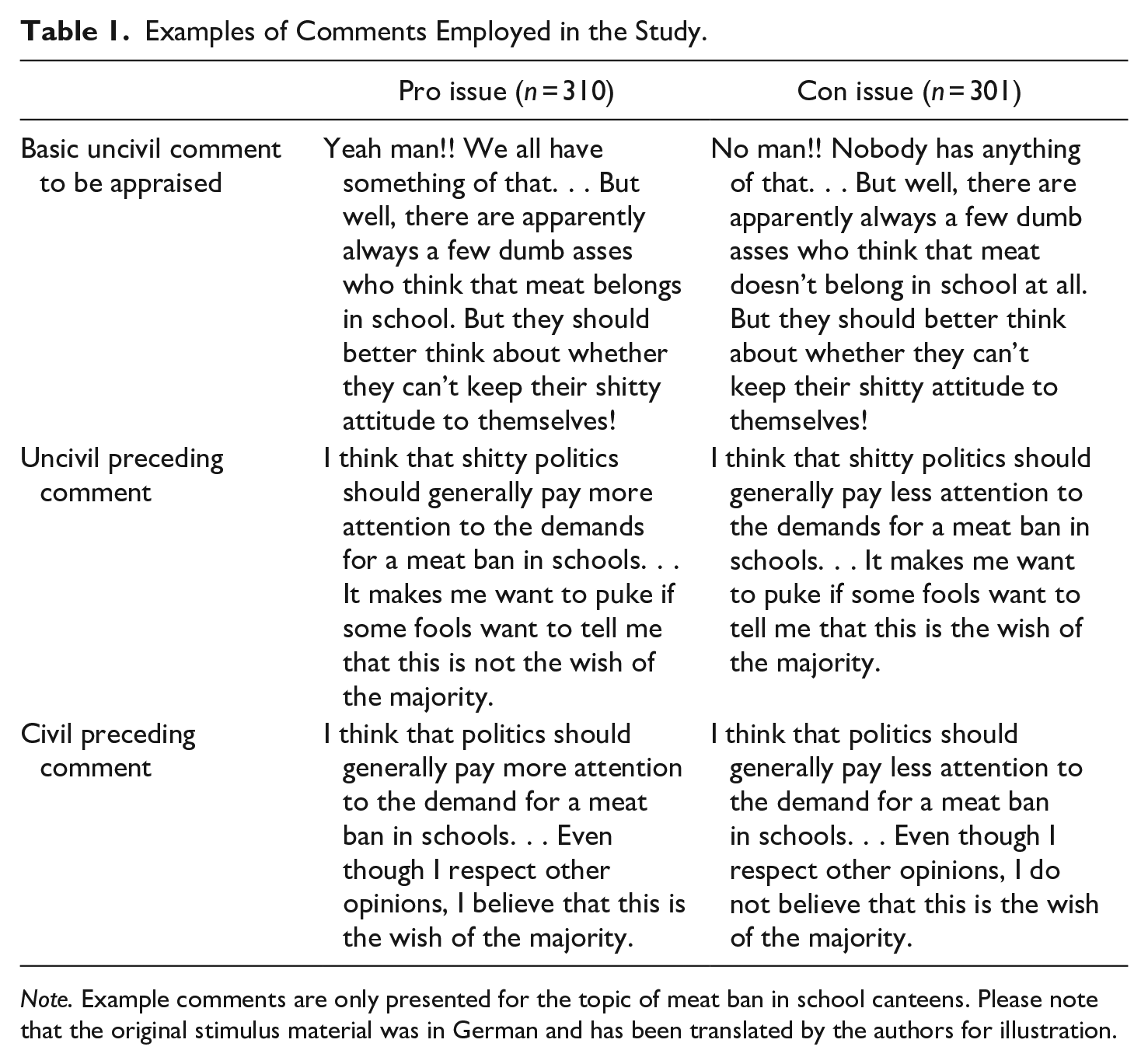
Note. Example comments are only presented for the topic of meat ban in school canteens. Please note that the original stimulus material was in German and has been translated by the authors for illustration.
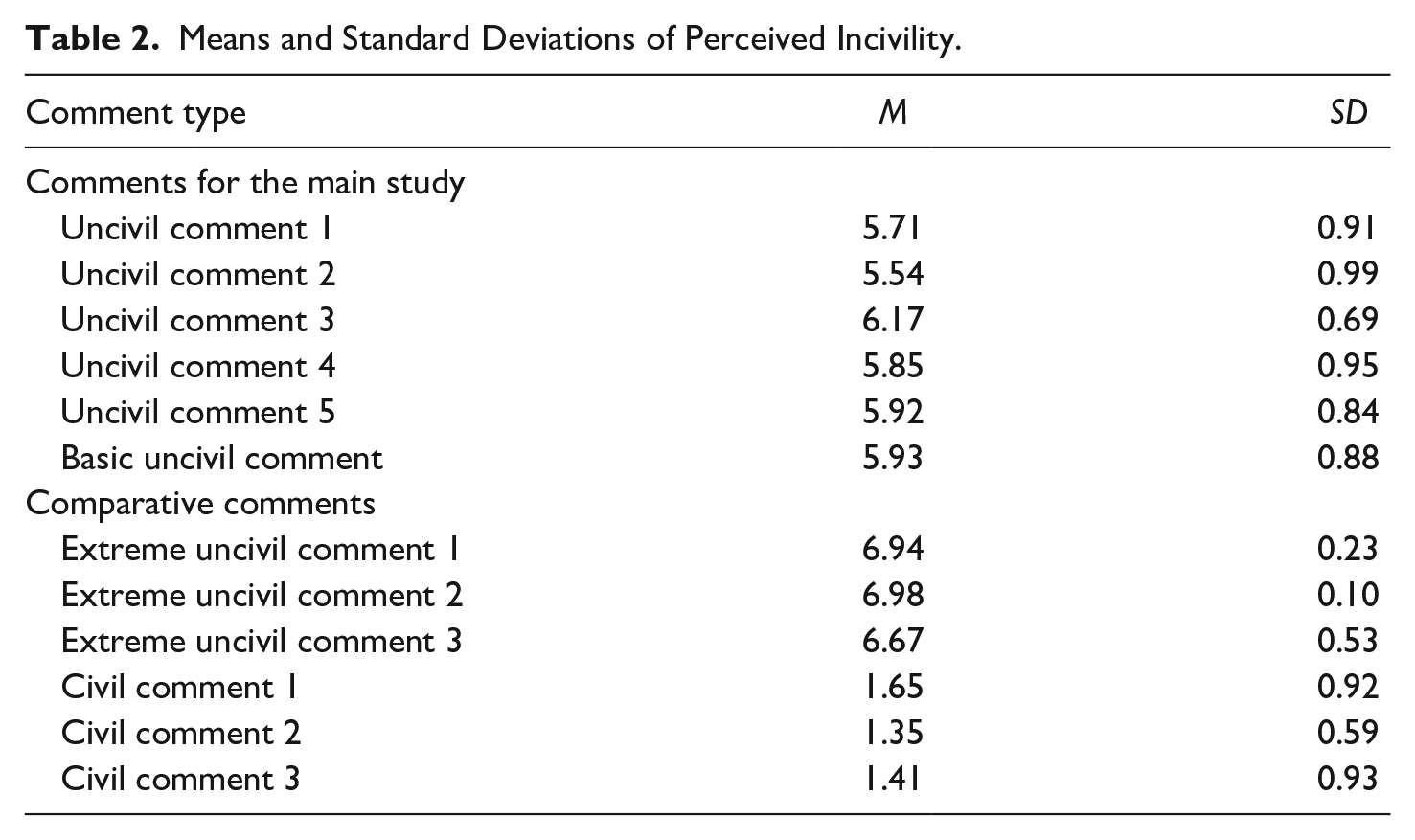
To ensure that all uncivil comments employed in the study are perceived on a similar level of incivility, these comments, as well as three extreme uncivil and three civil comments have been evaluated by participants within a pre-test (N = 30). In random order, each statement was rated on a 7-point semantic differential, including four adjective pairs reflecting perceived incivility (polite–impolite, respectful–disrespectful, friendly–hostile, and peaceful–aggressive). No discussion topic was mentioned in the pre-test. A repeated-measures ANOVA 5 revealed that there was a significant difference between comments regarding the perceived incivility (F(4,931, 143.003) = 304.84, p < .001, η² = .913). Pairwise comparisons with Bonferroni corrections revealed that the six comments intended for the study did not differ significantly from each other (each pair p > .05). However, the six comments differed significantly from the three civil comments (each pair p < .001) and the three extreme uncivil comments (each pair p < .05). Thus, it was concluded, that the uncivil comments were perceived as uncivil at a similar level. See Table 2 for means and standard deviations.
Means and Standard Deviations of Perceived Incivility.
Measures
Emotions
Individuals’ enthusiasm, anger, and aversion were each measured by items recommended by Marcus et al. (2006). For each emotion, we supplemented some )items to receive a more comprehensive measurement. Individuals indicated to which extent they feel certain states on a 7-point Likert scale (from 1 = not at all to 7 = very). For enthusiasm, individuals rated on enthusiastic, hopeful, proud, interested, elated, motivated, activated and encouraged (M = 3.32, SD = 1.30, Cronbach’s α = .90). For anger, individuals rated on hatred, contempt, bitterness, resentful, furious, angry, and hostile (M = 1.73, SD = 1.09, α = .92), and for anxiety, individuals rated on anxious, worried, afraid, unsettled, nervous, frightened (M = 2.29, SD = 1.39, α = .91).
Hostile cognitions
Hostile cognitions were measured by the approach employed by Bushman and Anderson (2002). Participants read an ambiguous story about a car accident and were asked to indicate open-ended ideas about what the protagonist might do, feel, think, or say in the further course. It must be noted that this task originally includes two further stories. However, as Rösner et al. (2016) found that only the story with the car accident (i.e., the first story) captured individuals’ hostile cognitions, we only adapted this story for the current study. Individuals could indicate up to 20 ideas on how the story could continue. To measure individuals’ hostile cognitions, the percentage of answers including aggressive acts, thoughts, or feelings was calculated from the total number of answers. Overall, 16.42% of the answers were coded as aggressive. A second rater, blind to the hypotheses and conditions, also coded the responses. Following the previous approaches (Bushman & Anderson, 2002; Rösner et al., 2016), we calculated the intraclass correlation coefficients (ICC) for the sum scores of aggressive answers indicating good reliability (ICC = .86; Cicchetti, 1994).
Attributed aggressive motives
We captured the attributed aggressive motives with nine self-constructed statements which were rated on a 7-point Likert scale (from 1 = I do not agree at all to 7 = I totally agree). An exploratory factor analysis (EFA) with a principal component analysis (PCA; Varimax rotation) revealed a two-factor solution that was supported by Horn’s (1965) parallel analysis. Based on an EFA with a principal axis analysis (PAA; Promax rotation) for a fixed number of two factors, two items with low loadings on the main factor (<0.50) were removed. The first factor included five items that addressed aggressive attributions. The second factor included two items that addressed positive motives, which should serve as reserved items. As the second factor did seemingly not capture aggressive attributions (e.g., “. . .to encourage other people”) only the first factor (e.g., “. . .to unsettle other people” or “. . .to attack other people;” M = 4.30, SD = 1.38, α = .80) was employed in the analyses. All items and factor loadings are presented in Supplemental Appendix A.
Intentions to react
To capture individuals’ aggressive and discussion-centered intentions to react to the comment, we constructed eight items each that were rated on a 7-point Likert scale (from 1 = I do not agree at all to 7 = I totally agree). An EFA with PCA (Varimax rotation) supported a two-factor solution that was also confirmed by Horn’s (1965) parallel analysis. Based on a further EFA with PAA (Promax rotation) for a fixed number of two factors, only one item was excluded from the scale because of high loading on the other factor (>0.20) leading to the anticipated factors aggressive (e.g., “. . .to signal the person to shut up “or “. . .to humiliate the person;“ M = 2.21, SD = 1.44, α = .93 ) and discussion-centered intent (e.g., “. . .to better understand the opinion of the person “or “. . .to share your knowledge with the person;“ M = 2.17, SD = 1.23, α = .87). Again, items and factor loadings are presented in Supplemental Appendix A.
Uncivil commenting and critique expression
To measure the likelihood of uncivil commenting and critique expressions, individuals were asked to write a comment regardless of their actual intention to do so. In accordance with common markers of incivility (Coe et al., 2014; Stryker et al., 2016), answers including offending speech like name-calling, mockery, aspersion, or vulgarity directed toward the commenter were coded as uncivil (e.g., “Shut up you idiot”). Moreover, comments were coded as critique expressions when they negatively assessed the “specific personal qualities, behavior, and traits” of the commenter (Gervais, 2015, p. 18; e.g., “Please stay factual and respectful”). About 8.67% of the responses were identified as uncivil and 61.54% were identified as critique expressions. Again, a second rater, blind to the assumptions, coded 10% of the answers, leading to a satisfactory intercoder agreement (uncivil comments: Krippendorff’s α = .93 and critique expressions: Krippendorff’s α = .83).
Manipulation check
To test whether people perceived the basic uncivil comment and the preceding comments in the intended direction, individuals assessed both on a 7-point semantic differential including five adjective pairs reflecting perceived incivility (polite–impolite, respectful–disrespectful, friendly–hostile, adequate–inadequate and nice–nasty; basic uncivil comment: α = .88 and preceding comments: α = .98). Individuals in the control condition only rated on the basic uncivil comment. An independent sample t-test revealed that uncivil preceding comments (M = 5.84, SD = 1.23) were perceived as more uncivil than the civil ones (M = 2.38, SD = 1.20; t(407) = 28.73, p < .001, d = 1.22). Moreover, pair-wise t-tests per condition indicated that the civil preceding comments were perceived as less uncivil (M = 2.28, SD = 1.20) than the basic uncivil comment (M = 6.24, SD = 0.79; t(199) = 34.33, p < .001, d = 1.59). Against our intention, uncivil preceding comments were perceived as slightly less uncivil (M = 5.84, SD = 1.23) than the basic uncivil comment (M = 6.32, SD = 0.84, t(208) = 6.43, p < .001, d = 1.09). However, the difference was comparatively small.
Procedure
Within the survey, participants first indicated their opinion toward the two discussion topics. In addition to some specific aspects regarding the topics, they indicated their general opinion toward the topics on a semantic 7-point differential (con–pro). Participants were then allocated to the stimulus according to the experimental condition they were randomly assigned to. Based on the answers given before, individuals were either assigned to like-minded or opposing comments—or have been screened out. Then, they indicated their willingness to join the discussion. Afterward, individuals answered open questions as part of a story completion task and indicated their emotional state. Then, individuals were again exposed to the stimulus, but this time they were asked to focus on the last comment (i.e., the basic uncivil comment). In random order, individuals assessed the comment writer’s motives and indicated how they would react to the comment. Thereafter, they rated the perceived incivility of the comments. Last, individuals rated on person-related and sociodemographic information.
Results
A path analysis was conducted using SPSS Amos 25 our hypotheses and research questions. Indirect effects were examined by using bias-corrected bootstrapping with 5,000 resamples (95% confidence interval). To determine the model fit, we followed indices proposed in the literature (Byrne, 2010; Hu & Bentler, 1999). As the individuals’ response comments were coded dichotomously, the effects of aggressive motive attribution on the likelihood to criticize or to comment uncivilly and the mediating effects of aggressive answering intent were tested employing the Process macro for SPSS (Hayes, 2018), which automatically uses logistic regressions for binary dependent variables. 6
Before conducting the path analysis, we checked if there are any meaningful differences between the dependent variables based on the topic of the discussion. A series of (M)ANOVAs revealed that there have not been any differences. Neither aggressive motive attributions (F(1,609) = 0.650, p = .402, η² = .001), the different emotions and hostile cognitions (Wilks’ λ = .995, F(4,606) = 2.54, p = .556, η² = .005) nor individuals’ intentions to react (Wilks’ λ = .995, F(2,608) = 1.41, p = .244, η² = .005) differed significantly between the two topics.
Within the path analysis, the experimental conditions were included as dummy coded variables. As the factor preceding comments has been multicategorical, it was included in the model by employing indicator coding. In this way, the uncivil preceding comment condition and the control condition (no preceding comments) were each tested against the civil comment condition to examine whether effects are caused by preceding uncivil comments or based on the absence of civility. For the interaction term, the dummy-coded variables uncivil preceding comments and opposing stance were multiplied. Correlations of the metric variables are presented in Table 3.
Bivariate Correlations of Variables in the Path Model.
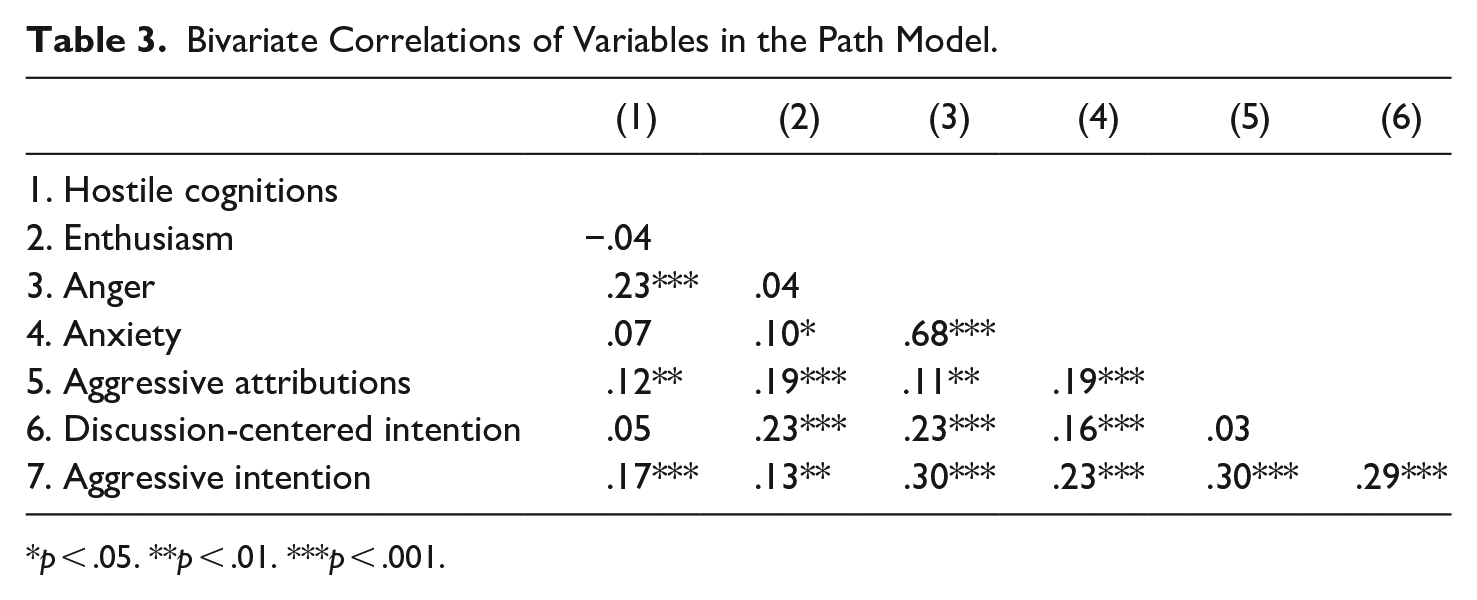
p < .05. **p < .01. ***p < .001.
Based on the theoretical discussion regarding the role of individuals’ emotions and hostile cognitions (RQ1, RQ2, and RQ4), we tested two different path models. According to the GAM, we tested one model in which the emotions and hostile cognitions are directly affected by the experimental factors and, in turn, predict the extent of hostile attributions. When calculating the path model as proposed, it poorly fitted the data: χ2 (18) = 140.105, p < .001, χ2/df = 7.78, CFI = 0.91, TLI = 0.74, RMSEA = 0.11 (90% CI [0.09, 0.12]), SRMR = 0.07.
Based on the assumptions of the cognitive appraisal theories and functional approaches to emotions (Keltner & Gross, 1999; Moors et al., 2013; Nabi, 1999), we tested an alternative model in which emotions and hostile cognitions succeed the hostile motive attributions and predict individuals’ intentions to react. The alternative model fitted the data considerably better: χ2 (26) = 52.201, p = .002, χ2/df = 5.779, CFI = 0.95, TLI = 0.96, RMSEA = 0.04 (90% CI [0.06, 0.82]), SRMR = 0.04. Although a better model fit does not give a more accurate indication of causalities, based on the additional theoretical arguments, this model was employed for the analyses. 7 The final model is visualized in Figure 1.
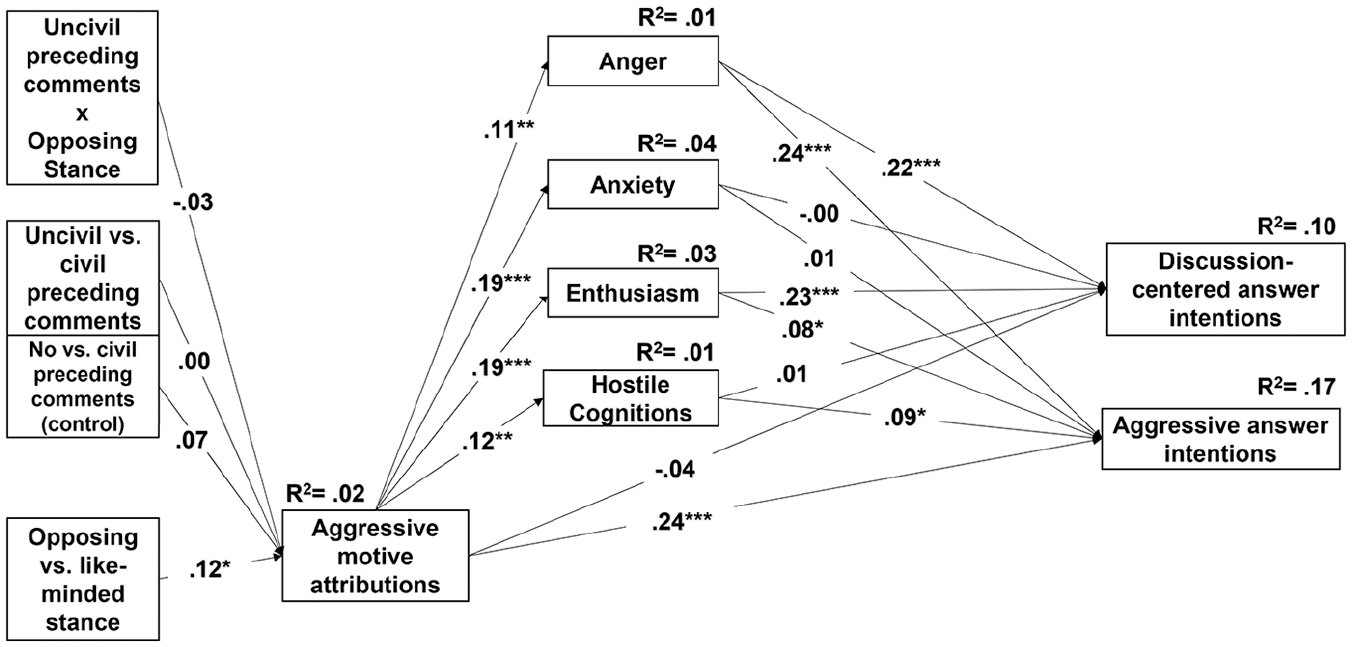
Computed path model.
We also hypothesized that preceding uncivil comments (H1), as well as an opposing stance (H2), will positively affect to which extent individuals attribute aggressive motives to the sender of the basic uncivil comment. Whereas, neither uncivil preceding comments (β = .00, p = .963) nor the control condition (β = .08, p = .148) affected the extent of aggressive attribution making, H1 was rejected. However, as expected (H2), individuals attributed more aggressive motives to the basic uncivil comment when they were confronted with opposing stances compared to like-minded stances (β = .12, p = .014). Yet, the interaction of preceding comments and opposing stances did not influence the extent of aggressive motive attributions (RQ3; β = −.03, p = .631). Regarding the question how emotions and hostile cognitions affect the processing of incivility (RQ1–2), we found that attributing aggressive motives to the sender of an uncivil message increased individuals’ anger (β = .11, p = .005), anxiety (β = .19, p < .001), enthusiasm (β = .19, p < .001), and hostile cognitions (β = .12, p = .004). Surprisingly, however, feelings of enthusiasm also increased when higher levels of aggressive motives were attributed to the sender of the basic uncivil message. Furthermore, as expected we found that attributing aggressive motives increased individuals’ intentions to answer aggressively (H3b; β = .24, p < .001) but did not influence intentions to answer in a discussion-centered manner (H3a; β = −.04, p = .291). However, aggressive motive attributions had a positive indirect effect on both answering intentions through the pathway of internal state variables (β = .07, p = .003, CI [0.05, 0.11] for discussion-centered intentions and β = .05, p = .009, CI [0.03, 0.09] for aggressive intentions).
Although the model did not include direct paths of the experimental conditions on the internal state variables, we found that an opposing comment stance indirectly increased anger (β = .01, p = .006, CI [0.00, 0.04]), anxiety (β = .02, p = .008, CI [0.01, 0.07]), enthusiasm (β = .02, p = .006, CI [0.01, 0.05]), and hostile cognitions (β = .01, p = .020, CI [0.00, 0.03]) through the pathway of motive attributions. Preceding uncivil comments did not show such an effect (anger: β = .00, p = .922, CI [−0.01, 0.04], anxiety: β = .00, p = .922, CI [−0.02, 0.06], enthusiasm: β = .00, p = .903, CI [−0.02, 0.05], and hostile cognitions: β = .00, p = .835, CI [−0.01, 0.01]).
Further, data revealed that anger (β = .24, p < .001), enthusiasm (β = .08, p = .048), and hostile cognitions (β = .09, p = .022) positively influenced intentions to answer in an aggressive manner whereas anxiety did not influence this variable (β = .00, p = .916). Moreover, anger (β = .22, p < .001) and enthusiasm (β = .23, p < .001) positively influenced individuals’ intentions to answer in an discussion-centered way. In contrast, anxiety (β = −.00, p = .939) and hostile cognitions (β = .01, p = .771) did not affect this intention.
We also expected that individuals are more likely to write an uncivil answer to the basic uncivil comment (H4a) and to criticize its sender (H4b) when attributing higher levels of aggressive motives to the sender. Although not hypothesized a priori, based on well-established psychological mechanisms (Ajzen, 1991), it was also tested whether individuals’ aggressive answering intentions functions as a mediator within this relationship. Therefore, for each dependent variable, a mediation analysis was conducted. Please note that results for the dependent variables are reported as log-odds metrics. In both models, aggressive motive attributions increased aggressive answering intentions message (R2 = .09, F(1,609) = 57.96, p < .001; B = 0.49, SE = 0.06, p < .001). When examining the effect of aggressive motive attributions on uncivil answers, the mediation model was significant (χ²(1) = 319.52, p < .001, Nagelkerke’s R2 = .15). Against H4a, aggressive motive attributions did not affect the likelihood of using uncivil expressions (B = −0.04, SE = 0.02, Z = −1.72, p = .086, CI [−0.08, 0.01]). However, participants aggressive answering intentions positively affected uncivil answering behavior (B = 0.07, SE = 0.01, Z = 6.28, p < .001, CI [0.05, 0.10]). Although the direct effect of aggressive motive attributions was not significant, the indirect effect through aggressive answering intentions was significant—albeit small (B = 0.03, SE = 0.01, CI [0.02, 0.05]). When entering critique expressions as dependent variable, the model was significant, too (χ²(1) = 791.40, p < .001, Nagelkerke’s R2 = .05). Important to note, the model was not well-fitting as indicated by Nagelkerke’s R2. As expected (H4b), aggressive motive attributions increased the likelihood of criticizing the sender of the basic uncivil message (B = 0.06, SE = 0.01, Z = 4.26, p < .001, CI [0.03, 0.08]). Likewise, aggressive answering intentions significantly, but negatively, affected the likelihood of criticism (B = −0.02, SE = 0.01, Z = −3.21, p = .001, CI [−0.04, −0.01]). Consequently an significant but negative indirect effect emerged (B = −0.02, SE = 0.00, CI [−0.02, −0.00]).
Discussion
By drawing on the general aggression model (GAM; C. A. Anderson & Bushman, 2002) and the affective intelligence theory (Marcus et al., 2000), the way in which incivility in other comments and the attitude expressed in a comment influence the processing of an uncivil comment was investigated. Overall, the GAM has proven to be a useful framework to examine the effects of uncivil comments in a more holistic manner that accounts for both discussion-centered and aggressive reactions.
The Impact of Descriptive Norms and Disagreement
Our results suggest that people appraise individuals’ motives for behaving uncivilly independent of others’ uncivil commenting behavior. Compared to preceding civil comments, neither preceding uncivil comments nor the absence of preceding comments influenced individuals’ attribution of aggressive motives to the sender of an uncivil comment. Thus, a descriptive uncivil norm is seemingly not able to alter the perception of uncivil behavior easily. This is surprising as it partially contradicts the assumptions of the focus theory of normative conduct (Cialdini et al., 1990) and also previous findings of Shmargad et al. (2021) who found that positive ratings for an uncivil comment increased when other comments were also uncivil. This result can have many potential reasons. First, the perception of descriptive norms, as proposed by Cialdini et al. (1990), might not have been strong enough to outweigh perceptions of injunctive norms. Thus, people still considered incivility as offensive behavior in discussions—especially because they were exposed to a public social media discussion. Indeed, some comments that were written by participants indicated that they considered the uncivil basic comment to be an adaptive behavior in the condition with preceding uncivil comments but still disapproved of this kind of communication. For instance, one person commented: “Please remain objective and try to understand the motives of the others. You should not stoop to the level of others.” Another person stated: “You may have been tempted by the rude and impolite language of the other posts in this forum, but should we not discuss such a serious topic objectively?” In this vein, the initial Facebook post to which the manipulated comments answered were written civilly. This may have been enough to activate an injunctive norm, as it reminded individuals that incivility is usually disapproved (see also Cialdini et al., 1990). Another explanation could be that the presentation of uncivil user comments at one time was not sufficient to activate a descriptive norm that overrides the injunctive norm. In terms of the GAM (C. A. Anderson & Bushman, 2002), people might have developed more stable knowledge structures regarding incivility through experiences that cannot be easily altered. Yet, we did not explicitly examine whether the behavior was perceived as acceptable but focused on the attribution of motives for discussion. Thus, we cannot rule out that individuals considered aggressive discussion motives more acceptable when accompanied by other uncivil comments (cf., Hmielowski et al., 2014; Shmargad et al., 2021). This aspect is important since it raises the question of what is perceived as the norm: the behavior as a stylistic device or the aggressive motivation behind it? As this could have very different implications, this should be further researched.
Overall, opinion differences proved to be a better predictor for the attribution of uncivil commenting motives than descriptive norms—at least in public political online discussions. When confronted with opposing views, individuals are likely to have increased feelings of dissonance (Festinger, 1957; Klofstad et al., 2013). Since the attribution of discussion motives is strongly related to person perception, it is plausible that people attribute negative motives to opposing stances to mitigate negative feelings triggered by cognitive dissonance (Cooper & Mackie, 1983). These findings are remarkable insofar as they show in direct comparison that the descriptive norm in online political discussions plays a minor role relative to individuals’ different stances. On a positive note, it seems that incivility is not easily “normalized” in online discussions due to descriptive norms but people assess it still as aggressive motivated communication behavior (yet, it remains open whether having aggressive discussion motives becomes more acceptable). On the other side, it is concerning that opinion differences rather guide the perception of uncivil discussants than the prevailing descriptive conversational norm. This pattern is very likely to contribute to conflicts when it comes to cross-cutting discussions since people seemingly pay more attention to an individual’s (different) stance than to the prevailing communication norm. Thus, adding to previous research on the effects of disagreement and incivility (e.g., Chen & Lu, 2017; Gervais, 2017; Kluck & Krämer, 2021), our results indicate that people focus rather on person factors like the stance of commenters than on the social context.
Beyond Negative Outcomes
The current study found that the attribution of aggressive discussion motives does not solely result in negative outcomes but can result in both aggressive and constructive answering intentions. Moreover, our research adds to previous findings regarding the role of hostile cognitions and emotions (e.g., Lu & Myrick, 2016; Masullo et al., 2021; Rösner et al., 2016) by showing that cognitive appraisal in the form of motive attribution can be an ascendant of these variables. From the perspective of the GAM, it is reasonable that individuals’ appraisal of an uncivil comment can reinforce or alter rudimentary emotions and cognitions triggered by exposure to an uncivil comment. However, since the hierarchy of emotions/hostile cognitions and motive attributions was inferred based on the fit of the data to the model, these relationships must be interpreted cautiously. The fit of this order of variables is probably an artifact of the measurements and cannot represent their complex interaction. Nevertheless, we found that the affective intelligence theory (Marcus et al., 2000) serves as a useful extension to the GAM as it can account for which emotions are relevant that go beyond anger and aggression.
In this vein, corresponding to the basic assumptions of the GAM (C. A. Anderson & Bushman, 2002), individuals’ anger and hostile cognitions increased aggressive answering intentions. However, anger also increased the likelihood of discussion-centered answer intentions. This result is important as it shows that anger can produce both constructive and aggressive reactions. This might also explain why incivility can simultaneously have positive and negative effects (e.g., Borah, 2014). Importantly, the two dimensions of answering intentions (discussion-centered or aggressive) are not mutually exclusive. People can have the intent to show uncivil others that they are “idiots” but at the same time are motivated to understand those persons. Then, anger might serve as a motivating force to “neutralize disliked elements” (Marcus et al., 2006, p. 36) by discussing more constructively.
This assumption is supported by our finding that aggressive motive attributions increased the likelihood of criticizing the sender and not the likelihood of behaving uncivilly—albeit this effect was small. It was also found that the attribution of aggressive discussion motives can indirectly increase the likelihood of uncivil commenting behavior and decrease the likelihood of critique expressions through the pathway of aggressive answering intentions. Therefore, when aggressive motive attributions increase aggressive discussion intentions, people seem to be more likely to engage in uncivil commenting behavior and less likely to criticize others. This finding is important as it shows that not incivility per se but the interplay of various factors lead to uncivil reactions (see also Chen & Lu, 2017).
Contradicting earlier findings regarding the impact of incivility (cf. Hutchens et al., 2019), aggressive motive attributions increased individuals’ feelings of enthusiasm, too. In the context of political stimuli, enthusiasm is associated with positive goal pursuit, whereas feelings like anger are associated with neutralizing undesired inputs (Marcus et al., 2000). Otherwise, these emotional states can probably co-occur. Concerning the current study, people might have felt increased anger as they perceived an undesired threat which is reflected by attributions of aggressive motive attributions. At the same time, they can also be convinced that their behavior is much more purposeful which in turn triggers feelings of enthusiasm. Indeed, enthusiasm positively influenced individuals’ intentions to answer to the basic uncivil comment in a discussion-centered manner. This would also explain why aggressive motive attributions indirectly increased participants’ intention to answer in a discussion-based manner.
Interestingly, in the study’s context, anxiety did not affect individuals’ behavioral intentions. Indeed, although associations between incivility and anxiety have been found (Gervais, 2017; Lu & Myrick, 2016), there is only limited evidence that anxiety directly affects individuals’ behavior. In general, anxiety is connected to a surveillance system that directs individuals’ attention (Marcus et al., 2000, 2006). Therefore, anxiety might rather drive people to take a closer look at the situation but not directly alter their behavior. Future studies should investigate which concrete role anxiety plays in online discussions. It must be noted that only a small amount of the variances of all internal state variables could be explained (1%–4%). Thus, there are assumably other variables that guide individuals’ emotional states.
Limitations and Further Directions
Some limitations of the study have to be acknowledged. First, the representativeness of the sample is limited as we draw on a convenience sample. Also, we recruited participants from different platforms. This approach was taken to have a more heterogeneous sample. Nevertheless, the generalizability of the findings is limited and must be replicated in future studies. A major limitation of the study is that we could not control in which order people read the distinct comments or whether they read all comments thoroughly. Nevertheless, the manipulations were made very clear, so individuals should have been able to recognize them even if they did not read all the comments particularly carefully. Further, participants’ self-reported emotions and cognitions were measured with a time delay. Thus, our computed model does only represent a part of the process that takes place when people are confronted with incivility as it did not include participants’ initial immediate affective state. Consequently, the statements about causality in this model are limited and should not be overinterpreted. In this vein, again, it has to be noted that some of the preregistered hypotheses could not be tested due to an inadequate model fit. Also, it has to be noted that confounding variables not included in the model might have biased the results. This also applies to the additional mediation analyses conducted with PROCESS.
Moreover, the stance of preceding comments and the basic uncivil comment were kept constant. Future studies should investigate how discussions with mixed stances influence the appraisal of uncivil comments. Another limitation is that we did not measure all motives which people can attribute to the sender of an uncivil message. Also, we did not measure all possible answering intentions. Likewise, many forms of incivility can affect individuals differently. Hence, it could be examined how different types of incivility alter the attribution of motives. Finally, participants were aware that they were exposed to a hypothetical scenario. Nevertheless, this does not necessarily mitigate the effects of incivility, as the relevant knowledge structures are assumably activated to a similar extent.
Conclusion
From a theoretical perspective, the study has shown that the general aggression model allows a more holistic way to investigate the effects of incivility and highlights that the outcome can differ based on the paths it takes. Moreover, this study found that it does not matter whether an uncivil comment stands alone, is accompanied by uncivil comments, or by civil comments for the attribution of aggressive motives. Consequently, although incivility is certainly a perceptual construct, the perception seems to be less dynamic than often expected. More important for the attribution of discussion motives seems to be the stance of the sender since an uncivil comment that represented an opposing opinion was associated with more aggressive motives than a like-minded uncivil comment. Hence, a major implication of this study is that disagreement is more powerful in shaping the attribution of discussion motives than the conversational context and, in turn, has a greater impact on the related discussion dynamics. Future interventions should focus on how attributions can be altered in cross-cutting discussions to mitigate the negative effects of incivility.
Supplemental Material
sj-docx-1-crx-10.1177_00936502221113812 – Supplemental material for Appraising Uncivil Comments in Online Political Discussions: How Do Preceding Incivility and Senders’ Stance Affect the Processing of an Uncivil Comment?
Supplemental material, sj-docx-1-crx-10.1177_00936502221113812 for Appraising Uncivil Comments in Online Political Discussions: How Do Preceding Incivility and Senders’ Stance Affect the Processing of an Uncivil Comment? by Jan P. Kluck and Nicole C. Krämer in Communication Research
Footnotes
Acknowledgements
We would like to thank Svenja Klocke and Fenja Stratenhoff for their help in collecting data and preparing the stimulus material.
Author Note
This manuscript describes original work that has not been published previously and is not under consideration by any other journal. All authors have agreed to the submission.
Declaration of Conflicting Interests
The authors declared no potential conflicts of interest with respect to the research, authorship, and/or publication of this article.
Funding
The authors disclosed receipt of the following financial support for the research, authorship, and/or publication of this article: This research was funded by the Digital Society research program funded by the Ministry of Culture and Science of the German State of North Rhine-Westphalia.

Supplemental Material
Supplemental material for this article is available online.
Notes
Author Biographies
References
Supplementary Material
Please find the following supplemental material available below.
For Open Access articles published under a Creative Commons License, all supplemental material carries the same license as the article it is associated with.
For non-Open Access articles published, all supplemental material carries a non-exclusive license, and permission requests for re-use of supplemental material or any part of supplemental material shall be sent directly to the copyright owner as specified in the copyright notice associated with the article.
