




Abstract
Temporal framing is a messaging strategy that highlights either the proximal or distal consequences of a recommended behavior in communication efforts. The results of this meta-analysis of experimental studies on temporal framing supported the overall small advantage of proximal versus distal frames in facilitating persuasion (r = .0659, k = 97, N = 6,808). Specifically, proximal frames were more effective than distal frames in increasing risk perception (r = .0996, k = 14, N = 977) and behavioral intention (r = .0715, k = 40, N = 5,888). However, no such effects were found on attitude or actual behavior. The temporal framing effect was stronger when (1) using specific time points for near future versus distant future, (2) applied to anti-smoking/drinking campaigns, and (3) using nonstudent samples. Besides, gain versus loss frame was a significant moderator of the temporal effect in studies on promoting healthy eating and anti-smoking/drinking.
Temporal framing is a messaging strategy that highlights the occurrence of the consequences of a recommended behavior in proximal versus distal temporal distance. The technique of presenting messages with proximal versus distal frames has been increasingly prevalent in communication campaigns. Accordingly, a growing number of studies have examined the relative effectiveness of proximal versus distal frames on persuasion in various contexts, and the findings are mixed. Some studies find that highlighting the shorter temporal distance of the consequences of an advocated behavior leads to better persuasive outcomes in terms of higher risk perception, more favorable attitude, and greater behavior intention than emphasizing the longer temporal distance (Chandran & Menon, 2004; K. Kim & Ahn, 2019; K. Kim & Kim, 2018). Other studies suggest that the effect of temporal framing is contingent on other message features, such as gain versus loss frame (Mollen et al., 2017) and narrative versus non-narrative messages (J. Kim & Nan, 2019). Individual difference factors also affect how people respond to temporally framed messages across multiple outcomes (K. Kim & Ahn, 2019; J. Kim & Nan, 2016; Zhao et al., 2015).
Given the inconclusive findings of empirical studies, a research synthesis is needed to investigate the temporal effect in aggregate and delineate the boundary conditions of the effect. Meta-analysis is a quantitative method that synthesizes research findings across primary studies and estimates the average weighted effect size of the association between two variables based on the data obtained from primary studies (Borenstein et al., 2009). Compared with primary studies, this method has the advantage of calibrating effect sizes by correcting for statistical artifacts, such as measurement errors and sampling errors, and identifying potential moderators that account for the heterogeneity of effects across studies (Schmidt & Hunter, 2015). To date, no meta-analysis on temporal framing has been undertaken. To fill this research gap, the present meta-analysis investigates the aggregated temporal framing effect, that is, the relative effectiveness of proximal- versus distal-framed messages in various persuasive outcomes, such as risk perception, attitude, behavioral intention, and actual behavior. We will also explore whether any factors moderate the effect sizes across various samples, shedding light on the boundary conditions under which the effect would be enhanced or attenuated. The uncovering of the overall pattern and moderators of the temporal effect will make valuable contributions to message design scholarship and provide actionable guidance to strategic communicators.
Literature Review
Temporal Framing
It is well documented that message receivers’ distinct psychological associations with the proximal and distal time aspects might lead their perceptions and behaviors in different directions (Chandran & Menon, 2004). In this view, the differential impact of temporal frames (proximal vs. distal) in message design can be explained by their influences on message receivers’ perceptions of temporal distance (Trope & Liberman, 2003). According to construal level theory (CLT), the perceived proximity (i.e., one’s subjective perception of the temporal distance between the present and a future event) leads to the variation in people’s construal level, that is, the mental process through which an object is represented in a concrete or abstract fashion (Trope & Liberman, 2003). CLT suggests that for distant events, people likely engage in a high construal level and think in more abstract terms; by contrast, for proximal events, they tend to engage in a low construal level and view things in a more concrete manner (Trope & Liberman, 2010). The core notion of CLT focuses primarily on the association between temporal framing and construal level. People possess different psychological associations with temporal distance, and the psychological effects ensued can be translated to temporal frames. Responding to an event that is relatively proximal requires more direct experience of the event with less demand on mental construal.
Some studies have attested to the robustness of temporal framing effects. Chandran and Menon (2004) found that, in general, people had greater risk perception when seeing health-related information in a proximal frame compared with a distal frame, which was due to the heightened concreteness and proximity evoked by the low-level construal. K. Kim and Kim (2018) found that in the case of anti-smoking messages, a near-future frame as opposed to a distant-future frame led smokers to report a shorter perceived temporal distance of the consequences presented in the message, greater personal relevance and perceived susceptibility to the risk, and a greater intention to quit smoking. K. Kim and Ahn (2019) found that depicting climate change in a proximal time frame elicited higher perceived relevance, a more favorable attitude, and a greater intention toward the sustainable consumption promoted by the messages.
Other studies have been inconclusive on the main effects of temporal framing. Many have thus examined the conditions under which a particular temporal frame is more effective in eliciting various outcomes. Gerend and Cullen (2008) found a significant interaction effect between gain versus loss frames and temporal framing with regard to reducing alcohol consumption among college students. Specifically, gain-framed messages were more effective than loss-framed messages only when delivering short-term consequences of alcohol consumption, while no significant difference was found between gain- and loss-framed messages when long-term consequences were presented. Relatedly, Mollen et al. (2017) found that warning labels against smoking were more effective when focusing on the short-term outcomes with gain-framed valence. Zhao and Peterson (2017) showed that using proximal frames as opposed to distal frames might increase receptivity to antismoking messages among young adult smokers; however, the impact on behavior was not convincing. In the case of promoting human papillomavirus (HPV) vaccination, J. Kim and Nan (2019) documented that the persuasive advantage of the present-oriented frame versus future-oriented frame was more evident for narrative messages. Two other studies on cigarette warning labels have yielded no significant main effects of temporal framing on the outcome variables for either smokers or nonsmokers (Nan et al., 2015; Zhao et al., 2015). H. Kim and Youn (2019) found that the near-future benefit message elicited more favorable responses in a high-risk condition. They also noted that information diagnosticity was the mediating mechanism through which temporal framing and perceived risk had an interaction effect on attitude and intention. Both were stronger for individuals with low-level construal.
An increasing number of studies have identified important individual difference factors to be considered in CLT research. For example, people show more optimism about distant future than proximal outcomes (Trope & Liberman, 2010). Extant research has indicated that individual differences, such as tolerance for ambiguity (Banks & De Pelsmacker, 2014), regulatory focus (A. Y. Lee & Aaker, 2004), and consideration of future consequences (CFC), affect how people respond to temporally framed messages across multiple outcomes. For example, Zhao et al. (2015) found a matching effect between temporal framing and CFC, which was more pronounced among nonsmokers than smokers. Similarly, J. Kim and Nan (2016) found that for promoting HPV vaccines, present-oriented messages were more persuasive among individuals with high CFC than future-oriented messages were. On the other hand, both time frames had no significant differences in terms of persuasion effects among those with low CFC. Recent studies also suggested that cultural background mattered; for example, compared with their US counterparts, South Korean college students reported a shorter perceived temporal distance to future-oriented messages, resulting in higher perceived relevance, more favorable pro-environmental attitudes, and greater behavioral intention (K. Kim & Ahn, 2019).
Persuasive Outcomes
For the present meta-analysis, we identified theoretically grounded outcome variables pertaining to aspects of persuasion. In line with the practice of previous meta-analytic studies on persuasion (e.g., Walter et al., 2018), we conceptualize overall persuasion as “a symbolic activity whose purpose is to affect the internalization or voluntary acceptance of new cognitive states or patterns of overt behavior through the exchange of messages” (Smith, 1983, p. 7), which is used as an umbrella term for all relevant persuasion-related outcomes. Specifically, persuasion effects are indicated by changes in risk perceptions, attitudes, behavioral intentions, and actual behaviors in the context of temporal framing (Dillard, 1998; O’Keefe, 2013). Dillard’s (1998) review of nine meta-analyses of persuasion variables found an average effect size of r = .18. O’Keefe (2013) demonstrated the equivalence of different persuasive outcomes, particularly concerning measures of attitude, intention, and behavior.
Similar to the procedure used in prior meta-analytic research and compatible with the diversity gleaned by this literature search, our meta-analysis considered multiple outcomes, including risk perception, attitude, behavioral intention, and actual behavior. These outcome variables were commonly examined in previous temporal framing literature and operationalized using observed and self-report measures (Trope & Liberman, 2010). Risk perception refers to individuals’ subjective evaluation of the combination of probability and severity induced by a hazard (Rimal & Real, 2003). Attitude refers to a set of favorable or unfavorable evaluations of the targeted object or behavior. Behavioral intention is conceptualized as the expectancy of engaging in a conduct or a plan to act in a way consistent with the persuasive intent by the message. Behavior deals with the measurement of the actual conduct. Therefore, this meta-analysis endeavors to uncover the effects of temporal framing (proximal vs. distal) on overall persuasion and specific persuasive outcomes. To establish the causal relationship between temporal framing and persuasive outcomes, we included only experimental studies on temporal framing in the meta-analysis to boost the robustness of the research. Accordingly, two research questions are raised to address the inquiry:
RQ1: What is the average weighted effect size of temporal framing (proximal vs. distal frame) on persuasion across prior experimental studies?
RQ2: What is the average weighted effect size of temporal framing (proximal vs. distal frame) on (a) risk perception, (b) attitude, (c) behavioral intention, and (d) behavior across prior experimental studies?
As mentioned above, temporal framing is a messaging strategy that has been applied to a wide range of real-world issues in communication campaigns, such as HPV vaccination (e.g., J. Kim & Nan, 2016), anti-smoking/drinking (e.g., Gerend & Cullen, 2008; Zhao & Peterson, 2017), healthy eating (e.g., Pavey & Churchill, 2017; Spassova & Lee, 2013), sun safety (e.g., J. Kim, 2015), environmental conservation (e.g., K. Kim & Ahn, 2019; Zhuang et al., 2018), and production promotion (e.g., H. Chang et al., 2015). Therefore, we propose the following research question to further examine the relative effectiveness of proximal versus distal frame in different topic areas.
RQ3: What is the average weighted effect size of temporal framing (proximal vs. distal frame) on persuasion for different topic areas?
Moreover, a closer look at the temporal framing literature reveals that the prior studies employed various ways to operationalize temporal framing and accordingly used different wording to implement the manipulation of different levels of temporal distance in the experiments. For example, in a study on sunscreen promotion, J. Kim (2015) compared the consequences of applying sunscreen between two temporal distances: “use it and you decrease your risk of immediate sun damage and sunburn” versus “use it and you decrease your risk of sun damage and sunburn after years of exposure.” The former emphasizes little temporal distance between the (non)compliance action and the consequences of the (non)compliance, and the latter specifies the considerable time span before the consequences of the (non)compliance to occur in the future. Therefore, we label this type of temporal frame “immediate versus future.”
A second type of temporal frame is labeled “near future versus distant future,” in which the two levels of temporal frame both orient toward future consequences, but the distance from the present to a specific future time point varies across the two levels. An example of this frame can be found in K. Kim and Ahn (2019). They discussed the consequences of global warming in two temporal distances: “what will happen next summer?” versus “what will happen at the end of the 21st century?” The participants reported shorter temporal distance and perceived the issue more personally relevant after exposure to the “near future” message than their counterparts exposed to the “distant future” message (K. Kim & Ahn, 2019). Thus, the focus of this temporal frame is on how far into the future, and the two levels of temporal distance are both future time points. By contrast, the “immediate versus future” frame features one frame of immediate consequences and the other of future outcomes.
Additionally, some studies operationalized temporal distance as different frequency of occurrence of the consequences of (non)compliance with the recommendation. For example, for promoting healthy lifestyles, Pounders et al. (2019) presented the risks of not adopting the lifestyles in two temporal frames: “every day a significant number of Americans have a heart attack” versus “every year a significant number of Americans have a heart attack.” The “day” frame highlights the relatively higher frequency of the consequences incurred, which links the recommended behavior to lower-level construal. Whereas the “year” frame refers to the lower frequency of the occurrence of the health hazard, inducing higher-level construal (Chandran & Menon, 2004).
As illustrated above, temporal framing studies largely employed the three ways to manipulate temporal frames in experiments to elicit varying perceptions of temporal distance and construal level. It would be theoretically intriguing and practically important to uncover the magnitude of the effect of temporal frame using different manipulations. Therefore, we pose the following research question.
RQ4: What is the average weighted effect size of temporal framing (proximal vs. distal frame) on persuasion for different types of temporal frame (i.e., immediate vs. future, near future vs. distant future, and frequency of occurrence)?
Potential Moderators
This meta-analysis also explores potential moderators that account for the inconsistent results across primary studies. Temporal framing has been examined frequently coupled with another messaging strategy—gain versus loss frame—in past studies (e.g., Mollen et al., 2017). Gain versus loss frames focus on the perceived desirability of the consequences highlighted in the message. According to Kahneman and Tversky’s (1979) prospect theory, a gain-framed message emphasizes the positive outcomes of conducting the recommended behavior, whereas a loss-framed message stresses the negative consequences of noncompliance. By pairing the valence of the consequences with temporal framing, we can present the consequences of a recommended behavior in four ways: proximal gains from following the recommendation, proximal losses from noncompliance, distal gains, and distal losses.
Past studies have found a significant interaction effect between gain versus loss frame and temporal framing, and the direction of the interaction varies across contexts. For example, in the scenario of promoting HPV vaccination in Macau, the researchers noted that when paired with gain frames, present-oriented messages were more effective in amplifying risk perception and promoting behavioral intention (Wen & Shen, 2016). By contrast, when coupled with loss frames, future-oriented messages increased behavioral intentions. A similar pattern was identified on charity advertising in Taiwan by C.-T. Chang and Lee (2009). They found that proximal gains and distal losses were effective message frames to enhance consumers’ intentions to engage in charitable behaviors. On the other hand, some other studies have observed an opposite pattern. de Bruijn and Budding (2016) found that future benefits and immediate losses would be most effective in promoting people’s intentions to increase fruit intake in the Netherlands. The finding was corroborated with Lo et al. (2012) study of healthy eating in the UK and H. Chang et al.’s (2015) study of advertising in the USA. Because of these contradictory patterns reflected in previous studies, disentangling the role of gain versus loss frame in temporal framing using a meta-analytic approach is therefore important.
Following the practice of past meta-analytic studies (e.g., Walter et al., 2018), the present study also included the following potential moderators for investigation: time of measurement, study context, sample type, age, and sex of the sample. Time of measurement refers to in an experimental setting whether the outcome variable was examined immediately after exposure to the messaging or at a later time. The investigation of this moderator will provide insights about whether the messaging effect of temporal framing can have an enduring impact. Study context is the region where a study was conducted. As mentioned previously, the temporal framing literature indicates the diversity of findings regarding various topic areas and study contexts (e.g., K. Kim & Ahn, 2019). Sample type is categorized as student versus nonstudent samples. College students have been a major sample source in a substantial number of social science studies because of their easy accessibility. However, J. Kim (2015) identified that the effect of temporal framing differed between student and nonstudent samples. Age and sex are important demographic variables on which messages may be developed to target different audience segments, and they have been widely examined in prior meta-analytic studies (e.g., Ratcliff & Sun, 2010). Thus, the present meta-analysis endeavors to understand the following:
RQ5: What factors (i.e., gain vs. loss frame, time of measurement, study context, sample type, age, and sex of the sample), if any, moderate the effect of temporal framing on persuasion?
RQ6: What factors (i.e., gain vs. loss frame, time of measurement, study context, sample type, age, and sex of the sample), if any, moderate the effect of temporal framing on (a) risk perception, (b) attitude, (c) behavioral intention, and (d) behavior?
Method
The meta-analysis included experimental studies that examined the effects of proximal versus distal frames on risk perceptions, attitudes, behavioral intentions, and behaviors.
Selection of Studies for Inclusion
The studies used in the meta-analysis were selected following the procedure recommended in previous meta-analytic studies (e.g., Oschatz & Marker, 2020; Walter et al., 2018). Systematic searches were conducted in major electronic databases, including PsycINFO, MEDLINE, Cumulative Index to Nursing & Allied Health Literature, Communication and Mass Media Complete, EBSCO, Elsevier, ABI/INFORM, Emerald, Web of Science, JSTOR, ProQuest (including Dissertations and Theses), and Google Scholar, to identify eligible articles. The search key terms were temporal fram*, temporal distance, time reference, proximal fram*, distal fram*, present orient*, future orient*, and temporal orient*. The sample was limited to the English language. After eliminating duplicates, the searches located 288 articles (including unpublished dissertations and theses, conference papers, and book chapters) that were released on or before December 31, 2020. We conducted another round of searches in November 2021 and identified another five articles published in 2021.
Thereafter, the articles were screened based on the following inclusion criteria. First, the article must contain experimental studies that examine the effects of temporal framing on persuasion. Accordingly, irrelevant articles were excluded (n = 30). For example, Picione et al. (2017) analyzed cancer patients’ narrations of their experience of illness and explored the construction of temporality in the narratives; given the irrelevance of the topic to our research theme, this article was excluded. Besides, those that used methods other than experimentation (e.g., survey, interview, and content analysis) were excluded (n = 77). Second, temporal framing must be operationalized as a message feature that refers to the temporal distance between the present and the consequences resulting from either adopting the recommended behavior or not adopting it; it should have two levels: proximal versus distal (e.g., “next year vs. 2050”; Zhuang et al., 2018). Thus, studies in which temporal framing was not a manipulated independent variable were excluded (n = 138). For instance, studies that measured temporal orientation as a dispositional factor that focuses on an individual’s level of emphasis on future consequences were excluded; studies that applied time frames to the occurrence of the actual behavior/event (e.g., “whether the requested meeting was ‘anytime today’ (now condition) or ‘anytime next Monday’ (later condition)”; Milkman et al., 2012) rather than the consequences of the recommended behavior were also excluded. Third, the article must examine at least one of the following persuasion outcome variables: risk perception, attitude, behavioral intention, and behavior. Two articles were excluded for not meeting this criterion (n = 2) as they studied argument choice (S. J. Lee, 2020) and neural responses (Casado-Aranda et al., 2018) as the dependent variables. Finally, the article must contain sufficient statistical information for effect size computation. We collected available information from the articles and then contacted the authors to request information that was not reported in the articles. Those articles that we were unable to obtain relevant statistical information on were finally excluded (n = 19). Additionally, we spotted that two pairs of articles used the same dataset, so we only included the ones that were published earlier in the meta-analytic sample and excluded the other ones to avoid duplicate samples (n = 2). After the screening, 25 articles (23 published and 2 unpublished) were included in the final sample of the meta-analysis. 1
Extraction of Effect Sizes
The unit of analysis was the pair between temporal framing (proximal vs. distal) and each of its persuasive outcomes. Bivariate correlation coefficient (r) was computed as the indicator of the effect size based on relevant statistics collected in each study (i.e., sample size, mean, and standard deviation; Borenstein et al., 2009; Schmidt & Hunter, 2015). A positive effect size indicates that the proximal-framed message is relatively more persuasive than the distal-framed message, and a negative effect size represents that the distal-framed message has a stronger persuasion effect. For articles that reported multiple experiments, effect sizes were calculated separately for each experiment. For studies that reported relevant statistics across multiple groups (e.g., a 2 × 2 experiment in which temporal framing was a manipulated variable), an aggregated effect size was calculated for the main effect of temporal framing with pooled variances, except for circumstances in which gain versus loss frame was the other manipulated variable. For those studies that investigated the joint effect of temporal framing and gain versus loss frame, effect sizes were calculated separately for the gain pair and the loss pair. In instances in which multiple effect sizes of interest were included in one study (i.e., risk perception, attitude, behavioral intention, and behavior), each effect size was treated as a separate entry in the meta-analysis. Some studies reported multiple measures for one outcome, for example, perceived susceptibility and perceived severity for risk perception (e.g., Zhuang et al., 2018); in such cases, effect sizes for each measure were included, and multilevel meta-analysis was performed to address the nested nature of the data, as detailed below. Eventually, we extracted 97 effect sizes from the 25 articles (k = 97, N = 6,808) for the four outcome variables: risk perception: k = 14, N = 977; attitude: k = 31, N = 3,563; behavioral intention: k = 40, N = 5,888; and behavior: k = 12, N = 1,307. 2
Correction of Measurement Errors
The effect sizes were corrected for measurement errors by multiplying the square root of the reliability coefficient (Cronbach’s α) of the corresponding variable (Schmidt & Hunter, 2015). A conservative reliability estimate α = .8 was adopted for measures whose reliability coefficients were not provided such as single-item measures (Schmidt & Hunter, 2015). As temporal framing was a manipulated factor and no reliability coefficients were therefore available, the effect sizes were only corrected for the dependent variables—the persuasive outcomes.
Moderator Coding
In line with the conceptualization, all studies were coded for the following moderators:
Gain versus loss frame
This variable was operationalized as a categorical variable: 1 = gain-framed or 0 = loss-framed. If a study described the consequences of adopting a promoted behavior by highlighting the benefits of compliance, it was coded as gain-framed. By contrast, if a study emphasized the losses resulting from not performing the recommended behavior, it was coded as loss-framed. All studies were coded for this moderator based on the valence of the message frame presented in the experimental stimuli. All the experimental stimuli in the sample were in text format. If the experimental stimuli mentioned both the gains and losses, the study was coded as “both” and thereby excluded from the analysis for this moderator (e.g., Zhao et al., 2015).
Type of temporal frame
We coded the type of temporal frame in the following categories: 1 = immediate versus future, 2 = near future versus distant future, 3 = frequency of occurrence (e.g., day vs. year).
Topic area
The topic area for each study was coded as indicated in the article: 1 = HPV vaccination, 2 = anti-smoking/anti-drinking, 3 = healthy eating, 4 = sun safety, 5 = environmental conservation, 6 = product promotion, and 7 = adequate sleep.
Time of measurement
This variable was operationalized as whether the outcome variable was measured at the time of the experiment or at a later time (1 = immediately after exposure to messages and 2 = at a later time).
Sample type
This variable was coded as follows: 1 = student sample or 0 = nonstudent sample.
Study context
Study context was coded based on where the experiment was conducted: 1 = North America, 2 = Asia, 3 = Europe, 4 = Australia, 5 = other. This variable was further coded in terms of whether the study was conducted in a Western or Eastern context: 1 = Western or 0 = Eastern.
Age
The mean of the participants’ ages was recorded for each study. For those studies that did not report the participants’ average age, mean replacement was executed to handle the missing data: student sample: Mage = 20.89 (SD = 2.07); nonstudent sample: Mage = 34.42 (SD = 5.80).
Sex
Sex was operationalized as the percentage of female participants. For those studies that did not report the sex distribution of the sample, 50% was imputed to replace the missing data.
The first author developed the coding protocol and trained the second author on this protocol. The two authors coded half of the sample randomly selected from the sample pool and checked the intercoder agreement. The Krippendorff’s alpha ranged from .91 to 1. 3 Disagreements were resolved after discussions. Thereafter, the first author coded the remaining articles.
Analytic Procedure
The meta-analysis was performed using a three-level modeling method to better accommodate the nested nature of the data. The meta-analytic method, by nature a quantitative synthesis of primary studies, involves at least two levels, that is, participants nested within studies (Ratcliff & Sun, 2020). In the present study, due to the fact that multiple effect sizes were extracted from one sample, these effect sizes were statistically dependent. Thus, the meta-analytic data of this study consisted of three levels: Level 1: participant, Level 2: effect size, and Level 3: study, with participants nested under effect size and effect size nested under study. The three-level meta-analytic approach can estimate parameters by taking into account the heterogeneity variances both within-study (Level 2) and between-study (Level 3), and it can thus provide a more accurate estimation of the overall average effect size of the data featuring the nested structure (Cheung, 2019). Therefore, three-level meta-analytic modeling has been recommended as an optimal approach for handling statistical dependency of effect sizes in meta-analytic data (Cheung, 2019; Ratcliff & Sun, 2020; Van den Noortgate et al., 2015). The weighted average effect sizes at Level 3 were computed using the random effects model. The random effects model was selected because of its advantage in estimating the mean of a distribution of effects to address variations across selected primary studies (Borenstein et al., 2009).
Q statistics were calculated as a test of the heterogeneity of effect sizes. A significant result of Q statistics indicates that the variance in the distribution of effect sizes cannot be attributed to sampling error alone, and there may be potential moderators accounting for the variance (Borenstein et al., 2009). Under circumstances in which heterogeneity was presented, three-level meta-regressions were performed to test the potential moderators. All computations were performed in RStudio (R Core Team, 2018) using the R package “metafor” (Viechtbauer, 2010).
Results
Weighted Average Effect Sizes
RQ1 asked whether proximal-framed messages are more persuasive than distal-framed messages based on the overall persuasion effect, which refers to the impact across all outcome measures. The results showed that exposure to proximal-framed messages has a stronger overall effect compared with distal-framed messages, r = .0659, SE = 0.0259, 95% CI [0.0145, 0.1172], k = 97, N = 6,808, z = 2.5461, p < .05.
RQ2 investigated the relative effectiveness of proximal versus distal frames in terms of each of the persuasion outcomes, including risk perception, attitude, behavioral intention, and behavior. Compared with distal frames, proximal frames significantly increased risk perception, r = .0996, SE = 0.0346, 95% CI [0.0248, 0.1743], k = 14, N = 977, z = 2.8784, p < .05. Moreover, the participants expressed greater behavior intentions after exposure to proximal frames than after exposure to distal frames, r = 0.0715, SE = 0.0322, 95% CI [0.0065, 0.1366], k = 40, N = 5,888, z = 2.2246, p < .05. However, no significant differences were found between proximal and distal frames in terms of attitude and behavior: attitude: r = .0707, SE = 0.0494, 95% CI [−0.0302, 0.1716], k = 31, N = 3,563, z = 1.4319, p = .1625; behavior: r = .0402, SE = 0.0445, 95% CI [−0.0578, 0.1382], k = 12, N = 1,307, z = 0.9032, p = .3858.
To answer RQ3, the weighted average effect size for each topic area was computed (see Table 1). The results showed that proximal-framed messages are more persuasive than distal-framed messages for anti-smoking/drinking campaigns, r = .1725, SE = 0.0514, 95% CI [0.0664, 0.2786], k = 25, z = 3.3541, p < .01. However, in topic areas HPV vaccination, healthy eating, sun safety, environmental conservation, and product promotion, no significant differences were detected between proximal- versus distal-framed messages in terms of overall persuasive outcomes. In addition, we also calculated the average weighted effect size for each type of temporal frame to answer RQ4. Studies that operationalized temporal framing as immediate versus future have no significant effect, r = .0229, SE = 0.0256, 95% CI [−0.0290, 0.0748], k = 38, z = 0.8935, p = .3774. Whereas messages highlighting proximal consequences are significantly more persuasive than those stressing distal outcomes, r = .1340, SE = 0.0466, 95% CI [0.0402, 0.2279], k = 46, z = 2.8765, p < .01. Studies that operationalized temporal framing as frequency of occurrence (e.g., day vs. year) show no significant effect, r = −.0216, SE = 0.0404, 95% CI [−0.1097, 0.0665], k = 13, z = −0.5338, p = .6032.
Average Weighted Effect Sizes of Temporal Framing by Topic Area and Frame Type.
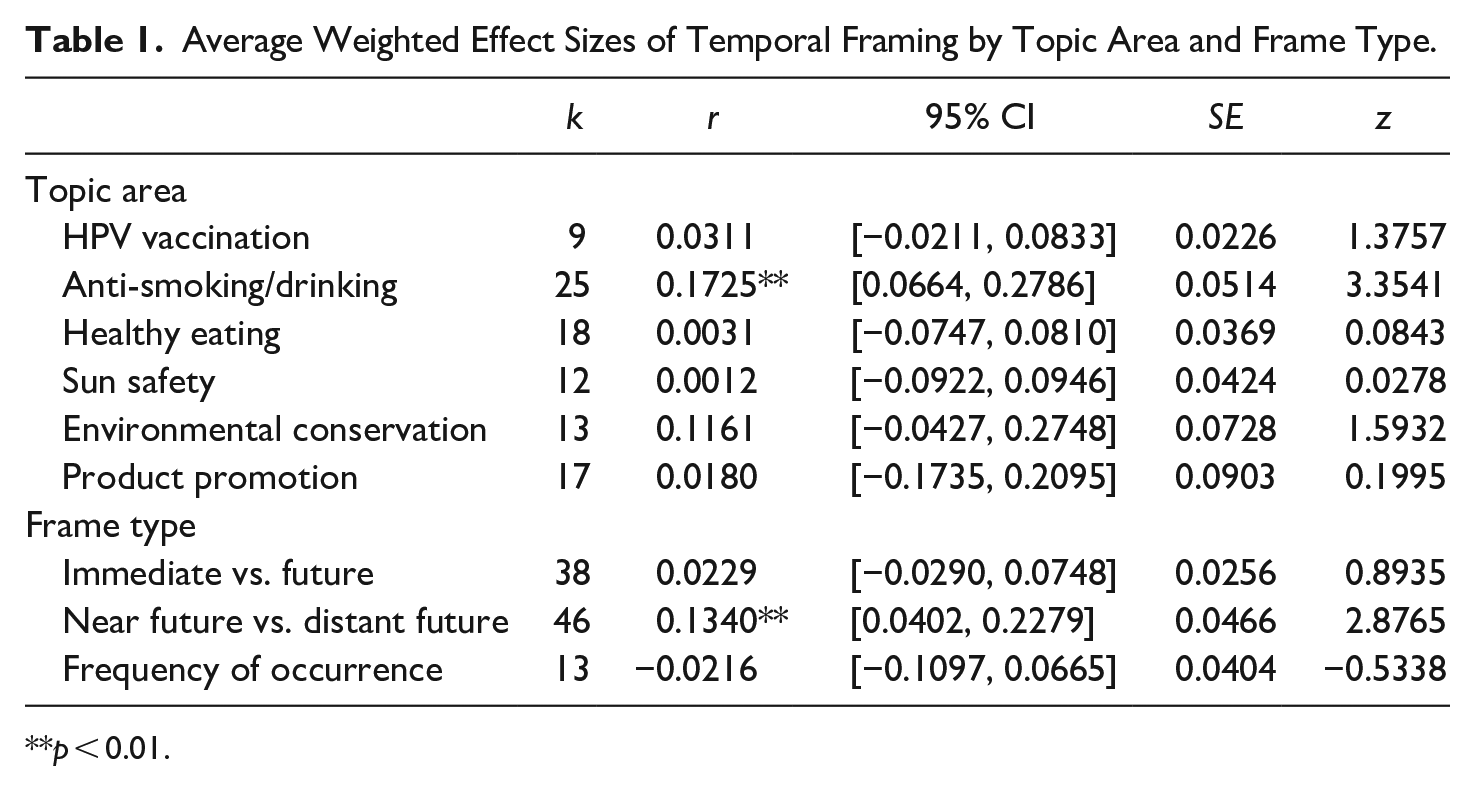
p < 0.01.
Heterogeneity Tests
The results of the Q statistics tests showed that there was significant heterogeneity across effect sizes in overall persuasion, Q = 611.7256, df = 96, p < .0001. As for specific persuasive outcomes, there was significant heterogeneity in attitude, behavior intention, and behavior: attitude: Q = 367.2227, df = 30, p < .0001; behavioral intention: Q = 193.8639, df = 39, p < .0001; behavior: Q = 24.8146, df = 11, p < .01. Therefore, follow-up analyses on potential moderators were warranted for these outcomes.
Moderator Analysis
RQ5 examined the factors that may moderate the overall effect of temporal framing on persuasion. To answer RQ5, we first entered all proposed moderators (i.e., time of measurement, gain vs. loss frame, sample type, study context, age, and sex) into the three-level meta-regression model as predictors (see Table 2). The results indicated a significant moderating effect of age (b = −0.0153, SE = 0.0071, 95% CI [−0.0294, −0.0012], p < .05) on overall persuasion. Sample type was also a significant moderator of the temporal framing effect (b = −0.2180, SE = 0.1077, 95% CI [−0.4319, −0.0040], p < .05). Studies with either student samples or an older sample observed a weaker effect of temporal framing on persuasion. In other words, the advantage of proximal versus distal frames in facilitating persuasion is mitigated under the two circumstances. As sample type is a categorical variable, a subgroup analysis was conducted to further explicate the effect sizes for student and nonstudent samples: student: r = .0568, SE = 0.0305; nonstudent: r = .0834, SE = 0.0500.
Results of Multilevel Meta-Regressions of Moderator Analysis.
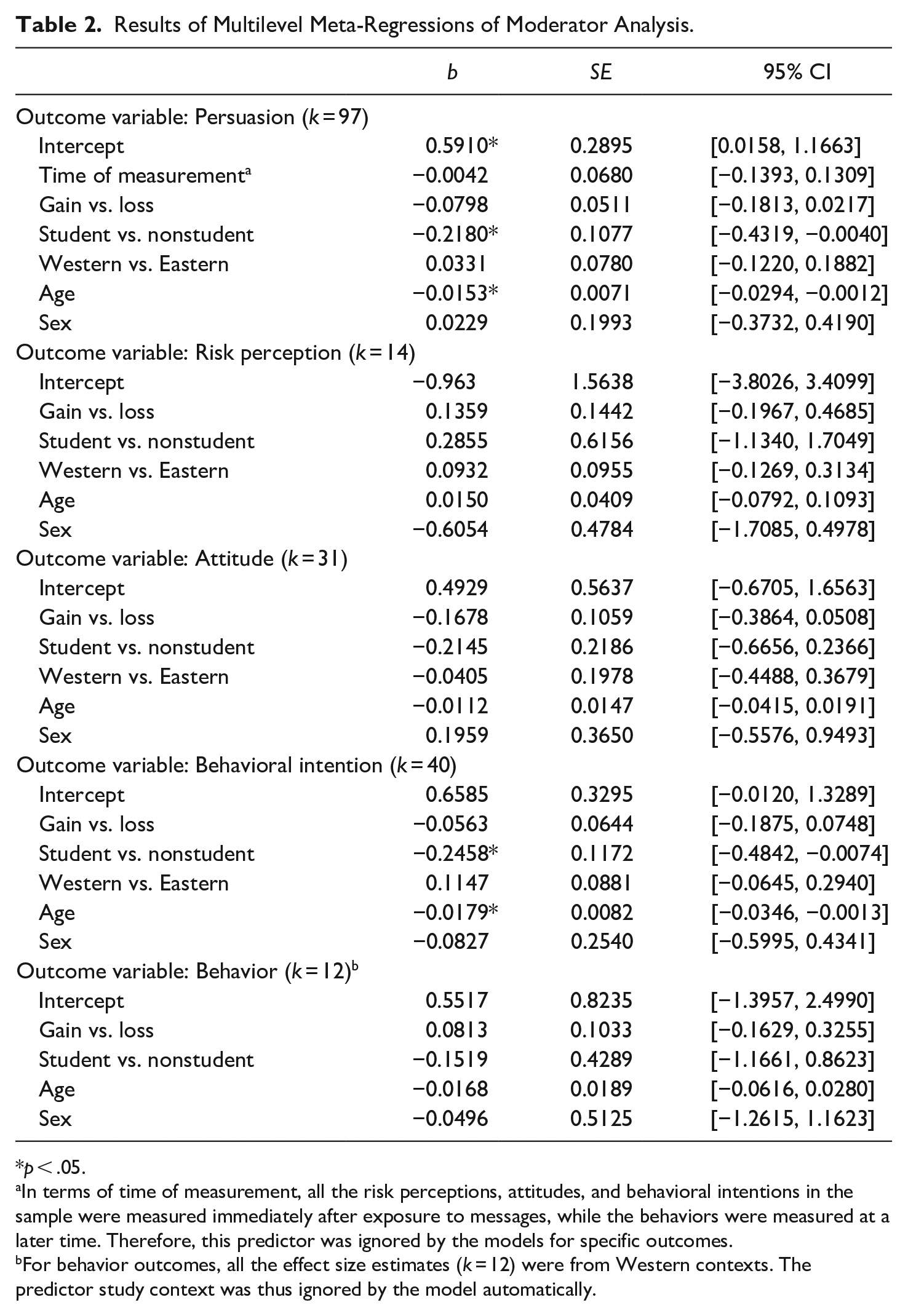
p < .05.
In terms of time of measurement, all the risk perceptions, attitudes, and behavioral intentions in the sample were measured immediately after exposure to messages, while the behaviors were measured at a later time. Therefore, this predictor was ignored by the models for specific outcomes.
For behavior outcomes, all the effect size estimates (k = 12) were from Western contexts. The predictor study context was thus ignored by the model automatically.
RQ6 investigated the moderators for specific outcomes. In light of the results of the heterogeneity tests, meta-regressions were performed with attitude, behavioral intention, and behavior following the same procedure described above. The results showed that none of the proposed factors were significant moderators of the relationship between temporal framing and attitude as well as behavior. With regard to behavioral intention, sample type (b = −0.2458, SE = 0.1172, 95% CI [−0.4842, −0.0074], p < .05) and the average age (b = −0.0179, SE = 0.0082, 95% CI [−0.0346, −0.0013], p < .05) were significant moderators. More specifically, the relative effectiveness of proximal versus distal frames in promoting behavioral intention would decrease for student samples and older samples. The effect sizes for student and nonstudent samples are r = .0441, SE = 0.0324 and r = .1071, SE = 0.0629, respectively.
Additional moderator analyses were conducted on subsets of the sample by topic area and frame type. In the topic area of healthy eating, gain versus loss frame was found to be a significant moderator of the effect of temporal framing on persuasion, b = −0.1682, SE = 0.0681, 95% CI [−0.3167, −0.0198], p < .05. Specifically, when promoting the benefits of healthy eating, distal frames were more persuasive than proximal frames (r = −.0636, SE = 0.0316). By contrast, when presenting the risks incurred by unhealthy eating, proximal frames had a larger effect (r = .0955, SE = 0.0534). Gain versus loss frame was also a significant moderator of the temporal effect among studies on anti-smoking/drinking, b = 0.2258, SE = 0.0902, 95% CI [0.3355, 0.4160], p < .05, but the direction of the interaction was the opposite. When presenting the positive outcomes of quitting smoking or drinking, proximal frames had an amplified effect than distal frames (r = .2922, SE = 0.0969). On the contrary, when highlighting the negative outcomes of not quitting, the relative effectiveness of proximal versus distal frames diminished (r = .1470, SE = 0.0469). In the remaining topic areas, no significant moderators were found. In studies using different frame types, no significant moderators were detected as well.
Diagnosis of Publication Bias
One of the criticisms against meta-analysis is publication bias, which refers to the phenomenon in which studies that have significant findings and larger effect sizes are more likely to be published (Schmidt & Hunter, 2015). Consequently, a meta-analysis that integrates published studies tends to yield an inflated average effect size estimate (Borenstein et al., 2009). To mitigate publication bias, this meta-analytic study used two methods in the search and screening stage. First, the initial database search did not set any filter to exclude unpublished studies. So, we located a few conference papers and book chapters in the initial sample. However, based on the inclusion and exclusion criteria, these conference papers and book chapters were screened out for various reasons. Second, we searched in the ProQuest Dissertations & Theses database in addition to the general academic databases to ensure that unpublished dissertations and theses were included in the sample. After the screening, two dissertations/theses were included in the final sample.
Then we applied the recommended methods by previous meta-analytic studies to inspect the publication bias, that is, the funnel plot, Egger’s regression test, and the trim and fill method (Vevea et al., 2019). The funnel plot is a scatterplot with Fisher’s z estimates on the horizontal axis and standard errors of effect sizes on the vertical axis. If the estimates distribute in the shape that resembles a funnel, it is generally considered that the symmetry is a sign of the absence of publication bias. Based on this graphic visualization method, Egger’s regression test is a significance test of the magnitude of the (a)symmetry of the distribution displayed in the funnel plot, whereby a nonsignificant result indicates the absence of publication bias. Trim and fill is another funnel-plot-based method that “uses an iterative process to determine how many studies would have to be removed, or ‘trimmed’ from one side of the funnel for the remaining effect sizes to be symmetric” (Vevea et al., 2019, p. 393). If only a small number of studies should be trimmed to achieve symmetric distribution, it indicates that the original distribution is largely symmetric with little publication bias.
Given that these methods were developed for conventional two-level meta-analysis, we randomly selected one effect size from each distinctive sample to compose a new two-level dataset (k = 44, r = .068, 95% CI [0.010, 0.126], z = 2.292, p < .05) for the inspection of publication bias in three-level meta-analysis (Ratcliff & Sun, 2020). The effect sizes are distributed nearly evenly on two sides with the shape resembling a funnel. 4 The result of the Egger’s regression test is nonsignificant, t(42) = 1.830, p > .05. In addition, the trim and fill result suggests that no study should have been trimmed to achieve symmetry of the distribution. Based on the evidence we obtained, we tend to believe that publication bias was not a point of concern for this meta-analysis.
Discussion
One overarching question across the spectrum of persuasion research involves dissecting the impact of various message features on persuasive outcomes and how they interact with people’s individual traits and mental schemas to exert influence. There is growing scholarly attention on the differences between proximal and distal temporal frames. Our study suggests that the relative effectiveness of proximal- and distal-framed messages is likely a complicated and nuanced matter. This meta-analysis enhances the understanding of CLT and encourages empirical modesty and conscientiousness when attending to the effect of temporal framing.
Differential Effects Across Multiple Outcomes
The findings provide evidence in support of the overall advantage of proximal versus distal frames in facilitating persuasion. Overall persuasion is defined as the impact across all persuasion-related outcomes. According to the suggested thresholds for small, medium, and large effects by Cohen (1992), temporal framing has a small positive effect on overall persuasion (r = .0659). In terms of specific outcomes, the significant effects appeared on risk perception (r = .0996) and behavioral intention (r = .0715). Proximal temporal frames heighten the proximity of the consequences of a recommend behavior, and distal temporal frames make it seem more distant. The differential perception of the risk involved may have accounted for the diversity in behavioral intention, as when people perceive higher levels of risks associated with the (in)activity, they are more likely to change their behavior (K. Kim & Kim, 2018). The main effect of temporal framing on attitude and actual behavior, however, is minimal.
It is worth noting that many meta-analytic practices in communication have combined outcome data across attitudinal, intention, and behavioral variables, which might afford greater statistical power without affecting substantive conclusion (e.g., Huang & Shen, 2016). For those which analyze outcome variables separately, the vast majority has revealed disparate or inconsistent results for different outcomes. For example, Walter et al.’s (2019) meta-analysis on anger and persuasion found a significant albeit weak impact of anger on behavior and nonsignificant effects on attitudes and intent. Zebregs et al. (2015) found that statistical appeals had stronger influence than narrative appeals on beliefs and attitude, but the edge was reversed on intention.
We attribute the differential effects across different outcomes in this study to the following observations. First, despite the small sample size for risk perception (k = 14), the temporal framing effect was particularly strong for this outcome, which is consistent with the robust findings in the CLT literature across various domains and measures. Compared to the distal frame, the proximal frame is structured closer in time, therefore, it is perceived as more concrete and more probable, thus evoking a greater sense of threat. Unlike other outcome variables that are more generalizable to other persuasive situations, risk perception seems to be more specifically located in the health domain. Temporal frames that heighten the proximity of the health hazard intensify judgments of risk. Second, although behavioral intention is the most proximate predictor of actual behavior, there is a notable discrepancy between intention and behavior (Sheeran & Webb, 2016). How behavioral intention can be translated into actual behavior has become a critical issue for strategic communicators to enhance the efficacy of communication efforts. We recommend that when resources allow, scholars should devote more effort to calibrating the real-world impact in terms of message receivers’ actual behavior change. More research is also needed to uncover the factors that may play a role in the relationship between behavioral intention and actual behavior. Third, the lack of significance on attitudes might be due to the fact that attitude is a relatively general variable conceptualizing the assessment on the messages or the behavior endorsed in the messages. At times, attitudinal change is not a prerequisite for behavior change. People do not need to like a behavior to enact it. For example, Nabi and Myrick (2019) found that attitudes towards sun safety behavior were not tightly linked to actual behaviors. Therefore, we believe that whether proximal or distal evidence has a stronger persuasive effect may depend on the outcome variables of interest. Future research is encouraged to examine the varied magnitude of the matching effect on various persuasive outcomes.
Moderating Factors of Temporal Framing Effects
We find that the overall effect of temporal framing on persuasion varies across topic area. Specifically, proximal frames are more persuasive than distal frames in promoting anti-smoking/drinking (r = .1725, p < .01), while no significant effects of temporal framing are found on HPV vaccination, healthy eating, sun safety, environmental conservation, and product promotion. This finding is in line with the observation that the effects of messaging strategy are contingent on the topic issues involved (Gallagher & Updegraff, 2013). One possible explanation of the nonsignificant findings is the small sample size in some of the categories (HPV vaccination: k = 9; healthy eating: k = 18; sun safety: k = 12; environmental conservation: k = 13; product promotion: k = 17). We thus are reluctant to conclude that temporal framing has no effect on these issues. Rather, we suggest when ample empirical studies have been accumulated in each topic area, a meta-analysis should be conducted again, which will provide relevant and updated results on this issue.
The type of temporal frame used in the manipulation of experimental studies also may play a role in influencing the effect size. When focusing on the comparison between immediate and future consequences, temporal frame has no significant effect (r = .0229, p > .05). The effect size is amplified when the comparison is between a near future point and a distant future point (r = .1340, p < .01). When the temporal frame is presented in the form of higher versus lower frequency of occurrence, the effect turns to be negative and nonsignificant (r = −.0216, p > .05). It is worth noting that most of the 25 articles performed manipulation checks wherein participants reported their perceived temporal distance. The manipulations were successful, indicating that the stimulus messages had the intended impact on people’s perceptions of temporal distance (proximal vs. distal). However, the three types of temporal frames have differential persuasive impacts. One possible explanation for the nonsignificant finding of the “immediate versus future” frame is that studies mostly used general descriptive words such as “immediate versus long-term” (Bernstein et al., 2016; Pavey & Churchill, 2017) to present the contrast between “immediate” and “future,” while studies that adopted the “near future versus distant future” frame specified two time points in their manipulations, for example, “next year versus 2050” (Zhuang et al., 2018) and “next summer versus the end of the 21st century” (K. Kim & Ahn, 2019). We speculate that using specific time points would have a greater effect than using vague words in inducing perceptions of varying levels of temporal distance. Providing specific time points in the messaging would likely make it easier for the message recipients to form a more accurate perception of the temporal distance implied in the messaging, thus amplifying the messaging effect.
As for the nonsignificant effect of the “frequency” frame, it is possible that people may perceive the “frequency” frame and the “distance” frame (e.g., “near future vs. distant future”) differently. Although previous studies showed that the “frequency” frame successfully induced the perceptions of proximal versus distal temporal distance (Chandran & Menon, 2004; Churchill et al., 2014), this frame literally features “how often” the consequences occur in the future. In contrast, studies using “near future versus distant future” focus on “how soon” the consequence occurs and result in more pronounced persuasive effects. Therefore, based on our meta-analytic findings, we speculate that “how soon” is more persuasive than “how often.” The above results offer valuable insights into the nuanced effect of temporal framing, particularly on which specific operationalization should be used for crafting the messages. Future research is recommended to compare the effect of “how soon” and “how often” with rigorous research design to better explicate the interplay among temporal frame, construal level, and persuasive outcomes.
The examination of moderators in a meta-analysis of purportedly divergent findings is restrained by the characteristics of the primary studies. This study found that sample type and the average age of participants have a significant effect on the relative effectiveness of proximal versus distal frames on behavioral intention. It seems contradictory that student samples and older samples are characterized with weaker effect sizes, as student samples are generally younger than nonstudent samples. One explanation for this finding is that age may have a curvilinear effect on temporal framing such that the temporal effect is weak among participants in their early 20s, it possibly becomes stronger among participants at an older age, and it becomes weak again among participants above a certain age. How temporal frames exert influence on people’s perception, attitude, and behavior relies heavily on how people process the frames along with their existing cognitive structures (Lakoff, 2004). Significant differences in cognitive capacity and knowledge repertoire have been found across age groups (Salthouse, 2009). Therefore, age may have an inverted U-shaped moderating effect on temporal framing. Given that the sample in our meta-analysis covered a narrow age range (18 to 42 years old), we were unable to provide a fuller picture of this matter. More empirical investigations are needed to further explicate the role of age in temporal framing.
We detected a significant moderation effect of gain versus loss frame on temporal framing in studies on healthy eating and anti-smoking/drinking, but not on other topics. This is consistent with the findings of previous primary studies such that the effects of temporal framing may be contingent on factors such as other messaging strategy (e.g., Gerend & Cullen, 2008; Mollen et al., 2017). This meta-analysis suggests that topic area might be a boundary condition for the moderation effect of gain versus loss frame on temporal framing to occur. We therefore encourage more academic efforts to be devoted to this inquiry to further elucidate the interplay of the two messaging strategies.
Implications for Construal Level Theory
Our study suggests that the temporal framing effect is hardly simple or straightforward. This meta-analysis focused on four dependent variables that have been commonly examined in the extant CLT literature (Trope & Liberman, 2010). The multiple outcomes assessed account for the diversity of empirical research in the area. The research highlights an important aspect of messaging related to psychological distances and provide a framework for understanding a wide range of persuasive evaluations. The current findings in part are consistent in pointing at proximal framing as a more impactful messaging strategy, particularly on risk perception and behavioral intention (Chandran & Menon, 2004).
As a leading theory on construal levels, CLT has rich theoretical and empirical implications in communication. Empirical tests of CLT have thus far focused largely on the temporal dimension of psychological distance. This meta-analysis enhances the understanding of CLT and encourages empirical modesty and conscientiousness when attending to the effect of temporal framing. CLT postulates that individuals construe future events that are distant from the present in an abstract manner and future events that are within reach in a concrete manner (Trope & Liberman, 2003). Past research has indicated that people tend to show more optimism about distant future than near future events (Trope & Liberman, 2010). CLT has not explored how different dimensions of psychological distance function interactively (Chandran & Menon, 2004). The model recommends distinguishing between emotions that may ensue based on different temporal frames (Trope & Liberman, 2010). Some emotions would decay or intensify over distance, depending on whether they reflect high or low level construal of the subject matter. Given that gain- versus loss-framed messages often elicit different emotional outcomes (e.g., Zhao & Peterson, 2017), it is plausible that this framing feature might interact with temporal framing to exert influence. As temporal framing effect is bounded by outcome valence, it is recommended that temporal frames be considered in conjunction with gain versus loss frame, which refers to a strategy to differentiate the valence aspects in a message to facilitate the evaluation process.
With the general support that framing an outcome in more proximal terms would lead to greater message impact, this study shows that the effect be considered in the context of specific behavioral contexts (Chandran & Menon, 2004). On a related note, prior CLT research has indicated that for events in the relatively distant future, people are more sensitive to desirability and utility losses; for events in the near future, they are more sensitive to feasibility and money losses (Sagristano et al., 2002; Thompson et al., 2005). It is valuable to accrue more empirical evidence on how message frames interact with temporal context to influence outcome. This meta-analysis makes both the CLT theory and framing theory more relevant to communication researchers and practitioners. It enhances understanding and offers insights regarding the complex role of message strategy.
Limitations and Suggestions
When interpreting the findings, several limitations of this meta-analysis should be taken into account. First, CFC is an important personal characteristic that may affect how people respond to proximal versus distal frames (Guan & So, 2020; Zhao et al., 2015). As many of the studies included in our sample did not investigate CFC, we were unable to extract relevant statistics and include CFC in the meta-analysis. When more empirical studies on CFC and temporal frame have been accumulated, a meta-analysis should be undertaken to better capture the interplay at an aggregate level. Second, in the meta-analytic dataset, risk perception, attitude, and behavioral intention were measured immediately after message exposure, while actual behavior was measured as delayed outcome. Although this study finds that time of measurement is not a significant moderator of the temporal effect, we cannot rule out the possibility of the confounding effect of different persuasive outcomes. More research on the time of measurement is therefore needed regarding each of the persuasive outcomes. Third, this study did not examine the number of temporal framed messages, nor did it investigate the length of the temporal distance between the proximal and distal points. In addition, a substantial portion of the studies in our sample investigated health-related topics, and therefore future health studies may consider examining the nature of health behavior (e.g., cessation vs. prevention) as a potential moderator for the temporal framing effect. These untapped inquiries warrant more scholarly attention.
To conclude, research on the role of temporal frames in persuasion, both in general and in specific contexts, remains limited. The findings of this meta-analysis are relatively strong in terms of risk perception and behavioral intention but less so with respect to attitudinal or behavioral outcomes. We showed that the temporal framing effect differed across topic area and frame type, and sample type and age played a moderating role in the relative effectiveness of proximal versus distal time frames in terms of behavioral intention. In addition, we found that gain versus loss frame was a moderator of the temporal framing effect in the topic areas of healthy eating and anti-smoking/drinking. More investigations are needed to weigh whether temporal framing presents an impactful messaging strategy and to inform practice in clearer terms.
Supplemental Material
sj-docx-1-crx-10.1177_00936502221102102 – Supplemental material for Disentangling the Effects of Temporal Framing on Risk Perception, Attitude, Behavioral Intention, and Behavior: A Multilevel Meta-Analysis
Supplemental material, sj-docx-1-crx-10.1177_00936502221102102 for Disentangling the Effects of Temporal Framing on Risk Perception, Attitude, Behavioral Intention, and Behavior: A Multilevel Meta-Analysis by Guanxiong Huang and Jie Xu in Communication Research
Footnotes
Declaration of Conflicting Interests
The authors declared no potential conflicts of interest with respect to the research, authorship, and/or publication of this article.
Funding
The authors received no financial support for the research, authorship, and/or publication of this article.

Supplemental Material
Supplemental material for this article is available online.
Notes
Author Biographies
References
Supplementary Material
Please find the following supplemental material available below.
For Open Access articles published under a Creative Commons License, all supplemental material carries the same license as the article it is associated with.
For non-Open Access articles published, all supplemental material carries a non-exclusive license, and permission requests for re-use of supplemental material or any part of supplemental material shall be sent directly to the copyright owner as specified in the copyright notice associated with the article.
