




Abstract
This meta-analysis synthesized 19 empirical articles reporting 123 effect sizes of character-recipient similarity on narrative processing and persuasion outcomes across different contexts, including health, environmental, and social issues. We also aimed to investigate whether the effect magnitude varies depending on how the similarity is operationalized, which perspective is adopted, and what context the narrative persuasion is placed in. The results indicated that, compared to a dissimilar counterpart, a similar character leads to stronger identification (k = 34, d = 0.14, p < .01) and self-referencing (k = 12, d = 0.16, p < .01). The effects on transportation (k = 22, d = 0.13, p = .05) and resistance (k = 12, d = −0.16, p = .05) were marginally significant. It was also found that the similarity manipulated on chosen demographic and biographic variables like occupation and living place yields the strongest impact among other variables (i.e., innate demographic and biographic variables like age and sex, psychological and behavioral variables like beliefs and behaviors). Furthermore, the similarity effect in narrative persuasion becomes intensified when combined with a first-person perspective and placed in a social issue context. By presenting a synthesis of the existing research, this meta-analytical study sought to identify areas in need of further refinement and outline future investigation directions for narrative persuasion.
Narratives are widely acknowledged for their potential to foster changes in attitudes and behaviors across various fields, including health (Shen et al., 2015), environmental (Jones & Peterson, 2017), and social issues (Zhuang & Guidry, 2022). Presumably, a defining feature of narratives is depicting one or more characters, serving as the focal point through which the story unfolds and conveys its thematic essence (de Graaf et al., 2012; Moyer-Gusé, 2008). For example, a narrative aiming to correct prejudice against a minority group may depict how a character from this group experiences discrimination (Creel et al., 2011; Niederdeppe et al., 2014). Similarly, health narratives are often constructed around a protagonist with the experience of a given disease or risk, hoping to achieve health education goals (Ooms et al., 2019).
A large body of research efforts has been devoted to exploring character-based determinants of narrative persuasiveness, including characters’ attributes (e.g., Appel & Mara, 2013; Tal-Or & Cohen, 2010), behaviors (e.g., Chen et al., 2017), and associated outcomes (e.g., Hoeken & Sinkeldam, 2014; Krakow et al., 2017). Recently, the similarity between the story character and the recipient has been proposed as another character-based factor with the potential to optimize the narrative’s persuasiveness. It was believed that character-recipient similarity can foster identification (Hoeken et al., 2016) and transportation (Ooms et al., 2019), two narrative experiences that are thought to drive the ultimate persuasion outcomes (Murphy et al., 2011).
Nevertheless, the empirical literature has yielded mixed results on this front. Specifically, while a series of studies provided compelling evidence for the appeal of a similar character (e.g., Chen et al., 2016; Kim & Shapiro, 2016), others did not find significant superiority in the character-recipient similarity manipulation (e.g., Cohen et al., 2018; de Graaf, 2014). Given this inconsistency, we performed a meta-analysis synthesizing the cumulative evidence to estimate the effect, if any, of the character-recipient similarity on narrative persuasion. Furthermore, considering the fact that character-recipient similarity was operationalized in different ways in the literature, we sought to understand their respective effect magnitudes. The last goal was to obtain a more nuanced understanding by identifying potential contextual factors moderating the effect.
This paper is organized as follows: We first ground and motivate this work by reviewing the relevant theories and discussing the role played by character-recipient similarity in persuasion. Then, we introduce key constructs of narrative persuasion that may explain the persuasive effects of character-recipient similarity. Lastly, potential moderators are proposed and discussed. By presenting and discussing the results, we hope this meta-analysis outlines future investigation directions and informs methodological choices that may merit careful consideration among researchers with an interest in narrative persuasion.
Similarity in Persuasion
Similarity was initially proposed as a theoretical construct in persuasion to entail the degree to which a message source matches the recipients’ attributes or experiences (Brock, 1965; Woodside & Davenport, 1974). Its various terminologies, like homophily (Mccroskey et al., 1975) and matching (Lavine & Snyder, 1996), all tap into the essence of the resemblance between the message source and the recipients. There was abundant evidence supporting the idea that source similarity can promote persuasion (see Wilson & Sherrell, 1993, for a review).
The appeal of similarity can be traced back to its ability to predict social influence in interpersonal communication (Montoya & Horton, 2013). The homophily principle suggests that this effect can be attributed to heightened attraction or liking toward a similar communication partner (McPherson et al., 2001; Rogers & Bhowmik, 1970). Its persuasive power can be explained by several classic psychological theories. For example, the elaboration likelihood model and message-interpretation process model have suggested that people do not often engage in extensive cognitive processing of a message unless they find the message personally relevant or the exemplar representative of themselves (Petty & Cacioppo, 1986; Zillmann et al., 1996). Presumably, similarity may act as such an important cue to intensify the recipients’ perceived relevance and representativeness of the message, further leading to the desired persuasion outcomes (Howard & Kerin, 2011). Empirical research demonstrated that the similarity could grasp more attention, stimulate more elaboration, and promote more self-referential thinking (Lu, 2013).
Character-Recipient Similarity in Narrative Persuasion
Narratives are defined as structures of meaning that enable individuals to understand themselves and others in terms of the characters that inhabit the story world and the roles they play in relation to one another (McAdams, 2001). It may take different forms, like stories and anecdotes (Bilandzic & Busselle, 2013; Green, 2008). It was believed that narratives are a natural ground for implementing the persuasive power of similarity. Specifically, similarity can be established through the creation of comparable characters or exemplars within a narrative for better attention, recall, and learning outcomes (Bandura, 2001). Consistent with the scholarship on interpersonal similarity, most empirical evidence supports the notion that narratives presenting a similar character often have heightened persuasion potency (Andsager et al., 2006; Pinkleton et al., 2010).
The distinctive processing of narrative persuasion lies in the involvement in the story world with heightened emotional, cognitive, and imagery experiences (Busselle & Bilandzic, 2009). The involvement may take two forms: identification and transportation. Identification occurs when the recipients adopt the perspective of the narrative character and internalize their thoughts and feelings (Cohen, 2001). Transportation describes a mental state of being absorbed in the story world but watching the story from an onlooker’s perspective (Green & Brock, 2000). It is believed that both types of involvement can suppress resistance (Ratcliff & Sun, 2020) and stimulate elaboration (Tukachinsky & Tokunaga, 2013), which further leads to desired persuasion outcomes (Oschatz & Marker, 2020).
Identification was originally proposed in the scholarship of developmental psychology to describe a process in which children incorporate their parents into the self and become part of the superego (Freud, 1940/1989, p. 76). Wollheim (1974) further distinguished identification from imitation: identification has an internal component, whereas imitation is external and behavioral. This postulation implied that identification engenders learning as a result of temporarily setting aside one’s own identity and internalizing the identity and perspective of others (Bettelheim, 1943, 1976). Specifically, identification was conceptualized as being multidimensional: empathic (sharing emotions with the character), cognitive (understanding the character’s thoughts and goals), and absorption (the loss of self-awareness during exposure) 1 (Cohen, 2001; Moyer-Gusé, 2008).
We postulated that character-recipient similarity may amplify identification in at least two ways (Maccoby & Wilson, 1957). First, recipients reading a similar character story may find the story more personally relevant and meaningful. This enhanced sense of relevance may motivate readers to invest more cognitive and affective effort into understanding the character’s thoughts, emotions, and goals, leading to a deeper absorption in the story world. As readers become more absorbed in the story, they may also temporarily forget about their own identity, resulting in heightened identification with the character. Second, when recipients see characters sharing their attributes and/or experiences, they are more likely to regard the story as relatable and authentic. This sense of realism then further amplifies identification (Cho et al., 2014). Therefore, we argued that
H1: Compared with a dissimilar character, a similar character leads to stronger identification.
Distinguishing from identification, transportation is concerned with the degree of overall involvement in the story world and does not specify which part of the narrative a recipient is engaged with (Green & Brock, 2000; Tal-Or & Cohen, 2010). Consequently, one can be transported into the story world via heightened attention and suspense feelings, but not necessarily with a strong connection with the story character. It is possible that the overall transportation into the narrative may be unaffected by such a character-based attribute. However, a similar character may garner one’s close attention and prompt effortful thinking as a result of their enhanced personal relevance. In support of this idea, two studies on advertising suggested that advertisements featuring similar characters were evaluated more positively than those featuring dissimilar characters, and this outcome was mediated by transportation (Bhatnagar & Wan, 2011; van den Hende et al., 2012). Therefore, we anticipated a positive effect of character-recipient similarity on transportation, albeit to a lesser extent.
H2: Compared with a dissimilar character, (a) a similar character leads to stronger transportation, (b) and the effect size is smaller than that of identification.
Besides identification and transportation, this meta-analysis also sought to summarize the effects of character-recipient similarity on persuasion variables. Two possible persuasion processing variables that were commonly examined in the literature were selected: self-referencing and resistance. Self-referencing describes the process of relating information to aspects of oneself (Burnkrant & Unnava, 1995). It has been identified as one of the key pathways toward achieving persuasive impact in the domains of advertising and health promotion (de Graaf, 2014; Lee, 2017). By activating the audience’s emotional and motivational processes, self-referencing can facilitate the generation of self-related thoughts and create a connection between the message and one’s own life and experiences. This increased perceived relevance and applicability of the message can facilitate elaboration and result in changes in attitudes and behaviors toward achieving desired outcomes (Burnkrant & Unnava, 1995; Lien, 2001). Self-referencing is of particular significance in narrative persuasion because, without such a connection and application process, the lessons and knowledge learned by the character will not be transferable to the audience (Dunlop et al., 2010). Therefore, we identified self-referencing in our meta-analysis as a variable affected by character-recipient similarity.
Although self-referencing and identification are often closely associated, they represent two distinct constructs. Identification occurs when one loses self-identity and takes on the character’s perspective, whereas self-referencing pertains to the recipient’s recognition that the message is pertinent to his or her life (Burnkrant & Unnava, 1995). That is, self-referencing entails a dynamic reaction that is activated and developed while one links the event in the story to their own life. In this light, a story world with a character is necessary for identification to occur, whereas self-referencing could occur in any meaningful message, like advertising, advocacy, and so on (Escalas, 2007). In narrative scholarship, there is empirical evidence suggesting that self-referencing is a product generated by identification, such that the vicarious experience of taking the character’s perspective may motivate one to reflect on their own life and apply the lessons learned in the story to themselves (Chen et al., 2016, 2017).
We argued that reading a story with a similar character may motivate the audience to link or even apply the story to their own lives, resulting in more self-referencing. Presumably, encountering a similar character can create a sense of relatability, as the recipients’ perception of shared attributes with the character would easily trigger self-reflection and introspection as they imagine the possible outcomes of experiencing similar events. This self-referencing, by connecting the narratives to their own lives and experiences, is believed to bring about desired outcomes. A number of studies have demonstrated that self-referencing acts as a mediator, explaining the effects of character-recipient similarity on narrative persuasion (Chen et al., 2016; de Graaf, 2014). Therefore, we proposed a positive effect of character-recipient similarity on self-referencing.
H3: Compared with a dissimilar character, a similar character leads to stronger self-referencing.
Another key construct in persuasion is resistance, often considered a barrier hampering persuasion effectiveness. Resistance is a broad concept encompassing various forces and non-compliance against a persuasion attempt, such as a desire to counterargue, a feeling of ambivalence and reactance to change, and so on (Moyer-Gusé & Nabi, 2010). It is believed that narratives are particularly good at mitigating resistance due to heightened cognition and masked persuasion intent (Moyer-Gusé, 2008; Moyer-Gusé & Nabi, 2010). There existed a range of perspectives concerning the influence of character-recipient similarity in mitigating resistance. The mainstream argument asserts that a similar character can alleviate resistance through three distinct mechanisms. First, E-ELM suggested that encountering a character sharing similar attributes or experiences captures the full attention of the recipients, leaving limited capacity to generate counterarguments (Bilandzic & Busselle, 2013; Dal Cin et al., 2004). Second, a similar character can evoke strong affectionate emotions, resulting in a loosed guard and lessened reactance (Robinson & Knobloch-Westerwick, 2017). Third, perceived similarity with a vulnerable character should also render recipients to perceive a higher likelihood of experiencing similar negative consequences, thereby addressing the issue of perceived invulnerability (Moyer-Gusé, 2008; Moyer-Gusé & Nabi, 2010). Nevertheless, it is worth noting that an empirical study found a backfiring effect of character-recipient similarity such that a similar character with negative experiences can trigger personal distress. This negative emotion further led to defensive resistance, where the participants rejected the relevance of the story content or their similarity to the negatively portrayed character (Kim & Shapiro, 2016). Despite this empirical finding, we contended that compared with a dissimilar character, a similar one should reinforce the narratives’ capacity for reducing resistance.
H4: Compared with a dissimilar character, a similar character is more effective in reducing resistance.
Lastly, we also sought to probe whether a similar character can enhance narrative persuasiveness by generating favorable risk perceptions, attitudes, and behavioral intentions. It is believed that a similar character can heighten the involvement with the story world, which should yield story-consistent perceptions, attitudes, and behaviors (Murphy et al., 2011, 2013). A number of studies have compared the effects of similar versus dissimilar characters on these outcomes across health (e.g., Igartua et al., 2020), social (e.g., Ooms et al., 2019), and environmental contexts (e.g., Kirby-Straker, 2014). The results yielded mixed results. For example, most studies found that narratives with a similar character elicit more intense risk perceptions (Chen et al., 2016), attitudes (Igartua et al., 2019a), and intentions (Ooms et al., 2019), while some results showed the opposite (e.g., Cohen et al., 2018; Igartua et al., 2022). We proposed three hypotheses to synthesize the direction and magnitude of the effects, if any, of the character-recipient similarity on these outcomes.
H5: Compared with a dissimilar character, a similar character is more effective in inducing story-consistent perceptions.
H6: Compared with a dissimilar character, a similar character is more effective in inducing story-consistent attitudes.
H7: Compared with a dissimilar character, a similar character is more effective in inducing the story’s recommended intentions.
Moderators
One potential moderator is the operationalization of character-recipient similarity. Characters could be similar to the recipient in demographic (i.e., age, biological sex) and biographic (i.e., education, residence) variables. Alternatively, the similarity could be manipulated on more personal characteristics, such as psychological (i.e., attitude, value) and behavioral variables (i.e., experience, intention) (Hoffner & Buchanan, 2005; Noar et al., 2009). A customary practice of audience segmentation in the domains of marketing and health tailoring is along four dimensions: demographic, geographic, psychographic, and behavioral (Lefebvre & Flora, 1988; Rimer & Kreuter, 2006). Following this practice, we first categorized the similarity manipulation into two broad groups: 1) demographic and biographic (D&B) variables, and 2) psychological and behavioral (P&B) variables. Variables in the D&B category are often characterized by objective information and thus can be observed or assessed directly and independently, such as age, nationality, and study major. In contrast, variables in P&B are typically associated with more subjective aspects of an individual’s life and experiences, including attitudes, beliefs, and behavioral tendencies. Then, we further refined the classification of the D&B category by distinguishing between innate and chosen variables. The innate D&B variables are predetermined and immutable traits such as age and biological sex, whereas the chosen D&B variables, more often than not, are contingent on one’s volition and preferences, like major, university, and place of residence.
We argue that the manipulation of P&B variables will generally lead to more robust effects than D&B ones based on three theoretical considerations. First, according to tailoring scholarship, manipulating similarity in behavior and experience variables affords greater personalization compared to the former category. This increased personalization enhances the likelihood of evoking a heightened sense of perceived relevance (Kreuter & Lezin, 2003). Second, the interpersonal communication model of social penetration theory, which structures personal attributes based on their degree of privacy, argues that the inner layers, composed of more private information related to psychological state and life experiences (e.g., beliefs, behavioral tendencies), play a more significant role in shaping one’s self-concept compared to the outer layer, which contains visible and publicly accessible objective information (e.g., biological sex, age range) (Altman et al., 1981; Carpenter & Greene, 2015). Third, narrative research indicates that the manipulation of psychographic and behavioral dimensions is predominantly theoretically driven and related to the targeted outcomes and thus tends to elicit more profound effects than demographic and behavioral ones (Christy et al., 2022; Huang & Shen, 2016). Taken together, we expect that the similarity manipulations on P&B variables will yield stronger effects than those on D&B variables.
Regarding the two subcategories in D&B, we argue that leveraging similarity based on one’s own volition can be particularly efficacious in capturing the recipients’ attention and conveying a sense of affinity or compatibility with others. Moreover, the chosen D&B categories, such as university and residence, often result in smaller cohorts when compared to the innate D&B categories, such as shared biological sex. Therefore, we contend that the former should be more prominent and foster a sense of shared identity, leading to an enhanced perception of relevance.
H8: The similarity manipulation on the P&D variables should yield the greatest effect magnitude, followed by chosen D&B, and innate D&B factors.
Another potential variable of relevance is the perspective adopted by the narrative message. There are two commonly used ones: the first-person narrative casts the main character as the narrator by using first-person pronouns like I, me, and so on, whereas the third-person narrative tells the story from an onlooker’s perspective by using third-person pronouns like he, she, they, and so on. We argued that a first-person perspective would reinforce the effects of a similar character compared to the third-person perspective, as prior research suggested that using first-person pronouns would cast the recipients as the character, thus facilitating the perspective merging (Chen & Bell, 2022; Chen et al., 2023). We thus proposed perspective as a potential moderator.
H9: The effect magnitude of character-recipient similarity should be reinforced by the first-person perspective.
Lastly, we aimed to probe whether the effect of character-recipient similarity would vary according to different study contexts. Narratives have been widely used in health, environmental, and social contexts to achieve persuasion purposes. Specifically, health narratives often deliver the message in order to form a healthy attitude or behavior. Environmental ones’ goal is to promote environment-friendly behaviors. Narratives addressing social issues often seek to promote social justice, such as prejudice and discrimination reduction. A research question was then asked to probe the potential moderating role of the study context.
RQ1: Would the effect magnitude of character-recipient similarity vary in different study contexts?
Method
Searching and Screening
We performed a comprehensive literature search on multiple databases, including the Web of Science Core Collection, MEDLINE, SciELO Citation Index, Communication Source, PsycARTICLES, and PsycINFO on the Web of Science and EBSCOhost in May 2022 to identify potential studies. No year range was set, and the search included publications, proceedings, conference papers, and dissertations. Then, we also obtained the first 100 search results on Google Scholar as a supplement. We used the search terms “narrative OR story OR anecdote” 2 AND “persuasion” AND “similarity OR similar character OR similar protagonist OR homophily OR matching” (Title/Abstract).
Two criteria were applied to screen the eligible articles. First, the article must report an experiment manipulating the character-recipient similarity in a narrative and examine its effects. Second, the experiment has to measure at least one outcome variable mentioned above. As shown in Figure 1, the initial search yielded 495 studies. Among them, 6 studies were written in a non-English language, 447 studies were found to be irrelevant, and 23 studies did not examine any outcomes of interest (e.g., reading comprehension, Komeda et al., 2009; brand evaluation, Bhatnagar & Wan, 2011; perceived support availability, Malloch & Zhang, 2019). 3 In total, 19 articles emerged after the screening as the final sample for the meta-analysis.
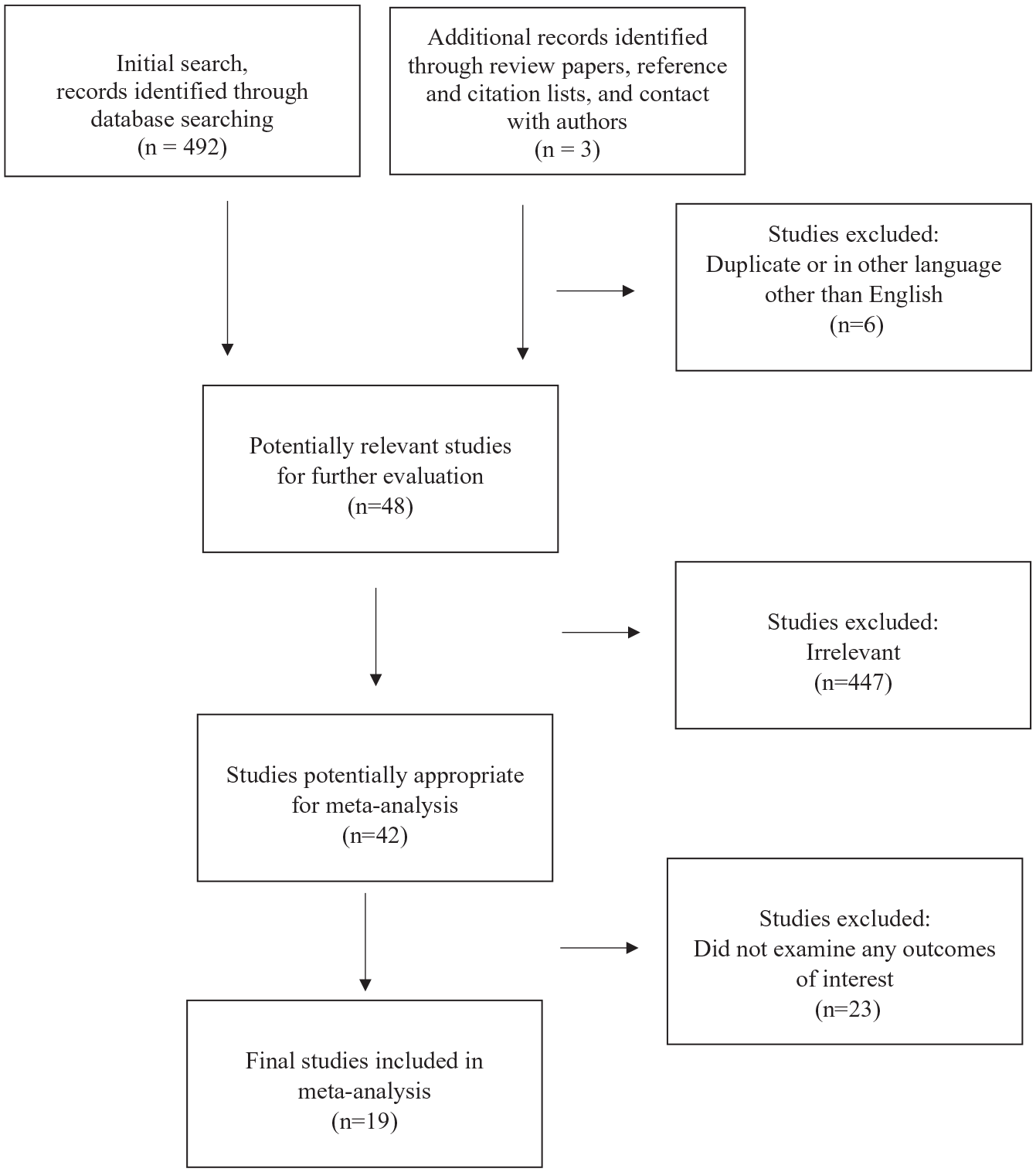
Flow chart of the study selection process.
Variable Coding
Outcome Variable Coding
In total, seven outcomes were examined: identification, transportation, self-referencing, resistance, 4 risk perceptions, attitudes, and behavioral intention. All the experiments assessed multiple effects. For example, Cohen and colleagues assessed the effects of character-recipient similarity on multiple outcomes, including identification, transportation, and attitudes (Cohen et al., 2018). Following Schmidt and Hunter’s (1999) suggestion, each effect represented one unit of analysis in the current meta-analysis. In total, the 19 empirical papers yielded 123 effects.
Moderators Coding
Similarity Manipulation Categorization
In light of the aforementioned theorizing and our data, we created three categories: innate D&B (e.g., age, biological sex), chosen D&B (e.g., major, university, living city), and P&B (attitudes, behavioral stage). The coding was performed by two independent coders. The result of Krippendorff’s alpha indicated that the agreement reached a satisfactory level (α = 1.00).
Perspective Coding
The stimuli were checked to determine the perspective used in each study. Narratives told from the protagonist’s point of view using first-person pronouns were coded as the first-person perspective, whereas narratives told from an onlooker’s point of view using third-person pronouns were coded as the third-person perspective. The result of Krippendorff’s alpha indicated that the agreement reached a satisfactory level (α = 1.00).
Study Context
Three topics emerged from our data: health (e.g., diabetes, smoking, etc.), environmental (e.g., aquariums, climate change), and social (e.g., racial stigmatization). The result of Krippendorff’s alpha indicated that the agreement reached a satisfactory level (α = 1.00).
Effect Size Extracting and Calculating
First, we examined the presence of public bias via two methods: a funnel plot was first performed to visualize and evaluate whether studies with small effect sizes were missing, followed by Egger’s test, which provided statistical evidence of publication bias (Egger et al., 1997).
Since the random-effects model meta-analysis assumes that the true effect size can differ across studies beyond variances explained by sampling error, it was used to estimate the effects (Borenstein et al., 2021). The standardized mean difference, Cohen’s d, was calculated to represent the effect of character-recipient similarity on narrative persuasion (Cohen, 1992). A positive d value indicates greater effects of a similar character on outcomes compared with a dissimilar character. The effect sizes, sample sizes, and key moderating variables for all the studies are presented in Table 1.
Studies, Sample Sizes, Outcome Variables, Effect Sizes (Cohen’s d), and Moderators.

Note. IDB = innate demographic & biographic variable; CDB = chosen demographic & biographic variable; PB = psychological & behavioral variable.
For moderator analysis, the fixed-effects model was adopted, considering the subgroups of our interest (e.g., first- vs. third-person perspective) represent fixed levels with no further sampling error to be introduced at the subgroup level (Borenstein & Higgins, 2013; Higgins & Thompson, 2002). We used the Q statistic and I2 to test the heterogeneity across effect sizes. The Q statistic calculates the difference between the observed effect sizes and the fixed-effect model estimate of the effect size. I2 indicates the percentage of variability in the effect sizes which is not caused by sampling error (Higgins & Thompson, 2002). If these heterogeneity tests were significant, mixed-effects models were used to perform the moderator analysis (Borenstein & Higgins, 2013). All statistical analyses were conducted using the metafor package (Harrer et al., 2021; Viechtbauer, 2010) in R (version 3.5.0).
Results
The funnel plots (Figure 2) showed a symmetrical pattern across the examined studies around the pooled effect size in the center, indicating the absence of publication bias. The Egger’s test was nonsignificant (t = −0.16, p = .88), further confirming no evidence of publication bias. The results suggested that no or little preference was given to studies that produced large effect sizes over those with small effect sizes. That is, no evidence was found suggesting that the effect of character-recipient similarity was falsely inflated due to publication bias.
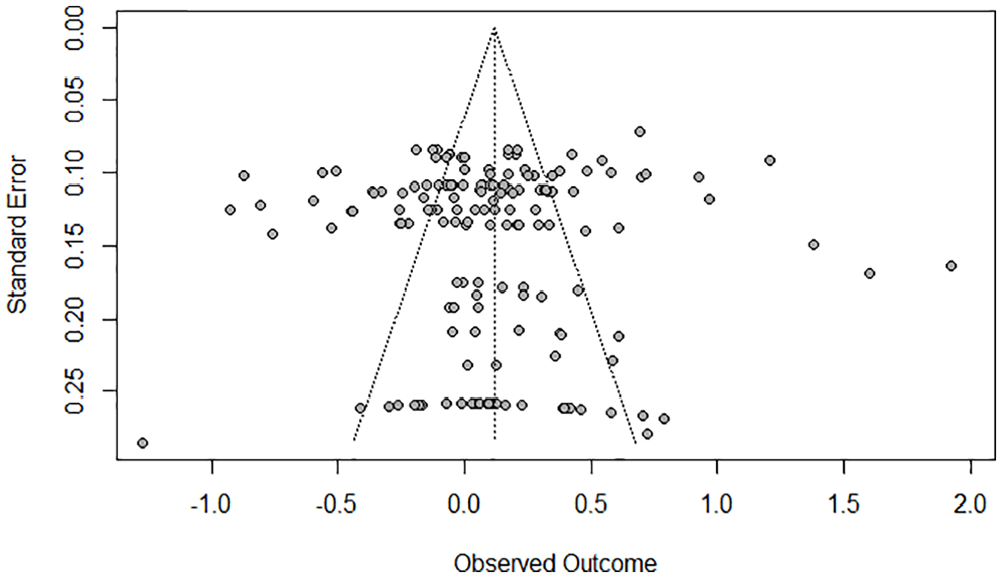
Funnel plot of effect sizes to check publication bias.
Most examined studies measured perceived similarity as a manipulation check. Although it was not proposed as a formal hypothesis, we synthesized the existing studies to obtain an overall effect size of the similarity manipulation on perceived similarity in narrative persuasion. The random effects model result showed a moderate significant effect of similarity manipulation on perceived similarity, with a standardized mean difference of d = 0.37 (k = 34, 95% CIs [0.15, 0.58], p < .01, I2 = 95.5%).
Effects of Character-Recipient Similarity
As shown in Table 1, H1 compared the effects of similar and dissimilar characters on identification. The random effects model result showed a small but significant advantage of similar characters in triggering identification, with a standardized mean difference of d = 0.14 (k = 34, 95% CIs [0.05, 0.23], p < .01, I2 = 69.5%). H2 examined the effect of character-recipient similarity on transportation. The results indicated that the effect was marginally significant (k = 22, d = 0.13, 95% CIs [0.00, 0.27], p = .05, I2 = 79.5%). Therefore, H1 was supported, and H2 was partially supported.
H3 looked into whether similar characters led to stronger self-referencing compared to dissimilar characters. The results showed a small but significant effect with a standardized mean difference of d = 0.16 (k = 12, 95% CIs [0.06, 0.25], p < .01, I2 = 29.4%). H3 was supported. H4 examined whether character-recipient similarity can reduce resistance. The results indicated a marginal effect (k = 12, d = −0.16, 95% CIs [−0.31, −0.00], p = .05, I2 = 79.1%). H4 was marginally supported. H5 to H7 examined the impact of character-recipient similarity on risk perception, attitude, and intention. The results showed the effects were insignificant for risk perception (k = 8, d = −0.05, 95% CIs [−0.39, 0.29], p = .74, I2 = 84.6%), attitude (k = 22, d = −0.10, 95% CIs [−0.26, 0.05], p = .18, I2 = 82.0%), and intention (k = 16, d = 0.08, 95% CIs [−0.05, 0.20], p = .20, I2 = 74.5%). Therefore, H5, H6, and H7 were rejected.
Potential Moderators
H8 asked whether the magnitudes of the effects of character-recipient similarity would vary according to different ways of operationalization. The fixed-effect model results showed that the magnitude of the effect on identification varied at different similarity operationalization levels (p < .05). Pos-doc analysis showed that the chosen D&B manipulations (e.g., major, living place) yielded the strongest effect on identification (d = 0.25, p < .05), followed by innate D&B (e.g., age, biological sex) (d = 0.08, p = .17) and P&B ones (e.g., values, behavioral tendency) (d = 0.02, p = .66). Its moderation effect on risk perception was also significant (p < .01). Specifically, the manipulations on chosen D&B variables led to the highest risk perceptions (d = 0.19, p < .01), followed by innate D&B ones (d = 0.17, p < .01). The manipulations on P&B variables surprisingly turned the effect inverted (d = −0.55, p < .01). For other outcomes, the similarity operationalization did not moderate any effects (ps > .14). Therefore, H8 was partially supported.
H9 compared the effect magnitude of similarity between first- and third-person perspectives. A moderation effect was observed on the outcomes of identification (p < .01) and transportation (p < .05). Specifically, a similar character led to stronger identification when the narrative was presented from a first-person perspective (d = 0.26, p < .001) than from a third-person perspective (d = −0.002, p = .92). The effect on transportation yielded a similar pattern, such that the effect was stronger in the first-person perspective (d = 0.20, p < .05) than that in the third-person perspective (d = −0.03, p = .63). Other than that, no further moderation effect was observed (ps > .06). Therefore, H9 was partially supported.
Lastly, the study context only moderated the effects of similarity on resistance (p < .05). Specifically, a similar character was found to mitigate more resistance in social contexts (d = −0.23, p < .01) than in health ones (d = 0.00, p = .99). No other moderation effect was found for the study context (ps > .09).
Discussion
This paper presented a meta-analysis of empirical studies synthesizing the impact of audience-recipient similarity on narrative involvement and persuasion-associated variables. In addition, a nuanced understanding of its role in narrative persuasion was gained by further exploring three possible moderators: similarity operationalization, narrative perspective, and study context. The findings summarized the current research status, indicated prosperous directions for future research, and informed methodological choices on this front.
Character-Recipient Similarity in Narrative Persuasion
The first goal of this study was to synthesize the effect of character-recipient similarity on narrative persuasion. As expected, the character-recipient similarity generated a stronger effect on character-based constructs like identification and self-referencing than story-based ones like transportation. This result makes great sense, as both identification and self-referencing tap into the connection between the story recipient and the character. Hence, tailoring the character to match the recipients can reduce the recipients’ psychological distance between the self and the character, leading to perspective merging and connecting with oneself. Moreover, the character-recipient similarity was found to have a marginally significant effect on transportation. Although the effect size was at a similar level to identification, their mechanisms might be different. For transportation, a similar character may easily grasp the recipients’ attention with elevated self-relevance feelings. As a result, they would put more cognitive effort into processing the message, leading to greater transportation feelings. However, the marginal significance result indicated that this is not always the case. That is, the effect may largely depend on some potential contextual factors, which should be explored in future research.
In addition, we found that having a similar character in the narrative may slightly reduce recipients’ resistance, the primary obstacle hindering persuasion efforts. Previous research showed that narratives are specialized in alleviating various types of resistance due to causing great involvement in the story world (Ratcliff & Sun, 2020). Our study summarized that the inclusion of a similar character in narratives may have a modest, yet discernible, amplifying effect on the reduction of resistance to persuasion. We suspected that there were two possible explanations for this. First, considering the above finding, it can be explained that the heightened identification and transportation experiences triggered by the character-recipient similarity would fully occupy the recipients’ cognitive capacity, leaving them a limited chance to develop counterthoughts. As a result, the resistance is suppressed. Alternatively, liking might be another mechanism. Prior persuasion literature suggested that perceiving someone similar to oneself can predict attraction, a natural remedy to eliminate the counterforce to persuasion (Tidwell et al., 2013). It is likely that a similar character can elicit strong liking feelings among the recipients, resulting in participants letting their guard down and lessening resistance. These two proposed mechanisms should be supported by further empirical research.
Interestingly, our study did not find evidence supporting the effect of similarity on outcome variables like risk perception, attitude, or behavioral intention. Although character-recipient similarity was found to enhance identification and transportation, this effect counterintuitively did not transfer to the examined persuasion outcomes. We suspected there may be practical and theoretical reasons for the non-significant findings. Practically, this result can be attributed to the insufficient sample size for each category. Among the 19 papers included in this meta-analysis, only 6 assessed the risk perception and 8 examined the effects on attitudes and behavioral intention, respectively. If so, the results may be updated when more studies are included in the future.
Moreover, there may be theoretical explanations for each outcome. First, one potential explanation for the non-significant results regarding risk perception is that it may involve a more cognitive evaluation of the threat (e.g., Witte, 1992, 1996, whereas identification and transportation triggered by a similar character are driven to a certain extent by emotional resonance. As a consequence, it is unlikely that changes in narrative involvement resulting from perceived similarity can effectively transfer to risk perception.
There may exist two explanations for the insignificant findings regarding attitude. First, attitude is a complex construct that forms over time and is influenced by a variety of factors, such as personal experiences, socialization, culture, and beliefs. Therefore, it is possible that the effect of character-recipient similarity may be too subtle to drive changes in one’s long-held attitudes. In other words, although we discovered that similarity had a significant, albeit small, effect on identification and transportation, this slight effect may not be sufficient to transfer to attitude outcomes. Second, although similarity can heighten narrative involvement, this vicarious experience may only progress to the perspective-taking or transportation stage without extending to the “take-home” messages, which are attitude changes. To put it another way, if the character explicitly expressed a change in attitude, the effect of similarity on identification or transportation might be further transferred to the recipients’ attitude change.
We speculated that the non-significant finding regarding intention can be attributed to the absence of efficacy beliefs, which are considered crucial in motivating behavioral change (Ajzen, 1991, Theory of Planned Behavior). A close look at the stimuli used in the studies revealed that the majority, if not all, of the narratives portrayed a negative character who lacks efficacy beliefs. Therefore, we argued that the lack of efficacy beliefs within the narratives may account for the non-significant findings. Notably, this proposition assumes greater significance when considering existing empirical evidence demonstrating the positive impact of instilling efficacy beliefs on narrative persuasiveness (e.g., Isberner et al., 2019; Robinson & Knobloch-Westerwick, 2022). In this light, future narrative practice is suggested to incorporate efficacy beliefs within the character so that a manifestation of the effect of similarity on behavioral intention could be brought about. It is noteworthy that all the above explanations are purely speculative and should warrant further empirical testing.
The final possible explanation for all the nonsignificant findings was the potential existence of moderators on the recipients’ side that obscured the impact of similarity. Notably, the perceived relevance of the message could be such a moderator shaping the effects of similarity on the outcome variables, as an irrelevant story even featuring a similar protagonist could hardly induce changes in perceptions, attitudes, or intentions. Another possible moderator could be the cross-cultural variance in individualism, where individuals from individualistic societies may attach greater significance to uniqueness and autonomy, rendering them impervious to the impact of a similar character. Future research is suggested to explore potential moderators that can intensify or hinder the efficacy of character-recipient similarity.
Potential Moderators
Another important goal of this meta-analytical paper was to investigate whether different similarity operationalizations may affect the magnitude of the examined effects. We found that the similarity manipulation on chosen D&B variables like major and living place produced the strongest effect, followed by the innate D&B ones like age and sex, whereas the similarity manipulation on P&B factors like attitudes and behaviors yielded the weakest effect. The finding on the disadvantage of similarity on P&B variables seemed to be inconsistent with previous tailoring scholarship, which suggested that the most optimized persuasion effect can be achieved through deep tailoring like manipulating the behavioral stage (Kreuter & Wray, 2003). One possible explanation was that, as most narrative persuasion research targets improper behaviors (i.e., unhealthy behaviors or social prejudice), the recipients may not realize they themselves engage in problematic behaviors due to the self-serving bias. Therefore, it would be difficult for them to acknowledge the similarity of manipulation between them and the character of those subjective variables. These speculations, however, await further empirical investigations.
In addition, the finding regarding the superiority of chosen D&B variables echoed a recent meta-analysis such that the tailoring on cultural identity (e.g., ethnicity) generated a stronger effect than that on demographic factors (Huang & Shen, 2016). That meta-analysis looked at the cultural tailoring strategy in cancer communication and suggested that tailoring one’s cultural identity can produce a substantial effect on persuasion outcomes. Our study provided another piece of evidence showing the categorical advantage of identity manipulation over other types of manipulation. This finding can perhaps be attributed to the salience of cultural identity. That is, compared with innate D&B factors like age and sex, a similar character on chosen variables like cultural identities is easier to stand out and catch recipients’ attention. At the same time, it also possesses the merit of being factual information, which is less subject to personal bias in interpretation. Considering the above reasoning, it becomes evident that subjective and personal variables may not always be the optimal choices for character manipulations in narrative persuasion. Instead, practitioners are advised to strive for an appropriate balance between objectivity and personal relevance to achieve the most robust effect.
Perspective proved to be another important moderator affecting the magnitude or even direction of the effect of the character-recipient similarity manipulation. Specifically, when presented from a first-person perspective, a similar character led to greater identification than a dissimilar one. However, the direction turned the opposite when a third-person perspective was adopted, such that a dissimilar character generated a slightly stronger identification. This finding can be easily explained when considering the congruence between similarity and perspective. That is, the recipients reading a character similar to themselves would greatly align with an internal perspective, whereas reading a dissimilar character may be more congruently processed from an objective onlooker’s perspective. Nevertheless, in circumstances associated with stigmatization, wherein a similar character may possibly lead to an urge to disassociate oneself from the stigmatized character to protect identity (e.g., drug use, Kim & Shapiro, 2016), researchers and practitioners may consider adopting a third-person perspective as a means to avoid possible negative emotions and backfiring effect from the stigmatization.
Lastly, the study context was found to moderate the similarity effects on resistance, such that resistance was reduced significantly by character-recipient similarity more in social contexts than in health contexts. Most studies in the social categories sought to alleviate social inequity by reducing prejudice towards people in other groups (i.e., depression patients, McKeever, 2015; immigrants, Igartua & Guerrero-Martín, 2022). Therefore, promoting perspective-merging with the victim by presenting a similar character can easily achieve the persuasion intent.
Limitations
Several limitations should be noted. First, although great efforts were made to collect all the studies and data on the effects of character-recipient similarity in narrative persuasion, it is possible that we may have missed some relevant studies. As more papers are accumulated, the results may be more comprehensive and accurate. Second, we did not distinguish different types of resistance due to the limited sample size. Future research may benefit from investigating whether the character-recipient similarity differentially affects the common three types of resistance: counterarguing, reactance, and perceived invulnerability. Third, the outcome variables included in this meta-analysis were cognitive and perceptual; no actual behavior was assessed in any of the experiments reviewed. Although these self-reported measurements are often used as a proxy for behavior, they are no substitute for observed behavior.
Conclusion
To conclude, this meta-analysis represented a preliminary synthesis of the existing research on the persuasive impact of character-recipient similarity in narratives. The findings suggested that character-recipient similarity can enhance identification and self-referencing while marginally enhancing transportation and reducing resistance to persuasion. Notably, similarity manipulation based on chosen demographic and biographic factors appeared to be more effective at achieving persuasive outcomes than other types of similarity manipulation. Lastly, narrative perspective and study context were tested as potential moderators of the persuasive impact of character-recipient similarity in narratives.
Footnotes
Declaration of Conflicting Interests
The authors declared no potential conflicts of interest with respect to the research, authorship, and/or publication of this article.
Funding
The authors received no financial support for the research, authorship, and/or publication of this article.
