




Abstract
In light of the growing politicization of social media, the spiral of silence theory and its predictions on the conditions under which individuals express political opinions have gained increasing scholarly attention. This study contributes to this line of research by identifying the influence of a central characteristic of social media: message persistence. It was expected that high technical durability of political messages reduces users’ propensity to voice their opinion, moderating the silence effect. A pre-registered experiment (N = 772) revealed a small-to-medium persistence effect in three out of four topical contexts. While perceived congruence with the opinion climate was not associated with the likelihood of opinion expression, the latter could be explained by a mental cost-benefit calculus that was shaped by message persistence. Theoretical implications are discussed referring to (a) a situational approach regarding silencing processes on social media and (b) its connection to a behavioral calculus of human communication.
With the emergence of social media technologies serving citizens as instruments to hold politically and civically relevant debates, many questions arise: Under which circumstances do people feel free to express their private opinions online? What are factors that drive their political participation in social media realms? In terms of theoretical approaches that offer explanations for people’s opinion expression behavior, the spiral of silence theory originally proposed that people participate in political debates and voice their viewpoint when they are part of the majority, and hold back their opinion when they feel part of a minority (Noelle-Neumann, 1974). In other words, people’s opinion expression behavior depends on their perception of the opinion climate. This hypothesis has been explained by people’s fear of isolation, meaning that they fear being rejected by their social environment if they express an opinion that deviates from that of the majority.
Despite the extensive amount of research corroborating the relationship between perceived opinion climate and people’s willingness to express their opinion (Matthes et al., 2018), recent research suggested that not only the opinion climate but also characteristics of the communication situation can affect political outspokenness. For instance, individuals tend to withhold their political stance when they are identifiable by their real name (Lane, 2020; Luarn & Hsieh, 2014) or when they perceived their environment as highly public (Chen, 2018; Neubaum, 2016). The potential influence of communication platform characteristics that could intervene in the relationship between the perceived opinion climate and people’s willingness to express their opinion becomes particularly relevant in the context of social media communication, wherein users are not always able to estimate the reach and ultimate audience of their message (Neubaum & Krämer, 2017a). Here, the question arises as to what extent characteristics of the communication channel can strengthen or mitigate the relationship between opinion climates and individual expression behavior.
In the context of computer-mediated communication, the persistence of messages has been proposed as a central characteristic of online communication, the effects of which, however, have rarely been subjected to empirical investigations (Walther et al., 2018). The level of message persistence, that is, the temporal extent to which messages are available on social media platforms, can vary: Highly persistent messages are recorded and archived for an inestimable amount of time (e.g., a public status update on Facebook), while less persistent messages can be automatically removed after 24 hours (e.g., an Instagram story). High persistence, which differs from the ephemeral acts in face-to-face communication, raises concerns such as whether the content of the message will be interpreted at a later point of time in the same way as it was at the time the message was created (Boyd, 2010): It seems conceivable that while one’s current stance on a political issue matches the prevailing opinion climate, the latter could evolve and, years later, one’s viewpoint could appear out of line and deviant from the mainstream. For users, technically persistent expressions of political opinion could entail social sanctions in the future, even if one is currently on the majority side. Thus, message persistence on public social media channels has the potential to challenge original assumptions made by the spiral of silence theory (Noelle-Neumann, 1974) on the circumstances under which people withhold their opinions on controversial topics.
To further address the affordances that influence the formation of opinion climates on social media, this study explores the effects of message persistence and how it intervenes in the process of individual opinion expression. The hypotheses, sample size calculations, and analysis plan of this study were pre-registered at https://osf.io/fr487/.
The Spiral of Silence Theory in Offline and Online Communication
With the spiral of silence theory, Noelle-Neumann (1974) offered initial explanations for social dynamics in public opinion. Relying on social psychological research, her assumptions suggest that human beings face a fundamental fear of isolation that motivates them to gauge which opinions and actions are accepted by their social environment. The core prediction—the silence hypothesis—states that when individuals realize that their personal opinion is in line with the opinion trend in their social environment, they freely express their viewpoint. In contrast, individuals lapse into silence when their personal stances are deemed to be counter to majority opinion. This hypothesis was subject to several empirical tests, ranging from survey to experimental research in different social settings (Donsbach et al., 2014; Scheufele & Moy, 2000). Despite the theoretical and empirical criticism related to the spiral of silence theory (e.g., Salmon & Kline, 1985), meta-analyses revealed a weak, albeit significant, positive relationship between perceived opinion congruence with the opinion climate and people’s willingness to express their opinion (Glynn et al., 1997; Matthes et al., 2018). Further research has refined the conceptualizations related to this theory, for instance, suggesting that “speaking up” as dependent variable may not only manifest itself in explicitly expressing one’s viewpoint but also engaging in strategies of expression avoidance such as voicing uncertainty or talking about someone else’s opinion (Hayes, 2007).
Since social media have become political forums in which users discuss their opinions on controversial issues, research tested to what extent the silence mechanism also applies to those communication environments and whether there are boundaries to the original theoretical tenets in online communication. Empirical studies, either survey or experimental approaches, did not provide consistent corroboration for the silence hypothesis in social media (e.g., Chen, 2018; Kwon et al., 2015; Nekmat & Gonzenbach, 2013; Porten-Cheé & Eilders, 2015). What may account for these inconsistencies is that studies exploring the silence hypothesis in online communication took different social media platforms into consideration, which resulted in investigating various communication settings with different situational characteristics such as the size of the audience or the user’s anonymity (e.g., Chen, 2018; Luarn & Hsieh, 2014; Neubaum & Krämer, 2018; Yun & Park, 2011; Wu & Atkin, 2018). To explain more variance in users’ opinion expression behavior, it seems desirable to account for those qualities that characterize social media channels and that could affect the silence effect. Previous works have examined the characteristics, often labeled as “affordances,” of communication technologies and outlined their potential effects on users’ behavior (Evans et al., 2017; Treem & Leonardi, 2012). Following this logic, the present work argues that the affordance of message persistence deserves particular attention as it might inevitably affect users’ considerations of potential social sanctions when they express their opinion on controversial issues in permanent computer-mediated communication (CMC) environments.
Persistence of Communication in Social Media
Persistence in social media refers to the temporal extent to which a message can be accessed by its receivers (Boyd, 2010; Herring, 1999, 2001; Treem & Leonardi, 2012). Across the evolution of social media technologies, applications and tools have emerged that allow users to vary the temporal availability of their created messages: While features such as tweets on Twitter, videos on YouTube, or status updates on Facebook are stored and accessible by default for an inestimable amount of time, stories on Instagram and Facebook or status on WhatsApp are commonly available for a maximum of 24 hours. This reduced longevity of communication is the unique selling characteristic implemented by the platform Snapchat, which removes messages (e.g., videos, pictures) 10 seconds (or less) after the receiver accesses it. The varying levels of message persistence across different social media have provoked new forms of interactions and new communication norms among users (Bayer et al., 2016), raising questions about a functional conceptualization of persistence with its characteristics and potential effects on communication practices.
This work suggests that the manifestation of persistence can be characterized not only by (a) the temporal availability of a message (i.e., time period for which a message is available to users), but also based on (b) public accessibility (i.e., how easy it is to access the message using public communication channels), and (c) the removability (i.e., how technically difficult it is to remove the message). Accordingly, message persistence may have different effects on people’s communication behavior (e.g., expressing a political opinion), depending on whether the message is stored forever on a private notebook without encountering any audience (i.e., with low or non-existent public accessibility) or on public Twitter. Likewise, people may be less concerned about the potential technical durability of, for instance, a user-generated comment if they are aware that they can easily delete or edit it on their own at any time (i.e., with high removability).
Persistence is also associated with a series of further affordances in online media: These include searchability, duplicability, spreadability, and visibility (Boyd, 2010; Evans et al., 2017). More specifically, when there is high persistence by default (e.g., a user-generated comment on Facebook), this message is automatically saved, archived, and made searchable on that platform. At the same time, the permanent storage of a message on a social media platform means that other users can copy it and spread the copy or even the original all over a network, making it visible to a large group of other users. However, whether or not a persistent message is visible to other users commonly depends on algorithms that determine what each user gets to see on his/her social media feed (Bucher, 2012). Persistence on social media, consequently, can, but must not, necessarily be associated with enhanced visibility.
Initial research revealed that users are aware of varying levels of persistence across different social media platforms (Bayer et al., 2016; DeVito et al., 2017; Kofoed & Larsen, 2016; Waddell, 2016), and this impacts whether and how they express themselves: High durability of communication seems to foster users’ conscious reflection upon their messages (Walther et al., 2018), which can also result in more selective self-presentation. It seems plausible to assume that people’s expression of political opinions also varies in accordance with the level of message persistence (Lane et al., 2019). Previous spiral of silence research suggested that situational factors, that is, characteristics of the communication setting (e.g., the size of the audience; Salmon & Oshagan, 1990) can influence people’s willingness to voice their political views (Matthes & Hayes, 2014; Perry & Gonzenbach, 2000; Shamir, 1997). Noelle-Neumann (1994) herself pointed out the potential impact of situational factors and argued that silencing mechanisms may not be detectable in circumstances that are too private (e.g., talking to close friends) or too public (e.g., giving a TV interview). The permanent storage of one’s political utterance in social media can be associated with high visibility. Thus, the question arises as to how users deal with this potentially greater publicness for their political expressions in highly persistent communication channels (Neubaum & Krämer, 2017a).
Generally, research found that the enduring form of communication goes hand in hand with increased privacy concerns that messages sent via social technologies can be “forwarded to unknown third parties, saved, retrieved, and might never be forgotten” (Trepte, 2015, p. 2). In the context of political expressions in social media, this creates the risk that these messages are interpreted differently when consumed outside the textual or temporal context in which they were originally produced (Boyd, 2010). Indeed, privacy concerns and attitudes that one should protect the information one divulges in online environments are associated with a reduced tendency to disclose personal information on social media (Baruh et al., 2017; Dienlin & Trepte, 2015). Consequently, the presence of the persistence affordance—from users’ point of view—is associated with perceived risks and concerns. At the same time, having one’s political message permanently recorded and archived may also be associated with perceived personal benefits. In the following, the psychological trade-off between costs and benefits behind persistent political messages is outlined.
The Costs and Benefits of Persistent Political Expressions
Expressing oneself via social media technologies was recently explained as a psychological trade-off between costs and benefits (Dienlin & Metzger, 2016; Neubaum & Krämer, 2017a; Trepte et al., 2017): Accordingly, individuals weigh up what they would gain and what they would lose if they express themselves. Noelle-Neumann (1993) already specified in the original theory what is at stake on the side of costs: social rejection and isolation. Indeed, concerns related to interpersonal conflicts appear to be particularly relevant in social media contexts in which users express their stance on morally loaded and controversial issues. Users associate political discussions in social media with negative dynamics such as being attacked by others (Vraga et al., 2015), meaning that they might withhold their potentially controversial opinion to avoid conflicts. This should be especially salient to users in cases in which they are unaware of the ultimate audience of their message. Previous research related to the spiral of silence theory in social media has shown that users’ perceived lack of control over their audience predicts people’s reduced willingness to voice a minority opinion on a social networking site compared with a face-to-face gathering (Neubaum & Krämer, 2018). As proposed by Noelle-Neumann (1993), this lack of control seems to increase people’s situational fear of isolation, which manifests itself in the fear of being negatively judged or even attacked by the potential receivers of one’s opinion expression, the audience. The notion that especially the permanence of one’s messages increases people’s likelihood to self-censor themselves politically on Facebook has been corroborated by initial correlational research (Fox & Holt, 2018). Given this finding, Fox and Holt (2018) explain that people “may fear that their posts may be discovered by others (such as future employers) or that the climate of opinion may shift in the future and leave them in the minority” (p. 546). Thus, perceived costs of expressing oneself in persistent social media platforms include jeopardizing or even harming personal and professional relationships.
At the same time, individuals perceive some advantages: On channels that enable one-to-many communication, users’ propensity to voice their opinion is driven by perceived benefits such as persuading, mobilizing, or impressing others (Gil de Zúñiga et al., 2016; Weeks et al., 2015; Winter & Neubaum, 2016) or by the wish to fulfill one’s civic duty and correct the opinion climate (Rojas, 2010). In the face of persistent messages in social media, individuals could see the benefits of spreading their stance and contributing to society’s deliberation on political questions in an enduring and, therefore, sustainable way. While some of those benefits represent gains for the individual (e.g., admiration as a consequence of positive self-presentation), others could—from a user’s perspective—do service to society by shaping public opinion correctly.
Given the juxtaposition of potential costs and benefits of political online expressions, research needs to examine to what extent social media affordances such as message persistence affect users’ perceptions of what they would gain or lose. This trade-off, however, may not occur equally for all topical contexts. In users’ perceptions, some topics might appear to be riskier to discuss in persistent communication channels than others, for instance, when the opinion climate on the issue in question is more likely to change in the future. Particularly when focusing on durability of mediated communication, the longevity of public debate and its potential changeability should be considered. To this end, a temporal classification of controversial political issues is outlined in the following.
Type of Issue: A Temporal View on Political Expressions
In many instances, research has argued that the occurrence of the silence effect related to public debates is contingent on the nature of the focal issue (Gearhart & Zhang, 2018; Salmon & Glynn, 2009). Noelle-Neumann (1993) suggested that, as a prerequisite, the topic needs to be controversial and morally loaded. Therefore, spiral of silence research has commonly considered political topics that are related to questions of moral value such as the death penalty (Hayes, 2007), genetic engineering (Scheufele et al., 2001), or abortion (Salmon & Neuwirth, 1990). To classify these topics in a meaningful way, Salmon and Glynn (2009) proposed also taking the temporal dimension of a political issue into account. Yeric and Todd (1996) differentiate between enduring, transitory, and emerging topics: Enduring topics are those “that remain in the public eye over a number of years, thus, permitting longitudinal analysis” (Yeric & Todd, 1996, p. 165), such as health care, gun control, or abortion. Transitory topics are marked “by high intensity and deep emotions for a short period. They are soon resolved and lack the qualities that would keep them in the public’s eye for a prolonged period” (p. 166), giving the Gulf war as an example. Emerging topics are “those that are beginning what appears to be a long-term existence in the public’s mind and eye” (p. 166), meaning that those topics remain in the status of “emerging” at its beginning stage of a public debate (previous examples include energy sources). Yeric and Todd (1996) themselves acknowledge that it is difficult to predict which emerging topics become enduring or transitory and that the definitional boundary between emerging and transitory is blurred, leading the present work to solely focus on the comparison between enduring and emerging topics.
The longevity of an issue in the public agenda is also represented in the factor “continuity” implemented in the theory of newsworthiness (Galtung & Ruge, 1965). Continuity refers to the idea that once news media cover an event, it is more likely that they report on it over and over again. Not only is continuity of a topic a guiding factor for journalists and news consumers when dealing with the issue (Eilders, 2006), social media users also take it as a cue to engage in discussions: News that had already been on the media agenda for a certain amount of time provoked an increased level of interactivity in the comment sections of articles (Weber, 2014). One explanation is that individuals have more knowledge about that particular topic and feel more comfortable discussing that issue. Recent research also suggests that the opinion climate could also play a role: Gearhart and Zhang (2018) found that people’s willingness to express their opinion on an enduring topic (i.e., abortion) on Facebook was predicted by the currently perceived congruence with the opinion climate in the media; for an emerging topic (i.e., gay marriage), however, the expected opinion climate among the nation in the future affected users’ outspokenness on this topic more than the currently perceived opinion climates (in the media, among friends, and nationally). This finding indicates that the perceived stability (or changeability) of the opinion climate plays a role in people’s consideration of whether or not to speak out publicly on social networking platforms. This consideration could become even more relevant when taking into account that, in social media environments, opinion climates can be fragmented and their constitution can vary depending on the particular online space the individual is interacting in (Nekmat & Gonzenbach, 2013; Neubaum & Krämer, 2017b; Ordoñez & Nekmat, 2019). In more public and diverse online channels, one could speculate that there is a greater likelihood for the opinion climate to change than in comparatively closed homogenous communication clusters. Drawing on this, the present work proposes that—in the public’s perception—the difference between enduring versus emerging topics lies in whether the opinion climate remains stable (i.e., enduring topic) or is likely to change in the future (i.e., emerging topic). More specifically, enduring topics have undergone extensive consideration (in terms of public discourses weighing up reasons in favor and against) by society, and individuals perceive certainty about the stability of the opinion climate. For emerging topics, in most cases, the (moral and political) consideration has not been as extensive as for enduring topics, and there is a chance that public consensus will someday change. Consequently, citizens may not feel as certain about the future opinion climate as they might feel in the context of enduring topics.
Taking into consideration varying levels of message persistence on social media, the differentiation of issue types appears decisive when analyzing how enduring an individual utterance is. When publicly expressing one’s opinion on an enduring topic, people—facing fear of isolation—may feel better able to judge whether social sanctions may follow their public and persistent opinion expression through social technologies. When dealing with an emerging topic, the persistence of communication on social media could become an inhibitor of opinion expression (irrespective of whether users currently feel in the majority or minority), since the instability of the opinion climate among emerging topics can entail social sanctions (if one’s act of opinion expression today does not match the opinion climate tomorrow).
The Present Study
Given preliminary findings (Fox & Holt, 2018), this work argues that people’s willingness to voice their political opinion will be lower when their expression is permanently recorded (i.e., when message persistence is high) compared to when it is ephemeral (i.e., when message persistence is low):
Hypothesis 1 (H1): On a public social networking platform, high persistence of a message reduces people’s willingness to express their opinion when compared with low persistence of the message.
Following the silence hypothesis (Noelle-Neumann, 1993), which predicts a positive relationship between perceived opinion congruence and willingness to voice one’s opinion, it is expected that persistence of communication functions as a boundary condition of the silence mechanism. While the association between perceived opinion climate and people’s opinion expression is believed to remain in the case of low message persistence (as was found in ephemeral face-to-face settings; Hayes et al., 2001), high message persistence is expected to significantly reduce the effect of perceived congruence with the opinion climate on people’s willingness to express their opinion:
Hypothesis 2 (H2): High persistence of the message on public social networking platforms attenuates the effect of perceived opinion climate on people’s willingness to express their opinion when compared with low persistence of the message.
Moreover, it is expected that message persistence interacts with the type of focal topic. Drawing on the differentiation between emerging and enduring topics (Yeric & Todd, 1996), one could argue that people perceive the opinion climate pertaining to emerging topics as less stable and more changeable compared to enduring topics that are characterized by a certain continuity in the media (Eilders, 2006). For emerging topics, an opinion expression act could be in line with the present but not with the future opinion climate. This consideration could become even more salient to people when they are about to express themselves in an environment that records and archives their message for an inestimable amount of time. This leads to the hypothesis that message persistence exerts a greater impact on people’s willingness to express their opinion when the corresponding topic is emerging than when it is enduring:
Hypothesis 3 (H3): The effect of message persistence on people’s willingness to express their opinion is stronger for newly emerging than for enduring topics.
Building on the explanation given above, people’s perceived changeability of the opinion climate is thought to mediate the effect of type of topic on people’s willingness to express their opinion—when message persistence is high:
Hypothesis 4 (H4): The effect of the emerging nature of a topic on people’s willingness to express their opinion (when persistence is high) can be explained by people’s expectations of the opinion climate’s changeability.
Previous research has left open whether perceptions of opinion climates can exert greater impact on people’s outspokenness when topics are emerging or enduring. It seems conceivable that people rely more on an opinion climate that is supposed to be stable. Still, it could also be claimed that, given the moral uncertainties that are associated with emerging controversial topics, people rely on prevailing opinion climates on newly emerging topics more when it comes to expressing themselves publicly. These two lines of argumentation raise the question:
Research Question 1 (RQ1): Do perceived opinion climate and type of issue have an interaction effect on people’s willingness to express their opinion?
In line with Noelle-Neumann’s (1993) claim about fear of isolation as the driving force behind people’s silence when faced with a hostile opinion climate, studies have shown that the expectation of sanctions from others affects people’s willingness to voice their opinion on controversial issues (Neubaum & Krämer, 2018). On an exploratory level, this study asks whether persistence of communication plays a role in people’s perceived likelihood of encountering social sanctions:
Research Question 2 (RQ2): To what extent does high persistence of online communication increase people’s expectation of future social sanctions?
Expecting social sanctions, however, represents only one side of people’s considerations. When expressing oneself online, individuals seem to go through a psychological cost-benefit trade-off (Dienlin & Metzger, 2016; Trepte et al., 2017), weighing the risks associated with divulging personal information (e.g., being judged or attacked) against the benefits (e.g., mobilizing other people). The fact that different scenarios of a cost-benefit trade-off combined with a varying level of message persistence are conceivable raises, on an exploratory level, the question of:
Research Question 3 (RQ3): To what extent does the level of message persistence on social media affect the cost-benefit calculus of expressing one’s personal opinion?
The hypotheses, research questions, methodological procedure, as well as the analytic strategy of this study were registered on the Open Science Framework (https://osf.io/fr487/) before data collection.
Method
In a 2 × 2 between-subjects factorial experiment, the effects of level of message persistence (low vs. high) and the type of issue (emerging vs. enduring) on social media users’ willingness to express their political opinion and related perceived costs and benefits were tested. To increase generalizability, the factor “type of issue” was operationalized with two emerging and two enduring political issues, leading to a total of eight experimental groups. The procedure of this study was approved by the local IRB. The questionnaire, stimulus material, raw data, analysis syntax, as well as supplementary material can be accessed at https://osf.io/fr487/.
Participants
A-priori sample size calculations were based on the effect size found in Fox and Holt (2018). In this study, the persistence effect on willingness to express one’s opinion had a coefficient of β = .12. Considering this effect size, the experimental design (with eight groups, since type of issue has two representations on each level and a df of 1) and a level of power of 90%, calculations with G*Power (version 3.1) suggested a sample size of N = 732.
Participants were recruited using the SoSci panel, a noncommercial online panel of German-speaking individuals who volunteered to participate in online research. The questionnaire was started by 970 subjects and completed by 773. One participant was removed since he/she stated an age that was below the minimum age to use most social media platforms. A total of N = 772 participants were considered in the following analyses, including 472 females (61.1%), 285 males (36.9%), and 15 subjects that either identified themselves with another gender or did not want to indicate their gender. Subjects’ age ranged from 17 to 99 with an average of M = 39.27 (SD = 15.38) (see more information about participants’ age in the Supplementary Material A1 at https://osf.io/qp2tv/). The majority (83.5%) had at least a high school diploma. The largest part of the sample consisted of employees (42.9%), students (23.7%), self-employed individuals (9.1%), and public servants (6.7%). A prerequisite for participation was the use of one social media platform (or more) at least once a week. The two services that were used the most were Facebook (used by 90.9% of participants) and Instagram (used by 41.8%).
Stimulus, Manipulation Checks, and Piloting
The stimulus was a written hypothetical scenario, introducing a new (fictitious) social media platform called WorldConnect.com. To increase the validity of hypothetical scenarios, vignettes should be as realistic as possible so that participants are able to connect to and envision the situation (Aviram, 2012). To achieve this, participants were given very detailed scenarios of a platform that resembled basic features of the currently popular platform Facebook. The vignette stated that individuals are able to create personal profiles on WorldConnect.com, connect with people, as well as write and respond to posts on current issues. Furthermore, the scenario mentioned that, on WorldConnect.com, messages were going to be either recorded, archived, and retrievable from the Internet for an inestimable amount of time (=high level of persistence) or only recorded for the specific period of a week and deleted afterwards (=low level of persistence; see Questionnaire and Written Scenarios at https://osf.io/fr487/). After introducing this platform, participants were asked to imagine a discussion on the platform about the experimental condition’s focal topic and reminded that messages are either archived for an inestimable amount of time (high persistence) or deleted after 1 week (low persistence).
As a manipulation check, participants were asked to state how persistent they perceived WorldConnect.com to be (four items such as “My opinion statement would be recorded on the Internet forever” on a seven-point scale; Cronbach’s α = .90). A t-test for independent samples revealed that subjects in the low persistence conditions perceived the communication channel as less persistent, M = 3.15, SD = 1.60, than did participants in the high persistence conditions, M = 5.22, SD = 1.87, t (747.44) = −16.49, p < .001, Cohen’s d = −1.19.
To identify controversial issues that are perceived as enduring versus emerging by social media users, a pilot study (N = 76; 42 females; age: M = 29.11, SD = 7.99; 96.1% had at least a high school diploma) was conducted. Participants rated eight different topics along different criteria including the perceived instability of the opinion climate (item: “How likely is the opinion on this topic to change among the national population in the future?”; 1 = very unlikely to 7 = very likely). Based on this criterion, participants rated the opinion climate on the death penalty, M = 2.78, SD = 1.51, and the right to abortion, M = 3.32, SD = 1.59, as the least instable. The highest opinion climate instability was perceived for the topic of using robots to replace human workers, M = 5.18, SD = 1.23, and tracking health information for medical purposes, M = 4.83, SD = 1.31. In other words, subjects perceived the opinion climates on the latter two topics as more likely to change in the future. Based on these pilot results, these four topics were selected to be included in the scenarios of the main experiment.
Participants of the main experiment were also asked to estimate how likely it is that the opinion climate on the focal issue is going to change in the future (one item measured on a seven-point scale). A t-test collapsing the two emerging (workers’ replacement, health tracking) and the two enduring (abortion, death penalty) topics showed that participants exposed to an emerging topic perceived the opinion climate of the focal issue as more likely to change in the future, M = 4.67, SD = 1.21, than those assigned to the conditions with enduring topics, M = 3.50, SD = 1.27, t (770) = 13.13, p < .001, Cohen’s d = 0.94 (see also Additional Information; https://osf.io/cygvb/).
Procedure and Measures
Panelists were invited via email to participate in a 15-minute online study on how social media platforms function as venues for political and civic discussions. Once subjects followed the link within the email, they were forwarded to the online questionnaire software and randomly assigned to one of the eight experimental groups. Subjects were asked to state how frequently they use various social media platforms such as Facebook or Instagram (seven items) and to what extent they use social media for political purposes (three items). Psychometric properties as well as correlations among all variables can be accessed in the Supplementary Material A2 and A3 (https://osf.io/qp2tv/).
Personal opinion and perceived opinion climates
Participants then stated their opinion on a seven-point scale (from 1 = I strongly oppose [topic], 4 = I neither support nor oppose [topic], to 7 = I strongly support [topic]) and based on a dichotomous decision (item: “If you had to decide whether to oppose or to support [topic], what would you do?” with 1 = support and 2 = oppose). As control variables suggested by previous research (Matthes et al., 2010), subjects indicated their certainty about their viewpoint (item: “how certain are you about your opinion on [topic]?” with 1 = not certain at all to 6 = very certain), their personal relevance, and perceived controversy related to one of the four topics used in the experiment. Participants then estimated the opinion climate on the focal topic among (a) the national population, (b) one’s reference group (friends and family), and (c) other social media users on a seven-point scale, from 1 = the national population strongly opposes [topic], 4 = neither opposes nor supports [topic], to 7 = the national population strongly supports [topic], how certain they felt about each estimate (one item for each estimate), and how likely the perceived opinion climate is to change in the future (as a manipulation check; see above). To obtain the variables on perceived incongruence with the opinion climates (see Kwon et al., 2015), the difference between the seven-point item on participants’ personal opinion and the three seven-point items on perceived opinion climates (among the “national population,” “one’s reference group (friends and family),” and “other social media users”) was calculated. Negative scores were recoded to positive ones so that the higher the score of this variable, the greater participants’ perceived incongruence with the prevailing opinion climate among the different groups.
Control variables
As control variables suggested by previous spiral of silence research (Hayes et al., 2013; Neubaum, 2016), participants indicated their dispositional fear of isolation (five items on a five-point scale; Hayes et al., 2013; α = .78; M = 3.22, SD = 0.82) and attitudes toward informational, psychological, and social privacy (three items for each dimension on a seven-point semantic differential; cf. Dienlin & Trepte, 2015; informational: α = .85; M = 4.77, SD = 1.24; psychological: α = .86; M = 4.78, SD = 1.29; social: α = .88; M = 5.36, SD = 1.43).
Likelihood of expression
After reading the hypothetical scenario, subjects had to state how likely they were to respond in different ways (for more information about the exploratory factor analysis of this measure, see Additional Information at https://osf.io/cygvb/). The final two-dimension solution of this measurement comprised the factor “opinion expression,” representing items such as “I would participate in the discussion on WorldConnect.com and express my personal opinion on this topic” (five items on a seven-point scale; α = .91; M = 3.02, SD = 1.65) and “subtle forms of expression,” with items such as “I would participate in the discussion and talk about someone else’s opinion” (three items; α = .77; M = 2.37, SD = 1.29).
Perceived benefits and costs of expression
Participants were then asked to state on a seven-point scale their agreement with reasons that are in favor or against expressing one’s opinion on this platform. Original items were developed based on previous literature identifying perceived benefits (e.g., Gil de Zúñiga et al., 2016) and costs (e.g., Vraga et al., 2015) of voicing one’s opinion online. Five latent variables were pre-defined for perceived benefits, and four for perceived costs. Confirmatory factor analyses (CFA; using the software R, package lavaan by Rosseel, 2012) were run for (a) perceived benefits and (b) perceived costs to corroborate the pre-defined dimensions derived from the literature. The CFA revealed satisfactory factorial validity in terms of the model fit for perceived benefits, χ2 (80) = 203.70, p < .001, CFI = 0.98, TLI = 0.97, RMSEA = 0.05 (90% confidence interval from 0.04 to 0.05), SRMR = 0.03, and perceived costs, χ2 (84) = 344.53, p < .001, CFI = 0.95, TLI = 0.94, RMSEA = 0.06 (90% confidence interval from 0.06 to 0.07), SRMR = 0.05.
For perceived benefits, factors were: “persuasion/mobilization” (three items; α = .88; M = 3.10, SD = 1.61), “corrective action” (three items; α = .86; M = 3.29, SD = 1.65), “self-presentation” (four items; α = .88; M = 2.48, SD = 1.38), “civic contribution” (three items; α = .89; M = 3.44, SD = 1.74), and “relational maintenance” (two items; α = .84; M = 2.44, SD = 1.48). For perceived costs, the factors were: “negative judgment by others” (four items; α = .83; M = 2.92, SD = 1.50), “dissolution of interpersonal relationships” (four items; α = .86; M = 2.74, SD = 1.46), “personal attacks by others” (four items; α = .94; M = 3.31, SD = 1.82), and “time investment with zero effect” (three items; α = .84; M = 3.95, SD = 1.69).
Perceptions of the platform
Subsequently, subjects were instructed to state the perceived persistence of communication (see manipulation check above), size of the audience (three items), and accountability for expressing one’s opinion (three items).
Before being debriefed, participants gave demographic information and had the chance to participate in a lottery for four vouchers (each 20 Euro) for an online shop of their choice.
Data Analysis
Hypotheses 1–3 and RQ1 were tested with the software SPSS version 25.0. For each measure of opinion expression behavior, a hierarchical regression analysis was computed. The first three steps of the regression included control variables that were found to influence political outspokenness offline and online. More specifically, Step 1 included dispositional fear of isolation, Step 2 subjects’ attitudes toward informational, psychological, and social privacy online, and Step 3 participants opinion certainty. In Step 4, three variables representing the perceived opinion incongruence with all three target groups (national population, reference group, and social networking site [SNS] users) were considered. Step 5 and 6 included the main independent variables persistence level and issue. The next three steps included the interaction terms of the independent variables (Step 7 = persistence × issue type; Step 8 = persistence × perceived opinion incongruence with three groups; Step 9 = issue type × perceived opinion incongruence with three groups). All interaction terms were calculated by multiplying the mean-centered and weighted effects-coded variables (Cohen et al., 2003). H4 was tested based on moderated mediation analyses using the PROCESS macro (Hayes, 2018) with 5,000 bootstrap resamples (percentile-based 95% confidence interval) with type of issue (emerging vs. enduring) as independent variable, perceived changeability of opinion climate as mediator, opinion expression and subtle expressions as dependent variables, as well as level of persistence as moderator (model 7). RQ2 and RQ3 were addressed based on structural equation modeling (SEM) using the software R (Version 3.5.3) with its package lavaan (Rosseel, 2012).
Results
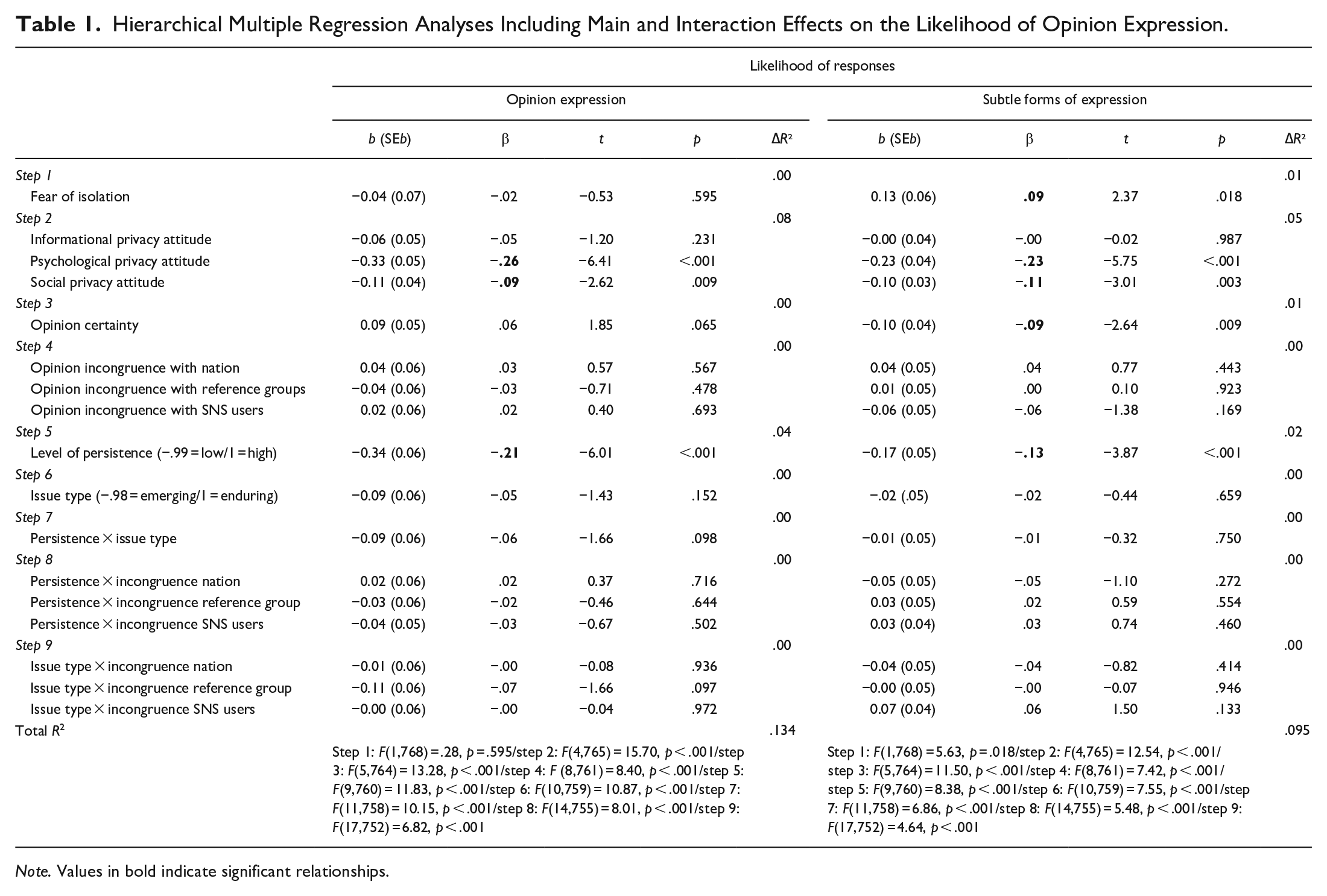
With H1, it was expected that high persistence of the communication channel reduces people’s willingness to express their political opinion in social media environments. As can be seen in Table 1, high message persistence negatively affected subjects’ likelihood of opinion expression, β = −.21, p < .001, and subtle forms of expression, β = −.13, p < .001. Additional t-tests for all four focal issues corroborated the persistence effect for three out of four topics, revealing small-to-medium effect sizes regarding the manipulation of persistence (see Supplementary Analyses A4 at https://osf.io/qp2tv/). H1 is considered as supported.
Hierarchical Multiple Regression Analyses Including Main and Interaction Effects on the Likelihood of Opinion Expression.
Note. Values in bold indicate significant relationships.
H2 predicted an interaction effect between level of persistence and perceived opinion climate on subjects’ willingness to voice their opinion. According to Table 1 (Step 8), no interaction effects between those predictors was identified. H2 cannot be supported. Moreover, H3 proposed an interaction effect between level of persistence and nature of issue on willingness of opinion expression. For both forms of expression (see Table 1; Step 7), no interaction effect was found. Thus, no evidence is provided for H3. H4 expected that when persistence is high, the effect of issue type on people’s willingness to express themselves can be explained by the perceived changeability of the opinion climate. While there was a main effect of issue type on perceived changeability of the opinion climate for both levels of persistence (see results on the manipulation check), the indirect effects were not significant, neither for opinion expression, path estimate for the indirect effect, high persistence: b = −0.03, SEb = .06; CI [−0.14, 0.08], low persistence: b = −0.03, SEb = 0.06; CI [−0.14, 0.10], nor for subtle forms of opinion expression, path estimate for the indirect effect: high persistence: b = −0.04, SEb = 0.04; CI [−0.13, 0.04], low persistence: b = −0.05, SEb = 0.05; CI [−0.14, 0.05]. Moreover, there was no significant moderated mediation effect: b = 0.00, SEb = 0.01; CI [−0.02, 0.02] (for likelihood of opinion expression) and b = 0.00, SEb = 0.01; CI [−0.02, 0.03] (for subtle forms of expression). Consequently, there is no empirical corroboration for H4. On an explorative level, RQ1 asked whether there is an interaction effect of perceived opinion climate and the type of issue on people’s willingness to voice their opinion. Based on Table 1 (Step 9), no evidence was found for an interaction effect between these variables. Moreover, the regression analyses did not reveal a main effect of type of issue (see Step 6 in Table 1) on different forms of expression on social media. RQ2 and RQ3 asked to what extent the level of message persistence increases people’s expectations of social sanctions and, consequently, their calculus about costs and benefits of voicing their opinion online. A structured equation model with the level of persistence as independent variable, perceived costs and benefits as mediators, and likelihood of opinion expression and subtle forms of expression as dependent variables fit the data well, χ2 (123) = 513.71, p < .001, CFI = 0.95, TLI = 0.94, RMSEA = 0.06 (90% confidence interval from 0.06 to 0.07), SRMR = 0.07. The model revealed that while a higher level of persistence decreased perceived benefits to a small extent, β = −.10, b = −0.25, SEb = 0.10, 95% CI [−0.44, −0.06], z = −2.59, p = .01, it slightly increased the perceived costs, β = .18, b = 0.51, SEb = 0.10, 95% CI [0.31, 0.71], z = 4.93, p < .001. Moreover, perceived benefits strongly increased the likelihood of opinion expression, β = .60, b = .84, SEb = 0.05, 95% CI [0.74, 0.94], z = 16.61, p < .001, and subtle forms of opinion expression, β = .60, b = 0.54, SEb = 0.04, 95% CI [0.45, 0.62], z = −12.56, p < .001. At the same time, perceived costs weakly reduced the likelihood of opinion expression, β = −.18, b = −0.23, SEb = 0.05, 95% CI [−0.32, −0.14], z = −4.92, p < .001, and slightly increased subtle forms of opinion expression, β = .07, b = 0.06, SEb = 0.03, 95% CI [−0.01, 0.12], z = 1.65, p = .098. The indirect effects of level of persistence through perceived benefits and costs on expressive acts were generally small (see Supplementary Analyses A5 at https://osf.io/qp2tv/). The variance explained by the model was R2 = 0.44 for the likelihood of opinion expression and R2 = 0.38 for subtle forms of opinion expression. Additional analyses revealed that while low message persistence increased perceived benefits of expressing one’s political stance in terms of fulfilling one’s civic duties (d = 0.31), correcting the opinion climate (d = 0.28), and persuading/mobilizing others (d = 0.27), it decreased perceived costs specifically in the sense of expecting negative judgment by others (d = −0.39), the loss of interpersonal relationships (d = −0.30), and personal attacks by others (d = −0.27) (see Supplementary Analyses A6 at https://osf.io/qp2tv/).
Discussion
The increasing “politicization” of social media communication raises the question of whether political interactions on these platforms follow the same social psychological principles as proposed by original theories such as the spiral of silence theory (Noelle-Neumann, 1993). Initial evidence focusing on this question revealed that particular characteristics of these technologies are likely to modify these social psychological processes and that it is desirable to explore the effects of these emerging qualities in a systematic manner (Neubaum & Krämer, 2017a; Yun & Park, 2011). One pivotal characteristic of computer-mediated communication that varies across different contemporary social media platforms is represented by the affordance of message persistence (Bayer et al., 2016; Evans et al., 2017), that is, the temporal extent to which a message can be accessed by users of a platform. The present work investigated the effects of communication persistence and its interplay with potential future changes of opinion climates on users’ opinion expression behavior and their mental cost-benefit calculus of voicing their viewpoint online. Findings corroborated a persistence effect on users’ willingness to express themselves, uncovering factors that encourage and inhibit political outspokenness through social media technologies.
In line with the first hypothesis, the present results indicate that the permanence of one’s message in a social media platform generally reduces one’s willingness to participate in political discussions, either by explicitly voicing one’s viewpoint or partially by more subtle forms of opinion expression (e.g., by expressing uncertainty or talking about someone else’s opinion). According to the effect sizes across the four controversial topics used in the present experiment, the persistence effect can vary between d = 0.10 and d = 0.57, that is, from small to medium. This effect, however, is larger than the coefficient found in previous correlational research on the connection between perceived persistence and self-censorship (Fox & Holt, 2018) and emphasizes how the constitution of the communication environment affects the inclusiveness of a discussion forum in the sense of how much people feel encouraged to express themselves. As reported by the present results, users have general reservations about participating in online discussions when they know that their contribution is recorded and archived for an inestimable amount of time. When expressing their political opinion in a highly persistent channel, users lose control over the ultimate audience and over the point in time at which their message is consumed (Boyd, 2010). Accordingly, communication via highly persistent platforms might be inevitably accompanied by privacy concerns and the wish to determine the space and the audience of one’s messages. This notion was corroborated by the finding that subjects’ psychological and social privacy attitudes are moderate inhibitors of expressive behaviors (see Table 1). The more dangerous users find it to share personal thoughts and the more important it is for users to determine their audience, the less they actually share political messages on social platforms (Baruh et al., 2017; Dienlin & Trepte, 2015).
Contrary to expectations, the persistence effect did not interact either with the perceived opinion climate or with the type of the public debate (emerging versus enduring). Different explanations can be given for the absence of interaction effects: First, the persistence of one platform could function as such a dominant affordance that it is not relevant to users whether the opinion climate is not in line with their opinion or might even change in the future—users wish to know who the ultimate audience of their opinion expressions is or will be in the future. Even in the face of debates on enduring topics (Yeric & Todd, 1996) such as death penalty, the opinion climate of which is seen as more stable and predictable in the country where the study was conducted, users may be reluctant to become outspoken in those social media platforms since the persistence of communication is associated with high personal costs (see below). Second, the absence of interaction effects could also lie in a weak manipulation of the factor “type of issue.” Although there was a significant difference regarding the perceived changeability of the opinion climate between emerging versus enduring topics (with a large effect size), it cannot be ruled out that other differences (such as the emotional loading of a topic) overrode the effect of “changeability” of the opinion climate in the future. Additional regression analyses replacing the experimentally manipulated factors persistence and type of issue by the subjective assessments of perceived persistence and perceived changeability of the opinion climate, however, did not change the pattern of the results reported above.
Given the results, it is remarkable that message persistence largely influenced users’ assessments of potential costs and benefits of voicing their political stance. Privacy research suggested that individuals’ communication behavior in social environments is preceded by a mental calculus of consequences of their actions (Dienlin & Metzger, 2016; Trepte, 2015; Trepte et al., 2017). The present study not only reveals that certain perceived costs inhibit, and particular perceived benefits encourage political expressions, it also points out that affordances of the social media environment directly influence these cost-benefit perceptions: Users consistently perceived higher benefits from expressing themselves when the platform offered low persistence communication. In less persistent discussions, users felt more encouraged to persuade or mobilize others, correct potentially distorted opinion climates, and make civic contributions by voicing their opinion. Given this pattern, it seems worthwhile to discuss whether public deliberation still exists when the exchange of opinions is ephemeral and not recorded or accessible for a longer period of time—as it might have been in the traditional understanding of deliberation in London’s coffeehouses or Paris’s salons during the Enlightenment (Neubaum & Krämer, 2017a). At least from the point of view of users, low persistence environments are more rewarding spaces to discuss political issues than are the majority of contemporary social technologies that have a predominantly persistent mode of communication.
This becomes even clearer when considering that high message persistence increased users’ perception of costs in terms of the expectation of being negatively judged or even attacked by others, losing interpersonal relationships, or investing time but having no impact on others. While this finding corroborates previous research on the increased expectation of encountering negative consequences when expressing oneself on social media, it clarifies that at least one particular characteristic—message persistence—of those platforms is responsible for the enhanced social fears that keep users from participating in political debates. Through the lens of the spiral of silence theory (Noelle-Neumann, 1974, 1993), the present findings suggest that characteristics of the communication platform appear to be more relevant for users than the prevailing opinion climate when it comes to deciding whether or not to speak out. Furthermore, platform characteristics such as message persistence seem to activate the fundamental social fears (such as being judged or rejected by others) that Noelle-Neumann herself proposed as an explanatory link between the social situation and people’s communication behavior. In fact, the present findings showed that high message persistence reduces people’s willingness to express their opinion due to the user’s expectation of others forming wrong impressions and making negative judgments about him/her after seeing his/her opinion expression. This clearly indicates that the persistence effect might also be seen as an audience effect. When it comes to developing theoretical tenets on the psychological mechanisms driving political expressions online, technology affordances warrant particular attention and need to be integrated into already existing theoretical frameworks. Moreover, future research needs to focus on interindividual and situational characteristics to predict which individuals in which situations associate high (vs. low) persistence with benefits (e.g., fulfilling their civic duty) and costs (e.g., being attacked by others). This approach will contribute to modeling the subjective trade-off of costs and benefits in the face of varying social media affordances.
In terms of theoretical implications, this work reveals that a comprehensive understanding of silencing mechanisms is not possible without accounting for characteristics of the communication situation, such as the question of the ephemerality of one’s opinion expression. A systematic consideration of situational characteristics could contribute to explaining why the silence hypothesis is supported in some online communication channels but not in others (Chen, 2018; Kwon et al., 2015; Nekmat & Gonzenbach, 2013; Porten-Cheé & Eilders, 2015). It seems that, in certain situations (e.g., diverse technological contexts), people perceive higher social costs for expressing themselves, while in other situations they feel encouraged to become outspoken given the potential benefits. Uncovering what characterizes these situations could succeed by systematically considering the affordances of the different technological contexts and examining their effects on users’ expressive actions.
Several limitations of this experiment need to be considered: First, while this study was intended to isolate the factor of persistence and vary it on different levels, one should question whether message persistence is able to exert an impact on human communication only in combination with other characteristics such as a person’s identifiability or a message’s visibility (Evans et al., 2017). In other words, do we observe a persistence effect of similar magnitude when users are anonymous and, therefore, less accountable for their political opinions? To identify the unique effect of message persistence on users’ political expression, this affordance and its combination with others should be systematically examined.
Second, this study made use of hypothetical scenarios in which a new, fictitious social networking platform was presented. This approach made it possible to systematically vary two levels of persistence, describing a realistic everyday situation while exerting full experimental control over the technological context (Aviram, 2012). Still, participants had to state how they would react to such a situation. While behavioral intentions are the common measures in spiral of silence research (Matthes et al., 2018; Matthes & Hayes, 2014), they do not always fully reflect actual behavior (Hayes et al., 2001). Different behavioral manifestations when expressing oneself were approached by asking participants not only whether they would voice their opinion explicitly, but also use different forms of “speaking up” (such as “expressing uncertainty”; Hayes, 2007). The hypothetical nature of these questions may still limit the predictive validity of the present findings. Two observations, however, indicate that this limitation applies only to a certain extent: First, participants’ habitual tendency to express political opinions in social media correlated on a medium level with their intention to voice their views explicitly (r = 0.45, p < .001) and in a more subtle way (r = 0.37, p < .001) in the fictional platform WorldConnect.com. Second, social psychological research repeatedly indicated that behavioral intentions are still the most reliable predictor of future behavior and documented statistical relationships ranging from r = 0.44 to r = .047 (Armitage & Conner, 2001). Although there may still be a gap between users’ hypothetical and actual responses, these observations suggest that the present results can provide reliable information to describe psychological processes that can be used for hypothesis testing in real behavior settings (Hayes et al., 2001; McDevitt et al., 2003; Scheufele et al., 2001). Experiments observing conversational behavior will help to corroborate or challenge the currently identified effects.
Third, in terms of ecological validity, it is unclear to what extent users are continuously aware of the persistence of their message exchanges in social media. The fact that instant messaging and social networking services such as Whatsapp, Snapchat, or Instagram have started offering variations of message persistence (e.g., when publishing one’s status for 24 hours or when sharing an Instagram story) could lead to the assumption that users will become ever more aware of this characteristic and its implications. In fact, this study also found that the “perception” of message persistence is associated with participants’ political outspokenness to an extent comparable to the effect of the experimental manipulation (as suggested by Table A3 at https://osf.io/qp2tv/ using the manipulation check measurement as “perceived persistence”). Still, future research should investigate the prevalence of users’ general awareness of message persistence in online environments.
This experiment contributes to the existing state of knowledge by outlining the importance of technological affordances such as message persistence and how these influence not only users’ potential behavior but also their behavioral calculus. With regard to the spiral of silence theory, this research shows the relative impact of the communication situation and its external conditions (such as the durability of one’s messages) in the face of traditional variables such as perceived congruence with the opinion climate. Message persistence significantly reduces people’s willingness to voice their political stances. Explanations for this effect are offered by the fact that, in users’ perceptions, high message persistence increases the costs and reduces the benefits of political participation. These findings yield preliminary indications of how future digital environments could be created to encourage their users to become politically outspoken and contribute to public deliberation.
Footnotes
Declaration of Conflicting Interests
The author declared no potential conflicts of interest with respect to the research, authorship, and/or publication of this article.
Funding
The author disclosed receipt of the following financial support for the research, authorship, and/or publication of this article: This research was supported by the Digital Society research program funded by the Ministry of Culture and Science of the German State of North Rhine-Westphalia (Grant Number: 005-1709-0004), Junior Research Group “Digital Citizenship in Network Technologies” (Project Number: 1706dgn009).
