




Abstract
The idea that the success of media personae in attracting audiences and maintaining their loyalty depends on the creation of a pseudo-friendship, known as para-social relationships, has been a mainstay of mass media research for more than half a century. Expanding the scope of para-social relationship research into the political realm, the notion that political support could be predicted based on the intensity of para-social relationships between voters and political figures was demonstrated in a recent study. The current exploration tests the predictive power of Political Para-Social Relationship (PPSR) in the context of the April and September 2019 Israeli election campaigns. Findings from online panel data (n = 1,061) demonstrate that PPSR toward Netanyahu was a positive predictor of voting for Netanyahu’s Likud party and a negative predictor of voting for opposition leader Benny Gantz’s Blue and White party in both campaigns. The opposite was true for PPSR toward Benny Gantz. The PPSR constructs also predicted shifts in party support from the February to October (post-election) waves of the study, and loyalty toward the parties. In all models, the PPSR constructs were among the strongest predictors of political support.
The idea that the success of media personae in attracting audiences and maintaining their loyalty depends on the creation of pseudo-friendships, known as para-social relationships, has been a mainstay of mass media research for more than half a century (Horton & Wohl, 1956). Research has uncovered many of the factors that contribute to the creation of para-social relationships (see Liebers & Schramm, 2019 for a review), has studied the dynamics of these relationships (e.g., Osterman & Hecmanczuk, 2019) and established their social influence (e.g., Young et al., 2013; see Tukachinsky et al., 2020). In all, this research has shown that para-social relationships tend to form and develop much like social relationships though with less intensity (Cohen, 2014). Our para-social partners feel like friends and, like our non-media friends, can influence us (Brown & Basil, 2010).
While the notion of para-social relationship has been examined in the political realm, most previous research has focused on the political relevance of para-social relations with media persona such as celebrities (Centeno, 2015) or talk-radio hosts (Hofstetter & Gianos, 1997). In the past decades, several scholars have expanded the scope of para-social relationship research into audience relationships with politicians and conceptualized citizens’ feelings of closeness and pseudo-friendships with politicians as similar to real-life relationships (Gabriel et al., 2018). These scholars have examined the effects of modes of candidates’ communication (e.g., Twitter vs. TV: Lee, 2013; interactive vs. non-interactive blog: Thorson & Rodgers, 2006; Facebook vs. Web: Dunn & Nisbett, 2014) on audience para-social relationships with these candidates.
In a recent study, Gabriel et al. (2018) demonstrated that para-social bonds with Donald Trump (interestingly predicted by watching him on the reality show The Apprentice) predicted attitudes toward Trump, believing his controversial election promises and self-reported voting for him. Their data were collected after the 2016 Presidential Elections and before Trump’s inauguration using a US-based sample. Another study by Cohen and Holbert (2018) was conducted in the immediate aftermath of Trump’s inauguration in 2017. Their results provided evidence that the intensity of political para-social relationships (PPSR) was a very strong predictor of support for Trump. Perhaps somewhat more surprisingly, PPSR was found to be as strong a predictor of support for Hillary Clinton and Paul Ryan as it was for Trump. Indeed, PPSR was the most powerful predictor of support for these three political leaders even controlling for a host of other political variables. Interestingly, the PPSR with each of the candidates did not prove to be a negative predictor of supporting their rival.
However, since these studies were conducted after the US election, they could not demonstrate the ability of PPSR to predict voting. Also, because both studies (Cohen & Holbert, 2018; Gabriel et al., 2018) were cross-sectional, the ability to establish the causal time order was limited. After all, it is not unreasonable that after voting for a candidate we feel closer to them. Thirdly, both studies came from the personal US electoral system and it is unclear whether the notion of PPSR is relevant to proportional representation systems in which voters cast their ballots for parties and not political candidates. Though Israeli elections have become increasingly personalized (Rahat & Sheafer, 2007), the system is still proportional and this has consequences for electoral strategies and the ways in which para-social relationships with candidates translate into voting behaviors (e.g., voting for the block). This study is a conceptual replication of Cohen and Holbert’s (2018) findings as well as an extension of their work. Beyond replicating, the present study aims to (1) establish the causal order between PPSR and political support, (2) extend the findings to a multi-stage panel data from two rounds of Israeli elections in 2019, and (3) test the ability of the strength of PPSR reported before the elections to predict actual voting.
Para-Social Relationships
Media personae such as entertainers, talk-show hosts, and news and sportscasters, populate our social lives on a regular basis. Viewers who watch the evening news on TV or even clips from news online, who enjoy a talk show or regularly listen or watch a sportscast, come to feel that they know the media personae appearing regularly on these shows and tend to develop imaginary relationships with them (Horton & Wohl, 1956). Through repeated imagined interactions in which media personae face the camera and talk to their audiences as if they were together, a sense of intimacy develops. Over time, patterns of imagined interactions occur which involve “an immediate illusionary feeling of being in a real social interaction” (Hartmann, 2016, p. 132) that strengthen these para-social relationships. Similarly, as fans feel that they have directly or indirectly interacted with a persona more on social media, they feel they know more about and develop a greater sense of intimacy (Chung & Cho, 2017; Dai & Walther, 2018). By creating a shared history, inside jokes and shared rituals (e.g., James Corden’s carpool karaoke or Jimmy Fallon’s lip sync battles), a sense of “intimacy at a distance” develops that can be quite strong (Horton & Wohl, 1956).
Obviously, audiences recognize that para-social relationships are imaginary and illusory but they are often quite strong and long lasting. Para-social relationships are the basis of audience loyalties to specific shows (Cohen, 2009) and account for the social influence of celebrities (Brown & Basil, 2010). As para-social relationships develop, they tend to become stronger such that audiences feel less uncertainty about media personae, attach more importance to the relationship (Rubin & McHugh, 1987), and experience more distress when such relationships end (Eyal & Cohen, 2006). Though most of the research into para-social relationships has been conducted in the context of entertainment celebrities, as the lines between politics and entertainment continue to blur and politics becomes increasingly personal (Adam & Maier, 2010), it can be expected that such relationships will also play an increasingly central role in politics. We base our expectation on a number of preliminary findings. First, simply put, people attribute very high PSR to politicians (Claessens & van den Bulck, 2015). Second, politicians use the same intimacy-inducing techniques, that are part of PSR, as entertainers (Marmor-Lavie & Weimann, 2008). Third, voters experience higher PSI with celebrities who endorse the candidates they voted for (Centeno, 2010; see Stehr et al., 2015 for a conceptualization of para-social opinion leadership). These feelings are also translated to political decision making, such as voting (Centeno, 2015).
Most political figures that make it to the top echelons of national politics have been in the public eye for significant periods allowing the public to get to know them (Gabriel et al., 2018). As election campaigns progress, public appearances and media performances increase the visibility of candidates and allow voters to get to know them. The use of soundbites and repeated campaign slogans make candidates seem more familiar and repeating folksy catch phrases is meant to create a sense of familiarity and intimacy (Marmor-Lavie & Weimann, 2008). Thus, it is likely that voters may develop para-social relationships not only with entertainment or media personae but also with leading political figures.
Political Para-Social Relationships
The idea that when we vote, we vote not only for the policies that candidates prefer but for the candidates themselves, is not new. Certainly, since television has become an important medium for politics (Peri, 2004) it is clear that politicians’ media performances and the image they project is a crucial part of their electoral success (Rahat & Sheafer, 2007; Stromback & Esser, 2017). But the contemporary notion of PPSR (e.g., Cohen & Holbert, 2018; Gabriel et al., 2018; Thorson & Rodgers, 2006) goes further. It suggests that voters not only care about who politicians are and the images they project to voters, but they want to feel that they know them and have a personal connection with them. In other words, they wish to create para-social relationships with them. That is, voters do not only form an image of their favorite politicians as capable, honest, and smart, they feel as if they know them as a person, have a shared history, and feel a bond with them. These bonds, PPSRs, consist of a sense of intimacy, closeness or friendship with a candidate that is more social in nature and focuses on imagining the candidate as a more real, down to earth person, who can understand them and cares about the things they care about. When we have a strong PPSR with a candidate, we not only like them but also have a sense of personal relationship with them. We feel that when they talk, they are addressing us and that we get them in a way many other people may not.
PPSRs develop, very much like para-social relationships, through repeated exposure to mediated presentations of politicians (Gabriel et al., 2018). Very much like talk show hosts and mediated drama or comedy characters, the televised appearances of politicians (including close up shots of them facing the camera as if they were looking us in the eyes) promote the illusory feeling we know them. The use of emotional appeals in political ads further fosters a sense of intimacy with candidates (Marmor-Lavie & Weimann, 2008). The growing personalization of news coverage (Van Aelst et al., 2011) that exposes the backstage personal lives of politicians, their families and pets, adds additional dimensions to their familiarity (Meyrowitz, 1986), in a way that resembles multiplexity in personal relationships. That is, we know them not only through their professional lives as politicians, but also as if we were their neighbors.
Finally, following politicians on social media makes them resemble our real friends in additional aspects. Social media not only provide politicians with more frequent communication with their followers than they would get on TV, they allow followers to respond and comment on politicians’ communication. They also allow politicians to contact followers more directly and such interactions seem interpersonal and authentic (Powell et al., 2011) and increase the sense of direct face-to-face conversation (Lee & Shin, 2012). On social media, we also see how politicians respond to others and gain insight into who they are from these interactions (Dai & Walther, 2018). Following politicians on social media also entails belonging to a community of followers, which, perhaps similarly to fan groups, may also increase the bond with the object of para-social relationship. While all of this points out that following politicians on social media can foster PPSRs, it is important to note that people often follow politicians they already like (Fisher et al., 2019, p. 242). That is, it is possible that in the current hybrid media ecology, the initial para-social sentiment toward politicians is still instigated on mainstream channels, while the intimate bonding with the politicians is intensified on social media.
In this paper, we continue previous work on PPSRs and argue that such strong para-social bonds with politicians is likely to lead to political support. This rationale matches well with Achen and Bartels’ (2017) Group Theory of Democracy which argues that voters are driven by “social identities and group attachments [that figure] crucially in their political loyalties and behavior” (pp. 16–17). Within this theoretical framework, political identification is based more on who someone perceives themselves to be in terms of group identity than what they think about in terms of advantageous policy positions or larger philosophical frameworks concerning governance (see also Hobolt et al., 2020; Lieberman et al., 2019). When voters walk into a voting booth, they are telling themselves that people like me vote for someone like that, and also that people like me definitely do not vote for some other candidate. The candidate who establishes that he or she is part of a certain group will gain the support of those folks who see themselves as being part of that group. Political para-social relationships are at the heart of group- and social-identity-based political decision making.
Political Para-Social Relationships and Other Views of Electoral Politics
Naturally, people tend to develop political para-social relationship with politicians they like, that is, with politicians toward which they feel an overall general sympathy. The concept of PPSR is thus expected to be correlated with, but distinct from, general feelings of sympathy toward the candidates (typically operationalized in the literature as candidate thermometer ratings). However, whereas liking is a generic and undertheorized construct which can be used toward inanimate objects as well as people, PPSR brings to the study of electoral politics a rich intellectual tradition from mass communication research that highlights the relational nature of feelings toward political figures. PPSR provides a narrower and more precise definition of how voters feel toward candidates than liking and thus offers a better understanding of these feelings. Yes, they tend to like them but more importantly, they feel as if they have a connection to them, they understand them and are understood by them, and they share a common history and interest. As argued in the personalization of politics hypothesis, “it is not only individuals per se, but it is their personal, non-political characteristics that become more relevant” in connections being formed between politicians and members of the electorate (Adam & Maier, 2010, p. 216). The notion of PPSR (e.g., Gabriel et al., 2018) suggests that over and above voting because one agrees with or identifies with a political party or ideological platform, people may vote because they feel personally connected to a candidate and develop an imaginary relationship with him or her (Campus, 2010; Garzia, 2011). We thus suggest that using PPSR, rather than liking, is a more fruitful tool to understand and explore the relationships of voters to candidates.
A para-social approach to how voters perceive political leaders should be viewed as an accompaniment to more traditional work on citizens’ perceptions of candidate traits (Hardy, 2017; Laustsen & Bor, 2017; Warner & Banwart, 2016), that are well-known as predictors of voting intentions (Balmas & Sheafer, 2010). A global review of the study of candidate trait perceptions in the political science literature reveals two primary latent constructs being assessed to date, competence and character (see Bittner, 2011). However, persuasion-based research has long argued source credibility to be a latent construct consisting of three dimensions: Expertise, trustworthiness, and goodwill (Hovland et al., 1953). The competence dimension identified in Bittner’s (2011) analyses is representative of expertise, and the character dimension equates to trustworthiness. What is missing in work on candidate trait perceptions is a focus on goodwill. Goodwill is more of a relational dimension than either perceived expertise or trustworthiness. It is focused on how well a source is seen to understand, empathize, and be responsive to a specific person (see McCroskey & Teven, 1999).
Building on a social identity-based approach to politics, the combination of understanding, empathy, and responsiveness speaks to the degree to which a given political leader is seen as being part of a citizen’s group. A fellow group member better understands a given voter’s needs, empathizes with his/her lot in life, and is seen as being more responsive to that voter’s concerns (i.e., friends help friends). The study of political para-social relationships should be viewed as offering a direct assessment of the goodwill dimension of citizens’ perceptions of their political leaders. It can be seen as a measure of how good a candidate is as a “Drinking Buddy,” a metaphor suggesting that voters favor a candidate they consider to be assertive, responsive, and authentic (Powell et al., 2014).
The notion of a para-social relationship between voters and politicians also nicely dovetails the personalization approach of news coverage of politics (Van Aelst et al., 2017). Research about personalization shows a gradual increase in media attention dedicated to individual politicians at the expense of political institutions (Rahat & Sheafer, 2007; Van Aelst et al., 2011). For voters, the relationship between voters and politicians they do not know in person had always been para-social by definition, although early in the 20th century most voters cast their ballots on the basis of ideology and identity, and less on the basis of a personal connection (Balmas et al., 2012). From the advent of television, politicians have increasingly put their personal lives in the spotlight, and the news media have collaborated and enhanced this trend (Rahat & Sheafer, 2007). When media pay attention to individual actors, their personal lives and personalities, the political importance of the sense of intimacy, shared bonds, and empathy that are at the core of PPSR is strengthened (Balmas & Sheafer, 2010). This is even more so the case in an age when politicians use social media to connect with voters by sharing politically inconsequential, personally-relevant information with voters (Bennett, 2012). When interacting through Facebook, for example, users feel increased intimacy toward politicians that foster interpersonal feeling (Dunn & Nisbett, 2014; Powell et al., 2011). A similar effect was found on Twitter: reading politicians’ tweets made users feel they are part of a direct face-to-face conversation with them. They ended up developing favorable impressions of these politicians and stronger intentions to vote for them (Lee & Shin, 2012). The effect still occurs even when users only perceive the interactivity in politicians’ blogs. Mediated by para-social interaction, their interactive connection on the blog shapes their attitudes toward the politician and their intention to vote (Thorson & Rodgers, 2006).
Hypotheses
Previous studies (Cohen & Holbert, 2018; Gabriel et al., 2018) provided initial confirmation of the role of PPSR in political support. However, these studies were postdictive rather than predictive and examined political support rather than actual voting behaviors. Furthermore, these past studies were based on cross-sectional data and given what we know about post-decisional dissonance reduction (Gerard & White, 1983) it is likely that deciding to vote for Trump/Clinton would increase liking for them and perhaps a sense of having a PPSR with them. Thus, a longitudinal replication of the findings would provide greater confidence in the basic proposition that PPSR leads to voting. Thus, we expect that like in the US context, PPSR will prove predictive of political support in the Israeli context as well. The theorized mechanism behind this hypothesis is simply that the intimacy, sense of authenticity, bi-directional understanding, and familiarity, that make up PPSR, all promote voting for a candidate (over and above ideological tendencies), in a way that is similar to the way we support friends in interpersonal relationships (Gabriel et al., 2018).
H1: The intensity of PPSR with a political candidate is associated with a higher probability of voting for that candidate.
In a meta-analysis of relationship dissolution studies, Le et al. (2010) found that relationship closeness, duration, and satisfaction were negative predictors of dissolution. It is thus also likely that the stronger the para-social relationship is with a celebrity the more difficult leaving that relationships will be and the more loyalty is likely. Indeed, Eyal and Cohen (2006) found that the strength of para-social relationships viewers had with their favorite Friends character and their commitment to the show were predictors of how sad they reported being following para-social breakup from characters when the show went off the air. This confirms the expectation that para-social relationships develop and strengthen over time (Rubin & McHugh, 1987) and that as they endure, ending them becomes more difficult. Similarly, Tsiotsou (2015) found that para-social relationships with others on social networks increased loyalty to the social network site and Ko and Wu (2017) found that para-social interaction increased loyalty to Youtubers. It can therefore be expected that in the political realm, the stronger the PPSR a voter has with a candidate, the less likely they will be to switch loyalties and vote for a rival candidate. The special political situation of repeated elections pitting the same candidates against each other in Israel thus provided a context for testing the following hypothesis:
H2: The intensity of PPSR with a political candidate is associated with a lower probability of switching away from voting for that candidate.
The opposite of switching favorite candidates is remaining loyal. Loyalty is operationalized in yet another way in our study, as expressing support and intending to vote for a candidate over the course of the entire campaign (i.e., in our study in more survey waves). Simply, the stronger one’s para-social relationship is with a candidate, the more they should be invested in that relationship and stay committed to it. Unsurprisingly, Cohen (2019) found that the duration of marriage was negatively related to the probability of divorce. More closely related to our context, para-social relationships also predicted audience loyalty in the context of entertainment research (Cohen, 2009). On the basis of these findings, it is reasonable to expect that the strength of PPSR would predict loyalty to a candidate as the campaign progresses.
H2a: The intensity of PPSR with a political candidate is associated with loyalty to that candidate. That is, intensity of PPSR with a candidate will be positively correlated with expressing support for that candidate more consistently over a campaign.
Method
Context: The Israeli Elections of April and September 2019
Benjamin Netanyahu, leader of the right-wing Likud party, served as Israel’s prime minister since 2009. Following the 2015 elections, Netanyahu formed a narrow cohesive conservative coalition. The ideological cohesion of the 34th Israeli government made it the longest serving Israeli government in history, but its days were numbered after Avigdor Lieberman, leader of the secular nationalist Yisrael Beiteinu party, resigned in late 2018 in protest over the government’s ceasefire with Hamas in Gaza. Having a narrow coalition that was unable to pass major legislation, such as the military service of the ultra-orthodox, and facing impending criminal investigations on charges of bribery, fraud, and breach of trust, Netanyahu pushed for the dissolution of the Knesset and called for early elections to be held in April of 2019 in the hope of winning a renewed public mandate.
Forty parties ran for the 21st Knesset, but only a dozen had any chance of passing the 3.25% threshold. Two parties dominated the contest: Likud headed by Netanyahu, and a new center party named Blue and White and headed by the former military’s Chief of the General Staff, Benny Gantz.
It was one of the most personalized campaigns Israel had ever known. The Likud’s campaign centered around the slogan “it is either Bibi (Netanyahu) or Tibi (leader of an Arab party),” implying that Gantz could only form a coalition with the support of the Arab parties, while Blue and White framed the election as a referendum on Netanyahu’s lack of leadership and his indictment pending a hearing by the attorney general on corruption charges. Platforms and policy position were sidelined by the candidates’ integrity and experience.
Eleven parties passed the threshold. Blue and White and the Likud both won 35 seats, but neither was able to secure a coalition of 61 MKs. Netanyahu’s coalition, which secured 60 seats courted Lieberman, but the latter was unwilling to compromise on the non-conscription of the ultra-orthodox. With no path forward, and fearful that the president may give Gantz the option to form a coalition, Netanyahu dissolved the Knesset and called for new elections, making the 21st Knesset the shortest in the history of the state, and for the first time two elections were held within 6 months.
With the threshold looming, smaller parties made a strategic decision to merge with other parties, forming united lists, narrowing the field to 29 parties. In an effort to appeal to center-right voters, Gantz presented himself as the only one capable of forming a national unity government, one free of Netanyahu and corruption. Lieberman, with his new king-maker status, claimed that without him both the Likud and Blue and White will cave to the demands of the ultra-orthodox, and called for a secular nationalistic government, without Arabs and ultra-orthodox Jews. Netanyahu remained loyal to his right-wing religious block, warning the public that a vote for Gantz is a vote for the Arab Joint List, a list that he argued supports Iran and wishes to destroy all Israelis.
In the context of these elections, our expectation is that a para-social relationship with Netanyahu shaped both voting for and loyalty to his Likud party and a para-social relationship with Gantz shaped both voting for and loyalty to his Blue-and-White party.
Procedure and Sample
To test our hypotheses regarding the relationship of PPSR to voting and loyalty, we used data from a seven-wave online panel study collected by a research consortium funded by the Israel Science Foundation (Grant # 2315/18) to study patterns of representation in Israeli elections. Respondents were recruited by Ipanel, a large online research company specializing in recruiting and incentivizing participants for survey research. The company maintains a large panel of survey participants in Israel, recruited via ads on Google, Facebook, and other popular sites. The panelists are asked to take part in periodic surveys in exchange for incentives (gift certificates).
Data collection for the first wave of this panel study started in late January, 2019. As this wave did not include the independent variable in the current study (PPSR), and given that several respondents were added in Wave 2 to compensate for attrition, the current paper did not include participants who completed Wave 1 only. Data for Wave 2 (n = 1,897) were collected between February 27 and March 6. Data for Wave 3 (n = 1,374) were collected between March 25 and 29. Data collection for Wave 4 (n = 1,257) were collected between April 1 and 4. Data collection for Wave 5 (n = 1,109) was conducted right after the April 9 elections (between April 11 and 16). Wave 6 (n = 896) was conducted right before the September elections (between September 3 and 14) immediately after which (between September 22 and October 3) Wave 7 (n = 865) was conducted. It is worth noting that respondents who failed to respond to the early waves (2–4) were still contacted for later waves. All data were collected through online surveys.
The attrition rate between Wave 2 and Wave 7 was 54%. Attrition was associated with lower education (t(1806) = −3.25, p < .001), and was borderline significantly lower among traditional respondents [21.9% of those dropping out were traditional, compared to 26.7% among those completing Wave 7; in contrast 57.3% of those dropping out were secular, compared to 52.2% of those completing Wave 7 (χ2 = 6.88, df = 3; p = .07); the rates of modern-orthodox and ultra-orthodox respondents among those dropping out and completing were almost identical]. However, attrition was not associated with voting (in April) for Netanyahu’s Likud or Gantz’s Blue and White, voting in 2015 for the Likud party, or PPSR-Netanyahu or PPSR-Gantz. On all other variables, including gender, income, Mizrachi ethnic origin, intention to vote, and attitudes toward topics, no significant differences were found. Also, there was no significant difference between those dropping out and completing Wave 7 in the effect of the Wave 2 PPSR constructs on voting in April (i.e., PPSR-Netanyahu and PPSR-Gantz did not significantly interact with a dummy variable for dropping out vs. completing Wave 7 in the models predicting voting for the Likud or Blue and White in Table 1 below). Thus, and given that we controlled for education and religiosity, we concluded that panel attrition did not pose a threat to the validity of the longitudinal findings reported below.
Voting for Netanyahu’s Likud Party or for Gantz’s Blue and White Party, in April and September.
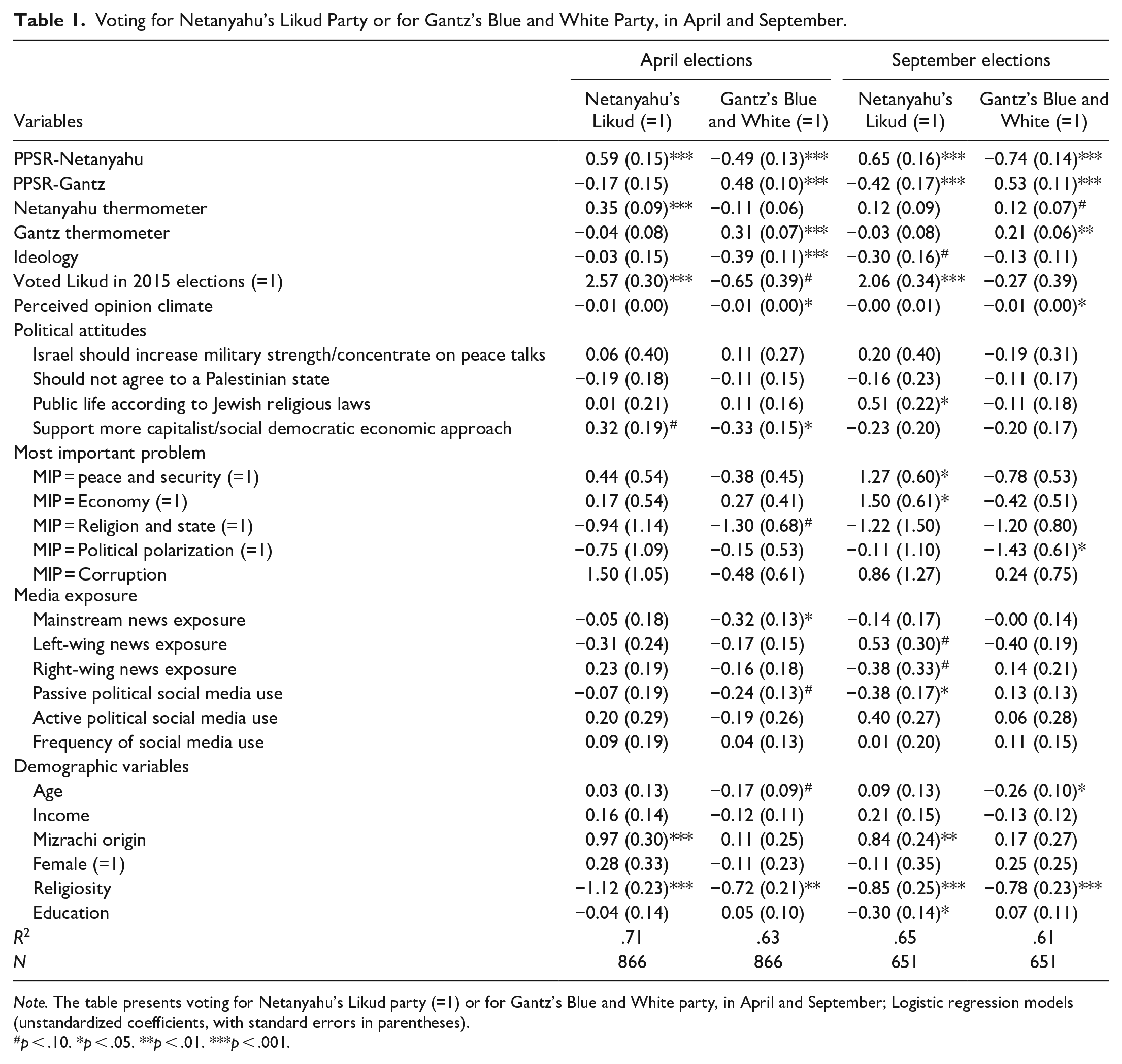
Note. The table presents voting for Netanyahu’s Likud party (=1) or for Gantz’s Blue and White party, in April and September; Logistic regression models (unstandardized coefficients, with standard errors in parentheses).
p < .10. *p < .05. **p < .01. ***p < .001.
After screening respondents who failed attention tests in Waves 1, 2, and 6 1 (from which the independent variables and main covariates came) the effective Ns were lower (for Wave 2 n = 1,785; for Wave 3 n = 1,262; for Wave 4 n = 1,145; for Wave 5 n = 1,001; for Wave 6 n = 795; for Wave 7 n = 764). For each of the statistical models below, all available data were utilized. The model with the largest number of respondents (n = 866) used Wave 2 PPSR to predict voting in April (as reported in Wave 5). For the models predicting loyalty in voting intentions (the only models reported below utilizing data from all waves of the study), only respondents who responded to the voting question in each of the six relevant waves were used (n = 595).
Measure of the Independent Variables: Political Para-Social Relationships
Application of the Political Para-Social Relationships Scale in the Main Study
Following a pilot study (described in Supplemental Online Appendix 1), items 3, 5, 6, 8 of the Cohen and Holbert (2018) PPSR scale were selected as a short version of the PPSR scale and were administered in Wave 2 and Wave 6 of the main study. The PPSR questions were targeted toward Prime Minister Netanyahu (using his commonly used nickname—Bibi) and opposition leader Benny Gantz (AKA—Gantz) and mentioned them by common name, after using their full name in the introduction (“Below are a few sentences, concerning prime minister Benjamin Netanyahu/prime ministerial candidate Benny Gantz. To what extent do you agree or disagree with each sentence on a scale varying between ‘1’ for ‘strongly disagree’ and ‘7’ for ‘strongly agree’?”). The items were “When I watch Bibi I feel I am part of his group” (3), “Bibi makes me feel comfortable as if I am with a friend” (5), “I see in Bibi a natural and real person” (6), and “Bibi looks like a person that understands the kind of things I need to know” (8). In both waves, the items for each politician loaded on a single factor and formed a reliable scale (Wave 2: MppsrBB = 3.11; SD = 1.84; α = .95; MppsrGantz = 3.40; SD = 1.71; α = .95; Wave 6: MppsrBB = 3.08; SD = 1.97; α = .96; MppsrGantz = 3.38; SD = 1.76; α = .95). Confirmatory factor analyses (presented in Supplemental Online Appendix 2) showed adequate fit statistics for each of the scales, in each of the waves.
Discriminant Validity
To establish that the constructs are empirically distinguishable from simple right-left ideology, and from mere thermometer ratings, we followed the model comparison approach recommended by Hayes et al. (2005). For example, we compared a measurement model in which a PPSR scale (e.g., PPSRBB, influencing its respective indicators) was allowed to correlate to a rival construct (e.g., Netanyahu-thermometer) to a model imposing a correlation of “1” between the two constructs. A correlation of “1” in effect forces two of the constructs to load on a single factor, and thus, our comparisons offer empirical tests for the discriminant validity.
Of the eight model comparisons, presented in Supplemental Online Appendix 3, seven showed significant fit improvement for the two factor models. That is, (e.g., for Wave 2) a model in which PPSRBB is empirically distinguishable from ThermometerBBWave3 2 performs better than a model in which the two are forced to load together (Δχ2 = 1135.86, df = 1, p < .001). Similarly, a model in which PPSRGantzWave2 is empirically distinguishable from ThermometerGantzWave3 performs better than a model in which the two are forced to load together (Δχ2 = 554.41, df = 1, p < .001). Models in which PPSRBBWave2 and PPSRGantzWave2 are empirically distinguishable from left-right ideology perform better than models where each of them are forced to load together with ideology (for PPSRBBWave2 Δχ2 = 5.46, df = 1, p < .05; for PPSRGanztWave2 Δχ2 = 19.88, df = 1, p < .001). The only exception was right-left ideology and PPSRGanztWave7, in which the evidence did not support the superiority of the two-factor model (Δχ2 = .01, df = 1, ns). Thus, PPSR is clearly an empirically distinct concept from general support or ideology.
Dependent Variables
The two main voting variables were coded from self-reported voting questions in the post-election waves (Wave 5 and Wave 7), worded “On April 9th/September 17th, the elections to the 21st/22nd Knesset were held. Did you vote?” (with yes/no response options) “For whom?” (response options included the 13 major parties, “a blank ballot” and an “other” option). Dummy variables were coded for Likud voting (=1; In April 18.8%; In September 18.9%; 0 = all others), and Blue and White voting (=1; In April 33.9%; In September 36.7%; 0 = all others). In each of the other waves, voting intention questions were worded “On April 9th/September 17th, the elections to the 21st/22nd Knesset will be held. Do you intend to vote? For whom?”
Variables reflecting shifts to and from intentions in Wave 2 to vote for parties other than Likud to reported voting to the Likud in September, and the other way around were also coded; similar dummy variables were created for shifts to and from Blue and White. Finally, two loyalty variables counted the number of times, across all seven waves, that participants mentioned intention or actually voting for either the Likud (M = 0.5; SD = 1.39) or Blue and White (M = 0.77; SD = .49).
Covariates
The models reported below control for a host of political and demographic covariates including attitudes toward various topics, such as Palestinian statehood (“To what extent should Israel agree to a Palestinian State in Judea, Samaria, and the Gaza Strip as part of a permanent status agreement?”– “should certainly agree” = 1 through “should certainly disagree” = 4; M = 2.79; SD = 0.99), state and religion (“To what extent should the Israeli government make sure that public life in Israel follows Jewish religious laws?”; “should certainly make sure” = 1 through “should certainly not make sure” = 4; M = 2.80; SD = 0.99); economic ideology (“With regards to economic life in the country, do you support a more social-democratic approach or a capitalist (neo-liberal) approach?” “absolutely capitalist” = 1, through “absolutely social-democratic” = 4; M = 2.84; SD = 0.99), military/peace policy (“What should Israel emphasize in order to avoid war?” “concentrate on peace talks?” = 1; or “increase its military strength” = 2; M = 1.54; SD = 0.50).
Perceived opinion climate was measured as the difference between an item asking “What do you think are the chances Benjamin Netanyahu will be the prime minister after the elections? Please answer on a scale between ‘0’ (there is no chance that Netanyahu will be the prime minister) to 100 (I am confident that Netanyahu will be the prime minister)” and an identically-worded question, directed toward Gantz, multiplied by the answer to the question “To what extent are you confident in your answers regarding who will be prime minister after the elections, between ‘0’ for ‘not confident at all’ to ‘100’ for ‘absolutely confident’?,” divided by 100; MWave-3 = 28.23; SD = 37.70, MWave-6 = 25.11; SD = 34.28. Perception of the most important problems facing Israel were measured using dummies for five main issues: peace/security = 1 (24.7%); economic/social = 1 (40.8%); religion and state = 1 (2.2%); political polarization/lack of unity = 1 (4.3%), and corruption = 1 (2.8%).
Our surveys included twelve news media exposure items, with response categories varying from “not at all” coded “1,” to “very often” (coded “5”). Exploratory factor analysis revealed three factors: mainstream broadcast news outlets (TV news on channels 11, 12, and 13 and radio news on the public channels; MWave-1 = 2.98; SD = 0.94, MWave-6 = 2.96; SD = 0.99), right-wing news outlets (Makor Rishon, Channel 7, Channel 20, and “other online outlets promoting a right-wing ideology”; MWave-1 = 1.75; SD = 0.94, MWave-6 = 1.65; SD = 0.91), and left-wing news outlets (Haaretz and “other online outlets promoting a left-wing ideology”; MWave-1 = 1.63; SD = 0.70, MWave-6 = 1.54; SD = 0.76). Two factors emerged from exploratory factor analyses of items measuring the number of times per week respondents performed various political activities on social media. The first related to more passive activities (“followed politicians or political parties on social media,” “content from politicians appeared on my social media feed,” and “read content from politicians on social media” MWave-3 = 2.51; SD = 1.04, MWave-6 = 2.50; SD = 0.76) and the second to more active ones (“shared content by politicians and parties,” “commented on posts by politicians,” “wrote on politicians’ Twitter or Facebook pages,” “tagged politicians on Twitter or Facebook,” “politicians or parties wrote back to me on Twitter or Facebook”; MWave-3 = 1.24; SD = 0.53, MWave-6 = 1.24; SD = 0.56). In addition, the models control for the general frequency of social media use (three items with scales varying between “never” coded “1” to “a few times a day” coded “5”; relating to Instagram, Facebook, and Twitter; MWave-1 = 4.04; SD = 0.87).
In addition, voting in the 2015 elections (Likud = 1; 17.3%), political ideology (“How would you place yourself on a scale representing the political map with ‘1’ meaning right and ‘7’ meaning left?” M = 3.18; SD = 1.60), Netanyahu and Gantz thermometers on a scale varying between “0” for “rejection and hate” to “10” for “support and sympathy”; (MBB-thermmometerWave2 = 5.45; SD = 3.65; MGantz-thermometerWave2 = 5.84; SD = 2.93; MBB-thermmometerWave6 = 5.14; SD = 3.60; MGantz-thermometerWave6 = 5.94; SD = 2.94), sex (Female = 1; 48.1%), age (Modal category 30–39), education (1 for “elementary” 6 for graduate degree; M = 4.37; SD = 1.24), income (1 for “far below the average” to 5 “far above the average”; M = 2.95; SD = 1.11), ethnic origin (Mizrachi = 1; 27.2%), and religiosity (1 = secular, 4 = ultra-orthodox; M = 1.71; SD = 0.88) were included as co-variates.
Results
Predicting Voting in April and September
To test H1, that PPSR will predict voting for candidates, we ran four logistic regression models, reported in Table 1, predicting voting for Netanyahu’s Likud and Gantz’s Blue and White in both April and September (R2Likud, April = .71, R2Blue and White, April = .63; n = 866; R2Likud, September = .65, R2Blue and White, September = .61; n = 651). Results demonstrated that, in line with H1, PPSR-Netanyahu was strongly and positively associated with Likud voting (April: b = 0.59, se = 0.15, p < .001; Sept: b = 0.65, se = 0.16, p < .001). PPSR-Netanyahu was also negatively associated with voting for Blue and White (April: b = −0.49, se = 0.13, p < .001; Sept: b = −0.74, se = 0.14, p < 0.001). As predicted by H1, PPSR-Gantz was strongly and positively associated with voting for Blue and White (April b = 0.48, se = 0.10, p < .001; Sept: b = 0.53, se = 0.11, p < .001). PPSR-Gantz was strongly and negatively associated with voting Likud in September (b = −0.42, se = 0.17, p < .001), but not in April. When examining the Wald statistics, PPSR toward the candidates was among the strongest predictors in the equations (together with voting in 2015, and the candidates’ thermometers), and the strongest in Models 1 and 4. 3
Modeling Voting Shifts
H2 predicted shifts to and from both main parties (Table 2; R2Shifts to Likud = .36, n = 549; R2Shifts to Blue and White = .38; n = 506; R2Shifts from Likud = .61, n = 114, R2Shifts from Blue and White = .32; n = 163). Here the main predictor variables were changes in PPSR (the difference scores subtracting PPSR scores, measured in Wave 6, from PPSR scores in Wave 2). Because this analysis focuses on a dynamic dependent variable, shifts to and away from a party between waves, we computed a dynamic independent variable of changes in PPSR between waves. Table 2 demonstrates that, in line with H2, changes in PPSR-Netanyahu from Wave 2 to the Sept post-election survey (wave 7) positively predicted shifting to the Likud, (b = 0.44, se = 0.22, p < .05) and negatively predicted shifting to Blue and White (b = −0.39, se = 0.17, p < .05). However, in contrast to the prediction of H2, the opposite pattern was not evident for changes in PPSR-Gantz (for shifting to the Likud b = 0.01, se = 0.17, n.s.; for shifting to Blue and White b = 0.20, se = 0.12, n.s.). 4
Shifting to and From Netanyahu’s Likud Party and Gantz’s Blue and White Party.
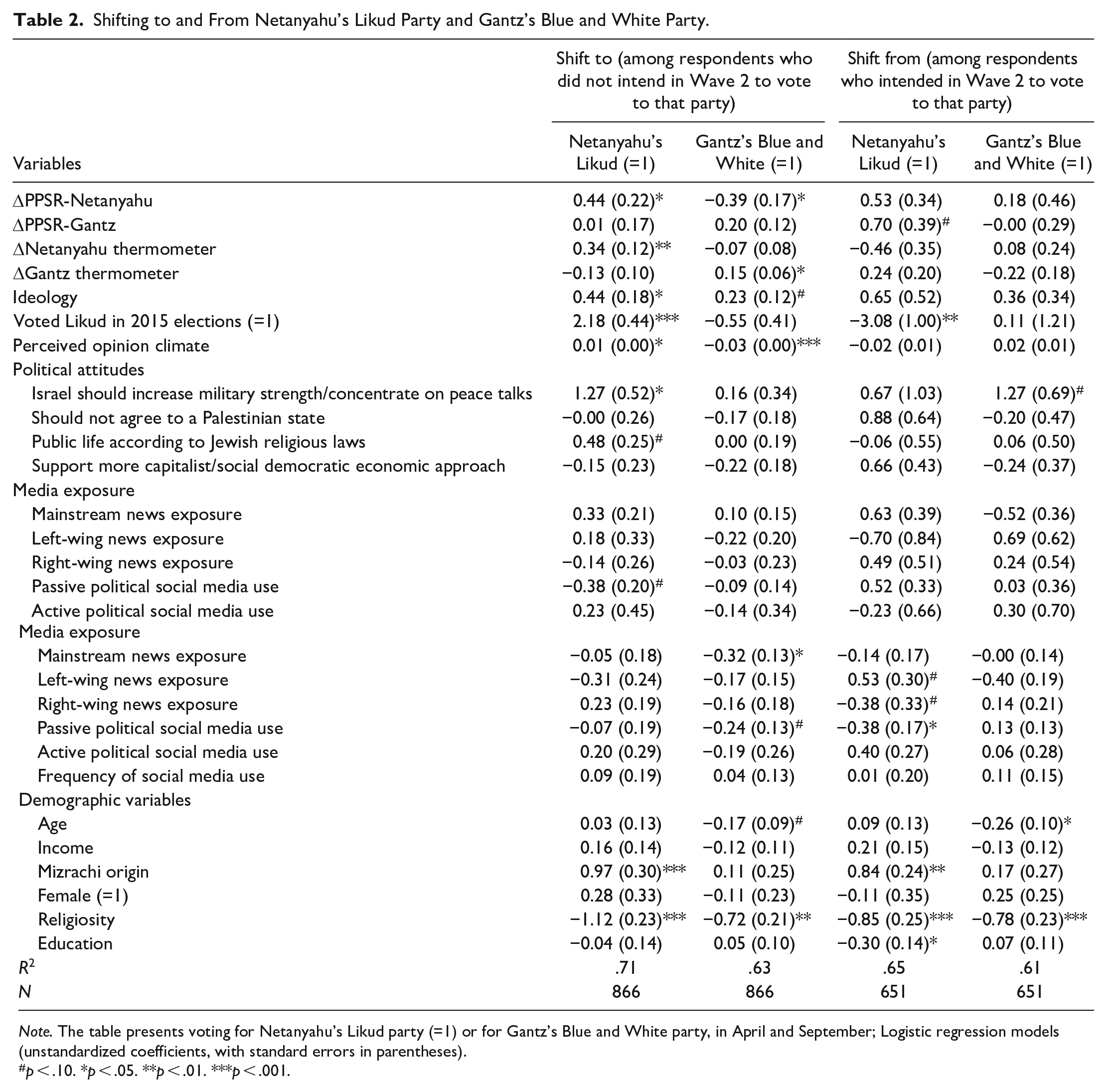
Note. The table presents shifting to and from Netanyahu’s Likud party and Gantz’s Blue and White party, between Wave 2 and the September post-election survey; Logistic regression models (unstandardized coefficients, with standard errors in parentheses).
p < .10. *p < .05. **p < .01. ***p < .001.
While the signs were mostly in the correct directions, changes in PPSR did not generally predict shifts in voting away from both the Likud and Blue and White to any other party. A likely reason for this may be the much lower sample size, as the models for shifting from Likud/Blue and White included only participants who initially reported intending to vote for Likud/Blue and White in Wave 2, a much smaller number than in the models predicting shifting toward these parties that include all participants who in Wave 2 reported intention to vote for any party other than Likud/Blue and White. Still, despite the small n, changes in PPSR-Gantz from Wave 2 to the Sept post-election survey (wave 7) positively predicted shifting from the Likud, (b = 0.70, se = 0.39, one-tailed-p < .05; a one-tailed hypothesis-test is justified given the clearly directional nature of the hypothesis). 5
Modeling Loyalty Toward Likud and Blue and White
Our final set of analyses involved testing H2a, which focused on the effects of PPSR on loyalty to both main parties, operationalized as the number of times (from the six relevant waves of the study) respondents reported either voting or intending to vote for either the Likud and Blue and White. We used negative binomial regression models, which are appropriate for dependent variables that include only non-negative integers (usually used for count variables; Allison, 2012, p. 265). Results, reported in Table 3, demonstrated that, in line with H2a, PPSR-Netanyahu positively predicted the loyalty to the Likud (b = 0.17, se = 0.08, p < .05), and negatively predicted loyalty to Blue and White (b = −0.27, se = 0.07, p < .01). That is, the stronger the PPSR a voter had with Netanyahu the more times s/he said they would vote/had voted for Likud and the fewer times s/he said they would vote/had voted Blue and White. The opposite pattern was evident for PPSR-Gantz, which was positively associated with loyalty to Blue and White (b = 0.26, se = 0.06, p < .001) and negatively associated with loyalty to the Likud (b = −0.17, se = 0.09, one-tailed p < .05), as predicted by H2a. 6
Predicting Loyalty.
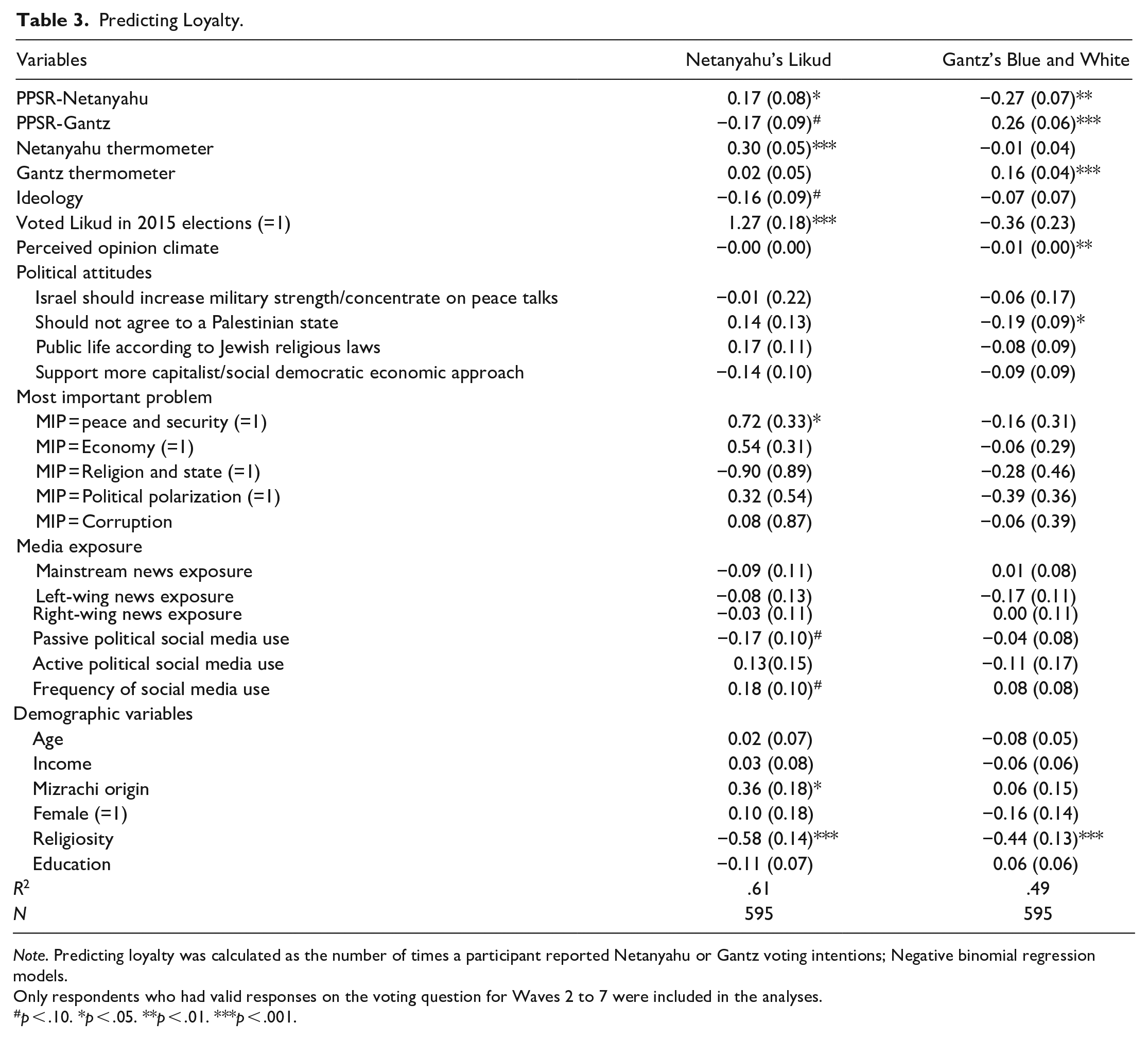
Note. Predicting loyalty was calculated as the number of times a participant reported Netanyahu or Gantz voting intentions; Negative binomial regression models.
Only respondents who had valid responses on the voting question for Waves 2 to 7 were included in the analyses.
p < .10. *p < .05. **p < .01. ***p < .001.
Discussion
The results of this study replicate previous findings supporting the use of PPSR as a strong predictor of political support and extend them to a multi-party context and to the realm of voting decisions. The PPSR construct consistently increased the odds of voting for the candidates’ parties, of shifting one’s vote toward the candidates’ parties, and of being loyal to the candidates’ parties. These were rather robust effects, even when controlling for a variety of political and demographic predictors. The negative effects of the PPSR constructs on voting for the other party, shifting from the other party, or being less loyal to the other parties, were less consistent.
The stronger positive role of PPSR in shaping voting for the candidates’ parties, compared to the weaker and less consistent role of PPSR in negatively affecting voting to the other party is consistent with Cohen and Holbert’s (2018) finding that PPSR is better at explaining support than negative feelings toward opponents. All the more so, this pattern makes sense in the Israeli multi-party context. If a voter did not feel a strong connection to Netanyahu, s/he did not necessarily have to vote for Blue and White and had quite a few other relevant voting options (including smaller right wing, center parties or religious parties, in addition to parties from the left-wing block).
Multi-party contexts are considered more ideological and less personal by political scientists (Lo et al., 2016). The fact that PPSR emerged as a strong predictor of voting in Israel, considered in the literature an extreme multi-party system (Markowitz-Elfassi et al., 2018), presents an important extension of the Cohen and Holbert’s (2018) study that uncovered the effects of PPSR in the more heavily personalized American context (McAllister, 2007). In other words, the current study demonstrates that the intensity of the para-social relationship voters form with candidates is important not only in contexts in which voters directly vote for candidates, it also matters when voters select between various ideological parties and have many options on the ballot.
The coefficients for PPSR were not only robust in-and-of themselves. They were consistently among the three strongest predictors of all dependent variables in all models. Their strength is particularly salient given the weakness of the attitudinal variables. Only four out of 40 coefficients for political attitudes significantly affected the dependent variables (two additional coefficients were borderline significant). Even left-right placement played a weaker and less consistent role (with only two out of 10 significant coefficients). Importantly, our models control for issue voting (Carmines & Stimson, 1980), closely linked to media agenda setting and priming theories (Iyengar & Kinder, 2010; Only four out of 30 most-important-problem indicators in our main models were significant predictors, and one additional borderline significant) and to the normative influences, whose potential influence on voting were depicted by spiral of silence theory (Donsbach et al., 2014; five out of 10 coefficients for perceived opinion climate were significant and in the direction predicted by the theory). The weakness of political attitudes in the models may stem from the fact that our analyses centers on the two main parties that did not differ very much ideologically, with the exception of attitudes toward corruption and the legal system (with Netanyahu’s corruption indictment in the background). Political attitudes mattered less than PPSR given the campaigns’ focus on personal aspects. Both media commentators and the parties’ campaigns portrayed the campaign as a vote for or against Netanyahu.
Other major predictors identified in this study (e.g., previous voting, demographics) echo classical findings in political communication research about the stability of political preferences and the importance of social groups in forming loyalty toward the parties (Lazarsfeld et al., 1944). While the American Voter studies (Campbell et al., 1980) stressed identification with parties as a psychological attachment with parties shaped early on in political life, that serves as a filter through which future events are processed, consequentially carrying an immense political significance, our data demonstrates a more personal, psychological attachment, more reliant on, and more similar to social or quasi-social relationship, interaction, and dynamics. Thinking of voting from a relational perspective can help explain both the centrality of media appearances (in which candidates talk directly to voters) and the long-term loyalty to leaders and parties. If voters feel that candidates “get them” and share their concerns and that in turn they have a relationship with a candidate, it seems very unlikely to change their minds based on policy arguments. Just as it takes a lot for us to sever a friendship and we are often willing to overlook quite a bit of hardship from a good friend before we abandon them (even when disinterested parties cannot understand why), so a strong connection to a candidate is likely to be hard to change.
Our study pitted PPSRs against the less theoretically-grounded and more general “thermometer score” which is akin to liking but lacks the relational components of some of the PPSR items. The fact that PPSR performed better as a predictor of voting and loyalty helps us understand that the friendship-like intimate bonds, not merely liking, that Gantz and Netanyahu managed to form with some of their voters have had an immense impact for their electoral success.
A political para-social relationship highlights perceived one-to-one relational connections forged by potential voters with those who seek elected office as being central to decision making. Binding relational perceptions of this kind speak to voters believing a candidate retains with them a shared understanding of the major issues of the day, that each listens to the other as they establish a nation’s priorities, and that their mutual friendship is based on each looking out for the best interests of the other. The transition from ideology or party identification to political para-social relationships as a key predictor of vote choice represents a shift toward more intimate, personal bonds being important in determining election outcomes. A perceived PPSR-based relational connection is envisioned to be a two-way dynamic. A citizen may engage politicians in mediated environments that are defined by one-way, politician-to-voter communication dynamics, but from these encounters two-way, reciprocal bonds are formed in the minds of those who will be heading to the voting booth.
It is the intimacy, sense of reciprocity and authenticity, bi-directional understanding and familiarity, that PPSR consist of, not only ideological congruence or mere sympathy, that are at the heart of the process described in this paper. From this perspective, voting is an act of social commitment toward a friend-like politician, not a rational choice between ideological alternatives.
An additional noteworthy finding is that the effects of PPSR-Netanyahu on voting for Netanyahu’s Likud were in many of the models stronger than the effects of PPSR-Gantz on voting for Gantz’s Blue and White. The reason for this is probably that Israeli voters’ para-social relationships with Netanyahu, whose political career started in the 1990s, are longer, and perhaps as a result more meaningful and consequential, compared to their relationships with political newcomer Benny Gantz. This is in line with the finding that para-social relationships become more meaningful over time in entertainment research (Rubin & McHugh, 1987) and, in the political domain, with the finding that incumbency brings with it stronger bonds with the electorate (Mayhew, 2008). Another reason could be related to the fact that in the Netanyahu era, Israeli news coverage demonstrated a relatively high level of concentrated personalization, focusing on the head of the government, compared to the visibility of all other domestic political actors (Van Aelst et al., 2017, p. 122).
The strong outcomes of PPSR are surprising and noteworthy in another way. Para-social relationships with media personae and celebrities exist in a non-competitive environment. Generally, (though not always) being a fan of a singer, sports figure or a host, does not preclude liking another. It also is not likely to meet with resistance from others or put one in competition with fans of other celebrities. But in a charged political environment, especially during heated campaigns, having para-social relationships with candidates is a risky proposition. First, a political loss is likely to hurt and be more disappointing if one is in a relationship with the loser. Second, one may receive criticism for their relationships from close others who are invested in opponents. Finally, a strong PPSR commits a voter to a candidate who may do something or say something one cannot condone, creating dissonance. That despite all of these risks people develop PPSRs, and these PPSRs have the effects found in this study, extends the boundaries of our understanding of para-social phenomena.
Though the focus of this study was primarily theoretical, there are also some interesting practical implications to our findings. The fact that PPSR predicts voting suggests that the ability of candidates to form strong para-social bonds is important both to attracting voters but also to keeping them loyal through the inevitable ebbs and flows of the campaigns. Using existing knowledge about predictors of para-social interaction and relationships (e.g., camera angles and direct address: Dibble et al., 2016; Schramm & Wirth, 2010; increased self-disclosure: Kim & Song, 2016, etc.) can help candidates strengthen their relationships with voters. Activity on social media can also increase PPSR, as demonstrated by past research (Paravati et al., 2020): intimacy can be fostered when politicians share stories that display them in personal settings in a way that makes politicians resemble regular friends (Powell et al., 2011), as well as when followers watch them interact with other followers (Dai & Walther, 2018).
Following politicians on social media seems to be crucial for the maintenance of PPSRs, but we know relatively little about why people select to follow politicians and which politicians they select to follow on social media. Given that followers of politicians on social media tend to be savvy news users (Fisher et al., 2019), it is possible that mainstream news attention instigates curiosity toward politicians’ social media profiles. Liking a politician or a party is cited by followers as one of the main reasons they follow politicians (Fisher et al., 2019, p. 242). This implies that even in an era of direct contact with political actors (Bennett & Manheim, 2006), part of the para-social bond with politicians is still formed on mainstream channels, mainly TV, and later augmented on social media. Future research should explore the potential of candidates to create PPSR using various media channels, in a hybrid media ecology.
Finally, this study is not free of limitations. Despite the time ordering of both independent and dependent variables, demonstrating that shifts in PPSR are correlated with shifts in voting does not necessarily prove that the former caused the latter, and an association between early PPSR and future voting is consistent with an argument regarding a causal effect of the former on the latter, but does not provide definitive evidence that support such an argument. A second limitation is that, as in all other election studies, reports of voting are probably not fully accurate (Waismel-Manor & Sarid, 2011). Thirdly, as mentioned above, given the very long surveys, we were able to apply the PPSR scales only toward the two main politicians (the only viable candidates for Prime Minister), and not toward additional political leaders of smaller parties. Fourthly, the 2019 Israeli elections turned out to be personalized and focused on the Israeli electorate’s approval or disapproval of prime minister Netanyahu. More ideological elections or a parliamentary multiparty system with candidates who are not as strong personalities as Netanyahu could have served as a better theoretical extension of previous US findings. Still, the fact that PPSR toward Benny Gantz, a relative newcomer and probably a weaker and less charismatic politician, was also a strong predictor of voting, is theoretically meaningful and extends previous findings.
A fifth and final limitation is that we cannot estimate the effects of media exposure on PPSR, and indirectly through PPSR on voting. Our survey included typical media exposure items, measuring the frequency of exposure to various news outlets and social media. Models predicting the PPSR scales using these news exposure items are reported in Supplemental Online Appendix 5. While some of the resulting patterns are telling (e.g., exposure to mainstream outlets significantly predicted PPSR with both Netanyahu and Gantz in three out of four models), a more accurate estimation should include frequency of exposure to TV interviews with the candidates and following them on social media, not the frequency of news exposure in general. As always, much remains for future research.
However, despite these inevitable shortcomings, the study finds convincing effects of PPSR on voting during two election campaigns. By replicating findings about PPSR across countries and types of political systems (two-party vs. multi-party elections), the present results provide evidence of the importance of thinking of voting decisions as based on a sense of a personal connection to candidates. By applying a theory from entertainment to a political context, our results point to the common thread between these two realms of public life. Like other media personae, politicians project an image and cultivate imaginary relationships with voters. Like singers or ball players, they are at once real people and imaginary characters who play a public role. It is crucial that we see politics as the enactment of real and important issues, but it is also crucial that we realize that voters look to politicians as more than remote problem solvers. In democracies, voters need to have a sense that their leaders are real, accessible, and that they understand what ails voters. They seek a personal relationship with candidates even if it is only an imaginary relationship. Future research should delve deeper into what underlies para-social relationships with politicians and how these are similar and different than the para-social relationships we have with other celebrities.
Supplemental Material
sj-docx-1-crx-10.1177_00936502211032822 – Supplemental material for Political Para-Social Relationship as a Predictor of Voting Preferences in the Israeli 2019 Elections
Supplemental material, sj-docx-1-crx-10.1177_00936502211032822 for Political Para-Social Relationship as a Predictor of Voting Preferences in the Israeli 2019 Elections by Yariv Tsfati, Jonathan Cohen, Shira Dvir-Gvirsman, Keren Tsuriel, Israel Waismel-Manor and R. Lance Holbert in Communication Research
Footnotes
Declaration of Conflicting Interests
The authors declared no potential conflicts of interest with respect to the research, authorship, and/or publication of this article.
Funding
The authors disclosed receipt of the following financial support for the research, authorship, and/or publication of this article: Data collection was funded by a grant (2315/18) form the Israel Science Foundation

Supplemental Material
Supplemental material for this article is available online.
Notes
Author Biographies
References
Supplementary Material
Please find the following supplemental material available below.
For Open Access articles published under a Creative Commons License, all supplemental material carries the same license as the article it is associated with.
For non-Open Access articles published, all supplemental material carries a non-exclusive license, and permission requests for re-use of supplemental material or any part of supplemental material shall be sent directly to the copyright owner as specified in the copyright notice associated with the article.
