




Abstract
Using the case of the 2019 European election, the study compares the visual self-depiction of female and male political candidates from all European Union’s 28 member states on social networking sites and their depiction in the news coverage. It thereby investigates to what degree the news coverage and politicians’ self-depiction employs visual gender stereotypes. Moreover, the study presents results on differences in the depiction of male and female candidates across party lines. With the help of computational vision, we demonstrate that, while differences between progressive and conservative candidates are scarce, there are clear differences in the depiction of female and male politicians. These differences resemble emotional gender stereotypes, especially since women are more often depicted as happy. Overall, the study demonstrates that female political communication is still distinct from male political communication for both their self-representation as well as the media’s portrayal of political candidates.
Keywords
Although a record share of over 40% of politicians elected into the European parliament in 2019 are female, women are still largely underrepresented in politics at the local, national, and European level (European Parliament, 2019). Scholars have repeatedly expressed concerns that gender stereotypes might disadvantage female politicians during nomination processes and elections (e.g., Bos, 2011; Huddy & Terkildsen, 1993). That is, while stereotypes characterize women as warm, emotional, and caring, a stereotypical man is regarded as tough, competitive, and assertive—mirroring character traits that people commonly associate with successful political leaders (Bauer, 2017; Meeks, 2012). Consequentially, experimental research provides substantial evidence that if gender stereotypes are activated through communication, recipients tend to evaluate female politicians as less fit for office than their male colleagues (Bauer, 2015; Ditonto et al., 2014; Huddy & Terkildsen, 1993).
Existing research on gender stereotypes in political communication largely neglects the role of visuals—in spite of a growing importance of visuals in contemporary political communication (Bauer & Carpinella, 2018). This is surprising given that as a consequence of the mediatization and personalization of political processes, images appear to be omnipresent in today’s political communication environment (Grabe & Bucy, 2009; Enli & Skogerbø, 2013). Moreover, photos have been shown to influence how the electorate evaluates political candidates and at times even affect their voting decisions (Bauer & Carpinella, 2018; Ditonto et al., 2014; Grabe & Bucy, 2009).
Simultaneously, politicians have increasingly professionalized their communication efforts (Lalancette & Raynauld, 2019). They produce high-quality photography and distribute it directly to the media. Politicians also make use of social networking sites (SNS) like Facebook, Twitter, or Instagram to circumvent the media’s gatekeeping function and distribute photos directly to the electorate (Haim & Jungblut, 2021; Klinger & Svensson, 2015). While journalists might select photos of political candidates based on ideas of news value or their political ideology (Peng, 2018), politicians can employ SNS to distribute visuals depicting them in a more favorable light (Bos, 2011).
Using the case of the 2019 European elections, this study seeks to systematically compare how male and female candidates are depicted in the media and how they present themselves on their social-media accounts. In doing so, it aims to identify if female and male politicians are more often depicted following (fe)male stereotypes in the media and if they choose to present themselves differently on SNS. Moreover, the study analyzes if the depiction of politicians differs across the political spectrum. To address these research interests adequately, we make use of a dataset created by Haim and Jungblut (2021) and thereby analyze candidate imagery from the news and SNS from N = 13,811 candidates across all 28 European member states.
The Role of Visuals in Political Campaigns
Images play a vital role in opinion-forming processes. Compared to textual information, visual content is perceived faster and is more likely to be processed and remembered (Bauer & Carpinella, 2018). Visual content thereby tends to trigger recipients’ heuristic routes of information processing (Schmuck & Matthes, 2017). Consequentially, in contrast to normative ideas of deliberation with a rationally engaged public, users’ initial impression of depicted persons can already influence their political opinions fundamentally (Bucy & Grabe, 2007). Based on this substantial impact as well as the visual nature of present-day media, images have even been characterized as “the lingua franca of politics” (Bucy & Grabe, 2007, p. 668).
Especially during campaigns, politicians are thus eager to distribute photos that depict them in a way that potentially increases their expected likeability, competence, and fitness for office (Fridkin & Kenney, 2014; Grabe & Bucy, 2009). Thereby, politicians want journalists to publish these images while simultaneously aiming to circumvent the media’s gatekeeping function and directly distribute favorable images to the electorate. To adapt to the highly mediatized political environment, politicians thus increasingly self-promote a deliberate image of themselves on SNS (Enli & Skogerbø, 2013; Haim & Jungblut, 2021; McGregor et al., 2017).
Given the lower number of female elected representatives in many Western nations (Bos, 2011; Huddy & Terkildsen, 1993; Hunter & Denton, 1984; Schneider and Bos, 2014), this raises the question whether the depiction of male and female politicians in the news and their self-depiction on SNS differ from one another. Relatedly, scholars have repeatedly emphasized that journalists resort to gender stereotypes when covering female politicians (Fridkin & Kenney, 2014; Rodgers et al., 2007; Van der Pas & Aaldering, 2020). Before providing an overview of research on visual news coverage and self-depiction of female and male politicians, it is thus helpful to focus more closely on gender stereotypes and their potential impact on the electorate.
Gender Stereotyping in Visual Communication
Across different cultures, socially constructed gender stereotypes categorize certain characteristics as typically female or male (Eagly & Steffen, 1984). In this, women are regarded as more empathetic, warm, compassionate, and gentle whereas men are expected to be tougher, more dominant, competitive, and aggressive (Bem, 1974; Eagly & Steffen, 1984; Huddy & Terkildsen, 1993). These stereotypes become especially problematic when they “suggest gender-specific rules and identities in society” (Meeks, 2012, p. 176) and are thereby connected to role expectations (Eagly & Steffen, 1984). Here, working as a nurse, care-giver, or teacher tends to be regarded as having a “female position” whereas men are more likely to be connected to risk-taking and autonomous professions like managers or political leaders (Bauer, 2015; Bauer & Carpinella, 2018; Bos, 2011).
While especially psychological research has clearly identified stereotypically (fe)male characteristics, traits, and jobs, communication research has largely ignored visual gender stereotyping so far (Bauer & Carpinella, 2018). To analyze stereotypical male and female depiction among candidates, it is thus necessary to translate existing stereotypes into different forms of visual representation.
First, stereotypical depictions of male and female candidates should differ in their display of emotions (Brooks, 2011, 2013; Fischer et al., 2004; Renner & Masch, 2019). Emotional gender stereotypes reflect stereotypical societal roles, character traits, and qualities. Since women are stereotypically perceived as more caring and warmer (Bauer, 2017; Bauer & Carpinella, 2018) and since they are simultaneously ascribed the function of maintaining social relationships (Alexander & Wood, 2000), they are also expected to display happiness and smile more often than their male colleagues (Renner & Masch, 2019; Rodgers et al., 2007).
Men, in turn, are stereotypically expected to be tough, coercive, competitive, and assertive (e.g., Bauer, 2017; Meeks, 2012). Since they are stereotypically expected to aggressively compete for leadership roles and since people tend to link anger and toughness (see: Brooks, 2011, 2013), stereotypical men are expected to display anger more often than women (e.g., Eagly & Steffen, 1984; Prentice & Carranza, 2002).
In addition to these emotional gender stereotypes, we also expect visual gender stereotypes to reflect the stereotypical dominance, competitiveness, and team-orientation of male and female candidates. Since women are stereotypically regarded as less competitive and more team-oriented, we expect stereotypical feminine depictions to also emphasize communality (Bauer & Carpinella, 2018; Eagly & Karau, 2002), for example by depicting groups of people as opposed to a single person. A stereotypically depicted man, however, should highlight dominance, for instance through an increased facial prominence. Following Archer et al. (1983) as well as Konrath and Schwarz (2007), male politicians tend to be depicted with larger heads than female politicians as this face-ism highlights character traits such as dominance and ambition. In contrast to the emotional gender stereotypes outlined above, communality and facial dominance do not describe differences in the displayed emotions but rather in the expected mis-en-scene of a stereotypically (fe)male candidate’s depiction. As such, we refer to these visual stereotypes as structural gender stereotypes.
Gender Stereotyping in Political Campaigns
As for political campaigns, while results from content analyzes and surveys suggest that political context (i.e., incumbency, party belonging) has larger impacts on voting decisions than gender stereotypes (Dolan & Lynch, 2016; Hayes & Lawless, 2015, 2016), experimental research indicates that gender stereotypes can serve as the metaphorical drop that makes the barrel overflow and thereby affect electoral outcomes (Bauer, 2015; Ditonto et al., 2014; Everitt et al., 2016). This appears to be especially true for potential voters with lower levels of political knowledge (Coronel et al., 2020).
Importantly, there are contradictory conclusions about whether female candidates can benefit from breaking with gender stereotypes (Bauer, 2017; Everitt et al., 2016). Unlike the presented experiments, however, content analyzes to date mostly ignore visual content. The current study is thus focused on identifying structural differences in candidates’ depiction in the media and their self-depiction on SNS. Moreover, while scholars have emphasized the moderating effect of party affiliation, we also raise the question of whether candidates’ visual depiction differs across party lines (Laustsen & Petersen, 2016; McGregor et al., 2017).
Imagery of Political Candidates in the Media
Scholars have voiced concerns that the media tends to treat male and female politicians differently (Fowler & Lawless, 2009; Johnston & White, 1994). Van der Pas and Aaldering (2020) thereby suggest that there are at least four reasons why gender stereotypes can account for differences in the characteristics of news coverage about male and female politicians. First, “stereotypes can work prescriptively, specifying how group member should behave” (van der Pas & Aaldering, 2020, p. 4). Since female stereotypes differ from stereotypical leadership qualities, female politicians are deemed to fail on at least one of those standards leading to a potentially more negative evaluation of female politicians. Second, gender stereotypes can also be descriptive if they assume how potentially women differ from men (Brooks, 2013). In this, van der Pas and Aaldering (2020) propose that, due to the existence of a descriptive masculine stereotype of leadership, female politicians’ viability for office will be discussed more often and judged more negatively. “Third, the fact that women are stereotypically dissociated from public life and politics leads to a host of expectations regarding personal coverage” (van der Pas & Aaldering, 2020, p. 5). Consequently, news coverage about female candidates might focus more strongly on their private life, their physical appearance, and their family. Fourth, news coverage should also reproduce gender stereotypes. In this, journalists’ existing stereotypes are potentially activated and thus applied when covering politicians. As a result, news coverage on (fe)male politicians might emphasize stereotypically (fe)male traits or competencies (van der Pas & Aaldering, 2020).
This fourth mechanism is also in line with research from Galtung and Ruge’s seminal work on news-value theory (1965). Here, the authors propose that the more consonant something is with “the mental image of what one expects to find” (p. 65), the higher the news value of a story. Moreover, Galtung and Ruge (1965) propose the so-called distortion hypothesis that suggests that “[o]nce a news item has been selected what makes it newsworthy according to the factors will be accentuated” (p. 71). It follows that stereotypical characterizations of politicians might have a higher news value due to their consonance with existing stereotypes and these stereotypical characteristics might be further emphasized in the news coverage. A similar argument has been put forward more recently by Fridkin and Kenney (2014) who argue that journalists prefer messages that reinforce gender stereotypes about political candidates due to their consonance with their own stereotypical views of male and female elites.
By and large existing empirical analyzes support these theoretical assumptions. Studies thereby suggest, for example, that male candidates receive more (prominently placed) coverage than their female competitors (Fridkin & Kenney, 2014; Kahn & Goldenberg, 1991; Rohrbach et al., 2020). Even though research also demonstrates the relevance of contextual factors such as a media outlet’s editorial line, the electoral system, a candidate’s party ideology or incumbency (e.g., Hayes & Lawless, 2015; Rohrbach et al., 2020) for how candidates of different gender are covered in the news, a recent meta-analysis by van der Pas and Aaldering (2020) clearly shows that female candidates receive more negative viability coverage, more coverage that discusses their appearance and family, and more coverage that mentions their gender. Moreover, female politicians’ “combative behavior is exaggerated, and there is reason to believe that politicians are mainly portrayed in accordance with the issues and traits belonging to their gender stereotype” (p. 21).
Despite the fact that research on visual depiction of candidates is still scarce, studies that compare visual representation of male and female candidates so far identified the unanimous use of gender stereotypes. Specifically, there is some concern that political news coverage might resemble existing visual gender stereotypes through an increased facial prominence of male candidates (Archer et al., 1983) and by portraying women as warm, less competitive, and more communal (Rodgers et al., 2007). For visual communication, the fourth proposed effect of stereotypes on news coverage thus seems to be the most relevant. In this, journalists prefer visuals that resemble existing stereotypes of (fe)male politicians because they might reflect their own stereotypes and because they have a higher news value due to their consonance with existing expectations (Fridkin & Kenney, 2014; Galtung & Ruge, 1965; van der Pas & Aaldering, 2020). As a result and in line with the visual gender stereotypes discussed before, we assume gender stereotypes to be present across all news imagery of all candidates:
H1: In comparison to male politicians, photos of female politicians in the news coverage more often resemble (H1a) female stereotypes (higher happiness and more communality), while they less often resemble (H1b) male stereotypes (higher angriness and higher facial dominance).
Moreover, journalists might depict politicians differently if they belong to different parties. On the one hand, this might be a consequence of differences in the existing visuals of politicians. In this, conservative politicians might strategically emphasize gender stereotypes in their imagery because their supporters value depictions that align with gender stereotypes (Fridkin & Kenney, 2014; Koch, 2000; Laustsen & Petersen, 2016) whereas more progressive candidates may choose not to emphasize gender stereotypes to appeal to a more progressive part of the electorate.
On the other hand, journalists might also choose to represent conservative candidates more often in a stereotypical depiction as compared to their progressive contestants. This again resembles the aforementioned idea that, when covering politicians, journalists are influenced by their own stereotypes as well as by the news value of consonance. Since research demonstrated that people possess stereotypes about liberals and conservatives, and that the adherence to traditional values and gender stereotypical behavior is part of a stereotypical conservative (Graham et al., 2012; Hayes, 2011; Koch, 2000, 2002), journalists should be more inclined to cover conservative politicians in a gender stereotypical manner compared to their liberal colleagues. This also follows the idea that a stereotypical visual representation of a conservative candidate might reflect the journalistic framing of a political candidate or party more closely. Since journalists prefer information that is in line with their overall framing, these visuals might have a higher chance of making the news (Fahmy et al., 2014; Grabe & Bucy, 2009). As a result, we assume that male and female conservative candidates are portrayed more often in accordance with gender stereotypes than progressive candidates:
H2a: In comparison to female politicians from progressive parties, photos of female politicians from conservative parties in the news coverage more often resemble female stereotypes (higher happiness and more communality).
H2b: In comparison to male politicians from progressive parties, photos of male politicians from conservative parties in the news coverage more often resemble male stereotypes (higher angriness and higher facial dominance).
Self-Depiction on Social Networking Sites
SNS have become a major venue for campaign communication (Enli & Skogerbø, 2013). While journalists have the ultimate say in how to cover candidates in the media, politicians can use SNS to communicate a most favorable picture of themselves (McGregor et al., 2017). Even though SNS thus offer female candidates means to avoid or counter gender stereotypes in their communication efforts, doing so might put them in an unfavorable position. Following Jamieson (1995), female candidates have to face the “double bind” between femininity and competence. As described above, this dilemma originates from the stereotype that female traits like warmth and compassion inherently conflict with agentic qualities that are stereotypically associated with strong leadership. “The conflict between the communal prescriptions of femininity and the agentic prescriptions of leadership therefore puts female candidates at a disadvantage because to succeed on one front will be to necessarily fail on the other front” (Brooks, 2013, p. 26).
This puts female candidates in a dilemma. On the one hand, they can decide to be perceived in accordance with female stereotypes and thus as likeable. Simultaneously, however, distributing messages that reinforce gender stereotype might undermine their competence and viability for office. On the other hand, female candidates can emphasize agentic character traits and thereby risk a backlash for violating descriptive gender stereotypes. In this case, however, they might be perceived as unfeminine and less likeable (Brooks, 2013; Jamieson, 1995; McGregor et al., 2017). Moreover, following Brooks (2013) and the influence of presumed influence (Gunther & Storey, 2003), it is not even relevant if this double bind between femininity and competence still exists in society, but whether candidates and their strategists believe that it does and adopt their behavior accordingly.
With their strategic stereotype theory, Fridkin and Kenney (2014) suggest a way to overcome this dilemma. They propose that candidates should emphasize gender stereotypes which they believe have a positive effect on their public perception, while they should de-emphasize stereotypes that might lower their chances of being elected. This is in line with empirical studies showing that female politicians can make use of controlled communication channels such as SNS to strategically distribute content that minimizes the negative effects of gender stereotyping (Bos, 2011; Cardo, 2020; McGregor et al., 2017; Schaffner, 2005; Schneider, 2014).
Research repeatedly indicated that visual communication might be a cornerstone of such a strategy. Jamieson (1995, p. 197), for instance, stated that “[t]he need for female candidates to establish that they are both tough and caring can be satisfied by sending tough cues in verbal form and caring cues nonverbally” (p. 197). This is in line with the results of a recent study by Carpinella and Bauer (2019) who compare the usage of verbal and visual stereotypes in campaign ads. Their analysis demonstrates that female candidates more often rely on stereotypical female imagery than on stereotypical male imagery. Female candidates also use stereotypical female imagery more often than their male colleagues do. Finally, the study shows that female politicians more often tend to pair stereotypical female imagery with stereotypical male verbal messages than their male colleagues. Reinforcing visual stereotypes while simultaneously emphasizing agency through verbal messages thereby can be understood as “a subtle and non-invasive way to overcome the perceived double-bind of having to be both feminine and masculine” (Carpinella & Bauer, 2019, p. 4). The authors thereby propose that the heuristic processing of visuals (Schmuck & Matthes, 2017) might be an ideal way to fulfill the impression management goal of demonstrating female qualities like warmth and compassion, while simultaneously be able to verbally underline agency and competence. In line with this, we expect female politicians to distribute visuals on SNS that resemble female stereotypes to appear likeable, warm and caring.
Unlike their female colleague, male politicians do not have to face a double bind, since stereotypical male traits correspond with characteristics that are associated with good leadership qualities (Jamieson, 1995). As such, male candidates can conform to both male and leadership stereotypes by relying on stereotypical male visuals (Brooks, 2013; Carpinella & Bauer, 2019). Consequently, we also expect male candidates to distribute visuals that are in line with visual stereotypes. As a result, we expect self-depiction on SNS to align with gender stereotypes:
H3: In comparison to male politicians, photos posted by female politicians on SNS more often resemble (H3a) female stereotypes (higher happiness and more communality), while they less often resemble (H3b) male stereotypes (higher angriness and higher facial dominance).
Research also points to differences in the communication strategies of male and female candidates that can be connected to different ideological orientations. That is, candidates might strategically emphasize gender stereotypes if they believe that these qualities are desirable for their electorate (Fridkin & Kenney, 2014; McGregor et al., 2017). Research repeatedly suggested that party allegiance is a significant and strong predictor of candidates’ political values and behavior (e.g., Cardo, 2020; Dolan, 2005; Hayes, 2011). Consequently, we propose that in addition to emphasizing visual gender stereotypes, political candidates should also highlight partisan stereotypes (Carpinella & Bauer, 2019).
Similar to news coverage, self-depiction of politicians should thus show some variance across party lines. Since candidates believe that their supporters hold a specific stance on gender stereotypes, they might choose to distribute visuals resembling these preferences. Here, conservatives are expected to post visuals that align with gender stereotypes while liberals are expected to prefer non-stereotypical depictions (Koch, 2000; Laustsen & Petersen, 2016):
H4a: In comparison to female politicians from liberal parties, photos posted by female politicians from conservative parties on SNS more often resemble female stereotypes (higher happiness and more communality).
H4b: In comparison to male politicians from liberal parties, photos posted by male politicians from conservative parties on SNS more often resemble male stereotypes (higher angriness and higher facial dominance).
Comparison of Media Imagery and Self-Depiction
As described above, we expect journalistic coverage of political candidates to be shaped by gender stereotypes due to journalists’ own existing stereotypes and because of the important role of consonance for news selection (Grabe & Bucy, 2009; Van der Pas & Aaldering, 2020). Moreover, information that is consonant with existing stereotypes might be further emphasized during news production following the “distortion hypothesis” (Galtung & Ruge, 1965). Conversely, we argued that it is likely that candidates will strategically emphasize gender stereotypes in their visual self-presentation to overcome the double bind (Carpinella & Bauer, 2019; Jamieson, 1995). Nevertheless, following the strategic stereotype theory proposed by Fridkin and Kenney (2014), we expect female and male candidates to only emphasize visual stereotypes in their self-presentation—that is, if they believe that doing so might be beneficial for their chances of being elected. As such, while we generally expect self-presentation on SNS to align with gender stereotypes, we propose that news depictions will resemble gender stereotypes more often than the self-presentation on social media.
Empirical research that compares the reliance on gender stereotypes in self-portrayal and controlled campaign messages to their role in news coverage is rare. One notable exception is a study by Kim (2012) that examines the 2007 Korean presidential primary campaign of the female candidate Geunhye Park. In line with our assumptions, the study shows that news coverage focuses much stronger on gender stereotypical issues like physical appearance and the candidate’s private life than the campaign website. As such, the media appears to exaggerate existing gender stereotypes compared to campaign communication. Similarly, for the U.S., Kahn (1994) shows that, in comparison to their campaign ads, the news coverage tends to emphasize gender stereotypical personality traits in the coverage of female candidates. Personality traits expressed in the campaign ads of male candidates, however, are mirrored more closely by the news.
Given our theoretical assumptions and the sparse but coherent empirical evidence so far, we expect that the news coverage will resemble visual gender stereotypes more closely than candidates’ self-presentation on SNS does:
H5a: In comparison to photos depicting female politicians on SNS, photos depicting female politicians in the news coverage more often resemble female stereotypes (higher happiness and more communality).
H5b: In comparison to photos depicting male politicians on SNS, photos depicting male politicians in the news coverage more often resemble male stereotypes (higher angriness and higher facial dominance).
Methodology
We build on the publicly available dataset from Haim and Jungblut (2021), where the original data collection is also laid out in great detail. The data contains all 13,961 voteable names belonging to all 13,811 unique candidates (39% female) who ran in the 2019 European Election in one of the 28 member states for a seat in the European Parliament. Candidate lists entail full names, national parties, and party-group affiliation on the European level (i.e., none or one of ECR, EPP, Greens/EFA, GUE/NGL, ID, RE, or S&D). For each candidate, images were collected from both news media and social media. For news-media imagery, the two most-read news outlets per country were identified and up to five images per outlet per candidate were collected via Bing’s image search function. For social-media imagery, Instagram (n = 8,530) and Twitter (n = 7,588) accounts were automatically identified and subsequently scraped for the latest self-posted profile and up to five post images from Instagram and the self-posted profile and banner image from Twitter. Ultimately, all images (n = 79,500; 34% from female candidates) were coded automatically for various characteristics such as a face’s happiness by means of Face++, a commercial provider of computational vision, and validated subsequently (Haim & Jungblut, 2021).
We enriched this data collection in three regards—party groups, image characteristics, and candidates’ gender. To illustrate these codings, a descriptive overview of all variables used (Supplemental Table A1) as well as two sample images (Supplemental Figures A2 and A3) are included in the appendix to this article. All additional data as well as our analyzes are openly available under https://osf.io/skeq6/.
First, following policy positions analyzed by McElroy and Benoit (2007), we divided the European party groups into (rather) progressive (S&D, Greens/EFA, GUE/NGL) and (rather) conservative (EPP, RE) groups. ID and ECR are not part of this analysis, however. Thus, given that ID mostly consists of nationalist and populist parties and that ECR already contains the term “conservative” in its name, both groups were added to the group of conservative parties. In total, 3,011 candidates were attributed to the conservative group, 2,014 candidates were attributed to the progressive group, and 8,786 candidates could not be attributed, the majority of which most likely did not get elected after all.
Second, we included automated classifications of depicted communality, facial dominance, and angriness as provided by Face++. That is, Face++ offers computational capabilities to analyze imagery, identify the number and dimensions of depicted faces, and, per depicted face, provides estimated likelihoods of, for instance, a face’s angriness. For communality, we categorized images as communal if at least two faces were depicted in an image. 52% of all images depicted exactly one person, 24% depicted more than one face, and the remaining images did not depict any person. For facial dominance, we categorized images as facially dominated if at least a third (i.e., 33%) of an image was covered by faces as reported by Face++, yielding 55% of all images as facially dominated imagery. The number and dimensions of depicted faces was validated by Haim and Jungblut (2021) who also provide a more in-depth description of Face++ in this regard. For angriness, we looked at Face++’s distribution of likelihood to be classified as angry and subsequently considered a face to be angry if Face++ estimated its likelihood to exceed 96%. To validate this classification, two coders manually coded a set of 50 faces each from Instagram, Twitter, and the news for whether a face depicted angriness (i.e., shouting and/or downturned mouth as well as tense eyebrows; Fox & Lawless, 2011). Intercoder agreement between the human coders and Face++ was not satisfactory (α = .29), also due to almost no identifiable anger in the manually coded sample (i.e., α = .74 between the two human coders with only up to 5 out of 150 faces depicting anger). While we will come back to this limitation, Face++ codings identified a total of only 635 images as predominantly angry.
Third, for the differentiation between female and male candidates we built on a two-step coding approach. Initially, we employed the Genderize API, a commercial provider of first-name-to-gender relations with additional country information based on current data collected from a variety of SNS. In contrast to other automated gender-attributing databases (e.g., Kantrowitz or IPUMS), it thus allows to also identify younger candidates with more international backgrounds. While also providing country information, we searched for all candidates’ first names and, if no result was found, used Roman representations of non-Roman names to search again. In total, the 13,811 candidates can be boiled down to 7,068 unique first names. Of these, the Genderize API was able to classify 3,844 first names (54% of all unique first names), which represent 9,437 candidates (68% of all unique candidates). Two human coders then manually coded all remaining first names as well as a sample of the Genderize-coded names to validate its classification, yielding satisfying intercoder reliability (n = 242 first names; Krippendorff’s α = .97). Ultimately, the 13,811 candidates represent exactly 8,000 male (58%) and 5,391 female (39%) candidates; a total of 420 (3%) candidates was not identifiable.
Results
To address the different hypotheses, we employed a variety of logistic regression models with per-candidate images as unit of analysis. All models employ respective stereotypes as dichotomous dependent variable; as such, we present two models per gender stereotype (e.g., on happiness and communality for female stereotypes). Just like our dependent variables, also all used independent variables are dichotomous in this study (i.e., female/male, conservative/not conservative, progressive/not progressive, news/SNS). The regression models, then, vary depending on the set of independent variables and the sample. All models’ standard errors are clustered on individual candidates using bootstrap-t procedures with 100 iterations each (Cameron et al., 2008). We report the models along with unstandardized B values and odds-ratios (Tables 1 and 2). We also report predicted probabilities to exemplify effect sizes more comprehensively for each model (Figures 1 and 2).
Logistic Regressions on Female Stereotypes.
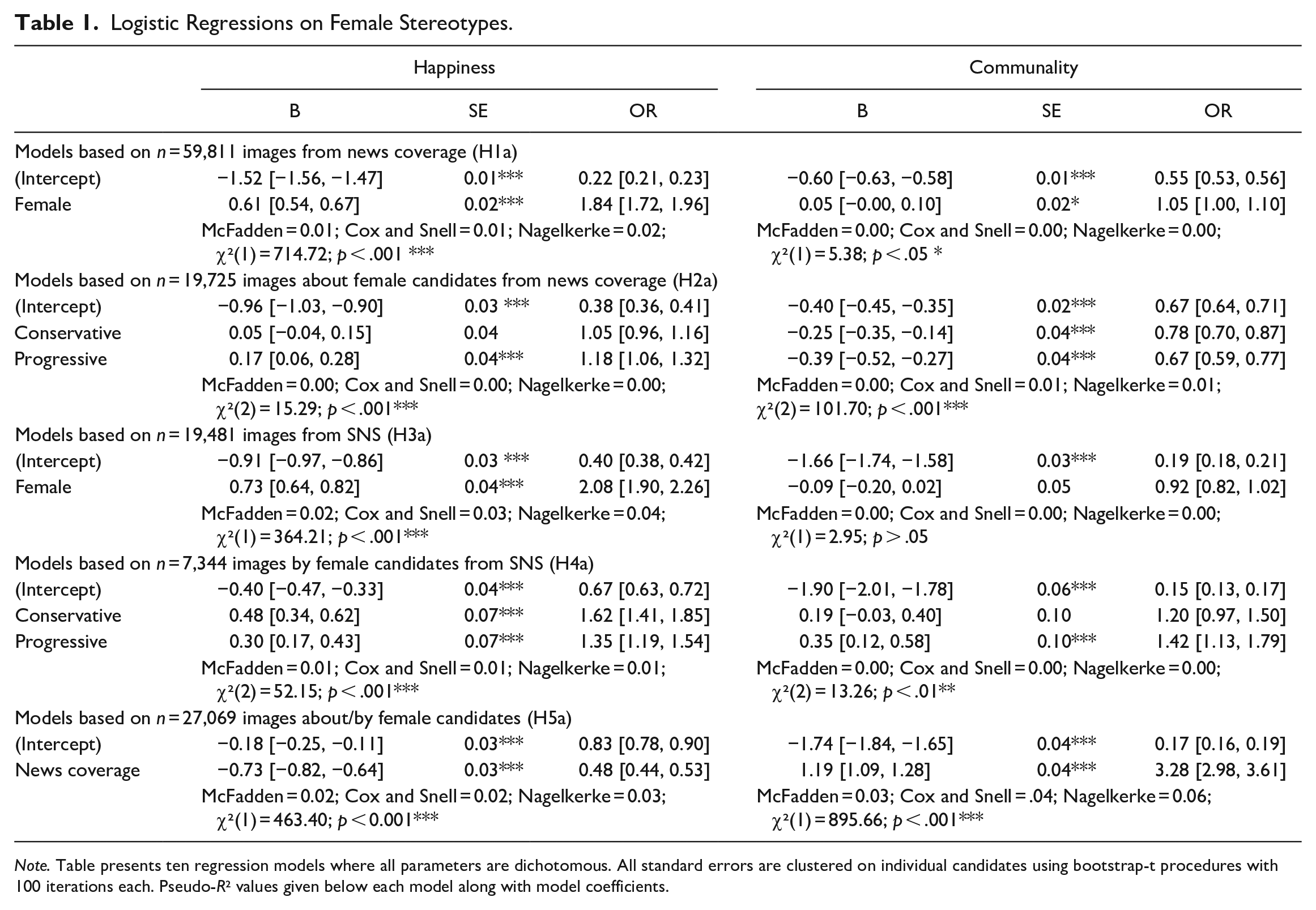
Note. Table presents ten regression models where all parameters are dichotomous. All standard errors are clustered on individual candidates using bootstrap-t procedures with 100 iterations each. Pseudo-R² values given below each model along with model coefficients.
Logistic regressions on male stereotypes.
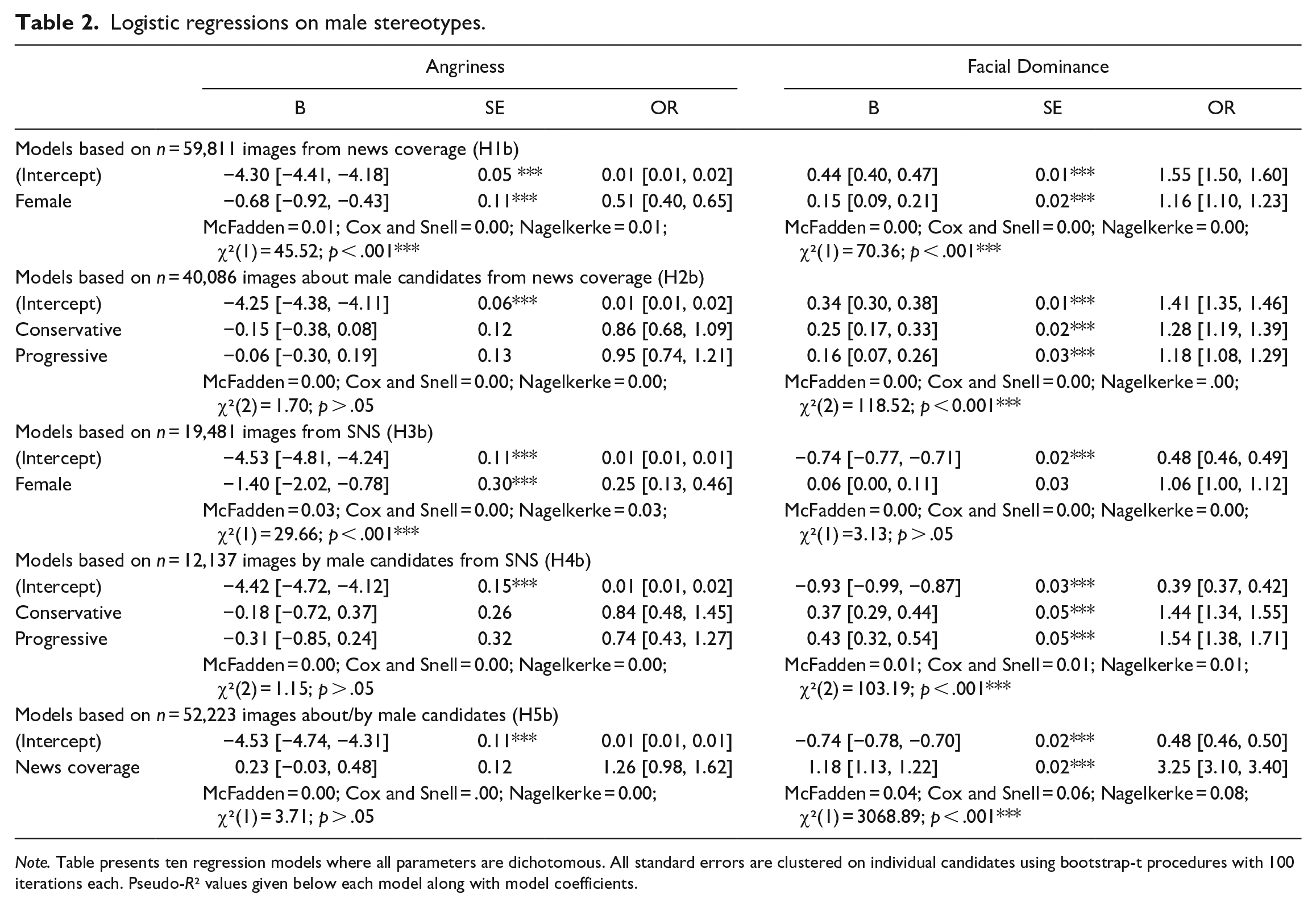
Note. Table presents ten regression models where all parameters are dichotomous. All standard errors are clustered on individual candidates using bootstrap-t procedures with 100 iterations each. Pseudo-R² values given below each model along with model coefficients.
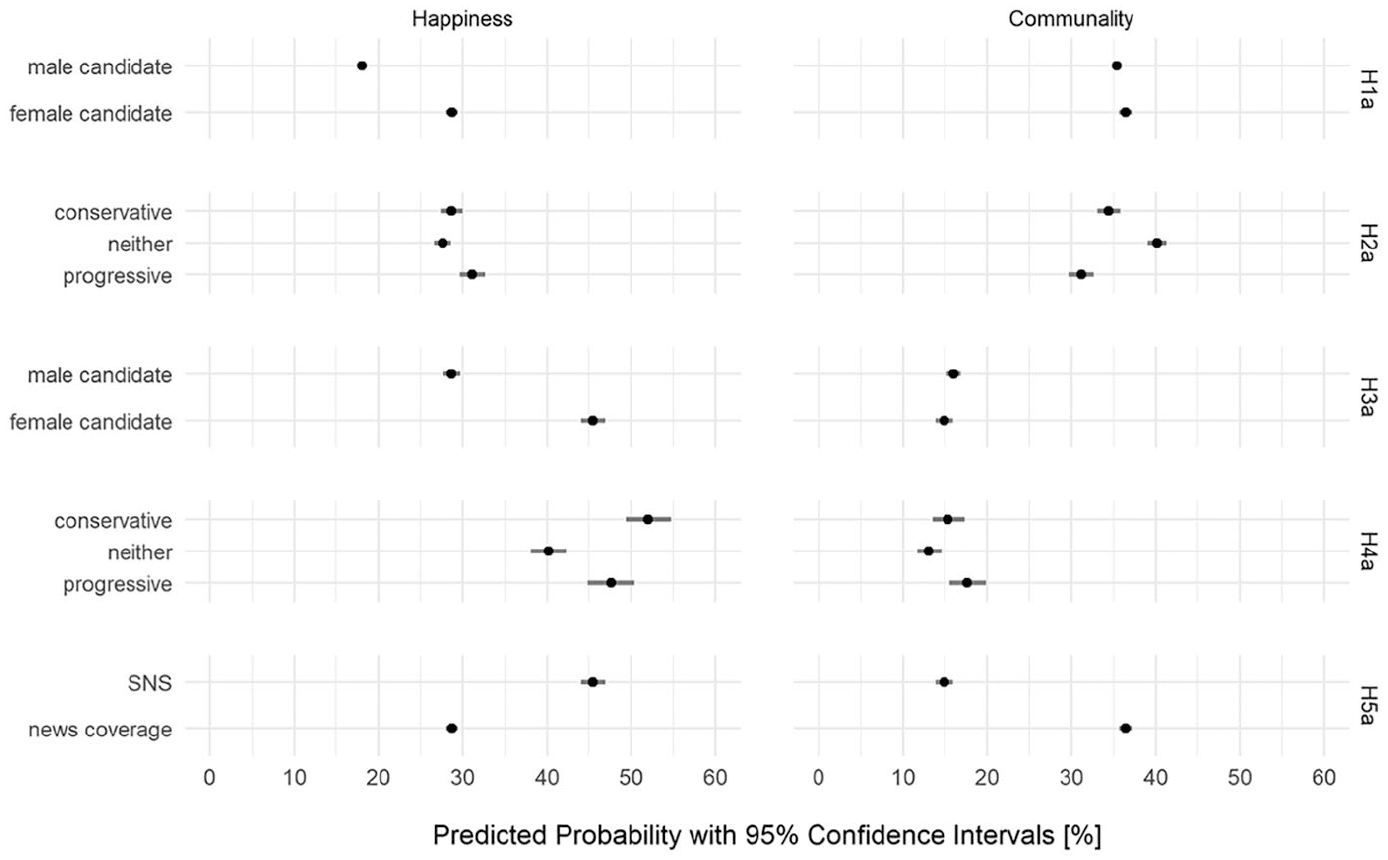
Predicted probabilities of female stereotypes
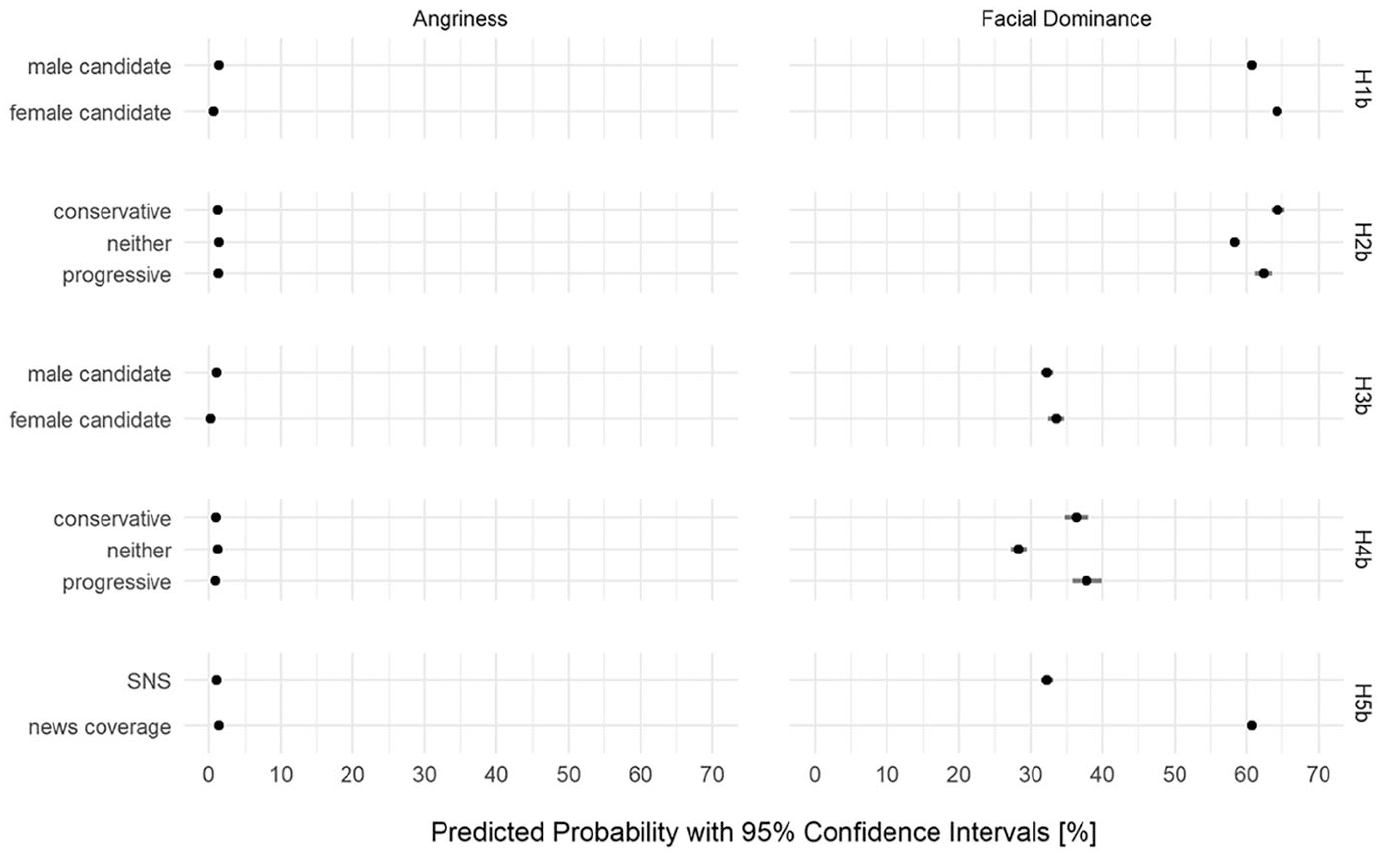
Predicted probabilities of male stereotypes
Findings for news coverage show that female candidates indeed increase the likelihood of an image showing happiness significantly (Table 1)—that is, their predicted probability is about 10 percentage points larger than that by male candidates (Figure 1). However, female candidates do not show substantially more communality. In contrast, male candidates show a slightly higher chance of depicting angriness yet a slightly smaller chance of facial dominance (Table 2 and Figure 2). News coverage can thus be said to resemble particularly happiness more strongly for female candidates and thus for the stereotypically respective gender (H1a); in contrast, communality (also H1a), angriness and facial dominance (H1b) do not show noteworthy relationships with the gender of a candidate. This leads to a rejection of H1b while lending some support for H1a.
Examining the effects of female (male) and conservative (progressive) candidates on respective gender stereotypes in the news, results indicate that female politicians from conservative parties are depicted slightly more often as communal than their female colleagues from progressive parties while differences in depicted happiness are not significant. Male politicians from conservative parties are depicted more often as facially dominant than their colleagues from progressive parties alongside negligible differences in depicted angriness. These findings do lend partial support for both H2a (in terms of communality) and H2b (facial dominance).
For SNS, again, female candidates indeed increase the likelihoods of an image showing happiness significantly and to a large extent. Other stereotypical depictions (i.e., communality, facial dominance) are either not significantly different between male and female candidates or the difference is significant yet not substantive (i.e. angriness). This supports H3a partially (happiness but not communality) but not H3b. Female candidates from conservative parties show slightly more happiness and slightly less communality; however, these differences are not statistically significant. Similarly, male candidates from conservative parties and progressive parties do not differ significantly in their depictions. Hypotheses H4a and H4b are thus rejected.
Finally, female candidates depicted in the news are indeed shown more often in communal situations than when depicted on SNS, whereas imagery on SNS is showing more happiness than respective news portrayals (i.e., some support for H5a). For male candidates, no differences are visible for angriness, which also showed some problems in operationalization. Male candidates are, however, depicted much more often in greater close-up detail (i.e., higher facial dominance) in the news coverage than in their self-depiction on SNS (i.e., some support for H5b).
Discussion
Visuals play an important role in contemporary political communication, with gender stereotypes deserving particular attention (Bauer & Carpinella, 2018). This study looked at how female and male candidates from progressive and conservative parties present themselves on SNS and how they are presented in the news. Therefore, we analyzed 79,500 images in the realm of the 2019 European Election.
Overall, findings suggest that across all candidates both news imagery (H1) and candidate’s self-depiction on SNS (H3) highlight some emotional gender stereotypes. In this, female candidates are more often depicted as happy compared to their male colleagues. This points toward a strategic utilization of emotional gender stereotypes by female candidates, largely reflecting the idea of the strategic stereotype theory (Fridkin & Kenney, 2014). Since qualities like happiness and warmth are positively connotated and regarded as stereotypically feminine, female candidates are also expected to emphasize them in their visual communication strategy. The news coverage seems to reproduce this emotional gender stereotype, but thereby not to further emphasize it (see H5a). On the contrary, female candidates are actually portrayed more often happy on SNS than in the news, which echoes the interpretation of a visual communication strategy that is in line with the strategic stereotype theory.
Conversely, even though angriness is rarely depicted and effect sizes are very small, male candidates are significantly more often depicted as angry compared to female candidates. This finding is to be taken with care, though, as the overall small number of images depicting anger was not as reliably identified by Face++ as other image characteristics (see below). That said, the finding suggests that at least to some degree the news coverage and SNS also reflect male emotional gender stereotypes. This might also resemble a strategic decision by male candidates to de-emphasize angriness in their visual strategic communication (Fridkin & Kenney, 2014). Since research suggests that both male and female candidates are similarly penalized for showing angriness (see Brooks, 2013), candidates might decide to deliberatively avoid being angry in public. In doing so, they might also succeed in preventing the media to get their hands on imagery depicting them with an angry facial expression.
While depictions of male and female candidates differed in their reliance on emotional gender stereotypes, the analyzed imagery did not reflect similar differences for structural gender stereotypes. That is, there was no difference in the communality of visuals depicting male and female candidates, neither in the news nor on SNS. If anything, facial dominance of visuals depicting male and female candidates in the news differed significantly, yet this difference was not in the expected direction and thus not in line with structural gender stereotypes. Instead, female candidates were depicted slightly more often in close-up shots in the news coverage than their male colleagues while not showing communality more often.
Overall, our analyzes so far suggest that political candidates appear to strategically emphasize and de-emphasize emotional gender stereotypes in their visual communication and that to some degree the media reproduces these stereotypes in their coverage. Yet, emotional and structural gender stereotypes should be treated as separate analytical categories as differences in structural gender stereotypes are not as prominent.
Moreover, we also compared the imagery of conservative to the imagery of progressive (fe)male candidates. For news (H2), again, results show that emotional and structural gender stereotypes appear to be distinct analytical categories. Here, however, the depiction of (fe)male candidates with different ideological orientation only varied in regard to structural gender stereotypes but not in regard to emotional gender stereotypes. In line with our hypotheses, female candidates from conservative parties were depicted more often communal than progressive female candidates, while male candidates from conservative parties had a higher probability of being depicted facially dominant than their progressive male colleagues. As such, news coverage tends to emphasize structural gender stereotypes in their depictions of conservative candidates. Self-depiction of (fe)male candidates on SNS (H4) did not show any systematic variation among ideological lines. Pictures posted by (fe)male candidates from progressive parties did not differ from photos posted by their conservative colleagues.
Importantly, our study demonstrates that self-portrayal on SNS differs heavily from candidates’ depiction in the news coverage. Female candidates are significantly more likely to be depicted as happy on SNS than in the news. There are two potential explanations for this. First, this might be a consequence of candidates’ social-media strategies. As happiness is a desirable quality that expresses warmth, female candidates might choose to emphasize pictures with happy facial expressions, partially resembling the strategic stereotype theory explained before (Fridkin & Kenney, 2014). Second, this pattern might also be a result of female candidates’ adoption to a social-media logic (Klinger & Svensson, 2015). In this, candidates might choose to publish photos that show an idealized version of themselves (i.e., through happy facial expressions). Following the discourse on self-depiction and authenticity on SNS, presenting oneself in a rather constant and positive fashion might also be the result of younger and thus presumably more social-media-affine candidates using SNS, particularly Instagram and Twitter in 2019, more than older candidates.
Conversely, the news coverage more often depicts female candidates as communal compared to their self-depiction on SNS. At first sight, the media thus tends to emphasize female gender stereotypes. However, as demonstrated in H1a, male and female candidates do not differ substantially in the probability of being depicted as communal in the news. As such, the higher overall focus on communality appears to be independent from the candidates’ gender and thus is more likely to be rooted in media logic than in gender stereotyping. In this, the media might focus on interactions between persons in their imagery and thus highlight communality in their visual communication.
Similarly, a comparison of how male politicians depict themselves on SNS and how they are depicted in the news coverage also shows that media imagery has a higher likelihood of depicting male candidates as facially dominant (H5b). This again can likely be described as a media peculiarity. While H1b indicated that female candidates show a higher likelihood of being depicted as facially dominant in the news than male candidates, the news generally tend to emphasize facial dominance independent from the candidates’ gender. This echoes political processes of mediatization and personalization as a general media propensity that is likely rooted in news values and media logic, thus also being largely independent from the candidates’ gender.
All in all, this study adds support to the assumption that female political communication is (still) different from male political communication, both directly (via SNS) and indirectly (through news media). In combination with prior findings on different effects of female (male) political communication, also varying due to communication contexts (e.g., background or interactions), this study points to differences on the communicator’s side. At first sight, this appears to indicate that by emphasizing emotional stereotypes female candidates might actually lower their chances of being elected (Bos, 2011; Huddy & Terkildsen, 1993). Given the increasing number of female elected officials as well as the inconclusive results on the effectiveness of breaking gender stereotypes through political communication (Bauer, 2017; Bauer & Carpinella, 2018), this might also be a deliberate strategy of emphasizing what might be perceived as female strengths—compassion and warmth (Fridkin & Kenney, 2014).
As for limitations, it is important to first highlight that the original data collection by Haim and Jungblut (2021) did already discuss some limitations, such as minor validity issues with identifying Instagram accounts.
Second, our visual content analysis employs Face++, a commercial and intransparent service for computational vision. Using an off-the-shelf software might be problematic as it can be hard to replicate the analysis and is prone to systematic bias (van Atteveldt & Peng, 2018). Changes in the algorithms of Face++ might translate into different empirical outcomes. Moreover, even though the human validation does not indicate any systematic bias between the validity of the results for male and female candidates, it is possible that the algorithm systematically underperforms for certain visual characteristics (e.g., age or race). Scholars thus need to be aware of the trade-off between the usability of ready-to-use software solutions and potential biases inherent in the algorithms. As sole manual content analyzes can also not guarantee full validity and reliability, an automated approach still seems very fruitful given the vast data set necessary to offer systematic comparative results across 28 countries (cf. Haim & Jungblut, 2021).
Third, even though our validation efforts show satisfying reliability scores for most variables, human coders and Face++ did not show a sufficient agreement in the recognition of angriness. This is mostly due to the rare occurrence of angriness in the sample. Still, the main result for angriness (i.e., men are depicted as angry more often than women) should be interpreted with great care and further in-depth analyzes are necessary to reach a valid conclusion. Even more so, the (maybe unsurprisingly) rare occurrence of anger in depictions of both male and female candidates calls for the investigation of additional visual male stereotypes. As such, the current analysis appears to be more informative for the investigation of female than male stereotypes.
Fourth, our analysis is purely cross-sectional. We are thus not able to track changes in visual communication across time. However, candidates might alter their communication strategy if the election date is approaching and in response to polling data or other informational sources. Similarly, journalists’ image selection might change across time as well. Future analyzes should take these potential temporal variations into account.
Finally, the operationalization of facial dominance was not ideal as it measured the share of the image that is covered by all faces and is not restricted to the candidate’s face depicted in the frame. This is due to the absence of a classifier to estimate which face actually depicts the corresponding candidate. While influences by the depiction of a larger group of people is mitigated in the regression models through the inclusion of communality, future studies might try to find a more straight-forward operationalization of actual candidate depiction.
Moving forward, this study offers several points of references for future research. First, the study only compared the structural differences between the self-depiction of all candidates and their news portrayal. A follow-up study could focus more closely on how the same candidates present themselves online and are presented in the news using a research design of pairwise comparisons. Additionally, the study calls for a more qualitative analysis of the depiction of female and male politicians in the media and on SNS. Through in-depth analyzes, scholars should be able to provide additional context to this study’s insights and identify relevant categories for future computational analyzes. Moreover, future research should focus more closely on the setting in which a photo was taken and the interactions between the depicted persons. Finally, studies should also extend the focus of attention toward moving images and combine the verbal and visual modality. Overall, we believe that the results presented here offer a first step towards fostering a deeper understanding of gender differences in visual political communication. Yet, there is still a lot of work to be done to determine the role of gender stereotypes in restricting women’s access to political power.
Supplemental Material
sj-docx-1-crx-10.1177_00936502211023333 – Supplemental material for Visual Gender Stereotyping in Campaign Communication: Evidence on Female and Male Candidate Imagery in 28 Countries
Supplemental material, sj-docx-1-crx-10.1177_00936502211023333 for Visual Gender Stereotyping in Campaign Communication: Evidence on Female and Male Candidate Imagery in 28 Countries by Marc Jungblut and Mario Haim in Communication Research
Footnotes
Declaration of Conflicting Interests
The authors declared no potential conflicts of interest with respect to the research, authorship, and/or publication of this article.
Funding
The authors received no financial support for the research, authorship, and/or publication of this article.

Supplemental Material
Supplemental material for this article is available online.
Author Biographies
References
Supplementary Material
Please find the following supplemental material available below.
For Open Access articles published under a Creative Commons License, all supplemental material carries the same license as the article it is associated with.
For non-Open Access articles published, all supplemental material carries a non-exclusive license, and permission requests for re-use of supplemental material or any part of supplemental material shall be sent directly to the copyright owner as specified in the copyright notice associated with the article.
