




Abstract
Mobile phones, television, internet services, games, and social media offer diverse and numerous opportunities for coping with stress in everyday life. Different disciplines have contributed to answering how these media are used for coping. Consequently, fragmented and disconnected research perspectives have evolved. To improve integration, we conducted a scoping review. A total of 318 articles met the inclusion criteria. Three main perspectives on media use for coping were identified: (1) stress and coping, (2) mood management and emotion regulation, and (3) media addiction and problematic media use. Each perspective has contributed to different aspects of the use of media for coping. Six advancements are proposed, which attempt to integrate perspectives and to guide future research on coping using media.
Currently, there is an ongoing debate among communication scholars concerning the mediatization of everyday life and how it might increase experienced stress, considering that it has led to phenomena like a growing “fear of missing out,” technostress, information overload, and permanent communication pressure (e.g., Halfmann & Rieger, 2019; Reinecke et al., 2017; Van der Schuur et al., 2019). However, contrary to frequent discussions, in addition to causing stress, media can be easily used for coping with stress in everyday life. In our media-saturated world, media use for coping might have become even more prevalent (Nabi et al., 2017). Social network sites, for instance, can be used for receiving social support (Frison & Eggermont, 2015), computer games can be used to recover from daily hassles (Reinecke, 2009), TV shows can be used to escape from stressful life events (Anderson et al., 1996), and blogs and health websites can be used for information seeking and problem solving (Chung & Kim, 2008). The diffusion of smartphones further enhanced access to these services (e.g., Hoffner & Lee, 2015; Schneider, Rieger, et al., 2018), especially for coping in everyday life.
Studying stress—and especially coping—is an important aim as there is probably no society that does not produce stress among its members (Pearlin, 1959). From an evolutionary perspective, stress is nothing negative per se as it can cause adaption to the environment and enhance fitness (Bijlsma & Loeschcke, 2005). However, if we experience stress more often over a period of time and, more importantly, if stress is not coped with effectively, it can have severe consequences for health and well-being (e.g., a negative impact on the immune system, Herbert & Cohen, 1993, or on fertility, Louis et al., 2011).
Thus, it is certainly a severe problem if research has not yet been able to shed light on the use of media for coping such that “some very basic questions about media use for coping with stress remain unanswered” (Nabi et al., 2017, p. 128), although “[i]t is desirable to fill the gaps in the existing evidence about such basic connections between people’s everyday lives and their relying on the media for dealing with everyday strains” (Knobloch-Westerwick et al., 2009, p. 266). However, when searching for literature on coping using media, we found that there is quite a lot of research on this topic (hence, the high number of articles—318—in our final sample that discussed this topic). The problem, therefore, seems to be not a lack of research but rather that the emerging research about coping with stress by using media has evolved in various research areas that have contributed to different aspects of this topic but have mostly neglected each other. To date, no review has captured these different research areas and, consequently, there has been no attempt to integrate conceptual approaches and to compare and relate findings.
With a scoping review of the current body of literature on coping through media use, our general goal is to map the field and synthesize different approaches. More specifically, we aim at (1) describing which research areas have contributed through what kind of lenses to the topic of coping through media use, (2) providing a condensed overview of the previous research and its problems so far, and (3) relating and integrating approaches. As the field has not been comprehensively reviewed yet and appears broad, complex, and fragmented, a scoping review seems more appropriate than a more focused systematic review (for details on terminology, see Munn et al., 2018; Peters et al., 2015). As we are interested in how media use is connected to ways of coping with stress and not in how media causes stress when used for other purposes, we focus on coping through media use and not on media as stressors.
We start by introducing the basic conceptualizations of stress and the coping processes as described in the transactional model of stress and coping by Lazarus and Folkman (1984). Next, we briefly explain differences and overlaps between stress management and related concepts, such as mood management and emotion regulation, before describing the method of our scoping review. In the Results section, we focus on the theoretical conceptualizations used in the different research areas and attempt to integrate the different approaches by proposing six advancements. We conclude by shedding light on the implications of our findings for the three identified research areas.
Theoretical Foundation
The transactional stress model by Lazarus and Folkman (1984) has most widely influenced stress and coping research and, thus, serves as our theoretical basis. According to this model, stress “is a particular relationship between the person and the environment that is appraised by the person as taxing or exceeding his or her resources and endangering his or her well-being” (Lazarus & Folkman, 1984, p. 19). Accordingly, stress and coping can only be understood when looking at the transaction between person and situation. In a first appraisal, individuals interpret environmental stimuli. If those stimuli are evaluated as threatening, challenging, or harmful, the individual analyzes whether personal resources are sufficient or nor. If not, the individual perceives stress, evaluates coping options in a second appraisal, and implements one or more of those options. Coping is defined as the cognitive and behavioral efforts that are undertaken to manage the stressful person–environment transaction (Lazarus & Folkman, 1984). Lazarus and Folkman (1984) differentiated between two superordinate ways of coping. Problem-focused coping includes the attempts to alter the stressful person–situation transactions including, for example, the search for further information. Emotion-focused coping is directed at the emotion evoked by the stressful situation rather than directed to the stress-evoking problem itself and includes, for example, distraction. A second prominent classification differentiates between approach coping, “oriented either toward the source of stress or toward one’s emotions or thoughts,” and avoidance coping, “oriented away from the stressor or one’s emotions or thoughts” (Compas et al., 2001, p. 92). The coping literature has partly used one of these differentiations and partly used other taxonomies (for an overview, see Skinner et al., 2003). Taken together, the literature has not agreed upon a taxonomy of different coping strategies (Skinner et al., 2003). Similarly, using media has sometimes been included in these taxonomies in different ways or not at all (Compas et al., 2001). Although individuals’ coping behaviors depend on situational circumstances, individuals can show a cross-situationally consistent tendency toward certain coping strategies, referred to as coping styles (Compas et al., 2001).
The choice of a suitable coping strategy is essential for successful coping, but coping effectiveness also depends on the context and the person (Bonanno & Burton, 2013). More precisely, coping effectiveness depends on the fit between the situation–person transaction and the coping response (Lazarus, 1999). According to the transactional model, coping serves as a mediator between the appraisal of a stressful situation and the outcomes that can be distinguished in the short term, including affect and psychological changes, and long-term effects, such as psychological well-being and health (Lazarus, 1999).
Related Concepts and Differentiation
Stressful situations nearly always involve emotions and as such, coping with stress and emotion regulation are closely connected (Lazarus, 1999). Similarly, mood management is closely linked to coping (Stevens & Dillman Carpentier, 2017). Focusing only on coping would miss important research traditions in communication. Thus, we treat these processes as having broad overlapping parts, but they can also exist without each other (Gross, 2015). Coping with stress could happen without emotions and moods (even if this is rare). Moreover, emotion and mood regulation refer to regulating not only negative but also positive emotions or moods (Gross, 1998; Larsen, 2000; Segerstrom & Smith, 2019). However, most research on emotion or mood regulation using media has focused on negative emotions and moods (Greenwood & Long, 2009; Nabi & Prestin, 2017), which often relate to stress. Thus, much of the research on emotion and mood regulation using media is relevant for our purposes. We include this research although our focus remains on media use for stress coping.
Guiding Research Questions
To map and review the state of research on the use of media for coping we will focus on three main guiding questions:
In addition, we will briefly look at the methods that were used and ask,
Method
To address these questions, drawing on existing recommended steps (e.g., Munn et al., 2018; Peters et al., 2015) and guidelines for reporting (i.e., Preferred Reporting Items for Systematic reviews and Meta-Analyses [PRISMA]; Moher et al., 2009; Tricco et al., 2018), we conducted a scoping review of coping using media. We searched electronic databases using a thorough search term and screened all titles, abstracts, and subject terms to identify potentially eligible studies according to our inclusion criteria. Relevant items were categorized following a codebook (see Supplemental Material at OSF).
Search Strategy
To identify and select relevant articles, we searched several scientific databases, accessible via EBSCOhost (Academic Search Premier; Communication & Mass Media Complete; EconLit; Library, Information Science & Technology Abstracts; PsyARTICLES; PsycINFO; PSYNDEX). We limited our search to academic journals, journals, books, reviews, and working papers, published in English before January 31, 2019. To account for the similarity between coping with stress, emotion regulation, and mood management, we constructed a comprehensive search term, aiming at a broad range of elicitors (e.g., emotion, stress), responses (e.g., coping), and media (for the search term and its structure, see Online Appendix A). This review aimed at capturing the theoretical concepts and frameworks that studied coping using media on a general level. Thus, we decided to not search for combinations of media and specific coping strategies such as, for example, information seeking or escapism if they were not additionally related to “coping with stress” as described in our search term.
Screening Procedure
Using the EBSCOhost interface, five trained coders checked the results of 6,261 items for non-English articles and duplicates. They also screened whether an item had only been found due to the use of homonyms (e.g., neuronal web, COPE [Committee on Publication Ethics]) or specific words related to media in the method description [e.g., online survey, internet access panel]). The exclusion of items that matched these criteria led to a sample of 1,637 articles. We imported them into the bibliographic software Citavi (Swiss Academic Software, 2019), obtained full texts, and proceeded with screening based on a preliminary coding scheme (see Supplemental Material at OSF). As we were not interested in media use as a stressor or in the evaluation of clinical interventions (e.g., cyber-therapy, specific platforms for patients or their families) or clinical samples, these articles were excluded, too. The final sample included 318 articles (see Figure 1 for a PRISMA flowchart of the full procedure).
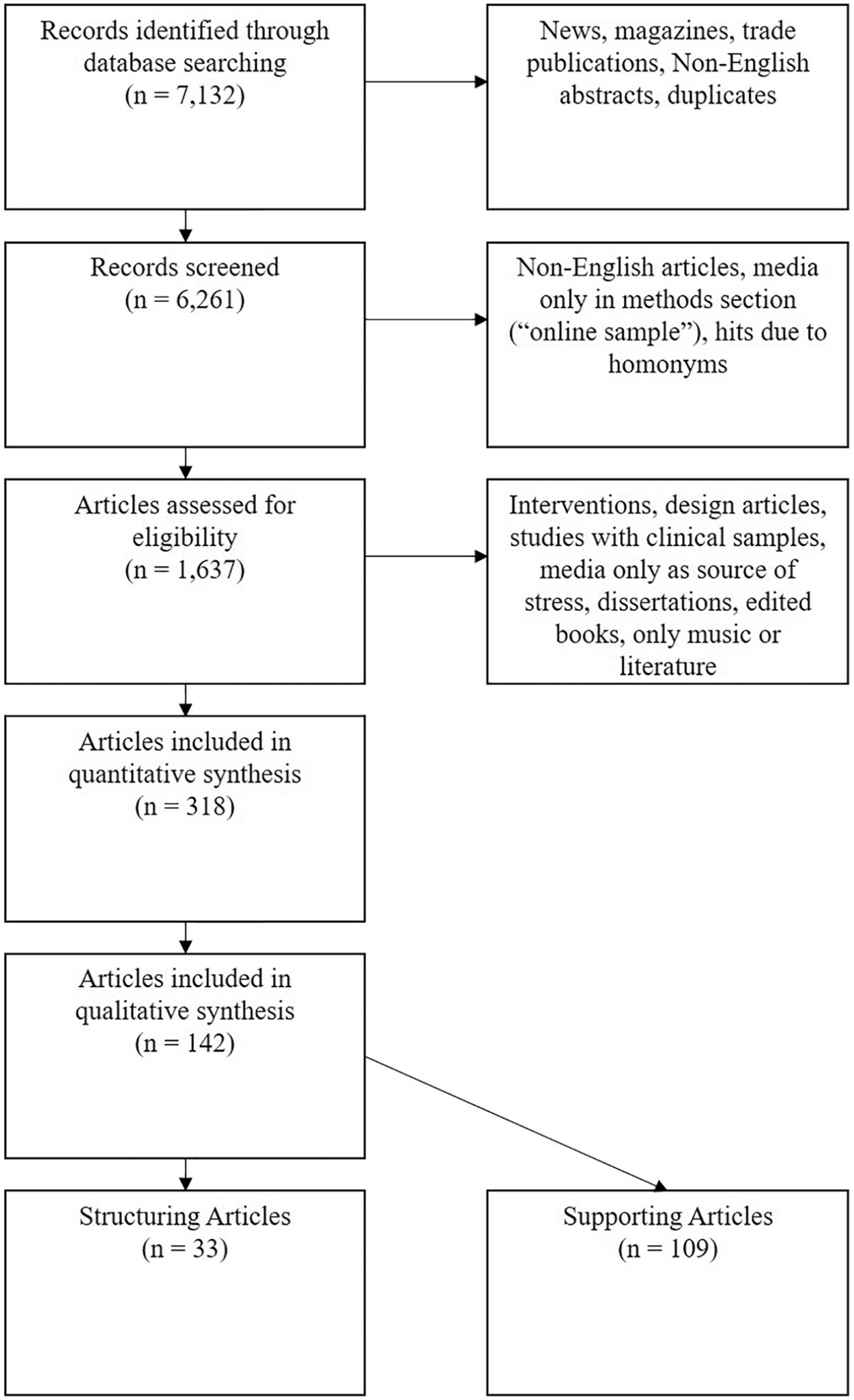
Flowchart of systematic literature review, adapted from Moher et al. (2009).
Article Coding
Four trained coders categorized the remaining articles as (1) highlight articles, which are of particular quality and importance (n = 33; 10%); (2) specific articles, whose scope is rather small (e.g., due to specific samples, situations, or media; n = 176; 55%); and (3) relevant articles that do not fall in one of the two other categories (n = 109; 34%). Highlights were used to identify research perspectives, to integrate and relate theoretical considerations, and to adapt the final coding scheme (e.g., Eschenbeck et al., 2018; Nabi et al., 2017). Relevant articles were used to check the conclusions we drew from the highlights, whereas specific articles were only included in the quantitative, descriptive results. An example of a specific article is Guo (2017), who examined public coping with the Boston Marathon bombing (for the list of all 318 articles, see Supplemental Material at OSF). All articles were coded using the same coding scheme. Following Donovan and Farris (2019), intercoder reliability was not calculated. Online Appendix B shows selected articles’ characteristics (for the codebook, see Supplemental Material at OSF).
Results
Our sample shows that the research on our topic has grown considerably since 2010 (see Online Appendix B). According to the disciplines of the journals, in which the articles have been published, the three disciplines that have contributed most widely to this topic were psychology, communication, and medicine. However, we also found articles published in other disciplines’ journals such as public health, substance abuse, management and business, and human–computer interaction, showing that the topic of coping using media has emerged in many different disciplines. This diversity has resulted in a wide range of theoretical models and theories. We encountered and coded over 200 theories or models.
In sum, the research area can be grouped into three different research perspectives: stress coping (n = 133; 42% of the articles), mood management and emotion regulation (115; 36%), and media addiction (109; 34%; perspectives are not exclusive). In the following, we describe these three perspectives, introduce the most often applied theoretical frameworks, and show how each perspective has contributed to the topic of coping using media. For a comparison table of these perspectives, see Online Appendix B.
Stress and Coping (SC) Perspective
The respective articles approached the topic of coping using media from a stress management perspective and based their research on traditional stress management theories (e.g., Plante et al., 2019; Reinecke, 2009; Van Ingen et al., 2016). The most used theoretical model was the transactional model by Lazarus and Folkman (1984), already outlined above (49%). There was also an emphasis on social support (22%), for example, when the buffering hypothesis (Cohen & Wills, 1985), which proposes that social support reduces negative effects of stress, served as the theoretical foundation (6%; e.g., Wright, 2000). Although reviews or meta-analyses have demonstrated the large body of research on media-based social support (e.g., Domahidi, 2018; Meng et al., 2017), we only found a few of these articles with our search, which implies that the coping perspective did not belong to their predominant theoretical frameworks. One explanation could be that those articles looked at social support and social capital not as a response to stress but rather as a resource (cf. Domahidi, 2018). Articles belonging to the SC perspective focused on the internet/digital media in general (30%), social media (25%), TV (12%), and mobile device use (11%). In addition, some articles discussed the theoretical role of media on a general level (17%). Compared with the other perspectives, social media played a greater role within this perspective, whereas games (9%) were discussed less frequently.
The first crucial contribution of the SC perspective is that its findings demonstrated how vital media use is for coping processes. In qualitative studies, media use emerged as one of the most important coping behaviors in very different contexts (e.g., I. R. Hunter & Gillen, 2009; Lapp et al., 2010). Quantitative studies have also found media use to be one of the most used coping behaviors (e.g., Bland et al., 2012; Nabi et al., 2017). This underlines the importance of studying media use for coping purposes both as a motive for media use and as a behavior in the stress management process.
Despite this importance, there is no deeper reflection on the exact function of media in the transactional theory of stress or other models (Nabi et al., 2017). One can differentiate two main distinct functions. First, media has been conceptualized as a “facilitation” of coping strategies that can also be accomplished without media (e.g., Hutchinson et al., 2006; Van Ingen et al., 2016). For instance, one can vent one’s emotions by posting on social media and by screaming out loud (Van Ingen et al., 2016). This view implies that media use is not a separate strategy but belongs to an independent dimension of coping. Second, media use has been seen as a strategy itself, distinct from other strategies that do not include media use. For instance, media use was compared with other strategies like “being alone” (Chen & Kennedy, 2005) or to avoidance coping or problem solving (Eschenbeck et al., 2018). Thus, the transactional model (Lazarus & Folkman, 1984) can serve as a basic framework for including media in the coping process but the exact function of media remains unclear.
Interestingly, research from SC has predominantly focused on media use for emotion-focused strategies and social support and its relationship with an emotion-focused coping style, whereas media use for problem-focused coping has been often neglected (for similar points, see Van Ingen et al., 2016; Watson, 2018). However, exceptions—for example, “therapeutic blogging” or the use of health-related online support groups—were also associated with a problem-focused coping style (Baker & Moore, 2011; Wright & Rains, 2014).
Mood Management and Emotion Regulation Perspective (MM/ER)
The second perspective includes research dealing with moods and using media to regulate emotions (e.g., Bowman & Tamborini, 2015; Greenwood & Long, 2009; Hoffner & Lee, 2015). The most frequently used theories or models were mood management theory (MMT; Zillmann, 1988a, 1988b) (51%), Gross’s (1998) process model of emotion regulation (20%), and the uses and gratifications approach (U&G; Katz et al., 1973) (18%). In this perspective, a diverse range of media types including online media such as games (19%), social media (18%), internet/digital media (17%), mobile devices (10%) but also traditional media such as TV (17%) and movies (6%) and media at a general level (23%) was discussed.
In MMT, Zillmann (1988a, 1988b) proposed that a person tries to maintain a good mood and to alter a bad mood by selecting stimuli that either distract or do not distract, and by choosing stimuli that either increase or reduce excitement. Thus, individuals choose or avoid media and other stimuli according to their absorption potential, their excitatory potential, their semantic affinity, and their hedonic valence (Zillmann, 1988a, 1988b). According to MMT, individuals learn how effective their regulation was and use this for future mood regulation. One important extension of MMT is mood adjustment, which states that pursuing a good mood might not always be the most successful strategy depending on situational circumstances (e.g., in an exam). It predicts that individuals choose media stimuli in order to adjust their mood to the most beneficial mood for the current circumstances or upcoming events (Knobloch-Westerwick, 2006, 2015; Luong & Knobloch-Westerwick, 2017).
In communication science, research on MMT and related models provides the broadest and most prominent perspective on coping using media—although managing one’s mood has rarely been explicitly described as a coping process. Stevens and Dillman Carpentier (2017) argued that MMT can be situated in the wider context of coping, considering it as a strategy of avoidance coping. In their work, using mood-congruent media for actively approaching stress-evoking problems can extend the ideas of MMT to explain a broader range of media choices. MMT research uses the term mood but has been criticized for using emotion-inducing instead of mood-inducing manipulations (Knobloch-Westerwick, 2006, 2015). Thus, the boundaries between research on mood management and on emotion regulation are blurred (e.g., Hoffner & Lee, 2015; Konijn & ten Holt, 2011).
According to Gross (2015, pp. 4–5), emotion regulation “refers to attempts to influence which emotions one has, when one has them, and how one experiences or expresses these emotions.” He differentiated five emotion regulatory processes, which have all been studied in relation to media use: the selection or avoidance of a situation (e.g., Ossenfort & Isaacowitz, 2018; Sands et al., 2016), the modification of a given situation (e.g., Sands et al., 2016), the decision of which element of a situation one focuses on (attentional deployment; e.g., Döveling, 2015), the construction of meaning in a situation (cognitive change; e.g., Suckfüll, 2013), and the regulation of one’s internal response (e.g., Nishio et al., 2013). The research on media use for emotion regulation has mainly focused on negative emotions (Nabi & Prestin, 2017).
The U&G postulates that humans use media to gratify their needs. This motivates users to select certain media stimuli. After usage, they evaluate their obtained gratifications and learn for their future media selection (Katz et al., 1973). One set of gratifications users can obtain from using media refers to stress relief, emotion, and mood regulation (Elhai et al., 2018; Finn & Gorr, 1988; Leung, 2007; Roe & Minnebo, 2007). The MM/ER shows that the U&G can be a fruitful framework for the combination of media use and coping. However, the U&G focuses on the active and conscious selection of media stimuli (Katz et al., 1973), whereas mood, emotion regulation, and coping include conscious and unconscious processes (Gross, 1998; Knobloch-Westerwick, 2006; Lazarus, 1999).
MMT and the process model of emotion regulation, on which most research in this perspective is based, almost exclusively address emotion-focused coping, and, thus, media use is mostly associated with an emotion-focused coping style (e.g., Reinecke, 2009). Interestingly, whereas emotion-focused coping is often seen as maladaptive in the coping literature (cf. Lazarus, 1999), it has been treated within MM/ER mostly as an adaptive regulation (e.g., Stevens & Dillman Carpentier, 2017). Similarly, media use was mostly seen as an adaptive choice and described as facilitation of regulation (Gaetan et al., 2016; Hoffner & Lee, 2015)—as a tool that “affords a highly flexible and personalized form of affect regulation” (Greenwood & Long, 2009, p. 616). Several articles in our sample have shown that the MM/ER’s emphasis on emotion-focused and avoidance coping and distraction can be also expanded on problem-focused and approach strategies by integrating MMT or the process model of emotion regulation with other theoretical approaches (Nabi et al., 2006; Reinecke et al., 2012; Stevens & Dillman Carpentier, 2017). Also, mood adjustment broadens the focus of the MM/ER on emotion and moods by emphasizing other goals that include directly approaching a problem (Knobloch-Westerwick, 2006).
In contrast to SC, MM/ER sheds light on specific media characteristics that are important for coping, including the MMT factors of absorption potential, excitatory potential, semantic affinity, and hedonic valence. Besides in MM/ER, a broader range of media types is examined. Consequently, this perspective’s contribution strongly emphasizes the role of the media content and its characteristics, which is neglected in the other perspectives. By shedding light on media characteristics, MM/ER also provides insights into the selection of media stimuli and its relation to certain coping strategies: MMT, for example, predicts that—when coping with stress—media users should avoid content associated with the stressors. This can be seen as a form of avoidance coping (Nabi et al., 2006; Stevens & Dillman Carpentier, 2017).
Media Addiction and Problematic Media Use Perspective (MA/PMU)
Coping through media use has become a major topic in research on media addiction in the last years. Using something to cope with stress has been used as a criterion for other addictions like substance use. Researchers have transferred this criterion to gaming and internet addiction (Loton et al., 2016). This has resulted in a large number of studies that investigated the association of some form of coping with some form of problematic use (e.g., Laier & Brand, 2017; Plante et al., 2019). MA/PMU mostly discussed the use of digital media or the internet in general (53%), followed by games (29%), social media (12%), and mobile devices (12%). Traditional media like TV (2%) only played a minor role.
Two of the most frequently used models in MA/PMU, the transactional model (16%) and the process model of emotion regulation (12%), both indicate that all three perspectives are interrelated. There were, however, also models that were specific to MA/PMU. The most frequently used model was the cognitive-behavioral model of generalized problematic internet use (34%) introduced by Davis (2001) and updated by Caplan (2010). Davis (2001) theorized that generalized problematic internet disorder is preceded by psychopathology. In combination with a reinforcing use of the internet, psychopathology leads to maladaptive cognitions, which then transfer to pathological internet use. One of these maladaptive cognitions and an important factor for developing pathological internet use is “internet use for mood regulation,” which Caplan (2010) integrated into Davis’s model.
Studies have also frequently applied Kardefelt-Winther’s (2014) model of compensatory internet use (12%). Its basic assumption is “that the locus of the problem [of internet use disorders] is a reaction by the individual to his negative life situation, facilitated by an internet application” (Kardefelt-Winther, 2014, p. 352). The coping strategy “internet use” is effective in reducing negative affect. But it can substitute other coping strategies such as meeting friends, which in turn leads to a problematic amount of compensatory internet use.
From the MA/PMU, coping using media is often seen as completely negative. For instance, computer games were described as “inadequate means of coping with frustration, stress, and fears” (Weinstein, 2010, p. 273); the thought that internet applications might help to relieve stress was seen as a “general dysfunctional coping style” (Laier & Brand, 2017, p. 10); and “media-focused coping” all in all was evaluated as a “dysfunctional coping strategy” (Kuss et al., 2017, p. 74). However, others emphasized that media can be used functionally and only become maladaptive if the ability to use alternative coping strategies or tools decreases (e.g., Loton et al., 2016; McNicol & Thorsteinsson, 2017). One factor for PMU that may play a role here is the salience of a specific media application (e.g., Loton et al., 2016). Something is seen as salient if it “dominates a person’s cognitions and behavior” (Loton et al., 2016, p. 566). Cheng et al. (2015) drew on this idea and proposed that internet addiction is linked to coping inflexibility. This implies that a high salience of one coping behavior like the use of a particular media type can relate to lower coping flexibility.
Connected to a high salience of coping behaviors is the idea that dispositional coping styles influence the development of a problematic usage pattern (e.g., Brand et al., 2014; Schneider, King, & Delfabbro, 2018). Within MA/PMU, problematic use is usually associated with avoidance (e.g., Brand et al., 2014) or emotion-focused (e.g., Schneider, King, & Delfabbro, 2018) coping, which is equated with a “negative” coping style (e.g., Li et al., 2016).
Another research perspective deals with the media use of individuals when they or their loved ones face an illness. We did not include those studies—along with clinical samples and interventions—because our focus lies on media use for coping in everyday life. What this research, however, adds to the perspectives introduced above is that media can be used for problem-focused coping including the search for information or the active approach of a problem (e.g., Sassenberg & Greving, 2016; Wright & Rains, 2014).
A Short Note on the Methods Represented in the Articles
Although our scoping review focuses on the theoretical conceptualizations, we provide a brief summary of the methodological approaches in Online Appendix B. In sum, 273 studies that also empirically assessed coping using media were included in our sample. Most empirical studies were based on quantitative surveys, of which 188 used cross-sectional and 28 longitudinal designs. To measure media use or coping, most studies relied on self-reports (223 and 221, respectively). Concerning coping measurement, we saw multiple different instruments: Throughout our sample, over 130 different scales were used. Coping efficacy was rarely measured in non-experiments. Of the 37 experiments in our sample, 28 measured coping efficacy in some way (e.g., mood repair; Rieger et al., 2015). Most experiments compared different variations of similar media content (e.g., different task demand levels for computer games; Bowman & Tamborini, 2015). Moreover, using media for coping was rarely compared with non-media coping options (for a summary table of the experiments and how effectiveness was assessed, see Online Appendix C).
Integration and Critique: Six Advancements
The three research perspectives—SC, MM/ER, and MA/PMU—show a wide diversity in theoretical approaches. We think that each of the perspectives contributes to different aspects of the process and that an integration of these perspectives can lead to a better understanding of the coping process when media are involved. We also think that each of the perspectives will benefit from the insights and contributions of the other fields. The following six advancements are based on contributions of the three perspectives but integrate and develop these contributions into a broader context (see Table 1 for an overview of the contributions of the three perspectives). The six advancements aim at integrating the different approaches and outline starting points for future research.
The Six Advancements and the Contribution of the Three Perspectives.
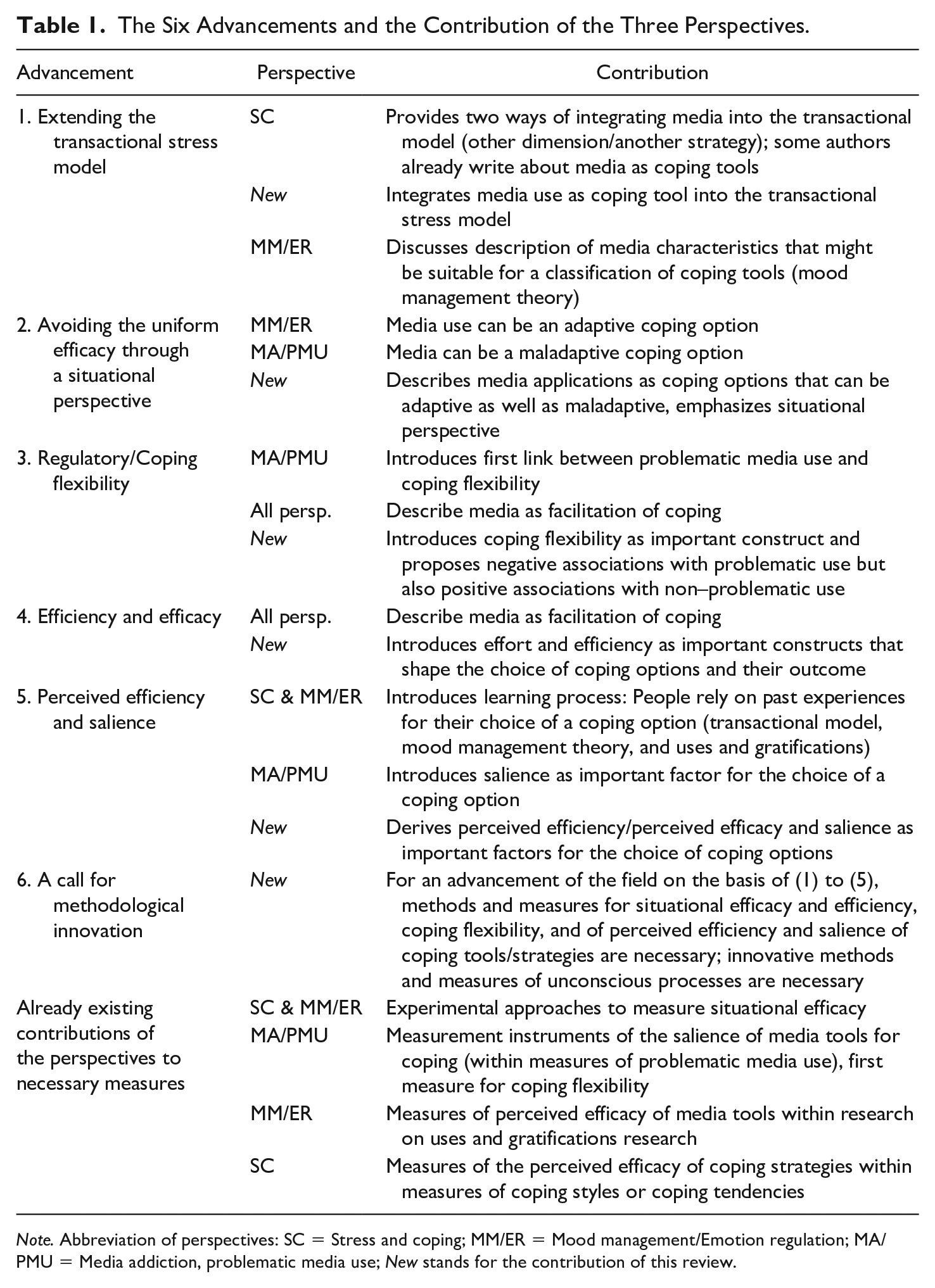
Note. Abbreviation of perspectives: SC = Stress and coping; MM/ER = Mood management/Emotion regulation; MA/PMU = Media addiction, problematic media use; New stands for the contribution of this review.
Extending the Transactional Model: Introducing Coping Tools Into the Model
We think that the transactional stress model is generally a suitable starting point for studying coping using media as it is applicable to a wide variety of contexts and individuals and provides a framework for dynamic processes (e.g., Biggs et al., 2017). The numerous studies that have applied it in this diverse research area (21%; see Online Appendix B) support this view. However, how media use can be situated within the coping process remains unclear. We argue against seeing media as just another coping strategy. Research across all three perspectives supports that media can be used for various coping strategies (e.g., Van Ingen et al., 2016). Thus, it seems more fruitful to conceptualize media applications as manifestations of a dimension of coping, lying orthogonal to coping strategies: as a “coping tool” (Soldatova & Zotova, 2013).
Following this conceptualization, individuals decide on two things when they evaluate their coping options in their second appraisal: (1) the coping strategy or coping goal (Hutchinson et al., 2006) and (2) the coping tool. (1) First, coping strategies or goals can be defined as “objectives or intents of coping responses” (Compas et al., 2001, pp. 88–89). Measuring and developing universal lists of these strategies or goals has been shown to be problematic because categories are rarely distinct or suitable for universal application (Skinner et al., 2003). Thus, several taxonomies have been developed that list different strategies or goals on different levels that can be relied upon dependent on the particular context of a study (e.g., Carver et al., 1989; Knobloch-Westerwick et al., 2009; Skinner et al., 2003). (2) Second, we define coping tools as instruments through which (a) a coping goal can be achieved and (b) a coping behavior can be performed. A tool can be a media application or another coping response like talking to other people or using one’s own imagination. Different tools can be used for different strategies (for a similar point, see Katz et al., 1973). For instance, one can use a mobile phone or one’s own imagination for distraction. Mobile phones can also be used for social support. Again, different abstraction levels are possible (e.g., one movie vs. another movie; a mobile phone vs. talking in person). Regarding the stable use of strategies and tools, we can subsequently extend the definition of coping styles as “a person’s general tendency or enduring disposition to handle stressors with a specific constellation of coping strategies” (Li et al., 2016, p. 409) to apply to coping tools as well. Following MMT, it might be suitable to classify the tools by their absorption potential, excitatory potential, semantic affinity, and hedonic valence (Zillmann, 1988a).
Thus, individuals may choose a specific combination of strategies and tools to cope in a particular situation. Accordingly, the efficacy of this way of coping is then determined by the fit between the person–situation transaction and the strategy–tool combination. We assume that certain combinations of strategies (e.g., self-distraction and computer games, avoidance coping with stressor-unrelated content or information seeking and search engines) are used more frequently than others. Moreover, specific combinations might fit certain situations in a particular way (see also Nabi et al., 2017; Van Ingen et al., 2016). With our extension of the transactional model, these combinations and their relationship to situational circumstances and particular stressors can be examined more systematically.
Avoiding the Fallacy of Uniform Efficacy Through a Situational Perspective
Bonanno and Burton (2013, p. 592) defined the fallacy of uniform efficacy as “the tendency to assign a value judgment about the consistent efficacy or consistent lack of efficacy of a particular regulatory strategy.” Research has shown that, as theorized by Lazarus and Folkman (1984), the consistent judgment of strategies as (in)effective is not appropriate (for an overview, see Bonanno & Burton, 2013). The same should hold true for coping tools.
In MA/PMU, media use for coping is often judged as uniformly ineffective. Similarly, media use is regarded as consistently effective in some MM/ER research. Throughout the literature, we saw that the fallacy to evaluate media use as a uniformly adaptive or maladaptive coping behavior appears in quite a large amount of the literature about coping using media. We argue that the efficacy of coping by using media must be evaluated from a situational point of view and that future research—instead of judging the uniform efficacy—should study the boundary conditions of efficiently using media for coping with stress.
One important boundary condition is the timing of coping behaviors (e.g., directly in the stressful situation, after the stressful situation), which has so far only been considered in studies about coping with particularly stressful events (e.g., coping with the death of a loved one; DeGroot & Carmack, 2013) but less in the context of everyday strain. In SC and MM/ER, qualitative studies about stressful events suggest that media use for coping can differ according to the timing (e.g., DeGroot & Carmack, 2013; Watson, 2018).
Regulatory/Coping Flexibility and Media Use for Coping
As proposed by Cheng et al. (2015, MA/PMU), regulatory or coping flexibility is a concept that is understudied in the literature on coping using media. Coping flexibility is a personality trait that is defined as “intra-individual variability in the deployment of diverse coping strategies and, more importantly, the capacity to exhibit such variability in a way that fosters adjustment to life changes” (Cheng et al., 2014, p. 1582). According to our conceptualization, coping flexibility should also include the flexible deployment of coping tools and, thus, a decrease of coping flexibility might more adequately predict types of problematic media use than using media for coping per se. Moreover, as authors from all three perspectives suggested that media facilitate coping, it is also worth looking at positive associations between media use and adoption, and coping flexibility.
Efficiency and Efficacy
The term “facilitation” of coping used in all three perspectives also refers to another important point. Stress is by definition a situation in which someone is overstrained. Thus, the literature on coping using media should not only look at the efficacy of coping using media (in specific situations in combination with specific strategies), it is also important to look at the costs (Bonanno & Burton, 2013)—how much effort does a certain coping tool require?—and the combination of costs and benefits. Consequently, coping efficiency is a construct that should receive considerably more attention. Although this is inherent to the term of “facilitation,” it has not yet been clearly included in theoretical conceptualizations nor in measurements.
Perceived Efficiency and Salience as Important Factors for the Choice of Coping Options
Both MMT (MM/ER) and the transactional model (SC) include a learning process that connects the perceived efficacy (or efficiency) of past regulation behavior with the selection of coping options (Lazarus, 1999; Zillmann, 1988b). Accordingly, it could be useful to conceptualize perceived efficiency as an important factor for the choice of both a coping strategy and a coping tool. The MA/PMU adds that in some situations, it might not be solely the perceived efficiency that influences the choice of coping options and, therefore, also the selection of media: Especially in situations in which coping is unconscious, another important factor in the selection of coping options might be the salience of a coping strategy or tool. Thus, we suggest that perceived efficiency and salience are inherently linked to the choice of a coping strategy and a coping tool in a particular situation. For instance, if individuals perceive social support seeking in a particular Instant Messenger (IM) group with friends as efficiently reducing stress, they will turn to this combination of strategy and tool when being confronted with stress more often. Similarly, if this group is highly active and the phone keeps alerting due to new messages in this group, the instrument (IM group) might also be salient in a stressful situation and will, therefore, be used with a higher probability.
Moreover, perceived efficiency and salience can also be related to individuals’ stable tendencies to use a strategy or a tool when confronted with stress. Stable tendencies could increase the salience of having such options. If somebody has, for example, developed a tendency to avoid stressors, distraction as a coping strategy and tools that have proven useful for this strategy (e.g., TV) can be more salient in a stressful situation. Furthermore, efficiency and salience could play a crucial role in developing certain coping styles as a high frequency of using certain strategies and tools may result in an enduring tendency to use them.
A Call for Methodological Innovation
We see several methodological issues that should be addressed by future research: First, a large number of studies relied on self-report measures. Given that many of the underlying processes are unconscious, such an approach could paint an incomplete or inaccurate picture. Thus, it is necessary to have measures that do not expect participants to judge their own general use of media for coping. For measures of problematic media use, the measurement of coping and media use were often mixed in the same measure. For instance, the report of media use for coping or mood regulation was included in an index of problematic media use (e.g., Adolescent Preoccupation with Screens scale, J. F. Hunter et al., 2018). This can be seen as a methodological manifestation of the fallacy of uniform (in)efficacy described above and, therefore, can be viewed critically. Related to this, in most studies in our sample, coping efficacy was rarely measured, if at all, on a situational level (e.g., considering the fit between the situation–person transaction and coping). In experiments, coping using media was often compared between groups using variations of the same media content, which makes it hard to identify coping efficacy patterns on a more general level. Coping efficiency was not measured at all. Measurement of fit on a situational level is complex but still necessary, and thus, we see a strong need for developing innovative instruments for coping efficacy and coping efficiency. Innovative measures should be applicable across media types and contexts, so they can additionally help to consolidate the multiplicity of used instruments. Finally, given the diversity of measures of media use, most measures seem to lack an appropriate level of specificity. Using terms like the internet or digital media use for coping are too vague. Consequently, more concrete and fine-grained levels of measurement are necessary.
With these six advancements, we contribute to the development of a common ground for research on coping using media. These advancements are informed by theoretical conceptualizations of different research perspectives and show that integrating these different perspectives can advance the research area as a whole and also each perspective individually.
Discussion
In our scoping review, we saw that the research on coping using media is manifold. With over 200 identified theories and models, there was a large heterogeneity across multiple scientific disciplines, such as communication, psychology, and medicine. Moreover, approaches to and conceptualizations of coping using media within the disciplines were diverse. The three perspectives—SC, MM/ER, and MA/PMU—have each contributed to different aspects of the process of coping using media, depending on the primary focus of the perspective: adaptive or maladaptive processes, the coping process, or media characteristics. Several ideas, such as learning processes or the idea of coping facilitation through media, have been mentioned in all research areas. We think that all of these perspectives benefit when they also pay attention to the interrelations with each other, as this, for example, can reduce the fallacy of uniform efficacy. Thus, we advocate for more integrated communication and knowledge sharing. We aim at providing the groundwork for such an integration.
Concerning the relative importance of the six advancements, we suggest particularly valuable advancements for each perspective. The SC might benefit the most from considering the differentiation between coping strategy and tool and from more explicitly measuring situational efficacy and efficiency. This holds true for research on coping of certain groups (e.g., children) but also for research on specific applications (e.g., social network sites). Moreover, we think a broader look at the use of media for problem-focused and approach strategies is important within this perspective. The MM/ER should integrate and conceptualize maladaptive forms of media use for coping purposes. By placing media use for emotion-focused or avoidance strategies into the bigger picture of coping strategies, this field might be able to contribute to an even broader range of media choices and effects (Stevens & Dillman Carpentier, 2017). Finally, the MA/PMU might particularly benefit by integrating the ideas about coping flexibility and its relation to problematic forms of media use, and by acknowledging adaptive forms of coping using media. However, before studying these suggested research topics, innovative measures—especially for coping efficacy, efficiency, and flexibility in the context of media use for coping—need to be developed.
With these contributions in mind, we admit that the diversity and multiplicity of approaches have led to limitations of our work. Firstly, we spotted several articles that were related to our topic but were not found with our search (e.g., Domahidi, 2018; Knobloch-Westerwick et al., 2009; Rieger et al., 2017). Diversity in approaches usually leads to diversity in wording and, thus, we would argue to have provided a comprehensive but not exhaustive picture of research on media use for coping. This is particularly the case for the field of health communication, which we have only touched upon.
This, secondly, also applies to some interesting aspects and smaller fields within our sample. The attempt to integrate approaches of 318 articles has inevitably led to a simplification of research and an omission of exotic but fascinating aspects and models. With the focus on the main research perspectives, we have neglected smaller but growing fields (e.g., need threats, Schneider et al., 2017; recovery and resilience, Reinecke & Rieger, in press; or social support, Wright, 2000). Although we did not have the space to shed light on these fields here, we think these areas can also profit from our advancements as several ideas can be integrated into these fields as well. For example, the factors of perceived efficiency and salience can be valuable for studying the selection of tools and strategies to cope with need threats. Similarly, the idea of a situational fit might be useful to explain and further study situational differences in the effectiveness of media use for recovering from strain but also for studying the boundary conditions of using media for receiving helpful social support.
Moreover, as we focused on conceptualizations of coping using media on a more general level, we did not investigate specific coping strategies. Again, we think that the six advancements can still help researchers who examine specific strategies (e.g., avoiding the fallacy of uniform efficacy can help research on escapism using media; see Hastall, 2017, for a similar point). Besides, we think that for specific coping strategies or coping families that received wide attention in communication research (e.g., escapism, information seeking and avoidance, social support seeking), separate reviews and meta-analyses building on a coping perspective would be valuable. Likewise, as we did not investigate efficacy or constellations of typical coping strategies and coping tools (e.g., media types), scrutinizing such patterns in previous literature and new research is an important and interesting avenue for future research for which our extension of the transactional model can be particularly helpful.
As a last limitation, the groundwork for integration we lay with our six advancements can be developed further. In our first advancement, we argued to build on the transactional stress model and its successors (for an overview, see Biggs et al., 2017). However, this model—especially in its initial form—has also received criticism (e.g., during the stress process, positive and negative emotions can exist simultaneously; see, for example, Folkman & Moskowitz, 2004). The advantage to build on an existing, established model is that our advancements can be placed into a broader framework and connected to the broad work on this model. However, extending our advancements to the conceptualization of a new model on coping using media that also addresses the critical points of the transactional stress model might be a valuable avenue for future work. In this article, we focused on a more open approach to advance the diverse field of coping using media.
Our review can be placed within the larger discussion on the relation of media use and well-being: Media provide additional coping options, can potentially lead to an increase in individuals’ coping repertoire, help to adapt to stressful situations, and increase well-being in the long run. However, if certain media types replace other successful coping options, media use for coping can also be detrimental for well-being. Taken together, the three perspectives we reviewed here show that seeing the relation between media use and successful coping and well-being as exclusively positive or negative remains short-sighted: Future research should focus on situational (e.g., situational fit), media characteristics (e.g., semantic affinity) as well as individual factors (e.g., coping flexibility) on which this relation depends.
Conclusion
We think it is important that the field using media for coping remains diverse and stays open to contributions of different disciplines and perspectives, as there are different media types and stressors that each have to be studied in the light of a unique theoretical background. However, we also think it is valuable for each of the perspectives to learn from the viewpoints and findings of other contributors. We argue that the viewpoints of the different perspectives can be integrated by extending the transactional model, by differentiating between coping strategies and coping tools, by building on a situational perspective, and by focusing more on the concepts of coping flexibility and efficiency. With this article and the six advancements, we aim at laying the groundwork for a communication and learning process across the boundaries of different perspectives and disciplines.
Supplemental Material
APPENDIX_A-D – Supplemental material for Using Media for Coping: A Scoping Review
Supplemental material, APPENDIX_A-D for Using Media for Coping: A Scoping Review by Lara N. Wolfers and Frank M. Schneider in Communication Research
Footnotes
Acknowledgements
We thank Felix Dietrich, Luisa Poschmann, and Silke Büchau for their assistance in managing the literature and coding; Krista DeLeeuw for proofreading; and the anonymous reviewers for their useful feedback on earlier versions of this article.
Declaration of Conflicting Interests
The authors declared no potential conflicts of interest with respect to the research, authorship, and/or publication of this article.
Funding
The authors disclosed receipt of the following financial support for the research, authorship, and/or publication of this article: The publication of this article was funded by the Ministry of Science, Research and the Arts Baden-Württemberg and the University of Mannheim.

Supplemental Material
Author Biographies
References
Supplementary Material
Please find the following supplemental material available below.
For Open Access articles published under a Creative Commons License, all supplemental material carries the same license as the article it is associated with.
For non-Open Access articles published, all supplemental material carries a non-exclusive license, and permission requests for re-use of supplemental material or any part of supplemental material shall be sent directly to the copyright owner as specified in the copyright notice associated with the article.
