



Abstract
Maintaining class participation and engagement poses a unique challenge in teaching online courses at postsecondary institutions. With the distinctive rise of online instruction during the COVID-19 pandemic, there is a critical need to develop innovative and exciting opportunities in online course concept learning, application, and peer-to-peer engagement. To fulfill this need, I utilized the popular social media app TikTok to help students engage with sociological insights and concepts during course participation activities in two asynchronous, online Sociology of Sex and Gender courses at the University of South Carolina. TikTok is an online-sharing platform that allows users to create short videos with music and visual effects. TikTok can also be a valuable tool for increasing student engagement in online sociology courses. In this article, I describe this teaching activity, present findings of the preliminary teaching evaluation, and discuss the potential impact of using TikTok in online sociology courses.
In recent years, there has been a distinctive rise in online instruction at postsecondary institutions (Driscoll et al. 2012; Gillis and Krull 2020; Means et al. 2009). Between the fall of 2012 and 2018, distance education course enrollment at Title IV institutions in the United States increased by 29 percent, from 5.4 to 6.9 million college students (U.S. Department of Education 2019). This growth in online instruction has notably expanded during the COVID-19 pandemic (Cameron et al. 2021; Gillis and Krull 2020; Muñoz-Najar et al. 2021), with about 11.8 million undergraduate students enrolled in at least one distance education course in fall 2020 (Cameron et al. 2021). Thus, online learning has been a growing demand in higher education settings.
Echoing Kozimor (2020), it is important to note how online learning differs from emergency remote instruction. Online learning has a carefully crafted teaching design and delivery for students to effectively learn in a virtual environment (Gillis and Krull 2020; Kozimor 2020), whereas emergency remote instruction is an unexpected and temporary shift to remote teaching delivery due to a crisis (Kozimor 2020). When designed and delivered using appropriate pedagogical approaches, online courses may equally promote effective student learning and engagement as traditional, face-to-face, classroom environments (Driscoll et al. 2012). As educators continue to teach online courses during the COVID-19 pandemic, beyond an emergency remote instruction context, there remains a critical need for innovative and creative educational tools in online learning that engages traditional undergraduate students.
There is a pedagogically rich body of literature on the evaluation of student engagement in online sociology courses (Clark-Ibáñez and Scott 2008). Prior research highlights the importance of assessing and evaluating student engagement with online sociology course curricula (Little, Titarenko, and Bergelson 2005), activities (Fields et al. 2021; Wyant and Bowen 2018), tools (Hunter and Frawley 2023), and technologies (Dougherty and Andercheck 2014; Vaughn and Leon 2021). Additionally, many socio-educational factors shape student engagement in online learning environments, such as online course design and implementation (Kozimor 2020), students’ existing needs and challenges (Gillis and Krull 2020), delivery of emotionally triggering topics (Bedera 2021), and students’ online technology literacy and access (Santoso and Lestari 2019). Although such literature is useful for pinpointing opportunities to enhance student engagement in online sociology courses, less scholarship assesses how popular social media technologies among traditional undergraduate students, such as Instagram and Snapchat, can enrich student engagement in online learning environments.
In this article, I utilize the popular social media app TikTok in two asynchronous, online Sociology of Sex and Gender courses to examine how undergraduate students engage with course content when participating in online course activities and assignments. To assess student engagement in two online courses, I developed a teaching activity that I call the “Teaching with TikTok activity” as a potentially useful, innovative, and enjoyable teaching-learning resource for undergraduate students in online sociology courses. In this article, I review relevant pedagogical literature, explain the Teaching with TikTok activity and the methods of the preliminary teaching evaluation, present quantitative and qualitative findings of the evaluation, and offer educators advice for using the Teaching with TikTok activity in online sociology classrooms.
Literature Review
Using Social Media for Teaching and Learning
Social media technologies are increasingly used in university classrooms (Greenhow and Galvin 2020; Van Den Beemt, Thurlings, and Willems 2020). Approaches to incorporating social media technologies in higher education vary widely among educators. Such approaches include using social media as a direct communication tool between students and instructors (McArthur and Bostedo-Conway 2012); a resource for applying course content, theories, and ideas to real-world, social problems (Jackman 2019); and an additional method for facilitating student engagement in university classrooms (Alharbi, Kuhn, and Morphet 2021). Utilizing social media platforms, such as Twitter or Facebook, in university course settings can significantly increase student engagement and support learning networks at postsecondary institutions (Dragseth 2020; Qureshi et al. 2021; Sarwar et al. 2019). Social media use in academic settings, however, may not meaningfully enhance student engagement if such use is irrelevant to course learning objectives or is used infrequently by students or the instructor (Dragseth 2020).
Despite its strengths, there are notable limitations when using social media platforms in university courses. Social media technologies often promote advertised ideas, goods, and services that are tailored to individual users using machine learning algorithms (Stellefson et al. 2020), which may not align with pedagogical values and objectives. Additionally, educators must frequently monitor social media content to prevent students from viewing misinformation or hate speech (McDougall et al. 2018). Finally, university students from certain religious and cultural backgrounds may not be able to fully participate in course activities and assignments that utilize social media technologies (Almenayes 2014). Thus, educators should center students’ learning needs and the classroom climate when using social media in university learning environments (Dragseth 2020).
In parallel with the popularity of social media usage, educators have increasingly used social media platforms for university student learning opportunities (Dougherty and Andercheck 2014; Hurst 2018; Purcell 2021), such as Facebook (Dougherty and Andercheck 2014), Twitter (McArthur and Bostedo-Conway 2012), Instagram (Chen et al. 2020), LinkedIn (Purcell 2021), Snapchat (Hurst 2018), and TikTok (Duggan 2023). Beyond individual and group engagement, each social media platform has its own unique user interface and capabilities. Thus, incorporating social media technologies into educational activities is heavily dependent on whether the social media app features help educators fulfill course learning objectives and bolster student engagement (Van Den Beemt et al. 2020). Instagram, for example, has garnered lively discussion in the scholarship of teaching and learning for its easy to use image-sharing capabilities, which could enhance student engagement in arts, business, and medical education (Chen et al. 2020). Prior research has also documented increased student participation, applied problem-solving, and ethical decision-making skills when using social media platforms in educational settings (Malik, Heyman-Schrum, and Johri 2019; Sarwar et al. 2019; Van Den Beemt et al. 2020).
Scholars have also examined social media use in sociology and gender studies courses (Belet 2018; Flores et al. 2020; Hunter and Frawley 2023). In assessing student engagement and achievement in introductory sociology courses, Belet (2018) found that using YouTube as a pedagogical tool fully engaged undergraduate students from financially disadvantaged backgrounds because YouTube is a low-threshold social media platform that is not tailored toward financially advantaged users’ technology uses and skills. Similarly, Flores et al. (2020) boosted student engagement through a class private Facebook page when examining socially sensitive topics (e.g., gender-based street harassment) that often do not get space in traditional classrooms. Overall, social media apps can serve as a beneficial pedagogical tool for enhancing undergraduate student engagement in sociology and gender studies courses.
In recent years, the social media app TikTok has been encompassed as a successful pedagogical resource for student learning (Adnan, Ramli, and Ismail 2021; Duggan 2023; Escamilla-Fajardo, Alguacil, and López-Carril 2021; Peña 2021). Launched in 2016, TikTok is an online sharing platform that allows users to create short videos with music and visualization effects. TikTok features videos on everything from chemistry experiments gone wrong to carefully choreographed dances and operatic solos to footage from public demonstrations. Many TikTok videos also reflect content creators’ diverse biographies and experiences. Creators can also share TikTok videos with others through diverse technologies, such as computers, smartphones, and tablets, which allows their content to reach people who do not have TikTok accounts (Duggan 2023).
In 2022, TikTok was the most downloaded social media app globally with over 672 million downloads (Koetsier 2023). TikTok (2021) also reported having more than 1 billion active global users access the app every month. Using findings from a nationally representative survey of adult Americans (n = 1,502), the Pew Research Center (2021) found that 55 percent of young adult respondents (ages 18–24) have ever used TikTok. TikTok has also recently skyrocketed in popularity among younger users (ages 13–17) in the United States (Pew Research Center 2022). Although TikTok is one of the most frequently used social media apps among traditional undergraduate student populations, limited research examines how TikTok could potentially be a pedagogical tool in university student learning (Escamilla-Fajardo et al. 2021).
Using mixed-research and arts-based methodologies, prior scholarship has examined the pedagogical effects of TikTok as a teaching-learning tool by assessing its usefulness in improving concept learning and memorization (Escamilla-Fajardo et al. 2021), strengthening students’ relationships with teachers (Peña 2021), combatting misinformation and stigma surrounding politically sensitive topics like abortion (Duggan 2023), and practicing new skills as English second language learners (Adnan et al. 2021). Yet many scholarly discussions about TikTok and its usefulness in university classrooms have overlooked how TikTok could be utilized as a pedagogical tool for creating inclusive teaching environments.
Inclusive Teaching Practices in Sociology Courses
Much pedagogical scholarship has focused on how to practice inclusive teaching in university learning environments (Dewsbury and Brame 2019; Nowakowski, Sumerau, and Mathers 2016; Smith-Tran 2020). Dewsbury and Brame (2019:1) defined inclusivity as “the practice of including people across differences, and [they] assert that inclusivity implies an intentional practice of recognizing and working to mitigate biases that lead to marginalization or exclusion of some people.” In the scholarship of teaching and learning, inclusive teaching is a pedagogical approach that actively incorporates the identities, histories, and lived experiences of underrepresented communities in higher education (Nowakowski et al. 2016). Inclusive teaching involves critically examining how unequal power structures, such as cissexism, white supremacy, capitalism, patriarchy, and heteronormativity, mutually reinforce one another to maintain inequalities in society (Smith-Tran 2020; Sola et al. 2022). Furthermore, inclusive teaching allows students to critically reflect on their own knowledge, experiences, and biases concerning the specific concepts and content areas that are covered. Such inclusive teaching strategies encourage students to think, read, write, and discuss such topics sociologically while preparing them for life outside of university classrooms, such as identifying and addressing inequalities in the workplace. For such reasons, inclusive teaching has become a popular pedagogical practice in sociology courses.
Sociologists have extensively documented effective strategies for inclusive teaching practices—particularly by enhancing cultural competency and empathy (Hart and Kocher 2023), employing trauma-informed strategies (Bedera 2021), and illuminating structural bias and prejudices against marginalized communities (Nowakowski et al. 2016). A growing concern with inclusive teaching practices in sociology classrooms is the need to address the multiple power systems that reproduce inequality and privilege (Smith-Tran 2020), such as understanding how intersectionality can be used as a teaching-learning tool for conceptualizing interlocking systems of oppression and privilege in classrooms (Crenshaw 1989; Gardner and McKinzie 2020). To inclusively teach a Sociology of Sex and Gender course, for example, educators must address racism, classism, heterosexism, and other forms of discrimination in their curriculum when discussing sex and gender inequalities in society (Nowakowski et al. 2016).
Using social media in sociology courses that explicitly address multiple systems of inequalities may be a more effective way to engage traditional undergraduate students while improving inclusive teaching practices. Inclusive teaching requires tailored, accessible, and innovative modes of student engagement for critical reflection and application of specific course content areas, concepts, and theories. Through the engagement of two online courses, I expand existing scholarship by conducting a preliminary analysis of the relationship between TikTok use in course participation activities and perceived fulfillment in maintaining an inclusive learning environment that explicitly confronts topics related to social inequalities, justice, and movements within the sociology of sex and gender.
Methods
Course Setting
During the fall 2020 semester, Dr. Carla A. Pfeffer and I each taught a section of the Sociology of Sex and Gender course in asynchronous online formats at the University of South Carolina (UofSC), a large, public university in the Southeastern United States with a predominantly white, non-Hispanic/Latin, middle-class, heterosexual, cisgender, and endosex student population. In 2020, UofSC had a total enrollment of approximately 27,000 undergraduate students. At the time of the preliminary teaching evaluation, I was a Ph.D. student and graduate student instructor in the UofSC Department of Sociology and Women’s and Gender Studies Program. In 2020, Dr. Pfeffer was a tenured associate professor in the Department of Sociology and the director of the Women’s and Gender Studies Program at UofSC. Dr. Pfeffer oversaw this preliminary teaching evaluation as my faculty advisor and provided feedback throughout the study design and implementation process. Due to the COVID-19 pandemic, we both taught our online courses remotely at our home offices and frequently communicated with each other to discuss the successes and challenges related to the teaching intervention.
Sociology of Sex and Gender is a sociology and gender studies cross-listed, upper-level, undergraduate course elective that fulfills diversity and social advocacy, leadership, and social science requirements for undergraduate students at UofSC. The course is taught by at least one instructor from the UofSC Department of Sociology and Women’s and Gender Studies Program every semester in an online, asynchronous format. A primary goal of this course is to introduce students to the sociological perspectives and findings of sex and gender and apply this evidence-based knowledge to real-world experiences. All student learning outcomes in the online Sociology of Sex and Gender courses are equivalent to its face-to-face version.
During the spring 2020 semester, I first reviewed pedagogical literature to explore teaching activities that will foster student engagement and creativity in an asynchronous online learning environment. I examined emerging research on social media use in higher education and developed an interest in further exploring this teaching-learning resource with UofSC students. After my course section was filled with enrolled students in May 2020, I sent out a class email with a short introduction to the course and asked students (a) if they would be interested in utilizing a social media platform for course participation activities and (b) if yes, what social media platform they would prefer to use. The majority of students in my section replied to the email and expressed support for using social media in course participation activities. Additionally, most students selected TikTok as their preferred social media platform to use throughout the course. I then presented this information to the UofSC Center of Teaching Excellence and proposed creating and implementing a teaching activity that uses TikTok videos to boost student engagement. After receiving approval and financial support for the project from the Center for Teaching Excellence, Dr. Pfeffer and I decided to use both of our Sociology of Sex and Gender online sections for the teaching intervention during the fall of 2020.
The study proposal was submitted to UofSC Institutional Review Board (IRB) and was deemed exempt from IRB review. For this study, I focused on two, online, asynchronous sections of the Sociology of Sex and Gender course taught by Dr. Pfeffer and me during the fall 2020 semester. Each section had 45 students. Both course sections had 90 students in total. Most undergraduate students who completed the courses had fourth-year standing (79.0 percent), with the minority consisting of third-year students (11.6 percent), second-year students (7.1 percent), and first-year students (2.3 percent). Students were enrolled in a variety of undergraduate programs, with most pursuing degrees at the UofSC College of Arts and Sciences.
Pedagogical Procedure
Before the video selection process, I first examined prior research on what effect algorithms have on my selection of TikTok videos for the teaching intervention. Algorithms are digital technologies that personalize users’ feeds, content, and advertisements. Although scholars have limited knowledge on exactly how TikTok’s algorithms operate among users, Simpson, Hamann, and Semaan (2022:2) suggest: On TikTok, people primarily engage with and consume video content on their For You Pages, which are algorithmically curated feeds of personalized content specifically constructed for "them.” Here, the "them" is constructed by trace data – the digital remnants people leave of themselves through their interactions with a system, such as through their clicks, likes, follows, and engagement with video content.
Considering prior research, I deleted all browsing history data from my desktop computer and smartphone before creating a TikTok account. I then created an account on my desktop computer for this teaching intervention in May 2022 after receiving IRB approval. After creating my account, I selected TikTok videos for the teaching activity and avoided “liking,” “following,” and engaging with any content on TikTok to potentially minimize algorithm effects with my video selection. I did not have a TikTok account before the creation and implementation of this teaching intervention. However, I did have other professional and personal accounts on multiple social media platforms before May 2022. Thus, despite my best efforts in minimizing algorithm effects, I likely had a “digital footprint” from those platforms that may have influenced the TikTok algorithms when I created and maintained my TikTok account for the teaching intervention. Without fully understanding the comprehensive criteria that TikTok established for maintaining its algorithms (Simpson et al. 2022), I was unable to fully determine the exact effect that the algorithms had on my selection of videos. Future studies are needed to fully examine the algorithm effects of TikTok within and beyond the scholarship of teaching and learning.
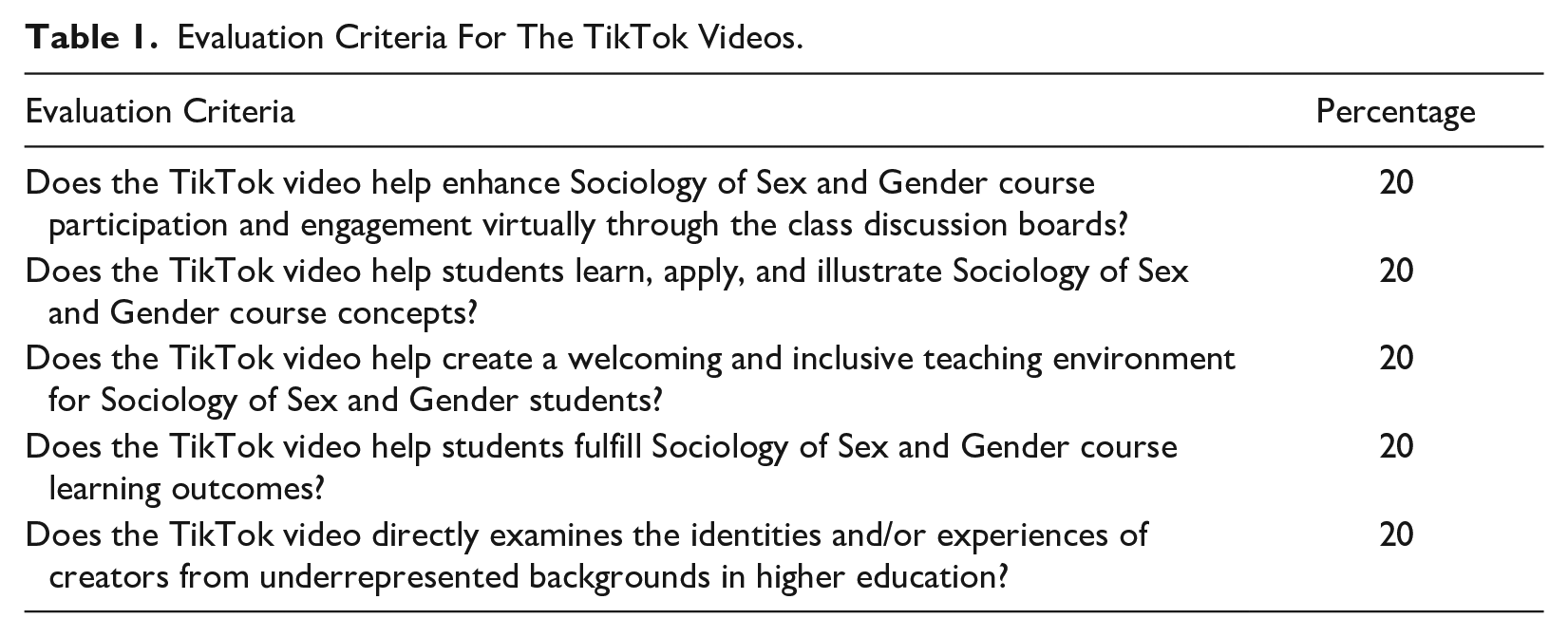
Through my account on a PC desktop computer, I searched for relevant topics and concepts through the TikTok user search engine. I then sorted TikTok video results by search term relevance and copied/pasted the first 30 video links for every search term that was listed in the video search results into a Microsoft Word document. In total, I had an initial section of 420 TikTok videos that I collected in a week. I then reviewed each video from the initial list and used Table 1 to evaluate the TikTok videos for educational use in the online courses. The top three videos that had the highest percentage in the evaluation criteria for each class week were used for the teaching activity. Additionally, each TikTok video had a different content creator so students could be exposed to a more diverse set of videos. The final selection consists of 42 TikTok videos, which includes three 15- to 60-second videos per week for 14 weeks (for selected TikTok video links with discussion questions, see Lampe 2022). To maintain a survivor-centered approach to teaching (Bedera 2021), I did not select videos for the week when students learned about sociological scholarship on sexual- and gender-based violence. 1
Evaluation Criteria For The TikTok Videos.
Students watched and examined the selected TikTok videos through the online discussion boards on the UofSC Blackboard website from their computers, tablets, and smartphones. At the beginning of every class week, students would read the assigned texts that cover course learning objectives (e.g., read about intersectionality), review supplementary materials (e.g., review course PowerPoint slides that provide an in-depth discussion about intersectionality, see [shorturl.at/hoOPW]), and answer online discussion board questions related to the weekly course content (e.g., answering questions related to intersectionality) after watching their assigned video. Each course section was split up into three to five groups of undergraduate students (9 to 15 students per group) for the online discussion boards. Each student group’s online discussion board had (a) one video that students were required to review and (b) corresponding online discussion board questions related to the weekly course materials and their assigned video. Students would answer the initial discussion board questions by Wednesday, and students would then meaningfully respond to their peers’ discussion board posts by Friday during every class week. Students had back-and-forth conversations with each other about the TikTok videos and their corresponding discussion questions. Dr. Pfeffer and I also communicated with students frequently through the online discussion boards to make sure students were continuing to engage with the weekly activities.
Data Collection and Analysis
I used an online one-group pretest-posttest survey design in Qualtrics with closed and open-ended questions to assess undergraduate students’ (a) course engagement, (b) comprehension of course materials, (c) peer engagement, (d) course learning outcomes, and (e) overall experiences with the Teaching with TikTok activities. Each survey had 32 questions listed in total with 29 closed questions and 3 open-ended questions. Pretest survey data were collected from August 20 to 24, 2020 (during the first week of classes), and posttest data survey data were collected from December 1 to 4, 2020 (during final exams week). Students voluntarily completed the pretest and posttest evaluation surveys for extra credit.
For the closed survey questions related to the teaching intervention, students reported their level of agreement or disagreement with each statement, which I coded on a 5-point Likert scale from 1 = strongly disagree to 5 = strongly agree. Descriptive, frequency, and Pearson correlation statistics were used to analyze the quantitative data of the present study. Three open-ended questions were asked in the posttest survey: (a) What specifically did you find helpful or valuable about these TikTok learning activities? (b) What would you change about these TikTok learning activities? and (c) Is there anything else you would like to add about your overall experience with these TikTok learning activities? Qualitative data analysis focused on the examination of students’ responses to these specific questions. I coded data using NVivo (Release 1.4) software and analyzed inductively utilizing a constructivist grounded theory approach (Charmaz 2014). A constructivist grounded theory approach offers robust yet flexible guidelines for examining qualitative data to build thematic themes and ideas from the data themselves. Thus, this approach was necessary for analyzing these qualitative data.
I engaged in initial or open coding, meaning I read all open-ended responses to develop a general sense of the qualitative data and generated an initial list of codes. Subsequently, I engaged in focused or thematic coding, which involves the identification of coding overlaps and divergences, resulting in the combining and collapsing open codes to form broader thematic codes/themes that are then placed in network relationships with one another. I also coded disconfirming evidence during the focused coding process. I then developed categories and themes from this coding scheme to discern emergent patterns and connections in the data. Finally, I engaged in axial coding, linking demographic and social attributes in the data set to specific codes and themes, which provided information about particular patterns among and between various subgroups of students. I subsequently inspected each theme as needed and modified them to ensure clarity and coherence through concept mapping. Utilizing recurring themes and prior scholarship on teaching and learning, I thematically analyzed these qualitative data while exploring emerging themes and codes concerning students’ responses to the three open-ended questions.
Preliminary Results
Quantitative Results
In both course sections, 81 undergraduate students (90.0 percent of total enrollment) completed the voluntary online pretest survey, and 58 undergraduate students (64.0 percent of total enrollment) completed the voluntary online posttest survey. Out of the total enrollment, 47.0 percent of students completed both the pretest and posttest surveys. Most students who took the pretest survey (86.7 percent) reported using the app TikTok before taking the online courses. Out of those who have used TikTok before course enrollment, over half of survey respondents (57.1 percent) reported engaging with the app every day and over a quarter (27.0 percent) did every week. The majority of students reported using TikTok before taking the courses and had a basic understanding of the app’s creative content, capabilities, and features. Additionally, the posttest survey asked students: “How would you rate your overall experience with using the TikTok app when participating in course participation activities?” All students rated their overall experience with using the TikTok app in course participation activities as “excellent” (66.0 percent) or “good” (34.0 percent).
Table 2 presents correlations between TikTok use and Sociology of Sex and Gender course learning outcomes. TikTok app use was significantly and positively related to the perceived accomplishment of seven learning outcomes. TikTok app use had significant positive associations with students’ self-reported course learning outcomes of (a) helping them learn, apply, and illustrate course concepts (r = .25); (b) providing them with an accessible way of learning course concepts and ideas (r = .27); (c) helping create a welcoming and inclusive learning environment (r = .34); (d) helping them gain a deeper understanding of course readings, discussions, and assignments (r = .18); (e) enhancing their knowledge on the sociology of sex and gender (r = .26); (f) improving their ability to understand nonbinary experiences (r = .25); and (g) improving their ability to understand sex and gender inequalities in contemporary society (r = .29). There is a lack of strength of those significant positive associations due to the relatively small sample sizes of the survey data.
Correlations of TikTok Use and Perceived Accomplishment of Course Learning Outcomes (Pearson’s Correlation Coefficients).
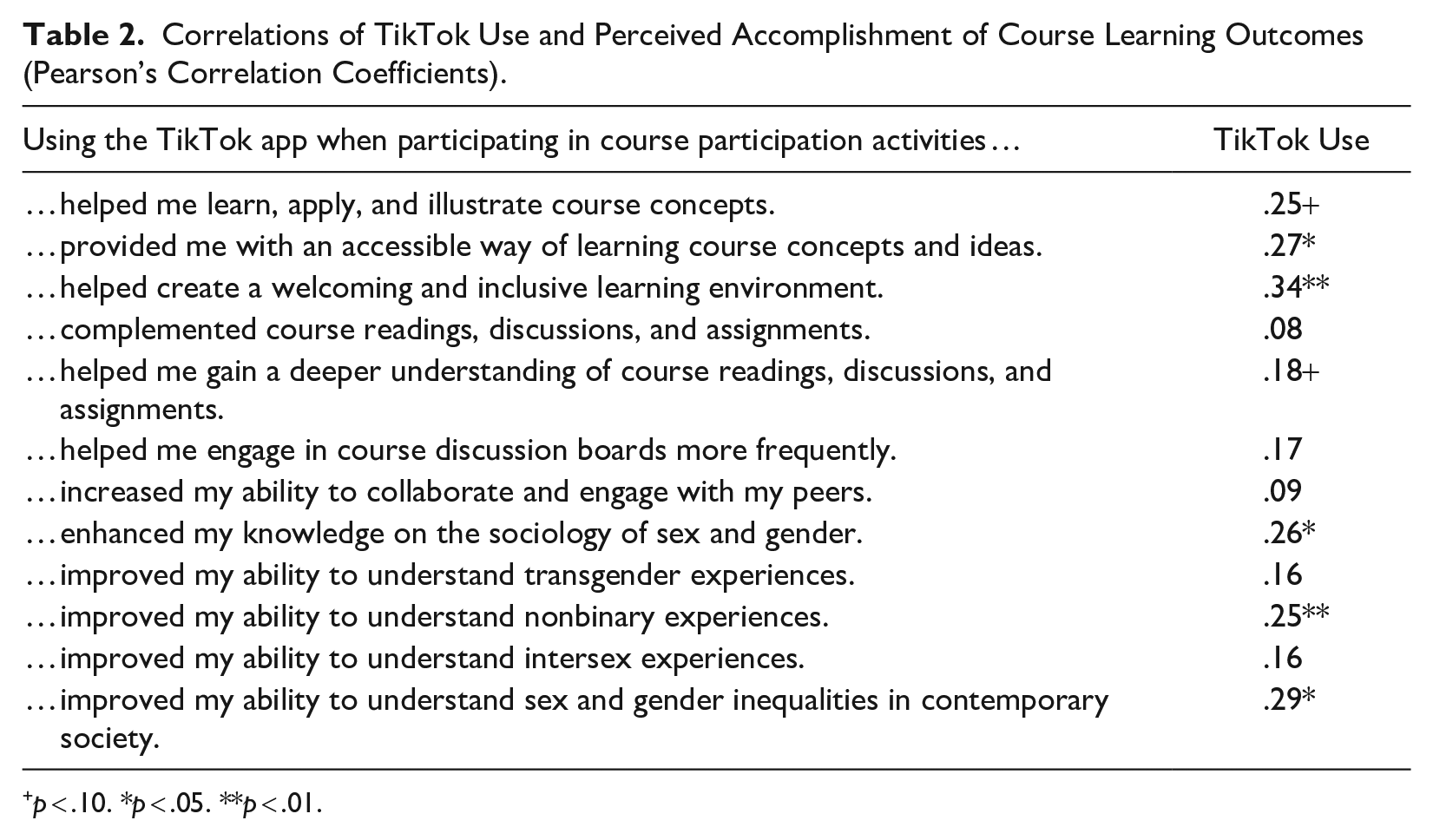
p < .10. *p < .05. **p < .01.
The present study is exploratory and not driven by a hypothesis. Thus, there is no casual inference present in the quantitative findings. I cannot make casual attributions about these quantitative data. These preliminary quantitative findings are evaluative in nature and should not be considered a large-scale generalizability study. These quantitative findings should, however, serve as a preliminary contribution to the exploration of using TikTok to engage undergraduate students in sociology online courses and deserves further investigation from educators.
Qualitative Results
Approximately, 78.0 percent of student respondents answered all of the open-ended questions. Three thematic themes emerged from the qualitative data of the present study: (1) examining TikTok creators’ lived experiences, (2) simplifying big ideas, and (3) technology challenges. The first thematic theme was students’ interest in examining TikTok content creators’ lived experiences. Students were especially excited about learning from creators who were directly affected by course-relevant topics, ideas, and social problems, such as a transgender TikTok content creator describing the barriers to accessing gender-affirming care. One student noted, “The inclusivity included in each TikTok was very helpful in learning these activities, it also helped that most of these TikToks were made by creators who have had the experiences discussed or were from the community directly affected by the issue.” This student identified the inclusivity of creators’ lived experiences as a key element in the engagement of these course participation activities. In the case of lesbian, gay, bisexual, transgender, queer, intersex, and asexual (LGBTQIA+) experiences, another student shared, “I enjoyed listening to real people’s experiences from the LGBTQIA+ community, I felt more connected to them than I would [be] reading about th[at] experience in a book.” Indeed, many students emphasized how they meaningfully learned about different LGBTQIA+ communities that they may or may not knew about beforehand, such as asexual communities. One student explained, “I learned about different groups of people. Such as intersex people, before watching that specific tik tok I would have never know[n] how common intersex people are.” Much like the previous quote, many students provided thoughtful reflections about their appreciation for learning about marginalized communities’ histories, needs, facts, and experiences in the courses.
Offering TikTok videos from content creators with diverse identities and lived experiences also allowed students to be empathic with creators and their communities. Specifically, students described their feelings of empathy toward TikTok content creators when assessing emotionally challenging topics in their course participation activities. Such examples included a transgender creator navigating familial and intimate relationships after medically transitioning and a creator describing their experience of undergoing unnecessary medical surgeries as an intersex youth. One student explained how examining these different experiences can help students cultivate empathy for others: The Tik Toks that I watched were created by people who had different experiences with their sexuality, gender identity, etc., than I did, throughout their adolescence. I find that being exposed to the differences that individuals face, helps create empathy amongst one another and positively assists the collective effort towards equality.
Overall, students explained how the Teaching with TikTok activities promoted the importance of maintaining “inclusivity” with and “empathy” for other people with different experiences than their own.
The second thematic theme was simplifying “big ideas.” Specifically, students praised the Teaching with TikTok activities for clearly conveying macro-level course ideas, concepts, and theories, such as West and Zimmerman’s (1987) “doing gender” conceptual framework, in easy, accessible, and fun ways. One student emphasized, “I thought the [TikTok] videos helped to simplify some big ideas that can seem very complicated when reading about them.” Similar to the aforementioned quote, students shared how participating in the Teaching with TikTok activities made completing their course participation activities “more fun” while allowing them to “simplify” course content that was more difficult to understand by only reading the weekly course text. Another student acknowledged, “I liked how I could learn more about a term/concept in a minute [from the activities] than I could in 30+ pages from a book.” This student reflected on how well they learned course terms and concepts with the Teaching with TikTok activities compared to reading the weekly course text.
Some students also noted the relationship between the first and second thematic themes in relation to further understanding course learning objectives. Specifically, one student explained: “Since Tik Tok videos are short and portray personal accounts of the experiences of individuals, it is easy to synthesize and utilize the material as it relates to the course readings. It oftentimes puts complex concepts into far simpler terms, while making them more relatable to the general population.” This student highlighted the usefulness of clearly demonstrating course concepts through TikTok videos while making the video content accessible to the general public. Overall, many students emphasized how the Teaching with TikTok activities made learning course material a much easier and more accessible process compared to only reading weekly course texts.
The third thematic theme was technology challenges. Some students ran into technological challenges with TikTok video access on the UofSC Blackboard website, depending on what device and Internet browser they used for watching videos. For example, one student mentioned, “The only issue I really saw with them [Teaching with TikTok activities] was how the [TikTok video] link opened up in [B]lackboard. It was confusing at first not knowing it [link] had to be opened in a separate tab.” This student’s reflection highlights how the Blackboard website made accessing TikTok videos sometimes challenging throughout the semester. To minimize Blackboard technology challenges for students, I created a Mircosoft Word document that contained all TikTok video links and their corresponding discussion board questions for students to use. Students had access to this document during and after the third week of classes.
Additionally, some students ran into challenges accessing TikTok videos on their Apple MacBook laptops because of Apple’s advanced privacy features. One student explained, “I couldn’t get them on my Mac computer so I would email the link to my phone.” Throughout the fall 2020 semester, I troubleshooted this issue with students who used Apple MacBook laptops. We determined that using the Firefox Internet browser on students’ Apple MacBook laptops to retrieve the TikTok videos substantially reduced these issues. One student offered an important strategy for avoiding technical challenges with accessing TikTok videos on a smartphone: “Let the class know that if you don’t have the TikTok app and/or account on your phone before the class starts that they will need [it]!” Although students do not need TikTok accounts for video access on their computers or tablets, having the TikTok app downloaded on a smartphone to review videos is helpful advice for resolving technical issues with accessing TikTok videos on a smartphone. Overall, some students experienced technical challenges with accessing the TikTok videos for course participation activities. I found that students had more successful user experiences with watching TikTok videos on their computers and using Firefox or Google Chrome Internet browsers for video access.
Discussion
In this study, I utilized the popular social media app TikTok for course participation activities to help undergraduate students engage with content in two asynchronous, online Sociology of Sex and Gender courses at the University of South Carolina. To evaluate the Teaching with TikTok intervention, I used an online one-group pretest-posttest survey design in Qualtrics with closed and open-ended questions to assess undergraduate students’ (a) course engagement, (b) comprehension of course materials, (c) peer engagement, (d) course learning outcomes, and (e) overall experiences with the weekly Teaching with TikTok activities. Descriptive, frequency, and Pearson correlation statistics were used to analyze the quantitative survey data. TikTok app use was significantly and positively related to the perceived accomplishment of seven course learning outcomes. However, there is a lack of strength in those significant positive associations because of the relatively small sample sizes of the survey data.
Using students’ responses to these questions, I coded the qualitative data using NVivo (Release 1.4) software and analyzed inductively utilizing a constructivist grounded theory approach (Charmaz 2014). Three thematic themes emerged from the qualitative survey data: (1) examining TikTok creators’ lived experiences, (2) simplifying big ideas, and (3) technology challenges. The first and second thematic themes from the qualitative findings highlighted how the Teaching with TikTok activities were valuable teaching-learning tools for student engagement in the online Sociology of Sex and Gender courses. The third thematic theme highlighted the primary challenge of the teaching intervention. These preliminary findings are evaluative in nature and should not be considered a large-scale generalizability study. These findings, however, should serve as a preliminary contribution to the exploration of using TikTok to engage undergraduate students in sociology courses and deserve further investigation from scholars.
This study has both strengths and limitations. Due to student burnout and exhaustion during the COVID-19 pandemic, I was not able to fully evaluate the benefits of using TikTok for course participation activities, such as allowing students to create their own TikTok videos of course content. I call for educators to explore the many possibilities TikTok and other popular social media apps have to offer as helpful, teaching-learning resources in online sociology courses. My findings also concur that there should be a further investigation into how social media use in university environments may promote inclusive teaching and learning practices. Additionally, this study is not nationally representative and is based on preliminary data from students in two online sociology courses at UofSC. Lower survey response rates due to the COVID-19 pandemic made me solely rely on less methodologically rigorous data analysis techniques to offer such preliminary research findings.
For educators interested in incorporating TikTok into their teaching, I offer some recommendations. First, it is important to center accessibility when delivering Teaching with TikTok activities. During the fall 2020 semester, TikTok did not have accessibility features such as closed captioning options and automated transcription. TikTok now has multiple accessibility features. such as photosensitive epilepsy toggle and warning, text-to-speech, animated thumbnails, and automated captioning (TikTok 2022). Additionally, educators should offer transcripts for each TikTok video to make the Teaching with TikTok activities more user friendly and accessible (for helpful TikTok accessibility resources, see also Bureau of Internet Accessibility 2021; Indiana University Information Technology Services 2021). Second, be prepared to troubleshoot technical challenges with students to access TikTok videos (see the qualitative results section for more discussion). Third, have a plan with addressing students’ concerns and complaints related to this teaching activity in advance. During the second week of classes, a student reported me to administrators because they disagreed with my course assignment feedback and used the Teaching with TikTok activities as an example to explain that I “don’t actually teach sociology.” My experience provides an example of the challenges that educators may encounter when using popular social media apps, such as TikTok, for course participation activities and assignments.
I call for scholars of teaching and learning to continue examining how TikTok and other popular social media apps may (a) enhance inclusive teaching practices and (b) help students achieve course learning objectives. Teaching sociology should be inclusive, creative, and enjoyable for both students and instructors in university learning environments.
Footnotes
Acknowledgements
This research was presented at the 2021 American Sociological Association Annual Meeting. My sincerest thanks to Dr. Carla A. Pfeffer for overseeing this preliminary teaching evaluation as faculty advisor, helping me improve my writing, and providing me with an abundance of support throughout my Ph.D. program. Second, thank you to Dr. Alexandra “Xan” C. H. Nowakowski for their feedback on the earlier drafts of this article, for helping me build my career in sociology, and for teaching me how to analyze statistical data in inclusive and accessible ways. Third, thank you to Dr. J. E. Sumerau and Dr. Lain A. B. Mathers for their talented editing skills, my early exposure to liberal arts education, and their encouragement. Finally, I thank Ezri A. Tyler for her research assistant support at the Vanderbilt LGBTQ+ Policy Lab and the UofSC undergraduate students who participated in this teaching intervention.
Editor’s Note
The reviewers for this manuscript were, in alphabetical order, Joslyn Brenton, Melissa Day, Sarah Frank, and Kristjane Nordmeyer.
Funding
The author disclosed receipt of the following financial support for the research, authorship, and/or publication of this article: This research benefited from the financial support of the University of South Carolina Center for Teaching Excellence. I was also supported by the National Institute of Aging (P.I. McKay; R01AG063771-01) during the journal peer-review process for this manuscript. The content of this article is solely my responsibility and does not necessarily represent the official views of the National Institute of Aging or the University of South Carolina.
