




Abstract
We discuss findings from a survey of sociology students in Germany and consequences for teaching. We focus on the de facto formation of a sociological canon, the relation between theories and methods, and effects of social and political characteristics on student’s scientific preferences. Our findings suggest that irrespective of an agreement of the sociological professionals on a common definition of a core, a de facto canon of theories and methods exists in teaching practices. Moreover, specific relations between sociological theories and methods occur in the data. Both should be recognized in the discussion about curricula design, especially concerning teaching research methods. Finally, we discovered effects of gender and political attitude on students’ preferences for theories and methods. Such differences might be associated with different motivations for studying sociology and labor market orientation. This should be considered in curricula design as well, especially at the local level of departments.
This article presents central findings from nationwide surveys of sociology students in 2013 and 2015 in Germany and discusses wider consequences for teaching sociology. Due to a strong federal education system and a high autonomy of single universities in Germany, teaching curricula differ greatly between locations, even at the undergraduate level. Even though the European standardization of the system of higher education—the Bologna process—has formalized the curricula in most European countries, the teaching system in Germany still allows for a large degree of individual choice, at least in international comparison. Consequently, German sociology represents a meaningful case study to analyze the possible formation of a sociological canon in a quite heterogeneous academic field. Our findings complement research on formal curricula design and students’ preferences. The formal curricula might differ from the theories and methods that are de facto used and evaluated as good by students in practice. Therefore, we explore the relations between preferences for theories and methods and the influence of social characteristics on these preferences. Taken together, the article focuses on the following three research questions:
Is there empirical evidence for a de facto canon in German sociology?
Which sociological theories and methods are empirically tied together?
Do social and political characteristics have effects on scientific preferences?
Literature Review
Sociological Canon
The question whether a sociological core is necessary, especially for teaching introductory courses, is discussed from different perspectives (Ballantine et al. 2016; see Ferguson 2016:174, for an overview of literature on the sociological core; for Germany, see Gerhards 2014; Lenger, Rieder, and Schneickert 2014). The claim to define a sociological core is usually tied to the definition and a consensus on learning goals. The discussion of a core aims at the question of “what students should know at the end of an introductory (or first) course and on completion of the major” (Ballantine et al. 2016:152). A sociological core may strengthen the disciplinary identity and help to develop a professional identity (Ballantine et al. 2016:153). The debate often focuses on (introductory) textbooks (Keith and Ender 2004; Howard et al. 2014), differences between long and short lists, and the differentiation between a core of theorists, a core of topics and concepts, and a core of research methods (Ballantine et al. 2016:156–58; see D’Antonio 1983). Ferguson (2016:173) criticizes that the discussion of a sociological core is focused too narrowly on standardization: “We do not need to have uniform syllabi, textbooks, or instructional styles for sociology courses.” Irrespective of this discussion about standardization, these contributions have in common that they focus on curriculum design and learning goals, not on the de facto core in teaching practice. Moreover, the focus on theories, topics, and concepts is usually stronger than the discussion of teaching methods and possible relations between theories and methods.
Theories and Methods
Markle (2017) discusses different factors—like attitudes, assumptions, or math anxiety (psychodynamic factors); perception of the relevance and the difficulty of the course (cognitive factors); and instructor–student interactions (environmental factors)—to explain the higher-than-average rate of failure in courses that are teaching research methods (Macheski et al. 2008). Williams, Sloan, and Brookfield (2017) discuss reasons for a possible quantitative deficit in British sociology, focusing on a divide between critique and analytic sociology. With data on students and professional sociologists in the United Kingdom, the Netherlands, and New Zealand, they show that national sociologies differ quite fundamentally regarding the teaching and use of research methods. The Netherlands tends to be more strongly quantitative and analytic and New Zealand tends to be more qualitative and critical (see Williams et al. 2017:17). The link between teaching research methods and the disciplinary identity of national sociologies establishes the question of how theories and methods are tied together in (teaching) practice. As Williams et al. link the preference for research methods to a general fragmentation of the sociological field (analytic vs. critique), they emphasize possible differences in motivation to study sociology. Such differences are especially interesting in international comparison and might be tied to different labor market orientation.
The Social and Political Structure
According to Bourdieu (1991), sociology as an academic discipline is in a unique situation that is defined by low autonomy, especially with regard to the political field: Sociology is an esoteric science that has all appearances of being exoteric. Therefore modes of producing representations of the world that would be discredited in other scientific domains can survive even in the highest positions in the sociological field as long as they are granted a social authority capable of offsetting their technical, logical, and empirical inadequacies. (Bourdieu 1991:376)
Thus, effects of social and political characteristics (of students and professional sociologists) on scientific preferences (theories, topics and concepts, and research methods; see preceding discussion) must be expected. In this context, social and political characteristics might also refer to different motivations to study sociology in general and different orientations toward the labor market. Such differences in motivation, attitude, and expectations between social groups are not systematically considered so far in the discussion of the relation between choosing majors and labor market success of sociology students (McKinney and Naseri 2011; Ciabattari et al. 2018).
Data and Method
The following results are based on an online survey of sociology students in the summer terms 2013 and 2015. Our data include bachelor’s and master’s students majoring in sociology and the social sciences at German universities. We excluded hybrid disciplines (such as the field of social work and education, etc.), students at technical colleges, and students still taking their degrees in the older Diplom and Magister study programs prior to the Bologna process. The entire number of potential participants, based on this definition, was thus 38,008 sociology students (number of students enrolled in the winter term 2013–14; information provided by the Federal Statistical Office Germany).
In a two-stage procedure, we first made contact with the sociology departments and asked them to send out a link to the online questionnaire via their student mailing lists. The second step was then to contact student representatives and student councils and ask them to pass on the questionnaire. Students from 50 of the 63 German universities (excluding universities of applied sciences and pedagogic universities) that offer majors in sociology or social sciences responded to the survey. The presented data rest on a final sample of 1,245 observations (see Table 1). 1
Descriptive Statistics of the Sample Population.
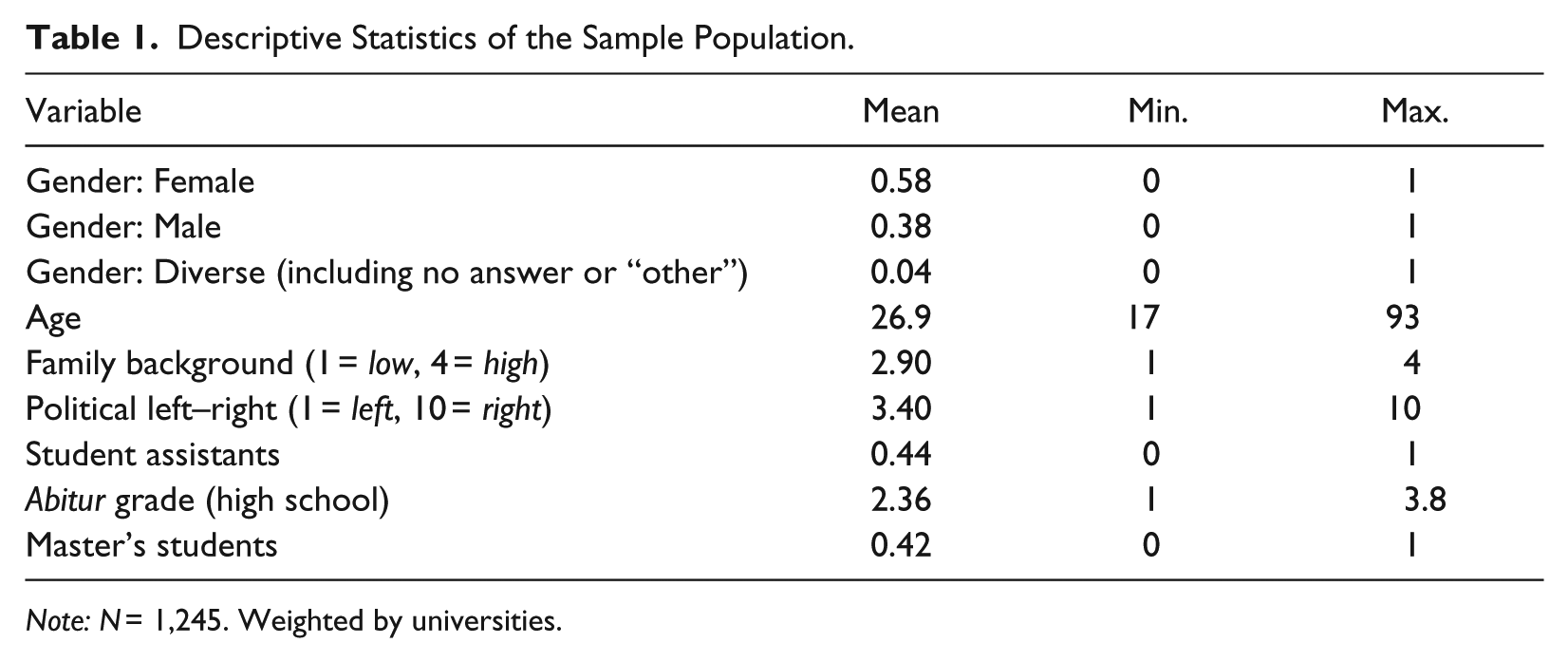
Note: N = 1,245. Weighted by universities.
Central dependent variables (what we refer to as theoretical and methodological preferences of the students) are (1) the frequently used theories (open question, coded as binary variables), (b) the knowledge and grading of 26 selected theories (by German school grades; we reversed coding in all analyses so that 6 = very good and 1 = insufficient), and (c) the frequently used empirical methods (six qualitative and six quantitative approaches, coded as binary variables).
To ensure the best possible regulation of any idiosyncratic distortion resulting from the personal perspectives of the researchers themselves, we first set an open question asking for the theories most often used during a respondent’s studies. It was only after this open question that we took the second step of providing the respondents with a list of sociological theorists. We derived this list from the standard introductory works used in German sociology: Klassiker der Soziologie (Kaesler 2006, 2007) and Aktuelle Theorien der Soziologie (Kaesler 2005). 2
We categorized the social background of the sociology students by following the methodological procedures of the social surveys of students in Germany by the Federal Ministry for Education and Research (BMBF). Based on the 19th social survey of students in Germany (BMBF 2010:563–65), the occupational class of the respondents’ parents (measured in 11 categories and including a further category of parents with a university degree) served as a proxy for social origin. Building on the parental class information, the students were assigned to one of four categories of social background: low, intermediate, high, and very high. Finally, we use a political left–right scale to depict the political spectrum (“In political matters, people talk of ‘the left’ and ‘the right.’ How would you place your views on this scale, generally speaking?” with 1 = left and 10 = right).
Data Limitations
Due to the survey distribution via snowball sampling, the survey does not meet the requirements of a random sample. Therefore, some differences between students in Germany, students of sociology in particular, and our sample should be acknowledged (Table 1). The proportion of women in the total student population in Germany in 2012 was 47.2 percent (BMBF 2013:50) and 59 percent in the subgroup of sociology students in winter term 2013–14, while it is 58 percent in our sample (information from the Federal Statistical Office). As a quite considerable number of 4 percent of our respondents made use of the option “no or other gender” (referred to in the following analyses as “diverse”), the proportion of men in the group is probably still below that of the totality of sociology students. The number of master’s students is significantly higher in our sample (42 percent compared to 15 percent of all students at German universities, while we have no official information on the share of master’s students among students of sociology).
A second issue concerns the university level. The participation varied strongly among universities. From our experience in the field, this is because not all departments were equally capable of contacting their own students. Accordingly, we had to weight the data to account for the differences in locations’ response rates. We estimated a weighting factor by dividing the known population by the sample population for each university. Regarding the small case numbers at the level of single universities, we restrict the analysis to the aggregate level.Despite these limitations, our data are unique and of high explorative value as we are not aware of any other study surveying scientific preferences of a student population in the specific discipline of sociology.
Results
The Formation of a Sociological Canon
In a heterogeneous and multiparadigmatic discipline, like sociology, it is indeed an open question if a consensual definition of a core is possible at all. The article at hand tackles this issue from the perspective of students. We find that irrespective of an agreement of the professionals of the field of academic sociology or a common definition of a canon or core, there is a de facto canon conveyed to the students via teaching. Given the data at hand, we aim at reconstructing precisely this de facto canon.
We distinguish between knowledge, usage, and evaluation (preference) of theories by students. At the very beginning of the survey, students had to name five theorists in an open text field whose theories they frequently use in their own term papers, essays, and the like. Here, Max Weber, Pierre Bourdieu, and Niklas Luhmann rank at the top of the list of widely used theories (Figure 1). Subsequently, the students were asked to evaluate the theories of 26 theorists (on a scale from 1 to 6) with the option to declare “I don’t know this theory.” In this regard, the theories of Pierre Bourdieu, Erving Goffman, Max Weber, Michel Foucault, and George Herbert Mead score highest on average. Particularly unpopular among German sociology students seem to be the theories of George Homans, Auguste Comte, and Herbert Spencer (see Figure A1 in the appendix).
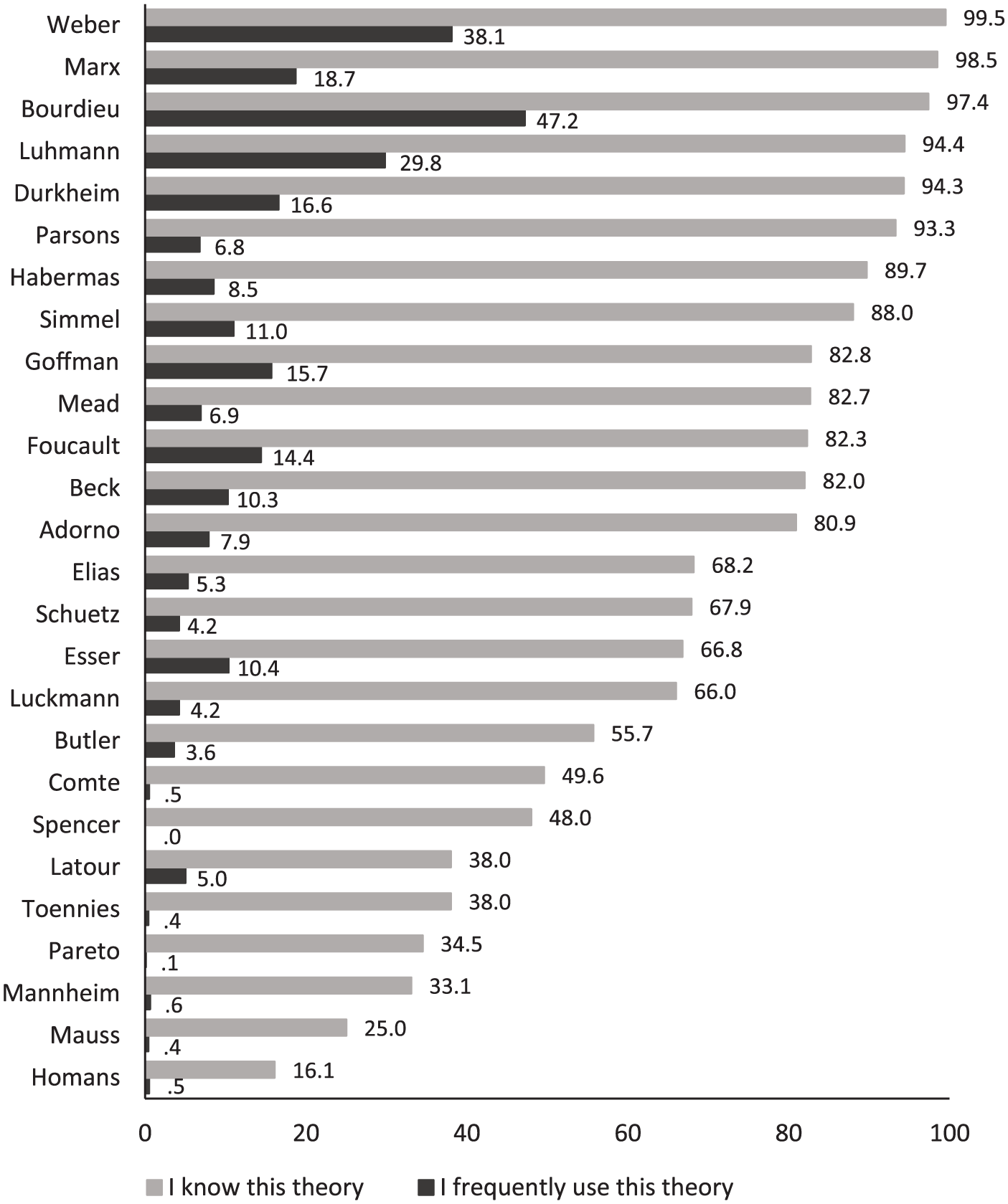
Knowledge and Use of Sociological Theories (in percentages).
Asking students to grade grand sociological theories definitely is a tough task, especially at the undergraduate level. Consequently, we do not assume that such evaluations represent adequate or “true” ratings of the theories. Rather we interpret the scores as a reflection of the teaching practices that nevertheless tell us something about how theories are subjectively perceived in an early phase of academic field socialization. Unsurprisingly in this context, there are quite considerable differences in the levels of familiarity with the various sociologists (Figure 1).
Some theorists, with recognition levels of over 90 percent, are clearly part of an indispensable de facto canon in German sociology: Weber, Marx, Bourdieu, Luhmann, Durkheim, and Parsons are prevalent, whereas a third or fewer students had ever heard of Vilfredo Pareto, Karl Mannheim, Marcel Mauss, or George Homans.
Yet, the formation of a sociological canon is not restricted to theory or themes. Rather, the prevalence of certain methodologies and specific empirical methods is important for the disciplinary identity as well as for the relation to other disciplines (including the degree of interdisciplinarity; for structural processes undermining sociological disciplinarity, see Haynes 2017).
The respondents were presented a list of 12 research methods for survey and analysis (six qualitative and six quantitative methods for both). They were then asked to select all methods (multiple answers possible) that they had already used in their studies. The 12 method variables are coded binary (applied/not applied) and thus do not reflect an evaluation of the methods. We construct four groups with different methodological approaches: students who work either (1) exclusively quantitatively or (2) exclusively qualitatively, (3) students who do not work empirically at all, and (4) students who have experience with both methodological approaches. The distribution is given in Figure 2, showing that the majority of sociology students in Germany have worked with both qualitative and quantitative methods. More than 1 in 10 students had done no empirical work in their studies at the time of the survey (13.8 percent). Although not fully comparable with the use of methods by professional sociologists (see Williams et al. 2017:14), these results seem to separate German sociology—with a rather strong theoretical focus and a quite equal use of quantitative and qualitative methods—from sociology in the United Kingdom, the Netherlands, and New Zealand.
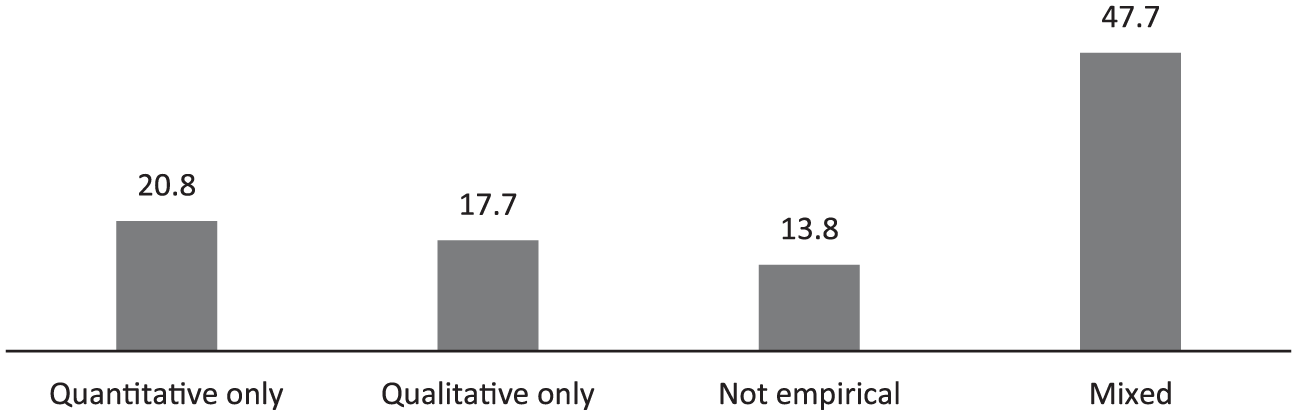
Typology of students using different methods (in percentages).
The students’ application of methods differs much more strongly by university than the use and evaluation of theorists. For example, the proportion of students who have, at least once, worked with regression analyses is 94 percent in Cologne and 93 percent in Mannheim (known as prominent locations for quantitative research in Germany) but only 7 percent in Augsburg (known for its qualitative focus). In contrast, discourse analysis is widely used in Augsburg, being mentioned by 71 percent of respondents there, whereas in Mannheim and Cologne it is entirely absent. Our data therefore provide further evidence of the particular heterogeneous structure in the application and teaching of research methods in German sociology (see Eifler, Hoffmeyer-Zlotnik, and Krebs 2015).
The Relation between Sociological Theories and Methods
The existence of a sociological canon does not tell anything about the internal structure of the relation between theories and methods. Such relations are of special interest as they indicate how certain path dependencies and schools of thought might emerge and be formed, sometimes already at the undergraduate level. On the other hand, the systematic exploration of proximity and distance among certain theories and methods might help to explain and improve the internal structure of curricula formation. Teaching staff certainly has an intuitive understanding of which theories and methods harmonize well in teaching practice and which do not. But we have only a crude empirical knowledge of how students actually perceive and adopt such relations.
To analyze these relations, we estimate a series of multinomial logistic regressions of the four methodological types (reference is quantitative methods) on the theoretical preferences, controlling for the level of the universities. We use methods as dependent variable for two reasons: First, we expect that students first come into contact with theories (e.g., in the introductory courses). Second, as around one fifth of the variation in methods is bound to the contextual level of universities, we use multilevel analysis (a generalized structural equation model) to control for the effects of the university level. Note that curricula for teaching research methods are not standardized in Germany, and students exhibit different degrees of freedom to choose the research methods they aim to learn. In a completely standardized curriculum of research methods, no such effects should occur.
The coefficients (relative risk ratios) are visualized in Figure 3 (category mixed is not displayed in the figure). From left to right, the first axis (F1) visualizes the increasing probability of not working empirically, compared to working purely quantitatively. The vertical axis (F2) plots the increasing probability of working purely qualitatively (upper plane), again compared to working purely quantitatively (lower plane).
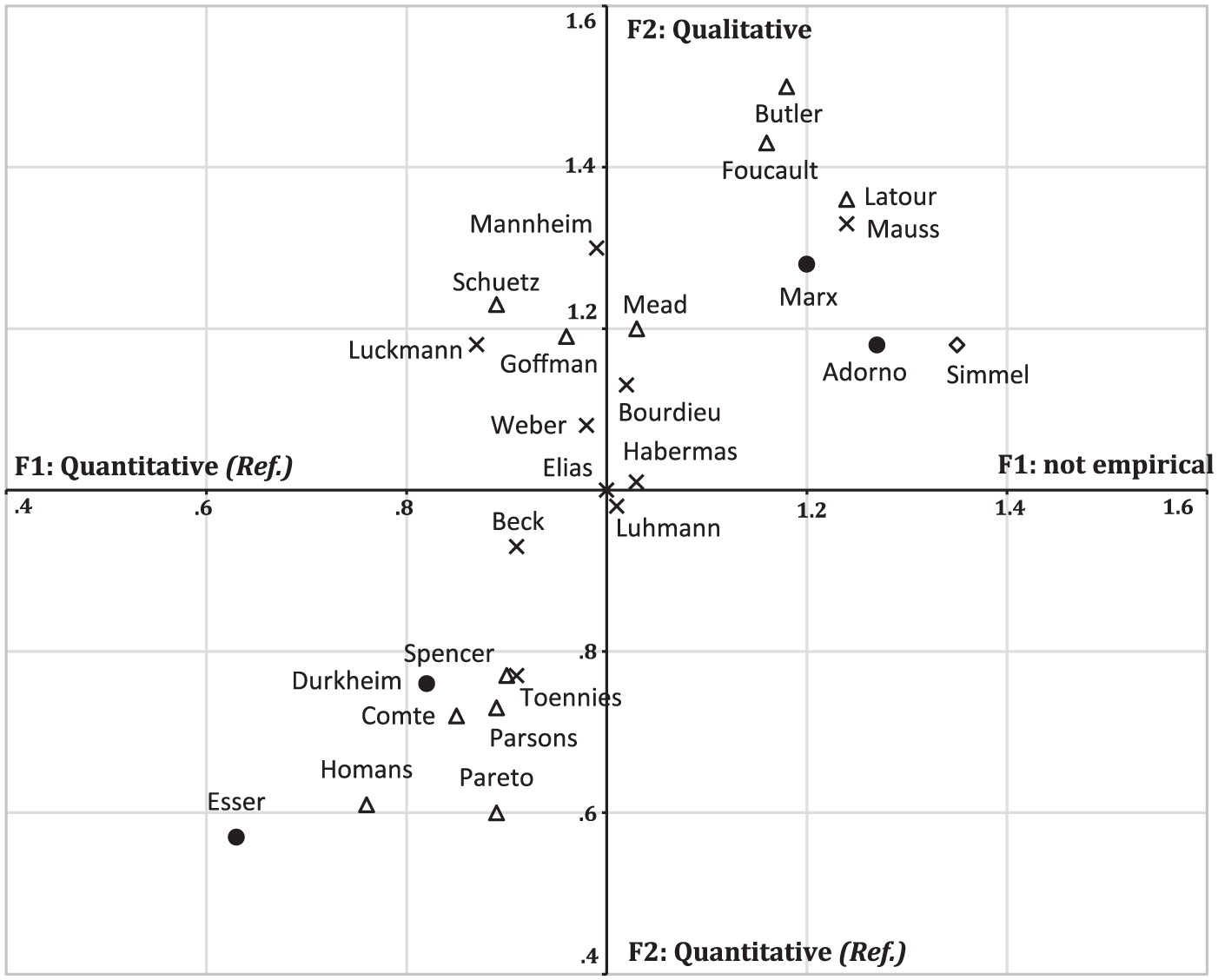
Relation between Sociological Theories and Methods.
A preference for Durkheim and Esser clearly increases the probability for working purely quantitatively, while a preference for Marx and Adorno indicates an aversion to quantitative methods in favor of both qualitative and nonempirical research.
In contrast, students who work purely qualitatively rather than purely quantitatively tend to favor Butler, Foucault, Goffman, Latour, Mead, and Schuetz. A positive assessment of Simmel, finally, is evidence of a general aversion to both qualitative and quantitative work. Our findings indicate that departments should also consider interdependencies and path dependencies between theories and methods in processes of curricula (re-)design (see Downey et al. 2019).
The Social and Political Structure of Sociological Knowledge
We explore the relationship between social characteristics (gender, age, family background, and abitur grade), political attitudes, and the preferences for theories and methods. While we identify only weak effects of social background (students from the highest level of family background show a stronger appreciation of Durkheim and Simmel), there are significant effects according to gender and political attitude. Female students seem to prefer Beck, Butler, Comte, Durkheim, Esser, Goffman, Mead, and Spencer. Regarding political attitude, we find statistical significant effects for 14 of the 26 theorists analyzed.
Figures 4 and 5 illustrate the b coefficients for gender and political attitude (the two variables contributing most explanatory power over all models) based on a series of multiple linear regressions of the theoretical preferences both for sociological “classics” (Figure 4) and for contemporary sociological theories (Figure 5). The explanatory power of the models (adjusted R²) is overall low—as expected, considering the fact that scientific preferences should be explained by scientific reasons, not by social and political characteristics—but varies quite strongly between the models. These results indicate that the preference for some theories is not explained by social and political characteristics (which is the case for Bourdieu, Elias, Habermas, Homans, Latour, Luckmann, Mannheim, Mauss, and Toennies), while the preference for others is explained significantly (especially in the case of Adorno, Butler, and Marx).
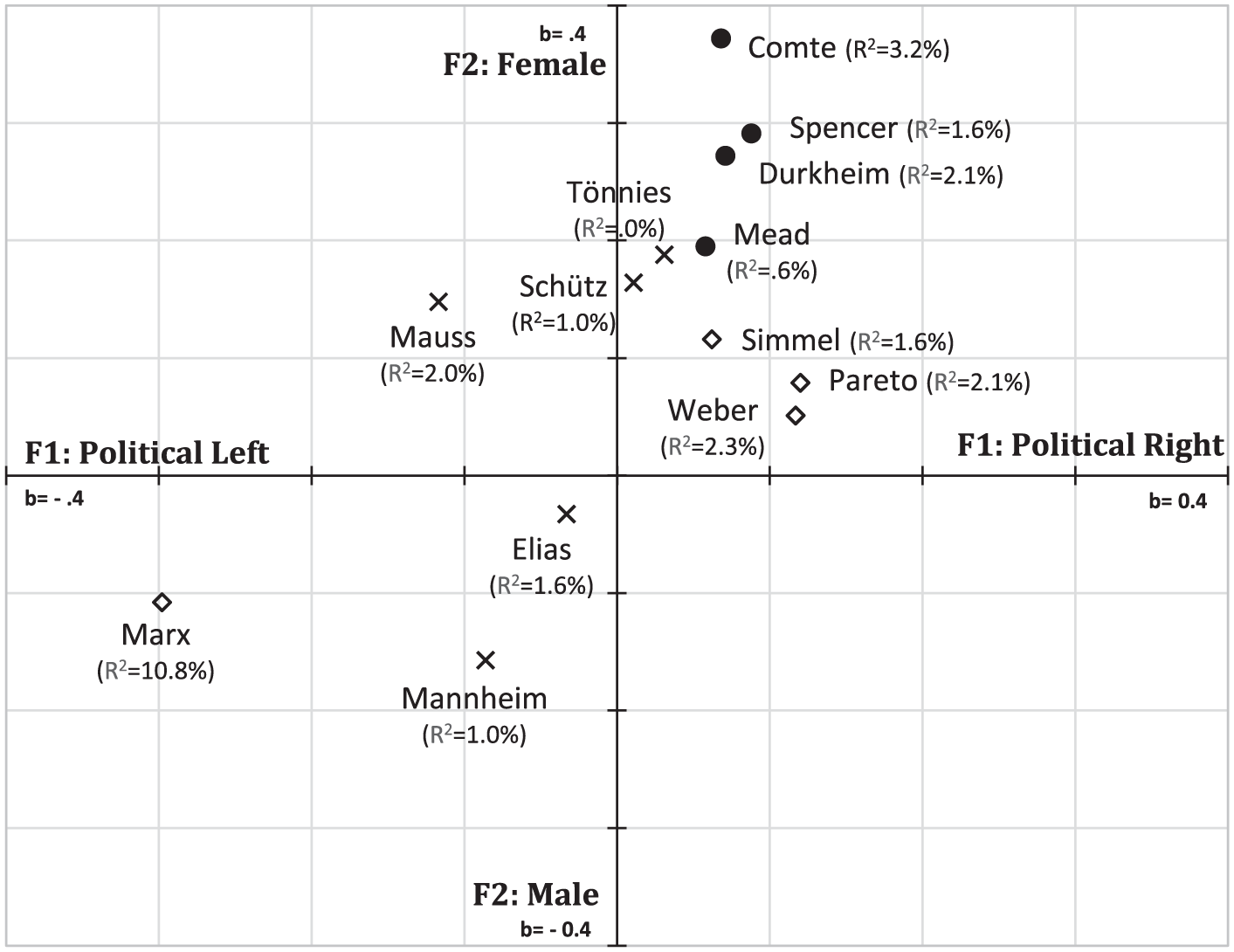
Preferences for Classical Theorists (Born before 1900) by Gender and Political Attitude.
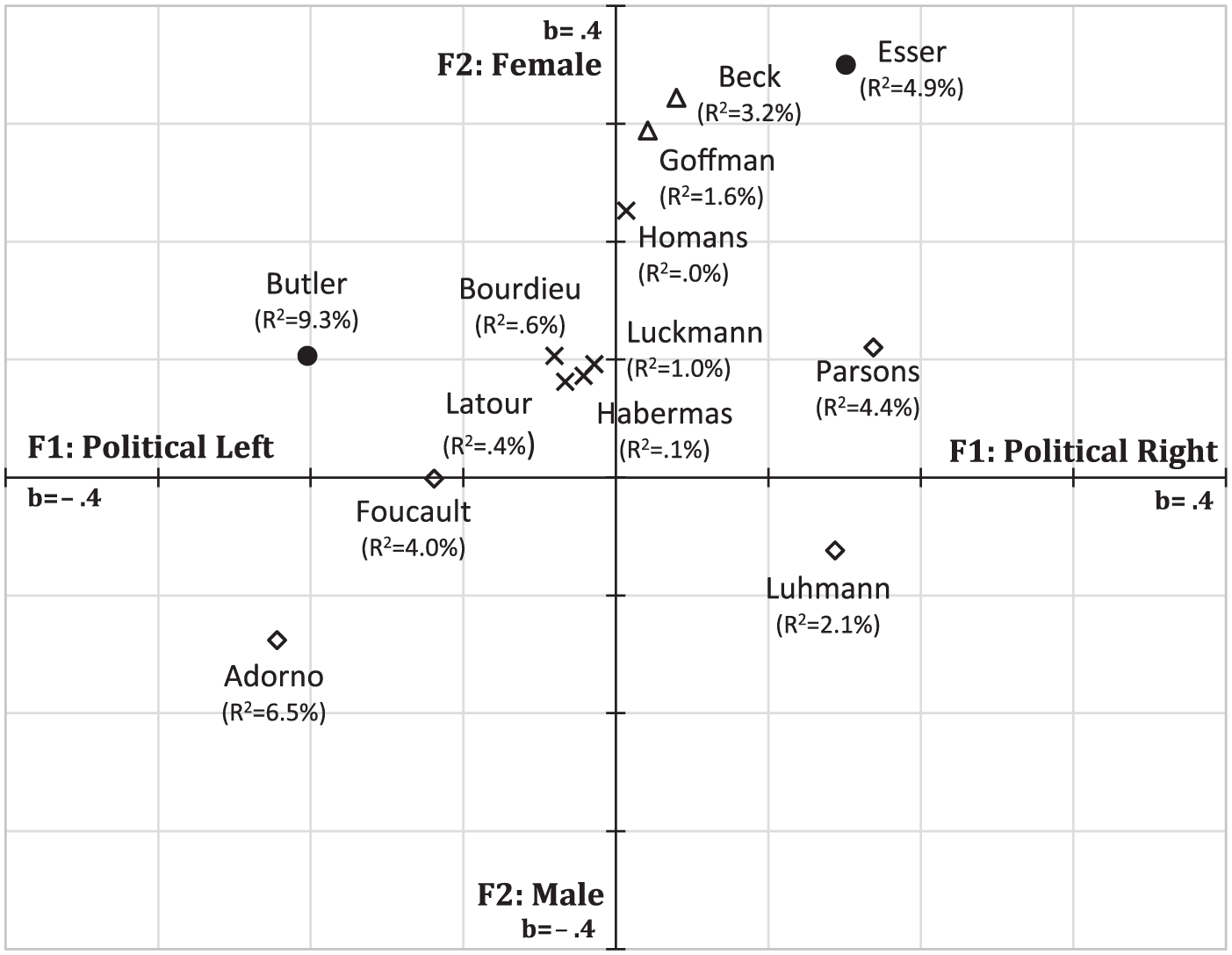
Preferences for Current Theorists (Born since 1900) by Gender and Political Attitude.
The figures show that left-wing students in general prefer Foucault, while male left-wingers tend to prefer Adorno and Marx and female left-wingers prefer Butler. A similar although more complicated picture emerges on the right side of the plane. Students who identify politically more centrist (“right”) tend to prefer the theories of Luhmann, Pareto, Parsons, Simmel, and Weber. Conservative females show a particular appreciation of Comte, Durkheim, Esser, Mead, and Spencer.Considering the fact that the majority of sociology students identifies as politically left (Ø = 3.4 on a scale from 1 = left to 10 = right) compared to the whole society (Ø = 5.02 for the German population according to the World Values Survey Germany 2013, see Ingelhart et al. 2014), we assume that the existing variation in the political self-identification of students indicates differences in the motivation of studying sociology. Students who rather self-identify as “politically right” might simply be more oriented to labor market success, while those who identify as rather “left” might be more interested in the normative idea of a good society and critical thinking. This underlying political structure of sociological knowledge should be considered when discussing the nexus between teaching methods, choosing majors, and labor market success of sociology students.
Conclusion
Based on data from surveys of sociology students in Germany, this article investigated three research questions and consequences for teaching sociology: (1) the existence of a de facto sociological canon, (2) the empirical relation between sociological theories and research methods, and (3) the influence of social characteristics and political attitude on the use of and preferences for theories and methods.
Regarding the sociological canon, we showed that there is indeed a core of theories, including especially Max Weber, Pierre Bourdieu, and Niklas Luhmann, that are frequently used at sociology departments in Germany. The theories of Marx, Durkheim, and Parsons are well known but not the most popular among students, who prefer Goffman, Foucault, and Mead (which seem not to be dominant in the curricula). On the level of empirical methods, we find a majority of students who at least came into contact with both qualitative and quantitative methods (with significant variation among the university locations). As we are not sure if these findings indicate a special situation in German sociology or if a similar pattern would emerge in other national sociologies, we hope to encourage investigations in international comparison. Although we do not demand to standardize curricula in sociology in general (cf. Ferguson 2016), we do think that highly specialized locations should communicate the local deviations from the national (or international) canon clearly to their (potential) students.
Second, we find that certain sociological theories and empirical methods are tied together empirically. In discussions about teaching methodology courses, this issue of possible path dependencies between teaching theories and applying methods is not systematically recognized so far (and vice versa). Again, it needs to be explored whether these relations are similar in other countries, especially in those with a more standardized teaching of research methods. The process of curricula (re-)design (see Downey et al. 2019) should reflect the fact that any specialization in theories or methods possibly influences the perception and choice of other theories and methods at a later stage.
Finally, the influence of social and political characteristics illustrates the low autonomy of sociology as an academic discipline, especially with regard to the political field (Bourdieu 1991). It indicates that the motivation of sociology students might differ especially by political attitude, influencing their motivation for studying sociology and labor market orientation. There is nothing wrong with these individual choices. But it again highlights the importance to provide a broad and comprehensive curriculum especially at the undergraduate level to facilitate a well-informed and object-related choice of adequate theoretical and methodological approaches.
Footnotes
Appendix
Editor’s Note
Reviewers for this manuscript were, in alphabetical order, Diane Pike, Suzanne Hudd and Ed Munoz.