



Abstract
Most US churches are non-affirming toward the lesbian, gay, bisexual, transgender, queer or questioning and more (LGBTQ+) communities, but a few have developed affirming theologies. We investigate the causal link between church messages and imagery on the expectation that queer Christians would feel accepted in a church. We designed two church websites with affirming and non-affirming theology. We hypothesized that queer Christians who examined an affirming church website would feel a greater sense of church acceptance than those who viewed a non-affirming church website. Queer Christians evidenced significantly greater expectations that they would be accepted when viewing the affirming church website than when viewing the non-affirming website. Exploratory analyses examined how these websites affected straight Christians. Straight Christians did not differ significantly between the two conditions but showed a trend toward greater feelings of acceptance by the affirming church. Therefore, when finding a church, symbols rooted in affirming theology welcome LGBTQ+ and straight Christians more than those rooted in non-affirming theology.
Baumeister and Leary (1995) proposed belongingness as a basic human need. Defined as unconditional social acceptance, they argued that the need to belong reflects an innate capacity for humans to form and maintain at least a minimum quantity of interpersonal relationships to sustain their biopsychosocial wellbeing. Because their theory presented belongingness as a motivator, they also predicted that the lack of belongingness has affective consequences such as stress, depression, and suicidality. Moreover, they proposed that a person must first believe they are loved, liked, and cared for to feel like they belong. Their theorized need to belong might be applied to churches; by providing a community that communicates belonging, a church might help fulfill a basic psychological need, and when this need is unmet a person may be at increased risk of psychological distress.
This sense of belonging can be achieved both in physical spaces and internet-based digital ones, through language and symbols. Youkhana’s (2015) work on the concept of Space-Sensitive Belonging accentuated how belongingness is facilitated through language and images in specific socio-spatial contexts. She defined Space-Sensitive Belonging as fluid, context-specific processes set in motion by ongoing meaning-making “between people and things, and between people and people, through material conditions” (p. 16) such as culture, religious practices, and technology. Among other places and institutions, she examined the ways a church can provide a religious space in which shared meaning-making between humans, language, and symbols can lead to a sense of belonging.
Religious spaces have played an important role for communities throughout time, and this is also true for lesbian, gay, bisexual, transgender, queer or questioning and more (LGBTQ+) communities. Research has shown that a majority (59%) of LGBTQ+ people are religiously affiliated, and 48% of them identify as Christian (Stern & Wright, 2018). As would be predicted by Baumeister and Leary’s (1995) theory, the need to belong motivates LGBTQ+ Christians to find a church home, but for them to feel like they belong in churches and experience positive psychological consequences, they must believe that the church cares about their welfare and loves them. In the United States, it is difficult for LGBTQ+ Christians to find a church home, since the majority of churches in the United States are non-affirming or do not welcome LGBTQ+ people into all aspects of congregational life or all sacraments (e.g., marriage, leadership, communion; Lewis, 2015). When LGBTQ+ people sense conditional acceptance from churches, many can disconnect. To set realistic expectations when looking for a church home, many LGBTQ+ Christians rely on a church’s internet presence, such as a social media page or website, to filter churches and determine if a church is “LGBTQ+ affirming” and would fully accept them into all aspects of congregational life (Lewis, 2015).
In the United States, the full versus partial acceptance of LGBTQ+ people in Christianity is a hotly debated topic in churches, yet the majority of churches are non-affirming toward the LGBTQ+ community. According to Gushee (2017), all major branches of Christianity have, at some point in their history, used a non-affirming lens to condemn LGBTQ+ relationships and gender identities. One is hard-pressed to “find many dissenters to this tradition as it has been grounded in knowledge sources at the very center of Christianity: scripture, tradition, and the leaders of the church, generation after generation (Gushee, 2017, p. 141).”
This has led to a systematic exclusion of LGBTQ+ identities and relationships in churches, and until recently “few Christians wanted to be seen as too cozy with LGBTQ+ people, for fear of sharing in their moral taint and losing the support of their own family and friends (Gushee, 2017, p. 141).” In fact, research has demonstrated that Protestant Christians, who comprise the majority of US Christians, have higher levels of rejection toward LGBTQ+ people than people in most other global religions (Janssen & Scheepers, 2019; Newport, 2017; Poushter & Kent, 2020). This historic consensus has cemented non-affirming theology as the default approach of interacting with LGBTQ+ Christians in the majority of US churches, leading Christian leaders in the United States to be silent or neutral on their position toward LGBTQ+ people, for fear of losing financial support from conservative church members who threaten to withhold donations for even thinking otherwise (Gushee, 2017). So, as memberships of progressive churches (which are more likely to affirm LGBTQ+ people into all aspects of congregational life) decrease and those of more conservative churches increase (Janssen & Scheepers, 2019), LGBTQ+ Christians may have a harder time finding an inclusive church home that would be welcoming and affirming of their identities.
The dominant presence of non-affirming churches is concerning for several reasons. For example, LGBTQ+ youth who lived in counties with a greater concentration of non-affirming churches experienced increased instances of alcohol abuse and more sexual partners than LGBTQ+ youth who live in counties with affirming churches (Wolff et al., 2016). Levy and Reeves (2011) also found that teenagers who had to conceal or subvert their same-sex attraction by increasing their church participation in fact were more likely to experience an increase in psychological distress. These findings have two important implications. First, churches play a role in the wellbeing of LGBTQ+ people, regardless of whether these churches intend to do so. Second, non-affirming theology contributes to lower self-esteem, higher psychological distress, and increased health risk behaviors such as excessive drinking in LGBTQ+ youth that can last a lifetime—the opposite of what many non-affirming Christian leaders claim to want for LGBTQ+ Christians (Sowe et al., 2017). Therefore, if churches want the LGBTQ+ community to flourish physically, psychologically, and spiritually, non-affirming theology falls short on many levels.
When looking for a church, LGBTQ+ people often avoid non-affirming churches, since the theology held by these churches often leads to negative psychological health outcomes. For example, Subhi and Geelan (2012) demonstrated that same-sex attraction and Christianity were linked with poorer emotional wellbeing, alienation, and guilt, in comparison to straight Christians. Moreover, LGBTQ+ people who cared most about their religion were more likely to have suicide ideation (Levy & Reeves, 2011; Lytle et al., 2018; Szymanski & Carretta, 2020). These negative mental health outcomes can be explained in part by heteronormative stances on gender and sexual identity. As a result of these stances, LGBTQ+ Christians at these churches are often excluded from formal church roles, encouraged to be celibate, or pressured to seek reparative therapy (Lewis, 2015). However, research has shown that religiously based efforts to change sexual orientation are not long-lasting and have been linked to riskier sexual activity, psychological trauma, depression, anxiety, feelings of abandonment, ostracization, and suicidality (Freeman-Coppadge & Horne, 2019; Sherry et al., 2010; Stern & Wright, 2018).
This same attitude of rejection from non-affirming churches also holds true for transgender and gender-expansive people. In a systematic review of the relationship between religion and feelings toward people who are not cisgender, Campbell and colleagues (2019) found that people who took a literal approach to reading and interpreting the Bible, participated in church services frequently, and had religious fundamentalist attitudes also had elevated levels of transphobia. So, many LGBTQ+ Christians experience significant psychological distress in these non-affirming spaces.
Churches also inflict psychological distress on LGBTQ+ people through their non-affirming messages and imagery. For example, when an LGBTQ+ Christian hears negative messages about their LGBTQ+ identity (i.e., “Being gay is a sin,” “Marriage is only acceptable between a man or woman”), they are more likely to experience internalized homophobia (Barnes & Meyer, 2012; Boppana & Gross, 2019). Internalized homophobia occurs when an individual loathes their queer identity as a result of negative messages that they hear and see from those around them. This internalized homophobia hinders the successful integration of an LGBTQ+ Christian’s faith, gender, and sexual identities, causing individuals to experience internal conflict, resulting in higher levels of depression, lower self-esteem, and alienation (Kocet et al., 2012; Moscardini et al., 2018; Page et al., 2013; Sherry et al., 2010).
Anti-LGBTQ+ messages have broad negative impacts beyond the LGBTQ+ community. Sowe et al. (2017) found that anti-gay religious exposure not only significantly affects LGBTQ+ persons attending non-affirming churches, but also straight Christians. They attributed this to the fact that strict gender and sexual categorizations may create hostile environments that oppress people of all sexual orientations and genders. Therefore, non-affirming church messages may not just be detrimental to LGBTQ+ people but also to straight people. Since Christianity is important for many LGBTQ+ people and many seek space-sensitive belonging to meet a basic human need, affirming ecclesiastical messaging and representation is important for fully welcoming LGBTQ+ Christians.
Consistent with the theory of the need to belong, researchers have found that affirming churches are beneficial to LGBTQ+ Christians because they decrease homonegativity and foster positive messages about LGBTQ+ Christian’s faith, gender, and sexual identity (Hamblin & Gross, 2014; Lewis, 2015). For example, LGBTQ+ people who heard fewer negative messages about their queerness were more likely to develop an accepting sense of both their faith and queer identities (McCann et al., 2020; Sherry et al., 2010). Other researchers found that queer-affirming religious activities empower LGBTQ+ people because they alleviate internal challenges between a person’s sexual, gender, and religious identities, enabling the easier integration of these aspects of identity and psychological growth (Gattis et al., 2014; Sherry et al., 2010; Stern & Wright, 2018). Ghazzawi et al. (2020) found that transgender people who had a supportive family and religious space had higher levels of resilience and faith integration. A reconciliation of LGBTQ+ people’s faith and sexual identity was shown to empower them to have an accepting view of themselves (Kocet et al., 2012), and LGBTQ+ Christians who are able to develop a positive view of their faith and queer identities experience less stress related to faith, gender, and sexual identities (Page et al., 2013).
While research shows that affirming theology helps LGBTQ+ Christians the most, little empirical research has been done in the field of psychology on the type of theological messages and imagery that signal to LGBTQ+ Christians that they would belong in a church, especially in a digitalized world. For example, in the architectural field, Mortorff (2020) studied the designs that signal to LGBTQ+ Christians that they would feel accepted since he found no literature on welcoming architectural designs specific to LGBTQ+ people. Through focus groups and church interviews in Buffalo, New York, he found that LGBTQ+ inclusive icons (e.g., Pride Flag, Human Rights Campaign stickers), accessibility for people with disabilities, and groomed landscaping were all perceived as welcoming for LGBTQ+ participants when evaluating a potential church home. This sentiment was confirmed in a focus group with members of Free Churches in Sweden, a general movement that includes the Evangelical Free Church, the Salvation Army, and others (LGBTQ in the Church of Sweden, 2022). Researchers found that LGBTQ+ Christian participants in Sweden looking for a church home relied on the Pride flag, links to Ecumenical Groups for Christian LGBTQ People (an inclusive church network in Sweden), and a Rainbow Certification (a certificate from the Church of Sweden that certifies a church includes LGBTQ+ people into all aspects of congregational life) to find a church home.
The inclusion of LGBTQ+ symbols on church websites is important for denoting inclusion in the digitalized world. Youkhana’s (2015) work on space-sensitive belonging provides a framework for understanding how church websites are an extension of the values and beliefs of churches (i.e., affirming versus non-affirming theology) and the language and images used on these websites—whether affirming or non-affirming—facilitate a sense of belonging or alienation for LGBTQ+ people. She highlighted how online spaces are valuable mediums for studying belonging since they represent a social reality; therefore, they can help researchers study the process of belonging through symbols and representations that embody different ideologies.
Through this lens, language and imagery on a website can play a crucial role in convincing LGBTQ+ people that a church accepts them unconditionally and cares about their welfare. Symbols in specific contexts play a role in co-constructing belonging/disbelonging with other humans and reality (Carlström, 2022). While some would argue inclusive symbols such as a Pride flag can be superfluous because the inclusion of LGBTQ+ people and their relationships has increased in high-income countries, Wasshede (2021) argued that these symbols gain even more meaning and are empowering in contexts where heteronormative structures exist and work to exclude LGBTQ+ people. A prime example is Chaze and colleagues’ (2019) exploratory research evaluating long-term care homes (LTCH) websites for older LGBTQ+ adults in Ontario, Canada. Given the lack of LGBTQ+ visibility on over 103 websites, the authors concluded it is crucial for LTCHs to display LGBTQ+ inclusiveness on their websites since acknowledging LGBTQ+ older adults’ sexual orientation and gender identities can help older LGBTQ+ adults looking for LTCH to belong. This study and Wasshede’s (2021) argument of symbols being contextualized highlight the importance of websites as a medium through which LGBTQ+ people determine their belonging in different organizations. Because it has been found that around 30% of Christians found their church online and 77% considered the website an important factor in their choice, research suggests that adding queer-inclusive symbols can help LGBTQ+ Christians find church homes and combat Christianity’s heteronormativity (Hutchings, 2010; Wasshede, 2021).
The use of inclusive LGBTQ+ symbols can especially help Black and Brown LGBTQ+ Christians in finding a church home. Black and Latinx LGBTQ+ people are more likely to participate in traditional or non-affirming churches. At the same time, Black and Latinx individuals evidence the highest levels of internalized homophobia (Lassiter et al., 2017). Since Historically Black Churches (HBC) and Latinx congregations have been a communal support system for individuals who face racism and xenophobia, it is important for spaces to exist where Black and Latinx individuals feel their racial, ethnic, sexual, and gender identities affirmed. For example, affirming churches may be good starting places for the positive wellbeing of Black LGBTQ+ people (Walker & Longmire-Avital, 2013). LGBTQ+-affirming HBCs can even serve as a safety net for Black LGBTQ+ people who live with HIV/AIDS by providing a community for queer Black Christians who need emotional, social, and economic support (Lewis, 2015; Smith et al., 2017).
In view of the positive relationship between affirming churches, messages, and imagery and the overall positive mental health of LGBTQ+ Christians, we decided to test this relationship experimentally. Given there exists little research on what constitutes affirming and non-affirming church messages, and most research is either qualitative or quantitative but not generalizable to a greater audience, we devised an experiment to measure the effect of non-affirming and affirming church messages on the feelings of acceptance of US LGBTQ+ Christians through church websites we created for this study. We decided to use these church websites as a proxy for the views that non-affirming and affirming churches held, allowing us to manipulate church websites’ messages and measure their impact on LGBTQ+ Christians versus straight Christians. We hypothesized that LGBTQ+ Christians would evaluate a church as being more likely to accept them if they examined the affirming church website than if they examined the non-affirming website. In addition to this hypothesis-driven research question, we conducted exploratory analyses for straight Christians, to examine whether the affirming or non-affirming website would affect their sense that the church would accept them. We reasoned that it would be possible that straight Christians might actually feel marginalized or alienated by overtly LGBTQ+ imagery, but we also recognized the possibility that straight Christians would not be affected by the presence or absence of inclusive imagery.
Methods
Procedure
Experimental stimuli
To measure the effect that affirming and non-affirming church messages have on the sense that LGBTQ+ and straight Christians would feel accepted, we constructed two church websites for this experiment. The messages that appeared on the affirming and non-affirming church websites were modeled after real-life church examples of affirming and non-affirming church websites throughout South Carolina. Moreover, we sought the advice of a religious leader familiar with affirming and non-affirming churches to validate the messages displayed on both websites. These two websites may be viewed at https://tinyurl.com/AffirmingCondition (i.e., the affirming version) and https://tinyurl.com/NonaffirmingCondition (i.e., the non-affirming version).
Only five elements differed between the two church websites. First, the picture and message on the landing page differed between the affirming and non-affirming churches. Specifically, the affirming church had a Pride flag and an inclusive welcoming message, whereas the non-affirming church had a picture of a Bible and no mention of the LGBTQ+ community. Second, throughout the affirming church website, congregational leaders displayed their pronouns alongside their names, and a box on the contact page invited interested visitors to specify their gender pronouns. No pronouns were displayed on the non-affirming church website. Third, to elevate an emphasis on Biblicism that is often characteristic of traditional churches, the non-affirming church website cited several scriptures in the church’s mission statement (Rouse, 2021). In contrast, the affirming church’s mission statement emphasized principles of inclusion without specific Biblical texts. Fourth, the affirming church had an LGBTQ+ ministry for queer members and allies, while the non-affirming church had a family ministry for dads and moms. Last, the affirming church participated in a Pride event in June, whereas the non-affirming church participated in an Independence Day event in July.
Initial screening survey
An initial screening survey was created to be administered in the MTurk platform. MTurk is an online platform that allows people to hire MTurk Workers for brief tasks. Previous research has shown that this can be used as a source of gaining psychometrically strong research data when best practices are followed (Rouse, 2015). This survey was intended to identify individuals who prequalified for the student by self-identifying as Christian, and then to divide qualified participants between those who identified as members of the LGBTQ+ communities or who identified as straight, so the survey only asked for age, gender, religious affiliation, and sexual orientation, and Workers were paid US$0.02 for completion of this survey. Out of the 2,000 MTurk Workers who completed the survey, 505 identified as straight Christians and 148 identified as LGBTQ+ Christians. Of these, 253 straight Christians were randomly prequalified for the Affirming Church condition and 252 straight Christians were randomly prequalified for the Non-affirming Church condition. Similarly, the LGBTQ+ Christians were randomly prequalified for either the Affirming Church or the Non-affirming Church condition, with 74 in each prequalified group.
Experimental surveys
Four versions of a survey were created to be administered within the MTurk platform. First, each survey began by presenting Informed Consent information.
Second, each version then asked for demographic information regarding age, race, and ethnicity (which used a forced-choice format but allowed participants to select as many relevant racial or ethnic identifiers as applied), gender (which used a forced-choice format), socio-economic status (which used a self-rated scale from 1 to 9, with 1 anchored as Lower and 9 anchored as Upper), religious affiliation (which used a forced-choice format but allowed participants to select as many relevant religious identifiers as applied), and sexual orientation (which was assessed in free-response format).
Third, the survey instructed respondents to spend at least 5 minutes examining a website. Two of the versions (one for prequalified LGBTQ+ Christians and one for prequalified straight Christians) provided a link to the website for the affirming church, but the other two versions (one for prequalified LGBTQ+ Christians and one for prequalified straight Christians) provided a link to the website for the non-affirming church.
Fourth, each survey presented a modified version of the Feelings of Church Acceptance Scale (FCAS; Valen & Graham, 2023), which includes 32 Likert-type items to assess four different dimensions of church acceptance. These include Lack of Judgment (LJ; with eight items such as “I do not feel criticized when at my church”), Positive Nature (PN; with eight items such as “My church’s congregation is kind to me”), Emotional Support (ES; with eight items such as “Other church members support me when going through difficult times”), and Feelings of Inclusion (FI; with eight items such as “My role in church is acknowledged by other church members”). These four scales can be averaged together for a general FCAS score. In addition to these 32 items, two additional items assess Church Teaching and Values (CTV; such as “I believe my church’s teachings help me grow as a person”), but these are not included in the FCAS score. Valen and Graham reported internal consistency estimates of .96 (FCAS), .81 (LJ), .85 (PN), .92 (ES), and .87 (FI); they also reported a correlation of .56 between the two CTV items. A modified version of the scale was used, in that the language was changed from referring to the respondent’s church to referring to the church represented by the website. For example, “I do not feel criticized when at my church” was changed to “I would not feel criticized when at this church.”
Fifth, each survey included an Opt-In or Opt-Out question, as recommended by Rouse (2015).
Data collection
After this study was designated “exempt” by the Seaver College Institutional Review Board (Protocol #20-12-1494), we launched the four different forms of the survey. Because we anticipated that the survey could be completed in 10 minutes, we set the payment rate at US$2.00, for an effective payment level of US$12/hour (in keeping with local minimum wages). Using G*Power 3.1.9.2, an a priori power analysis suggested a target sample size of 210 participants (with an anticipated effect size of .25, a significance level of .05, power of .95, a numerator df of 1, and four groups); we decided to seek a sample of 240 participants, with 60 prequalified participants for each group. 1
Participants
For this study, the participants’ ages ranged from 18 to 70 years old. The median age for our sample was 34 years old (M = 37.12, SD = 12.50). Our sample included individuals who self-identified as Female (54.0%), Male (44.0%), Nonconforming (1.0%), Transgender Female (0.5%), and Transgender Male (0.5%). The socioeconomic status of our participants ranged from Lower (1) to Upper (9), with the median income level being Middle (5). Our sample included participants who self-identified as Catholic (37.8%), Baptist (17.2%), Other Christian group (11.0%), Methodist (8.6%), Presbyterian (6.2%), Church of Christ (4.8%), Lutheran (4.3%), Episcopal (2.4%), Latter Day Saint (1.0%), Nothing in Particular (1.0%), Nondenominational (0.5%), and Unitarian (0.5%); since participants were allowed to select all identifiers that apply to them, the total exceeded 100%. While all participants identified as Christians, a number of participants also identified as Agnostic (3.3%), Atheist (1.0%), and Buddhist (0.5%) in addition to their Christian self-identification.
Participants self-identified their sexuality in the following ways: Heterosexual/Straight (59.9%), Bisexual (16.3%), Gay (7.9%), Lesbian (6.4%), Asexual (3.5%), Pansexual (2.5%), Queer (1.5%), Bisexual but Very Fluid (0.5%), Mostly Straight (0.5%), Questioning (0.5%), and Straight Leaning Bisexual (0.5%). In addition, our sample incorporated participants who self-identified as European American or White (65.9%), African American or Black (10.6%), Asian American (7.7%), Latina or Latino or Latinx (3.9%), Other or No Answer or Prefer not to Answer (3.8%), Hispanic (3.4%), Native American or Indigenous American (2.9%), Middle Eastern or North African (1.0%), and Hawaiian or Pacific Islander (1.0%).
Results
All analyses were performed using SPSS version 27.0.
Descriptive statistics for the FCAS are presented in Table 1. Because of the high intercorrelations among the subscales, we decided to only use the total score, as repeating the analyses for each subscale would likely result in redundancy.
Descriptive Statistics and Scale Intercorrelations for the Feelings of Church Acceptance Scale.
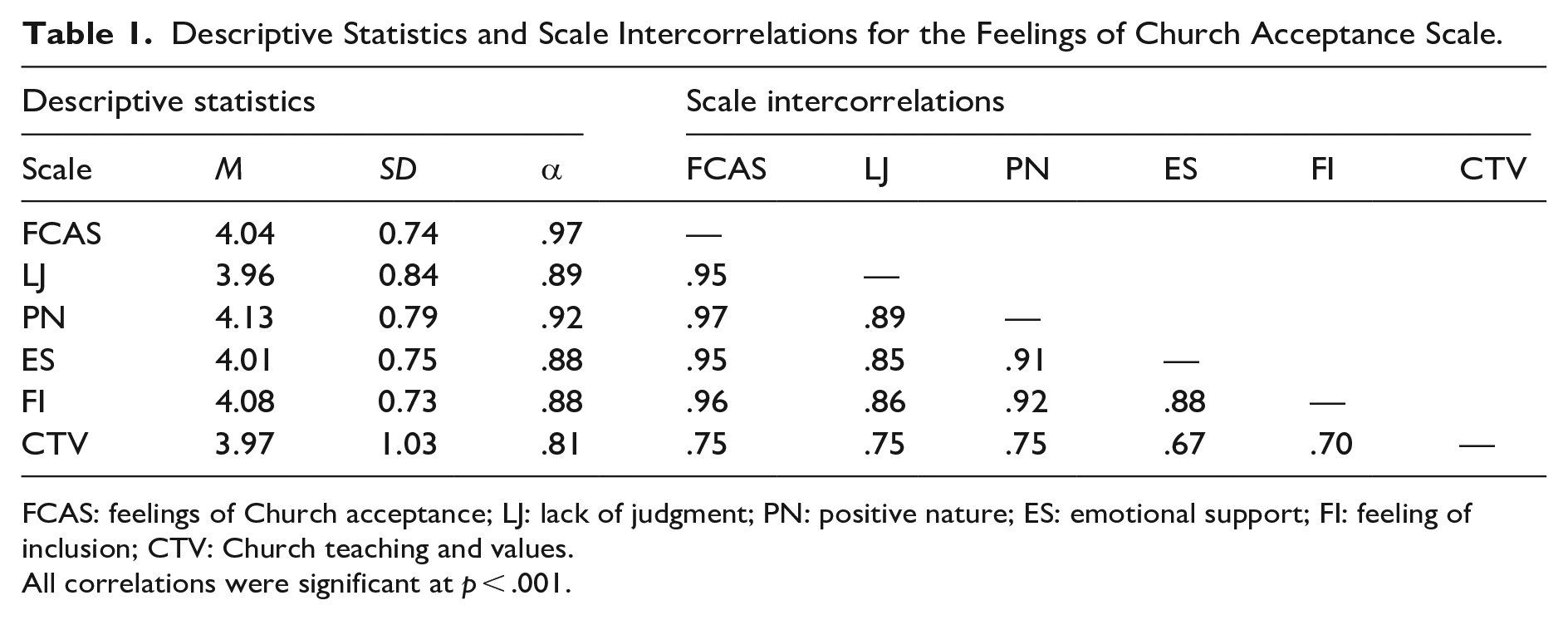
FCAS: feelings of Church acceptance; LJ: lack of judgment; PN: positive nature; ES: emotional support; FI: feeling of inclusion; CTV: Church teaching and values.
All correlations were significant at p < .001.
A 2 × 2 factorial analysis of variance (ANOVA) was performed to determine the extent to which the affirming and non-affirming church websites affected scores on the FCAS scale (M = 4.04, SD = 0.74). Means and standard deviations are presented in Table 2 and Figure 1. The overall model was statistically significant, F(3,196) = 10.57, p < .001, η2 = .14. The main effect for the website condition (i.e., affirming and non-affirming church website) was statistically significant, F(1,196) = 25.87, p < .001, η2 = .12, with Christians having higher mean scores when shown the Affirming church website than the non-affirming website. The main effect for group identification (i.e., LGBTQ+ Christian or straight Christian) was not statistically significant, F(1,196) = 2.36, p = .13, η2 = .01, suggesting that, on average, LGBTQ+ Christians and straight Christians were comparable in their general responses to church websites. Finally, the interaction effect was statistically significant, F(1,196) = 8.11, p = .005, η2 = .04, illustrating that FCAS scores from both LGBTQ+ Christians and straight Christians depend on the church website they view.
Scores of LGBTQ+ and Straight Christians on the Feelings of Church Acceptance Scale.
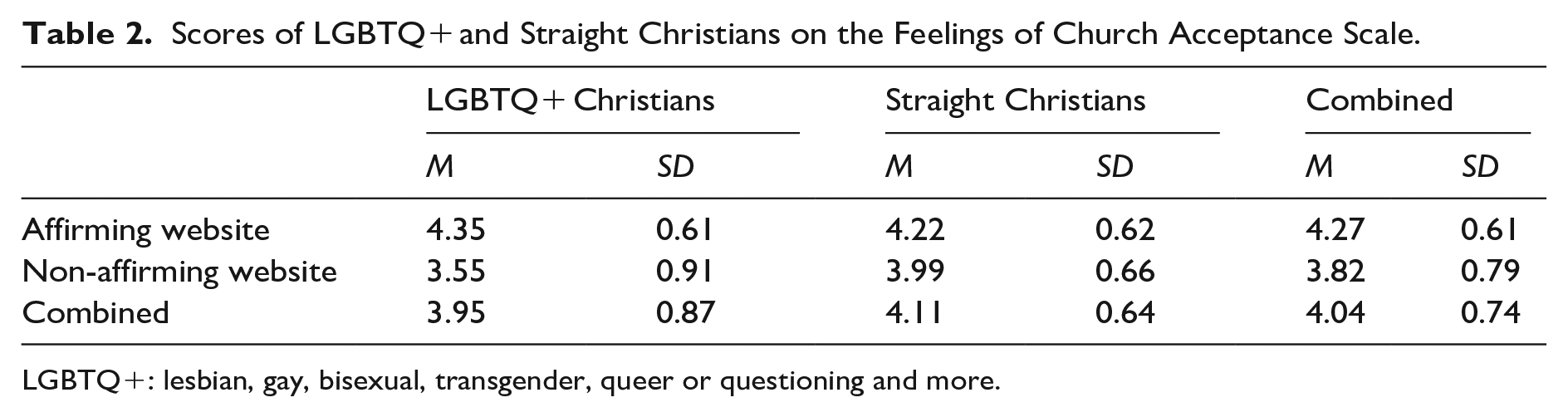
LGBTQ+: lesbian, gay, bisexual, transgender, queer or questioning and more.
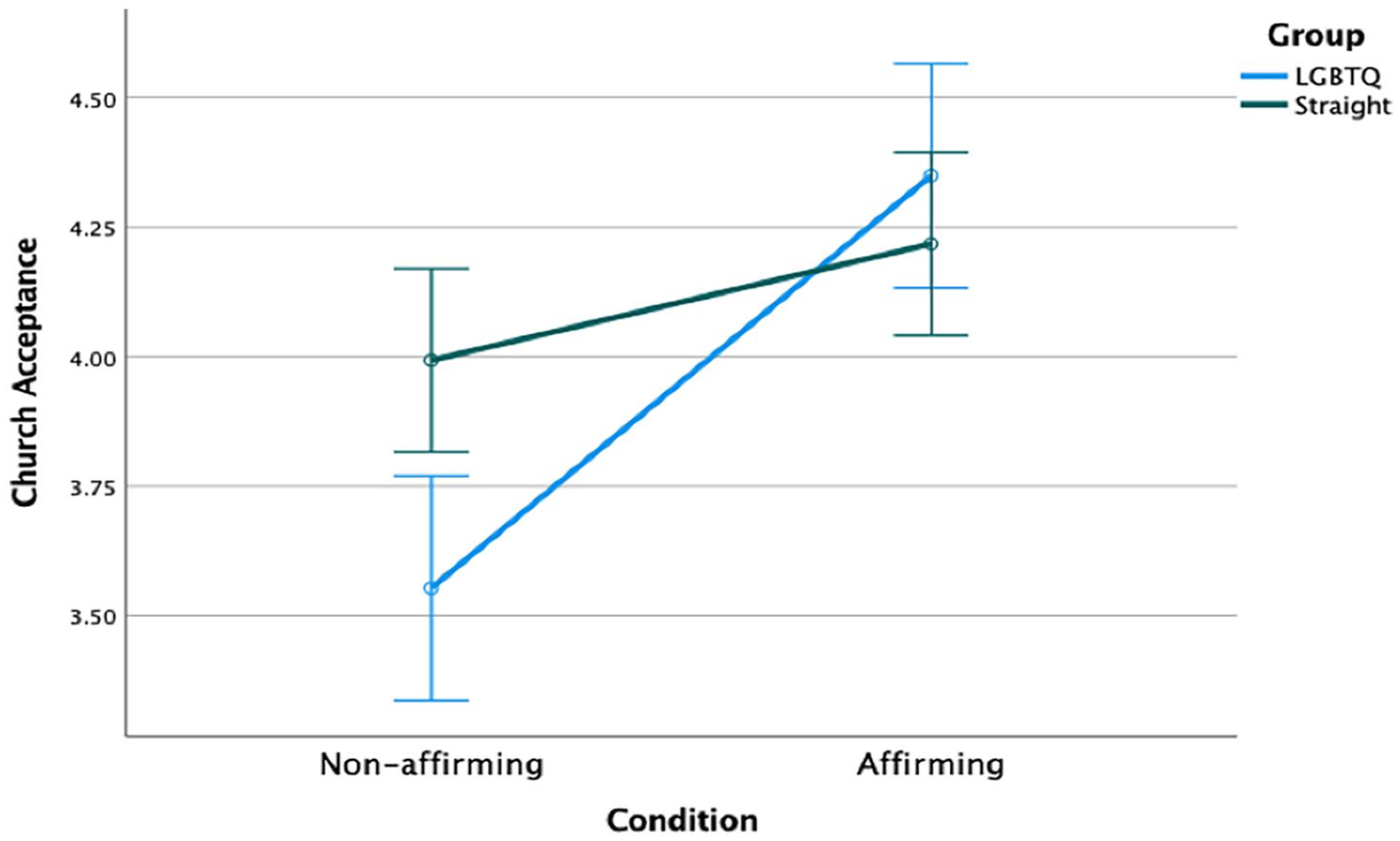
Feelings of Church acceptance by LGBTQ+ and straight Christians.
The data supported our hypothesis. As seen in Figure 1, LGBTQ+ Christians expressed a greater sense that they would be accepted by the affirming church (M = 4.35, SD = 0.61) than the non-affirming one (M = 3.55, SD = 0.91; d = 1.03, p < .001).
Our exploratory analyses did not result in statistically significant findings; the difference in the perception of acceptance by straight Christians did not differ between those examining the affirming church’s website (M = 4.22, SD = 0.62) and those examining the non-affirming church’s website (M = 3.99, SD = 0.66; d = 0.35, p = .06). However, this lack of statistical significance despite sufficient power indicates that the straight Christians who viewed the affirming church website did not feel alienated or marginalized by the pro-LGBTQ+ imagery. In fact, though falling short of statistical significance, the trend leaned in the direction of a higher perception of being accepted by the affirming church than the non-affirming one.
Discussion
Conclusion
We explored the causal link between church messages and imagery on the expectation that LGBTQ+ Christians would have higher feelings of acceptance when viewing the affirming church website than when viewing the non-affirming church website. Our hypothesis was confirmed because those LGBTQ+ Christians who viewed the non-affirming church website reported a significantly lower sense that they would feel accepted at the church, relative to those who viewed the affirming church website. Furthermore, the exploratory analyses showed that straight Christians did not differ significantly in their feelings of church acceptance across the two conditions. Although the nonsignificant difference among straight Christians trended in the direction of expecting to be more accepted at the affirming church than the non-affirming one, this suggests that straight Christians did not feel alienated by a church website that explicitly affirmed the LGBTQ+ community. These findings suggest for us that when evaluating a church website, LGBTQ+ Christians feel significantly accepted when churches are visible and intentional with their support for the LGBTQ+ community, given the cultural context in the United States where 48% of LGBTQ+ people are Christians and the number of places where LGBTQ+ are accepted in churches is decreasing (Janssen & Scheepers, 2019). Moreover, affirming church messages have a broad effect of helping people feel more welcomed and accepted.
Identifying whether a church adheres to affirming or non-affirming theology is important since language and imagery are the means through which a church cultivates belonging for LGBTQ+ people in a digitalized world. Our research demonstrates that as a whole, symbols rooted in affirming theology, such as the Pride flag, inclusive pronoun use, inclusive LGBTQ+ theology, church participation in LGBTQ+ events within the church and community, and LGBTQ+ representation in church leadership help LGBTQ+ Christians to feel like they belong at a church. Conversely, a lack of Pride flag, perceived heteronormativity and patriarchal theology, and lack of LGBTQ+ member participation in leadership is seen as exclusive or non-affirming for US LGBTQ+ Christians. These results echo Youkhana’s (2015) and Wasshede’s (2021) assertion that language and images have the power to foster belonging or alienation in specific contexts. As a result, if churches want to meet the basic need of belonging for LGBTQ+ Christians, it is important that they clearly demonstrate symbols and language rooted in affirming theology on their church websites.
Finally, our experiment falls in line with previous research that shows church messages affect the mental health of people of all genders and sexual orientations. For example, Sowe et al. (2017) found that while LGBTQ+ Christians’ mental health suffers most from heterosexist religious views, straight Christians also exhibited decreased psychological wellbeing when exposed to these views. On the contrary, positive church messages about the LGBTQ+ community empower LGBTQ+ Christians to construct a positive self-image of their intersecting queer and religious identities (Kocet et al., 2012), reducing the anxiety and stress that comes from wrestling with these identities (Page et al., 2013). Through the present experiment, it is clear that affirming church messages help queer Christians feel significantly more accepted and empowered in who they are, enabling them to flourish.
Constraints on generalizability and limitations
We believe that our finding of a higher sense of acceptance for LGBTQ+ Christians who view an affirming website and a lower sense of acceptance for LGBTQ+ Christians who view a non-affirming website would generalize to the broader population of LGBTQ+ Christians living within the United States. These participants represented a broad range of Christian denominational affiliations and were diverse in terms of gender, age, and racial and ethnic identification. Thus, we would anticipate that replications conducted with LGBTQ+ Christians within the United States would result in similar findings. However, cultural factors influence the intersectionality between one’s religious, sexual, and gender identities; therefore, we do not assume that the same findings would be observed if this study were replicated in different cultural contexts outside of the United States.
At the same time, there were limitations in the study. First, it is worth mentioning that our experiment does not exhaust all the ways churches can digitally show that they are affirming or non-affirming. As Wasshede mentioned, symbols are context-specific and culture plays a role in how LGBTQ+ Christians around the world find and evaluate church homes. Second, participants took the experiment over the internet, and it is possible that different environments could have had an impact on participants’ responses.
Third, our sample was not as diverse as the general US population, in terms of ethnicity, race, and gender. In our study, approximately two-thirds of the participants identified as European American or White (65.9%), while in the 2021 US census, 59.3% of people identified as “White alone, not Hispanic or Latino” (U.S. Census Bureau, 2021). Conversely, about one-third of our participants (30.5%) identified as African American or Black (10.6%), Asian American (7.7%), Hispanic (3.4%), Latina or Latino or Latinx (3.9%), Native American or Indigenous American (2.9%), Middle Eastern or North African (1.0%), and Hawaiian or Pacific Islander (1.0%), while in the United States, more people (43.1%) identify with a marginalized cultural or racial group (U.S. Census Bureau, 2021). In addition, the overwhelming majority of participants were cisgender (98%). Four participants (2%) in our study identified as either Nonconforming, Transgender Female, or Transgender Male. Future studies should include more participants from marginalized gender communities, especially in research like ours since their input is needed for the full inclusion of LGBTQ+ communities in churches (Powell, 2021; Wilson & Meyer, 2021).
A final limitation is that researchers may derive alternative interpretations from our experiment. For example, it is possible that our websites served as a proxy for a church’s political ideology. In other words, the use of LGBTQ+ inclusive messages and symbols may be viewed as an indicator of liberal views and their absence might be viewed as indicative of conservative stances, perhaps even more than being viewed as indicative of affirming versus non-affirming theologies. This could also explain why some straight participants felt more comfortable with the affirming church condition since the affirming church could have aligned with their potentially liberal ideologies. Furthermore, while the affirming website included overtly inclusive imagery and language, the non-affirming website held more traditional imagery and language; for example, the homepage of the first included the phrase “We welcome all” while the homepage of the second included the phrase “Dive in and build your faith.” Thus, the difference in the perceptions might have represented a broader dimension of nontraditionalism to traditionalism.
While we believe these limitations do not change our interpretation or overall results significantly, future research should consider improving these areas to increase validity and generalizability.
Directions for future research
Due to the possibility that these findings are likely to have a cultural constraint on generalizability, future research should focus on replicating this experiment in cultures outside of the United States, in countries such as Switzerland and Panama, where the French Protestant Reformation and Catholicism have molded the social fabric and continue to play a role in how LGBTQ+ people feel accepted and welcomed in society. Moreover, future studies can focus on accounting for factors such as age, political ideology, and social desirability bias to examine how straight people are affected by inclusive religious messages. Future research can also tease apart which inclusive messages and symbols have more importance for LGBTQ+ people when looking for a church home (e.g., inclusive theology, pronouns, or Pride flags). More research could focus on monitoring participants’ eye movements when evaluating a church website to better understand whether there are significant differences between LGBTQ+ and straight Christians when evaluating church websites. Finally, future research could focus on measuring wellbeing in other areas besides expectations of acceptance, to more holistically understand how prejudicial church messages about the LGBTQ+ community affect queer Christians.
Implications
We devised a causal experiment that tests different types of church messages that make LGBTQ+ people feel significantly more or less accepted. These results demonstrated that imagery and messages rooted in affirming theology led to a greater expectation of being accepted at the inclusive church. Underneath this phenomenon lies the basic premise that LGBTQ+ Christians need to find an inclusive church home to flourish. This is consistent with Baumeister and Leary’s (1995) theorized need to belong; like all humans, LGBTQ+ Christians actively seek to be a part of spaces that accept them unconditionally. Regrettably, many LGBTQ+ Christians do not find these religious spaces because of many churches’ historical non-affirming theological stance (Gushee, 2017). In the end, every queer Christian deserves to feel accepted and affirmed in their church. Since the majority of churches in the United States are non-affirming toward the LGBTQ+ community, it is important that there be churches that publicly affirm LGBTQ+ through queer-inclusive language and imagery. This action would help LGBTQ+ Christians find a church home and flourish (Janssen & Scheepers, 2019; Wolff et al., 2016). The full affirmation of LGBTQ+ people in the church is a timely topic for Christianity in the United States and this experiment is the beginning of more causal research on how queer Christians’ search for a church home is directly affected by affirming versus non-affirming Christian symbols and messages.
Footnotes
Declaration of Conflicting Interests
The author(s) declared no potential conflicts of interest with respect to the research, authorship, and/or publication of this article.
Funding
The author(s) disclosed receipt of the following financial support for the research, authorship, and/or publication of this article: This study was supported by a grant from the Academic Year Undergraduate Research Initiative at Pepperdine University.
Data Availability
This study was preregistered at https://osf.io/kx4rz. Study materials and data are available at  .
.
Positionality Statement
This article examines the intersectionality of religious identity and gender/sexual identity; both authors identify as Christians and as members of the LGBTQ+ communities.
1.
Transparent Change from Preregistration. Although we sought 60 LGBTQ+ Christians for each of the two conditions (and prequalified 74 MTurk workers for each of these groups), we were only able to assess 40 participants from each group for two reasons. First, although each of these MTurk Workers self-identified as LGBTQ+ on the screening survey, several self-identified as “straight” or “heterosexual” on the actual survey, so their data were excluded from analyses due to inconsistency of responding. Second, although there were more prequalified MTurk Workers than we sought, MTurk does not allow targeted recruitment, and many prequalified Workers simply never opted to complete the study survey. Funding limitations prevented us from duplicating the prequalification and assessment process. Therefore, although we were able to collect data from 120 prequalified straight Christians, we only collected data from 80 prequalified LGBTQ+ Christians. In the end, then, our actual sample included 200 participants. This resulted in a reduction of anticipated power from .95 to .94. Because this still was substantially larger than the a priori power level suggested by as a default for experimental studies (i.e., .80), we proceeded with analysis, confident that although the sample was smaller than expected it was still sufficiently large to detect a small effect (should it exist).