




Abstract
Researchers in several academic disciplines have begun to take an interest in group character traits, including the character traits of religious congregations. This article reports the first empirical studies of congregational virtues. The Congregational Character Questionnaire was developed for measuring 12 different virtues of Christian churches: clinging to apostolic teaching, honoring teachers, prayerfulness, hopefulness, discipleship, emotional supportiveness, material supportiveness, spiritual equality, unity, submission, peace with the world, and spreading the faith. The instrument was then used with an online sample (N = 530) to study how congregants’ perceptions of their congregation’s virtuousness related to congregants’ evaluations of their congregation, participation in their congregation, as well as congregants’ satisfaction with life, presence of meaning in life, and religious well-being. Results indicated that congregants’ overall perceptions of congregational virtuousness were significantly positively related to all of these dependent variables. These results help to reveal the important role that congregational character may play in the experience of congregants. Directions for future research in this area are outlined.
Keywords
There has been a well-documented explosion of academic research in multiple fields focused on character traits in recent decades (Miller & Knobel, 2015). This research has focused largely on the character traits of individuals (e.g., Peterson & Seligman, 2004; Timpe & Boyd, 2014). Yet, the idea that groups may have character traits that are important for the well-being of their members has also begun to attract attention (Cameron et al., 2004, 2011; Fehr et al., 2017; Fehr & Gelfand, 2012; Fricker, 2010; Gowri, 2007; Lahroodi, 2007). This attention includes some interest in character traits of Christian churches, specifically, discussed in scholarship in theology and philosophy of religion (Brown & Strawn, 2012; Byerly & Byerly, 2019; Healy, 2000). Building upon this work, the present studies involved developing a theoretically well-grounded instrument for measuring congregational virtues. This instrument was then used to assess how congregants’ perceptions of their congregation’s character were related to congregants’ evaluations of their congregation, participation in their congregation, as well as congregants’ satisfaction with life, presence of meaning in life, and religious well-being.
Conceptualizing and Measuring Congregational Character Traits, Virtues, and Vices
Previous research defines collective character traits as character traits possessed by a group of people, as opposed to character traits possessed by an individual person (Lahroodi, 2007). For instance, a group might be open- or closed-minded, just as an individual might be. But what is it for a group—and in the present case, a church—to possess a character trait, a virtue, or a vice?
A consideration of character traits, virtues, and vices of individual people may prove helpful in answering these questions. When it comes to character traits of individual people, scholars across multiple disciplines have agreed that a character trait is a tendency to display a wide range of characteristic behaviors under characteristic triggering circumstances, out of characteristic motivations or values (Battaly, 2015; Fowlers et al., 2021; Miller, 2014; Wright et al., 2020). Thus, for example, Miller (2018) defines the character trait of generosity as a tendency to give things valued by the giver to others in circumstances in which doing so is supererogatory rather than obligatory, out of altruistic motivations.
Scholars have argued that collective character traits, too, can be conceptualized as having this same basic structure (Byerly & Byerly, 2016). A group character trait will consist in the group’s tendency to display a wide range of characteristic behaviors under characteristic triggering circumstances, out of characteristic motivations or values. If Miller’s (2018) account of generosity is correct, for instance, then a generous group may be a group that tends to give things the group values to others in circumstances in which doing so is supererogatory rather than obligatory, out of altruistic motivations. Other collective character traits will exhibit a parallel structure.
This parallelism between the basic nature of collective character traits and the basic nature of character traits of individual people raises the question of the exact relation between the two. This question has been a focal point of interest for philosophers working on collective character traits (Byerly & Byerly, 2016; Fricker, 2010; Lahroodi, 2007, 2019). When a collective character trait is possessed by a group, is this only because the members of the group themselves possess this trait? Summativists answer “yes”; anti-summativists answer “no.”
The trend in philosophical work on collective character has been toward anti-summativism. The main kind of argument given in defense of anti-summativism appeals to cases in which group members tend to behave in a markedly different way in the group context than they would outside of it (see Lahroodi, 2019, for a review). In these examples, a group appears to display a character trait while the group members in their private lives appear not to display it, or a group appears not to display a character trait, though its members do appear to display it in their private lives. Often, what plays a key role in these examples are the group’s policies or procedures, whether formal or informal.
Research in social psychology suggesting that situational forces are important and often underestimated determinants of behavior provides further support for this anti-summativist position. Though the considerable research dating back to the 1960s claiming that behavior is more the product of situations than dispositions has now been moderated in light of subsequent research (see Funder & Ozer, 1983; McCrae & Costa, 2008), it is nevertheless noted that situational factors do sometimes play a determining role in behavior. This does not negate the importance of dispositions (see Hill & Sandage, 2016, for a more thorough analysis) but rather suggests that an interactionist perspective on dispositions and situations is what best predicts behavior. Thus, collective character traits, whether virtuous or not, are something more than simply a summation of individual traits because the collective itself at least partially creates the situation in which group members act. Indeed, research in theology has also stressed the role of the congregation—especially congregational practices—in shaping congregant character, even going so far as to propose that congregants cannot attain virtue in any other way (Herdt, 2015).
A second argument for anti-summativism is also relevant for this article. This argument focuses on cases in which a group appears to manifest a character trait that just is not available as a character trait for individuals, because of differences between groups and individuals (Byerly & Byerly, 2016). Potential examples of such “distinctively collective” character traits include a group’s tendencies regarding the division of group labor, or regarding training and resourcing members to contribute to group activities (Byerly, forthcoming). These are characterological tendencies that only groups, and not individuals, can possess.
Both of these arguments for anti-summativism contain an important lesson for operationalizing collective character traits. They both reveal that it will not always work to operationalize a group’s possession of a character trait as a summation of group members’ individual possession of this trait. In some cases, this will not work because, while both the group and its members can possess the trait, there is divergence between the group’s possession of it and group members’ possession of it. In other cases, this will not work because only the group and not its members can possess the trait.
Given this lesson, it is important that instruments that aim to measure group character traits focus on the collective level of analysis, using items focused on group features and not just features of group members. A focus on the group level of analysis has previously proven important in the study of a wide variety of organizational climate features (Schneider et al., 2013), including climate features of religious congregations (Pargament et al., 1983, 1987). It has likewise been exemplified in a small number of studies that measure various dimensions of organizational virtuousness (Cameron et al., 2004, 2011). The studies presented below employ this methodological approach as well.
While the basic nature of collective character traits and individual character traits are similar in some regards, their nature may not be as close when collective virtues and vices are compared with individual virtues and vices. The consensual agreement among philosophers (e.g., Baehr, 2011; Battaly, 2015) that virtuous character traits make a person better as a person while vices make a person worse as a person must be adapted when it comes to groups (Byerly & Byerly, 2019). What makes a collective character trait a virtue is that it makes the group that possesses it better as the kind of group that it is (rather than better as a person). And, what makes a collective character trait a vice is that it makes the group that possesses it worse as the kind of group that it is (rather than worse as a person). What makes a group the kind of group it is, in turn, depends upon the distinctive purposes for which the group exists. As in the case of virtues of individual people, so likewise in the case of virtues of groups, when a virtue is possessed in its fullness, possession of the virtue becomes an important ingredient in the narrative identity of the possessor (see Wright et al., 2020, pp. 161–168). Being characterized by the virtue becomes an important part of who the group understands itself to be.
Given this conception of the nature of collective character traits, virtues, and vices, it makes sense when investigating the collective character traits of Christian churches to focus on candidates for traits that would make a church better (a congregational virtue) or worse (a congregational vice) specifically as a church. These traits will inform the group’s understanding of who they are and will better enable them to fulfill their distinctive purposes as a church. Theologians have sometimes commented on features that may make a church better as a church, and their comments tend to be informed by an appreciation of the historical developments of the church while being ultimately rooted in biblical revelation (e.g., Akinwale, 2015; Collins, 2008). The empirical study of congregational virtuousness requires a measure of collective character traits grounded in a biblically based idea about what makes a church better as a church.
The Present Research
The research noted above on both organizational climate (e.g., Schneider et al., 2013) and congregational climate (Pargament et al., 1983, 1987) is not adequate for measuring congregational virtue. The congregational climate tendencies measured, such as emotional expressiveness and orderliness, are not conceptualized as virtues or vices of churches, nor are the measures designed specifically for Christian churches. Likewise, research on organizational virtuousness has not focused specifically on churches, but has attempted to identify collective traits that may be virtues for a variety of organizations, and it has focused exclusively on virtues available to individuals as well as groups. Thus, an initial step for research is to develop an instrument, informed by biblical ideas about what makes a church better or worse as a church, which examines collective virtues of Christian churches.
Study 1
This study focused on developing a new instrument for measuring congregational virtues that would reflect a broad and representative spectrum of virtues while not being too long to be useful in academic research. Initial development of the instrument required two steps. First, researchers needed to identify a broad range of candidates for particular congregational virtues. Second, researchers needed to create a questionnaire with items that could be used to measure each of these virtues, while ensuring that the questionnaire was of an appropriate length for use in research. To accomplish these goals, a sorting task study was undertaken with three external experts. Sorting tasks of this kind have been used widely at initial stages of scale development in many contexts (Hinkin et al., 1997), including the creation of the Congregational Climate Scales (Pargament et al., 1983). In this case, as discussed further below, the sorting task methodology offered an efficient approach to initial scale development.
Method
Participants
The three participants were individuals with advanced training in Christian theology and multiple years of ministerial experience in Christian congregations. In light of these qualifications, they might be expected to have an advanced understanding of congregational character. One participant was a male Anglican priest in the United Kingdom, one was a female regional Baptist minister in the United Kingdom, and one was a female Episcopal priest in the United States. Three participants were selected so that if there were cases of disagreement between two participants the third participant might help settle the disagreement. Participants were solicited from multiple Christian denominations because researchers aimed to develop a scale that would be relevant to multiple Christian denominations.
Materials and procedures
The research team developed an initial list of 109 items for measuring congregational character traits. These items were formulated on the basis of a careful reading of two kinds of texts in the New Testament, a source that addresses both a broad range of congregational character traits and is widely regarded by Christians as authoritative. The first kind of text is one in which a church is described in a value-laden way. A description is given of the way the church was, and it is suggested or implied in the context that this was a good or bad way for the church to have been. An example of this type of text is: “They devoted themselves to the apostles’ teaching and to fellowship, to the breaking of bread and to prayer” (Acts 2:42 NIV). The second kind of text is one in which a church is instructed or encouraged by an apostle to display or not display a certain character trait. Many of these examples come from the New Testament epistles. An example is: “Now we ask you, brothers and sisters, to acknowledge those who work hard among you, who care for you in the Lord and who admonish you” (1 Thess 5:12 NIV).
After collating a large list of these texts, the research team attempted to group them thematically, on the basis of apparent similarity in content. This led to the identification of 13 potential congregational virtues: clinging to apostolic teaching, honoring teachers, prayerfulness, hopefulness, discipleship, emotional supportiveness, material supportiveness, spiritual supportiveness, spiritual equality, unity, submission, peace with the world, and spreading the faith. Items were then drafted for each category on the basis of relevant New Testament texts, focusing on patterns of behavior at the organizational level. Item wording was guided by biblical texts, though sometimes the biblical language was rephrased when it might spark associations for contemporary readers that differ from those intended in the original text (e.g., “submission”).
A sorting task was then undertaken with the three external experts. The three participants were asked to complete a sorting task in which they matched items from the initial item pool to the 13 virtue categories. They were provided with one-sentence definitions for each of the 13 virtues, and asked to match items to the virtue definition the participant believed the item best reflected, with the requirement that the participant put at least four items in each category. Two of the participants also sorted the items they placed within categories into tiers. For any category that these participants had assigned more than four items, they could create up to three tiers for these items reflecting their views about the items’ fit with the category. The top two (best fitting) tiers could have no more than four items each. The third participant did not complete this part of the sorting task.
Once participants completed the task, a scoring procedure was used to select the items that participants agreed best measured each of the 13 virtues. Total scores for the items were computed by summing the scores the items received from each of the participants. Items given the highest total score were selected for inclusion in the final version of the questionnaire, with the aim of including at least four items for each virtue category. In cases where there was a tie for fourth best item, all items with the tying score were included.
Results and discussion
For 10 out of 13 virtues, all of the highest scoring items were selected by all three participants as fitting the relevant virtue category. For all but one of the virtue categories, at least two participants agreed on four or more items fitting that category. Because of the lack of agreement for best items to measure one of the candidate virtues—spiritual supportiveness—this virtue was cut from the final survey. One potential explanation for why this candidate virtue did not perform well was that it overlapped substantially with the virtue of discipleship. The resulting version of the questionnaire, which was used in Study 2, measured the following 12 congregational virtues using a total of 56 items, with between four and seven items per virtue:
A congregation’s tendency to hold fast to the central teachings delivered by the early Christian apostles.
A congregation’s tendency to honor and support those who fulfill teaching functions in the congregation.
A congregation’s tendency to be devoted to prayer.
A congregation’s tendency to maintain Christian hopefulness for the future, including the eschatological future.
A congregation’s tendency to support congregants’ growth in the Christian faith.
A congregation’s tendency for members to offer one another emotional support.
A congregation’s tendency for members to offer one another help satisfying their material needs.
A congregation’s tendency for members to treat one another as spiritual equals.
A congregation’s tendency to maintain unity in pursuing congregational aims.
A congregation’s tendency for members to submit to one another, putting the interests of other members ahead of their own.
A congregation’s tendency to maintain good relationships with individuals and institutions outside the church where possible.
A congregation’s tendency to support the growth of the Christian faith beyond the congregation.
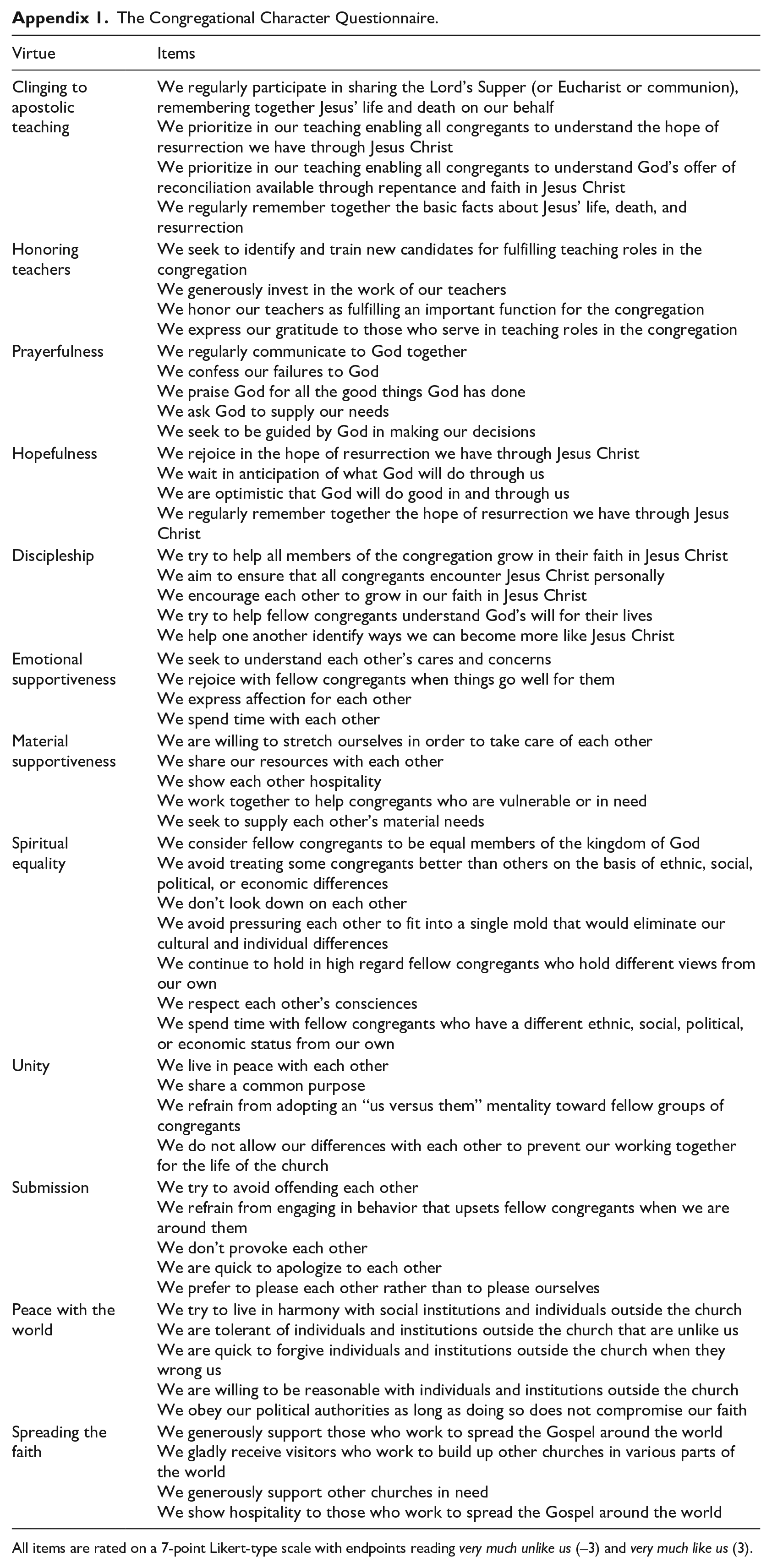
The complete Congregational Character Questionnaire (CCQ) is included in Appendix 1.
The CCQ provides a theoretical model of congregational character according to which the items of the CCQ reflect 12 distinct congregational virtues. It should be noted that exploratory factor analysis (EFA) is the procedure used in most measurement development studies to develop this kind of theoretical model. However, the EFA approach is most typically used when measuring individual constructs such as single personality traits or virtues, rather than groups of virtues. Also, the EFA approach requires that researchers typically create many more items (e.g., 60 or more) to measure that feature. In the present case, proper application of this methodology would have required developing 780 or more items, given the number of candidate virtues being investigated as collective character traits. As this is far too many items to include in a single survey, multiple surveys would need to be administered to create initial scales for congregational virtues using this method. As a result, it was decided to use the more efficient sorting task approach to initial scale development to identify a model of congregational character that could be tested for goodness of fit using confirmatory factor analysis (CFA). At the same time, the researchers acknowledge that the CCQ may be fruitfully examined using EFA to determine which aspects of the scale are most unique. With this purpose in mind, both CFA for the twelve-factor model and a combined EFA and CFA were subsequently conducted as part of Study 2.
Study 2
Study 2 focused on congregants’ perceptions of their congregation’s character traits, using the CCQ. There were three purposes for this study. First, researchers tested the reliability of the CCQ, and used CFA to test the fit of the 12-factor model derived from Study 1. Second, a combined EFA and CFA procedure was used to create a shortened version of the CCQ that reflects the most distinctive aspects of the CCQ. Third, researchers used the CCQ, as well as the shortened scale, to test two primary hypotheses.
Hypotheses
It was expected that if a church is better as a church on account of being more virtuous, congregants may evaluate the church more positively, they may participate in the church more frequently, and they may also experience greater personal and religious well-being via this participation. It was therefore hypothesized that:
H1. Congregants’ perceptions of their congregation’s virtuousness will be positively correlated with their evaluations of their church and participation in their church.
H2. Congregants’ perceptions of their congregation’s virtuousness will be positively correlated with congregants’ own satisfaction with life, presence of meaning in life, and religious well-being.
Method
Participants
Five hundred thirty participants were recruited using Qualtrics online panelist service. All participants self-identified as members of a Christian church who had attended the church for at least 6 months and participated, on average, in at least one church activity per month. Participants were from a wide variety of denominational backgrounds, but caps were put on the percentages of participants that could be from Catholic, Mainline Protestant, and Evangelical denominations so that these groupings could be compared with each other in research. Forty-seven percent of participants were male, and participant ages ranged from 18 to over 65 with a median age between 35 and 44. Eighty-four percent of participants were White, 9% were Black, and less than 5% each were Latino, Asian, and Native American. All participants were from the United States, but further data about their geographic location were not collected.
Materials and procedures
Participants completed the CCQ, responding to its items using a 7-point Likert-type scale anchored by very much like us/very much unlike us. They answered demographic questions and questions about their church’s denomination, size, their length of membership, and their frequency of participation in church activities. They answered questions about their satisfaction with eight areas of congregational life identified as important in previous research (Silverman et al., 1983), using Likert-type responses. The eight areas concerned weekly religious services; fellow congregants; congregational rules, policies, and regulations; religious education; lay leadership; special programs; facilities; and clergy. Participants answered a question about the extent to which they judge that their church is what a church should be, using a 100-point sliding bar. They also completed several widely used measures concerned with their own individual well-being. These included the religious well-being subscale of the spiritual well-being scale (Paloutzian & Ellison, 1982), α = .83; the satisfaction with life scale (Diener et al., 1985), α = .86; and the presence subscale of the meaning in life questionnaire (Steger et al., 2006), α = .82.
Results and discussion
Cronbach’s alpha for the full CCQ was .98. The alpha scores for the 12 individual subscales were also high, with a range from .84 to .90. Participants tended to rate their churches highly across all congregational virtues measured, with a mean score of 2.25 on a scale running from –3 to 3, with a mean standard deviation of .89. Thus, in general, participants tended to view their churches as “somewhat,” “mostly,” or “very much” like the virtues measured in the CCQ. Given this tendency toward positive evaluation, CCQ scores exhibit a high negative skew. While some authors suggest possible transformations to reduce distribution skewness (Tabachnick & Fidell, 2019), it was decided that the meaning of the transformed scores would be more difficult to interpret. Thus, analysis proceeded with the actual scores. Table 1 gives descriptive statistics for the subscales of the CCQ.
Descriptive Statistics for the Congregational Character Questionnaire.
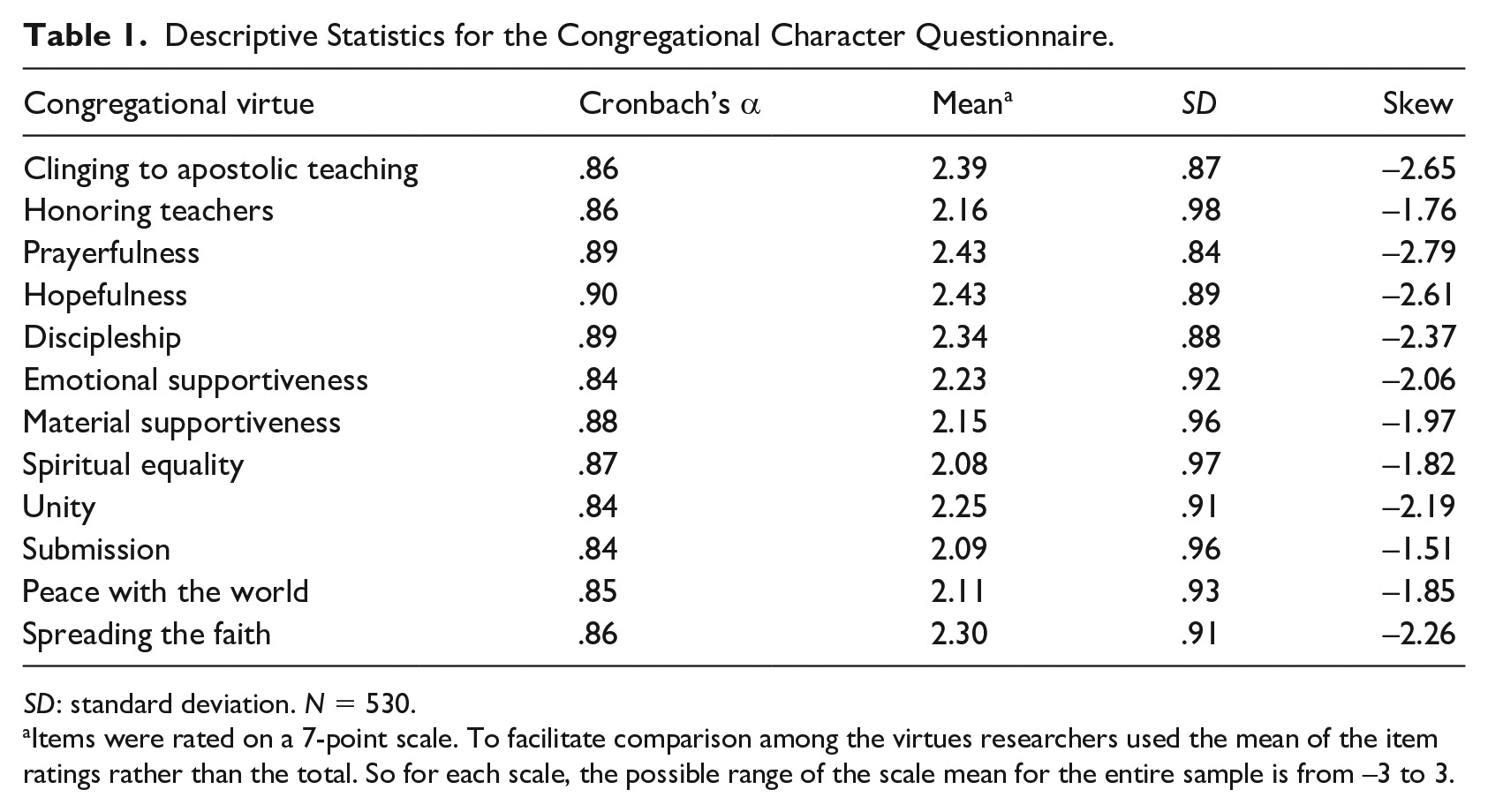
SD: standard deviation. N = 530.
Items were rated on a 7-point scale. To facilitate comparison among the virtues researchers used the mean of the item ratings rather than the total. So for each scale, the possible range of the scale mean for the entire sample is from –3 to 3.
CFA revealed good or adequate fit for the 12-factor model, with a .055 root mean square error of approximation (RMSEA), .036 standard root mean square residual (SRMR), and .91 comparative fit index (CFI).
The 12 subscales were all highly intercorrelated, with a range between .68 and .88. These high correlations between subscales reduce the likelihood that the subscales will uniquely explain variance in other variables, even if they are distinguishable in other ways. This finding is not necessarily surprising, as this level of multicollinearity between multiple virtues has been found in previous research on organizational virtuousness (Cameron et al., 2011), where correlations between virtue subscales ranged from .57 to .93.
There are different ways that researchers could proceed on the basis of these results. On one hand, researchers might conclude that there is enough support for the 12-factor model that it is worthwhile to further explore the full scale and/or its subscales in research. It is worth noting here that churches themselves may take an interest in assessing their positions on all 12 of the subscales, even if these subscales are not each individually related in distinctive ways to other variables. Churches may simply want a more thorough description of their character traits attainable through the full survey and its subscales. Moreover, the multicollinearity of the subscales is indicative only of general patterns of covariance and these may not hold in individual cases. Thus, while it may be true in general that churches that score high (or low) on one virtue will score high (or low) on certain others, there may also be exceptions to this pattern. This kind of variance, even if the exception rather than the norm, may be of interest both to churches and to researchers.
On the other hand, researchers may take an interest in shortening the CCQ using exploratory and confirmatory procedures. This kind of analysis can reduce multicollinearity, revealing the aspects of the scale that are most unique and have the most potential to relate differently to other variables. As an initial step toward developing a model of this kind, the researchers conducted an EFA on one half of the sample and CFA on the other half.
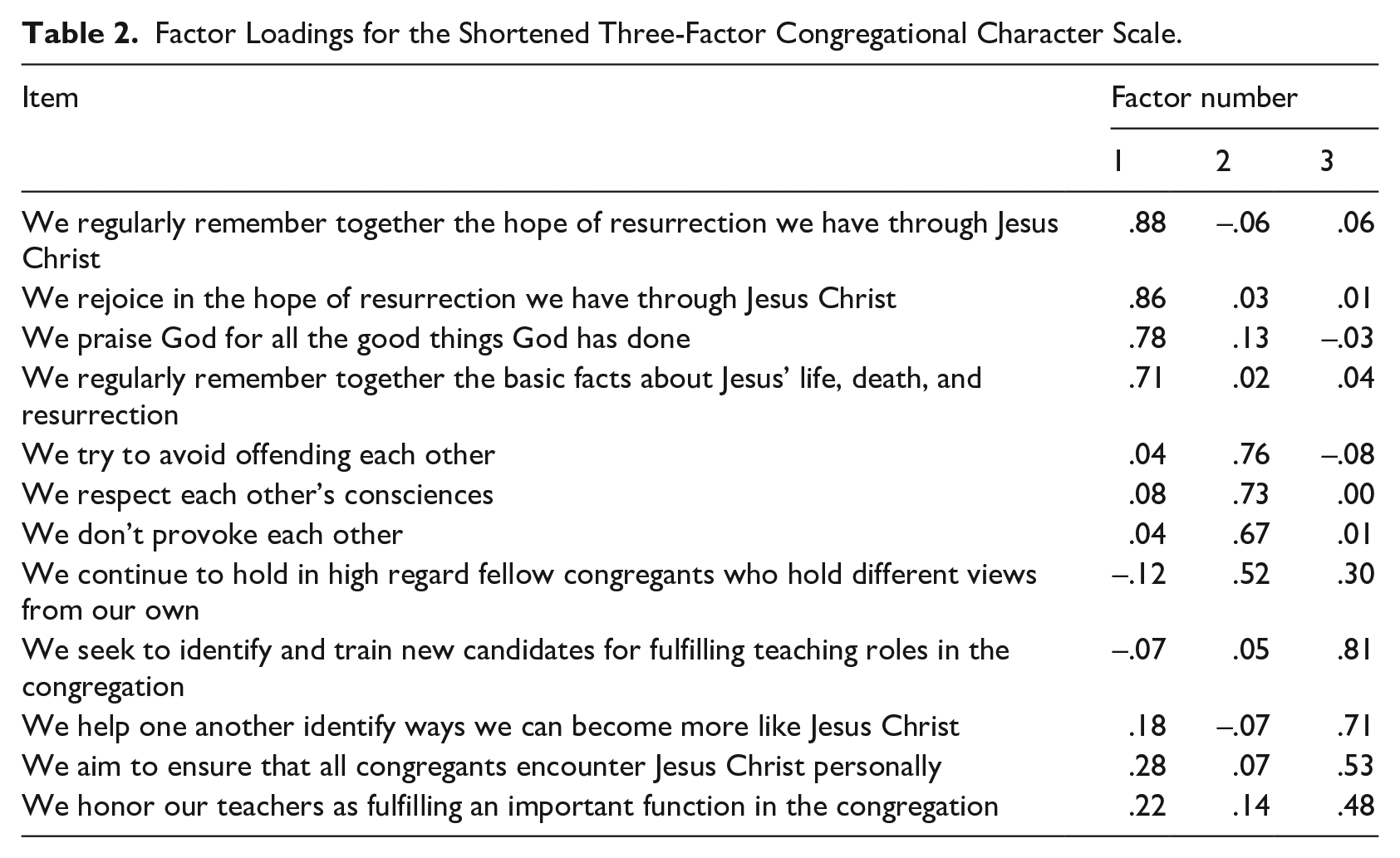
A scree plot suggested three factors that together accounted for 59% of the variance. Using EFA, the four highest loading items for each of these factors were retained for conducting a CFA on a shortened 12-item scale. The three factors of the model could be conceptualized as follows:
A congregation’s tendency to engage in faithful corporate worship.
A congregation’s tendency for members to show each other respect despite differences.
A congregation’s tendency to support congregants’ growth in becoming more like Jesus Christ, especially through teaching.
The CFI (.92) and SRMR (.06) for this model were adequate, though the RMSEA (.11) was not. Given that RMSEA is sensitive to sample size, it could be that its adequacy was affected by the small sample size in this case. Table 2 provides factor loadings for this 12-item, three-factor scale using the entire sample.
Factor Loadings for the Shortened Three-Factor Congregational Character Scale.
Total scores on the CCQ correlated significantly (r = .46, p < .001, df = 528) with the participant’s total satisfaction with their church, which was computed based upon a summation of the participant’s satisfaction with eight different dimensions of their church. CCQ scores also correlated significantly (in all cases p < .001, df = 528) with the participant’s judgment that their congregation is what a church should be, r = .49; with their frequency of participation in church activities, r = .22; with their own religious well-being, r = .43; with their satisfaction with life, r = .30; and with their presence of meaning, r = .36.
Examination of semi-partial correlations revealed that total CCQ scores explained unique variance in the dependent variables of H1 and H2 when controlling for other variables. For example, the semi-partial correlation between CCQ scores and satisfaction with church was .46 (p < .001, df = 463) when controlling for church denomination and size and the sex and age of the participant. There was a .25 (p < .001, df = 463) semi-partial correlation between CCQ scores and congregant religious well-being when controlling for church denomination and size and the participant’s sex, age, satisfaction with church, length of membership, and frequency of participation in church activities. Some of the control variables in these cases were significantly related to CCQ scores while others were not: CCQ scores were not significantly correlated with church denomination (Mainline Protestant, Evangelical, and Catholic) or age of the participant, but were slightly correlated with church size (r = .10, p < .05, df = 528) and with male sex (r = .14, p < .01, df = 528). Table 3 reports several additional semi-partial correlations between CCQ scores and dependent variables from H1 and H2.
Semi-Partial Correlations Between CCQ and Variables From Hypotheses.
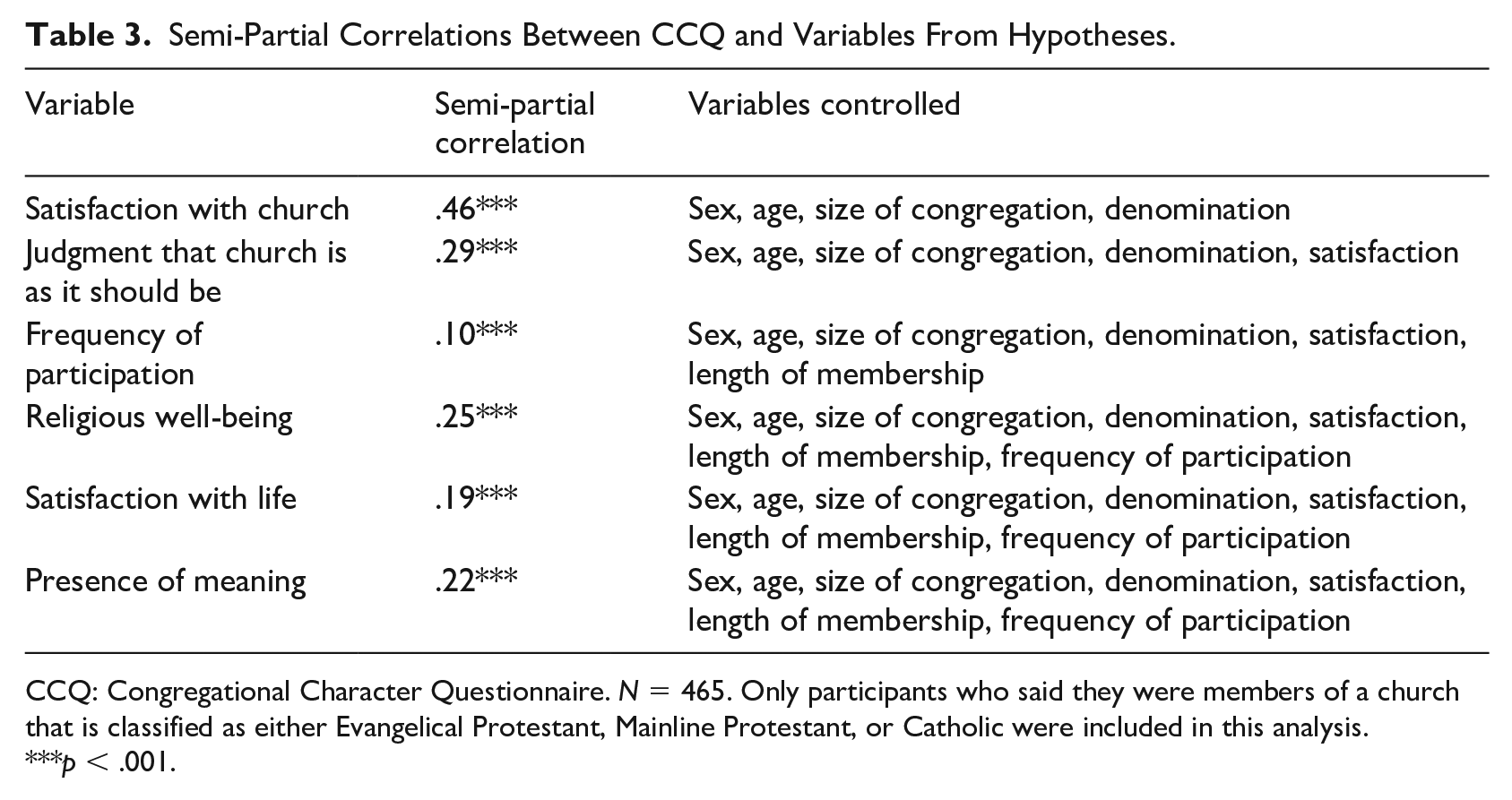
CCQ: Congregational Character Questionnaire. N = 465. Only participants who said they were members of a church that is classified as either Evangelical Protestant, Mainline Protestant, or Catholic were included in this analysis.
p < .001.
To investigate whether the different subscales of the CCQ related in significantly different ways to the dependent variables of H1 and H2, semi-partial correlations between each of these subscales and these variables when controlling for all other subscales were examined. Results indicated that semi-partial correlations for the individual subscales were not statistically significant, and tended to be below .08. Nonetheless, some suggestive patterns in the distinctive behaviors of the subscales did emerge. Subscales more focused on “upward” dimensions of congregational life—how the congregation relates to God—had stronger positive relationships with congregants’ religious well-being and frequency of participation in church activities. These upward dimensions include clinging to apostolic teaching, hopefulness, and prayerfulness. In contrast, tendencies concerned with “inward” dimensions of congregational life—how congregants relate to each other—had stronger positive relationships with congregants’ satisfaction with the congregation and judgments that the congregation is what a church should be, as well as with congregants’ own satisfaction with life and presence of meaning in life. These inward dimensions included spiritual equality, submission, and material supportiveness.
A similar pattern emerged when semi-partial correlations were computed using the three-factor, 12-item scale. Semi-partial correlations between each factor of the scale and the dependent variables of H1 and H2 when controlling for the other factors were examined. Faithful worship had a .15 (p < .001) semi-partial correlation with religious well-being, while neither of the other factors was significantly related to the religious well-being variable. Management of differences had semi-partial correlations of .16 (p < .001) with satisfaction with church and .15 (p < .001) with satisfaction with life, while the other factors were not significantly related to either the satisfaction with church or satisfaction with life variables. Both management of differences (r = .10, p < .05) and discipleship (r = .09, p < .05) were significantly related to the presence of meaning, while only discipleship was significantly related to the participation in church activities (r = .09, p < .05).
These results suggest that while the various dimensions of congregational character are highly interconnected, some of these dimensions may have stronger relationships to dependent variables in H1 and H2 than do other dimensions. Upward dimensions, especially those displayed in collective worship practices, may be the most important when it comes to variables concerned with congregants’ religious well-being. Inward dimensions, especially those concerned with managing differences among congregants, may be the most important when it comes to congregants’ satisfaction with church and satisfaction with life. Dimensions concerned with discipleship and teaching may have particular importance for frequency of attendance and presence of meaning.
General Discussion
Researchers in several academic fields have begun to turn their attention to group character traits, including the character traits of Christian churches. This article reports the first empirical studies focused on congregational character. In Study 1, researchers utilized a sorting task with outside experts to develop the CCQ, a 56-item instrument for measuring 12 congregational virtues. In Study 2, the reliability of the CCQ and its subscales and the fit of the hypothesized 12-factor model for the CCQ were tested with an online sample. Researchers also tested two correlational hypotheses: that congregants’ perceptions of their congregation’s character would be positively correlated with their evaluations of their congregation and frequency of participation in church activities (H1), and that congregants’ perceptions of their congregation’s character would be positively correlated with congregants’ own satisfaction with life, presence of meaning, and religious well-being (H2).
The reliability of the CCQ and its subscales were supported, as was the fit of the 12-factor model. Yet, there was a large amount of shared variance between the virtues. As a result, the researchers used EFA and CFA to develop a shortened, three-factor, 12-item scale that reflects the most unique aspects of the CCQ and reduces their shared variance. The fit of this model received mixed support. It would be useful for future studies to provide additional evidence regarding the dimensionality of both the 12-factor model and especially the shortened three-factor model of the CCQ. It may be that the 12-factor scale is most useful for churches and the three-factor scale is most useful for researchers.
Results indicated that CCQ scores were robustly related to the dependent variables specified in H1 and H2. Total CCQ scores were moderately correlated with congregants’ satisfaction with their church, judgments that their church is what a church should be, and their own satisfaction with life, presence of meaning in life, and religious well-being. They had a small correlation with frequency of participation in church activities. Perception of congregational character remained significant for these variables when controlling for other variables, such as the age and sex of the congregant and the denomination and size of the congregation. Congregants’ perceptions of aspects of congregational character with a more upward dimension, especially those manifested in collective worship, were more strongly related to congregants’ religious well-being. Congregants’ perceptions of aspects of congregational character with a more inward dimension, especially those concerned with managing differences among congregants, were more strongly related to congregants’ satisfaction with church and satisfaction with life. Congregants’ perceptions of aspects of congregational character concerned with discipleship and teaching were significant for congregants’ frequency of participation in church activities.
These results are largely in accordance with the theoretical perspective that congregational virtues make churches better as churches, leading to greater congregant well-being and more positive congregant evaluations of church (Byerly & Byerly, 2019). The findings also cohere with previous research that has indicated that organizational virtuousness is positively related to organizational performance and employee well-being (Cameron et al., 2004, 2011).
The current studies have several limitations. First, they are only correlational in nature. They provide evidence that congregational character is correlated with other variables in H1 and H2, yet they do not directly address the causal or explanatory order between these variables. Second, the findings rely upon participants’ self-reports, which are subject to bias. Third, the procedures used to identify candidates for congregational virtues, while allowing for the identification of a broad range of virtues, are certainly not exhaustive. Candidate virtues were identified by focusing on the New Testament; yet it is possible that there are congregational virtues that may play an important role for some churches today that received little emphasis during the New Testament period.
There are many directions that future empirical research on congregational character could take. First, longitudinal studies could be conducted to determine whether changes in congregants’ perceptions of their congregation’s character correlate with changes in the dependent variables in H1 and H2. Such change would provide some evidence that congregational character plays a causal role in relation to these variables. Second, researchers could average together the perceptions of multiple members of the same congregation to create a score for the congregation’s character, following an approach that has been used to create scores for organizational virtuousness (Cameron et al., 2011). This would allow for a more direct study of congregational character, as opposed to individual congregants’ perceptions of their congregation’s character. Third, future studies could examine many other variables beyond those studied here. For instance, studies could examine relationships between congregational character and church membership increases or declines, church financial performance, or non-member perceptions of church. Finally, future studies could examine whether specific interventions improve or injure congregational character. The present research, hopefully, can contribute to promoting research on these and related topics.
Footnotes
Appendix
The Congregational Character Questionnaire.
| Virtue | Items |
|---|---|
| Clinging to apostolic teaching | We regularly participate in sharing the Lord’s Supper (or Eucharist or communion), remembering together Jesus’ life and death on our behalf We prioritize in our teaching enabling all congregants to understand the hope of resurrection we have through Jesus Christ We prioritize in our teaching enabling all congregants to understand God’s offer of reconciliation available through repentance and faith in Jesus Christ We regularly remember together the basic facts about Jesus’ life, death, and resurrection |
| Honoring teachers | We seek to identify and train new candidates for fulfilling teaching roles in the congregation We generously invest in the work of our teachers We honor our teachers as fulfilling an important function for the congregation We express our gratitude to those who serve in teaching roles in the congregation |
| Prayerfulness | We regularly communicate to God together We confess our failures to God We praise God for all the good things God has done We ask God to supply our needs We seek to be guided by God in making our decisions |
| Hopefulness | We rejoice in the hope of resurrection we have through Jesus Christ We wait in anticipation of what God will do through us We are optimistic that God will do good in and through us We regularly remember together the hope of resurrection we have through Jesus Christ |
| Discipleship | We try to help all members of the congregation grow in their faith in Jesus Christ We aim to ensure that all congregants encounter Jesus Christ personally We encourage each other to grow in our faith in Jesus Christ We try to help fellow congregants understand God’s will for their lives We help one another identify ways we can become more like Jesus Christ |
| Emotional supportiveness | We seek to understand each other’s cares and concerns We rejoice with fellow congregants when things go well for them We express affection for each other We spend time with each other |
| Material supportiveness | We are willing to stretch ourselves in order to take care of each other We share our resources with each other We show each other hospitality We work together to help congregants who are vulnerable or in need We seek to supply each other’s material needs |
| Spiritual equality | We consider fellow congregants to be equal members of the kingdom of God We avoid treating some congregants better than others on the basis of ethnic, social, political, or economic differences We don’t look down on each other We avoid pressuring each other to fit into a single mold that would eliminate our cultural and individual differences We continue to hold in high regard fellow congregants who hold different views from our own We respect each other’s consciences We spend time with fellow congregants who have a different ethnic, social, political, or economic status from our own |
| Unity | We live in peace with each other We share a common purpose We refrain from adopting an “us versus them” mentality toward fellow groups of congregants We do not allow our differences with each other to prevent our working together for the life of the church |
| Submission | We try to avoid offending each other We refrain from engaging in behavior that upsets fellow congregants when we are around them We don’t provoke each other We are quick to apologize to each other We prefer to please each other rather than to please ourselves |
| Peace with the world | We try to live in harmony with social institutions and individuals outside the church We are tolerant of individuals and institutions outside the church that are unlike us We are quick to forgive individuals and institutions outside the church when they wrong us We are willing to be reasonable with individuals and institutions outside the church We obey our political authorities as long as doing so does not compromise our faith |
| Spreading the faith | We generously support those who work to spread the Gospel around the world We gladly receive visitors who work to build up other churches in various parts of the world We generously support other churches in need We show hospitality to those who work to spread the Gospel around the world |
All items are rated on a 7-point Likert-type scale with endpoints reading very much unlike us (–3) and very much like us (3).
Declaration of Conflicting Interests
The author(s) declared no potential conflicts of interest with respect to the research, authorship, and/or publication of this article.
Funding
The author(s) disclosed receipt of the following financial support for the research, authorship, and/or publication of this article: This research was generously funded by the John Templeton Foundation Grant ID #65015.
