



Abstract
This article explores the differential coverage of drug overdose death in three major Australian newspapers between 2015 and 2020. It outlines the number of articles, the types of voices, and emotional collectives drawn on in three types of overdose death stories: those related to injecting drug use, pharmaceuticals (largely opioids), and those that occurred at music festivals. Our analysis finds that in each newspaper festival deaths are reported on more than other types of overdose stories, even though deaths in the other categories represent significantly larger loss of life. Beyond the number of articles written about each type of overdose, our analysis pays attention to emotional collectives, such as pity, surprise, and grief, and how these constitute the overdose victim. We argue that the differential media treatment of overdose deaths—depending on substance involved, social circumstance—is intimately (if implicitly) linked to a differential valuing of human life. We explore the way people who die of an overdose exist on a spectrum, from those who are visible and valued subjects in media coverage (the grievable), to those who are abject and already lost (the ungrievable). Finally, our analysis finds that proximity to White and middle-class culture structures the way the lives of overdose victims are (re)produced as lives worth grieving in media coverage.
Introduction
Over the 2018–2019 Australian summer, one would have been hard-pressed not to notice the exhaustive newspaper coverage devoted to a spate of overdose deaths occurring at music festivals. There were stories about the tragedy of these deaths, about the police investigations that followed, and the associated court cases, as well as a lively public policy discussion about the introduction of “pill testing” (pop-up drug-checking sites at music festivals). At the same time as this flurry of media coverage poured over the details of lives lost at festivals, there was a decidedly different story being told about Australia's “other” overdose deaths.
In September 2018, new data from the Australian Bureau of Statistics reported over 1,800 drug-related overdose deaths: the highest number in more than 20 years. Media coverage of this significantly larger loss of life was conspicuous in its difference from the festival reportage: not only less frequent in occurrence, and more muted and dispassionate in style, but also preoccupied with a different set of questions. This article was inspired by our reflection on this difference: Why, we wondered, would the largest number of overdose deaths in 20 years and a small number of overdoses at music festivals generate such dramatically different media coverage?
To answer this question, we undertook a systematic review of Australian media coverage of drug-related overdose deaths between 2015 and 2020. This article reports on the findings from our review of three major Australian newspapers: The Australian (Aus), The Sydney Morning Herald (SMH), and The Age (Age). Our analysis identifies three kinds of overdose death-related stories: those concerning injecting drug use, those concerning pharmaceuticals (primarily opioids), and those occurring at music festivals. Working comparatively across this typology, we analyze the different ways in which victims of overdose are constituted in this reportage, including through the different emotional responses being articulated. For as Butler (2009, p. 41) argues, our affect is never simply our own, but rather “tacitly regulated” by certain kinds of “interpretive frameworks.” We cannot easily recognize life, Butler explains, outside the frames in which it is given and as such, interpretive frameworks operate by “establishing an inside (what is recognized) and an outside (what is rejected) of it” (Lillo, 2022, p. 1). Media coverage, we contend, is one such critical interpretive framework through which our collective affect is tacitly regulated. We argue that the differential media treatment of overdose deaths is intimately (if implicitly) linked to a differential valuing of human life. The media's articulation of emotional response materializes norms about who and what is valuable, or not. Our analysis attempts to make sense of this differential valuing.
Background
Our media review was extensive, providing insight into the way people who inject drugs, use pharmaceuticals, and attend music festivals are variously “made up” or enacted in the media. While there is a significant body of research on the coverage of drug use in the media, analyses of media representations of overdose deaths are less common. Here, by way of contextualizing our findings, we trace commonplace media conceptualizations of people who use drugs, starting with the most stigmatized of these groups: people who inject drugs.
There is a significant body of literature on the way injecting drug use is represented and constructed in the media. When discussing injecting drug use and the media it is hard to ignore the many iterations of “moral panic” that have surrounded the use of crystal methamphetamine (colloquially known as “ice”; Fredrickson et al., 2019; Jenkins, 1994; Ritter, 2007; Waller & Clifford, 2019). These empirical studies have demonstrated that media reports of increased crystal methamphetamine production and use in Australia have been consistently exaggerated. Drawing on the popular tropes of media coverage used in previous generations in relation to heroin use, coverage of “ice users” has tended to rely on hyperbolic depictions of their “depravity” and “criminality.” Similar findings regarding methamphetamines have been reported in relation to media coverage from comparable high-income nations, such as North America (Armstrong, 2007) and the United Kingdom (Ayres & Jewkes, 2012). At various points in the past three decades, heroin use has received similar treatment in Australia (Rowe, 2007). Studies about the media coverage of heroin use have revealed a focus on criminality, often accompanied by explicit campaigning in media coverage for more punitive and prohibitionist drug policy (Elliott & Chapman, 2009; Lawrence et al., 2000; Watts, 2003). Collectively, research on media coverage of injecting drug use points to one of general contempt and condemnation, articulated through dehumanizing representations of the people involved and support for prohibition and criminalization (Bessant, 2008; Hughes et al., 2011).
The literature presents a very different picture when it comes to media accounts of the current overdose crisis in North America. The emergence of the non-medical use of pharmaceutical opioids has received considerable media coverage, including as a matter of public health concern. This coverage has subsequently been the subject of several media analyses. One of the central issues that permeate the latter has been the way race and class shape the reporting (Hansen et al., 2023). The largest increases in pharmaceutical use, overdose, and treatment in North America have occurred among Caucasian people, the privately insured, and those in higher income brackets (Cicero et al., 2014; Subramaniam & Stitzer, 2009). This has impacted the content and tone of reporting (Johnston, 2020; McLean, 2017), which early on in the crisis abandoned the punitive policy positions typically found in reporting on drug use in favor of references to the need for treatment and support services (McGinty et al., 2019). The impact that the crisis has had on racial and class groups who are not “traditionally” associated with drug use and addiction has produced a dramatically different portrayal of the pharmaceutical opioid user in North American media: as innocent victims worthy of empathy, not punishment. As Netherland and Hansen explain, “When an epidemic is coded as a middle class White, largely suburban problem, different representational strategies and interventions are invoked” (2016, p. 667). This literature has also signaled the distinctions made between the use of pharmaceutical opioids in middle-class and poor White communities. While the former receives less media attention the latter is subject to a “kinder, gentler” set of drug war policies less heavily reliant on criminal interdiction, although still subject to significant forms of medical surveillance and social control (Beckett & Brydolf-Horwitz, 2020; Tiger, 2017). Colloquial terms for oxycodone medications like “hillbilly heroin” signal the racialized and classed coding of these substances: distinguishing it from the blackness associated with “heroin,” while nonetheless marking it pejoratively as poor, White, and working-class (Linnemann, 2016; Tunnell, 2016). Moreover, such media analysis of the crisis has highlighted that comment on the Whiteness of victims often only appear as coded references to “rural” and “suburban” people in overdose coverage: “Because race and class are most often not named as such in the media, but rather operate through euphemisms and naturalized assumptions” (Johnston, 2020, p. 126). This is a common analytical approach when discussing Whiteness (Dyer, 1988), and is especially so in Australian media coverage which only selectively includes discussion of racialized others while rarely mentioning Whiteness (McQuire, 2019).
Our final category is the least researched, with scarce scholarly analysis of media coverage of “party drug use” at music festivals. While there are pockets of research on the media coverage of deaths in the night-time economy, the focus has been on alcohol-related violence (Wadds, 2020) with little reference to drug-related overdoses. The single relevant study we located (Ritter, 2019) outlines the public policy discussions that followed the series of overdose deaths in the Australian summer of 2018–2019, the period we referenced in our introduction. Unsurprisingly, Ritter found the media coverage involved a heated policy debate between proponents and opponents of pill testing. There was ample coverage of the evidence, including notions of informed choice and the educative role of harm reduction, as well as the canvassing of more conservative ideas about the “inherent risks” and fears about “sending the wrong message.” Of note here is the ample space provided for public debate about alternatives to the criminalization of drug use, underscoring a sense that media coverage of festival deaths are closely tied to public policy debates about the need to “save lives.” Indeed, as Ritter notes “Despite diverging arguments, the advocates and the opponents shared the same goal—to save lives, to protect people, and to reduce harm” (2019, p. 17).
Our review identified only one previous analysis of media representations of overdose deaths among people who inject drugs (Fraser et al., 2018). In their analysis, Fraser and colleagues argue that overdose deaths among people who inject drugs tend to be framed in apolitical terms: as the “natural” if not inevitable result of the individual's choice to use drugs (in the face of their inherent dangers) coupled with the personal problems and characteristics of the “victim” (of criminality and so forth). Where Fraser and colleagues’ work focusses specifically on media accounts of overdose deaths among people who inject drugs, our research takes a comparative approach, examining how media representations of overdose differ according to the substances and settings involved. Similarly, where Ritter's work on festival deaths concerns policy debate, our analysis focuses on the way victims of overdose are represented in media accounts. While there is little research regarding media coverage of festivals, there is some instructive analysis on the “classed” dimension of music festivals. We turn our attention to the latter in our discussion. Where the literature on drug use outlined above richly explores the different ways the lives of people who use drugs are portrayed in the media, a comparative analysis of the death of different kinds of people who use drugs provides a fuller account of the way those lives are grieved, or potentially seen as ungreivable.
Approach
To conceptualize the way victims of overdose are presented in our media sample, we first draw on Sara Ahmed's scholarship on the cultural politics of emotion. Ahmed is interested in the political dimensions and constitutive power of emotional articulations. Rather than understanding emotions as individual psychological dispositions, she is interested in the role emotions play in creating and securing social collectives and in constituting categories of subject. Ahmed asks: “What do emotions do? The ‘doing’ of emotions, I have suggested, is bound up with the sticky relation between signs and bodies” (2004, p. 191). While Ahmed explores the role of “hate” in neo-Nazi politics, we suggest that “hate” also helps explain the enactment of the “junkie” as the despised Other to the “clean,” non-using subject of Western discourse (Rance & Fraser, 2011). Aspects of drug use—particularly the act of injecting, but also dependence and treatment—typically invoke strong, symbolically charged emotional responses. As Manderson notes, “The standard portrayal of the drug addict, stultified and immured in incapacity, reassures us of their absolute otherness” (2005, p. 48). For people who inject drugs, the identity of the “junkie” serves as a metonym, a totalizing identity; one that, as Malins and colleagues put it, “encompasses all the dirtiness, disease, deviance, dangerousness, laziness, and absence of will that are so commonly associated with injecting drug use” (2006, p. 519). Here the symbolic “dirtiness” and “otherness” of dependent drug use perform and thus produce the “junkie” as a figure of hate. For as Ahmed (2004, p. 32) explains, “Emotions can be theorized as performative: they both repeat past associations as well as generating their object.”
The performativity of emotions around drug use is perhaps most heightened in political discourse, which has long been entangled with media coverage. In his work, Alex Stevens (2019) outlines how the intersection of drug-related overdoses and social class constitutes official governmental discourse that is seemingly indifferent to the loss of particular types of life. Stevens describes the constant dismissal of well-evidenced harm reduction interventions by UK politicians in the face of record levels of drug overdose deaths as a “moral sidestep.” He uses the term “totemic toughness” to characterize the process by which politicians avoid “making changes on the basis of evidence by citing the importance of moral concerns” (Stevens, 2019, p. 9). For Stevens, the discursive treatment of overdose deaths among British working-class people (typically middle-aged residents of a de-industrialized estate) as unremarkable, even inevitable, is the product of “class contempt.” Here, official discourse denies overdose victims from deprived neighborhoods full human agency, instead rendering them passive, vulnerable, abject—less-than-human.
Alongside Ahmed on the sociality of emotions and Stevens on class contempt, Judith Butler's (2009) notion of “grievability” affords us another valuable way in which to conceptualize what media accounts of overdose deaths reveal about the different ways in which human life is valued. Butler argues that “[p]art of the very problem of contemporary political life is that not everyone counts as a subject” (2009, p. 31). “Grievability,” she claims, “is the presupposition for the life that matters” (14). Differential expressions of grief are “politically saturated” (Butler, 2009), illustrative of competing political positions and priorities. Fraser and colleagues’ analysis of opioid overdose deaths in Australian newspapers draw on this concept to argue that the “lives of people who consume drugs [are presented as] invalid, disposable and, in turn, potentially ungrievable” (2018, p. 30). While their work is based on the media coverage of opioid-related overdose deaths, often among people who inject drugs, we seek to extend the scope of this conceptualization by conducting a comparative analysis across different kinds of overdose deaths. We explore the way people who die of an overdose exist on a spectrum, from those who are visible and valued subjects in media coverage (the grievable), to those who are abject and already lost (the ungrievable).
Method
We conducted a search of the Factiva database, using the terms “overdose” and “drugs” and “death,” and a timeframe of January 2015 to January 2020. As noted above, articles from three newspapers were included in our sample, The Australian, The Sydney Morning Herald, and The Age. These newspapers were chosen as they represent the only national masthead (Australian) and the most widely circulated outlets in the country's largest and most populous cities, Sydney (SMH) and Melbourne (Age). All three are long-standing publications, generally well regarded for upholding journalistic standards of independence and reasoned debate, as opposed to those publications, largely owned by Murdoch, often characterized as the “tabloid” press. We suggest there is much to be learned by engaging with the ideas, assumptions, and tacit frameworks operating in what is considered to be “serious” newspaper discourse (see also Fraser, 2006) precisely because of the trusted function these newspapers play within Australia’s liberal democracy.
Articles were included in the study if their primary focus was overdose death(s), or if overdose deaths were used to spark discussion of related events or policy outcomes. Articles were excluded where the primary focus was drug use and there was only passing mention of overdose. Media articles were excluded from the sample if they only included mention of overdoses that did not cause death, as were those in which the overdose status of the deceased was called into question; for example, cases in which the article reports that police are investigating the death as suspicious rather than accidental were not included in the sample. Once duplicates were removed and articles screened (as per above), we were left with a total sample of 83. These were then subject to both content and thematic analyses.
Content analysis comprised of paragraph-level coding to identify the type of content and the spread of topics and different voices. Initial codes were then subject to close reading to identify themes within each grouping—injecting, pharmaceutical, and festival coverage. Thematic analysis focussed on the way overdose victims were represented within newspaper discourse. Our thematic analysis followed an iterative process refined over a period of several months, entailing multiple close readings of each story category. This analysis involved identifying the different components of the way the overdose victim was presented in each category, and reflecting on the common cultural tropes they form part of and/or how they depart from the way drug use is typically understood in public discourse. Our analysis paid particular attention to the way individual stories articulated and/or reinforced particular affective responses to drug use and how this was entangled in the way the “drug user” was positioned within the coverage.
In this research, we consider newspaper coverage to be inextricably entangled with both the commercial imperatives of modern media (Jones, 2016) and the cultural milieu of the middle-class profession of journalism (Deuze, 2005). Hence, our analysis understands newspaper reporting not as a matter of revealing “the Truth,” but rather as a discursive practice which is constitutive of its subject matter (Ott & Mack, 2020), involved in the co-production of public policy “problems” (Watts et al., 2021) and part of a process that produces what is considered socially legitimate and worthy of public attention (Couldry et al., 2016). Our approach borrows from Martin and Stenner's (2004) conceptualization of qualitative and interview research, where in the act of narrating their experiences, people who use drugs are produced and reproduced, as certain kinds of subjects, with certain kinds of qualities. Our analysis treats newspaper discourse as (re)productive or constitutive of overdose victims as certain kinds of social subjects, possessed of (or lacking in) particular qualities. Here, via both the explicit content of the coverage and its affective articulation (of sympathy, blame, and so forth), the relative value of the individual overdose victim is conferred.
Findings
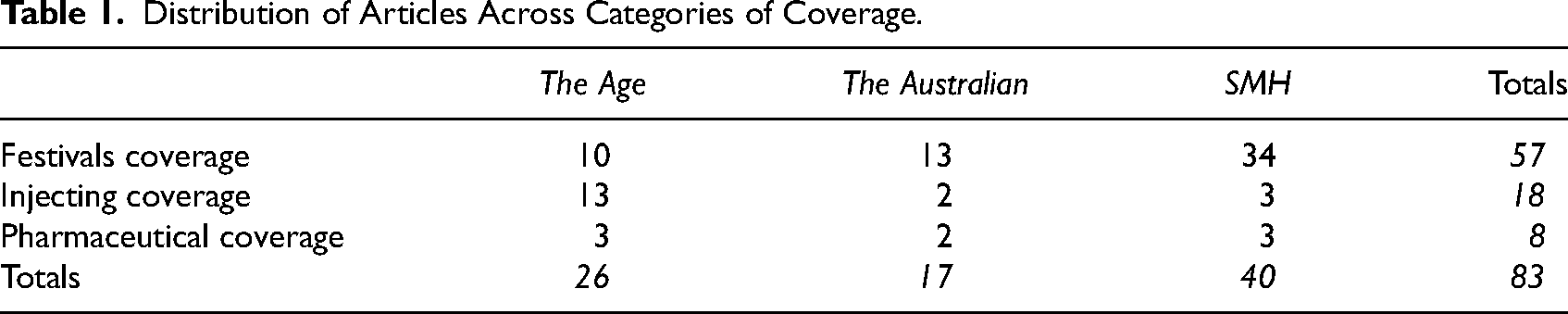
We start our analysis with a short breakdown of the different categories of articles, captured in Table 1. In keeping with our initial observations, the largest proportion of articles across the sum of all three publications was devoted to coverage of overdose deaths at music festivals (68.67%, n = 57). This was followed by coverage related to injecting-related deaths (21.69%, n = 18) and then pharmaceutical overdose deaths (9.64%, n = 8). In terms of individual newspapers, music festival deaths again comprised the largest proportion: 85% (n = 34) of articles in the SMH, and 76.47% (n = 13) in The Australian. If not for our exclusion of duplicate articles, this pattern would have also been replicated in The Age, making up just over half (51.52%) of its articles and increasing the overall proportion of festival coverage across all three newspapers to well over two-thirds (71.11%).
Distribution of Articles Across Categories of Coverage.
Injecting-Related Coverage
The majority of injecting-related articles in our sample were concerned with a proposal for a safer injecting facility (SIF) in the Melbourne suburb of North Richmond. While the substances mentioned in this coverage generally refer to criminalized opioids (such as heroin), there are a handful of references to “ice” (crystal methamphetamine). Framed as a response to the crime, trauma, and death of people who inject, almost a third (29.66%) of the coverage in this category was devoted to contextual information, including descriptions of events that framed the case for the establishment of a SIF. While few details are provided about the individual(s) who have died (representing only 4.1% of the content), each article nonetheless kept a grim tally of overdose deaths. In this way, people who die of an injecting-related overdose across the country come to be presented as a set of aggregated, disembodied numbers that simultaneously serve as a proxy for the dire circumstances of a single inner-city suburb in Melbourne.
Among articles covering injecting-related deaths, only four included a brief mention of the actual individual who had died. A series of articles in The Age used the pseudonym “Ms A” to describe a “34-year-old mother” who had succumbed to an overdose with “a needle and a spoon…beside her” (AGE11). These articles also included a description of the impact that the removal of Ms A's children had on her drug use. Dr Dwyer said Ms A tried to overcome her addiction, but traumatic events, such as the removal of her children by the Department of Human Services, and a history of family violence, set her back. (AGE11)
Another article describes how Ms A acquired heroin from an illicit drug market. In the six months before her death, Ms A had visited North Richmond regularly to buy and use heroin. Three weeks before her death, outreach workers used naloxone to treat her for an overdose. (AGE16)
When presented as anything more substantive than a statistic, those who died in an injecting-related overdose tended to appear as tragic figures in need of saving. Coverage included brief gestures to the grief experienced by remaining “loved ones” (3.88% of coverage): Almost 20 years have passed since Nicole Warr's cousin died from a heroin overdose. He had just turned 21. “He shouldn't have died in that way,” Ms Warr says. “He was a beautiful young man and there was no dignity in his death.” (AGE15)
Following a rally on Victoria Street on Sunday, Laura Turner spoke of the death of her sister Skye, who died from a heroin overdose in March 2017. “She lay dead in the back of a van on Elizabeth Street in the CBD, that beautiful face, that incredible mind, had slipped away,” she said. (AGE25)
Articles in this category also included descriptions of how these overdoses occurred: The person was found slumped on the floor with a syringe in their hands or needles and drug paraphernalia strewn next to their body, indicating a death shortly after the drug was injected (SHM14)
This reportage included the “undignified” conditions of the death, such as occurring in a public laneway or in the back of a van. Descriptions of the “dirty” or “seedy” setting of the death become entangled with the personhood of the individual victim, working to confer a certain value upon the life lost. Yara Sturak Mignon, 35, died seven days after he was found unconscious in the bathroom of a Victoria Street restaurant at 5.30pm on November 4 last year following a drug overdose. (AGE53)
Mr Bugden died at the Royal North Shore Hospital in August 2015 after suffering a stroke in a public toilet. Similarly to Mr Bestrin, it took hospital cleaners more than 20 h to find him. (SMH76)
Ms A overdosed in a Hungry Jack's toilet in North Richmond. (AGE11)
In these accounts, there is a tension between the apparent publicness of the overdose setting, and yet ultimately, a hiddenness too. Despite the deaths occurring in ostensibly public locations, the potent stigmatization of injecting as a practice means that they must also remain hidden, behind the doors of bathroom stalls and abandoned vehicles. The inclusion of such descriptions reinforces both the precarity of injecting as a practice and the social position of the overdose victim as residing at the symbolic margins. Here, the liminal existence of people who inject drugs—as neither part of society yet nor entirely outside it—is enacted in their death. This sense of otherness is reinforced through repeated references to “abuse” in the media coverage—abuse suffered by and engaged in by victims. Maria Liordos died in September 2013 at a friend's house from a combination of drugs, including heroin and methylamphetamine. She had been in residential care, provided by the Salvation Army Westcare agency, for two years in the lead-up to her death following disclosures of drug abuse, self-harm and sexual abuse. (AGE13)
The teenager was living at the care unit because of her drug and alcohol problems, her criminal behaviour and history of absconding and self-harm. In 2011, she disclosed a history of being sexually abused, and in 2013, she was diagnosed with hepatitis C. (AGE23)
Of the three forms of coverage, articles about injecting-related deaths were the only ones to include significant commentary on crime. This included the association of increases in crime statistics with injecting-overdose deaths and frequent references to the reliance on illicit drug markets by those who needed to maintain their drug usage. The harms associated with drug-related crime also featured: Throughout my time as a lawyer, I have seen the impact of drug misuse, addiction and drug-related crime. As the State Coroner of Victoria, I encounter the harm associated with drug misuse at its most devastating level. The Coroners Court regularly investigates the circumstances which lead to lives lost to drugs, together with the associated and lasting effects of that loss. (AGE18)
The close association between crime and the life and death of people who inject drugs further cements the impression that this group of overdose victims was always already marginal and precarious. And the circumstances of their death—a public toilet, the backseat of a van, etc.—seems to only to confirm this status. In the context of such reporting, including about the need for a supervised consumption site, the overdose victim emerges as a pitiful figure that rarely rises above its status as a tragic trope in media discourse.
Pharmaceutical Overdose Coverage
The next category of articles that we will discuss is those related to pharmaceutical overdose deaths. In our sample of pharmaceutical overdose coverage, the tone of the reporting is often couched in public health terms. The substances referred to in this coverage are predominantly pharmaceutical opioids, with a smattering of references to benzodiazepines. Almost a third (31.90%) of the coverage involves reporting on statistical information, as well as a heavy reliance on commentary from research (12.38%) and medical (7.14%) professionals. Collectively, inclusion of statistics and the commentary of research and medical professionals made up just over half of the reporting about pharmaceutical overdose death. One of the primary ways that this coverage frames the problem of overdose is through repeated reference to the “death toll.” The death rate has more than doubled among addicts aged between 35 and 44 since 2007. The death toll is expected to rise. “We expect further increases once the deaths data for 2014 and 2015 are finalised,” said lead author Amanda Roxburgh. (SMH22)
In 2016, there were around 11 deaths in Australia each week from prescription painkillers such as oxycodone, morphine and codeine. The death toll over five years was about 2700 people. (SMH27)
References to the rate of pharmaceutical deaths often appear alongside an emphasis on the “urgency” and “immediacy” of the problem of overdose and the need to respond. Ms Roxburgh, from the University of NSW, said the patchwork of inconsistent legislation meant there was an urgent need for a national clinical guideline or an agreement among the states and territories on national measures such as a real-time monitoring program (SMH22)
Coroner Harriet Grahame last month recommended that “urgent consideration is given to raising the priority for the introduction of Real Time Prescription Monitoring (RTPM) in NSW.” (SMH29)
Coroner Audrey Jamieson wrote that the death, “reinforces the immediate need for a real-time prescription monitoring system to assist doctors in their clinical decision-making around drug prescribing … to tackle the ever-increasing toll of pharmaceutical drug related deaths in the state.” (AGE07)
This provides a valuable point of comparison between the injecting and pharmaceutical overdose coverage. While the deaths of those who inject tended to be (re)presented as tragic albeit expected, the death of the pharmaceutical users was (re)presented as a shocking “development” that necessitated urgent action. Pharmaceutical overdose coverage emphasized a “broadening” of and “shift” in the profile of overdose victims. This was most evident when articles included direct comparisons between pharmaceutical and heroin-related deaths. Each year in Australia, about 1100 people die from opioid overdoses—mostly from legal painkillers such oxycodone, morphine and fentanyl—and the modern drug death toll is now higher than that seen at the height of the heroin epidemic. (SMH33)
We're seeing a real shift from illicit to pharmaceutical opioids implicated in these deaths, affecting a broader range of people who want to manage their pain. (SMH22)
These articles contained a clear preoccupation with, even surprise at, the idea that pharmaceuticals are responsible for the death of a group of “non-traditional” drug users. Much of this reporting emphasized that pharmaceuticals were causing more deaths than illicit drugs. The repetition of this claim, in different forms, was striking. More Australians are dying from accidental opioid overdoses each year, with prescription painkillers rather than heroin now accounting for two-thirds of the fatalities. (SMH22)
But Australia's overdose crisis is about legal as well as illicit drugs. Pharmaceutical opioids such as oxycodone, codeine and pethidine are still involved in more than half of unintentional deaths involving opioids. (SMH70)
[We are] “Sleepwalking” to drug crisis. Australia is heading towards a US-style drug crisis where many are bingeing on sleeping and anxiety medication and the middle-aged account for almost 70 per cent of all accidental drug deaths. (AUS17)
Unlike the reportage surrounding injecting-related overdose—of a “tragic” but “predicable” telos—the reportage here used terms like “accidental” and “unintentional” to underscore the avoidable nature of overdose—a sense that things could, and perhaps even should be otherwise. Indeed, we are warned explicitly not to “sleepwalk” into a crisis.
In this reporting a sharp distinction is drawn between “pharmaceutical medications” and “illicit drugs,” even though the substances referred to are often either the same product or else contain virtually the same chemical properties. One article in the SMH for instance explains to the reader what “opioids” are: Opioids—powerful painkillers that act on the nervous system—were traditionally used by cancer patients in hospitals, but over the past couple of decades, have become mainstream. (SMH22)
Though broadly accurate, at no point does the article mention that heroin is also classified as an opioid because it contains similar chemical properties. The use of medical labels such as “prescription painkillers” and “anxiety medication” simply elides the fact that these are either the very same products as those sold illicitly on the street (becoming “illicit opioids”) or that they share a very close chemical composition to heroin itself. These terms become polysemic signifiers that tell the reader more about the people consuming the substance than they do about the chemical properties they contain. A subtle slippage occurs whereby the description of the substance becomes a characterization of the person. In our discussion below we argue that this is based on emotional entanglements around the racialized and classed status of different groups of people who die from pharmaceutical overdose.
Festival Overdose Coverage
The final group of articles we will discuss is the one covering overdose deaths at music festivals, which, as noted above represents the most common coverage in our sample. The primary substance referred to in this coverage is MDMA (an amphetamine-type substance common in party settings). A distinctive feature of the coverage is their inclusion of explicit and myriad expressions of grief. In part, this is materialized through the inclusion of humanizing details about the deceased alongside commentary from friends and family. Over a third (36.92%) of the coverage in this group of articles was contextual information about the events surrounding the overdose and details about the deceased. Importantly, every article in this coverage included the name of the overdose victim. Indeed, these articles often begin with the reporting of basic information about the deceased, setting up a clear picture of who they were and the circumstances of their deaths. Sylvia Choi, 25, died after collapsing at the electronic music festival, which was attended by more than 48,000 people. (SMH09)
Queensland man Josh Tam, 22, died at the Lost Paradise festival held in the Glenworth Valley, near Gosford, over New Year's Eve. (SMH47)
Joshua Tam, 22, died on December 29, the second day of the Lost Paradise Festival on NSW’ Central Coast, after taking an estimated four to five doses of MDMA crystal rock. (AUS36)
This is often followed by a series of humanizing details, including an outline of the final moments of the deceased's life, where loved ones and medical staff attempted to revive the victim. His friends administered first aid until NSW Ambulance paramedics arrived and he was taken to Nepean Hospital, where he later died. (SMH05)
His friends tried to revive him, before paramedics took him to Nepean Hospital where he was pronounced dead. Eight other festival-goers were taken to Nepean Hospital on the same day. (SHM06)
This week, 22-year-old Brisbane man Josh Tam died after he was taken to hospital from the Lost Paradise music festival on the Central Coast. (SMH43)
The Baulkham Hills teen was found at Sydney Olympic Park train station, then taken to Concord Hospital where he died from a suspected drug overdose. (AGE48)
This group of articles also reported on social media posts from family members. Friends and family also took to social media to remember the “beautiful” young woman, who collapsed about 6pm on Saturday at the over-18s music festival in Parramatta Park. (AGE49)
Mr Mcrae's heartbroken friends took to social media to pay tribute to him. (AGE66)
In another example, two separate articles in the SMH mentioned the number of people who attended the funeral of one of the victims of overdose. More than 700 people attended St Mary's, North Sydney, for her funeral last year. (SMH01)
At Ms Bartter's funeral last year, a 700-strong congregation…. (SMH02)
The humanizing material discussed so far was written in the voice of the journalist, providing a clear signal to the reader that the overdose victims were “proper” subjects, “real people” with families and friends that mourned their loss.
Beyond the journalist’s voice, this coverage also included a significant amount of commentary from those who knew the deceased in life (10.78%)—much more than was devoted to this in either the injecting (1.58%) or the pharmaceutical (0.95%) coverage. This was made possible by the publication of multiple articles focused on the same overdose event. The personal qualities of those who died at festivals was often included in the form of commentary from friends and family members: He was a guy with a big heart, and is going to be sorely missed. (SMH06)
He is kind-hearted. (SMH32)
Rest in Peace to one of the most beautiful, thoughtful, honest and intelligent souls I’ve come across on this earth. You will be missed dearly. (SMH38)
You couldn’t not feel happy or energised around her. (SMH61)
Ms Macklin said “he was a good guy and was always up for a chat and a laugh”. (AGE66)
“Today I lost one of my best mates. Glenn you were the most funniest, sweetest person I know,” wrote Neha Singh. (AGE66)
Also included were expressions of love and admiration from a range of people who know the deceased. From caring grandparents: These are children, in the news they say “young woman” but to me she's still a child. (AUS26)
Loving friends: The last time I saw her, we both said “I love you.” (SMH61)
When she was carried out on the stretcher, I put my hand on her arm and said “I love you.” (AUS37)
“It's like a rollercoaster. And the one person you would want to talk to in a situation like this is Marli, but you can’t,” said Ms Koster, who also went to Brigidine College. (AGE52)
Grief-stricken mothers: Ms Ross-King told the inquest she was still in disbelief over the loss of Alex, an “amazing soul” who “touched so many people during her short stay.” (SMH67)
A “really funny and loving kid who lit the room up when he came in”, as Josh's mother describes him, Josh was mourned widely as family and friends should have been enjoying the summer holidays. (AGE55)
And remorseful fathers: I wonder what I could have done differently, as a father. It's hard to let go. (AUS37)
To lose your son is the worst thing that can happen to a father. (SMH32)
Here, grief was not only articulated explicitly, but also co-mingled with other “positive” emotions, such as the love, happiness, kindness, humor, and mateship ascribed to the overdose victim.
Analysis and Discussion
We have been tracing how media coverage of overdose deaths helps to shape and materialize norms around the question of the humanness and relative “grievability” of the victim. We have argued that through a combination of discursive content and collective emotion, media overdose stories perform their victims differently depending on the mode of drug use and type of social setting involved. Our analysis has focussed on three types of overdose stories that have become commonplace in mainstream media reportage. We turn now to examine more closely the predominant discursive and emotional frames enacted through these three storylines. In the following section, we draw on different emotional collectives to structure our analysis. Given such collectives are neither mutually exclusive nor seamless, we inevitably note some emotional movement or slippage between categories.
Pity
In the first instance, people who die by injecting overdose predominantly appear as a set of disembodied numbers in our sample. These numerical figures, this numbering of the dead with sparse contextual detail, creates the clear impression that injecting itself is the most reliable explanation for such overdoses. It renders injecting drug-related overdose as part of the natural order of things—as what we the audience should expect to happen when people engage in an “unsavory” practice like injecting one-self for pleasure (Vitellone, 2017). In the injecting coverage, we are presented with a generic figure (that is both the number of people who died, and the imagined person who dies this way) within an all-too-familiar cultural narrative, accompanied by all the usual motifs: “spoons,” “needles,” and so on. Typically, this figure is pitiable but not often relatable, and in this sense, they really are “other.” In the absence of details about individual people who have died by overdose, emotional responses such as pity generate the object of this reporting, the injecting overdose victim, as desperate people in need of an intervention. Here it is important to clarify that the presentation of statistical information about the death of people who inject drugs may well generate sympathy, and this can function to build support for a public health intervention that will have the effect of saving and improving their lives. There is a tacit acknowledgment of the inherent value of human life in the presentation of the death toll here, one that indicates that people who inject drugs are produced as potentially grievable. Yet, the sympathy generated by numbering the dead is not achieved through reference to the actual people whose lives are lost. Whether this coverage seeks to generate sympathy through disembodied numbers because people who inject cannot be considered fully human to mainstream audiences, or because of the journalist sees this as the presentation of “unbiased” evidence for the need for harm reduction policies is not possible to know from our analysis—these points are also not mutually exclusive, and may well reinforce one another. It is useful however to look to the context upon which much of this coverage formed part of: a public policy conversation about the proposed supervised injecting room in Melbourne. Our findings align closely with research on print media constructions of the “drug problem” leading up to the establishment of the injecting room in Melbourne: that is, injecting drug use is presented in depoliticized and individualized terms, as a bad “choice”; the voices of people who inject are essentially absent from the coverage; and there is a focus on drug use as a “health problem” in ways that ostensibly generate support for a harm reduction service (Whiteside & Dunn, 2022). In this way, the framing of the deaths in the injecting coverage as part of a public policy conversation about a proposed supervised injecting site in Melbourne is paternalistic—the audience is asked to consider this “controversial” proposal as an act of mercy on desperate people.
When descriptions of actual people who have died of an injecting-related overdose do emerge, they are rare and always tied closely to the abuse that characterized their lives, as well as the “shameful” conditions of their death. In this coverage, the life of those who die by injecting-related overdose is presented as one of trauma and abuse. Their trauma is debilitating: a life full of setbacks and doomed interventions. Their drug use is represented as extreme and excessive: well beyond the bounds of acceptable forms of consumption. Even their death lacks dignity. Here, the inclusion of descriptors such “a needle and a spoon” and “syringe in their hands” work metonymically to evoke a sense of familiarity with this scene—it is a storyline we have seen before, played out at the cinema or on television. The audience knows how this ends, and the article confirms it: the person dies “shortly after the drug was injected” (SMH14). Highlighting the criminality of injecting drug use is another way that this coverage presents overdose as the seemingly inevitable consequence of criminal risk. Much like accounts of injecting in urban (code for black) neighborhoods and the use of “hillbilly heroin” in rural (code for poor White) communities, these deaths are narrated as one of the expected social consequences of engaging in the criminal world of drug markets. Descriptions of deaths occurring in public places emphasize that people who inject drugs are alone or abandoned at the point of overdose, taking days for their body to be discovered. Even at the moment of death people who inject drugs are stripped of their social connection. With this, the overdose event becomes a site of pity upon which the reader can access a well of deeply entrenched cultural associations about injecting: disgust and fear are reinforced through public shaming of a different kind.
Our findings about the coverage of injecting-related overdose are in many ways similar to much of what is found in the literature canvassed earlier, echoing a focus on disfunction and crime in media reporting on injecting drug use more generally. In the absence of any details about these people beyond the crime and chaos of their life, the reader is drawn into an evocative tale of misfortune and shame about what can only be assumed to be those who live on the margins. Even when attempts are made to humanize individuals who have died, with names given and quotes from family members included, there is nonetheless a sense evoked of lives lost even before the overdose itself. Butler (2009, p. 38) suggests that “An ungrievable life is one that cannot be mourned because it has never lived, that is, it has never counted as a life at all.” Here, even among examples of more humanized accounts, while they may not be “ungrievable,” it is at best an attenuated, compromised form of grief. Despite the (re)presentation of death as almost inevitable—a “natural” consequence of poor choices, criminality, individual flaws, and so forth—they are nonetheless pitiable deaths.
Surprise
In this section, we will explore the way media coverage of pharmaceutical overdose invites its audience to be surprised at the kind of people who die of this type of overdose. While there is also a strong emphasis on statistics in reporting on pharmaceutical overdose deaths, and a distinct focus on public health, the tone and tenure of the reporting is much more generous when compared to injecting-related coverage. In the pharmaceutical overdose coverage, there is a sharp focus on the death of an apparently new and emerging group of pharmaceutical users who are accidentally overdosing and dying. Much of this coverage emphasizes that those in this “new” group succumbed to circumstance—unlike the injecting overdose victim whose death is framed as inevitable or the outcome of “bad choices,” pharmaceutical overdose deaths are tragic because they are accidental and unintentional. Those who die of pharmaceutical-related overdose are thus constructed as “normal” people for whom drug use, and its stigmatizing associations, are not emblematic of the person consuming them—their drug use is uncharacteristic, their overdose is a matter of unfortunate circumstance, and their death is a surprise.
As noted above, there is an extensive body of literature on the overdose crisis in North America that provides some useful context for our analysis of this reporting. The role that race and class play in this reporting is found in the silences, in the absence of any specific articulation of who this new group of overdose victims are, except that they are not “traditionally” associated with drug use. In Australia, there is a long history of criminalizing the drug use of minority groups, including drug policies that target First Nations communities (Evans et al., 1993; Gentile et al., 2022), crackdowns on drug use in migrant communities (Dixon & Maher, 2005; Maher & Dixon, 2001) and the framing of the LGBTIQ community as more vulnerable to the harms of drug use (Pienaar et al., 2018). In this way, racialized “others,” minority groups and the socially disadvantaged likely animate what is implied as the “traditional” drug user, with the “non-traditional” drug user emerging as heteronormative, White, and middle-class. Where in North American media coverage terms like “rural” and “suburban” are coded references to both the middle-class and the poor, White people dying (Johnston, 2020), in our sample reporting on pharmaceutical deaths themselves become code for White deaths. This is not because that is the only group dying by pharmaceutical overdose, but because that is what this reporting emphasizes in its appeals to the “urgency” of the issue.
Of course, this focus on the “non-traditional” overdose victim does not map onto the structural conditions causing the most harm. For instance, Indigenous people are far more likely than non-Indigenous people to be the victims of overdose in Australia, as are people from rural communities (Chan et al., 2019; Penington Institute, 2020). Though First Nations people are disproportionately impacted by pharmaceutical overdose deaths, their voices do not feature in any of the coverage. In fact, in all of the articles included in our sample, only one makes reference to the harm caused to First Nations communities, and it comes in the form of a set of statistics. Moreover, the Australian newspaper often positions itself as having a strong editorial focus on issues that impact Indigenous people—yet in our sample no article from this newspaper makes any comment about the impact that overdose deaths have had on Aboriginal and Torres Strait Islander communities. Echoes of the North American media coverage are salient, with Johnston noting that: “zeroing in on the tragedy of overdose deaths only among middle-class White youth misrepresents the nature of the crisis, which is actually most severe among Indigenous, unstably housed, and [the] middle-aged” (Johnston, 2020, p. 124). It is indeed common in Australian media for the suffering of First Nations people to be seen as “too routine or ordinary, and/or irrelevant to a largely white audience” (Cripps, 2021, p. 8). Media coverage that largely ignores the deaths of Indigenous people yet emphasises the deaths of non-Indigenous people as surprising builds on ongoing but evolving colonial narratives about how Aboriginal people are “destined to die” (Watego, 2021). In this way, the coded racialized undertones of North American coverage (Revier, 2020) also appear in Australian media.
While most overdose victims in the pharmaceutical coverage appear only as statistics, some warrant further comment beyond mention as an aggregate number. Those who deserve comment beyond the numbers in the coverage are not however colonized people or rural and regional communities who experience compounding and disproportionate harm in this crisis—like people who inject, their deaths are ordinary and to be expected. Instead, media coverage of pharmaceutical deaths focuses on those who are not supposed to die by overdose: the White, middle-class folks whose drug use is apparently new—their deaths are surprising and urgent.
Grief
In this section, we explore how grief appears in all of the categories of media coverage in different ways, though we focus on deaths at music festivals because this represents the only category that includes direct articulations of grief. In doing so we seek to examine what might explain the differences between the ways in which grief is introduced in the different categories of coverage.
In the paternalistic constructions of injecting-related overdose victims, pity—and thus potential gestures to grief—are present but only achieved through the absence (or limited presence) of the humanness of the people who have died. In the pharmaceutical coverage articulations of surprise gesture toward grief for non-traditional (code for White and middle-class) people who die by pharmaceutical-related overdose, to the exclusion of the heavy burden of grief experienced in Indigenous communities and regional areas. In contrast to the injecting and pharmaceutical coverage, the festivals coverage involves many direct and unambiguous expressions of grief about the overdose victim. The festival overdose victim is never presented in statistical form, but always as case studies of the life lost. The festival overdose victim is rarely associated with crime. When occasional references to the buying of drugs are included, they are presented as uncharacteristic “mistakes.” Indeed, with several articles devoted to the court cases of the “dealers” involved, crime here becomes something done to the festival overdose victim. In these accounts, overdose victims are presented as young people full of potential, as once bringing “love, joy and laugher” to those “left behind.” We hear directly from grieving friends and family members about the lives they lead and the tragic accidents that caused their death. In this way, festival overdose victims are presented as deeply sympathetic individuals. Far from the often anonymous, statistical accounting of those who died from injecting drug use, here we have rich personalities, admirable qualities, and so on. Consistently, the inclusion of explicit articulations of grief evokes the loss of potential. Far from lives already lost, these are young lives “struck down” in their “prime.”
How then are we to make sense of the overt expressions of grief presented in the festivals coverage when compared to the sense of pity that characterizes the injecting coverage and the sense of surprise that defines the pharmaceutical coverage? Given how scarce research on media coverage of festivals and party drug use is, here it is useful to draw on a broader literature on the social position of festival drug use and its relationship to media. In the UK, demographic research of the festival goer has long revealed a young, middle-class profile, including higher levels of income and a greater number of academic qualifications (Wilks, 2011). Research has highlighted how festivals enable practices of belonging and well-being in youth culture (Özdemir et al., 2023) and how they involve forms of playful expressions of youth (Jaensch et al., 2018). Festivals research has also explored the “greening” of festival events and the way this appeals to the sustainability sentiments of youth culture (Cummings, 2016; Cummings et al., 2011). Scholars have also observed the “corporatisation of the music festival sector,” involving “rising ticket prices and significant changes to the demographic characteristics of festival goers, who now span a broader age range and increasingly consist of White middle class consumers” (Griffin et al., 2018, p. 481). This is partly the result of the sector engaging a narrower target market “branded as ‘posh’ festivals, including a middle- or upper-class attendee profile and a programming strategy that goes well beyond the music” (Anderton, 2018, p. 159). There is also ample evidence of the corporatization of the festivals sector in Australia, including the increasing presence of corporate sponsors in both the physical and online spaces created by the festival experience (Brodmerkel & Carah, 2013; Carah, 2017). This is reiterated by empirical research with Australian festival goers, who, for instance, can pay for access to more exclusive camping accommodation to ostensibly avoid sexual violence: Penny reflects “it's so middle class” (Wadds et al., 2021). As with elements of the pharmaceutical overdose coverage, the Whiteness and middle-classness of the festival overdose victim (whether imagined or otherwise) is a plausible explanation for how newspaper audiences are encouraged to grieve the overdose victim.
In many ways, the ability for victims of overdose to be presented as lives worth grieving is structured around their proximity to Whiteness and middle-class and youth culture, which is central to the commercial enterprise of modern media (Deuze, 2005; Jones, 2016). Injection drug use is highly stigmatized and criminalized, associated with the underclass of society. As a result, those who die by injecting-related overdose appear in media coverage only as objects of pity, their deaths a cautionary tale about the perils of dabbling in the illicit. Pharmaceuticals on the other hand are decidedly more conventional and mainstream, their legitimacy linked closely with the medical profession. There is a significant, and marketable public interest in reporting about medications and medication use. Yet, when it comes to the deaths of medication consumers, the picture is more mixed: it includes a “new” cohort of apparently more innocent and naïve White and middle-class users, but also more stigmatized groups, like those who inject drugs, working class, and Indigenous people. This curtails the marketability of these lives as greivable and at least partly explains the distinct focus on the former, to the exclusion of the latter. When it comes to music festivals, however, there is little impediment to its marketability—indeed scholars have argued that there has been an intensification of marketized processes around the music festival in recent years. Those who die at the festival are thus mourned more explicitly, with their youth compounding the tragedy. These young lives are seen as emblematic of the ideal vehicle for economic potential and their deaths as the loss of that potential.
Conclusion
In asking why media coverage of festivals overdose deaths produced such different reportage than significant increases in overdose in the community more broadly, our analysis suggests that the White and middle-class drug user receives both more “attention,” as well as the kind of attention that places more value on the lives lost. The initial observation that sparked our study, about the disproportionate coverage of festival overdose deaths, was subsequently confirmed by the disproportionate number of articles published in each major newspaper. Further, our findings illustrate how the discourse and collective emotion drawn on in media coverage of overdose deaths constitute the grievability, and thus humanness of the overdose victim. The death of those who are seen to occupy the underclass, like people who inject drugs and groups who are “traditionally” associated with drug use, are treated as lives already lost. The apparent inevitability of the death of people who inject, those who live in rural and regional areas and First Nations people, means that in media reporting their lives rarely warrant mention outside of the death toll they form part of. They are pitied, deemphasized, or forgotten altogether. Their lives are (re)produced as less relevant to mainstream society, much in the same way that their deaths are rendered less able to be grieved. The pharmaceutical coverage is a particularly striking example, as this category involves deaths from a significant cross-section of social positions, yet the focus of the reportage and the human, emotional response to loss of life that it invokes remains focussed on the “non-traditional” (code for White and middle class) drug user. By contrast, the increasingly commercialized setting of the festival produces the overdose victim as explicitly grieved, through the reporter’s humanizing tone and the inclusion of direct articulations of sorrow from friends and family of the deceased. Here, grief is deeply felt and uncomplicated.
These examples provide a clear illustration of how the more aligned those who die by overdose are with mainstream, White, and middle-class culture, the more media coverage frames their lives as worthy of grieving. Our comparative analysis has thus identified how culturally entrenched ideas about the lawfulness or otherwise, humanness or otherwise, of people who use drugs are enacted even in death. Perhaps unsurprisingly, death affords no equalizing moment in media discourse, no respite from the social and material forces (of race, class, or age) of social life. The “differential distribution of public grieving” is, Butler (2009, p. 38) suggests, a “political issue of enormous significance.” Our own examination of “grievability” has focussed on the operations of power evident within mainstream newspaper coverage of drug-related overdose deaths. Following Ahmed (2004, p. 32), we have understood emotions not as individual psychological dispositions but as socially performative and ontologically constitutive; emotions “repeat past associations as well as generating their object.”
Building on this understanding, we have argued that through its differential affective responses to overdose deaths, the media materializes and reinforces social norms regarding the relative value of human life—its degrees of humanness. We contend that the articulation of these different emotional responses—in our case, those of pity, surprise, and grief—has serious implications, not only for people who use drugs, but for researchers and policymakers working in the field. These implications are both epistemological and ontological, concerning not only how we know or apprehend the lives (and deaths) of people who use drugs, but the question of “what is life,” the “being” of these people. Butler (2009, p. 31) argues that “[p]art of the very problem of contemporary political life is that not everyone counts as a subject.” For people navigating the enduring stigmatization and ongoing criminalization associated with particular types of drug use(rs), this “problem” of recognition—of legitimacy—has very real material and social ramifications. While questions of subjectivity and humanness are familiar to many within critical drugs scholarship (see e.g., Keane, 2003; Moore & Fraser, 2006), it is imperative that as social researchers we continue to publicly draw attention to and challenge the ways in which such ideas are embedded not only within mainstream media discourse but materialized at a service, programmatic and policy level.
Footnotes
Acknowledgments
We acknowledge that this research was conducted on the unceded lands of the Bidjigal and Gadigal People of the Eora and Darug Nations, on which the campus of UNSW Sydney is built. We would also like to thank Maria Giannacopoulos for reviewing a draft of the manuscript and for providing generous and generative feedback.
Declaration of Conflicting Interests
The author(s) declared no potential conflicts of interest with respect to the research, authorship, and/or publication of this article.
Funding
The author(s) received no financial support for the research, authorship, and/or publication of this article.
