




Abstract
The present study relied on 15 dyads of adult children and their older parent to better understand intergenerational family relations from a life course perspective. Interviews were analyzed relying on qualitative thematic analysis, identifying similarities and differences within and between interviews and dyads. Our analysis resulted in three major themes. The first concerns the important role of intergenerational family relation as a means to define and conceptualize the experiences of loneliness and ways of coping with loneliness. The second theme concerned intergenerational relations as a cause (and at times a remedy) of loneliness. The third theme concerns the ability of the dyad's members to reflect on the level of loneliness of the other member in the intergenerational dyad. The findings stress the importance of intergenerational family relations throughout the life course and highlight the importance of adopting an intergenerational lens as a possible means to address loneliness.
Loneliness is a distressing feeling resulting from a perceived gap between desired and achieved social relations (Peplau & Perlman, 1982). Loneliness also is a public health concern (Cacioppo & Cacioppo, 2018; Gerst-Emerson & Jayawardhana, 2015), with its implications looming even stronger in the current time of global pandemic and restrictions on social contact (Groarke et al., 2020). An extensive body of research documented the adverse effects of loneliness, showing that loneliness has negative implications for mental health (Holvast et al., 2015), cognitive health (Ayalon et al., 2016), and physical health (Hawkley et al., 2009). For example, in a cross-lagged examination, Cacioppo et al. (2010) reported that loneliness is a predictor of depression, and not the other way around. Loneliness was also found to predict numerous physical health problems ranging from sleep disturbances (Griffin et al., 2020), to functional limitations and all-cause mortality (Henriksen et al., 2019; Ong et al., 2016; Rico-Uribe et al., 2018; Shiovitz-Ezra & Ayalon, 2010). A better understanding of the ways in which loneliness is developed and transmitted throughout the life course and within the family could help to develop both a theoretical perspective on the ways in which loneliness spreads in the family, and timely interventions targeting individuals and families at risk for the experience of loneliness.
Loneliness is mostly examined at the individual level, as a chronic state (Mund et al., 2020) or as a situationally depended emotional reaction (Shiovitz-Ezra & Ayalon, 2010), with studies exploring its predictors and outcomes. However, theoretical perspectives and empirical data suggest that there is merit to examining loneliness as a family phenomenon. For example, studies suggest that loneliness is shared between couple members (Ermer et al., 2020; Stokes, 2017), and between parents and children (Burke et al., 2013).
In the current qualitative study, we employ a family perspective on loneliness, exploring dyads (and one triad) of adult children and older parent/s. We interviewed parents and children separately, asking them to describe their experiences of loneliness throughout their life course. We also asked respondents about their dyad member’s experiences of loneliness, and requested them to try and reflect on similarities and differences related to the experience of loneliness.
Loneliness: A Family Perspective
Whereas the experience of loneliness is, first and foremost, an emotionally distressing feeling experienced by the individual, it can be suggested that it is both developmentally grounded within early parent–child interactions and the family climate, and has social implications that reverberate through the family unit. Family systems theory (Bowen, 1966) suggests that the study of varied phenomena, ranging from mental health to career choices should consider the family as the main unit of analysis. Traditionally, children are born into an emotional unit formed in marriage by fusion of two individuals, and their lives thereafter are shaped by the family’s emotional climate. Families can differ in their base level of loneliness (anxiety in Bowen's initial theoretical work), and this baseline is responsive to situational changes (Bowen, 1966).
There are three main mechanisms that can explain how loneliness is transmitted between parents and children. First, studies suggest that there is a genetic component to loneliness. In a study of 8,387 adult twins from the Netherlands Twin Register, Boomsma et al. (2005) found that heritability can account for up to 48% of the variance in loneliness. The role of heritability was not modified by age of the twins, or by sex. They also reported finding no common environmental effect on loneliness.
A second mechanism can relate to family dynamics. From the perspective of social learning theory (Bandura, 1997), children observe, model, and imitate their parents’ behaviors, attitudes, and emotional reactions. Lonelier parents might have lower social skills (DiTommaso et al., 2003), more hostile attitudes toward others (Segel-Karpas & Ayalon, 2020), and feel awkward or rather hypervigilant in social situations (Cacioppo et al., 2006). This suggests that children to lonely parents will not have a role model to learn from how to securely navigate social situations. It is also possible that lonely parents would not support the social interactions of their children (e.g., playdates for younger children) due to their own inadequate social skills in interaction with parents. In adolescents, lonelier parents might feel uncomfortable or be hostile when entertaining their children’s friends or their parents.
A third mechanism can be the domestic climate. According to Bowen’s theoretical thinking, in situations of high loneliness, the family can suffer from over-focus on the child, relying on the child as a respite from a sense of isolation. This over-focus can create what Bowen termed “fusion,” preventing the child from achieving autonomy and finding his or her own developmental trajectory that are independent from that of the family. On the other hand, parents that experience loneliness can have less emotional reserve to parent their child, resulting in under-treatment or neglect. Their lack of social support can increase their hardships, and result in over-burden, stress, and strain that can be expressed in hostility or neglect (Junttila et al., 2007).
Finally, environmental factors that shape both parents’ and children’s social integration and loneliness should be considered. For example, the experience of immigration, racism, and ostracism for various reasons can imply that the family as a whole does not find its place within the community. In support of this assumption, research has shown that immigrants often report higher levels of loneliness even years after immigration. However, immigrants who share similar language and culture with the majority culture are not lonelier than the majority group (de Jong Gierveld et al., 2015).
In the current study, we interviewed both older parents and their adult children and asked about their experiences of loneliness as children and adults. An intergenerational family perspective was employed, asking interviewees to reflect on their own experiences of loneliness within the family of origin as well as on their parents’ and children’s perceived experiences.
Methods
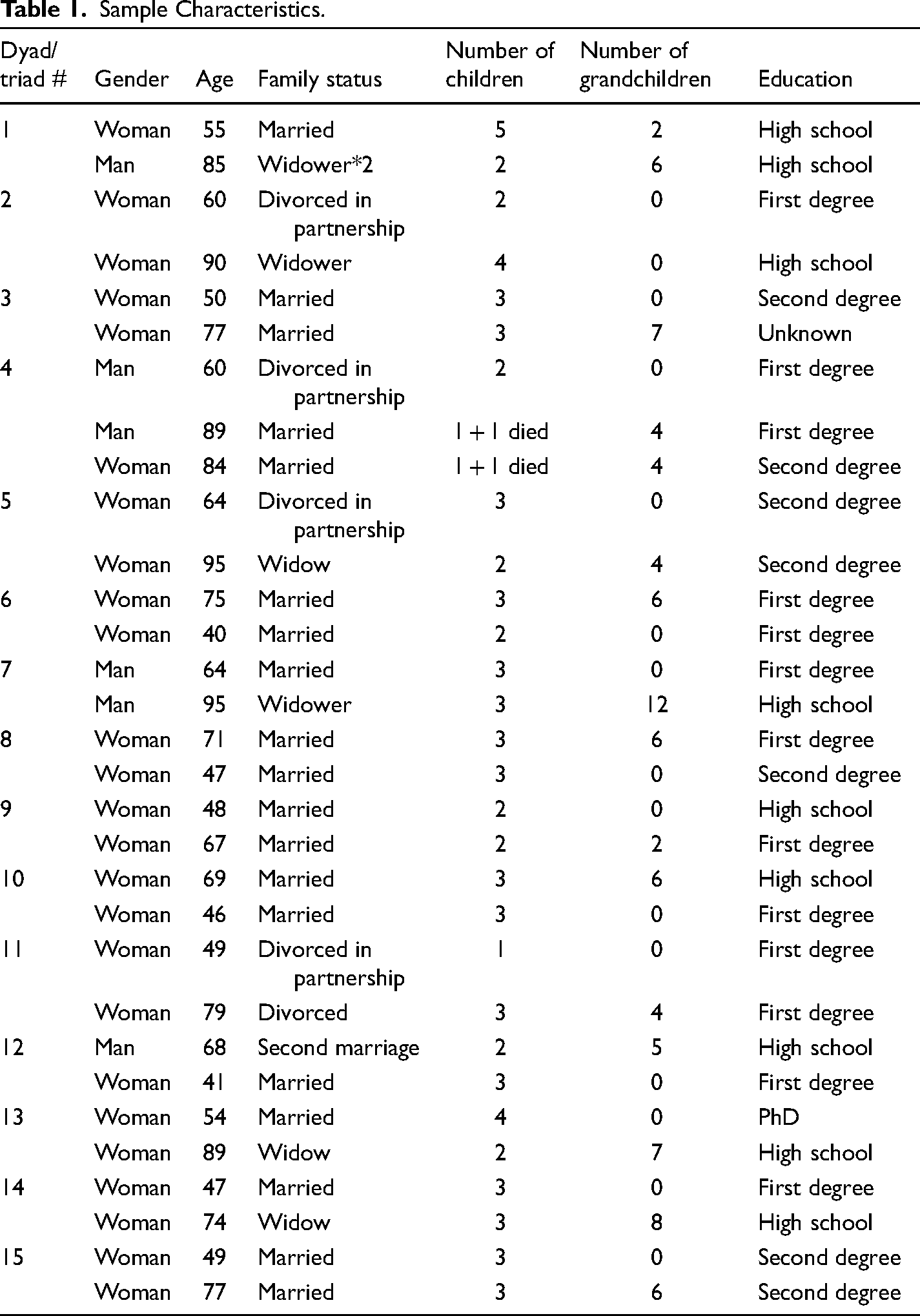
A sample of 15 dyads, mainly composed of mothers and daughters (N = 11 out of the 15), was recruited through word of mouth. An invitation to participate in a study about social loneliness in families was distributed in social networks, including Facebook and WhatsApp. Inclusion criteria were speaking Hebrew, an adult child over the age of 18 and an older parent over the age of 60, and no hearing problems that can prevent the participation in an interview. The study was approved by the ethics committee of the principal investigators (PI) university. We concluded recruitment when we reached saturation and no new themes were presented in the interviews (Fusch & Ness, 2015). However, we realize that our representation of men is lacking, thus preventing us from comparing the experiences of loneliness of men and women within the family. Table 1 summarizes the characteristics of the sample.
Sample Characteristics.
Procedure
A PhD student in the field of gerontology conducted the interviews. The student had previous experience with qualitative research and was familiar with theories of loneliness and ageing. Interviews were conducted in-person, with adult children and parents, separately to ensure open communication. All participants signed an informed consent prior to participating in the interview. The interviews lasted on average 1 hr. All interviews were recorded and transcribed. An interview guide was followed, starting with broad questions such as “tell me about experiences growing up in your family of origin,” “how has your experience of loneliness changed over time,” and moving on to narrower questions such as “tell me about your relationships with your parents,” “how do you think loneliness was experienced by your mother when you were a child.”
Analysis
Both the authors read and re-read each interview to familiarize themselves with the data. Subsequently, each interview was coded descriptively, using open-coding with no a priori hypotheses about the coding. This process was conducted separately for each interview. In this process, we had codes such as “loneliness as a child”; “never experienced loneliness”; “loneliness in marriage.” Next, the authors met to discuss possible higher-level themes. For instance, if we started with descriptive themes such as “mother is not lonely,” “I am not feeling lonely,” we subsequently grouped them to represent an interpretative overall category of “loneliness in intergenerational relations.” At this stage, the authors discussed differences and similarities within each dyad in relation to the overall themes identified (Eisikovits & Koren, 2010). Next, we discussed a coherent story line which concentrates around the main research question, namely, “dyadic intergenerational perspectives on loneliness over the life course.” Themes that were not deem relevant to our research question, such as relationships with siblings or with partner were not included in this article. The reliance on two researchers who independently coded the data and the reliance on interviews with two members of the family, possibly increased the trustworthiness of the findings. We also provide direct quotes from the text to allow the reader to judge the coding system.
Findings
Employing an overall framework of loneliness as an intergenerational experience within the family, we identified three themes. The first theme concerns intergenerational relations as a means to learn about loneliness. Under this theme, both the understanding of what constitutes loneliness and ways of coping with loneliness was discussed from an intergenerational perspective. Although some dyads shared common definitions of loneliness and ways of alleviating it, this was not the case for all dyads. However, even when differences were noted, they often were discussed within the intergenerational framework of loneliness, with the family as the primary place to learn about loneliness, alleviate loneliness, and prevent loneliness. The second theme addressed intergenerational relations as a cause of (and a remedy for) loneliness. This theme represented two subsections. Respondents discussed intergenerational relations as a cause of loneliness either because the intergenerational relationships themselves did not provide the type of emotional and social support needed or because of family transitions that affected the child's sense of loneliness. Other times, intergenerational relations were portrayed as alleviating loneliness. The third theme concerned the within-dyad ability to assess and reflect on the sense of loneliness of the other member of the dyad, which again was not always consistent across dyads. Each of the themes is described and illustrated using direct quotes from the text.
Intergenerational Relations as a Means to Learn About Loneliness
In four of the dyads, both dyad members denied feeling lonely. They also tended to use similar means to address loneliness, largely relying on occupying themselves with various activities to avoid the sense of loneliness. Below are some excerpts to illustrate similarity in experiences and coping within the dyad.
The son in Dyad 4 stated: “I have never felt lonely. Even during the COVID lockdown, I never felt lonely, because I always worked. We worked from home.” Similarly, his father stated: “Look, I never felt loneliness. I was very popular. I never felt lonely. Moreover, as I told you, I was trained as a commander and I commanded guys my age, and then I was an officer and was responsible for many people my age and older. And—loneliness—I no longer felt.” Hence, both son and father report the absence of loneliness in their lives.
In a different family, Dyad 15, in response to a question about the experiences of loneliness, the mother stated that she had never experienced loneliness: “No. Really-never. First of all, my family, we are a family of five kids. Two families. A village of Ashkenazim (Jews from European ancestry).” Similarly, her daughter stated that she had never experienced loneliness. This, too, was attributed to her relationship both with family members and friends: “I don’t, I personally never felt lonely. I don’t feel loneliness. It could be, I mean. I have two three good friends that I talk about intimate issues with. And I have my partner with whom I share intimacy.”
These dyads demonstrate that the experience of so-called, lack of loneliness was common to both parent and adult child within the same dyad. Although the dyads attributed the limited sense of loneliness to different coping mechanisms, they were nevertheless, shared by both members of the dyad.
In contrast to the four dyads that completely negated the experience of loneliness, both mother and daughter in Dyad 9 experienced loneliness. Both mother and daughter attributed their sense of loneliness to inadequate intimacy within their marital relations. In response to a question about the definition of loneliness, the mother stated: “Well, I understand it this way, as if, loneliness is when the person is alone. For instance, a married person, a couple. Even if they are married and love and all these things, the woman might still feel loneliness. That's how I see it.” She later, moved on to talking about her unsatisfactory relations with her husband of many years: “…We are already veterans here. Live here for over 29 years. But—my husband never told me, come, let's have breakfast together, let's have coffee.”
Like her mother, the daughter also reported unsatisfactory relationships with her ex-husband that had increased her sense of loneliness. In response to a question about her experiences of loneliness, the daughter stated: “For instance, I had a sociopath husband, who all the time took care of his body and counted his abs. And I had to be a slave to his muscles and proteins and… Let's say, he would come home and then a protein meal. ‘This is not ironed.’ I mean—go iron your own cloths.” Unlike her mother, who remained in the relationship despite feeling lonely for many years, the daughter had used a different strategy and decided to divorce in order not to remain in these unsatisfactory relationships.
Although the daughter in Dyad 13 sees herself as very different from her mother, they both report relying on similar means to deal with their loneliness. For instance, the mother stated that following the death of her husband, she felt lonely. Her ability to cope with loneliness was largely attributed to her long-term relations with friends, who have supported her throughout her life: “I was very active. Very. I never thought I could be in such a situation. Nothing matters. I don’t care about anything. I stopped cooking altogether. But thank God, I have friends that I met even when I lived abroad, we went to the same school.” Similarly, her daughter, who emphasized her difference from the rest of the family, also described her reliance on long-term social support to address loneliness: “I am a bit odd in my family. I am a bit odd. The investment I have put in my friends was unique to me. I mean, it is not something that I was encouraged to do at home. We are three friends. Today the relationship is a bit less close than in the past, but we still meet about once a month once every other month. We are very informed about what's going on in each other's life. When a friend divorced, she immediately called us, and we came over. And—I speak with you, I am 54 years-old, we are friends since the age of nine. So—we have been together for many years.”
Intergenerational Relations as a Cause (and Remedy) of Loneliness
In nine of the dyads, loneliness, especially during childhood, was attributed at least to some extent to intergenerational relations. Whereas some attributed their loneliness to a general lack of fit or limited support provided by parents, others argued that the parents’ behaviors (and varied life transitions) were directly responsible for their loneliness.
For instance, the daughter in Dyad 3 attributed the loneliness she had felt as a child to the multiple transitions her family had experienced. Although her mother can see this now, the mother was described by her daughter as being insensitive to her loneliness as a child.
As clearly stated by the daughter: “I always experienced a sense of loneliness. Always. I came to Israel in eighth grade, for the second time. So—my entire class had already known each other and had social interactions. I arrived in eighth grade—after the bonding took place. So, I got stuck. I mean, I had a friend that was an outsider, an American. I always was an outsider—when abroad, I was an Israeli and in Israel I was a foreigner.” Her mother corroborated her statement: “I think that socially, the fact that we moved every three years to a different country, by the time she became acquainted, by the time she felt good in a new place, we had to move to a different place. But—on the other hand, this is a good preparation for life. As a teen, I think we hurt her a bit because we came back when she was in eighth grade and the class was already quite well-integrated.”
The daughter in Dyad 11 felt loneliness within the family. She described how she could not reach out to her mother. Moreover, her parents’ divorce had a negative impact on her sense of loneliness: “Many times in my life, I felt lonely. Around the age of 12, when my parents separated, I felt very intense loneliness.” Hence, this again reflects the substantial impact of her parents’ life transitions on her own sense of loneliness.
Her father, in contrast, described his divorce as a positive social experience, which had alleviated his loneliness: “When I lived with (Dyad11's) mother, I felt a terrible sense of loneliness. I felt alone. As if I had lived with a refrigerator. A washing machine, a dishwasher. Not a human being. No conversation. No cooperation. No exchange. Everything is dead…But, for 23 years (since the divorce), I do not feel loneliness.” Both mother and daughter in Dyad 12 reported similar experiences.
The daughter in Dyad 10 described a heightened sense of loneliness, for the first time, when her first daughter was born: “I was young on maternity leave and I just felt all alone. Not completely alone because I had my husband, but he went to work. I would call my grandpa and grandma, who were still alive at the time, to come and go to the mall with me. I felt alone. I was with her (daughter) alone and I felt loneliness. This is a time I remember feeling lonely.” Hence, she too reflects on loneliness associated with intergenerational transitions.
Intergenerational relations did not only increase or instigate loneliness, but also alleviated loneliness in some dyads. For instance, the mother in Dyad 5 stated that she had moved to live in Israel to be next to her daughter and alleviate some of her loneliness: “Here (in Israel), I have my daughter. This is important. This is the reason I am here. I am not lonely because I have my daughter nearby. I have my daughter's friends. I am not lonely.”
Consistently, in Dyad 6, the mother described how her loneliness was immediately lifted once she gave birth to her first-born child: “I felt lonely because I was not a mother before. I had not experienced that before and, I was the last to marry in my class. So—I didn’t like going to weddings. I was full of jealousy. Full of jealousy. This has made me full of loneliness as well.” Hence, both accounts suggest that intergenerational relations also have the potential to serve as a remedy.
Two dyads negated loneliness altogether due to their strong familial support. The daughter in Dyad 14 stated: “As a child, I don’t remember feeling lonely. She (mother) was always there. Always there was food. Always knew. You know, she supported us. Also—me. In sports. She was the team manager. Also at school, she was always the boys’ teacher. I didn’t feel she was bothering me. I had a good feeling.”
Her mother stated: “I told you that I have never felt loneliness. This is because as a child, I had a very supportive family. Later, I was as a child, a teenager and an adult and a mother of children and a grandmother of grandchildren. I always had people to share my intimate feelings with. I have never felt loneliness.”
Reflecting on Loneliness Experienced by the Other Dyad Member
The third theme concerned the ability of each member of the dyad to reflect on the other member's experiences of loneliness. In four dyads, there was an agreement between mother and daughter. For instance, in Dyad 6, the daughter did not acknowledge loneliness in mother and the mother did not report loneliness. However, the mother did see loneliness in her daughter and the daughter acknowledged feeling loneliness. Hence, even though they did not share the same experience of loneliness, they could reliably estimate the experiences of loneliness in each other.
Daughter in Dyad 6 stated: “I don’t see them (parents) as (lonely) people. No. I can’t see them as people who have suffered, who suffer from loneliness. No.”
Mother in Dyad 6 corroborated: “So, I had a hard time trying to see where I experienced loneliness. Because—I tried. I invested internally. I brought myself to experience childhood and adulthood and teenage years. I had a hard time finding loneliness. The question is how we define loneliness.”
Consistently, in Dyad 9, the daughter could see her mother's loneliness and the mother indeed reported loneliness: mother in Dyad 9: “I felt that I needed him (husband), but it was a long time ago. I felt alone. Do you understand?” Her daughter acknowledged: “I don’t experience loneliness in my family. Thank God. My mother does. I would never live such a life. Marital relations… When my life is not… When I am not satisfied with them. If I am not happy, I am not there. Just like my first marriage. When I decided to divorce. My child was three years old when I decided to divorce. When I feel loneliness. I do not stay. I am not there.”
On the other hand, in two dyads, there was a discrepancy between what the daughter observed in her mother and what her mother reported. The daughter of Dyad 11 thought that her mother experiences loneliness but did not reveal it even to herself: “I am sure she feels lonely even if she does not acknowledge that even to herself.”
Indeed, during the interview, the mother denied feeling lonely: “I do not experience loneliness. This is the reason I told you I don’t think it is worth your time to be travelling all the way from Tel Aviv to the North of Israel to interview someone who has never experienced loneliness.” Given the fact that loneliness is a universal feeling, it is unlikely that the mother has never experienced loneliness in her life. Therefore, her daughter's prediction is probably accurate. A similar pattern was evident in Dyad 15. The mother reported never feeling lonely and her daughter stated that her mother never discussed loneliness and minimized her problems.
In Dyad 10, there was a discrepancy between reports made by daughter and mother. The daughter thought her mother was lonely, but the mother did not acknowledge feeling lonely. In some cases, as in Dyad 2, the mother did not acknowledge feeling lonely. She also did not think that her daughter has ever felt lonely: “I do not think that she (daughter) is feeling lonely. Because she is, she is such a good friend. She has many friends. She divorced, but it was a great divorce.”
The daughter, on the other hand, admitted to feeling lonely in the past. Hence, this discrepancy could be a result of her mother's projection of her own feelings on her daughter or her inability to acknowledge challenges and weaknesses in her daughter: “I felt lonely when my oldest daughter was born, and I felt he (husband) didn’t understand and didn’t help as much as I needed…. It could be that in the period before I had a partner. When I didn’t have a partner. Yes—I think about this. I am not sure if I should call it loneliness, but I had a dog and I used to walk with him.”
Discussion
The present study explores the role of intergenerational family relations in determining, shaping, and addressing one's experiences of loneliness. In our inquiry, we identified three major themes that emerged from the interviews with 14 dyads and one triad of parents and adult children. The first theme concerned intergenerational relations as a means to learn about loneliness. The second theme addressed intergenerational relations as a cause (or a remedy) of loneliness, whereas the third theme reflected the ability to acknowledge and reflect on the loneliness experienced (or not) by the other member of the dyad.
Overall, our findings support the notion that loneliness is a shared family experience. Although loneliness is an intrapersonal experience, which is subjective in nature, thus, not necessarily involves objective social interactions, it is clear that the family of origin throughout the lifespan shapes one's experiences of loneliness and ways of coping with it. One way to examine loneliness from a life course perspective is by focusing on different life stages and the presence of loneliness during each of these stages (Perlman, 1988). Likewise, the present study also examines loneliness from a life course perspective by pointing out to different familial life events and their possible implications to one's loneliness. The present study offers a somewhat different approach as we highlight overall intergenerational processes involved in loneliness throughout the life course.
One such intergenerational family process of relevance to the experience of loneliness throughout the life course is the important role played by the parents as providing information about loneliness and ways of coping with it. This intergenerational similarity is not a coincidence. As already noted, similarity between parents and their children in the experiences of loneliness can be established through behavioral learning processes, shared environments, and shared genetic mechanisms (Perlman, 1988). Our analysis has shown that even when definitions and coping styles are not shared between parents and their children, they often guide the children's behaviors. Children learn not only what to do, but also what not to do. When they notice loneliness in their family of origin, due to a limited social support network or inadequate marital relations, they learn to work on these issues in their own adult life. Hence, the study points to a different type of learning, which is not imitation, but rather doing the opposite of one's parents. Yet, this still represents learning through observation. This of course does not deem the other way of learning through imitation as irrelevant. Lack of imitation and observation of parents in social situations can harm the child’s development of social skills (Wagner et al., 2018) and may even result in loneliness.
Another finding highlighted by the present study concerns the important role of adult parents in their children's sense of loneliness. Not only via social learning and (un)shared definitions and copying styles, but also due to parent–child (mis)match as well as parent's own life transitions and choices, which directly affect their children. (Mis)match between parents and their children is well-known. There is research demonstrating the contribution of infant–mother attachment style to the sense of loneliness during adolescence (Antognoli-Toland, 2001). There also is research that shows how life transitions, such as divorce, relocation, or the birth of a new child may contribute to one's sense of loneliness (Bayat et al., 2021; Rönkä et al., 2018). The present study adds by stressing the varied ways in which parents influence their children. These influences can be direct via intergenerational family relations or indirect via the environments provided to the children through their parents. It is important to discuss the concepts of chronic and situational loneliness together (Shiovitz-Ezra & Ayalon, 2010). Families that do not support social integration and do not model close social interactions could be chronically lonely. Frequent transitions during childhood, for example, could not only cause situational loneliness, but also establish a sense of inadequacy that can possibly become chronic. It also is important to note that the impact is not always from parents to children, having a newborn child or moving next to adult children also were discussed as transitions associated with alleviating (or increasing) one's sense of loneliness. Hence, the dyadic relations in the context of loneliness can be bi-directional.
A third theme identified in this study concerns the ability of family members to identify each other's experiences of loneliness. Our findings were mixed, with some dyad members being very tuned to the loneliness felt by the other member of the dyad and others being more oblivious. Moreover, it appears as if at least in some dyads, members were more open to recognizing the experiences of loneliness in the other dyad member than the latter were able to acknowledge these experiences in themselves. These findings raise questions about the nature of such empathic abilities to view the other and recognize or misrecognize his or her sense of loneliness. Projecting one's own feelings or simply attempting to avoid noticing negative feelings in one's loved ones are potential explanations to challenges to decipher loneliness in the other member of the dyad. Further research is needed to better understand the relevance of the present findings to the shared sense of loneliness of the dyad as well as to the ability especially of adult children to identify their own sense of loneliness in the absence of recognition from their parents during early childhood and adolescence.
Despite its strengths, the present study has several limitations that should be noted. The focus on dyads limited our ability to create a comprehensive family picture of loneliness in the entire family system. Instead, our focus was limited to intergenerational relations. We also did not discuss findings concerning the importance of relationships between siblings or couples, given our focus on intergenerational relations. Second, our sample consisted mainly of mothers and daughters. Hence, our ability to point to gender differences is limited. Nevertheless, our findings demonstrate the importance of intergenerational family relations throughout the life course. Intergenerational family relations are important for a way to learn about loneliness and ways of coping with it. Intergenerational relations also establish an environment, which is either suitable and allows one to flourish and develop meaningful social relations or discourages one from engaging in such relationships. Last, intergenerational relations also can serve as a mirror to reflect and perceive the other member in the dyad's sense of loneliness. At times, such mirroring is accurate and observant, yet other times the perception of the other in the dyad is off. Future research could try and focus on the mechanisms that enable or disable accurate perceptions of the other’s loneliness. Given the strong role those intergenerational relations play in shaping one's sense of loneliness and ways of coping with it throughout the life course, it is important to employ a life course intergenerational perspective in the development of interventions that address loneliness. Working together with children and their parents might be one approach to alleviate sense of loneliness within and outside the family. Paying special attention to children and teenagers that frequently move could mitigate the harmful effect of dislocation. Finally, strengthening parents’ and children's ability to openly discuss their social needs and social difficulties could perhaps not only promote better family communication, but also help parents and children find satisfactory social relationships.
Footnotes
Declaration of Conflicting Interests
The author(s) declared no potential conflicts of interest with respect to the research, authorship, and/or publication of this article.
Funding
The author(s) received no financial support for the research, authorship, and/or publication of this article.
