




Abstract
In recent years, growth-oriented leadership (GOL) has come to the fore as a salient predictor of positive employee outcomes in public sector contexts. This empirical paper examines the role of GOL in shaping perceptions of quantitative demands as a product of an evolved New Public Management (NPM) context and the subsequent impact on stress and well-being for 419 local government employees working in Western Australia. While latent in previous GOL-oriented studies, this paper is the first to explore the intersection of GOL and quantitative demands, noting that the former has an established positive effect on employee wellbeing, and the opposite case for the latter. Drawing on the challenge-hindrance framework, this article argues that GOL helps to shape employees’ primary appraisals of demands as challenges, rather than hindrances, in the post-NPM environment. The results indicate strong, direct negative relationships linking GOL with quantitative demands and stress, and a strong positive relationship between GOL and well-being. This study establishes GOL as a relevant capability for public leaders in supporting employees to deal effectively with public service demands and subsequently grow. Understanding how leadership capability, and particularly GOL, can shape the employee experience is important in ensuring the effective delivery of public services.
Introduction
Public sector reforms place increasing pressures on new ways of leading and organizing. Although not new, the tenets of New Public Management (NPM) still inform the daily experiences of today’s public servants and place unique demands on public service delivery. In particular, the expectations associated with “doing more with less” (Farr-Wharton et al., 2021) are pervasive and are arguably becoming even more intensified through the layering of public sector reforms against a backdrop of ever-changing societal expectations on government institutions (Christensen & Lægreid, 2022).
The ascension of NPM can be traced back to the early 1980s with the rise of neoliberalism and the mounting economic shocks occurring across Organization for Economic Co-operation and Development (OECD) countries (Simonet, 2015). Australia was by no means immune to NPM reforms, and its remnants still shape the daily operations of public services today. NPM is viewed as a market-based approach which “includes the familiar elements of shrinking government and making administration more efficient through use of private-sector performance-management and motivation techniques” (Box et al., 2001, p. 11). Many argue that despite attempts to replace NPM with new institutional logics, its effect on public service operations is even more complex today than it was 40 years ago, primarily due to the layering of reform models over time, giving way to a public service “hybridity” of sorts, and what we will refer to throughout this manuscript as a post-NPM environment (Christensen & Lægreid, 2022; Hendrikx & van Gestel, 2017).
The current context is characterized by increased and intensified work demands, which in turn, pose risks to the well-being of public sector employees (van der Meer et al., 2022). Furthermore, ongoing pressures to “do more with less” call for new, more sustainable and effective forms of leading and organizing (Franken et al., 2021). Indeed, governments require adaptive workforces that thrive in the face of challenge and adversity (Lengnick-Hall et al., 2011) to meet and exceed public sector demands and effectively execute public service delivery (Farr-Wharton et al., 2021). Like state institutions, local governments have also been required to adapt to changing conditions while remaining responsive to norms and expectations of decentralization and increased public–private coordination with generally poor resourcing, rendering them particularly vulnerable (Anessi-Pessina & Steccolini, 2005; Bowman & Parsons, 2009; Zafra-Gómez et al., 2013).
Such high expectations are easier in theory than in practice, and institutional constraints, as well as job-level demands, can thwart efforts to adapt and grow, particularly when there is a lack of leadership support for such behavior (Franken & Plimmer, 2019). Leadership is thus a core means through which organizations can ensure strong and sustainable public services (Franken et al., 2021; Van Wart, 2014). Such leadership needs to be adept at fostering growth and adaptation in employees, so that the challenges of a post-NPM environment can be effectively confronted and managed, and risks to well-being can be reduced.
This study posits that growth-oriented leadership (GOL), defined as “behaviors by line managers to actively build employee capability” (Franken et al., 2021, p. 662), is a relevant approach to leadership in this context in that it matches and aids adaptation to the hybrid demands of the public sector work environment. Research on GOL to-date has found a positive association with employee resilience, work engagement, and well-being among white-collar workers, including those working in the public sector (Franken et al., 2023; Franken & Plimmer, 2019). These findings speak to the pivotal role GOL can play in supporting growth-oriented outcomes in employees. However, little is known about the way in which GOL interacts with the post-NPM environment, and whether the tenets of this construct may further shape employee capabilities.
This investigation draws on the challenge-hindrance framework (Cavanaugh et al., 1998) to conceptualize that GOL helps to frame employees’ appraisals of particular public service demands as challenges, rather than hindrances, therefore reducing the harm of work demands on employee outcomes such as stress and well-being. Well-being is defined in this study as the degree to which an individual has a favorable view of their life (Boujbel & d’Astous, 2012; Veenhoven, 1991). Stress, on the contrary, is defined as “the change in one’s physical or mental state in response to situations (stressors) that pose an appraised threat to that employee” (Beattie & Griffin, 2014, p. 126). The post-NPM context, with its increasing expectations despite reducing resources, can have a negative impact on public servants’ stress levels, and ultimately their well-being (Brunetto et al., 2011a). Public sector leaders may indeed play a key role in supporting employees to deal with public service demands effectively and in a way that protects their overall well-being.
The challenge-hindrance framework posits that work demands may be viewed by employees as either challenges or hindrances (Cavanaugh et al., 2000). Challenge stressors can foster growth and development and are perceived as controllable (Haar & Bardoel, 2008). For example, a goal that stretches and expands an employee’s capability, but is also sufficiently difficult to achieve can be experienced as a challenge stressor, particularly when there are adequate resources such as supportive leadership (Plimmer et al., 2023; N. P. Podsakoff et al., 2023). In contrast, hindrance stressors are demands that are often perceived as outside an employee’s control and may undermine their ability to learn and grow (Hsieh, 2014). For instance, high work demands without adequate time and other resourcing can challenge their ability to cope, contributing to employee stress (Leka et al., 2003). This situation impacts employees’ ability to effectively contribute to organizational aims (Giauque et al., 2013). High quantitative demands at work are a psychosocial risk, and past research has linked them with staff burnout, poor sleep, and turnover intention (Eriksson et al., 2021; Hong & Cho, 2021). These experiences can undermine well-being and thus the quality of an employee’s experience of work and performance (González-Morales & Neves, 2015).
This study reports on survey data collected from 419 local government employees working across different local government jurisdictions across Western Australia—Australia’s largest geographical state and tests a structural equation model which conceptualizes the role of GOL on two key employee outcomes—well-being and stress—in the post-NPM context. Specifically, this study aims to answer the following research question: What is the role of GOL in shaping experiences of demands and influencing employee outcomes in the post-NPM context?
Literature Review
Public sector realities today grapple with current and emerging challenges, but the tenets of previous reforms still inevitably inform the operations and norms of public agencies. In other words, “[p]ost-NPM reforms did not replace NPM-reforms, but instead partly merged with them and partly modified them in what can be described as a layering process” (Christensen, 2014, p. 161). This layering process makes demands more complex and compounding for public servants. Ironically, the principles guiding these reforms have all been driven in some way by a desire to deal effectively with changing demands. This hybridization of past and present reforms, such as with traditional public administration and NPM, defies such principles, by increasing role complexity, ambiguity, demands, and tensions, essentially making it harder for public servants to approach and deal with changing demands effectively (Christensen & Lægreid, 2022; Denis et al., 2015; Wällstedt & Almqvist, 2015). This is true for the Australian context within which this study is situated, and such challenges are felt at federal, state, and local government levels (Pocock et al., 2001; Tiernan, 2011; Verlinden et al., 2023).
The shift from a centralized, bureaucratic form of public administration to a more decentralized, market-driven method of organizing (Bryson et al., 2014) has also intensified work (Chandler et al., 2002). The customer-oriented demands on public organizations to deliver services at all costs puts pressure on resources and places strain on employees (Christensen & Lægreid, 2011). Pressures on employees have been exacerbated by the loss of resources associated with large-scale reforms, especially in relation to people, time, and budgetary support (Noblet et al., 2006).
Doing More With Less and Competing Expectations
Indeed, the prerogative to “do more with less” confronts many public sector organizations today (Farr-Wharton et al., 2021). This involves not only a high quantity of demands facing public servants (Hupe & Buffat, 2014) but also extensive and intensive demands inherent in their daily work (i.e., pace of work, hours of work, workload; Mette et al., 2018). This study views high levels of quantitative demands to be reflective of the post-NPM environment. Accordingly, quantitative demands focus on the strain caused by the amount or load of work in a period of time—specifically, “how hard you work” (Kristensen et al., 2004, pp. 305–306). These demands, which can be seen as a routine, medium-intensity and manageable aspect of work, hold the potential to become hindrances in this pressurized public sector environment, especially in contexts with little or poor supervisory support (Xerri et al., 2019).
In this context of “doing more with less,” quantitative demands can become sources of stress and, in particular, hindrances, through the “mismatch between the amount of work and the time available to do it” (Kristensen et al., 2004, p. 308). This is consistent with the notion that public service reforms, including their layering effects, may coincide with an accumulation of work demands for public servants to the point of burnout and exhaustion (Berntson et al., 2012; Franken & Plimmer, 2019; Sciepura & Linos, 2024). This situation has resulted in growing tension between unmet growing public service demand and limited supply, which has been referred to as the public sector gap (Hupe & Buffat, 2014). COVID-19 has placed further pressure on public services, and also created new challenges associated with resource use and scarcity (Plimmer et al., 2021; van der Meer et al., 2022).
The tension of needing to perform consistently with the evolved-NPM logic of being accountable to serving the public (Denhardt & Denhardt, 2015), while also experiencing the residual pressure to ensure efficient implementation of decisions (Christensen & Lægreid, 2011), places increased burden on public servants and high levels of quantitative demands are likely to erode wellbeing and lead to stress if left unchecked (Farr-Wharton et al., 2022). Hendrikx and van Gestel (2017) give an example of this tension from the context of health care, where public servants “are expected to collaborate with peers in a local network context to ensure continuity, as well as to be competitive, guided by financial incentives and performance measurement set by central government” (Hendrikx & van Gestel, 2017, p. 1116). This is a strong example of how the layering process in which resources are constrained but expectations are complex (and often contradictory), shapes behavior at the employee and manager levels and contributes to the accumulation of work demands, resulting in stress (Noblet & Rodwell, 2008).
NPM has also been associated with work intensification and high-stakes performance management approaches (Chandler et al., 2002). The impact of such NPM-informed practices on the stress and well-being of public employees are significant (Chandler et al., 2002; Diefenbach, 2009). Such environments can harm employee well-being through heightened job uncertainties, demoralization, role ambiguity, reduced trust in managers, and cynicism (Brunetto et al., 2011a, 2011b; Diefenbach, 2009; Hoggett, 1996). These factors are hindrances in post-NPM environments which typically lack the support required for employees to effectively cope with the high demands associated with complex, often contested, and diverse public service delivery (Brunetto & Farr-Wharton, 2005).
Local governments are also quintessentially “public sector,” where funding pressures, coupled with NPM layered with NPM-reform, place them at the frontline of seeking to source financing solutions to meet residents’ needs through often complex public private partnerships (Xiong et al., 2023). Notwithstanding, local governments may struggle with low levels of human capital across their staff, and lower levels of leadership capability (Addendorf et al., 2021; Jacobson & Sowa, 2015).
Leadership in the Public Sector Environment
The approach to leadership under NPM has often been referred to as “managerialist” (O’Reilly & Reed, 2011), representing a belief that “all aspects of organizational life can and should be managed according to rational structures, procedures and modes of accountability” (Wallace & Pocklington, 2002, p. 68). The ongoing relevance of this rational-technical approach to managing is increasingly critiqued by today’s organizational scholars because it does not deal with institutional and stakeholder complexity. Managerialism is poor at balancing diverse stakeholder needs and fulfilling other ethical obligations (Simmons, 2004). This balance matters in the public sector, where stakeholder involvement is necessary, creating public value is essential, and maintaining public trust is important.
Managerialism has also been associated with output-based performance management. Although technically “efficient” on resources, an over-reliance on output measurement, with a disregard for strategy and process, can lead to performance management systems that are ambiguous, partial, and misaligned with policy or organizational objectives (van Thiel & Leeuw, 2002). If the relationship between the system and the aims and goals of the organization are unclear and ambiguous, managers will essentially establish “inadequate paths for future growth” (Andrews et al., 2006, p. 277). This argument is not new and was emphasized by Levine in research on cutback management, an approach to management concerned with responding to resource scarcity across sectors (Levine, 1979). Levine claimed that management concerned with tight, standardized resource allocation and reversing the sequences of previous organizational activities to save on resources will actually do the opposite of its intention of cost-effectiveness. Under the conditions of cutback management, “creativity diminishes, innovation and risk-taking decline, and the sense of excitement that comes from doing new things disappears” (Levine, 1979, p. 180).
What is instead necessary in times of tight resource-dependency is, perhaps counterintuitively, management that fosters flexibility, learning and innovation, rather than management that punishes mistakes and experimentation because of the initial burden they may place on valuable organizational resources (Pandey, 2010). This highlights the need to rethink and redefine the nature of effective public sector leadership. Described as line managers’ behaviors which actively intend to build employee capacity (Franken et al., 2021), GOL reflects a set of dynamic leadership capabilities to support employees to deal effectively with the complex and emerging challenges of the public service environment.
GOL consists of leadership capabilities centered on fostering development, trust and collaboration in employees, all of which support the dynamism and adaptability required to navigate today’s public sector environments (Plimmer et al., 2021).
Development reflects a willingness to attend to the development needs of employees (Franken et al., 2023) and reflects a relational approach to leading, underpinned by trust and a consideration for the different development needs of employees, tailoring feedback accordingly (Graen & Uhl-Bien, 1995). Focusing on development as part of a growth-oriented approach to leadership involves a leader’s willingness to genuinely invest and support employee aspirations, and to be aware of how these approaches might differ between employees (Franken et al., in press). This capability is essential for quality leader-follower relations which, in turn, supports public service motivation in employees and public service delivery (Andersen et al., 2021; Camilleri, 2007).
Trust, defined here as “a psychological state comprising the intention to accept vulnerability based upon positive expectations of the intentions or behavior of another” (Rousseau et al., 1998, p. 395), is an important aspect of perceived leader effectiveness (Hogan et al., 1994; Lombardo et al., 1988). Trust-based leadership has been identified as an important capability of public sector managers (Camilleri, 2007) and can be seen in GOL through allowing autonomy and receiving discretionary efforts (Franken et al., 2023). Underpinning this dimension is a leader’s belief in one’s potential ability to do a job well and in employees’ knowledge, skills, and abilities to effectively contribute to the organization (Franken, 2019).
Collaboration relates to leaders enabling and supporting employees to work effectively within a team (Franken et al., 2023). This approach is reflective of team-centered leadership, which involves leaders being proactive in inspiring collective ways of working, establishing methods of mutual support between team members, and providing clear opportunities for working collaboratively (Maddux, 1994). Setting collective tasks supports employees to enact competencies that, when shared, promote collective learning. Such collaborative activities are important for employees today, particularly in the public sector environment (Camilleri, 2007; Denhardt & Denhardt, 2015; Zeier et al., 2021). This emphasizes the notion that wicked problems and challenges are best confronted together, leveraging diverse capabilities, rather than alone, using isolated, individual attempts (Getha-Taylor et al., 2016; Kuntz et al., 2016).
In the public sector work environment, there are increasing pressures to operate efficiently through heightened job expectations and workload amid constrained resourcing related to staffing, equipment, budgets, and general scope within jobs to allow for ample time to deliver services effectively (Hupe & Buffat, 2014). Such demands are known to hinder teamwork and performance, leading to stress and poor well-being outcomes (Demerouti et al., 2017; Farr-Wharton et al., 2021). Yet, the role of leadership can be crucial in these circumstances, and a growth-oriented approach, as described above, can enable the autonomy, trust, and support to buffer harmful stressors, and even enable them to be experienced as challenges to promote growth and development, rather than as hindrances adding to stress and harming well-being (Franken et al., 2021; LePine, 2022; O’Brien & Beehr, 2019).
The Role and Perception of Stressors
Drawing on the challenge-hindrance literature, demands in the work environment, such as quantitative demands, can be viewed by employees as either challenges or as hindrance stressors (Cavanaugh et al., 1998). Challenge stressors represent controllable circumstances or events that can foster growth and development (Haar, 2006). For example, a high but manageable and well-supported workload can support engagement and satisfaction (Casper et al., 2017). However, hindrance stressors are often reflected by demands that employees feel they have no control over and which can undermine their ability to perform and adapt (Bao & Zhong, 2021). The relevance of challenge and hindrance stressors has been applied, albeit briefly, in public service contexts for over a decade (Haar, 2006) and has more recently been examined in relation to public service motivation (Bao & Zhong, 2021; Zhang & Liu, 2023). Haar (2006) found that challenge stressors were positively related to supervisor and organizational support, as well as employee loyalty. It is found that hindrance stressors, on the contrary, were negatively related to such outcomes. Furthermore, Zhang and Liu’s (2023) recent study examining 255 street-level public employees found both stressors to be positively related to burnout.
In line with the transactional theory of stress, an individual’s primary appraisal of the environment plays a critical role in the stress process (Webster et al., 2011). This initial appraisal is considered one of the main psychological mechanisms linking stressors to outcomes and may determine whether a stressor is considered a hindrance or a challenge. Situations which offer potential rewards, such as recognition, growth, and mastery, are considered challenge appraisals (Webster et al., 2011). Those situations which are considered to primarily threaten well-being are viewed as hindrance appraisals (Cavanaugh et al., 2000). Secondary appraisal relates to a cognitive process whereby the individual evaluates their coping response (i.e., coping style, coping resources, and the situation itself) in an attempt to “shape, manage, or resolve the event” (Dewe & Cooper, 2008, p. 144).
The transactional nature of this theory is aligned with the notion that the production of stress is a complex transaction between the individual and their environment (Biggs et al., 2017). Lazarus (1991) posits that there are two forces which influence appraisal of individual/environment transaction, an individual’s personal agenda and environmental factors, such as job demands and resources (Biggs et al., 2017). Resources, such as leadership, may help individuals to appraise a threat, such as high quantitative demands, as a challenge, rather than a hindrance, thereby reducing the demand’s overall impact on stress and well-being (Lazarus & Folkman, 1984; Ng et al., 2022). This article posits that, in a context characterized by high GOL, this leadership style may serve as a way in which employees may be more prone to view stressors as challenges, rather than hindrances. Such leadership may also act as an important resource in the secondary appraisal process, whereby individuals evaluate the impact of a stressor in their work environment, and identify that their growth-oriented leader can help to mitigate its effect in future.
In summary, this research examines how GOL may positively relate to employee well-being in the public sector context. More specifically, it investigates whether GOL might influence appraisals of the demands associated with a post-NPM environment, particularly those related to time pressures and workload (Kristensen et al., 2004) and prompts consideration of whether or not GOL can play a pivotal role in shaping challenges and hindrances in the work environment.
Hypotheses Development
Growth-oriented leaders provide support and trust to employees so that they can navigate their environment in a way in which challenges can be viewed as opportunities, and where leadership exists to support them should mistakes occur (Franken et al., 2021). More specifically, such leaders provide stretch assignments that expand employees’ abilities and experiences and support them with the resources required to engage in such goals, facilitating engagement in challenge-stressors. They also involve themselves in collaboration with employees which, in public service environments where intra- and interagency collaboration is an inherent requirement (Getha-Taylor et al., 2016), helps employees to better engage in this important skill (Groves & Feyerherm, 2022). This potentially buffers the impact of the collaboration requirement, aiding a challenge, rather than hindrance, appraisal. Specifically, GOL provides the means and the direct guidance for employees to navigate inherent work stressors in ways that promote a challenge-oriented, rather than hindering, view and experience of demands (Ding & Cao, 2023). The collaborative nature of GOL also provides the basis for meaningful relationships to be built and maintained, fostering a sense of belonging and team inclusion (Casimir et al., 2014; Mellor et al., 2008; Settoon et al., 1996). GOL has been found to support the well-being of employees in private sector contexts through its role in developing positive self-concepts and social exchanges (Franken et al., 2023). In the public sector, GOL may support well-being and reduce stress, such as through its role in framing the inherent demands of the public sector environment as challenging, and not necessarily as hindrances for the employee. It is therefore proposed that:
The lack of resources in the post-NPM environment in terms of budgetary support and time, increase the salience of work demands. These demands, often quantitative in nature and heavily results-focused (i.e., heavy workloads and time pressures) are likely to hinder work outcomes and harm wellbeing, particularly when there are not adequate resources available for employees to effectively manage them (Kristensen et al., 2004; Noblet et al., 2006). Through support, tailored recognition, collaboration and trust, GOL provides the relational resources for employees to make sense of, balance, and effectively navigate public service demands (Franken et al., 2019, 2021). GOL also provides the means and autonomy for employees to problem solve, innovate, and find more suitable ways to “do more with less” (Franken et al., 2021; Plimmer et al., 2021). As such, the following hypothesis is proposed:
The impact of GOL represents a nuanced approach to leading which matches the dynamism and complexity of the post-NPM environment. In the absence of a leadership approach that is responsive to the unique and often conflicting demands placed on public sector employees, the pressurized post-NPM context can lead to stress and negatively impact employee well-being. This can result in high quantitative demands, whereby employees experience time pressure and high workloads. Such experiences can result in stress and subsequently, exhaustion (Gonge et al., 2002; Söderfeldt et al., 1997; Vegchel et al., 2004). Thus, when faced with the stressor of heightened quantitative demands, employees’ stress levels are likely to increase, particular in the absence of adequate support and resourcing (van Veldhoven, 2013). Furthermore, the ongoing impact of high quantitative demands on exhaustion and other fatigue-based symptoms will deplete employee capacity for recovery, resulting in diminished well-being (Kristensen et al., 2004; van Veldhoven, 2013). In light of these points, the following combined hypotheses are offered:
Work stress is understood as “a general process in which individuals respond to and manage demands to meet multiple goals over time” (Griffin & Clarke, 2011). As established in the challenge-hindrance literature, some work demands are experienced more positively and productively than others, and are understood as challenge stressors (Cavanaugh et al., 2000). When stress results from a hindrance stressor, on the contrary, the effort expended by individuals to cope with the demand is unsuccessful in creating an adaptive, productive response because the situation is perceived as unmanageable and unable to be controlled (Griffin & Clarke, 2011). The stress response caused by unmanageable demands such as excessive workloads and time pressures is thus likely to result in negative well-being outcomes, linked to emotional exhaustion and burnout (Essens & Lepeley, 2018). Indeed, high levels of stress have been consistently linked to decreased levels of well-being, and this is more likely in the absence of supportive resources such as leadership (Essens & Lepeley, 2018; Hernandez Grande, 2023). We therefore posit that the direct relationship between stress and well-being will be negative:
Considering the above hypotheses, it is expected that quantitative demands will also act as a mediator between GOL and the two employee outcomes in this study: well-being and stress. In relation to well-being, it is well known that leadership is crucial in managing, and reducing, the impact of hindrance demands on employees (Breevaart & Bakker, 2018; Schaufeli, 2015). In doing so, the effect of leadership on well-being is less restricted, or hindered, and thus potentially more potent. GOL may reduce the appraisal of quantitative demands as a hindrance, meaning that it is experienced at a lower degree. In other words, quantitative demands are kept at “challenging,” manageable level, allowing for the activation of well-being (Franken et al., 2023; Haar, 2006). The mechanism of quantitative demands is also likely to act in a similar way when considering the negative well-being outcome of stress. Through reducing the primary appraisal of high quantitative demands as hindrances in the work environment, GOL may play a key role in reducing stress. In line with this logic, the following final hypotheses of the study are presented:
Method
To test our hypotheses, survey data were collected from 419 local government employees working across different local government jurisdictions across Western Australia. The survey was distributed and was open over a 6-week period. The engagement strategy included direct emails as well as newsletters to the 16,000 local government employees in Western Australia. The survey was also promoted at a state conference with more than 200 local government leaders and employees.
Data were assembled into a structural equation model (SEM) and analyzed using the lavaan package in R (version 4.3.1). In our sample of 419 respondents, 26.5% were male (the vast majority were female), 47.3% were aged from 18% to 44% and 44.6% were aged between 45 and 59. Some 19.3% worked in managerial roles, while 45.8% worked in frontline service delivery and 34.8% in team supervisory roles. The majority of respondents (83.8%) were on permanent contracts, while 83.5% worked full-time hours, and 37% had caring responsibilities.
Research Context
The Australian local government context posits an opportune environment to examine the perceptions of public sector leader characteristics and their impact on employee outcomes. Local governments are public sector organizations, governed by elected officials, and operated by public servants and contract staff who deliver services to tax-paying residents. In general, the number of employees for Australians local governments ranges from 15 to 1,500 people; covering regions ranging from kilometers to hundreds of kilometers wide; and on behalf of residents ranging from 1,500 to 1.5 million. There are 537 local government organizations in Australia (Australian Local Government Association, 2018). In the Western Australian jurisdictions, elected members and representatives from the State Government are responsible for recruiting and conducting performance appraisals for the Chief Executive Officer (CEO)/President—who has employment conditions commensurate with those of the broader public sector (Local Government Act Review Panel, 2020). In turn, the CEO sets the framework for the recruitment of other leaders within the local government, which shapes not only the nature of leadership but also the work experiences of public servants (Hutchinson et al., 2017).
Measures
Control variables consisted of gender, role (e.g., front-line, manager, executive), employment status (e.g., fixed term, permanent, casual), and tenure, because of their established relationships to public sector work experiences (Carey & Dickinson, 2015; Plimmer et al., 2023).
Except for the controls, all study variables were measured using a 1- to 7-point Likert-type scale from “Strongly disagree” to “Strongly agree.”
GOL was measured using a 12-item scale adapted from Franken (2019). An example item is “My manager encourages me to seek out opportunities for my own development.” The Cronbach’s alpha for this scale was .937. Quantitative demands were measured using the scale from Yulita et al. (2022). An example item is “My workload is unevenly distributed so it piles up.” The Cronbach’s alpha was .906. Employee well-being was measured using the scale developed by Brunetto et al. (2011a). An example item is “Overall, I am reasonably happy with my work life.” This scale generated a Cronbach’s alpha of .909. Finally, work stress was measured using the scale identified by Griffin et al. (2010). An example item is “A lot of the time my job makes me very frustrated or angry.” This scale yielded a Cronbach’s alpha of .844.
Following current practice, we tested for common method variance (CMV) using the common latent factor method, which revealed that the variance due to the common method is 2.5%, and therefore not a cause for concern (P. M. Podsakoff et al., 2003). We also reduced the risk of social desirability by ensuring anonymity throughout all phases of the study (Vaccaro et al., 2012).
Results
Table 1 below shows the correlations between the key variables and control variables.
Correlation Table for Key Variables and Control Variables.
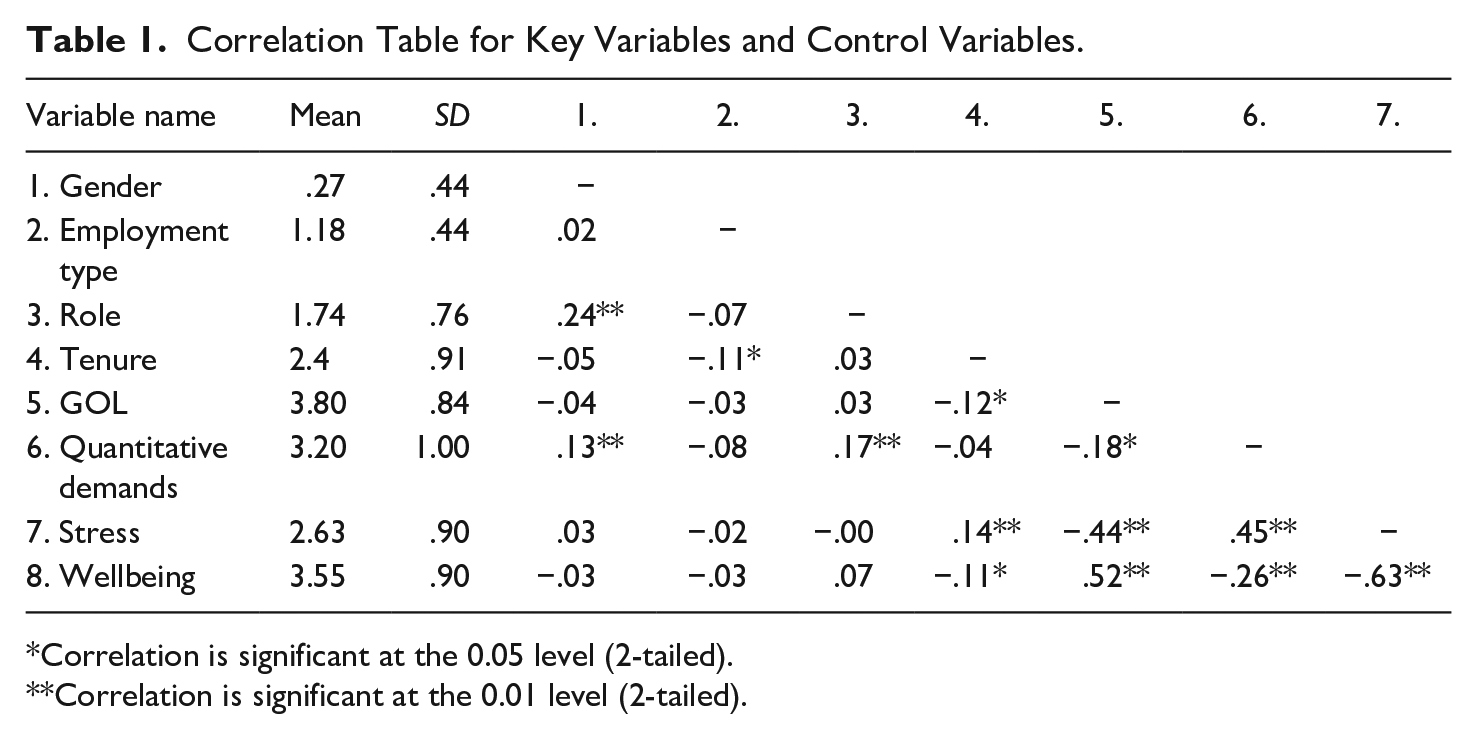
Correlation is significant at the 0.05 level (2-tailed).
Correlation is significant at the 0.01 level (2-tailed).
Confirmatory Factor Analysis
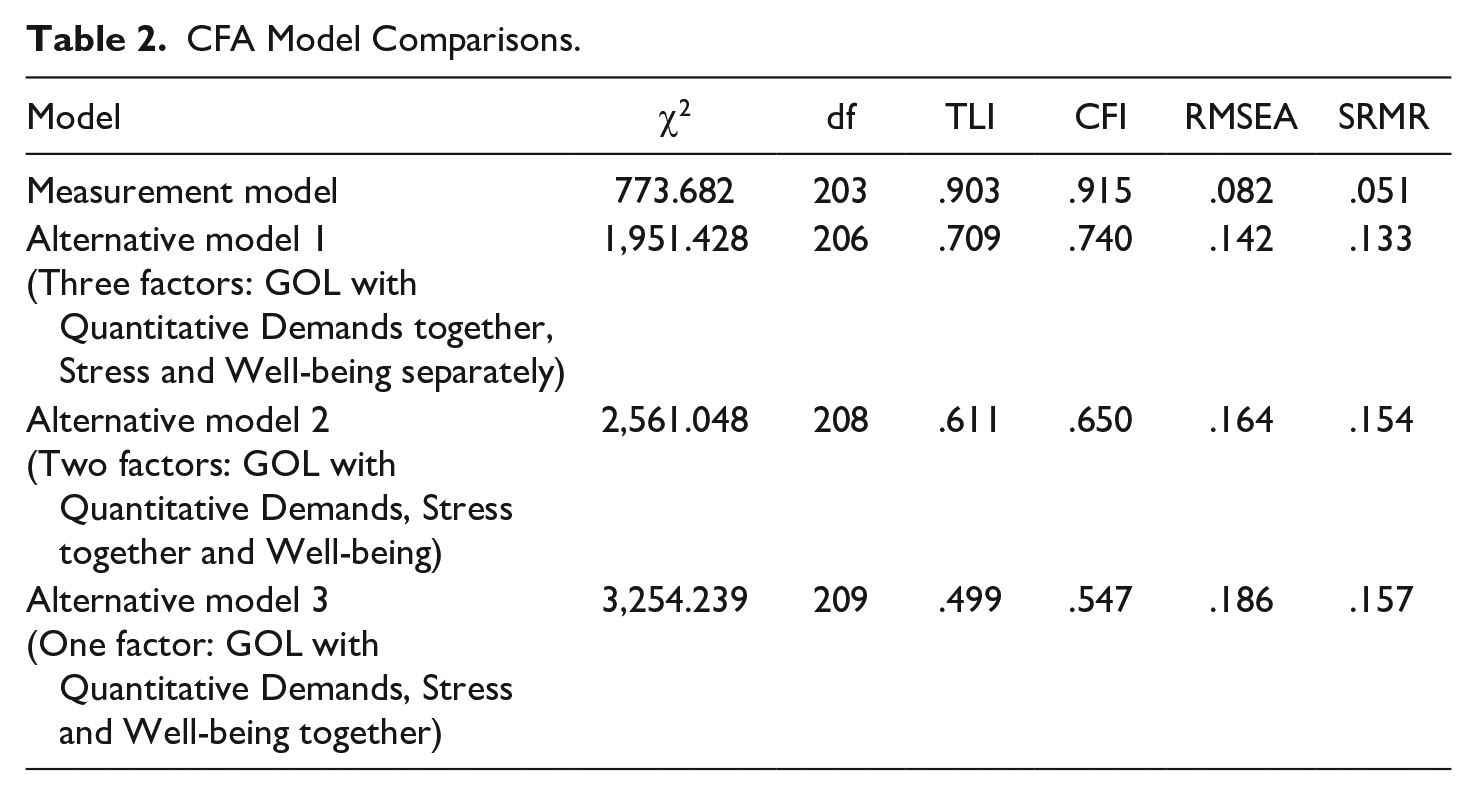
First, a confirmatory factor analysis (CFA) was conducted on our measurement model to confirm the degree to which the study measures loaded on to their expected constructs (Browne & Cudeck, 1992). The CFA results (Table 2) show an acceptable model fit to analyze in an SEM (Beauducel & Wittmann, 2005).
CFA Model Comparisons.
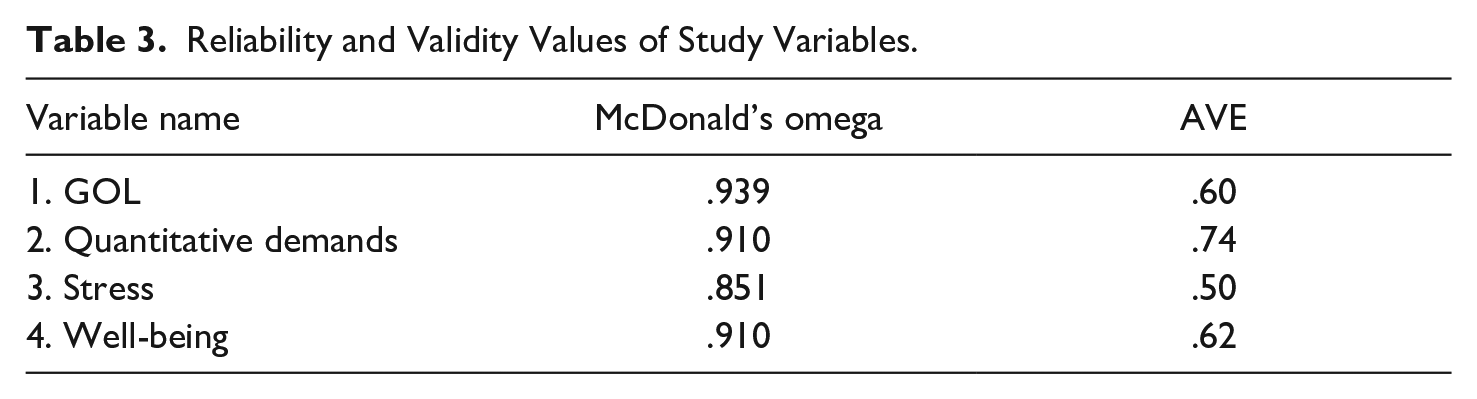
As part of the CFA, the reliability and validity of the model using the values of McDonald’s Omega and Average Variance Extracted (AVE) was also tested, as shown in Table 3 above. McDonald’s Omega was above the threshold of >.70 (Sharif Nia et al., 2019). The AVE values all exceeded the recommended value of .5 (Lam, 2012).
Reliability and Validity Values of Study Variables.
Structural Equation Model
The hypothesized SEM revealed an adequate model fit: χ2/df: 773.682/203, root mean square error of approximation (RMSEA): .082, Comparative Fit Index (CFI): .915, Tucker–Lewis index (TLI)`903.
The results show support for all Hypotheses, except H5. Overall, the results indicate a direct positive relationship for H1 linking GOL with well-being (β
Direct and Indirect Effects.
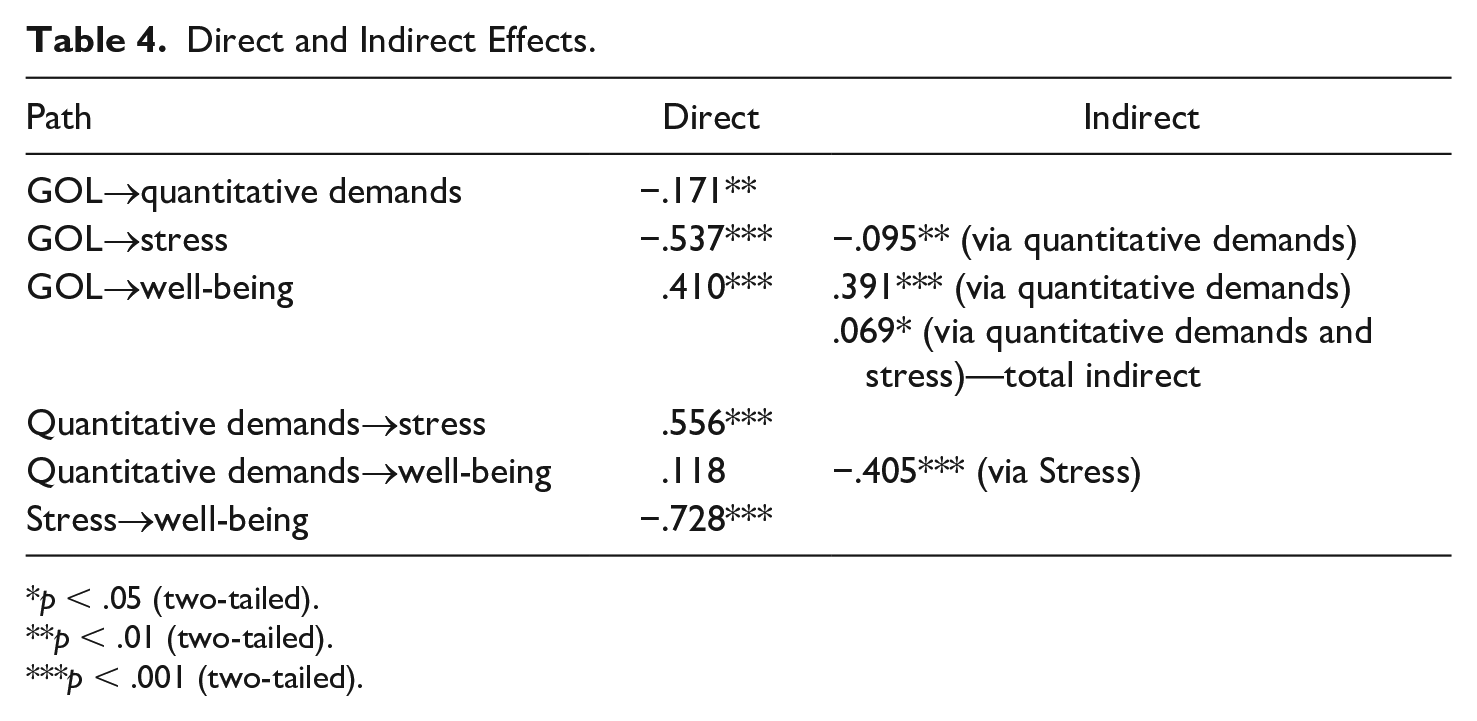
p < .05 (two-tailed).
p < .01 (two-tailed).
p < .001 (two-tailed).
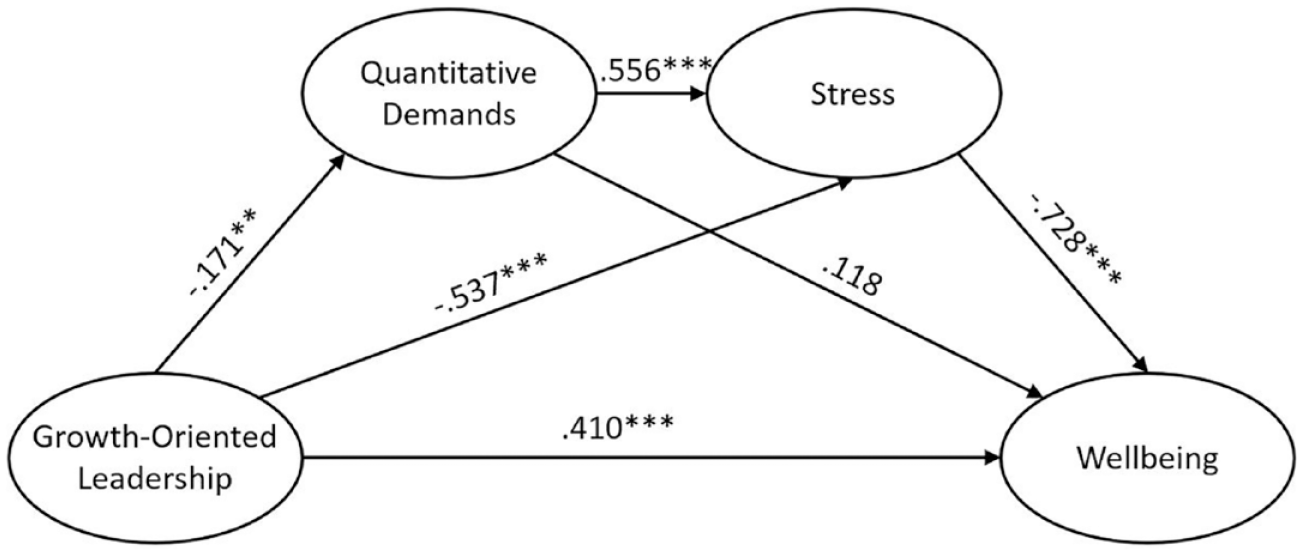
Structural Equation Model With Path Coefficients.
Discussion
The primary aim of this study was to examine the role of GOL on employee experiences in the post-NPM work environment. As part of this examination, this study focused on the mechanism of quantitative demands, framed in this study as a unique feature of the public sector operating environment. It is also the first study to explore the impact of GOL on important employee outcomes beyond growth and resilience in the public sector working environment (Franken et al., 2021), taking into account the implications of reform models and their changing but enduring impact on work experiences. Drawing on the challenge hindrance framework, the role of GOL is highlighted in buffering the hindering effect of quantitative demands, and potentially helping employees to perceive such demands as challenges. GOL does this through its distinct leadership behaviors centered on enabling learning, growth, and collaboration in employees. These are three crucial behaviors for navigating the complex and dynamic public sector context that is still impacted daily by past reform models, particularly NPM (Christensen & Lægreid, 2022).
In particular, this research explored some of the mechanisms through which GOL may positively relate to employee well-being. Specifically, it sought to understand how GOL might influence perceptions of the demands associated with NPM logics, particularly those related to time pressures and workload (Kristensen et al., 2004). As such, the study examined whether GOL supports wellbeing and reduces stress and demands, such that growth-oriented leaders play a role in shaping employees’ experiences of quantitative demands, a key product of the post-NPM environment. The results show that GOL is positively related to well-being, negatively related to stress, and negatively related to quantitative demands, as hypothesized in H1, H2, and H3. In addition, quantitative demands are positively related to stress and mediate the relationships between GOL and well-being and stress.
Theoretical Implications
First, the results of this study suggest that when a public sector leader promotes employee growth, it may act to dampen the perception of quantitative demands as hindrance stressors, shaping them as challenges, and reducing the impact on stress. Interestingly, the effect of quantitative demands on well-being is nonsignificant, and positive, suggesting that, in the hypothesized model, quantitative demands may not be a threat to well-being, even in the pressurized post-NPM context. In line with the challenge-hindrance framework, GOL may play a key role in affecting employees’ primary appraisals of such demands, which can lead to the difference between whether a demand is perceived (and experienced) as a challenge or a hindrance (Edwards et al., 2014), and, ultimately, whether there exists a threat to one’s overall well-being.
Many public administration studies stress the importance of shifting from rational and linear approaches to leadership toward more decentralized, organic, and adaptive approaches (Ospina, 2017; Zeier et al., 2021). These views address the need to take collective responsibility for solving complex problems (Dunoon, 2002), deal effectively with dynamic challenges, and ensure adaptation to changing demands and environments. GOL serves as an approach to leadership which effectively balances the demands inherent in the public sector environment and plays a role in employees’ appraisals of stressors. This has sound contributions to the behavioral public administration and public sector human resource management fields of research as it introduces and examines how leadership features in the challenge–hindrance stressor relationship and the appraisal of stressors as underpinned by the transactional model of stress, by identifying that leadership can play a key role in shaping perceptions of stressors in public sector workplaces (Ding & Cao, 2023). Both theoretical frameworks have been usefully applied in public sector contexts (Haar, 2006; Walinga & Rowe, 2013), yet the pivotal role of GOL in the stress-appraisal relationship has not been established in previous research. As a result, new strands of public sector research, focused on adaptive, nuanced and flexible approaches to leading and managing, are bolstered.
Practical Implications
Rather than attempting to “layer” NPM with other logics (i.e., New Public Governance; Progressive Public Administration; Public Value Governance (Bryson et al., 2014; Christensen & Lægreid, 2022; Dahl & Soss, 2014; Wiesel & Modell, 2014), this study directs more sustained attention to new ways of leading and organizing which help governments transcend the traditional burdens of NPM. In doing so, this research responds to calls for combining scholarship on public administration and organizational behavior to better understand how public service hybridity can be effectively navigated by public servants (Denis et al., 2015). Such an approach, with GOL as a key pathway, arguably gives way to a better application of more appropriate and future-oriented reform models in the future. Significant potential for leadership capability and training, particularly from a growth-oriented lens, exists in the public sector and studies such as this only give weight to such initiatives.
Furthermore, public administration scholarship calls for public organizations to exercise discretion to allow for things like effective collaboration and innovation, while remaining aligned and accountable to democratic laws and values (Bryson et al., 2014). From a leadership perspective, a response to this shift might be about designing leadership that reflects and responds to the demands of the context, rather than retaining traditional prescribed leadership models that are at risk of losing relevance in today’s dynamic public service environments (Ospina, 2017; Van Wart, 2014; Zeier et al., 2021). GOL, as a set of adaptive daily leader behaviors, corresponds to this call for new, more relevant, and contextual forms of leadership which help to balance changing expectations and demands that emerge through public sector reforms. All the while, these leadership behaviors also support growth and positive well-being outcomes in employees (Franken et al., 2021).
Limitations
A key limitation is this study’s cross-sectional nature, indicating that inferences about causation should be interpreted cautiously. Further research, perhaps longitudinal, would be beneficial in further validating and establishing the effects and trends associated with GOL in the public sector work environment. However, cross-sectional studies are still helpful in exploring new relationships and constructs (Spector, 2019).
This study employed the challenge-hindrance framework in the examination of the hypotheses, yet challenge and hindrance stressors were not measured directly (Baethge et al., 2019; Plimmer et al., 2023). Rather, we theorized certain constructs to be reflective of either challenges or hindrances in certain situations and contexts, for example, a post-NPM environment with the presence of GOL.
The survey data analyzed in this study is self-reported in nature. This raises the potential of bias, particularly related to social desirability, and positive/negative affective reactions, which may positively or negatively skew results (Caputo, 2017). However, a number of procedural techniques were employed to limit this bias, such as ensuring anonymity and voluntary participation, and avoiding complex and ambiguous survey items (MacKenzie & Podsakoff, 2012).
Conclusion
This study has shed light on the mechanisms through which GOL impacts employee well-being in the post-NPM environment. Drawing on the challenge-hindrance framework, it sought to examine whether and how managers who are growth-oriented and actively build employee capability, may shape perceptions around quantitative demands among their staff. Findings confirm that, under GOL, rather than experiencing quantitative demands as stressor, employees’ primary appraisals may instead identify them as challenges. Through this unique leadership style, a potentially threatening work demand is essentially appraised differently, and instead viewed as an opportunity to foster personal development. This process has important implications for employee well-being as it essentially eradicates some of the harmful stress associated with experiencing quantitative demands.
Public leaders who are equipped to develop growth in employees give public organizations the ability to address complexity and dynamism, engage effectively with diverse stakeholders, provide high-quality public services, and, ultimately, contribute to public value. GOL provides a leadership approach, through a set of leadership behaviors centered on learning, trust, and collaboration, which support employees to deal effectively with demands and pressures of the public service. GOL supports the balance of demands, fostering a work experience where challenges can be effectively navigated, and employee well-being can be maintained.
Footnotes
Declaration of Conflicting Interests
The author(s) declared no potential conflicts of interest with respect to the research, authorship, and/or publication of this article.
Funding
The author(s) received no financial support for the research, authorship, and/or publication of this article.
