




Abstract
The nexus between work and social categories is known to have an impact on how people develop in their careers. The purpose of this study was to examine the conditions for career work undertaken by civilian criminal investigators (CIs) who are currently entering police organizations, complementing police officers in criminal investigations. The empirical study encompassed 71 interviews conducted with both civilian and police CIs in the Swedish police. The conditions for career work were analyzed through a social-symbolic lens, recognizing the impact of both resource distribution and agency in a network of different actors. Furthermore, the contextual nature of career work was examined, highlighting tensions between civilian and police CIs, influenced by gender dynamics and cultural factors. The situatedness and cultural characteristics of the workplace, involving gender and academic and professional background, have divergent outcomes in career work. This research discusses the multifaceted nature of career development among civilian CIs, providing an extended understanding of career as a socially negotiated process and unraveling the mutual influence of organizational dynamics, cultural norms, and resource distribution in shaping individual career trajectories.
Introduction
While the study of careers is a long-standing and widely developed area of public personnel research (e.g., Choi & Park, 2014; Ng & Gossett, 2013), a social-symbolic work perspective has received little attention in this field. In criminal investigations, an ongoing trend in Western countries is the “civilianization” of the police, where there is a major increase of civilian criminal investigators (CIs) taking on the tasks of warranted police officers (Kiedrowski et al., 2019). Civilian CIs differ from their police colleagues in two important respects: They usually have higher degrees of education and are mostly women. Our studied case thus contains inherent tensions in that relations between social categories and work are known to have an impact on how employees develop their working-life trajectories (Bloksgaard, 2011; Kanter, 1977). This has also appeared to be relevant in police organizations (Fejes & Haake, 2013; Jacobsen, 2007).
The police are known for their challenging conditions, which include exposure to high-risk situations, unpredictable work environments, and emotional and psychological demands when handling crime and crisis situations. In this article, CIs’ notions of careers are analyzed through a social-symbolic work lens (Lawrence & Phillips, 2019), exploring how individuals construct and navigate their identities and careers within the social context of work. It emphasizes the symbolic aspects of work, highlighting how individuals use work to convey meaning and create self-identity. According to this theory, careers are viewed as socially constructed and performative, shaped by societal norms, values, and interactions. It suggests that individuals engage in symbolic actions and behaviors in the workplace to establish and maintain their identity and status. This understanding of career highlights the distribution of resources as important in shaping career trajectories. Agency is an important element in this social-symbolic analysis of careers, as is the influence of a network of different actors. When exploring careers, adopting a social-symbolic work perspective proves valuable for understanding actors’ motivations and the resources necessary for actively shaping individuals’ careers. This perspective acknowledges individuals’ motivations, available resources, and their specific situational context as influential factors in career work (Lawrence & Phillips, 2019).
The social-symbolic work perspective emphasizes the actors’ motivations and resources as highly situated. This perspective shifts our focus from viewing motivations solely as individual, cognitive, or emotional processes to understanding them as influenced by the material, relational, and discursive locations of the actors (Lawrence & Phillips, 2019). Similarly, the resources required for engaging in social-symbolic work are influenced by the occupations and organizational settings of the actors. Through this theoretical framework, we explore why individuals might feel motivated to change their careers, identify the resources necessary to do so, and consider the situational factors that affect career decisions. This study contributes to our understanding of careers as social-symbolic constructs by examining the conditions that influence career efforts. In doing so, this research broadens the scope of public personnel management, deepening our understanding of the unique challenges and complexities public-sector organizations encounter in recruiting and retaining employees. The research question that guided the present study was the following:
Career and Career Work
Studying careers from a social-symbolic work perspective involves a recognition of the individual’s autonomy in constructing careers. In this view, career is seen as simultaneously performative and situated.
The applied process model for understanding social-symbolic work (see Figure 1, adapted from Lawrence & Phillips, 2019, Fig. 2.1, p. 37) begins with the motivations that drive people to perform purposeful and reflexive efforts to change an object, that is, their careers. Additional arrowed boxes are resources and situatedness, implying that these affect the career work undertaken by civilian CIs.
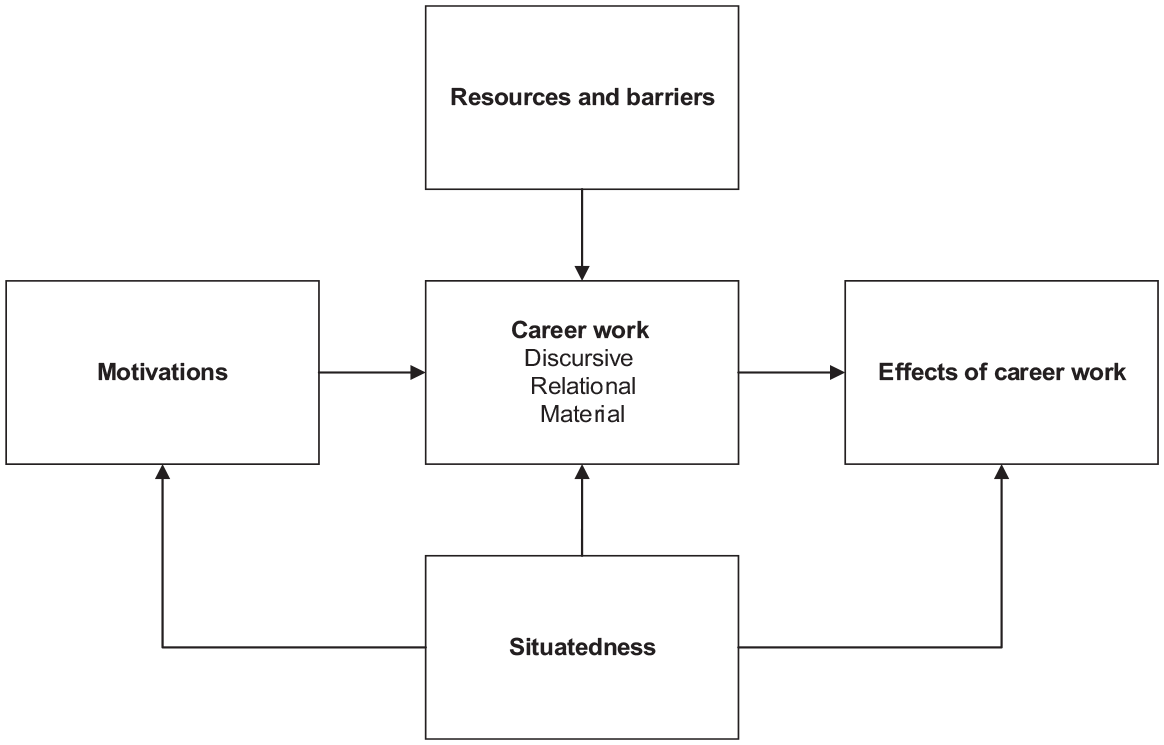
A Theoretical Model of Career Work
In the following, we present previous research on careers across three overarching themes connected to the theoretical framework of social-symbolic work. This encompasses research exploring motivations and resources for career work. In these strands of research, we have identified several relevant studies, both within and beyond the police organization. Our focus is primarily on literature related to policing, while the final section delves into research examining the situatedness of career work for civilians.
Motivations for Career Work
Motivations described in previous research can be both extrinsic and intrinsic and are intertwined with different contextual factors surrounding each work domain or organization where the career is pursued. Previous studies have found that individuals’ career decisions often revolve around the pursuit of well-being, encompassing aspects such as quality of life and time for family and personal needs (Aljerian, 2022; Ng & Gossett, 2013; Prabhu & Sriram, 2021). These considerations are closely linked to career satisfaction (Aljerian, 2022), which, in turn, correlates with heightened organizational contribution from employees (Fleisher et al., 2014). In a large Australian study, police officers described the factors influencing their decisions to either remain in or exit their policing careers. This study emphasized the significance of retention strategies aimed at addressing the individuals’ need for authenticity, work–life balance, and professional challenge at various stages of their career trajectories (Howes & Goodman-Delahunty, 2015).
In research aiming at creating a taxonomy of antecedents to making a career, three important categories were developed: readiness (for making a career), orientation of career-decision style, and access to and use of relevant information, some of them stemming from personal motivations (Kulcsár et al., 2020). Another study, examining 655 pairs of employees and supervisors, found that individuals with a protean career orientation, characterized by self-directed and motivation-driven approaches, contribute positively to both personal and organizational outcomes. Moreover, the study underscored the significance of implementing high-commitment human resource practices to effectively manage the impact of employees who pursue conventional career paths (Rodrigues et al., 2015).
Many studies have also focused on gender aspects in career motivations. One such study, comparing gender differences in career preferences and motivations between 1990 and 2010, revealed a diminishing gap in factors such as income, career advancement, length of training, and teamwork over the years. Notably, women showed a stronger preference for working in community services compared with men (Gati et al., 2014). Another study examined why women are less likely than men to be promoted, even in organizations with high gender equality climates. Based on a large sample of managers in South Korea, this study unveiled that women and men adopt different strategies in their pursuit of promotion. Specifically, women with high self-efficacy tend to concentrate on increasing their work effort, that is, investing in firm-specific human capital like extending working hours on current work tasks. At the same time, men in similar circumstances prioritize enhancing their career development efforts, that is, investing in general human capital like taking part in leadership training programs, which results in skills or knowledge that is transferable to other organizations. Notably, only the latter was found to have a positive correlation with promotion. Conversely, elevated work effort was associated with increased work stress and turnover intentions, alongside diminished job satisfaction. This study suggests that different effort strategies lead women to become ensnared in a vicious cycle of working hard and gaining only unpleasant outcomes (Kim et al., 2020).
Resources and Barriers for Career Work
There is a substantial literature that has engaged with the question of resources for career work, predominantly by identifying enablers and barriers to individuals’ pursuit of a career. Many of these studies have specifically examined gender inequalities in the workplace, finding that women are disadvantaged in several ways, for example, in relation to work–family balance, support, networks, and career opportunities at work (e.g., Choi & Park, 2014; Vuorensyrja, 2014; Watts et al., 2015; Wynen et al., 2015). These patterns have also been highlighted in police research (Diaz & Nuño, 2021; Haake, 2018; Rossler et al., 2020) and been described as a macho police culture in several papers (e.g., Chaiyavej & Morash, 2008; Silvestri, 2007). A limited number of studies also show how other social categories (e.g., ethnicity and class) can influence career opportunities negatively (Garth & Sterling, 2018; Ossenkop et al., 2015).
One strand of research has identified resources outside of the workplace as important, where work–family balance constitutes a barrier, particularly for women (Choi & Park, 2014; Frear et al., 2019; Walsh, 2012). These studies often advocate flexibility in work as an important factor for career development (e.g., Donnelly, 2015). There are also several studies that show that support from managers and supervisors is an important factor in career work (Kossek et al., 2017; Y. Lee & Eissenstat, 2018), particularly for employees who are less motivated to pursue career opportunities (Baethge et al., 2017). Generally, support from others beyond the individual is shown to be important (Schulz & Enslin, 2014).
Furthermore, Spurk et al. (2015) conclude that the gender composition of networks also is important, where male networks give more opportunities than female ones. Studies concerning the police have also identified important resources for career work that highlight the social aspects of work. Howes and Goodman-Delahunty (2014) identify feeling undervalued as a common reason for quitting a job and pursuing a new career. In contrast, feeling appreciated and recognized for skills and competencies made participants more ready to stay in a given position. Research has also found that the availability of mentoring and co-worker support—for both men and women—is an important resource for pursuing careers in the police (Britton et al., 2023; Hassell et al., 2011). However, a recent study shows that women are less likely to have mentoring relationships at work (H.-W. Lee et al., 2020).
Studies have also made a distinction between perceived and real career opportunities, arguing that the perceived opportunities (or lack of opportunity) are important for pursuing a career (e.g., Barnard et al., 2021). Here, women also perceive less opportunity than men. Wynen et al. (2015) also find that these perceptions are persistent over longer periods of time in an organization. Tremblay et al. (2014) demonstrate that these perceptions of opportunities have a real impact on career effects. Thus, awareness of existing career patterns (Dubois & François, 2020), and whether careers are pursued as a result of conscious “career politics” (Clerc & Kels, 2013), are important factors in career work. A study involving more than 20,000 police officers from England and Wales addressed the career progression of female officers by exploring two key questions: (a) the degree to which female officers perceived hierarchical rank advancement as achievable, and (b) their level of desire for such progression. The findings revealed that in comparison with their male counterparts, female constables were less inclined to anticipate or aspire to advancement to higher ranks (Boag-Munroe, 2019). Furthermore, the significance of perceiving career opportunities is notably intriguing, particularly considering research demonstrating the concept of “silent” privilege (Niemistö et al., 2020). This term implies a widespread belief within an organization that equal opportunities exist while simultaneously masking the inequalities and disadvantages faced by certain groups, thus perpetuating them. In the context of the police, Rubio et al. (2021, p. 16) assert that male officers predominantly hold a perspective they term “the mirage of equality,” which minimizes the existence of gender disparities. The authors argue that this mindset poses a significant obstacle to achieving real equality. When barriers to career work remain unnoticed or unaddressed, they are less likely to be the object of purposeful and reflexive efforts, which is the focus of social-symbolic work theory (Lawrence & Phillips, 2019).
The Situatedness of Career Work—Civilian Investigators in the Police
As mentioned, the increased proportion of civilian personnel has been depicted as the “civilianization” of the police and describes a development where civilians take on tasks previously carried out by warranted police officers (Kiedrowski et al., 2019). In other countries, civilians are more commonly hired as analysts or intelligence officers to aid investigation. In Sweden, however, large numbers of civilians are employed as civilian CIs. Between 2019 and 2020 alone, the recruitment of civilian personnel increased by 22.6% in Sweden (The Police Authority, 2020). The advantages of employing civilians in police organizations are claimed to be several: In addition to being cost-effective, civilians can contribute specialized skills and diversity to an otherwise homogeneous organization (Alderden & Skogan, 2014; Kiedrowski et al., 2019; The Police Authority, 2018; Rice, 2020; Whelan & Harkin, 2021). In their strategy for criminal investigation activities, The Police Authority (2021) has stated that the diversity of competencies that civilian employees contribute with is crucial for the investigative work to be successful.
In this development, however, civilian CIs face the challenge of not being perceived as “real” police officers and potentially being treated as inferior employees, as documented in previous studies (e.g., King, 2009). This has also been proven to be relevant in the Swedish context (The Police Authority, 2019). Although civilian employees have been present in the Swedish police for decades, they still lack clear career and development trajectories. In international research, concerns have been raised regarding the incorporation of civilian CIs into the police (Alderden & Skogan, 2014; Kiedrowski et al., 2019; McCarty & Skogan, 2013; Whelan & Harkin, 2021). This research has found, for instance, that the civilian group of employees in police organizations experiences limited opportunities in terms of both promotion and internal career mobility, and that they lack clear career development paths. Furthermore, the limited opportunities for career mobility and skills development have been shown to have significant effects on the experience of job satisfaction. These combined barriers have been explained by this stream of research as a cause of increased staff turnover, as well as poor health for the group of civilian CIs.
Another challenge for the police is to make use of the skills and competencies that civilians contribute. In an internal assessment of their organizational culture, the police authority identified cultural factors influencing the management and control of the organization. Ninety-three employees from various police areas across Sweden participated in focus group discussions. The findings revealed collective beliefs hindering the utilization of civilian expertise within the organization (The Police Authority, 2019). These beliefs involve assigning value to specific groups while devaluing others based on factors such as gender and professional category (The Police Authority, 2019).
Method
Studying careers as social-symbolic objects requires robust methods to capture the complex interplay between individuals’ conditions for engaging in career work and potential effects of that work. This section provides an overview of the methodological approach employed to gather and analyze the data.
The research setting for this article is criminal investigation in the Swedish police. The empirical study we report on is based on interviews conducted with CIs. The data encompass 71 semi-structured in-depth interviews with both civilian (n = 56, 48 women and eight men) and police (n = 15, eight women and seven men) employees. Most of the civilians had higher education degrees in social work, criminology, law, political science, psychology, or other behavioral sciences and had worked for other public authorities in the field of their expertise. At the same time, most of the police CIs do not have higher education, but a shorter police education at upper secondary level. Civilian CIs, therefore, often contribute analytical, critical, writing, specialist, and more academic skills to investigative work (Lindberg et al., 2023).
Questions were asked about everyday work as a CI, the introduction to work, organizational hierarchies, organizational culture, and career ambitions. According to the Swedish Ethical Review Authority, this research does not fall within the ethical legislation as sensitive personal data are neither collected nor processed. Thus, the study meets the national guidelines regarding research ethics requirements. Prior to collecting data, informed consent was obtained from all participants. The interviews were conducted during the years 2020–2021 via Zoom, Skype, or telephone, and lasted 45 to 90 min.
The data were analyzed through a thematic analysis aiming to identify, analyze, and report patterns in the data (Braun & Clark, 2006). Specifically, codebook thematic analysis was undertaken that involved a combined inductive and deductive approach (Roberts et al., 2019). The analytical methodology aimed to explicate the factors defining individuals’ motivations for career work, the resources that either enabled or hindered these efforts, and the situated aspects associated with them. The analysis was conducted using Nvivo 12. Initially, the coding function was employed to reduce the data corpus into a data set in line with the alignment of this study. The first step of the analysis involved an open reading of the data set, identifying initial codable units in relation to the study’s aim (Roberts et al., 2019). In the following step, a second reading was undertaken using themes theoretically informed by the framework for social-symbolic work (Lawrence & Phillips, 2019). The themes applied here were motivations, resources, and situatedness. In the next step of the analysis, initial codes were applied to the raw data. Codes from the theoretically informed themes were developed empirically. The aim of this procedure was to enrich the specifics that add to how career work is conceptualized and thus contribute to developing theory.
Informed by the guidelines of Boyatzis (1998), codes were formulated and classified with a code label, definition, description, and examples from raw data. Through this process, a codebook was constructed, consistent with the systematics of codebook thematic analysis (Roberts et al., 2019). In summary, the analytical process included reading and re-reading the theoretical framework as well as the data set multiple times until codebook saturation was reached. The analysis was carried out reflexively, determining whether the data could fit in the theoretically informed themes, and whether codes needed to be eliminated, altered, or added into the codebook. As a result of this process, a new theme was identified and applied: effects of career work. Codes were reviewed, moved around, and altered until a sufficient representation of the theme became evident. Furthermore, the codes were sorted into categories, branched from the themes. Across the entire data set, categories and codes were defined as patterns that appeared in at least 10 data items, that is, interviews. Thus, the prevalence of a pattern was counted at the level of the data item (i.e., did a pattern appear anywhere in each individual interview?). Throughout this analytical method, we had an active role in the identification of codes and categories, deciding which were of interest. The coding process thus involved a number of decisions. The “keyness” of each code was decided upon in terms of its relevance in relation to the research questions as well as the prevalence in each data item (i.e., was it a recurring description of importance?). Throughout the presentation of the findings, the participants are labeled with gender, employment (civilian or police), and interview number.
Findings
In the following, we present the findings of the study using the theoretical concepts outlined in Figure 1, that is, the motivations, resources, situatedness, and effects of career work that were identified in the interviews. The findings reveal nuanced factors that influence the expression, experience, and effect of career work.
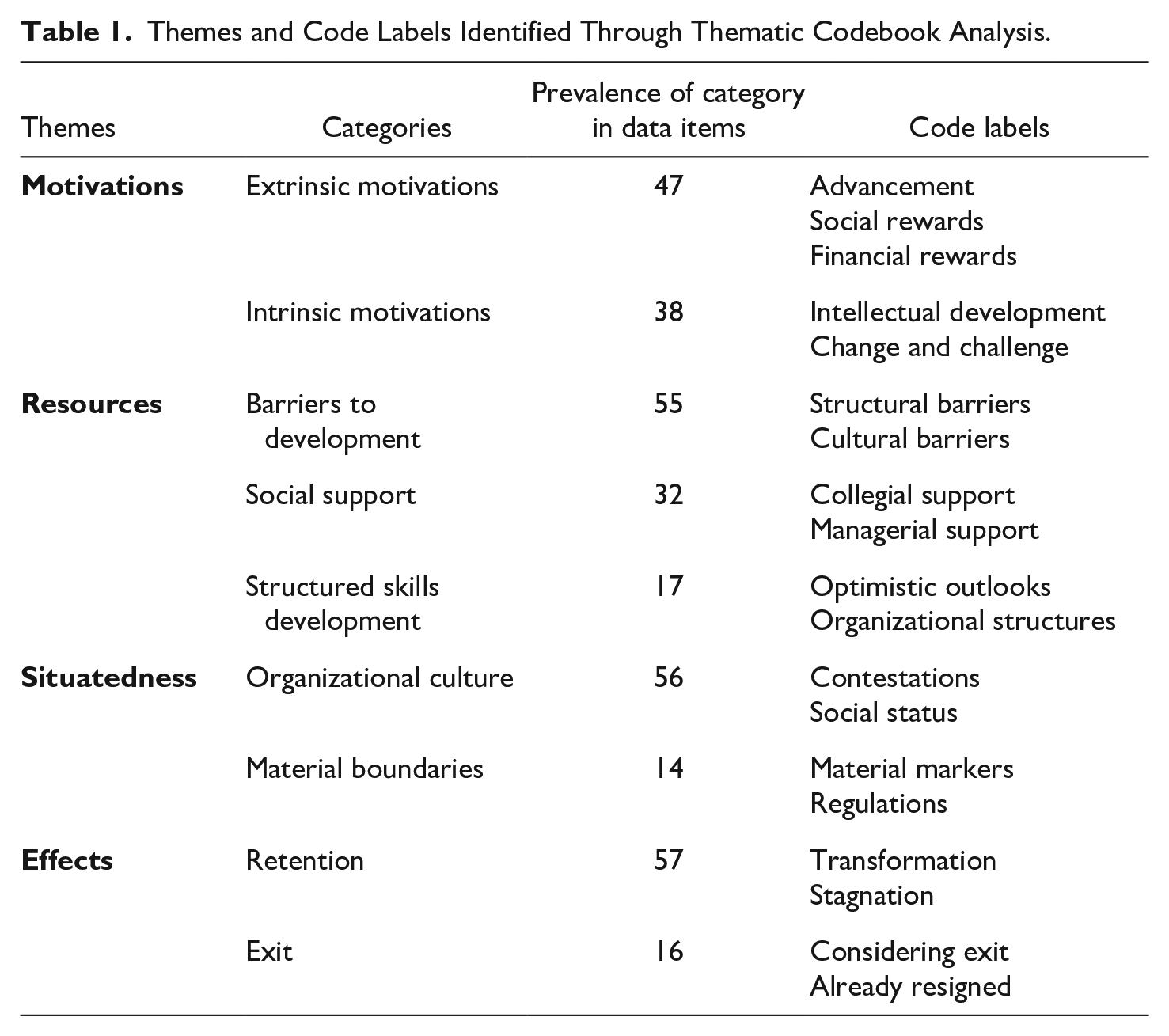
Table 1 provides an overview of the themes, categories, and codes developed through the thematic codebook analysis. The table also reports the prevalence of categories throughout the data. The themes explored in the study are motivations, resources, situatedness, and effects of career work. Each theme is further divided into specific categories and code labels to capture the nuances in the data. By presenting the prevalence of each code label and subcode label in the data, Table 1 offers insights into the distribution and frequency of key codes identified in the data set.
Themes and Code Labels Identified Through Thematic Codebook Analysis.
Motivations for Career Work
Analyzing individuals’ intentions when engaging in career work, two patterns were identified: extrinsic and intrinsic motivations.
Extrinsic Motivations
Looking at the external objectives in the context where the individual operates, conceptions about advancement and both social and financial rewards were recurring among the participants. The most common pattern in extrinsic motivations is a desire for advancement in the organization. Several of the participants mention advancement as being possible only after a completed police education because of both practical and cultural barriers associated with civilian employment. Police training is repeatedly described as crucial for having a fair opportunity for vertical advancement in the organization: If I had gone through this police training, I would have seen myself as group leader or section leader somewhere, I think, in some exciting department. . . . Now I don’t really know. . . . I am not super eager to become a civilian manager. . . . I think I have an idea that it’s more difficult to be a civilian manager than a police manager and I don’t know where that comes from, really. Maybe because I mostly see managers who are police officers around me . . . I don’t really have a real role model who is a civilian manager. (Female Civilian 15)
Given this reality, several civilian participants describe having the intention of going through police training, primarily to have more opportunities when it comes to internal advancement or mobility. When reflecting on advancement in the organization, several of the individuals note that they are unsure about their opportunities as civilians or perceive limited opportunities because of their civilian employment.
Another pattern in the data material is a desire for recognition, that is, social rewards. The understanding of recognition as connected to individuals’ motivation acknowledges the organization’s importance for individuals’ career choices. A common pattern in the narratives is that the skills and previous working-life experiences of civilians are not recognized or used properly. Some describe it as being invisible or coming into the organization as a “blank paper.” Others describe it as previous education and working-life experience having no value. One of the participants explains, “I feel a little depressed, because the way they communicate, I, as a civilian, don’t really feel appreciated or valued” (Female Civilian 34). Several individuals state that the only thing considered to have real value in the police organization is the police training and local experience: Regardless of how you twist and turn it, police training will always be ranked higher than any other education for that matter. It doesn’t matter how many master’s degrees you have or what it may be, you are not a police officer, it’s that simple. (Male Civilian 35)
Another participant recounts that the feeling of one’s experiences not being taken advantage of is common and affects civilians’ view of the organization negatively: I think the feeling is that your experience is not taken advantage of. I think many people share that feeling. This is what makes the police an unattractive employer for many who want to move on, as well. . . . That feeling that you don’t have a development opportunity. That you don’t make use of the experience [you have] or that you don’t get to use it. I think that is quite common. (Female Civilian 43)
Some of the participants describe that they experience recognition to some extent. In most cases, the manager or external partners such as prosecutors are highlighted as being those who value civilians’ skills and experiences. Several participants describe that they experience recognition from colleagues and managers now, but have had to work hard for many years to achieve that recognition. Throughout the narratives, another central pattern regards a claim for financial rewards, because salaries for civilian CIs are currently insufficient. This is described as related to the lack of opportunities for advancement and internal mobility: Considering the limitations that exist for me at this authority, of course I also look outside the [police] authority for other positions. Above all, positions where you are somewhat better paid as well. It has become the case a bit that other social services and other employers value the skills and experience I have acquired at the police authority and want to give a salary accordingly. But my own authority does not want to, and then, it makes you look outward. (Male Civilian 35)
A combined lack of social and financial rewards is referred to as contributing to civilians considering making an exit. Others refer to logistical conditions, such as commuting distance or working hours, when accounting for their career objectives.
Intrinsic Motivations
When analyzing individuals’ intrinsic motivations for engaging in career work, we refer to their internal desire to develop and pursue their career objectives. These motivations come from within the individual, rather than being driven by external factors such as rewards or recognition. Exploring the intrinsic motivations of these individuals, the most common pattern in the narratives is a desire for intellectual development. The development is described in different forms: as competence development, internal mobility, and skills development through experience. Common among these stories is a desire for personal growth and self-improvement. The participants describe that they want to become “great,” “excellent,” or “the best” at the practices of criminal investigation: My dream, my plan, is to become an excellent investigator. Right now, I don’t have any desire to climb higher or anything, it’s nothing that I’m that interested in. But I want to learn to be a great investigator. (Female Civilian 69)
Recurringly, these individuals describe that they lack the desire to climb vertically in the organization; they rather want to specialize and develop their skills. Another pattern identified is the desire for change and challenge. The individuals who describe a desire for challenge narrate that they want to work with more complex or new work tasks, solving other types of crimes. Some are considering changing positions within the authority to work with something they describe as more challenging. In contrast, participants who are police officers have little trouble imagining future career opportunities, even one as distant to investigations as the national anti-terrorism unit: I know what I want, and my ambition is that I want to get out and work on patrol duty now as soon as possible and then I want to, within four years maybe, I want to try to apply to either the Swedish National Counter-Terrorist Unit or the personal protection group. I want to work outside then and preferably with something that is very challenging. (Male Police 17)
The pattern of a desire for change and challenge is described as relevant by both civilian and police CIs. In parallel, individuals describe plans for changing positions or units because of their personal interests and passion. They mention seeing themselves changing positions within a few years, to another crime solving unit, working with something they are “a little more passionate about” (Female Civilian 9). A similarity between these two narratives is that these individuals plan on shifting positions internally and thus staying in the organization.
Resources for Career Work
In the police and in other organizations, various career practices are informed and determined by the manager. When it comes to individuals’ access to resources needed for engaging in career work, this includes resources such as social support and structured skills development. Furthermore, our findings highlight the perceived barriers and their potential effects on career choices, making the situatedness key for the employees’ career work. The narratives on resources connected to careers refer to barriers and enablers for development, suggesting conditions that either hinder or facilitate the progress and growth of individuals in the organization.
Barriers to Development
The pattern recurring most often in narratives on resources for career making concerned descriptions of barriers to development within the organization. These narratives include descriptions of structural and cultural barriers. Both police and civilian personnel report such conceptions, and a majority regard civilians as having limited opportunities. The barriers to development apply to internal advancement, mobility, and competence development. Some participants describe that they in theory perceive several educational possibilities, but that in practice, they lack the possibility to participate because of under-staffing and shortage of educational openings. Others refer to limited opportunities for civilian personnel due to bureaucratic conditions that have to do with employment and ranks. Limited access to competence development opportunities, lack of clear career progression pathways, and rigid hierarchies that stifle mobility are identified in the narratives as structural barriers. Both police and civilian CIs describe advantages of being a police officer, career wise, and the limitations for civilians: In the police authority, you have a career advantage by being a police officer. Career paths are open and so are opportunities for development, and to rise in ranks as well. As a civilian employee, you can’t get very much higher than you are . . . I don’t know the titles of the civilians, but there aren’t very many. As a police officer, you are first and foremost a police assistant. If you get a higher position, you become a police inspector and then eventually you can become a commissioner or a police inspector with a special position if you are a group leader. There are a lot of trajectories . . . So that, it’s something that you must remember as well, that we have a benefit as a police employee. (Male Police 13)
Other participants describe the shortage of educational openings as insufficient preparedness when it comes to the organization recruiting civilians in criminal investigations: They have hired a huge number of civilian investigators and they are going to hire even more, but they don’t really seem to have a plan for this. For example, education. There are three of us at my work who needed to do this training that was offered. And my manager only got a place for one of us. It is the same with further education, too. They have not adapted the organization to this huge inflow of civilians that is coming. (Female Civilian 11)
Several of the civilian participants emphasize the lack of internal mobility. This is described as evident when applying for other positions internally, as one of the individuals explains: “They require you to be a police officer. It is stated here and there, and it says so in quite a lot of the internal ads that you should be a police officer” (Male Civilian 32). Others describe their perceptions of not having access to apply for certain management positions because of their employment as civilian CI: There are significantly more management positions that police officers can hold than civilians can hold. You absolutely cannot become a senior manager as a civilian. I have a very hard time imagining that. Then you’re supposed to be a policeman. (Female Civilian 34)
Some of the participants emphasize the cultural barriers, rather than the practical ones, when asked about career objectives. These encompass norms, values, and beliefs prevalent in the organization that inhibit learning and career advancement. One of the participants talks about potential barriers to becoming a manager: “Possibly the attitude of other colleagues in that case, but not any like practical obstacles or whatever one might say” (Female Civilian 14). Several participants refer to civilians not being accepted in different roles or positions in the organization and civilians having to work harder than the police officers for achieving their career objectives. Other participants refer to cultural constraints driven by the police union regarding matters of civilians’ opportunities for advancement in the organization, implying that there is a strong resistance against civilians being let through as managers of police officers.
Social Support
The pattern identified as central in the narratives on enablers for development was about social support from colleagues or the manager. Some participants describe collegial support, where police colleagues treat civilians as equal partners. In some narratives, the social support has to do with the distribution of work tasks: It depends a bit on who is leading these tasks. There are the police officers who think I am equal to the other police officers and pick me because they think I am good at interrogations. Then suddenly it becomes more fun, of course, than being told that, “You can’t do that because you’re a civilian and you can’t do this and that.” . . . Then there are the cops who send me on everything, based on the fact that they know that I can handle those tasks. . . . They see me simply as a co-worker. (Female Civilian 31)
Other participants describe the opportunity of visiting other units at the authority, with the purpose of developing their competencies. These opportunities are described as supportively encouraged by their colleagues or managers. Another pattern when it comes to social support is managerial support. The participants who experience this kind of support often describe their opportunities for development as being within reach. Either they have already started a desired career path, or they explain that if they would like to do so, they would have their manager’s support: I feel that my manager does everything to make me feel that I’m stimulated by the work, that I get the opportunity to develop skills and take courses and kind of learn more and improve myself and such. So, I feel that I have huge opportunities for it. (Female Civilian 48)
Common in these narratives is a managerial recognition of the individual’s career-related desires.
Structured Skills Development
A number of the participants (17 of 71) talk about reachable and structured opportunities for skills development in the organization. Common to these participants is that they either have finished an educational activity recently or have one scheduled. Some of the participants describe that they have such opportunities because they work with specific crimes that require continuous renewal of their knowledge. Overall, these participants convey optimistic outlooks regarding their skills development: There are many different courses you can take. We have a competence planning where you set up a plan for what kind of courses you could take and how you could further develop yourself. . . . So, there are possibilities if you want and have the opportunity. (Male Civilian 32)
The most prevalent theme in these narratives is the description of organizational structures regarding their skills development, such as individual plans. The structures are referred to as fair, functioning, transparent, and well-known to the employees. Some describe a turn order for the educational activities, where it is evident who is next in line to be sent off to an education. Others explain that the manager keeps track of such activities: The manager keeps track of what you have said you want to focus on, and he prioritizes who will go, so that it is not one and the same person who gets all the time and takes the training spots. The manager distributes, and that works. (Female Civilian 67)
Overall, the manager is described as a gatekeeper for career activities related to competence development and internal mobility.
The Situatedness of Career Work
Looking at the situational aspects specific for criminal investigation, we find a prevalence of descriptions of the organizational culture. Furthermore, our analysis shows examples of the interplay between the employees’ career work and the organization’s boundary work, which is presented here as material boundaries.
Organizational Culture
When analyzing narratives on organizational culture, contestations between civilian and police CIs were identified as a significant pattern. Civilians often described themselves as being scrutinized and questioned for entering the organization because of their lack of police training. The narratives reveal instances where civilian CIs felt they were being tested by their police colleagues, particularly in the early stages of their careers. One participant shared an experience of being placed in a room with male police colleagues who requested a demonstration of their skills. The use of an intimidating jargon and aggressive behavior is seen as a means of asserting power and authority, which can be unsettling for civilian CIs: In the beginning when I was new, I was exposed to some situations where they would kind of test me, my police colleagues, in a way I have not experienced in any other workplace before. . . . At some point I came into a room where there were like five or six male police colleagues and they said, “sit here in front of the computer and show [us] how it’s done.” . . . So, this rough, the oppressive peer education climate that can exist with some police officers . . . It’s a certain jargon that you might be a little intimidated by as a civilian when you’re new. (Female Civilian 3)
Loafing and resistance to change are additional aspects of the organizational culture observed by civilian CIs. The loafing involves not fully engaging in assigned tasks or responsibilities, instead wasting time, procrastinating, or engaging in non-work-related activities. Some individuals express frustration with differences in the pace of work between themselves and certain police officers, which is described as leading to tensions within work groups. The loafing is described as most evident among senior police officers, with long experience in the police. Resistance to adopting new working methods or procedures is also observed, with some police colleagues citing tradition and past practices as reasons for their reluctance. One of the civilian CIs describes the discrepancy: I’ve ended up in a workplace where it’s quite . . . “We’ll do it tomorrow.” I’m not like that. I want things to do. I want to come to work to do a job. I can sit and have coffee and talk, but I’ll go crazy if I have nothing to do, then I might as well go home. What should I do? Look at Facebook? It might stress some of these older men. That maybe they also have to work, because I think it’s boring. I say what I think, so I say I’m really bored. Then they become completely mute. (Female Civilian 10)
Several participants describe that social status, determined by factors such as gender and experience in police work, influences how competence is perceived in the organization. This perception of social status prevailing over actual performance is seen as unfair and detrimental to the recognition of talented and dedicated individuals. Such conceptions are present in narratives of both civilian and police participants: If you have a high status, then you are considered a good investigator, although you may not be that at all. While there are people who are very talented, very committed, almost getting burnt out who don’t get any credit for it. But it’s really weird and it’s a great shame actually. Because it is more based on social status than on what you really do that governs, I think anyway, the employer’s view of whatever a good investigator is. (Male Police 18)
Gender dynamics also play a significant role in the narratives on organizational culture, with exclusion as the central pattern. Women in the police organization, and civilian women in particular, describe facing challenges and feeling excluded. Male police officers are described as physically and verbally taking up space, using their body language and assertive voices to establish dominance. These experiences contribute to a sense of devaluation among civilian CIs, particularly women, and can lead them to consider leaving the organization. The organizational culture is frequently depicted as excluding and challenging, particularly for civilian personnel. The narratives collected reveal the contestations between civilian and police CIs in the organizational culture of the police organization. The findings highlight the challenges faced by civilians in terms of scrutiny and exclusion. They also emphasize the issues related to gender dynamics, where a significant proportion of the women interviewed describe experiences of a macho culture.
Material Boundaries
When talking about contextual conditions that are specific to the police environment, the participants recurringly describe material boundaries as an evident part of this context. These material boundaries include both regulations related to the employment of civilian CIs and material markers that serve to differentiate civilians from police officers. Some participants describe situations where the material markers can cause inconveniences throughout their work practices. One example is civilians not having access to work uniforms and thus wearing their civilian clothes when visiting crime scenes. This is described as inconvenient by one of the participants and as a marker of “us and them,” dividing police and civilian personnel. Further examples of material markers regard not having access to certain areas because of civilian employment, or being treated differently when entering a court hearing. The police officers are described as having access to places, whereas civilians are restricted.
An illustrative example of this disparity is evident in the experience of civilians being compelled to queue alongside suspects and undergo personal item searches upon entering court hearings. In contrast, police officers are afforded the privilege of bypassing the queue by presenting their police identification badges. Another boundary, related to regulations, concerns civilians not being allowed to report suspicion to suspects. Some of the participants describe this as surprising or undermining as some of them have longer legal training than the police officers: Civilians must have special permission to report suspicion, that is also surprising. I have longer legal training than the police officers have after their two years of training, and I am not allowed to report suspicion. They can do that by default, so to speak, because they are police officers. I must have a special order from the police area commander to be allowed to do so. (Male Civilian 32)
Other examples concern not being allowed to take in a suspect for questioning or doing a house search. These work tasks need to be carried out by, or with the help of, a police officer. In several cases, these regulatory boundaries are described as contributing to inefficiency in the work practices. In summary, several regulatory boundaries are described in the interviews. Although the participants commonly express they understand the purpose of these boundaries, such as having to do with safety, they also express that some procedures are inefficient and, in some cases, undermining their previous educational background and experiences.
Effects
Analyzing the narratives on individuals’ objectives for engaging in actions aimed to shape, change, or maintain their careers, we find that a significant proportion of the CIs (16 of 71) are considering, or already making, an exit from the police. We find different explanations for this trend in the narratives, related to the individuals’ objectives for working on their careers. Looking at the potential effects of the participants’ career work, we could find that most of the participants were planning on staying in the organization (55 of 71). In this group, a recurring narrative regards transformation. These participants elaborate on their motives for staying with reference to a perceived opportunity for advancement, skills development, or internal mobility. Narratives on optimistic outlooks for the future are common, although there are few descriptions of actual plans or opportunities. Thus, the perception of possible transformation is key in these narratives. Another pattern, similar in prevalence, is stagnation. The participants who see themselves staying at the same department, working with the same work tasks, often describe structural barriers for achieving advancement or internal mobility. Several of the participants describe climbing in the hierarchy as the only career possibility, and if one is not interested in that, having no other option than to stay in their current position. One of the participants reports, “To put it bluntly, my next step, in that case, is to become a manager and I’ve said that I don’t want to be that” (Female Civilian 66). Some of the participants describe themselves as being pleased with where they are and not having any further ambitions. These participants are either newly employed or close to retirement.
In contrast, a significant proportion of the participants (16 of 71) either consider making an exit or have already resigned. The most prevalent pattern here is participants considering making an exit. In these narratives, common patterns regard dissatisfaction with the organizational culture or lack of career opportunities, as referred to previously. Another motive is insufficient salary. Several participants explicitly state that the organizational culture is the primary reason for them considering an exit. The intersection of being a woman, a civilian, and having a mixed ethnicity is portrayed as adding further complexity to fitting into the police culture: You can come in as a civilian and feel that you don’t fit in, quite simply. And choose to leave the organization. So, it’s a challenge. And I can feel that even though I like my job very much, I don’t know if I will be able to do it, how long I will be able to do it. So, this thing about being a woman and having a foreign-born parent, so that background, considering certain things that I hear then, simply every day. Because I also can’t bear to be a spokesperson for these questions because after all, I’ve only applied for this job because I want to work with what I want to work with. So, I don’t want to have to debate or speak out all the time and explain why you can’t say certain things. Then I think I should get a salary increase for it, if I’m going to be some kind of democracy ambassador, too. (Female Civilian 3)
In several cases, a perceived lack of advancement opportunities is reported as a reason for considering making an exit from the organization: I don’t even know if it is possible for a civilian employee to become a manager. Actually, I don’t know that. Or if it’s because we’re so new to the organization that there’s no one, there’s no one with that kind of experience yet. Yes, but that could have made me stay then. If I can advance a bit and straighten it up. But . . . Well, we’ll see what happens. (Female Civilian 3)
Another participant expresses considering leaving the organization based on a desire for professional development: “Sometimes I think about whether to find another job, just because I don’t know how to develop” (Female Civilian 12). In the narratives of those who have already resigned, the same patterns emerge.
Key Insights Into the Conditions for Civilian CIs’ Career Work
As our findings show, motivations, resources, and potential effects of career work are highly situated and related to the social-symbolic work of organizations, such as setting or maintaining social boundaries. Analyzing individuals’ career objectives, we could find that both material and relational dimensions matter, while the discursive dimension was less evident. Looking at the material dimension, narratives on insufficient salary were recurring when accounting for career objectives. Relationally, social rewards such as recognition from colleagues, managers, and external partners were described as important. Discursively, the way the police organization communicates was found to be relevant for the career objectives of some individuals, as it was considered to lead one to not feel appreciated or valued. While some participants expressed a desire for vertical career progression through advancement, many others prioritized specialization and skills development over climbing the organizational hierarchy. These individuals demonstrated a preference for challenging work tasks and expressed a desire for personal growth and self-improvement through intellectual development.
Furthermore, our findings show that the distribution of resources connected to a career has an impact on the potential effects of the individual’s career work. One prominent pattern identified in the narratives was the presence of barriers for engaging in career work. Both police and civilian participants reported on the advantage police officers have in terms of career paths and opportunities for development and advancement. Conversely, civilians often faced limited opportunities because of bureaucratic conditions pertaining to employment and ranks. Here, the discursive dimension was relevant, as such conceptions were stated in internal ads and expressed elsewhere. Materially, a shortage of educational openings and insufficient preparedness for recruiting civilians to criminal investigation were identified as hindrances to career development. Cultural barriers were also prevalent in participants’ narratives. These barriers encompassed norms, values, and beliefs in the organization that inhibit career advancement. At the same time, enablers for development were also identified as a pattern in the narratives. Social support from colleagues or managers, and thus the relational dimension, was found to play a crucial role. The findings suggest that managers act as gatekeepers for career activities related to competence development and internal mobility within the police organization.
Our findings highlight the situatedness of career work in the police organization, particularly in relation to organizational culture and material boundaries. The narratives provided by civilian CIs reveal the complex interplay between their career objectives and the organization’s boundary work. Looking at the relational dimension, the analysis of narratives on organizational culture uncovers contestations between civilian and police CIs. Civilian CIs often experience scrutiny and questioning upon entering the organization. In narratives on exclusion, gender dynamics are present, with female police officers and civilian women facing challenges. The intersection of gender, civilian status, and ethnicity adds further complexity to fitting into the police culture. Materially, regulations related to civilian employment and material markers that differentiate civilians from police officers create inconveniences and divisions. The regulatory boundaries are seen as inefficient and sometimes undermining in relation to the educational background and experiences of civilian CIs. Overall, the narratives reveal a complex interplay between individual aspirations, organizational structures, and cultural norms in the context of civilian CIs’ career work.
Discussion
In this article, we have attempted to provide an extended understanding of career as a social-symbolic object, unraveling the motivations, resources, situatedness, and potential effects of career work for CIs. This article provides a fuller lexicon in framing the theoretical model and a richer understanding of the specifics that shape individuals’ career work. Furthermore, our article provides a new understanding of careers as social-symbolic objects, highlighting how individuals’ career work is entangled in organization work. In this context, we have found that the motivations of both the individuals (CIs) and other organizational members are relevant to the construct of careers. Although the organization and the individuals can work to shape different social-symbolic objects, the organization’s work can affect the career opportunities of individuals. Thus, organizational work can have implications for resources and other situational factors relevant for the career work of individuals.
It has previously been discussed that the practices embedded in social-symbolic work entail material, relational, and discursive dimensions to various extent, depending on the characteristics of the social-symbolic object (Lawrence & Phillips, 2019). Our findings suggest that these dimensions are relevant for actors’ motivations, resources, and situatedness related to career work. Overall, the results of our study show that career work is motivated, formed, and constrained by the contexts in which it occurs and the social-symbolic resources accessible to those involved. Analyzing the data through a social-symbolic lens, our findings suggest an extension of the concept of career work through its relatedness to the organization work performed. As our findings show, individuals’ motivations and resources for engaging in their careers are highly related to the boundaries within the organization that can serve to constrain individuals’ career opportunities.
Alongside the purposeful career-work efforts by individuals, organizational efforts to shape the social boundaries within the organization are ongoing simultaneously. One concrete example of organization work that affects career work for civilians is the police union’s programmatic actions. In these efforts, the union actively and purposefully works against hiring more civilian CIs and downplays their value. These connections between career work—as a type of self-work as well as a type of organization work—are relevant in gaining knowledge about careers. We thus find that the theory of social-symbolic work is helpful in understanding careers and career work, particularly in disentangling the complex interrelationships between motivations, resources, and situatedness.
A limitation of the theoretical lens used in our study concerns how we should understand resources and barriers relevant to career work that are not visible to individuals. Earlier research has pinpointed that perceived opportunities matter in career work (Barnard et al., 2021; Clerc & Kels, 2013; Tremblay et al., 2014), and that a “mirage of equality” or “silent” privilege promotes the reproduction of inequality in organizations. In our findings, we see a range of views on gender equality and its effects on career opportunities, from those who are aware of inequalities at the structural level to those who assert the opinion that the police organization is gender-neutral. Research and theory on career work need to develop tools to allow for analysis of structural inequalities of which participants are largely unaware.
When comparing this study’s results with previous research, we can find both strong similarities and aspects that diverge. Earlier research stresses support from the family, work–family balance, and flexibility in work as important resources and motivations for making a career (Aljerian, 2022; Choi & Park, 2014; Donnelly, 2015; Frear et al., 2019; Ng & Gossett, 2013; Prabhu & Sriram, 2021; Walsh, 2012). However, these aspects were not prominently reflected in our data, which could be attributed to several reasons. First, our study did not specifically focus on work–life balance, and related questions were not included in the interviews. Second, it is plausible that Sweden’s extensive community-based child care services mitigate work–life balance concerns to a lesser extent, potentially influencing our findings. Intrinsic motivations like intellectual development and challenges at work are highlighted in our results. Some other research studies also describe these and other intrinsic motivations, such as the importance of challenges at work and having personal power over career choices (Howes & Goodman-Delahunty, 2015; Rodrigues et al., 2015).
One resource that is highly valued in our findings is structured skills development. This is also mentioned in other research, mostly in relation to protean careers. Aspects that research describes as important are the need for highly committed HR and for personal and structural support, as well as a need for clear and relevant information on career possibilities and preparations (Kulcsár et al., 2020; Rodrigues et al., 2015). Furthermore, social support from the organization and colleagues is shown to be a key resource for career work in our study. Other research studies confirm these findings and show that support from managers and supervisors (Kossek et al., 2017; Y. Lee & Eissenstat, 2018) and the availability of mentoring and co-worker support are important resources for pursuing careers (Britton et al., 2023; Hassell et al., 2011).
Through our findings, the organizational culture and cultural barriers can be understood as aspects of situatedness and (lack of) resources for CIs, and most prominently female CIs, for making a career. This is salient in earlier research on careers that concludes that women in many work organizations in our society are disadvantaged when pursuing career work (e.g., H.-W. Lee et al., 2020; Vuorensyrja, 2014; Watts et al., 2015; Wynen et al., 2015). This is also to a large extent shown in police research (Haake, 2018; Chaiyavej & Morash, 2008; Diaz & Nuño, 2021; Rossler et al., 2020; Silvestri, 2007). Howes and Goodman-Delahunty (2015) identify feeling undervalued as a common reason for quitting a job and pursuing a new career. In the interviews, several female CIs voice strong sentiments about exiting the police, where some already had resigned. This phenomenon seems more prevalent in our study than in earlier research and needs to be discussed in relation to the situatedness of police organizations.
The findings of this study carry implications for public personnel management in general, and law enforcement in particular. Efforts to enhance the visibility and appreciation of different sets of skills, experiences, and contributions can provide a more inclusive and motivating work environment. Providing opportunities for personal and professional development, including specialized training and challenging assignments, can help align organizational priorities with the intrinsic motivations of individuals and contribute to their job satisfaction and retention. Creating a supportive environment that addresses both structural and cultural barriers is essential for fostering employees’ career growth and satisfaction. By providing adequate resources and recognizing individuals’ career aspirations, organizations can enhance career development opportunities and promote a more inclusive and equitable environment for all employees.
Concerning this study’s contribution to the wider area of public personnel management, the social-symbolic lens provides some general insight into the challenges facing organizations. Initially, our research delineates how bureaucracy manifests itself in putting up barriers for alternative career opportunities, where the material (uniforms) and regulatory apparatus are used as arguments against alternative careers. This entails an extension of the social-symbolic work perspective, given that barriers have been overlooked in prior conceptualizations. Subsequently, our findings echo other studies in the field (e.g., Ng & Gossett, 2013) that stresses the importance of providing meaningful careers in a war for talent. Here, we particularly highlight the intrinsic motivations of employees that includes both intellectual development and need for challenge. Moreover, our findings identify parallels with prior studies in the field, despite substantial differences in the research settings (e.g., Choi & Park, 2014). The pervasive influence of culture continues to have a significant impact on career choices and opportunities, even in countries like Sweden, as demonstrated in our case. In addition, we argue that toxic cultural elements, such as scrutiny and questioning, along with regulatory boundaries and material markers, contribute to gender inequality. Our study exemplifies the complex dynamics of exclusion through relational dynamics, discourses, and material circumstances further undermine and disproportionately exclude civilian women from achieving their career aspirations. Remarkably, our case diverges from conventional findings in public personnel management literature in that state-provided child care seem to mitigate some of the issues that has been prevalent in previous research (e.g., Aljerian, 2022; Choi & Park, 2014; Donnelly, 2015; Frear et al., 2019).
Future research could delve deeper into the specific strategies that organizations can implement to overcome career barriers and enhance career support for their employees. It would also be valuable to examine the career narratives of individuals who are undergoing a professional transition from a civilian to becoming a police officer, as it is evident that several are considering such career development in the Swedish police. Overall, the narratives collected from civilian CIs in this study highlight the interplay between employees’ career objectives and the boundaries set by the organization. This article has thus contributed insights on the multifaceted nature of career work and the interplay between organizational dynamics, cultural norms, and resource distribution in shaping individual career trajectories. However, further research is warranted on the relationship between organization work and career work, and how this relationship affects career resources.
Footnotes
Acknowledgements
The authors wish to thank Oscar Rantatalo and Kirsi Kohlström, who did some of the interviews in this project.
Declaration of Conflicting Interests
The author(s) declared no potential conflicts of interest with respect to the research, authorship, and/or publication of this article.
Funding
The author(s) disclosed receipt of the following financial support for the research, authorship, and/or publication of this article: This work was supported by the Swedish Research Council for Health, Working Life and Welfare under (Grant No. 2020-00344).

Availability of Data Materials
The data sets generated and analyzed during the current study are not publicly available to protect the identity of the participants, but sections of the data without identifiers are available from the corresponding author on reasonable request.