




Abstract
This interview-based study investigates how primary school teachers cope with rules to maintain their vitality. It is important to understand how teachers can keep their vitality high as they play an important role in the development of future generations. This study categorized teachers into four groups based on their experience of rules (few or many) and their vitality (high or low): (a) resilient, (b) affected, (c) untroubled, and (d) decoupled. Then the coping strategies these groups used to cope with rules to maintain vitality were studied. It seems that the resilient group of teachers is able to maintain vitality by using different coping styles. Consequently, if teachers became more aware of the coping strategies they could adopt, for example, through coping training, this could help them to maintain their vitality.
Introduction
Teaching has been ranked as a highly stressful occupation, with relatively high sick leave (Freude et al., 2005) and the highest burnout rates in comparison with similar professions (Saloviita & Pakarinen, 2021). As a result, teacher burnout is often studied (Shen et al., 2015). However, understanding how teachers maintain high vitality is crucial as well because they need their full potential in their profession, playing a key role in children’s achievements (Özgenel & Mert, 2019). Furthermore, avoiding burnout does not automatically mean that teachers are having high vitality (being active and lively) as other mechanisms can also be important. Nevertheless, research regarding vitality in public organizations (including schools) remains scarce (Tummers et al., 2018).
Nowadays, there is a lot of media attention on the effects of burdensome rules in the public sector on employees, assuming that they are one of the main reasons for problems, such as work pressure, burnout and dropout. Rules can become burdensome and result in superfluous administrative tasks. However, rules are not necessarily negative. Rules will always remain present within organizations, and it seems that some employees suffer more from rules than others. Rules are considered particularly negative if they are perceived as red tape, indicating that a rule’s compliance burden is high and that it lacks functionality (Van Loon et al., 2016). The public sector, including schools in the Netherlands, is still known for having high levels of red tape (Boulet & Parent-Lamarche, 2022). Accordingly, it is relevant to understand how teachers cope with rules in different ways to maintain high vitality. This study specifically focuses on the education sector as high teacher attrition rates and teacher shortages are problems faced by many countries (Madigan & Kim, 2021). Furthermore, the research of Blom et al. (2021) suggests that coping with burdensome rules may come at the cost of employees’ well-being and hence it is relevant to link the three elements, namely, vitality, rules, and coping within one research.
This study uses a qualitative method to contribute to the research gap identified by George et al. (2021) who suggested that theory-building qualitative studies could be useful in understanding the impact of different forms of red tape in organizations. Moreover, the public administration concept of “red tape” has not yet been linked to vitality in research despite Tummers et al. (2018) and Kaufmann and Tummers (2017) recommending this.
To summarize, this study contributes to research and practice related to teachers in three ways. First, this research brings in a “positive psychology” perspective by focusing on vitality. Second, through a qualitative study, knowledge is added on what strategies teachers use to cope with rules to maintain high vitality. Third, this qualitative approach provides new insights by combining the elements of vitality, rules, and coping. This study focuses specifically on primary school teachers because this educational sector, at least in the Netherlands, reports higher levels of mental and emotional exhaustion than other education sectors. The studies’ ambitions can be summarized in the following research question:
Theoretical Framework
Within the theoretical framework, three main variables are explained of this qualitative research: vitality, rules, and coping.
Employee Vitality
Vitality is conceptualized as “the experience of having positive energy available to or within the regulatory control of one’s self” (Ryan & Frederick, 1997, p. 530). This means that employees with high vitality consciously experience positive energy, liveliness, passion, and excitement (Kark & Carmeli, 2009; Ryan & Frederick, 1997). Accordingly, vitality is not just a health-related concept but also much broader: employees with high vitality frequently outperform (Carmeli et al., 2009), have less stress (Ryan & Frederick, 1997), and have better mental health (Nix et al., 1999) than employees lacking high vitality. In line with this, there is a broad consensus in the literature that vitality has both a physical and a psychological or mental component (Ryan & Frederick, 1997; Strijk et al., 2009). The physical component can be characterized as having feelings of positive energy and being strong. The psychological or mental component reflects lacking fatigue, strong perseverance, high resilience, and positive well-being (Strijk et al., 2009). Some people naturally have more energy and higher vitality, and they can fluctuate over time, depending on different circumstances (e.g., life events, stressors, or health conditions). It might not be realistic to consistently have high vitality, but it is possible to improve vitality through various strategies, such as taking care of physical and mental health and being in a supportive environment.
Vitality is believed to be a crucial element in enhancing positive employee outcomes. Employees with high vitality put effort and time into their work and not do “things halfheartedly or halfway” (Kark & Carmeli, 2009, p. 789). In addition, having vitality makes employees more resilient and less vulnerable to negative functioning and stressors (Ryan & Deci, 2008). Consequently, organizations often try to enhance vitality to increase employees’ productivity, performance, innovation, creativity, and ability to cope with change, and to lower turnover intentions (Binyamin & Brender-Ilan, 2018). As public organizations, such as schools, have to rapidly adopt profound reforms because of innovations, smaller budgets, critical citizens, and political demands (Van der Voet et al., 2014), adapting to contextual influences can cause peaks in workload and drain energy. Furthermore, it is often argued that excessive rules harm employees’ work energy. Nonetheless, high vitality is crucial for the teaching profession, in specific, as teachers have to be enthusiastic and lively to capture and hold pupils’ attention (Näring et al., 2006). Correspondingly, this establishes that the teaching profession involves a high level of emotional labor (Näring et al., 2006) for which high vitality is helpful to perform well. In summary, understanding vitality in relation to employee health outcomes is not only essential for employees but also aligns with various organizational interests.
Rules in the Public Sector
Despite the New Public Management (NPM) aim to reduce bureaucracy, the transition toward NPM has also created bureaucratic accountability. For instance, as NPM focuses on performance management, the number of dashboards and indicators increased, which could affect public sector employees’ vitality (George et al., 2021). This is why organizational rules are still at the core of public employees’ working life (DeHart-Davis et al., 2015). Furthermore, scholars have found that especially complex public services, such as education and health care, are experiencing increasing pressure to justify their burden on the public purse (Murphy & Skillen, 2015). Rules give structure and discipline on how work should be done, which results in discretion, equal treatment, but also constraints (Borry & Henderson, 2020; DeHart-Davis et al., 2015). That is, rules build bureaucratic structures. Organizational rules can, on one hand, be beneficial for employees’ morale but, on the other hand, also be damaging for employees (DeHart-Davis et al., 2015). To be more specific, some rules are seen as contributing to high workloads (George et al., 2021) and consequently turnover, whereas effective rules are associated with lower turnover intention (Kaufmann et al., 2023). Given these not insignificant effects, it is important to understand rules as an element of the work environment. As rules can have both positive and negative effects, it is important to understand the rules themselves and go beyond just the presence or absence of rules. DeHart-Davis (2009) distinguishes between green tape, which are effective rules, and red tape, which are ineffective rules. Green tape shows five patterns: written requirements, logical requirements, consistent rule application, optimal control, and stakeholder-understood rule purposes (DeHart-Davis et al., 2015).
This study aims to understand how individual employees deal with rules and acknowledges that certain rules have positive effects. However, in the context of this study, there is a strong interest in how employees cope with burdensome rules. Therefore, this research adopted the job-centered perspective as this includes how rules affect employees in the delivery of their work (Van Loon et al., 2016). This job-centered perspective distinguishes four different types of rules based on two dimensions: a rule’s compliance burden and a rule’s lack of functionality (Van Loon et al., 2016).
This job-centered perspective uses Bozeman’s original definition of red tape as a starting point to classify the four rule types. Bozeman (1993) defines red tape as “rules, regulations and procedures that remain in force and entail a compliance burden but do not advance the legitimate purposes the rules were intended to serve” (p. 283). First, to qualify as red tape, this means that rules need to be perceived as burdensome, which implies that an employee feels burdened while executing the rule. This could, for example, be the case when a rule requires excessive energy or time or is complex or frustrating. Nevertheless, a rule that is burdensome need not be by definition perceived as red tape because it might be considered worth the trouble involved. Accordingly, a second dimension is identified to distinguish red tape from burdensome rules, namely, a rule’s lack of functionality. This second dimension can be seen as the extent of the ineffectiveness: a rule not necessarily has no functionality at all but fails to serve the purpose it was established for (Kaufmann & Feeney, 2012).
These two dimensions lead to four different quadrants. A rule with a high compliance burden that lacks functionality qualifies as red tape. When a rule’s compliance burden is high but it is perceived as functional, it is then classified as necessary bureaucracy. At the other extreme, a rule where the compliance burden is low, and there is no apparent functionality, can be labeled as unnecessary. Finally, in the fourth quadrant are rules that are achieving functional objectives while only imposing a low compliance burden, and these can be considered high-quality rules. High-quality rules and necessary bureaucracy are both related to green tape (DeHart-Davis, 2009) as they have a high functionality.
The main consequence of a high compliance burden, however unintended, is time compression (Murphy & Skillen, 2015). Scholars argue that the trend toward time compression results in situations where public sector employees need to leave things out and have concerns, such as “coping with impossible workloads by suppressing a variety of normal practices and states of mind in order to focus on the ‘headlines’” (Pollitt, 2009, p. 208). As such, it can be expected that experiencing struggles with time compression and feelings of leaving things out might result in lower vitality. Furthermore, existing studies show that how rules are designed and implemented relate to employee well-being (DeHart-Davis, 2009). Furthermore, the overcontrolling and under-controlling of rules have been found to negatively affect the well-being of employees in terms of higher risk of burnout, lower job satisfaction, and work–life balance (Kaufmann et al., 2023). As rules relate to well-being, it seems relevant to investigate the link with vitality too. While this study assumes that all teachers will have to deal with rules, some teachers will experience a higher vitality than others even within the same school. This study therefore anticipates that teachers will use different ways to cope with rules, and that these coping strategies relate to someone’s vitality.
Coping Strategies
Coping is widely acknowledged in the literature as a prominent response of public service employees to challenges (Dubois, 2010) such as rules (Tummers, Bekkers, et al., 2015). The literature offers various definitions of coping and this study uses the definition proposed by Tummers, Bekkers, et al. (2015) as it is focused on the public sector: “behavioral efforts that public service employees employ while executing their job and interacting with clients in order to tolerate, master or reduce the external and internal demands and conflicts they face on an everyday basis” (p. 1100). In this definition, coping is seen as a broad concept and as such can include talking with friends about work problems, positive thinking, and quitting one’s job.
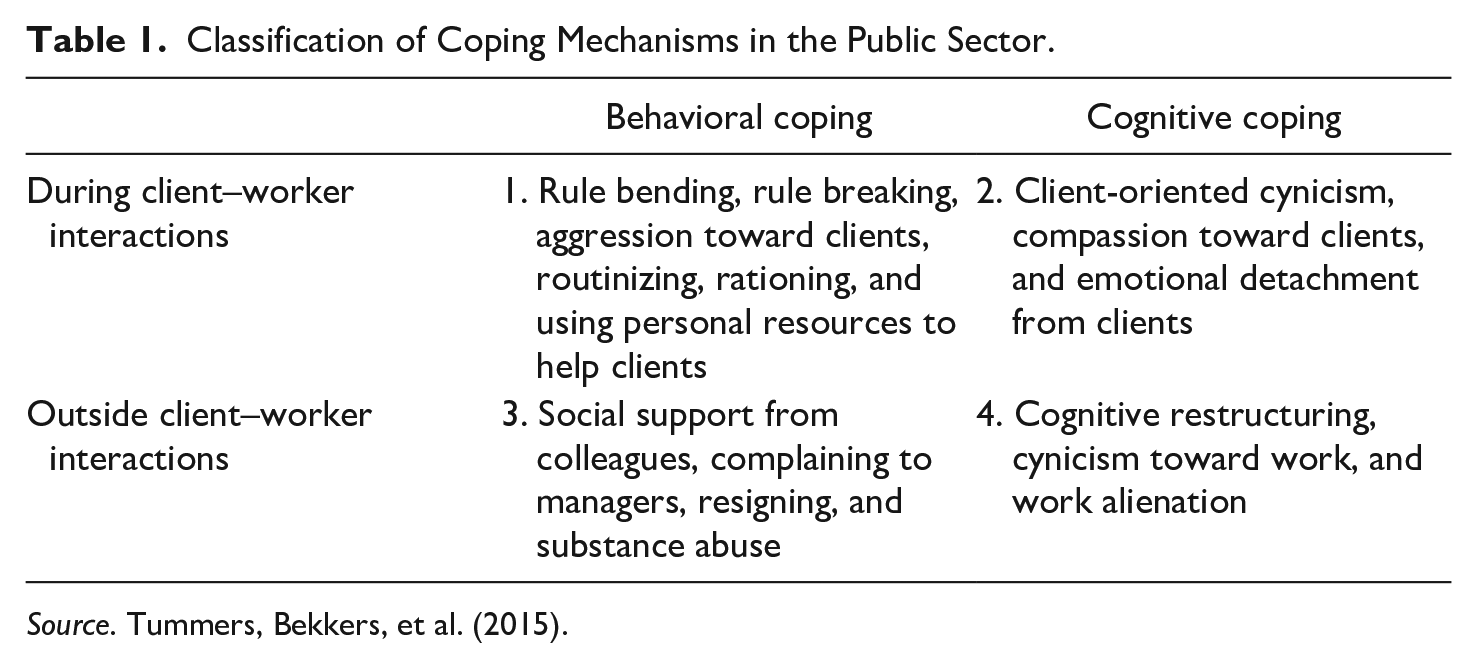
Tummers, Bekkers, et al. (2015) identify four ways of coping that public service employees use (see Table 1). First, coping can be behavioral, such as looking for social support by discussing work with colleagues, supervisors, and friends or family, or, alternatively, coping can be cognitive such as becoming exhausted and cynical. Second, coping can occur during or outside client interactions. For example, a teacher can use coping strategies while in the classroom with pupils, or outside the classroom either alone or with colleagues. Which coping strategies a teacher adopts will depend on various characteristics, such as the organizational policy of their organization or the level of autonomy in their work. In addition, rules cannot address all complex situations, especially while interacting with others (Lipsky, 1980), which can invite rule bending or breaking (Borry & Henderson, 2020). Earlier research showed that rule bending takes place at all hierarchical levels, but it is mostly an exception (Maynard-Moody & Musheno, 2000). Furthermore, Maynard-Moody and Musheno (2000) found that street-level bureaucrats, such as teachers, decide whether they bend rules when they find it worthy for clients. Street-level bureaucrats are, in such cases, even willing to take significant professional risks. Both rule bending and breaking are acts of rule violation, for which this study does not differentiate between the two (Borry & Henderson, 2020). Furthermore, personal characteristics influence the coping mechanisms, such as having the skills and abilities required to successfully cope with rules. Table 1 shows the four different coping categories identified by Tummers, Bekkers, et al. (2015), which are used in identifying the coping strategies that teachers use to deal with rules in their schools.
Classification of Coping Mechanisms in the Public Sector.
Source. Tummers, Bekkers, et al. (2015).
Method
This qualitative study was conducted in the Netherlands in the first 6 months of 2022. A qualitative method is used to gain insights into how teachers cope with rules to maintain high vitality as there was no refined literature available that includes all these three elements. Hence, a more exploratory design suited better to retain flexibility in going more in depth to understand and be able to distinguish different groups of teachers and related coping styles.
Participants
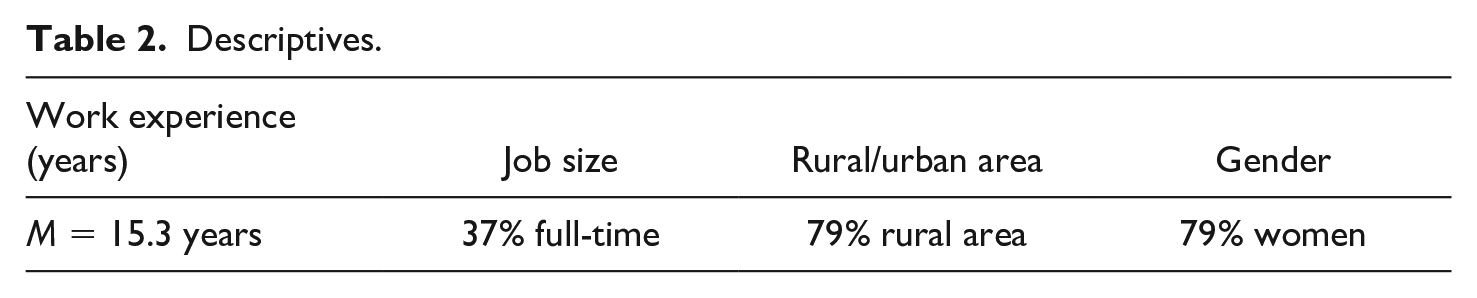
In total (N = 19) participants were interviewed. All respondents were teachers in regular primary education, which is a public sector domain in the Netherlands. Primary school teachers in the Netherlands teach children between 4 and 12 years of age and are responsible for teaching all subjects to a single class. This research attempted to recruit diverse respondents in terms of the following characteristics: work experience, gender, and work environs (rural/urban), which was expected to facilitate the acquisition of a broad spectrum of perspectives (see Table 2). Convenience sampling is used through the network of the researcher followed by the snowball method. The selection of teachers was also based on the teachers’ willingness to participate and their availability during the study period. First, work experience might affect teachers’ vitality as previous research shows that tenure is related to vitality (Van den Elsen & Vermeeren, 2019). Second, gender was included as research shows that female teachers often are more exhausted and report lower levels of accomplishment, whereas male teachers show higher levels of depersonalization (Saloviita & Pakarinen, 2021). Third, the local environs might affect teachers’ vitality because urban areas face problems with greater teacher shortages and often higher levels of poverty (Saloviita & Pakarinen, 2021). Hence, this study tried to recruit teachers from different parts of the Netherlands. Most respondents were working in rural areas (79%), with only 21% working in urban areas. The work experience of the sample ranged from half a year to 39 years (M = 15.3 years). The sample was 21% male and 79% female. This is representative for the gender variation in primary education based on the Dutch government numbers (13% male teachers in 2021). During the interviews, participants were asked about the working hours as part-time work is common in the Netherlands. Only seven respondents (37%) were working full-time, with the remainder working fewer hours.
Descriptives.
In general, in this sort of research, the number of interviews needed to achieve saturation is between 12 and 24 interviews (Hennink et al., 2017). In this study, saturation level was achieved after 19 interviews because no new information was achieved and data collection halted.
Data Collection
The data were collected using in-depth, face-to-face, semi-structured interviews. Before each interview, the purpose of the research was explained. Furthermore, all participants were asked to sign an informed consent form in which permission to record the interview was sought. Some interviews were held at the schools where the teachers were working and others online using Microsoft Teams. This depended on the COVID-19 measures at the school as this research was conducted during the COVID-19 pandemic.
The research was approved by the ethics committee of the Erasmus School of Social and Behavioral Sciences of Erasmus University and the data from the respondents were treated according to the General Data Protection Regulation (GDPR). All participants were informed about the voluntary nature of participation and were guaranteed confidentiality.
Interview Procedure
To fine-tune the questionnaire, a pilot interview was conducted with one teacher who was not included in the final sample. The interviews took 53 min on average (ranging from 33 to 74 min). Participants were asked to
Describe the school where they work. Questions were asked about the school population, the aims of the school, how the school is organized, and questions about the characteristics of the class such as size and age;
Describe the level of vitality they experience in their job as a teacher. During the interviews, participants were questioned about the vitality level by showing images of four different people with all at different energy levels and accordingly battery levels, namely, (a) blue: completely full, (b) green: almost full, (c) yellow: moderate, and (d) red: empty. Teachers were asked to describe toward which person they could relate the most. Furthermore, follow-up questions were asked about how their energy develops during the workday/week;
Describe the level of rules in their school and their compliance burden and functionality (according to Van Loon et al., 2016). The topic of rules was introduced by discussing the current media attention toward rules in the education sector. Furthermore, participants were asked for examples of rules within the school and were asked about the characteristics about those rules. Then, the respondents were asked to plot those examples on an image with two axes (functionality and compliance burden) based on the model of Van Loon et al. (2016);
Explain how they try to deal with these rules; what strategies they use. Here participants were mainly asked for examples; and
Describe in what way their strategies help them remain vitalized. Examples were discussed that respondents gave to deal with rules to help them in maintaining their work energy and why they think so.
Data Analysis
The interviews were recorded and transcribed. All the transcripts were pseudonymized. Next, Atlas.ti was used to organize, manage, and code the qualitative data. The theoretical frameworks that were discussed of the concepts of rules, vitality, and coping were the main drivers to identify the codes. Furthermore, the coping styles were refined that teachers can use and which were not known from the literature yet. Accordingly, the interviews were coded by connecting the code as much as possible to the vocabulary used by the teachers. They did not use the exact terminology as “red tape,” but, for instance, a rule that costs lots of efforts but was found not useful. Furthermore, these generated codes were used for the other transcripts as well. Afterward, the codes were structured and merged to get a clear overview and develop a codebook (e.g., two codes were generated for the levels of vitality experienced). This codebook was discussed within the research team. Subsequently, all transcripts were reviewed again, this time using the developed codebook as a guide and assigning relevant codes according to the themes and concepts they represented. To ensure consistency, the coding was performed by the same researcher throughout the analysis process. As the final step, networks were developed using the network function in Atlast.ti to make the data more insightful and to gain an overview.
Findings
During the interviews, teachers discussed about their vitality levels, the rules they experience in their organization, and how they try to cope with these rules. The following paragraph discusses the findings in this sequence.
Vitality Levels: Two Groups of Teachers
During the interviews, teachers were asked about their energy levels during their working day. All the teachers described that, at the start of their working day, they had a full battery and felt energized when going to their work. Teachers were asked about their vitality levels by showing four different images of employees with different energy levels accompanied by decreasing batteries (see “Method” section). On the basis of the teachers’ descriptions, one group of teachers was identified as experiencing a completely or almost full battery throughout the whole day (8 teachers). On the contrary, a second group of teachers was identified who experienced decreasing vitality during the day with a moderate or empty battery at the end of the day (11 teachers). The first group responded to the question about vitality by choosing images of employees with full batteries right away. These teachers explained that they always felt very energized during their work and while going home. In contrast, most teachers in the second group with a decreasing vitality immediately asked a clarification question when they had to choose an image, such as “an image describing my energy at the beginning of the day or at the end?” Furthermore, most teachers within the second group explained why they felt a decreasing vitality during the day. Teachers who stated to have high vitality were consistently asked a follow-up question regarding any potential changes in this feeling over time. Only those who reported experiencing a consistent and stable sense of vitality were categorized as teachers belonging to the first group. To illustrate the differences between the two groups of teachers, quotes are presented from each group as examples. First, a teacher’s quote who fell within the first group with a steady full battery is as follows: Yes, I would just on average have a full battery during the day. It is not that my battery is empty. I always go to work with great pleasure and energy. Because every day is just different from other days. And you can prepare all you want but, as a teacher, a working day can go completely differently than expected.
In contrast, although the second group also starts with a high energy, they go home with feelings of mild fatigue. In this second group, a decreasing vitality is experienced as the day progresses, as exemplified in the following two quotes: At the beginning of the day, the battery is still quite full, but towards the end of the day, well usually when I’m home, the battery is quite empty. Yeah, at the end of the day I don’t have enough energy to complete my administrative tasks because I am really exhausted. And the classroom is always really messy. So it first has to be cleaned up, otherwise I can’t do anything at all.
Table 3 below presents the main descriptive characteristics of the two groups.
Mean Descriptives of Two Groups of Teachers.
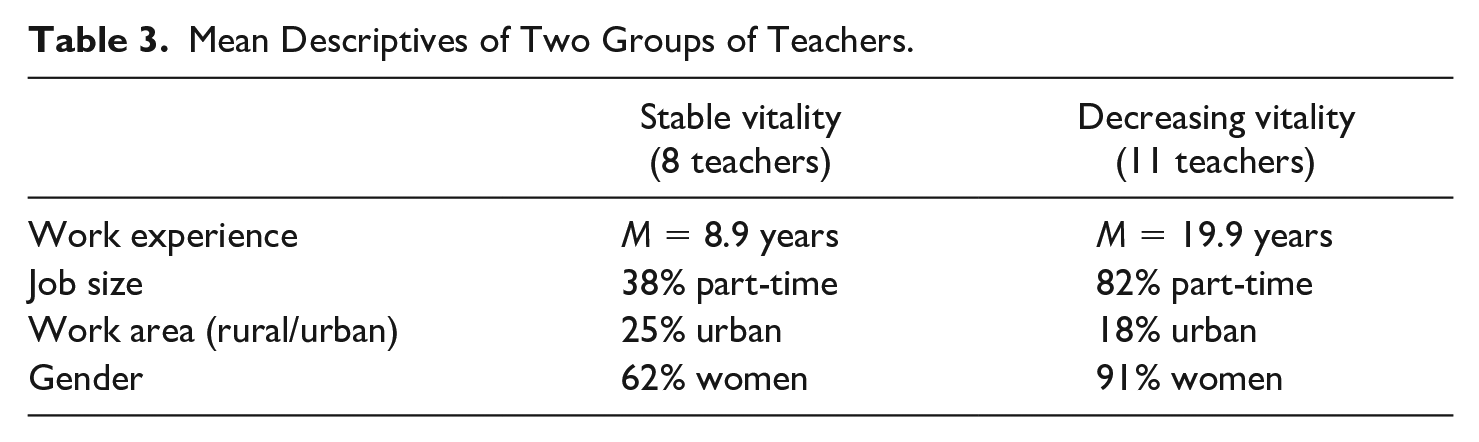
There are differences between the two groups in terms of their main characteristics. First, the group with a stable level of vitality has less work experience than the group with decreasing vitality. Gender is not equally divided between the groups, with one male teacher falling outside the high and stable vitality group. The selection variable about the nature of the area (urban or rural) where a school was situated was comparable between groups. Furthermore, the group with decreasing vitality includes many more teachers working part-time (82% vs. 38%). One of the teachers who works part-time herself provides a possible explanation for this difference between part-time and full-time teachers. This teacher noticed that working part-time costs overall more energy during a working day because this involves an information transfer to the partner teacher, which consumes considerable energy: The difficult thing is that you always have such a transfer. You have to hand over the lessons you have to give, but that’s done in no time. However, sometimes a child is not feeling well, parents are getting a divorce, a grandmother is sick. Well, you name it. And if you’re having such things in the group, you have to transfer that too.
Rules Perceived in the School
After discussing teachers’ vitality, the rules teachers have to deal with in their school were discussed. The model of Van Loon et al. (2016) was used to understand what kind of rules the teachers were discussing. The topic of rules was introduced in the interview by an introduction stating that nowadays there is a lot of media attention toward the bureaucratic accountability and multitude of rules in education. On one hand, most teachers responded to this introduction by explaining that they experienced many rules within their school organization too. On the other hand, there was a group of teachers who explained that this media attention toward rules in education is heavily exaggerated and think that it is not that bad. There were few exceptions of teachers without a strong outspoken opinion about the rule experience within their school. Based on the different types of reactions, how teachers experienced rules within their own school was further discussed by asking for examples. By going further in depth on their rule experience, the teachers were divided into a group experiencing many rules and a group experiencing few rules. The first group who experienced many rules explained that they still perceive a high level of autonomy in shaping their lessons and that most rules were about other aspects of the profession. These rules had, for example, to do with the tests children have to undertake, rules about special needs children, rules regarding how to address parents, or rules about how to carry out their administration duties. The following quotes were illustrative of teachers who on one hand experienced many rules and a high compliance burden (79%) and teachers who, on the other hand, experienced few rules (21%). First, an example of a teacher who experienced many rules and a high compliance burden, who made the following observation: Yes, we have a lot of rules and protocols. And a lot of administration. To be more concrete, I have a math test next Monday, and the results of that math test I will have to fill in one, two, three, four times. So, I enter the results of the test in four different places. That is, I mark the test and then I spend maybe 1.5 hours filling in the same results everywhere. That could be done in half the time.
Another teacher who experienced many rules compared the current situation with when this teacher started teaching: The big thing is, of course, if I compare it with 20 years ago when I started, then certainly a lot has changed. You really lose a lot of time after a teaching day with administrative things because everything has to be written down, everything has to be checked.
However, on the contrary, there is a minority of teachers (21%) who state that they only have to deal with a few rules. It seems that the group that experiences many rules experience a high compliance burden. On the contrary, the other group of teachers acknowledges that they have to deal with rules too, but they experience only few rules and perceive these rules as less of a burden. The following quote below illustrates this: Yes, I think the rules are less than expected. Well, with national exam period is quite a lot of administrative work but, yes, that is twice a year, a few weeks. I personally think it’s not that bad. (. . .) Yes, you are working on it, but okay, you have from a quarter past two to five to do that work. I can easily get it done in that time.
Another example is the quote below from a part-time teacher who does not experience a high level of rules in the school: I have to say that I don’t run into rules very much, because of course I only have my own group for one day.
In addition, during the interviews, the functionality of the rules that teachers experienced was discussed and the extent of the compliance burden in terms of the model of Van Loon et al. (2016). As explained previously, by discussing rules, the related compliance burden was mostly discussed immediately when introducing the topic. When zooming in on both the functionality and compliance burden of rules, most teachers provided examples of rules having a high compliance burden (on 88 occasions during the interviews), whereas rules with a low compliance burden were only mentioned 26 times. Given that only 19 teachers were interviewed, clearly most had multiple examples of rules with a high compliance burden. Furthermore, teachers often said that they could understand why certain rules were in place, and that their purpose was valid and useful (high functionality). However, frequently they experienced that the way in which they had to comply with a rule was illogical and that rules were inefficiently organized (high compliance burden). In the following examples, rules were addressed for which the compliance burden and functionality were discussed. First, the following quote is an example of a teacher who experienced a rule with a high functionality and which is not red tape. However, the rule is perceived as a frustrating process and having high compliance burden. This teacher explained, You have to address many organizations for a child. (. . .) You have to complete a registration for every problem a child has. If you don’t, then you actually have too little evidence to go to for example the organization which helps with child abuse. And, 9 out of 10 times, they say: no, too little, we will not process this. So, you have to do an enormous amount of administration. (. . .) However, it would be strange if help and money would be granted right away. Of course, it would be abused. But it would be nice if it could be a conversation like you and I are having now, that you could just explain it.
Furthermore, most teachers also mentioned examples of rules with a low functionality and high compliance burden which is seen as red tape (Van Loon et al., 2016). This teacher explains, I am now working on a social and emotional questionnaire that you have to fill in for each child. It is about how we see them socially and emotionally, but then we actually don’t do anything with the lists. (. . .) I know who they are, what they need to be able to do their work, and whether the child is growing or not, you just see it every day in your classroom—but you still have to fill in the questionnaires.
Linking Vitality and Rules
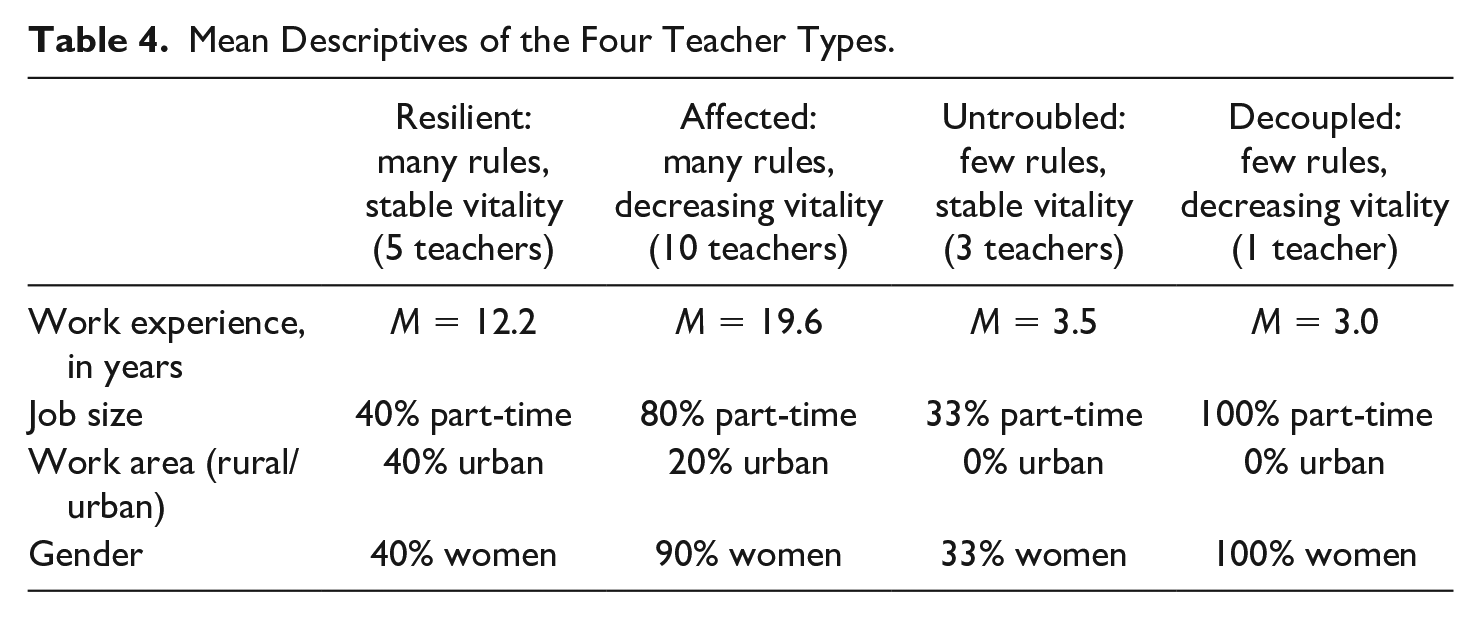
To be able to answer the main research question, high and low vitality teacher groups were linked to the two groups of teachers who experienced many rules and few rules. As Figure 1 shows, these four different groups were labeled as (a) resilient: teachers who experience many rules but maintain a stable vitality, (b) affected: teachers who experience many rules and have a decreasing vitality, (c) untroubled: teachers who only experience a few rules and maintain a stable vitality, and (d) decoupled: teachers who experience few rules but still experience a decreasing vitality. This study mostly zooms in on the resilient group as this group is able to cope with rules in such a way that they are able to maintain their vitality.
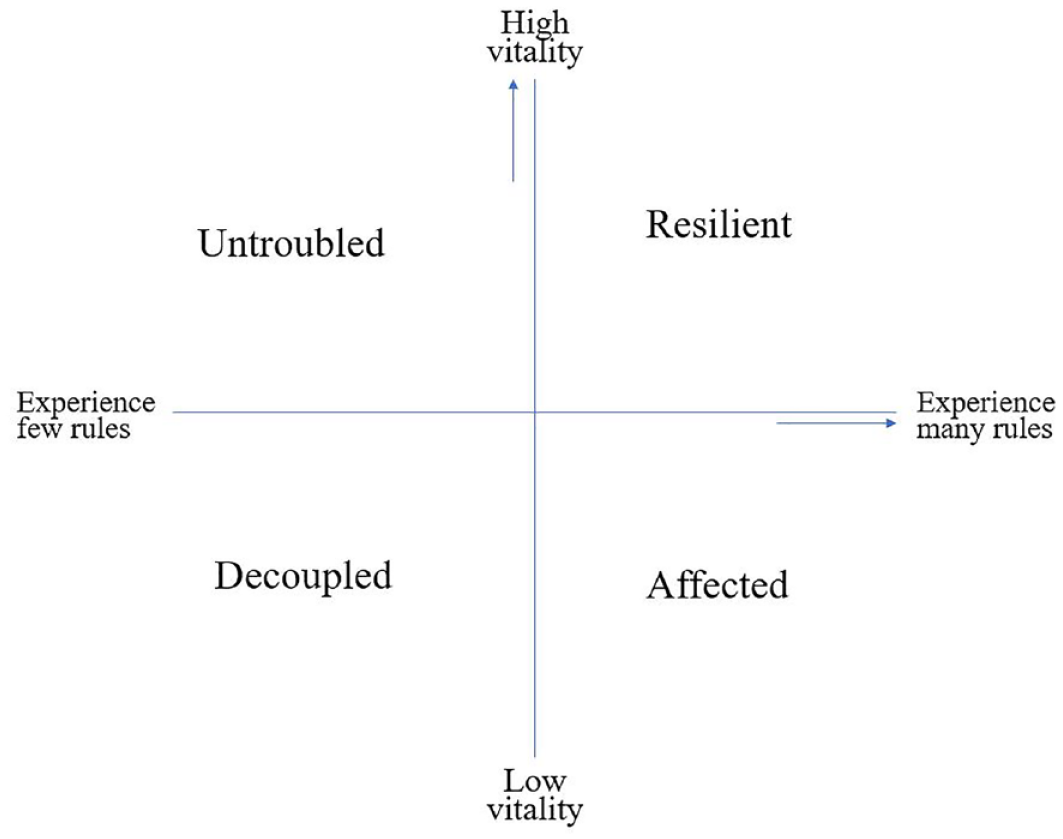
Four Groups of Teachers
Table 4, with the characteristics of the four groups, shows that teachers in the affected group have much more work experience than those in the three other groups. Furthermore, there are differences between the four groups in terms of working hours, in that the two groups of affected and decoupled teachers mostly work part-time. In addition, all the teachers working in urban areas experience many rules in their schools. Most male teachers were resilient. As Table 4 shows, only one teacher fell into the decoupled category. This teacher has an unusual work pattern: on Thursdays, this teacher does not have an own class but helps several other teachers, without having time to prepare the lessons, and, on Fridays, this teacher has an own class to take care of. In terms of energy, this teacher finds the former more draining. This suggests that preparation time can be an important factor affecting teachers’ work energy. The following quote explains the situation of this specific teacher:
Mean Descriptives of the Four Teacher Types.
And I must say, on Thursday the battery is empty at the end of the day. Then of course I have been in a lot of classrooms, and without preparation, or at least really good preparation, and that is also a long day. The children are not going home until a quarter to three. But, on Friday, I’ll end up having energy.
The decoupled teacher is excluded from the analysis as this is only one teacher with a very specific work situation. In addition, as the research question suggests, this study is mostly interested in teachers who are able to maintain their vitality and how this differs from the group with a decreasing vitality.
The Use of Different Coping Strategies
As Tummers, Bekkers, et al. (2015) show, different types of coping can be distinguished in the forms of behavioral (e.g., rule breaking, social support seeking, and turnover) and cognitive coping (e.g., cynicism, compassion, emotional detachment, and work alienation), which can take place during or outside client–worker interactions. This framework is used to categorize the coping styles used. Most teachers described behavioral coping strategies when discussing how they dealt with rules. For example, teachers often mentioned that they tried to work as efficiently as possible or might not comply with certain rules (rule bending/breaking). Tummers, Bekkers, et al. (2015) position rule bending/breaking as a coping style during client–worker interactions. However, when, for example, a rule is related to administrative tasks, it can also be positioned outside client–worker interactions. Furthermore, it needs to be acknowledged that the coping styles used to maintain high vitality were mostly related to administrative tasks causing work pressure. This means that the coping styles described are related with general strategies, such as avoiding burnout and having a good work–life balance. In the following quotes, some examples of the coping strategies used by teachers are illustrated. In the first quote, a teacher explained that she does not always comply with rules that have to do with administrative tasks (rule bending/breaking): Yeah, sometimes I just don’t. But if I think, okay, I have to justify this then I just say I don’t do it. I never really ask for anything, I just don’t do it. And if they don’t want me, I’ll just leave, but that’s never really the case.
Furthermore, some teachers were consciously setting boundaries by, for example, not taking work home, neither physically nor mentally. For example, a teacher explained, At peak times it is indeed quite busy and then it is not ready at 5 o’clock. Anyway, yeah, I think the important thing is that you need to be able to turn off. Tomorrow is another day, then you just continue.
Some teachers described how they sought social support in dealing with rules. Teachers would discuss the rules with colleagues, with their supervisor, or even at home. The following quote from a teacher illustrates social support–seeking behavior: And I can tell my story at home with my family, and I have good contact with colleagues, so we can also discuss together what we run into.
Furthermore, several teachers mentioned that they would discuss rules with their supervisor if they did not perceive certain rules as useful.
Only one cognitive coping style was mentioned, namely, that some teachers just carry out their tasks without thinking too much about it. The following quote below illustrates a teacher who just carries out her tasks without addressing it or thinking too much about it, and this teacher expects other colleagues to work in a similar way: Yes, teachers are quite easy to manage, they just have a sense of duty. Yes, so we just fill in that form.
However, no coping styles were identified during client–worker interactions according to the classification of Tummers, Bekkers, et al. (2015). This can be explained by the fact that teachers mostly experience rule compliance as a burden when carrying out tasks that are unrelated to client–worker interactions (i.e., teaching itself). Most rules concerned administration, such as processing exams or the paperwork for special needs children (outside client–worker interactions).
Analyzing Coping
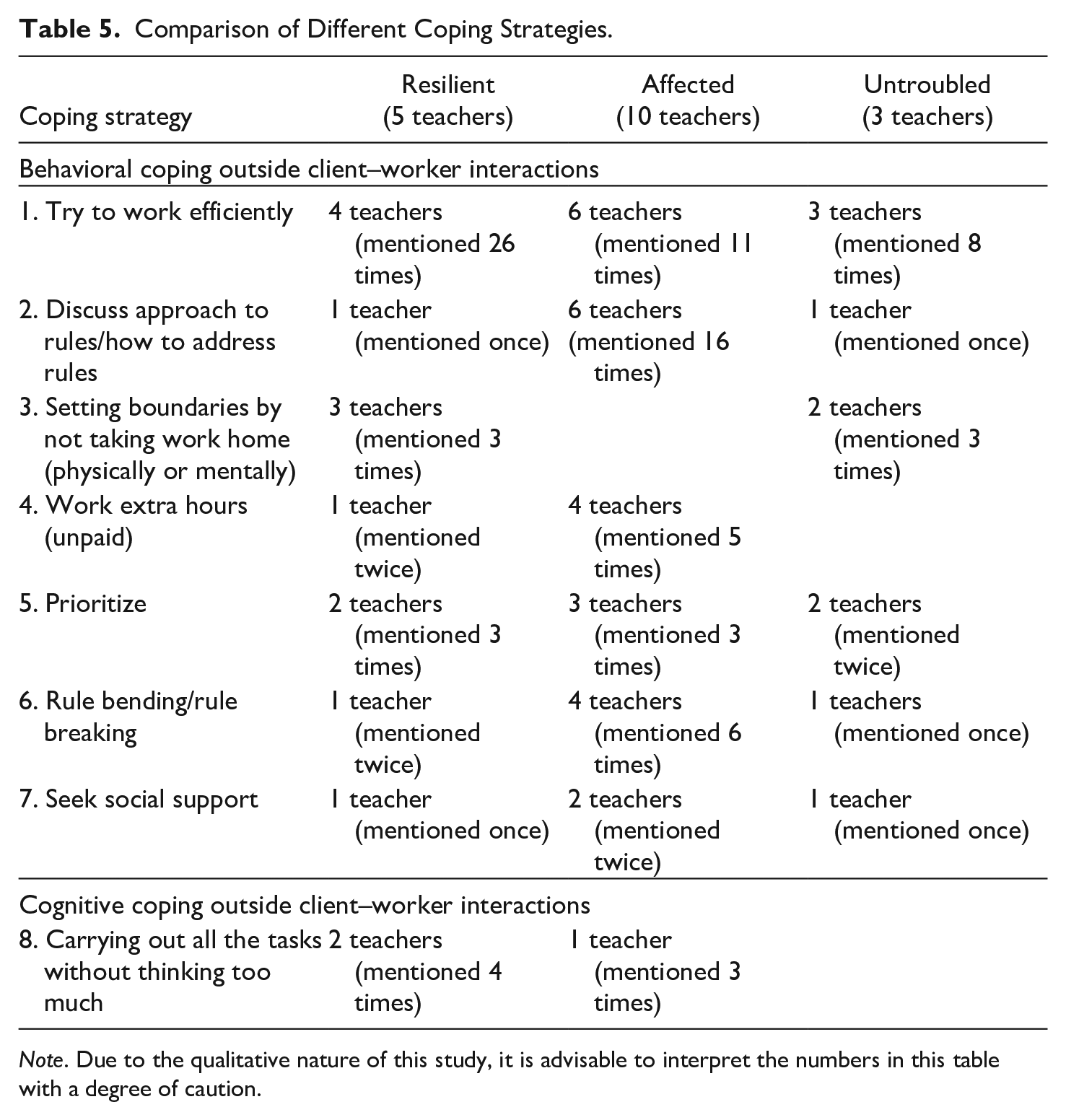
Furthermore, this study investigates whether the three groups of teachers with different levels of vitality and different experiences of the extent of rules in their school use different coping strategies. As noted earlier, the decoupled group is left out, with only one teacher out of the analysis. In Table 5, the classification of Tummers, Bekkers, et al. (2015) is used to classify the different coping strategies used by the three groups of teachers. The first point to note is that nearly all the coping mechanisms reported were behavioral rather than cognitive in nature. However, the teachers within the untroubled group did not mention concrete examples of cognitive coping strategies, but it seemed that most of them were having a different mindset regarding rules, which can be interpreted as cognitive coping style.
Comparison of Different Coping Strategies.
Note. Due to the qualitative nature of this study, it is advisable to interpret the numbers in this table with a degree of caution.
Nevertheless, as Table 5 shows, there are differences between the three groups in what kinds of coping strategies they use and how often. The discussion begins with the resilient group as those teachers are able to maintain a high vitality while experiencing many rules. First, the findings show that the resilient teachers tend to use a wider variety of coping styles than the other groups. Notably, most of the resilient teachers mentioned examples about routinizing their work to make it more efficient and get it done as quickly as possible. Furthermore, all the teachers in the untroubled category also focus on working as efficiently as possible. In contrast, fewer of those in the worried category use working efficiently as a coping strategy. For example, a resilient teacher who tries to work efficiently commented, Yep, how I made the group plans?—they were pretty basic. You just have a left, a middle, and a right column and you copy and paste the sentences. This makes it less useful, because you just do the same thing over and over.
The second most commonly mentioned coping strategy among the resilient category was “trying not to take work home” and this coping strategy is also very widely used by the untroubled category. However, those in the affected category do not use this coping strategy at all. Instead, they use the coping strategy of addressing the rules considerably more often than the other groups. For example, a respondent described how she dealt with rules: by trying to report it to management in the hope that they would be revised: I would discuss it. And especially with the management at some point.
Of the three groups, the affected group also uses rule bending the most. The coping strategy of prioritizing the work was most often a strategy of the untroubled.
To summarize, teachers falling in the resilient and the untroubled groups mainly focus on their own work by working efficiently and trying not to take work home, whereas the affected are more focused on addressing rules and bending or breaking them if they feel this is justified. In the following “Discussion” section, the implications of these findings are discussed.
Discussion
Nowadays, many countries are facing serious problems due to teacher shortages (Madigan & Kim, 2021). In response, considerable research is conducted on how to prevent teacher burnout and turnover that is often attributed to high workloads (Desrumaux et al., 2015). While acknowledging the significance of this research, this study argues that it is equally crucial to explore the positive aspects of the profession and strategies for enhancing the vitality of teachers. This research aims to understand how teachers cope with rules to maintain high vitality as all teachers have to cope with rules as in all (public) organizations. Consequently, the main research question was “How do primary school teachers cope with rules to maintain their vitality?” To answer this, 19 primary school teachers were interviewed. Based on the findings, this study differentiated between four groups of teachers which helped interpret the data. These four groups were based on their level of vitality and experiences of rules, namely, the (a) resilient, (b) affected, (c) untroubled, and (d) decoupled groups. Accordingly, the coping styles used were linked with the distinguished groups. As the group of resilient teachers and, to a lower extent, the untroubled group might be able to cope with rules in the best way to maintain their vitality, the focus of this study was mostly on the coping styles of these groups. Some important conclusions can be drawn from the results, which will be discussed in the next paragraphs.
First, working efficiently is an important focus among the resilient and untroubled groups but less often applied by the affected group. This suggests that working efficiently and trying to focus on your own work might be an effective way to prevent a decline in vitality as the untroubled and resilient had higher vitalities. In addition, the untroubled and resilient groups often mentioned focusing on setting boundaries and trying not to take work home, but this approach was not reported by the affected group. This suggests that setting boundaries by not taking work home can be a good way of coping with rules.
Second, on the contrary, the coping strategy of addressing rules (by discussing them with others and seeking changes) was far more frequently used by affected teachers (experiencing many rules and a decreasing vitality). Two possible explanations can be offered for this finding. First, this coping strategy might not be very effective while costing energy, with many teachers providing examples where the manager did not listen to their suggestions. However, another explanation may be that the teachers who do adopt this strategy feel more of a need to address rules as they are experiencing a decline in vitality and that this approach does actually help them. Further research based on longitudinal data (e.g., a diary study) would be an appropriate approach to clarify whether there are causal relations between the mentioned coping styles and vitality.
In addition to answering the research question, this research has also provided some further insights that show the added value of this qualitative research by finding new avenues for future research. First, the descriptives of the groups experiencing a high or low vitality varied substantially with regard to working part-time, gender, and work experience. This study does not provide an explanation for these findings as this was outside the study’s scope, but the relation between these characteristics, rules, and vitality suggests interesting avenues for future research. Second, some teachers explained that they were better able to deal with rules because their school board actively tries to decrease the burden of rules. This school board’s efforts/the role of leadership can be an interesting field for future research. Third, many teachers explained that they experience a high workload and many responsibilities, regardless of the number of rules. Hence, the responsibilities of teachers in relation to their workload can be an interesting field for future research. Fourth, during the interviews, the teachers mentioned examples that interface with the research domain of emotional labor. As the teaching profession involves a high level of emotional labor (Näring et al., 2006) that might relate to vitality and coping with rules, this would be a relevant future research domain. Fifth, as vitality is a broad concept, it is related to many more personal characteristics, for example, employees’ character traits (Big five) or personal situation. This study focused on the combination of rules, coping, and vitality, but for future research it can be interesting to choose a broader research focus.
This study has several limitations. First, based on the interviews, it is not possible to draw causal relationships as to whether some coping strategies are more effective in dealing with rules to have high vitality than other coping strategies. This would be an interesting field to explore for future longitudinal research. Second, during the interviews, teachers were asked to describe a work situation where they had to deal with rules. By asking about rules in this way, teachers might have been more likely to mention behavioral rather than cognitive coping strategies as the latter are more difficult to perceive. Hence, a bias might have been introduced in this research toward behavioral coping strategies. To overcome this issue, follow-up questions were asked about earlier examples of rules mentioned and how they dealt with those rules. Despite efforts to reduce this bias, for future research, these questions can be asked more about feelings regarding a rule or even be more open-ended by, for example, asking, “How do you perceive the role of rules and regulations in your organization’s culture and day-to-day operations?” Third, it is self-evident that the coping styles adopted to deal with rules will mainly take place outside client–worker interactions as most rules relate to administrative tasks. Furthermore, the interviews were mostly held at the end of a working day just after the teachers had completed their administrative tasks and this might affect how teachers felt about certain rules. Moreover, the first few interviews took place during the national testing period for primary education and many of the offered examples of rules were about the administration of these tests. Linked to this, perceptions were only measured at one point of time. In future research, a diary study could be appropriate for investigating how the vitality of teachers fluctuates during the day, and indeed the school year, and which personal and contextual factors determine these fluctuations. Finally, the responses about the experience of vitality might, in some cases, be attributed to social desirability. It might have been the case that some teachers who actually feel exhausted are not likely to admit this. To minimize this bias, examples were asked in which teachers felt high vitality and the work situations in which they felt exhausted. By naming examples, some teachers acknowledged that in general they felt having a lower vitality.
This research has some practical implications for the public sector context and education in specific. First, most teachers could provide examples of rules with a low utility and high compliance burden and ones that were inefficiently organized. This confirms that red tape is still common in schools (George et al., 2021) as in most public organizations. As such, in practical terms, schools and their governmental authorities could usefully evaluate the current rules and see whether they can make adjustments. Furthermore, this research shows that there are differences in coping styles used by teachers with different vitality levels and rules experience for which the model was developed with four different types of teachers. In practical terms, this finding can help human resource management (HRM) practitioners and managers. To be more concrete, HRM practitioners can facilitate intervision groups and coaching to make employees more aware of which one of the four groups they can relate to the most and the various coping strategies, so the different groups of teachers can learn from each other.
Overall, this research clarified the coping strategies used. The untroubled and the resilient categories with a stable high vitality more often coped with rules by working efficiently and setting boundaries by not taking work home than the affected group. In conclusion, it seems that working efficiently and setting boundaries are effective ways of coping with rules to maintain high vitality.
Footnotes
Declaration of Conflicting Interests
The author(s) declared no potential conflicts of interest with respect to the research, authorship, and/or publication of this article.
Funding
The author(s) received no financial support for the research, authorship, and/or publication of this article.
