




Abstract
The aim of this article is to unravel the determinants of inclusive leadership by combining mixed methods in two phases to explore and test theoretically grounded personal and organizational antecedents of inclusive leadership. The first qualitative phase used semi-structured interviews with public managers, while the second quantitative phase tested assumptions using survey data from employees working in the Dutch public sector. The findings support the hypothesized positive association of leader humility as well as a flexible culture on inclusive leadership. Public managers also tend to have, both social justice and business case arguments for diversity, affecting their inclusive leadership. Motivation and discretionary room enable public managers to cope with structural constrains. Top management support is important to change organizational culture and norms, motivating and stimulating lower level managers to actively show inclusive leadership. Overall, the findings contribute to a better understanding of inclusive leadership in a public sector context.
Introduction
A diverse and inclusive work environment is valued for realizing social equity and fairness (Meier, 2023; Riccucci & Van Ryzin, 2017). The integration of diverse identities, perspectives, and voices into core work and decision-making processes is crucial for inclusive public service delivery (Alang et al., 2022; Ely & Thomas, 2001; Getha-Taylor et al., 2020). Yet, despite many efforts, public organizations do not always succeed in diversifying and/or fail in fostering inclusiveness (Ashikali et al., 2021b; McCandless et al., 2022; Riccucci, 2021). Recent studies show that leadership, particularly inclusive leadership, is an important factor in supporting employees’ perceptions of inclusiveness and role modeling inclusive behaviors (Fagan et al., 2022; Mor Barak et al., 2022; Shore & Chung, 2023; Veli Korkmaz et al., 2022).
There are many leadership styles that may affect outcomes on different levels, such as transformational, transactional, authentic, or servant leadership, among others. Each is, however, grounded in different theoretical and philosophical approaches, resulting in various mechanisms that affect employee outcomes (Leroy et al., 2018; Randel et al., 2018), and thus are not necessarily effective in sustaining inclusiveness. Based on social identity and optimal distinctiveness theory, inclusive leadership involves addressing potential in- and exclusion of marginalized groups and creating a work environment in which diverse identities are respected and included in core work and decision-making processes (Fagan et al., 2022; Nishii & Leroy, 2021; Shore & Chung, 2022). Furthermore, different from dyadic-oriented leadership styles, inclusive leadership in this study is about addressing team diversity processes needed to support an individual’s belongingness and uniqueness at the group level (Ashikali et al., 2021a; Randel et al., 2018; Shore & Chung, 2022).
Leadership is, however, a complex phenomenon, dependent on personal and contextual factors (Antonakis & Day, 2018; Leroy et al., 2018). Although previous empirical studies explore inclusive leadership attributes and outcomes (Carmeli et al., 2010; Fagan et al., 2022; Hirak et al., 2012; Nembhard & Edmondson, 2006; Roberson & Perry, 2022), the context affecting leadership behavior is often understudied. For instance, public managers work in a complex context characterized by competing demands and values due political and societal pressures affecting their leadership behaviors (Grøn et al., 2020; Hood, 1991; Jesper & Villadsen, 2010; O’Toole & Meier, 2015; Vogel & Masal, 2015). Although social equity is a fundamental value (Blessett et al., 2019; Svara & Brunet, 2020), co-existing neo-public management paradigms might oppose competing values of efficiency and performance, affecting public managers’ leadership (Hood, 1991; Pedersen et al., 2019; Van Wart, 2013).
Furthermore, specific to the public context is the existence of political control and constraints. Increased political control may result in augmented hierarchy and accountability, resulting in leadership that is more autocratic or transactional in nature and top down, potentially limiting inclusive leadership. At the same time, endorsed by societal events, social justice motives are prevalent in a public context, making issues of inclusiveness more salient for public managers’ leadership (Ashikali et al., 2021b; OECD, 2015, 2019). Yet, current research does not address if and how these contextual factors affect inclusive leadership in public organizations.
Given the lack of knowledge what affects inclusive leadership in public organizations, our understanding of when and why inclusive leadership is shown, and how it potentially can be developed is limited. To better understand the conditions under which inclusive leadership is shown, this research explores and tests how organizational contexts and personal antecedents affect public managers’ inclusive behaviors in public organizations. The central research question is:
This study contributes to the public human resource management and leadership literature in several ways. First, this study considers the particular paradoxical public context that might affect inclusive leadership. As a theoretical lens, the competing values framework (CVF) is used to theorize about how competing values (Cameron & Quinn, 2011; Quinn & Rohrbaugh, 1983) might induce certain leadership to realize different values (Bandura, 1969; Salancik & Pfeffer, 1978). The CVF combines competing values that illustrate multiple conflicting and competing demands public managers could face while managing their teams (Backhaus et al., 2022; Van der Wal et al., 2015; Vogel & Masal, 2015).
Second, this research goes beyond business case arguments for diversity that are prevalent in many studies, including those labeling diversity motives as pro-diversity beliefs or diversity mindsets (van Knippenberg & van Ginkel, 2022). Different values underlie the reasoning for diversity and inclusiveness (Ely &Thomas, 2001), particularly in a public sector context in which values of fairness and social equity are considered core pillars of public administration (Blessett et al., 2019; Riccucci & Van Ryzin, 2017; Svara & Brunet, 2020). At the same time, existing management values and practices in public organizations might not be aimed at fostering inclusiveness, demanding different leadership of public managers. To better understand how these potential contradictory values, relate to inclusive leadership, this research further explores which diversity perspectives are prevalent and how they inform inclusive leadership in public organizations.
Third, the study used a mixed method design, which is increasingly applied by public administration scholars to better understand the complexity in public administration (Hendren et al., 2018), allowing to capture multiple factors and perspectives related to inclusive leadership. Data were collected in two phases: (a) a qualitative interview study with public managers in Dutch central government organizations (N = 30) to collect managers’ motives and experiences and (b) a quantitative survey study of public employees (N = 879) to assess their perceptions of inclusive leadership, diversity perspectives, and organizational context.
The article continues with a theoretical framework that outlines theoretically grounded personal and organizational antecedents of inclusive leadership resulting in theory-driven expectations. The next section discusses the methods used and explains in detail the mixed method study, followed by a presentation of the results. Finally, the last section discusses the findings, and their implications and conclusions are explained.
Theoretical Framework
Inclusive Leadership
Previous research has focused on inclusive leadership, by focusing on attributes of direct supervisors by examining their openness to diversity and the extent to which they invite and appreciate team members’ contributions (Carmeli et al., 2010; Hassan & Jiang, 2021; Nembhard & Edmondson, 2006). Studies that built on this concept of leader inclusiveness, have found positive effects for the psychological safety climate experienced by employees and a number of positive employee attitudes and behaviors (for an overview, see Shore & Chung, 2022). However, previous approaches to inclusive leadership focus on an exchange process between leaders and followers based on professional status and not specifically on in/exclusion mechanisms related to marginalized groups (Fagan et al., 2022; Shore & Chung, 2022).
More recent conceptualizations of inclusive leadership depart from social identity and optimal distinctiveness theory, focusing on needs of belongingness and uniqueness at the team level (Ashikali et al., 2021a; Nishii & Leroy, 2021; Shore & Chung, 2022). Social identity theory and optimal distinctiveness theory identify two competing needs individuals aim to satisfy: needs of belongingness and uniqueness (Brewer, 1991; Shore et al., 2011). On one hand, individuals seek similarities and identification with others, while on the other hand, individuals seek individuality from others. Individuals experience inclusiveness when both needs are balanced in their teams. Inclusiveness goes beyond a mere focus on diversity, which often focuses on the (numerical) representation of minority groups. Based on this conceptualization, inclusive leadership involves “a set of leader behaviors that are focused on facilitating group [team] members feeling part of the group [team] and retaining their sense of individuality while contributing to group [team] processes and outcomes” (Randel et al., 2018, p. 191). Inclusive leadership differs from previous leadership styles, such as transformational, ethical and authentic leadership, because these leadership styles do not address leaders’ behaviors aimed at balancing belongingness and uniqueness at the team level (Ashikali et al., 2021b; Nishii & Leroy, 2021; Shore & Chung, 2022). Inclusive leadership is pivotal to consider team members’ (status) differences and support their participation in team processes, rather than encouraging individuals to adhere to collective needs that are central to transformational leadership (Ashikali et al., 2021a; Randel et al., 2018).
The literature on inclusive leadership proposes different categories of inclusive behaviors (Fagan et al., 2022; Veli Korkmaz et al., 2022). Based on their review, Randel et al. (2018) identify leader supportiveness, ensuring justice and equity, shared decision-making, encouraging diverse contributions and helping group members to fully integrate. Others include leader encouragement and enablement of team members’ social integration and information elaboration. For instance, through stimulating team members to voice their ideas, to learn from other team members, and to support fruitful cooperation among diverse team members (Ashikali et al., 2021a; Ely & Thomas, 2001).
In an organizational setting, inclusive leadership is shown when public managers are aware of voices that are not heard, and actively invite and stimulate them to participate and set the stage to do so. For instance, creating a safe environment in which diverse team members can have their unique identities, both in formal (i.e., a work meeting) and informal settings (i.e., at lunch). To stimulate exchange and learning behaviors, public managers may assign team members to a shared task and explain how their diverse backgrounds, expertise and perspectives are important in realizing a shared goal and or task.
Determinants of Inclusive Leadership
Diversity Perspectives
An important determinant for inclusive leadership is the motive associated with diversity and inclusion. In the diversity literature, pro-diversity beliefs are used to refer to the motives individuals hold regarding the value of diversity in work groups (Ely & Thomas, 2001; Van Knippenberg et al., 2007). Managers who have a pro-diversity belief will perceive diversity as a resource that contributes to team effectiveness due to the availability of diverse perspectives, backgrounds, and ideas (Randel et al., 2018; Van Knippenberg et al., 2007). A pro-diversity belief overlaps with an integration and learning perspective (I&L; Ely & Thomas, 2001). When an I&L perspective is adopted, managers will value (cultural) diversity as a resource for learning and integrate differences in core work practices and processes. This will result in an increase in involvement from underrepresented groups and participation in decision-making processes. Managers with an I&L perspective are, thus, expected to show inclusive leadership. The same rationale can be used in organizations to motivate diversity management from a business case argument perspective (Ashikali & Groeneveld, 2015; Groeneveld & van de Walle, 2010). When employees perceive their organizations to apply an I&L perspective, they are more likely to perceive inclusive leadership aimed at creating synergy from team diversity.
In addition to the I&L perspective, Ely and Thomas (2001) differentiate between an access and legitimacy (A&L) and a discrimination and fairness (D&F) perspective that are particularly relevant in a public sector context. From an A&L perspective, diversity is viewed as valuable because it may help an organization reach diverse clients and citizens and by doing so increase the organization’s legitimacy. Managers with an A&L perspective support diversity, particularly when interacting with important external stakeholders. A D&F perspective reflects motives that are based on a social justice case argument: increasing fair treatment of minority groups and decreasing discrimination (Ely & Thomas, 2001). However, a D&F perspective might also result in colorblindness, as managers emphasize treating everyone equally. As a result, managers are expected to encourage treating everyone the same, particularly in hiring and promotion, while diversity is less incorporated into core work processes. Lacking an instrumental link between diversity and the team’s work, a D&F perspective also assumes assimilation to the dominant culture and hence negatively affecting inclusive leadership.
Applying these perspectives to a public sector context, the A&L and D&F perspectives can be combined into a perspective of Representation & Fairness (the R&F perspective) when social justice cases are emphasized targeting marginalized groups (Riccucci, 2009; Riccucci & Van Ryzin, 2017). Both an I&L perspective and an R&F perspective are expected to be present in public organizations and to be held by public managers. However, since there is no clear link with changing work processes as R&F can be passive or symbolic, public managers are not expected to change their leadership based on an R&F perspective. Overall, multiple motives can be expected to drive diversity and inclusion in public organizations, but an intrinsic drive to value diversity and include diverse employees will relate to public managers’ inclusive leadership. This results in the following proposition:
Leader Humility
Several literature reviews elaborate on leader attributes, involving being aware of one’s own blind spots, knowledge, overall self-awareness, among other related concepts (Fagan et al., 2022; Veli Korkmaz et al., 2022). These attributes can be linked to leader humility a crucial organizational virtue for leaders who have to deal with a dynamic and changing environment (Owens et al., 2013, 2015; Wang et al., 2018). With a diversifying society, workforce leader humility is an interesting subject for public management and leadership research. Owens et al. (2013) define leader humility as an interpersonal characteristic that occurs in social interactions when one is willing to view oneself accurately and displays an appreciation for others’ strengths and contributions. Humble leaders will be more likely to learn from others by utilizing information gathered in interaction with others, seeking feedback, and acknowledging mistakes (Chiu et al., 2022). Previous research shows that leader humility is positively related to empowering leadership behaviors positively influencing social relationships in a team (Chiu et al., 2022; Kelemen et al., 2023; Ou et al., 2014).
Increased leader humility would result in public managers being more receptive to social cues in a team setting, and therefore expected to show inclusive leadership. Being receptive to social interactions within their teams, open to feedback, and willing to learn from others, managers show an appreciation for others’ strengths and engage in more inclusive leadership (Randel et al., 2018). Through being aware of team members’ uniqueness and intergroup relations, humble public managers will be more effective at incorporating team diversity into work practices and hence show more inclusive leadership. Moreover, humble public managers are less likely to reinforce status differences that might prevail from formal assigned roles (i.e., hierarchical status) that could hinder inclusive leadership. This leads us to the following proposition:
The next section outlines the CVF and maps out the organizational context as an important determinant of leadership.
Competing Values and Organizational Culture
Culture and leadership are complex constructs and can be viewed as different sides of the same coin; leadership shapes culture by signaling shared values and norms and by modeling espoused behavior (Schein, 2010). Organizational culture can be seen as a social context providing cues for expected behavior (Salancik & Pfeffer, 1978). Based on social learning, values, norms and cues laid down by top-level managers, can have a trickle-down effect to lower level managers (Bandura, 1969). Recent studies show that managers adapt their behavior to match internal organizational goals and performance indicators and espoused public values (van der Hoek et al., 2021). To conceptualize competing demands and tensions, the CVF is used (Quinn & Rohrbaugh, 1983). The CVF proposes values that result in several culture types and effectiveness criteria that inform leadership.
The CVF proposes that managers need to balance several tensions and competing demands between flexibility and stability and an internal and external focus. The combination of these dimensions results in four organizational culture types and related structures that determine different leadership strategies to gain effectiveness (Cameron & Quinn, 2011; Lavine, 2014; O’Neill et al., 2021). Figure 1 represents the CVF framework, in which there are two main dimensions shown by two axes. The first axis represents a tension between competing demands of stability and control versus flexibility and discretion. At one end, culture is characterized by flexibility and spontaneity, while at the other end, stability, control, and order are emphasized in the organization (Cameron & Quinn, 2011; Lavine, 2014; O’Neill et al., 2021). The second axis represents an emphasis placed by the organization upon the internal organization versus the external environment. At one end, the focus is on integration and buffering to sustain the existing organizational culture, while at the other end, there is a focus on competition, adaptation, and interaction with the environment (Cameron & Quinn, 2011; Hartnell et al., 2019). Positioning organizations along these two dimensions results in four cultural types: a group culture, a developmental culture, a rational/market culture, and a hierarchical culture.
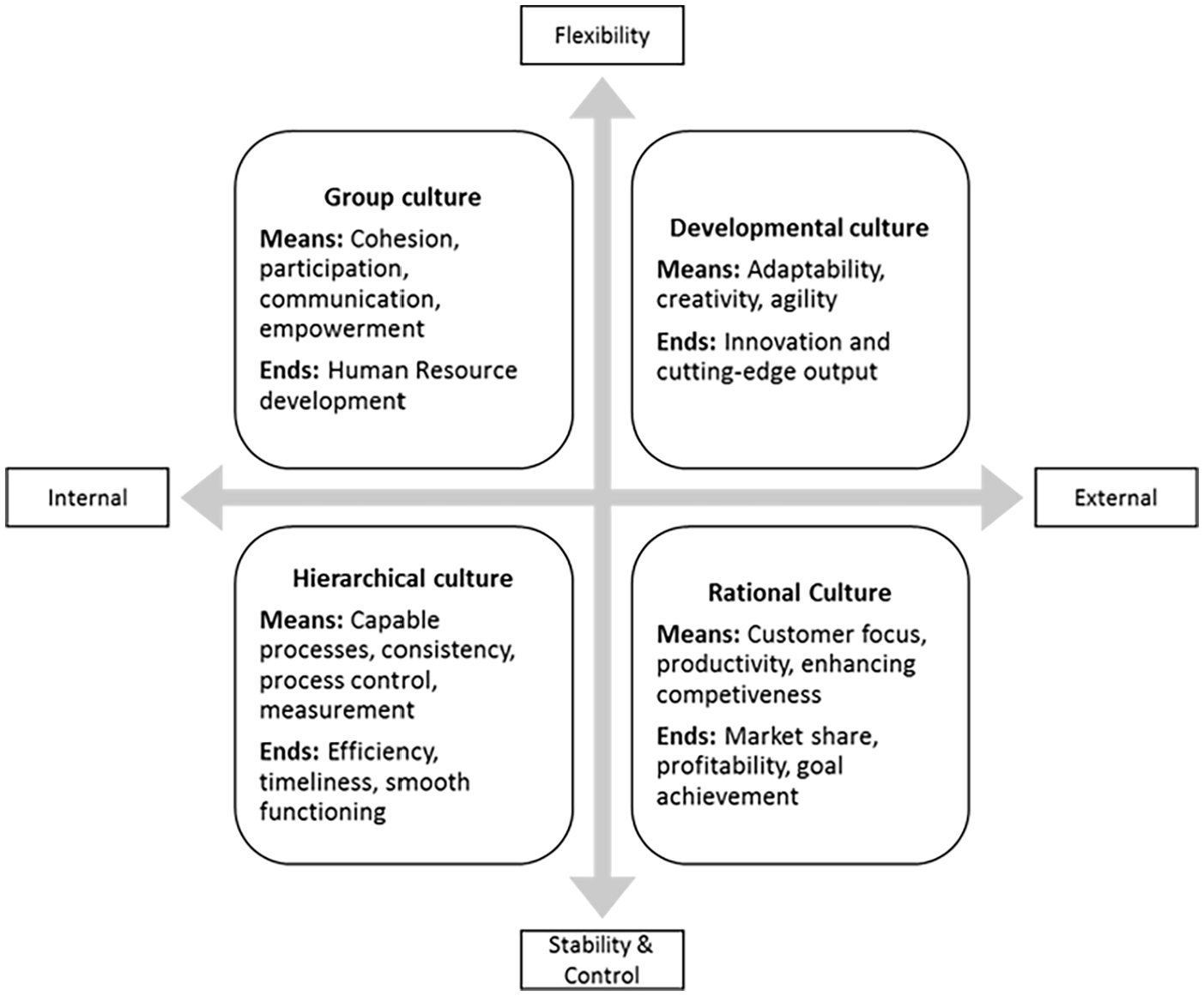
The Competing Values Framework.
In a group culture, the main concern is human relations. The most important goal is to maintain group cohesion. Managers tend to be participative, considerate, and supportive. They will stimulate interaction through teamwork, with the end goal of developing human potential (Hartnell et al., 2011, 2019). Since the focus is on group work and developing human capital, it can be expected that in a group culture, public managers will show more inclusive leadership. At the same time, however, group cultures tend to emphasize cohesion. Public managers then might emphasize collectiveness, which can undermine valuing individual uniqueness.
A developmental culture emphasizes flexibility and change with an external focus. In this type of culture, the focus is on growth, resource acquisition, creativity, and adaptability to the external environment. Managers in such a culture are more likely to be entrepreneurial and willing to take risks and develop a vision for the future. They are more likely to acquire resources and attain visibility, legitimacy, and external support (Cameron & Quinn, 2011; Lavine, 2014; O’Neill et al., 2021). In such a culture, managers may be inclusive and invite different perspectives, as they may be viewed as bolstering creativity. Furthermore, embracing inclusiveness might also contribute to an organization’s legitimacy in terms of being more representative and responsive to external stakeholders. Hence, a developmental culture could be likely to elicit inclusive leadership.
In a rational culture, the emphasis is on productivity, performance, and goal fulfillment. The focus is on the attainment of well-defined goals. In this type of culture, managers are more likely to be directive, goal-oriented, and focused on planning and productivity (Cameron & Quinn, 2011; Hartnell et al., 2011). Such an organizational culture is less likely to be linked to inclusive leadership unless inclusiveness is viewed as a means to enhance productivity or create a market advantage. With an external market orientation, a rational culture may elicit inclusive leadership if utilizing team differences is necessary to meet client needs and by doing so strengthen goal attainment. However, since diversity is only seen as instrumental to an organization’s effectiveness, it might hamper the full inclusion of minority voices in core work practices and decision-making.
A hierarchical culture emphasizes internal efficiency, uniformity, coordination, and evaluation. The focus is on the internal organization, and stability is valued. The overriding value in such a culture is the execution of rules. Managers are more likely to be conservative and cautious; to pay close attention to technical matters and to value control, stability, and efficiency (Cameron & Quinn, 2011; Lavine, 2014; O’Neill et al., 2021). Since the focus is on standardization and control with little room for discussion and the exchange of different perspectives and ideas, public managers are expected to show less inclusive leadership. Showing inclusive leadership means that public managers need to consider employees’ differences in their work practices and include minority voices in decision-making. Furthermore, inclusive leadership might call for changing work practices to enhance inclusiveness. These aspects might hamper efficiency and stability, as standardization is less possible. With centralized decision-making, leaders aim to avoid risks, resulting in little room for minority voices.
The above four types of cultures are ideal types, meaning that organizations are likely to exhibit a combination of cultures that might also have competing demands (Denison & Spreitzer, 1991; Hartnell et al., 2011, 2019). Specifically, in the public sector, multiple and sometimes competing values can play a role (Hood, 1991), generating an ambiguous and complex organizational context for public managers (van der Hoek et al., 2021). It can be expected that organizational cultures emphasizing flexibility, both internal and external (i.e., group and developmental), elicit more inclusive leadership of public managers.
Method
Study Overall
This study aimed to identify determinants of inclusive leadership and used a parallel mixed method study design to collect data. Mixed method studies can have different purposes and designs and are increasingly used by public administration scholars to better understand the complexity of public administration (Hendren et al., 2018; Mele & Belardinelli, 2019). Data collection consisted of two phases: a qualitative explorative phase and a quantitative phase to augment findings from the first phase. Both phases explore how diversity perspectives and organizational context relate to inclusive leadership and complement each other in different ways. The qualitative study involved collecting the experiences of public managers with their organizational context, their personal motives, and their approaches to (inclusive) leadership. Public managers were purposively sampled based on their different roles in their organizations (i.e., director, middle manager, and team manager). Since leadership is defined in the eye of the beholder (Jacobsen & Andersen, 2015), the quantitative data provide more insight into employees’ experiences and enable us to explore the determinants of inclusive leadership that follow from theory. Moreover, the complementary phases allow for refining the findings and for a multilevel understanding of inclusive leadership. The sections below outline the different data collection steps of each phase.
Phase 1: Qualitative Exploration
The first phase included a case study that explored potential determinants of inclusive leadership from the perspective of managers, expected to perform leadership roles. The research reported here was conducted on a set of Dutch central government organizations. Many Dutch public organizations have signed a diversity charter underlining their commitment to support diversity and inclusiveness in their organizations through policies and leadership development. The Dutch public sector is divided into different tiers, such as the central government (including ministries and executive agencies), provinces, municipalities (local government), and water authorities. Using a convenience sampling strategy, the researcher’s network was contacted to reach potential respondents. A research proposal was sent to contact persons in two central government organizations, a ministry and an executive agency, who distributed the survey among the managers in their organizations.
The ministry is a broad organization that deals with the development of policies and legislation of several topics, such as democracy, public administration, personnel management within the central government, and public housing, and includes several executive agencies responsible for implementing developed policies and legislation. Publicly available data collected by the ministry of the Interior and Kingdom Relations provide insights into their workforce. In 2017, 41% of their workforce was female, 13% had a non-Western, non-native Dutch background, and 43% were 50 years or older. Of those in top management positions, 29% were female. These numbers are comparable to those of the Dutch labor force, with the exception that the ministry shows a higher percentage of employees who are older than 50 years (17.4% of the labor force).
The executive agency is responsible for the implementation of policies from another ministry and is involved in maintaining Dutch main road networks and waterway networks and safeguarding the environment. Compared with the ministry studied, the executive agency is more technically focused and regionally organized. Unfortunately, there are no publicly available data on the composition of its workforce.
The selection of these organizational contexts made it possible to explore different organizational factors of the CVF, such as an internal versus external focus and a stability versus flexibility focus. Qualitative data collection made it possible to obtain in-depth insights into managers’ perceptions and interpretations regarding their organizational contexts and assess their individual characteristics. Semi-structured interviews with public managers were used as the main data collection method.
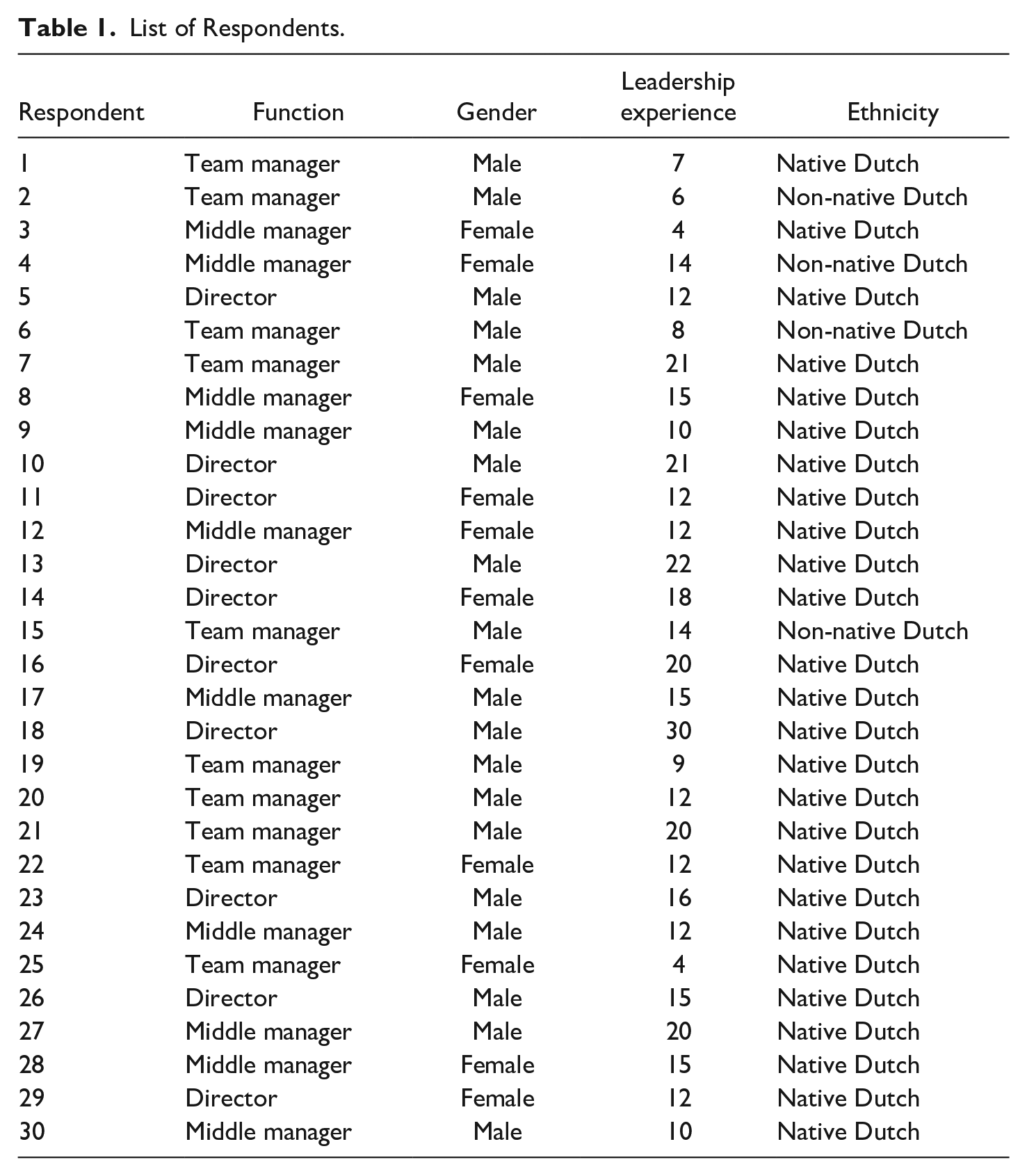
A total of 55 managers replied to be willing to participate in the interview study. To assess antecedents of inclusive leadership on different managerial levels, respondents were purposively selected to equally represent different management levels. This resulted in interviews with team managers (lower level, n = 10), unit managers (midlevel, n = 10), and department heads (top level, n = 10), a total of 30 respondents. Thirteen respondents were female, and their ages ranged between 30 and 60. Only four public managers had a migration background. To ensure the anonymity of the respondents, organizational characteristics, such as their names and specific policy domains, are omitted from the analysis. An overview of respondents is presented in Table 1.
List of Respondents.
All interviews were conducted between February and April 2020, lasted approximately 1 hr, were recorded and transcribed ad verbatim and were analyzed using Atlas.Ti. Five interviews were held via Skype or telephone due to the COVID-19 pandemic and the first lockdown in the Netherlands. The theoretical framework not only guided the semi-structured interviews but also allowed to be flexible and allowed for probing questions when more explanation was needed. The list of the interview questions is included in Appendix A.
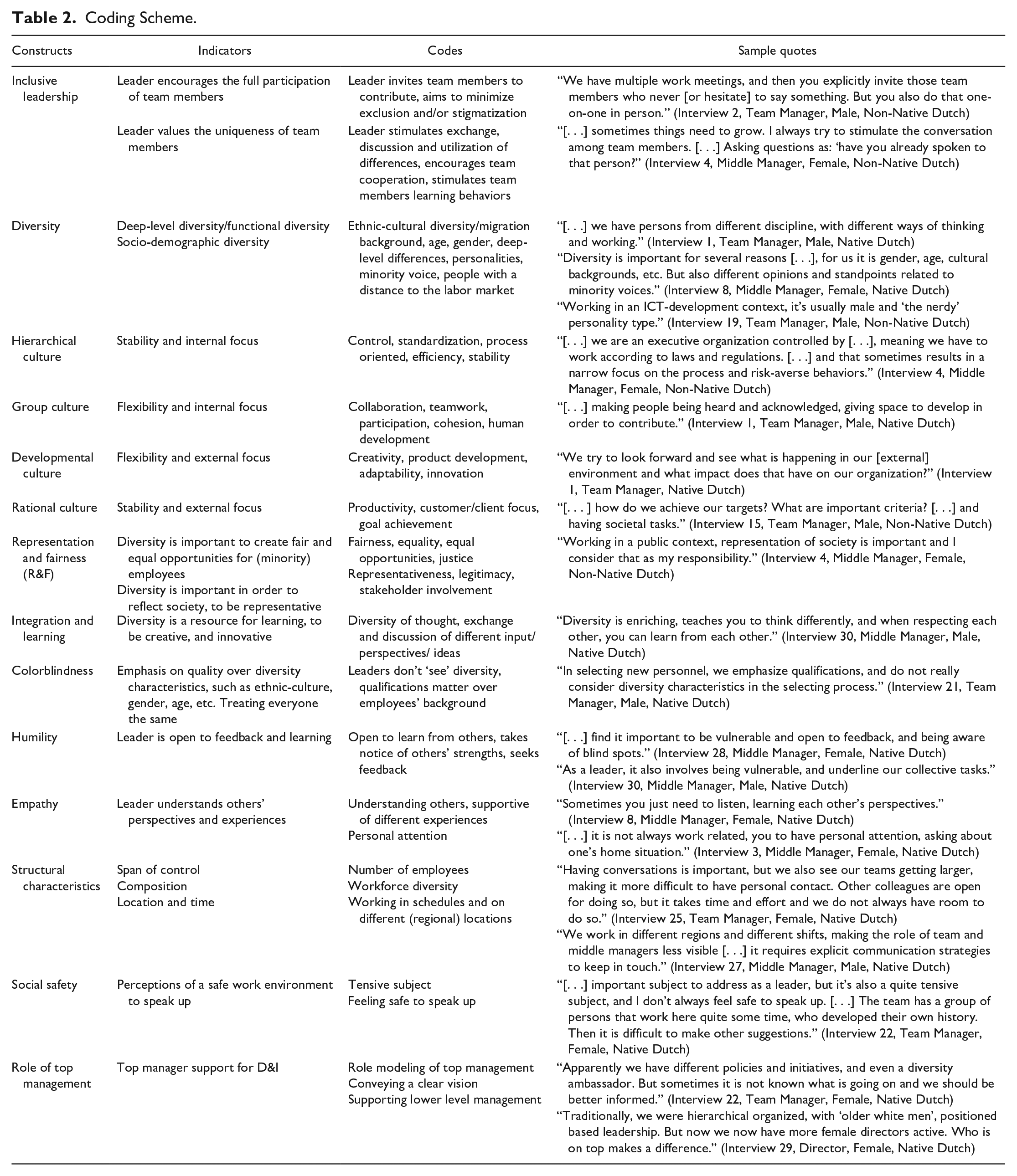
All of the interviews were coded in full, representing both the theoretical concepts and factors that may facilitate or hamper inclusive leadership. Data were open-coded, remaining as close to the data as possible generating a list of codes that were considered relevant for the research question, as well as selectively coded based on the theoretical concepts. In a second step, axial coding linked the different coding categories to the theoretical themes. This was an iterative process, thematically organizing the main codes and sub-codes, following a disassembling and reassembling process (Yin, 2015). Furthermore, rather than quantitatively assess the frequency of codes, the emphasis was to get a better understanding of the potential antecedents of inclusive leadership. The full coding scheme with example quotes is presented in Table 2.
Coding Scheme.
Phase 2: Quantitative Testing
For the quantitative phase, data from an online “Flitspanel” survey of a representative sample of Dutch public sector employees were used. Flitspanel is an online panel that surveys public employees on a range of topics related to work practices, human resource management and leadership and is commissioned by the Ministry of Interior Affairs and Kingdom Relations (Min. BZK). According to Flitspanel, the panel members are a fair representation of the different public sectors in the Netherlands. For this research, it was possible to send the online questionnaire to panel members who work in the public sectors “central government” and “local government/municipalities.” These two sectors combined take up a large percentage of public employees working in the public sector, and made it possible to test our hypotheses on a more representative sample and include employees’ perceptions.
The survey was conducted from June 9 to June 30, 2020. A total of 1,812 panel members were invited to participate in the survey, of which 1.016 responded (response rate 56%), of which 879 were employees (response rate 48.5%). Of these respondents, 37% were female and had an average age of 56.7, and <5% of the respondents reported having a migration background. 1 Compared with publicly available employment statistics, female and ethnic minorities are underrepresented in the sample.
Measurements
Each variable was measured on a 7-point scale ranging from “1: fully disagree” to “7: fully agree.” All variables reflect employees’ perceptions. Inclusive leadership was measured using eight items adapted from a previously validated scale (Ashikali et al., 2021a). Diversity perspectives were measured using seven items adapted from the scale from Podsiadlowski et al. (2013). Although Ely and Thomas (2001) originally distinguished three perspectives, items from the D&F and A&L perspectives were combined into one “R&F” perspective. The CVF and corresponding culture types were measured using 12 adapted items from Helfrich et al. (2007). However, the theoretical model of four culture types did not fit the data. Based on the theoretical dimensions of stability versus flexibility (Cameron & Quinn, 2011; Lavine, 2014; O’Neill et al., 2021), two constructs were computed combing items for hierarchy and rational culture to reflect “Stability” and items for developmental and group culture to reflect “Flexibility.” Leader humility was measured using six items from a validated scale from Owens et al. (2013). The full measurement scales can be found in Appendix B. The analysis is controlled for several employee characteristics, such as age and gender, and the sectors the employees work in. Furthermore, since previous research shows that leadership is partly dependent on leader characteristics (Carli & Eagly, 2001), supervisors’ gender and age were included.
Results
In this section, the results of the qualitative data analysis are presented, starting with a summary of personal antecedents, followed by a discussion of organizational antecedents.
Phase 1: Managers’ Experiences
Inclusive Leadership
Previous research shows that managers’ evaluations of their own leadership tend to be biased and to differ from employees’ perceptions (e.g., Jacobsen & Andersen, 2015). Public managers were, therefore, asked about how they influence and facilitate specific diversity processes (Ashikali et al., 2021a), instead of asking directly about their inclusive leadership. The extent to which public managers showed inclusive leadership varied across organizational levels. In the ministry, public managers often stated that they work with highly educated professionals with considerable autonomy. Given this, public managers did not feel they were responsible for actively managing team diversity processes and that employees were instead responsible themselves for fruitful exchange within their teams (Interview 3; Middle Manager; Interview 13, Director). Most of the managers, at all levels, were not actively involved in communicating the value of diversity and were not always aware of exclusionary processes related to different social identities. A few did, however, actively address diversity and inclusion because of their vision of teamwork (Interview 18, Director), had experienced exclusionary practices themselves or were part of a minority group (i.e., women and ethnic-cultural minorities) (Interview 4, Middle Manager; Interview 11, Director). Public managers showing inclusive leadership, also take notice when voices tend not to be heard, actively invite them to contribute, and stimulate team members to collaborate: We have multiple work meetings, and then you explicitly invite those team members who never [or hesitate] to say something. But you also do that “one-on-one” in person. (Interview 2, Team Manager) [. . .] sometimes things need to grow. I always try to stimulate the conversation among team members. [. . .] Asking questions as: ‘have you already spoken to that person? (Interview 4, Middle Manager)
Diversity Perspectives
The interview data showed multiple motives for valuing diversity. Almost every public manager emphasized working in a public organization, which makes it important to be reflective of society. Working for the public makes diversity and inclusion important topics within their organizational context. Some explicitly stated that diversity was a professional responsibility as a public manager. Being reflective of society can be paired with an R&F perspective. As one public manager stated, it is her supervisory role and responsibility to promote diversity and ensure inclusiveness (Interview 4, Middle Manager).
According to the respondents, public organizations are also model employers, and some managers state that being a model employer is one of the reasons diversity and inclusion are addressed within their organizations and teams. This reasoning, however, was not linked to core work practices. Rather, it emphasized improving the representation of a certain group of employees from a moral/legal imperative ensuring justice and fair treatment, which aligns with an R&F perspective (Ely & Thomas, 2001).
Many public managers state that they do not address cultural diversity per se but report that they view everyone as equal and should be treated as such. A limitation of the R&F perspective is that people adhere to a colorblind view (Ely & Thomas, 2001). Having a colorblind view makes managers less aware of the different social identities people derive from their cultural heritage and how this affects their attitudes and behavior on the work floor. A colorblind view could also reflect a view that people with different cultural backgrounds are considered outsiders instead of insiders in the group. As a result, public managers might be implicitly excluding them while neglecting how this could affect group dynamics.
As expected, public managers who have an I&L perspective indicated showing more inclusive leadership and considering how different people can complement each other in terms of experiences, perspectives, skills, and different backgrounds. Here, it shows that having an I&L perspective may result in leadership that aims to support coworkers and make sure they can fully contribute. One middle manager stated the following: Sometimes you need to go out on a limb and take on someone that from a traditional view would not fit the function profile but brings a different perspective that can make a difference. This person could be someone who brings something unique; discussing how to incorporate these differences is how creativity and inclusion are fostered. (Interview 4, Middle Manager)
One department head was very explicit in expressing such a view of employees. According to him, diversity and inclusion approaches tend to focus on targeting specific groups to help them work and participate in organizational life, which can be stigmatizing. Instead of this approach, he considers the overall tasks and goals the department must achieve and, based on these, selects people who are able to work toward achieving such goals. It is then also the responsibility of the supervisor to support inclusion and motivate diverse team members to fully contribute: We do not approach people because they fit a certain [target] group, but rather based on what difference they could make in a team effort. I also try to transfer this approach to managers within the organization. (Interview 18, Director)
Especially in the case of project teams, public managers emphasize the need to be inclusive of diverse perspectives for effective goal attainment. This motive fits an integration and learning perspective whereby diversity is seen as a resource to improve a team’s performance (Ely & Thomas, 2001). However, including differences in a project team is more linked to having a team composed of team members with different functional backgrounds rather than of cultural backgrounds, as was proposed by Ely and Thomas (2001). In addition to diversity based on more traditional dimensions, such as gender, age and race or ethnicity, public managers often emphasize deeper diversity dimensions such as personality, functional and education differences.
Furthermore, respondents who actively addressed inclusiveness within their teams or departments explicitly stated that they had a team perspective. Supervisors then take all the differences team members bring to work into account and aim to incorporate them into team processes. This approach aligns with an I&L perspective.
Supervisors managing teams that had to deal with external stakeholders, such as citizens, interest groups, private organizations, and other public organizations, in executing their tasks also addressed the need to include differences in work practices (Interviews 1 and 7, Team Managers). However, this was only emphasized as improving their interaction with other stakeholders and better understanding their interests. Some supervisors who worked in a policy department underlined the importance of legitimacy when developing policies that need to be responsive to societal issues (Interviews 14 and 16, Directors). However, a clear link with inclusive leadership could not be found. Only a few supervisors actually reasoned from an R&F perspective, since most of them did not work directly with clients or citizens. Studying how an R&F perspective relates to inclusive leadership could be further examined in public teams that directly interact with clients and/or citizens.
Humility
Being a humble leader entails a willingness to see oneself accurately and show an appreciation for others’ strengths and contributions (Owens et al., 2013). Respondents who expressed humility communicated to their employees that they do not have all the expertise, and they relied on their teams’ combined expertise. Managers underlined that every employee is unique and therefore might need a different approach. Rather than solving their teams’ problems themselves, some managers encouraged team members to first identify a solution themselves and then apply it as a team: Being a supervisor means switching between different coaching roles. I always try to let them really do their work themselves as professionals. As a supervisor, you can come first with the solution, but I think we should do it together. So, I give employees the time to think about their issues and their struggles. In the end, we try to find a solution together as a team. (Interview 1, Team Manager)
Furthermore, respondents expressed that they themselves have blind spots and their own ways of thinking. Public managers emphasized that they learn from different perspectives and need team members’ input to function effectively as a team. Managers clearly communicated to their employees what their strengths are and how they can contribute. Furthermore, these supervisors were also explicit in noting that if they were to recruit a new employee, they would make sure not to select “a clone of themselves” but rather to hire someone with a different perspective that would complement the supervisor and team. They stipulated being open to feedback and diversity of thought. One middle manager explicitly searched for minority voices in her department to include and learn from (Interview 8, Middle Manager). Managers stipulated that they work with professionals, so it is important to give them the room to utilize their skills and experiences. They also considered it their task to further develop their employees.
Empathy
Some managers also mentioned other aspects that played a role. Some (most often female managers) underlined already being open to employees’ diversity and concern for their belongingness because they also experienced a certain degree of exclusion when they had started their roles. For example, one department head who started working for her organization at the age of 24 was one of the few young female employees at the time, and she said she had experienced what it takes to be seen and heard (Interview 8, Middle Manager). Public managers’ previous encounters with inclusion and exclusion enhance their empathy, making them more considerate of employees’ needs with regard to inclusion. Another female middle manager also mentioned that being open to differences matches her personality, as she intrinsically is interested in others and their motivations, and she strives to include those who might differ from the dominant group.
Organizational Antecedents
Organizational Culture
A first take away is that organizational cultures differ immensely within organizations depending on types of tasks involved but also due to the external environment.
As expected, a group culture, in which human potential, participation and teamwork are emphasized, asks public managers to value differences and belongingness. Public managers emphasized that they appreciate personal talent and give employees the room to develop and support their participation. This occurred particularly in project teams that consisted of team members with different functional expertise (e.g., policy development requires expertise from different fields). Teamwork was essential to achieving team goals. However, these teams focused on the need for diversity in functional characteristics, expertise, and experience rather than on social identities that might result from individuals’ sociodemographic backgrounds.
A potential downside of the group culture lies in its focus on team cohesion. Some public managers acknowledged that a more cohesive group has fewer conflicts and therefore requires less intervention in-group dynamics. Maintaining a group culture could also mean that differences might be downplayed to uphold cohesion within the group. Public managers stated that it is difficult to balance needs for uniqueness and belongingness. For highly educated professionals with a high degree of autonomy, public managers indicated that it is their professional responsibility to keep track of group processes and cooperate with others (e.g., also outside their policy domain).
A developmental culture can to some extent also be related to inclusive leadership. Some team managers worked in a developmental culture, using scrum and agile (in an IT domain) as main drivers to examine team composition and the value of different perspectives. Here, aspects such as innovation and development were emphasized. Although this fits with facilitating the uniqueness dimension of inclusive leadership, public managers working from this philosophy did not explicitly engage in inclusive leadership. Teams in this organizational context were more or less self-managed. The way of working already implied a certain degree of cooperation based on team members’ skills and expertise, which required a more supportive role from team managers. These managers were also dealing with a change of culture, from a more hierarchical to a developmental culture. One manager noted the following: We as managers are occupied with facilitating teamwork and removing any hurdles in the scrum process, creating a culture in which team members can develop and evaluate the process afterward. This is sometimes difficult, since developing means making and learning from mistakes, while traditionally we would be more risk avoidant. (Interview 6, Team Manager)
A rational goal culture was present in some departments within the two organizations, especially in the executive agency. Managers addressed societal tasks and the need to engage with different stakeholders as important motivations to embrace diversity and inclusion in their departments or teams. To achieve their goals, a client and stakeholder perspective was necessary, and these managers showed a sense of valuing differences, but more explicitly if it contributed to their responsiveness to external factors. This also corresponds with an A&L perspective (Ely & Thomas, 2001). It can be questioned to what extent managers with this perspective also succeed in facilitating the belongingness of employees.
Almost every public manager (at each level) interviewed experienced a sense of a hierarchical culture in which standardization and formalization and a focus on timeliness and efficiency were present. These aspects made it less possible to facilitate uniqueness, since this would detract from the focus of achieving efficiency in a timely manner. Including different perspectives in the work process requires time and effort, but in the case of crises or when direct action is needed, for example, when a policy brief needs to go to the minister, there is less room to hear all voices and come to better-weighed decision-making.
Decision-making was, in some cases, also more placed at the upper management level. Some managers addressed the procedural constraints they would experience when recruiting new personnel. They had to deal with fixed recruitment procedures and function profiles, which made it difficult to select people who might have a different profile. The inability to change standardized recruitment procedures in turn increased homogeneity in the work force, particularly in the higher management echelons.
In other circumstances, many rules are in place to direct employees’ and supervisors’ behaviors. Rules and procedures were meant to prevent risks and employees from making mistakes. An emphasis on control through rules and procedures can be experienced as a barrier to public managers showing inclusive leadership. As two department heads stated, “the change needed to foster inclusiveness, or a team approach for that matter, is going really slow, because public managers in general are afraid to take risks and make mistakes” (Interview 14, Director; Interview 18, Director). At the same time, however, a middle manager stated the following: [. . .] it impedes having an eye for human aspects of the work. It also depends on managers and how they act on it. However, if you are motivated to make a change, you need to think out of the box; do not be afraid to take risks and change standard processes. If you have a clear vision of what you want to achieve, a lot is possible. (Interview 4, Middle Manager)
This shows that despite the culture, as a manager one can make a change when one is motivated to do so. The middle manager also connects top and lower management and therefore has an important role in communicating between top and lower managers. As one manager stated, “I see it as my responsibility to also see the individual behind all the procedures and take a more human approach” (Interview 4, middle manager).
Public managers reported that they have a good deal of discretionary room and make their own choices. Intrinsically motivated managers may take this opportunity to determine and implement their visions, contributing to inclusive leadership. For lower-level managers, support from their department heads can also help them think outside of the box and change the standard processes needed for inclusive leadership.
Structural Characteristics
An important factor observed from the data relates to structural characteristics that play a role. Across the different cultures (in particular those with a focus on stability), managers listed span of control as an important factor that could be a barrier to inclusive leadership. Some middle managers had to deal with a unit of 30 or more employees. The larger the unit is, the less it is possible to value the uniqueness and belongingness of all employees. In some cases, a lower-level coordinator who could take responsibility for some of these tasks was also absent: Having conversations is important, but we also see our teams getting larger, making it more difficult to have personal contact. Other colleagues are open for doing so, but it takes time and effort and we do not always have room to do so. (Interview 25, Team Manager)
Another structural impediment to inclusiveness concerned working in different locations from the team and working with different time schedules. Some team managers (and middle managers and department heads) were not involved in the daily tasks of the teams they supervised and therefore had limited room to demonstrate inclusive leadership. Managers who had to manage this barrier made sure that they had at least 1 day a week to hold a team meeting (either physically at the office or via an online medium like Skype) to foster a sense of team cohesion. Nevertheless, distance in the workplace remains a barrier, since team managers are not directly able to view the team dynamics needed to foster inclusiveness.
Finally, executive departments of both the ministry and agency were regionally organized. In the Netherlands, each region (i.e., province) has a different composition of citizens and potential labor market, resulting in varying diversity in the work forces of such departments. For example, one department head did not perceive that diversity and inclusiveness were a priority in her department. As she stated, the department is more homogeneous on such matters (referring to cultural diversity and age), but it also serves a more homogeneous clientele. Because of the composition of her unit, the topic was not addressed within her department.
Social safety and top management support. Some managers, particularly in the executive organization, voiced that the lack of feeling safe to speak up makes it difficult to ask questions related to diversity and inclusion. Furthermore, in some teams, public managers had to deal with older employees with long tenures, which made it more difficult to ask for and suggest new insights and ways of working. In these situations, it is helpful when there is top management support, to communicate a shared vision on diversity and inclusion, and change norms and values in the organization toward inclusiveness.
The next section uses insights from phase one to illustrate the effects observed from the employee survey.
Phase 2: Employees’ Perceptions
Analytical Strategy
STATA 13 was used for analyzing the relationships between variable of interest. Confirmatory factor analyses were conducted to examine construct validity and explore potential common method bias. Additional discriminant validity tests using the heterotrait-monotrait ratio of correlations (HTMT; Henseler et al., 2015; Voorhees et al., 2016) were used to examine the constructs inclusive leadership and leader humility. The HTMT is an estimate of correlations between two constructs and an HTMT value smaller than one would indicate discriminate validity. Henseler et al. recommend thresholds of .85 or .90. Using their calculation method, the CR of the two constructs are .94 for inclusive leadership and .96 for leader humility, and the HTMT is .84. Based on these results, it can be concluded that these constructs are reliable and measure theoretically different constructs.
To further test the research model, it was estimated to what extent all research variables load to one factor and compared that model fit to a model with the different factors loading to each theoretical construct. The one-factor model resulted in a poor fit of χ2 = 7,672.739, df = 495, p. 000, root mean square error of approximation (RMSEA) = .128, comparative fit index (CFI) = .644, Tucker–Lewis index (TLI) = .620, standardized root mean square residual (SRMR) = .120 and coefficient of determination (CD) = .973. The model with the different factors loading to each theoretical construct showed a good fit of χ2 = 2,221.829, df = 480, p. 000, RMSEA = .064, CFI = .914, TLI = .905, SRMR = .056 and CD = .1. An acceptable fit of the structural model is assessed using the goodness of fit statistics CFI, TLI, RMSEA, and SRMR, and is achieved when the value of CFI and TLI is >.90, RMSEA is <.08, and SRMR is <.08 (Jackson et al., 2009).
Results
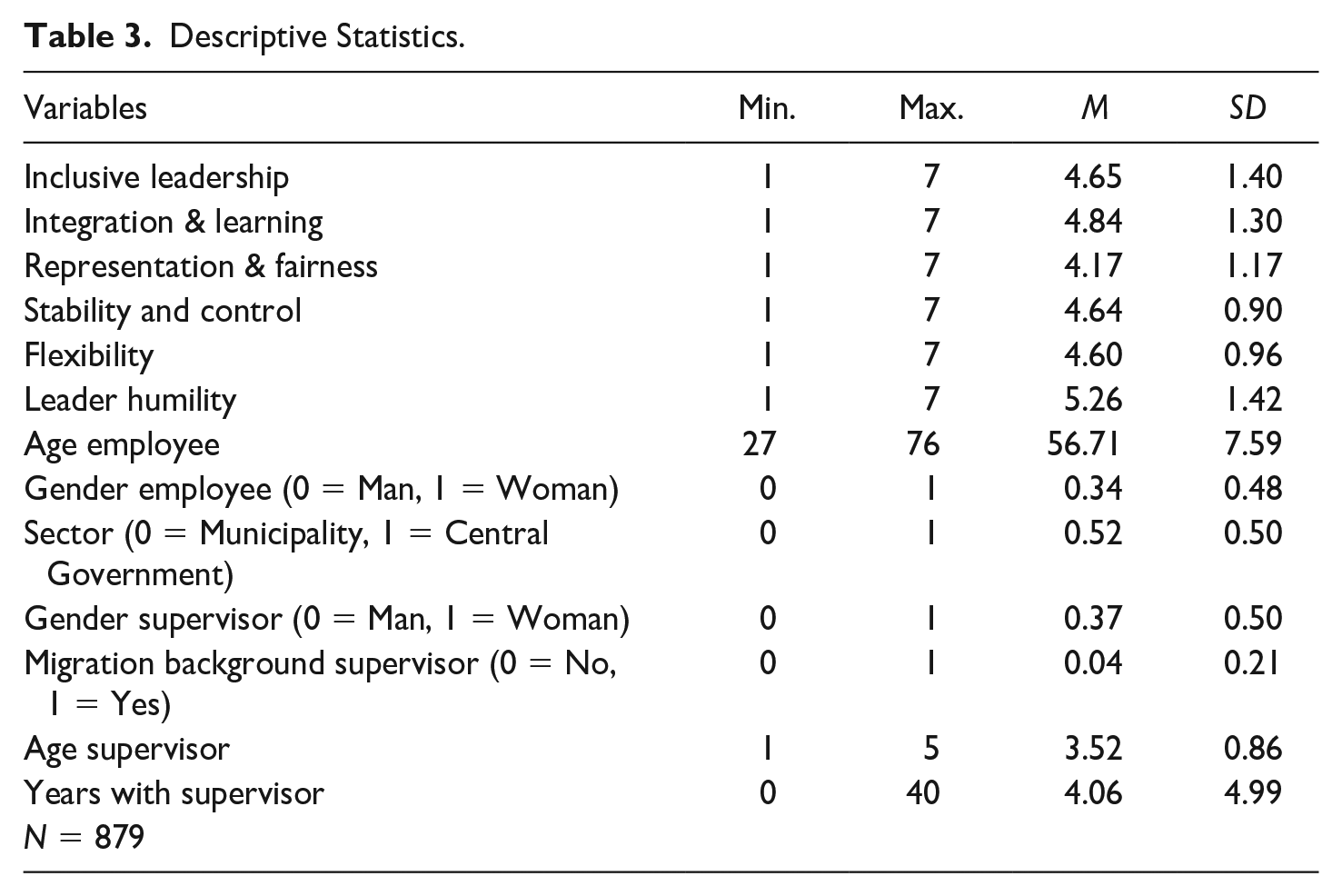
An overview of descriptive statistics, Pearson correlations and CRs can be found in Tables 3 and 4. The correlation analysis indicates that all research variables are positively correlated with inclusive leadership. Of the control variables, only age and supervisors’ gender (female) are statistically significant. This could imply that older employees and employees who have a female supervisor perceive more inclusive leadership than younger employees and those who have a male supervisor.
Descriptive Statistics.
Pearson Correlation and Composite Reliability (CR).
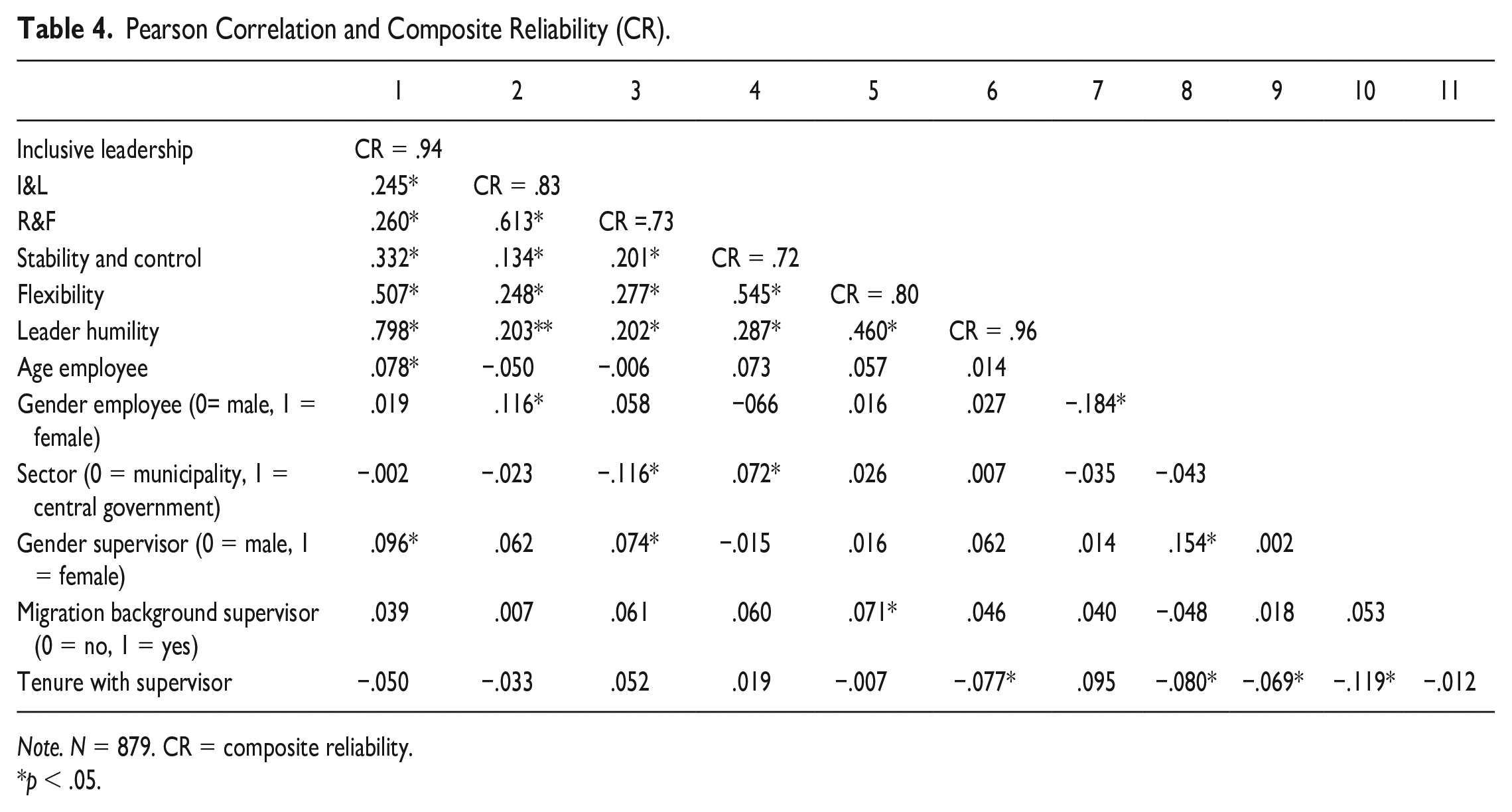
Note. N = 879. CR = composite reliability.
p < .05.
Next, a path model was estimated with inclusive leadership as dependent variable and R&F, I&L, stability, flexibility, and leader humility as independent variables. Figure 2 reports the path model including standardized coefficients. Table 5 shows the model fit statistics. The analysis indicates that leader humility (β = .75, p ≤ .000) and flexibility (β = .17, p ≤ .01) are significantly associated with inclusive leadership. The diversity perspectives are not statistically significant in this model and thus show no support for H1. Next, as expected, when employees perceive their leaders to be humble, they perceive a higher extent of inclusive leadership, which supports H2. Finally, a flexible culture, emphasizing participation and development (group and development culture) is associated with higher perceptions of inclusive leadership supporting H3.
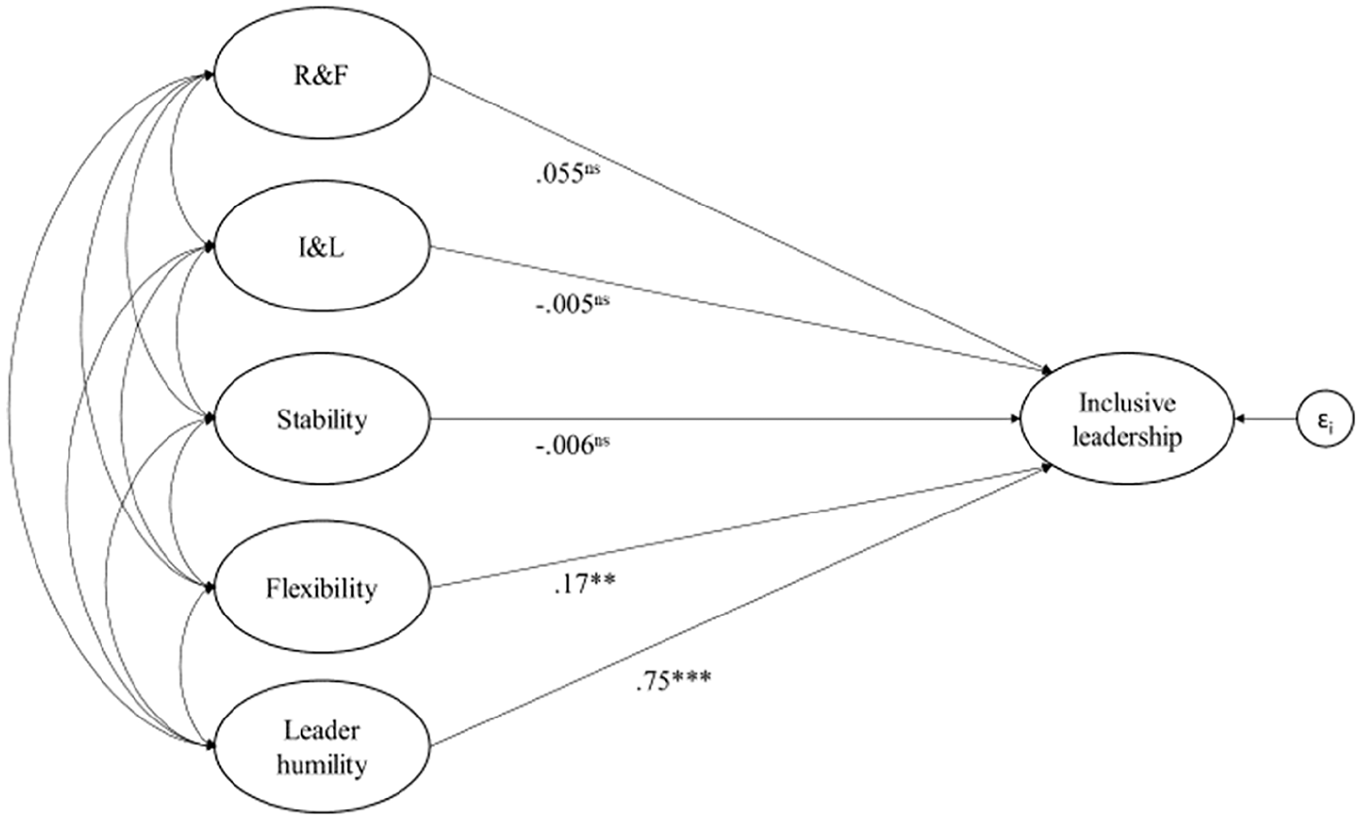
Structural Model With Determinants and Inclusive Leadership
Model Fit Statistics.
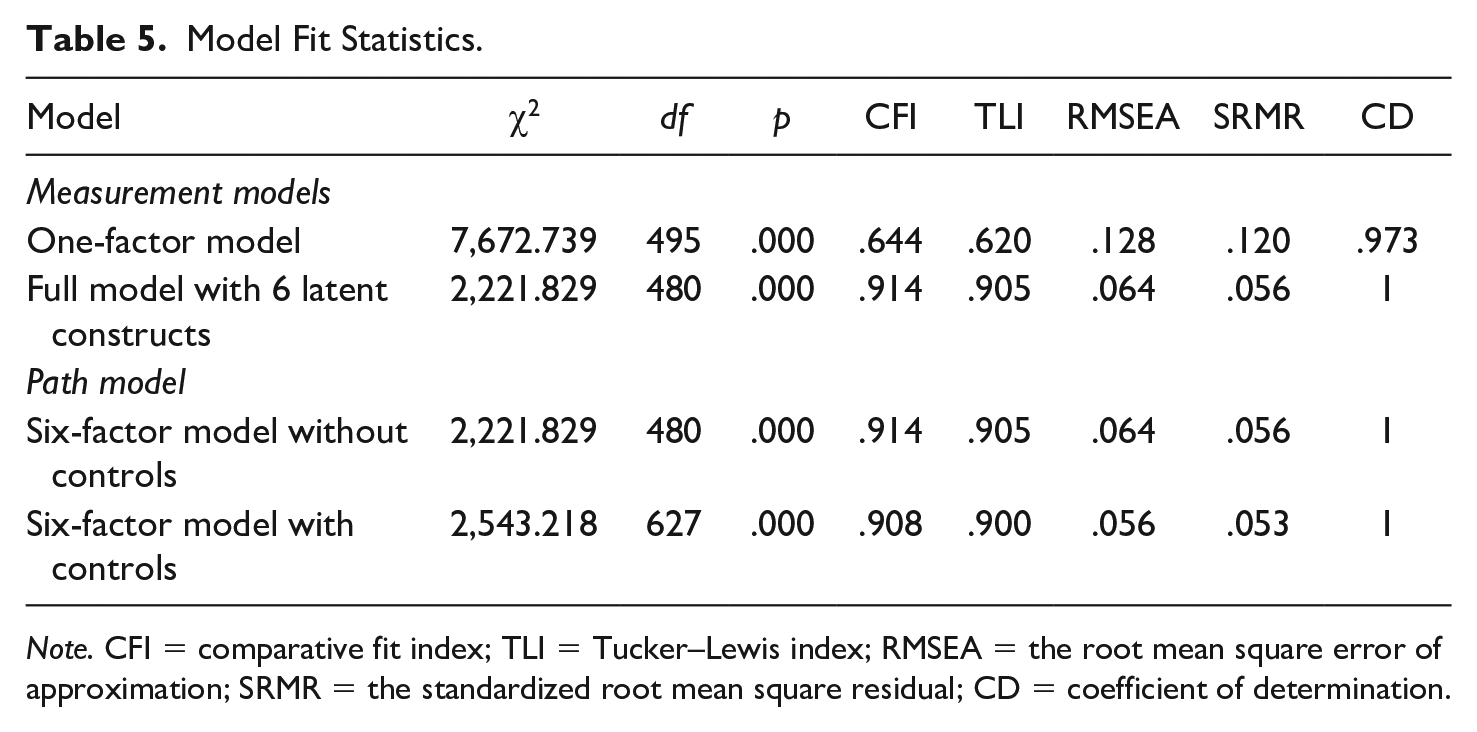
Note. CFI = comparative fit index; TLI = Tucker–Lewis index; RMSEA = the root mean square error of approximation; SRMR = the standardized root mean square residual; CD = coefficient of determination.
Discussion
Using a mixed method approach, this study conducted a case study to explore both public managers’ experiences and survey employees’ perceptions on potential determinants of inclusive leadership. The study gives multiple insights in how both personal and contextual factors relate to inclusive leadership. For instance, public managers are balancing between multiple, and sometimes conflicting, values related to diversity perspectives and organizational culture, as well as structural constraints within their organizations that impact their inclusive leadership. Personal motivations and discretionary space and top management support were used as a buffer to potential constraints. From an employee’s perspective, it is the leaders’ humility and flexibility of the organizational culture that was related to inclusive leadership. This research contributes through identifying both personal and organizational determinants of inclusive leadership in a public sector context (Nishii & Leroy, 2021) and complements previous studies (Fagan et al., 2022; Veli Korkmaz et al., 2022).
Personal antecedents that positively relate to inclusive leadership involve leader humility, empathy and personal experiences of public managers. Humble leaders are more likely to show inclusive leadership, as they are self-aware and considerate of employees’ needs, talents and contributions (Kelemen et al., 2023). The quantitative data support these findings and are in line with propositions accumulated in the diversity literature (Nishii & Leroy, 2021; Randel et al., 2018). However, the qualitative data also indicated that social safety is important both for public managers and employees to address inequities and support inclusive behaviors. This can be linked to the seminal work of Edmondson on psychological safety (Edmondson, 1999). Although psychological safety is shown to be crucial for several team and organizational outcomes (Edmondson & Bransby, 2023), the link between leaders’ own perceptions of safety linked to their inclusive behavior is yet to be uncovered.
The role of organizational context and values on inclusive leadership paints a more complex picture. Public organizations are characterized by a higher degree of competing demands, both from control and accountability mechanisms from society and political authorities (Groeneveld, 2019; Vogel & Masal, 2015). As such, organizations might be more hierarchically structured and public managers’ leadership more risk-averse. The CVF includes several values and tensions resulting in different culture types, which we explored in relation to inclusive leadership. Public managers seemed to experience multiple aspects of the culture types in their organizations. This is also related to the level of public managers. Relatedly, structural constraints also hinder inclusive leadership, such as a high span of control, working on different time shift and locations, as well as homogeneity of the team or department. These aspects hinder public managers to have personal contact with their employees, making it difficult to satisfy needs for uniqueness and belongingness (Shore & Chung, 2022).
The research suggests that a culture emphasizing flexibility and spontaneity (Lavine, 2014) is more likely to induce inclusive leadership, both from a managerial and an employee perspective. Organizations looking to develop inclusive leadership might want to change organizational norms and culture to stimulate inclusive leadership across different levels. Top-level managers are more likely to shape the culture by signaling norms, values and appropriate behaviors (Schein, 2010) and through a trickle-down effect may affect the leadership of lower level managers (Bandura, 1969; Salancik & Pfeffer, 1978). Higher-placed managers have more power and leverage to change organizational cultures and structures to better support middle and team managers’ inclusive leadership.
Managers may also have a great deal of autonomy or discretionary space to navigate, which may result in greater variety in which leadership styles different managers exhibit, even within the same organizational context. This phenomenon is a result of increased managerialism in public organizations (Hood, 1991; Karlsson, 2019). Discretion is often studied from a street-level bureaucracy perspective but may also apply to public managers and their leadership. This might create tensions in contexts with higher politicization, and relatedly more formalization and centralization, and leadership and organizational practices in public organizations (Backhaus et al., 2022; Fuenzalida & Riccucci, 2019; Van Dorp, 2022), which can be studied in future research.
The qualitative data indicated public managers to have multiple motives and drives for diversity and inclusion, and act upon the most salient perspective. Public managers who intrinsically believe in the value of diversity, both from an integration and learning and a social equity perspective, actively aim to foster an inclusive work environment in which diverse individuals are valued for who they are and have the opportunity to contribute. They also explicitly take a team perspective in the sense that a team’s composition, the amount of teamwork needed, and team dynamics are viewed as important to manage as a leader. The quantitative analyses showed some mixed findings, while the perspectives did positively correlate with inclusive leadership, this effect was not significant when including leader humility and flexibility culture.
Limitations as to the study’s research design and measurements require that we interpret the findings prudently. This study applied a case study using a purposive and convenience sampling strategy. The qualitative approach enabled capturing public managers’ perspectives and experiences but was also bounded in its scope. To explore our hypotheses on a larger sample and to include employee perceptions of inclusive leadership (i.e., Jacobsen & Andersen, 2015) a cross-sectional survey method was used. Although we controlled for potential biases and validity of the models, common-method biases are still a concern (Podsakoff et al., 2012). Future research might consider reducing method biases by using different sources for independent and dependent variables, including using a time gap to measure outcomes (Favero & Bullock, 2015; Podsakoff et al., 2012). A multilevel and multi-actor design also aids in common source and method biases that might play a role in collecting perceptual data collected via a single survey (George & Pandey, 2017; Podsakoff et al., 2012). In future research, a multilevel and multi-actor study is needed to obtain a more nuanced analysis of (shared) inclusive leadership and contextual antecedents to better understand the development and outcomes of inclusive leadership. For instance, a daily diary study could be used to study how organizational context and daily work pressure (Ågotnes et al., 2021) relate to inclusive leadership.
This study focused on public managers and employees in a Dutch public sector context, which could question the generalizability of our findings to other countries. The Netherlands has a rich migration history of persons from former colonies as well as migrant workers and their families. Diversity, and ethnic-cultural diversity specifically, is associated with different values compared for instance with race in the U.S. Furthermore, in recent years, attention for diversity and inclusion has increased both politically and societally. Yet, public managers tend to speak about broad dimensions of diversity and not marginalized or underrepresented groups in particular. Although a broad definition of diversity fits with an I&L perspective of diversity, it may underplay social equity related to sociodemographic background and intersectionality (Riccucci & Van Ryzin, 2017). Moreover, employees with a migration background were underrepresented in our sample (despite Flitspanel’s statements on representativeness). Our findings on the relation between diversity perspectives and inclusive leadership might be contextual, in the sense that the Dutch context is often characterized by a colorblind approach to diversity (Ely & Thomas, 2001; Rose, 2022; Stevens et al., 2019). Future research might compare different national context, to examine how inclusive leadership emerges based on the meaning and salience of different diversity dimensions and related values.
Conclusion
This research examined personal and organizational determinants related to inclusive leadership in public sector organizations. Above all, leaders’ humility determines their inclusive leadership followed by a flexible culture. Public managers tend to have multiple motives and drives explaining their inclusive leadership, both based on social justice case and business case arguments. A strong belief in the value of diversity can also motivate public managers paired with discretionary room to cope with structural and cultural constrains that might result from a culture emphasizing rules, procedures, and control. Top management support plays an important role to change organizational culture and norms, motivating and stimulating middle and lower managers to actively show inclusive leadership.
Supplemental Material
sj-docx-1-ppm-10.1177_00910260231180286 – Supplemental material for Unraveling Determinants of Inclusive Leadership in Public Organizations
Supplemental material, sj-docx-1-ppm-10.1177_00910260231180286 for Unraveling Determinants of Inclusive Leadership in Public Organizations by Tanachia Ashikali in Public Personnel Management
Footnotes
Declaration of Conflicting Interests
The author(s) declared no potential conflicts of interest with respect to the research, authorship, and/or publication of this article.
Funding
The author(s) disclosed receipt of the following financial support for the research, authorship, and/or publication of this article: This research was funded by the Leiden University Fund under Grant W19369-7-01.

Supplemental Material
Supplemental material for this article is available online.
1.
In the Netherlands, ethnic-cultural background is referred to as migration background: A person who was born abroad or with at least one parent who was born abroad. This criterion was used in the survey by asking respondents to indicate whether they and/or one of their parents were born abroad.
Author Biography
References
Supplementary Material
Please find the following supplemental material available below.
For Open Access articles published under a Creative Commons License, all supplemental material carries the same license as the article it is associated with.
For non-Open Access articles published, all supplemental material carries a non-exclusive license, and permission requests for re-use of supplemental material or any part of supplemental material shall be sent directly to the copyright owner as specified in the copyright notice associated with the article.
