




Abstract
Most of our knowledge of the benefits and costs of telework are based on self-selected workers who have worked remotely part-time. Full-time, pandemic-induced mass telework may present benefits and costs that differ from what was understood in the prior context. Informed by conservation of resources (COR) theory, this study examines the effect of pandemic-induced remote working on work alienation in the public sector with two Canadian surveys: a panel of teleworking public servants (n = 605), and a representative sample of teleworking Canadians in public and private sectors (n = 1001). Teleworkers who fit the “conscientious” personality profile were less alienated in their new teleworker status, and by contrast “extroverts” were more alienated than before the pandemic. We then examine the types of organizational adaptations that lower alienation, and find that more autonomy, avoiding micromanagement and promoting communication among employees is most promising.
Introduction
Work alienation has long been a focus of organizational theorists, sociologists, and psychologists, given its potentially corrosive effects on productivity, organizational culture, and personal well-being. Defined concisely, work alienation is the estrangement or disconnection from work, the context, or self (Nair & Vohra, 2009) and is understood as an experience beyond merely job dissatisfaction and one especially contingent on working conditions (Watson, 2003). As such, in the context of the COVID-19 pandemic—a dramatic upheaval in working conditions toward mass forced telework—work alienation is a critical phenomenon to investigate. The predictors and causes of work alienation in normal times are well understood, not only in terms of its effects if left unchecked—including high turnover intention (O’Donnell et al., 2010; Orhan et al., 2016), diminished team work (Itani et al., 2019), lower motivation for change (Liston-Heyes & Juillet, 2019), and even deviant behavior (Mangles et al., 2016)—but also how management can mitigate against alienation and disengagement through workplace adaptations, policies, and programming (Charalampous et al., 2019).
Yet the past couple of years have not been normal times, particularly in professional office environments which rushed into mass forced telework with the onset of the COVID-19 pandemic (and which look likely to retain various elements of mass telework going forward). It is particularly useful to study work alienation in this context because much of the telework literature is based on voluntary participation in it, typically by those self-selecting into it as part of a niche program in an organization. In the pandemic, by contrast, the professional office environment changed dramatically for everyone virtually overnight, in what has been characterized as “the world’s largest work-from-home experiment” (Banjo et al., 2020), and various public surveys across countries have documented the struggles faced by many. This is especially important for public sector professionals and organizations which, by the very nature of the public health crisis, were called upon to make critical policy and programmatic decisions in short order in the context of significant domestic and global uncertainty.
One recent public opinion survey in Canada found that 40% of remote workers are been experiencing more stress and nearly 50% are feeling less engaged with their work since the shift (Dunham, 2021). At the same time, there are data that suggest for some that mass forced telework has come with certain benefits like reduced commutes, higher productivity, and better work–life balance. Nearly 50% of British Columbian respondents in a separate survey claimed they would leave their current job if the organization did not allow them to continue to telework as often as they want (Canseco, 2021). Early academic evidence from diverse work environments in the context of the COVID-19 pandemic suggests variable experiences with telework with respect to productivity, team cohesion, and job satisfaction (Fominykh, 2020; Jeong & Henderson, 2020).
It is therefore clear that mass forced telework has had a differential impact on employees based on public surveys, media reporting, and the early scholarly research, likely dependent on the nature of their work, dimensions of their personality, and the network of resources they draw on to manage work life. Prior academic work on telework by Cooper and Kurland (2002) noted that professional isolation stemming from telework depends on the degree to which individual employees miss informal development activities like networking or mentoring, signaling differential personality profiles as important to understanding the effects of pandemic-induced telework when whole organizations are thrust into this space. The pandemic threatened the kinds of resources that many employees draw on to engage and succeed in their work lives, as personal, relational, and job-related elements associated with in-person work settings became mostly digital. This article thus asks the following question: How are the effects of mass telework on work alienation conditioned by the personal resources of employees and organizational adaptations to work arrangements? This research connects to the personal resources (ie. self-efficacy, sense of optimism, etc.) and job-related resources (ie. job autonomy, organizational adaptations, etc.) identified in conservation of resources (COR) theory as critical elements in organizations’ efforts to reduce resource loss cycles in situations of uncertainty and change.
This study begins by reviewing the literature on telework in prepandemic conditions, exploring the arguments and evidence for its advantages and disadvantages for employees and managers, in both the public and private sectors. Following that we review studies associated with COR theory, which when applied to employment conditions conceptualizes the dynamics of stress and strain on work life in situations of uncertainty, to inform pandemic-induced mass telework analysis. We then introduce our empirical strategy of two surveys of teleworking Canadians in public and private sectors that aim to identify and isolate the effects of pandemic-induced telework on work alienation. Our analytical interest is in public sector workers, but we examine private sector workers in parallel to parse what is common for all teleworkers, and what is more specific to the public sector. We find that work alienation is contingent on one’s job autonomy and personal resources, and that particular organizational adaptations are associated with lower alienation, which is closely linked with an organization’s ability to continue to deliver on its core functions and services. The concluding section reflects on the implications of these findings for public human resources management in an anticipated future of hybrid work.
Previous Research
Telework
Telework has been around for about 50 years, preceding widespread computer-based technology that makes it comparatively easy today. Simply defined, telework refers to completing work duties away from the traditional office (Bailey & Kurland, 2002). It was initially viewed as conferring a number of individual and organizational benefits. At the organizational level, early work suggested that fewer full-time workers in offices could offer the possibility of reducing real-estate costs (Egan, 1997), enhancing public servants’ productivity (Schmidt & Duenas, 2002), and bolstering employee recruitment and retention (Caillier, 2016; Gordon, 1990; Kwon & Jeon, 2020). At the individual level, many hypothesized that workers would report higher job satisfaction (Allen et al., 2015), especially female federal workers (Bae & Kim, 2016), higher worker well-being due to flexibility that the arrangement offers (Hill et al., 1998), and reduced commute times (Pinsonneault & Boisvert, 2001). Subsequent research has challenged many of these purported benefits.
At the organizational level, the preponderance of studies that aim to measure the productivity of teleworkers relies on self-reported data, which likely carries various conflations in terms of time worked and biases that are difficult to isolate (Bailey & Kurland, 2002), even with the role of supervisors factored by Kim et al. (2021). Similarly, subsequent research has found no strong causal link between telework opportunities and employee recruitment and retention (Caillier, 2016). At the individual level, voluntary prepandemic teleworking was not unambiguously associated with higher job satisfaction (Caillier, 2016; Kim & Lee, 2020), even if such workers enjoy reduced commute times. The flexibility that comes with teleworking is not always a balm for work–life imbalances but can in fact fuse work and life in negative ways (Lee & Hong, 2011). Thus, while some research has found that telework can improve worker well-being (Anderson et al., 2015), others have found that it can hurt employees if they perceive little personal control over their situation (Kossek et al., 2009).
The ambiguous findings about telework’s effects emerge because there are observed “costs” associated with any benefits that may be realized. Such costs may include social and professional isolation, and concern about career advancement at the employee level, and a potential loss of control at the managerial level (Harris, 2003). Previous studies of telework generally involve those employees who have sought out remote working conditions and measure their effects on performance, career advancement, team morale, and so on (Bae & Kim, 2016; Charalampous et al., 2019; Lee & Kim, 2018). Cooper and Kurland (2002) studied both private and public sector teleworkers in the U.S. prepandemic and found that professional isolation among teleworkers was closely linked to employee development activities (such as interpersonal networking, informal learning, and mentoring), with those in the public sector valuing such informal developmental activities less, and thus reporting less professional isolation in teleworking than private sector counterparts.
The rare studies prepandemic that involve forced telework organization-wide—such as a study from one large company that converted the entire firm to remote work—half of employees would return to the office if permitted, citing feelings of isolation, loneliness, and depression from working from home (Bloom et al., 2015). This suggests that there are many unknowns and possibly unique dynamics that emerge when examining telework at a mass scale. The extant research is confronted by the dramatically different context of mass forced telework today. B. Wang et al. (2021) found that mass telework contributed to loneliness due to fewer face-to-face interactions with colleagues and supervisors, and information and communication technology (ICT)-enabled interactions tended to be task-focused without providing the psychological need for belongingness. With the onset of the COVID-19 pandemic, large swaths of the public services of whole nations—a sector traditionally less eager to embrace telework—were thrust into telework conditions in a short period of time, with uncertain effects in terms of employee resilience.
Work Alienation
A major risk associated with forced telework, in addition to all that it may impose on employees’ personal life, is heightened feelings of alienation from work as conventional elements of office life vanish (Fominykh, 2020; Jeong & Henderson, 2020). The community and dynamics of office life, with planned and improvised opportunities for interaction and collaboration, as well as mentorship and supervision, is significantly transformed (and likely reduced) with organization-wide telework.
There is some ambiguity around the concept of alienation as it relates to work, variously referred to as a lack of control over work, isolation, or estrangement (Hirschfeld & Field, 2000). Nair and Vohra (2009) concisely define work alienation as the estrangement or disconnection from work, the context or self. Watson (2003) stresses that alienation can be especially contingent on working conditions, which given the major changes in this regard during (and beyond) the pandemic, work alienation is a particularly relevant concept to investigate. There are various alternative concepts used in the literature that appear connected to work alienation, such as job dissatisfaction, low job commitment, job stress, burnout, as either synonyms, antecedents, or consequences. However, work alienation cannot be fully accounted for by these concepts. For example, one can suffer from work alienation, which captures a separation or estrangement from work, yet still be either satisfied or dissatisfied with their particular job (Korman et al., 1981).
As Nair and Vohra (2012) argue, work alienation is an experience that can overlap with other conditions like job dissatisfaction, low commitment, and disengagement, but it is a heightened state of negative affect and carries with it unique beliefs about “the uselessness of work and sense of being pained” (29) and “unmet aspirations from work” (31) (Nair & Vohra, 2012). Key antecedents to work alienation identified in the literature are a lack of autonomy and meaningful work—which are distinct from common antecedents for dissatisfaction, commitment, and engagement—and concepts like burnout and workplace deviance (and even sabotage) are properly viewed as unique consequences of work alienation. Therefore, work alienation is a particularly important concept to measure in the pandemic context, and especially so within the public service, given the weighty consequences of alienation in a time when government response is most acutely relied upon.
With the importance of work alienation articulated, and the unique threat of it being exacerbated by sudden mass telework presented by the pandemic established, recall that we are motivated to answer the following research question: How are the effects of mass telework on work alienation conditioned by the personal resources of employees and organizational adaptations to work arrangements? We turn to the COR theory to provide a theoretical framework to guide the empirical investigation of this phenomenon in Canada.
COR Theory
While there were few alternatives to forcing remote work on large number of employees, given the nature of the public health crisis of COVID-19, there was considerable uncertainty regarding how such a dramatic shift to remote work in the private and public sectors would affect individuals and organizations. Yet the COR theory, developed by Hobfoll (1989), articulates how occupational stress and strain can frame empirical investigation of the COVID-19 pandemic as it relates to telework. The main precept of COR is that the constellation of resources—personal, relational, and job-related—held or accessed by employees is related to their resilience and engagement with work. Personal resources range from the skills and personality traits of the employee (such as self-efficacy and optimism), relational resources include social support from family, friends, colleagues and supervisors, and job-related resources encompass various organizational supports like job autonomy, performance feedback, and rewards from supervisors as well as programmatic interventions and organizational adaptations like training opportunities and flexible work arrangements (Ojo et al., 2021).
An important insight from the theory is that the loss—real or perceived—of resources is more salient than their gain, and that loss can beget loss, manifesting as vicious cycles that may feed burnout, reduced productivity, and interpersonal conflicts, among others (Ojo et al., 2021; Shirom, 2003)—all viewed as consequences of work alienation (Nair & Vohra, 2012). Yet considerable empirical research has discovered that organizations can mitigate against work alienation through proactive provision of various resources (Chang et al., 2021), including social supports (Leiter, 1993), targeted support by supervisors (Fletcher & Sarkar, 2013), and ongoing training programs (C. Wang et al., 2020).
COR theory thus lends a useful theoretical framework to study occupational stress and strain in situations of uncertainty and change, which the COVID-19 pandemic introduced to a pronounced degree. As mentioned, personal resources range from the skills and personality traits of the employee (such as self-efficacy and optimism), and are a key pillar of resilience and engagement with work in studies of traditional working conditions. Yet organizational shocks—such as those induced by the pandemic—and adaptations to those shocks are not expected to affect all employees similarly with respect to alienation, as individuals have various personality traits that may shape how they react and respond to change. Well-established in the psychology literature is the Five-Factor Model (FFM) of personality, commonly referred as the Big 5, which is a framework for differentiating major individual variation in personality (McCrae, 2011). As described by Cooper (2020, p. 65), the Big 5 are categorized as agreeableness, conscientiousness, extraversion, neuroticism, and openness, and are defined in the following way: Agreeableness refers to “the extent to which one is trusting and helpful or suspicious and uncooperative” (Ewen, 2010, p. 281). Conscientiousness is “the extent to which one is hardworking and reliable or lazy, unreliable, and careless” (p. 281). Extraversion focuses on how “social and outgoing or more aloof, retiring, reserved, and introspective” one is (p. 281). Neuroticism refers to “the extent to which one is nervous and insecure as opposed to calm and secure” (p. 281). Finally, Openness to New Experiences is “the extent to which one is creative and nonconformist or conventional and down-to-earth” (p. 281). (Cooper, 2020, p. 65)
Public management researchers have fruitfully drawn on the FFM to examine work-related variables such as job satisfaction and performance (Judge et al., 2002) and to differentiate decision-making patterns among public servants (Filiz & Battaglio, 2017). Judge et al. (2002) find in a meta-analysis of studies in this realm that the five factors as a group were significant predictors of job satisfaction across multiple independent occupational samples, with extraversion and neuroticism being the most consistent findings across all groups. Given the empirical associations discovered between the FFM and job satisfaction, we anticipate discovering relationships between the five factors and work alienation, a related but distinct concept. In the context of pandemic-induced mass telework, there are important opportunities to contribute to this literature on FFM and employee adjustment (see also Sahai et al., 2020). On this basis, we advance the following descriptive hypothesis as it relates to personal resources and work alienation:
COR theory also suggests that job-related resources are an important well from which employees draw resilience, or by contrast in their absence or loss contribute to alienation. Job-related resources encompass various organizational supports like job autonomy, performance feedback, and rewards from supervisors as well as programmatic interventions like training opportunities and flexible work arrangements (Kwon & Jeon, 2020; Ojo et al., 2021). We find it important to hone in on job autonomy, given that autonomy is a basic psychological need and occupies a central place in the public service motivation (PSM) literature (Perry & Wise, 1990). Brey (1999) argues that worker autonomy is related to “the control that workers have over their own work situation” (p. 15), which can include the pace of work, working hours, scheduling, work criteria and goals, and how they are evaluated, among others. Some workers simply have more autonomy in their job due to its nature, whereas others are more directly supervised and steered on a daily basis. Dutcher (2012) shows that telework’s productive effect predominantly exists among workers performing creative tasks with considerable discretion, whereas it is counter-productive for workers dealing with dull tasks for which there is less autonomy. Deole et al. (2021), studying the COVID-19 lockdown in the United Kingdom, found that employees with higher autonomy over job tasks and their hours worked longer hours when working from home. Yet B. Wang et al. (2021) found that remote workers’ well-being in the pandemic benefits from job autonomy, as those with higher job autonomy claim they can balance work and rest and choose the most productive ways to do their work.
COR theory also identifies job-related resources connected to management practices, which can include communication, performance feedback, organizational training, and employee development programs, as resources from which employees build resilience, or alternatively in their absence or misalignment contribute to work alienation (Ojo et al., 2021). Charalampous et al. (2019) conducted a systematic review of studies of teleworkers’ well-being at work, and find that organizational culture and environment can play a pivotal role in remote workers’ well-being. Kodz et al. (2002), for example, identify organizational cultures that are less compatible with telework, and whose lack of flexibility is signified within the organization by unsupportive attitudes, behaviors of managers and colleagues, and a tendency for working long office hours. The presence of professional isolation and its relationship to lack of trust was noted in prepandemic telework research to result in ineffective teleworking conditions (Taskin & Edwards, 2007), particularly for public servants (de Vries et al., 2019); professional isolation has stood out as a strong and significantly negative impact on telework adjustment in studies since in the pandemic (Carillo et al., 2021).
A dramatic shift to mass telework in a pandemic therefore may result in various management and supervision choices that effect worker adjustment and experience. Although the barriers to mass telework collapsed out of necessity with the onset of the pandemic, previous institutional cultures and managerial attitudes may linger in this context, shaping how the workplace is governed and supervised (Williamson et al., 2020). Organizations may choose to use technology to engage in more “direct” forms of control and supervision (e.g., monitoring software on computers) which may be more heavy-handed than previous supervisory practices in the office environment, whereas other organizations may choose more “indirect” controls of incentives or flexibility performance evaluation metrics that create more autonomy in their work than before (Clear & Dickson, 2005). Bulińska-Stangrecka and Bagieńska (2021) report that interpersonal trust in colleagues and managers mediates the relationship between employee relations and job satisfaction in remote work during the pandemic. Interestingly, pandemic teleworkers in B. Wang et al.’ (2021) study noted that ICT monitoring by supervisors in this context was not inherently negative; to many, monitoring can help them to cope with procrastination and to concentrate on their core tasks.
Emerging from Charalampous et al.’s (2019) systematic review are seven key implications for practice for management in organizations using telework that can be tested in a mass forced telework context precipitated by the COVID-19 pandemic: (a) granting autonomy to individuals and avoiding micromanagement, (b) conveying a sense of trust in employees to appropriately conduct their work duties at home, (c) creating social support networks among employees, (d) establishing good communication channels for task interdependence, (e) promoting flexibility around work time, (f) coordinating online work activities, and (g) providing information about career mentoring and development (Charalampous et al., 2019). That is, we are presented with a unique opportunity with mass forced telework to examine if the presence of these specific organizational adaptations that constitute best practices for telework individually or collectively constitute job-related resources that can mitigate against work alienation since the onset of the pandemic with H2 below. We pair this interest in the adoption of best practices with our contention that workers respond differently to work conditions by personality traits, and thus advance H3 as it relates to best practices and work alienation:
Hypothesis 2 (H2): The more organizational adaptation best practices in place in their work unit will be associated with lower alienation for employees.
Hypothesis 3 (H3): Organizational adaptation best practices in place since the shift to mass telework will be associated with less alienation among employees with low and high autonomy, conditional on personality traits.
Pandemic-induced telework, as described by Carillo et al. (2021), is quite a different context from voluntary engagement with telework in the past, one that has exposed many more people to its effects and dynamics at the organizational level, and offers a unique opportunity to examine work alienation as it relates to telework across various employee personality types and organizations that might have never pursued telework absent these circumstances. Gaining more nuanced insight into how organizational adaptations intersect with employee personality types to shape work alienation will be important for managing what many expect to be a sustained teleworking future after the acute public health emergency subsides.
Data
To answer the main research question and hypotheses above, we devised and distributed two surveys in a Canadian context: (a) a sample of a panel of public servants the authors created and manage (n = 605 of 1,076 in the panel at that time) and (b) a representative sample of Canadians in public and private sectors with the help of survey sampling company Luc.Id (n = 1,001), both available in French or English, Canada’s two official languages. The representative sample of Canadians enhances the external validity of the analysis and thus strengthens the real-world applicability of the findings. The panel of public servants enables us to oversample public servants, especially analysts and professionals, who are prime candidates for extensive telework after the pandemic, but are a smaller share of the broader work population.
The first survey sample of public servants was launched in October 2020, asking questions rooted in the literature about their prepandemic experience with telework, their current teleworking situation, as well as work alienation (Nair & Vohra, 2009), job autonomy (Tummers et al., 2018), and the best practices for organizational adaptations to telework used in their workplace since the pandemic (Charalampous et al., 2019). The scale developed by Nair and Vohra is used in prior research on work alienation, including one on the link between explorative and exploitative learning and emotional exhaustion in 225 manager–employee dyads in private sector firms (Khan et al., 2019, p. 935). Respondents were also asked to complete a 10-Item Personality Inventory (Gosling et al., 2003) consistent with the FFM.
The second sample collected in December 2020 was a representative survey of Canadians in both public and private sectors who currently work remotely at least some of the time. That survey contained virtually all the same questions as the first, with one important change: for the questions on work alienation and job autonomy, we asked these respondents to answer through a prepandemic frame of mind and their current pandemic frame of mind, as well as two questions about nostalgic orientation and future optimism for analytical control. This modified second survey thus has data elements that can be merged with the first study to engage in public versus private sector comparisons, but also contains elements that can identify and isolate the temporal marginal effects of pandemic-induced telework on questions of alienation.
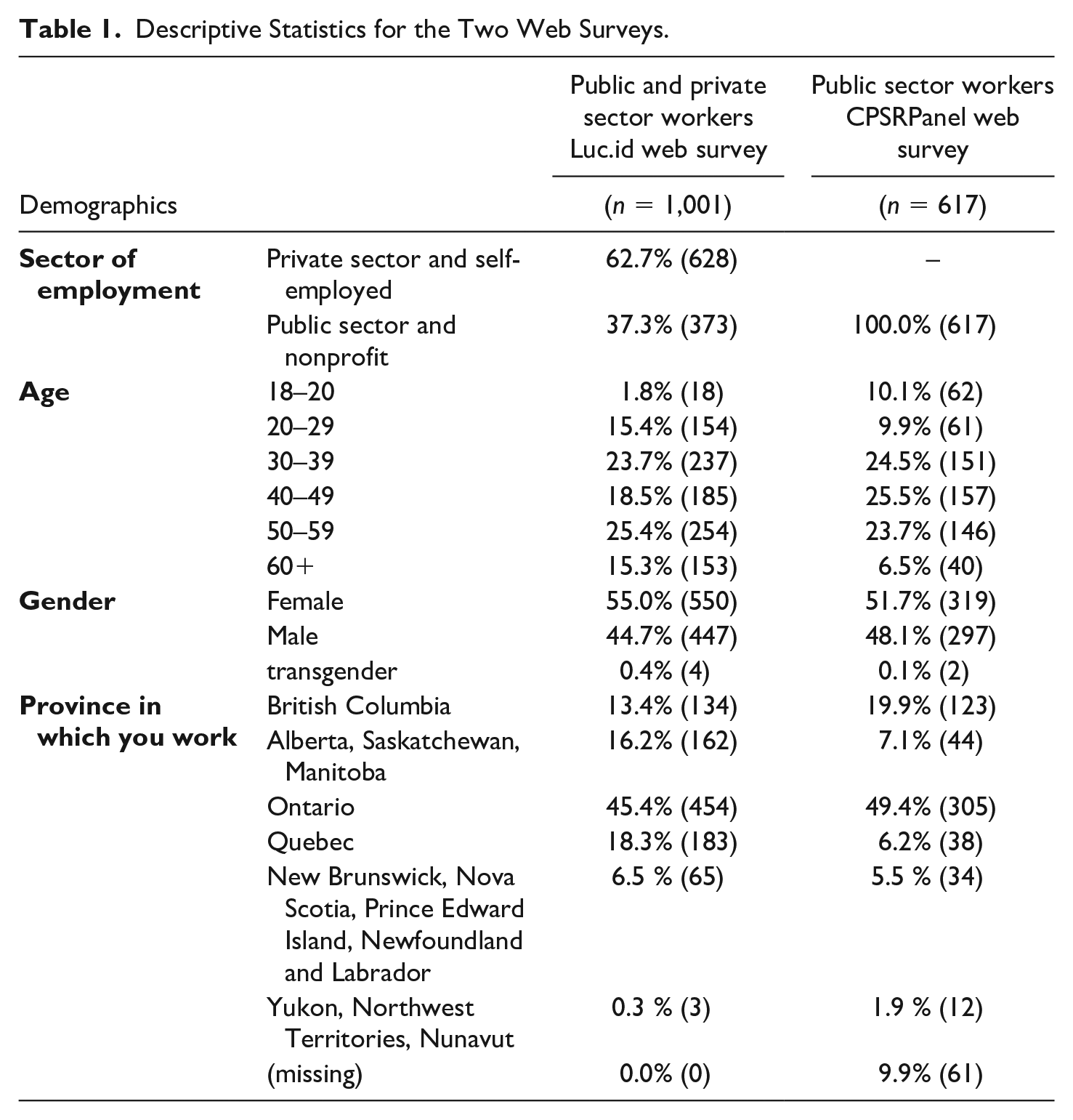
Descriptive data from both of the samples reveal a diverse set of respondents on key dimensions, including on experience with telework prior to the pandemic. These data and other sample demographics are reported in Table 1.
Descriptive Statistics for the Two Web Surveys.
The main dependent variable in this study is work alienation, as measured by a battery of seven questions used by Nair and Vohra (2009) (all measures used in this study are described in the online Appendix). Recall that we are primarily interested in identifying the constellation of resources that influence work alienation in the context of the forced telework. Prior research indicates that job autonomy is a critical resource in the work environment, with greater alienation associated with lower job autonomy (Bulińska-Stangrecka & Bagieńska, 2021; Deole et al., 2021). We measure job autonomy from the scale used by Tummers et al. (2018) and similarly find that as autonomy increases, work alienation decreases. The relationship is strong (z = 14.65, p < .001) and consistent with prior empirical studies outside of Canada (Bulińska-Stangrecka & Bagieńska, 2021; Deole et al., 2021). This is important to establish as characteristic of our data at the onset, as hypothesis testing below examines alienation in relation to other resources, conditioned by one’s level of job autonomy.
Methods
Mirroring previous research about forced telework (B. Wang et al., 2021, p. 36), we asked respondents to report the frequency of their remote work habits before the pandemic. Our merged samples consist of 62% of workers who never (or very rarely—less than once per week) teleworked prior to the pandemic, which approximates proportions identified in previous telework survey studies in comparable jurisdictions (Raišienė et al., 2020). During the pandemic, about 70% of our sample reported working from home 4 or more days per week, confirming the dramatic change in work patterns among our respondents. Comparing respondents by sector, those in the private and self-employed were more likely to engage in more frequent telework prior to the pandemic, and this gap closed considerably in the pandemic period with public and nonprofit sector experiencing bigger changes.
The results are those reported in December 2020, about 9 months into the pandemic-induced mass telework. Unlike van Zoonen and Sivunen (2021, p. 3), who conducted a baseline survey in mid-March 2020, at the beginning of the pandemic, and later sent a second wave to measure differences, we were forced to measure prepandemic and postpandemic perceptions in the same survey. To try to gauge their baseline alienation at work prior to the pandemic, we asked respondents to report their feelings about work alienation retrospectively as well as currently (similar to Giauque et al. [2022, p. 11]) and measured the difference between their alienation index scores. However, we added a precaution to account as much as possible for retrospective biases, we controlled statistically for pessimism about the present, as opposed to the past, and about optimism about the future (as is done by Vicente, 2010 and in Charbonneau & Doberstein, 2020). This method is meant to purge the biases stemming from asking how respondents felt in a prior period compared to a current one. This allows us to produce estimates that are as close as possible to measures of alienation that would have been measured contemporaneously (see for example, van Zoonen & Sivunen, 2021, p. 3). At a substantive level, measuring a dynamic model enables us to assess which personality types experienced the largest deterioration or amelioration of work alienation while working remotely for nearly a year at the time of measurement.
Results
Recall that the first hypothesis advanced in this study is that in the context of mass forced telework, workers differentiated by the Big 5 attributes will exhibit different levels of alienation (Cooper & Kurland, 2002; Judge et al., 2002). Table 2 shows both a static regression model explaining work alienation during the pandemic, and a dynamic model of the variation of alienation stemming from the pandemic, differentiating private and public sector workers. The second dynamic model attempts to purge the coefficients from the potential retrospective bias found in the research design by controlling for present pessimism and future optimism orientations of respondents.
Static and Dynamic Regression Analyses of Personality Traits on Work Alienation Before and During the Pandemic (Luc.id Sample).
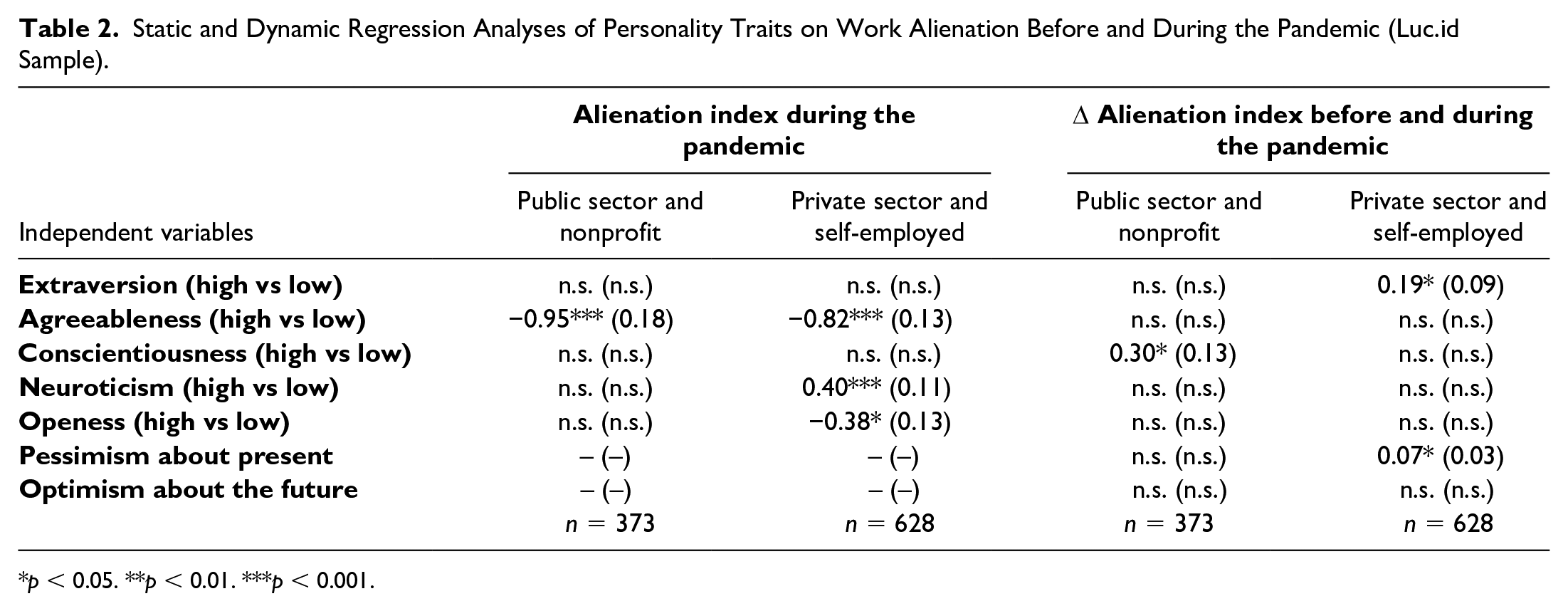
p < 0.05. **p < 0.01. ***p < 0.001.
In the private sector, work alienation during the pandemic is most acutely felt for workers who score relatively highly on the neuroticism dimension. Controlling for the other four personality traits, those high on neuroticism see their alienation score rise very close to the neutral mid-point on the scale. Private sector respondents who are relatively more open to new experiences see a similar effect but in the opposite direction (are less alienated). Remote workers in both the private and public sector who are more “agreeable” report even less work alienation, as they fall between “mostly disagree” and “disagree” on the items related to work alienation.
In the public sector, only teleworkers who are high on the “agreeable” dimension of the personality framework report work alienation levels different than their peers. The effect is akin to those of their private sector counterparts but even more pronounced. Controlled for other personality traits, these employees score close to a full point lower (which is about 2/3 of the standard deviation), than less agreeable respondents on the work alienation scale. The other personality traits do not seem to bear a discernible relationship to alienation many months into the pandemic.
In the private sector, teleworkers higher on the extraversion scale report more work alienation during the pandemic than before (Table 2, second column set). The effect is half the one reported during the pandemic for relatively high “neurotic” private sector employees. Other personality traits do not correlate with increases or decreases in work alienation since the beginning of the pandemic in our sample. In the public sector, highly conscientious remote workers are the only ones reporting swings (positive in this case) in work alienation large enough to be statistically significant since the pandemic, after controlling for other personality traits and pessimism about the present and optimism about the future.
Thus, we find supportive evidence for our descriptive hypothesis H1: that adjustment to pandemic-induced mass telework is conditional on the FFM of personality among our respondents. We observe some patterns on traits across work sectors (e.g., agreeableness), but variation in effects on the other four traits by sector. As anticipated in the literature reviewed earlier, some of this may be dependent on particular work conditions that have emerged in pandemic-induced mass telework, and as such, in the section below we explore the organizational management adaptations that may contribute to one’s work alienation, controlling for personality traits and job autonomy.
Unlike the data analysis above, which included public and private teleworkers, we focus here on the Canadian public servant sample who tend to be analysts in provincial or federal ministries and agencies, given our substantive interest in public sector management strategies in this context. Drawing on Charalampous et al. (2019) who examined private sector management strategies as it relates to telework, we asked our respondents to weigh in on how applicable the best practices identified in the private sector would be in the public sector, and if these best practices have been implemented in their own team. In relationship to the second hypothesis, we looked for evidence that organizational adaptation best practices in their workplace in this period are affecting alienation. We show in Figure 1 that more alienated respondents tend to also report fewer organizational adaptation best practices in their work unit than those less alienated, suggestive evidence for H2 being true.
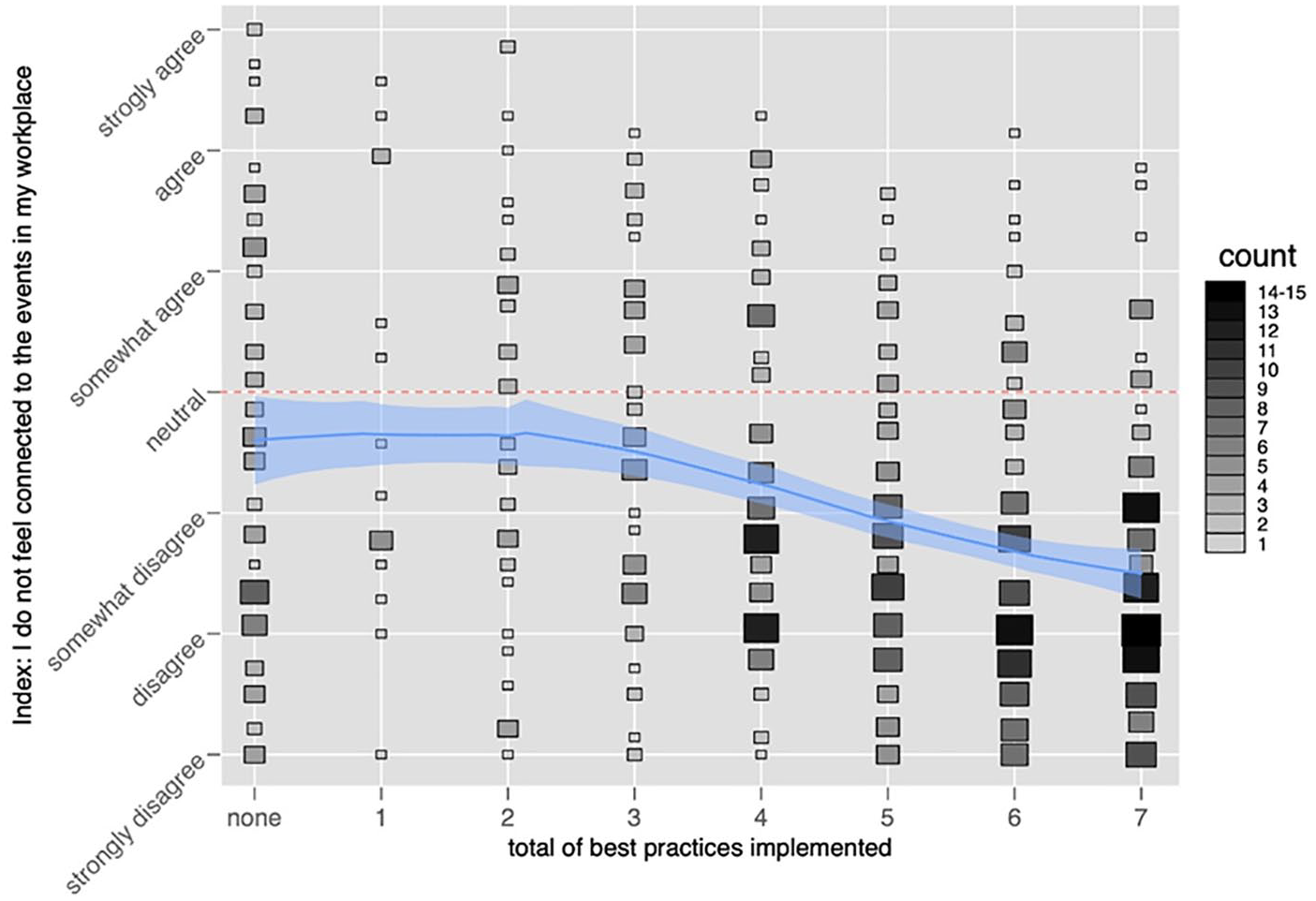
Work alienation index measured against number of organizational adaptation best practices in employees’ work unit (Canadian Public Sector Research Panel respondents).
However, H2 asserts that more organizational adaptation best practices in place will be generally associated with lower work alienation, H3 contends that one’s job autonomy and personality characteristics will condition the effects of organizational adaptation best practices on work alienation. To the extent that this claim is true, these types of insights are helpful for managers who must contemplate what type of organizational adaptations are suitable in what contexts and how to support the varied needs of their employees.
The coefficients in Table 3 below are the results of ordinary least squares (OLS) regressions. We split our overall sample into smaller subsamples of more homogeneous teleworkers. This way, we can observe with a high level of confidence how best practices identified in a systematic literature review on telework impacts workers with high and low work autonomy with different personality profiles. This is consistent with recommendations from the literature “to separate the observations into meaningful subsets (. . .) the data should be divided into categories in which theory or experience or data analysis suggests that the coefficients are similar” (Achen, 2005, p. 337), rather than use linear models with many independent variables to control for other influences, an approach that is not as benign as many assume (Achen, 2002, p. 447, 2005, p. 337; Schrodt, 2014, pp. 295–296; Green et al., 2016, pp. 422–423).
Results of OLS Regressions of the Presence of Best Telework Practices in One’s Work Unit on Alienation, by Level of Autonomy and by Low and High Levels of Big 5’s Personality Types. (CPSRPanel Respondents) 1 .
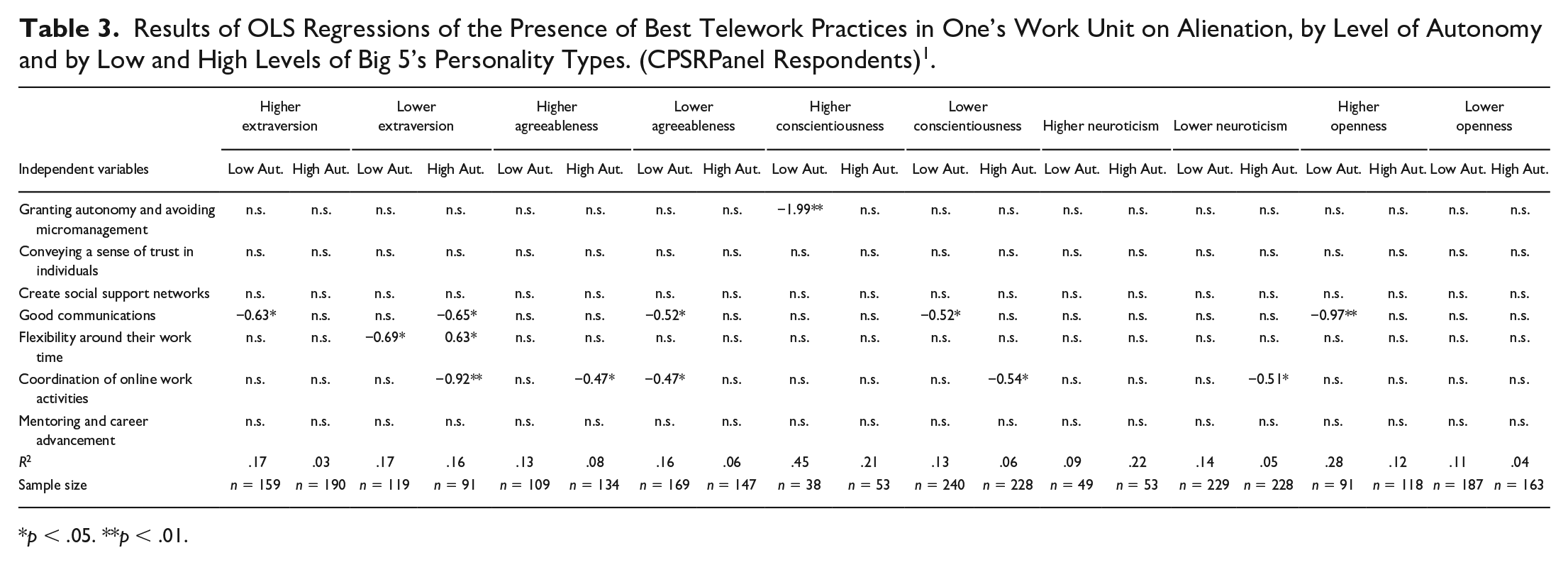
p < .05. **p < .01.
We report the results of the regression analysis relating to organizational adaptation best practices and personality types in Table 3, which corresponds to H3. The first best practice that is robust across various personality types is “good communication encouraged between e-workers, especially when interdependence is involved,” consistent with the findings from Raišienė et al. (2020) regarding the risks to worker engagement and efficiency from communication failures in this context but in contrast to the findings of van Zoonen et al. (2021). Moreover, the results are especially robust for public sector teleworkers who scored low on the autonomy index. We find that this organizational management strategy used in one’s telework context decreases work alienation among those scoring lower on agreeableness and those scoring higher on openness to experience, compared to those with opposing traits. In other words, public managers who promote good communication practices among teleworkers will observe less alienation among their staff who are predisposed to closing in socially and creatively, and it will also support those who are prone to a more negative outlook on life. For extraverted and introverted workers, the correlations are differentiated. Relative extraverts particularly benefit from good communication if they report low autonomy; relative introverts benefit in equal measure of good communications if they report high autonomy.
The second-best practice that is robust across various personality types is “A good coordination of online work activities with colleagues . . . to ensure that deadlines are met and projects are finished on time,” which is consistent with Ojo et al. (2021) and central precepts of COR theory related to the management of personal resources. We find that this organizational management strategy used in one’s telework context decreases work alienation among those scoring high on autonomy. This holds true for respondents with higher openness, lower conscientiousness, and lower extraversion. The pattern of correlation is more complex for agreeableness. Respondents with lower agreeableness and reporting low autonomy benefiting from this best practice declare feeling less alienated, in equal measure to respondents who are more agreeable and score higher on the autonomy index. In other words, public managers who resist micromanaging their teleworkers who are introverts, or those who often do not get along with co-workers, or those who are less ambitious at work, are likely to find less alienation among them than those with opposing traits.
A third best practice is associated with work flexibility. Work alienation decreases among low extraverts (ie. introverts) with low autonomy when organizations adapt with flexibility around their work time and place. Hence, the presence of flexibility around worktime reduces alienation among more introverted teleworkers who report low autonomy. The effect is different for introverts with high autonomy. Flexibility around their work time increases, on average, their feeling of alienation. This reflects frequent mentions that telework blurs personal and family time with work time. With added flexibility around work time, days can become longer, as teleworkers might not set for themselves firm boundaries.
Other best practices advanced by Charalampous et al. (2019) did not emerge with consistent effects on work alienation in our public servant sample in Canada, and thus overall the results for H3 are mixed. The presence or absence of management (a) granting autonomy and avoiding micromanagement, (b) conveying a sense of trust in employees working from home, (c) creating social support networks among employees and supervisors, and (d) providing mentorship for career advancement, did not exhibit the direct independent effects on work alienation (conditional on personality profiles) like the other best practices did. Several of the above management adaptations are focused on mitigating resource loss among employees, which we expected to be associated with lower alienation in our sample. However, if public managers are concerned about growing alienation within their team in the context of widespread telework, promoting good communication and coordinating online work activities among employees appears most promising across diverse worker personality profiles. And there is evidence in our sample of Canadian public servants in the federal and provincial governments that there is room to grow from a management adaptation perspective that holds promise to reduce alienation among segments of the public service—fewer than 60% report that good communications are encouraged between teleworkers, especially when interdependence is involved.
Discussion
Our most important results are that adjustment to forced telework has been harder for some based on personality types. Presenting themselves as “reputable employees,” who do not need strict monitoring (Pianese et al., 2022, p. 10), is taxing for some types of employees. That is one possible mechanism identified in a recent research synthesis of telework before and during the pandemic, which might link personality types to work alienation (Pianese et al., 2022). Furthermore, through analyses of prepandemic and pandemic work alienation and work conditions among our sample, we have been able to identify the organizational management best practices that are most promising to reduce alienation in this context. We have also found support for the other hypotheses advanced in this study: that those in organizations that deployed strategies to limit resource loss, many diverse employees report less alienation. Consistent with Giauque et al.’s (2022, p. 22) study finding organizational freedom impacts work exhaustion among French-speaking Swiss public servants, we find that job autonomy impacts work alienation. However, not all strategies that we expected to be associated with less alienation among workers in this context were observed in our sample. We offer a nuanced portrait of how some management practices have higher yield with employees with distinct personality traits, responding to the call from Giauque et al. (2022, p. 22) to examine how personalities could mediate autonomy and work alienation.
Scholars have studied workforce continuity in the face of crisis—prepandemic, in the case of Colbert (2011) studying the U.S. response to 9/11 in 2001 and Hurricane Katrina in 2005—focusing on employees and their ability to perform their jobs and remain productive during moments of significant societal disruption. Employee resilience—the ability to recover and maintain normal activities of the organization quickly after experiencing massive disruptions—is a key part of workplace continuity research. We know from workplace studies in the context of 9/11 in the United States that organizations that had more flexible work processes and structures bounced back more effectively and that was driven to a great degree by the individuals in the organization (Burke, 2005, p. 635). Thus, the individual responses and reactions to adversity within an organization affect the response of the organization as whole (Mallak, 1998). Organizational resilience is driven by individual behaviors (including skills and knowledge, trust, and commitment), but also organizational dimensions (including shared visions, connections, communication, and coordination) (Horne & Orr, 1998).
The findings from this research present important implications for public managers as they confront a workforce that has faced enormous upheaval in the work environment in the context of the pandemic, and its aftermath as hybrid work emerges as a likely future norm. Understanding that employees have unique responses to this context, shaped by fairly immutable personality characteristics, will aid public managers in crafting effective and sustainable organizational adaptations that are responsive to those unique drivers. It is neither realistic, nor likely most effective, to expect public managers to apply all best practices in this realm to all of their employees all the time. Emerging research echoes these findings. In recent research about telework loneliness during the pandemic, Becker et al. (2022) argued for recognizing individualized preferences in terms of organizational responses. They summarized their findings as “that individual employees will perceive and respond to these changes in working conditions differently,” and acting upon the differences maximizes the impact on employee well-being (Becker et al., 2022, p. 3). Our findings support the emerging claims that personality types are a way to offer individualized interventions according to meaningful and scientific distinctions. It is also a highly practical way to triage needs and allocate managers’ precious time to minimize work alienation among their employees.
For example, one robust finding from this study is with respect to the organizational adaptation of providing more flexibility around work time and space. This appears to be an effective strategy to reduce alienation for relative introverts who have low autonomy in their jobs but has the opposite effect for relative introverts with higher autonomy. In the former category of employee, this may provide the dose of flexibility they do not otherwise get in the completion of the actual work tasks. In the latter category of employee—introverts with high job autonomy—more flexibility in work time and space can make these employees feel more alienated. More flexibility does not appear to help all employees and may in fact result in their further drift from work commitment and engagement without the balance of structure suited to their personality and autonomy that comes with the nature of their work. Based on these considerations, leaders and managers organizations planning to transfer employees to remote or hybrid work on a permanent basis ought to use a differentiated approach to applying organizational adaptations, depending on the psychological characteristics of the employees, to prevent work alienation under changed working conditions.
Limitations
There are limitations to this work that could be addressed with further research. First is that this study is limited to Canada, and the particular adaptations may be linked to the administrative culture and traditions of Canada and thus the findings will need to be compared to other countries to determine how far they travel. Early indications, however, are that the findings from Canada share important similarities with public sector studies in France (Carillo et al., 2021), Italy (Toscano & Zappalà, 2020), and Lithuania (Raišienė et al., 2020). A second limitation that could be addressed in future work is a longitudinal study of telework over time. Our study was forced to measure prepandemic alienation with retrospective imagination at one moment in time rather than contemporaneous alienation sentiment, though we did control for timely dimensions of nostalgia and pessimism to dampen possible retrospective biases.
In addition, we should bear in mind that pandemics are dynamic events—findings from a moment in time might reflect relative low and high points related to hardening or softening of public health measures in the broader society. Finding evidence of widespread, high anxiety in a cross-sectional study conducted in the early phases of a pandemic does not mean that high anxiety will be persistent (Taylor, 2022, pp. 237–238). Future research would benefit from a design that followed public servants over time, by consulting them as close as possible the beginning of a crisis or change in work conditions, to establish a baseline, which would be able to answer temporal questions associated with alienation and organizational adaptations. This would seem critical as public administrations appear likely to move into hybrid workplaces once the most acute features of the pandemic recede, providing fruitful opportunities to add nuance to these critical questions of public sector resilience.
Conclusion
This article sought to better understand the pandemic-induced effects of telework on employee alienation in diverse work environments, but with special focus on the public sector. We expected that we would observe contingent responses depending on the autonomy one holds in their position, and one’s personality profile, and found confirmatory evidence for both. Those with greater autonomy in their work reported less alienation. Teleworkers who fit the “conscientious” personality profile were less alienated in their new teleworker status, and by contrast, “extroverts” were more alienated than before the pandemic. Our study leverages these insights to explore the types of organizational adaptations that are more associated with lower alienation and finds that granting more autonomy, avoiding micromanagement, and promoting good communication among employees is most promising across diverse worker personality profiles.
The future of mass telework is uncertain in the public sector. Some predict that the employers who dragged their feet in letting employees work from home in March of 2020 could bring back their employees onsite when the pandemic abates (Williamson et al., 2020). The ongoing and relatively untested mass telework initiative needs to be further assessed. Ben Waber, the president and co-founder of Humanyze, a work surveillance firm, expressed in an interview that it will take years to fully feel the negative effects of forced telework, stemming from reduced worker cohesion, when new innovations are underwhelming: “I think we’re going to see just this general degradation of the health of organizations” (Thompson, 2020). Our study provides early data on the transformation of work culture in this context and which best practices should be prioritized within a diverse workforce to mitigate against such degradation.
Supplemental Material
sj-docx-1-ppm-10.1177_00910260221114788 – Supplemental material for Alienation in Pandemic-Induced Telework in the Public Sector
Supplemental material, sj-docx-1-ppm-10.1177_00910260221114788 for Alienation in Pandemic-Induced Telework in the Public Sector by Carey Doberstein and Étienne Charbonneau in Public Personnel Management
Footnotes
Acknowledgements
The authors thank the CPSRPanel members who answered our survey.
Declaration of Conflicting Interests
The author(s) declared no potential conflicts of interest with respect to the research, authorship, and/or publication of this article.
Funding
The author(s) disclosed receipt of the following financial support for the research, authorship, and/or publication of this article: C.D. thanks Canada’s Social Sciences and Humanities Research Council support through their support with Insight grant (grant no. 435-2019-0090). Étienne Charbonneau acknowledges funding from the Canada Research Chairs program and Canada’s Social Sciences and Humanities Research Council support through Insight grant (grant no. 435-2020-1013).

Supplemental Material
Supplemental material for this article is available online.
Notes
Author Biographies
References
Supplementary Material
Please find the following supplemental material available below.
For Open Access articles published under a Creative Commons License, all supplemental material carries the same license as the article it is associated with.
For non-Open Access articles published, all supplemental material carries a non-exclusive license, and permission requests for re-use of supplemental material or any part of supplemental material shall be sent directly to the copyright owner as specified in the copyright notice associated with the article.
