




Abstract
This article connects human resource management (HRM) research to studies of street-level bureaucracies and public professionals. It investigates the intermediary role of professional behavior in the HRM–individual performance link in the context of public human service organizations. The article hypothesizes that human resources (HR) practices, aimed at enhancing street-level workers’ abilities, motivation, and opportunities, strengthen these workers’ professional behavior; that professional behavior and individual performance are positively related; and that professional behavior mediates the relationship between HR practices and individual performance. The analysis of findings from a survey study of street-level workers in local welfare agencies implementing welfare-to-work policies in the Netherlands shows support for the mediating role of professional behavior in the HRM–individual performance chain. Based on this evidence, the article concludes that the professional behavior of street-level workers in public human service organizations deserves scrutiny of both HRM scholars and HR practitioners who are interested in promoting the performance of public professionals.
Introduction
This article elaborates on the academic literature about the human resource management (HRM)–individual performance link in public human service organizations (Abner et al., 2017; Giauque et al., 2013; Knies et al., 2018; Van Loon, 2017). It proposes and analyzes professional behavior in public organizations as one of the factors mediating the relationship between HRM and the performance of street-level bureaucrats. It connects the HRM literature with the bodies of knowledge on street-level bureaucrats and public professionals by arguing that HRM investments in professional behavior are a way of managing street-level bureaucrats’ use of discretion. They do so by providing these employees with abilities, motivation, and opportunities for discretionary decision-making based on shared professional knowledge, norms, values, and standards.
Although, nowadays, many public employees will experience the qualification of “bureaucrats” as derogatory, their work role still matches the definition of street-level bureaucrats Lipsky (1980) presented 40 years ago: “Public service workers who interact directly with citizens in the course of their jobs, and who have substantial discretion in the execution of their work [. . .]” (p. 3). In the public administration and public management literature, the issue of public employees’ use of discretion has received considerable attention (Riccucci, 2002; Thomann et al., 2018; Zacka, 2017). These studies made clear that street-level decision-making is a crucial factor in shaping the performance of street-level bureaucrats and, ultimately, the street-level bureaucracies (such as schools, welfare agencies, and the police) they serve. Nevertheless, street-level behavior has hardly been explicitly studied as an HRM issue, as pointed out by several authors (Brockmann, 2017; Hwang & Han, 2020; Petter et al., 2002; Van Loon, 2017).
Given the key role of street-level bureaucrats’ use of discretion in individual and organizational performance, managing the use of discretion is a major challenge for HRM in public service organizations. Often, this challenge is depicted as ensuring “that frontline employees contribute to organizationally prioritized goals rather than personally prioritized goals [. . .]” (Jakobsen et al., 2019, p. 557). This perspective on the challenge of managing use of discretion reflects Evans’s (2011) observation that street-level bureaucracy literature has paid insufficient attention to the issue that (in many cases) managing street-level bureaucrats implies managing professionals. Many are trained as professionals who “treat cases and clients—patients, pupils, criminals—by relying on knowledge and skills that they use to assess situations, make decisions, and act and intervene” (Noordegraaf, 2016, p. 784). Professionals are expected to use their discretion in ways that are in line with professional values, ethics, standards, knowledge, and competences, that is, to behave professionally and to contribute to professionally prioritized goals. Professionalization can be regarded as an HRM strategy to promote street-level professional behavior (see Perry, 2018; Zhang et al., 2020). This raises the question of how HRM can contribute to professional behavior as a means to manage street-level bureaucrats’ use of discretion.
This article reports on a study of promoting professional behavior of street-level bureaucrats through HRM. The aim of the study was to investigate the relationships between HRM, professional behavior, and individual performance. The underlying theoretical argument here is that professional behavior influences street-level discretionary decision-making: use of discretion is a mechanism explaining the link between professional behavior and individual performance. The study provides empirical evidence that HRM matters in promoting professional behavior. In addition, it finds that professional behavior is a vital linking pin between HRM and individual performance. Finally, it contributes to the call to develop an HRM perspective on public administration and public management research (Boselie et al., 2019). For HRM practitioners, the article provides insights into the role of HRM in promoting the strategic direction and performance of public organizations (Jacobsen & Sowa, 2015), especially in public organizations where professional street-level bureaucrats play a crucial role in organizational performance.
The next section discusses the theoretical framework underlying the study and the hypotheses. Then, the methods of the study are presented, including the context in which the study took place. The article continues with a presentation of the results, and the final section discusses the findings and concludes the article.
Theoretical Framework
Professional Behavior, Street-Level Bureaucrats’ Use of Discretion, and Performance
Studies of street-level bureaucrats’ use of discretion often focus on what Taylor and Kelly (2006) called rule discretion: the street-level interpretation of rules and their application in individual cases. However, Taylor and Kelly (2006) also distinguished two other elements of discretion. The first concerns task discretion: room for discretionary decision-making in the way in which street-level bureaucrats carry out their jobs. Although constrained by rules, for example, concerning the aims of social services, street-level bureaucrats often have considerable discretion in decisions concerning what types of services are offered, what clients are prioritized, the treatment of clients, and so on (Freier & Senghaas, 2021; Lipsky, 1980; Zhang et al., 2020). Second, street-level bureaucrats have value discretion. Both in the context of rule discretion and task discretion, street-level decision-making involves considerations regarding clients’ responsibilities for their situation, their willingness and ability to change their situation, their deservingness of public support, and so on.
The mix of these elements of discretion varies depending on the “service technology” (Hasenfeld, 2010) or “normative institutional logic” (Borst, 2018) that is dominant in public sector organizations. Hasenfeld (2010) made a distinction between people-processing and people-changing technologies. In people-processing organizations, discretion is necessary to apply legal rules and regulations in individual cases. In this type of public organizations, rule and value discretion are likely to be dominant. In people-changing organizations, discretion is needed to adjust service provision to the individual needs and circumstances of clients, aimed at changing clients and their situation. Here, task and value discretion are most dominant. Whereas equal treatment is the leading principle in people-processing organizations, tailor-made, personalized service provision is the hallmark of people-changing organizations. This distinction in terms of dominant service technologies or institutional logics is relevant as it helps to clarify the nature and function of discretion in concrete public service provision processes. At the same time, many public service organizations are hybrid and combine people-processing and people-changing elements.
It is especially in public service organizations where people-changing technologies are important that professional behavior is expected to play a role in discretionary decision-making and the use of task and value discretion, such as making a diagnosis of clients’ situations and problems, offering effective services, the treatment of clients, and consulting peers when confronted with difficult cases (see Zhang et al., 2020). In practice, professional behavior is unlikely to be the sole determinant in street-level use of discretion. Studies of street-level bureaucrats and public professionals provide abundant evidence that, apart from professional considerations, organizational factors (resources, performance targets, and caseloads) and individual factors (attitudes toward clients or policies) shape discretionary decision-making as well (Evans, 2011; Jakobsen et al., 2019; Lipsky, 1980).
Street-level decision-making not only shapes individual performance, but it is also shaped by employees’ perceptions of the individual performance expected from them. The issues of performance, performance goals, and goal ambiguity in public organizations have received considerable attention. In line with other scholars, Boyne (2002) pointed at the multidimensionality of performance in public organizations, arguing that these dimensions are potentially conflicting. Brewer and Selden (2000) distinguished three dimensions: fairness, effectiveness, and efficiency. Whereas efficiency can be regarded as a performance dimension relevant for all public organizations operating in a new public management context, the other two can be more directly related to the service technologies distinguished above. Where fairness and equity can be considered a core performance dimension in people-processing service technology environments, effectiveness is a core dimension in people-changing contexts. Since, as was mentioned before, many public organizations are hybrid in terms of their service technologies, we may expect that fairness, efficiency, and effectiveness constitute the multidimensionality of performance in these organizations.
Professional Behavior and the Black Box: HRM, Employee Behavior, and Performance
As was mentioned in the introduction, the aim of this article is to investigate the relationships between HRM, professional behavior, and individual performance. Studying professional behavior as an outcome of HRM and an antecedent of performance positions this article in research of the mechanisms that explain the relationship between human resources (HR) practices and performance: the “black box” (Boxall et al., 2010; Jackson et al., 2014; Jiang et al., 2013; Messersmith et al., 2011). Following Messersmith et al.’s (2011) argument that “[. . .] performance does not stem from the HR practices themselves but rather from the human efforts that result from using HR practices” (p. 1107), the behavioral perspective on HRM is of particular interest here. For it explicitly focuses on the design of HRM systems (HR practices) that elicit and sustain particular employee behaviors (human efforts) required to implement the chosen strategy (performance; Jackson et al., 2014). Jackson et al. (2014) considered the ability–motivation–opportunity (AMO) model as one of the variants of the behavioral perspective: HR practices provide employees with the abilities, motivation, and opportunities that trigger the employee behavior that organizations consider desired. Jackson and colleagues expanded the AMO model arguing that prior to developing AMO-enhancing HR practices, HRM systems need to identify what behaviors are needed from employees. Developing HR practices aimed at stimulating professional behavior therefore assumes (a) that organizations consider professional behavior as required in realizing their strategy, and (b) that they have a view of what employee behaviors constitute professional behavior.
Enhancing Professional Behavior: HRM–Employee Behavior Relationships
This study builds on the distinction between ability-, motivation-, and opportunity-enhancing HR practices, which was elaborated by Jiang et al. (2012) and has been used in various empirical studies (among others, Vermeeren, 2017). Vermeeren (2017) argued that ability-enhancing HR practices (training and development, recruitment and selection), motivation-enhancing HR practices (performance appraisal and rewards), and opportunity-enhancing HR practices (autonomy and participation) are related to HRM outcomes, which in turn are related to performance. Following this argument, the contextualized HRM–performance link used in this study can be summarized as follows: HR practices enhancing employees’ abilities, motivation, and opportunities stimulate street-level bureaucrats’ professional behavior (an HRM outcome), which in turn increases their individual performance. The theoretical rationales behind the relationships between AMO-enhancing HR practices and employees’ professional behavior originate from different theories. First, the relationship between ability-enhancing HR practices and professional behavior is based on the resource-based view and its implications for the (HR) management of people in organizations (Knies & Leisink, 2014; Saridakis et al., 2017; Wright et al., 2001). Employees are considered (human) resources in the production of products or services. By recruiting employees with relevant abilities, skills, and knowledge and by improving these human resources through the enhancement of abilities, skills, and knowledge, better products or services will be produced (Wright et al., 2001). As professionals, by definition, strongly rely on their abilities, skills, and knowledge in doing their work, recruitment and selection as well as training and development are likely to be positively related to professional behavior. Second, the relationship between motivation-enhancing HR practices and professional behavior can be derived from social exchange theory. When employees receive support from their organization (for instance, through decent wages and procedures for performance appraisal), they will reciprocate this support by doing something in return (for instance, by demonstrating professional behavior; Rhoades & Eisenberger, 2002). As a result, HR practices enhancing employees’ motivation will be positively related to employees’ professional behavior. Finally, the relationship between opportunity-enhancing HR practices and professional behavior can be derived from the literature about public professionals and professionalism. Autonomy is considered a vital condition for professional behavior as it gives employees the opportunity to use their knowledge, skills, and competences in treating their clients and providing them tailor-made services. In addition, participation gives employees voice in organizational decision-making, affecting their opportunities for professional behavior (Evans, 2011; Taylor & Kelly, 2006; Zhang et al., 2020). Therefore, opportunity-enhancing HR practices will be positively related to professional behavior.
Various studies lend support to the expectations presented above about how HR practices support professional behavior. Two strands of research are relevant in this context. On one hand, several studies looked at the relationship between the level of professionalization of employees (operationalized as the proportion of professional or certified staff, which points at the role of ability-enhancing HR practices) and individual or organizational performance (Lee & Whitford, 2013; Lim et al., 2017; Meier & O’Toole, 2001). The findings of these studies remain inconclusive as some found a positive relationship, whereas others did not. On the other hand, studies have investigated employee behaviors that can be regarded as representing specific dimensions of professional behavior. For example, knowledge-sharing behavior (KSB) and innovative work behavior (IWB) have been identified as important dimensions of professional behavior in public organizations and have received considerable attention in HRM studies. In a systematic literature review of HRM studies of IWB, and using an AMO-enhancing HR practices approach, Bos-Nehles et al. (2017) found that training and development (ability enhancing), rewards and job security (motivation enhancing), and autonomy (opportunity enhancing) were related to IWB. Using the AMO framework as well, Minbaeva (2013) looked at relationships between HR practices and KSB, and found evidence that ability-enhancing (recruitment and selection, and training), motivation-enhancing (performance-based compensation), and opportunity-enhancing (flexible work arrangements) HR practices promote KSB.
Another dimension of professional behavior concerns the treatment of clients or customers. Client-oriented or customer-oriented behavior has been analyzed in HRM studies. Most studies did not focus specifically on professionals but studied service workers more generally, often in private organizations. However, these studies do provide insights regarding the potential contribution of AMO-enhancing HR practices in promoting this dimension of professional behavior. For example, a study of a private, nonprofessional service organization (Boxall et al., 2010) found that ability-enhancing HR practices contributed to customer-oriented behavior. Interestingly, the study also found that customer-oriented behavior was negatively associated with performance ratings, pointing at the problem of internal fit in HRM. This underlines the aforementioned relevance of explicitly gearing HR practices to desired behaviors.
Summarizing, studies provide indications that HRM matters in promoting specific dimensions of professional behavior. They also provide indications that each of the three bundles of HR practices that the AMO model distinguishes is relevant in stimulating professional behavior.
Hypotheses
In the above section, the role of professional behavior as a crucial factor in analyzing the HRM–performance link in public human service organizations was discussed. In addition, studies were discussed that found evidence for the role of AMO-enhancing HR practices in stimulating professional behavior. This leads to the following hypotheses:
Method
The Study’s Context
This article reports results of a study of public employees in Dutch local welfare agencies responsible for implementing welfare-to-work policies aimed at (re)integrating jobless recipients of social assistance into the labor market. This type of public employees and the organizations where they work have been studied extensively in street-level bureaucracy studies (see Brodkin, 2011; Hasenfeld, 2010; Riccucci, 2002). At the organizational level, welfare-to-work requires combining people-processing work processes (benefit administration, sanctioning) with people-changing work processes (providing tailor-made support to promote clients’ integration into the labor market). At the employee level, these tasks may be separated (traditional casework model), distinguishing the provision of support from the administration of benefits and sanctioning; or they may be combined (integrated casework model; Hill, 2006). Depending on the casework model, the mix of rule, task, and value discretion of employees varies. Another issue affecting welfare-to-work implementation and its management concerns the nature of the core tasks of the policy implementing organizations in the period before the introduction of welfare-to-work policies (Daley et al., 2002; Riccucci, 2002). In countries where these organizations’ core task used to be benefit administration, welfare-to-work implied the introduction of people-changing service provision processes besides the traditional people-processing tasks. In other countries, the organizations responsible for the implementation of welfare-to-work used to be responsible for both benefit administration and social services (social work). In these countries, welfare-to-work often implied a reorientation of the focus of people-changing service provision from traditional social work support toward welfare-to-work services, which strongly emphasize labor-market integration and conditionality requirements for clients (such as the obligation to participate in welfare-to-work programs to be entitled to benefits).
In the Netherlands, the introduction of welfare-to-work implied that local welfare agencies, traditionally responsible for the administration of social assistance benefits, were gradually being transformed into hybrid organizations combining people-processing and people-changing service provision processes. In terms of the casework models used in these agencies, the picture is diverse. Some agencies work with traditional casework and others with integrated casework. Within local welfare agencies, different casework models are sometimes used for different client groups. During the past decade, efforts to professionalize the provision of welfare-to-work services have been introduced. This professionalization process is explicitly endorsed and stimulated by important stakeholders in this policy area in the Netherlands, such as the Ministry of Social Affairs, the association of heads of local welfare agencies, and the occupational association of employees delivering welfare-to-work. Thus, returning to the aforementioned discussion of Jackson et al. (2014), professional behavior is considered “desired behavior” in Dutch local welfare agencies. At the same time, as an institutionalized “welfare-to-work profession” is—similar to the situation in other countries—nonexistent, the professionalization efforts raise several challenges. On one hand, it raises the question of what “professional behavior” means in the context of welfare-to-work service provision. On the other hand, it raises the issue of what HR policies and practices local welfare agencies can develop to support employees’ professional behavior. These challenges constituted the background of the study reported here. Reflecting the hypotheses discussed above, it focused on the relationships between AMO-enhancing HR practices, professional behavior, and performance.
Finally, each of the three dimensions of performance discussed above (fairness, efficiency, and effectiveness) is reflected in the expectations concerning the individual performance of the employees in this study. Efficiency is a core concern of Dutch local welfare agencies as significant budget cuts in resources available for welfare-to-work have taken place since the financial crisis of the late 2000s. Effectiveness is of importance, given the overall objective of welfare-to-work policies to promote clients’ labor-market participation and reduce their benefit dependency, which is often also translated into individual performance targets of employees. Together with the efficiency concerns, this may promote a focus on servicing those clients considered easy to integrate into the labor market. However, fairness is a relevant performance dimension as well, as Dutch welfare-to-work policies entitle all clients to receive support in labor-market integration or reduce their labor-market distance. Besides, fairness is also deemed important in decisions about benefit entitlements and imposing sanctions.
Sample
Invitations to participate in an online survey were distributed among employees in Dutch local welfare agencies involved in providing welfare-to-work services. No national register of these employees from which a random sample could be drawn exists. Therefore, a strategy of convenience sampling was used. Invitations to participate in the study were sent to all employees involved in providing welfare-to-work in eight local welfare agencies. Together, these agencies provide welfare-to-work services for 23% of all Dutch social assistance recipients. In addition, invitations were sent to members of the Dutch occupational association for employees delivering welfare-to-work. For privacy reasons, the invitations were sent by the local welfare agencies and the occupational association, respectively. Data collection took place at the end of 2018 and beginning of 2019. A total of 431 workers filled in the survey. Their average age was 47.83 years (SD = 10.99 years) and 63% of our respondents were female. On average, their work experience in providing welfare-to-work was 12.5 years. Eighty-five percent of respondents had an educational background at university level or at the level of an institute for higher professional education (such as social work). Two thirds of the respondents worked under a permanent contract, and about a quarter worked under a temporary or flexible contract.
Measures
HR practices were measured by asking respondents to what degree they feel being supported by these practices, using a 5-point Likert-type scale. As discussed before, three groups of HR practices were selected: ability-enhancing, motivation-enhancing, and opportunity-enhancing practices. Ability-enhancing practices included recruitment and selection, as well as training and development. Motivation-enhancing practices included performance appraisal and rewards. Opportunity-enhancing practices included participation and empowerment. For measuring ability-, motivation-, and participation-enhancing practices, items from Vermeeren (2014b) were used. For measuring empowerment, two of the dimensions of the Leader Empowering Behavior Questionnaire (Konczak et al., 2000) were used, namely, delegation of authority and self-directed decision-making (see Supplemental Appendix).
Professional behavior was defined and operationalized in terms of “practicing professionalism” rather than “practicing a profession” (Green, 2009). Practicing professionalism is described by Green (2009) as follows: “[. . .] the fact that one enacts professionalism, one practices what it is to be professional, or to be a professional. In this case, professionalism is itself to be understood as a practice phenomenon [. . .]” (p. 6). The “practicing professionalism” approach allowed abstracting from specific (social) professions which, given the heterogeneity of educational backgrounds of workers delivering welfare-to-work, is more adequate. The definition of practicing professionalism in the study distinguished eight dimensions of professional behavior: knowledge acquisition, knowledge sharing, knowledge use, innovation, client-centered practice, collaboration, accountability, and methodical work. The definition and operationalization of these dimensions, as well as the results of the reliability and validity tests, have been presented and discussed elsewhere (Van Berkel et al., 2021; this article also includes the full measurement instrument). The operationalizations of the eight dimensions into questionnaire items were based (wherever possible) on operationalizations developed and tested in prior research. Examples of items used for operationalizing the dimension knowledge acquisition included “reading professional journals” and “attending conferences”; the items used for operationalizing knowledge sharing included “voluntarily sharing my knowledge, information and know-how with colleagues.” For all items in the questionnaire, respondents were asked how often they perform the professional behaviors mentioned in the items on a 5-point Likert-type scale, ranging from never to often. Furthermore, always was not included as the likelihood of respondents to always perform certain professional behaviors was expected to be practically nil. The results of exploratory and confirmatory factor analyses suggest that dimensionality of the measurement model is in line with the conceptualization of practicing professionalism (based on exploratory factor analysis [EFA]), and that the measurement model is reliable (based on Cronbach’s alpha), valid (based on confirmatory factor analysis [CFA]), and measurement invariant (based on multigroup CFA).
There are two ways in which performance was measured. First, linked to the discussion of performance in “Theoretical Framework” section, individual performance was measured using the three-dimensional (efficiency, effectiveness, and fairness) measure of performance presented by Vermeeren (2014a). Using this measure (denoted as “individual performance” below) implies that self-reported estimates of respondents’ performance were used. Although non-self-reported performance data could not be collected in this study, respondents’ most recent performance rating by their supervisors was used as a second measure for performance (denoted as “performance rating” below). By conducting analyses using two different ways of measuring performance, the robustness of the results is increased.
Analytical Strategy
Structural equation modeling in Mplus 8.2 was used to test the hypotheses. First, the measurement quality of the constructs included in the model was assessed using CFA. These CFAs were conducted using the Weighted Least Squares Means and Variance adjusted method (WLSMV), which is an appropriate method when dealing with non-normally distributed data (Brown, 2006). Root mean square error of approximation (RMSEA), comparative fit index (CFI), and Tucker–Lewis index (TLI) were used to assess the model fit of the CFAs. Following the recommendation by Byrne (2013), an RMSEA value below .08, a CFI value above .900, and a TLI value above .900 were considered to indicate an acceptable model fit. Second, descriptive statistics and correlations were evaluated. Third, various structural equation models were estimated to test the hypotheses. Similar to the CFAs, WLSMV method was used to estimate these models.
Results
Measurement Models
A total of three measurement models were tested. First, a measurement model for ability-, motivation-, and opportunity-enhancing HR practices was estimated. A second-order construct for ability-enhancing HR practices was included in which two factors (recruitment and selection, and training and development) were loaded onto one factor for ability-enhancing HR practices. In addition, two separate first-order constructs for motivation were included: performance appraisal (intrinsic motivation–enhancing HR practices) and rewards (extrinsic motivation–enhancing HR practices). Because these two constructs did not load significantly on one factor for motivation-enhancing HR practices, it was decided to include the two constructs for motivation-enhancing HR practices separately. Finally, a second-order construct for opportunity-enhancing HR practices was included, consisting of three factors for participation, delegation of authority, and self-directed decision-making. The values for the model fit indices were RMSEA = .066, CFI = .959, and TLI = .955, indicating a good model fit. Furthermore, the factor loadings all significantly loaded onto the factors. The standardized factor loadings for ability-enhancing HR practices were between .651 and .980, for motivation-enhancing HR practices were between .659 and .843, and for opportunity-enhancing HR practices were between .780 and .923.
Second, a measurement model for professional behavior was estimated. The model consisted of a second-order construct for professional behavior in which eight factors were loaded onto one factor for professional behavior. The model fit indices were CFI = .906, TLI = .900, and RMSEA = .066, indicating a model fit. The factor loadings all significantly loaded onto the factors and ranged from .504 to .967.
Third, a measurement model for the three-dimensional measure of individual performance was estimated. The model consisted of a second-order construct in which three factors were loaded onto one factor for individual performance. The model fit indices were as follows: CFI = .980, TLI = .974, and RMSEA = .071, indicating a model fit. All factor loadings loaded onto the dimensions significantly and ranged from .508 to .985.
Common Method Bias
Several procedural measures were taken to minimize the risk of common method bias. In addition, a post hoc statistical analysis was conducted to test whether common method bias poses a threat to the results. First, validated measurement scales were used to measure the constructs included in the study. Furthermore, these measurement scales were first tested among several practitioners to make sure that answering the questionnaire items was within the capabilities of respondents (Podsakoff et al., 2012). Second, all items were formulated in such a way that they refer to concrete practices (in the case of AMO-enhancing HR practices) or behaviors (in the case of professional behavior and individual performance). Third, the items for the dependent, mediating, and independent variables were situated on different pages of the survey. Fourth, a Harman’s single factor test was conducted using a CFA in which all items included in the structural models were loaded onto one factor (George & Pandey, 2017). Because three different structural models to test the hypotheses were estimated, three different CFAs were estimated as well (for ability-enhancing HR practices, motivation-enhancing HR practices, and opportunity-enhancing HR practices) to assess whether there is common method bias in the structural model. The model fit indices of the models were poor (ability-enhancing HR practices: CFI = .536, TLI = .522, and RMSEA = .122; motivation-enhancing HR practices: CFI = .536, TLI = .549, and RMSEA = .100; and opportunity-enhancing HR practices: CFI = .514, TLI = .497, and RMSEA = .115), which is an indication that common method bias might not be a problem for the structural models.
Descriptive Statistics
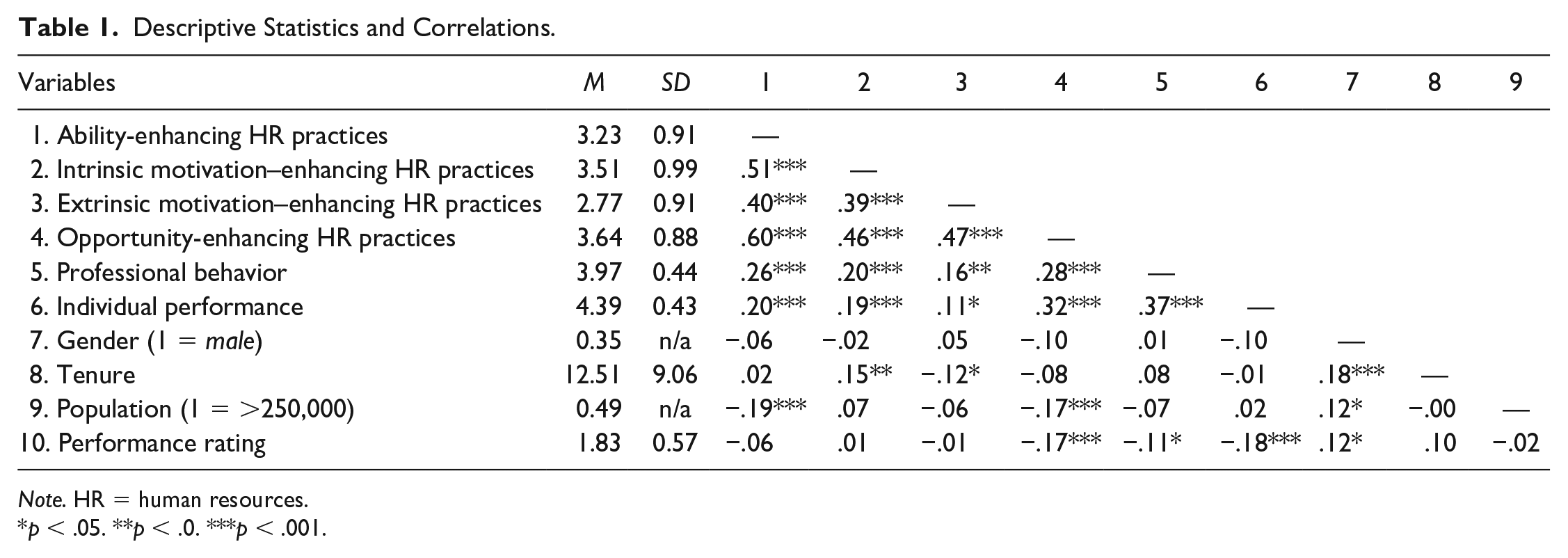
In Table 1, descriptive statistics and correlations are presented. Means scores for ability-enhancing HR practices (M = 3.23, SD = 0.91), intrinsic motivation–enhancing HR practices (M = 3.51, SD = 0.99), and opportunity-enhancing HR practices (M = 3.64, SD = 0.88) were moderate, whereas the mean score for extrinsic motivation–enhancing HR practices (M = 2.77, SD = 0.91) was fairly low. Furthermore, on average, respondents indicated fairly high levels of professional behavior (M = 3.97, SD = 0.44), individual performance (M = 4.39, SD = 0.43), and performance rating (M = 1.83, SD = 0.57). In addition, the standard deviations of these measures show that there was more variance on the measures for HR practices than on the measures for professional behavior and performance. Finally, all HR practices correlate significantly with each other, as well as with professional behavior and individual performance (Table 1).
Descriptive Statistics and Correlations.
Note. HR = human resources.
p < .05. **p < .0. ***p < .001.
Structural Equation Models
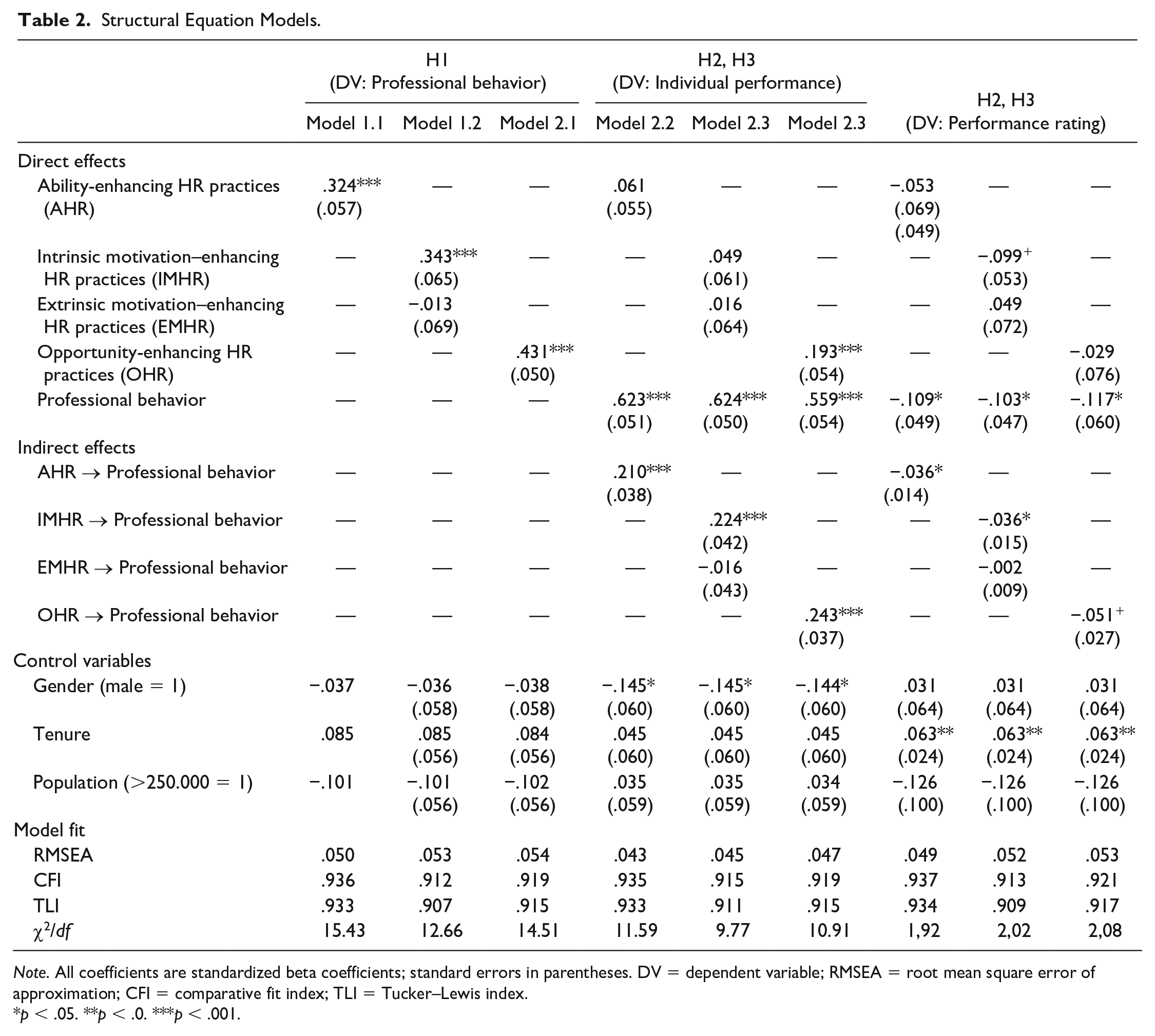
Table 2 presents the results of the structural equation models. In Models 1.1, 1.2, and 1.3, professional behavior is included as a dependent variable. These models are used to test Hypothesis 1. In Models 2.1, 2.2, and 2.3, individual performance is included as a dependent variable. Therefore, these models are used to test Hypotheses 2 and 3.
Structural Equation Models.
Note. All coefficients are standardized beta coefficients; standard errors in parentheses. DV = dependent variable; RMSEA = root mean square error of approximation; CFI = comparative fit index; TLI = Tucker–Lewis index.
p < .05. **p < .0. ***p < .001.
First, the results show significant positive relationships between ability-enhancing HR practices (β = .324, p < .001), intrinsic motivation–enhancing HR practices (β = .343, p < .001), and opportunity-enhancing HR practices (β = .431, p < .001) and professional behavior. Extrinsic motivation–enhancing HR practices were not significantly related to professional behavior. Based on these results, Hypotheses 1a and 1c can be accepted. Hypothesis 1b can partly be accepted (for intrinsic motivation–enhancing HR practices).
Second, our results show a significant positive direct relationship between professional behavior and individual performance in Model 2.1 (β = .623, p < .001), Model 2.2 (β = .624, p < .001), and Model 2.3 (β = .559, p < .001). Based on these results, Hypothesis 2 can be accepted.
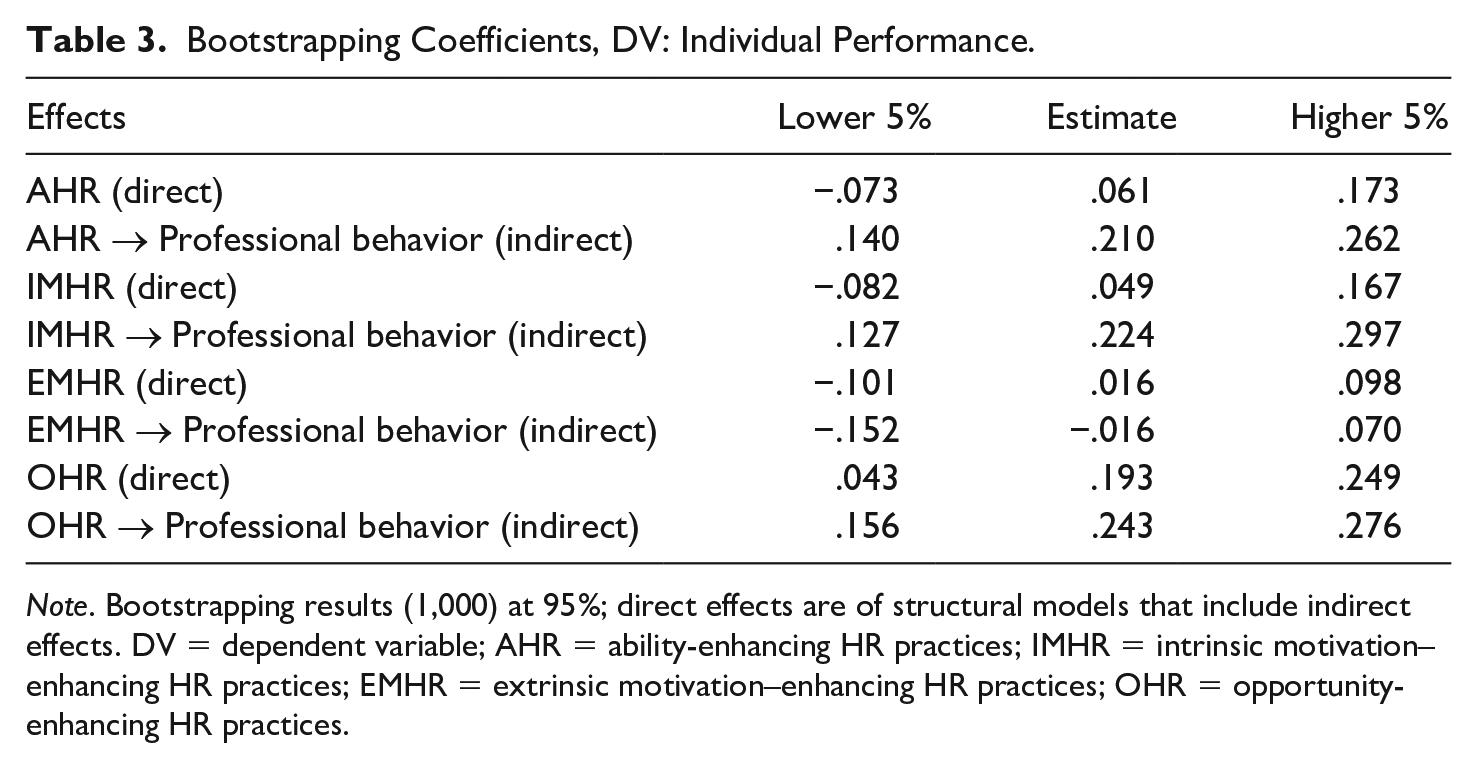
Third, our results show a significant indirect relationship between ability-enhancing HR practices (β = .210 p < .001), intrinsic motivation–enhancing HR practices (β = .224, p < .001), and opportunity-enhancing HR practices (β = .243, p < .001) and individual performance through professional behavior. Bootstrapping confidence intervals at 95% also indicate that ability-enhancing HR practices [.140, .262], intrinsic motivation–enhancing enhancing HR practices [.127, .297], and opportunity-enhancing HR practices [.156, .276] are indirectly related to individual performance through professional behavior (Table 3). Similar to Hypothesis 1, we did not find a significant indirect relationship between extrinsic motivation–enhancing HR practices and individual performance through professional behavior. Based on these results, Hypotheses 3a and 3c can be accepted. Hypothesis 3b can be partly accepted (for intrinsic motivation–enhancing HR practices). Interestingly, the results of Models 2.1 and 2.2 show that when the mediating variable (professional behavior) is included in the analysis, the relationship between the independent (ability-enhancing HR practices, intrinsic motivation–enhancing HR practices) and dependent (individual performance) variables vanishes. This indicates that the indirect relationship between ability-enhancing and intrinsic motivation–enhancing HR practices and individual performance through professional behavior is a full mediation. The direct relationship between opportunity-enhancing HR practices and individual performance remains significant when professional behavior is included, thereby indicating a partial mediation.
Bootstrapping Coefficients, DV: Individual Performance.
Note. Bootstrapping results (1,000) at 95%; direct effects are of structural models that include indirect effects. DV = dependent variable; AHR = ability-enhancing HR practices; IMHR = intrinsic motivation–enhancing HR practices; EMHR = extrinsic motivation–enhancing HR practices; OHR = opportunity-enhancing HR practices.
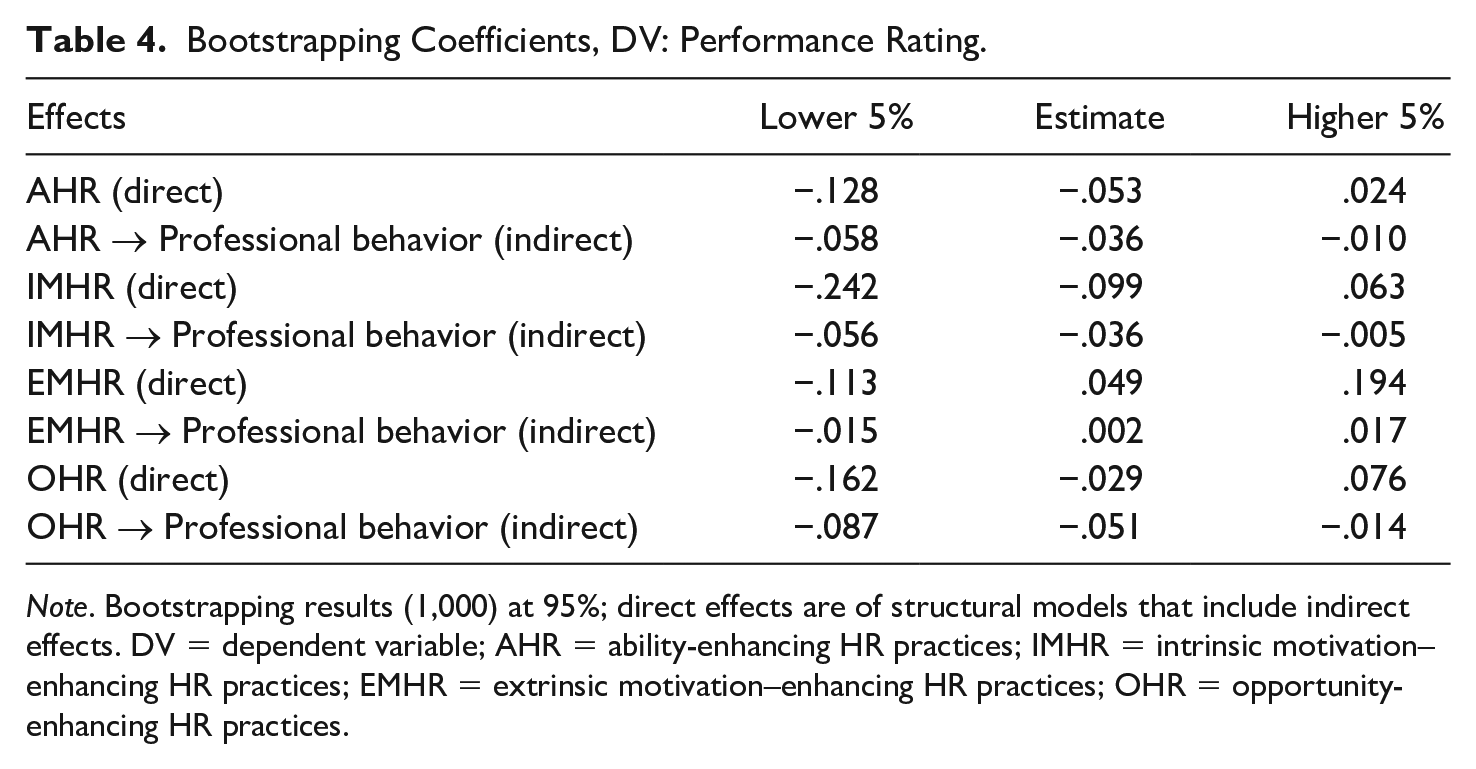
As mentioned earlier, the structural models were also conducted with a different measure for performance as dependent variable. A one-item measurement was included in which respondents were asked what performance rating they received during their last appraisal interview. The categories ranged from 1 (excellent) to 5 (insufficient). First, professional behavior was directly related to performance rating (β = −.109, p = .026). Second, ability-enhancing HR practices (β = −.036, p = .036) and intrinsic motivation–enhancing HR practices (β = −.112, p = .032) were indirectly related to performance rating through professional behavior. Bootstrapping confidence intervals at 95% also indicate that ability-enhancing HR practices [−.058, −.010] and intrinsic motivation–enhancing HR practices [−.056, −.005] are indirectly related to performance rating through professional behavior. Opportunity-enhancing HR practices were moderately indirectly related to performance rating through professional behavior (β = −.051, p = .059). Bootstrapping confidence intervals at 95% indicate that opportunity-enhancing HR practices are indirectly related to performance rating [−.087, −.014] (Table 4). Extrinsic motivation–enhancing HR practices were neither directly nor indirectly related to performance rating. Considering that these results resemble the results of Models 2.1, 2.2, and 2.3, it can be concluded that the results related to performance are fairly robust.
Bootstrapping Coefficients, DV: Performance Rating.
Note. Bootstrapping results (1,000) at 95%; direct effects are of structural models that include indirect effects. DV = dependent variable; AHR = ability-enhancing HR practices; IMHR = intrinsic motivation–enhancing HR practices; EMHR = extrinsic motivation–enhancing HR practices; OHR = opportunity-enhancing HR practices.
Discussion and Conclusion
The central topic of this article was introduced by arguing that the management of street-level bureaucrats’ use of discretion in public organizations and the role of professional behavior in their performance has received little attention in the HRM literature up until now. This is problematic for two reasons. First, street-level bureaucrats’ use of discretion is crucial for their performance. And, second, promoting street-level bureaucrats’ professional behavior may be an important strategy for managing their use of discretion, especially in public service organization contexts where people-changing logics are important. Against this background, this study set out to investigate whether and to what extent professional behavior mediates the relationship between HR practices and performance.
Overall, the findings of the study provide support for the hypotheses. Most importantly, the analyses reveal that professional behavior is a crucial linking pin in the relationship between HR practices and performance. In the case of ability-enhancing and intrinsic motivation–enhancing practices, professional behavior fully mediates this relationship. This corroborates and expands theoretical arguments that the three bodies of literature (HRM, street-level bureaucracy, and public professionalism) connected in this article have developed. The study supports the HRM “black box” literature that considers employee behavior an important mechanism in linking HRM to employee performance (Jackson et al., 2014; Messersmith et al., 2011). This article contributes to this literature by pointing at the role of professional behavior as a relevant type of employee behavior in public organizations. It also supports the argument discussed in many street-level bureaucracy studies that street-level behavior is crucial for street-level bureaucrats’ performance and is structured by a range of organizational factors (Lipsky, 1980; Zacka, 2017). The article contributes to street-level bureaucracy studies by explicitly considering these organizational factors as resulting from HR policies and practices. Specifically, the article focused on the professionalization of employee behavior. In addition, the article provides evidence for the argument that investing in professional behavior is a fruitful way of managing the performance of street-level bureaucrats (Jakobsen et al., 2019; Perry, 2018). The theoretical argument here is that professional behavior is one of the factors shaping street-level bureaucrats’ use of discretion.
Extrinsic motivation–enhancing practices, which were operationalized in terms of rewards, were not related to professional behavior, nor was there an indirect relationship between these practices and employee performance through professional behavior. This may be due to the specific public sector context in which this study took place: public sector organizations often have relatively limited room to use rewards as an instrument to manage or appraise performance (Knies et al., 2018; Vermeeren, 2017). This seems to be reflected in the fact that respondents in the study felt least supported by extrinsic motivation–enhancing HR practices. Following Andreeva and Sergeeva (2016), this does not necessarily have to be problematic. An opportunity-rich environment (the respondents in this study experienced relatively high support by opportunity-enhancing practices) triggers intrinsic motivation and investments in rewards in such an environment may promote extrinsic motivation that does not pay off in improved professional behavior. In opportunity-low environments, on the contrary, extrinsic motivation becomes important in promoting professional behavior. Intentionally or unintentionally, the Dutch local welfare agencies involved in this study seem to have acted upon Andreeva and Sergeeva’s recommendation: to invest in opportunities or rewards, but not both.
The aforementioned results showed that whereas the contribution of ability-enhancing and intrinsic motivation–enhancing HR practices to performance is fully mediated through professional behavior, the story for opportunity-enhancing HR practices is somewhat different. Opportunity-enhancing HR practices are both indirectly (through professional behavior) and directly related to performance. Against the background of extensive debates about discretion as a control problem or a necessity (Brockmann, 2017; Jakobsen et al., 2019; Thomann et al., 2018), this study shows that providing street-level bureaucrats with opportunities for participation and empowerment is a vital part of public human service organizations’ HR systems to enhance performance through promoting professional behavior. At the same time, the relationship between opportunity-enhancing practices and performance is not fully explained by professional behavior. Other variables apparently function as mechanisms as well in this relationship. As suggested by some of the studies discussed above (Andreeva & Sergeeva, 2016; Thomann et al., 2018), motivation might be one of these mechanisms: having the opportunities for professional behavior might trigger motivation (Knies & Leisink, 2014). Job satisfaction might be another linking pin, explaining the relationship between opportunity-enhancing practices and performance (Vermeeren, 2017).
This study has several limitations. It used self-reported data on professional behavior and individual performance although, in the latter case, an additional analysis was performed by analyzing respondents’ performance ratings by their supervisors. Including other stakeholders’ assessment of professional behavior and performance in the analysis would be an evident strategy for dealing with common method bias issues that might have had an impact on the study. Apart from that, comparing employees’, clients’, and supervisors’ perceptions of employees’ behavior and performance would be interesting in itself. In terms of research design, analyzing relationships between employees’ perceptions of HR support and other stakeholders’ perceptions of employees’ professional behavior and performance is probably only feasible at the team or organizational level: an individual-level approach is likely to encounter various privacy and practical issues. In addition, this study took place among a specific group of street-level bureaucrats working in a non-randomly selected sample of local welfare agencies in a specific country. In terms of statistical generalization, the study design renders generalization to street-level bureaucrats in other local welfare agencies, in other policy areas or in other countries impossible. In terms of theoretical generalization, however, the findings presented here have relevance beyond these specific agency, policy, and country contexts. First, debates about the role of professional behavior in promoting the performance of public employees delivering welfare-to-work are not limited to the Netherlands (Van Berkel et al., 2017). Thus, it could be hypothesized that similar relations between HR practices, professional behavior, and performance can be found in public organizations responsible for implementing welfare-to-work in other countries. Keeping in mind the importance of the fit between HR practices and desired behaviors underlined by Boxall et al. (2010) and Jackson et al. (2014), this will specifically be the case in countries where the value of professional behavior in the delivery of welfare-to-work policies is explicitly recognized and where welfare-to-work delivery is considered as requiring people-changing rather than people-processing technologies and logics. Second, the findings may also be relevant for other types of public organizations where professional behavior of street-level bureaucrats is considered desirable. It could even be argued that other public sectors are more likely to reveal the type of results presented above as the desirability of professional behavior in public sectors such as education, health care, or social work is less contested than in the case of welfare-to-work. Finally, the study did not empirically investigate the theoretical argument that the use of discretion is a linking pin in explaining the relationship between professional behavior and performance. Future studies could address this issue, for example, by investigating whether knowledge use (one of the dimensions of professional behavior) results in different decision-making regarding services that street-level bureaucrats offer to their clients.
For HRM practitioners in public human service organizations, the study shows that investing in ability-, motivation-, and opportunity-enhancing HR practices, in a context in which professional behavior is valued and desired, pays off in terms of both professional behavior and performance. The relevance for employees’ performance of investing in their professional behavior is a key argument for HR practitioners in politically, organizationally, and managerially legitimating such HR investments. Against the background of the current dominance of new public management–inspired strategies in managing street-level bureaucrats’ discretion, evidence that “alternative” HRM strategies are effective is likely to be welcomed. At the same time, HR practitioners should be aware that the very nature of professional behavior is contested. In other words, efforts to invest in professional behavior should be accompanied by efforts to define what professional behavior means in specific contexts. This study also offers support for an approach to discretion that goes beyond the frequently used approach—in organizations as well as in science—that emphasizes the “amount” of discretion street-level bureaucrats should be granted. The study provides evidence that a focus on the professional use of discretion might be more fruitful (Evans, 2011; Perry, 2018). This approach acknowledges the importance of street-level discretion for performance, without implying that the use of discretion is merely up to the individual employee and their personal preferences. Instead, a professional perspective on managing the use of discretion stimulates street-level decision-making that is guided by professional values, ethics, and standards.
Supplemental Material
sj-docx-1-ppm-10.1177_00910260211046554 – Supplemental material for Managing Street-Level Bureaucrats’ Performance by Promoting Professional Behavior Through HRM
Supplemental material, sj-docx-1-ppm-10.1177_00910260211046554 for Managing Street-Level Bureaucrats’ Performance by Promoting Professional Behavior Through HRM by Rik van Berkel, Julia Penning de Vries and Eva Knies in Public Personnel Management
Footnotes
Declaration of Conflicting Interests
The author(s) declared no potential conflicts of interest with respect to the research, authorship, and/or publication of this article.
Funding
The author(s) disclosed receipt of the following financial support for the research, authorship, and/or publication of this article: For this study, a grant was received from ZonMW, The Netherlands Organization for Health Research and Development, file number 535004001.

Supplementary Material
Supplemental material is available online with this article.
Author Biographies
References
Supplementary Material
Please find the following supplemental material available below.
For Open Access articles published under a Creative Commons License, all supplemental material carries the same license as the article it is associated with.
For non-Open Access articles published, all supplemental material carries a non-exclusive license, and permission requests for re-use of supplemental material or any part of supplemental material shall be sent directly to the copyright owner as specified in the copyright notice associated with the article.
