




Abstract
This essay explores the problem of legitimation crises in deliberative systems. For some time now, theorists of deliberative democracy have started to embrace a “systemic approach.” But if deliberative democracy is to be understood in the context of a system of multiple moving parts, then we must confront the possibility that that system’s dynamics may admit of breakdowns, contradictions, and tendencies toward crisis. Yet such crisis potentials remain largely unexplored in deliberative theory. The present article works toward rectifying this lacuna, using the 2016 Brexit and Trump votes as examples of a particular kind of “legitimation crisis” that results in a sequence of failures in the deliberative system. Drawing on recent work of Rainer Forst, I identify this particular kind of legitimation crisis as a “justification crisis.”
The 2016 Brexit vote shocked the Western world, topped only by the unexpected election of Donald Trump to the U.S. presidency several months later. With fortunes rising for populist and charismatic figures around the globe, many people have come to fear that liberal and democratic values are in grave danger. Yet we are still just beginning to grapple with the challenges recent events pose to democratic theory, let alone deliberative-democratic theory.
This essay explores the problem of legitimation crises in deliberative systems. For some time now, theorists of deliberative democracy have started to embrace a “systemic approach.” Whereas earlier deliberative democrats tended to place their stress on the ideal of deliberation or its institutionalization in particular sites and forums, proponents of the systemic turn explore ways to effectively theorize and instantiate deliberative democracy at a mass scale, across multiple actors, institutions, and stages, possibly even including nondeliberative elements that nonetheless support the overall deliberative quality of the system. 1 But if deliberative democracy is now to be understood in the context of a system of interacting parts, then we should countenance the possibility that that system’s dynamics may admit of breakdowns, contradictions, and tendencies toward crisis.
The present essay works toward exploring such crisis potentials, using the Brexit vote and Trump’s election as examples of a particular kind of legitimation crisis that results from incongruities between deliberative system components. Drawing on recent work of Rainer Forst, I identify this particular kind of legitimation crisis as a justification crisis. 2
In the process, I aim to develop two more general points about legitimation crises and deliberative theory. The first concerns how deliberative democrats may account for such crises within the deliberative system, and what an examination of crisis potentials within a deliberative system tells us about the functions and contributions of its various components vis-à-vis the system as a whole. The second concerns how deliberative theory may actually contribute to our understanding of legitimation crises in contemporary democracies. As I argue, the Brexit and Trump votes exhibit features that set them apart from many accounts of legitimation crisis but that pose interesting questions for democratic theory. While both results were formally democratically legitimate, they nevertheless appeared erratic or alienating to much of the public. In a democracy, the legitimacy of official decisions relies in the end on their traceability to a sense of collective democratic will, whereby the “winners” as well as the “losers” of a given decision can understand themselves as equal coparticipants in the shaping and making of it. 3 Yet a crucial implication of the theory of deliberative systems is that the fostering of such a sense of will and coparticipation is dispersed across multiple components. Far from being generated spontaneously, it must be operationalized through a series of deliberative and nondeliberative components, such as the public sphere, the political party system, and voting systems. Moreover, each of these components must perforce rest on a particular claim to legitimacy (“justification narrative”) in the context of the broader system. Should one or more of these components fail as a result of legitimation challenges, it is possible to see the system generating decisions that the citizenry at large no longer recognizes as the reflection of a collective democratic will. We then find ourselves in a particular kind of crisis whereby the citizenry cannot make justificatory sense of its own decisions. A theory of deliberative systems can show how such a crisis can follow from certain kinds of legitimation challenges.
A Legitimation Crisis in 2016?
Since the 2008 economic crisis, there have been murmurings of a “legitimation crisis” is Western capitalist democracies. 4 According to Malte Frøslee Ibsen, the growing resonance of the specifically anti-elitist stances of populist parties and figures should be understood as a political response to the administrative crisis that followed 2008. The common arguments that Brexit and Trump voters were driven by “economic anxiety” in the face of globalization, or that they represent a “cultural backlash” against twenty-first-century multiculturalism, do not fully capture “why voters turn to populists and their Manichean discourse of the common people versus the political elite, instead of more traditional mass parties with similar policies.” 5 In Ibsen’s view, “it is the increasing inability of welfare states to successfully manage economic crises and prevent the negative social consequences of globalization that has translated into a growing withdrawal of legitimation from the governing political institutions and ruling political elites across the West.” 6 This public consciousness of crisis, not simply in relation to the economic crisis but also in relation to the apparent haplessness or unwillingness of governments to effectively manage its fallout, precipitated a dramatic loss of confidence in established parties and trust in leadership. 7
Ibsen is not alone. Without disregarding the role of xenophobia and white (and male) privilege in these new currents, Nancy Fraser also argues that the anti-elitist thrust of populist movements is crucial to capturing the nature of the present juncture. She stresses how the rise of right-wing populist movements has been accompanied by equally significant (if less electorally successful) left-leaning movements, including the Occupy movement and the rise of such figures as Bernie Sanders and Alexandria Ocasio-Cortez in the United States, Jeremy Corbyn and Momentum in the UK, and Syriza, Podemos, La France Insoumise, and others. 8 Diagnosing the 2016 votes as a rejection of what she calls “progressive neoliberalism,” she invokes Antonio Gramsci to understand the present situation as a “crisis of hegemony.” On this reading, the rise of reactionary populists such as Trump or Nigel Farage are the “morbid symptoms” of a crisis in which “the old is dying and the new cannot be born.” 9
Assessments like those of Ibsen and Fraser present deliberative systems theory with two questions. The first is the question of how we, as deliberative democrats, are to understand legitimation crises within the deliberative system. To be sure, theorists have long debated the place of activism, protest, and resistance in deliberative politics. 10 In “A Systemic Approach to Deliberative Democracy,” Jane Mansbridge and colleagues discuss the ways ostensibly “anti-deliberative” forms of protest nevertheless enhance a deliberative system, and Mark Warren’s “Problem-Based Approach to Democratic Theory” includes “resistance” in his list of seven “generic practices” that provide essential support to democratic functions. 11 But there is a notable difference between particular challenges by parties experiencing exclusion, on one hand, and a legitimation crisis, on the other. The former invites a focus above all on the agents, their motivations, and their practices or tactics—for example, whether the disruptions they create ultimately constitute a net benefit to the system or infuse it with unnecessary division. 12 The latter, in contrast, denotes a mass withdrawal of legitimation by many parties. Though these parties also exhibit particular motives and practices, and cannot be understood without them, the mass character of a legitimation crisis calls for a broader, systemic point of view on legitimation, of which theories of deliberative systems have yet to take full account.
But there is something else to be considered. Compelling as analyses like those of Ibsen and Fraser may be, there are notable features of what happened in the British and US democratic systems in 2016 that points beyond a legitimation crisis—or, at least, that requires us look more deeply into what a legitimation crisis entails. In this regard, what is jarring about the 2016 votes is not merely that they resulted in populist victories; rather it is that these were putatively “democratic” decisions, which citizens and elites alike nevertheless find difficult to interpret as the valid expression of a collective democratic will. The Brexit vote left British political society caught in an awkward position between the formal legitimacy of the referendum, on one hand, and the profound conflictedness of the citizenry and directionlessness of the government, on the other. This was evidenced, among other things, by the struggles of successive UK prime ministers to conclude a deal with parliamentary support, a renewed push by Scottish representatives for independence, and repeated calls by many for a second referendum. The reaction of the US public to Trump’s election was, if anything, even more stark. Attendance at his inauguration ceremony was dwarfed the following day by the “Women’s March on Washington,” a massive protest of his election; related protests were also held worldwide. 13 And though Trump was not the first president to be elected with fewer votes than his opponent, he is the first on record to be inaugurated with a minority approval rating, which, according to Gallup, tied his equally record-setting disapproval ratings at 45%. Compare this with his predecessors: George W. Bush’s election in 2000 was much more controversial in terms of electoral procedure, yet he still entered office with a solid majority of public approval (57%). Barack Obama’s approval rating at inauguration was even higher (68%), despite the high partisan hostility of the time period. 14
Both 2016 decisions were “democratic” in the sense that they were made according to procedures recognized as expressing the “will of the people”—the Electoral College in the case of the United States, a majority-vote referendum in the United Kingdom. On the other hand, the circumstances surrounding them leave substantial questions about what “the people” actually “willed.” If there was a legitimation crisis in 2016, it triggered, in turn, symptoms of what we might call a justification crisis—a breakdown in the democratic machinery whereby the citizenry cannot make justificatory sense of its own decisions.
I argue a deliberative systems point of view, with the right tools, is well-suited to analyzing such a breakdown. It has been a longstanding tenet of deliberative-democratic theory that voting and electoral competition are not sufficient for a political system to qualify as “democratic,” and that, at the end of the day, democratic legitimacy must be discursively generated. At the same time, the deliberative systems approach strives to comprehend how such “aggregative” mechanisms can nonetheless coexist with other mechanisms to support a system whose legitimacy derives ultimately from its discursive qualities. My argument is that we can understand justification crises as situations where the parts of a deliberative system fail to work together in the way required to generate decisions that the citizenry can understand as “theirs.” This becomes possible because, in present-day deliberative systems, it often happens that the components that foster a sense of collective authorship of decisions a system produces are not the same as the components that register a decision as binding. Should the linkage between them be broken or corrupted in a certain way, it is possible for the system to punch out decisions divorced from the requisite sense of collective authorship. As I will show, such situations are liable to arise with a sudden withdrawal of legitimation in one or more parts of a deliberative system.
The Legitimation of Deliberative Systems
I take the deliberative systems approach as a largely reconstructive approach to democratic theory: rather than looking to design an ideal model of deliberative democracy, it examines existing political practices and systems and looks for ways to bring out, add to, and/or maximize their deliberative potential. Such a reconstructive approach allows theorists to accommodate real-world practices (such as strikes and protests) and “path-dependent” features of established institutions (such as political parties), which may at first glance appear to stray from the deliberative ideal, and looks for ways they can nonetheless support the system overall. Accordingly, such reconstructive approaches lend themselves to a certain kind of “normative functionalism,” whereby practices within and pertaining to the system may be appraised, criticized, or designed on the basis of the role they play and what they contribute to the system and its overall deliberative quality. 15
One consequence of this systemic turn is that “deliberative” is no longer identified exclusively with particular venues or practices of deliberation; instead, it becomes a quality of the system as a whole. As John Parkinson notes, this can lead to some debate over what precisely makes a system “deliberative.” 16 The full contours of this debate need not concern us here, but it does point us to one of the most prominent criticisms of the systemic approach, which is that it can dilute or distort deliberative democracy as an ideal of democratic legitimation. One worry concerns theorists overextending the definition of “deliberation” to existing institutions, such as present-day legislatures, even when their actual practices fall well short of the deliberative ideals of egalitarianism, inclusiveness, and reasoned, reflective dialogue. Another is that the systems approach lures theorists into an overly output-focused or technocratic perspective, where the aim becomes to design a system whose decision-making reflects certain virtues associated with deliberation, while neglecting broad-scale democratic inclusion and participation. 17
A couple of strategies have been offered to alleviate these criticisms. One involves greater attention to institutions of representative democracy and their deliberative-democratic potentials. A number of theorists, for example, have sought to reevaluate the functions political parties perform in a democratic system and improve upon them via mechanisms such as “intra-party deliberation.” 18 Such strategies attempt to address the legitimation problem by seeking to strengthen, broaden, and deepen avenues for direct inputs by citizens. A second involves the concept of meta-deliberation, or deliberation over the terms of deliberation. 19 As Dennis Thompson explains, deliberative democrats need “not insist that every practice in deliberative democracy be deliberative but rather that every practice should at some point in time be deliberatively justified.” 20 Meta-deliberation can be institutionalized in various ways. Thompson gives the example of a citizens’ assembly explicitly set up for the purpose of rethinking aspects of democratic institutional design, while Claudia Landwehr imagines the public sphere fulfilling this role on a more general and constant basis. 21
At first glance, meta-deliberation seems to resolve the legitimation problem by offering a path through which the organization and components of the deliberative system can themselves be rendered answerable to deliberative challenge and justification. This includes components that are ostensibly nondeliberative: one cannot deliberate within a voting system, but one can deliberate about one. And it allows for the monitoring of deliberative components. Mechanisms such as intra-party deliberation may provide avenues for greater reflexive control over system processes; however, meta-deliberation allows us to drop back one more level to assess the ways these deliberative mechanisms do or do not live up to the standards they profess—be they standards of fair representation, inclusion, consensus-generation, quality decision-making, and so on. As John Dryzek notes, any deliberative process can just as well become corrupted by power relations or distorted by some form of hegemony. Importantly, this also applies to meta-deliberative processes, and this means that every consensus, deliberative or meta-deliberative, “might therefore have to be treated as provisional and itself contestable.” 22 Even the public sphere, as an institution, is not immune to corruption and distortion.
But therein lies a puzzle, for it seems meta-deliberation leads us to a kind of “procedure paradox”: if every deliberative institution itself requires deliberative legitimation, do the institutions that grant this deliberative legitimation not also require deliberative legitimation, and so on? Call this the problem of meta-deliberative regress. 23
This regress may not have a formal, institutionally soluble endpoint; however, it does have a de facto, informal one. This takes the form of legitimation crises, which we can define as a large-scale rejection of one or more core components of a deliberative system. In other words, a legitimation crisis can be said to represent a kind of breakdown in the society-wide meta-deliberative consensus (or “meta-consensus” 24 ) regarding crucial aspects of the deliberative system. Such mass withdrawals of legitimation are hardly unproblematic. Precisely because they represent a breakdown in meta-consensus that offers no ready solution through formal institutions, legitimation crises can be messy affairs, suffuse with confusion, fear, and opportunities for the unscrupulous. But this does not mean they are immune to analysis and critique; on the contrary, it is all the more reason that deliberative democrats should want to take theoretical account of them.
Orders and Narratives of Justification
It is here that Rainer Forst’s concepts of orders of justification and narratives of justification may prove useful. Deliberative democracy may be normatively evaluated along several dimensions: inclusivity, epistemic quality, citizen motivation, and so on. However, democratic legitimacy is primarily a question of justification. Does the system generate decisions that can be justified as binding on the grounds that those subject to them can also understand themselves as their authors? 25 Accordingly, meta-deliberative questions are questions about the extent to which the system and/or its components can justifiably claim to meet relevant requirements of deliberative democracy.
An order of justification may be described as a kind of structure that institutionalizes (formally or informally) a certain procedure, grammar, or “currency” of justification. Such an order establishes within itself a set of standards and criteria more or less specific to it, according to which activities generated within it can be considered “justified.” Viewed internally—that is, from a standpoint within the order—an order of justification privileges certain kinds of justifications over others according to how well they conform to these standards and criteria. However, viewed externally—that is, from a critical standpoint—the justifications generated within the order are always, in a certain sense, derivative of the broader field of relations of justification within which the order is situated and by which the order itself may be subjected to demands for justification. Accordingly, any order of justification relies in turn on one or more narratives of justification, in light of which “social relations and institutions and certain ways of thinking and acting appear as justified and legitimate.” 26 Such narratives ground the order’s status as a generator of justified outcomes and against which it can be measured, held to account, or even rejected.
This justification-theoretic framework can help us reconstruct and navigate the legitimation of deliberative system components with regard to their functions within the system and their meta-deliberative justifications. A democratic system can itself be described as an order of justification, with justification narratives about inclusion, equality, and collective will that endow it with legitimation. But this order also consists of several components, each of which can be looked upon as an order of justification in its own right that is grounded in a corresponding narrative. As orders of justification, different components often have specific procedures or standards according to which their outputs may be considered internally “justified.” For example, one of the standards by which deliberative procedures are evaluated may be on how well information and opinions held by participants are tested, affirmed, or revised on the basis of open processes of reason-giving. In contrast, secret ballot procedures typically admit of the opposite standard: the integrity of a secret-ballot process relies, in part, on participants being able to register their preferences privately, without having to give reasons to anybody. In this sense, each of these can be said to possess their own “internal” standards of justification. At the same time, we can distinguish those internal standards from the external narratives through which these orders each justify their contribution to the broader system in which they are situated. Crucial as it may be to a secret ballot system that each voter be shielded from having to give justification for one’s vote, the ballot system as such still remains subject to demands for justification on a number of grounds, such as whether the system meets standards of political equality or whether the decisions it generates appropriately reflect popular will. If it is perceived to fall short on these standards, its narrative of justification may be called into question.
Accordingly, the legitimacy of both the deliberative system as a whole as well as each of its various components can be shown to rely in the end on justificatory narratives that can be accessed and thematized discursively. Each touts, explicitly or implicitly, some broadly accepted story about its role in democratic inclusion, agenda-formation, and decision-making that members of society can understand, interpret, and question. 27 In principle, this means anyone at any time can thematize one or more of these narratives as focal points of legitimation challenges. They may thus be considered meta-deliberatively accessible. Frequently, accounts of meta-deliberation such as we find in Thompson, Dryzek, and Landwehr focus on the sites charged with the purpose of meta-deliberation about some system component or other. But legitimation challenges do not always wait for someone to set up such sites, and, as per the problem of meta-deliberative regress discussed previously, such sites could be subject to challenge themselves. By shifting our attention from sites of meta-deliberation to meta-deliberatively accessible narratives of justification, we can more easily see how challenges to a prevailing meta-consensus can come from a variety of places in society—including places we may not expect or even desire.
Moreover, insofar as we are interested here in the workings of a deliberative system, the framework can help us reconstruct the justificatory relations between its various components as well as in relation to the whole. To the extent that a given component has an identifiable function within the broader deliberative system, that component’s justificatory narrative is related to how it fulfills that function. Yet the ability of a given component to fulfill a certain function and so make good on its narrative often depends on the capacity of other components to do the same. A chamber of representatives within a system can prove an exemplary model of deliberation and consensus-building; but it would still fall short on fulfilling its narrative if other components of the system—such as the component that selects representatives for the chamber—are called into question. Thus, legitimation problems experienced by one component can have ramifications that spread to other parts of the system. If we put this together with the previous point about the meta-deliberative accessibility of justification narratives, we can already get a sense of how legitimation crises can prove volatile to the functioning of a deliberative system. It is to this that we now turn.
Three Components
The previous two sections give us some idea of how we can comprehend legitimation crises from the perspective of deliberative systems theory—namely, as mass challenges to meta-deliberatively accessible justification narratives surrounding one or more deliberative system components. This brings us part-way to answering the first question we posed in the first section of this article. Up to this point our discussion has been somewhat abstract. In the following sections, we will begin to make it more concrete, and in the process, we will also start to answer our second question—not only how deliberative systems theory might account for legitimation crises, but what it can contribute to our understanding of them.
Indeed, one of the more nebulous features of the concept of a “legitimation crisis” is that it is not always clear what precisely it is in a given political system that “loses” legitimacy. Is it a specific governmental body? A reigning policy paradigm? The entire constitutional system? Even Jürgen Habermas’s influential account in Legitimation Crisis remained vague on this point, a fact noted by both Ibsen and Fraser. 28 This lack of clarity not only makes it difficult to assess when a legitimation crisis has in fact come to pass; it closes off analysis of different ways a legitimation crisis may articulate itself and with different consequences. However, the framework outlined above does allow us to distinguish among various components of a deliberative system and their legitimation conditions by viewing them as orders of justification with distinguishable justificatory narratives.
In the case of the 2016 Brexit and Trump votes, Ibsen and Fraser posit that it is the established political parties who have suffered a dramatic loss of confidence on the part of citizens. Indeed, declining faith in party democracy has been anticipated for some time by scholars such as Russell Dalton, Colin Crouch, and Peter Mair, and several studies have noted a gradual process of disengagement between voters and parties over the course of the late twentieth and early twenty-first centuries across Western Europe and North America. 29 The link between declining faith in established parties and the rise of populism has also been widely commented upon, with Jan-Werner Müller noting a trend according to which, “where previously coherent and entrenched party systems broke down, chances for populists clearly increased.” 30
A rejection of established parties is almost certainly a key part of the story, which we will return to below, but it still does not fully explain the aspects of justification crisis described previously: the apparent disconnect between the results of voting and the sense of collective popular will (or lack thereof) that produced these results. Accomplishing this requires a second tool afforded by our framework; we need to look at how legitimation-challenged components are situated, functionally and narratively, in a broader deliberative system aimed at generating collective decisions that citizens can recognize as their own.
In what follows, I will demonstrate how such a breakdown in the democratic process is possible by focusing in on three deliberative system components, which can be comprehended as orders of justification—the public sphere, the voting order, and the partisan order. I am above all interested in how the partisan order—the system of political parties, understood as an order of justification—functions in between the public sphere and the voting order, and what happens when it fails in this role. Granted, these are not the only three components of a deliberative system, and there are almost certainly additional and more complex ways to describe their place in the system than what I shall present. But I am settling on these insofar as they are enough to demonstrate sufficient conditions (though not necessarily necessary ones) for a kind of justification crisis whereby a citizenry cannot recognize itself as makers of decisions to which it is subject, despite the formal democratic legitimacy of a decision-making process.
The Public Sphere
The political public sphere is crucial to the development of a collective democratic will. Its character is that of a host of associations and spaces for the cultivation of opinion and will-formation through the unregulated and spontaneous circulation of information, ideas, and reasons. As an order of justification, the public sphere’s currency of justifications is the ordinary communication of citizens, and it stands on a justificatory narrative—namely, that the public opinions and discourses it generates arise from the free expression and exchanges of ideas of equal citizens. Hence, despite its relatively formless and even “anarchic” structure, 31 its claim to serve as a faithful generator of democratic will implies that the justifications in which it trades will be oriented in principle toward standards of reciprocity and generality.
We should note that any attempt to discuss “the” public sphere runs a risk of being misleading. In practice, most polities exhibit a diverse patchwork of public spheres that cater to various constituencies—subnational, national, and transnational—through a variety of media. 32 Developments in communications technology, such as the rise and ubiquity of the internet, have altered the shape of these public spheres even further. Still, there remain reasons to need to refer to “the” public sphere within the context of a state-centered deliberative system such as the United States or United Kingdom.
One has to do with a sense of collective solidarity, wherein all citizens can understand themselves and each other as equal and reasonable coparticipants in, as well as subjects to, the system and its decisions. This requires a centralized discursive arena wherein citizens encounter each other as members of a common “imagined community.” 33 Accordingly, the public sphere serves as a vehicle for inclusion through which participants can express their own views and be exposed to the views of others, and so are able to see themselves coexisting with others in public discourse. Equally crucial, the public sphere is the arena in which those who perceive themselves as excluded from processes of opinion and will-formation can stage their presence. Precisely because the public sphere is relatively “formless,” it has a unique ability to afford the greater reflexivity and communicative freedom necessary for the mobilization of demands, issues, awareness, and “counterknowledge” 34 that may escape more formally institutionalized parts of the deliberative system. This makes the public sphere a crucial resource for monitoring power, and it can operate as “a warning system with sensors that, though unspecialized, are sensitive throughout society.” 35
But, as Landwehr has noted, the public sphere is also a crucial site of meta-deliberative legitimation. 36 While meta-deliberation can take place in dedicated sites and forums, ultimate legitimacy of a deliberative system requires a society-wide consensus, in which all participants can freely, equally, and discursively accept, challenge, interpret, and negotiate the rules of the game. Being in principle the most public and inclusive site for issuing or withholding legitimation, capable of openly and without invitation checking the justificatory narratives of any and all components as well as the system as a whole, the public sphere plays a unique and irreplaceable role.
At the same time, the dispersed and anarchic nature of publics today means that the public sphere’s capacity to fulfill these roles is not automatic. And the same formlessness and comparative lack of regulation that allows its openness and reflexivity also renders it highly vulnerable to unequal social power, as well as various informal mechanisms of exclusion and distortion.
The Voting Order
The public sphere also has no mechanism for converting the democratic will into binding decisions. In contemporary democracies, the ballot box remains the key mechanism through which citizens convert democratic will directly into the force of law. We have already discussed some aspects of how voting systems function as orders of justification in the previous section. Typically anchored today in secret balloting practices, a voting order’s narrative of justification is bound up with (though not exhausted by) its ability to preserve the integrity of the process. This consists in each citizen being able, at a set time, to cast her vote individually, anonymously, uncoerced, and with equal weight, after which all votes are aggregated and converted into a decision that is meant to stand as the legitimate reflection of the will of the citizenry.
The abstract, anonymous, and mechanical nature of this process ensures the equal inclusion of every vote and the authenticity of the results, but it also means that its connection to the democratic will of the citizenry is not immanent. Rather, its justificatory narrative as an authentic expression of democratic will must be judged “externally”—not only in relation to its fairness, integrity, faithfulness to principles such as “one person, one vote,” and the like, but also in relation to the sense of democratic will emergent in the public sphere. The voting order is as dependent on the public sphere for its legitimacy as the latter is dependent on the former for binding decisions. 37
Furthermore, the technical demands of the voting process place restrictions on the way in which democratic decisions can achieve the force of law. Because of its high level of formalization, which shields the process from the free flow of public justifications, the alternatives among which voters may choose cannot be developed internally; the secret ballot must take the form of a finite array of predetermined options among which voters can choose. How finite may vary somewhat among voting systems: first-past-the-post systems must be able to guarantee a recognizable “winner”; proportional representation systems often seek to maximize prospects for stable coalitions; referenda avoid overtaxing voter energy with abstruse wording and details. More significantly, neither the voting order nor the public sphere is able to supply these options on its own. A “gap” remains between the freewheeling logic of the public sphere and the mechanical logic of the voting booth, and this is typically filled by other deliberative system components, such as the partisan order.
The Partisan Order
Jonathan White and Lea Ypi distinguish partisanship from mere “factionalism” by its orientation to the generalizable interests of the whole; even though parties compete with each other, each trades in a specific language of justification that addresses itself to the citizenry at large. Political parties can foster a level of political solidarity that connects citizens to political activists, policy experts, and political and social elites; they can also be said to play an “educative” role, offering citizens resources for understanding complex policy topics; and well-functioning parties can be vehicles for mobilization and amplification of voices and interests that may otherwise be suppressed by power inequalities in the public sphere. 38 They organize a “division of labor” in democratic politics between citizens who voice general aims for society, experts who translate those aims into policy proposals, and political representatives who strategize to implement them. 39
To be sure, parties have rarely, if ever, functioned so ideally. As Carlo Invernizzi-Accetti and Fabio Wolkenstein observe, explorations of “ethical” partisanship such as those forwarded by White and Ypi tend to focus on “what parties ‘at their best’ ought to do,” not on what they actually do. 40 Moreover, such normative accounts often treat parties individually, while several pathologies that we find in practice, such as cartelization, need to be understood in the context of a system of several parties. But not everyone neglects this systemic aspect. Matteo Bonotti, drawing on Rawls’s political liberalism, shows how parties acting within a party system play a crucial role in the cultivation and articulation of a society’s conception of “public reasons.” 41 Broadly speaking, these can be understood as reasons that can be addressed to the entirety of the citizenry, as alternative visions of the common good, without prior adherence to any particular ethical or otherwise partial worldview.
Accordingly, the parties making up the party system together compose an order of justification that shapes, structures, and sets the parameters of a democratic society’s sense of “reasonable disagreement.” 42 It thereby assists in cultivating inclusive processes of opinion and will-formation, on the one hand, and shepherding these into the machinery of agenda-formation and decision-making, on the other. It channels 43 publicly justified differences of opinion from the public sphere and packages them into coherent governing philosophies, policy positions, and organizational strategies, which are then presented back to the public as discrete ballot choices. 44 As such, it serves as a “bridge” between the public sphere and the voting order.
The partisan order also takes on a certain justificatory narrative—namely, that the parties it comprises effectively exhaust the full range of reasonable alternatives available to citizens within the bounds of reasonable disagreement. The partisan order helps to secure an array of electoral and ballot choices in which not only the “winners” but also the “losers” of elections and referenda are able to see the collective democratic will reflected in the results. As a bearer of public reason, not only should a well-functioning partisan order faithfully represent those visions and platforms that stand within the bounds of reasonable disagreement, it should also be able to filter out those that do not. Parties and elites also help disempower exclusionary, illiberal, or antisystem platforms that may spring up within parties, while setting limits on platforms addressed only to “partial” constituencies.
This means that not only does the partisan order present alternatives within the bounds of reasonable disagreement, it also has influence over what counts as “reasonable.” In this sense, it can be said to generate a form of political hegemony. This need not be bad by itself. Yet, as we shall see, there are circumstances in which a partisan order can work to exclude or disempower policy alternatives and governing philosophies that may otherwise qualify as reasonable. 45
Sequences and Counter-Sequences
Putting together these three component orders of justification, we can envision an ideal sequence of how they would function together in cultivating a sense of collective democratic will and converting them into binding decisions. In brief, an inclusive public sphere generates reasonable disagreements over general goals for society, which are then taken up by the party system and repackaged into bundles of governing philosophies, policy strategies, and candidate personnel, and these are in turn presented to the citizenry as a set of discrete voting choices backed by public reasons. As shown in Figure 1, each component plays a role in the sustenance of a deliberative sequence wherein the “losers” as well as the “winners” of a given decision can nonetheless understand themselves as coauthors of that decision.
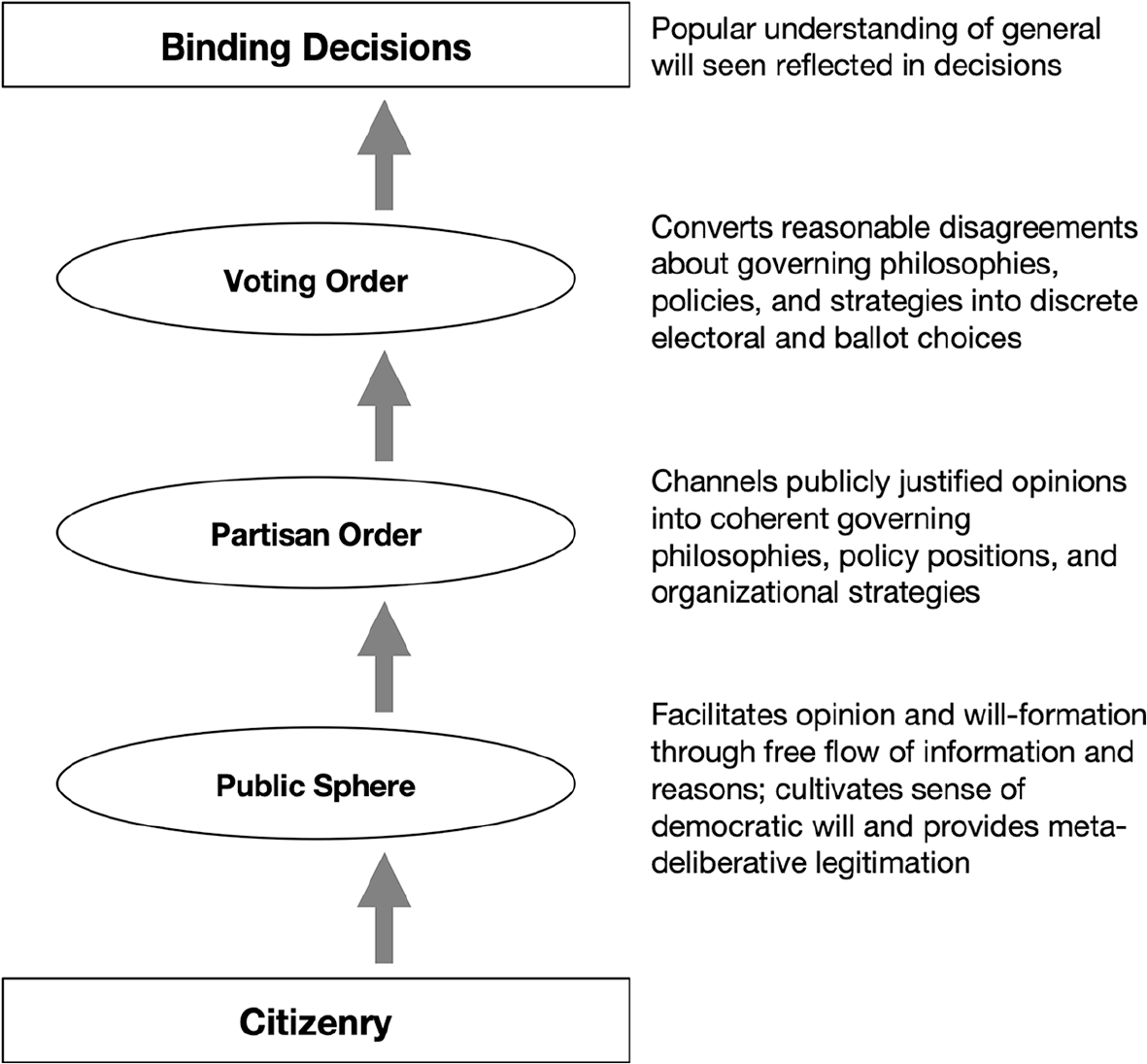
Ideal sequence.
We have also seen how, as orders of justification, each of these components has a corresponding narrative, which citizens, taking up a deliberative stance, 46 may thematize into focal points of justificatory challenges. The question for us is what happens to this sequence, the decisions that issue from it, and its overall legitimacy when one or more of these components is perceived to be compromised or challenged. Taking up a critical stance, we can use our systemic framework to anticipate possible points of weakness, contradiction, or perverse incentives in system components and their interrelationships. In so doing, we can anticipate ways they may be driven astray from their putative contribution to the deliberative system, fail to adhere to their justificatory narrative, and so, in the long run, fall to meta-deliberative challenges.
For example, we have seen how the partisan order draws legitimation from the narrative that it faithfully channels reasonable disagreements from the public sphere to the voting order. But motives for partisan action do not just come from the public sphere; the mechanistic character of the voting order also incentivizes among party elites a strategic orientation to winning elections. And victory, at least in modern capitalist democracies, often has at least as much to do with material resources and superior mobilization as it does the better argument. This can encourage party leaders, despite their nominal commitment to the general interest, to seek compromise and coordination with actors promoting nongeneral interests. This is most pronounced in the United States, where electoral success is dependent both on attracting large campaign donations and avoiding targeting by political action campaigns. But it is also the case in states where campaigns are financed publicly, where the provision of public goods promised by competing political parties is fulfilled (without raising taxes) through reliance on public debt—thus binding the state to interests of finance capital. 47
Richard Katz and Peter Mair describe an ongoing process of cartelization among major political parties, whereby they become increasingly disengaged from their bases in civil society and seek to become self-supporting entities geared primarily toward preserving their positions and power. 48 Features of cartelization include a tendency to turn to the state itself (especially in Europe) or private capital (especially in the United States) for their material support, a trend that also goes along with political campaigns becoming more capital-intensive and reliant on mass media instead of labor-intensive and reliant on activist labor and canvassing. As party elites increasingly evolve into a professional class in its own right, it also involves a convergence of party platforms and a narrowing of the scope of political competition, by either passing off policy areas to technocratic agencies or to the market, or by tacitly agreeing not to compete: “many issues are simply avoided by the mainstream parties as demagogic or populist, and the range of proposals offered for those issues that remain is often limited in the name of ‘realism’ or ‘responsibility.’” 49
Indeed, by 2016, major parties in the United States and United Kingdom had been on convergent paths for several decades, particularly with regard to matters such as economic regulation, public services, international trade, and legal immigration. Hence, though Republicans were known in the United States for being more hawkish on immigration, George W. Bush gave speeches in Spanish and touted guest worker programs; Democrat Barack Obama’s model for healthcare reform was modeled in part on ideas advocated by the Heritage Foundation and previously enacted by his 2012 Republican opponent. 50 In the United Kingdom, both Labour and Tory governments advocated austerity programs following the 2008 crisis. 51 Across North America and Western Europe, both center-right and center-left governments followed similar postcrisis strategies that relied heavily on bailouts to the financial system and extensive monetary stimulus from central banks. 52
The trends toward cartelization can also, in turn, have effects on how political debate is conducted in the public sphere. Between the high thresholds for inclusion in televised debates and the capital demands of advertisements, the increasing dependence of political campaigns on television and mass media have a strong status quo–reinforcing effect for major parties, who wish to keep political discourse narrowed while upholding the narrative that they represent the only “reasonable” alternatives. 53 Unfortunately, this dovetails with another trend in contemporary democracies: the concentration of mass media platforms into the hands of fewer and fewer private owners. Figures such as Rupert Murdoch, Lord Rothermere, or the Sinclair Broadcast Group, all of whom have pronounced conservative and neoliberal leanings, have outsized influence over public spheres in the United States and United Kingdom. Colin Crouch has argued that not only does this favor media coverage of some parties or political agendas over others, it also influences and constrains how politicians formulate their agendas. 54 Debate in the public sphere is reshaped around issues largely unthreatening to the interests of economic and political elites. In place of deliberative engagement, politicians rely on marketing and public relations consultancy to influence voter behavior, as well as rhetorical strategies that appeal to emotion, prejudice, or the sensationalist impulses of commercial media.
Habermas, in Between Facts and Norms, notes a tendency of democratic systems to exhibit a circulation of power in practice that is the opposite of what it is purported to be in theory, resulting in a default condition of political society being one of low mobilization and democratic practice being limited to periodic approval or disapproval through elections. 55 Public spheres in actually existing democracies tend to be overrun by power relations and dominated by mass media, greatly weakening opportunities for genuine “bottom-up” influence on the political process. 56 In our justification-theoretic reconstruction of three deliberative system components, we can posit an analogous “unofficial” sequencing between the three component orders (Figure 2) that stands in contrast to the “ideal” sequence described above. Major crises, however, have a way of politically mobilizing citizens in ways that draw these contradictions out into the open, leaving extant narratives of justification exposed to challenges.
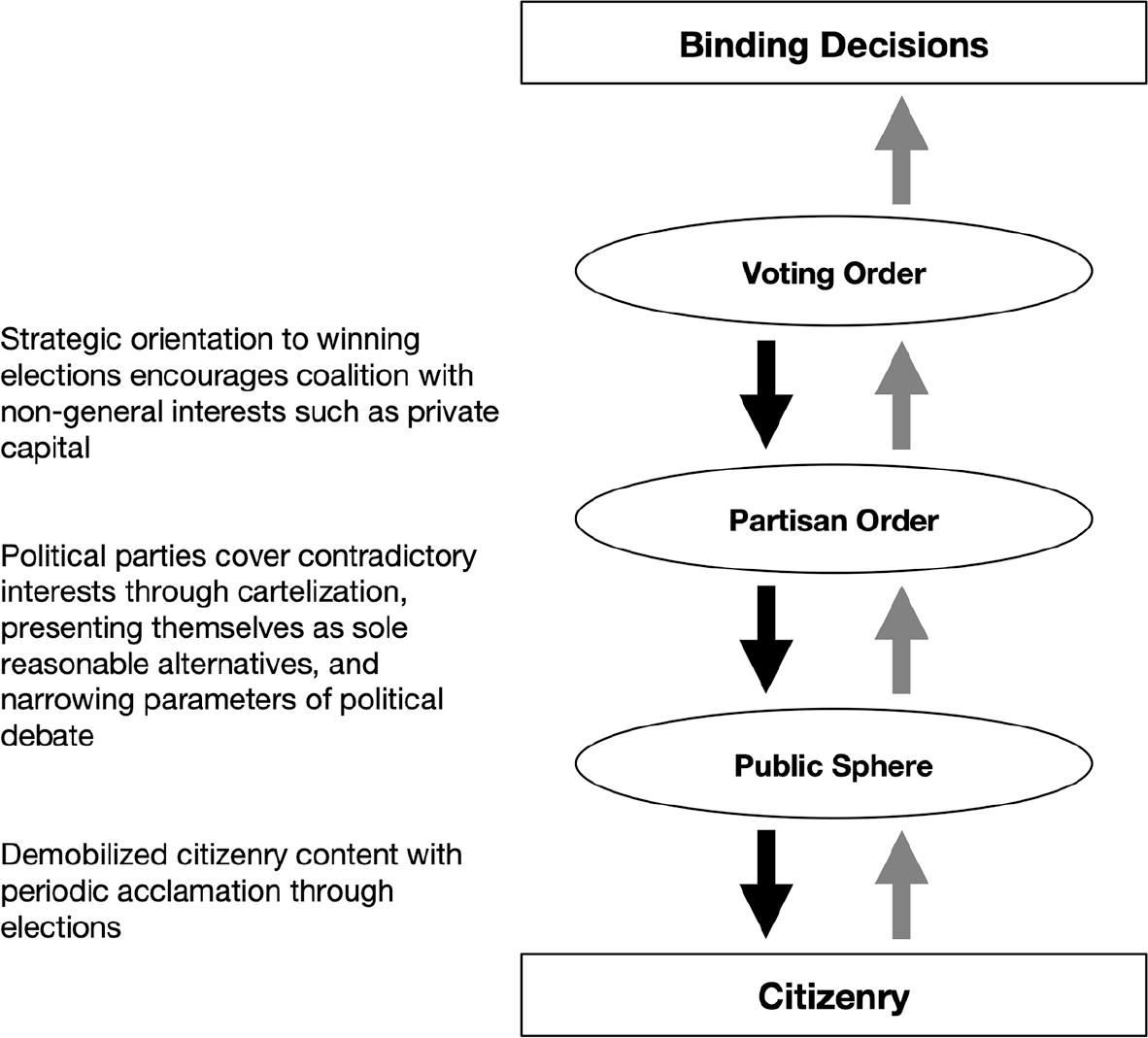
“Unofficial” sequence.
Legitimation and Justification Crises in the Deliberative System
We discussed above how the Brexit and Trump votes have been characterized as symptoms of a “legitimation crisis” that has been brewing since the 2008 economic crisis. But what happens during a legitimation crisis?
Hegelian-Marxist theories of politics and society frequently identify crises as moments for possible change, when an older, creaky paradigm finally crumbles, giving way to a new—and presumably better—order of things. In the pragmatist tradition, too, it is common to associate crises with paradigm shifts or revolutionary discourses. 57 Hence, Habermas, in both Legitimation Crisis and later in Between Facts and Norms, believes it possible for a broad sense of crisis consciousness to mobilize citizens to challenge an ossified political system, through upsurges in activism and participation and an expansion in the scope of “discursive will-formation.” 58 The justification-theoretic model we have been developing over the preceding pages can help us see why things may be more complicated.
Using our model, we can reconstruct the picture Habermas draws of a “successful” legitimation crisis—an “ideal scenario” in which a crisis-galvanized citizenry rejects the narratives of a detached and intransigent partisan order and reclaims the stage of public discourse (Figure 3). Mobilizing viable counternarratives through a discursive process of broadly general and reciprocal justification, the citizenry then throws its support behind new programs, new leaders, and new governing philosophies. The legitimation crisis becomes a contest for hegemony on the terrain of partisan realignment—a prospect consistent with recent diagnoses of a “crisis of party democracy.” 59 Of course, this ideal scenario presupposes a sufficiently robust and uncorrupted public sphere. A legitimation crisis signals a breaking up of the prevailing consensus surrounding a given justification narrative; it can only be resolved to the extent that the means of discursive opinion and will-formation remain sufficiently open for a successful meta-deliberative process. In Between Facts and Norms, Habermas believed it is still possible, even in a “more or less power-ridden public sphere,” for civil society actors to successfully reassert organized control over such a process in times of crisis. 60
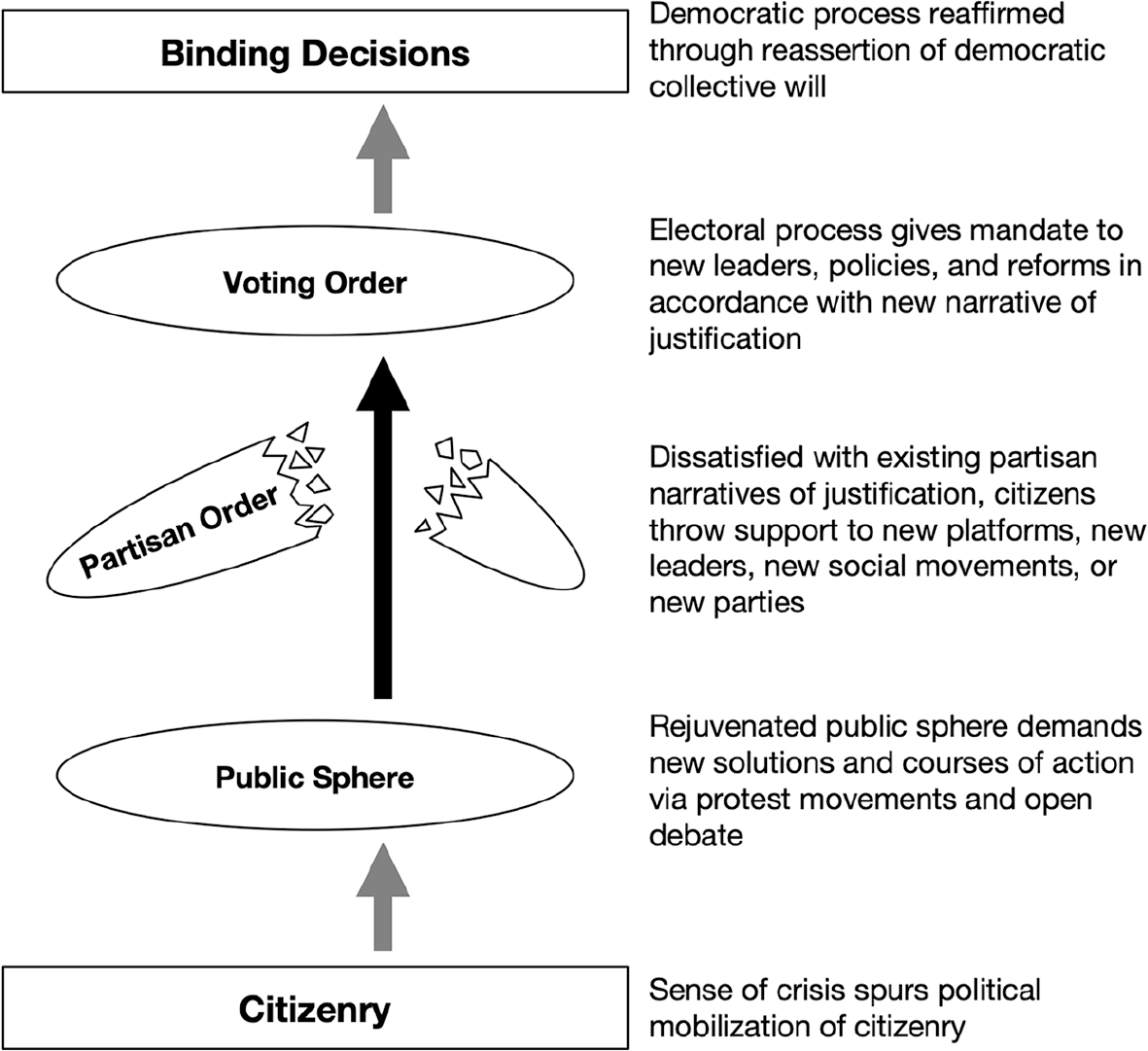
Legitimation crisis (ideal scenario).
There is no reason to discount this possibility out of hand; however, our model suggests another possible scenario, were the public sphere itself to be dragged into the fold of hegemonic conflict. As an order of justification, the public sphere too relies on a certain narrative and certain legitimation conditions. But this means the public sphere can also incur a loss of legitimation. When the hegemony of party elites began to falter in the 2015–16 campaign season, much of the treatment from media elites ran between bemusement and disdain. The most common trope was that figures such as Trump or Sanders (New York Times columnist David Brooks threw in Ben Carson and Jeremy Corbyn for good measure 61 ) were impractical, fringe, and unattuned to the realities of politics. MSNBC’s Chris Matthews derisively asked about Sanders’s supporters, “Can the kids behind him be told that this is how it works in our system?” 62 At one point, Sanders’s supporters even staged a march outside of CNN in Los Angeles to protest their candidate’s treatment. 63 Trump’s attacks on mass media, of course, have been a standard part of his political arsenal, with even Fox News receiving his ire early in the primary campaign. 64 By 2016, trust in media had reached a nadir. 65 At the same time, circulation of news online and independently of standard outlets was at a high. Alternative, ideologically oriented venues of varying quality and truthfulness were finding new levels of popularity. 66 And social media, which allows for information to be passed on rapidly and with comparatively less reflection, became a major conduit for the circulation of links to “fake news” sites, which attempt to make fabricated stories that go viral either for ideological ends or to profit from advertising revenue. 67
With minor variations, a related story can be told about the public sphere in the lead-up to the Brexit referendum. 68 In both cases, the major parties lost their ability to set the parameters of political discourse. However, as the justificatory narrative surrounding the partisan order was faltering, citizens alienated from established parties found themselves without a public sphere able to fulfill its narrative as the core arena for society-wide processes of opinion and will-formation. The meta-deliberative consensus had broken, but no meta-deliberation would be forthcoming.
This is where a legitimation crisis can pass over into a justification crisis (Figure 4). Recall how in the first section Fraser compared the moment to Gramsci’s idea of a “crisis of hegemony.” Indeed, in the Prison Notebooks, Gramsci describes such a crisis as a point at which parties lose the recognition of their constituencies. “When such crises occur,” he writes, “the immediate situation becomes delicate and dangerous, because the field is open for violent solutions, for the activities of unknown forces, represented by charismatic ‘men of destiny.’” 69 We are now in a position to describe this crisis in deliberative-theoretic terms. Having lost faith in the partisan order and the public sphere as legitimate sites for political problem-solving, citizens are left to make political decisions on the basis of snap judgments and prejudices untested by broad discursive justification. Broad-minded progressive visions fail to get a full rational hearing, while reactionary and exclusionary views fail to get adequately challenged. Universal healthcare, building a wall on the Mexican border, student loan forgiveness, a blanket ban on Muslims, raising the minimum wage, democratizing the EU, leaving the EU: all were portrayed as equally “populist” and equally fringe and—by perverse implication—equally valid. The political field is left open for charismatic figures to “break through” the discursive fog with simplified, emotional, or sensationalistic appeals to gather support for political agendas that should not pass deliberative-democratic muster (e.g., a bus making false claims about redirecting £350 million per week to the NHS, or Twitter rants about “radical Islam”), and using accusations of “lying media” or “fake news” to deflect criticism. 70
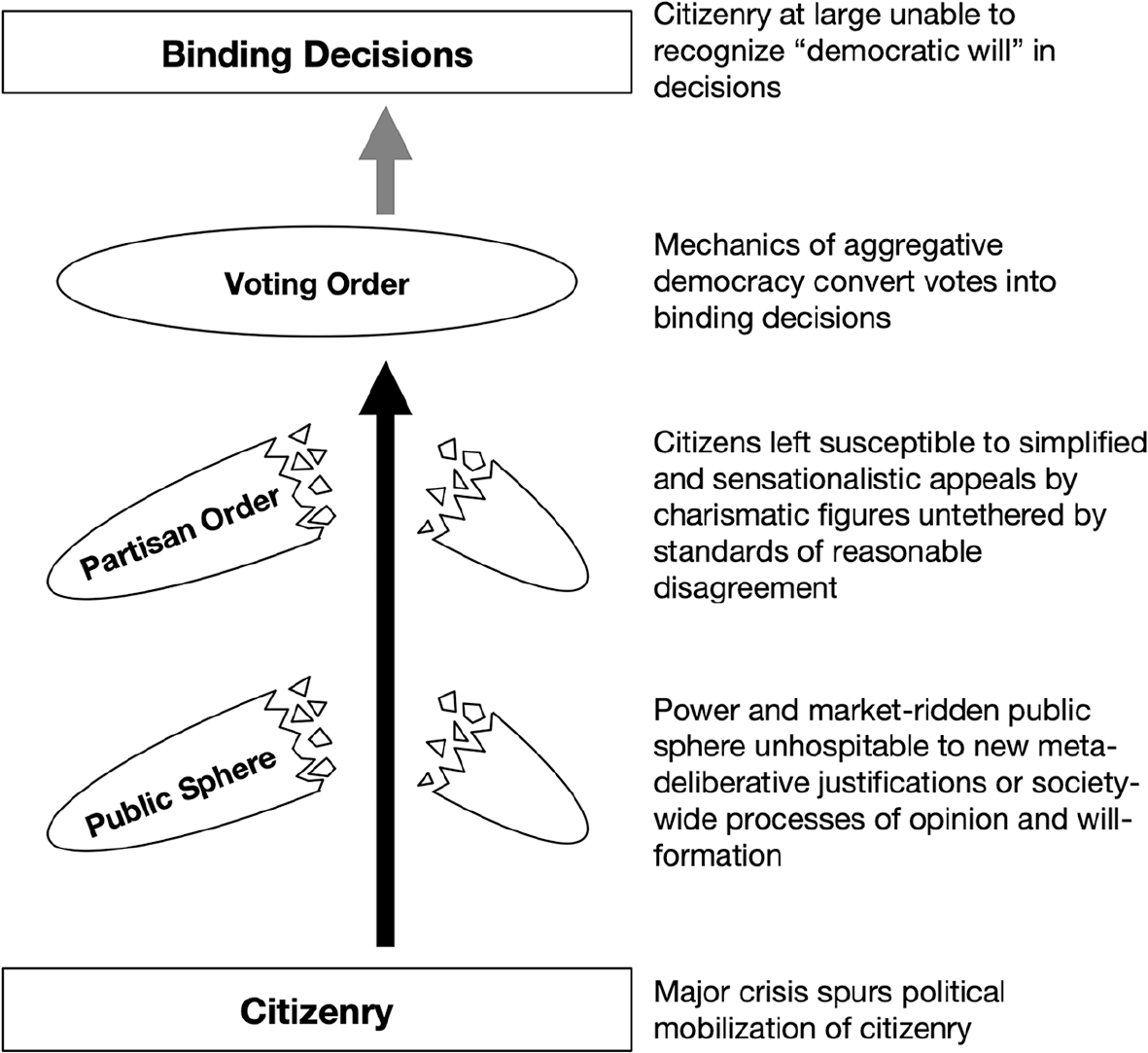
Legitimation crisis passes into a justification crisis.
Finally, the metastasized crisis is converted by the voting order into decisions that carry the force of law. As we have seen, the voting order’s narrative of justification mainly guarantees the integrity of voting process; the translation of the formal results of aggregative democracy into a reflection of the general democratic will must be provided by the deliberative and partisan orders, which together establish the set of electoral choices as being within the bounds of reasonable disagreement and therefore as alternative paths for the articulation of the public good. Absent the proper functioning of these other two orders of justification, the risk is that the voting order will generate formally legitimate binding decisions that the citizenry at large is nevertheless unable to recognize as the reflection of a collective democratic will.
Conclusion
We have long read about ways neoliberalism corrupts party politics and the public sphere; the above model helps us to understand why such a state of affairs is not just normatively undesirable but also unstable in times of crisis, with potentially disastrous consequences.
As stated at the beginning, the above is not meant as a complete explanation of the Brexit vote or Trump’s election much less a general account of the recent populist surge. Rather, it is to use these events to explore and demonstrate how deliberative systems theory can make sense of legitimation crises in contemporary democracies. Drawing on recent work by Rainer Forst, the framework I propose suggests we think of deliberative system components as orders of justification with accompanying justificatory narratives that are accessible to meta-deliberative scrutiny. Doing so not only allows us to reconstruct legitimation in deliberation-theoretic terms, it allows us to offer a differentiated framework that permits us to examine different kinds of legitimation challenges in the deliberative system and their possible ramifications.
One advantage to this approach is that it enhances the tools deliberative theory has for analyzing and assessing crises and crisis tendencies that may afflict democratic systems. This includes not only legitimation crises as such but also potential conflicts or complications within a deliberative system that may arise from them. In the case of Brexit and Trump, the framework allows us to follow the development of an initial set of post-2008 legitimation challenges that then, through a sequence of failures in the deliberative system, cascade into a justification crisis. Although I have focused on relations between the public sphere, the partisan order, and the voting order, these are neither the only components that can be analyzed as orders of justification, nor are they the only ones that may generate system complications. There is no reason this framework should not be amenable to further articulation and application to other cases and contexts. By analyzing the possibilities for crisis that may result from declining legitimation in one or another portion of the deliberative system, we obtain a clearer view of how these various components of the system work together, as well as what is at stake when they don’t.
More pertinently, this approach affords us a sharper perspective on what is required for deliberative systems to guarantee processes and decisions that citizens can recognize as the justified expression of a collective democratic will. Deliberative systems theory offers a compelling means of viewing how, in complex societies, various necessary functions of democracy must be fulfilled by distinct components of a mass-scale democratic machinery. I have here used the term “justification crisis” to describe a situation in which one or more such components break down, resulting in a situation whereby a citizenry cannot make justificatory sense of its own ostensibly democratic decisions. Perhaps ironically, the prospect of such justification crises testifies to the importance of the deliberative-democratic project, as it demonstrates how elections and voting by themselves are not sufficient for robust democratic legitimacy, as such legitimacy relies in the end on society-wide processes of public justification, deliberation, and meta-deliberation. As twenty-first-century societies hurtle from crisis to crisis, it is more crucial than ever that citizens have confidence in their abilities to understand themselves as democratic coparticipants in the making of decisions to which they are subject.
Footnotes
Acknowledgements
Earlier versions of this essay were presented at the Philosophy and Social Sciences Conference in Prague, the ECPR General Conference in Oslo, the Centre for the Study of Global Ethics at the University of Birmingham, the Normative Orders Annual Conference at Goethe University Frankfurt, and the APSA Annual Meeting in Boston. I must thank Afsoun Afsahi and Miriam Dajczgewand Świętek for their irreplaceable support and for reading and commenting on several drafts of this essay. I would also like to thank Ilaria Cozzaglio, Nicole Curato, Rainer Forst, James Ingram, Jason Mast, Noëlle McAfee, Darrel Moellendorf, Merten Reglitz, Johannes Schulz, Fabio Wolkenstein, editor Lawrie Balfour, and two anonymous reviewers for their helpful comments, discussion, and encouragement.
Declaration of Conflicting Interests
The author declared no potential conflicts of interest with respect to the research, authorship, and/or publication of this article.
Funding
The author received no financial support for the research, authorship, and/or publication of this article.
