




Abstract
Meaning in life is a key aspect of our well-being and is a central issue within the field of existential health. Knowledge is scarce on the experience of meaning in life of people living with dementia. Dementia is defined as loss of memory and other cognitive abilities, reducing the person’s ability to perform activities of daily living. This poses challenges to interviewing and including persons with dementia in qualitative research. In this study we explore how nursing home residents with dementia experience meaning in life, and how they can reflect on this existential question. We used an exploratory qualitative design with semi-structured interviews of ten people with mild to severe dementia living in one nursing home and found that conversations about meaning in life with persons with dementia were feasible. Some memories of the past were told as if they were happening here and now, and some topics were repeated several times throughout the interview. This study highlights the importance of awareness of existential themes and interventions facilitating meaning in life for this population, despite certain challenges to be overcome. The past and present merge, giving their stories a unique character. This holds significance for the moment by providing insight into how cognitive impairment might affect the perception of time. It is important to acknowledge this perspective and understand that meaning in life may be connected to memories and experiences from the past, and that this might be more prominent for this group than others.
Introduction
Dementia currently affects approximately 55 million people worldwide, a figure that is estimated to increase to 152 million by 2050 (World Health Organization [WHO], 2018). In the context of Norwegian nursing homes, about 80% of long-term residents have dementia (Røen et al., 2017). Dementia is characterized by memory loss, impairment in abstract thinking (American Psychiatric Association, 2013; WHO, 1993) as well as in other cognitive functions and activities of daily living (Gale et al., 2018). Dementia is therefore also an existential challenge when the cognitive abilities necessary for the coherence in life are reduced (Wogn-Henriksen, 2012).
Person-centred care (PCC) is a basic principle in dementia care (Livingston et al., 2017; The Norwegian Ministry of Health and Care Services [NMHC], 2025). It focuses on offering individually tailored care, based on the individual’s values, needs, subjective experiences and well-being (Kitwood & Bredin, 1992). Central to PCC approaches is the implementation of personalized care to enhance residents’ autonomy, choice, sense of personal control, independence and interactions with other residents and staff (Brownie & Nancarrow, 2013). Edvardsson et al. (2010) added an existential dimension to PCC: ‘promoting a continuation of self and normality’. Accordingly, PCC gives an existential experience of being a whole person rather than just being reduced to a patient, a disease, or a task.
To cope with distressing emotions, Clare et al. (2008) in their qualitative exploratory study found that nursing home residents generally tried to accept and make the best of things and affirm their past sense of self and identity, but there were also some residents who expressed anger and frustration. Furthermore, Mjørud et al. (2017) report in their qualitative explorative study that the nursing home residents were content with life in general, but that everyday life was experienced as boring. They argue that the sense of contentment is based on acceptance of certain facts of reality and the ability to adjust expectations (take things as they are). Existential care in nursing homes should be attentive to the person’s existential questions, needs, and resources, and listen to the meaning that these have in the person’s life (Stifoss-Hanssen, 1998; Stifoss-Hanssen & Kallenberg, 1998). To find a meaning and purpose in life can be difficult for people who are spending the last part of their life with reduced abilities in an institution.
Meaning in life
From the perspective of existentially oriented psychology, meaning in life is a growing research interest. Various approaches have investigated both general populations and specific groups (Schnell, 2025; Steger, 2022). Studies among elderly individuals have found that a sense of meaning or purpose in life is significantly associated with a reduced risk of dementia. For example, Sutin et al. (2021) conducted a meta-analysis revealing that individuals with a greater sense of purpose had a 23% lower risk of developing dementia. In addition, professionals working in specialized dementia care may view meaning in life as a core component of effective PCC. Isene et al. (2021) argue that meaning in life is as important for persons with severe dementia as it is for everyone else. However, without a clear conceptual understanding of meaning or purpose in life, these aspects can be overlooked in research and practice in favour of related areas, which are central to PCC, such as quality of life emphasizes purpose, understanding, responsible action and enjoyment/evaluation. Park (2010) distinguishes between global and situational meaning and understanding meaning-making related to adjusting appraisals or beliefs to restore coherence after stressful events.
While valuable insights are brought to the fore by the mentioned and several other scholars, we have used the model of Tatjana Schnell in this study.
According to Schnell (2020), meaning in life includes three dimensions: meaningfulness, crisis of meaning, and sources of meaning. Meaningfulness is defined as a basic trust that life is worth living based on a (mostly unconscious) evaluation of one’s life as coherent, significant, oriented, and belonging (Schnell, 2025). The second dimension is crisis of meaning, defined as the judgement of one’s life as frustratingly empty and lacking meaning. This is on a parallel dimension to meaningfulness, making it clear that low meaningfulness is not necessarily accompanied by a crisis of meaning. Finally, sources of meaning represent a variety of experiences that give meaning to life when actively pursued.
An advantage by Schnell’s model related to studies including persons with cognitive impairments is the experiential aspect – the underlining of ‘mostly unconscious’ – in the appraisal of life as meaningful. Furthermore, Schnell includes the dimension of belonging into meaningfulness, in addition to the three facets suggested by others, as shown. Belonging refers to the felt connection to something beyond the self – be it people, nature, culture, tradition, a cause, or the transcendent. It reflects embeddedness and relatedness as an existential grounding. In Norway, aspects of belongingness, such as place-belongingness and nature connectedness, have been found to be associated with meaning (Grau-Ruiz & Løvoll, 2025), as well as the sense of belonging to the welfare state – and also, for the majority of the population (particularly among the elderly), political movements and The Church of Norway or other religious communities (Lundby & Repstad, 2018). However, affiliation with religion has decreased during recent decades in Scandinavia, yet a sense of belonging persists (Lemos & Puga-Gonzalez, 2021). Schnell is unique in including belonging as a core facet of meaningfulness – not just a source or outcome. This concept extends beyond social bonding to include spiritual, cultural, and ecological belonging. It is broader than typical psychological models and expands the understanding beyond goals, coherence, and values – grounding meaning in being embedded, connected, and part of something larger, not only as sources of meaning but as a core dimension of the experience of meaningfulness, or, in other words, the (often unconscious) evaluation of life as worth living.
Furthermore, Schnell’s model is developed from large psychometric studies where factor analyses, along with theoretical anchoring in existential psychology, generated 26 types of ‘sources of meaning’, grouped into categories like self-transcendence, order, well-being and relatedness, and, in the Norwegian version, liberality (Sørensen et al., 2019). These empirically derived categories provide insight into where people derive meaning – for example, nature, tradition, generativity, fun, and health. Unlike Steger’s binary ‘presence vs search’ model (Steger, 2022), Schnell includes ‘crisis of meaning’ as a separate dimension, not just low presence or high search, and she identifies a group of people who are not in crisis but also don’t experience much meaning and are okay with that (Schnell, 2010). This challenges the assumption that meaning is always necessary for well-being or quality of life, even though, for a majority, it has been shown to have beneficial health effects, increase resilience, and buffer the effects of stress (Schnell & Danbolt, 2023; Schnell & Krampe, 2022).
Meaning in life for residents with dementia in nursing homes
It is argued that dementia can be a threat to the experience of meaning in life as it leads to isolation from self-awareness (Isene et al., 2021). Nursing home residents can report restricted freedom and feelings of homesickness, as well as distressing emotions relating to loss, isolation, uncertainty, fear, and a sense of worthlessness (Clare et al., 2008; Heggestad et al., 2013). This can be a significant threat to people’s sense of belonging (Isene et al., 2021).
Dewitte, van Wijngaarden, et al. (2021) argue that coping through acceptance can be seen as an accommodating meaning-making process that sustains coherence. However, coherence is arguably the biggest loss related to meaning in life as the timeline seems to be cut, and the connection to the identity and the person that once existed appears inaccessible (Schnell, 2020).
Research indicates that for individuals with dementia, meaning in life is closely associated with elements such as social connections, autonomy, freedom, acceptance, and personhood. Dewitte, van Wijngaarden, et al. (2021) conducted in-depth interviews with older adults diagnosed with Alzheimer’s disease, revealing that maintaining personal identity and engaging in daily activities contribute significantly to a sense of continuity and meaning. The engagement in meaningful activities has been strongly linked to enhanced quality of life among individuals with dementia. Such activities address psychological and social needs, fostering connectedness, personal identity, autonomy, and empowerment. Harmer and Orrell (2008) emphasize that activities for people with dementia extend beyond mere pleasure, serving as avenues for social interaction and self-expression.
Furthermore, the concept of continuity, or the ability to maintain aspects of one’s previous lifestyle, plays a crucial role in preserving meaning for those with dementia. Menne et al. (2002) and Phinney (2011) highlight that continuing valued interests and routines helps individuals retain a sense of normalcy and personal identity. Dewitte, van Wijngaarden, et al. (2021) also underscore the importance of the past in shaping present meaning, noting that reminiscing and integrating past experiences contribute to a coherent sense of self.
In addition, Isene et al. (2021) explore the role of meaning-making in individuals with severe dementia, interpreting their expressions and behaviours as narratives of embodied meaning. This perspective suggests that even in advanced stages, individuals with dementia engage in processes that contribute to their sense of meaning.
In summary, fostering social connections, promoting autonomy, facilitating engagement in meaningful activities, and supporting continuity of life experiences are integral to enhancing the sense of meaning in life for individuals with dementia.
Qualitative interviews and dementia
There are conflicting conclusions on how people with dementia can cope in qualitative interview situations. Abendstern et al. (2020) found that those with a mild degree of dementia rarely generated elaborate answers in a structured interview setting. Others have found that people with cognitive impairment, including those with dementia, are able to describe their situation, and communicate their views and what that is important to them (Cahill & Diaz-Ponce, 2011; Hoel et al., 2021; Mjørud et al., 2017). One study found that residents do this while being grounded in a strong sense of self and identity (Clare et al., 2008). Dewitte, van Wijngaarden, et al. (2021) found that participants were able to talk about their experience of meaning in life although they showed hesitation and had difficulty finding words. Wogn-Henriksen (2012) emphasizes the role of the interviewer in this process and how conversations with residents can be facilitated to provide a detailed understanding of their experiences. All the above studies had similar forms, described as in-depth interviews, explorative design with semi structured interviews.
Objectives and research questions
The present study therefore set out to explore, first, how nursing home residents with dementia experience meaning in life (i.e. how they articulate this in an interview).
Second, we aimed to explore the process of interviewing residents with varying levels of dementia. Is it possible for nursing home residents with a mild to severe degree of dementia to elaborate on such existential questions? This differs from conversations about concrete topics such as physical activity and eating.
Design and methods
We chose an exploratory design using a semi structured qualitative interview with the residents. One semi-structured interview guide was developed based on the Meaning and Purpose Scale (MAPS) (Schnell & Danbolt, 2023), tapping into the theoretical framework of Schnell. Three aspects of meaning in life were addressed: meaningfulness (experiencing life as meaningful), crisis of meaning (experiencing life as frustratingly empty), and two sources of meaning (religion and companionship) that are found to be related to meaning in life for older adults (Hupkens et al., 2018; Schnell, 2009).
Participants and settings
The nursing home staff used the Clinical Dementia Rating Scale (CDR) (Hughes et al., 1982) to assess the level of cognitive impairment and the level of dementia. CDR 1 is considered mild, CDR 2 moderate, and CDR 3 severe dementia. The CDR score was not known to the interviewer prior to the interviews.
As a first step, we interviewed six patients (three had CDR 2 and three had CDR 3). We next included four more participants with mild and moderate dementia (CDR 1 [n=2] and CDR 2 [n=2]). The functional level of the ten participants varied from some degree of independence to completely in need of care. Inclusion criteria were: 1. diagnosis of dementia, 2. permanent resident in a long-term nursing home, 3. no severe speech or hearing impairment, and 4. the ability to participate in an interview. The nursing home staff provided a list of eligible participants based on the inclusion criteria. Participants were recruited from one nursing home in Norway. The nursing home is situated on the outskirts of a medium to large Norwegian municipality. All participants were referred to the nursing home because they needed extra care. This nursing home is located within a small local community in an agricultural district. It comprises two standard nursing home units, each accommodating approximately twenty patients.
We have not gathered data about the rest of the residents in the nursing home, but the national number says that three of four are 80 years or older (Hoen & Abrahamsen, 2025) and about 70% of the residents are women (Helvik et al., 2015). Studies have estimated that 84% of all the residents have dementia and more than 90% of the residents 70 years or older have dementia (Gjøra et al., 2020).
One interview was carried out by the first and the third author, while the remaining interviews were carried out by the first author. Both interviewers had previous experience with talking to older adults with dementia. One of the interviewers was a psychologist, the other a registered nurse.
Measurements
Interview procedure
Every interview started with a casual conversation. It focused on making the participant feel safe and emphasized that the interview was not a test.
We adapted the questions to this population by considering the challenges associated with dementia. The focus here was to make the questions short and easy to understand. In addition, the following recommendations from previous research ensured conduction of the interviews in an ethical and sensitive way, by
Adapting to residents’ individual needs.
Showing empathy, respect and having a positive attitude in the interview.
Giving residents the time they needed.
Active listening.
Reducing demands on the participants’ long-term memory.
Being actively involved without overriding the participants’ own voice and associations (Wogn-Henriksen, 2012).
We used one interview guide for the first six interviews. The questions were adapted to persons with cognitive decline. The interviewers asked the participants to elaborate with examples, for example, by asking ‘Could you tell me some more?’ or rephrasing the question. The focus was on gaining an understanding of what was meaningful and important to them, through stories and descriptions of situations and experiences that held significance for them.
A few problems arose when using this interview guide: the difficulty of grasping other sources of meaning than the ones specifically asked about, and to know whether participants had understood a question when they only answered yes or no. In fact, we found that residents were able to provide elaborate answers. Therefore, we created a second interview guide for the last four participants to allow the participants to elaborate more on the questions.
The second interview guide included a few opening questions, such as ‘How would you describe your life now?’ In this guide, the interviewers did not use a fixed set of questions; instead, the guide was a set of many open-ended questions covering the three main domains of meaning in life. The focus was still on gaining an understanding of meaning in life and to create a more conversation-like interview setting. One challenge across interviews was to find a way to help and guide the participants without leading them. An English translation of the semi-structured interview-guides are found in Appendix 1.
Analysis
Audio recordings from the interviews were transcribed verbatim into 113 pages of text. For the first aim, we used systematic text condensation (Malterud, 2017) to analyse how nursing home residents with dementia experience meaning in life.
Systematic text condensation (Malterud, 2017) is a pragmatic method of cross-case thematic analysis specifically developed for qualitative health research. Pragmatism is essentially about ‘what works’ and solutions to problems (Creswell, 2003). Questions about ontology and epistemology is not in focus, rather the central issue is the research problem (Creswell, 2003; MacKenzie & Knipe, 2006). The following four steps were included in the analysis: (1) establishing an overall impression of the data and creating preliminary meaning units, (2) identifying and sorting meaning units, with a focus on meaning in life, (3) creating code groups representing the content from the individual meaning units made in the previous step, and (4) synthesizing and summarizing previous steps. In step 1, we read thoroughly through the data to create an overall picture. We looked for various preliminary themes in the text and divided them into preliminary analysis groups. Four of the authors read the material independently to form a general impression of the entire data set and to identify preliminary units. In step 2, we identified meaning-bearing units. The themes found in the previous step were converted into codes and the units were systematized. The texts selected contained knowledge about the different themes from step 1. This step was guided by the theoretical framework of Schnell (2020). The authors met again to discuss these units and to further code groups. In step 3, we extracted what the code groups represented and excluded the code groups which we found not to be meaningful. At this stage, an artificial quote, a condensate, was created.
We looked for categories related to the three dimensions of meaning in life using an inductive and iterative approach (Malterud, 2017). The first and third author further analysed the material by sorting and abstracting the content from the individual meaning units, which finally was discussed with all authors. In step 4, the previous steps were summarized. The analysed material was as a last step validated against the transcribed interviews. See Table 1 for an example of the analysis steps.
Example of the systematic text condensation.
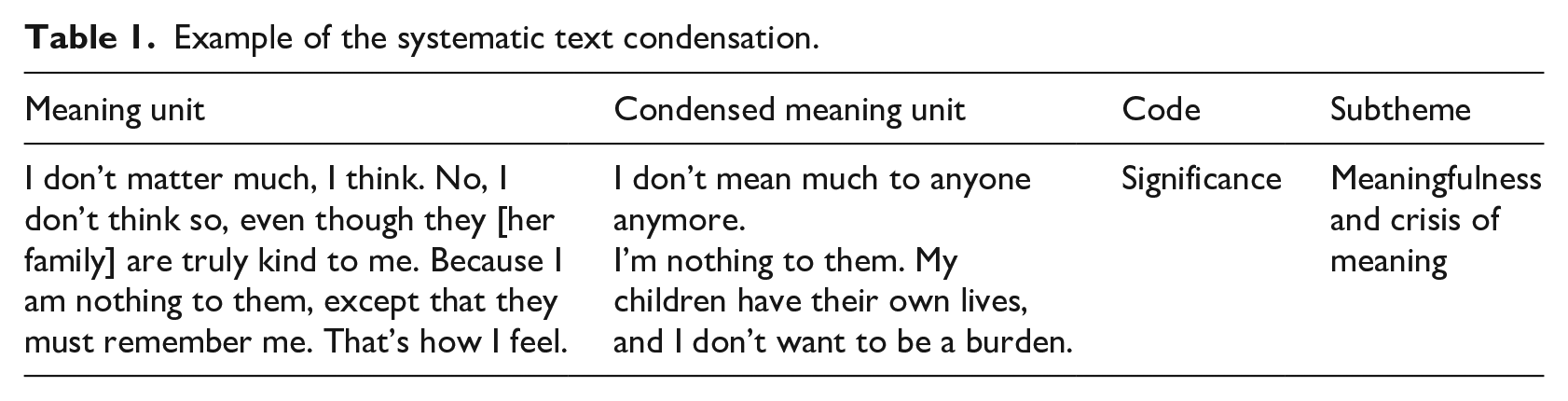
Since we used a semi structured interview guide, based on a theoretical perspective related to ‘meaning in life’, the starting point was deductive. However, we wanted to get the participants’ story, and we analysed what they said in a conversation, thus this part must be characterized as inductive. It is the participants’ personal perspective and the conversation with the interviewer leaving space for participants’ individual experience.
Ethical considerations
The study followed the ethics guidelines of the National Research Ethics Committee for the Social Sciences and the Humanities to address ethical considerations. In accordance with national regulations, this study is not within the legislation of the Regional Committees for Medical and Health Research Ethics. The research institution has approved the data collection, data analysis, and publishing of the findings. The project was approved by the Data Protection Officer of Innlandet Hospital Trust (Reg. No. 13780627). A text message about the study was sent by phone from the nursing home to family members. The message also included the contact details of the first author to enable family members to object to participation of their relative or ask questions. Nursing home staff informed residents about the study on the day of the interview. The participants were visited in their private rooms and received information about the study and gave verbal and written informed consent. Capacity to provide informed consent was based on an assessment made by nursing home staff and the interviewers. The interviewers were attentive throughout the interview to any sign of distress and initiated regular breaks as well as asking participants if they were happy to continue. The data collection took place between October and December 2021.
Results
The findings from our study are presented below as two main themes based on the research questions:
The residents’ experiences of meaning in life. 1.1. Meaningfulness and crisis of meaning 1.2. Sources of meaning
The process of interviewing persons with dementia about an existential topic. 2.1. The resident’s perspective 2.2. The interviewer’s perspective 2.3. Experiences of meaning in life in relationship to the severity of dementia.
The residents’ experience of meaning in life
Close relationships, memories, and religion emerged as themes associated with the experience of meaning across interviews. Other sources of meaning mentioned were activity, social contact, animals, traditions, health, and generativity.
The understanding of meaning was identified through the data analysis and organized into two main categories: meaningfulness and crisis of meaning, and sources of meaning. The categories describe what the participants emphasized in relation to their experience of meaning in life. The presentation of the results is based on these categories.
Meaningfulness and crisis of meaning
Some participants talked about their daily life as meaningful and explained, ‘Yes, as long as I can be healthy and happy’, ‘Yes, because I have my family’ or ‘Life is meaningful when I can teach my grandchildren what my parents taught me’. One resident wanted to stay alive: ‘I want to stay for as long as I can’. However, some residents experienced life here and now as frustratingly empty and lonely. Some pointed to their lack of significance, for example, I don’t matter much, I think. No, I don’t think so, even though they [her family] are truly kind to me. Because I am nothing to them, except that they must remember me. That’s how I feel.
Some indicated feeling useless and restricted, for example, To live is to do something for others too, you know. And that . . . I can’t do anything for others. Well, honestly, I don’t know what to say because there is a limit to what I can do from now on. I don’t know how to say it, but . . .. There should have been more, maybe activities that we could have joined. I think that’s a little sad. There is a limit to how much you can do. I think it’s sad.
Many, however, would still emphasize that life was not meaningless and focused on what used to give them meaning. Some seemed to look back on their life and describe it as a good, meaningful life, which was then their basis for how they would describe their life, even when they found it empty or meaningless today. Furthermore, a few residents talked about accepting life as it is now: Well, [. . .] Now it is too late to do anything over again. Yes, now you just must accept it, I mean. I think I did the best I could. I have done the best I could, I think. But you should probably not demand anything when you’re so old, you just have to accept it and take it as it comes.
Sources of meaning
Close relationships, memories, and religion were emphasized across the interviews. The residents explained that they wanted to have social contact but not as much as they used to. They mentioned activities, animals, generativity, traditions, hobbies, care, social contact, health, being out in nature, and social engagement as important sources of meaning. Below is a more detailed description of the subcategories that we found.
Close relationships
A key focus across interviews seemed to be on close relationships with others. Most residents mentioned their family as the most important thing in their life. One resident said, ‘Family means everything’, and others referred to their family as a ‘pillar in life’ and ‘something to lean on’. They emphasized the importance of perceived support and belonging in the family. When asked about meaning and what her family meant to her, one resident said, Well, because I have my family. We cooperate. We don’t fight and we’re one together. I have pictures of them hanging on my wall. I look at them when I’m resting, and it helps me relax. I am so happy to have my family.
Memories
Residents seemed to focus on their past life rather than the here and now when they talked about meaning in their life. They talked about memories from their childhood, their parents, traditions they used to have, their work, experiences from World War II, and situations and experiences with other people, both positive and negative ones. Some memories were told as if they were happening here and now, and some were repeated several times throughout the interview. For example, when asked if she found her life meaningless, one resident said, No. I have lived, I have lived! I have experienced so much. Both good and bad.
Religion
Most residents reported having a connection to God and practising different religious rituals. However, they seemed to describe and keep their religion private. One resident pointed out the aspect of belonging: ‘I feel at home when I’m in church’, although she was no longer able to go to church. Some also seemed to emphasize finding safety and support in their prayers: My grandmother was deeply religious. But I can’t say that I’m directly religious myself. But I say my evening prayer every night, I do. Especially when something is difficult to deal with, then I send a prayer. I guess I do it because I trust that it might help me.
Activities
Some residents said they wished there were more organized social activity in the nursing home and described their life as passive, for example: Activities here? Not at all. You get dressed if you can manage it yourself, then you eat and sit there and do nothing. You can go in there and look at them. Until the next meal, but there is nothing for them! Nothing!
Another resident said, . . . I have always had something in my hands and . . . And now I’m sitting with my hands in my lap, there is nothing. I think that’s sad.
Animals
A few residents mentioned missing their pet and wished there were animals at the nursing home. One resident talked about what animals had meant to her during her childhood: I don’t know but the animals really gave me what no human could give me. Because going down to the barn to the animals it was somehow so nice and calm. I walked up to the animals, the cows, the sheep, whatever and cuddled them. Then they gave that back to me. They, I don’t know how to say it, at least they made me feel secure.
Companionship
Responses regarding spending time with others varied. Some said they would rather be alone because they did not enjoy the conversations other residents were having. For example, they talked too much about illness or simply did not have the same interests. Others said they enjoyed socializing but only to a certain degree without giving further explanation: Yes, I do, you know, but not too much of it, not too many.
Some emphasized that they felt lonely and that it was difficult to find someone to be with. One resident found it difficult to start a conversation: Yes, I think that’s nice many times. But other times it’s terribly difficult too, you don’t really know how to get it [the conversation] going.
Health
Residents rarely mentioned dementia, but one resident felt sad because she had been diagnosed with Alzheimer’s disease. Instead, the focus for someone seemed to be on their physical health and whether they could ‘contribute’ or do things they used to do.
[. . .] being healthy is probably the most important thing. Because if you’re not, you don’t have much to contribute, you know.
The process of interviewing persons with dementia about an existential topic
The resident’s perspective
It was important to talk about life experiences that evoked painful feelings and emotions such as death, loss, illness, trauma, grief, meaninglessness, and hopelessness. These topics needed space in several interviews and residents seemed to appreciate talking about them. Furthermore, some residents worried that the questions would be too difficult for them to answer and that they would perform badly in the interview. The interviewer sometimes asked if it was ok for her to give an example of a question, and when the resident said yes, she gave an example. In these cases, the residents quickly seemed interested, and the interview continued. At the end of the interview, the residents were asked about their experience of participating: I think it went well. You didn’t rush me, and you took things slowly, that’s important in a situation like mine. . . . surprisingly well. I was able to say things as they are, thank you. It has been very nice. It’s been very good because much of what we know goes with us to the grave.
The interviewer’s perspective
There were some difficulties in interviewing residents linked to the impairments associated with dementia such as memory loss, language impairments, or problems with focus and attention. This meant guiding some residents back to the topic, reminding them of what had been said. Moreover, the participants’ ability to express themselves seemed to vary according to the severity of their dementia. To some, certain concepts needed to be explained by using synonyms or gestures (such as ‘praying’). One participant confused ‘meaning’ with ‘opinion’, and one initially talked about meaning of life. Another challenge was whether to orient the resident back to the present, as they tended to talk about the past. Despite these challenges, we found that the residents were able to elaborate and articulate their experiences.
Experiences of meaning in life in relationship to the severity of dementia
We observed certain similarities and differences in the experiences of meaning according to the severity of dementia, although we had not set out to explore this. Some of those with mild dementia explained that their life was lonely and empty, and they were more in a state of ‘crisis’ than those with moderate or severe dementia. Residents with mild dementia also varied in how they coped with this. A few seemed to focus on acceptance, while others expressed frustration and sadness and seemed troubled by a longing to go home. Moreover, only residents with a mild level of dementia mentioned being diagnosed with dementia had been hard for them. Those with moderate to severe dementia seemed to be more confused about where they were. They also focused more on appreciating what they were provided with at the nursing home. They mentioned ‘good care and help’, ‘everyone is so kind here’ and ‘we have food and a place to live’. Furthermore, some of these residents gave short answers and did not elaborate, while others talked much more and quickly made associations. Overall, all residents looked back on their life when they reflected on their experience of meaning. However, those with a mild degree of dementia seemed to be suffering more from homesickness and the grief that came from reflecting on their daily life as empty and lonely, in addition to being more aware of their diagnosis.
Discussion
The residents’ experiences of meaning in life
The results of our interviews support existing evidence that interviewing persons with dementia is challenging. They are a heterogenous group in terms of their personality, cognitive abilities, and levels of introspection. Nevertheless, these interviews show that people with dementia can reflect on abstract topics such as meaning in life, and that these conversations are appreciated and needed in nursing homes. In a way these interviews related to meaning in life focus on the autonomy and strengthen the person-centred approach. What our residents at this nursing home tell us, ‘This is my life, this is how I have lived, and these are my values in life’.
Even though there was a slight difference in the interview guide and the first six participants did not receive the same open-ended questions as the last four, this did not limit the resident perspective but made it possible for the persons to resonate on the questions asked.
Our findings suggest that there are some similarities in residents’ experience of meaning in life. Having lived a life that they described as a ‘good life’ could contribute to their experience of meaningfulness even if they found that their current life lacked sources of meaning. The residents based their experience of meaning on the life they had lived and associated meaningfulness with past experiences and memories. Moreover, acceptance of their situation was emphasized in several interviews and might be a protective factor against crisis of meaning.
Close relationships
The residents emphasized the importance of close relationships when they talked about meaning in life. Similarly, Dewitte, Vandenbulcke, et al. (2021) found that family relationships were most important to residents with Alzheimer’s disease. However, in their study, close relationships were not related to the experience of meaningfulness. This contrasts with our study, where family and close relations were associated with the experience of belonging. For these residents, it was belonging to their family that provided ‘meaning in life’. A few residents also referred to the support they experienced from their family. They may have felt the support to be a resource to help them cope with life and the support is connected to coherence through coping.
Coherence
Coherence is based on the experience that our actions, perceptions and goals make sense and are consistent with each other. In our study, residents spent most of the interview talking about their life and telling life stories. Life stories are found to be important to maintain a sense of identity and coherence in life (Hupkens et al., 2018; Schnell, 2020). According to McAdams (2001), life stories can help us maintain our identity, by putting different appearances and events in a meaningful order (McAdams, 2001; Schnell, 2020). The repetition of certain stories, as seen in our participants, is common in patients with dementia, and such stories may create meaning, maintain a connection between the past and present, and thus provide a sense of coherence.
Some memories of the past were told as if they were happening here and now, and some were repeated several times throughout the interview. It seemed that the residents past experiences added to the experience of meaning in their daily life. It was also mentioned by one patient that she felt safe when she went to the church. This was just one example of activities participants talked about as something that they were still doing, even though this had happened in the past. Patients with dementia have impaired memory, but our participants also demonstrated a broken timeline for past experiences where they mixed up past and present. The past was the present.
Moreover, although residents felt that life was empty today, they also found it meaningful because they had lived a meaningful life. In their stories, the timeline had almost dissolved. The function of this was not just to focus on who they are now, but to draw meaning from the life they have lived. What we call the ‘present past’ has significance for the experience of meaning, because it makes the person experience life today as meaningful. The residents’ life story was not experienced chronologically but with the past and present intertwined. A key issue in the interviews was whether to orient the residents back to the here and now or to follow them in their individual perceptions of the ‘present’. Many residents described a ‘present lifespan’, where their current importance or significance differed from their past experiences. This finding emphasizes the substantial presence of the past in the lives of individuals with cognitive impairment. The past and present merge, giving their stories a unique character. This holds significance for the moment by providing insight into how cognitive impairment might affect the perception of time. It is important to acknowledge this perspective and understand that meaning in life may be connected to memories and experiences from the past, which might be more prominent in this group than in others. The cognitive impairment of our participants expressed an overall sense of self in the present moment, based on their ‘present past’. This separation between past and present experiences, highlights the complexity of engaging with individuals with cognitive impairment and underscores the need for flexibility in communication strategies. It also highlights the interplay between memory, meaning-making, and cognitive decline. Understanding this perspective is important in providing holistic care to individuals with cognitive impairment, as it highlights the significant role that memories and past experiences play in shaping their current sense of self and purpose.
So, even if residents find life empty or meaningless today, they look back on their life and describe it as a good, meaningful life, which is the basis for how they would describe their life. They were actually quite satisfied with their life.
Religion
Religion was practised mostly in private settings, although most residents reported being religious. They found comfort and strength in for example prayer, which is in line with other research on elderly (Dunn & Horgas, 2000). However, they were not very outspoken about personal religious practice, which also can be seen in light of increasing secularization among persons with traditional Norwegian ethnic background where personal religious beliefs have decreased, still with high confidence in the Church, particularly the traditional Church of Norway (Lemos & Puga-Gonzalez, 2021). It would seem important to get to know the residents’ individual needs in terms of practising their religion and to support them in their belief. Residents also pointed out the aspect of belonging and orientation in connection with God, making religion an important source of meaning for those residents (Schnell, 2009).
The process of interviewing persons with dementia about an existential topic
The interviews provided useful insight into what is important for these residents. This contrasts with Abendstern et al. (2020), who found that their research participants could contribute very little in a structured interview setting. In our study, all the residents could manage to answer questions related to meaning in life. They reflected on the concept using their own words. This extends previous findings on how people with dementia can communicate their emotions and experiences (Cahill & Diaz-Ponce, 2011; Clare et al., 2008; Mjørud et al., 2017). Our findings show that they can contribute to research and talk about an abstract phenomenon, despite their illness. However, it was more difficult for persons with severe dementia.
It is important to note that we observed nuances and differences in quality between the interviews, which seemed to depend on the severity of the dementia. Those with moderate to severe dementia needed more guidance in elaborating an answer or in explaining certain words and concepts. Some participants gave short answers, while others quickly made associations and needed to be guided back to the topic. However, these were merely observations due to the design of our study. There are likely to be differences in the experience of meaning according to the severity of dementia, which can be a crucial point for future research.
It is crucial to explore how residents with cognitive impairment engage in conversations about their past experiences and how this contributes to their current experience of meaning in life. Wogn-Henriksen (2012) argues that due to the symptoms of dementia, the interviewer must actively participate in the interview to maintain focus and coherence. This involves the risk of overshadowing residents’ voices and increases the chance of undue influence by the interviewer. However, Wogn-Henriksen (2012) argues that maintaining a distance will not lead to in-depth data in this context. In extension of this, our findings highlight the value of maintaining an exploratory attitude during these conversations, following the residents’ lead, and providing gentle guidance when necessary. This approach promotes a more genuine and enriching exchange, where the participant’s perspective remains at the forefront.
Furthermore, having a cognitive impairment does not imply an inability to reflect on abstract topics. While memory may be impaired, there is still a cognitive role in holding and connecting thoughts. This creates an intriguing dynamic in conversations. It is crucial to acknowledge the uneven nature of cognition between interviewer and interviewee and reflect on one’s role in the conversation. Conversation partners can compensate for cognitive impairment by taking joint responsibility for the conversation. The cognitive process is embedded in the dialogue, emphasizing cooperation over control. It is essential to foster a sense of symmetry in the conversation, avoiding the ‘patient versus caregiver’ dynamic and to aim at a genuinely balanced dialogue where separate roles meet on a human level.
Our findings indicate that the sense of coherence, belonging, and integrity of the resident is strengthened by discussing with him or her aspects of meaning in life. It allows the resident to reflect on life lived despite cognitive difficulties such as memory deficiencies. These are aspects that can contribute to active conversations, and for the employees at the nursing home getting to know the lives of their residents. It may play a part of PCC. This aligns with previous studies on meaning in life in dementia. The most severe cases may be a challenge where it is difficult to communicate. People who live with dementia cannot concentrate on long and complicated questionnaires.
Regarding our findings and concepts that are used, it is important to find the most precise words to describe the meaning in life for patients who suffer from dementia. Martela and Steger (2016) have proposed tripartite with coherence, purpose and significant. Anderson et al. (2022) emphasizes purpose (i.e. having goals, aims, and objectives with a direction). Dewitte, Schellekens, et al. (2021) examined 126 participants with Alzheimer’s disease using ‘directed content analysis’, which is deductive theory driven approach related to coherence purpose and significance. They found coherence and purpose for 15% of the participants. We found that it was difficult to communicate with participants with the most severe cases of dementia, but possible. Our study was much smaller than Dewitte, van Wijngaarden, et al., but it was often necessary to remind the participants of the questions and keep them on track. However, our experience was that concepts used in the qualitative interview had a meaning for the participants.
Limitations and strengths
Our small sample of 10 residents included in this study was a convenience sample recruited by healthcare personnel and they were all from the same nursing home. Quality of care, including access to meaningful activities, will vary between nursing homes, and this could affect residents’ perceptions of current meaning in their lives. We used CDR for defining severity of dementia. There was no diagnosis of specific illness (i.e. Alzheimer’s disease, Vascular dementia, etc.). The qualitative interview guide was slightly modified before the last four participants. However, findings from 10 qualitative interviews with persons with dementia ranging from mild to severe dementia, have some transferability to other nursing homes. We used a systematic method of analysis, which adds to the credibility and transparency of the study.
Implications
Adding to the transferability of our findings, we would argue that talking about meaning in life is important in a nursing home setting for several reasons. Despite the challenges, the conversation itself can be meaningful as it can provide a safe space to share and connect. This may facilitate coherence and belonging as well as the notion that the person’s life still matters and is significant. Given that emotionally painful experiences may arise in a conversation of this kind, we must be able to provide emotional support and comfort. This requires an attitude of respect and empathy and giving residents the time they need.
Our findings are also important in terms of care and treatment. In PCC it is crucial to know the interests of the residents to make individual care plans. Care providers must relate to residents ‘where they are’. In this way, they can be engaged and brought out of passivity, which can often be seen in nursing homes. We would argue that to increase the residents’ experience of a meaningful life, sources of meaning need to be facilitated through getting to know each resident and finding what is most important to them. We would argue that it is crucial to establish existential contact with residents while they are in the early phases of dementia to provide the best basis for person-centred existential care that will still be significant for residents as their dementia progresses. For further research, it would be nice to examine lager cohorts, perhaps using triangulations to study the aspects of meaning in life from different angles. One approach could be to interview next of kin to hear if their perspective is the same as the nursing home residents. Our perspective has been on patients with a late debut for dementia. Would it be the same values when examining younger people in their forties or fifties regarding meaning in life?
Conclusion
Meaning in life for residents with dementia living in long-term nursing homes has scarcely been researched. We found that close relationships and having lived a meaningful life were important to the present experience of meaning in life, despite severe memory difficulties and confusion of past and present. Thus, ‘meaning in life’ as an existential topic is a crucial part of the person-centred approach in dementia care. Finally, despite the challenges, residents with dementia can be included in qualitative research on an abstract phenomenon such as meaning in life, as they are able to provide important insight into their experiences.
