



Abstract
Meaning in life has become an important topic in empirical research in the psychology of religion. Although it has been studied and found applicable in many different contexts, research on meaning in life and sources of meaning in African countries is scarce. This study qualitatively investigates understandings and experiences of meaning in life and sources of meaning among urban and village dwellers with different educational backgrounds in Zambia. Seven focus group interviews (total N = 52) were conducted and analysed, drawing on Schnell’s model of meaning in life and sources of meaning. The results indicate that the concept of meaning in life is relevant to both urban and village dwellers in Zambia. Meaning experiences and sources of meaning are associated with certain life domains: relationships; religion; education and work; leisure activities; and health and survival. Each life domain includes several fundamental sources of meaning, which can be related to Schnell’s four dimensions of sources of meaning: self-transcendence, self-actualisation, order and well-being and relatedness. The results are discussed in light of extant studies on meaning and cultural characteristics in Africa.
Introduction
Meaning in life is a subjective experience that is central to human beings (Wong, 2012). Psychology has emphasised that people are motivated to maintain meaningful frameworks for understanding the world that provide value and purpose (Taves et al., 2018). In this regard, meaning in life has become an important and growing topic in empirical research (Heintzelman & King, 2014; Schnell, 2014; Taves et al., 2018). Large-scale representative surveys and several smaller studies have suggested that the experience of meaning in life is relatively common (Heintzelman & King, 2014). However, although meaning in life has been studied and found applicable in many different contexts, research on meaning in life and its sources in African countries is limited (Wissing et al., 2020). The existing studies derive primarily from university student samples (Mason, 2013; Nell, 2014; Wilson et al., 2021; Wissing et al., 2014). As meaning in life is integrated into historical and societal processes (Schnell, 2021, p. 33), differences between continents, countries and specific samples may be significant. The present study aims to contribute to the literature by qualitatively investigating understandings and experiences of meaning in life and sources of meaning among urban and village dwellers with different educational backgrounds in Zambia. Furthermore, the study aims to explore the applicability of existing conceptualizations of meaning in life and sources of meaning, especially Schnell’s model (2009, 2021).
Conceptualisations of meaning in life and sources of meaning
In psychology, the concept of meaning in life has been subject to diverse definitions and is viewed as difficult to operationalise (Leontiev, 2013). However, in recent years, researchers have worked to integrate different aspects of the concept (Baumeister & Landau, 2018; George & Park, 2016; Heintzelman & King, 2014; Taves et al., 2018; Wissing et al., 2020). Summarising different conceptual definitions of meaning in life, three common themes have been pointed out: purpose, mattering/significance and comprehensibility/coherence (George & Park, 2016; Heintzelman & King, 2014; Martela & Steger, 2016). In addition, Schnell (2009, 2021) has included a fourth theme, namely ‘belonging’. According to Schnell (2021), the experience of meaning in life refers to the basic trust that life is worth living: ‘It is based on a (mostly unconscious) evaluation of one’s life as coherent, significant, oriented, and belonging’ (p. 7). Coherence, in this context, points to experiencing one’s life as comprehensible and consistent. Significance refers to the perception that one’s actions have resonance, that is, that they matter. Orientation is defined as the availability of a direction or purpose, that is, knowing the path one’s life should take. Finally, belonging means existentially perceiving oneself as part of a larger whole, as having a place in this world (Schnell, 2021, p. 7).
An appraisal of life as empty and lacking meaning is referred to as a crisis of meaning. Meaningfulness and crisis of meaning are relatively independent of each other, which is reflected in three principal qualities of meaning (Schnell, 2009). The most common quality is characterised by high meaningfulness and low crisis of meaning. While some people report the opposite, approximately one-fourth of the population in the Western world seem to have low levels of both, which is conceptualised as ‘existential indifference’ (Schnell, 2010, 2021).
People experience meaningfulness when they engage with sources of meaning. Several researchers have identified such sources (e.g. Bar-Tur et al., 2001; Delle Fave et al., 2013; Reker, 2000). Schnell (2009, 2011) provides a comprehensive inventory of these sources in the Sources of Meaning and Meaning in Life Questionnaire and categorises them along four dimensions. Commitment to concerns beyond the individual’s own immediate needs, termed self-transcendence, is the first dimension. It covers two sub-dimensions: horizontal self-transcendence, which refers to an individual’s orientation towards worldly affairs that do not primarily serve their own interest (e.g. social commitment, generativity and unity with nature), and vertical self-transcendence, which is an orientation towards an immaterial, supernatural reality and is lived as organised religiosity or individual spirituality. The second dimension, self-actualisation, refers to the realisation of personal resources and capacities. Order is the third dimension; it refers to people’s commitment to long-lived values and decency. Finally, well-being and relatedness encompass the cultivation of communion and enjoyment in privacy and company. It has been suggested that an individual will experience meaning from several different sources and that greater variety of these will lead to greater sense of fulfilment and meaning in life (Reker, 2000; Reker & Wong, 1988; Schnell, 2021).
Cultural manifestations of meaning in life
Studies of sources of meaning and their relation to meaningfulness have been conducted across different geographical sites, including Brazil (Damásio et al., 2013), Peru (Gapp & Schnell, 2008), Canada (Lavigne et al., 2013), Indonesia (Ginting, 2017), Denmark (Pedersen et al., 2018), Norway (Sørensen et al., 2019), and Germany and Austria (Lehmann et al., 2018; Mavrogiorgou et al., 2020; Pollet & Schnell, 2017; Schnell, 2014; Schnell & Hoof, 2012; Schnell & Pali, 2013; Vötter & Schnell, 2019). From the African continent, studies that draw on models of meaning other than Schnell’s have been conducted in South Africa and Ghana (e.g. De Klerk et al., 2009; Wilson et al., 2021; Wissing et al., 2020).
The findings of these studies show that understandings of meaning seem to be largely shared, whereas the distribution of qualities of meaning and the dimensionality of sources of meaning partly vary across contexts. Cultural, social and personal life-world processes impact experiences of meaning in supporting, modifying or restricting ways (Schnell, 2021, p. 33). From a narrative perspective, it could be said that individuals develop their own life stories by drawing on prototypical ones embedded in larger cultural stories (McAdams, 2001).
One example of cultural manifestations and processes is in the field of religion. While the Western world seems to have become more secularised on the societal, institutional and individual levels (Dobbelaere, 2002), the pervasiveness of religious and spiritual beliefs is often said to be part of the very fabric of the African and Zambian psyche (Cheyeka, 2014; Inglehart, 2018). In modern times, Zambians have developed a Christian identity, which is often expressed through Pentecostalism (Kaunda, 2016). The declaration of Zambia as a Christian state in 1991, the poor economy and consequent unemployment and poverty and the HIV and AIDS epidemic may be among the factors that explain why many Zambians have constructed their lives based on the prosperity gospel of modern Pentecostal pastors (Togarasei, 2015). Erstwhile perceived as an urban form of Christianity, modern Pentecostalism has diffused into rural areas with its message of prosperity and health. However, although Zambians generally identify as Christians and regularly attend church services, they remain heavily rooted in their traditional pre-Christian religious heritage (Carmody, 2015). In this hybrid form, some Zambian traditional values, such as the quest for abundant life, resonate with modern Pentecostal theology.
African traditional thought sees religion as an ‘integral part of life itself’, in which there is no distinction between the sacred and the profane (Beyers, 2010; Thorpe, 1991). Religion permeates all aspects of life to an extent which sometimes makes it difficult to isolate from other factors (Mbiti, 1990; Wilson et al., 2021). Although African traditional religion exists in multiple versions (Beyers, 2010), common traits have been identified. These traits include belief in a supreme being, the realm of spirits, and a unified community (Krüger et al., 2009). Regarding a unified community, in Zambian tradition, life belongs to a community in which the value is strongly linked to the concept of wholeness. This means that a human being finds fulfilment in the total community of their fellows in whose existence they participate. African thought emphasises that individuals can only exist when they are part of a group: ‘they are because they belong’ (Metz, 2011, p. 532; Thorpe, 1991, p. 120). There is a dynamic and synergistic bond between the individual, the extended family, the tribe, the ancestors, nature and the supreme being (Krüger et al., 2009; Nwoye, 2015). Hence, the significance of religion in Zambia overlaps with the centrality of communion, which is conceptualised as a separate dimension of meaning in Western countries.
Another example of how meaning is mediated by culture is in the field of education. In Germany, perceived meaningfulness has been connected to education; it has been found to be lower among people with low educational attainment than among those with intermediate education certificates or university graduates (Schnell, 2021, p. 47). These results may be explained by the Western neoliberal narrative whereby every person has a responsibility to upskill and improve throughout life. As Western society today is predominantly education based, citizens with low levels of education may feel disadvantaged and exposed to social stigma. In Zambia, education, especially academic education, is the main hope for remunerative employment (Carmody, 1992, p. 86). Education is also a means of escaping the difficulties of life in rural areas, which generally have limited social amenities in Africa (Khumalo et al., 2012). It is seen as a liberating force and is often referred to as the ‘great equaliser’ because it provides opportunities for a better life. Zambian national policies identify education as a key driver of higher productivity, which is a prerequisite for national development (Government of the Republic of Zambia, 2017, p. 13).
Despite the common features of Zambian culture, there are apparent differences. For instance, people with higher education may be more aware of Western narratives compared to people without higher education (Simpson, 2003). Religion, in its different manifestations and denominations, is also a basis for diversity within Zambian culture. In addition, as meaning in life and sources of meaning are personal experiences, they are not only affected by cultural and sub-cultural stories but also by individual life stories. Thus, experiences of meaning in life in Zambia are influenced by personal identities, different African identities and globally transported ideas (Maluleke, 2001).
Aim and research questions
Based on the above considerations, this study aims to qualitatively investigate understandings, experiences and sources of meaning in two Zambian contexts: an urban academic context and a rural village context. It addresses the following research questions: What characterises the conceptual understanding of meaning in life? How and when are meaningfulness and crises of meaning experienced? What are the most prominent sources of meaning among Zambians from urban and rural districts? Furthermore, it addresses the following question: How and whether do the experiences of meaning in life and sources of meaning in urban and rural Zambia correspond to Schnell’s model of meaning?
Materials and methods
Recruitment and sample
The article is based on seven focus group interviews conducted in Zambia: four were conducted in June 2018 in the capital city of Lusaka, and three were held in March 2019 in a village in the rural Chibombo district. We used a combination of purposive and convenience sampling (Silverman, 2013, p. 141) with the aim of achieving moderate variation in the sample. The interviewees from Lusaka consisted of bachelor’s and master’s students and university academic staff, whereas the village interviewees had lower or no school education. Recruitment was carried out by the Zambian research team, who sought volunteers among students and staff from the Department of Religious Studies at the University of Zambia. The university sample was divided into four focus groups: two groups of bachelor’s students (U1 and U2), one group of master’s students (U3) and one group of academic staff (U4). Access to the village was obtained through one of the researcher’s contact with the head woman in the village. The head woman approved the visit prior to our arrival and called on people currently living in the village to take part in the interviews. Based on the number of people who showed up, we distributed the participants randomly into three focus groups (V1, V2 and V3).
In total, 52 people participated in the interviews: 29 men (m) and 23 women (w), ranging in age from 19 to 64. The distribution within the groups was as follows:
○ U 1: 6 (4m, 2w)
○ U 2: 5 (5m)
○ U 3: 5 (4m, 1w)
○ U 4: 9 (7m, 2w)
○ V 1: 11 (5m, 6w)
○ V 2: 9 (4m, 5w)
○ V 3: 7 (7w)
We found the sample size satisfactory for our qualitative analysis. As the dialogues in the material turned out to be relatively rich and focused, we considered the material to have the necessary information power (Malterud et al., 2016). Moreover, studies that apply specific theories usually require smaller samples than studies supported by limited theoretical perspectives (Malterud et al., 2016). In this study, we applied established theory to analyse the interview data and used the data to elucidate the theory.
Data collection
We followed an interview guide with seven main questions based on Schnell’s (2009, 2021) theory of meaning in life and sources of meaning. We asked what the participants spontaneously associated with the term meaning, in what situations they think and talk about meaning and what makes their life meaningful. Furthermore, we asked if/in what situations they had experienced a sense of meaninglessness. We continued with questions on when they feel at one with themselves and from what they get strength and energy to move on. Finally, we asked them to reflect on the difference between a meaningful life and a happy life
In the urban university sample, all the interviews were led by the last author, assisted by one other from the Norwegian research team, whose primary role was to observe the sessions. Two additional observers from the Zambian research team observed the staff interview. All four university interviews took place in a conference room at a hotel. The village interviews were held in the head woman’s house in the centre of the village. As several people in the village did not speak English, two of those interviews were moderated by members of the Zambian research team, who provided translation in the local language. The third village interview was led by one of the Norwegian research team members. The entire research group (six observers and two interviewers) was present during the village interviews, as recommended by the Zambian team members. The head woman was also present, moving back and forth between her kitchen and the living room in which the interviews took place. Each interview took approximately 1 h, except for the university staff interview, which lasted approximately 2 h.
In all but the first village interview in which it was forgotten, the participants were asked to write down what they associated with meaning on a sheet of paper. Generally, we aimed to capitalise on the potential of focus group interviews to elicit a variety of viewpoints on the topic in focus (Kvale & Brinkmann, 2009, p. 150).
Coding and analysis
The interviews were transcribed and anonymised by an assistant at the University of Zambia and subsequently sent to the research team. The transcribed text was then systematised into tables ready for coding. We applied content analysis (Graneheim & Lundman, 2004), beginning with inductive coding and then abstracting to categories (Graneheim et al., 2017). In this initial phase, the Norwegian and Zambian teams worked separately on creating codes and categories based on discussions within the two groups. The two research teams then met for two joint workshops in March 2019 and February 2020 to compare and discuss the coding of the university and village interviews, respectively. This resulted in a common codebook. After the 2020 meeting in Lusaka, the material was reanalysed based on the agreed codebook. To evaluate the reliability of the codes (Graneheim et al., 2017), the material from two of the interviews was double-coded by the Norwegian and Zambian teams. Interrater reliability ranged from Cohen’s kappa .65 to .77, which is deemed ‘substantial’ by statistical convention (Landis & Koch, 1977). 1
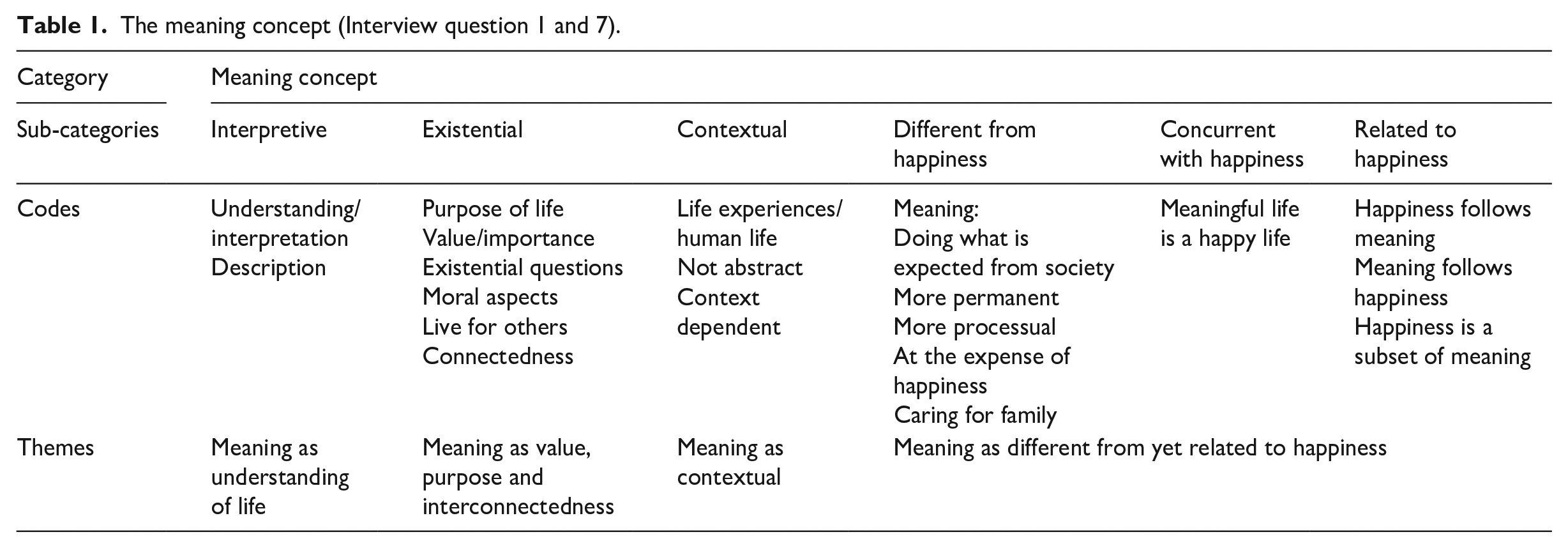
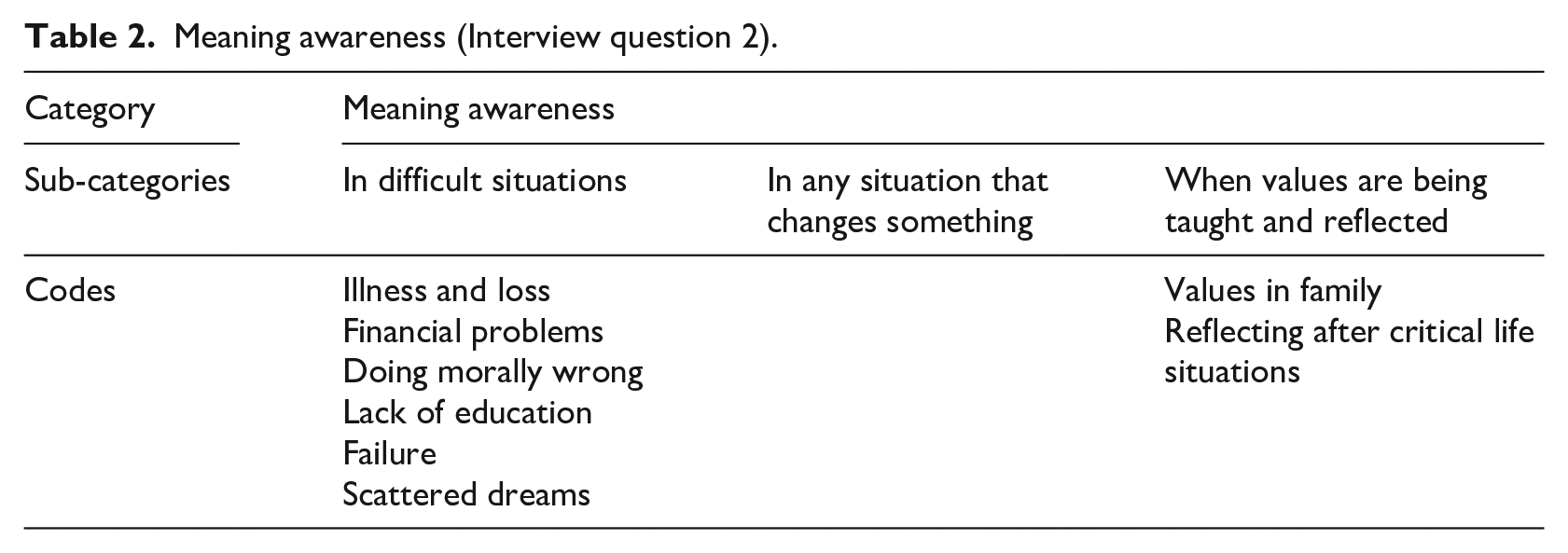
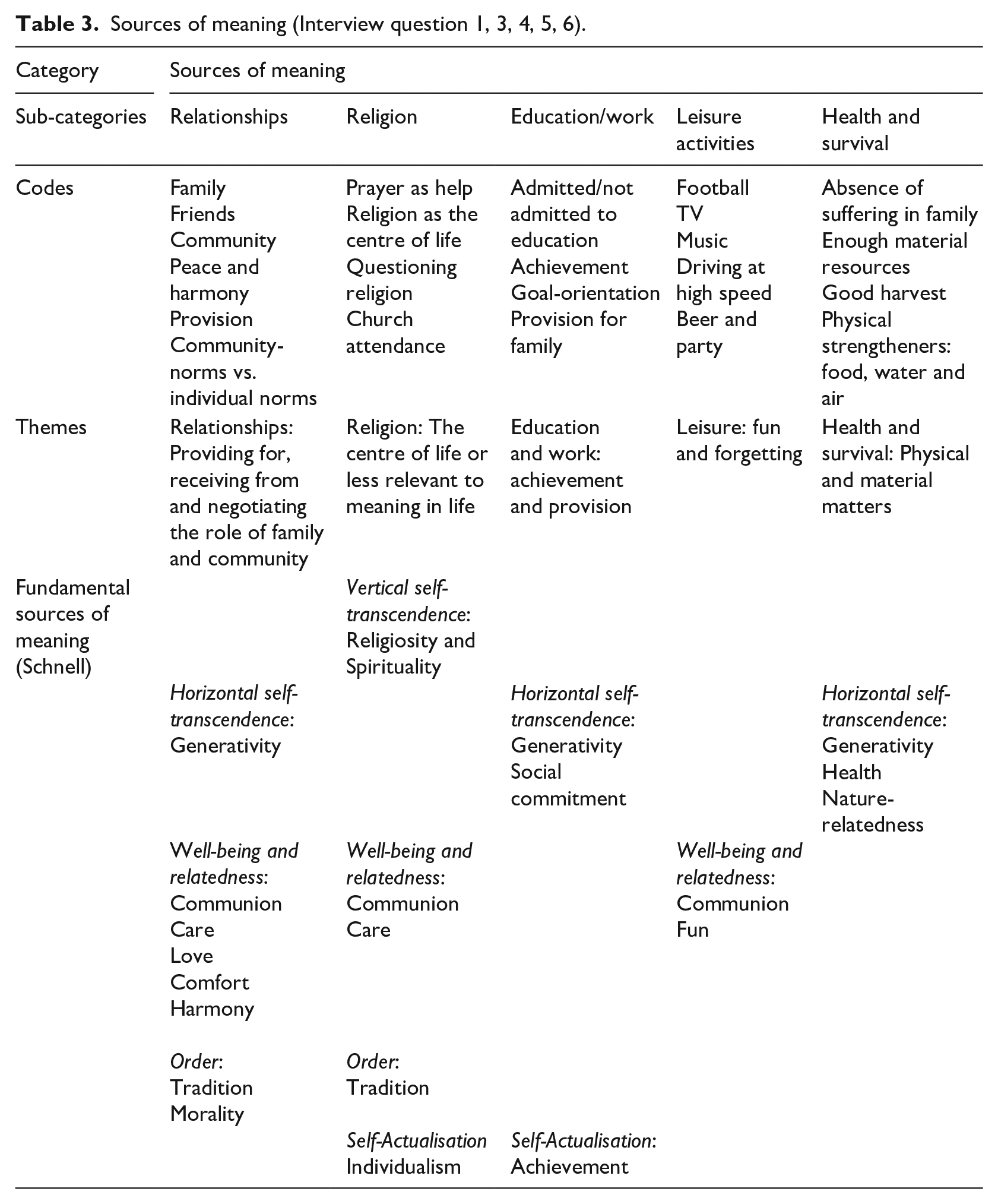
In the next phase, the codes and categories were synthesised, and the first author identified themes, 2 (see Tables 1–3) moving the analysis to a more interpretive level (Graneheim et al., 2017). Thereafter, Schnell’s theory of sources of meaning was applied in a deductive analysis to test the model against the collected data (Graneheim et al., 2017; see Table 3).
The meaning concept (Interview question 1 and 7).
Meaning awareness (Interview question 2).
Sources of meaning (Interview question 1, 3, 4, 5, 6).
During the write-up phase, a synthesis of the concept-driven interview guide was used as the main structure, whereas the emergent themes comprised the substructure. The deductive analysis was written in a separate section.
Ethical procedures
Ethical clearance was obtained from the Humanities and Social Sciences Research Ethics Committee Institutional Review Board at the University of Zambia. Before the interviews were initiated, anonymity and confidentiality were assured, and the participants orally consented to participate in the research project. No names were collected or stored. The audiotapes were deleted immediately after transcription in Zambia, and the transcripts were anonymised. 3
Results
The concept of meaning
As mentioned above, all participants were initially asked to write down what they associated with the concept of meaning on a sheet of paper before sharing their associations with the group. Some responded by referring to specific sources of meaning related to family, education, work and religion. Others associated meaning with more abstract phenomena such as achievement and balance, while some centred their discussion on conceptual definitions of the term ‘meaning’.
An overarching finding derived from the answers to this first question was that all the focus groups provided reflections showing that the concept of meaning was relevant to them. A cross-case analysis resulted in the identification of four main themes regarding the participants’ associations with the concept of meaning: (1) meaning as understanding; (2) meaning as value, purpose and interconnectedness; (3) meaning as contextual; and (4) meaning as different from yet related to happiness.
Meaning as understanding of life
Some participants related the concept of meaning to an understanding of life. One student interpreted meaning as ‘how I understand life in general’ (U1), while a participant from the village stated that ‘meaning is a word that gives full description to things that happen in life’ (V2). In this category of answers, the term meaning was associated with interpretation, understanding, and perception of situations. One of the master’s students identified it as ‘impressions created by signs, situations and signals’ (U3). In other words, meaning was related to making sense of life events.
Meaning as value, purpose and interconnectedness
Meaning was understood not only in relation to general life experiences but also in relation to life experiences that are particularly important and valuable and that provide an orientation or direction in life. This view of meaning was expressed in two of the university interviews and all the village interviews. For instance, one participant identified meaning as ‘something that has value to me’ (V1), and another reported that meaning ‘adds value to my life’ (V2). A third participant linked value to his ‘family and anything that is important’ (V1). Similarly, meaning as purpose in life or the purpose of one’s existence was suggested by several participants. One of the university staff members stated, ‘So, it’s about someone asking themselves why they exist. It’s about discovering one’s value and purpose of living. If someone does not discover why they exist, it means that their life has no meaning, it has no value’ (U4). Thus, existential issues, such as the purpose of life, why we exist, and what is valuable or significant in life, emerged as important themes associated with meaning.
One participant believed that an African understanding of meaning had certain specific features: ‘For me, meaning is the interpretation that one gets from different scenarios or situations. The meaning of life in an African context is the interconnectedness among people. That’s because we say that I am because we are’ (U3). This understanding of meaning as interconnectedness and belonging also permeated the responses to the questions on sources of meaning to which we will return.
Meaning as contextual
Some participants explicitly emphasised that what gives life meaning changes throughout life and in different contexts. One university staff member stated, ‘Meaning in life has different contexts depending on where you are because there are certain things that have different meanings depending on whether you are looking at it from a religious point of view or not’ (U4). Later in the interview, the same person explicitly stated, ‘The moment you miss the context, you miss meaning and everything that surrounds meaning’, adding ‘words don’t mean, it’s people who mean’ (U4). The association of meaning with contextual life experiences rather than words or abstract concepts permeated the responses. This was explicit in some of the responses, such as ‘It’s about what people go through and what they get out of life’ (U4), while others referred to meaning simply as ‘a way of life’ (V3).
Meaning as different from yet related to happiness
All the interviews featured a specific question about meaning and happiness. In response, a few participants put forth the idea that meaning and happiness are the same. However, most participants expressed the view that meaning and happiness are different, although they can be related. Regarding the relationship between meaning and happiness, most said that happiness follows meaning, although a few suggested that meaning follows happiness, and some saw happiness as a subset of meaning. In general, what distinguished meaning from happiness was that meaning was perceived as more permanent than happiness; happiness was seen as temporal and emotional. Meaning was believed to be something that one worked hard to accomplish, and it could even be at the expense of happiness. Meaning was referred to as less individual and related to doing what was expected from society, such as caring for family and living out collective values. One of the master’s students defined it as follows: A meaningful life is one that is supposed to impact my life, family and the society to which I belong. But a happy life may not necessarily have the attributes of bringing out the development, so to say, in the lives of the people that matter to me and society. (U3)
Thus, relating meaning to the concept of happiness added nuance to the participants’ understandings of meaning in life, whereby meaning was considered more permanent, other-oriented and collective than the concept of happiness.
Meaning awareness
Most participants said that they became aware of meaning in difficult or precarious situations. They mentioned concrete situations, such as times of illness or loss, financial problems, failure, immoral actions, accidents and a lack of education or work. Participants specified situations when goals were not reached, when they were let down or when their dreams became shattered. A few participants believed that meaning awareness could also happen in advantageous situations, and one stated that meaning awareness occurs ‘after any event that changes something’ (U3). One participant mentioned specific situations of reflection on values. Such situations were not necessarily connected to negative life events but to teaching and learning values within the family.
Sources of meaning
Analysing the responses to the questions ‘What makes your life meaningful?’, ‘What gives you strength and energy?’ and ‘What makes you complete?’, as well as some of the participant’s associations with the concept of meaning, enabled us to approach sources of meaning from different angles. A question on experiences of meaninglessness was also included, as it thematically mirrored the question on the sources of meaning from the opposite side. We identified five main themes in the category of sources of meaning, the first three of which characterised most of the responses: (1) relationships; (2) religion; (3) education and work; (4) leisure activities; and (5) health and survival. These themes emerged not only as separate but also as interconnected categories. For instance, several participants discussed connections between relationships and education or work and between religion and health.
Relationships: providing for, receiving from and negotiating the role of family and community
The importance of family, both the nuclear family and the extended family, was visible across the entire data set. Family appeared as the first association to the question about the concept of meaning in V1. Statements from participants included ‘My family is my meaning of life’ and ‘When I wake up in the morning, I think about my family’. Family also featured in answers to the question of what gives life meaning. For example, one participant answered, ‘Having my family around makes my life meaningful’ (V2).
Family was pictured as the place to receive from. One participant from the village stated, ‘These people give me the drive to move forward’ (V1). Similarly, one of the master’s students answered, ‘When one is with family, there is comfort and security. At the end of it all, whatever happens, a person feels protected’ (U3). Family was also described as people one cared for and provided for. In this sense, the family was understood as the meaningful purpose of daily striving. One of the village dwellers said, ‘For me, it’s also my family. When I wake up in the morning, I think about what my family will eat. I also have to think of ways to make money to take my children to school and so on’ (V1).
Family was understood as both the nuclear family and the extended family, and for some, it also included friends and the local community (U3). Community was perceived as important for providing norms for life: The life I am leading represents the community I come from. So, my behaviour is a reflection of my community. So, if I do not live according to the expected norm of the community, then my behaviour is damaging to the community. So, I always have to make sure my reputation is not destroyed. So, it’s not about an individual but the family, village and community. (U3)
The importance of family and community was discussed in the interview with academic staff. The participants reflected on whether it was better to conform to social and family values or to follow one’s personal inner values. Some stated that conforming to social norms could make one ‘untruthful to oneself’, whereas others maintained that norms came from and should come from society and family. One participant reflected on the co-existence of Western individual values and the traditional African view, stating that ‘exposure to the Western culture has caused us to decide on what to choose, because from the traditional point of view it is very clear where to get values’ (U4). Thus, the role of family and community as providers of norms was partly challenged in favour of individual choice between existing values.
A few participants, both from the village and the university, stated that meaning in life happened when relationships in the family and between different communities of faith were peaceful and harmonious.
Religion: the centre of life or less relevant to meaning in life
A few participants mentioned religion in response to the question of what gives life meaning. However, religion was more visible in answers to the question on sources of strength and energy. ‘God is the one that gives me strength to move on’, reported one of the participants (V2). In the reflections on this question, prayer emerged as a prominent source of strength, with God featuring as ‘the provider’ (V3) who knows what people need and who can alleviate problems by giving people the strength to face life’s challenges. One of the bachelor’s students offered the following reflection: Another important aspect of having religious beliefs is that you feel all problems can be sorted out. One feels if they approach God, their problems will surely be limited. After praying, one feels revived and energised to face life, problems and challenges. (U2)
Prayer was connected to life needs. Several participants believed that God would provide for them and would also strengthen them when their needs were unmet. Thus, prayer linked religion to other meaningful areas of life, such as health, work and making a living. The central role of religion in living a meaningful life was underscored by several participants in the staff interview: ‘For me, being a religious person, when you asked us the meaning of life, I put God at the centre. Then, from God, I pointed to work. Life is about hard work, investment, sustainability, responsibility and enjoyment’ (U4).
Religion was presented as something that was embedded in the participants’ way of life and as a starting point for their orientation in life and their understanding of meaning. God was ‘someone who brings in principles’ (U3), and meaning was derived from following these principles. However, religion was also contrasted with other sources of meaning. In one of the interviews with bachelor’s students, some participants reflected on how religion had gradually lost its relevance in their lives, giving way to other sources of meaning, such as relationships and education. One of the students stated, When I was growing up, I thought religion meant something big. I was born into a Christian family. But at a later stage, I realised that religion had nothing to do with my life. The people around me are the ones who give me meaning. I get love and happiness from the people around me. Without these people, I am not defined. (U1)
Another student responded, ‘When I was very young, religion used to give meaning to my life. I thought there was nothing more to life. But now I realise education gives meaning to my life’ (U1). Generally, the data showed that education and relationships was a prominent source of meaning, and for some participants, education and relationships were more relevant than religion for experiencing meaning in life. This did not mean, however, that religion was not part of their lives or that they did not call themselves Christians anymore. For practical reasons, the university interviews were held on a Sunday, and when the participants were asked if they would have attended church had they not been involved in the focus group interview, all affirmed that they would have gone to church. One of the bachelor’s students said, ‘Today is Sunday, and I am a Christian, but I pay so much more attention to education than any other aspect’ (U1).
Education and work: achievement and provision
All the interviews included reflections on education. Education emerged as important not only for the students and staff from the university but also for participants from the village. One of the village participants stated, ‘Education can make my life worthwhile’ (V1). However, in the village interviews, education was more visible in the answers to the question on meaninglessness than as a source of meaning. In these interviews, it was the participant’s lack of education and lack of hope of receiving an education that was emphasised. For instance, one participant stated, ‘I also feel my life has no meaning because I am not educated, and I live a hard life as a result of being unemployed’ (V1).
These participants linked education to the possibility of work and, consequently, to taking care of family. In their situation, education was a way out of poverty. For the same reason, their children’s education was a source of meaning but also a source of meaninglessness when education was unattainable: ‘There are times I fail to pay for my children’s school fees and have no source of income. When in such a situation, I feel life is meaningless’ (V3).
Several participants mentioned work as a source of meaning. One of the participants from the village stated, ‘Life can only be meaningful when a person works hard’ (V3). For many, work was connected to having enough resources to meet the daily needs of their family, as reflected in the following statement: ‘I am a farmer, and when I sell farm products and make money, I am able to meet my needs and take care of my family. That makes my life meaningful’ (V2).
In this context of precariousness, money as the outcome of work was found to be a source of meaning. In the university interviews too, the participants related education to possibilities for work but also more generally to achievement, purpose and goals in life: ‘For me I think meaning is defined by what I want to achieve in future. Because everything I do now is a preparation of what I want to achieve in future. So, meaning comes from my goals in life’ (U1). Generally, achievement emerged as a prominent theme in relation to both education and work. In the interviews with the bachelor’s students, in particular, achievement and goal orientation featured as important sources of meaning in several answers.
Leisure: fun and forgetting
Although work and education in relation to achievement, goal orientation and provision for one’s family were important themes in the interviews, a few participants also related meaning in life to leisure activities. Football, church choir, partying, listening to music and driving a car at high speed were examples of leisure activities that participants reported gave them a sense of community but also pleasure and fun. In addition, some of these leisure activities were regarded as important for forgetting a harsh and stressful life. One of the bachelor’s students responded, ‘mostly the hobbies we have help us get rid of the stress we have. When I am stressed, I play the piano or watch animal documentaries’ (U1). Similarly, a couple of the village dwellers said that they felt complete when at a party and that they temporarily forgot their problems when drinking beer (V1 and V2).
Health and survival
A few participants from both the university and village samples mentioned health as a source of meaning. One master’s student stated, ‘As for me, it’s health, success and love. Those are key interpreters of the meaning of life’ (U3). A focus on health and its central role in relation to other themes associated with meaning was evident in the following statement: ‘Once that family is healthy and relating well, I know I am assured to develop as a person, and my family will develop as well’ (U3).
When asked about where they got the strength and energy to move on, some participants in two of the village interviews cited concrete physical sources of energy. For instance, one stated, ‘I get energy from food and water’. They also mentioned sun, air and sleep, and a few participants referred to the importance of productive harvest. Thus, strength and energy were related to concrete matters of survival and health. One person specifically related survival to meaning in life: ‘This year we haven’t had enough rainfall and that has led to poor harvests; there isn’t enough food in the village and so we might starve. When things are like that, you can’t say life is meaningful’ (V2). Later in the interviews, these concrete sources were supplemented by religion and prayer as important sources of strength. As explained in the section on religion, obtaining strength through religious practice was related to alleviating problems and improving health.
Similarities and differences between groups of participants
In addition to the similarities and differences between individual responses, we also found group differences between students, staff and villagers. One difference between the groups was in the narrative character of their answers. The villagers mostly responded with short concrete comments, although some offered longer stories of personal life events connected to the theme in question. The students’ responses were generally longer including personal stories and more conceptual reasoning. In the staff interview, personal stories and conceptual reasoning comprised an even larger part of the conversation, and the interaction between the participants took the form of thematic discussions expressing agreement and disagreement to a greater extent than in the other groups.
Thematically, the student interviews focused to a large degree on achievement as a source of meaning. Conceptualisations of achievement were mostly connected to education and work and generally reaching defined goals in life. In contrast, only one participant mentioned achievement of life goals in the village interviews. Another thematic difference was the weight attached to physical and material matters, particularly in relation to health and survival. This theme was raised by several of the participants in two of the village interviews but by none in the university interviews. Generally, the village interviews included more answers related to material provision for the family, including money. The questioning of religion as a source of meaning was most prominent in the student interviews. It was not reflected in the staff interview, and in the village interviews, only one of the participants said that he was not religious anymore, defining himself as ‘a borderline atheist’.
There were also similarities between the groups. All the groups regarded family, education and religion as prominent life domains connected to sources of meaning. Relational harmony and interconnectedness emerged as important for all groups. The same can be said about personal loss as an experience of meaninglessness. Finally, the concept of meaning was perceived as relevant across all groups.
Life domains and Schnell’s fundamental sources of meaning
The inductive thematic analysis of sources of meaning was structured around specific areas of life that corresponded with the way most participants narrated their experiences of meaning. The time limitations and character of the focus group interviews did not allow us to probe the individual utterances in order to move from manifest answers to underlying ultimate meanings (Leontiev, 2007; Schnell, 2021). However, on an interpretive level, we were able to identify fundamental sources, as they were intertwined with and embedded in the descriptions of concrete meaningful experiences, such as achievement as a fundamental source of meaning within the life domain of education.
Applying Schnell’s model of sources of meaning (Schnell, 2009, 2021), we identified several fundamental sources of meaning embedded in each life area. In the area of the extended family, we identified ‘well-being and relatedness’ because family was described as providing communion, comfort, love and care. We also found references to ‘horizontal self-transcendence’, and in particular to generativity, in terms of providing for one’s family. Furthermore, the extended family was closely connected to ‘order’ because family and community were found to represent tradition and morality.
The life area of education and work was related to ‘horizontal self-transcendence’, with generativity emerging as a main source of meaning. Education and work seemed to be of largely instrumental importance as means of generatively providing for one’s family. However, ‘self-actualisation’, specified as achievement, also featured in some of the responses on education and work.
The narratives regarding leisure activities, which included fun and communion, related to the dimension of ‘well-being and relatedness’. Survival and health included ‘horizontal self-transcendence’ in which health, generativity and nature-relatedness were fundamental sources. Finally, religion represented ‘vertical self-transcendence’. Religious practice also included ‘well-being and relatedness’ and ‘order’ because of the role of religious communion, care through prayer and the importance of tradition.
Thus, we identified all four dimensions of sources of meaning (Schnell, 2009) in the material. Among these, self-actualisation was the least prominent. It was certainly present in the responses of the students, which connected achievement to education, and in the accounts of the village dwellers in relation to work. However, sources of meaning such as freedom, creativity and individualism were rarely mentioned. The two most central fundamental sources of meaning were community and generativity (see Table 3).
Also, the phenomena that the participants associated with the concept of meaning resonate to a large extent with Schnell’s (2021) definition of meaning in life. What we inductively conceptualised as purpose, value and interconnectedness resemble Schnell’s categories of orientation, significance and belonging (Schnell, 2021). However, based on our material, we were not able to discern whether the participants’ reflections on and interpretations of meaning corresponded to Schnell’s concept of coherence. Overall, the participants’ understandings of meaning came close to Schnell’s conceptualisations of meaning in life.
Discussion
In this study, we asked what characterises the conceptual understanding of ‘meaning in life’, how and when meaning and crises of meaning are experienced and what the most prominent sources of meaning are for Zambians from urban and rural districts. In general, the inductive analysis found that the concept of meaning was understood as a way of connecting things for the purpose of interpretation, that is, to make sense of life events. Meaning was also seen as an existential concept, specifically connected to belonging and purpose and direction in life. It was perceived as contextual and related to life experiences. Meaningfulness and happiness were generally regarded as different concepts. Meaning awareness was mostly associated with difficult life situations, but some participants also reported awareness of meaning in any situation that involved change and when teaching values to family. Meaning experiences and sources of meaning were associated with the following life domains: relationships: religion; education and work; leisure and health. Among these, the first three areas emerged as the most prominent.
Significant life domains: Relationships, education and religion
The findings regarding areas of life associated with sources of meaning resonate with those of other studies from the African continent. In Mason’s (2013) mixed-methods study among students in South Africa, an analysis of qualitative material identified three areas of life where meaning was found: relationships, education and religion. Nell (2014) and Wissing et al. (2014) also found these domains to be significant areas of meaning in their sample of students in South Africa, although Nell (2014) identified a fourth domain: hope, achievement and goals.
Family, community and the extended self
In our study, family (both the nuclear and extended family) was not only explicitly mentioned by the participants in response to questions of meaning but also featured implicitly in narratives about other life domains. For instance, family was brought up in discussions on the importance of education in connection with the ability to take care of family. The family was also believed to provide collective norms and values, and it was emphasised that the African worldview is less individualised than the Western one. This supports the finding in several studies that people find fulfilment not as individuals but as part of the community to which they belong (Mason, 2013; Nell, 2014; Onyedinma & Kanayo, 2013; Wissing et al., 2020).
However, the importance of family is not exclusive to African contexts. Studies of sources of meaning in Western countries have found that family is the most frequently reported area in which meaning is sourced (Delle Fave et al., 2013; Schnell, 2021, pp. 91–92). Moreover, family is, also in Western contexts associated with communion, care, tradition and generativity (Schnell, 2021, pp. 91–95). As a difference, however, our Zambian participants seemed to construe themselves as interdependent to a greater extent and to emphasise the role of family and communal relationships in what can be conceptualised as an ‘extended self’ (Hermans & Gieser, 2012, p. 8). Whereas Western societies value autonomy and self-sufficiency (Lindegger & Alberts, 2012), people in Africa are more likely to imagine the mind and the self as interwoven with others (Luhrmann et al., 2015). Although we found some individual values among the participants, there was an emphasis on the notion of being part of a community as primary to the self (Beyers, 2010). Based on the material, we could not discern if communal/societal bonds were less important than close personal relationships, as found in Wissing et al.’s study (2020), but the overall relational perspective showed that the concept of meaning for the Zambian dweller is directly linked to the experience of belonging and connectedness with others.
Instrumental education
As expected, education was found to be a major source of meaning for students, both in this study and in other studies based on student populations (Mason, 2013; Nell, 2014; Wissing et al., 2014). However, our study also found that education was a prominent source of meaning among village dwellers. It was referred to as something to strive for but also as something that was lacking. This lack generated a sense of meaninglessness. While students reported feeling advantaged by being enrolled at university, some of the village dwellers reported leading disadvantaged lives due to a lack of education.
The experience of being either disadvantaged or advantaged in relation to education resonates with findings from Austria and Germany (Schnell, 2021), where a lower education status is often stigmatised and associated with lower levels of experienced meaning. The narrative about the meaning of educational experiences in Zambia, however, has a distinctively collective and stronger instrumental dimension, as education, particularly among the village dwellers, was connected to providing for family. While education in Germany and Austria are linked to Western narratives of upskilling and improvement throughout life, the Zambian narratives centre on the goals of getting a job and supporting one’s family. This finding resembles that of Nell’s (2014) study of sources of meaning among students in South Africa, which suggested education was primarily seen as instrumental in the sense of an investment in a fulfilling career. Intrinsic values, such as enjoyment of learning, were only marginally present in Nell’s study. Likewise, in our study, such values regarding education were not particularly apparent in the participants’ responses. However, this does not preclude the possibility that the students in our study may derive additional intrinsic meaning from education.
Religious orientation, secularisation and holistic ontology
In accordance with the understanding of African culture as highly religious (Wilson et al., 2021), religion emerged as an important source of meaning in our study – although it was not mentioned as often as family or education and was mostly related to the question on sources of strength. Some participants questioned the role of religion as a source of meaning, citing family and education as more important. Because this questioning of religion featured primarily in the responses of the youngest participants in the urban educational context, this could indicate an emerging secularisation in African cities (Simpson, 2003). Secularisation theories, which emphasise education (Carmody, 2015), as well as modernisation, industrialisation and rationalisation (Togarasei, 2015), as sources of religious decline, might explain the questioning of religion as a source of meaning among some of our participants. However, individual experiences of a failure to find meaning in religion do not necessarily reflect secularisation at a societal or institutional level (Dobbelaere, 2002). As our material shows, failing to find meaning in religion does not accordingly influence church attendance, which may be a matter of routine, duty or tradition (Togarasei, 2015) or may be associated with values other than meaning. The disconnectedness between meaning and religion articulated by some participants in our study might better be described as variation in African cultural orientations as young people explore their emerging identities (also) outside their religious commitments (Mason, 2013; Wilson et al., 2021).
The fact that religion played an important role in our interviews but was not mentioned as often as education and family could also be interpreted in line with Wilson et al.’s (2021) suggestion that in African communities, religion and everyday life are intertwined to such an extent that religion is not thought of as instrumental in the search for meaning in life. Moreover, the African perception of the transcendent dimension as a dynamic force or power present in the natural world (Beyers, 2010) may explain our finding that religion is more commonly seen as a source of strength than as a source of meaning. Similarly, the weight attached to material aspects of life as sources of strength might reflect the African holistic ontology, according to which sacred and the profane are connected (Beyers, 2010; Thorpe, 1991).
Individualism and collectivism
Although collective fundamental sources of meaning like community and generativity were most prominent in our material, and self-actualisation seemed to be the least prominent dimension of sources of meaning, there were some references to and discussions on individualism. The staff members explicitly reflected on the existence in Zambian society of individualism side by side with traditional collective values in Zambian society due to Western influences. The questioning of religion as a source of meaning among some of the young students could also reflect the existence of individualist norms. The desire to be ‘true to themselves’ in their search for meaning (Taylor, 1991, pp. 26–29), which some of the students demonstrated, could be regarded as the voice of individualism in a collective religious society (Mason, 2013). However, the students’ questioning of religion does not necessarily indicate individualism as the only fundamental source of meaning in that respect. Those students emphasised education and relationships over religion, indicating that they found meaning in relatedness and achievement, the latter of which could possibly be linked to family expectations and collective norms. Thus, instead of reflecting a dichotomy between individualistic and collective notions, our findings may point to a dynamic pattern of individualist and collectivist notions (Wissing et al., 2020). Integrated models in which intrapersonal, interpersonal, social and transpersonal relationships interplay in meaning making (Wissing et al., 2019) may be suited to understand the co-existence of both individualistic and collective sources of meaning among the participants.
The concept of meaning in life and awareness of meaning
The participants’ reflections on the concept of meaning came close to established conceptualisations of meaning in life (George & Park, 2016; Heintzelman & King, 2014; Martela & Steger, 2016; Schnell, 2009, 2021). Their responses corresponded to both basic denotative meaning, as in the meaning of a sentence or sign, and existential meaning in life (Baumeister & Landau, 2018). We could not discern coherence among the conceptual reflections of the participants. However, interconnectedness and belonging (Schnell, 2009, 2021) were central.
Baumeister (1991) begins his seminal book Meanings of Life by stating that ‘when survival is at stake, when the events of each day or each hour carry a sense of urgency, life’s meaning is irrelevant’ (p. 3). He argues that considerations of meaning in life require ‘stepping back from the moment’ (p. 3). As our study investigates experiences of meaning and crises of meaning considered in retrospect, our material is certainly based on stepping back and reflecting. Yet a prominent finding of our study is that the participants reported becoming aware of meaning in difficult and precarious life situations. We also found that the concept of meaning resonated with their life experiences, regardless of their general life situation.
Strengths and limitations
Conducting focus group interviews allowed us to access several personal and diverse viewpoints. However, to capitalise on the advantages of focus groups, it is necessary to facilitate interactions between the participants while also probing for variety in the answers (Kvale & Brinkmann, 2009). In the first village interview, in which the initial step of writing associations with meaning on a piece of paper was forgotten, we observed that the group’s answers to the first question were very similar. This may have been due to the participants influencing one another. Thus, including this step in all other interviews seems to have avoided biased responses resulting from the group setting. The degree to which the focus group interviews took the form of joint discussions varied during the interviews and between the different interviews. In particular, in the first two village interviews, the participants responded primarily to the interviewer. This may have been due to the language translation between English and the local language, which somewhat impeded the flow of conversation between the participants. It may also have been a result of the village dwellers being less familiar with an academic way of discussing agreements and disagreements.
The presence of the headwoman during all village interviews, although she only formally took part in the first interview, may have created some bias, as the participants may have tailored their answers to accommodate her. This may also have been the case in the staff interview in which colleagues were present as observers. However, it was our general impression that most of the participants answered based on their own experiences and contexts, although they were inevitably influenced to some extent by the others in the group.
Conclusion and avenues for further research
This article contributes to the study of meaning in life and constitutes a starting point for future studies by offering in-depth understandings of important areas where meaning is sourced among a rural and urban Zambian sample: family; religion; education and work; leisure activities and health and survival. Furthermore, it identifies fundamental sources of meaning related to these areas, in which community and generativity are the most prominent. Experiences of meaning in life are embedded in African cultural self-understandings, which include collective values and a holistic ontology, but also a few individualist orientations.
A fruitful avenue for further research would be to quantitatively investigate experiences of meaning in life and sources of meaning (Schnell, 2009) to measure the distribution in a larger Zambian sample. It would be particularly interesting to survey the distribution of religious and spiritual sources of meaning and their correlations with meaningfulness. Based on the findings of this qualitative study, we can assume that religiosity is a highly significant source of meaning for Zambian people but that some variations in worldview orientations would be found in a representative sample. Therefore, it would also be interesting to assess alternative worldview positions, such as agnosticism and atheism, in a larger sample with anonymous responses. Furthermore, it would be relevant to survey if ‘self-actualisation’ is the least relevant dimension of sources of meaning in a representative sample, given the results of this study in which achievement and (to some degree) individualism were the only mentioned sources from that dimensional group. Based on the reported collectivist values and the co-existence of a few individualist orientations in this study, we suggest that future studies investigate correlations between community, generativity and meaningfulness – and the role of individualism as a source of meaning in Zambia.
Footnotes
Acknowledgements
The authors thank Dr. Judith Ziwa, Dr. Farelli Hambulo and Prof. Gift Masaiti, who facilitated access to the participants, conducted and translated interviews in the local language and contributed to their joint analysis seminars. They also thank their participants for sharing their experiences related to this project.
Funding
The author(s) received no financial support for the research, authorship and/or publication of this article.
