




Abstract
Remote and hybrid modes of work have become widespread since the Covid-19 pandemic and pose new challenges for organisations. This study examined the mediating role of psychological safety in the relationship between inclusive leadership and employee voice in a sample of remote and hybrid employees. While inclusive leadership involves openness, availability, and accessibility, we argue that it does not necessarily remove the risk involved for employees who want to raise well-intentioned concerns, and that psychological safety is necessary for this. A quantitative, cross-sectional, survey-based design was used with purposive sampling. White-collar employees (N = 146) in South Africa completed online questionnaires during the Covid-19 pandemic. The statistical analyses identified significant relationships between all the variables as well as a mediating role for psychological safety in the relationship between inclusive leadership and employee voice. Recommendations are made for increasing well-intentioned employee voice in organisations.
Keywords
Working from anywhere, or remote and hybrid work, has become widespread since the Covid-19 pandemic, including in South Africa (Munyeka, 2024; Winkler-Titus et al., 2025). Although working from home was not a new practice for some employees, the transition from office to home was sudden and involuntary for many people at the onset of the pandemic and brought both benefits and disadvantages for employees and organisations (Munyeka, 2024; Winkler-Titus et al., 2025). More than half the employees in South Africa (SA) worked from home at some point during the first months of the Covid-19 pandemic (West, 2020). This created a challenging context for leaders whose subordinates were geographically dispersed in a climate of uncertainty, and for subordinates who had to adapt to new ways of interacting. An understanding of organisational and employee behaviour under remote working conditions is important as remote (working from places other than the office) and hybrid (working from home or other spaces and the office) work has persisted in the post-pandemic environment and appears to be here to stay (Mabaso & Manuel, 2024; Munyeka, 2024). Organisations continue to grapple with finding optimal ways of managing employees with whom they have little or no face-to-face contact (Mabaso & Manuel, 2024; Winkler-Titus et al., 2025). This study focuses on whether perceived inclusive leadership predicts increased feelings of psychological safety, and whether this, in turn, predicts more comfort with giving voice to concerns and making informal suggestions for improvement to senior staff in the organisation in a sample of remote and hybrid employees.
Reduced face-to-face contact between managers and employees raises concerns about maintaining job performance and working relationships (Galanti et al., 2021). In addition, many remote employees experience social isolation despite virtual communication (Toscano & Zappalà, 2020). As working remotely changes the dynamics between employees and the organisation (Green et al., 2020), leadership is likely to play a key role in maintaining job performance and two-way communication with employees. Employees are often reluctant to voice their concerns and suggestions due to the risks involved, such as managers not listening or acting on the input given or imposing sanctions for going against established organisational norms (Jolly & Lee, 2021). Both employees’ perceived psychological safety and their willingness to use their voices to raise issues might therefore be influenced by leadership style in remote and hybrid working conditions. We propose that inclusive leadership is more likely to facilitate psychological safety and employee voice even under remote and hybrid conditions due to its emphasis on relationships and valuing of employee uniqueness (Fatoki, 2024; Shore & Chung, 2022).
Previous research has demonstrated relationships between inclusive leadership and employee voice (Guo et al., 2020; Qi et al., 2023; Younas et al., 2022); inclusive leadership and psychological safety (Chen et al., 2023; Hassan & Hassan, 2018; Javed et al., 2017); and psychological safety and employee voice (Elsaied, 2019; Ge, 2020), as well as the mediating role of psychological safety in the relationship between inclusive leadership and employee voice (Fatoki, 2024). This study aims to extend this by examining the mediating role of psychological safety in the relationship between inclusive leadership and employee voice in employees working remotely and in hybrid form during the Covid-19 pandemic.
Social exchange theory
Social exchange theory (SET) provided a theoretical framework for the study because both inclusive leadership and employee voice can be seen as forms of social exchange. SET views all social interactions as reciprocal, where positive offerings or exchanges lead to positive responses, and negative offerings result in negative responses (Blau, 1964). This implies that the positive behaviours demonstrated by inclusive leaders could allow for more positive perceptions of psychological safety, and subordinates may then be more likely to respond with the positive behaviour of expressing their voices with the intention of initiating improvements for the organisation.
Inclusive leadership
Inclusive leaders foster a sense of belonging in subordinates and value their uniqueness as individuals, demonstrating openness, availability, and accessibility (Choi et al., 2017; Randel et al., 2018). They are supportive, ensure justice and equity, share decision-making, elicit diverse contributions, and assist all group members to engage meaningfully (Randel et al., 2018). Inclusive leadership differs from participative leadership by emphasising the inclusion of employees whose views might otherwise be ignored and treating those with different social identities or lesser status as insiders (Davis & Rogers, 2023; Edmondson, 2003).
In the context of remote work, the above behaviours are likely to facilitate the maintenance of relationships between leaders and subordinates. Remote employees are at risk of being isolated and marginalised, even if they enjoyed high-quality relationships with their managers when previously working from the office (Toscano & Zappalà, 2020). This is due to perceptions of social isolation and decreased opportunities for informal interactions. To feel included while working remotely, employees need to feel that they are part of critical organisational processes (Schwarz et al., 2023), that their views are expressed and heard (i.e., employee voice), that their unique contributions are valued (Ferdman, 2014), and that they have access to information and resources (Yang et al., 2022). We argue that inclusive leaders are likely to meet these needs by encouraging employees’ active participation in discussions and decisions, being open to different views, and being available and accessible. However, employees need to feel safe enough to express their views.
Inclusive leadership and psychological safety
Research indicates that inclusive leadership cultivates psychological safety (e.g., Hassan & Hassan, 2018; Zhao et al., 2020). Individual psychological safety is defined as employees’ perceptions of the consequences of interpersonal risk-taking at work and includes engaging in open communication, speaking up about issues, and asking for feedback at work (Frazier et al., 2017). Psychological safety in remote work contexts was important during the pandemic, when there were high levels of uncertainty and fear (Lee, 2021). At the time of collecting data, vaccines had not been developed for the virus and it was not known whether effective and safe vaccines would be developed. Reports of the number of job losses during the first few months of the pandemic in SA differ widely, ranging from 648,000 (StatsSA, 2020) to 3 million (Tswanya, 2020). Prior to the pandemic, the economy was constricted and unemployment was high at 30% in January 2020 (Trading Economics, 2021). This context was likely to increase feelings of job insecurity and the need for psychological safety at work.
Inclusive leadership behaviours increase psychological safety by encouraging individuals to take interpersonal risks without fear of being punished (Hassan & Hassan, 2018), rejected, embarrassed, or being seen as incompetent by their manager (Pacheco et al., 2015). Similarly, an absence of leader openness and availability maximises employees’ fear of interpersonal risk-taking (Javed et al., 2017). Employees feel safer posing questions (Javed et al., 2017) or asking for feedback (Pacheco et al., 2015) and assistance (Hassan & Hassan, 2018) from leaders who are open to different views, listen to employees, and who look out for new opportunities (Nembhard & Edmondson, 2006). These behaviours are likely to be important to employees working remotely, especially where new ways of working are required and there is a reliance on communication platforms which may lead to employees feeling insecure, uncertain, and isolated. Subordinates’ positive responses to inclusive leaders’ behaviours are in line with SET (Blau, 1964). This led to the following hypothesis in the study:
H1. Perceptions of inclusive leadership will relate positively to perceptions of psychological safety.
Inclusive leadership and employee voice
Employee voice has been conceptualised in various ways. We adopt the definition of employee voice as extra-role behaviour that communicates ideas, suggestions, information, and concerns that challenge organisational norms and processes with the intention of improving or changing a situation, as originally proposed by LePine and Van Dyne (1998). This definition has become dominant and is still used today by many researchers (Morrison, 2023). Similarly to Morrison (2023) in her systematic review, we restrict our focus to informal, internal, and discretionary voice behaviours and exclude actions that use formal complaint mechanisms (e.g., grievance procedures) and channels that are not aimed at change (e.g., talking to peers). Employee voice can be used in a destructive manner based on negative intentions and can be aimed at maintaining the status quo (Maynes & Podsakoff, 2014), but we focused on expressions aimed at changing the status quo based on positive intentions. Employee voice involves communicating with someone who might be able to act on the information (Morrison, 2014). It consists of two components. First, promotive voice is the expression of ideas and suggestions to improve a situation or organisational functioning (Chamberlin et al., 2017; Svendsen et al., 2018). Second, prohibitive voice involves the expression of concerns related to work processes and practices, accidents, or actions that may be harmful to the organisation and that are perceived as being risky to the employee who communicates the concern (Chamberlin et al., 2017; MacMillan et al., 2020).
Employee voice is important because of its links to engagement, organisational effectiveness (Ruck et al., 2017), reduced safety events (Chamberlin et al., 2017), and team and individual outcomes (Morrison, 2014). Silence and lack of voice could deprive the organisation of information that could be useful (John & Manikandan, 2019). Leadership style is one of the antecedents to employee voice, with inclusive leadership being a particular style that is related to employee voice (Jolly & Lee, 2021). The emphasis on consultation, openness, availability, and accessibility in inclusive leadership is likely to reduce the risks involved in speaking up (Milliken et al., 2003; Qi et al., 2023; Younas et al., 2022). This led to the following hypothesis in the study:
H2. Perceptions of inclusive leadership will relate positively to perceptions of employee voice.
Psychological safety and employee voice
Employee voice is associated with risk as it involves challenging the status quo, including raising questions around workplace injustice, speaking out on behalf of individuals with less power in the organisation, and highlighting issues that are not visible to other co-workers (Burris, 2012; Liang et al., 2012; MacMillan et al., 2020). Consequently, managers may interpret instances of employee voice negatively, such as perceiving employees as being obstructionist, disloyal, or undermining of authority (Chen & Appienti, 2020; Wei at al., 2015). They may also feel threatened or label employees as troublemakers (Pacheco et al., 2015; Wei et al., 2015). There is a risk that managers may react in a defensive or hostile manner, such as by giving poor performance ratings (Burris, 2012), allocating undesirable tasks, reducing the speaker’s chances of career advancement (Milliken et al., 2003), and demoting or terminating employees (Ashford et al., 2009).
Given the risks involved, employees are more likely to use their voices when they feel psychologically safe (Elsaied, 2019; Ge, 2020). The relationship between psychological safety and employee voice is likely to also apply to remote work where there is uncertainty, insecurity, and the added challenge of communication being mediated by technology where limited non-verbal cues make it more difficult to interpret reactions to what is said (Edelmann et al., 2013). This led to the following hypothesis in the study:
H3. Perceptions of psychological safety will relate positively to perceptions of employee voice.
Psychological safety as a mediator
Examining the extent to which psychological safety accounts for the relationship between inclusive leadership and employee voice is important as this may contribute to better understanding the ways in which employee voice can be facilitated through leadership. Despite this, there are relatively few studies available that have directly explored this. Lee and Dahinten (2021) found that psychological safety partially mediated the relationship between inclusive leadership and employee voice as well as the relationship between inclusive leadership and intention to report errors in a sample of nurses in South Korea. Fatoki (2024) found that psychological safety mediated the relationship between inclusive leadership and employee voice and that both psychological safety and affective commitment sequentially mediated the relationship between inclusive leadership and employee voice in a sample of South African hospitality workers. This study extends these findings by exploring whether psychological safety acts as a mediator in the inclusive leadership-employee voice relationship in a sample of white-collar workers working remotely or in hybrid form in South Africa during the Covid-19 pandemic.
Other studies have found a mediating role for psychological safety between various types of leadership and employee voice. Examples of this for leadership approaches and styles that align with inclusive leadership by being open, empowering, or supportive of employees include change leadership (Detert & Burris, 2007); self-sacrificial leadership (Zhang et al., 2020); paradoxical leadership (Li et al., 2020); servant leadership (Chughtai, 2016); supportive leadership (Elsaied, 2019); and ethical leadership (Sağnak, 2017). Detert and Burris (2007) found that managerial openness fostered psychological safety and, through this, employee voice, which is relevant to the current study because openness is a key element of inclusive leadership. Wu et al. (2020) found negative relationships between authoritarian leadership (which tends to be less supportive and open), psychological safety, and employee voice. These studies suggest that creating perceived psychological safety may be a necessary condition for leadership to elicit employee voice, and support the importance of exploring psychological safety as a mediator in the relationship between inclusive leadership and employee voice. This led to the following hypothesis in the study:
H4. Perceptions of psychological safety will mediate the relationship between perceptions of inclusive leadership and perceptions of employee voice.
Method
The study was quantitative, non-experimental, cross-sectional, and survey-based (Stangor, 2015). This design allowed us to reach a large number of possible participants and was suitable because we were interested in examining the perceptions of employees based on their experiences while working remotely or in hybrid mode and wanted to test a mediation model.
Participants
White-collar employees were sampled because these employees were likely to be working remotely during the pandemic. Inclusion criteria were that participants should be white-collar workers employed by an organisation (i.e., not self-employed), working in SA, and working partly or fully from home during the first 6 months of the pandemic. Of the 172 online questionnaires returned, 146 met the inclusion criteria.
The final sample was 75% female, mainly identified as African (43%) or White (34%), had a mean age of 36.35 years (SD = 9.96), and had a mean organisational tenure of 6.67 years (SD = 6.38). A binary understanding of gender was used. Most participants occupied skilled or professional positions or were in junior or middle management positions (68%), and 81% were graduates. At the time of collecting data (August to October 2020), the first wave of the pandemic had subsided in SA and some of the lockdown restrictions had been eased. However, the number of people who could be present at workplaces remained restricted and work rotation, shift-systems, and remote working measures applied. The number of people who could attend in-person meetings was also limited. Before the pandemic, 88% of participants had worked exclusively at their employers’ premises. At the time of collecting the data, most participants (61%) were working only from home, 29% worked from their offices and homes, and 10% had fully returned to their employers’ premises after working from home for varying periods of time.
Procedure
Two purposive sampling strategies were used. The first involved inviting employees who were working remotely from four organisations to participate. This was a challenging strategy as most of the 118 organisations that were approached declined to participate, citing reasons such as data privacy and confidentiality constraints (despite assurances of anonymity and confidentiality); risk and quality compliance rules; pressure experienced due to the pandemic; and small numbers of employees working from home. Some organisations did not respond to the emails sent to them or responded after the data collection period. The second sampling strategy involved posts on social media (LinkedIn, Facebook, Instagram, and WhatsApp) inviting participation. The social media invitations contained the aim of the study, what participation would involve, statements about anonymity and confidentiality, and contact details of the researchers. They also contained links to the full participant information sheet. Questionnaires were completed online using Google Forms.
Instruments
A biographical questionnaire was used to collect demographic data. For the other variables, participants were asked to answer questionnaires in the context of working remotely using 5-point Likert-type scales varying from 1 (strongly disagree) to 5 (strongly agree), where 1 indicated a low level of the variable and 5 indicated a high level.
Inclusive leadership
Carmeli et al.’s (2010) nine-item Inclusive Leadership scale has subscales for openness, availability, and accessibility; however, only the total score for the scale was used in the current study to measure perceptions of inclusive leadership. Examples of the items include: ‘The manager is attentive to new opportunities to improve work processes’ (openness); ‘The manager is available for consultation on problems’ (availability); and ‘The manager encourages me to access him/her on emerging issues’ (accessibility). Excellent Cronbach’s alpha coefficients have been reported (.94 in Carmeli et al., 2010; .96 in the current study).
Psychological safety
Four items adapted from Liang et al.’s (2012) Psychological Safety scale were used to measure perceptions of psychological safety on an individual level. The items were adapted by changing the context for answering from ‘in my work unit . . . ’ to ‘While working from home during the Covid-19 pandemic . . .’. One item from the original scale was omitted in the current study as we considered it to overlap with inclusive leadership. A sample item is ‘I feel comfortable about expressing my true feelings regarding my job’. Two items required reverse scoring. Reported Cronbach’s alphas have been acceptable or very good (.72 and .75 in Liang et al., 2012; .86 in Erkutlu & Chafra, 2015; .85 in this study).
Employee voice
Liang et al.’s (2012) 10-item Employee Voice scale has two subscales, promotive voice and prohibitive voice, however only the total score for the scale was used in the current study to measure perceptions of employee voice. Sample items include ‘Proactively develop and make suggestions for issues that may influence the unit’ (promotive voice) and ‘Proactively report coordination problems in the workplace to the management’ (prohibitive voice). Very good to excellent Cronbach’s alpha values (.86 to .90) have been reported (Liang et al., 2012). The Cronbach’s alpha in the current study was .88.
Ethical considerations
Ethics approval was obtained from the University of the Witwatersrand’s Human Research Ethics Committee (protocol number MAORG/20/07). Participation was voluntary and anonymous.
Data analysis
Frequencies and percentages were calculated to describe the categorical variables in the study, while means, standard deviations, and minimum and maximum values were used to describe the continuous variables (Field, 2009). Skewness coefficients, kurtosis estimates, and histograms indicated that psychological safety and employee voice were normally distributed in the sample, however inclusive leadership was slightly skewed. This was addressed using a square transformation (Field, 2009). Pearson’s product-moment correlation coefficients and simple regression models were used to examine H1, H2, and H3 (Field, 2009). Mediation (H4) was tested using Hayes’s (2025) PROCESS Macro v5.0 with model 4 for mediated regression, which produces a series of simple and multiple regression models to estimate both direct and indirect effects between the variables (Hayes, 2022). A significance level of 0.05 was used for all analyses (Field, 2009) and all analyses were run using IBM SPSS version 30 (IBM Corporation, 2024).
Results
Descriptive statistics for inclusive leadership, psychological safety, and employee voice are presented in Table 1.
Descriptive statistics and Pearson’s product-moment correlation coefficients for inclusive leadership, psychological safety, and employee voice (n = 146).
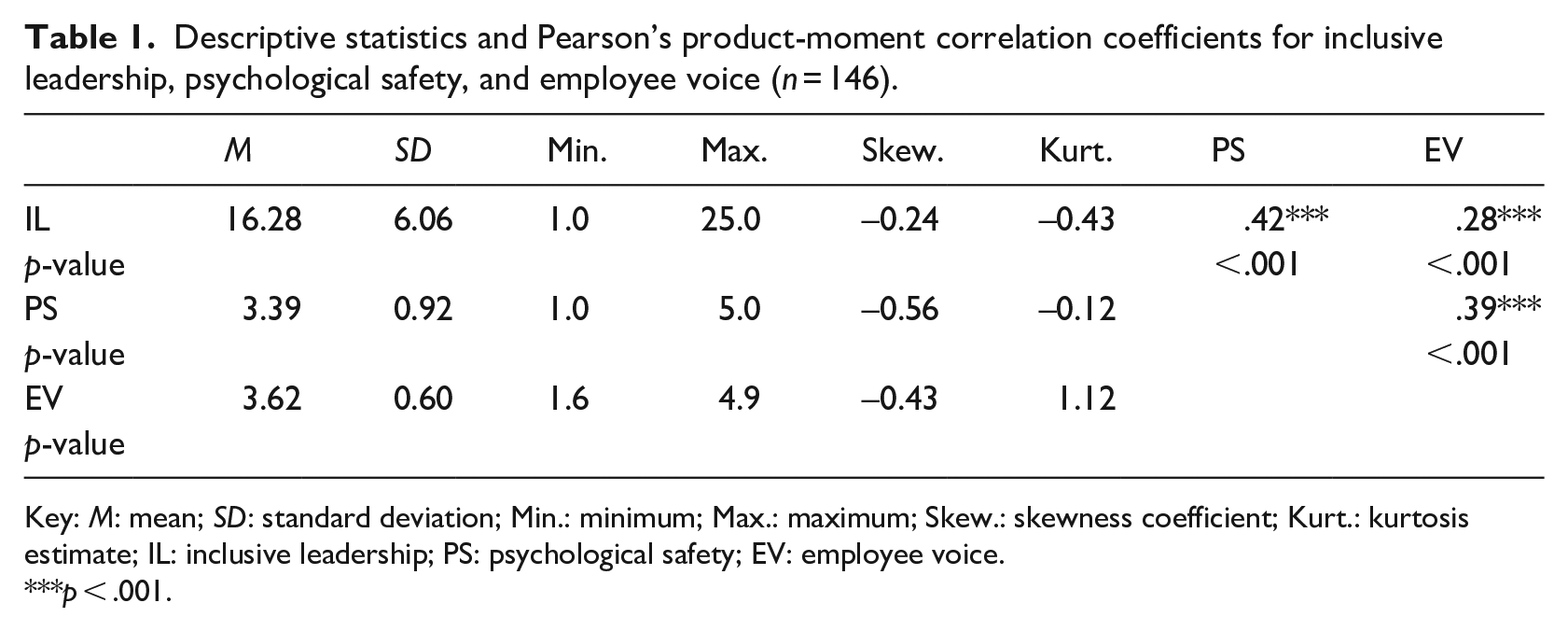
Key: M: mean; SD: standard deviation; Min.: minimum; Max.: maximum; Skew.: skewness coefficient; Kurt.: kurtosis estimate; IL: inclusive leadership; PS: psychological safety; EV: employee voice.
p < .001.
As shown in Table 1, inclusive leadership was significantly, positively, and weakly correlated with employee voice, while psychological safety was significantly, positively, and moderately correlated with both inclusive leadership and employee voice. Inclusive leadership significantly predicted psychological safety (r2 = .18; b = 0.06; SE = 0.01; t = 5.54; p < .001; 95% CI: [0.04, 0.09]) and was also initially a significant predictor of employee voice (r2 = .08; b = 0.03; SE = 0.01; t = 3.52; p < .001; 95% CI: [0.01, 0.04]). Psychological safety significantly predicted employee voice (r2 = .15; b = 0.25; SE = 0.05; t = 5.03; p < .001; 95% CI: [0.15, 0.35]). Together these results provided full support for H1, H2, and H3 in the sample.
When inclusive leadership and psychological safety were included in the same regression model (r2 = .17), psychological safety remained a significant predictor of employee voice (b = 0.21; SE = 0.06; t = 3.87; p < .001; 95% CI: [0.10, 0.32]) while inclusive leadership became non-significant (b = 0.01; SE = 0.01; t = 1.72; p = .088; 95% CI: [−0.00, 0.03]). The direct effect, representing the effect of inclusive leadership on employee voice through psychological safety, was therefore not significant (c′ = 0.01), while the indirect effect was significant (a*b = 0.01; BootSE = 0.00; Boot95% CI: [0.01, 0.02]). The Sobel test for the model was also significant (z = 3.79; p < .001; 95% CI: [0.01, 0.03]), providing further support for the significance of the indirect effect (van den Berg, 2025). The standardised Beta coefficients for the path relationships are presented in Figure 1. The results fully supported H4, indicating that the relationship between inclusive leadership and employee voice was fully mediated by psychological safety in the sample.
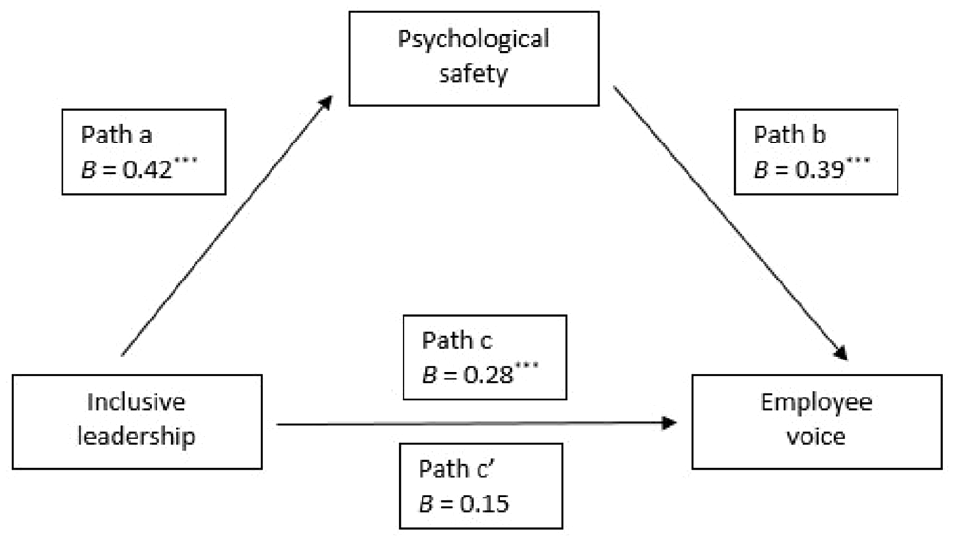
Mediation model for inclusive leadership, psychological safety, and employee voice.
Discussion
This study examined the mediating role of psychological safety in the relationship between inclusive leadership and employee voice in white-collar employees working fully or partly from home during the Covid-19 pandemic. This contributes to an understanding of the processes involved in creating a context where employees are willing to raise issues which may challenge organisational norms and processes while working remotely or with reduced face-to-face contact with their managers. This is important because remote and hybrid forms of work are likely to continue in the future both internationally and in South Africa (Munyeka, 2024; Winkler-Titus et al., 2025) and organisations can benefit from well-intentioned employees using their voices to bring about improvements in work processes and reducing negative outcomes (Chamberlin et al., 2017; Morrison, 2014, 2023); The study was situated within SET which proposes that social exchanges are reciprocal, where positive or negative behaviours are responded to with similarly positive or negative behaviours (Blau, 1964).
The results supported the first three hypotheses which examined the relationships between inclusive leadership, psychological safety, and employee voice. The relationship between inclusive leadership and psychological safety is consistent with previous research (e.g., Carmeli et al., 2010; Hassan & Hassan, 2018; Nembhard & Edmondson, 2006; Zhao et al., 2020). The openness, availability, and accessibility of inclusive leaders and their emphasis on subordinates’ needs and perceptions (Milliken et al., 2003; Randel et al., 2018) may explain why inclusive leadership was perceived as creating psychological safety and reducing perceptions of interpersonal risk even when working from home. This reduction in risk is likely to facilitate employee voice because the environment is perceived as being safer and leaders are perceived as being approachable (Javed et al., 2017; Nembhard & Edmondson, 2006; Pacheco et al., 2015). The receptiveness of inclusive leaders to diverse views is also likely to contribute to feelings of psychological safety and employee voice, as a range of views are listened to and considered in the organisation (Randel et al., 2018). This supports the proposition that psychological safety is related to employee voice, which is consistent with both existing literature (e.g., (Elsaied, 2019; Ge, 2020) and the results in this study.
In SA, inclusive leadership is a relevant leadership style and makes a significant contribution to psychological safety at work in a context where there is uncertainty regarding the economy and high unemployment (Dadam & Viegi, 2024). This context reduces options for finding alternative jobs for some employees and therefore highlights the importance of enhancing work experiences for employees and improving organisational performance. Encouraging discretionary input from employees that promotes improvements and identifies and mitigates risks is vital to ensuring positive organisational outcomes (Chamberlin et al., 2017; Morrison, 2014, 2023); and a lack of opportunities for employees to voice these concerns could deprive organisations of valuable input (John & Manikandan, 2019; Pacheco et al., 2015). The results of this study support other research findings demonstrating that psychological safety facilitates employee voice (e.g., Fatoki, 2024; Ge, 2020; Lee & Dahinten, 2021) and add to these by suggesting that this applies even under remote and hybrid working conditions.
Similarly, the relationship between inclusive leadership and employee voice is supported by previous research (e.g., Guo et al., 2020; Qi et al., 2023; Younas et al., 2022). By encouraging employees to speak up (Morrison, 2014), to be open to new information (Hirak et al., 2012), and to listen to and appreciate employees’ views (Nembhard & Edmondson, 2006), inclusive leaders foster employee voice (Jolly & Lee, 2021). The findings of this study support SET (Blau, 1964) as they suggest that the positive behaviours exhibited by inclusive leaders create positive perceptions of psychological safety, and employees are then able to respond by contributing ideas for improved organisational functioning and alerting managers to situations that involve risks to the organisation through voicing their views. They also suggest that the relationship between inclusive leadership and employee voice can be extended to remote and hybrid working conditions.
Previous research has examined psychological safety as a mechanism whereby inclusive leaders can elicit employee voice. Detert and Burris (2007) found that employees need to perceive a low level of risk if they are to express views that may be contrary to organisational norms or the views of their colleagues or superiors and that change leadership could facilitate this. Lee and Dahinten (2021) identified psychological safety as a partial mediator of the relationship between inclusive leadership and employee voice, while Fatoki (2024) found that psychological safety fully mediated the relationship between inclusive leadership and employee voice. The significant mediation model identified in this study thus adds to a growing body of knowledge suggesting that the creation of psychological safety through an inclusive leadership approach can facilitate positive expressions of employee voice, and extends this to working under remote and hybrid conditions.
Leaders need to create psychological safety for employees to voice well-intentioned ideas, suggestions, and concerns. Similarly to Detert and Burris’s (2007) finding that leaders’ openness was particularly important in creating psychological safety and fostering employee voice, it is likely that the openness of inclusive leaders plays a similar role. For remote workers, the availability and accessibility of inclusive leaders is also likely to be important as face-to-face contact is reduced (Edelmann et al., 2013), making it more difficult to assess when to initiate interactions with leaders and to test out ideas in an informal manner before addressing them more formally. By focusing on inclusive leadership, this study extends previous research on the mediating role of psychological safety in the relationships between other types of leadership and employee voice (e.g., change leadership (Detert and Burris, 2007); self-sacrificial leadership (Zhang et al., 2020); paradoxical leadership (Li et al., 2020); servant leadership (Chughtai, 2016); supportive leadership (Elsaied, 2019); ethical leadership (Sağnak, 2017); and authoritarian leadership (Wu et al., 2020). The study also demonstrates the need for leaders to be open, accessible, and available in a context of remote and hybrid work and to create non-threatening work environments if they wish to encourage employees to raise their views and concerns and provide suggestions.
The results have several implications. First, it is important to develop an organisational culture where diversity and inclusive leadership are valued and actively developed, and where employees have a sense of psychological safety so that they can exercise their voices. This is likely to apply to remote and hybrid as well as in-person work. Adopting a systemic approach to identifying norms and processes at the organisational, group, and individual levels that support rather than detract from these values and behaviours could be useful. Second, both managers and employees are responsible for developing employee voice (Detert & Burris, 2007). Therefore, developmental programmes should be aimed at both groups. Employees need to be actively encouraged to develop both promotive and prohibitive voice and may benefit from interventions designed to build their assertiveness and communication skills. Managers may need to enhance their active, non-defensive listening, group facilitation, and conflict resolution skills to encourage employees to speak up and deal with conflicts that may arise due to voice. While formal organisational processes (e.g., suggestion systems) and espoused values (e.g., ‘open door’ policy) should support employee voice, these alone are not sufficient and leaders need to develop specific behaviours that show openness and encourage discretionary and informal employee voice. Third, prohibitive voice could highlight actions that are unethical, illegal, or unsafe, increasing risks to employees who raise these issues. Organisations need policies and measures in place to protect employees when this occurs. Fourth, linking employee voice to business strategies for improvement, innovation, and good governance could assist in legitimising employees’ views, especially when they differ from majority views. Fifth, human resource systems should be aligned with inclusive leadership and employee voice. For example, hiring, development practices, and reward systems should include the characteristics and behaviours needed for inclusive leadership, psychological safety, and employee voice in both leaders and subordinates.
The current study had several limitations. The small sample size limits the robustness and generalisation of the results. The sample focused largely on medium- to high-income employees and the results may not generalise to lower-income employees. Individual differences (e.g., personality, demographic characteristics) and job characteristics were not controlled for and should be considered in future research. Data was also collected at one point in time and it is likely that employees adjusted to remote and hybrid work as the pandemic progressed, and that leadership behaviours and employee voice also responded to these adjustments. Future research needs to focus more on voice in low-income employees and the effects of inclusive leadership in remote and hybrid work in more ‘normal’ situations beyond the pandemic, as well as comparing experiences between employees who do and who do not work remotely or in a hybrid setting. This would provide valuable insights into potential differences in experiences between these groups, as well as insight into variations in circumstances that promote employee voice.
Conclusion
The openness, availability, and accessibility of inclusive leaders are important in creating the psychological safety needed for employees to use their voices to improve organisations. This study extends the importance of inclusive leadership and psychological safety for promoting employee voice to remote and hybrid work where communication and job performance are mediated by technology.
Footnotes
Declaration of conflicting interests
The author(s) declared no potential conflicts of interest with respect to the research, authorship, and/or publication of this article.
Funding
The author(s) received no financial support for the research, authorship, and/or publication of this article.
