



Abstract
During the COVID-19 pandemic, many workers have been forced to work from home. In this situation, the boundaries between work and private life have become particularly blurred, and recovering from work was even more difficult than in traditional times, with negative consequences for workers’ health. Among the psychological experiences that might underlie the recovery process, mastery played a crucial role as people sought new stimuli and challenging situations. However, there are few articles that have explored the role of this specific recovery experience, its antecedents, and the health consequences under conditions of work from home. Therefore, in this multiwave study, we aimed to investigate the role of mastery as a mediator between supervisor support and insomnia problems. The study was conducted during the COVID-19 pandemic in Italy and had a three-wave design. A convenience sample of 130 employees (67% women) completed an online questionnaire. Hypotheses were tested using a three-wave autoregressive cross-lagged panel model. According to the results, supervisor support at Time 1 was positively related to mastery at Time 2, which in turn showed a negative association with insomnia at Time 3. The results demonstrated that mastery experiences have played a crucial role during COVID-19 mandatory work from home, which points to some potential implications for workers’ health in the adoption of teleworking beyond the emergency situation.
Introduction
As of early 2020, the COVID-19 emergency required several measures to contain the spread of the virus. In addition to the use of face masks and social distancing, organizations were encouraged to introduce work-from-home (WFH) practices on a large scale. From this point of view, the crisis provided an opportunity to better understand the dynamics of WFH and, in line with the present study’s aims, to investigate the conditions that can promote better recovery experiences. Recovery after work represents a fundamental aspect of mental health, well-being, and optimal functioning, especially in highly demanding times, such as those we are currently experiencing. Many workers have had to adjust to full-time WFH, in most of the cases without proper training, without adequate tools and ergonomic conditions, and with a lack of physical boundaries between their workspace and the rest of their family and home life (Zhang et al., 2021).
Among the various recovery experiences described in the literature (Sonnentag & Fritz, 2007), mastery played a crucial role during the pandemic. Mastery experiences are those that promote the learning and development of new resources and skills (e.g., sports, languages, crafts, cooking, and so forth) and are therefore perceived as stimulating by the individual. In times of self-distancing restrictions, with the closure of training centers, sports, and other facilities and the impossibility of leaving the house, people were forced to find alternative stimulating leisure activities, to do on their own at home or attending online courses.
The main aim of the present multiwave study was to examine whether mastery after work in times of emergency restrictions had the potential to improve well-being, with particular reference to its negative effects on insomnia.
The interest in studying insomnia stems from the fact that it is related to decreased ability to work, decreased ability to concentrate, and decreased ability to listen and make decisions (Linton & Bryngelsson, 2000; Swanson et al., 2011). Studies have also shown a significant association between insomnia and absenteeism, increased risk of accidents, lower job satisfaction and efficiency (Léger et al., 2002, 2006), and a positive association with work–family conflict and work stress (Yang et al., 2018).
Although some studies have not confirmed the presence of sleep disturbances during lockdown (AMHSI Research Team et al., 2020), other authors have reported insomnia problems, sleep fragmentation, nightmares, and, in general, some specific tendencies in sleep–wake cycles (Bhat & Chokroverty, 2022), which are probably also related to the excessive use of smartphones, whose association with sleep problems has already been highlighted (Bhat et al., 2018).
In addition, we were interested in understanding the role of a job resource, namely supervisor support, as an antecedent of mastery. The article aimed to contribute to the literature on telework and recovery by providing first evidence about the role of mastery over the exceptional condition of emergency WFH. Although teleworking registered considerable growth in the last 2 years, research on this form of work is still sparse (Athanasiadou & Theriou, 2021), especially if we consider it as a relatively new approach and assume differences in its dynamics and effects compared with the pre-pandemic period (Elbaz et al., 2022).
Recovery and Mastery Experiences
Recovery refers to a psychological process that allows the resources and energies depleted by stressful situations to be restored and the individual’s functional system to return to its pre-stressor levels (Meijman & Mulder, 1998; Sonnentag et al., 2008). Two major theories, which complement each other, address recovery. The effort-recovery model (Meijman & Mulder, 1998) assumes that physiological activation and fatigue are normal consequences of energy expenditure at work. To have an effective recovery process, the functional systems activated during the work activity should no longer be stressed to return to the pre-stressor levels. In addition, the Conservation of Resources (COR) theory (Hobfoll, 1998) states that individuals try to defend and maintain their resources and gain new ones to protect themselves from stress. Recovery is essential to restore internal resources such as energy, positive mood, or self-efficacy that have been consumed by the workday.
Sonnentag and Fritz (2007) introduced the concept of recovery experiences to define the mechanisms through which recovery processes occur. The present study focused on the experience of mastery, which has its roots in the COR theory. Indeed, mastery-oriented strategies support the recovery process by providing opportunities to gain new resources in addition to restoring those expended during the workday (Siltaloppi et al., 2009). Furthermore, a review on leisure and subjective well-being (Newman et al., 2014) supported the notion that mastery is an essential mediating link to well-being, highlighting the connection with flow theories (Csikszentmihalyi, 1990). The state of flow, introduced by Csikszentmihalyi (1990), can be experienced by an individual who engages in an activity that provides a balance between challenge and skill. The person enters a state of complete concentration and absorption which, according to flow theories, leads to optimal experience and well-being through the mechanism of mastery. Although some studies have shown that flow occurs more often at work than during leisure (Csikszentmihalyi & LeFevre, 1989), flow can also be present in experiences of mastery recovery when one is confronted with meaningful and pleasantly absorbing tasks that provide a sense of accomplishment.
In the context of the pandemic, mastery specifically means engaging in new experiences of learning and growth, such as reading about a subject of interest or engaging in stimulating hobbies, such as gardening, painting, playing a musical instrument, cooking, playing sports, and, at the same time, being distracted by the COVID-19–associated worries (Grandey et al., 2021; Ménard et al., 2021). Ménard and colleagues (2021), in their diary study conducted in Canada with a sample of 423 individuals who were in lockdown, found that mastery experiences at midday could help reduce experienced stress, particularly among single individuals.
The Role of Supervisors During Mandatory WFH as Antecedent of Mastery
The role of leadership as a job resource (Tummers & Bakker, 2021) and as a predictor of recovery (Hawkes et al., 2017) has been widely documented. In this article, we focused on the positive role of leadership, positioning it as a key resource within the broader positive leadership approach (Van Dick & Monzani, 2020). Among the several models that fall under this approach, we focused on the dyadic relationship between leader and follower in terms of positive social exchange (Ilies et al., 2005) as envisioned in the Leader-Member Exchange theory (LMX; Graen & Uhl-Bien, 1995). The role of LMX in performance (Gottfredson & Aguinis, 2017) and well-being dynamics (Ilies et al., 2005; Inceoglu et al., 2018) is well established. Several meta-analyses show that the positive effects of LMX include: increased in-role and extra-role performance, constructive attitudes and psychological states, reduced role conflict, and turnover (Ilies et al., 2007; Martin et al., 2016). Supervisory support can also be understood as a specific form of social support at work, a variable that has previously been associated with worker motivation, follower confidence, positive personal development, and prosocial behaviors (e.g., Gatti et al., 2020; Hannah et al., 2014). A recent systematic review of the literature on leadership in the context of the job demands-resources theory (Bakker & Demerouti, 2017) also found that, among job resources, LMX is the second most studied model (the first being transformational leadership; Tummers & Bakker, 2021).
With reference to WFH, key position papers in the field of organizational studies emphasized the importance of paying special attention to the role of leadership, both in an emergency situation and in the upcoming “new normal” scenario (Kniffin et al., 2020; Rudolph et al., 2020; Sinclair et al., 2020; Spagnoli et al., 2021). Some empirical evidence has highlighted the beneficial role of positive leadership (Lamprinou et al., 2021) but also the detrimental effects of abusive/intrusive, toxic, or destructive leadership behaviors (Dolce et al., 2020; Magnavita et al., 2021), and identified the role of the supervisor as a key variable in the dynamics of remote working. Nevertheless, a few contributions have analyzed the relationship between leadership and recovery experiences under WFH conditions. A recent work by Dolce and colleagues (2020), which involved a sample of remote workers in France, found that employees had lower levels of recovery in the presence of destructive leadership; moreover, recovery mediated the relationship with emotional exhaustion. However, little is known about the relationship between positive forms of leadership and the specific recovery experiences under WFH conditions.
Based on these considerations, we propose that the support provided by the supervisor at Time 1 (T1) enables mastery experiences at Time 2 (T2), within a relational dynamic of exchange and growth, where time away from work is respected by the supervisor and becomes an opportunity to expand personal resources through spaces and actions chosen by the person.
Insomnia and Its Relationship With Mastery
Overall, evidence from studies conducted during and prior to the COVID-19 pandemic suggests that broadening one’s horizons through mastery experiences can improve psychological and physical health by increasing self-efficacy and distracting from stressors (Grandey et al., 2021; Hahn et al., 2011). Fritz and Sonnentag (2006) found that employees who experienced higher levels of mastery while on leave reported lower levels of exhaustion when they returned to work. Sonnentag and colleagues (2008) demonstrated that mastery experiences in the evening were negatively associated with positive affect in the morning. More recently, a study by Grandey and colleagues (2021) investigated the association between pandemic-related COVID-19 work reduction or absenteeism and short-term health changes. Their results showed that mastery had positive short-term effects, being positively associated with immediate positive mood and negatively associated with insomnia. Successful recovery has been shown to improve sleep quality, resulting in a reduction in fatigue and restoration of resources (Sonnentag & Geurts, 2009).
Several studies demonstrated that the pandemic, like other stressful events, has impaired sleep, at a time when healthy sleep was particularly important to cope with the crisis and uncertainty about the future. The impact of the pandemic on sleep quality has been reported in several countries. For example, the study by Mandelkorn and colleagues (2021), which involved 2,500 participants, found that on average 40% reported a worsening of sleep. Moreover, the National Institutes of Health (2005) reported that chronic insomnia is a major public health problem affecting millions of individuals. Within the framework of the COR theory (Hobfoll, 1998), we assumed that the negative relationship between mastery experiences and insomnia would also apply to remote workers during the COVID-19 lockdown.
Finally, according to the job demands-resources-recovery model proposed by Kinnunen and colleagues (2011), we hypothesize a mediation of mastery in the relationship between supervisor support of job resources and insomnia. This hypothesis is based on the COR theory (Hobfoll, 1998) and on the fact that individuals who receive many resources from the job context (e.g., supervisor support) are likely to develop more internal resources (e.g., self-efficacy, optimism, energy) that can be used for learning through leisure activities (Kinnunen et al., 2011). These types of recovery experiences, by restoring or creating new personal resources, in turn, help recover and maintain well-being and motivation.
Method
Participants and Procedure
This study included a convenience sample of 130 individuals who were informed about this research through a link shared by researchers and master students on LinkedIn and other social and professional networks. The questionnaire was completed via the Google Moodle platform and targeted workers from different occupational sectors who stated that they were working from home. The first administration started at the beginning of April 2020, during the first COVID-19 lockdown. Later, those who agreed to be contacted again received another link in June 2020 (T2), after 6 weeks from T1, and in September 2020, after 12 weeks from T2. In total, 700 participants completed the questionnaire at T1, 226 at T2 and 130 at T3. The amount of dropouts, albeit high, is common in online surveys, particularly when participants are employed, participate voluntarily, and are not incentivized (O’Neil et al., 2003).
All participants gave informed consent and confidentiality was ensured. Research aims, data treatment information, voluntary and unpaid participation, and instructions to complete the questionnaire were described in the cover letter. The Bioethical Committee of the University of Turin approved the study (document no. 150561, April 3, 2020). Participants consented to the use of the anonymous data for research and statistical purposes and for publication of the results in journals, books, research papers, and presentations to a wide audience.
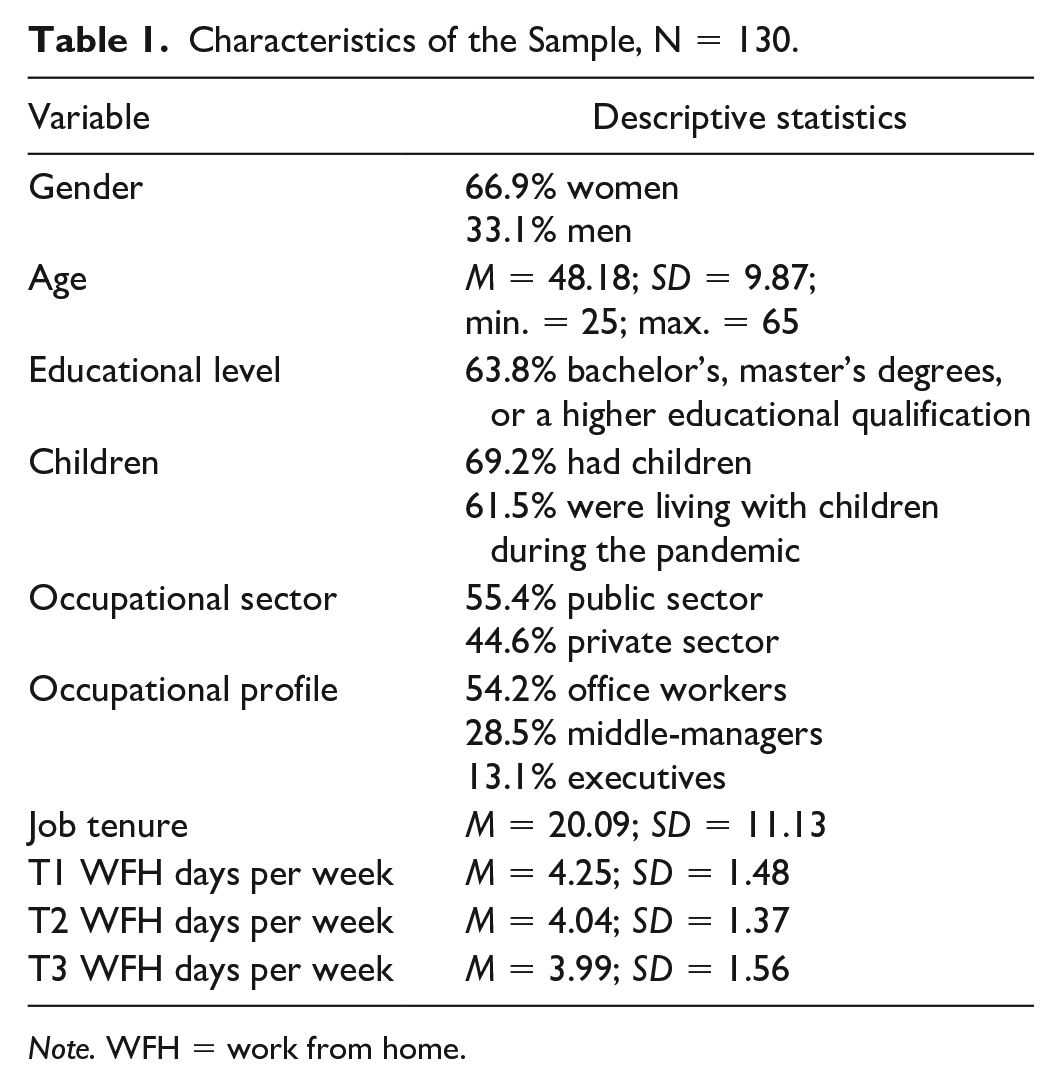
The main characteristics of the sample are described in Table 1. To assess potential differences between the final longitudinal sample and the larger sample that participated only at T1, a series of t-tests were conducted on supervisor support, t (690) = 0.92, p = .359, mastery, t (696) = 0.68, p = .494, and insomnia, t (688) = −1.85, p = .070, and no one showed statistically significant differences. Moreover, a χ2 test indicated that gender distribution did not vary between waves, χ2 (1) = 0.011, p = .915.
Characteristics of the Sample, N = 130.
Note. WFH = work from home.
Measures
Supervisor support was assessed with five items adapted from the Leader Member Exchange scale (Graen & Uhl-Bien, 1995). Participants answered all items on a scale from 1 = Never to 5 = Always. Cronbach’s alpha was .92 at T1, .94 at T2, and .94 at T3. An example item is: “My supervisor uses his or her influence to help me solve my problems at work.”
Mastery was measured by using three items of the Recovery Experience Questionnaire (Sonnentag & Fritz, 2007). Participants were asked to think about what they did in the evening after work during the last 10 days and to answer the three items by using a scale from 1= do not agree at all to 5 = fully agree. Cronbach’s alpha was .91 at T1, .90 at T2, and .90 at T3. An example item is: “I seek out intellectual challenges.”
Insomnia was assessed with three items (Broman et al., 2008) on a scale from 1 = Never to 5 = Always. Cronbach’s alpha was .85 at T1, .81 at T2, and .78 at T3. An example item is: “I have problems with falling asleep.”
Data Analysis
The theoretical model was tested using a three-wave autoregressive cross-lagged panel model; because of the small sample size we used observed variables to reduce the number of freely estimated parameters (e.g., Avanzi et al., 2021; Xanthopoulou et al., 2009). However, the measurement model and the metric invariance across time for each variable were tested.
After that, we tested a series of alternative models. In the first one (M1) all autoregressive paths and all cross-sectional covariances among variables at the same time, and all cross-lagged paths were calculated, with no constraints. Then, we controlled reversed models testing four models where one pair of paths at a time was constrained. Whether fixing paths to be zero did not worsen the model we moved toward a more parsimonious one.
According to the literature (Bollen & Long, 1993) several goodness-of-fit criteria were considered: the χ2 goodness-of-fit statistic; the Root Mean Square Error of Approximation; the Comparative Fit Index; the Tucker–Lewis Index; the Standardized Root Mean Square Residual. Bootstrapping procedure (2000 replications) was used to test the significance of the indirect effect (Preacher & Hayes, 2008), which was calculated as the product of the path from supervisor support at T1 and the mediator, namely, mastery, at T2, and the path from mastery at T2 and insomnia at T3. Data were analyzed using SPSS 27 and Mplus 8 software package. The dataset is available as supplementary material.
Results
Descriptive Statistics and Correlations
Table 2 shows the means, standard deviations, and correlations between the study variables. Each variable showed a good level of construct stability as retest correlations ranged from r = .52 to r = .78. The longitudinal correlations preliminary supported study hypotheses; in particular, supervisor support at T1 was positively correlated with mastery at T2, which negatively correlated with insomnia at T3. Gender, age, and sector did not correlate with any of the variables at any time.
Item Means (M), Item Standard Deviations (SD), and Correlations Among the Study Variables.
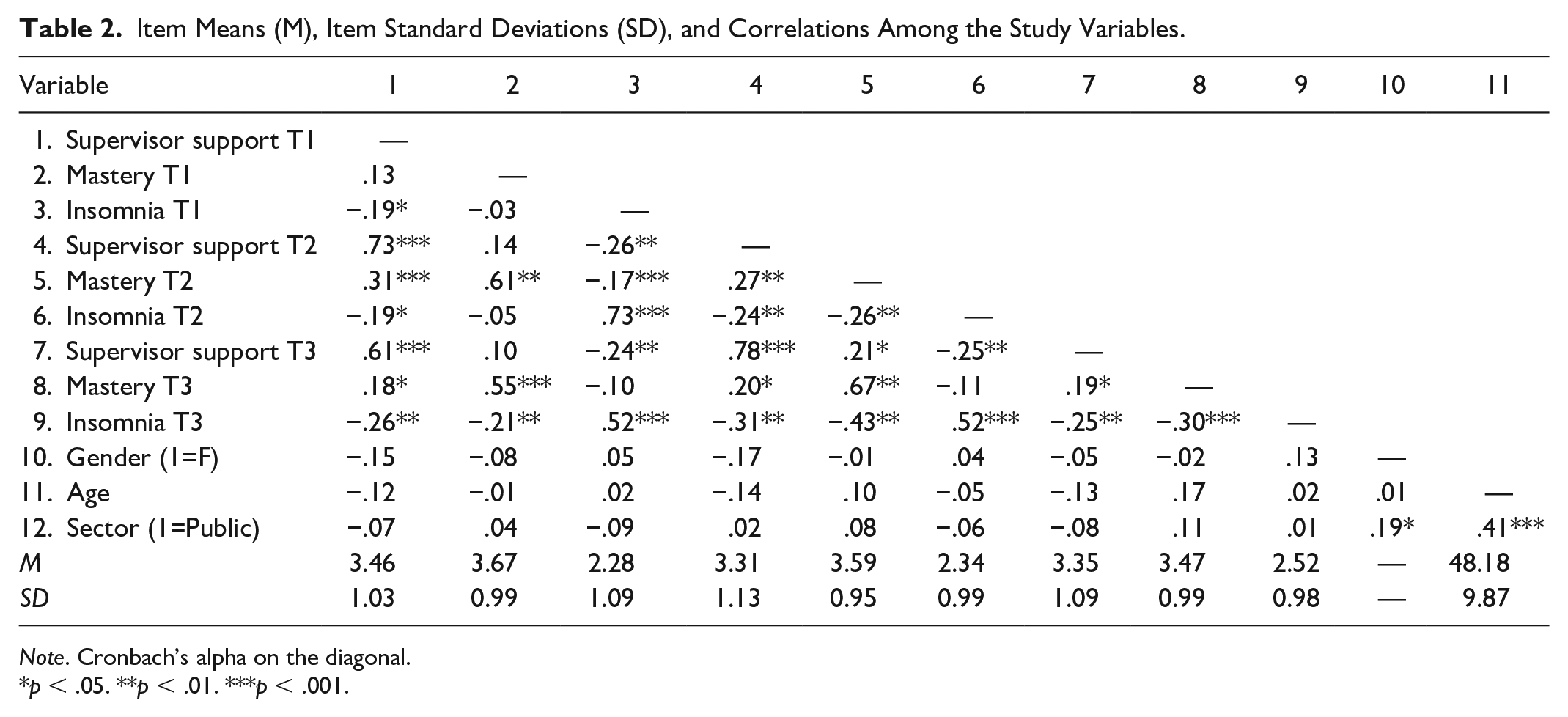
Note. Cronbach’s alpha on the diagonal.
p < .05. **p < .01. ***p < .001.
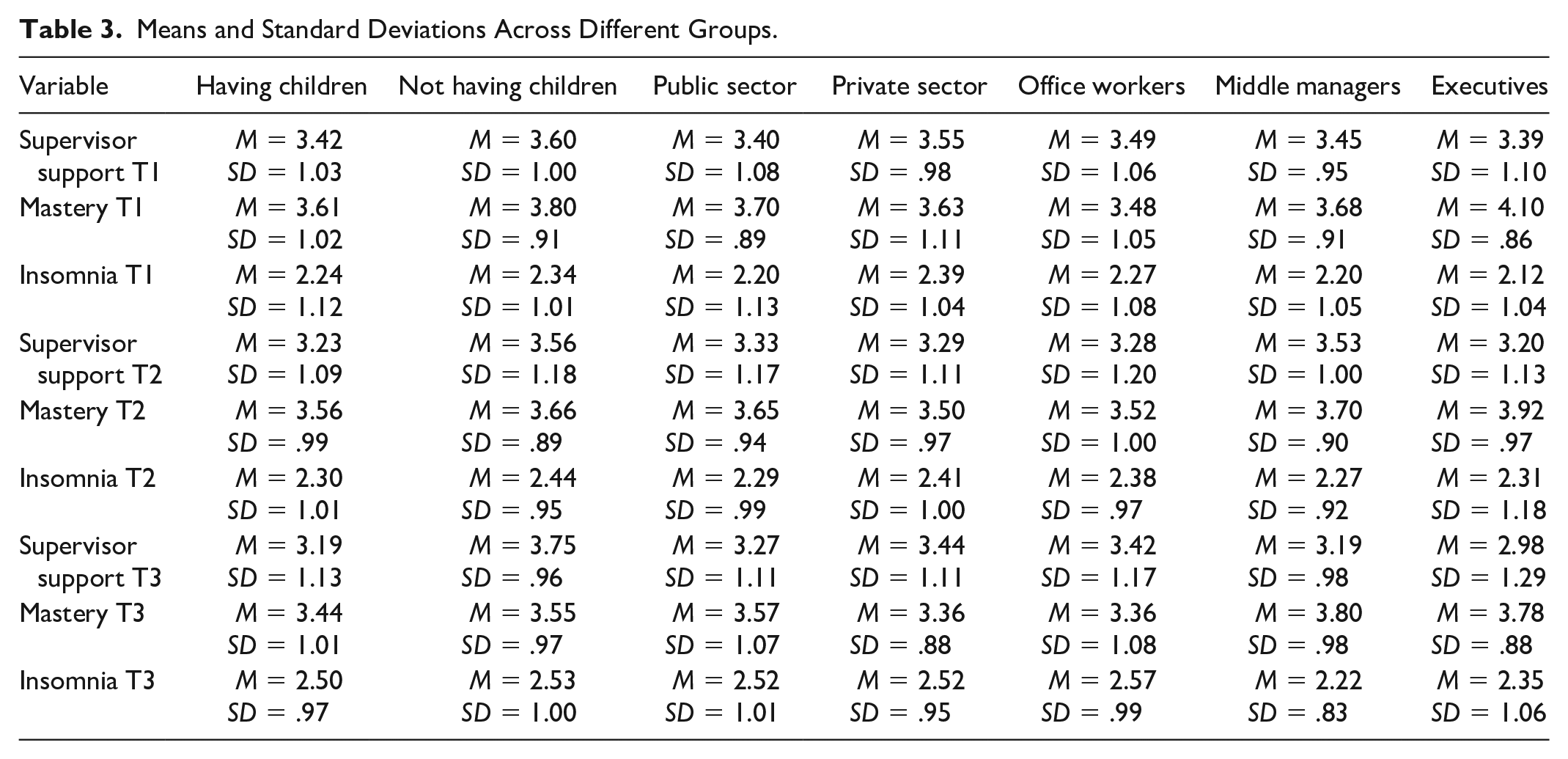
Table 3 shows the means and standard deviations for each variable, comparing the different groups based on having children, occupational sector, and professional profile. There were no significant differences, except for supervisor support at T3, which was higher for those without children, t(127) = −2.70; p = .008, and mastery at T1, which was lower for office workers compared with executives, F(2; 124) = 3.54; p = .032.
Means and Standard Deviations Across Different Groups.
Measurement Models
We computed separate models for each variable to test configural invariance across the three time points and metric invariance by constraining the factor loadings for each item to be equal across time. As shown in Table 4, configural invariance across time was supported, with good model fits. Factor loadings across time were all significant at p < .001 and ranged from 0.763 to 0.951 for supervisor support, from 0.831 to 0.945 for mastery and from 0.681 to 0.863 for insomnia. Metric invariance was also supported; the models did not worsen in comparison with the configural invariance models.
Model Fits to Test Configural Invariance and Metric Invariance for Each Variable.
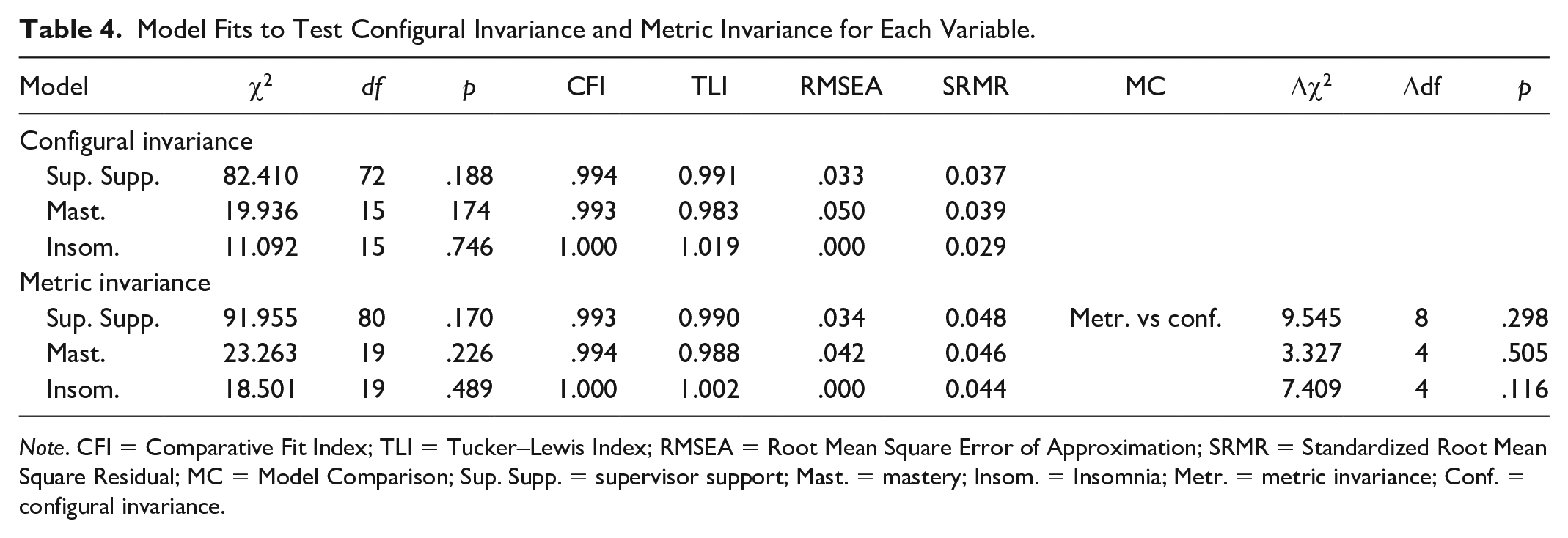
Note. CFI = Comparative Fit Index; TLI = Tucker–Lewis Index; RMSEA = Root Mean Square Error of Approximation; SRMR = Standardized Root Mean Square Residual; MC = Model Comparison; Sup. Supp. = supervisor support; Mast. = mastery; Insom. = Insomnia; Metr. = metric invariance; Conf. = configural invariance.
Hypothesis Testing
Table 5 shows the results of alternative models tested to verify our hypotheses. The first model (M1) had no constraints and showed an acceptable fit to the data. In Model 2 (M2), the paths from supervisor support to insomnia were constrained to zero in both time lags; these two paths were not statistically significant in M1. The model showed a good fit and the constraints did not significantly worsen the fit. In Model 3 (M3) we constrained to zero the paths from insomnia to supervisor support in both time lags; in M2, the paths were not statistically significant. In this case, the model also showed a good fit and the constraints did not significantly worsen the fit. In the fourth model (M4), we constrained to zero the path from mastery to supervisor support in both time lags; the two paths were not statistically significant in M3. The model fit did not significantly worsen. Finally, in the fifth model (M5), we constrained to zero the path from insomnia to mastery in both time lags; the two paths were not statistically significant in M4. Again, the model fit did not significantly worsen.
Model Fits of the Alternative Model Tests.
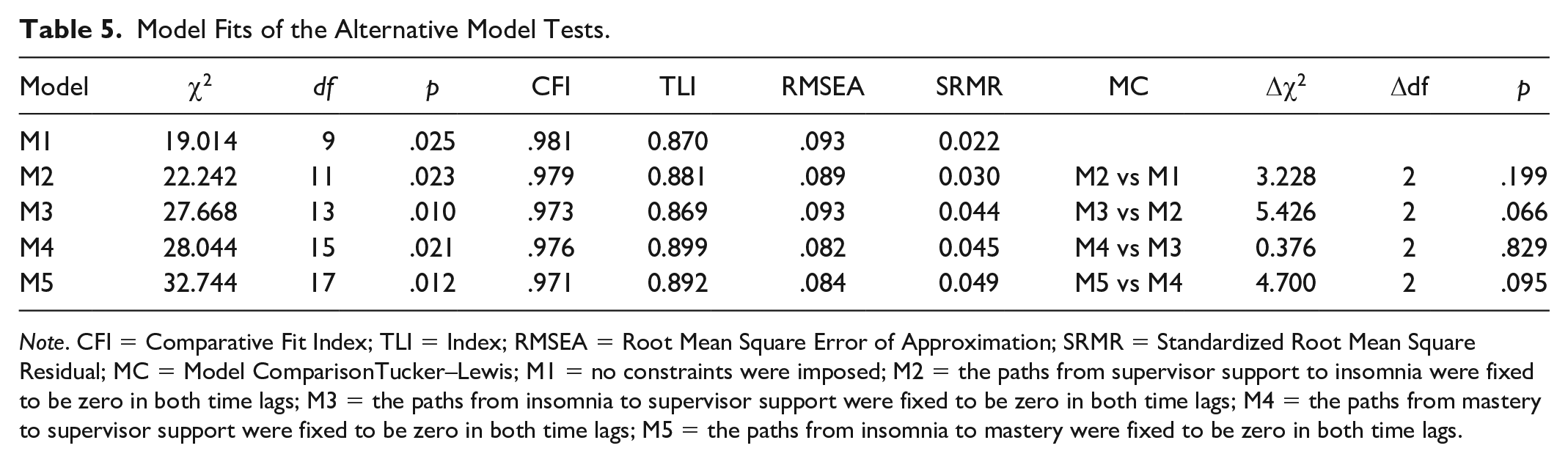
Note. CFI = Comparative Fit Index; TLI = Index; RMSEA = Root Mean Square Error of Approximation; SRMR = Standardized Root Mean Square Residual; MC = Model ComparisonTucker–Lewis; M1 = no constraints were imposed; M2 = the paths from supervisor support to insomnia were fixed to be zero in both time lags; M3 = the paths from insomnia to supervisor support were fixed to be zero in both time lags; M4 = the paths from mastery to supervisor support were fixed to be zero in both time lags; M5 = the paths from insomnia to mastery were fixed to be zero in both time lags.
Thus, Model 5, which is depicted in Figure 1, was the preferred one. According to our mediational hypothesis, supervisor support at T1 significantly predicted mastery at T2, and mastery at T2 in turn significantly predicted insomnia at T3. In the model we controlled for gender (1 = female), age and sector (1 = public sector); all of them were uncorrelated to any of the other variables across time. All R2 values were significant and, particularly, indicated that the percentage of the variance of mastery at T2 and insomnia at T3 explained by the independent variables of the model was respectively 44% and 36%. The significance of the indirect effect was also supported by a bootstrap analysis with 2,000 resamples (unstandardized indirect effect = −0.078; p = .004; 95% confidence interval [CI]: [−0.145, −0.025]).
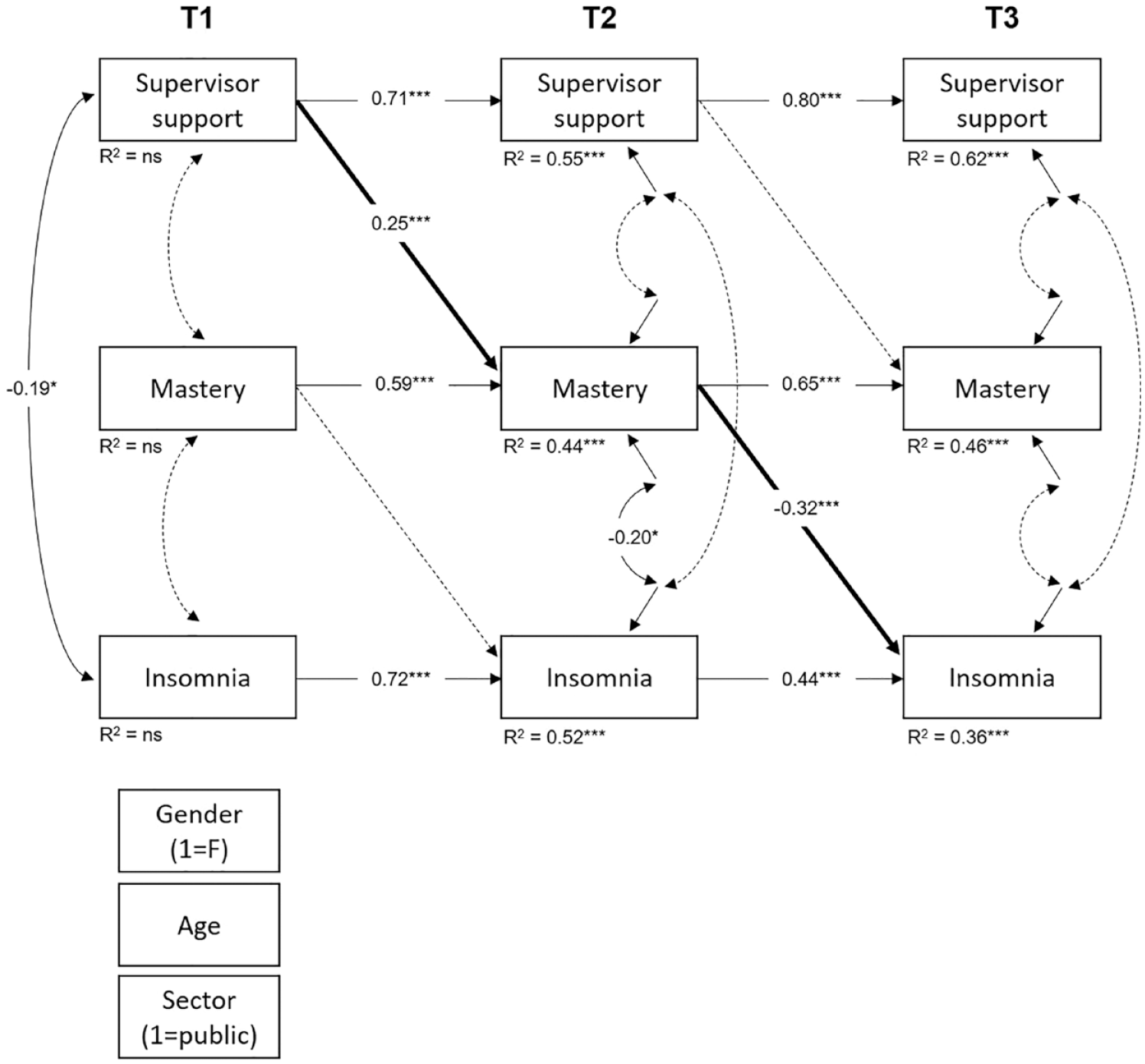
Model 5 (best fitting solution). Mediation paths are highlighted in bold. Nonsignificant paths are represented by dotted lines. *p < .05, **p < .01, ***p < .001. ns = nonsignificant. In the model, we controlled for gender, age, and sector across time; none of these variables were correlated with any of the other variables (dotted lines are not depicted for these paths).
Discussion
In this study, we have focused on the role of mastery, a recovery experience particularly affected by the change imposed by the COVID-19 outbreak. The present study contributed to the literature in different ways: it investigated the role of mastery experience in an unprecedented situation and in conditions of intense WFH; it is one of the few studies that investigated a specific antecedent, that is, supervisor support, of a specific recovery experience, that is, mastery; it provided evidence and suggestions for interventions for sleep problems of remote workers.
The first study’s hypothesis stated that supervisor support at T1 was positively related to mastery experience at T2. The hypothesis was supported, supporting the understanding of a positive relationship between specific kinds of job resources and recovery experiences (Bakker & de Vries, 2021; Bennett et al., 2018; Kinnunen & Feldt, 2013). A supportive leadership style is necessary to promote mastery for several reasons. First of all, a supervisor should respect his or her colleagues’ rest periods and allow them enough free time, even if they work from home. Moreover, if employees feel that the supervisor understands their problems and needs and is available to help, they will be more willing to take their free time and feel comfortable in postponing non-urgent work-related problems or unfinished tasks until the next day. Finally, in a relationship of mutual exchange and growth (Ilies et al., 2005), a supervisor who cares about their employees’ interests and provides feedback may promote the development of internal resources and encourage a desire to engage in (new) challenging activities to find additional learning opportunities after work.
In the second hypothesis, which was also supported, we postulated a negative relationship between mastery at T2 and insomnia at T3. By engaging the person in a stimulating leisure task, mastery experiences reduce activation from work and promote the development of new resources. Reducing activation allows the psychological load from work tasks to be reduced or halted, and functional systems activated during the workday return to pre-stressor levels. This process protects psychological and physical health, including the quality of sleep. In addition, mastery activities during leisure time distract the person from the COVID-19-associated worries, which was found to be one of the main causes of sleep disorders during the COVID-19 pandemic (Grossman et al., 2021).
Finally, we hypothesized that there would be a mediation of mastery experiences between supervisor support and insomnia. It is likely that other variables are involved in this dynamic and mediate the relationship. Although the indirect effect was not particularly high, it was significant, and it is interesting to observe the role of mastery. Thus, Hypothesis 3 was also supported in line with the job demands-resources-recovery model, according to which recovery experiences mediate the relationship between job characteristics and well-being outcomes (Bennett et al., 2018; Kinnunen et al., 2011). The mediation of mastery in the relationship between job resources and well-being outcomes is supported by the fact that individuals who already have resources tend to invest in them to improve the situation and generate more resources, according to the COR theory (Hobfoll, 1998). Thus, they may use available resources to preserve their leisure time and spend it gaining new resources through mastery experiences. These new resources, in turn, help them recover, avoid burnout symptoms such as insomnia, and maintain motivation to work.
Limitations and Avenues for Future Research
The first limitation of the current study lies in the nature of the self-reported data. In the future, especially for more sensitive constructs such as insomnia, it might be useful to combine the use of other-rated (peers, supervisors, or subordinates), objective, or physiological indicators. The second limitation concerns sample size. The voluntary participation and multiwave design resulted in a smaller number of participants, which affected the generalizability of the results. Moreover, we used non-equivalent intervals across waves while using the same time lag between waves is suggested (Zapf et al., 1996). Furthermore, this study was conducted during the pandemic emergency in Italy, which on the one hand allowed to focus attention on a specific country and provided practical implications for the management of other potential crises, but on the contrary also partially limits the generalizability of the results to other countries dealing differently with the public health emergency. Therefore, further studies can be conducted in other contexts and in less crisis-like situations.
As for the variables considered, further limitations emerged. First, the study of leadership requires a multilevel approach to better capture the characteristics of specific leadership styles and their impact on other dynamics. Finally, a measurement capable of identifying leadership support in the specific context of WFH and remote working would be necessary to take into account all the elements that influence the relationship between leader and followers at a distance. Also, a measure of leadership for health promotion could be useful to obtain more specific indications about the role of supervisors in the management of health problems (Barrett et al., 2005).
In relation to recovery, we chose to focus on mastery as a single variable and avoid the other experiences proposed in the literature. Indeed, understanding the specific role and dynamics associated with a single recovery experience is important to better understand its nature; however, future research also needs to examine how multiple recovery experiences may be used in combination to achieve positive outcomes (Siltaloppi et al., 2011). Moreover, as regards the specific measure of mastery, a focus on the different kinds of experiences (cognitive, physical, social) would be necessary in the future, also through qualitative studies.
Practical Implications
The research findings suggest practical implications in several areas. First, the ability of supervisors to provide support, even in the context of remote work mediated by information and communication technologies, is particularly important today (Spagnoli et al., 2021). Models of “digital leadership” or “leadership 4.0” are described in the literature (Trenerry et al., 2021), which can serve as a reference for the institutional and self-directed training of new generations of managers.
In terms of mastery, we can assume an intertwining between the organizational and individual levels. For the first level, it is important to provide time and resources for adequate recovery, which includes wellness initiatives, such as agreements with external service providers to offer mastery activities; at the same time, organizations should recognize these interventions as investments that can collectively impact performance and physical and psychological health. In addition, it is critical that managers respect employees’ non-work time by reducing demands and, more importantly, expectations of constant availability, while fostering a climate that encourages detachment and the active pursuit of mastery experiences outside of work. In this context, workers need to be trained to actively seek out and take advantage of recovery opportunities in their own environments to recognize their contribution to quality of life and well-being, both for themselves and for those close to them. Recovery training programs, which are widely cited in the literature (Hahn et al., 2011), represent both a cultural challenge and a concrete way to achieve this goal. Moreover, mindfulness programs, which can be offered within organizations, have been proven to be particularly effective for people with sleep disorders (Klatt et al., 2009).
In this study, we considered insomnia as the final outcome. However, we know that the relationship between working conditions and sleep problems is complex and reciprocal and that the determinants of sleep problems can be multiple (Bhat & Chokroverty, 2022; Swanson et al., 2011). In addition to the strategies and interventions described earlier, some specific interventions could address workers’ sleep problems, including interventions to ensure the right to disconnect from technologies (Ghislieri et al., 2017) and digital well-being, given the potential negative impact of ICT use on sleep (Bhat et al., 2018). In assessing well-being and/or stress at the organizational level, it may be important to examine sleep issues and then consider indirect interventions such as training to improve work–life balance (Olson et al., 2015) or direct interventions in sleep hygiene and fatigue management (Redeker et al., 2019), as appropriate, or even medical and psychological support for those with more severe problems within the psychophysical health services that may be available in organizations
Supplemental Material
sj-docx-2-heb-10.1177_10901981231192988 – Supplemental material for Stop (to Work) and Go (to Recover) During Mandatory Work From Home: A Three-Wave Study
Supplemental material, sj-docx-2-heb-10.1177_10901981231192988 for Stop (to Work) and Go (to Recover) During Mandatory Work From Home: A Three-Wave Study by Monica Molino, Valentina Dolce, Claudio Giovanni Cortese, Domenico Sanseverino and Chiara Ghislieri in Health Education & Behavior
Research Data
sj-sav-1-heb-10.1177_10901981231192988 – Supplemental material for Stop (to Work) and Go (to Recover) During Mandatory Work From Home: A Three-Wave Study
sj-sav-1-heb-10.1177_10901981231192988 for Stop (to Work) and Go (to Recover) During Mandatory Work From Home: A Three-Wave Study by Monica Molino, Valentina Dolce, Claudio Giovanni Cortese, Domenico Sanseverino and Chiara Ghislieri in Health Education & Behavior
Footnotes
Declaration of Conflicting Interests
The author(s) declared no potential conflicts of interest with respect to the research, authorship, and/or publication of this article.
Funding
The author(s) received no financial support for the research, authorship, and/or publication of this article.
Ethical Approval
The authors also declare that the Bioethical Committee of the University of Turin approved the study (document no. 150561, April 3, 2020).

References
Supplementary Material
Please find the following supplemental material available below.
For Open Access articles published under a Creative Commons License, all supplemental material carries the same license as the article it is associated with.
For non-Open Access articles published, all supplemental material carries a non-exclusive license, and permission requests for re-use of supplemental material or any part of supplemental material shall be sent directly to the copyright owner as specified in the copyright notice associated with the article.
