




Abstract
This article presents some snapshots from 30 years of my collaborative work in the social psychology of social change in South Africa. Projects with students and colleagues used ethnographic, discursive, and survey methods to document racial encounters in the newly desegregated spaces of post-apartheid South Africa. I will review some of the successes and failures of desegregation efforts both in the country and in social psychology, where intergroup contact theory has come under considerable scrutiny. Critically, an assimilate-to-privilege form of desegregation has not resulted in systemic change but replaced the apartheid ‘colour line’ with an ‘epistemic line’ of White privilege and race stereotyping. Towards the end of the article, I’ll consider why anticolonial discourse rejects intergroup contact as a solution, and turn, finally, to Mbembe’s concept of Afropolitanism to make modest proposals for a way forward – the ‘how to fix it’ part of the article.
Social psychology of contact and desegregation
What is social psychology? For someone schooled in the critical South African tradition (Foster & Louw-Potgieter, 1991; Hook et al., 2004; Ratele & Duncan, 2003), a good place to start is with a quote (attributed to Descartes, John Searle, Talmudic scholars, and others) underscoring constructionism: ‘We do not describe the world we see; We see the world we can describe’. In other words, our thinking has been captured so that we see what we already know. As proof of this constructionism, I’ve shown Rembrandt’s sketch ‘Christ and the Woman Taken in Adultery’ (see Figure 1) to many generations of South African students and am always surprised when they identify Jesus from these few strokes of ink. From our cultural, historical, and geographical remove, we recognize the figure and the benevolent gesture. We see the world we can describe. Perception is pre-structured. Our minds have been captured, colonized, and it is the job of social psychology to understand this.
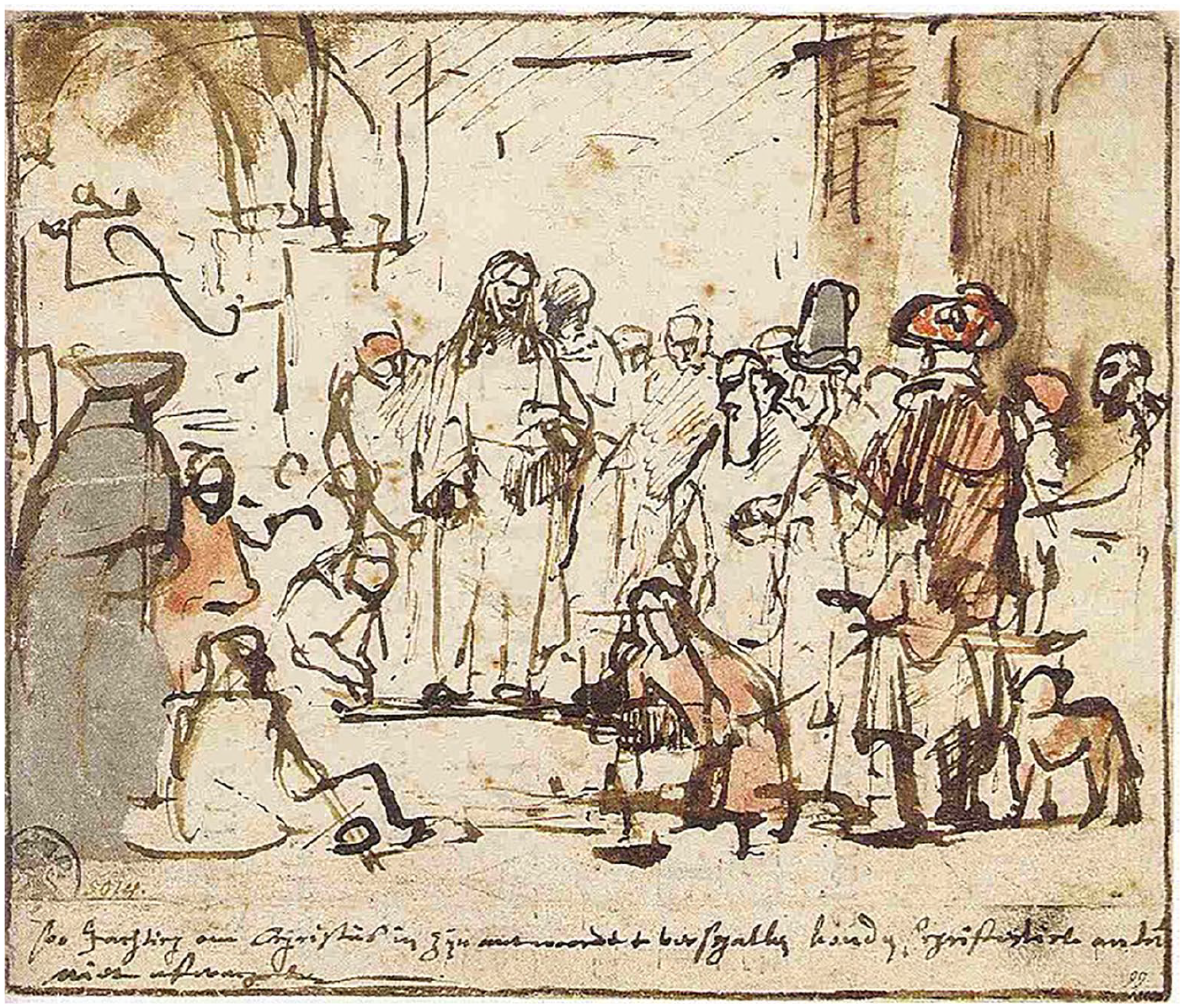
Christ and the woman taken in adultery (Rembrandt, 1659, https://www.pubhist.com/w28304).
Apartheid shows how both the mind and world become formed together in this process of ideological capture. Another benevolent gesture in the mind of apartheid: Verwoerd (1954) infamously argued that ‘natives . . . are hewers of wood and drawers of water’ and should thus (for their own good) not be educated for work ‘above certain forms of labour’. First, note that this way of seeing is already captured, colonial and racist. As Mamdani (2013, pp. 2–3) reminds us, contrary to its designation of autochthony and authenticity, the term ‘native . . . is the creation of the colonial state: colonized, the native is pinned down, localized, thrown out of civilization’. Second, note how the physical world of apartheid segregation, in schooling, neighbourhoods, employment, and so on was built on this racist way of seeing and came to reflect it. Colonized ways of seeing – ‘natives’ as the-poor-to-be-helped and as servants in this example – become imprinted on the physical world by the provision of ‘Bantu’ education, housing and work that made the construction appear to be true.
Social change in South Africa has involved challenging both this way of seeing and breaking down the world that has been constructed in its form. The three central pillars of change implemented in the democratic era have included the (1) Truth and Reconciliation initiatives, centred around the work of the Commission, (2) desegregation by the repeal of apartheid laws, and (3) Broad-Based Black Economic Empowerment. These policies and interventions – overseen by a black-majority government of former liberation fighters – provided the ‘exogenous force’ for undoing apartheid and ‘convincing ordinary people to rethink their views about the contentious past’ (Gibson, 2006, p. 431).
Gibson had sanguine views of Truth and Reconciliation. This hopeful view is shared by social psychology theories of desegregation, which Clark (1953) argued could lead to ‘the emergence of more favourable attitudes and friendlier relations between races’ (p. 11). Intergroup contact theory has its roots in resistance to Jim Crow racism and segregated schooling in the United States. In the Brown versus Board of Education (1954, 1955) case before the Supreme Court, psychologists, including Kenneth Clark and Gordon Allport, were asked to advise whether desegregation could proceed peacefully (see Adams et al., 2008). They recommended that intergroup contact under optimal conditions – that is, equal status, cooperative contact, supported by institutional authorities – would reduce prejudice.
What does the South African experiment in intergroup contact teach us? First, in many cases, desegregation led to informal resegregation. In 1999, John Dixon and I conducted an ethnographic study of intergroup interaction on the newly desegregated Scottburgh beach. We found segregation being (re)enacted in practices of racialized beach usage: where beachgoers sat, with whom, and when they arrived, left, or avoided the beach altogether. These practices were supported by captured ways of seeing, rooted in apartheid. White beachgoers complained that Blacks were pushing them out and taking over and Black beachgoers complained that Whites were racists, still under apartheid (Durrheim, 2025; Durrheim & Dixon, 2005). 1
Second, in many cases, intergroup contact produced feelings of threat, contact avoidance, and fortification. We conducted a survey in Northdale, a historically Indian suburb of Pietermaritzburg, where informal settlements had been established after the fall of apartheid (Dixon et al., 2023). Indian residents felt more threat the closer they lived to the informal settlements, they expressed more avoidance of contact, and they erected fortifications around their houses. The levels of conflict between the communities were so high that media outlets at the time described a low-grade war taking place on the boundaries of the informal settlements.
Rather than producing favourable attitudes and friendlier relations between the races, desegregation in situations as diverse as beaches and neighbourhoods often produced the opposite. Of course, real-world contact in changing societies doesn’t always conform to the optimal conditions model of psychology theory (Dixon et al., 2005). The theory also neglects to consider the history of contact, which in settler societies has been in the model of violent conquest. I.D. MacCrone’s (1937) frontier hypothesis maintained that race attitudes in South Africa assumed ‘extreme and exaggerated forms’ due to their origin – their site of capture – in an ‘atmosphere of war’ on the advancing frontier of land seizure (p. 125).
There is evidence to suggest that these underlying attitudes have remained relatively stable over time. Our review of race attitude survey data in South Africa showed persistent high levels of race prejudice (Durrheim, Tredoux, et al., 2011). For example, White Afrikaans respondents have shown a very slight drop in ‘social distance’ towards Black South Africans over time. Social distance scales measure willingness to have contact with outgroup members at various levels of closeness, for example, in the country, in your neighbourhood, as next door neighbours, in your family by marriage. Although South Africans generally support the principle of racial equality and desegregation, they often resist contact and equality in practice, especially when it gets close to home (Dixon et al., 2017; Durrheim, Dixon et al., 2011).
Of course, post-apartheid South Africa also showcases many instances of positive contact. Our national random-digit-dialling cell phone survey of Black South Africans showed that good-quality contact with Whites reduced anti-White prejudice. However, contact also reduced perceptions of personal discrimination as well as perceptions that Black South Africans as a whole had been victims of discrimination (Dixon et al., 2010). This has subsequently become known as the ‘sedative effect’ of contact (Cakal et al., 2011), which is especially corrosive to the social change motivation among disadvantaged groups in society.
Domestic labour relations in South Africa can be dehumanizing (Murray et al., 2022), but there are many cases of warm, friendly relations between Black workers and White employers. Many of the White employers (colloquially referred to as ‘madams’) we have interviewed over the years have expressed their desire to be non-exploitative, and fair, and have avowed non-racism, and even love, for their workers. The domestic workers we have interviewed have expressed similar affection and a desire to reciprocate the kindness they have received (Durrheim et al., 2014; Murray & Durrheim, 2021). This work shows how, in addition to the sedative effect, intergroup contact can support systemic inequality, when intergroup harmony and friendly relations weaken the demand for social change, genuine equality, and systemic justice (see Dixon et al., 2012).
In response to these problems and this critique, the literature on intergroup contact in the United States has recognized the need for system change and has shifted focus from prejudice reduction to promoting Diversity, Equity, and Inclusion (DEI) (see Esses et al., forthcoming). Yet the DEI industry still relies on the same ‘light touch’ (Paluck et al., 2021) intergroup contact interventions, and research on ‘diversity washing’ shows how talk about DEI has grown exponentially in recent years but diversity in hiring practices in public companies in the United States has hardly changed at all (Baker et al., 2023; Selvanathan & Durrheim, 2025). Similarly in South Africa, the long historical process of colonial capital accumulation could not be halted by transformation policies but rather deepened and expanded to entrench White privilege (Wilson, 2011).
Social change: from ‘colour line’ to ‘epistemic line’
How was White privilege able to survive the end of apartheid and the extensive programme of desegregation and affirmative action implemented by a democratic government led by a former liberation movement? Policies and implementation of social change failed to challenge racial patterns of capital accumulation and social differentiation, instead, underscoring the material and symbolic order of White privilege. This happened by adopting an assimilative model of contact and change that aimed primarily at not upsetting anyone, especially those with economic capital. Just as the poor and needy in Rembrandt’s picture (Figure 1) gather around as beneficiaries of Jesus’ benevolence, both intergroup contact and redress have been based on the (captured) idea that the ‘the disadvantaged’ should come to join ‘us’, become ‘like us’, and come to ‘love us as we love them’. Instead of pouring resources into previously poorly-resourced Black schools, neighbourhoods, and institutions, redress policies aimed to increase the participation of Black South Africans in well-resourced (previously White) institutions, where intergroup contact could do its magic. As a result, the wealthy and middle classes are now (unevenly) racially mixed but almost all poor South Africans are not White.
In addition to their shared understanding of change as assimilation of previously excluded populations into (White) privilege, South African redress strategies and the social psychology of contact also have the same Achilles heel: They preserve the White privilege at the expense of the Black poor and in so doing they promote new captured ways of seeing. In so doing, they relay the ‘atmosphere of war’ from the colonial past into the present by creating troubled racialized bonds of alliance and conflict (Maseko & Durrheim, 2023).
The end of apartheid in 1994 represented the culmination of the century-long struggle against racial exclusion and segregation, from the Civil Rights victories in the United States, though the decolonization of Africa, to the final demise of apartheid. The struggle proved the truth of Du Bois’ (1903) prediction, at the height of the Jim Crow racism in the United States, that the ‘problem of the twentieth century’ would be the ‘problem of the colour line’. Yet, despite many victories and the eradication of the colonial colour line, the problem of racism persists, as is evidenced by new solidarities – for example, “Black lives matter”, “Rhodes must fall” – and increasingly urgent calls for decolonization.
Sabelo Ndlovu-Gatsheni (2018) argues that the colour line of racial segregation has been replaced by an ‘epistemic line’ of racial privilege and disqualification that is now the ‘major problem of the 21st century’. The epistemic line emerges from the Achilles heel of redress and intergroup contact. Preserving White privilege at the expense of the Black poor has multiplied, intensified and fractured race stereotyping almost everywhere you look in South Africa today. Consider some other fault lines that emerged in the #RhodesMustFall and #FeesMustFall protests for justice in education. ‘F** White people . . . who remain the beneficiaries’, 2 proclaims a Wits student leader. Criticism of the anti-white rhetoric, for example, by Eusebius McKaiser (2015), results in him being targeted as a ‘house Negro’. 3 Apartheid segregation may be over, but race as an organizing principle of identification continues to animate the boundaries of the epistemic line and the struggle for justice (cf. Mamdani, 2001). The assimilative form that desegregation and redress have taken – with a small minority of the majority ‘invited in’ to join the (White) advantaged classes, leaving the (Black) majority outside the circle – incites an atmosphere of race war and threatens to undermine the credentials of those Black South Africans who have ‘made it’ into the inner circle.
Machine learning models of language have allowed us to study large databases of opinions and positioning in the natural language of South African debates. Our ‘speaker landscape’ of the South African land debate was constructed by training a word embedding model, first on 3 million quotes from 8 years of South African news, and then retraining the embedding on 3356 quotes about land (Schuld et al., 2024). Individuals (dots in Figure 2, colour representing party affiliation) are placed close to each other if they talk about land in a similar way and they are placed far apart if they use dissimilar language. Our speaker landscape shows the polarized epistemic line separating the pro-capital position of the Democratic Alliance (DA) speakers (in blue) from the pro-poor position of the Economic Freedom Front (EFF) speakers (in red). The DA are concerned about ‘land invasions’, ‘law enforcement’ and ‘private ownership’ whereas the EFF is concerned about ‘white supremacy’, ‘expropriation of land’, and ‘rubber bullets’. In contrast to the two opposition parties, members of the ruling African National Congress (ANC) are divided into factions around the epistemic line, with some speaking like the DA and others speaking like the EFF.
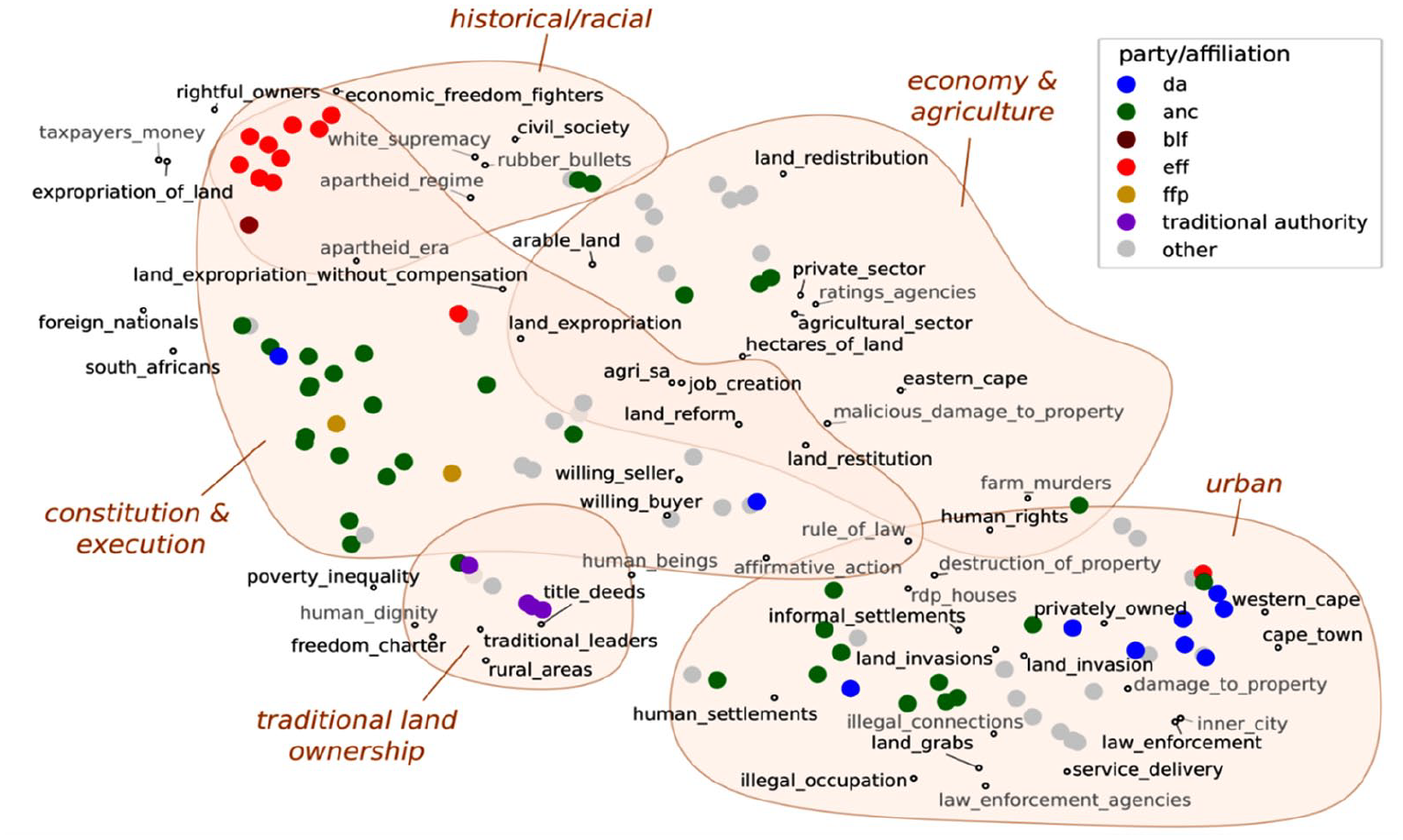
Speaker landscape of land reform debate. Quotes from SA news, 2013-2021 (from Schuld et al., 2024).
Our speaker landscape of the Twitter debate about ex-President Jacob Zuma shows a similar racialized structure (Schuld et al., 2024). The community who speak English and African languages are divided between supporters and critics of President Zuma who nonetheless share concerns about ‘White monopoly capitalism’ and ‘White supremacy’. On the opposite side of the speaker landscape is a community who speak English and Afrikaans, who expressed anger about ‘our tax money’, want Zuma to ‘go to jail’ and use hashtags, #arrestzuma and #voetsekanc.
The speaker’s landscapes reflect the racial composition of the ideological terrain in the country, which gets reconstituted with each new debate and social conflict. The epistemic line is manifest in challenge to and defence of the status quo, and it ‘cascades from the colour line because the denial of humanity automatically disqualified one from epistemic virtue’ (Ndlovu-Gatsheni, 2018, p. 3). It is only because there is enough racial mixing (‘inside the house’) and that a substantial proportion of the capital-owning classes are not White, that pro-poor rhetoric can be positioned as radically racialized and disqualified as lacking epistemic virtue.
The epistemic line is not only evident in talk and opinions, it is also baked into the social fabric. This is nowhere more clear than in universities. There was a time when South African universities were racially segregated. However, the epistemic line survived the remarkable change we’ve witnessed in student and staff demographics and institutional leadership during the past 30 years. The architecture and buildings speak volumes. Let’s look past the brutalism of the University of Johannesburg’s campus to the majestic buildings of UCT, constructed on land deemed ‘God-given’ but bequeathed and defined as suitably prestigious by Rhodes himself. The architect, Solomon, was sent on a tour of ‘universities of Great Britain, Western Europe and North America in search of ideas and information’ (Walker, 1929, cited in Cornell, 2021, p. 112). The monumental structure breathed the classical world, Whiteness, and Eurocentrism, and its elevated position overlooked the city below, where only a select few would ever be privileged enough to gain acceptance and elevation to this (racialized) world.
The epistemic line infiltrates post-apartheid institutions, curricula, and research practices within universities as the previously excluded are invited to assimilate in ways that reproduce White privilege. This can be seen from a little snapshot from the discipline of psychology. By way of background, it must be noted that the epistemic line is a planetary phenomenon and that Black psychologists in the United States have been calling out epistemic exclusion, White centring, and scholarly delegitimation of their work for years. The scandal broke in 2010 with the publication of an article entitled ‘The weirdest people in the world?’ (Henrich et al., 2010). These were the subjects of psychological science. The discipline and its knowledge of the supposedly universal processes of psychological functioning had been built on the very narrow foundation of experiments and studies with US student populations, who were predominantly Western, Educated, Industrialized, Rich, and Democratic, that is, WEIRD.
But the authors’ calls for change are what especially interested me (Durrheim, 2024). They call for partnerships, for intergroup contact, for opening the empirical tent cloths to include now so-called Non-Weird people. It is the same assimilative model of desegregation and inclusion that we’ve considered throughout the paper, in which the marginalized and needy are ‘invited into’ the master’s house. And it has the same Achilles heel. Although the racial designation – ‘Black’ – is missing from the acronym, Clancy and Davis (2019) point out just how racializing the terms are. Non-Weird scholars from elsewhere should be recruited into the empirical project. But the project remains the same, namely, a complete understanding of ‘human nature’ as defined by the WEIRD White researchers of the Global North. While such partnerships are valued by African universities and bring status to African academics, these are certainly not equal partnerships among peers of equivalent epistemic virtue. Nor do they undo the structural factors that hamstring the African academy. Instead, these partnerships mostly extract knowledge to be transformed into high-value products in the Global North, while doing little to build networks and capacity in the Global South.
Decolonial discourse and social change
2015 was a pivotal year in the history of the epistemic line. It was the year that the narrative of the rainbow nation fell apart. The first 15 years of democracy had witnessed rapid desegregation of institutions like universities, strong economic growth of the early 2000s, and the absorption of Black graduates into state employment and the private sector. By 2015, it was clear that we had been captured by the rainbow narrative of assimilative desegregation and that social justice had failed to materialize. Fallism protests (#RhodesMustFall and #FeesMustFall) targeted colonial education and the lack of structural transformation. Ndlovu-Gatsheni (2018) lists deeper challenges behind the Fallism protests, including socioeconomic inequalities, poverty, the problems of access to education, unequal wealth distribution, throughput and retention of students, curriculum irrelevance to the labour market, and many more. The Black majority remained locked in poverty.
The period since 2015 has witnessed a proliferation of decolonial discourse in all disciplines and in nearly every corner of the South African academy. The discourse has proliferated internationally too, but I want to consider some features of the decolonial discourse developed and used to explain the systemic inequality and underdevelopment of postcolonial Africa.
The main point is that decolonial discourse rejects the idea of desegregation and contact as the foundation for social change. First, decolonial discourse articulates a historical narrative of negative contact, colonial theft of artefacts and resources (most obviously) but also the theft of history, dignity, and selfhood (see Figure 3). The colonists not only looted masks, bronzes, land, and minerals; they also stripped Africa of history by imposition of a conceptual and political order in which civilization and progress were contrasted with the unchanging state of savagery. Then by inviting Africans to see themselves in these terms, they colonized African mind and being, as Fanon (1968; Maldonado-Torres, 2007) describes.
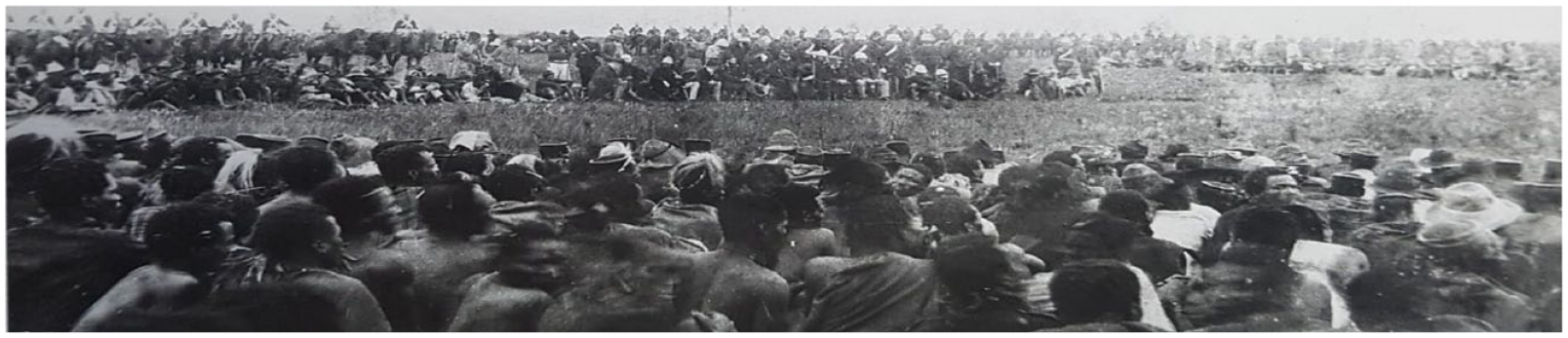
Cetshwayo coronation on 1 September 1873. His crowning by Sir Theophilus Shepstone illustrates how colonial contact relayed power and racial hierarchy. (Photo used with permission of the Pietermaritzburg Archives Repository).
A second feature of decolonial discourse is highlighted by Mbembe. In addition to historical narrative, decolonial discourse articulates a ‘declaration of identity’ (Mbembe, 2017, p. 28, 2002) that constitutes an act of self-affirmation that disavows the colonizer and contact in both of its constitutive strands. (1) Nativism claims ‘cobelonging to the human condition’ (p. 90) and looks to the precolonial past for origins of distinctly African personhood. (2) Afro-radicalism combines ‘racial authenticity and territoriality’ (p. 91) to reject broad categories of foreignness – including Eurocentric education, ideas, and White people – as not African.
A third feature of decolonial discourse is that it typically ends with a weak proposal for change. What do we do with our tainted inheritance? Do we destroy the universities and burn the books? What compromise must we make, and where do we draw the lines? What is the positive proposal for the way forward? Neither nativism nor Afro-radicalism accommodate compromise so they provide little guidance about how to get from where we are to where we want to be.
We can take a look at how decolonial discourse works by considering Kopano Ratele’s (2019) thoughts on African Psychology. He addresses the colonial theft of personhood and has the aim of decolonizing the mind. His book starts in an important place – which I will pick up later – a situated empirical project: ‘the world looks like this from here’. Its approach is both nativist – starting from distinctly African ‘way of seeing . . . hearing . . . listening . . . speaking and ultimately language’ (p. 8) and Afro-radicalist, eschewing the foreign imposition in the creation of a distinctly African psychology. Of course, there are inevitable compromises involved, including, most fundamentally, borrowing the concept of ‘psychology’ as a central point of reference.
Mbembe’s rejection of nativism and Afro-radicalism can help us to recover, reconfigure, and rehabilitate intergroup contact as an instrument of progress. He does this through his concept of Afropolitanism, which he describes as ‘. . . a cultural, historical and aesthetic sensibility’ (2021, p. 215). His starting point is the idea that ‘Africa no longer constitutes a centre in itself’, and this is for two reasons. The first is the history of migration – slavery, colonial settlement, today’s workers, refugees, and asylum seekers – that birthed the African diaspora. The first sensibility of Afropolitanism then is the ‘the awareness of the imbrication of here and elsewhere . . .’ (p. 215). Second, Africa is no longer centred in itself because of new technologies, most notably, networked cell phones which have fundamentally altered the way images of self are produced, shared, and consumed. Remarkably, he argues that this has prompted a ‘spectacular return to animism’ where identities are formed and reformed in ritualistic interaction on screens, over the internet (2024, p. 7). The world has shrunk, people are interconnected, fabricating themselves anew to become human.
Mbembe replaces the inward looking gaze of much decolonial discourse with a gaze that looks both inward and outward, seeking to connect what the world looks like from here with what it looks like from there. Such connectivity lays a foundation for hope in generative interactions between here and elsewhere. Of course, the connectivity made possible by networked mobile devices has often been exploited by bad actors, recruited and weaponized to revive and entrench stereotypes and divisions (Iandoli et al., 2021), but this technology also provides a historic opportunity to connect Africa to itself in unprecedented ways, and to initiate new transformations in individual and collective selfhood. Afropolitanism prises open a crack of a new dawn at the brutalist precipice of history.
A way forward
How do we break out of the captured ways of seeing and thinking that come down to us from 400 years colonialism, apartheid and racism, and that have brought us to the brink? How do we remove the epistemic line of racial disqualification that has Africa captured?
We have considered three perspectives on the value of desegregation and intergroup contact for promoting social change. Contact theory in social psychology valorises ‘optimal’ contact as an instrument for prejudice reduction and, more recently, for promoting Diversity, Equity, and Inclusion. South African research has highlighted many problems with this view. In abandoning the Black poor, assimilative models of contact have promoted threat, withdrawal, fortification, new patters of resegregation, and White privilege, all of which have preserved an ‘epistemic line’ of racialized virtue. Contact can also have sedative effects among the desegregated wealthy and middle classes, which ultimately helps to preserve systemic inequality. For these reasons, well-illustrated by the colonial history of race contact, decolonial discourse rejects contact ‘solutions’ in favour of inward-looking identities rooted in nativism and Afro-radicalism.
Mbebme’s concept of Afropolitanism, provides a way of reconfiguring contact, rejecting both assimilation and nativism. The spectacular return of animism replaces the sovereign self of social psychology – defined by race, gender, and other categories – with something much more provisional and emergent. In imbricating the here and elsewhere, newly transformed selves can be born in interacting networks of Africa-to-Africa connection. Perhaps this is a way to pull ourselves out of coloniality by our bootstraps.
We find ourselves in the rubble of colonialism, neo-liberalism, and late capitalism. The question is how do we put the conditions in place for progressive forms of contact, encounter, and exchange? Empirical grounding, ‘the world looks like this from here’ (Ratele, 2019), is a useful starting point for gaining bearings after the shock and trauma. But rather than relying on the authority that our ways of seeing provide, Afropolitanism hopes for the birth of something new, rupturing contained points of view by placing them into dialogue with each other. Instead of closing down the discussion – the world looks like this from here – Afropolitanism opens a dialogue between the many here. And rather than relying on authentic African ways of seeing, we recognize that these themselves are products of a history of exchanges between previous ‘here’s’ and ‘elsewhere’s’.
New ways of seeing have proliferated in astounding diversity in the past few decades, fuelled by capitalist logics of the academy, disciplinary, ideological and methodological diversity, and an explosion of new data sources, translation and transcription methods, qualitative sensibilities, digital humanities, bibliometrics, computational grammars, dynamic modelling, network science, machine learning, generative AI, open science protocols, online research platforms, and technologies, mostly freely available via the internet. This Cambrian explosion of method is proliferating tools and lenses that are breaking down borders between disciplines, imploding knowledge silos, and producing new entrepreneurial subjects. They all provide techniques for ukwankumkanya of sorts, shielding the glare and squinting to gain a proper view of the world (ka Canham, 2023). But of course, they also have the potential to being mindlessly coopted by corporates (Suresh, 2024).
Mobile devices and internet connectivity provide new opportunities for connecting Africa to Africa, here, here, and here. New methods provide new opportunities for saying what the world looks like. It is up to us to exploit these affordances, to create rituals of engagement, to enter into dialogue about how the world looks from here and here, to experiment with new possibilities, and to rupture captured ways of seeing and being.
Footnotes
Author’s note
This paper is the edited text of my inaugural lecture at the University of Johannesburg, 9 April 2024.
Declaration of conflicting interests
The author(s) declared no potential conflicts of interest with respect to the research, authorship, and/or publication of this article.
Funding
The author(s) received no financial support for the research, authorship, and/or publication of this article.
