




Abstract
This study investigated the effects of group rational emotive behaviour therapy on the mathematics anxiety of students in Nigerian secondary schools. In total, 118 senior secondary school students constituted the sample for the study: 63 learners were allocated to the experimental group and 55 learners to the control group. The instruments used for data collection were the Mathematics Anxiety Scale (primary outcome measure) and the Irrational Beliefs in Mathematics Scale (secondary outcome measure). The Mathematics Anxiety Scale was used to elicit information from the participants that enabled the researchers to randomly allocate them to the programmes of the treatment groups. The experimental group was exposed to the rational emotive behaviour therapy treatment, while the control group received conventional counselling. The treatment programme lasted 6 weeks. The results reveal that students in group rational emotive behaviour therapy, post-test, had experienced significantly more positive effects relating to mathematics anxiety and irrational beliefs about mathematics (effects that remained consistent at follow-up) than students in the control group.
Keywords
Introduction
Mathematics is an important subject, one that determines a person’s functioning in any given society (Okeke et al., 2023). Despite the importance of mathematics, students still perform poorly in the subject (Egara & Mosimege, 2023). Reports of examination bodies, such as the West Africa Examination Council (WAEC, 2018–2022), indicate the extent of students’ poor achievement in mathematics in the West Africa Senior School Certificate Examination, as contained in the Chief Examiners’ Reports on the General Certificate Examination. The percentages of students with credit passes in mathematics in 2018, 2019, 2020, 2021, and 2022 were 49.98%, 35.10%, 39.82%, 30.11%, and 23.99%, respectively (WAEC, 2018–2022). For 5 years, fewer than 50% of students have passed mathematics, which means more than half of students performed poorly in mathematics. Several reasons could be given for their poor achievement: the poor mathematics background of students, students not applying themselves, overcrowded classrooms, inadequate mathematics facilities (Evans et al., 2019), negative attitudes of students, shortages of teaching and learning materials (Okeke et al., 2023; Osakwe et al., 2023), inadequate teaching methods (Egara et al., 2021; Mosimege & Egara, 2022), and mathematics anxiety (Adimora et al., 2015). In addition to these factors, which are suggested to be responsible for students’ poor achievement in mathematics, is mathematics anxiety, which is the focus of this article. The reason for focusing on mathematics anxiety is its negative effects on students’ well-being and academic performance (Sarfo et al., 2020).
Mathematics anxiety is one of the major causes of secondary school students’ poor performance in mathematics (Sarfo et al., 2020, 2022). Mathematics anxiety can negatively impact a learner’s initial mathematics learning (Salahot, 2022). Mathematics anxiety is a problem for many students across the globe (Luttenberger et al., 2018). Operationally, mathematics anxiety is a form of anxiety that affects a learner psychologically because it often causes panic, and a feeling of helplessness, worry, and tension whenever the learner engages in any mathematical calculation or activity. When students engage in mathematics activities and are confronted by these feelings, they automatically disengage from learning (Hogbin, 2021). Some of the causes of mathematics anxiety are teachers’ negative attitudes towards mathematics, teaching methods that do not consider learner differences, varied learning paces, or diverse cognitive strengths and weaknesses, students’ negative classroom experiences, students’ failure to grasp the importance of mathematics in daily life, students fear that they will give the wrong answer to a question, parents’ unrealistic expectations for their children to attain high scores in mathematics, and pressure from high-stakes tests (Caglar & Senol, 2021; Mollah, 2017).
What is essential is finding ways to reduce the mathematics anxiety that affects students. Mathematics anxiety is a psychological factor that requires psychological treatment (Nzeadibe, 2022). Bandelow et al. (2017) postulate that psychological therapy is the best treatment for anxiety. In their respective studies, Eifediyi (2015) and Nzeadibe (2022) recommended the following psychological therapies to treat anxiety: cognitive behavioural therapy, systematic desensitisation, and rational emotive behaviour therapy (REBT). Among the recommended treatments, REBT is of interest to us. REBT was chosen because of its capacity to facilitate the restructuring of the limiting belief held by some students that mathematics success is unachievable, resulting in anxiety about the subject. The focus of this study was to change the wrong notions exhibited by these students through the application of REBT. REBT has proven to be effective in reducing other forms of anxiety (Aurooj & Ijaz, 2018; Eifediyi et al., 2018), though few studies used REBT to treat mathematics anxiety in secondary school students.
Rational emotive behaviour therapy
REBT is a psychotherapy that was created by Albert Ellis in 1955. Group REBT has been an effective intervention for numerous psychological issues, such as anxiety, phobia, depression, and stress (Aurooj & Ijaz, 2018; Eseadi et al., 2016; Nwachukwu, 2007; Onuigbo et al., 2019). The REBT approach also helps individuals modify unhelpful thinking patterns, so as to improve their quality of life (Albert Ellis Institute, 2014; Timothy, 2018). Meshach (2015) reports that the main objective of group REBT is to eradicate the client’s self-defeating thoughts on life and replace the irrational thoughts with rational ones. Group REBT also helps clients to critically examine and recognise their present behaviour and beliefs (Ogbuanya et al., 2018). Therefore, in a school setting, REBT is a group therapy that the school counsellor can use to help students in groups ‘dispute’ and challenge their irrational beliefs and substitute them with more helpful and sensible rational thoughts, using the REBT A–B–C–D–E theory.
The A–B–C–D–E theory, introduced by Albert Ellis, outlines a five-step process for overcoming irrational beliefs. ‘A’ signifies an Activating Event that triggers emotional distress (Roberts, 2019), such as a failed mathematics exam. This event prompts the formation of irrational thoughts as a coping mechanism. ‘B’ represents Beliefs, which can be either rational or irrational (Axelrod, 2016). An example of an irrational belief is doubt about the possibility of future success in mathematics. ‘C’ stands for Consequences, which encompasses emotional and behavioural outcomes (Mahoney, 2019). For instance, someone might lose confidence in their mathematics abilities and avoid studying the subject altogether. ‘D’ denotes Disputation (Roberts, 2019); individuals recognise the detrimental effects of their irrational beliefs. Therapists may assist individuals by helping to construct positive arguments against these beliefs, offering evidence to counter negative thoughts. Finally, ‘E’ represents the New Effect, which occurs when an individual successfully disputes and counters an irrational belief (Ackerman, 2017). Doing so can increase the individual’s confidence about doing mathematics, renew dedication to studying, and stimulate an overall positive outlook on the subject. According to Ellis, individuals can only progress to the final step if they have effectively fortified their belief system by adopting more rational beliefs and relinquishing irrational ones. Ellis asserts that, with proper REBT training, individuals can modify their thoughts, as irrational beliefs are the root of negative emotions. This model provides a structured approach to understanding and transforming thought patterns for improved emotional well-being.
The theory of REBT assumes that reducing irrational beliefs leads to reducing negative psychological states, such as depression, anxiety, anger, and guilt (Ellis, 1992). Consequently, since irrational beliefs about mathematics are associated with mathematics anxiety in students (Bester & Kufakunesu, 2021), a reduction in students’ irrational beliefs about mathematics would lead to a reduction in students’ mathematics anxiety. Therefore, in this study, REBT addressed the symptoms of mathematics anxiety experienced by students through the A–B–C–D–E model proposed by Ellis, which helped students manage the causes of their mathematics anxiety by changing their irrational thoughts into more functional and rational beliefs.
Studies on REBT in reducing anxiety
Group REBT has been applied in other discipline areas and has effectively reduced maladaptive behaviours by students. For instance, Eifediyi et al. (2018) found group REBT effective in decreasing the examination anxiety of students in Edo State, Nigeria. The study used a quasi-experimental design and used the Nigerian version of Spielberger’s Test Anxiety Inventory as an instrument for data collection. Ntamu (2017) also found the group REBT assisted in tackling fears of academic failure by secondary school students. The study used a pre-test/post-test control group design, and the instrument for data collection was the Students’ Fear of Failure Questionnaire. In their findings, Badejo and Anyanwu (2016) state that 70% of junior secondary school students who received REBT treatment demonstrated a more positive attitude towards basic science after the programme. This study used a quasi-experimental design and used four instruments for data collection, namely, the Attitude to Basic Science Scale, the Basic Science Test, the Parental Interest Scale, and the Socio-Economic Status Scale. Finally, Okoiye et al. (2013) found group REBT effective in helping to manage mathematics anxiety and improving the academic performance of in-school adolescents in Calabar, Nigeria. Their study used a quasi-experimental design and the Fennema-Sherman Mathematics Anxiety Scale (MAS) as an instrument for data collection.
Most of the reviewed studies used quasi-experimental designs, which might not present accurate measures of the effectiveness of group REBT, and none of the reviewed studies applied the Irrational Belief Scale to determine the levels of irrational beliefs of students, which is a prerequisite in REBT interventions. To close the gap, the current study used a group randomised trial design to evaluate the effectiveness of group REBT in reducing the mathematics anxiety of students. The study also used the Irrational Beliefs in Mathematics Scale (IBMS) to gauge student’s levels of irrational beliefs in mathematics. This assessment involved a comparison between pre-intervention baselines and post-intervention findings. Thus, the primary purpose of this study was to examine the effect of group REBT on the mathematics anxiety of secondary school students. We hypothesised that group REBT would significantly help reduce the mathematics anxiety of secondary school students.
Methods
Participants
The study included 118 participants who were in the first year of senior secondary school (SS1), drawn from four secondary schools that met the inclusion criteria, comprising 51 male students and 67 female students. The four schools were purposively selected from the 59 public secondary schools that had professional guidance counsellors in two local government areas (Nsukka and Igbo-Etiti) in the Nsukka Education Zone of Enugu State (Post-Primary Schools Management Board, 2019). Students in this region are known to have high levels of mathematics anxiety (Adimora et al., 2015; Nzeadibe, 2022). The reason for purposively selecting the four schools from which participants were drawn was that the schools were the only secondary schools in the area that had professional guidance counsellors (facilitators) with training in REBT, which was a specific element that satisfied the predetermined criteria of the current study (Fraenkel et al., 2023). Initially, 225 SS1 students showed interest in participating in the study. However, after eligibility screening, only 118 students met the inclusion criteria, namely, that (1) participants had to be secondary school students in SS1 in the Nsukka Education Zone and (2) the SS1 students had to show symptoms of mathematics anxiety, that is, they had to have scored 50 on the MAS. The volunteers who did not meet the inclusion criteria were not selected, and no intervention was put in place for them. The simple random sampling technique was used to assign the participants who met the inclusion criteria. Sixty-three students were allocated to the experimental group and 55 to the control group, as shown in Figure 1 (see Table 2 for school levels).
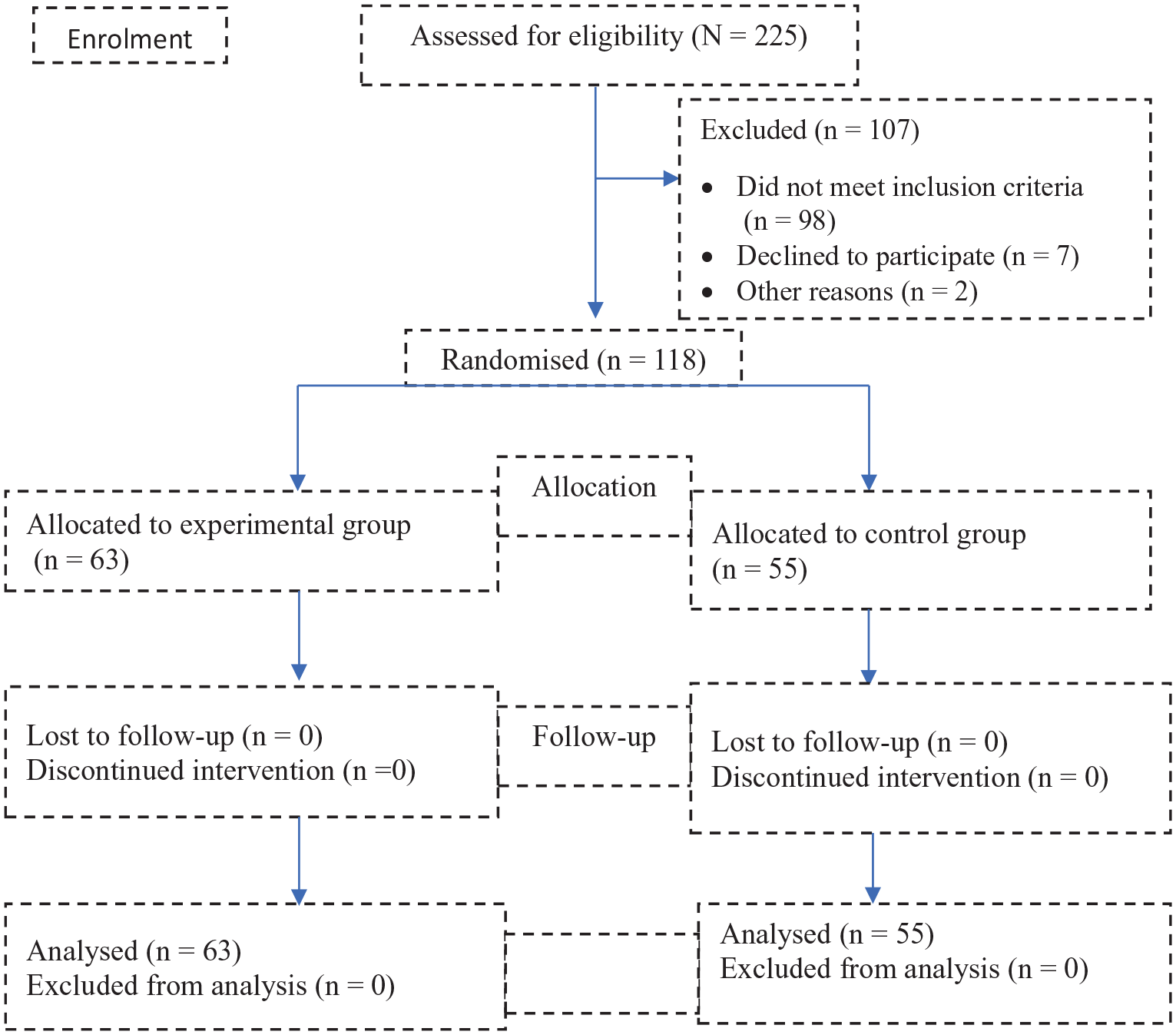
Participant eligibility criteria and sampling distribution for the study.
Measures
Demographic questionnaire
This questionnaire was used to obtain demographic data, such as gender, age, and school location, from the participants. Table 2 shows the participants’ demographic data.
Primary outcome: MAS
The MAS used in this study was adapted from the MAS developed by Zakariya (2018). The MAS has 4-point Likert-type scale response options of strongly agree (SA), agree (A), disagree (D), and strongly disagree (SD). It consists of 20 items, which are assigned weights of 1, 2, 3, and 4 points. The screening cut-off score set for the study was 50, which was determined using the Angoff method of obtaining the average score (Sarkın & Gülleroğlu, 2019). Accordingly, students who scored 50 and above (⩾50) were deemed to have mathematics anxiety. The participants had to indicate their responses on the 4-point scale to show the degree of their agreement with each statement. The internal consistency of the adapted MAS was measured using Cronbach’s alpha, and a reliability coefficient of .79 was obtained.
Secondary outcome: IBIMS
The IBIMS used in this study was developed by Kaya (2017). The IBIMS is a 20-item scale with five options, ranging from very low (1) to very high (5). High scores show that a student’s irrational beliefs are at higher levels, and low scores indicate that a student’s irrational beliefs are at lower levels. The IBIMS has a four-dimensional structure consisting of inclination for finding reasons (items 1–6), inclination for perfection (items 7–12), inclination for being conditioned (items 13–17), and inclination for being accepted (items 18–20). The total internal consistency of the IBIMS was .81 alpha, and the internal consistency coefficients of the items of Finding reason = .85, Perfection = .78, Being conditioned = .71, and Inclinations for being accepted = .66. Farahiyah et al. (2020) and Janssens et al. (2008) suggest that Cronbach’s alpha between .6 and .8 is acceptable.
Experimental procedure
The procedure is presented as pre-test, treatment, post-test, and follow-up, since the data were collected in three separate stages, namely, the pre-test stage (Time 1), post-test stage (Time 2), and follow-up stage (Time 3).
Pre-test
Researchers paid a preliminary visit to the SS1 students, during which the students were assured that their interaction and personal information would be treated confidentially while they worked together in self-disclosure. Afterwards, 225 students indicated an interest in the study. Their symptoms of mathematics anxiety were measured using the MAS inventory to collect baseline data. However, only 118 SS1 students (63 experimental and 55 control) who met the researchers’ inclusion criteria were chosen to participate in the study. The IBIMS was also administered to participants to determine their irrational belief levels for mathematics before the group REBT treatment.
Treatment
The experimental and control groups were subjected to six sessions of the intervention programmes, each lasting 45 min, over 6 weeks. Before the intervention, the researchers addressed the participants of both groups about the reason for the training programme, and the need for them to feel comfortable with the facilitators and to ask questions if they were uncertain about anything. They were informed of the rules of the training programme. The group treatment programme was conducted after school (on weekends), to ensure full participation and commitment. The REBT treatment programme manual was adapted from Wilde (2011). Table 1 provides a summary of the REBT intervention programme conducted by the professional guidance counsellors. However, the control group participants underwent conventional counselling that covered several aspects. These sessions included guidance on study habits, emphasising independent study, peer learning, group discussions, and online information searches. Participants were instructed on strategies, such as scanning through examination questions, confidently selecting familiar questions, addressing mathematics anxiety and its causes, managing anxiety before examinations, and optimising time during examinations by reviewing answers before submission.
Summary of the REBT intervention programme manual for the experimental group.
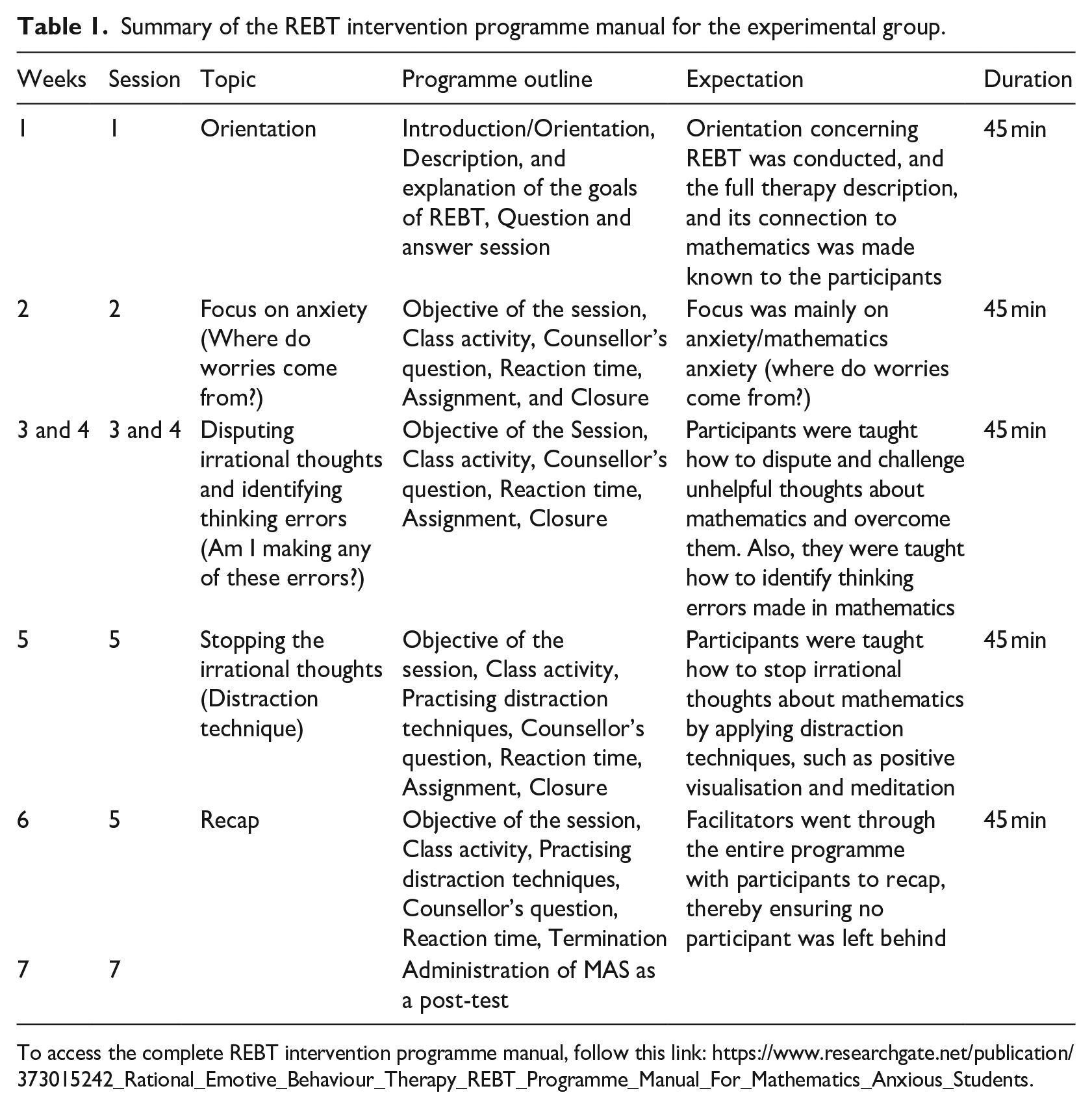
To access the complete REBT intervention programme manual, follow this link: https://www.researchgate.net/publication/373015242_Rational_Emotive_Behaviour_Therapy_REBT_Programme_Manual_For_Mathematics_Anxious_Students.
Post-test
This stage involved assessing the intervention packages and the entire programme in the seventh week. At this point, the researchers administered the MAS and IBIMS as post-tests to both groups.
Follow-up
The researchers conducted an assessment after 2 months of the intervention programme for students in the experimental group who had been exposed to group REBT treatment, and their counterparts in the control group who had been exposed to conventional counselling.
Data analysis
The effect of group REBT was statistically analysed using mixed between and within measures analysis of variance (ANOVA). The data were analysed using a 2 × 3 mixed design that considered Group (Experimental vs Control) as a between-groups factor and Time (pre-test vs post-test vs follow-up) as the within-groups factor. Partial
Ethics statement
The Research Committee on Ethics, Faculty of Education at the University of Nigeria, Nsukka, granted ethics approval to conduct this study (REC/UNN/FE/2019/00048), which commenced on 11 May 2019. The school principals officially granted permission to conduct the research at their schools. Parents of the eligible students provided informed consent. Finally, the researchers also obtained informed verbal consent from participants after giving a detailed explanation of the purpose of the study.
Results
Preliminary analyses
The students’ mean age in the group REBT was 15.46 ± 0.78 years, whereas the mean age for students in the control group was 15.35 ± 0.73 years, t(116) = 0.825, p = .411. Other details of the students are shown in Table 2. Secondary school students in the REBT group (Mdn = 56.00, interquartile range [IQR] = 22.00) and students in control group (Mdn = 58.00, IQR = 22.00) had significantly similar pre-test mathematics anxiety scores, F(1, 117) = 0.001, p = .980, ΔR2 = −.009. Secondary school students in the REBT group (Mdn = 67.00, IQR = 21.00) and students in the control group (Mdn = 68.00, IQR = 20.00) also had similar pre-test mathematics irrational belief scores, F(1, 116) = 0.165, p = .685, ΔR2 = −.007.
Demographic characteristics of the students (within-group analysis).
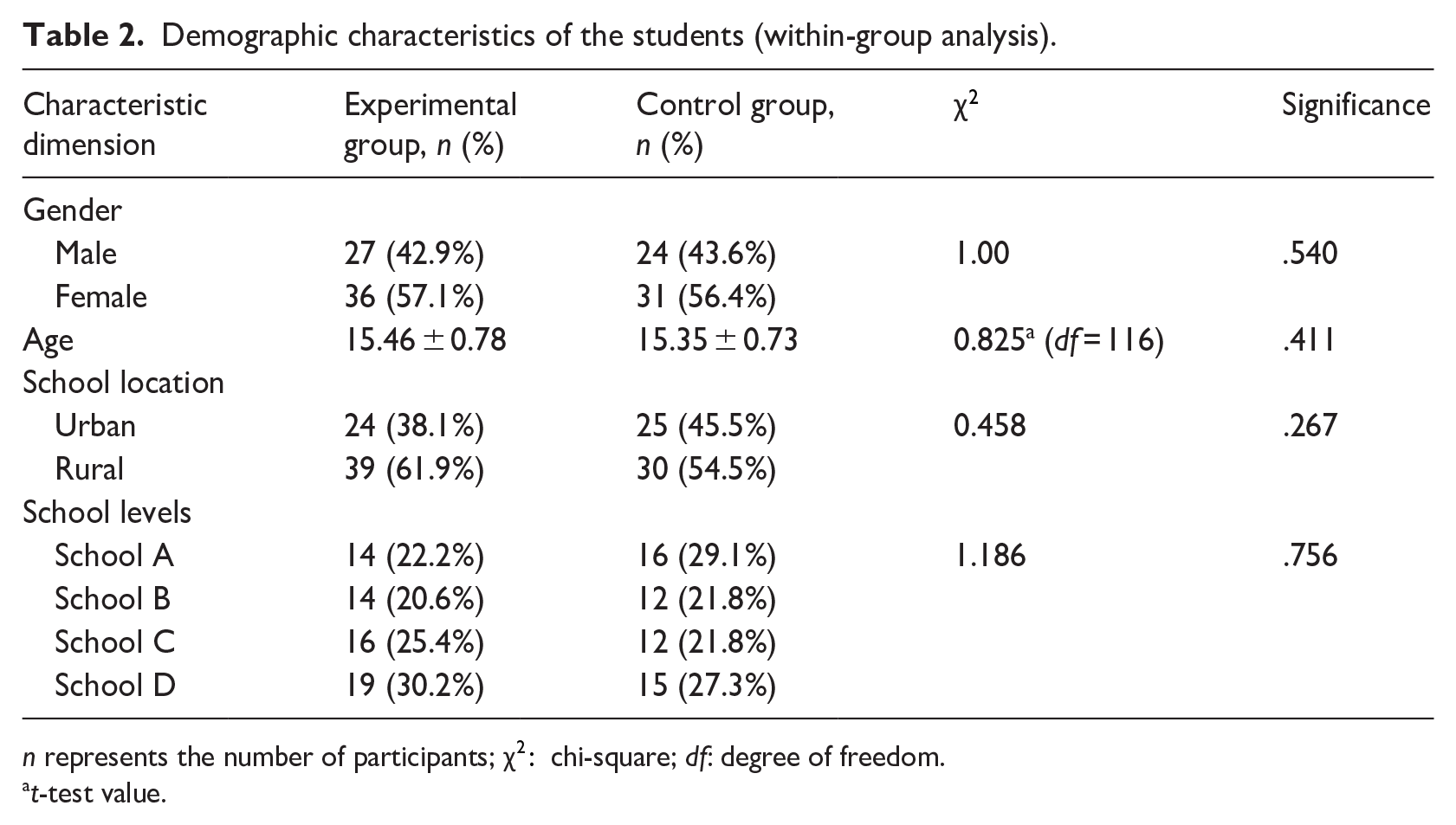
n represents the number of participants;
t-test value.
In Table 3, the results for secondary school students’ mathematics anxiety (Greenhouse-Geisser corrected) reveal a significant effect of Time, F(1.69, 196.76) = 19.729, p < .001, η2p = .145, Group, F(1, 116) = 36.441, p < .001, η2p = .239, and Time-by-Group interaction, F(1.69, 196.76) = 36.323, p < .05, η2p = .238, after the group REBT programme (see Figure 2). The results suggest that secondary school students’ mathematics anxiety scores, after they had been exposed to group REBT, declined more than the scores of secondary school students in the control group. The results of the follow-up analysis (univariate analysis) show that the effect of group REBT on secondary school students’ mathematics anxiety scores in the treatment group remained consistent, F(1, 116) = 59.779, p < .001, η2p = .340, ΔR2 = .334.
Results of repeated-measures ANOVA for the study outcomes (effects of Group, Time, and Time by Group interaction).
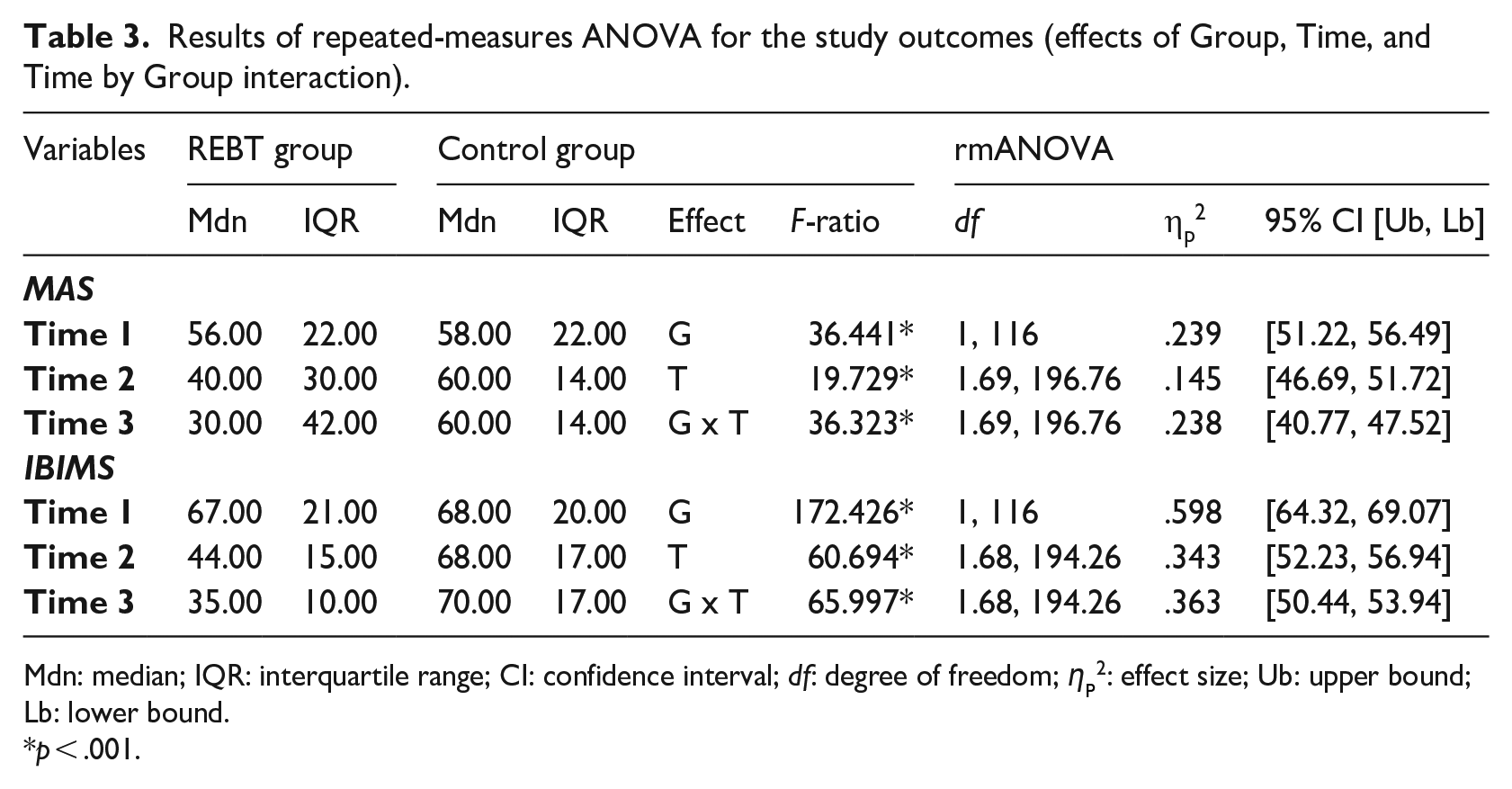
Mdn: median; IQR: interquartile range; CI: confidence interval; df: degree of freedom;
p < .001.
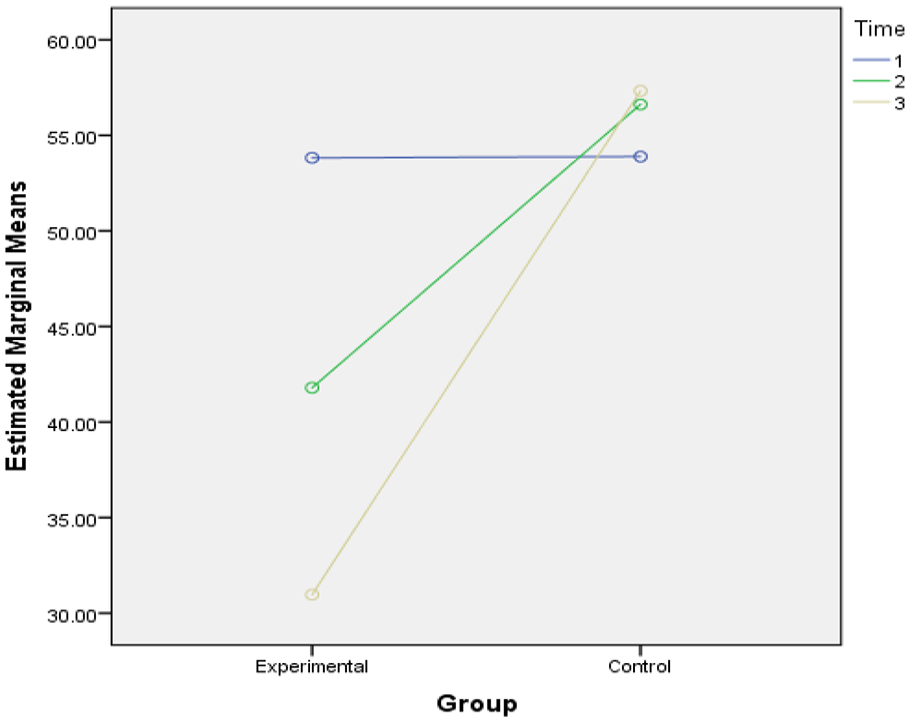
Time × Group interaction effect for mathematics anxiety.
In Table 3, the results for secondary school students’ mathematics irrational beliefs (Greenhouse-Geisser corrected) revealed a significant effect of Time, F(1.68, 194.26) = 60.694, p < .001, η2p = .343, Group, F(1, 116) = 172.426, p < .001, η2p = .598, and Time-by-Group interaction, F(1.68, 194.26) = 65.997, p < .05, η2p = .363, after the group REBT programme (see Figure 3). The results suggest that secondary school students’ mathematics irrational beliefs scores, after exposure to group REBT, declined more than those of students in the control group. The results of the follow-up analysis (univariate analysis) show that the effect of group REBT on mathematics irrational beliefs scores of secondary school students in the treatment group remained consistent, F(1, 117) = 317.452, p < .001, η2p = .732, ΔR2 = .730.
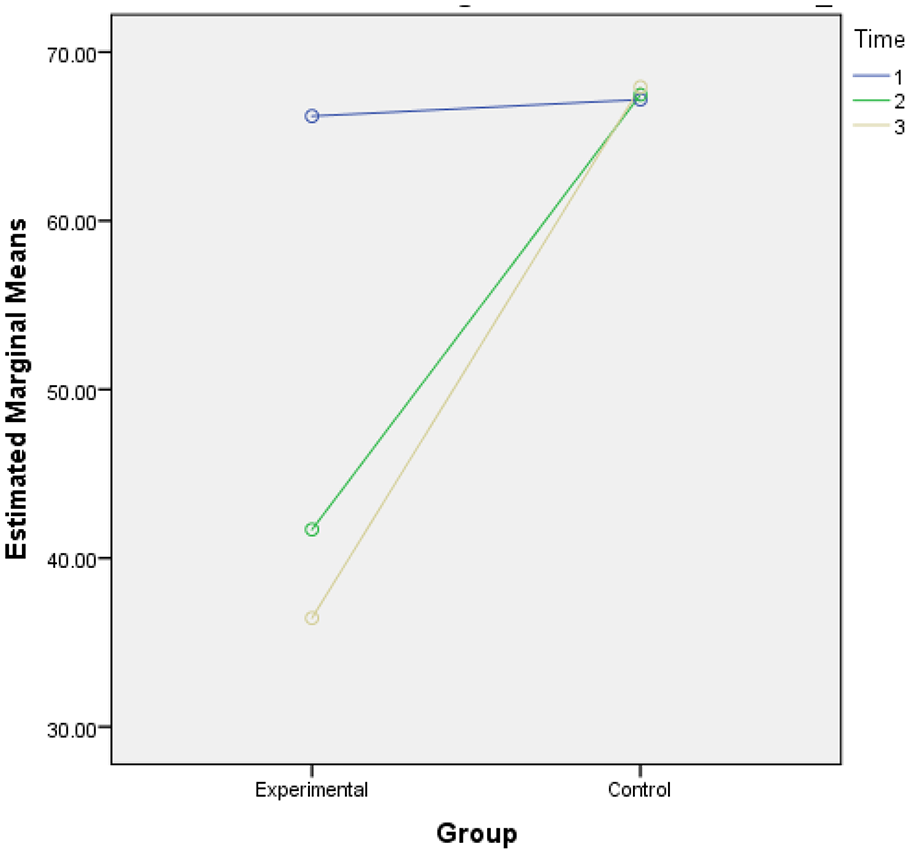
Time × Group interaction effect for irrational beliefs.
Pairwise comparisons for students’ mathematics anxiety
The pairwise comparisons (Sidak corrected) regarding the main effect of Time revealed a significant decrease in secondary school students’ mathematics anxiety scores from pre-test to post-test (mean difference = −4.652, SE = 1.28, p < .01, 95% confidence interval [CI] = [1.560, 7.744]), and from pre-test to follow-up (mean difference = 9.710, SE = 1.83, p < .001, 95% CI = [5.277, 14.144]). Likewise, the significant decrease in students’ mathematics anxiety scores on the post-test was consistent at follow-up (mean difference = 5.058, SE = 1.48, p < .01, 95% CI = [1.468, 8.648]). In addition, pairwise comparisons (Sidak corrected) regarding the main effect of the group revealed that the secondary school students in the REBT group experienced a lesser degree of mathematics anxiety than the students in the control group (mean difference = −13.750, SE = 2.28, p < .001, 95% CI = [−18.26, −9.24]).
Pairwise comparisons for students’ mathematics irrational beliefs
The pairwise comparisons (Sidak corrected) regarding the main effect of Time revealed a significant decrease in the students’ mathematics irrational belief scores from pre-test to post-test (mean difference = −12.109, SE = 1.64, p < .001, 95% CI = [8.143, 16.074]), and from pre-test to follow-up (mean difference = 14.508, SE = 1.46, p < .001, 95% CI = [10.977, 18.039]). Likewise, the significant decrease in students’ mathematics irrational beliefs scores at post-test were consistent at follow-up (mean difference = 2.400, SE = 1.08, p = .084, 95% CI = [−0.226, 5.026]). In addition, pairwise comparisons (Sidak corrected) regarding the main effect of the group revealed that the secondary school students in the REBT group demonstrated a lesser degree of mathematics irrational beliefs than secondary school students in the control group (mean difference = −19.411, SE = 1.48, p < .001, 95% CI = [−22.34, −16.48]).
Discussion
This study investigated the effect of group REBT on secondary school students’ mathematics anxiety. The findings show that the effect of group REBT on mathematics anxiety of secondary school students was significant; there is evidence of lower mathematics anxiety scores of students in the experimental group than those in the control group. The study also demonstrates the significant benefit of group REBT over conventional counselling for reducing the irrational mathematics beliefs of secondary school students. The study’s outcome shows that six sessions of REBT effectively reduced the mathematics anxiety of students by addressing irrational thought patterns and decreasing tension and worries about mathematics. Our results support an earlier finding by Eifediyi et al. (2018) that group REBT is an effective intervention for reducing students’ anxiety. Our finding also agrees with that of Ntamu (2017), who found that group REBT effectively mitigated secondary school students’ fear of failure. The findings of this study also align with those of Badejo and Anyanwu (2016), who found that secondary school students treated with group REBT had a positive attitude towards school subjects. The findings also support the results of Okoiye et al. (2013) that group REBT is effective for helping to manage mathematics anxiety of school-going adolescents.
Conclusion
This study investigated the effect of group REBT on the mathematics anxiety of secondary school students. The group REBT had more significant positive effects on reducing mathematics anxiety and mathematics irrational beliefs of the experimental group students at the post-test than on that of students in the control group. These effects were observable at follow-up. Therefore, we conclude that group REBT effectively reduced mathematics anxiety among the study participants.
This research makes the following contributions. It is the first to use a group randomised trial design to evaluate the effectiveness of REBT in reducing mathematics anxiety of secondary school students in Enugu State, Nigeria. In addition, this study used a scale that measures students’ irrational beliefs, which is a crucial step in REBT interventions.
The results of this study have educational implications for mathematics teachers, guidance counsellors or psychologists, and the government. To ensure that students act rationally, mathematics teachers could create friendly classroom environments for learners that are conducive to mathematics instruction or activities that boost their interest and engagement and help them develop positive belief systems about mathematics. Guidance counsellors could help and advise mathematics teachers on ways to support students and to reduce mathematics anxiety. Guidance counsellors and psychologists could use the REBT to assist students with mathematics anxiety. This recommendation is supported by evidence of the effectiveness of the REBT in reducing mathematics anxiety, and its alignment with students’ positive reception of rational emotive behaviour intervention programmes, which schools can implement effectively. Finally, in collaboration with non-governmental agencies, the government could develop and implement programmes that could help guidance counsellors use REBT more effectively to reduce the consequences of the mathematics anxiety of secondary school students.
Limitations
Despite the positive results, this research is not without limitations. Since purposive sampling was used to select the schools from which the participants were recruited, confounding variables that permeated both groups may have been introduced. Therefore, caution should be exercised when interpreting the study findings. Moreover, this study could have given consideration to the moderating effect of student demographic variables such as gender, age, and location. Considering the participants’ gender, age, and location, this study could have given more insight into how these variables influenced the REBT intervention in relation to students’ mathematics anxiety. Therefore, prospective studies should investigate how students’ demographic characteristics may moderate the effectiveness of group REBT on mathematics anxiety of students. Another limitation is that we did not consider the mathematics achievement scores of the participating students who had been exposed to REBT intervention; doing so may have indicated whether REBT can improve student achievement in mathematics. Therefore, prospective studies should consider pre- and post-tests and follow-up of students’ mathematics achievement scores, alongside pre- and post-tests and follow-up test scores of mathematics anxiety of students exposed to REBT intervention. The study lacks the power calculations and intended sample size for robust analysis, which highlights the need for future research to address this matter and to achieve a more comprehensive evaluation.
Footnotes
Acknowledgements
We would like to thank all those who contributed positively towards the success of this study, most especially the participants for their precious time. We would also like to appreciate the authors whose works were cited for the study.
Declaration of conflicting interests
The author(s) declared no potential conflicts of interest with respect to the research, authorship, and/or publication of this article.
Funding
The author(s) received no financial support for the research, authorship, and/or publication of this article.
Availability of data and materials
Data are available upon request from the corresponding author.
